
Q1. Statement: M ≥ O ≥ L ≥ T = E ≥ D
Conclusions:
I. D ≤ O
II. M ≥ E
(A) Both conclusion I and II are true.
(B) Neither conclusion I nor II is true.
(C) Only conclusion II is true.
(D) Either conclusion I or II is true.
(E) Only conclusion I is true.
EXPLANATION
Correct Option: A
Given statement: M ≥ O ≥ L ≥ T = E ≥ D
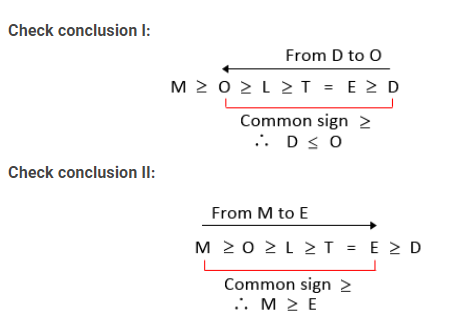
Hence, both conclusion I and II are true.
Q2. Statement: B < C = D ≤ X ≤ Y < Z
Conclusions:
I. B < X
II. Z ≤ C
(A) Both conclusion I and II are true.
(B) Neither conclusion I nor II is true.
(C) Only conclusion II is true.
(D) Either conclusion I or II is true.
(E) Only conclusion I is true.
EXPLANATION
Answer: (E)
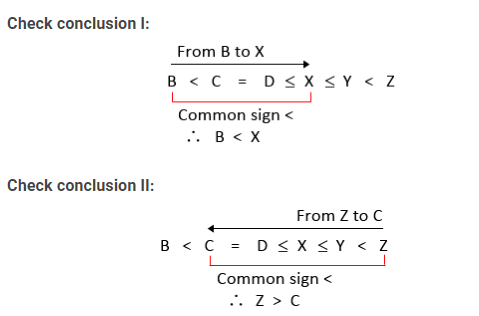
Hence, only conclusion I is true.
Q3. Statements: B > A ≥ T > F = Y ≤ S < D
Conclusions:
I. F < D
II. A > S
(A) Only conclusion I follows
(B) Either conclusion I or conclusion II follows
(C) Only conclusion II follows
(D) Both conclusions follow
(E) Neither conclusion I nor conclusion II follows
EXPLANATION
Correct Option: A
Statements: B > A ≥ T > F = Y ≤ S < D
Conclusions: F < D , A > S
For conclusion I: F < D
Here, the common sign between F and D is ‘<‘, hence F < D.
Thus conclusion I follows.
For conclusion II: A > S
Here, we can see the opposite sign between A and S, thus no relationship can be established between them.
Thus conclusion II does not follow.
Therefore only conclusion I follows.
Hence option A is correct.
Q4. Statements: Y < O ≤ G ≤ K = U > L > P
Conclusions:
I. O = U
II. U > O
(A) Only conclusion I follows
(B) Either conclusion I or conclusion II follows
(C) Only conclusion II follows
(D) Both conclusions follow
(E) Neither conclusion I nor conclusion II follows
EXPLANATION
Correct Option: B
Statements: Y < O ≤ G ≤ K = U > L > P
Conclusions: O = U , U > O
Here, the common sign between O and U is ‘≤’, hence O ≤ U.
Thus, either O < U or O = U.
Therefore either conclusion I or II follows.
Hence option B is correct.
Q5. Statements: M < T < G ≤ J = U > Y > R
Conclusions:
I. G < U
II. J > R
(A) Only conclusion I follows
(B) Either conclusion I or conclusion II follows
(C) Only conclusion II follows
(D) Both conclusions follow
(E) Neither conclusion I nor conclusion II follows
EXPLANATION
Correct Option: C
Statements: M < T < G ≤ J = U > Y > R
Conclusions: G < U , J > R
Here, the common sign between G and U is ‘≤’, hence G < U does not follow.
Therefore conslusion I does not follow.
And, the common sign between J and R is ‘>’, thus J > R follows.
Therefore conclusion II follows.
Hence option C is correct.