
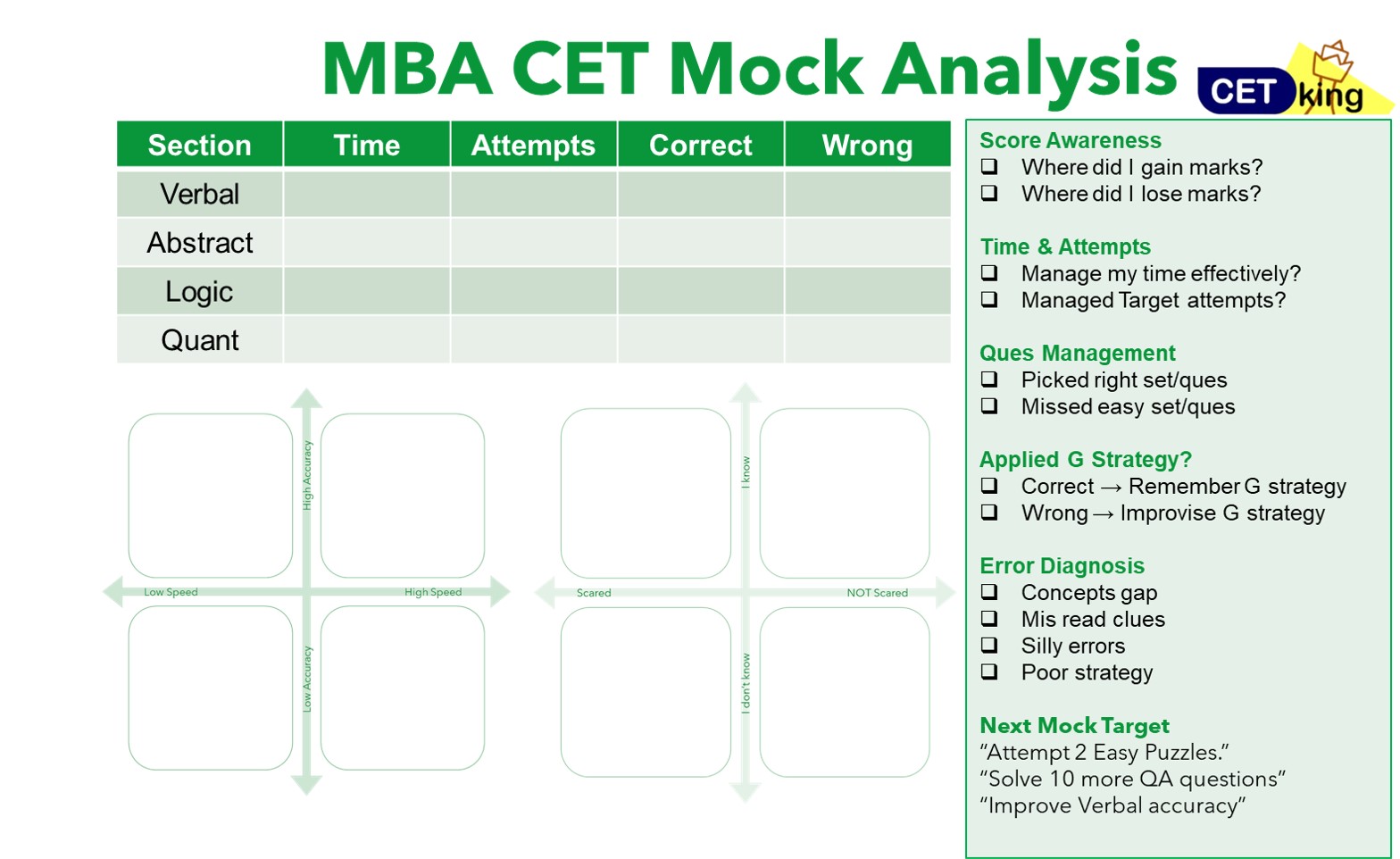
MBA CET Mock Analysis – Step-by-Step Guide
Think in 3 layers: Accuracy → Time → Strategy.
Do this within 24 hours of every mock.
Step 1: Start with a Section Snapshot (5 minutes)
Create a small table like this:
| Section | Attempted | Correct | Time | Accuracy |
|---|---|---|---|---|
| Logical Reasoning | ||||
| Abstract Reasoning | ||||
| Quant | ||||
| Verbal |
Now ask:
- Which section has lowest accuracy?
- Which section consumed maximum time?
- Where did you over-attempt?
This tells you where marks leaked first.
Step 2: Categorise EVERY Wrong Question (Most Important)
For each wrong or skipped question, tag it into one bucket:
A) Concept Gap
You didn’t know how to solve it.
B) Process Error
You knew the concept but applied it wrongly.
C) Calculation / Reading Mistake
Silly arithmetic, missed data, misread condition.
D) Time Trap
Spent too long on one question/set.
Make a tally:
| Error Type | Count |
|---|---|
| Concept Gap | |
| Process Error | |
| Silly Mistake | |
| Time Trap |
Your highest count = your primary improvement lever.
Step 3: Deep Review Only These 3 Categories
Do NOT waste time re-reading everything.
Focus only on:
1. Questions you got wrong
Re-solve without seeing solution.
2. Questions you skipped but were easy
These are free future marks.
3. Questions that took >2 minutes
Even if correct — they damage your paper flow.
For each such question, write ONE line:
- Why did I lose time/marks?
- What shortcut or decision rule could I use next time?
This builds exam instincts.
Step 4: Section-Wise Strategy Reset
After analysis, adjust strategy:
Logical / Abstract Reasoning
- Identify which sets you should skip instantly
- Mark pattern types that suit you (arrangements, distributions, visuals, etc.)
Goal: Faster selection, not faster solving.
Quant
Split errors topic-wise:
- Arithmetic
- Algebra
- Geometry
- Numbers
- DI
Whichever topic causes most errors → becomes your next 5-day revision focus.
Verbal
Classify mistakes:
- RC comprehension
- Vocabulary
- Grammar
- Para jumbles / sentence placement
Then check:
- Were errors due to haste or logic misunderstanding?
If haste → slow down.
If logic → revise that question type.
Step 5: Maintain a “Mock Mistake Notebook”
One page per mock:
- Top 3 mistake patterns
- 5 tricky questions (with takeaway)
- One strategy change for next mock
Example:
- I rush Abstract
- I over-attempt Quant
- I ignore RC tone
This prevents repeating the same mistakes across mocks.
Step 6: Track Improvement Across Mocks (Weekly)
Make a simple tracker:
| Mock | Score | Accuracy | Weakest Section |
|---|---|---|---|
You’re not chasing score jumps.
You’re chasing:
- Higher accuracy
- Fewer silly mistakes
- Better section balance
Score follows automatically.
Golden Rule (Very Important)
Time spent analyzing should be at least 1.5× the time spent writing the mock.
2-hour mock → minimum 3 hours analysis.
That’s where rank is created.