
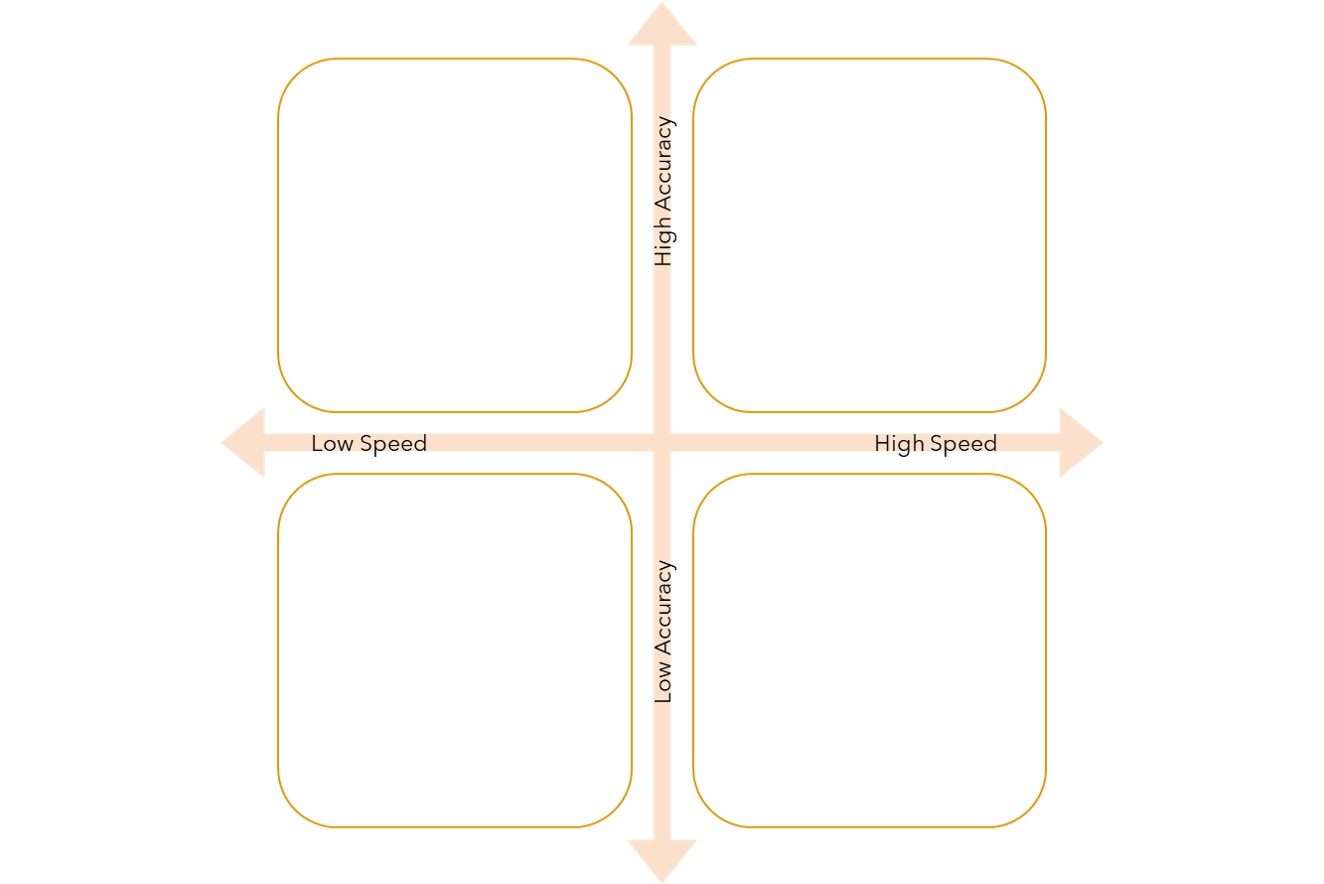
The 2×2 Matrix is a powerful diagnostic tool for your MBA CET preparation. With 200 questions to solve in just 150 minutes, the exam is less about what you know and more about how efficiently you perform. By plotting your mock test topics onto this matrix, you can move away from “random practice” and toward a data-driven strategy.
The Four Quadrants of CET Performance
1. High Accuracy & High Speed (The Safe Zone)
These are your “Bread and Butter” topics. Whether it is Syllogisms, Coding-Decoding, or simple Arithmetic, you can solve these quickly without errors.
- Strategy: Do not ignore them. Practice just enough to maintain your speed and ensure these are the first questions you hunt for in the actual exam.
2. High Accuracy & Low Speed (The Time Traps)
You get the right answer, but it takes you 3 to 4 minutes. This often includes heavy Puzzles or lengthy Data Interpretation sets.
- Strategy: You need “Speed Hacks.” Learn shortcuts, approximations, or visual observation techniques to bring the time down. In the CET, a correct answer that takes too long is often as costly as a wrong one.
3. Low Accuracy & High Speed (The Danger Zone)
You fly through these questions but often fall for traps or make silly mistakes. This usually happens in Verbal Ability or fast-paced Number Series.
- Strategy: Slow down. Analyze your errors—are they conceptual or due to haste? You need to build a “checking mechanism” to ensure your speed doesn’t lead to negative marking or wasted attempts.
4. Low Accuracy & Low Speed (The Exit Zone)
These are your weakest links. You spend a lot of time and still get them wrong.
- Strategy: If the exam is near, leave them. Use the “ABC” (Abhi, Baad mein, Chodo) rule. These topics should be marked for a random guess or skipped entirely to save time for Quadrant 1 and 2.
Analysis Tip
After every mock, list your topics in these four boxes. Your goal over the next few weeks is to migrate topics from the Low Accuracy and Low Speed buckets into the High Accuracy & High Speed quadrant.