CET 2026 Slot 2 · MBA CET 2026 Attempt 1 Slot 2 · Abstract – Page 2
All 25 Abstract questions of CET 2026 Slot 2. Tap Show answer, or open the detailed solution (free login). Page 2 of 5.
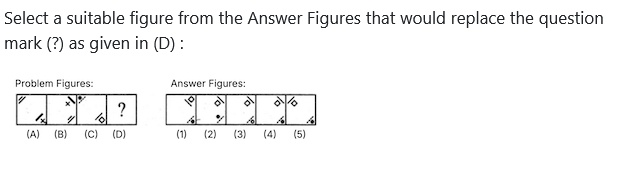
Select a suitable figure from the Answer Figures that would replace the question mark (?) as given in (D) :
Answer: B. (2)
Solution — first steps
Approach: Figure analogy: the top-left element moves to the bottom-right unchanged; the bottom-right element moves to the top-right and is mirrored (its two parts change order and the line tilts the other way). Solution: A: "//" at top-left; thick line + "×" at bottom-right.
The full step-by-step working opens with a free login.
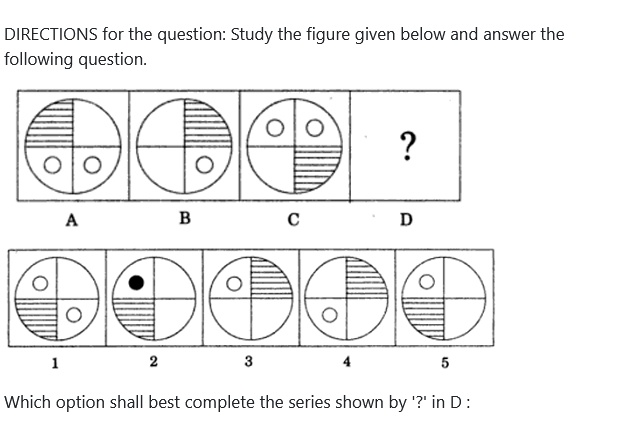
DIRECTIONS for the question: Study the figure given below and answer the following question.
Which option shall best complete the series shown by '?' in D :
Answer: E. 5
Solution — first steps
Approach: Figure series: the shaded quadrant moves clockwise one quadrant per step; the number of small circles alternates 2, 1, 2, 1. Solution: Shading: A top-left → B top-right → C bottom-right → D bottom-left.
The full step-by-step working opens with a free login.
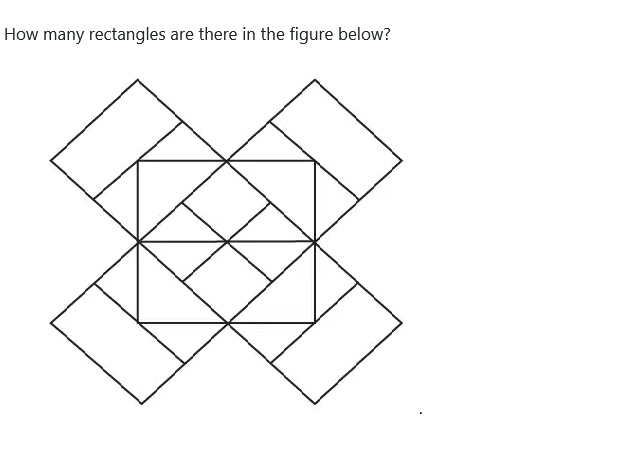
How many rectangles are there in the figure below?
Answer: E. 34
Solution — first steps
Approach: Count every tilted rectangle by choosing two down-right lines and two up-right lines whose four sides are fully drawn, add the upright ones, then remove the squares (the key counts only non-square rectangles). Solution: There are 7 down-right lines and 7 up-right lines.
The full step-by-step working opens with a free login.
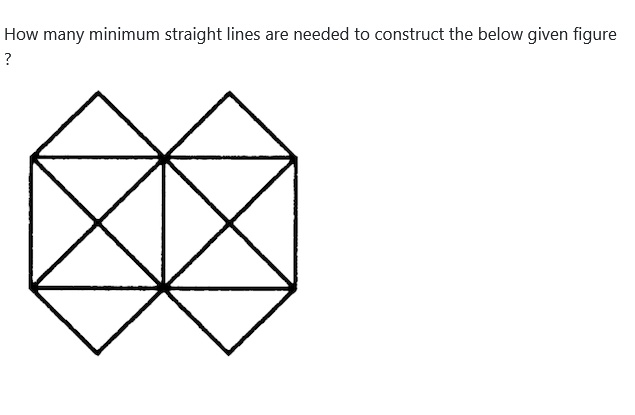
How many minimum straight lines are needed to construct the below given figure ?
Answer: B. 13
Solution — first steps
Approach: Minimum lines = number of maximal straight lines, joining collinear pieces into one. Solution: Horizontal: the top line and the bottom line each run across the whole figure → 2.
The full step-by-step working opens with a free login.
Find the number of squares in the given figure ?
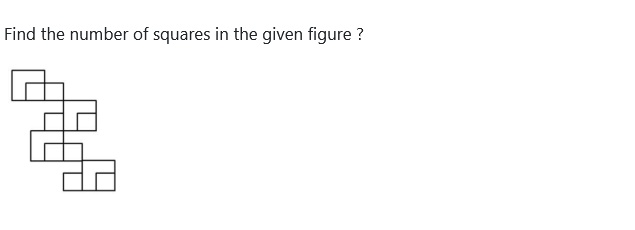
Answer: A. 12
Solution — first steps
Approach: Count squares unit by unit; the figure is four identical units. Solution: Each unit = 1 big square + 2 small squares attached along its lower edge.
The full step-by-step working opens with a free login.