CET 2024 Slot 2 Question Paper with Solutions PDF – Page 19
All 200 questions of CET 2024 Slot 2. Tap Show answer, or open the detailed solution (free login). Page 19 of 41.
In these questions, the symbols @,%,©,$ and #
are used with the following meaning as illustrated
below.
'P@Q' means 'P is neither smaller than nor equal to
Q.
'P%Q' means 'P is neither greater than nor equal to Q
P©Q' means 'P is not greater than Q’
'P$Q' means 'P is not smaller than Q'.
'P#Q' means 'P is neither smaller nor greater than Q.
Assuming the given statements to be true, find which
of the conclusions is definitely true
Statements:
R%H
H©T
T@K
Conclusions:
I. T©R
II. K%H
A Only Conclusion II is true
B Only Conclusion I is true
C Either Conclusion I or II is true
D Neither Conclusion I nor II is true
E Both Conclusions I and II are true
Answer: D. Neither Conclusion I nor II is true
Solution — first steps
RR, so I (T≤R) is false. K<T does not fix K versus H.
The full step-by-step working opens with a free login.
In these questions, the symbols @,%,©,$ and #
are used with the following meaning as illustrated
below.
'P@Q' means 'P is neither smaller than nor equal to
Q.
'P%Q' means 'P is neither greater than nor equal to Q
‘P©Q' means 'P is not greater than Q’
'P$Q' means 'P is not smaller than Q'.
'P#Q' means 'P is neither smaller nor greater than Q.
Assuming the given statements to be true, find which
of the conclusions is definitely true
Statements
N@K
K%D
D#M
Conclusions
I. M@K
II. D@N
A Either conclusion I or II is true
B Only conclusion II is true
C Only conclusion I is true
D Neither conclusion I nor II is true
E Both conclusions I and II are true
Answer: C. Only conclusion I is true
Solution — first steps
KK, proving I. D versus N is unspecified, so II does not follow.
The full step-by-step working opens with a free login.
Group the given figures into three classes using
each figure only once
A 2,6,7 ; 1,5,8 ; 3,4,9
B 2,6,9 ; 1,5,7 ; 3,4,8
C 2,4,7 ; 1,8,9 ; 3,5,6
D 2,8,7 ; 1,5,9 ; 3,4,6
E 2,8,9 ; 1,5,7 ; 3,4,6
each figure only once
A 2,6,7 ; 1,5,8 ; 3,4,9
B 2,6,9 ; 1,5,7 ; 3,4,8
C 2,4,7 ; 1,8,9 ; 3,5,6
D 2,8,7 ; 1,5,9 ; 3,4,6
E 2,8,9 ; 1,5,7 ; 3,4,6
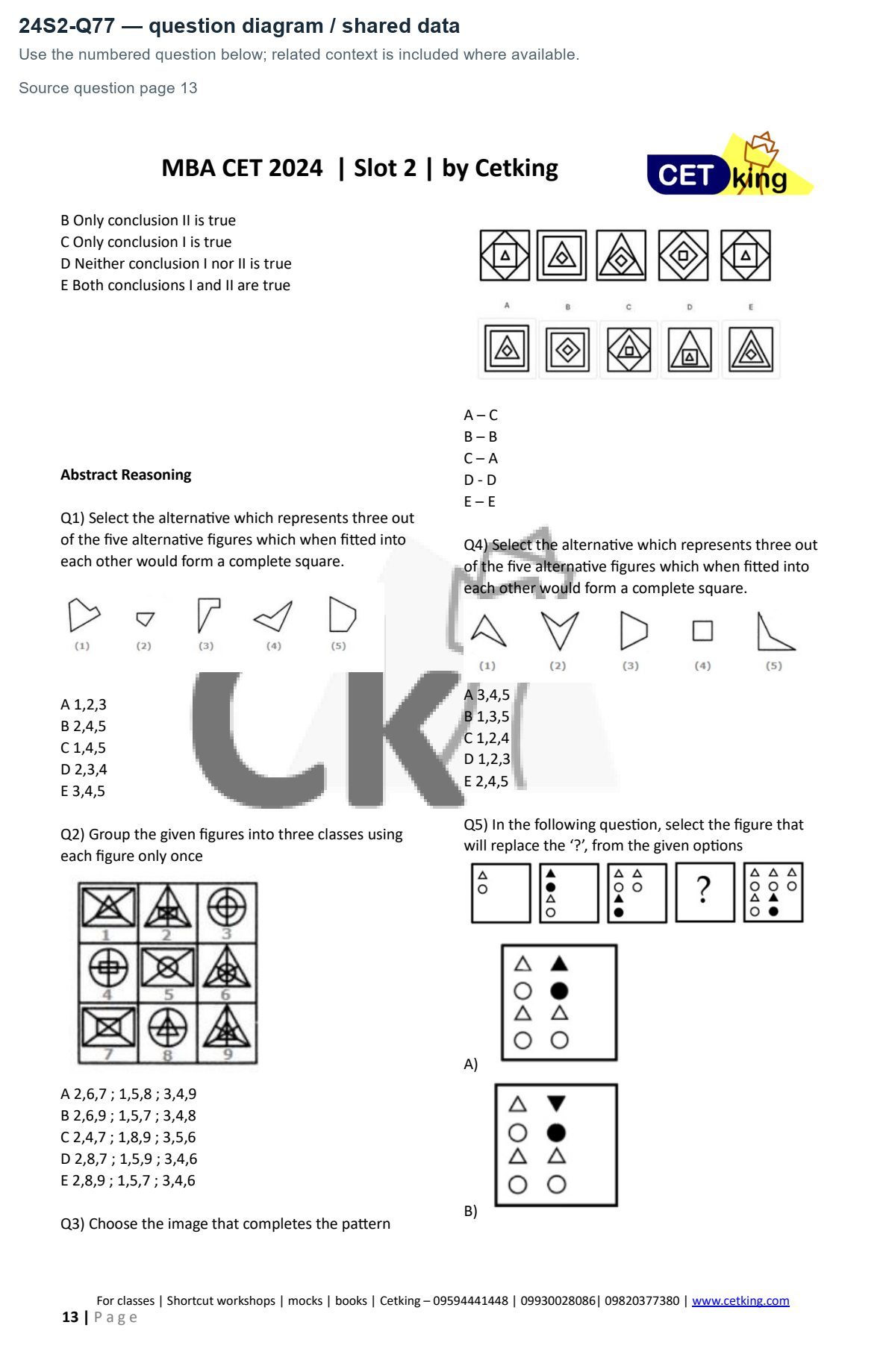
Answer: B. 2,6,9 ; 1,5,7 ; 3,4,8
Solution — first steps
Group by the outer boundary: triangles 2,6,9; squares 1,5,7; circles 3,4,8. These disjoint groups use all nine figures exactly once.
The full step-by-step working opens with a free login.
Choose the image that completes the pattern
A – C
B – B
C – A
D - D
E – E
A – C
B – B
C – A
D - D
E – E
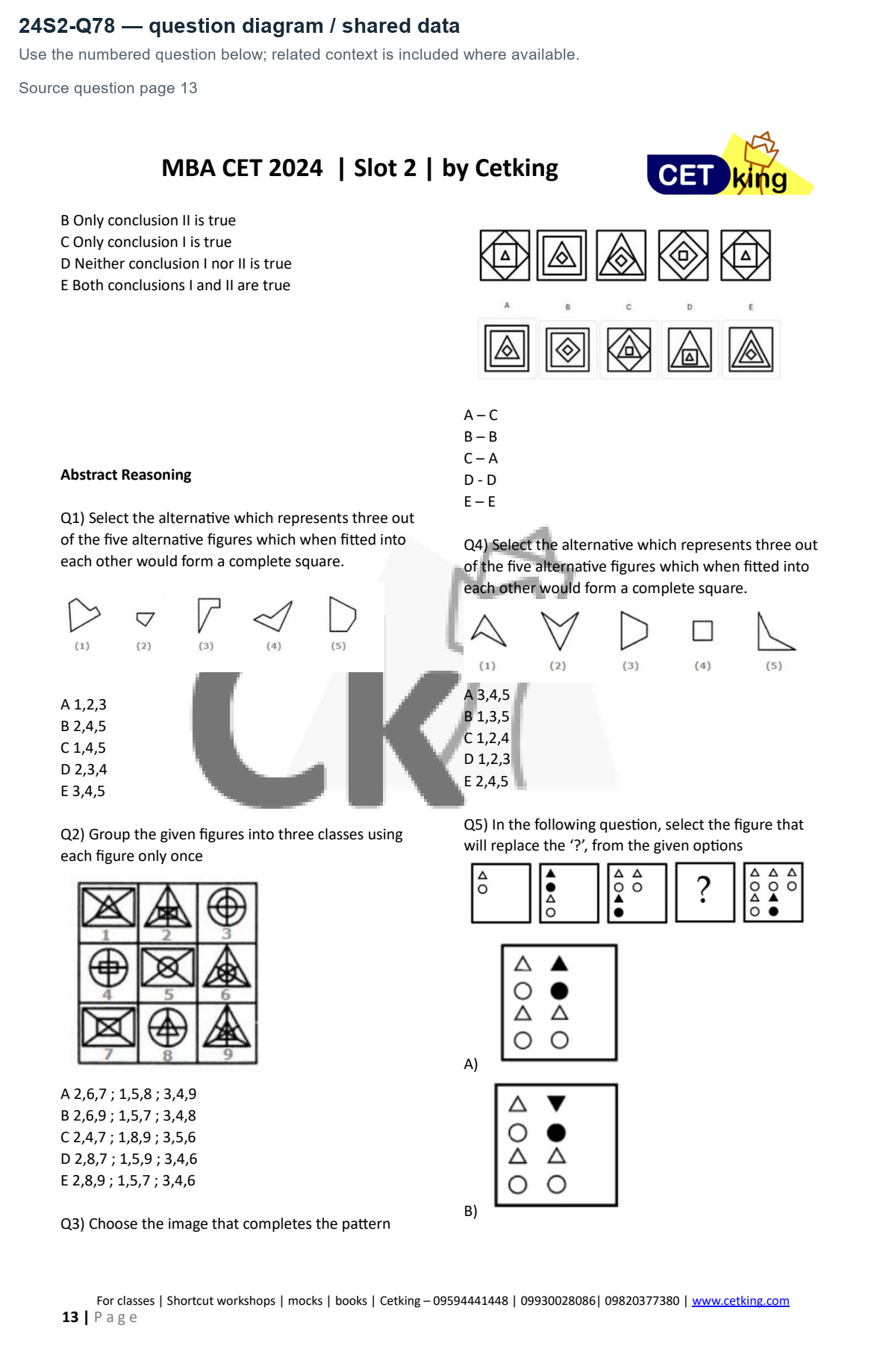
Answer: C. – A
Solution — first steps
The fifth nested-shape figure repeats the first, starting the cycle again. The next is the second figure: outer square, inner square, triangle, diamond.
The full step-by-step working opens with a free login.
In the following question, select the figure that
will replace the ‘?’, from the given options
A)
B)
C)
D)
E)
will replace the ‘?’, from the given options
A)
B)
C)
D)
E)
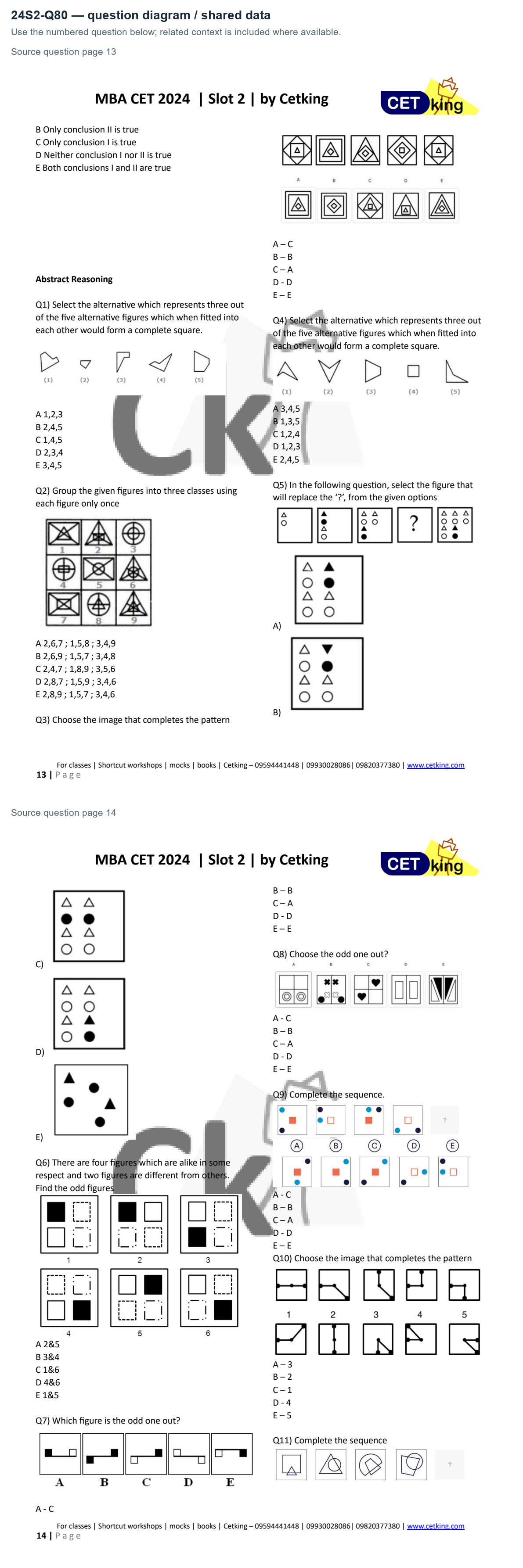
Answer: A. Figure (a) in the attached diagram
Solution — first steps
Each frame adds one triangle/circle pair. The filled pair alternates between the upper and lower rows; in the fourth frame it must occupy the upper-right pair while the other three pairs remain hollow.
The full step-by-step working opens with a free login.