The cost price of a toy is Rs. 225. The marked price is twice of the cost price. What will be the discount offered to get profit of 56% on the sale of the toy ?
- A30%
- B20%
- C33%
- D22%
- E28%
Show answerHide answer
Answer: D
Approach: Required SP from target profit; discount = (MP − SP)/MP × 100.
Solution:
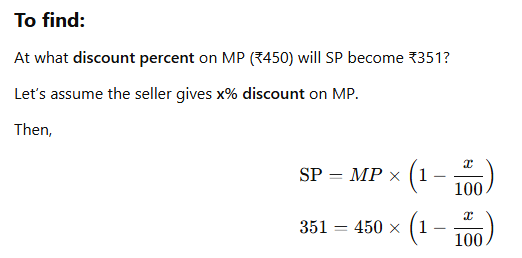
CP = ₹225, MP = 2 × 225 = ₹450
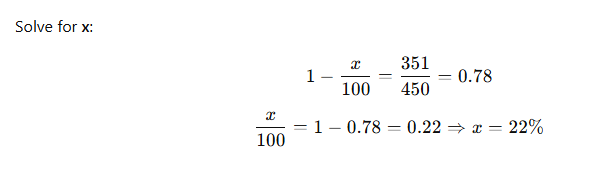
Required SP for 56% profit = 1.56 × 225 = ₹351
Discount = 450 − 351 = ₹99
Discount % = 99/450 × 100 = 22%
Cetking shortcut: MP = 2 × CP, so SP/MP = 1.56/2 = 0.78 → discount = 22% directly.
Answer: D
What is the product of all the prime numbers between 0 to 100 ?
- A1
- B23055679639455184247531021473334556070
- C0
- D2305563945518424753102147334531756070
- E2305567963945518424753102147331756070
Show answerHide answer
Answer: E
Approach: Product of the 25 primes below 100 (2, 3, 5, …, 97); eliminate options by size and digit pattern.
Solution:
Primes below 100: 2, 3, 5, 7, 11, 13, 17, 19, 23, 29, 31, 37, 41, 43, 47, 53, 59, 61, 67, 71, 73, 79, 83, 89, 97 (25 primes)
Product = 2305567963945518424753102147331756070 (37 digits)
It contains 2 × 5, so it ends in 0 — and it is clearly neither 0 nor 1.
Why the other options are wrong:
A (1) and C (0): a product of primes can be neither.
B: 38 digits — one digit too many.
D: 37 digits but drops the '79' after 230556 (2305563945…).
Cetking shortcut: Size check: 2 × 3 × 5 × 7 = 210 and the primes from 11 to 97 multiply to about 1.1 × 10³⁴, so the product ≈ 2.3 × 10³⁶ — a 37-digit number; then match the digit string.
Answer: E
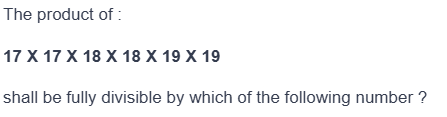
The product of : 17 X 17 X 18 X 18 X 19 X 19 shall be fully divisible by which of the following number ?
- A971
- B173
- C646
- D23
- E5813
Show answerHide answer
Answer: C
Approach: Prime-factorise the product and each option.
Solution:
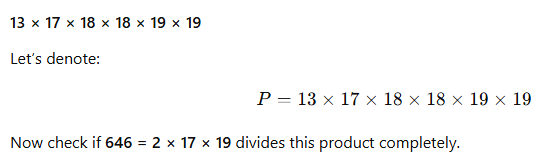
Product = 17² × 18² × 19² = 2² × 3⁴ × 17² × 19²
Prime factors available: 2, 3, 17, 19 only
646 = 2 × 17 × 19 → all three present → divides fully
Why the other options are wrong:
A: 971 is a prime not in the product.
B: 173 is a prime not in the product.
D: 23 is a prime not in the product.
E: 5813 is odd and not divisible by 3, 17 or 19, so it has a prime factor outside the product.
Cetking shortcut: Any option containing a prime other than 2, 3, 17, 19 is out — only 646 = 2 × 17 × 19 survives.
Answer: C
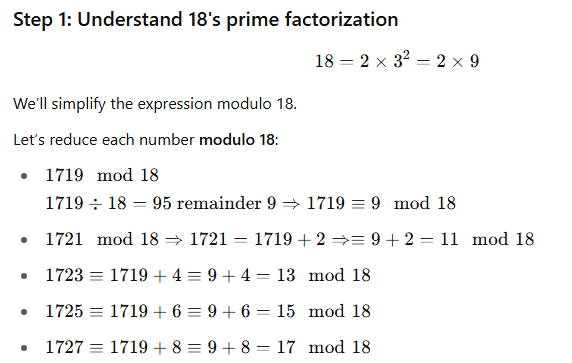
Find the remainder when : (1719 X 1721 X 1723 X 1725 X 1727) is divided by 18 ?
- A9
- B1
- C19
- D31
- E7
Show answerHide answer
Answer: A
Approach: Replace each factor by its remainder mod 18.
Solution:
1719 = 18 × 95 + 9 → 9
1721 → 11, 1723 → 13, 1725 → 15, 1727 → 17
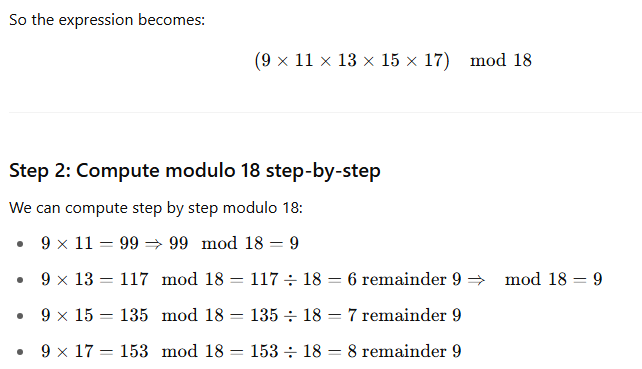
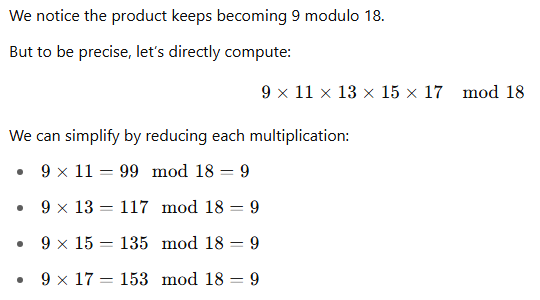
Product ≡ 9 × (11 × 13 × 15 × 17) (mod 18)
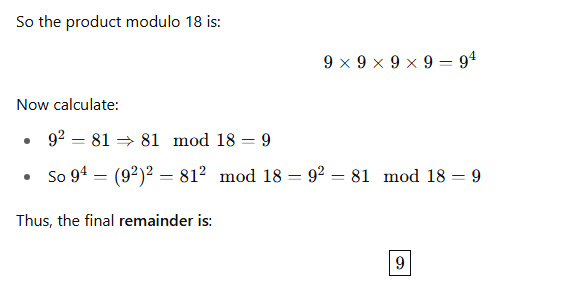
11 × 13 × 15 × 17 is odd, and 9 × odd ≡ 9 (mod 18)
Remainder = 9
Cetking shortcut: One factor leaves 9 and all others are odd: 9 × odd always leaves 9 on division by 18.
Answer: A
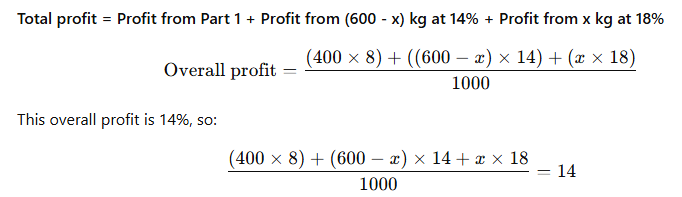
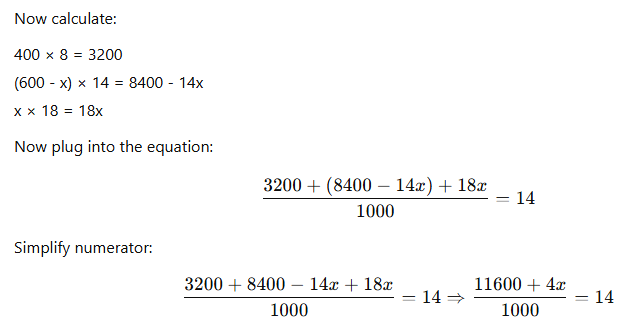
A dealer has 1000 kg sugar and he sells a part of it at 8% profit and the rest of it at 18% profit. The overall profit he earns is 14%. What is the quantity which is sold at 18% profit ?
- A450kg
- B900kg
- C630kg
- D400kg
- E600kg
Show answerHide answer
Answer: E
Approach: Alligation of profit rates 8% and 18% around mean 14%.
Solution:
8% part : 18% part = (18 − 14) : (14 − 8) = 4 : 6 = 2 : 3
18% part = 3/5 × 1000 = 600 kg
Check: 400 × 8% + 600 × 18% = 32 + 108 = 140 = 14% of 1000 ✓
Cetking shortcut: Mean 14 is closer to 18 than to 8, so the 18% part is more than half — alligation fixes it at 600.
Answer: E
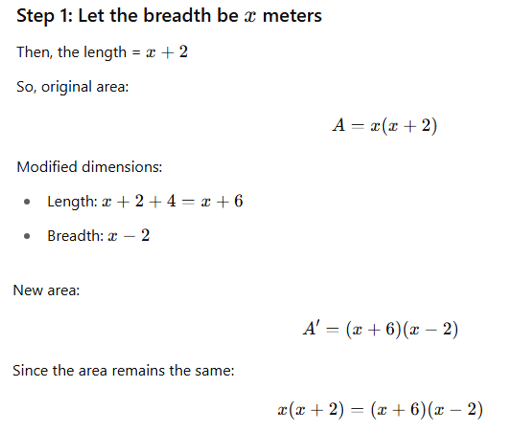
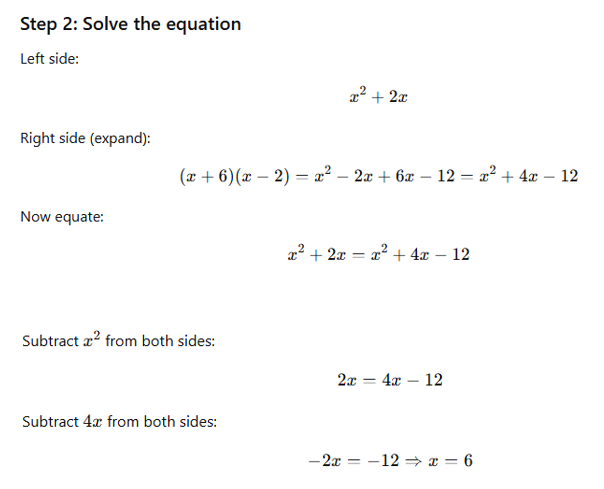
The length of a room exceeds its breadth by 2 meters. If the length be increased by 4 meters and the breadth decreased by 2 meters, the area remains the same. Find the surface area of its walls if the height is 3 meters ?
- A248m2
- B48m2
- C84m2
- D56m2
- E260m2
Show answerHide answer
Answer: C
Approach: Form an equation from 'area unchanged', then use 2(l + b)h.
Solution:
Let breadth = b, length = b + 2
(b + 2 + 4)(b − 2) = (b + 2)b
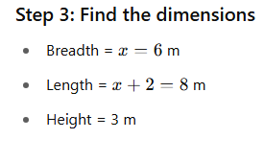
b² + 4b − 12 = b² + 2b → 2b = 12 → b = 6, l = 8
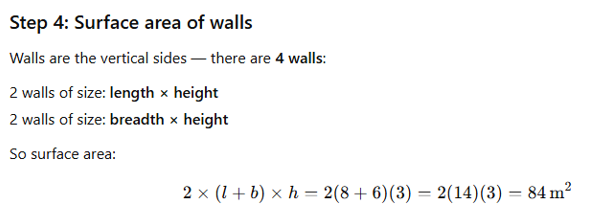
Walls = 2(8 + 6) × 3 = 84 m²
Cetking shortcut: (l + 4)(b − 2) = lb ⇒ 4b − 2l = 8; with l = b + 2 this gives b = 6 in one line.
Answer: C
A bus covers a distance of first 50 km in 40 minutes, next 50 km at a speed of 2 km per minute and the next 30 km at a speed of 1.0 km per minute. What is its average speed during the entire journey ?
- A81.2kmph
- B64.8kmph
- C80.8kmph
- D84.1kmph
- E82.1kmph
Show answerHide answer
Answer: E
Approach: Find time for each leg, then total distance / total time.
Solution:
Leg 1: 50 km in 40 min
Leg 2: 50 km at 2 km/min = 25 min
Leg 3: 30 km at 1 km/min = 30 min
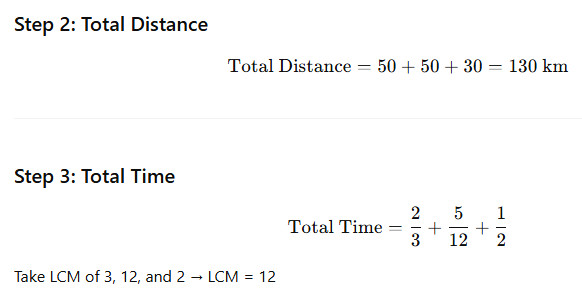
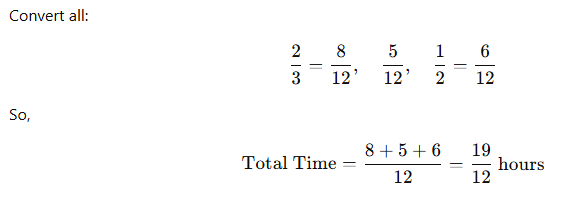
Total: 130 km in 95 min
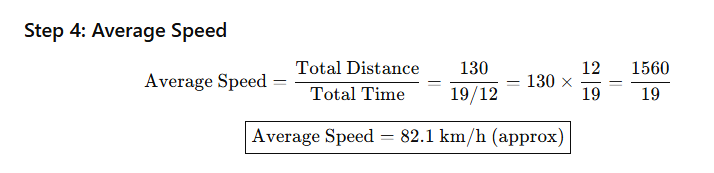
Average speed = 130 × 60/95 = 7800/95 = 82.1 km/h
Cetking shortcut: 130/95 ≈ 1.368 km/min × 60 ≈ 82.1 — just above 82, which rules out 81.2 and 80.8.
Answer: E
If the height of a right circular cone is increased by 200% and the radius of the base is reduced by 50%, then volume of the cone shall :
- Aincrease by 25%
- Bdecrease by 25%
- Cincrease by 100%
- Dincrease by 75%
- Edecrease by 20%
Show answerHide answer
Answer: B
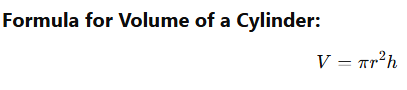
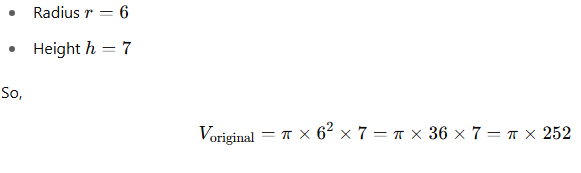
Approach: Volume ∝ r²h; apply multiplying factors.
Solution:
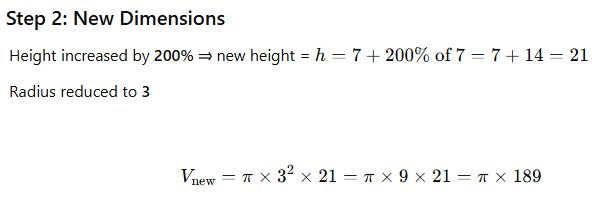
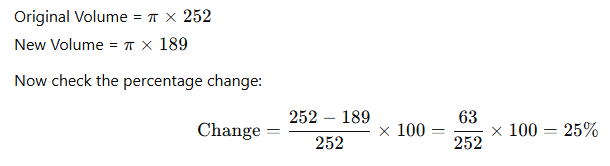
Height +200% → h becomes 3h
Radius −50% → r becomes r/2, so r² becomes r²/4
New volume factor = 3 × 1/4 = 0.75
Volume decreases by 25%
Cetking shortcut: Factors only: (½)² × 3 = ¾ → 25% down.
Answer: B
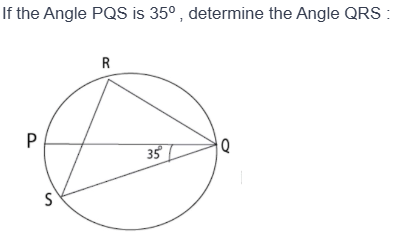
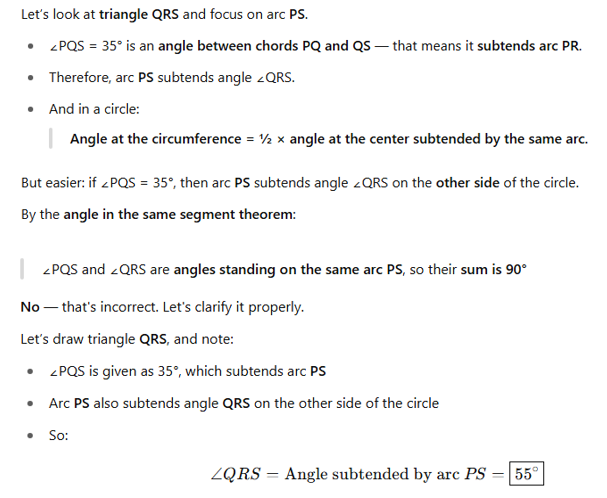
If the Angle PQS is 35°, determine the Angle QRS :
- A35 degree
- B135 degree
- C55 degree
- D60 degree
- E65 degree
Show answerHide answer
Answer: C
Approach: PQ is a diameter → ∠PSQ = 90°; then use 'angles on the same arc'.
Solution:
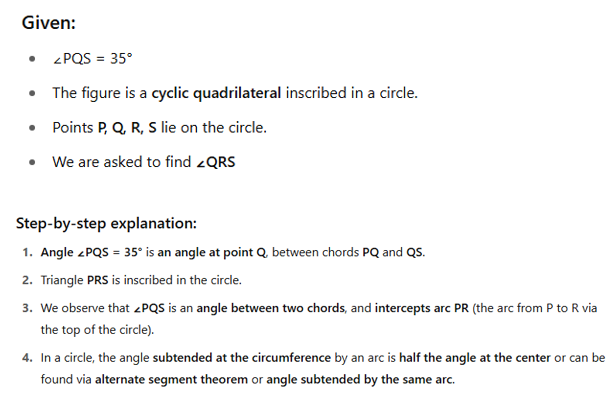
In the figure, PQ is a diameter, so ∠PSQ = 90° (angle in a semicircle)
In ΔPSQ: ∠SPQ = 180° − 90° − 35° = 55°
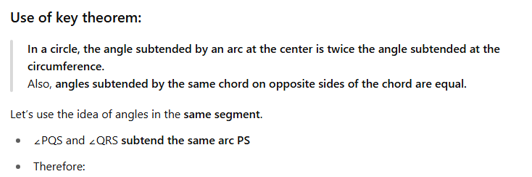
∠QRS and ∠QPS stand on the same arc QS → ∠QRS = ∠QPS = 55°
Why the other options are wrong:
A (35°): that is ∠PQS itself, which stands on arc PS, not QS.
B (135°): would be an angle in the opposite segment.
D, E: no theorem gives 60° or 65° here.
Cetking shortcut: Diameter + given angle 35° → the other acute angle of the right triangle is 55°, which carries over along the same arc.
Answer: C
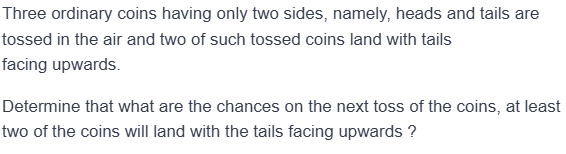
Three ordinary coins having only two sides, namely, heads and tails are tossed in the air and two of such tossed coins land with tails facing upwards. Determine that what are the chances on the next toss of the coins, at least two of the coins will land with the tails facing upwards ?
- A80%
- B33.33%
- C66.67%
- D50%
- E25%
Show answerHide answer
Answer: D
Approach: Independent events: P(at least 2 tails with 3 coins).
Solution:
Total outcomes = 2³ = 8
Exactly 2 tails: HTT, THT, TTH = 3
3 tails: TTT = 1
P = 4/8 = 1/2 = 50%
Cetking shortcut: By symmetry, 'at least 2 tails' and 'at least 2 heads' are complementary and equally likely → 50%.
Answer: D
Questions 111–113 share this
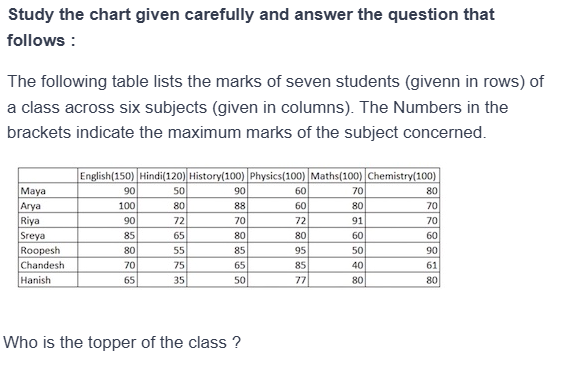
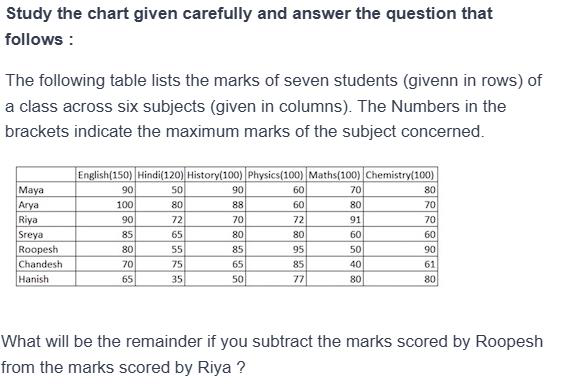
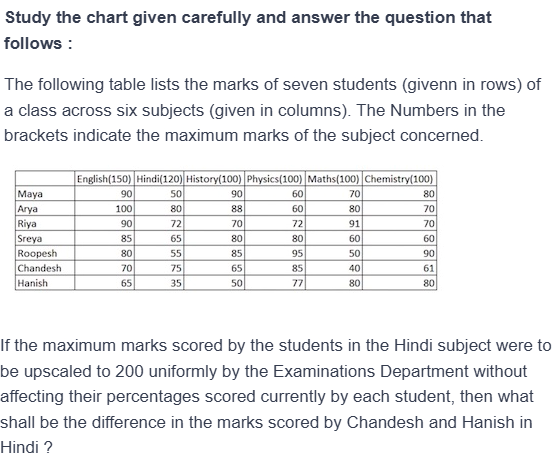
Study the chart given carefully and answer the question that follows :
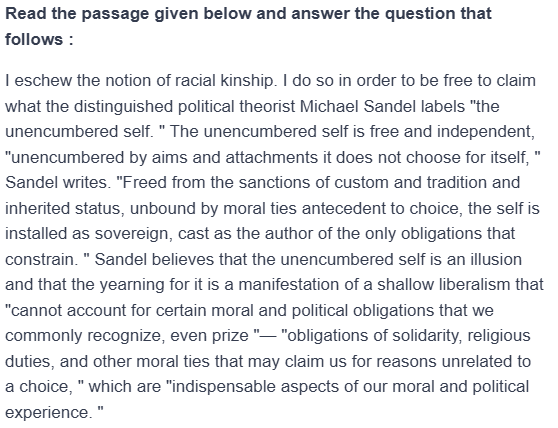
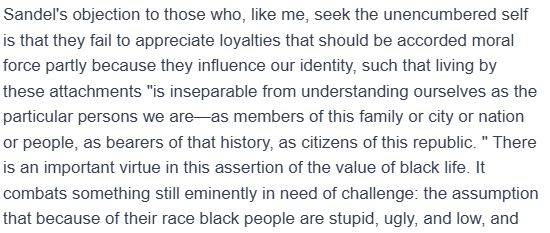
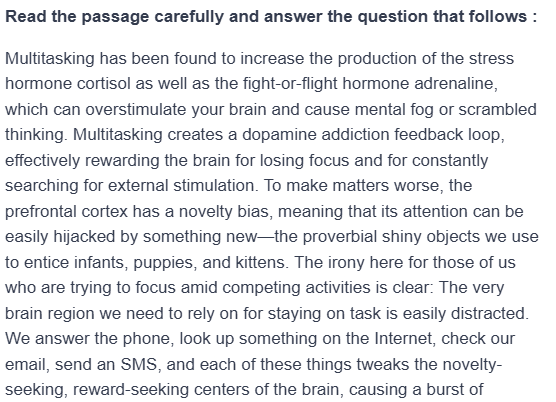
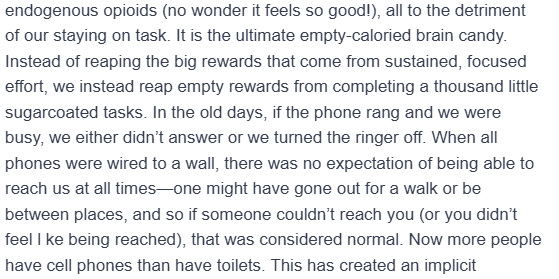
The following table lists the marks of seven students (givenn in rows) of a class across six subjects (given in columns). The Numbers in the brackets indicate the maximum marks of the subject concerned.
| English(150) | Hindi(120) | History(100) | Physics(100) | Maths(100) | Chemistry(100) |
|---|
| Maya | 90 | 50 | 90 | 60 | 70 | 80 |
| Arya | 100 | 80 | 88 | 60 | 80 | 70 |
| Riya | 90 | 72 | 70 | 72 | 91 | 70 |
| Sreya | 85 | 65 | 80 | 80 | 60 | 60 |
| Roopesh | 80 | 55 | 85 | 95 | 50 | 90 |
| Chandesh | 70 | 75 | 65 | 85 | 40 | 61 |
| Hanish | 65 | 35 | 50 | 77 | 80 | 80 |
Who is the topper of the class ?
- AArya
- BSreya
- CChandesh
- DMaya
- ERoopesh
Show answerHide answer
Answer: A
Approach: Add each row (maximum marks are the same for all, so totals compare directly).
Solution:
Maya = 90+50+90+60+70+80 = 440
Arya = 100+80+88+60+80+70 = 478
Riya = 90+72+70+72+91+70 = 465
Sreya = 85+65+80+80+60+60 = 430
Roopesh = 80+55+85+95+50+90 = 455
Chandesh = 70+75+65+85+40+61 = 396
Hanish = 65+35+50+77+80+80 = 387
Highest = Arya (478)
Why the other options are wrong:
B Sreya 430, C Chandesh 396, D Maya 440, E Roopesh 455 — all below Arya's 478.
Cetking shortcut: Total only the five option names (Riya and Hanish are not options); Arya's 478 is the only total above 460.
Answer: A
Refer to the passage above ↑
What will be the remainder if you subtract the marks scored by Roopesh from the marks scored by Riya ?
- A32
- B13
- C23
- D8
- E10
Show answerHide answer
Answer: E
Approach: Difference of row totals.
Solution:
Riya total = 465
Roopesh total = 455
Riya − Roopesh = 10
Cetking shortcut: Subject-wise differences (Riya − Roopesh): +10, +17, −15, −23, +41, −20 → sum = 10, no full totals needed.
Answer: E
Refer to the passage above ↑
If the maximum marks scored by the students in the Hindi subject were to be upscaled to 200 uniformly by the Examinations Department without affecting their percentages scored currently by each student, then what shall be the difference in the marks scored by Chandesh and Hanish in Hindi ?
- A40
- B80
- C88
- D70
- E66
Show answerHide answer
Answer: E
Approach: Scale the Hindi difference by 200/120 = 5/3.
Solution:
Hindi: Chandesh 75, Hanish 35 (out of 120)
Chandesh = 75 × 5/3 = 125, Hanish = 35 × 5/3 = 58⅓
Difference = 66⅔ marks, listed in the options as 66 (fractional part dropped)
Cetking shortcut: Scale the difference, not each score: 40 × 5/3 = 66⅔ → 66.
Answer: E
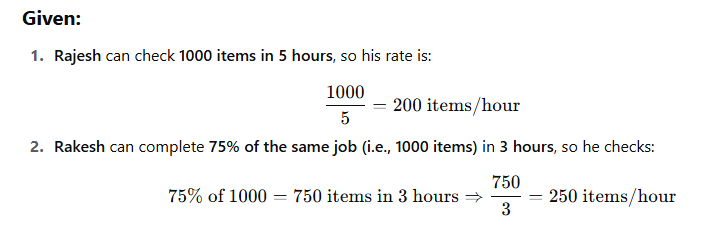
Sunil Makhihija can check the quality of 1000 items in 5 hours and Nilesh Desai can complete 75% of the same job in 3 hours. How much time is required for both of them to check 1300 items, if Nilesh stops checking after 2 hours ?
- A2hrs
- B4hrs
- C3hrs
- D6.5hrs
- E4.25hrs
Show answerHide answer
Answer: B
Approach: Rates in items/hour; together for 2 hours, then Sunil alone.
Solution:
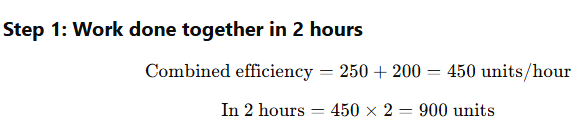
Sunil: 1000 items in 5 h → 200 items/h
Nilesh: 75% of 1000 = 750 items in 3 h → 250 items/h
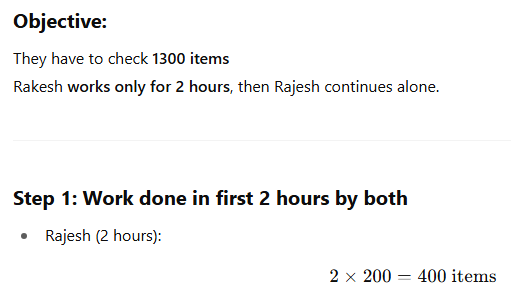
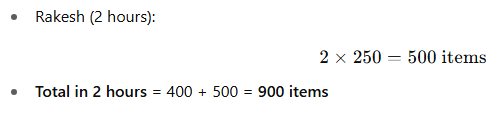
Together for 2 h: (200 + 250) × 2 = 900 items
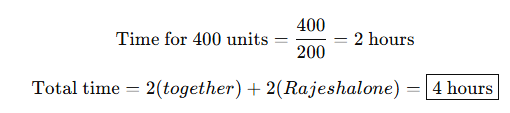
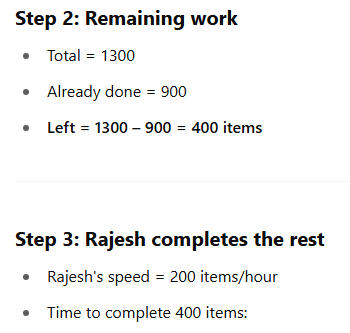
Remaining: 1300 − 900 = 400 items
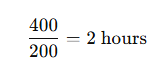
Sunil alone: 400/200 = 2 h
Total time = 2 + 2 = 4 hours
Cetking shortcut: Nilesh does 2 × 250 = 500; Sunil does the other 800 at 200/h → 4 h, and Sunil works the whole time.
Answer: B
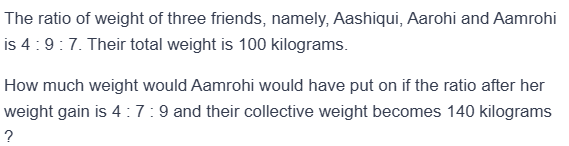
The ratio of weight of three friends, namely, Aashiqui, Aarohi and Aamrohi is 4:9:7. Their total weight is 100 kilograms. How much weight would Aamrohi would have put on if the ratio after her weight gain is 4 : 7 : 9 and their collective weight becomes 140 kilograms ?
- A28kg
- B63kg
- C49kg
- D21kg
- E35kg
Show answerHide answer
Answer: A
Approach: Ratio → actual weight before and after.
Solution:
Before: 4 + 9 + 7 = 20 parts = 100 kg → 1 part = 5 kg
Aamrohi before = 7 × 5 = 35 kg
After: 4 + 7 + 9 = 20 parts = 140 kg → 1 part = 7 kg
Aamrohi after = 9 × 7 = 63 kg
Weight gained = 63 − 35 = 28 kg
Why the other options are wrong:
B (63): that is her new weight, not the gain.
E (35): her original weight.
C (49), D (21): come from using the wrong ratio position (7 × 7, 7 × 3).
Cetking shortcut: Both totals are 20 parts: gain = 9 × 7 − 7 × 5 = 28.
Answer: A
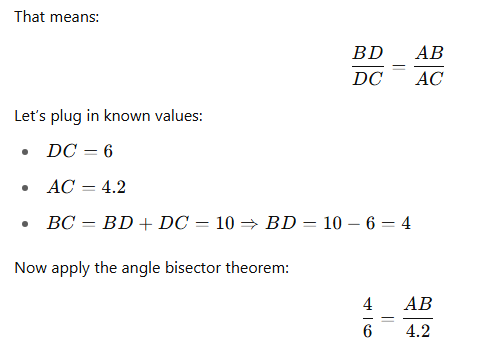
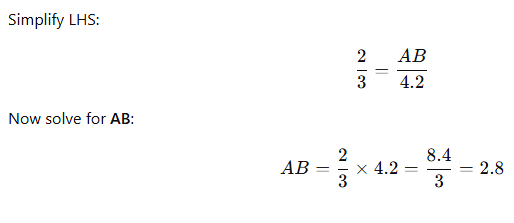
In a triangle ABC, AD is the bisector of angle A. If AC = 4.2 cm, DC = 6 cm, BC = 10 cm, then find AB ?
- A3.4cm
- B2.9cm
- C2.7cm
- D3cm
- E2.8cm
Show answerHide answer
Answer: E
Approach: Angle bisector theorem.
Solution:
BD = BC − DC = 10 − 6 = 4 cm
AB/AC = BD/DC → AB/4.2 = 4/6
AB = 4.2 × 2/3 = 2.8 cm
Cetking shortcut: AB pairs with BD (the smaller piece), so AB < AC: 4.2 × 4/6 = 2.8.
Answer: E
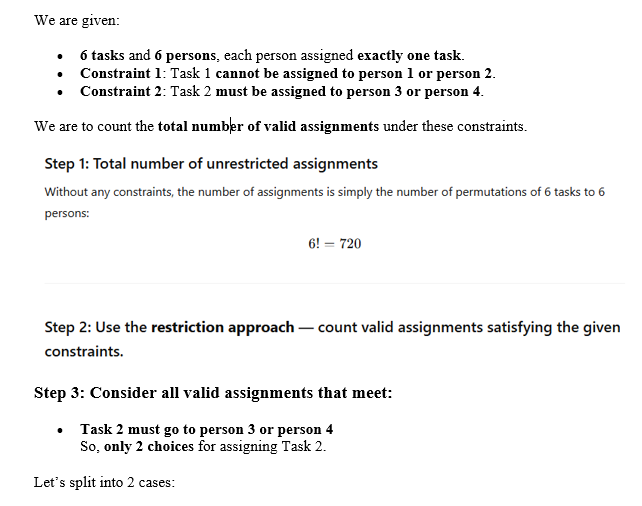
There are 6 tasks and 6 persons. Task 1 cannot be assigned either to person 1 or person 2. Task 2 must be assigned to either person 3 or person 4. Every person is to be assigned one task. In how many ways can the assignment be done ?
- A72ways
- B192ways
- C360ways
- D144ways
- E256ways
Show answerHide answer
Answer: D
Approach: Fundamental counting principle, most-restricted task first.
Solution:
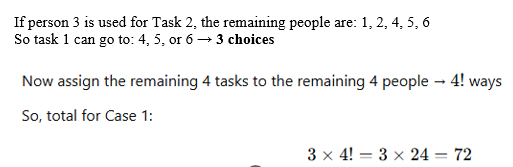
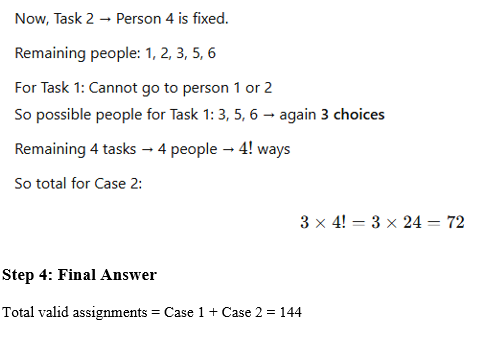
Task 2 → person 3 or person 4: 2 ways
Task 1 → not person 1, not person 2, not the person who took Task 2: 6 − 3 = 3 ways
Remaining 4 tasks → remaining 4 persons: 4! = 24 ways
Total = 2 × 3 × 24 = 144
Why the other options are wrong:
B (192): forgets that Task 2's person is used up (2 × 4 × 24).
A (72): counts only one choice for Task 2.
C (360), E (256): no valid counting gives these.
Answer: D
The speed of a boat in still water is 5 km/hr. If it takes thrice as much time in going 20 km upstream as in going the same distance downstream, find the speed of the stream :
- A5.5kmph
- B2.5kmph
- C6.5kmph
- D15.5kmph
- E3.5kmph
Show answerHide answer
Answer: B
Approach: Same distance → speeds are inversely proportional to times.
Solution:
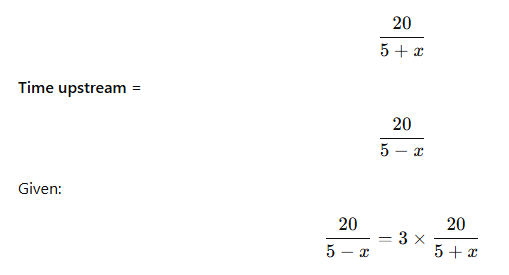
Downstream speed = 5 + x, upstream speed = 5 − x
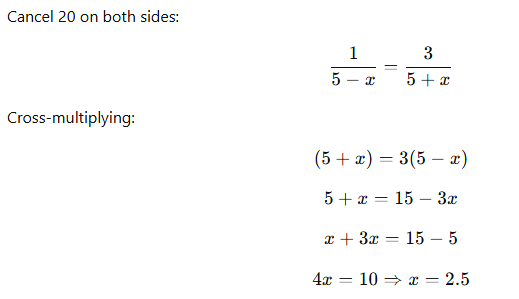
t_up = 3 × t_down → (5 + x) = 3(5 − x)
5 + x = 15 − 3x → 4x = 10 → x = 2.5 km/h
Cetking shortcut: Down : Up speed = 3 : 1 → boat = (3 + 1)/2 = 2 units, stream = (3 − 1)/2 = 1 unit; 2 units = 5 → stream = 2.5.
Answer: B
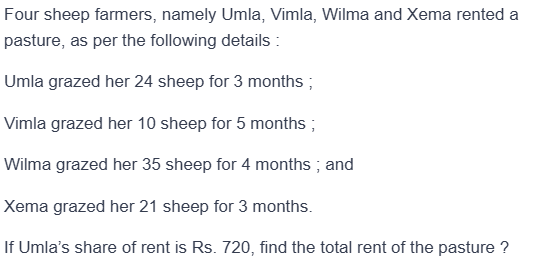
Four sheep farmers, namely Umla, Vimla, Wilma and Xema rented a pasture, as per the following details:
Umla grazed her 24 sheep for 3 months ;
Vimla grazed her 10 sheep for 5 months ;
Wilma grazed her 35 sheep for 4 months ; and
Xema grazed her 21 sheep for 3 months.
If Umla's share of rent is Rs. 720, find the total rent of the pasture ?
- A2880rs
- B3200rs
- C3150rs
- D3250rs
- E3350rs
Show answerHide answer
Answer: D
Approach: Share ∝ sheep × months.
Solution:
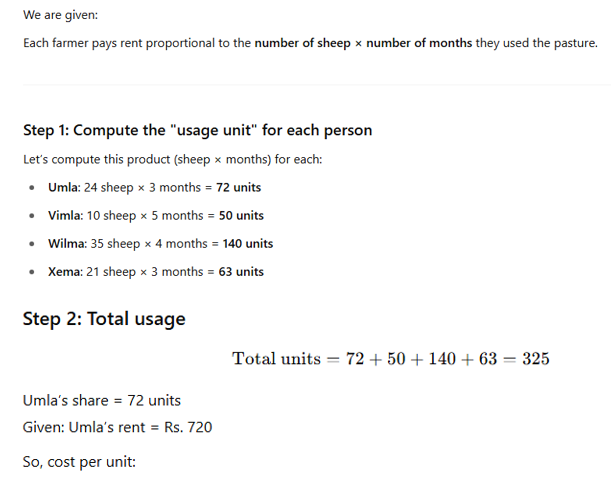
Umla 24 × 3 = 72, Vimla 10 × 5 = 50, Wilma 35 × 4 = 140, Xema 21 × 3 = 63
Total = 72 + 50 + 140 + 63 = 325 units
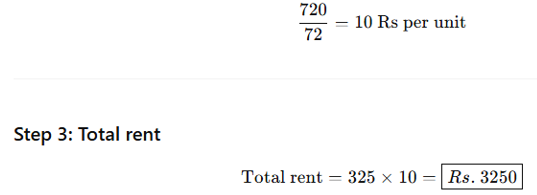
Umla's 72 units = ₹720 → 1 unit = ₹10
Total rent = 325 × 10 = ₹3250
Cetking shortcut: ₹720/72 = ₹10 per sheep-month, so the total must be 325 × 10.
Answer: D
A copper wire having length of 243 m and diameter 4 mm was melted to form a sphere. Find the diameter of the sphere thus formed ?
- A16cm
- B24cm
- C18cm
- D22cm
- E20cm
Show answerHide answer
Answer: C
Approach: Equate volumes in cm.
Solution:
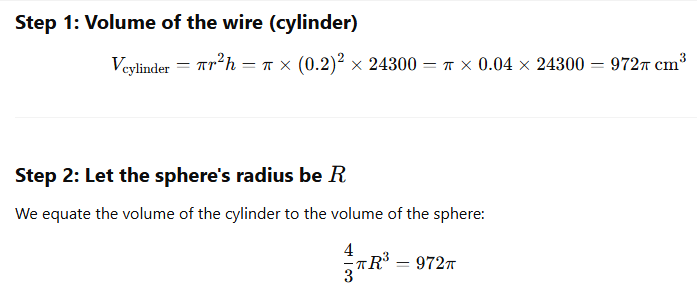
Wire: r = 2 mm = 0.2 cm, length = 243 m = 24300 cm
Volume = π × 0.2² × 24300 = 972π cm³
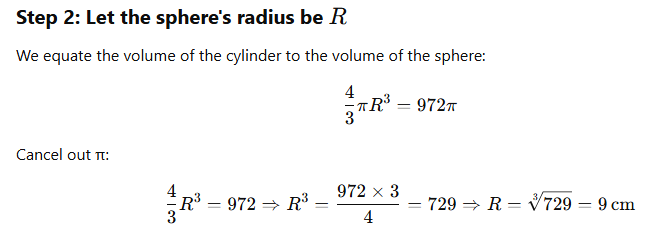
Sphere: (4/3)πR³ = 972π → R³ = 729 → R = 9 cm
Diameter = 18 cm
Cetking shortcut: R³ = (3/4) × 0.04 × 24300 = 729 — a perfect cube, confirming R = 9.
Answer: C
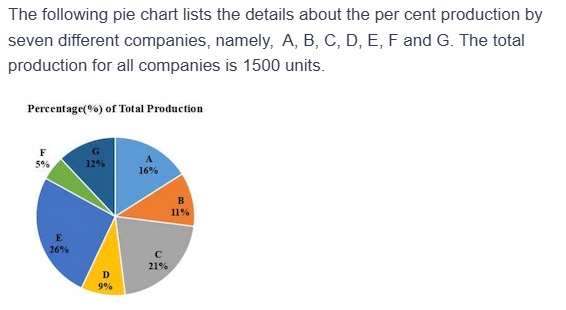
The following pie chart lists the details about the per cent production by seven different companies, namely, A, B, C, D, E, F and G. The total production for all companies is 1500 units.
Percentage(%) of Total Production: A 16%, B 11%, C 21%, D 9%, E 26%, F 5%, G 12%.
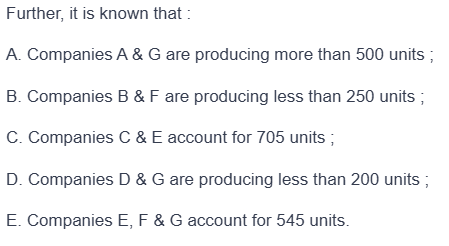
Further, it is known that
A. Companies A & G are producing more than 500 units ;
B. Companies B & F are producing less than 250 units ;
C. Companies C & E account for 705 units ;
D. Companies D & G are producing less than 200 units ;
E. Companies E, F & G account for 545 units.
Choose which of the following is correct
- AOnly A,D and E are true
- BOnly A and E are true
- COnly C and E are true
- DOnly B and C are true
- EOnly A and D are true
Show answerHide answer
Answer: D
Approach: 1% of 1500 = 15 units; add the percentages of each group and convert.
Solution:
Statement A: A + G = 16% + 12% = 28% = 420 → not more than 500 → false
Statement B: B + F = 11% + 5% = 16% = 240 → less than 250 → true
Statement C: C + E = 21% + 26% = 47% = 705 → true
Statement D: D + G = 9% + 12% = 21% = 315 → not less than 200 → false
Statement E: E + F + G = 26% + 5% + 12% = 43% = 645 ≠ 545 → false
Only B and C are true
Why the other options are wrong:
A, B, E: each includes statement A (420, not more than 500).
C: includes statement E (645, not 545).
Cetking shortcut: Convert thresholds to %: 500 = 33.3%, 250 = 16.7%, 705 = 47%, 200 = 13.3%, 545 = 36.3% — compare percentages directly.
Answer: D
In a local election between two candidates, one candidate got 55% of the total valid votes and was declared as winner. 15% of the votes were invalid. If the total number of votes polled were 15200, what were the valid votes of the loser ?
- A5832
- B5416
- C6018
- D5800
- E5814
Show answerHide answer
Answer: E
Approach: Valid votes first, then loser's share.
Solution:
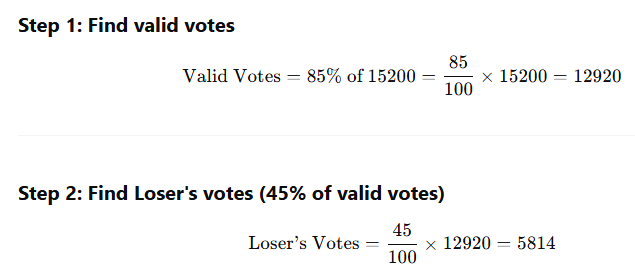
Valid votes = 85% of 15200 = 12920
Loser's share = 100% − 55% = 45%
Loser's votes = 45% of 12920 = 5814
Cetking shortcut: 0.85 × 0.45 = 0.3825; 0.3825 × 15200 = 5814.
Answer: E
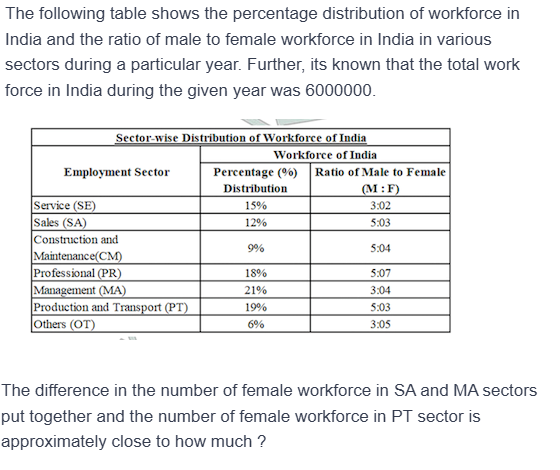
Questions 123–124 share this
The following table shows the percentage distribution of workforce in India and the ratio of male to female workforce in India in various sectors during a particular year. Further, its known that the total work force in India during the given year was 6000000.
| Employment Sector | Percentage (%) Distribution | Ratio of Male to Female (M:F) |
|---|
| Service (SE) | 15% | 3:2 |
| Sales (SA) | 12% | 5:3 |
| Construction and Maintenance(CM) | 9% | 5:4 |
| Professional (PR) | 18% | 5:7 |
| Management (MA) | 21% | 3:4 |
| Production and Transport(PT) | 19% | 5:3 |
| Others (OT) | 6% | 3:5 |
The number of male workforce in SA and MA sectors put together is, approximately what percent of the total number of workforce in the PT sector ?
- A80%
- B87%
- C85%
- D90%
- E89%
Show answerHide answer
Answer: B
Approach: Work in % of total workforce; the total cancels.
Solution:
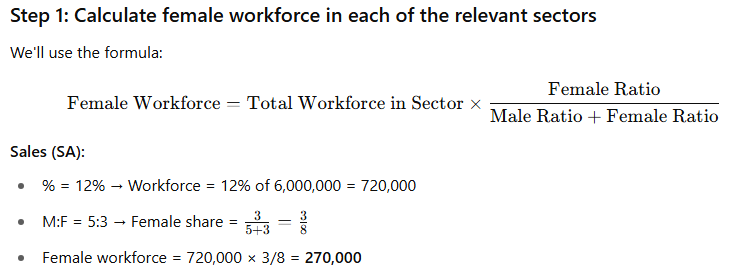
SA = 12%, M:F = 5:3 → male = 12 × 5/8 = 7.5%
MA = 21%, M:F = 3:4 → male = 21 × 3/7 = 9%
Male in SA + MA = 16.5%
PT total = 19%
Required % = 16.5/19 × 100 = 86.8% ≈ 87%
Cetking shortcut: Never multiply by 6,000,000 for a percent-of question — 16.5/19 is just under 87%.
Answer: B
Refer to the passage above ↑
The difference in the number of female workforce in SA and MA sectors put together and the number of female workforce in PT sector is approximately close to how much ?
- A560000
- B510000
- C570000
- D550000
- E1320000
Show answerHide answer
Answer: A
Approach: Female shares in % of total, then convert.
Solution:
SA female = 12% × 3/8 = 4.5%
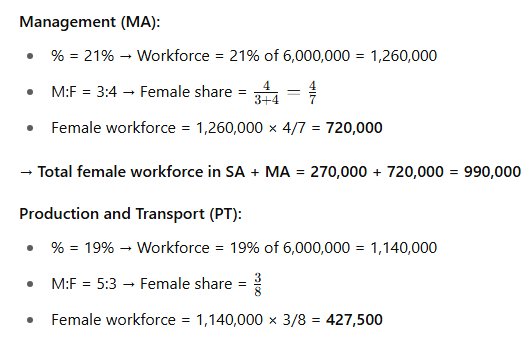
MA female = 21% × 4/7 = 12%
SA + MA female = 16.5%
PT female = 19% × 3/8 = 7.125%
Difference = 16.5 − 7.125 = 9.375% of 6,000,000 = 5,62,500 ≈ 5,60,000
Why the other options are wrong:
B, C, D: 510000, 570000 and 550000 are all further from 562500.
E (1320000): adds the two groups instead of subtracting.
Cetking shortcut: 1% = 60,000; 9.375 × 60,000 = 5,62,500.
Answer: A
One year payment to the servant is Rs. 90 plus one gift coupon. The servant leaves after 9 months and receives Rs. 65 and a gift coupon. Determine the value of the gift coupon ?
- A7.5
- B15
- C10
- D12
- E18
Show answerHide answer
Answer: C
Approach: Prorate the whole annual package.
Solution:
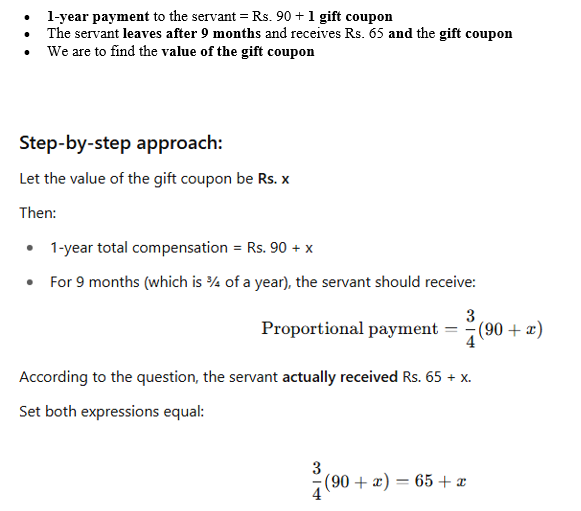
Let gift = G. Annual pay = 90 + G
9 months' pay = (3/4)(90 + G)
(3/4)(90 + G) = 65 + G
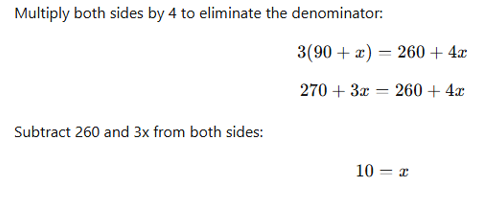
67.5 + 0.75G = 65 + G → 0.25G = 2.5 → G = ₹10
Cetking shortcut: 3 months' pay = (90 + G) − (65 + G) = 25 → annual = 100 → G = 100 − 90 = 10.
Answer: C
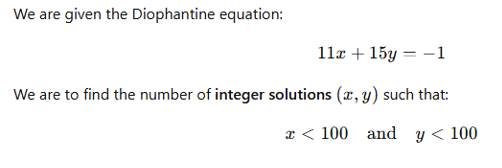
How many integer solutions exists for the equation 11x + 15y = -1 such that both x and y are less than 100
- A1
- B15
- C17
- D16
- E20
Show answerHide answer
Answer: D
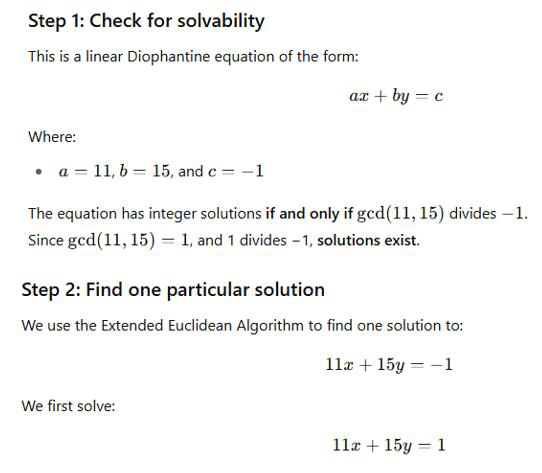
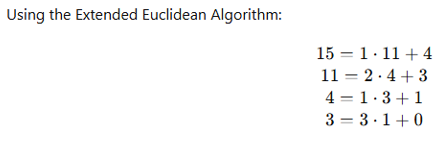
Approach: Find one solution, write the general form, count valid t.
Solution:
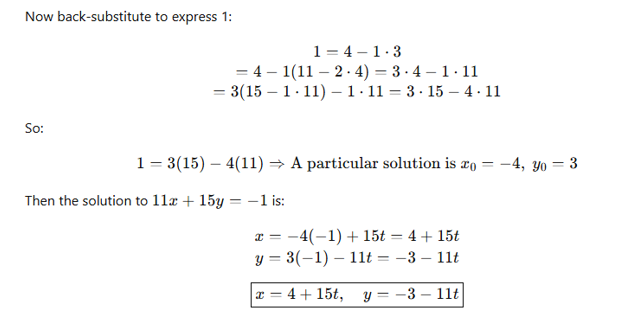
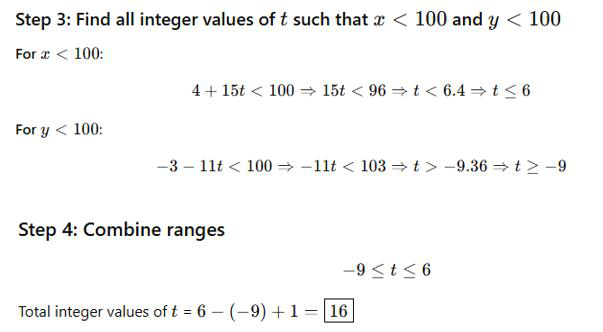
Particular solution: x = 4, y = −3 (44 − 45 = −1)
General: x = 4 + 15t, y = −3 − 11t
x < 100 → 15t < 96 → t ≤ 6
y < 100 → −11t < 103 → t ≥ −9
t = −9, −8, …, 6 → 16 values
Cetking shortcut: Count t-values as 6 − (−9) + 1 = 16; watch the off-by-one traps (15 and 17).
Answer: D
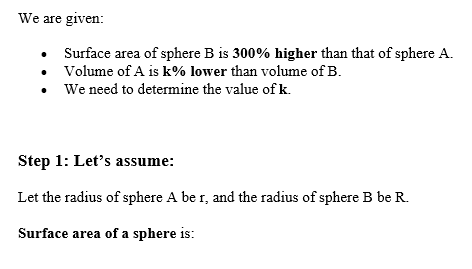
Let A and B be two solid spheres such that the surface area of B is 300% higher than the surface area of A. The volume of A is found to be k% lower than the volume of B. Determine the value of k :
- A85.5
- B92.5
- C87.5
- D88.5
- E90.5
Show answerHide answer
Answer: C
Approach: Area ratio → radius ratio → volume ratio.
Solution:
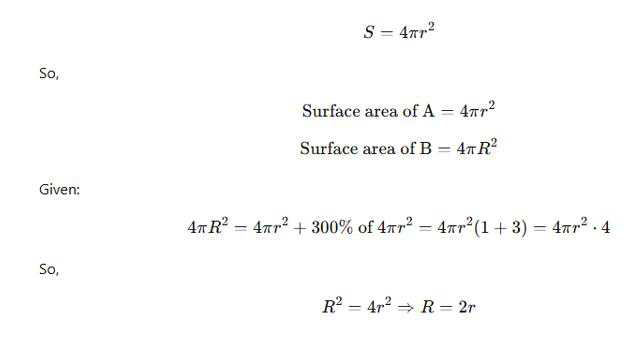
SA of B = SA of A + 300% = 4 × SA of A
r_B/r_A = √4 = 2
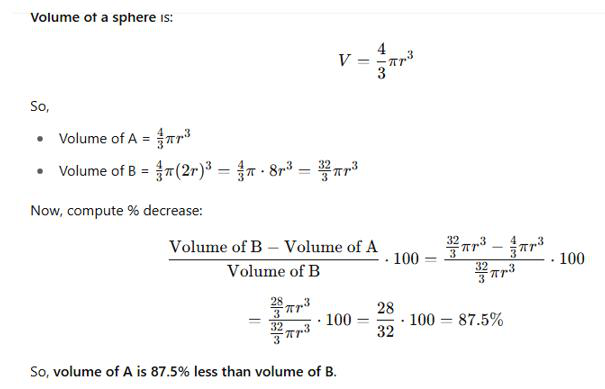
V_B/V_A = 2³ = 8
V_A is lower than V_B by (8 − 1)/8 = 7/8 = 87.5%
Cetking shortcut: 'k% lower than B' uses B as base: 1 − 1/8 = 87.5%.
Answer: C
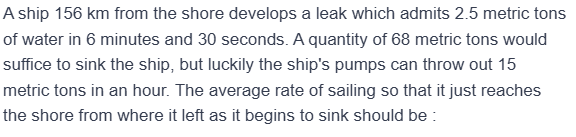
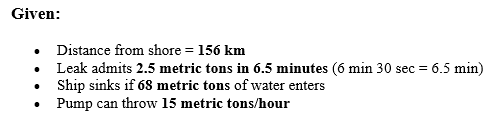
A ship 156 km from the shore develops a leak which admits 2.5 metric tons of water in 6 minutes and 30 seconds. A quantity of 68 metric tons would suffice to sink the ship, but luckily the ship's pumps can throw out 15 metric tons in an hour. The average rate of sailing so that it just reaches the shore from where it left as it begins to sink should be :
- A25kmph
- B10kmph
- C18kmph
- D15kmph
- E60kmph
Show answerHide answer
Answer: C
Approach: Net water rate → time to sink → required speed.
Solution:
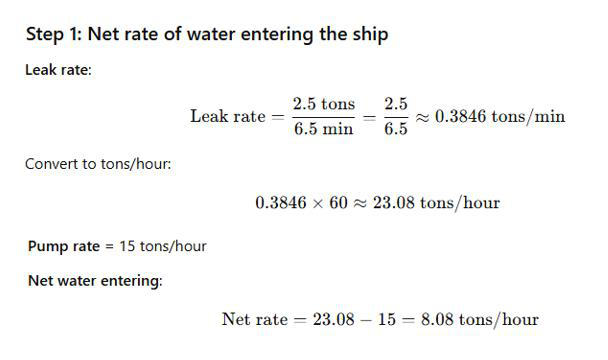
Leak: 2.5 t in 6.5 min → 2.5 × 60/6.5 = 300/13 ≈ 23.08 t/h
Pump: 15 t/h → net inflow = 300/13 − 15 = 105/13 ≈ 8.08 t/h
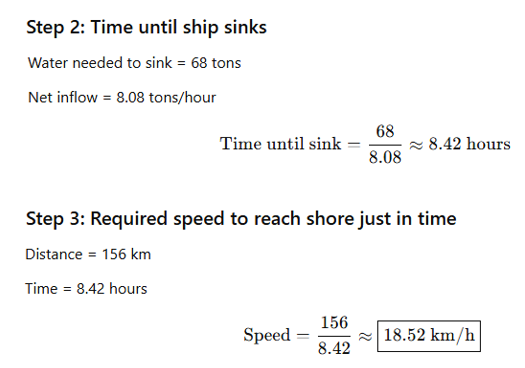
Time to take in 68 t = 68 × 13/105 ≈ 8.42 h
Speed = 156/8.42 ≈ 18.5 km/h → 18 km/h
Why the other options are wrong:
A (25), E (60): far above the required rate.
B (10), D (15): the ship would sink before reaching the shore.
Cetking shortcut: 156 km ÷ about 8.4 h is about 18.5 km/h; 18 is the only option in that range.
Answer: C
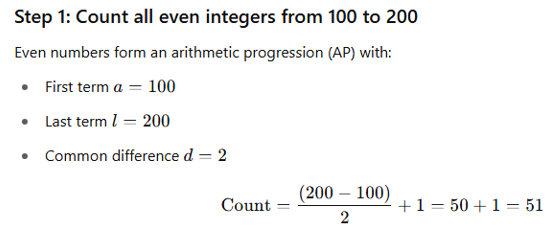
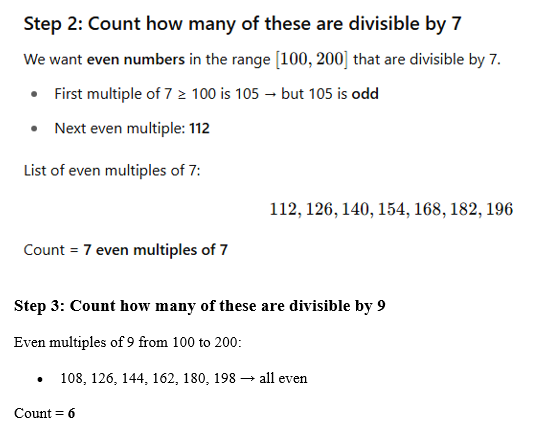
How many even integers 'n', where, 100 ≤ n ≤ 200, are divisible neither by 7 nor by 9 ?
- A37
- B38
- C39
- D44
- E40
Show answerHide answer
Answer: C
Approach: Even numbers 100–200, remove multiples of 14 and 18, add back multiples of 126.
Solution:
Even numbers from 100 to 200 inclusive: (200 − 100)/2 + 1 = 51
Multiples of 14: 112 to 196 → 14 × 8 to 14 × 14 → 7
Multiples of 18: 108 to 198 → 18 × 6 to 18 × 11 → 6
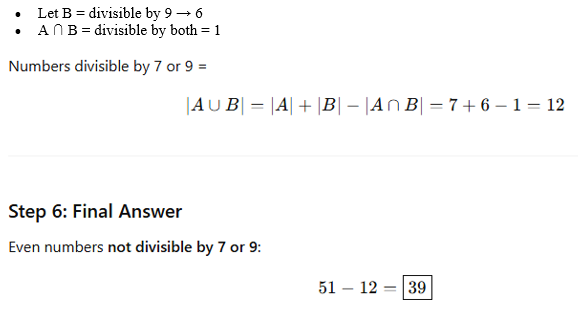
Multiples of LCM(14, 18) = 126: only 126 → 1
Neither = 51 − 7 − 6 + 1 = 39
Cetking shortcut: Only even multiples matter: count with 14 and 18, not 7 and 9.
Answer: C
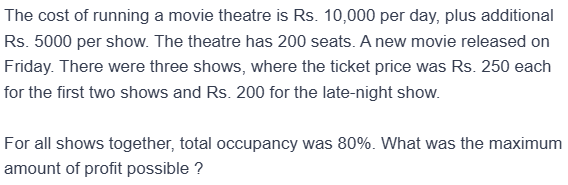
The cost of running a movie theatre is Rs. 10,000 per day, plus additional Rs. 5000 per show. The theatre has 200 seats. A new movie released on Friday. There were three shows, where the ticket price was Rs. 250 each for the first two shows and Rs. 200 for the late-night show.
For all shows together, total occupancy was 80%. What was the maximum amount of profit possible ?
- A120000rs
- B116000rs
- C91000rs
- D95000rs
- E87500rs
Show answerHide answer
Answer: C
Approach: Fix total tickets, push them into ₹250 shows, then subtract all costs.
Solution:
Cost = 10,000 + 3 × 5,000 = ₹25,000
Tickets sold = 80% of (3 × 200) = 480
Max revenue: 200 + 200 tickets at ₹250 and 80 at ₹200
Revenue = 50,000 + 50,000 + 16,000 = ₹1,16,000
Profit = 1,16,000 − 25,000 = ₹91,000
Why the other options are wrong:
B (116000): that is revenue, not profit.
A (120000): puts all 480 tickets in ₹250 shows, ignoring the 200-seat limit per show.
E (87500): near the equal-occupancy profit (₹87,000), not the maximum.
D (95000): that is 120000 − 25000, built on the same seat-limit mistake.
Cetking shortcut: Equal split gives 160 × (250 + 250 + 200) = 1,12,000; moving 80 tickets from ₹200 to ₹250 shows adds 80 × 50 = 4,000 → 1,16,000 − 25,000 = 91,000.
Answer: C
The least common multiple of a number and 990 is 6930. The greatest common divisor of that number and 550 is 110. What is the sum of the digits of the least possible value of that number ?
- A16
- B14
- C3
- D9
- E18
Show answerHide answer
Answer: B
Approach: Prime-factorise and read each prime's exponent in x.
Solution:
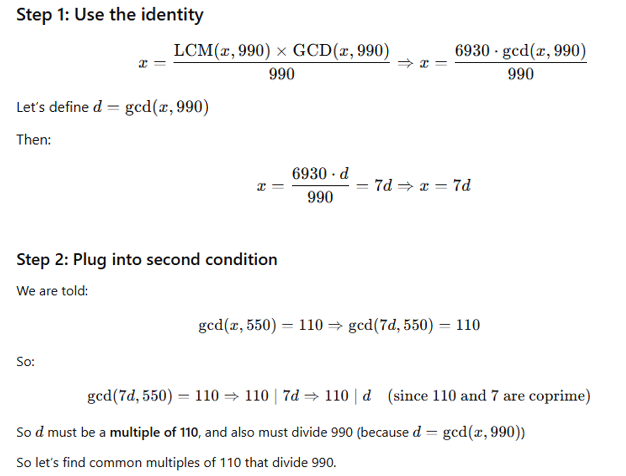
990 = 2 × 3² × 5 × 11; 6930 = 2 × 3² × 5 × 7 × 11
LCM has 7 and 990 has no 7 → x must contain 7
x divides 6930 → at most 2¹, 3², 5¹, 7¹, 11¹
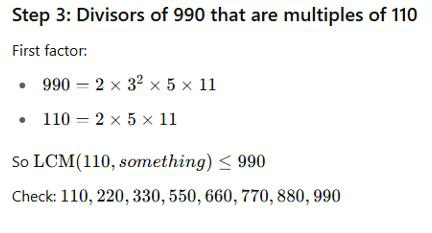
550 = 2 × 5² × 11; GCD = 110 = 2 × 5 × 11 → x contains 2, 5 and 11
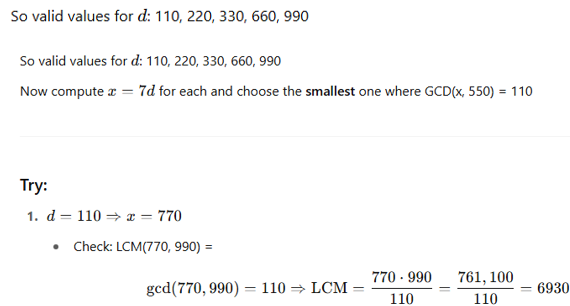
So x = 2 × 5 × 7 × 11 × 3ᵃ, a = 0, 1 or 2
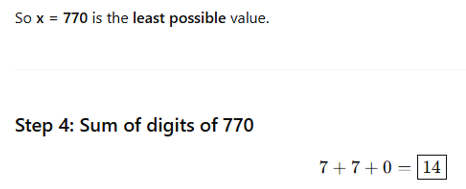
Least x = 770 → digit sum = 7 + 7 + 0 = 14
Cetking shortcut: Least x = product of the forced primes 2 × 5 × 7 × 11 = 770.
Answer: B
How many isosceles triangles with integer sides are possible such that sum of two of the side is 12 ?
- A16
- B17
- C24
- D2
- E23
Show answerHide answer
Answer: B
Approach: Sides (a, a, b) with some pair summing to 12.
Solution:
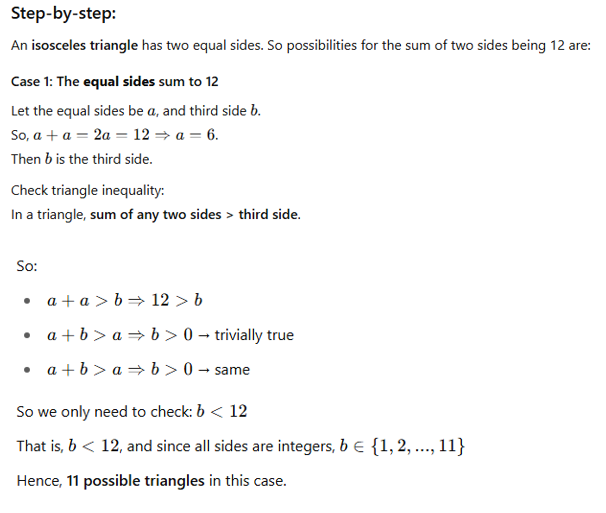
Case 1: a + a = 12 → a = 6, base b < 12 → b = 1 to 11 → 11 triangles
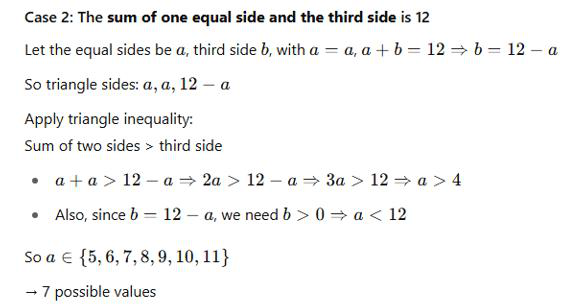
Case 2: a + b = 12 (b ≠ a), need b < 2a → 12 − a < 2a → a > 4
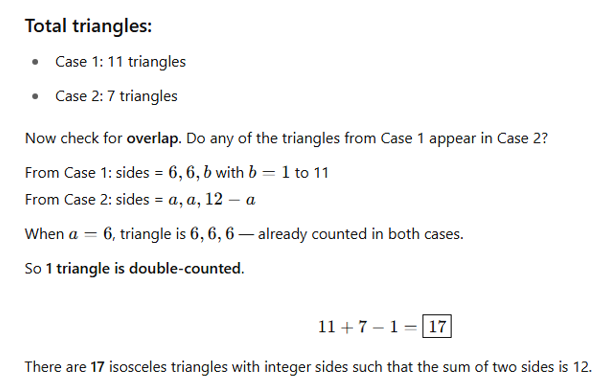
a = 5, 7, 8, 9, 10, 11 (a = 6 gives b = 6, already counted) → 6 triangles
Total = 11 + 6 = 17
Why the other options are wrong:
A (16): drops the equilateral 6-6-6.
C (24), E (23): ignore the triangle inequality.
D (2): counts only one side pattern.
Answer: B
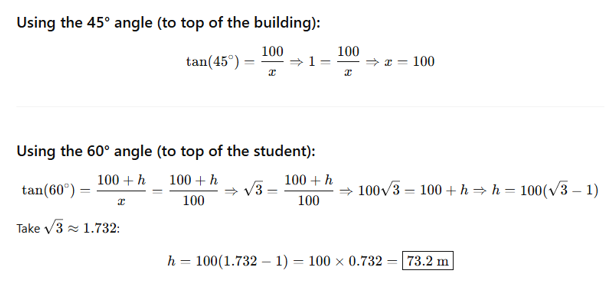
A student is standing with a banner at the top of a 100 m high college building. From a point on the ground, the angle of elevation of the top of the student is 60° and from the same point, the angle of elevation of the top of the tower is 45°. Find the height of the student ?
- A35.7m
- B75.2m
- C50m
- D73.2m
- E75m
Show answerHide answer
Answer: D
Approach: Use the 45° angle for the distance, the 60° angle for the total height.
Solution:
Building = 100 m, angle 45° → distance x = 100 m
Top of student: tan 60° = (100 + h)/100
100 + h = 100√3 = 173.2
h = 73.2 m
Cetking shortcut: h = 100(√3 − 1) = 100 × 0.732 = 73.2.
Answer: D
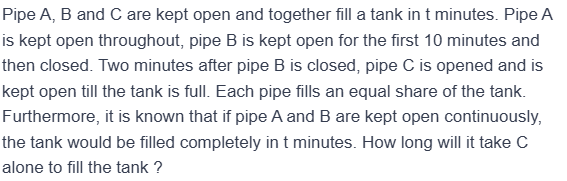
Pipe A, B and C are kept open and together fill a tank in t minutes. Pipe A is kept open throughout, pipe B is kept open for the first 10 minutes and then closed. Two minutes after pipe B is closed, pipe C is opened and is kept open till the tank is full. Each pipe fills an equal share of the tank. Furthermore, it is known that if pipe A and B are kept open continuously, the tank would be filled completely in t minutes. How long will it take C alone to fill the tank ?
- A20min
- B24min
- C32min
- D48min
- E18min
Show answerHide answer
Answer: B
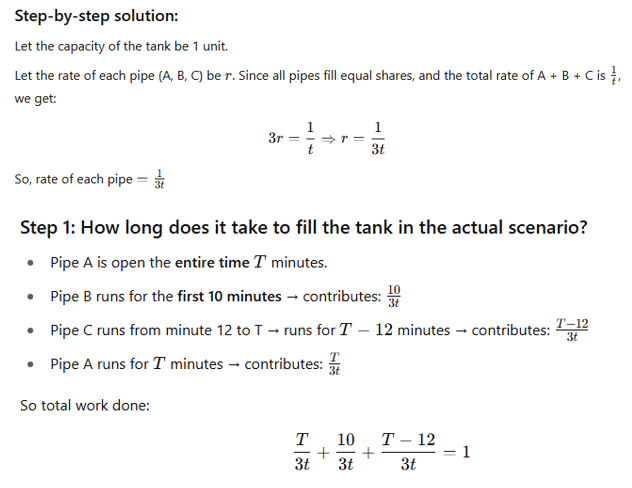
Approach: Each pipe fills 1/3; use 'A + B together fill in t' to find t.
Solution:
A is open all t minutes and fills 1/3 → rate of A = 1/(3t)
B is open 10 minutes and fills 1/3 → rate of B = 1/30
A + B fill the tank in t: 1/(3t) + 1/30 = 1/t
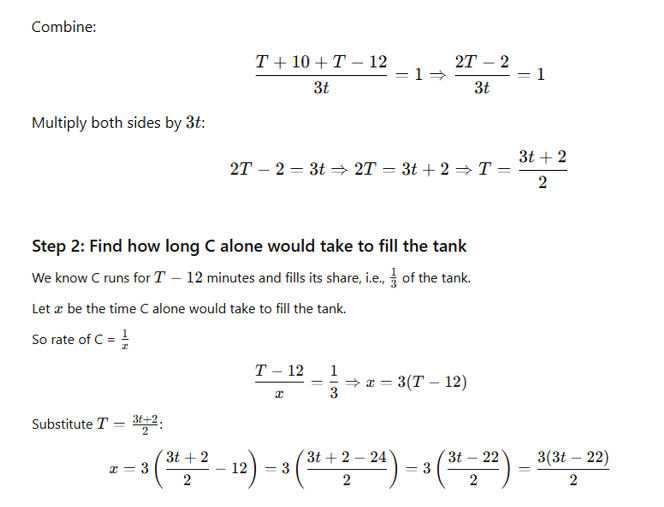
1/30 = 2/(3t) → t = 20 minutes
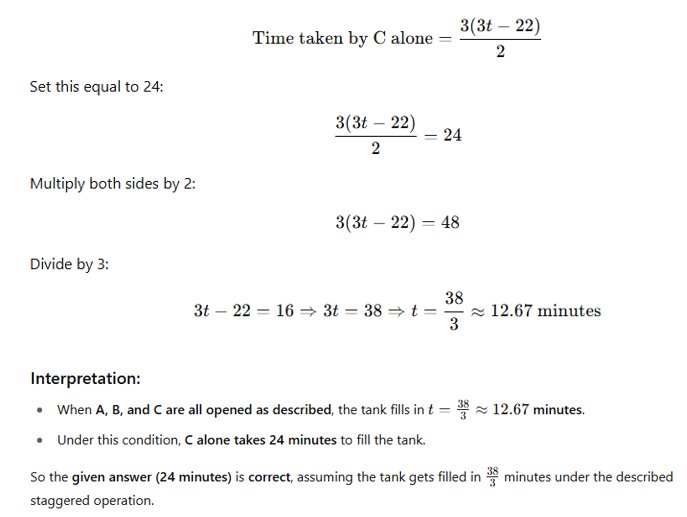
C is open from minute 12 to 20 = 8 minutes and fills 1/3
C alone = 8 × 3 = 24 minutes
Cetking shortcut: Once t = 20, C's window is 20 − 12 = 8 min for one-third → 24 min alone.
Answer: B
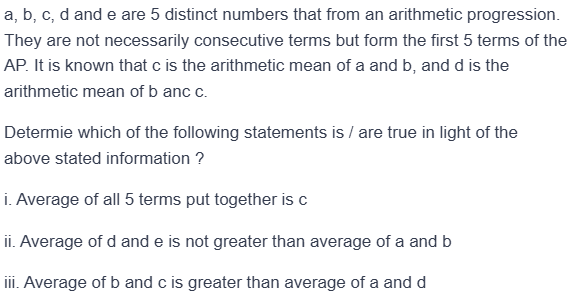
a, b, c, d and e are 5 distinct numbers that from an arithmetic progression. They are not necessarily consecutive terms but form the first 5 terms of the AP. It is known that c is the arithmetic mean of a and b, and d is the arithmetic mean of b anc c.
Determie which of the following statements is / are true in light of the above stated information ?
i. Average of all 5 terms put together is c
ii. Average of d and e is not greater than average of a and b
iii. Average of b and c is greater than average of a and d
- Ai and ii only
- Bi and iii only
- Cii and iii only
- Dii only
- Ei ,ii and iii
Show answerHide answer
Answer: A
Approach: Place a, b, c, d on a number line, then fit e.
Solution:
Take a = 0, b = 4k (k ≠ 0). c = mean of a, b = 2k; d = mean of b, c = 3k
0, 2k, 3k, 4k plus e must be 5 equally spaced values → e = k (common gap k)
So a = 0, e = k, c = 2k, d = 3k, b = 4k
i. Average = (0 + k + 2k + 3k + 4k)/5 = 2k = c → true
ii. Avg(d, e) = 2k, Avg(a, b) = 2k → 'not greater' → true
iii. Avg(b, c) = 3k vs Avg(a, d) = 1.5k → greater only if k > 0; for a decreasing AP (k < 0) it fails → not necessarily true
Why the other options are wrong:
B, C, E: treat iii as always true, but it reverses for a decreasing AP.
D: misses statement i, which holds for every k.
Cetking shortcut: Equalities and 'not greater' (here an equality) survive a sign flip of k; a strict 'greater' comparison does not.
Answer: A
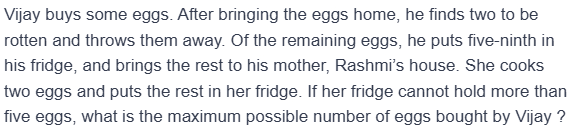
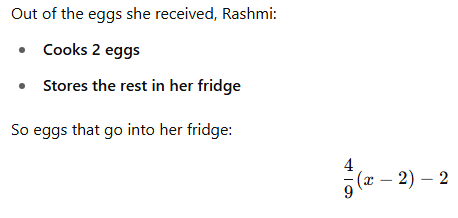
Vijay buys some eggs. After bringing the eggs home, he finds two to be rotten and throws them away. Of the remaining eggs, he puts five-ninth in his fridge, and brings the rest to his mother, Rashmi's house. She cooks two eggs and puts the rest in her fridge. If her fridge cannot hold more than five eggs, what is the maximum possible number of eggs bought by Vijay ?
- A17
- B11
- C16
- D23
- E20
Show answerHide answer
Answer: B
Approach: Inequality from the fridge limit + whole-number condition.
Solution:
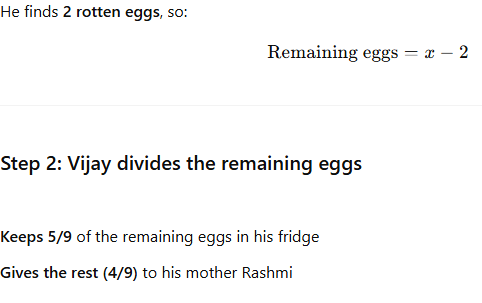
Vijay buys x; good eggs = x − 2
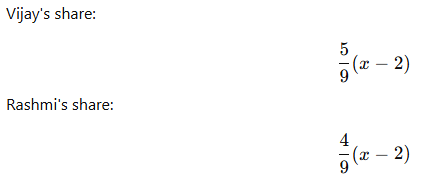
His fridge: 5/9(x − 2); to mother: 4/9(x − 2)
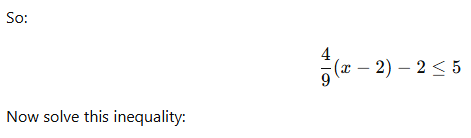
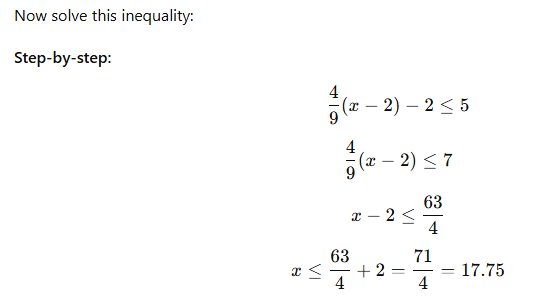
Her fridge: 4/9(x − 2) − 2 ≤ 5 → x − 2 ≤ 15.75 → x ≤ 17.75
Eggs are whole → x − 2 must be a multiple of 9 → x − 2 = 9 (18 exceeds 15.75)
x = 11: 9 good eggs, 5 in his fridge, 4 to mother, she cooks 2, 2 go in her fridge ✓
Why the other options are wrong:
A (17): 15 good eggs → 5/9 × 15 = 8⅓ eggs — impossible.
C (16), D (23): x − 2 = 14 and 21 — not multiples of 9.
E (20): 18 good eggs → 8 to mother → 6 in her fridge, more than 5.
Cetking shortcut: Check options for (x − 2) divisible by 9: only 11 and 20 qualify; 20 puts 6 eggs in her fridge, so 11.
Answer: B
Some coins are to be put into 7 pockets so that each pocket contains at least one coin. At most 3 of the pockets are to contain the same number of coins, and no two of the remaining pockets are to contain an equal number of coins. What is the least possible number of coins needed for the pockets ?
- A17
- B7
- C28
- D13
- E22
Show answerHide answer
Answer: A
Approach: Greedy: three pockets with the smallest count, four with the next distinct values.
Solution:
3 pockets × 1 coin = 3
Remaining 4 pockets must be distinct and ≠ 1 → 2, 3, 4, 5 = 14
Total = 3 + 14 = 17
Check: 3 × 2 + (1, 3, 4, 5) = 19 and 3 × 3 + (1, 2, 4, 5) = 21 → larger
Why the other options are wrong:
B (7): needs all 7 pockets with 1 coin — breaks 'at most 3 same'.
D (13): impossible — the minimum arrangement already needs 17.
C (28): all distinct 1–7, not the minimum.
E (22): not minimal.
Cetking shortcut: Put the repeat on the smallest value: 1 + 1 + 1 + 2 + 3 + 4 + 5 = 17.
Answer: A
Read the Question given below and choose the option that is sufficient to answer the Question.
What is the monthly rent for a certain apartment ?
(1) The monthly rent per person for 4 people to share the rent for the apartment is $375.
(2) The monthly rent per person for 4 people to share the rent of the apartment is $125 less than the monthly rent per person for 3 people to share the rent.
- AStatement 1 alone is sufficient, but statement 2 alone is not
- BStatement 2 alone is sufficient, but statement 1 alone is not
- CBoth together are sufficient, but neither alone
- DEach statement alone is sufficient
- EBoth 1 and 2 together are not sufficient
Show answerHide answer
Answer: D
Approach: Test each statement separately for a unique rent R.
Solution:
Statement 1: R/4 = 375 → R = $1500 → sufficient
Statement 2: R/3 − R/4 = 125 → R/12 = 125 → R = $1500 → sufficient
Each statement alone is sufficient
Why the other options are wrong:
A, B: ignore that the other statement also works alone.
C: neither statement needs the other.
E: both clearly give a value.
Cetking shortcut: Statement 2 is one equation in one unknown — sufficient without solving.
Answer: D
If a certain wheel turns at a constant rate of x revolutions per minute, how many revolutions will the wheel make in k seconds ?
- Akx/60
- Bx/(60k)
- Ckx
- Dx/k
- E60kx
Show answerHide answer
Answer: A
Approach: Convert k seconds to minutes and multiply by the rate.
Solution:
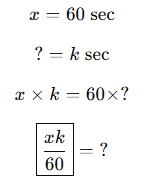
Rate = x revolutions per minute = x/60 revolutions per second
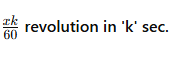
In k seconds: (x/60) × k = kx/60
Why the other options are wrong:
B, D: divide by k — revolutions must grow with time.
C: forgets the minute-to-second conversion.
E: converts the wrong way (× 60).
Cetking shortcut: Plug numbers: x = 60 rpm, k = 1 s → 1 revolution; only kx/60 gives 1.
Answer: A
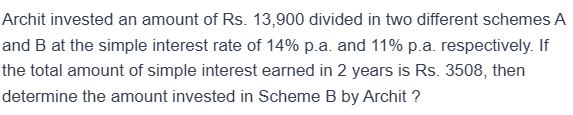
Archit invested an amount of Rs. 13,900 divided in two different schemes A and B at the simple interest rate of 14% p.a. and 11% p.a. respectively. If the total amount of simple interest earned in 2 years is Rs. 3508, then determine the amount invested in Scheme B by Archit ?
- A6400
- B6500
- C7200
- D7500
- E6800
Show answerHide answer
Answer: A
Approach: Simple interest equation for 2 years.
Solution:
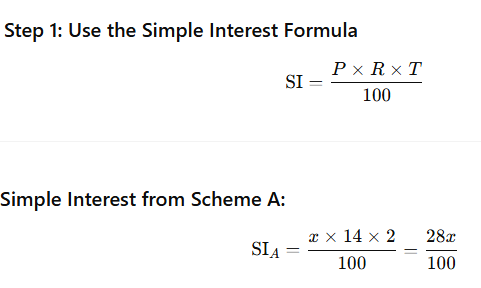
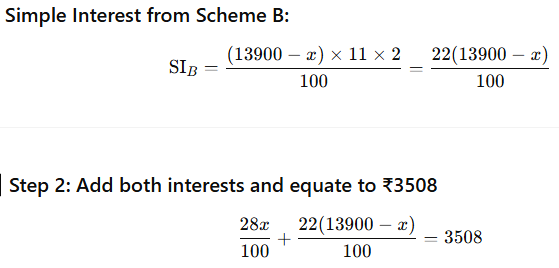
Let A = x, B = 13900 − x
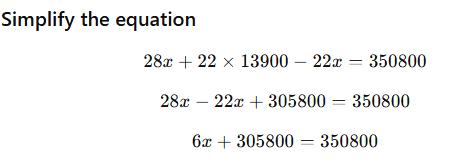
2 × [0.14x + 0.11(13900 − x)] = 3508
0.14x + 0.11(13900 − x) = 1754
0.03x + 1529 = 1754 → x = 7500
Scheme B = 13900 − 7500 = ₹6400
Why the other options are wrong:
D (7500): that is the Scheme A amount.
Cetking shortcut: If all ₹13,900 earned 14%, yearly SI = ₹1946; actual = ₹1754; shortfall 192 = 3% of B → B = 192/0.03 = ₹6400.
Answer: A
Choose the correct option that should come next in the series given below :
2, 1, (1/2), (1/4), ...
- A1/16
- B2/8
- C1/3
- D1/32
- E1/8
Show answerHide answer
Answer: E
Approach: Identify the common ratio.
Solution:
2 → 1 → ½ → ¼: each term is half the previous one
Next term = ¼ × ½ = 1/8
Why the other options are wrong:
A (1/16), D (1/32): skip one or two terms.
B (2/8): equals 1/4, the current term.
C (1/3): breaks the halving pattern.
Answer: E
Two friends, Alka and Alkit appear for an interview for two vacancies for the same post in an Organisation. The probability of Alka's selection is 1/7 and Alkit is 1/5. What is the probability that only one of them will be selected ?
- A1/35
- B8/15
- C4/5
- D4/35
- E2/7
Show answerHide answer
Answer: E
Approach: Two exclusive cases: only Alka or only Alkit.
Solution:
P(Alka) = 1/7 → P(not Alka) = 6/7; P(Alkit) = 1/5 → P(not Alkit) = 4/5
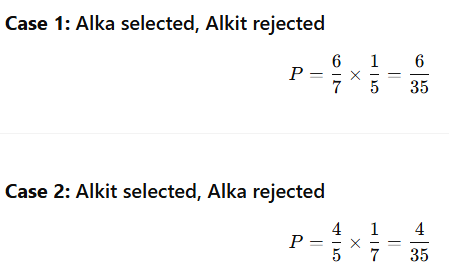
Only Alka: 1/7 × 4/5 = 4/35
Only Alkit: 6/7 × 1/5 = 6/35
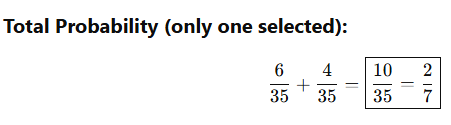
P(only one) = 4/35 + 6/35 = 10/35 = 2/7
Why the other options are wrong:
A (1/35): both selected.
D (4/35): only Alka's case.
B (8/15), C (4/5): mix up selection and rejection probabilities.
Cetking shortcut: P(exactly one) = p + q − 2pq = 1/7 + 1/5 − 2/35 = 10/35 = 2/7.
Answer: E
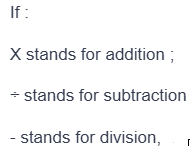
If :
X stands for addition ;
÷ stands for subtraction ;
- stands for division,
+ means multiplication
Then,
20 X 8 ÷ 8 - 4 + 2 shall be equal to
- A22
- B15
- C24
- D25
- E30
Show answerHide answer
Answer: C
Approach: Decode symbols, then BODMAS.
Solution:
X → +, ÷ → −, − → ÷, + → ×
20 X 8 ÷ 8 − 4 + 2 becomes 20 + 8 − 8 ÷ 4 × 2
8 ÷ 4 × 2 = 2 × 2 = 4
20 + 8 − 4 = 24
Cetking shortcut: Write the decoded expression on paper before calculating — most errors come from decoding in your head.
Answer: C
Questions 144–146 share this
Read the information provided and answer the question that follows :
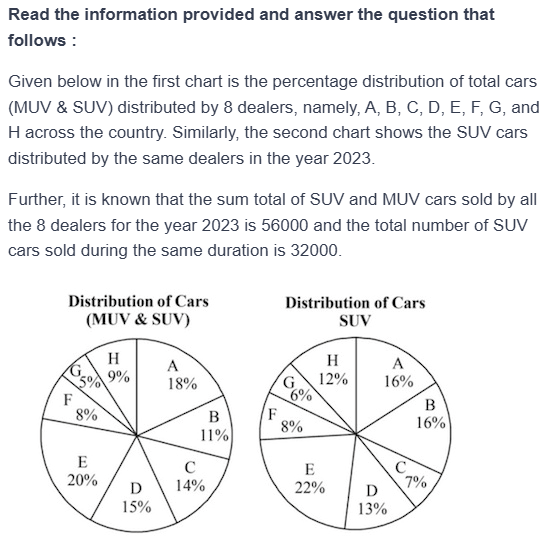
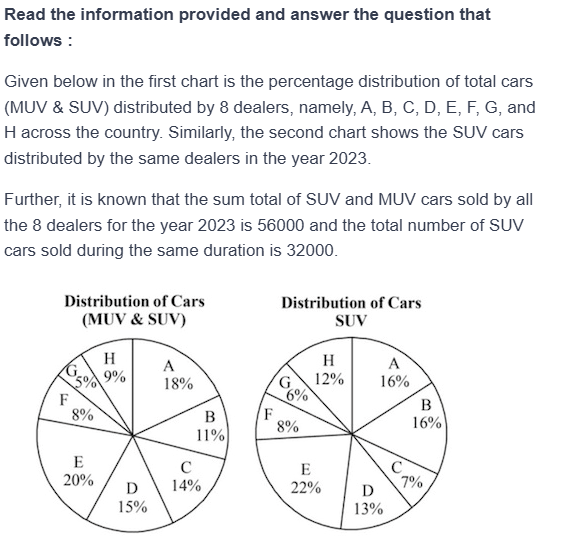
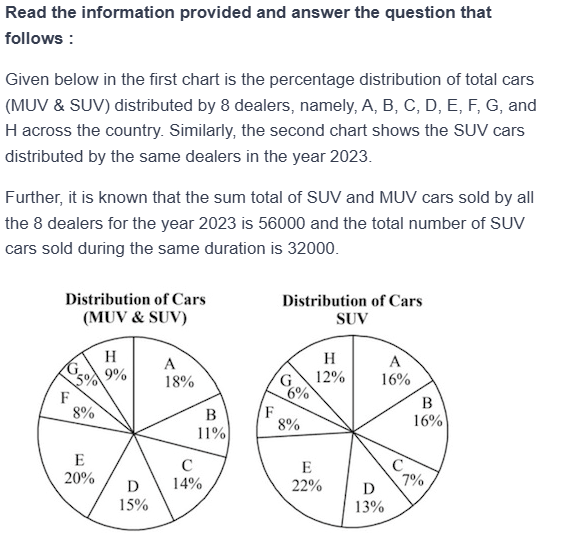
Given below in the first chart is the percentage distribution of total cars (MUV & SUV) distributed by 8 dealers, namely, A, B, C, D, E, F, G, and H across the country. Similarly, the second chart shows the SUV cars distributed by the same dealers in the year 2023.
Further, it is known that the sum total of SUV and MUV cars sold by all the 8 dealers for the year 2023 is 56000 and the total number of SUV cars sold during the same duration is 32000.
Distribution of Cars (MUV & SUV): A 18%, B 11%, C 14%, D 15%, E 20%, F 8%, G 5%, H 9%.
Distribution of Cars SUV: A 16%, B 16%, C 7%, D 13%, E 22%, F 8%, G 6%, H 12%.
The total number of cars sold by the dealer D is by what percentage more than the total number of SUV cars sold by dealers C, F and G together ?
- A75%
- B50%
- C63%
- D33%
- E25%
Show answerHide answer
Answer: E
Approach: Convert each pie share to units with its own total.
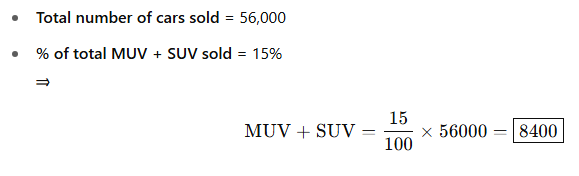
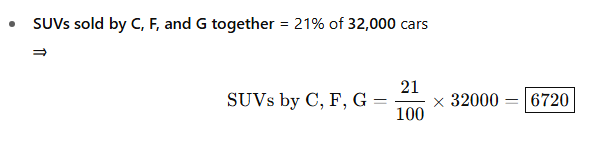
Solution:
Dealer D total cars = 15% of 56000 = 8400
SUVs of C, F, G = (7 + 8 + 6)% = 21% of 32000 = 6720
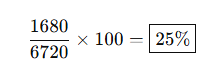
% more = (8400 − 6720)/6720 × 100 = 1680/6720 × 100 = 25%
Why the other options are wrong:
A, B, C, D: come from applying SUV percentages to 56000, or using the wrong base for 'percentage more'.
Cetking shortcut: 8400/6720 = 1.25 → 25% more.
Answer: E
Refer to the passage above ↑
Determine the ratio between the total number of SUV cars distributed by dealers A and B together and total number of SUV and MUV cars distributed by dealers C and F together ?
- A54:77
- B64:73
- C64:77
- D1:4.33
- E64:79
Show answerHide answer
Answer: C
Approach: Convert to units, then simplify.
Solution:
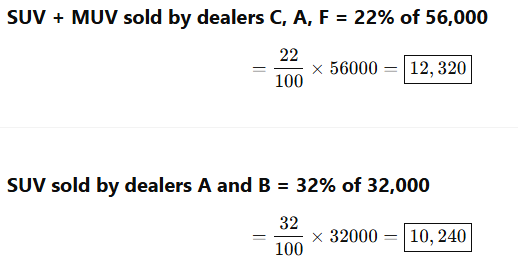
SUV of A + B = (16 + 16)% of 32000 = 10240
All cars of C + F = (14 + 8)% of 56000 = 12320
Ratio = 10240 : 12320 = 64 : 77 (divide by 160)
Why the other options are wrong:
A (54:77), B (64:73), E (64:79): one term altered.
D (1:4.33): no such relation between the groups.
Cetking shortcut: (32 × 32000) : (22 × 56000) = (32 × 4) : (22 × 7) = 128 : 154 = 64 : 77.
Answer: C
Refer to the passage above ↑
Determine the average number of MUV cars distributed by dealers A, D, E, F and H together ?
- A2892
- B3634
- C3326
- D3296
- E3354
Show answerHide answer
Answer: D
Approach: MUV per dealer = total cars − SUVs, then average.
Solution:
A: 18% × 56000 − 16% × 32000 = 10080 − 5120 = 4960
D: 8400 − 4160 = 4240
E: 11200 − 7040 = 4160
F: 4480 − 2560 = 1920
H: 5040 − 3840 = 1200
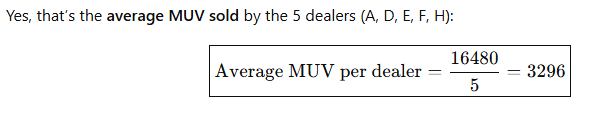
Sum = 16480; average = 16480/5 = 3296
Cetking shortcut: Sum directly: total share (18+15+20+8+9)% = 70% × 56000 = 39200; SUV share (16+13+22+8+12)% = 71% × 32000 = 22720; (39200 − 22720)/5 = 3296.
Answer: D
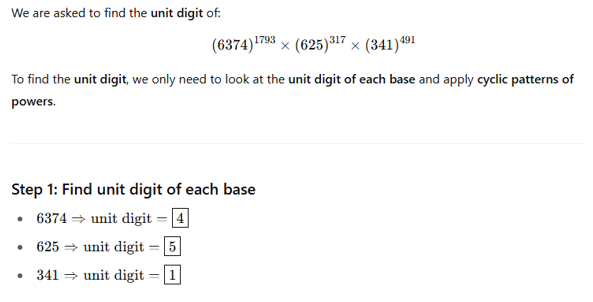
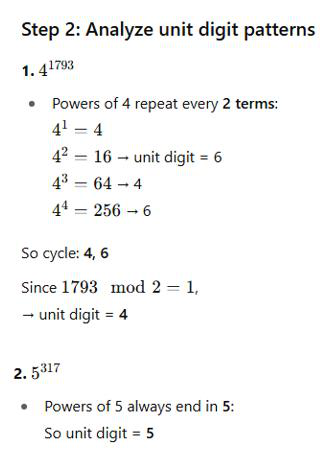
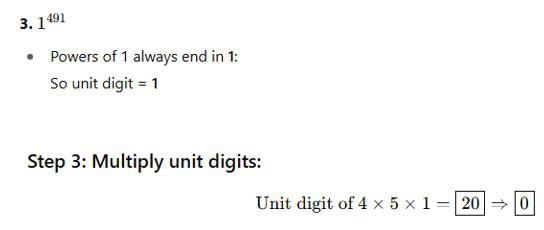
What number shall you get in the unit digit on solving the following problem :
{(6374)^1793 X (625)^317 X (341)^491}
- A0
- B1
- C2
- D3
- E4
Show answerHide answer
Answer: A
Approach: Unit digits only.
Solution:
6374¹⁷⁹³: base ends in 4, odd power → ends in 4 (even)
625³¹⁷: ends in 5
341⁴⁹¹: ends in 1
Product: 4 × 5 × 1 → unit digit 0
Cetking shortcut: Even × (…5) always ends in 0 — no cyclicity needed.
Answer: A
Gajodhar throws two ordinary dice simultaneously. What is the probability that he shall get two numbers whose product shall be an even number ?
- A1/3
- B2/3
- C5/16
- D3/8
- E3/4
Show answerHide answer
Answer: E
Approach: Complement of 'both odd'.
Solution:
P(both odd) = 3/6 × 3/6 = 1/4
P(product even) = 1 − 1/4 = 3/4 (27 of 36 outcomes)
Why the other options are wrong:
A (1/3), B (2/3), C (5/16), D (3/8): none matches 27/36.
Answer: E
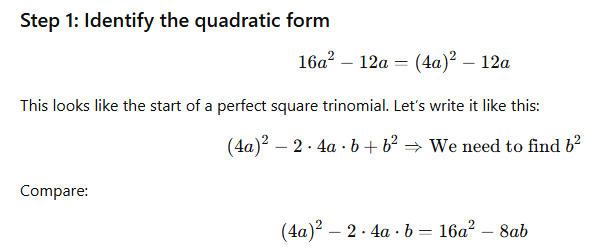
What number must be added to 16a² - 12a to make it a perfect square ?
- A9/4
- B13/2
- C11/2
- D16/9
- E13/4
Show answerHide answer
Answer: A
Approach: Match with (4a − q)².
Solution:
16a² = (4a)², so p = 4a
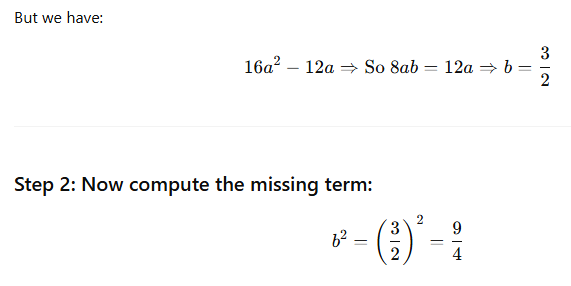
2 × 4a × q = 12a → q = 3/2
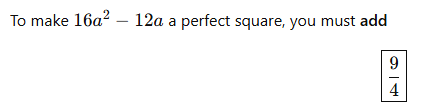
Add q² = 9/4 → 16a² − 12a + 9/4 = (4a − 3/2)²
Cetking shortcut: Number to add = (b²)/(4a) = 144/64 = 9/4.
Answer: A
There are 8436 steel balls, each with a radius of 1 centimeter, stacked in a pile, with 1 ball on top, 3 balls in the second layer, 6 in the third layer, 10 in the fourth, and so on. Determine the number of horizontal layers in the pile ?
- A32
- B36
- C96
- D34
- E24
Show answerHide answer
Answer: B
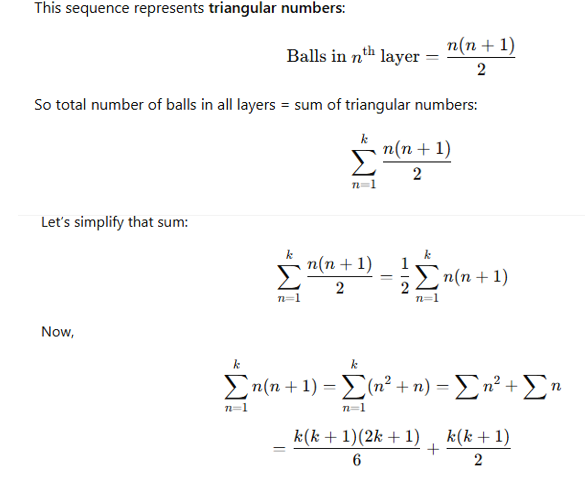
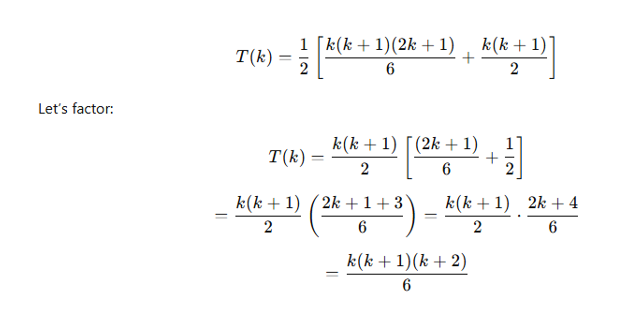
Approach: Sum of triangular numbers = n(n+1)(n+2)/6.
Solution:
Layers: 1, 3, 6, 10, … = n(n+1)/2
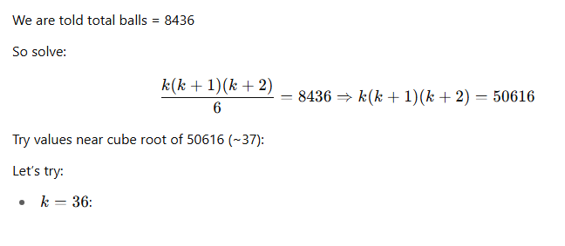
Total = n(n+1)(n+2)/6 = 8436
n(n+1)(n+2) = 50616
Cube root of 50616 ≈ 37 → try 36 × 37 × 38 = 50616 ✓
n = 36 layers
Why the other options are wrong:
A (32), D (34): give 5984 and 7140 balls.
E (24): 2600 balls.
C (96): far too many.
Cetking shortcut: n³/6 ≈ 8436 → n³ ≈ 50600 → n ≈ 37 → the middle of three consecutive numbers is 37, so n = 36.
Answer: B
Identify the Odd One Out from the options provided below :
- AVABK
- BNSTC
- CLQRA
- DQVWE
- EEJKT
Show answerHide answer
Answer: D
Approach: Letter-gap pattern inside each 4-letter group (positions A=1 … Z=26, wrapping after Z).
Solution: Check the gaps between consecutive letters:
VABK: V(22)→A(1) = +5, A→B = +1, B(2)→K(11) = +9
NSTC: N→S = +5, S→T = +1, T(20)→C(3) = +9 (wrap)
LQRA: L→Q = +5, Q→R = +1, R(18)→A(1) = +9 (wrap)
EJKT: E→J = +5, J→K = +1, K(11)→T(20) = +9
QVWE: Q→V = +5, V→W = +1, W(23)→E(5) = +8 (wrap); the pattern needs W+9 = F.
So QVWE breaks the +5, +1, +9 rule.
Why the other options are wrong:
A, B, C, E: all follow +5, +1, +9 exactly.
Cetking shortcut: Middle pair is consecutive in every option, so only the jumps 1st→2nd and 3rd→4th can differ; check the last jump first.
Answer: D
Questions 152–156 share this
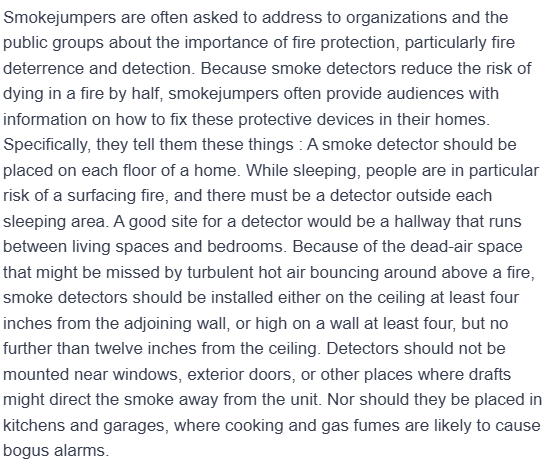
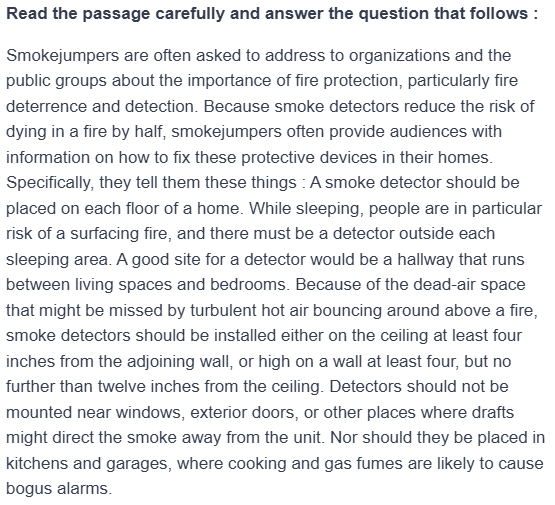
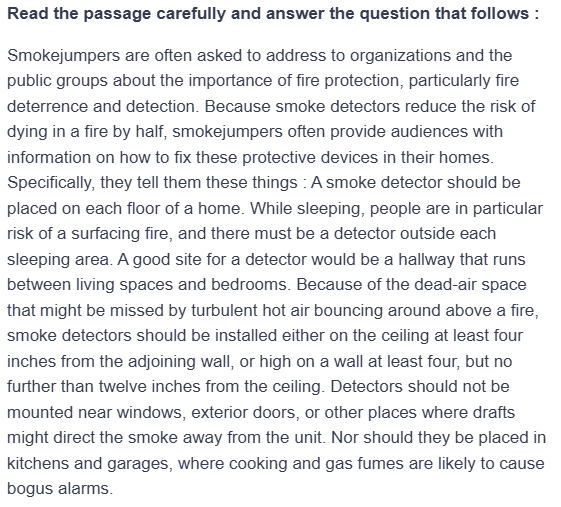
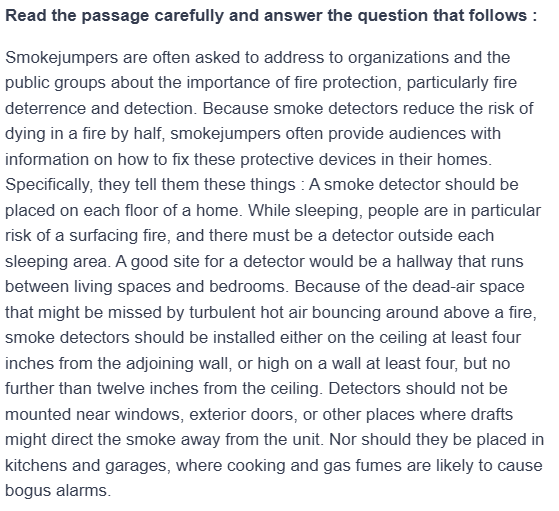
Reading Comprehension passage — shown as image.
What is the main focus of the author of this passage ?
- A

- B

- C

- D

- E

Show answerHide answer
Answer: E
Approach: Main idea = what most of the passage is spent on.
Solution: Only the first two sentences mention smokejumpers' talks; the rest gives specific rules on where and how detectors must be placed (each floor, outside sleeping areas, hallway, 4–12 inches from ceiling, not near windows, doors, kitchens or garages). So the author's main focus is the proper installation of home smoke detectors.
Why the other options are wrong:
A: smokejumpers' errands are only the setting.
B: dead-air space is one detail inside the placement advice.
C: firefighting by smokejumpers is not discussed.
D: the passage never explains how detectors stop fires; it says only that they halve the risk of dying.
Cetking shortcut: In 'main focus' questions, pick the option that covers the bulk of the sentences, not the opening line.
Answer: E
Refer to the passage above ↑
Which word used in the passage is the synonym of LANCET
- ATwelve
- BWindow
- CInch
- DTurbulent
- ESmokejumper
Show answerHide answer
Answer: B
Approach: Vocabulary in context: match the given word's meaning to a word used in the passage.
Solution: A lancet (lancet window) is a tall, narrow window with a pointed arch. Of the passage words given, only 'window' (in 'near windows, exterior doors') shares this meaning.
Why the other options are wrong:
A Twelve, C Inch: measurements from the passage.
D Turbulent: describes hot air.
E Smokejumper: a firefighter.
Answer: B
Refer to the passage above ↑
The passage indicates that one responsibility of smokejumpers is to :
- A

- B

- C

- D

- E

Show answerHide answer
Answer: E
Approach: Specific detail: find the line about smokejumpers' duties.
Solution: The opening line says smokejumpers 'are often asked to address organizations and public groups about the importance of fire protection'. The option 'Address corporate companies about the importance of preventing fires' restates this duty.
Why the other options are wrong:
A: checking homes is never mentioned.
B: they advise on installation; they do not install.
C: developing safety programmes is not stated.
D: this option is a word-for-word duplicate of E in the printed paper; E is the keyed choice.
Cetking shortcut: Duty questions are answered from the first one or two lines of the passage.
Answer: E
Refer to the passage above ↑
Which of the following should be avoided as per the contents of the passage :
- A

- B

- C
- D

- E

Show answerHide answer
Answer: C
Approach: Specific detail: what the passage says must NOT happen.
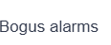
Solution: The last line says detectors should not be put in kitchens or garages 'where cooking and gas fumes are likely to cause bogus alarms'. So bogus (false) alarms are what must be avoided.
Why the other options are wrong:
A: placing high on a wall (4–12 inches from the ceiling) is recommended.
B: a hallway is called 'a good site'.
D: making people aware of fire hazards is the smokejumpers' job.
E: the passage warns about dead-air space; it does not recommend firefighting provisions for it.
Cetking shortcut: Look for negative words in the passage ('should not', 'nor').
Answer: C
Refer to the passage above ↑
Which word used in the passage is the antonym of NESCIENCE
- ADeterrence
- BTurbulent
- CBouncing
- DSmokejumper
- EDetection
Show answerHide answer
Answer: E
Approach: Vocabulary in context: antonym of the given word, chosen from passage words.
Solution: Nescience = lack of knowledge, ignorance. Its opposite is knowing or finding out. 'Detection' (discovering the presence of something) is the only option tied to knowledge or discovery.
Why the other options are wrong:
A Deterrence: preventing something.
B Turbulent: agitated.
C Bouncing: rebounding.
D Smokejumper: a person.
Cetking shortcut: Ne + science (Latin nescire, 'not to know') = not knowing, so look for a word about finding out or knowing.
Answer: E
Choose the correctly spelt word :
- A

- B

- C

- D

- E

Show answerHide answer
Answer: B
Approach: Spelling: break a long word into its parts.
Solution: anti + dis + establish + ment + arian + ism = Antidisestablishmentarianism (opposition to removing the Church of England's status as the state church).
Why the other options are wrong:
A: 'Ante' (before) in place of 'Anti' (against).
C: 'es' missing (disestablish).
D: 'ment' missing (establishmentarian).
E: 'ian' missing (establishmentarianism).
Cetking shortcut: Check each building block in order; every wrong option drops or changes one block.
Answer: B
Choose the correctly spelt word :
- A

- B

- C

- D
- E
Show answerHide answer
Answer: D
Approach: Spelling: break the medical term into its Greek parts.
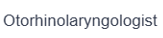
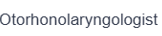
Solution: oto (ear) + rhino (nose) + laryngo (throat) + logist = Otorhinolaryngologist, an ear, nose and throat (ENT) specialist.
Why the other options are wrong:
A: 'Otrhono…' garbles oto-rhino.
B: 'rhinily-rangologist' garbles both parts.
C: 'laryon' is missing 'g'.
E: 'rhono' in place of 'rhino'.
Cetking shortcut: Ear-nose-throat = oto-rhino-laryngo, in that order.
Answer: D
Choose the correctly spelt word :
- A
- B
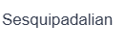
- C
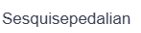
- D
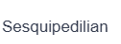
- E
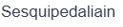
Show answerHide answer
Answer: A
Approach: Spelling: Latin parts sesqui + ped + alian.
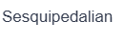
Solution: sesqui (one and a half) + ped (foot) + alian = Sesquipedalian: very long words, or someone who uses them.
Why the other options are wrong:
B: 'pad' in place of 'ped'.
C: extra 'se' (sesquisepedalian).
D: 'pedilian' in place of 'pedalian'.
E: 'aliain' in place of 'alian'.
Answer: A
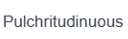
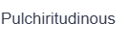
Choose the correctly spelt word :
- A
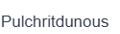
- B
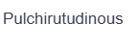
- C

- D
- E
Show answerHide answer
Answer: C
Approach: Spelling: pulchritude + -inous.
Solution: From pulchritude (beauty) + -inous comes Pulchritudinous, meaning beautiful.
Why the other options are wrong:
A: letters jumbled ('tdun' for 'tudin').
B: extra letters ('chiru' for 'chri').
D: 'inuous' in place of 'inous'.
E: extra 'i' (pulchiritudinous).
Cetking shortcut: Write the noun 'pulchritude' first, then add -inous.
Answer: C
Choose the correctly spelt word :
- A
- B

- C
- D

- E
Show answerHide answer
Answer: E
Approach: Spelling: curmudg + eon.
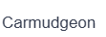
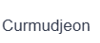
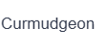
Solution: Curmudgeon means a bad-tempered, grumpy person, often an old one. Spelling: c-u-r-m-u-d-g-e-o-n.
Why the other options are wrong:
A: 'Car' in place of 'Cur'.
B: 'madg' in place of 'mudg'.
C: 'j' in place of 'g'.
D: 'e' dropped (curmudgon).
Cetking shortcut: The word keeps the 'dge' of 'grudge': cur-mudge-on.
Answer: E
Five sentences related to a topic are given below. Four of them can be put together to form a meaningful and coherent short paragraph. Identify the odd one out :
- A

- B

- C

- D

- E

Show answerHide answer
Answer: C
Approach: Odd sentence out: find the four sentences that share one specific thread.
Solution: Sentences 4 (muscle proteins travel to the brain and drive thought), 5 (only recently have neuroscientists described these factors), 1 (they have begun studying exercise's effect on genes inside brain cells) and 2 (even there they find the body's influence on the mind) form one chain on the neuroscience of exercise and the brain. Sentence 3 is a general remark about modern sedentary, screen-driven life. It does not feed the pronoun links of the chain ('these factors', 'even there'), so it is the odd one.
Why the other options are wrong:
A, B: 'Even there' in B points back to 'within brain cells… genes' in A, so they are a pair.
D: introduces the proteins that 'these factors' in E refers to.
E: links D to A ('neuroscientists have begun…').
Cetking shortcut: Sentences joined by pronoun or demonstrative links ('these factors', 'even there') stay; the one with no link out is usually the odd one.
Answer: C

Select the grammatically correct sentence :
- A

- B

- C

- D

- E

Show answerHide answer
Answer: D
Approach: 'Although' already shows contrast, so it takes no 'but', 'yet' or 'that' in the main clause.
Solution: 'Although he had failed in Mathematics' is a complete subordinate clause; the main clause 'he received a Degree in Engineering' follows after a comma with no extra connector. The past perfect 'had failed' correctly marks the earlier action. Sentence D is correct.
Why the other options are wrong:
A: 'that he received…' turns the main clause into a fragment.
B: 'Although, having failed…' joins a participle phrase to 'although'; 'the Engineering Degree' is also unidiomatic.
C: uses 'Although… but' (double connector) and 'that' as well.
E: 'failed in that Mathematics' is wrong, and 'Although… but' is a double connector.
Cetking shortcut: Strike any option with 'although/though… but'; that removes most choices at once.
Answer: D
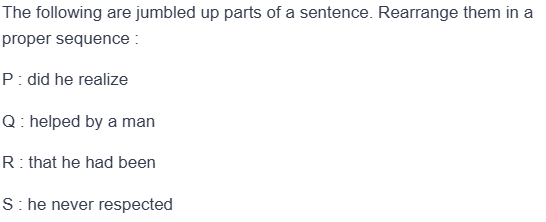
The following are jumbled up parts of a sentence. Rearrange them in a proper sequence :
P : did he realize
Q : helped by a man
R : that he had been
S : he never respected
- APQRS
- BSRQP
- CSQRP
- DPSRQ
- EPRQS
Show answerHide answer
Answer: E
Approach: Sentence rearrangement: an inverted question order ('did he realize') + a 'that'-clause + an agent phrase + a relative clause.
Solution: P 'did he realize' (inverted order, as after 'Only later…' or 'Never…') → R 'that he had been' → Q 'helped by a man' → S '(whom) he never respected'. The full sentence: '…did he realize that he had been helped by a man he never respected.'
Why the other options are wrong:
A PQRS: 'helped by a man' cannot come before 'that he had been'.
B SRQP, C SQRP: start with 'he never respected', which has nothing to attach to and leaves 'did he realize' dangling at the end.
D PSRQ: 'did he realize he never respected that he had been' makes no sense.
Cetking shortcut: 'had been' needs a past participle next, so R→Q is a fixed pair; only E has it after P.
Answer: E
Choose the option which is opposite in meaning to the word :
Intrepid
- AAmiable
- BFiendish
- CCowardly
- DTranquil
- ETepid
Show answerHide answer
Answer: C
Approach: Antonym: intrepid = fearless.
Solution: Intrepid = fearless, bold. Its opposite is cowardly.
Why the other options are wrong:
A Amiable: friendly.
B Fiendish: cruel, wicked.
D Tranquil: calm.
E Tepid: lukewarm, unenthusiastic.
Cetking shortcut: in- (not) + trepid (alarmed, as in 'trepidation') = not afraid, so the opposite is 'afraid' = cowardly.
Answer: C
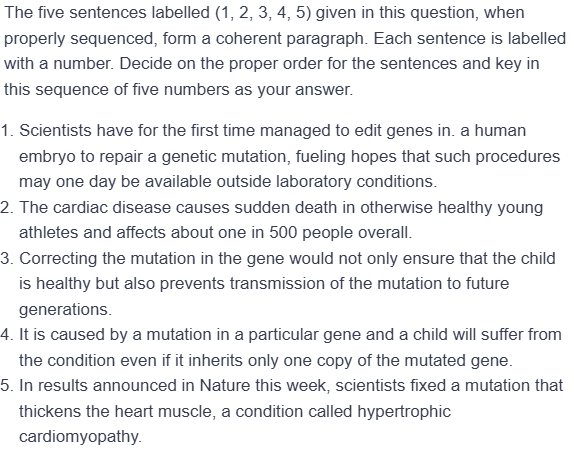
(see figure)
- A12345
- B32514
- C15243
- D51243
- E12435
Show answerHide answer
Answer: C
Approach: Para jumble: general news → specific case → explain the disease → its cause → benefit of correcting it.
Solution: 1 (scientists edited genes in a human embryo for the first time) is the opener. 5 gives the specific result: a fix for the mutation behind hypertrophic cardiomyopathy. 2 'The cardiac disease…' describes that disease. 4 'It is caused by a mutation…' gives its cause. 3 'Correcting the mutation…' ends with the benefit. Order: 1-5-2-4-3.
Why the other options are wrong:
A 12345: 2 ('The cardiac disease') cannot come before the disease is named in 5.
B 32514, D 51243: 3 and 5 cannot open; 5 needs 1's context.
E 12435: same problem as A.
Cetking shortcut: 'The cardiac disease' (definite article) must follow the sentence that names it (5), so 5-2 is a fixed pair; only C has 1-5-2.
Answer: C
(see figure)
- A43215
- B23541
- C25341
- D25314
- E13542
Show answerHide answer
Answer: C
Approach: Para jumble: general claim → problem → consequence → extension → conclusion ('hence').
Solution: 2 'The stories we tell reflect the world around us' is the general opener. 5: once we capture a story, the world has already changed. 3: so we cannot help retelling stories, since they are never quite right for our time. 4 'And even if we get them right…' extends 3. 1, with 'hence', concludes about retelling Indian stories in modern India. Order: 2-5-3-4-1.
Why the other options are wrong:
A 43215: 4 starts with 'And even if', so it cannot open.
B 23541: 3 needs 5's idea of a changed world before it.
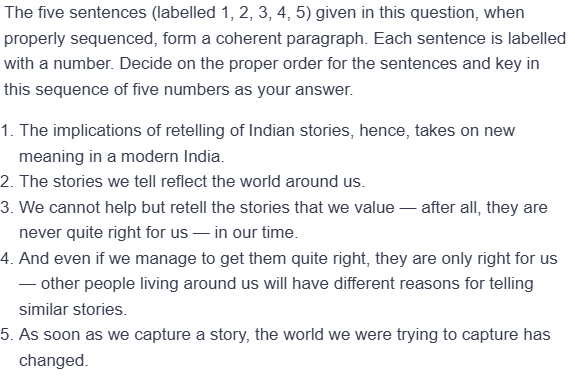
D 25314: 1 ('hence') must conclude, not 4.
E 13542: 1 has 'hence', so it cannot open.
Cetking shortcut: 'Hence' marks the concluding sentence and 'And even if…' must follow its partner (3-4); only C has both.
Answer: C
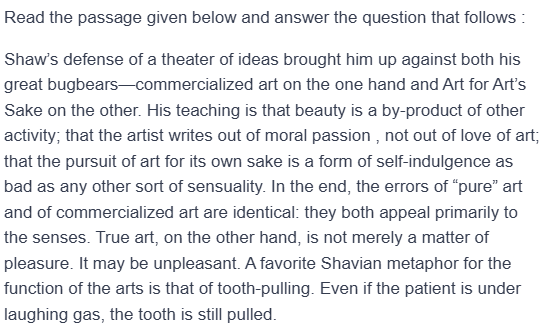
Questions 168–170 share this
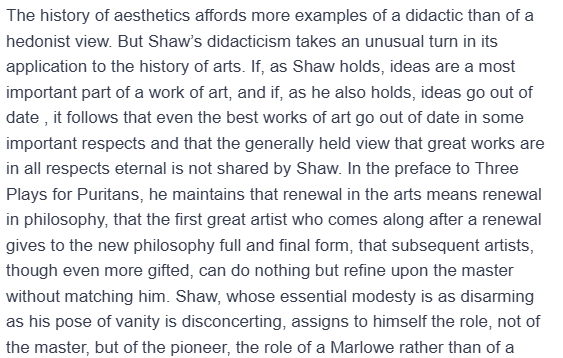
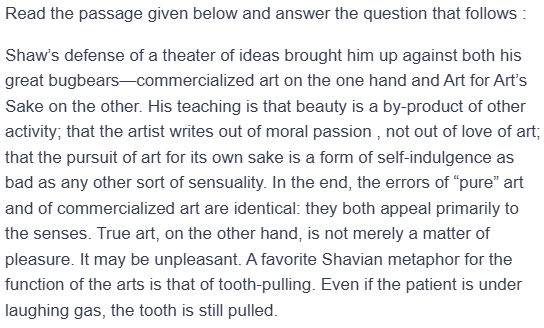
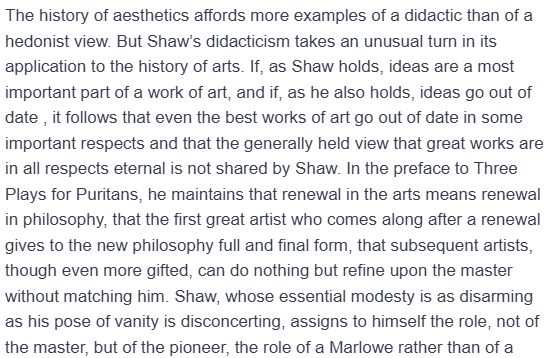
Reading Comprehension passage — shown as image.
The author sets off the word “pure” with quotation marks in order to :
- A

- B

- C

- D

- E

Show answerHide answer
Answer: A
Approach: Purpose of punctuation: why the author puts quotation marks around 'pure'.
Solution: The author writes 'the errors of "pure" art and of commercialized art are identical' and then says 'True art, on the other hand, is not merely a matter of pleasure'. The quotation marks show that so-called pure art (Art for Art's Sake) is not genuinely pure, which sets it against the true art Shaw values.
Why the other options are wrong:
B: the quotes add a negative tone; they do not strip one away.
C: the passage equates the errors of the two, not the words themselves.
D, E: the quotes are sceptical, not emphatic or approving.
Cetking shortcut: Quotation marks around an approving word usually mean 'so-called'; look for the contrasting word nearby ('True').
Answer: A
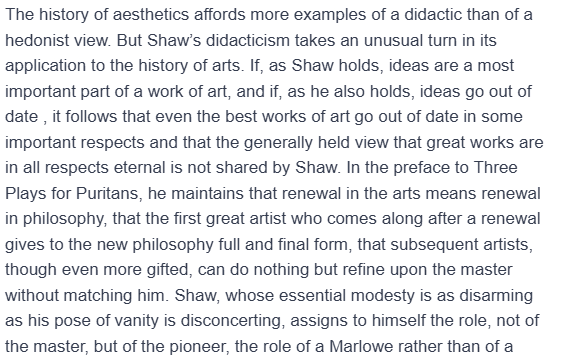
Refer to the passage above ↑
According to the author, Shaw’s didacticism was unusual in that it was characterized by :
- AMoralism
- BHedonism
- CDogmatism
- DIdealism
- EHistoricism
Show answerHide answer
Answer: E
Approach: Specific detail: what made Shaw's didacticism 'take an unusual turn'.
Solution: The passage says Shaw's didacticism is unusual 'in its application to the history of arts': ideas go out of date, so even great works date, and each renewal of philosophy gets its full form from the first great artist after it. Judging art by its place in history is historicism.
Why the other options are wrong:
A Moralism: moral purpose is ordinary didacticism, not the unusual part.
B Hedonism: Shaw rejects art for pleasure.
C Dogmatism: the passage stresses his modesty.
D Idealism: not discussed.
Cetking shortcut: Find the line right after 'unusual turn'; it says 'history of arts', which points to historicism.
Answer: E
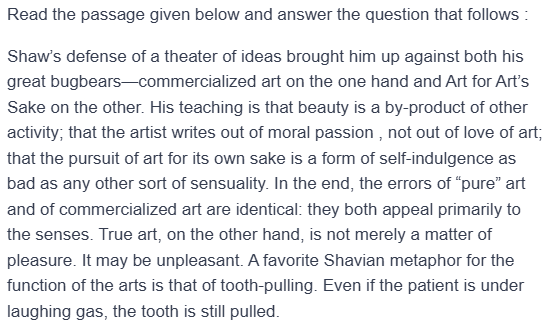
Refer to the passage above ↑
According to the author, Shaw compares art to tooth-pulling in order to show that :
- A

- B

- C

- D

- E

Show answerHide answer
Answer: D
Approach: Purpose of an analogy.
Solution: The analogy sits right after 'True art… is not merely a matter of pleasure. It may be unpleasant.' Even under laughing gas (some pleasure), the tooth is still pulled (the real, possibly painful, purpose). So art's purpose goes beyond pleasure.
Why the other options are wrong:
A: a lasting effect is not the point of the analogy.
B: dating of art belongs to the next paragraph.
C: extracting moral relevance from an epoch is not stated.
E: 'may be unpleasant' does not mean art is always painful.
Cetking shortcut: Read the sentence just before the analogy; it states the point the analogy illustrates.
Answer: D
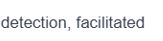
Fill in the blanks with the most appropriate options :
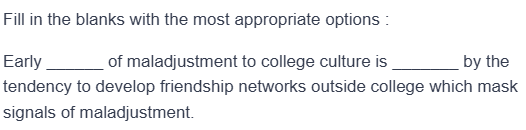
Early ______ of maladjustment to college culture is ______ by the tendency to develop friendship networks outside college which mask signals of maladjustment.
- A

- B

- C

- D
- E
Show answerHide answer
Answer: A
Approach: Double blank: the second half ('networks… mask signals of maladjustment') tells us the tendency makes something harder.
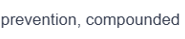
Solution: If friendships outside college mask the warning signs, then spotting the problem early becomes harder. Blank 1 needs a word for spotting (identification or detection), and blank 2 a word for 'made harder' (complicated). Only 'identification, complicated' fits both blanks.
Why the other options are wrong:
B treatment, compounded: masking signals hampers spotting, not treatment, and 'compounded' needs a problem to worsen.
C prevention, helped: masking does not help anything.
D prevention, compounded: you cannot 'prevent' through signals that are hidden; the clue is about noticing.
E detection, facilitated: blank 1 fits, but masking cannot facilitate detection.
Cetking shortcut: Fill the easier blank first: 'mask signals', so blank 2 must be negative. That leaves B, D and A; then 'signals' points to identification.
Answer: A
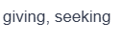
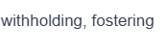
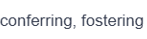
Fill in the blanks with the most appropriate options :
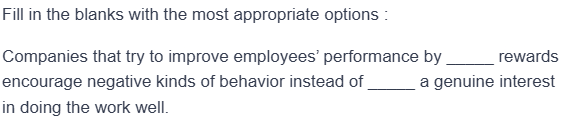
Companies that try to improve employees’ performance by _____ rewards encourage negative kinds of behavior instead of _____ a genuine interest in doing the work well.
- A
- B
- C
- D
- E

Show answerHide answer
Answer: B
Approach: Double blank with contrast: 'instead of' sets the first idea (bad method) against the second (good result).
Solution: Companies that keep dangling or withholding rewards to push performance encourage negative behaviour. 'Instead of' needs a positive verb for blank 2: fostering (encouraging the growth of) a genuine interest. Only B gives this pair.
Why the other options are wrong:
A giving, seeking: 'seeking a genuine interest' does not fit with companies.
C conferring, fostering: blank 2 fits, but 'conferring' (granting) does not fit the manipulative tactic described.
D conferring, discrediting: blank 2 must be positive.
E bestowing, discouraging: blank 2 must be positive.
Cetking shortcut: After 'instead of', blank 2 must be positive; that leaves B and C, and 'encourage negative behavior' points to withholding.
Answer: B
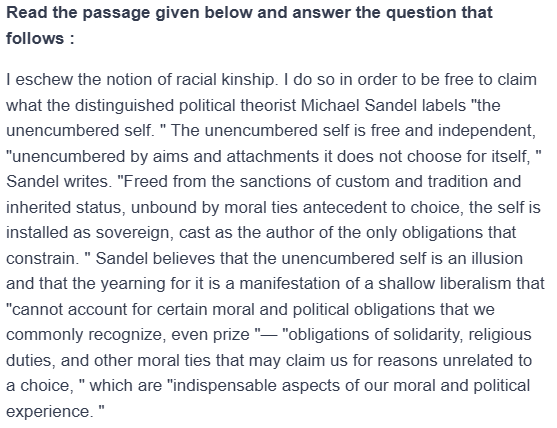
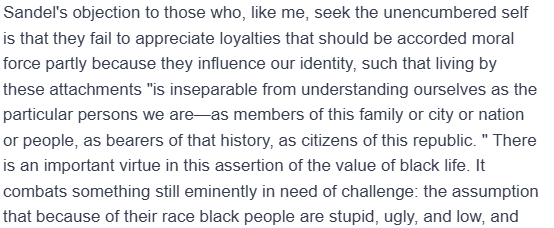
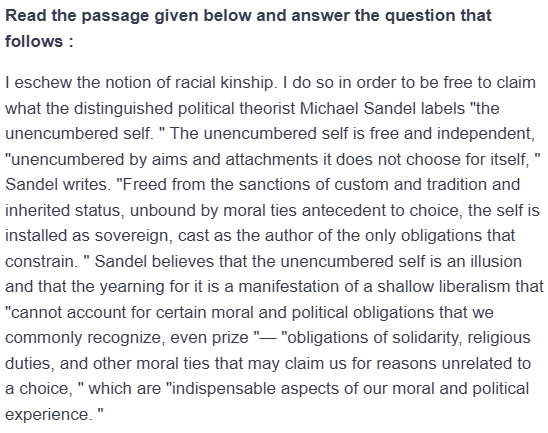
Questions 173–175 share this
Reading Comprehension passage — shown as image.
Through his discussion of the works and beliefs of Michael Sandel, the author suggests all of the following characteristics of the encumbered self EXCEPT :
- A

- B

- C

- D

- E

Show answerHide answer
Answer: D
Approach: EXCEPT question: mark each option as supported or not for the encumbered self (the self bound by inherited ties).
Solution: Sandel's encumbered self is defined by attachments 'antecedent to choice': history, family, city, nation, loyalties, solidarity. A self that is 'the product of independent accomplishment' is the unencumbered self the author himself wants. So D is not a trait of the encumbered self.
Why the other options are wrong:
A: 'as bearers of that history', so it is influenced by history.
B: family and community ties formed early are such attachments.
C: it keeps loyalties inherited from the past.
E: racial kinship is the kind of inherited tie the author rejects (he eschews it in order to be unencumbered).
Cetking shortcut: Encumbered = inherited ties; unencumbered = self-made. Any option about 'independent' or 'self-made' belongs to the other side.
Answer: D
Refer to the passage above ↑
The author states his definition of "what should properly be the object of pride for an individual " in order to :
- A

- B

- C

- D

- E

Show answerHide answer
Answer: E
Approach: Purpose question: why the author defines what should properly be an individual's object of pride.
Solution: The author opens by rejecting racial kinship ('I eschew the notion of racial kinship') and claiming the unencumbered self. Saying that pride should rest on one's own accomplishments, not on one's race, prepares the ground for his case against racial solidarity and race pride.
Why the other options are wrong:
A: he openly claims the unencumbered self; he is not trying to hide that yearning.
B: 'gain professional sops' has no basis in the passage.
C: he supports the unencumbered self; he does not undermine it.
D: the Frederick Douglass reference is outside the given text, and the definition serves his own thesis.
Cetking shortcut: Purpose questions about a definition usually point to the author's main thesis; here, rejecting racial kinship.
Answer: E
Refer to the passage above ↑
With an eye towards the passage as a whole, which of the following represents the author's primary focus ?
- A

- B

- C

- D

- E

Show answerHide answer
Answer: E
Approach: Primary focus: the option that covers both sides the passage discusses.
Solution: The passage sets two views of identity against each other: Sandel's (the self is constituted by family, history, nation, culture) and the author's (the unencumbered self, judged by what one achieves). So the focus is identity formation as self-definition by family, history and culture versus by independent accomplishment.
Why the other options are wrong:
A: too narrow; rejecting kinship is only the author's side.
B: success stories are not the topic.
C: 'individual versus group consciousness' is vague and leaves out the identity framing.
D: covers Sandel's critique but misses the author's side, accomplishment.
Cetking shortcut: For 'whole passage' questions, choose the option that names both sides of the debate.
Answer: E
Reading Comprehension passage — shown as image.
According to the passage, why do people in meetings routinely answer their cell phones to say, “I’m sorry, I can’t talk now, I’m in a meeting.”?
- A

- B

- C

- D

- E

Show answerHide answer
Answer: D
Approach: Specific detail from the passage's argument about cell phones.
Solution: The passage contrasts the landline days, when 'there was no expectation of being able to reach us at all times', with today, when phones are everywhere and this 'has created an implicit' expectation of always being reachable. So people answer even in meetings because carrying a phone creates the expectation that you will respond.
Why the other options are wrong:
A: looking busy is not given as the reason.
B: the passage criticises multitasking; it does not say phones let people multitask in meetings.
C: convenience of messaging is not discussed.
E: others' tolerance of calls is not mentioned.
Cetking shortcut: Find the sentence that contrasts 'then' and 'now'; the change it names (an expectation) is the reason.
Answer: D
Reading Comprehension passage — shown as image.
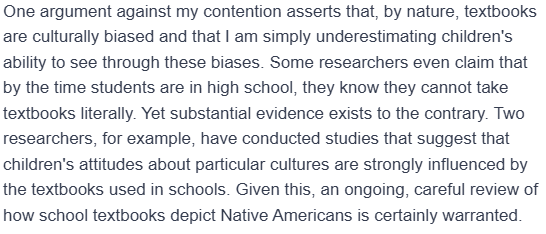
Which of the following would most logically be the topic of the paragraph immediately following the passage ?
- A

- B

- C

- D

- E

Show answerHide answer
Answer: D
Approach: Next-paragraph question: continue the passage's last line.
Solution: The author argues that US history textbooks distort the place of Native Americans and ends: 'an ongoing, careful review of how school textbooks depict Native Americans is certainly warranted'. The natural next step is how to carry out that review, so specific ways to evaluate the biases of the textbooks.
Why the other options are wrong:
A: the teacher's role is never raised.
B: teaching methods go beyond the textbook focus.
C: parents are not part of the argument.
E: European immigrants' contributions would change the topic.
Cetking shortcut: The last sentence of the passage almost always sets up the next paragraph.
Answer: D
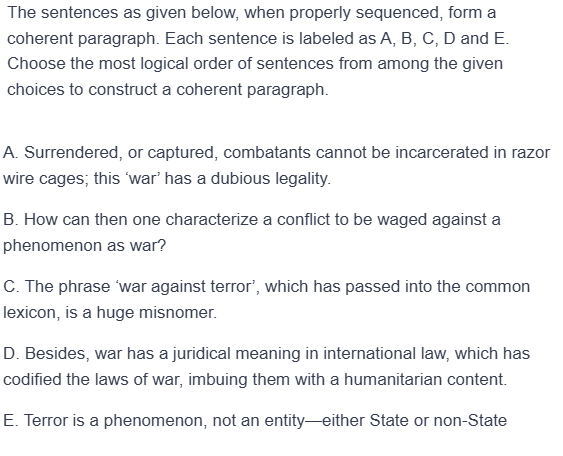
(see figure)
- AECDBA
- BBECDA
- CEBCAD
- DCDEAB
- ECEBDA
Show answerHide answer
Answer: E
Approach: Para jumble: claim → reason → question → second reason ('Besides') → consequence.
Solution: C states the claim: 'war against terror' is a misnomer. E gives the reason: terror is a phenomenon, not an entity. B follows: so how can a conflict against a phenomenon be called war? D adds a second reason with 'Besides': war has a legal meaning. A ends with an example of that legal problem: captured combatants in cages, 'dubious legality'. Order: C-E-B-D-A.
Why the other options are wrong:
A ECDBA, C EBCAD: E cannot open; it explains a claim not yet made.
B BECDA: B's 'then' needs an earlier reason.
D CDEAB: 'Besides' (D) must come after the first reason (E).
Cetking shortcut: 'Besides' adds a second point, so it needs the first point (E-B) before it; E-B is a fixed pair.
Answer: E
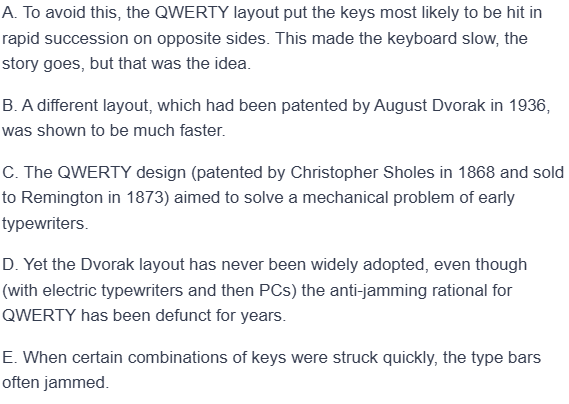
The sentences as given below, when properly sequenced, form a coherent paragraph. Each sentence is labeled as A, B, C, D and E. Choose the most logical order of sentences from among the given choices to construct a coherent paragraph. (see figure)
- ACEABD
- BCAEBD
- CCBAED
- DECABD
- EABDCE
Show answerHide answer
Answer: A
Approach: Para jumble: history → problem → design response → better alternative → why it was not adopted.
Solution: C introduces the QWERTY design and its aim, to solve a mechanical problem. E describes the problem: type bars jammed. A begins 'To avoid this' and gives QWERTY's solution, slower by design. B introduces Dvorak's faster layout. D begins 'Yet', so Dvorak was never adopted. Order: C-E-A-B-D.
Why the other options are wrong:
B CAEBD: 'this' in A needs the jamming problem (E) first.
C CBAED: B (Dvorak) before the QWERTY story ends.
D ECABD: E opens without context.
E ABDCE: A's 'this' has nothing to refer to.
Cetking shortcut: 'To avoid this' (A) must follow the problem (E), and 'Yet the Dvorak layout' (D) must follow B; only CEABD keeps both pairs.
Answer: A
Choose the option that best describes the idiom given below :
To catch a tartar
- A

- B

- C

- D

- E

Show answerHide answer
Answer: B
Approach: Idiom meaning.
Solution: To catch a tartar = to take on someone or something that turns out far tougher or harder to handle than expected. So it means to deal with someone or something difficult to handle.
Why the other options are wrong:
A: 'tricky path' describes a situation, not a tough opponent.
C: reputation is not involved.
D: the literal reading; the idiom is about unexpected difficulty, not danger.
E: being stuck is too general and misses the idea of a formidable opponent.
Answer: B
Questions 181–184 share this
Reading Comprehension passage — shown as image.
The claim that "it would be a miracle if there weren't any 'miracle cures'" would be most weakened by evidence that showed that :
- A

- B

- C

- D

- E

Show answerHide answer
Answer: A
Approach: Weaken: attack the premise the claim rests on.
Solution: The claim 'it would be a miracle if there weren't any miracle cures' rests on the premise that most diseases improve by themselves, fluctuate or are self-limiting, so chance alone produces some 'cures' after any treatment. Evidence that improvement is impossible in the course of many illnesses removes that natural variation. Then 'miracle cures' could not arise by chance, and the claim is weakened.
Why the other options are wrong:
B, C: patients recovering without intervention, or illnesses curing themselves, support the claim.
D: crackpot treatments sometimes working does not touch the chance argument.
E: fewer fraudulent practitioners does not change how diseases behave.
Cetking shortcut: To weaken, negate the key premise ('diseases improve by themselves'), so look for the option that says improvement does not happen.
Answer: A
Refer to the passage above ↑
Suppose that in order to demonstrate the legitimacy of his work, a faith healer compiles a book of interviews of people who swear that he has cured them just by blessing them. The author would most likely respond by asserting that :
- A

- B

- C

- D

- E

Show answerHide answer
Answer: D
Approach: Apply the author's reasoning to a new case.
Solution: The author says most conditions improve by themselves, so any treatment started at the right time gets the credit. Faced with testimonials from people 'cured by a blessing', he would say these people would have recovered anyway, without the healer.
Why the other options are wrong:
A: the author does not doubt that patients improved; he doubts the cause.
B: self-promotion ethics is not his argument.
C: he would deny healers have special power.
E: unreliable eyewitnesses is a different argument from the one in the passage (natural recovery).
Cetking shortcut: Match the reply to the passage's core mechanism (natural recovery plus false credit).
Answer: D
Refer to the passage above ↑
Doctors and scientists continue to debate whether certain types of alternative medicine are scientific or pseudo-scientific. How is this information relevant to the passage ?
- A

- B

- C

- D

- E

Show answerHide answer
Answer: E
Approach: Relevance of new information to the passage's point.
Solution: The passage argues that even outlandish cures are 'often difficult to refute conclusively'. If experts still debate whether certain alternative medicine is scientific or pseudo-scientific, that shows science and pseudo-science cannot always be told apart, which strengthens the passage's claim.
Why the other options are wrong:
A: medicine versus science is not the passage's distinction.
B: not a relevance statement, and unsupported.
C: the debate does not weaken the usefulness of the scientific method.
D: the debate does not touch 'pet theories'.
Cetking shortcut: An ongoing expert debate means 'hard to tell apart', so look for the 'cannot always be distinguished' option.
Answer: E
Refer to the passage above ↑
The author of the passage would most likely inclined to agree with the individual who argues that Willard Van Orman Quine's philosophical views are :
- A

- B

- C

- D

- E

Show answerHide answer
Answer: C
Approach: Author's likely view of an extreme position, read from the passage's stance.
Solution: The author holds that some claims can be judged: he shows how fraudulent cures exploit chance and calls certain cures outlandish. Quine is known for holding that any statement can be kept true 'come what may' if enough other beliefs are adjusted. An author who thinks some beliefs can be shown true or false would call such a view extreme.
Why the other options are wrong:
A: 'do not apply to any particular situation' is not the author's objection.
B: 'callous' is an emotional judgement the author does not make.
D: the author's concern is beliefs that are hard to refute, not why people reject beliefs.
E: the author does not treat all beliefs as equally valid.
Cetking shortcut: The author debunks fraud, so he believes some claims are testable; choose the option that says beliefs can be proven true or false.
Answer: C
Select the option that is most nearly the opposite in meaning to the word given below :
Fiendish
- ABashful
- BCallous
- CComplacent
- DSympathetic
- EIncomplete
Show answerHide answer
Answer: D
Approach: Antonym: fiendish = extremely cruel or wicked.
Solution: Fiendish = devilishly cruel. Its opposite is someone who feels for others: sympathetic (kind, compassionate).
Why the other options are wrong:
A Bashful: shy.
B Callous: unfeeling, closer to a synonym.
C Complacent: self-satisfied.
E Incomplete: unrelated.
Cetking shortcut: Fiend = devil, so the opposite is kind or compassionate.
Answer: D
Choose the option which best expresses the meaning of the given word :
ELEGIAC
- APeaceful
- BMournful
- CConfused
- DCheerful
- ERestless
Show answerHide answer
Answer: B
Approach: Synonym: elegiac relates to an elegy (a lament for the dead).
Solution: Elegiac = expressing sorrow or lament, so it means mournful.
Why the other options are wrong:
A Peaceful, C Confused, E Restless: unrelated moods.
D Cheerful: opposite.
Cetking shortcut: Elegy = a mourning poem, so elegiac = mournful.
Answer: B
Select the option that is most nearly the opposite in meaning to the word given below :
Acme
- ACondition of oily human skin
- BPimple
- CVolcano
- DPalatial
- ELowest
Show answerHide answer
Answer: E
Approach: Antonym: acme = the highest point.
Solution: Acme = the peak or highest point of achievement. Its opposite is the lowest point (nadir).
Why the other options are wrong:
A, B: puns on 'acne'.
C Volcano: a mountain, not a meaning of acme.
D Palatial: grand, like a palace.
Cetking shortcut: Acme and zenith mean peak; nadir means lowest. Ignore look-alike 'acne' traps.
Answer: E
Choose the option which best expresses the meaning of the given word :
Emancipate
- ARigorous
- BHealthy
- CRoyal
- DEnslave
- ELong rope
Show answerHide answer
Answer: D
Approach: Word meaning; the options contain only the word's opposite.
Solution: Emancipate = set free from legal, social or political restraint. No option means 'set free', and the only word directly linked to emancipate is its opposite, enslave. The stem asks for the meaning, but the options hold only the opposite, so D is the keyed answer.
Why the other options are wrong:
A Rigorous, B Healthy, C Royal: unrelated.
E Long rope: 'giving long rope' means allowing freedom, an idiom and not a meaning of emancipate.
Cetking shortcut: When no synonym is offered, check whether the option set is really an antonym set.
Answer: D
Select the option that is most nearly the opposite in meaning to the word given below :
Sanguine
- ABellicose
- BRed Skinned
- CPessimistic
- DGladiatorial
- ETechnical
Show answerHide answer
Answer: C
Approach: Antonym: sanguine = optimistic.
Solution: Sanguine = cheerfully optimistic, even in a bad situation. Its opposite is pessimistic.
Why the other options are wrong:
A Bellicose: aggressive, warlike.
B Red skinned: a trap from 'sanguine' meaning blood-red (complexion).
D Gladiatorial: combative.
E Technical: unrelated.
Cetking shortcut: Sanguine is tied to sang (blood), but in exams it nearly always means optimistic.
Answer: C
Select the option that is most nearly the opposite in meaning to the word given below :
Wrench
- ASeal
- BYank
- CAbstract
- DTug
- ERip
Show answerHide answer
Answer: A
Approach: Antonym: wrench = pull or twist out suddenly and violently.
Solution: Wrench means to tear or twist something free. Yank, tug and rip are synonyms. The opposite action, closing or fastening firmly in place, is seal.
Why the other options are wrong:
B Yank, D Tug, E Rip: all near-synonyms of wrench.
C Abstract: 'to remove', also close to wrench.
Cetking shortcut: Remove every synonym (yank, tug, rip, abstract); the one word left is the antonym.
Answer: A
Choose the option that best describes the idiom given below :
Thick as two short planks
- AIn deep trouble
- BHaving lack of intelligence
- CPreservationist
- DBraveheart
- EBeing in bad company
Show answerHide answer
Answer: B
Approach: Idiom meaning (British informal).
Solution: (As) thick as two short planks = very stupid. 'Thick' means dull-witted, and a short plank is thick for its length. So it means having a lack of intelligence. Example: 'He's a skilled footballer, but he's as thick as two short planks.'
Why the other options are wrong:
A: trouble is not implied.
C, D: unrelated.
E: 'thick with someone' (close friends) is a different idiom.
Cetking shortcut: 'Thick' in idioms usually means stupid ('thick-headed').
Answer: B
Choose the option that best describes the idiom given below :
On the breadline
- A
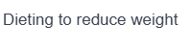
- B

- C

- D

- E

Show answerHide answer
Answer: E
Approach: Idiom meaning.
Solution: On the breadline = extremely poor, with barely enough money to live (from queues for free bread). So it means being in a condition of poverty.
Why the other options are wrong:
A, D: diet or weight puns on 'bread'.
B: a risky position is 'on the line' or 'on thin ice'.
C: boredom is unrelated.
Answer: E
Choose the option that best describes the meaning of the sentence given below :
Use of mild words in place of words required by truth
- AEuphemism
- BCinephile
- CMisobiblic
- DPessimistic
- ERapacious
Show answerHide answer
Answer: A
Approach: One-word substitution.
Solution: Euphemism = a mild or indirect word used in place of a harsh or blunt one (e.g. 'passed away' for 'died'). This matches 'use of mild words in place of words required by truth'.
Why the other options are wrong:
B Cinephile: lover of cinema.
C Misobiblic: hating books.
D Pessimistic: expecting the worst.
E Rapacious: greedy.
Cetking shortcut: eu- = good or well (euphony, eulogy), so euphemism = 'speaking well' of something harsh.
Answer: A
Choose the option which best expresses the meaning of the word given below :
VITUPERATE
- ATeach
- BWarn
- CAbuse
- DAppreciate
- EHail
Show answerHide answer
Answer: C
Approach: Synonym: vituperate = abuse in words.
Solution: Vituperate = blame or insult someone in harsh, violent language. Its synonym is abuse.
Why the other options are wrong:
A Teach, B Warn: neutral.
D Appreciate, E Hail: opposites (praise).
Cetking shortcut: 'Vituperative' remarks are bitterly abusive.
Answer: C
Choose the option which best expresses the meaning of the word given below :
CONTRITE
- APenitent
- BBashful
- CJoyful
- DRemorseless
- EConniving
Show answerHide answer
Answer: A
Approach: Synonym: contrite = feeling sorry for wrongdoing.
Solution: Contrite = remorseful, repentant. Its synonym is penitent (feeling sorrow for one's sins).
Why the other options are wrong:
B Bashful: shy.
C Joyful: unrelated.
D Remorseless: opposite.
E Conniving: secretly scheming.
Cetking shortcut: Contrition, penitence and remorse form one word family.
Answer: A
Reading Comprehension passage — shown as image.
The passage’s description of the issue raised by unconditional guarantees for health care or legal services most clearly implies that which of the following is true ?
- A

- B

- C

- D

- E

Show answerHide answer
Answer: E
Approach: Inference from one specific line.
Solution: The passage says that in legal and health care services, guarantees 'may mislead clients by suggesting that lawsuits or medical procedures will have guaranteed outcomes'. For that to mislead, it must be true that such outcomes cannot be guaranteed in advance. So the result of a lawsuit or medical procedure cannot necessarily be determined beforehand by the professionals.
Why the other options are wrong:
A: compensation is not discussed.
B: cost prediction is not discussed.
C: professional standards being violated is not mentioned.
D: the passage says guarantees may look like begging for business; it does not say all marketing undermines dignity.
Cetking shortcut: 'Misleading by suggesting X' implies X is not true. Look for the option that negates X.
Answer: E
Reading Comprehension passage — shown as image.
According to the passage, which of the following options could most appropriately be attributed to the American travel literature of the 1920’s ?
- A

- B

- C

- D

- E

Show answerHide answer
Answer: D
Approach: Specific detail on the 1920s road narrative.
Solution: The passage says the 1920s highway created the road narrative, which highlights male protagonists 'discovering themselves' and emphasises 'the independence of road travel'. Celebrating the freedom that travel gives restates this.
Why the other options are wrong:
A: the narratives emphasised independence; they did not 'develop the desire' for it.
B: women travellers are not discussed.
C: 'discovering themselves' does not mean being different from others.
E: they valued rural folk traditions but did not show the travellers taking part in them.
Cetking shortcut: Match the option to the exact phrase 'emphasizing the independence of road travel' = freedom of travel.
Answer: D
Homichlophobia is the fear of :
- AHomo Sapiens
- BBeing Alone
- CHeight
- DFox
- EFog
Show answerHide answer
Answer: E
Approach: Word meaning: Greek root of a phobia name.
Solution: Greek homichle = fog or mist, so homichlophobia is the fear of fog.
Why the other options are wrong:
A: fear of humans is anthropophobia.
B: fear of being alone is monophobia or autophobia.
C: fear of heights is acrophobia.
D Fox: unrelated to the root homichle.
Cetking shortcut: Do not let 'homi' pull you to 'homo sapiens'.
Answer: E
A person suffering from Aichmophobia is most likely to be afraid of which of the following object ?
- AComputers
- BText Books
- CBack Aches
- DKnives
- ETooth Aches
Show answerHide answer
Answer: D
Approach: Word meaning: Greek root of a phobia name.
Solution: Greek aichme = point or spear-tip, so aichmophobia is the fear of sharp, pointed objects such as knives and needles. Of the options, it is knives.
Why the other options are wrong:
A Computers: cyberphobia.
B Text books: bibliophobia.
C Back aches, E Tooth aches: not phobia objects here.
Answer: D
Reading Comprehension passage — shown as image.
All of the following statements can be inferred from the passage EXCEPT that :
- A

- B

- C

- D

- E

Show answerHide answer
Answer: D
Approach: EXCEPT question: check each option against the passage.
Solution: The passage says grammar rules exist so that communication works; when they break down, 'confusion and misunderstanding result'. So the purpose of grammar is clarity, not keeping sentences simple. 'The primary purpose of grammar is to ensure that sentences remain simple' cannot be inferred.
Why the other options are wrong:
A: inferable: 'Must you write complete sentences each time? Perish the thought.'
B: inferable: a sentence has 'a subject (noun) and a predicate (verb)'.
C: inferable: 'Grammar Police' is a figure for strict rule-enforcers.
E: the passage opens with parts of speech (words) and rules that organise them, so it does not support 'words play no role' either; D is the keyed statement, since it contradicts the passage's stress on clarity.
Cetking shortcut: In EXCEPT questions, the answer usually states a purpose or claim that the passage never makes ('simple').
Answer: D