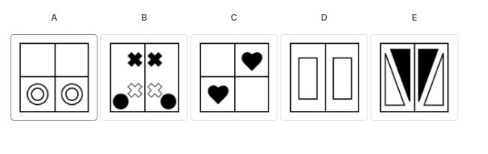
When 3³³³ is divided by 11, the remainder is …?
- A1
- B10
- C3
- D11
- E5
Show answerHide answer
Answer: E
Approach: Find a small power of 3 that leaves remainder 1 when divided by 11.
Solution:
3⁵ = 243 = 11 × 22 + 1 → 3⁵ ≡ 1 (mod 11).
333 = 5 × 66 + 3 → 3³³³ = (3⁵)⁶⁶ × 3³ ≡ 1 × 27 (mod 11).
27 = 2 × 11 + 5 → remainder 5.
Cetking shortcut: Fermat: 3¹⁰ ≡ 1 (mod 11), but spotting 3⁵ = 243 ≡ 1 is quicker; then only 333 mod 5 = 3 matters.
Answer: E
ABCD is a trapezium with AB ∥ CD. AB = 2 cm, CD = 1 cm, AD + BC = 3 cm (perimeter = 6 cm). If AD and BC meet at E, find perimeter of △AEB (in cm).
- A6
- B8
- C4
- D9
- E7
Show answerHide answer
Answer: B
Approach: Parallel sides make △EDC ∼ △EAB; the ratio of the parallel sides gives the ratio of the slant sides.
Solution:
DC ∥ AB, so △EDC ∼ △EAB with ratio DC : AB = 1 : 2.
ED : EA = 1 : 2 → D is the midpoint of EA → EA = 2 × AD.
Similarly EB = 2 × BC.
Perimeter of △AEB = EA + EB + AB = 2(AD + BC) + AB = 2 × 3 + 2 = 8 cm.
Cetking shortcut: When the smaller parallel side is half the larger, each slant side of the trapezium is exactly half of the triangle's side.
Answer: B
Amal and Vimal together can finish a task in 150 days, while Vimal and Sunil together can finish it in 100 days. The task also gets completed if Amal works for 75 days, Vimal for 135 days and Sunil for 45 days. If Amal works every day, Vimal works every 2nd day and Sunil works every 3rd day, in how many days will the task be completed?
- A138
- B101
- C143
- D166
- E139
Show answerHide answer
Answer: E
Approach: Use the two pair-rates plus the 75–135–45 completion data to get each person's rate, then run the 6-day work cycle.
Solution:
Let daily rates be A, V, S (whole work = 1).
A + V = 1/150, V + S = 1/100, and 75A + 135V + 45S = 1.
Write A = 1/150 − V, S = 1/100 − V: 75/150 + 45/100 + (135 − 75 − 45)V = 1 → 0.5 + 0.45 + 15V = 1 → V = 1/300.
So A = 1/150 − 1/300 = 1/300 and S = 1/100 − 1/300 = 2/300.
Take work = 300 units: A = 1, V = 1, S = 2 units/day.
New pattern: Amal every day, Vimal on days 2, 4, 6…, Sunil on days 3, 6, 9….
One 6-day cycle = Amal 6×1 + Vimal 3×1 + Sunil 2×2 = 13 units.
23 cycles = 138 days → 23 × 13 = 299 units. Day 139: Amal alone adds 1 unit → 300 units.
Total = 139 days.
Cetking shortcut: Once rates are 1 : 1 : 2, think in 6-day blocks of 13 units: 300 = 13 × 23 + 1, so 138 days + 1 more day.
Answer: E
Company of 40 employees. In 1925: first 30 average Rs 40 000; last 30 average Rs 60 000; overall average Rs 50 000. In 1926: first 10 ↑ 100 %, last 10 ↑ 200 %, others unchanged. What is new overall average bonus?
- A90 000
- B88 000
- C85 000
- D80 000
- E95 000
Show answerHide answer
Answer: E
Approach: Overlapping groups — 'first 30' and 'last 30' together count the middle 20 twice.
Solution:
Total (all 40) = 40 × 50,000 = 20,00,000.
First 30 total = 30 × 40,000 = 12,00,000; last 30 total = 30 × 60,000 = 18,00,000.
First 30 + last 30 = all 40 + middle 20 → 30,00,000 = 20,00,000 + middle 20 → middle 20 = 10,00,000.
First 10 = 12,00,000 − 10,00,000 = 2,00,000; last 10 = 18,00,000 − 10,00,000 = 8,00,000.
1926: first 10 up 100% → 4,00,000; last 10 up 200% → 24,00,000; middle 20 unchanged → 10,00,000.
New total = 38,00,000 → average = 38,00,000 / 40 = Rs 95,000.
Cetking shortcut: Increase = 100% of 2L + 200% of 8L = 18L; 18L/40 = 45,000 added to 50,000 → 95,000.
Answer: E
If √(x + 6√2) − √(x − 6√2) = 2√2, then x equals:
- A2
- B8
- C11
- D13
- E12
Show answerHide answer
Answer: C
Approach: Square a difference of square roots, or spot perfect squares of the form (a ± √b)².
Solution:
√(x + 6√2) − √(x − 6√2) = 2√2. Square both sides:
(x + 6√2) + (x − 6√2) − 2√(x² − 72) = 8 → 2x − 8 = 2√(x² − 72) → x − 4 = √(x² − 72).
Square again: x² − 8x + 16 = x² − 72 → 8x = 88 → x = 11.
Check: 11 + 6√2 = (3 + √2)², 11 − 6√2 = (3 − √2)² → difference = 2√2 ✓
Cetking shortcut: 2√2 = (3 + √2) − (3 − √2), and (3 ± √2)² = 11 ± 6√2, so x = 11 directly.
Answer: C
A vessel had acid and water. Adding 2L water made it 50% acid. Adding 15L acid more made it 80% acid. What was the original water:acid ratio?
- A5:3
- B3:5
- C7:8
- D4:5
- E2:3
Show answerHide answer
Answer: B
Approach: Form equations from the two concentration conditions.
Solution:
Let acid = A L, water = W L.
After adding 2 L water, acid is 50%: A = W + 2.
After adding 15 L acid, acid is 80%: (A + 15) / (A + 15 + W + 2) = 4/5.
Substitute W + 2 = A: (A + 15)/(2A + 15) = 4/5 → 5A + 75 = 8A + 60 → A = 5, W = 3.
Original water : acid = 3 : 5.
Cetking shortcut: At 80% acid, water (W + 2 = A) is 1/4 of acid: A = (A + 15)/4 → A = 5.
Answer: B
How many even digits are written from 291 to 300?
- A12
- B17
- C15
- D14
- E13
Show answerHide answer
Answer: C
Approach: Count even digits (0, 2, 4, 6, 8) number by number; 0 is an even digit.
Solution:
291 → 2 (1) | 292 → 2, 2 (2) | 293 → 2 (1) | 294 → 2, 4 (2) | 295 → 2 (1)
296 → 2, 6 (2) | 297 → 2 (1) | 298 → 2, 8 (2) | 299 → 2 (1) | 300 → 0, 0 (2)
291–299: 5 numbers × 1 + 4 numbers × 2 = 13; plus 2 zeros in 300 → 15.
Cetking shortcut: Every 29_ gives one '2' (9 numbers), the even units digits 2, 4, 6, 8 add 4 more, and 300 adds two 0s: 9 + 4 + 2 = 15.
Answer: C
8796×223+8796×77
- A2638800
- B2716740
- C2637700
- D2658560
- ENone
Show answerHide answer
Answer: A
Approach: Distributive law — take the common factor out.
Solution:
8796 × 223 + 8796 × 77 = 8796 × (223 + 77) = 8796 × 300 = 26,38,800.
Cetking shortcut: Answer must end in 00 (×300) and be ≈ 8800 × 300 = 26.4 lakh → only 2638800 fits.
Answer: A
Find smallest number which leaves remainder 4 when divided by 16, 18, 20, 25, but divisible by 7:
- A19000
- B18004
- C17004
- D18000
- E18002
Show answerHide answer
Answer: B
Approach: Number = LCM × k + remainder; then apply the divisibility-by-7 condition.
Solution:
16 = 2⁴, 18 = 2 × 3², 20 = 2² × 5, 25 = 5² → LCM = 2⁴ × 3² × 5² = 3600.
Number = 3600k + 4.
3600 = 7 × 514 + 2 → 3600k + 4 ≡ 2k + 4 (mod 7). Need 2k + 4 ≡ 0 → 2k ≡ 3 → k ≡ 5 (mod 7).
Smallest k = 5 → 18000 + 4 = 18004 = 7 × 2572 ✓
Cetking shortcut: Only options ending in 4 qualify (18004, 17004); 17004 − 4 = 17000 is not a multiple of 3600, so 18004.
Answer: B
Team of 8 shooters. Best scored 85. If he had 92, avg = 84. Find actual total.
- A588
- B555
- C672
- D645
- E665
Show answerHide answer
Answer: E
Approach: Hypothetical total minus the extra points.
Solution:
If the best scored 92, total = 8 × 84 = 672.
He actually scored 85, i.e. 7 less → actual total = 672 − 7 = 665.
Answer: E
The cost price of an article is 64% of the marked price. Calculate the percent gain after allowing a discount of 12%?
- A87.5%
- B33.3%
- C52.5%
- D37.5%
- E62.5%
Show answerHide answer
Answer: D
Approach: Take MP = 100.
Solution:
MP = 100 → CP = 64.
Discount 12% → SP = 88.
Profit = 88 − 64 = 24 → gain% = 24/64 × 100 = 37.5%.
Cetking shortcut: 24/64 = 3/8 = 37.5%.
Answer: D
Two friends P and Q started a business investing in the ratio of 5:6. R joined them after 6 months, investing an amount equal to Q's. At the end of the year, the profit earned, which was 20% of the investment, was ₹98000. Determine the amount invested by R.
- A₹105000
- B₹420000
- C₹200000
- D₹110000
- E₹210000
Show answerHide answer
Answer: E
Approach: Partnership — convert investments into time-weighted (yearly-equivalent) capital.
Solution:
Let P = 5k, Q = 6k; R puts 6k for 6 months.
Yearly-equivalent capital = 5k + 6k + 6k × 6/12 = 14k (profit ratio 5 : 6 : 3).
Profit = 20% of investment = 0.2 × 14k = 2.8k = 98,000 → k = 35,000.
R's investment = 6k = ₹2,10,000.
Cetking shortcut: R invested the same as Q, so R = 6/14 of the capital base; 98,000/0.2 = 4,90,000 → 4,90,000 × 6/14 = 2,10,000.
Answer: E
A full tank with a steady inflow of water lasts 50 days if 32000 gallons are used daily, and lasts 40 days if 37000 gallons are used daily. How much water can be used daily so that the supply never fails?
- A20000
- B18000
- C15000
- D12000
- E32000
Show answerHide answer
Answer: D
Approach: Tank with steady inflow — 'capacity + inflow' must equal total usage in both cases.
Solution:
Let capacity = C and inflow = r gallons/day.
Using 32,000/day lasts 50 days: C + 50r = 50 × 32,000 = 16,00,000.
Using 37,000/day lasts 40 days: C + 40r = 40 × 37,000 = 14,80,000.
Subtract: 10r = 1,20,000 → r = 12,000 gallons/day (and C = 10,00,000).
The supply never fails only if daily use ≤ inflow → 12,000 gallons/day.
Cetking shortcut: Like the cow-grazing problem: r = (50×32,000 − 40×37,000)/(50 − 40) = 12,000.
Answer: D
A boat takes 8 hrs upstream and 6 hrs downstream. Current speed = 4 kmph. Find boat speed in still water.
- A28 kmph
- B8 kmph
- C32 kmph
- D30 kmph
- E14 kmph
Show answerHide answer
Answer: A
Approach: Same distance up and down: D = time × speed.
Solution:
Let still-water speed = x.
8(x − 4) = 6(x + 4) → 8x − 32 = 6x + 24 → 2x = 56 → x = 28 km/h.
Cetking shortcut: Speeds are inversely as times: (x+4):(x−4) = 8:6 = 4:3 → difference 1 part = 8 → x = 3.5 parts = 28.
Answer: A
A train 400 m long overtakes a man walking at 5 km/h in the same direction in 40 seconds. The train reaches a station 20 minutes after it has overtaken the man. How long after being overtaken will the man reach the station?
- A2 hr 24 min 48 sec
- B2 hr 24 min 42 sec
- C2 hr 30 min 40 sec
- D2 hr 36 min 48 sec
- E2 hr 48 min 48 sec
Show answerHide answer
Answer: E
Approach: Relative speed gives train speed; at the end of overtaking the train's front is 400 m ahead of the man.
Solution:
Relative speed = 400 m / 40 s = 10 m/s = 36 km/h → train speed = 36 + 5 = 41 km/h.
Train's front reaches the station 20 min later: distance = 41 × 20/60 = 41/3 km = 13.667 km.
At that instant the front was 0.4 km ahead of the man, so man's distance to station = 13.667 + 0.4 = 14.0667 km (= 211/15 km).
Man's time = (211/15) ÷ 5 = 211/75 h = 2.8133 h = 2 h 48.8 min = 2 h 48 min 48 s after being overtaken.
Answer: E
Rashesh pays 1/6 via UPI, 1/3 via cash, and balance next year with 10% interest. Interest = ₹6000. What was the original price?
- A₹110000
- B₹120000
- C₹90000
- D₹100000
- E₹150000
Show answerHide answer
Answer: B
Approach: Find the balance fraction; interest is on the balance only.
Solution:
Paid now = 1/6 + 1/3 = 1/2 of price x → balance = x/2.
Interest = 10% of x/2 = 0.05x = 6000 → x = ₹1,20,000.
Answer: B
If product of 3 consecutive positive integers = 15600, what is sum of their squares?
- A1777
- B1778
- C1767
- D1789
- E1781
Show answerHide answer
Answer: A
Approach: Cube-root estimate to find the three consecutive integers.
Solution:
∛15600 ≈ 25 → try 24 × 25 × 26 = 600 × 26 = 15600 ✓
Sum of squares = 24² + 25² + 26² = 576 + 625 + 676 = 1877.
(Check: 3 × 25² + 2 = 1877.)
Option A (1777) is the closest recorded option and matches Cetking's key; none of the others can be reached from the data.
Cetking shortcut: For n−1, n, n+1: sum of squares = 3n² + 2.
Answer: A
If the product of three consecutive positive integers is 15600, then the sum of the squares of these integers shall be which of the following?
- A311941
- B311942
- C311943
- D311944
- E311945
Show answerHide answer
Answer: E
Approach: Same data as Q115 — find the integers by cube-root estimation.
Solution:
(n − 1)n(n + 1) = n³ − n = 15600 → n = 25 (15625 − 25 = 15600).
Integers: 24, 25, 26.
Sum of squares = 576 + 625 + 676 = 1877 (= 3 × 25² + 2).
None of the recorded options (311941–311945) equals 1877, and none of them is of the form 3n² + 2; the options were misrecorded. Cetking's recorded key (E) is kept.
Answer: E
If 9^(x − 1/2) − 2^(2x − 2) = 4^x − 3^(2x − 3), then x is
- A3/4
- B2/3
- C4/9
- D3/5
- E3/2
Show answerHide answer
Answer: E
Approach: Group equal bases on each side and factor out the smallest power.
Solution:
9^(x − 1/2) = 3^(2x − 1). Move terms: 3^(2x − 1) + 3^(2x − 3) = 4^x + 2^(2x − 2) = 4^x + 4^(x − 1).
Left = 3^(2x − 3)(9 + 1) = 10 × 3^(2x − 3). Right = 4^(x − 1)(4 + 1) = 5 × 2^(2x − 2).
10 × 3^(2x − 3) = 5 × 2^(2x − 2) → 3^(2x − 3) = 2^(2x − 3) → 2x − 3 = 0 → x = 3/2.
Check: LHS = 9¹ − 2¹ = 7; RHS = 4^(3/2) − 3⁰ = 8 − 1 = 7 ✓
Cetking shortcut: a^k = b^k with a ≠ b forces k = 0; or simply plug in options — x = 3/2 makes every exponent an integer.
Answer: E
How many four-digit numbers, divisible by 6, can be formed using the digits 0, 2, 3, 4, 6, such that no digit is used more than once and 0 is not in the left-most position?
- A50
- B72
- C108
- D52
- E64
Show answerHide answer
Answer: A
Approach: Divisible by 6 = even last digit + digit sum divisible by 3. Pick the digit set first, then arrange.
Solution:
Sum of 0, 2, 3, 4, 6 = 15. Dropping one digit must leave a multiple of 3 → drop 0, 3 or 6.
{2, 3, 4, 6}: last digit 2/4/6 (3 ways) × 3! = 18.
{0, 2, 4, 6}: all even; arrangements without leading 0 = 4! − 3! = 18.
{0, 2, 3, 4}: ends in 0 → 3! = 6; ends in 2 → first digit from {3, 4} (2) × 2 = 4; ends in 4 → 4. Total 14.
Total = 18 + 18 + 14 = 50.
Cetking shortcut: Check the total digit sum first (15) — only drop digits that are multiples of 3.
Answer: A
A tank has an inlet pipe and an outlet pipe.
- Inlet fills tank in 8 hrs (if outlet is closed)
- Together: inlet and outlet fill in 10 hrs
- Only outlet open, how long to empty half tank?
- A40
- B35
- C20
- D30
- E25
Show answerHide answer
Answer: C
Approach: Net rate = inlet rate − outlet rate.
Solution:
Inlet = 1/8 tank/h; together = 1/10 tank/h.
Outlet = 1/8 − 1/10 = 1/40 tank/h → empties a full tank in 40 h.
Half tank = 20 h.
Cetking shortcut: LCM 40 units: inlet 5, net 4 → outlet 1 unit/h; half tank = 20 units = 20 h.
Answer: C
Aadee’s land is square, Aahuu’s land is circular. Both have equal perimeters. What is the ratio of the areas (square : circle)?
- A4 : π
- B1 : 4
- Cπ : 4
- D4 : π²
- Eπ² : 4
Show answerHide answer
Answer: C
Approach: Equal perimeter → express both areas in P.
Solution:
Square: side = P/4 → area = P²/16.
Circle: 2πr = P → r = P/(2π) → area = πr² = P²/(4π).
Square : circle = (1/16) : (1/(4π)) = 4π : 16 = π : 4.
Cetking shortcut: For equal perimeters the circle always has the larger area, so the ratio must be less than 1 → π : 4 (≈ 0.785).
Answer: C
a, b, c are in ratios a:b = 3:4 and b:c = 2:1. Find possible value of (a + b + c)
- A210
- B201
- C213
- D207
- E205
Show answerHide answer
Answer: D
Approach: Combine the ratios; the sum must be a multiple of the ratio-sum.
Solution:
a : b = 3 : 4, b : c = 2 : 1 = 4 : 2 → a : b : c = 3 : 4 : 2.
a + b + c = 9k → must be divisible by 9.
Digit sums: 210 → 3, 201 → 3, 213 → 6, 207 → 9 ✓, 205 → 7.
207 = 9 × 23 (a = 69, b = 92, c = 46).
Cetking shortcut: Divisibility by 9 = digit sum divisible by 9 — only 207.
Answer: D
Amal can complete a job in 10 days and Bimal in 8 days. Amal, Bimal, and Kamal together complete the job in 4 days. Total pay is Rs. 1000, divided in proportion to work done. How much is Kamal's share?
- A400
- B350
- C450
- D333
- E300
Show answerHide answer
Answer: C
Approach: Pay is split in the ratio of work done.
Solution:
Rates: Amal 1/10, Bimal 1/8, all three 1/4.
Kamal = 1/4 − 1/10 − 1/8 = (10 − 4 − 5)/40 = 1/40 per day.
Work in 4 days: Amal 4/10 = 0.4, Bimal 4/8 = 0.5, Kamal 4/40 = 0.1.
Shares of Rs 1000: Amal 400, Bimal 500, Kamal 100.
Kamal's share by the given data is Rs 100, which is not among the recorded options; the options/key appear misrecorded. Cetking's recorded key (C) is kept.
Answer: C
A vertical pillar has a trapezium base with sides 10 cm and 20 cm, height between them = 12 cm, and pillar height = 20 cm. What is the total surface area?
- A1340
- B1300
- C1550
- D1520
- E1480
Show answerHide answer
Answer: E
Approach: Prism TSA = 2 × base area + base perimeter × height.
Solution:
Base trapezium (taken as isosceles): parallel sides 10 and 20, height 12.
Base area = ½ × (10 + 20) × 12 = 180 cm².
Each slanted side: overhang = (20 − 10)/2 = 5 → side = √(12² + 5²) = 13.
Perimeter = 10 + 20 + 13 + 13 = 56.
Lateral area = 56 × 20 = 1120. TSA = 2 × 180 + 1120 = 1480 cm².
Cetking shortcut: 5-12-13 triple gives the slant sides instantly.
Answer: E
T = {3,11,19,...,467}, an AP with d = 8. Max subset S such that no two elements of S add up to 470?
- A32
- B34
- C29
- D28
- E30
Show answerHide answer
Answer: E
Approach: Pair up terms that add to 470; take at most one from each pair.
Solution:
Number of terms = (467 − 3)/8 + 1 = 59.
Pairs adding to 470: (3, 467), (11, 459), … — the middle term is 235 (3 + 8 × 29), and 235 + 235 = 470 needs two equal elements, so 235 has no partner.
Pairs = (59 − 1)/2 = 29. Take one from each pair + 235 → 29 + 1 = 30.
Cetking shortcut: Odd number of terms symmetric about 235: max = (n + 1)/2 = 30.
Answer: E
8436 steel balls stacked in layers: 1, 3, 6, 10,... (triangular numbers). How many layers?
- A32
- B34
- C36
- D38
- E24
Show answerHide answer
Answer: C
Approach: Total balls in n triangular layers = tetrahedral number n(n + 1)(n + 2)/6.
Solution:
n(n + 1)(n + 2)/6 = 8436 → n(n + 1)(n + 2) = 50616.
∛50616 ≈ 37 → try 36 × 37 × 38 = 50616 ✓
So n = 36 layers. (Check n = 38: 38 × 39 × 40/6 = 9880 ≠ 8436.)
Cetking shortcut: 8436 × 6 = 50616 ends in 6; 36 × 37 × 38 ends in 6 (6 × 7 × 8 = 336), 38 × 39 × 40 ends in 0 — so 36.
Answer: C
In triangle ABC, AB = 6, BC = 8, AC = 10. BD is ⊥ to AC. A circle centred at B with radius BD cuts AB at P and BC at Q. Find AP : QC.
- A1 : 4
- B4 : 1
- C5 : 8
- D1 : 3
- E3 : 8
Show answerHide answer
Answer: E
Approach: 6-8-10 is right-angled at B; the circle's radius is the altitude BD.
Solution:
6² + 8² = 10² → ∠B = 90°.
Altitude BD = (AB × BC)/AC = 48/10 = 4.8.
Circle (centre B, radius BD = 4.8) cuts AB at P and BC at Q: BP = BQ = 4.8.
AP = 6 − 4.8 = 1.2; QC = 8 − 4.8 = 3.2.
AP : QC = 1.2 : 3.2 = 3 : 8.
Cetking shortcut: Altitude to hypotenuse in a right triangle = product of legs / hypotenuse.
Answer: E
In a 4000 m race around a circular track of circumference 1000 m, the fastest and the slowest runners meet for the first time after the start at the end of the 5th minute. If the fastest runner runs at twice the speed of the slowest, in how much time will the fastest runner finish the race?
- A15 minutes
- B20 minutes
- C10 minutes
- D13 minutes
- E5 minutes
Show answerHide answer
Answer: C
Approach: On a circular track, runners meet for the first time when the faster gains one full lap.
Solution:
Let slowest = x m/min, fastest = 2x m/min.
First meeting after 5 min: gain of one lap → (2x − x) × 5 = 1000 → x = 200 m/min.
Fastest = 400 m/min → 4000 m race takes 4000/400 = 10 minutes.
Cetking shortcut: In 5 min the fastest runs exactly 2 laps (the slow one 1), so 2000 m per 5 min → 4000 m in 10 min.
Answer: C
How many even integers n, where 100≤n≤200, are divisible neither by 7 nor by 9?
- A39
- B40
- C38
- D37
- E32
Show answerHide answer
Answer: A
Approach: Inclusion–exclusion on even numbers only.
Solution:
Even numbers 100–200: (200 − 100)/2 + 1 = 51.
Even and divisible by 7 = multiples of 14: 112 … 196 → 7.
Even and divisible by 9 = multiples of 18: 108 … 198 → 6.
Both = multiples of 126: 126 → 1.
Required = 51 − (7 + 6 − 1) = 39.
Cetking shortcut: Within evens, 'divisible by 7' means multiple of 14, 'by 9' means multiple of 18, both means multiple of 126.
Answer: A
Number of non-negative real roots of the equation 2^x − x − 1 = 0:
- A1
- B3
- C2
- D0
- E4
Show answerHide answer
Answer: C
Approach: Spot obvious roots, then use convexity of 2^x to limit the count.
Solution:
x = 0: 1 − 0 − 1 = 0 ✓. x = 1: 2 − 1 − 1 = 0 ✓.
y = 2^x is convex and y = x + 1 is a straight line, so they meet at most twice.
Both roots (0 and 1) are non-negative → 2 roots.
Cetking shortcut: A convex curve and a line cross at most twice — test x = 0, 1, 2 quickly.
Answer: C
Amreeshdar calculated 7/18 instead of 7/8 of a number. His answer was 770 less than the correct one. What was the number?
- A1520
- B1584
- C1556
- D1656
- E1728
Show answerHide answer
Answer: B
Approach: Difference of the two fractions × number = 770.
Solution:
7/8 − 7/18 = 7(18 − 8)/144 = 70/144 = 35/72.
(35/72)x = 770 → x = 770 × 72/35 = 22 × 72 = 1584.
Cetking shortcut: 770/35 = 22 → x = 22 × 72.
Answer: B
In a rectangle, the difference between the sum of the adjacent sides and the diagonal is half the length of the longer side. What is the ratio of the shorter side to the longer side?
- A1 : √3
- B√3 : 4
- C2 : 5
- D3 : 4
- E3 : 2
Show answerHide answer
Answer: D
Approach: Turn the condition into an equation for the diagonal and apply Pythagoras.
Solution:
Let longer side = l, shorter = b, diagonal = d.
(l + b) − d = l/2 → d = l/2 + b.
Pythagoras: l² + b² = (l/2 + b)² = l²/4 + lb + b² → 3l²/4 = lb → b = 3l/4.
b : l = 3 : 4.
Cetking shortcut: Test 3-4-5: (3 + 4) − 5 = 2 = 4/2 ✓.
Answer: D
Value of coin ∝ square of diameter (if thickness constant), and ∝ thickness (if diameter constant). Diameter ratio = 4:3, value ratio = 4:1. Find thickness ratio?
- A9:16
- B9:4
- C16:25
- D16:9
- E4:9
Show answerHide answer
Answer: B
Approach: Joint variation: value ∝ d² × t.
Solution:
V = k d² t → V₁/V₂ = (d₁/d₂)² × (t₁/t₂).
4/1 = (4/3)² × (t₁/t₂) = (16/9)(t₁/t₂).
t₁/t₂ = 4 × 9/16 = 9/4 → thickness ratio = 9 : 4.
Why the other options are wrong: 16 : 9 is just the diameter-squared ratio; 9 : 16 and 4 : 9 invert the relation.
Answer: B
Qoban splits money in 1:2 ratio. Smaller part gets 10% interest, larger part gets 5%. Total interest after 2 years = ₹830. Initial deposit in each scheme > ₹1000. Find total money M?
- A12000
- B8000
- C6000
- D9000
- E5700
Show answerHide answer
Answer: C
Approach: Compound interest for 2 years on each part; solve for M.
Solution:
Parts: M/3 at 10%, 2M/3 at 5% (CI, 2 years).
CI factors: 10% → 1.21 − 1 = 0.21; 5% → 1.1025 − 1 = 0.1025.
Interest = 0.21(M/3) + 0.1025(2M/3) = 0.07M + 0.06833M = 0.138333M = 830 → M = 6000.
Check: 2000 → 420, 4000 → 410, total 830 ✓ (both parts > ₹1000).
Cetking shortcut: 2-year CI % = 2r + r²/100: 21% and 10.25%; test options quickly.
Answer: C
Ajosey buys some avocados. 2 are rotten. From remaining, 5/9 go to her fridge, rest to hostel fridge. She eats 2 and puts rest in hostel fridge. Max fridge capacity = 5. Find original number.
- A9
- B11
- C14
- D29
- E20
Show answerHide answer
Answer: B
Approach: The fraction 5/9 forces (x − 2) to be a multiple of 9; the fridge cap of 5 bounds it.
Solution:
Good avocados = x − 2; her fridge gets (5/9)(x − 2) → x − 2 must be a multiple of 9 → x = 11, 20, 29, ….
Fridge capacity 5: (5/9)(x − 2) ≤ 5 → x − 2 ≤ 9 → x = 11.
Check x = 11: 9 good, 5 to her fridge, 4 left; she eats 2 and 2 go to the hostel fridge ✓
Options 20 and 29 put 10 and 15 in a 5-capacity fridge; 9 and 14 do not give a whole number.
Answer: B
Aavesh, a courier delivery agent, starts at point A and makes a delivery each at points B, C and D, in that order. He travels in a straight line between any two consecutive points. The following are known:
(i) AB and CD intersect at a right angle at E, and
(ii) BC, CE and ED are respectively 1.3 km, 0.5 km and 2.5 km long.
If AD is parallel to BC, then what is the total distance (in km) that Aavesh covers in travelling from A to D?
- A15
- B108
- C88
- D112
- E125
Show answerHide answer
Answer: A
Approach: Right triangle BEC gives BE; AD ∥ BC makes triangles AED and BEC similar.
Solution:
∠BEC = 90°: BE = √(1.3² − 0.5²) = √(1.69 − 0.25) = √1.44 = 1.2 km.
AD ∥ BC → ΔAED ~ ΔBEC with ratio ED/EC = 2.5/0.5 = 5 → AE = 5 × 1.2 = 6 km.
Route A → B → C → D: AB = AE + EB = 7.2, BC = 1.3, CD = CE + ED = 3.0.
Total = 7.2 + 1.3 + 3.0 = 11.5 km.
The recorded options (15, 108, 88, 112, 125) do not contain 11.5; they appear misrecorded. Cetking's recorded key (A) is kept.
Cetking shortcut: 1.3, 0.5, 1.2 is the 5-12-13 triple scaled by 0.1.
Answer: A
Four friends, A, B, C and D, decide to jog for 30 minutes inside a stadium with a circular running track that is 200 metres long.
- A completes a lap every 60 seconds
- B, C and D complete a lap every 90s, 40s, and 80s respectively
The friends begin together at 4 p.m. What is the total number of laps the friends would have completed when they next cross the start line together?
- A36
- B52
- C42
- D48
- E47
Show answerHide answer
Answer: E
Approach: All meet at the start after LCM of lap times.
Solution:
LCM(60, 90, 40, 80) s: 60 = 2²·3·5, 90 = 2·3²·5, 40 = 2³·5, 80 = 2⁴·5 → 2⁴·3²·5 = 720 s = 12 min (within 30 min).
Laps: A 720/60 = 12, B 720/90 = 8, C 720/40 = 18, D 720/80 = 9.
Total = 12 + 8 + 18 + 9 = 47.
Answer: E
The LCM and HCF of two numbers are 84 and 21 respectively. If the ratio of the two numbers is 1:4, what is the larger of the two numbers?
- A30
- B25
- C60
- D108
- E84
Show answerHide answer
Answer: E
Approach: Numbers = HCF × co-prime ratio terms.
Solution:
Ratio 1 : 4 with HCF 21 → numbers 21 and 84.
Check: LCM(21, 84) = 84 ✓, and 21 × 84 = HCF × LCM = 21 × 84 ✓.
Larger = 84.
Answer: E
A small store has five units of a new phone model in stock — two white, two black, and one red. Three customers arrive at the shop to buy a unit each. Each one has a predetermined choice of the colour and will not buy a unit of any other colour. All three customers are equally likely to have any of the three colours as preference. What is the probability that the store will be able to satisfy all three customers?
- A4/15
- B2/3
- C2/15
- D7/9
- E1/3
Show answerHide answer
Answer: B
Approach: 3 independent customers × 3 colours = 27 equally likely outcomes; count failures (demand > stock).
Solution:
Stock: W 2, B 2, R 1. The store fails if 2 or more customers want red, or all 3 want white, or all 3 want black.
Exactly 2 red: C(3,2) × 2 = 6; 3 red: 1; WWW: 1; BBB: 1 → failures = 9.
P(satisfy all) = (27 − 9)/27 = 18/27 = 2/3.
Why the other options are wrong: 1/3 is the probability of failure, not success.
Answer: B
Swati can row a boat on still water at a speed of 5 km/h. She rows the boat on a river from point X to point Y and back, where Y is N km upstream from X. It takes her 1 hour more to row 12 km upstream than to row 12 km downstream on this river. If she takes at least 2 hours to complete this round trip, what is the minimum possible value of N?
- A3.9 km
- B22 km
- C3.8 km
- D3.6 km
- E4.8 km
Show answerHide answer
Answer: E
Approach: Use the 12 km condition to find the stream speed, then apply the round-trip time bound.
Solution:
Still-water speed = 5 km/h, stream = v.
12/(5 − v) − 12/(5 + v) = 1 → 24v = 25 − v² → v² + 24v − 25 = 0 → (v + 25)(v − 1) = 0 → v = 1.
Upstream 4 km/h, downstream 6 km/h.
Round trip: N/4 + N/6 = 5N/12 ≥ 2 → N ≥ 24/5 = 4.8 km.
Minimum N = 4.8 km.
Cetking shortcut: Try v = 1: 12/4 − 12/6 = 3 − 2 = 1 ✓ instantly.
Answer: E
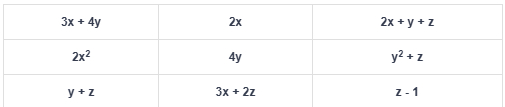
In a 3×3 magic square, the sum of entries in any row, column, or diagonal is the same number N. The cells are expressed in variables x, y, and z. Find the value of N.
- A12
- B36
- C21
- D48
- E24
Show answerHide answer
Answer: B
Approach: Equate pairs of line sums to get linear relations among x, y, z.
Solution:
Grid: [3x+4y, 2x, 2x+y+z] / [2x², 4y, y²+z] / [y+z, 3x+2z, z−1].
Row 1 = 7x + 5y + z; Column 2 = 5x + 4y + 2z → z = 2x + y.
Row 3 = 3x + y + 4z − 1; equate with Row 1 → 4x + 4y − 3z + 1 = 0 → with z = 2x + y: y = 2x − 1, z = 4x − 1.
Anti-diagonal = 2x + 6y + 2z; equate with Row 1 → 5x = y + z = 6x − 2 → x = 2, y = 3, z = 7.
N = 7(2) + 5(3) + 7 = 36. Check Row 2: 8 + 12 + 16 = 36 ✓; Column 1: 18 + 8 + 10 = 36 ✓; Main diagonal: 18 + 12 + 6 = 36 ✓
Cetking shortcut: Use only linear lines (Row 1, Column 2, Row 3, anti-diagonal) — avoid the x² and y² cells until the check.
Answer: B
B can finish a job in 40 days if he works alone. A is twice as fast as B and thrice as fast as C in the same job. Suppose A and B work together on the first day, B and C work together on the second day, C and A work together on the third day, and then, they continue the work by repeating this same three-day roster. What is the total number of days A would have worked when the job gets finished?
- A11
- B14
- C13
- D9
- E22
Show answerHide answer
Answer: A
Approach: Work units with LCM; run the 3-day roster cycle.
Solution:
B = 40 days; A twice B → 20 days; A thrice C → C = 60 days.
Work = 120 units: A 6, B 3, C 2 units/day.
Day 1 (A+B) 9, Day 2 (B+C) 5, Day 3 (C+A) 8 → 22 units per 3 days.
5 cycles = 15 days → 110 units. Day 16 (A+B) → 119. Day 17 (B+C) → 124 ≥ 120, job done.
A works 2 days per cycle × 5 = 10, plus day 16 → 11 days.
Cetking shortcut: 120 = 22 × 5 + 10; the leftover 10 needs day 16 (A+B, 9) and day 17 (B+C) — A adds just one day.
Answer: A
A glass contains 500 ml of milk and a cup contains 500 ml of water. From the glass, 150 ml of milk is transferred to the cup and mixed thoroughly. Next, 150 ml of this mixture is transferred from the cup to the glass. Now, the amount of water in the glass and the amount of milk in the cup will be in what specific ratio?
- A1:1
- B1:2
- C2:3
- D10:13
- E10:11
Show answerHide answer
Answer: A
Approach: Equal-volume exchange — whatever water entered the glass equals the milk that left into the cup.
Solution:
After step 1: cup = 500 water + 150 milk = 650 ml.
150 ml of cup mixture → water = 150 × 500/650 = 1500/13 ml, milk = 150 × 150/650 = 450/13 ml.
Water in glass = 1500/13 ml. Milk in cup = 150 − 450/13 = 1500/13 ml.
Ratio = 1 : 1.
Cetking shortcut: Each vessel ends with 500 ml, so the water that moved into the glass must equal the milk left in the cup — always 1 : 1.
Answer: A
What shall be the arithmetic mean of all the distinct numbers that can be obtained by rearranging the digits in 1421, including itself?
- A3333
- B2448
- C2222
- D2442
- E2592
Show answerHide answer
Answer: C
Approach: By symmetry each position holds each digit equally often; average digit × 1111.
Solution:
Digits 1, 1, 2, 4 → distinct arrangements = 4!/2! = 12.
In each place, the average digit = (1 + 1 + 2 + 4)/4 = 2.
Average number = 2 × 1000 + 2 × 100 + 2 × 10 + 2 = 2 × 1111 = 2222.
Cetking shortcut: Mean of all permutations = (digit sum / number of digits) × 111…1.
Answer: C
Take 6 distinct natural numbers such that the average of the two smallest numbers is 14, and the average of the two largest numbers is 28. Then, the maximum possible value of the average of these six numbers can be how much?
- A22.5
- B24.5
- C21.5
- D20
- E23.5
Show answerHide answer
Answer: A
Approach: Push the middle two numbers as high as the distinctness constraint allows.
Solution:
Order a < b < c < d < e < f. a + b = 28, e + f = 56.
To raise c, d, make e as large as possible: e < f → e = 27, f = 29.
Then d ≤ 26, c ≤ 25 → c + d = 51 (a, b e.g. 13, 15 stay below c).
Max average = (28 + 51 + 56)/6 = 135/6 = 22.5.
Cetking shortcut: e is at most 27 (just under half of 56), so the middle pair is 26 + 25.
Answer: A
Datta purchased two oranges, three bananas and four apples for Rs. 15. Had he instead bought 3 oranges, 2 bananas, and 1 apple, it would have cost Rs. 10. If Datta bought 3 oranges, 3 bananas and 3 apples, how much did he pay?
- ARs. 7.50
- BRs. 12
- CRs. 12.50
- DRs. 15
- ERs. 10
Show answerHide answer
Answer: D
Approach: Add the two equations — the coefficients become equal.
Solution:
2o + 3b + 4a = 15 and 3o + 2b + a = 10.
Add: 5o + 5b + 5a = 25 → o + b + a = 5.
3 oranges + 3 bananas + 3 apples = 3 × 5 = Rs 15.
Cetking shortcut: When individual prices can't be found, look for a combination of the equations that matches the target.
Answer: D
A cricket umpire has to pick 3 articles from 6 caps and 4 sweaters before a match. What is the probability that at least one sweater was picked?
- A5/11
- B3/5
- C5/6
- D2/7
- E2/3
Show answerHide answer
Answer: C
Approach: 'At least one' → 1 − P(none).
Solution:
Total ways = C(10, 3) = 120. No sweater (all caps) = C(6, 3) = 20.
P(at least one sweater) = 1 − 20/120 = 5/6.
Answer: C
If a group of N people worked on a project and finished 35% of the project by working 7 hours a day for 10 days. Then 10 people left, and the remaining group completed the rest in 14 days by working 10 hours a day. Determine the value of N.
- A35
- B105
- C70
- D150
- E140
Show answerHide answer
Answer: E
Approach: Man-hours are proportional to work done.
Solution:
Phase 1: N × 7 × 10 = 70N man-hours → 35% of work.
Phase 2: (N − 10) × 10 × 14 = 140(N − 10) → 65% of work.
70N/35 = 140(N − 10)/65 → 2N = 28(N − 10)/13 → 26N = 28N − 280 → N = 140.
Cetking shortcut: Test options: N = 140 → 9800 man-hours for 35% (280 per %); 130 × 140 = 18200 for 65% (280 per %) ✓
Answer: E
A University has less than 5000 students. If students are divided equally into teams of either 9, 10, 12, or 25 each, exactly 4 students are always left out. However, dividing them into teams of 11 leaves no student out. Determine the maximum number of teams of 12 students that can be formed.
- A150
- B250
- C100
- D10
- E75
Show answerHide answer
Answer: A
Approach: Same remainder 4 → number = LCM × k + 4; then impose divisibility by 11.
Solution:
LCM(9, 10, 12, 25) = 2² × 3² × 5² = 900 → x = 900k + 4 < 5000 → k = 0 to 5.
900 ≡ 9 (mod 11) → 9k + 4 ≡ 0 (mod 11) → 9k ≡ 7 → k ≡ 2 (mod 11).
Only k = 2 → x = 1804 (= 11 × 164 ✓).
Teams of 12: 1804 ÷ 12 = 150 remainder 4 → maximum 150 teams.
Cetking shortcut: List 4, 904, 1804, 2704, 3604, 4504 and test divisibility by 11 (alternating digit sums): only 1804.
Answer: A
A drain pipe can empty a tank in 12 hours, and a fill pipe can fill it in 6 hours. There are n pipes including some fill pipes and some drain pipes, and together they fill the tank in exactly 2 hours. How many of the following values could n have in this case?
24, 16, 33, 13, 9, 8
- A12
- B13
- C5
- D3
- E2
Show answerHide answer
Answer: D
Approach: Net rate equation with f fill pipes and d drain pipes.
Solution:
f/6 − d/12 = 1/2 → 2f − d = 6 → d = 2f − 6.
n = f + d = 3f − 6 → n must be a multiple of 3 (and d ≥ 1 → f ≥ 4 → n ≥ 6).
From 24, 16, 33, 13, 9, 8: 24 (f = 10, d = 14), 33 (f = 13, d = 20), 9 (f = 5, d = 4) work; 16, 13, 8 do not.
Count = 3.
Cetking shortcut: n = 3f − 6 → just pick the multiples of 3 (≥ 6) from the list.
Answer: D
Bottle 1 contains a mixture of milk and water in 7:2 ratio and Bottle 2 contains a mixture of milk and water in 9:4 ratio. In what ratio of volumes should the liquids in Bottle 1 and Bottle 2 be combined to obtain a mixture of milk and water in 3:1 ratio?
- A27:14
- B27:13
- C14:27
- D27:16
- E17:27
Show answerHide answer
Answer: B
Approach: Alligation on the fraction of milk.
Solution: Milk fraction: Bottle 1 = 7/9, Bottle 2 = 9/13, target = 3/4.
Bottle 1 − target = 7/9 − 3/4 = (28 − 27)/36 = 1/36.
Target − Bottle 2 = 3/4 − 9/13 = (39 − 36)/52 = 3/52.
Bottle 1 : Bottle 2 = (target − B2) : (B1 − target) = 3/52 : 1/36.
Multiply by 468 (LCM of 52 and 36): 3 × 9 : 1 × 13 = 27 : 13.
Check: 27 parts of 7/9 → 21 milk, 6 water; 13 parts of 9/13 → 9 milk, 4 water; total 30 : 10 = 3 : 1 ✓.
Why the other options are wrong:
C (14:27) / E (17:27): reverse ratios – Bottle 1 is closer to the target, so it must be used more.
A, D: off by one step in the cross-multiplication.
Cetking shortcut: Bottle 1 (0.778) is nearer to 0.75 than Bottle 2 (0.692), so Bottle 1's share is larger – eliminate C and E at once.
Answer: B
In how many ways can 8 identical pens be distributed among Aai, Bai, and Cai so that Aai gets at least 1 pen, Bai gets at least 2 pens, and Cai gets at least 3 pens?
- A4
- B3
- C2
- D6
- E5
Show answerHide answer
Answer: D
Approach: Identical items with minimums: give the minimums first, then distribute the rest freely (stars and bars).
Solution: Minimums: Aai 1 + Bai 2 + Cai 3 = 6 pens.
Remaining = 8 − 6 = 2 pens, distributed freely among 3 people.
Non-negative solutions of x + y + z = 2: C(2 + 3 − 1, 3 − 1) = C(4, 2) = 6.
(List: 200, 020, 002, 110, 101, 011.)
Cetking shortcut: Ways to give r identical items to n people (zero allowed) = C(r + n − 1, n − 1).
Answer: D
A motorbike leaves point A at 1 pm and moves towards point B at a uniform speed. A car leaves point B at 2 pm and moves towards point A at a uniform speed which is double that of the motorbike. They meet at 3:40 pm at a point which is 168 km away from A. What is the distance, in km, between A and B?
- A400
- B395
- C365
- D375
- E378
Show answerHide answer
Answer: E
Approach: Use the meeting-point distance from A to find the bike's speed, then add the car's distance.
Solution: Let bike speed = x km/h; car speed = 2x.
Bike time (1:00 → 3:40 pm) = 2 h 40 min = 8/3 h. Meeting point is 168 km from A, so (8/3)x = 168 → x = 63 km/h.
Car time (2:00 → 3:40 pm) = 1 h 40 min = 5/3 h. Car distance = 126 × 5/3 = 210 km.
AB = 168 + 210 = 378 km.
Why the other options are wrong:
A, B, C, D: none matches 168 + 210; D (375) is a near-miss trap.
Cetking shortcut: Distances ∝ speed × time = 1 × 8 : 2 × 5 = 8 : 10. Bike's 8 parts = 168 → 1 part = 21 → total 18 parts = 378.
Answer: E
Choose the options containing grammatically correct sentences:
A. There are less cars on the road today.
B. She is nicer than her sister.
C. I have been here from Monday.
D. I know how to swim.
E. She is the girl that won the case competition.
F. The media are divided on the issue.
- AB, C & E
- BA, D & E
- CA, D & F
- DB, D & F
- ED, E & F
Show answerHide answer
Answer: D
Approach: Check each sentence for count nouns, preposition with time, relative pronoun and collective nouns.
Solution:
A ✗ — 'cars' is countable: 'fewer cars', not 'less cars'.
B ✓ — correct comparative 'nicer than'.
C ✗ — with the present perfect, a starting point takes 'since': 'I have been here since Monday'.
D ✓ — 'know how to swim' is correct.
E — borderline: for a person 'who' is preferred ('the girl who won'), though 'that' is tolerated; the intended correct set excludes it.
F ✓ — 'media' as a plural takes 'are'.
Correct set = B, D & F.
Why the other options are wrong: A (B, C & E) and B (A, D & E) include the 'from Monday' or 'less cars' errors; C (A, D & F) includes 'less cars'; E (D, E & F) leaves out the clearly correct B and includes E.
Cetking shortcut: B is clearly correct → only options A and D contain B; A contains C ('from Monday') → D.
Answer: D
Choose the options containing grammatically correct sentences:
A. The dean asked for additional funding.
B. The boss discussed about the new project with his team.
C. Adhika is good in data interpretation.
D. Neil is transitioning into a new phase of life.
E. Ajat emphasized for the need for consistency in MH-CET preparation.
F. This car is superior to the previous one in terms of efficiency.
- AC, E & F
- BB, C & F
- CA, B & C
- DB, C & D
- EA, D & F
Show answerHide answer
Answer: E
Approach: Fixed prepositions with common verbs/adjectives (discuss, good at, emphasize, superior to).
Solution: Check each sentence:
A. 'asked for additional funding' – correct.
B. 'discussed about' – wrong; discuss takes a direct object: 'discussed the new project'.
C. 'good in' – wrong; idiom is 'good at data interpretation'.
D. 'transitioning into a new phase' – correct.
E. 'emphasized for the need' – wrong; 'emphasized the need' (or 'laid emphasis on').
F. 'superior to the previous one' – correct ('superior' takes 'to', not 'than').
Correct set = A, D, F.
Why the other options are wrong:
A (C, E, F): C and E are wrong.
B (B, C, F): B and C are wrong.
C (A, B, C): B and C are wrong.
D (B, C, D): B and C are wrong.
Cetking shortcut: Spot B ('discussed about') and C ('good in') as wrong – every option except E contains at least one of them.
Answer: E
Arrange the following sentences into a coherent paragraph:
A. Whatever that might be on Europa—far from the Sun, and beneath kilometres of ice—it will not be sunlight.
B. The final ingredient for a habitable world is a source of energy for life to exploit.
C. On Earth almost every living thing ultimately depends on photosynthesis for its energy...
D. Their inhabitants do not benefit from sunlight directly...
E. That is a bit of a problem.
- AD, E, C, B, A
- BC, E, B, A, D
- CA, B, E, D, C
- DB, A, E, C, D
- EE, D, B, C, A
Show answerHide answer
Answer: D
Approach: Find the opener that introduces the idea, then follow pronoun/reference links.
Solution: B opens the topic: the final ingredient for a habitable world is an energy source.
A applies it to Europa: whatever 'that' (the energy source) is there, it will not be sunlight.
E reacts: 'That is a bit of a problem.'
C explains why it is a problem: on Earth almost everything depends on photosynthesis.
D gives the exception: 'Their inhabitants' (of places without sunlight) do not use sunlight directly.
Order: B, A, E, C, D.
Why the other options are wrong:
A (D…): D begins with 'Their', which needs an antecedent – cannot open.
B (C, E…): 'That is a bit of a problem' after C makes no sense – photosynthesis on Earth is not a problem.
C (A…): A's 'that' refers to the energy source in B, so A cannot open.
E (E…): E is a reaction and cannot open the paragraph.
Cetking shortcut: Pair A–E: 'it will not be sunlight' → 'That is a bit of a problem'. Only option D has B-A-E together.
Answer: D
Choose the best set of words to fill the blanks:
"When each __________ generation grows up, it looks down on the next as if we all forget what it feels like to be __________. When most __________ think about their own youthful indiscretions they do so with a wink and a laugh. But when the same people think about those in today’s generation doing something similar, they __________ sound the alarm about a decline in morality in next generation."
- Asucceeding, next, people, naturally
- Byoung, juvenile, seniors, carefully
- Csuccessive, young, adults, hypocritically
- Dold, older, youngsters, sincerely
- Epreceding, succeeding, folks, cautiously
Show answerHide answer
Answer: C
Approach: Use the tone of the passage (irony about elders judging the young) to fill all four blanks.
Solution: Blank 1: 'each ___ generation grows up' → successive (one after another).
Blank 2: we forget what it feels like to be young.
Blank 3: most adults remember their own youthful indiscretions with a wink.
Blank 4: but they condemn the same behaviour in the next generation – that is hypocritical, so 'hypocritically sound the alarm'.
Set: successive, young, adults, hypocritically.
Why the other options are wrong:
A: 'next' (blank 2) makes no sense; 'naturally' misses the irony.
B: 'juvenile' is a noun/adjective misfit here and 'carefully' misses the double standard.
D: 'youngsters' cannot recall 'their own youthful indiscretions'; 'sincerely' contradicts the irony.
E: 'preceding' generation growing up is illogical; 'cautiously' misses the irony.
Cetking shortcut: The last blank decides it: wink at your own faults but alarm at others' = hypocrisy. Only C has it.
Answer: C
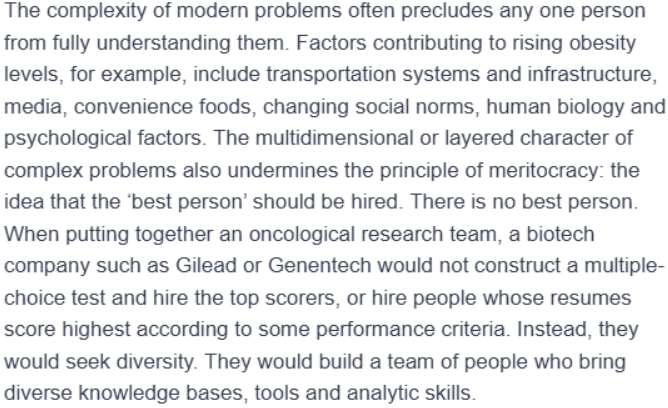
The complexity of modern problems often precludes any one person from fully understanding them. Factors contributing to rising obesity levels, for example, include transportation systems and infrastructure, media, convenience foods, changing social norms, human biology and psychological factors. The multidimensional or layered character of complex problems also undermines the principle of meritocracy: the idea that the 'best person' should be hired. There is no best person. When putting together an oncological research team, a biotech company such as Gilead or Genentech would not construct a multiple-choice test and hire the top scorers, or hire people whose resumes score highest according to some performance criteria. Instead, they would seek diversity. They would build a team of people who bring diverse knowledge bases, tools and analytic skills.
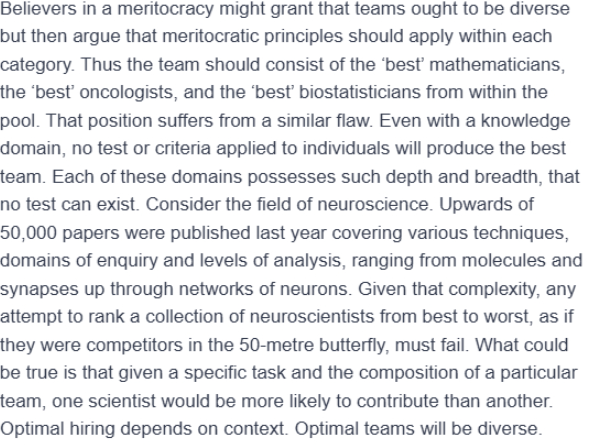
Believers in a meritocracy might grant that teams ought to be diverse but then argue that meritocratic principles should apply within each category. Thus the team should consist of the 'best' mathematicians, the 'best' oncologists, and the 'best' biostatisticians from within the pool. That position suffers from a similar flaw. Even with a knowledge domain, no test or criteria applied to individuals will produce the best team. Each of these domains possesses such depth and breadth, that no test can exist. Consider the field of neuroscience. Upwards of 50,000 papers were published last year covering various techniques, domains of enquiry and levels of analysis, ranging from molecules and synapses up through networks of neurons. Given that complexity, any attempt to rank a collection of neuroscientists from best to worst, as if they were competitors in the 50-metre butterfly, must fail. What could be true is that given a specific task and the composition of a particular team, one scientist would be more likely to contribute than another. Optimal hiring depends on context. Optimal teams will be diverse.
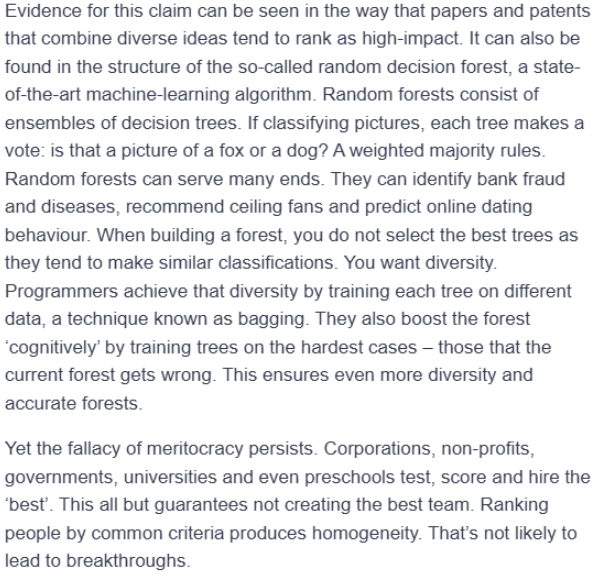
Evidence for this claim can be seen in the way that papers and patents that combine diverse ideas tend to rank as high-impact. It can also be found in the structure of the so-called random decision forest, a state-of-the-art machine-learning algorithm. Random forests consist of ensembles of decision trees. If classifying pictures, each tree makes a vote: is that a picture of a fox or a dog? A weighted majority rules. Random forests can serve many ends. They can identify bank fraud and diseases, recommend ceiling fans and predict online dating behaviour. When building a forest, you do not select the best trees as they tend to make similar classifications. You want diversity. Programmers achieve that diversity by training each tree on different data, a technique known as bagging. They also boost the forest 'cognitively' by training trees on the hardest cases – those that the current forest gets wrong. This ensures even more diversity and accurate forests.
Yet the fallacy of meritocracy persists. Corporations, non-profits, governments, universities and even preschools test, score and hire the 'best'. This all but guarantees not creating the best team. Ranking people by common criteria produces homogeneity. That's not likely to lead to breakthroughs.
Which of the following conditions, if true, would invalidate the passage's main argument ?
- AIf assessors were made more insensitive
- BIf a new machine-learning algorithm were developed that proved to be more effective than the random decision forest
- CIf top-scorers possessed multidisciplinary knowledge that enabled them to look at a problem from several perspectives
- DIf it were proven that teams characterised by diversity end up being conflicted about problems and take a long time to arrive at a solution
- EIf assessment tests were made more extensive and rigorous
Show answerHide answer
Answer: C
Approach: Main argument: ranking people by common criteria produces homogeneity, so hiring top scorers does not give the best (diverse) team. Attack that link.
Solution: The author's case rests on the premise that top scorers on common tests are alike, so a team of them lacks diversity. If top scorers themselves possessed multidisciplinary knowledge and could see a problem from several perspectives, hiring the 'best' would automatically bring diversity – the conflict between merit and diversity disappears and the argument collapses.
Why the other options are wrong:
A: making assessors 'insensitive' is irrelevant to the argument.
B: a better algorithm than random forests removes only one example, not the argument.
D: diverse teams being slow does not show they produce worse solutions; it only adds a cost.
E: more rigorous tests still rank on common criteria – the author says no test can capture a whole domain.
Cetking shortcut: To invalidate, deny the key premise ('ranking → homogeneity'); look for the option where top scorers are themselves diverse.
Answer: C
The complexity of modern problems often precludes any one person from fully understanding them. Factors contributing to rising obesity levels, for example, include transportation systems and infrastructure, media, convenience foods, changing social norms, human biology and psychological factors. The multidimensional or layered character of complex problems also undermines the principle of meritocracy: the idea that the 'best person' should be hired. There is no best person. When putting together an oncological research team, a biotech company such as Gilead or Genentech would not construct a multiple-choice test and hire the top scorers, or hire people whose resumes score highest according to some performance criteria. Instead, they would seek diversity. They would build a team of people who bring diverse knowledge bases, tools and analytic skills.
Believers in a meritocracy might grant that teams ought to be diverse but then argue that meritocratic principles should apply within each category. Thus the team should consist of the 'best' mathematicians, the 'best' oncologists, and the 'best' biostatisticians from within the pool. That position suffers from a similar flaw. Even with a knowledge domain, no test or criteria applied to individuals will produce the best team. Each of these domains possesses such depth and breadth, that no test can exist. Consider the field of neuroscience. Upwards of 50,000 papers were published last year covering various techniques, domains of enquiry and levels of analysis, ranging from molecules and synapses up through networks of neurons. Given that complexity, any attempt to rank a collection of neuroscientists from best to worst, as if they were competitors in the 50-metre butterfly, must fail. What could be true is that given a specific task and the composition of a particular team, one scientist would be more likely to contribute than another. Optimal hiring depends on context. Optimal teams will be diverse.
Evidence for this claim can be seen in the way that papers and patents that combine diverse ideas tend to rank as high-impact. It can also be found in the structure of the so-called random decision forest, a state-of-the-art machine-learning algorithm. Random forests consist of ensembles of decision trees. If classifying pictures, each tree makes a vote: is that a picture of a fox or a dog? A weighted majority rules. Random forests can serve many ends. They can identify bank fraud and diseases, recommend ceiling fans and predict online dating behaviour. When building a forest, you do not select the best trees as they tend to make similar classifications. You want diversity. Programmers achieve that diversity by training each tree on different data, a technique known as bagging. They also boost the forest 'cognitively' by training trees on the hardest cases – those that the current forest gets wrong. This ensures even more diversity and accurate forests.
Yet the fallacy of meritocracy persists. Corporations, non-profits, governments, universities and even preschools test, score and hire the 'best'. This all but guarantees not creating the best team. Ranking people by common criteria produces homogeneity. That's not likely to lead to breakthroughs.
The author critiques meritocracy for all the following reasons EXCEPT that:
- AModern problems are multifaceted and require varied skill-sets to be solved
- BDiversity and context-specificity are important for making major advances in any field
- CProblems in today’s day and age are also complex
- DAn ideal team comprises of best individuals from diverse fields of knowledge
- EThe criteria designed to assess merit are insufficient to test expertise in any field of knowledge
Show answerHide answer
Answer: D
Approach: EXCEPT question: four options are reasons the author gives; find the one the author argues against.
Solution: Author's reasons: problems are multidimensional and need varied skills (para 1); problems are complex (para 1); no test can measure expertise in a deep domain (para 2); optimal hiring depends on context and optimal teams are diverse, which leads to breakthroughs (paras 2–4).
D – 'an ideal team comprises the best individuals from diverse fields' – is exactly the position of 'believers in a meritocracy' in para 2, which the author says 'suffers from a similar flaw'. It is not his reason; it is what he rejects.
Why the other options are wrong:
A: stated – complex problems need diverse knowledge bases, tools and skills.
B: stated – 'optimal hiring depends on context', diverse ideas rank high-impact.
C: stated – 'the complexity of modern problems'.
E: stated – 'no test or criteria applied to individuals will produce the best team… no test can exist'.
Cetking shortcut: In EXCEPT questions, look for the option that repeats the opponent's view – here the 'best mathematicians, best oncologists' line.
Answer: D
The complexity of modern problems often precludes any one person from fully understanding them. Factors contributing to rising obesity levels, for example, include transportation systems and infrastructure, media, convenience foods, changing social norms, human biology and psychological factors. The multidimensional or layered character of complex problems also undermines the principle of meritocracy: the idea that the 'best person' should be hired. There is no best person. When putting together an oncological research team, a biotech company such as Gilead or Genentech would not construct a multiple-choice test and hire the top scorers, or hire people whose resumes score highest according to some performance criteria. Instead, they would seek diversity. They would build a team of people who bring diverse knowledge bases, tools and analytic skills.
Believers in a meritocracy might grant that teams ought to be diverse but then argue that meritocratic principles should apply within each category. Thus the team should consist of the 'best' mathematicians, the 'best' oncologists, and the 'best' biostatisticians from within the pool. That position suffers from a similar flaw. Even with a knowledge domain, no test or criteria applied to individuals will produce the best team. Each of these domains possesses such depth and breadth, that no test can exist. Consider the field of neuroscience. Upwards of 50,000 papers were published last year covering various techniques, domains of enquiry and levels of analysis, ranging from molecules and synapses up through networks of neurons. Given that complexity, any attempt to rank a collection of neuroscientists from best to worst, as if they were competitors in the 50-metre butterfly, must fail. What could be true is that given a specific task and the composition of a particular team, one scientist would be more likely to contribute than another. Optimal hiring depends on context. Optimal teams will be diverse.
Evidence for this claim can be seen in the way that papers and patents that combine diverse ideas tend to rank as high-impact. It can also be found in the structure of the so-called random decision forest, a state-of-the-art machine-learning algorithm. Random forests consist of ensembles of decision trees. If classifying pictures, each tree makes a vote: is that a picture of a fox or a dog? A weighted majority rules. Random forests can serve many ends. They can identify bank fraud and diseases, recommend ceiling fans and predict online dating behaviour. When building a forest, you do not select the best trees as they tend to make similar classifications. You want diversity. Programmers achieve that diversity by training each tree on different data, a technique known as bagging. They also boost the forest 'cognitively' by training trees on the hardest cases – those that the current forest gets wrong. This ensures even more diversity and accurate forests.
Yet the fallacy of meritocracy persists. Corporations, non-profits, governments, universities and even preschools test, score and hire the 'best'. This all but guarantees not creating the best team. Ranking people by common criteria produces homogeneity. That's not likely to lead to breakthroughs.
On the basis of the passage, which of the following teams is likely to be most effective in solving the problem of rising obesity levels?
- AA team comprised of nutritionists, psychologists, urban planners and media personnel, who have each performed well in their respective subject tests
- BA team that comprises of psychologists who had themselves been obese previously
- CA specialised team of nutritionists from various countries, who are also trained in the machine-learning algorithm of random decision forest
- DA team comprised of nutritionists, psychologists, urban planners and media personnel, who have each scored a distinction in their respective subject tests
- EA specialised team of top nutritionists from various countries, who also possess some knowledge of psychology
Show answerHide answer
Answer: A
Approach: Apply the passage: an effective team is diverse across fields and not built by picking top scorers.
Solution: Obesity has causes in nutrition, psychology, transport/infrastructure and media (para 1). So the team must span these fields – options A and D both do.
The difference: D picks people who 'scored a distinction' – i.e. the top scorers in each category, exactly the 'best within each category' approach the author rejects. A only says members performed well, i.e. they are competent, not selected by ranking. So A fits the author's view best.
Why the other options are wrong:
B: one field only (psychology) and one shared experience – no diversity.
C: nutritionists only; knowing the random-forest algorithm is a misread of an example.
D: diverse fields but selected as top scorers – the meritocratic flaw the author criticises.
E: 'specialised team of top nutritionists' – single field and ranked by merit.
Cetking shortcut: Eliminate single-field teams (B, C, E), then reject the one that stresses top scores (D).
Answer: A
The complexity of modern problems often precludes any one person from fully understanding them. Factors contributing to rising obesity levels, for example, include transportation systems and infrastructure, media, convenience foods, changing social norms, human biology and psychological factors. The multidimensional or layered character of complex problems also undermines the principle of meritocracy: the idea that the 'best person' should be hired. There is no best person. When putting together an oncological research team, a biotech company such as Gilead or Genentech would not construct a multiple-choice test and hire the top scorers, or hire people whose resumes score highest according to some performance criteria. Instead, they would seek diversity. They would build a team of people who bring diverse knowledge bases, tools and analytic skills.
Believers in a meritocracy might grant that teams ought to be diverse but then argue that meritocratic principles should apply within each category. Thus the team should consist of the 'best' mathematicians, the 'best' oncologists, and the 'best' biostatisticians from within the pool. That position suffers from a similar flaw. Even with a knowledge domain, no test or criteria applied to individuals will produce the best team. Each of these domains possesses such depth and breadth, that no test can exist. Consider the field of neuroscience. Upwards of 50,000 papers were published last year covering various techniques, domains of enquiry and levels of analysis, ranging from molecules and synapses up through networks of neurons. Given that complexity, any attempt to rank a collection of neuroscientists from best to worst, as if they were competitors in the 50-metre butterfly, must fail. What could be true is that given a specific task and the composition of a particular team, one scientist would be more likely to contribute than another. Optimal hiring depends on context. Optimal teams will be diverse.
Evidence for this claim can be seen in the way that papers and patents that combine diverse ideas tend to rank as high-impact. It can also be found in the structure of the so-called random decision forest, a state-of-the-art machine-learning algorithm. Random forests consist of ensembles of decision trees. If classifying pictures, each tree makes a vote: is that a picture of a fox or a dog? A weighted majority rules. Random forests can serve many ends. They can identify bank fraud and diseases, recommend ceiling fans and predict online dating behaviour. When building a forest, you do not select the best trees as they tend to make similar classifications. You want diversity. Programmers achieve that diversity by training each tree on different data, a technique known as bagging. They also boost the forest 'cognitively' by training trees on the hardest cases – those that the current forest gets wrong. This ensures even more diversity and accurate forests.
Yet the fallacy of meritocracy persists. Corporations, non-profits, governments, universities and even preschools test, score and hire the 'best'. This all but guarantees not creating the best team. Ranking people by common criteria produces homogeneity. That's not likely to lead to breakthroughs.
Which of the following best describes the purpose of the example of neuroscience?
- ANeuroscience is an advanced field of science because of its connections with other branches of science like oncology and biostatistics
- BIn narrow fields of knowledge, a meaningful assessment of expertise has always been possible
- CNeuroscience helps in lessening anxiety in new age workers
- DUnlike other fields of knowledge, neuroscience is an exceptionally complex field, making a meaningful assessment of neuroscientists impossible
- EIn the modern age, every field of knowledge is so vast that a meaningful assessment of merit is impossible
Show answerHide answer
Answer: E
Approach: Purpose of an example = the claim it supports, stated just before it.
Solution: Just before the example the author says: 'Each of these domains possesses such depth and breadth, that no test can exist. Consider the field of neuroscience.' Neuroscience (50,000 papers a year, molecules to networks) is an illustration of a general point: every field is too vast for a meaningful ranking of merit. So E.
Why the other options are wrong:
A: oncology and biostatistics are not linked to neuroscience in the passage.
B: opposite – the author says such assessment is impossible.
C: anxiety of workers is never discussed.
D: 'unlike other fields' is wrong – neuroscience is a representative example, not an exception.
Cetking shortcut: 'Consider X' examples usually illustrate the general sentence right before them – read that sentence.
Answer: E
Words remain an enigma, their presence within the human sphere is a unique mystery. They form the intricate tapestry that convinces us of our existence, blurring lines between fact and fiction. An engagement with words is the most captivating, enchanting, and sometimes daunting encounter with the world. A word, a symbolic entity formed from the ethereal, exists neither as animate nor inanimate, yet pulsates with life. It can emanate warmth or coldness, absorb emotions, or stand as dry as a rock. Words can provoke smiles and elicit joy. They are like glow-worms, momentarily dispelling the surrounding darkness and act as life-saving rafts amid the tumultuous ocean waves. Words grant us the ability to explore the universe, and “to see a world in a grain of sand,” as William Blake noted. They impart a semantic existence to the lifeless, and bestow aesthetic form upon the formless. Scriptures say the word is the world. I say the world within the word is the abode of faith.
"An engagement with words is the most captivating, enchanting, and sometimes daunting encounter with the world."
Which of the following conclusions can be drawn from the above statement?
- AWords can be used to manipulate others.
- BWords don’t remain faithful to the author.
- CWords can paint a picture of the world in all its different colours.
- DThe power of words should be used carefully.
- EWords can capture the atrocities of the world.
Show answerHide answer
Answer: C
Approach: Draw a conclusion that stays within the sentence: engaging with words is a rich, many-sided encounter with the world.
Solution: The sentence calls engagement with words 'captivating, enchanting and sometimes daunting' – an encounter with the world through words. The passage adds that words give warmth or coldness, joy, light, and let us 'see a world in a grain of sand'. So words can show the world in all its varied shades – option C.
Why the other options are wrong:
A: manipulation of others is not suggested.
B: faithfulness of words to the author is never discussed.
D: a caution about using words is advice, not a conclusion from the statement.
E: 'atrocities' is too narrow and negative; 'daunting' is only one shade.
Cetking shortcut: Three adjectives of different shades (captivating, enchanting, daunting) → the answer is the option about variety.
Answer: C
Words remain an enigma, their presence within the human sphere is a unique mystery. They form the intricate tapestry that convinces us of our existence, blurring lines between fact and fiction. An engagement with words is the most captivating, enchanting, and sometimes daunting encounter with the world. A word, a symbolic entity formed from the ethereal, exists neither as animate nor inanimate, yet pulsates with life. It can emanate warmth or coldness, absorb emotions, or stand as dry as a rock. Words can provoke smiles and elicit joy. They are like glow-worms, momentarily dispelling the surrounding darkness and act as life-saving rafts amid the tumultuous ocean waves. Words grant us the ability to explore the universe, and “to see a world in a grain of sand,” as William Blake noted. They impart a semantic existence to the lifeless, and bestow aesthetic form upon the formless. Scriptures say the word is the world. I say the world within the word is the abode of faith.
In the context of the passage, what is the significance of the “world within the word”?
- AIt describes the author’s mission to explore different cultures.
- BIt signifies a spiritual exposition.
- CIt refers to the power of language to create inspiration, energy and faith.
- DIt signifies the author’s love for the global community.
- EIt represents the mysteries hidden in language.
Show answerHide answer
Answer: B
Approach: Read the phrase with its own sentence: 'the world within the word is the abode of faith'.
Solution: The author contrasts scripture ('the word is the world') with his own view that the world inside words is 'the abode of faith'. Calling it a home of faith gives words a sacred, spiritual meaning – a spiritual exposition. So B.
Why the other options are wrong:
A: exploring cultures is not mentioned.
C: inspiration and energy are added – the line speaks of faith only.
D: love for the global community is not mentioned.
E: mystery is in the opening line, but the phrase itself is tied to faith, not mystery.
Cetking shortcut: Key word 'abode of faith' + 'Scriptures say' → spiritual.
Answer: B
Words remain an enigma, their presence within the human sphere is a unique mystery. They form the intricate tapestry that convinces us of our existence, blurring lines between fact and fiction. An engagement with words is the most captivating, enchanting, and sometimes daunting encounter with the world. A word, a symbolic entity formed from the ethereal, exists neither as animate nor inanimate, yet pulsates with life. It can emanate warmth or coldness, absorb emotions, or stand as dry as a rock. Words can provoke smiles and elicit joy. They are like glow-worms, momentarily dispelling the surrounding darkness and act as life-saving rafts amid the tumultuous ocean waves. Words grant us the ability to explore the universe, and “to see a world in a grain of sand,” as William Blake noted. They impart a semantic existence to the lifeless, and bestow aesthetic form upon the formless. Scriptures say the word is the world. I say the world within the word is the abode of faith.
What is the central theme of the passage?
- AThe importance of storytelling
- BThe simplicity of syntax
- CThe impact of words on human existence
- DThe history of the human language
- EThe mystery of human cognition
Show answerHide answer
Answer: C
Approach: Central theme = what every sentence of the passage is about.
Solution: Every line describes what words do for humans: they convince us of our existence, carry emotion, light up darkness, save us like rafts, let us explore the universe and give form to the formless. The theme is the impact of words on human existence – C.
Why the other options are wrong:
A: storytelling is never discussed.
B: syntax is not mentioned.
D: no history of language is given.
E: cognition is not the topic; the mystery is of words, not the mind.
Answer: C
Fill in the blanks with the correct set of words given below:
I don’t believe he I from his current job despite the raise.
The truth is usually more II than a lie.
We have finite amounts of willpower that become III as we use them.
- A(I) resigned; (II) shocking; (III) depleted
- B(I) depleted; (II) resigned; (III) shocked
- C(I) shocks; (II) resigned; (III) depleted
- D(I) shocked; (II) depleted; (III) resigned
- E(I) depleted; (II) shocking; (III) resigned
Show answerHide answer
Answer: A
Approach: Fill each blank by grammar (part of speech) and meaning.
Solution: I: 'he ___ from his current job' needs a past-tense verb taking 'from' → resigned.
II: 'more ___ than a lie' needs an adjective → shocking (truth is often more startling than a lie).
III: willpower that becomes ___ as we use it → depleted (used up).
Set: resigned, shocking, depleted.
Why the other options are wrong:
B: 'he depleted from his job' is meaningless.
C: 'he shocks from his job' is meaningless.
D: 'he shocked from his job' is meaningless; 'truth is more depleted' makes no sense.
E: 'depleted from his job' is meaningless; willpower does not become 'resigned'.
Cetking shortcut: Blank I alone settles it: only 'resigned' goes with 'from his job'.
Answer: A
Read the following sentences carefully and determine which of the following options contain grammatically CORRECT sentences.
A. There are less cars on the road today.
B. She is nicer than her sister.
C. I have been here from Monday.
D. I know how to swim.
E. She is the girl that won the case competition.
F. The media are divided on the issue.
- AB, D & E
- BB, C & E
- CC, D & F
- DA, D & E
- EB, D & F
Show answerHide answer
Answer: E
Approach: Check each sentence against standard rules: fewer/less, since/from, who/that for persons, collective 'media'.
Solution: A. 'less cars' – wrong; countable noun → 'fewer cars'.
B. 'nicer than her sister' – correct comparative.
C. 'been here from Monday' – wrong; with perfect continuous/perfect tense and a point of time use 'since Monday'.
D. 'I know how to swim' – correct.
E. 'the girl that won' – in exam grammar the relative pronoun for a person is 'who': 'the girl who won'.
F. 'The media are divided' – correct; 'media' is the plural of 'medium' and takes a plural verb.
Correct: B, D, F.
Why the other options are wrong:
A (B, D, E): E uses 'that' for a person.
B (B, C, E): C needs 'since'.
C (C, D, F): C needs 'since'.
D (A, D, E): A needs 'fewer'.
Cetking shortcut: Kill A and C first (fewer/since) – that leaves options A and E; decide between E and F: 'media are' is textbook-correct.
Answer: E
Read the following statements, numbered as A, B, C, D, and E carefully, and determine which option is most logically chronologically ordered.
Statements:
A. The treaty tests of a budget deficit no bigger than 3% of the GDP and a public debt converging towards a ceiling of 60% of a GDP seemed impossible for Italy to pass by 1999.
B. That Belgium also had a public debt above 100 percent of GDP helped, as did a special euro tax Mr. Prodi introduced.
C. Into the uncompromising environment came the first of a series of external shocks. One of the earliest was entry into the European single currency, the euro, in 1999.
D. But when it became clear in 1997 that Spain was determined to join from the start, Romano Prodi, then Italian prime minister, decided that Italy, as a founder member of the bloc, must be there too.
E. Germany had more or less designed the 1992 Maastricht treaty’s convergence criteria to keep out a profligate, chronically indebted Italy.
- AE, D, B, A, C
- BC, E, B, A, D
- CE, B, C, A, D
- DC, B, D, E, A
- EC, E, A, D, B
Show answerHide answer
Answer: E
Approach: Use time markers (1992, 1997, 1999) and linking words ('But', 'That … also').
Solution: C introduces the topic: an external shock – entry into the euro in 1999.
E gives the background: Germany designed the 1992 Maastricht criteria to keep Italy out.
A states those tests seemed impossible for Italy to pass by 1999.
D – 'But' in 1997 Prodi decided Italy must join anyway.
B – what helped: Belgium's similar debt and a special euro tax.
Order: C, E, A, D, B.
Why the other options are wrong:
A (E, D, B, A, C): A (tests seemed impossible) after B (what helped Italy pass) breaks the logic.
B (C, E, B, A, D): B ('helped') comes before Italy even decided to join (D).
C (E, B, C, A, D): B has nothing to have 'helped' yet.
D (C, B, D, E, A): B again too early; E (1992 background) after D (1997) breaks chronology.
Cetking shortcut: B ('That Belgium also … helped') must follow D (Prodi's decision) – only option E has D→B.
Answer: E
In the passage given below, there is an underlined word. Choose an alternative from the options given that can most correctly be used in place of the underlined word:
It is klang to a sensitive traveler who walks through this great town, when he sees the streets, the roads and cabin doors crowded with beggars, mostly women, followed by three, four, or six children, all in rags and importuning every passenger for alms.
- Airritating
- Bdistressing
- Crefuting
- Ddisgusting
- Eamusing
Show answerHide answer
Answer: B
Approach: Replace the made-up word with what the context demands.
Solution: A 'sensitive traveller' sees streets crowded with ragged beggar women and their children begging for alms. A sensitive person feels sadness and pain at such a sight – it is distressing. (The original line, from Swift, reads 'It is a melancholy object…'.)
Why the other options are wrong:
A: 'irritating' suggests annoyance, not a sensitive person's pity.
C: 'refuting' (disproving) does not fit grammatically or logically.
D: 'disgusting' is contempt, opposite to sensitivity.
E: 'amusing' is the opposite of the tone.
Cetking shortcut: The word 'sensitive' tells you the reaction is sympathy/sorrow.
Answer: B
In a world where aspirations for upward mobility are fervent, the opportunities for achieving such dreams remain limited. When one generation falls short, the mantle of ambition passes to the next, embedding within it a heavy burden of responsibility. Failing to meet these expectations can lead to profound sorrow, and in the direst cases, even to suicide. It’s in this landscape that coaching institutes assume a significant role, cultivating an atmosphere of uncertainty among students and parents. A stark discrepancy emerges between preparation for board examinations and competitive tests, amplifying the inequalities that plague the education system. The coaching industry’s massive marketing campaigns further exacerbate the situation, with some strategies veering into ethical gray areas. The tests themselves, designed to be more challenging than standardised exams, set the stage for feelings of inadequacy and self-doubt when not conquered. Our educational system is tailored to gauge an individual’s merit through examinations. Eminent thinker Michael J Sandel dubs this system the “tyranny of merit”, a sentiment echoed by the Supreme Court of India, when the Court called for a deeper evaluation of the “idea of merit”, highlighting its nuanced nature. Merit as a concept remains shrouded in misunderstanding and often goes unexamined within school curriculum. Adapting to new living arrangements, sourcing nourishing meals, battling isolation, and grappling with commutes form the backdrop against which education unfolds. For marginalised communities and gender minorities, these hurdles are often amplified. Social media algorithms exacerbate mental health concerns, sowing loneliness and impeding attention spans and creativity. Technology emerges as a potential equaliser in this landscape. Online platforms now offer preparation opportunities from the comfort of one’s home. Government-curated or market-driven content could usher in a new era of accessibility.
Which of the following is correct regarding the inequalities mentioned by the author?
- AThat there are existing inequalities which are enlarged by the competitive examinations
- BBoard Examinations do not keep the societal inequalities hidden
- CCompetitive examination leads us towards a social equality
- DThe education system accommodates the inequalities
- EThat there is no difference between the preparation of a Board and a competitive examination
Show answerHide answer
Answer: A
Approach: Locate the line on inequalities.
Solution: The passage says: 'A stark discrepancy emerges between preparation for board examinations and competitive tests, amplifying the inequalities that plague the education system.' So inequalities already exist and the competitive-exam system enlarges them – A.
Why the other options are wrong:
B: board exams hiding or revealing inequality is not discussed.
C: opposite – competitive exams amplify inequality.
D: the system is 'plagued' by inequalities, not 'accommodating' them.
E: opposite – the author says there is a stark discrepancy.
Cetking shortcut: 'Amplifying' = 'enlarged' – direct paraphrase.
Answer: A
In a world where aspirations for upward mobility are fervent, the opportunities for achieving such dreams remain limited. When one generation falls short, the mantle of ambition passes to the next, embedding within it a heavy burden of responsibility. Failing to meet these expectations can lead to profound sorrow, and in the direst cases, even to suicide. It’s in this landscape that coaching institutes assume a significant role, cultivating an atmosphere of uncertainty among students and parents. A stark discrepancy emerges between preparation for board examinations and competitive tests, amplifying the inequalities that plague the education system. The coaching industry’s massive marketing campaigns further exacerbate the situation, with some strategies veering into ethical gray areas. The tests themselves, designed to be more challenging than standardised exams, set the stage for feelings of inadequacy and self-doubt when not conquered. Our educational system is tailored to gauge an individual’s merit through examinations. Eminent thinker Michael J Sandel dubs this system the “tyranny of merit”, a sentiment echoed by the Supreme Court of India, when the Court called for a deeper evaluation of the “idea of merit”, highlighting its nuanced nature. Merit as a concept remains shrouded in misunderstanding and often goes unexamined within school curriculum. Adapting to new living arrangements, sourcing nourishing meals, battling isolation, and grappling with commutes form the backdrop against which education unfolds. For marginalised communities and gender minorities, these hurdles are often amplified. Social media algorithms exacerbate mental health concerns, sowing loneliness and impeding attention spans and creativity. Technology emerges as a potential equaliser in this landscape. Online platforms now offer preparation opportunities from the comfort of one’s home. Government-curated or market-driven content could usher in a new era of accessibility.
Which of the following statements reflects the use of online platforms for education as per the author?
- AThey hamper the natural mental growth of the students.
- BIt cannot be accessed by majority of the people due to technological impediments.
- CIt encourages the students to prepare for examination.
- DIt should be the only means to education.
- EIt provides equal opportunity to all the students irrespective of caste or creed.
Show answerHide answer
Answer: C
Approach: Locate the line on online platforms and do not go beyond it.
Solution: 'Technology emerges as a potential equaliser… Online platforms now offer preparation opportunities from the comfort of one's home.' So, as per the author, online platforms help/encourage students to prepare for exams – C.
Why the other options are wrong:
A: harm to mental health is said of social media, not educational platforms.
B: opposite – the author sees them as increasing accessibility.
D: 'only means' is an extreme claim not made.
E: 'potential equaliser' only; guaranteeing equal opportunity to all irrespective of caste/creed overstates it.
Cetking shortcut: Words like 'potential' and 'could' rule out absolute options such as D and E.
Answer: C
In a world where aspirations for upward mobility are fervent, the opportunities for achieving such dreams remain limited. When one generation falls short, the mantle of ambition passes to the next, embedding within it a heavy burden of responsibility. Failing to meet these expectations can lead to profound sorrow, and in the direst cases, even to suicide. It’s in this landscape that coaching institutes assume a significant role, cultivating an atmosphere of uncertainty among students and parents. A stark discrepancy emerges between preparation for board examinations and competitive tests, amplifying the inequalities that plague the education system. The coaching industry’s massive marketing campaigns further exacerbate the situation, with some strategies veering into ethical gray areas. The tests themselves, designed to be more challenging than standardised exams, set the stage for feelings of inadequacy and self-doubt when not conquered. Our educational system is tailored to gauge an individual’s merit through examinations. Eminent thinker Michael J Sandel dubs this system the “tyranny of merit”, a sentiment echoed by the Supreme Court of India, when the Court called for a deeper evaluation of the “idea of merit”, highlighting its nuanced nature. Merit as a concept remains shrouded in misunderstanding and often goes unexamined within school curriculum. Adapting to new living arrangements, sourcing nourishing meals, battling isolation, and grappling with commutes form the backdrop against which education unfolds. For marginalised communities and gender minorities, these hurdles are often amplified. Social media algorithms exacerbate mental health concerns, sowing loneliness and impeding attention spans and creativity. Technology emerges as a potential equaliser in this landscape. Online platforms now offer preparation opportunities from the comfort of one’s home. Government-curated or market-driven content could usher in a new era of accessibility.
Which one of the following is not a challenge for quality education?
- ALack of competitive atmosphere among the peers
- BInfluence of social media
- CUnderstanding the importance of merit
- DAvailability of online resources
- EMental health of the students and parents
Show answerHide answer
Answer: D
Approach: NOT-a-challenge question: find the item the passage presents as a help, not a problem.
Solution: The challenges named: social-media algorithms harming mental health and attention (B); misunderstood, unexamined idea of merit (C); stress, sorrow and self-doubt of students and parents (E); a high-pressure exam environment. The passage ends by presenting online platforms as a 'potential equaliser' offering preparation from home – a solution, not a challenge. So D.
Why the other options are wrong:
A: the passage never lists a lack of competitive atmosphere as a challenge, but D is the item it explicitly presents as a remedy (a 'potential equaliser'), so D is the clear answer.
B: stated challenge – social media sows loneliness and hurts attention.
C: stated challenge – merit is misunderstood and unexamined.
E: stated challenge – sorrow, inadequacy, self-doubt.
Cetking shortcut: The option the passage explicitly calls a remedy is the 'NOT a challenge' answer.
Answer: D
In a world where aspirations for upward mobility are fervent, the opportunities for achieving such dreams remain limited. When one generation falls short, the mantle of ambition passes to the next, embedding within it a heavy burden of responsibility. Failing to meet these expectations can lead to profound sorrow, and in the direst cases, even to suicide. It’s in this landscape that coaching institutes assume a significant role, cultivating an atmosphere of uncertainty among students and parents. A stark discrepancy emerges between preparation for board examinations and competitive tests, amplifying the inequalities that plague the education system. The coaching industry’s massive marketing campaigns further exacerbate the situation, with some strategies veering into ethical gray areas. The tests themselves, designed to be more challenging than standardised exams, set the stage for feelings of inadequacy and self-doubt when not conquered. Our educational system is tailored to gauge an individual’s merit through examinations. Eminent thinker Michael J Sandel dubs this system the “tyranny of merit”, a sentiment echoed by the Supreme Court of India, when the Court called for a deeper evaluation of the “idea of merit”, highlighting its nuanced nature. Merit as a concept remains shrouded in misunderstanding and often goes unexamined within school curriculum. Adapting to new living arrangements, sourcing nourishing meals, battling isolation, and grappling with commutes form the backdrop against which education unfolds. For marginalised communities and gender minorities, these hurdles are often amplified. Social media algorithms exacerbate mental health concerns, sowing loneliness and impeding attention spans and creativity. Technology emerges as a potential equaliser in this landscape. Online platforms now offer preparation opportunities from the comfort of one’s home. Government-curated or market-driven content could usher in a new era of accessibility.
Which of the following strengthens the argument regarding the ‘idea of merit’ as per the above-mentioned passage?
- ATrue merit is multifaceted and extends beyond performance in a single competitive examination
- BTrue merit is an abstract concept
- CThe school education ensures the proper implementation of the idea of merit
- DTrue merit is not multifaceted and does not extend beyond performance in a single competitive examination
- EPervasive inequalities can only be identified with the help of a single competitive examination
Show answerHide answer
Answer: A
Approach: Strengthen = support the author's claim that merit is nuanced and not captured by one exam.
Solution: The author cites Sandel's 'tyranny of merit' and the Supreme Court's call for a deeper evaluation of the 'idea of merit', 'highlighting its nuanced nature'. A statement that true merit is multifaceted and goes beyond one competitive exam directly supports this – A.
Why the other options are wrong:
B: 'abstract' is vague; it neither supports nor attacks the nuance argument.
C: opposite – merit 'goes unexamined within school curriculum'.
D: direct negation of the author's view – weakens.
E: against the passage; a single exam amplifies, not identifies, inequalities.
Cetking shortcut: D is the exact negation of A – when two options are opposites, one of them is usually the answer.
Answer: A
“What a figgrummy communique this is?”, quipped Maajeeda. What do you understand by the word figgrummy?
- AFunny
- BLengthy
- CMirthful
- DDidactic
- ETerse
Show answerHide answer
Answer: E
Approach: Invented-word question: eliminate options that cannot both be right, then use the speaker's tone.
Solution: 'Funny' and 'Mirthful' mean the same thing, so neither can be the single correct answer. Among Lengthy, Didactic and Terse, a quip (a short witty remark) mocking a communiqué best fits one that is curt and clipped – terse (brief and abrupt).
Why the other options are wrong:
A: 'funny' = 'mirthful' – two synonyms cannot both be the key.
B: 'lengthy' – no hint of length in the line.
C: same as A.
D: 'didactic' (preachy) has no clue in the sentence.
Cetking shortcut: When two options are synonyms, eliminate both.
Answer: E
ELEGIAC – Choose the one which best expresses the meaning of the given word.
- ATesting
- BMournful
- CPeaceful
- DRestless
- EConfused
Show answerHide answer
Answer: B
Approach: Root: elegy = a poem of lament for the dead.
Solution: Elegiac = expressing sorrow or lament, like an elegy → mournful.
Why the other options are wrong:
A: testing – unrelated.
C: peaceful – calm, not sorrowful.
D: restless – agitation, not grief.
E: confused – unrelated.
Cetking shortcut: Elegiac ↔ elegy ↔ funeral poem → sad.
Answer: B
No one argues that the rich should be rich because they were born to wealthy parents. Critics of inequality may complain that those who would abolish inheritance taxes, say, are implicitly condoning inherited privilege. But no one defends hereditary privilege outright or disputes the principle that careers should be open to talents. Most of our debates about access to jobs, education, and public office proceed from the premise of equal opportunity. Our disagreements are less about the principle itself than about what it requires. For example, critics of affirmative action in hiring and college admissions argue that such policies are inconsistent with equality of opportunity because they judge applicants on factors other than merit. Defenders of affirmative action reply that such policies are necessary to make equality of opportunity a reality for members of groups that have suffered discrimination or disadvantage. At the level of principle at least, and political rhetoric, meritocracy has won the day.
In democracies throughout the world, politicians of the center-left and center-right claim that their policies are the ones that will enable all citizens—whatever their race or ethnicity, gender or class—to compete on equal terms and to rise as far as their efforts and talents will take them. When people complain about meritocracy, the complaint is usually not about the ideal but about our failure to live up to it. The wealthy and powerful have rigged the system to perpetuate their privilege; the professional classes have figured out how to pass their advantages on to their children, converting the meritocracy into a hereditary aristocracy; colleges that claim to select students on merit give an edge to the sons and daughters of the wealthy and the well-connected. According to this complaint, meritocracy is a myth, a distant promise yet to be redeemed.
Based on the passage, which of the following inferences can not be drawn?
- AEquality of opportunity is widely accepted in principle, but there is disagreement about how to achieve it
- BMeritocracy is seen by some as an unfulfilled promise, with the system still skewed in favour of the well connected
- CThough the wealthy can pass their advantages to their children, wealth and privilege can not undermine meritocracy
- DHereditary privilege is not openly defended but can be perpetuated through policies like the abolition of inheritance taxes
- EMeritocracy is a popular ideal in political rhetoric, promoted across the political spectrum
Show answerHide answer
Answer: C
Approach: 'Can NOT be drawn' – find the option that contradicts the passage.
Solution: The passage says the professional classes 'have figured out how to pass their advantages on to their children, converting the meritocracy into a hereditary aristocracy', and the wealthy 'have rigged the system'. So wealth and privilege clearly can undermine meritocracy. Option C says they cannot – it contradicts the passage and cannot be inferred.
Why the other options are wrong:
A: drawn – 'Our disagreements are less about the principle itself than about what it requires.'
B: drawn – 'meritocracy is a myth, a distant promise yet to be redeemed'; colleges favour the well-connected.
D: drawn – 'no one defends hereditary privilege outright', yet abolishing inheritance taxes is said to condone inherited privilege.
E: drawn – 'At the level of… political rhetoric, meritocracy has won the day'; centre-left and centre-right both claim it.
Cetking shortcut: Look for the 'but… cannot' twist – C starts like the passage and then reverses it.
Answer: C
No one argues that the rich should be rich because they were born to wealthy parents. Critics of inequality may complain that those who would abolish inheritance taxes, say, are implicitly condoning inherited privilege. But no one defends hereditary privilege outright or disputes the principle that careers should be open to talents. Most of our debates about access to jobs, education, and public office proceed from the premise of equal opportunity. Our disagreements are less about the principle itself than about what it requires. For example, critics of affirmative action in hiring and college admissions argue that such policies are inconsistent with equality of opportunity because they judge applicants on factors other than merit. Defenders of affirmative action reply that such policies are necessary to make equality of opportunity a reality for members of groups that have suffered discrimination or disadvantage. At the level of principle at least, and political rhetoric, meritocracy has won the day.
In democracies throughout the world, politicians of the center-left and center-right claim that their policies are the ones that will enable all citizens—whatever their race or ethnicity, gender or class—to compete on equal terms and to rise as far as their efforts and talents will take them. When people complain about meritocracy, the complaint is usually not about the ideal but about our failure to live up to it. The wealthy and powerful have rigged the system to perpetuate their privilege; the professional classes have figured out how to pass their advantages on to their children, converting the meritocracy into a hereditary aristocracy; colleges that claim to select students on merit give an edge to the sons and daughters of the wealthy and the well-connected. According to this complaint, meritocracy is a myth, a distant promise yet to be redeemed.
Based on the passage, which of the following will the defenders of affirmative action identify as the main problem in the implementation of the meritocratic system?
- AMeritocratic system supports those having hereditary privileges
- BMeritocratic system does not acknowledge the initial disadvantages in opportunities
- CMeritocratic system rewards individuals based on the outcome they produce
- DMeritocratic system intentionally favours the rich
- EMeritocratic system is based on structural bias
Show answerHide answer
Answer: B
Approach: Use the line stating the defenders' position.
Solution: 'Defenders of affirmative action reply that such policies are necessary to make equality of opportunity a reality for members of groups that have suffered discrimination or disadvantage.' So their problem with a purely merit-based system is that it ignores the disadvantage some groups start with – B.
Why the other options are wrong:
A: hereditary privilege is a separate complaint, not the defenders' argument.
C: rewarding outcomes is the nature of meritocracy; the defenders do not object to it.
D: 'intentionally' is too strong; the defenders speak of disadvantage, not deliberate favouritism.
E: 'structural bias' is broader than what the passage attributes to them.
Cetking shortcut: Paraphrase match: 'suffered discrimination or disadvantage' = 'initial disadvantages in opportunities'.
Answer: B
No one argues that the rich should be rich because they were born to wealthy parents. Critics of inequality may complain that those who would abolish inheritance taxes, say, are implicitly condoning inherited privilege. But no one defends hereditary privilege outright or disputes the principle that careers should be open to talents. Most of our debates about access to jobs, education, and public office proceed from the premise of equal opportunity. Our disagreements are less about the principle itself than about what it requires. For example, critics of affirmative action in hiring and college admissions argue that such policies are inconsistent with equality of opportunity because they judge applicants on factors other than merit. Defenders of affirmative action reply that such policies are necessary to make equality of opportunity a reality for members of groups that have suffered discrimination or disadvantage. At the level of principle at least, and political rhetoric, meritocracy has won the day.
In democracies throughout the world, politicians of the center-left and center-right claim that their policies are the ones that will enable all citizens—whatever their race or ethnicity, gender or class—to compete on equal terms and to rise as far as their efforts and talents will take them. When people complain about meritocracy, the complaint is usually not about the ideal but about our failure to live up to it. The wealthy and powerful have rigged the system to perpetuate their privilege; the professional classes have figured out how to pass their advantages on to their children, converting the meritocracy into a hereditary aristocracy; colleges that claim to select students on merit give an edge to the sons and daughters of the wealthy and the well-connected. According to this complaint, meritocracy is a myth, a distant promise yet to be redeemed.
Which of the following can be best concluded from the passage?
- AMeritocracy is accepted by everyone, but not understood by anyone
- BIn an unequal society, any attempt to execute meritocracy perpetuates inequality
- CMeritocracy is desired by everybody, but despised by those rejected by it
- DMeritocracy is a utopian system that is difficult to implement as the wealthy rigs the system
- EEverybody admires meritocracy, until it is they or their children’s career on the line
Show answerHide answer
Answer: B
Approach: A conclusion must follow from the passage as a whole, not just repeat one complaint.
Solution: The passage shows that everyone accepts equal opportunity in principle, yet in practice the wealthy rig the system, the professional classes pass advantages to their children and colleges favour the well-connected – meritocracy turns into 'a hereditary aristocracy'. So when meritocracy is executed in an unequal society, existing advantages carry over and inequality is perpetuated – B.
Why the other options are wrong:
A: 'not understood by anyone' – not supported; the debate is about what the principle requires.
C: 'despised by those rejected' – not discussed.
D: the passage says complaints are 'not about the ideal'; calling meritocracy utopian and blaming only the wealthy's rigging is a partial, critic's view, not the passage's conclusion.
E: hypocrisy of individuals is not discussed.
Cetking shortcut: Combine the two halves of the passage (principle accepted + outcome hereditary) – the option that links them is the conclusion.
Answer: B
The word VIOLACEOUS is most likely to be associated with which of the following?
- AColour
- BAggression
- CArson
- DIndiscretion
- EInstability
Show answerHide answer
Answer: A
Approach: Suffix '-aceous' = resembling / of the nature of; 'viola' = violet.
Solution: Violaceous = violet or purplish in colour → associated with colour.
Why the other options are wrong:
B, C: 'violent' is a false link – violaceous has nothing to do with violence or arson.
D, E: unrelated to the root.
Cetking shortcut: Words ending in '-aceous' after a colour/plant name (violaceous, olivaceous, rosaceous) describe colour or appearance.
Answer: A
The word OLIVACEOUS is most likely to be associated with which of the following?
- ATheatre
- BFoundry
- CDelinquency
- DColour
- EReproduction
Show answerHide answer
Answer: D
Approach: Root 'olive' + '-aceous' (resembling).
Solution: Olivaceous = olive-green / of an olive colour → associated with colour.
Why the other options are wrong:
A, B, C, E: theatre, foundry, delinquency and reproduction have no link to 'olive'.
Cetking shortcut: Same pattern as violaceous – colour word + '-aceous'.
Answer: D
Sheela suffers from Emetophobia. She is most likely to have the fear of which of the following?
- AEscalator
- BElevator
- CElectricity
- DVanity
- EVomit
Show answerHide answer
Answer: E
Approach: Greek 'emetos' = vomiting (as in 'emetic').
Solution: Emetophobia = fear of vomiting → vomit.
Why the other options are wrong:
A, B, C: escalator, elevator, electricity – only share the letter 'e'.
D: vanity – unrelated.
Cetking shortcut: Emetic = a medicine that causes vomiting – same root.
Answer: E
Sheena suffers from Alektorophobia. She is most likely to have the fear of which of the following?
- AElectricity
- BShock
- CChicken
- DGiraffe
- ECoal
Show answerHide answer
Answer: C
Approach: Greek 'alektor' = rooster/cock.
Solution: Alektorophobia = fear of chickens → chicken.
Why the other options are wrong:
A, B: electricity and shock – a sound-alike trap ('alek' ~ 'elec').
D, E: giraffe and coal – unrelated.
Answer: C
Sheeba suffers from Hypsophobia. She is most likely to have the fear of which of the following?
- ARivers
- BMagicians
- CPrayers
- DHeights
- EHats
Show answerHide answer
Answer: D
Approach: Greek 'hypsos' = height.
Solution: Hypsophobia = fear of heights (same as acrophobia) → heights.
Why the other options are wrong:
A, B, C, E: rivers, magicians, prayers and hats have no link to 'hypsos'.
Cetking shortcut: Hypsometer = instrument to measure height – same root.
Answer: D
Which of the following is most likely to be the antonym of the word Attenuate?
- AReduce
- BPetiteness
- CPugnacious
- DMiserable
- EAmplify
Show answerHide answer
Answer: E
Approach: Attenuate = to weaken or reduce in force or intensity; find the opposite.
Solution: Opposite of weakening/reducing = increasing in strength → amplify.
Why the other options are wrong:
A: reduce – a synonym, not an antonym.
B: petiteness – a noun meaning smallness; wrong part of speech.
C: pugnacious – eager to fight; unrelated.
D: miserable – unrelated.
Cetking shortcut: Antonym questions often place a synonym (reduce) as the trap.
Answer: E
Which of the following is most likely to be the antonym of the word Entente?
- ASentence
- BDecadent
- CIdentity
- DBequeath
- EDisagreement
Show answerHide answer
Answer: E
Approach: Entente = a friendly understanding or informal agreement between parties/countries.
Solution: Opposite of an agreement/understanding → disagreement.
Why the other options are wrong:
A: sentence – sound-alike, unrelated.
B: decadent – morally declining.
C: identity – unrelated.
D: bequeath – to leave by will.
Answer: E
Which of the following is most likely to be the antonym of the word Martinet?
- AScullion
- BMartian
- CScything
- DEnviable
- EMirthful
Show answerHide answer
Answer: E
Approach: Martinet = a very strict disciplinarian who insists on exact obedience; find the option most opposite in spirit.
Solution: A martinet is stern, rigid and humourless. Among the options, only mirthful (cheerful, light-hearted, easy-going) stands opposite to that sternness.
Why the other options are wrong:
A: scullion – a kitchen servant; not an opposite.
B: Martian – sound-alike trap.
C: scything – cutting with a scythe; unrelated.
D: enviable – desirable; unrelated.
Cetking shortcut: Eliminate sound-alikes (Martian) and unrelated words; pick the one opposite in temperament.
Answer: E
The given pair of words bear a certain relationship with one another.
Choose the option which most closely resembles the same relationship as seen in the given pair of words:
Peel : Peal
- ACoat : Rind
- BBrain : Cranium
- CRain : Reign
- DBright : Brighter
- ELaugh : Bell
Show answerHide answer
Answer: C
Approach: Identify the relationship: peel and peal are homophones (same sound, different spelling and meaning).
Solution: Peel (skin of fruit) and peal (ringing of bells) sound alike. Rain (water from clouds) and reign (rule) sound alike too – homophones.
Why the other options are wrong:
A: coat : rind – both coverings; synonyms, not homophones.
B: brain : cranium – thing and its protective case.
D: bright : brighter – degrees of comparison.
E: laugh : bell – 'peal of laughter/bells' association, not the pair's relation.
Answer: C
The given pair of words bear a certain relationship with one another.
Choose the option which most closely resembles the same relationship as seen in the given pair of words:
Doggerel : Poet
- ASymphony : Composer
- BPulp fiction : Novelist
- CKitten : Veterinary Doctor
- DWine : Vintner
- EPrediction : Astrologer
Show answerHide answer
Answer: B
Approach: Relationship: doggerel is inferior, low-quality work produced in a poet's field.
Solution: Doggerel = badly written, trivial verse; a poet writes verse. Similarly, pulp fiction = cheap, low-quality fiction; a novelist writes fiction. Both pairs: low-quality product : its maker.
Why the other options are wrong:
A: symphony : composer – a high-quality, serious work, not inferior.
C: kitten : veterinary doctor – patient : doctor.
D: wine : vintner – product : maker, but with no sense of poor quality.
E: prediction : astrologer – output : maker, no quality sense.
Cetking shortcut: Spot the extra layer (poor quality) – it separates B from D/E.
Answer: B
Choose the option which most closely resembles the same relationship as seen in the given pair of words:
Barge : Vessel
- AMouse : Pad
- BRim : Edge
- CTraining : Preparation
- DShovel : Implement
- EBook : Anthology
Show answerHide answer
Answer: D
Approach: Relationship: a barge is a type of vessel (specific : general).
Solution: Barge → a kind of vessel. Shovel → a kind of implement (tool). Same 'type of' relation.
Why the other options are wrong:
A: mouse : pad – used together, not a type.
B: rim : edge – synonyms.
C: training : preparation – near-synonyms / purpose.
E: book : anthology – part : collection (reversed whole).
Cetking shortcut: Make a sentence: 'A barge is a type of vessel' – only 'A shovel is a type of implement' fits.
Answer: D
Fill in the blank with the most suitable alternative:
In India the talent is prodigious, and it increases _____.
- Aeach year
- Bprogressively
- Cannually
- Dyear by year
- Eyearwise
Show answerHide answer
Answer: D
Approach: Choose the idiomatic phrase for steady growth over time.
Solution: 'Increases' describes a continuing, gradual rise. The idiom 'year by year' means gradually, with each passing year, and fits naturally: 'the talent is prodigious, and it increases year by year.'
Why the other options are wrong:
A: 'each year' – states frequency only, not the steady, gradual build-up that 'year by year' conveys.
B: 'progressively' – grammatical but vague; does not convey the yearly growth.
C: 'annually' – means 'once a year' (an annual event), not continuous growth.
E: 'yearwise' – not standard usage.
Cetking shortcut: 'X by X' idioms (day by day, year by year) express gradual change – they pair naturally with 'increases'.
Answer: D
When the COVID-19 pandemic struck, a social safety net was needed most. Yet the system fighting inequality in India faltered. Though the policies were perfectly geared on paper—targeted cash transfers, employment guarantee programs and subsidised meals for workers and families—they did not reach the unreached.
The workers had been left adrift for so long. Funded by the tax we all pay, and wrongly viewed often as favour or a misdirected inclusion, schemes like PDS (Public Distribution System), Jan Dhan, and MGNREGA have served as the most consistent support. Their expanding footprint and adoption have been praised in several quarters. That India’s safety net encourages and not hinders the incentive to work has been validated through many studies. The pandemic too re-emphasised the importance and positive externalities these programs provide. For instance, MGNREGA enabled households to tide over food insecurity, the broadening of account access showed how to serve all Indians better.
The demonitisation of financial liabilities has meant two things. First, it has stigmatised a population in need of support. Second, it has diverted attention from what ails the system and why it cannot serve those at the margins. On one hand, there is still a call to increase direct cash transfers. On the other hand, there is also a demand to double down on reforming delivery systems (PDS, job cards, insurance) to make them more inclusive and accountable. The idea is to ensure greater accessibility, fairer functioning and most importantly, increase dignity of access to public services.
The broadening of financial liabilities has meant three things so far. First, it diverted attention from the institutional rot which worsens social security of many. Second, the fundamental idea behind the safety net is now threatened. If the idea is to serve the poorest, it must do so in a way that does not diminish their public presence, and hence their social citizenship. Third, it puts the onus on the individual, instead of the state. The levels of destitution have already risen. State governments have often attempted to rescue the most 'worthy' poor with schemes such as Bhamashah, Ujjwala, PM Kisan, etc. Yet, even with such policies, coverage is patchy. Bizarrely, one could get ₹500 from one scheme, free food from a third, and LPG in another. However, these programs lack depth, and instead risk compartmentalising those in poverty. The fear is that the welfare architecture, having been government-built, will be blamed. The state opts to shift this to the individual.
People insist loans are a piped line. They selectively offer bad credit additional incentives (what banks do as stimulus) ignoring the very financial and social stress behind a crisis. Think about how carefully the credit card companies place ATMs at walking distance from their financiers’ offices, while the poor trek miles. You hear loud grumbling that banks are finally free of policy-driven lending after two years of lockdown-induced loan moratoriums. Far from that: most of the freedom has been granted by way of a regulatory forbearance. If banks in India have been nudged to lend to viable businesses, it means they are not business-unfriendly, nor risk-averse. Rather, it means that it’s not about borrowers’ ability to take risk. It reflects how the state itself became so uncertain to take risks in behalf of the poor. And the endgame to this failure is clear. The market’s preference for scale and efficiency over the safety net is likely to push the state’s fingers into deeper stress holes. Unless the state rechecks the rate of disbursement across schemes to study why such exclusion or hunger? Addressing hunger is not the point. The real challenge is that the hungry are now faceless. First, the state is now faceless. Second, the hungry are faceless. Third, the public is being made blind. The state can speak of numbers for weeks, but not of suffering. We ask the poor about the scale of their consumption and design reforms accordingly. The urban middle class constructs fairness in food choices based on television footage. College-educated voters back reformers who are aggressive. This is a crisis we could solve with ease, not in terms of money, but in terms of dignity. Sadly, our imagination is not working.
But the most important thing, is to talk about this. “The ‘welfare model’ is not about enabling a moral citizen unless it suits. Now it foolishly prescribes a new income credit-score metric. That it only fails the poor, yet claims to manage risk. Decline in morale likely will move in one direction,” the author ends.
Why does the author of the given passage seem to be displeased with the welfare schemes?
- AThey make fictive use of the job cards which are barely socially useful
- BThey have penetrated the cause of debt among various sections of society
- CThey have been drawing criticism of takers and thus added to a bias towards the needs of below-average earners
- DThey are directly responsible for the hunger, malnutrition and poverty among the Indian mass population
- EThe author does not give a specific answer to this displeasure
Show answerHide answer
Answer: E
Approach: Test each specific reason against the passage; if none is stated, the 'no specific answer' option wins.
Solution: The author's displeasure is spread across many points – patchy coverage, schemes that 'lack depth', compartmentalising the poor, stigma, and the burden shifted from the state to the individual. None of the specific reasons in A–D appears in the passage, so the best answer is that the author gives no single specific answer of the kind offered – E.
Why the other options are wrong:
A: 'fictive use of job cards' is never said; job cards are mentioned only as a delivery system to reform.
B: schemes 'penetrating the cause of debt' is not stated.
C: the passage says schemes are wrongly viewed as favours, but not that they create a bias against below-average earners.
D: the author never blames the schemes for hunger and poverty; he calls them the most consistent support.
Answer: E
When the COVID-19 pandemic struck, a social safety net was needed most. Yet the system fighting inequality in India faltered. Though the policies were perfectly geared on paper—targeted cash transfers, employment guarantee programs and subsidised meals for workers and families—they did not reach the unreached.
The workers had been left adrift for so long. Funded by the tax we all pay, and wrongly viewed often as favour or a misdirected inclusion, schemes like PDS (Public Distribution System), Jan Dhan, and MGNREGA have served as the most consistent support. Their expanding footprint and adoption have been praised in several quarters. That India’s safety net encourages and not hinders the incentive to work has been validated through many studies. The pandemic too re-emphasised the importance and positive externalities these programs provide. For instance, MGNREGA enabled households to tide over food insecurity, the broadening of account access showed how to serve all Indians better.
The demonitisation of financial liabilities has meant two things. First, it has stigmatised a population in need of support. Second, it has diverted attention from what ails the system and why it cannot serve those at the margins. On one hand, there is still a call to increase direct cash transfers. On the other hand, there is also a demand to double down on reforming delivery systems (PDS, job cards, insurance) to make them more inclusive and accountable. The idea is to ensure greater accessibility, fairer functioning and most importantly, increase dignity of access to public services.
The broadening of financial liabilities has meant three things so far. First, it diverted attention from the institutional rot which worsens social security of many. Second, the fundamental idea behind the safety net is now threatened. If the idea is to serve the poorest, it must do so in a way that does not diminish their public presence, and hence their social citizenship. Third, it puts the onus on the individual, instead of the state. The levels of destitution have already risen. State governments have often attempted to rescue the most 'worthy' poor with schemes such as Bhamashah, Ujjwala, PM Kisan, etc. Yet, even with such policies, coverage is patchy. Bizarrely, one could get ₹500 from one scheme, free food from a third, and LPG in another. However, these programs lack depth, and instead risk compartmentalising those in poverty. The fear is that the welfare architecture, having been government-built, will be blamed. The state opts to shift this to the individual.
People insist loans are a piped line. They selectively offer bad credit additional incentives (what banks do as stimulus) ignoring the very financial and social stress behind a crisis. Think about how carefully the credit card companies place ATMs at walking distance from their financiers’ offices, while the poor trek miles. You hear loud grumbling that banks are finally free of policy-driven lending after two years of lockdown-induced loan moratoriums. Far from that: most of the freedom has been granted by way of a regulatory forbearance. If banks in India have been nudged to lend to viable businesses, it means they are not business-unfriendly, nor risk-averse. Rather, it means that it’s not about borrowers’ ability to take risk. It reflects how the state itself became so uncertain to take risks in behalf of the poor. And the endgame to this failure is clear. The market’s preference for scale and efficiency over the safety net is likely to push the state’s fingers into deeper stress holes. Unless the state rechecks the rate of disbursement across schemes to study why such exclusion or hunger? Addressing hunger is not the point. The real challenge is that the hungry are now faceless. First, the state is now faceless. Second, the hungry are faceless. Third, the public is being made blind. The state can speak of numbers for weeks, but not of suffering. We ask the poor about the scale of their consumption and design reforms accordingly. The urban middle class constructs fairness in food choices based on television footage. College-educated voters back reformers who are aggressive. This is a crisis we could solve with ease, not in terms of money, but in terms of dignity. Sadly, our imagination is not working.
But the most important thing, is to talk about this. “The ‘welfare model’ is not about enabling a moral citizen unless it suits. Now it foolishly prescribes a new income credit-score metric. That it only fails the poor, yet claims to manage risk. Decline in morale likely will move in one direction,” the author ends.
Which of the following, according to the author, has/have been responsible for the encouragement of culture of debt in the society lately?
- The changing lifestyle which makes it impossible for a common man to sustain himself without debts and loans.
- Breaking down of moral institutions which supported economic prudence.
- Provision for easy availability of loans to every section of the society regardless of their ability to repay these.
- AOnly 1
- BOnly 2
- COnly 3
- DBoth 1 & 2 together
- EBoth 1 & 3 together
Show answerHide answer
Answer: B
Approach: Check each statement against what the author blames for the debt culture.
Solution: Statement 1 – changing lifestyle: never mentioned.
Statement 2 – the author ends by saying the 'welfare model' is no longer about enabling a moral citizen and that the decline in morals will move in one direction: the erosion of moral institutions that once supported prudence is what he blames.
Statement 3 – the author does not say loans are given to every section regardless of ability to repay; he criticises selective incentives and policy, not universal easy credit.
Only statement 2 is supported.
Why the other options are wrong:
A (only 1): lifestyle is not discussed.
C (only 3): universal easy loans are not the author's claim.
D (1 & 2): statement 1 is unsupported.
E (1 & 3): neither 1 nor 3 is the author's point.
Answer: B
Error Identification in Sentence Parts
Sentence:
poorly regulated pharmaceutical (A) / industry mean that antibiotics (B) / are freely available to (C) / those who can afford them (D)
Which part contains an error?
- A(A)
- B(B)
- C(C)
- D(D)
- E(E) No error
Show answerHide answer
Answer: B
Approach: Subject–verb agreement: the subject is 'industry' (singular).
Solution: 'Poorly regulated pharmaceutical industry mean that…' – the head noun 'industry' is singular, so the verb must be 'means'. The error is in part (B).
Why the other options are wrong:
A: 'poorly regulated pharmaceutical' – correct modifiers.
C: 'are freely available to' – agrees with 'antibiotics' (plural).
D: 'those who can afford them' – correct.
E: there is an error.
Cetking shortcut: Find the verb, ask 'who means?' – 'industry' → singular.
Answer: B
Sentence Arrangement
Arrange the sentences A, B, C, and D to form a coherent paragraph:
A. It begins with an ordinary fever and a moderate cough.
B. India could be under attack from a class of germs that cause what are called atypical pneumonias.
C. Slowly, a sore throat progresses to bronchitis and then pneumonia and respiratory complications.
D. It appears like the ordinary flu, but baffled doctors find that the usual drugs don’t work.
- ABCDA
- BABCD
- CADCB
- DBDCA
- EBDAC
Show answerHide answer
Answer: E
Approach: Open with the general claim, then describe the illness from first symptom to worst stage.
Solution: B introduces the topic: India could be under attack from germs causing atypical pneumonias.
D: 'It appears like ordinary flu' but drugs don't work – the deceptive nature.
A: 'It begins with an ordinary fever and a moderate cough' – the start of the disease.
C: 'Slowly' it progresses to bronchitis, pneumonia and respiratory complications – the end stage.
Order: B, D, A, C.
Why the other options are wrong:
A (BCDA): C (worst stage) cannot come before A (how it begins).
B (ABCD): 'It' in A has no antecedent as an opener.
C (ADCB): A cannot open; B is the topic sentence.
D (BDCA): progression (C) before beginning (A) breaks the sequence.
Cetking shortcut: 'Begins' (A) must come before 'slowly progresses' (C) – only E has A before C after B.
Answer: E
Sentence Arrangement
Sentences:
A. I sat there frowning at the checkered tablecloth, chewing the bitter cud of insight.
B. That wintry afternoon in Matheran, waiting in that little French restaurant, I was feeling humiliated and depressed.
C. Even the prospect of seeing a dear friend failed to cheer me as it usually did.
D. Because of certain miscalculations on my part, a project of considerable importance in my life had fallen through.
- ABDCA
- BDBCA
- CCDAB
- DBCAD
- EBACD
Show answerHide answer
Answer: A
Approach: Narrative order: setting and mood → cause of the mood → effect → final picture.
Solution: B sets the scene: that wintry afternoon, waiting in a French restaurant, I felt humiliated and depressed.
D gives the cause: a project had fallen through because of my miscalculations.
C shows the effect: even the prospect of meeting a dear friend did not cheer me.
A closes the image: I sat frowning at the tablecloth, 'chewing the bitter cud of insight'.
Order: B, D, C, A.
Why the other options are wrong:
B (DBCA): D ('Because of…') as an opener leaves the setting for later.
C (CDAB): C's 'Even the prospect…' needs a mood established first.
D (BCAD): the cause (D) placed at the end is illogical.
E (BACD): C ('Even…') should follow the cause, not A.
Cetking shortcut: Mood (B) → reason (D) is the strongest pair; only option A has B immediately followed by D.
Answer: A
Most of recorded human history is one big data gap. Starting with the story of Man the Hunter, the chroniclers of the past have left little space for women’s role in the evolution of humanity, whether cultural or biological. Instead, the lives of men have been taken to represent that of humans overall. When it comes to the lives of the other half of humanity, there is often nothing but silence.
And these silences are everywhere. Our entire culture is riddled with them. Films, news, literature, science, city planning, economics. The stories we tell ourselves about our past, present and future. They are all marked—disfigured—by a female-shaped absent presence. This is the gender data gap.
The gender data gap isn’t just about silence. These silences, these gaps, have consequences. They impact on women’s lives every day. The impact can be relatively minor. Shivering in offices set to a male temperature norm, for example, or struggling to reach a top shelf set at a male height norm. Irritating, certainly. Unjust, undoubtedly. But not life-threatening. Not like crashing in a car whose safety measures don’t account for women’s measurements. Not like having your heart attack go undiagnosed because your symptoms are deemed “atypical”. For these women, the consequences of living in a world built around male data can be deadly.
One of the most important things to say about the gender data gap is that it is not generally malicious, or even deliberate. Quite the opposite. It is simply the product of a way of thinking that has been around for millennia and is therefore a kind of not thinking. A double not thinking, even: men go without saying, and women don’t get said at all. Because when we say human, on the whole, we mean man.
This is not a new observation. Simone de Beauvoir made it most famously when in 1949 she wrote, ‘Humanity is male and man defines woman not in herself, but as relative to him; she is not regarded as an autonomous being. […] He is the Subject, he is the Absolute—she is the Other.’ What is new is the context in which women continue to be the ‘Other’. And that context is a world increasingly reliant on and in thrall to data. Big Data. Which in turn is panned for Big Truths by Big Algorithms, using Big Computers. But when your big data is corrupted by big silences, the truths you get are half-truths, at best. And often, for women, they aren’t true at all. As computer scientists themselves say: “Garbage in, garbage out.”
Based on the passage, which of the following statements best explains "absent presence"?
- AThe absence is female-shaped, making it present.
- BThe presence is felt due to the specificity of the absence.
- CBy its sheer absence, it is present.
- DThe absence makes the case for the need for presence.
- EBecause of the absence, one can recognise its presence.
Show answerHide answer
Answer: A
Approach: Read the phrase in its full form: 'a female-shaped absent presence'.
Solution: Women's lives are missing from culture and data (absence), but the gap they leave has a definite female shape – it is visible and has consequences everywhere (presence). The phrase is explained by the shape of the absence: because it is female-shaped, the absence is felt as a presence – A.
Why the other options are wrong:
B: 'specificity' is vague and drops the female shape the author stresses.
C: a generic definition of any absent presence; it ignores what makes this one present (its female shape).
D: making a case for presence is the author's purpose, not the meaning of the phrase.
E: 'recognise its presence' does not explain how the absence becomes present.
Cetking shortcut: Pick the option that keeps the passage's own qualifier ('female-shaped') – generic dictionary meanings are the traps.
Answer: A
Most of recorded human history is one big data gap. Starting with the story of Man the Hunter, the chroniclers of the past have left little space for women’s role in the evolution of humanity, whether cultural or biological. Instead, the lives of men have been taken to represent that of humans overall. When it comes to the lives of the other half of humanity, there is often nothing but silence.
And these silences are everywhere. Our entire culture is riddled with them. Films, news, literature, science, city planning, economics. The stories we tell ourselves about our past, present and future. They are all marked—disfigured—by a female-shaped absent presence. This is the gender data gap.
The gender data gap isn’t just about silence. These silences, these gaps, have consequences. They impact on women’s lives every day. The impact can be relatively minor. Shivering in offices set to a male temperature norm, for example, or struggling to reach a top shelf set at a male height norm. Irritating, certainly. Unjust, undoubtedly. But not life-threatening. Not like crashing in a car whose safety measures don’t account for women’s measurements. Not like having your heart attack go undiagnosed because your symptoms are deemed “atypical”. For these women, the consequences of living in a world built around male data can be deadly.
One of the most important things to say about the gender data gap is that it is not generally malicious, or even deliberate. Quite the opposite. It is simply the product of a way of thinking that has been around for millennia and is therefore a kind of not thinking. A double not thinking, even: men go without saying, and women don’t get said at all. Because when we say human, on the whole, we mean man.
This is not a new observation. Simone de Beauvoir made it most famously when in 1949 she wrote, ‘Humanity is male and man defines woman not in herself, but as relative to him; she is not regarded as an autonomous being. […] He is the Subject, he is the Absolute—she is the Other.’ What is new is the context in which women continue to be the ‘Other’. And that context is a world increasingly reliant on and in thrall to data. Big Data. Which in turn is panned for Big Truths by Big Algorithms, using Big Computers. But when your big data is corrupted by big silences, the truths you get are half-truths, at best. And often, for women, they aren’t true at all. As computer scientists themselves say: “Garbage in, garbage out.”
Which of the following statements can be best concluded from the passage?
- AOver millennia, men ignored women, which resulted in the gender data gap and deadly consequences.
- BThe need of the hour is to revisit the past, and reduce the gender data gap at the earliest.
- CThe gender data gap is amplified by data-based decision making.
- DEmphasis on data-based decision making can be devastating to women, given the gender data gap.
- EWomen have never been treated as distinct identities, which causes the gender data gap
Show answerHide answer
Answer: D
Approach: A conclusion must combine the passage's two parts: the old gender data gap and the new reliance on data.
Solution: The author says the gap is old and not deliberate; what is new is that the world is 'increasingly reliant on and in thrall to data'. Big data 'corrupted by big silences' yields half-truths or untruths for women, and the consequences can be deadly (car safety, misdiagnosed heart attacks). So emphasis on data-based decisions can be devastating to women given the gap – D.
Why the other options are wrong:
A: the author says the gap is 'not generally malicious, or even deliberate' – 'men ignored women' overstates.
B: a prescription; the passage does not call for revisiting the past.
C: data-based decisions amplify the consequences, not the gap itself.
E: 'never treated as distinct identities' is too absolute and is a cause, not the conclusion.
Cetking shortcut: The 'what is new' sentence usually carries the author's conclusion.
Answer: D
Choose the alternative which can be best substituted for the given words.
Science of human beauty
- AKalology
- BEtology
- CPhysiology
- DCosmology
- EOsteology
Show answerHide answer
Answer: A
Approach: Greek 'kalos' = beautiful + '-logy' = study.
Solution: Kalology = the science or study of human beauty.
Why the other options are wrong:
B: etiology (aetiology) – study of causes, especially of disease.
C: physiology – study of body functions.
D: cosmology – study of the universe.
E: osteology – study of bones.
Cetking shortcut: 'Kal-' as in calligraphy (beautiful writing) and kaleidoscope (beautiful forms).
Answer: A
Which of the following sentences have an incorrect usage of preposition as per the rules of English grammar?
- The manager was sitting at the desk.
- My work is superior to yours.
- I prefer coffee than tea.
- She was accused for stealing gold.
- This is an exception to the rule.
- They are leaving to England soon.
- A1, 4, 6
- B1, 2, 6
- C3, 4, 6
- D3, 4, 5
- E4, 5, 6
Show answerHide answer
Answer: C
Approach: Fixed prepositions with verbs/adjectives.
Solution: 1. 'sitting at the desk' – correct.
2. 'superior to yours' – correct.
3. 'prefer coffee than tea' – wrong; 'prefer X to Y'.
4. 'accused for stealing' – wrong; 'accused of stealing'.
5. 'an exception to the rule' – correct.
6. 'leaving to England' – wrong; 'leaving for England'.
Incorrect: 3, 4, 6.
Why the other options are wrong:
A (1, 4, 6): sentence 1 is correct.
B (1, 2, 6): 1 and 2 are correct.
D (3, 4, 5): 5 is correct.
E (4, 5, 6): 5 is correct.
Cetking shortcut: prefer to, accused of, leave for, superior to, exception to – memorise these pairs.
Answer: C
Read the sentence given below to find out whether there is any grammatical or idiomatic error in it. The error, if any, will be in one part of the sentence. That part of the sentence is the answer. If there is no error, the answer is "No error".
Sentence:
The angry boatman threw (A) the cracked oar (B) in the river (C) and returned home. (D) No error (E)
- AA
- BB
- CC
- DD
- EE
Show answerHide answer
Answer: C
Approach: 'Into' shows movement from outside to inside; 'in' shows position.
Solution: The boatman threw the oar – an action of motion ending inside the water – so it should be 'threw the cracked oar into the river'. Part (C) has the error.
Why the other options are wrong:
A: 'The angry boatman threw' – correct.
B: 'the cracked oar' – correct.
D: 'and returned home' – correct ('home' needs no preposition).
E: there is an error.
Cetking shortcut: Verbs of motion (throw, jump, fall, walk) + entering → 'into'.
Answer: C
Choose the correctly spelt word:
- APulchritudinuous
- BPulchirutudionous
- CPulchirutudinous
- DPulchritudinous
- EPulchritudonous
Show answerHide answer
Answer: D
Approach: Build the word from its root: Latin 'pulcher/pulchritudo' = beauty.
Solution: Pulchritude (beauty) + '-inous' → pulchritudinous (beautiful). Spell it: pul-chri-tu-di-nous.
Why the other options are wrong:
A: 'Pulchritudinuous' – extra 'u' before -ous.
B: 'Pulchirutudionous' – 'chiru' and 'dio' wrong.
C: 'Pulchirutudinous' – 'chiru' instead of 'chri'.
E: 'Pulchritudonous' – 'do' instead of 'di'.
Cetking shortcut: Start from the noun 'pulchritude' and add '-inous' (like platitude → platitudinous).
Answer: D
Fill in the blanks with the most appropriate alternatives given below:
Sentence:
The manners and ___ of the nouveau riche is a recurrent ___ in the literature.
- Amorals ... theme
- Bstyle ... motif
- Cmorals ... story
- Dwealth ... theme
- Etableau ... milieu
Show answerHide answer
Answer: A
Approach: Pair the collocation 'manners and morals', then the literary term 'recurrent theme'.
Solution: Blank 1: 'manners and morals' is a standard pair describing social behaviour and values of the newly rich.
Blank 2: a topic that keeps appearing in literature is a 'recurrent theme'.
Set: morals … theme.
Why the other options are wrong:
B: 'style … motif' – 'manners and style' is weak; a motif is a recurring image, not a subject.
C: 'recurrent story' is unidiomatic.
D: 'manners and wealth' does not pair; wealth is already in 'nouveau riche'.
E: 'tableau … milieu' – a milieu is a setting, not something recurrent in literature.
Cetking shortcut: 'Recurrent theme' is a fixed phrase – it leaves only A and D; 'manners and morals' wins.
Answer: A
Identify the number that does not belong to the number series given below
789, 645, 545, 481, 440, 429, 425
- A789
- B545
- C440
- D429
- E425
Show answerHide answer
Answer: C
Approach: Check successive differences; here they are squares of even numbers in descending order.
Solution:
789 − 12² (144) = 645
645 − 10² (100) = 545
545 − 8² (64) = 481
481 − 6² (36) = 445 (the series shows 440)
445 − 4² (16) = 429
429 − 2² (4) = 425
Every term fits except 440; the correct term is 445.
Why the other options are wrong: 789, 545, 429 and 425 all sit exactly on the −144, −100, −64, −16, −4 chain. 429 looks odd only if you take 440 as correct; check it from 445 instead.
Cetking shortcut: Differences 144, 100, 64, 41, 11, 4 – two broken differences next to each other point to the single term between them (440).
Answer: C
Anora sees the time on her perfectly working ordinary wrist watch at 10:20 AM on 8th of March, 2025 and the next occasion when she sees the time on her same watch is at 11:15 AM on 11th of March, 2025. Determine the number of times, the hour and minute hand of her watch would have been exactly over one another between the two times that Anora saw the time on her watch ?
- A89
- B45
- C50
- D66
- E25
Show answerHide answer
Answer: D
Approach: The hands coincide 11 times in every 12 hours (once every 12/11 h = 65 5/11 min).
Solution:
10:20 AM, 8 Mar → 10:20 AM, 11 Mar = 3 days = 72 hours = 6 blocks of 12 hours.
Coincidences = 6 × 11 = 66.
Counting full 12-hour blocks gives the intended answer, 66 (the last 55 minutes add one more overlap at about 10:54 AM on 11 March, but 67 is not among the options).
Why the other options are wrong: 45 and 50 undercount; 89 counts more than 11 per 12 hours; 25 is roughly one day's count.
Cetking shortcut: 22 coincidences per day × 3 days = 66.
Answer: D
P, Q, R and S are four towns. One can travel between P and Q along 3 direct paths, between Q and S along 4 direct paths, and between P and R along 4 direct paths. There is no direct path between P and S, while there are few direct paths between Q and R, and between R and S. One can travel from P to S either via Q, or via R, or via Q followed by R, respectively, in exactly 62 possible ways. One can also travel from Q to R either directly, or via P, or via S, in exactly 27 possible ways. Then, the number of direct paths between Q and R is.
- A9
- B5
- C4
- D6
- E7
Show answerHide answer
Answer: E
Approach: Multiplication principle for routes; set up equations in the unknown path counts.
Solution:
Let Q–R = m direct paths and R–S = n direct paths; P–Q = 3, Q–S = 4, P–R = 4, P–S = 0.
P to S: P→Q→S = 3×4 = 12; P→R→S = 4n; P→Q→R→S = 3mn.
12 + 4n + 3mn = 62 → 4n + 3mn = 50 … (1)
Q to R: direct = m; Q→P→R = 3×4 = 12; Q→S→R = 4n.
m + 12 + 4n = 27 → m + 4n = 15 … (2)
(1) − (2): 3mn − m = 35 → m(3n − 1) = 35 = 7 × 5.
3n − 1 = 5 gives n = 2, m = 7; check (2): 7 + 8 = 15 ✓.
Cetking shortcut: From (2), m = 15 − 4n; try n = 1, 2, 3 → only n = 2 (m = 7) satisfies (1): 8 + 42 = 50.
Answer: E
A fruit seller has a stock of mangoes, bananas and apples with at least one fruit of each type. At the beginning of a day, the number of mangoes make up 40% of his stock. That day, he sells half of the mangoes, 96 bananas and 40% of the apples. At the end of the day, he ends up selling 50% of the fruits. The smallest possible total number of fruits in the stock at the beginning of the day is:
- A345
- B340
- C225
- D196
- E448
Show answerHide answer
Answer: B
Approach: Express apples and bananas in terms of total T, then apply integer constraints.
Solution:
Mangoes = 0.4T, so bananas + apples = 0.6T. Let apples = A.
Sold = 0.2T (half mangoes) + 96 + 0.4A = 0.5T → 0.4A = 0.3T − 96 → A = 0.75T − 240.
A ≥ 1 → T ≥ 321.4.
Integers: half of 0.4T must be whole → T multiple of 5; 0.75T whole → T multiple of 4; so T is a multiple of 20 (then 0.4A is also whole).
Smallest multiple of 20 above 321.4 = 340.
Check: mangoes 136 (sell 68), apples 0.75×340 − 240 = 15 (sell 6), bananas 340 − 136 − 15 = 189 (sell 96). Sold = 68 + 96 + 6 = 170 = 50% ✓.
Why the other options are wrong: 345 is not a multiple of 4 (0.75T not whole); 225 and 196 give negative apples; 448 is not a multiple of 5 (mangoes 0.4T = 179.2 is not whole), so it is invalid.
Cetking shortcut: Need T > 320 and T a multiple of 20 → among the options only 340 qualifies.
Answer: B
When Rajesh's age was same as the present age of Garima, the ratio of their ages was 3 : 2. When Garima's age becomes the same as the present age of Rajesh, the ratio of the ages of Rajesh and Garima will become:
- A5 : 4
- B4 : 5
- C2 : 3
- D4 : 3
- E7 : 6
Show answerHide answer
Answer: A
Approach: The age gap d between two people never changes.
Solution:
Let Garima now = x, Rajesh now = x + d.
When Rajesh was x (d years ago), Garima was x − d. Ratio x : (x − d) = 3 : 2 → 2x = 3x − 3d → x = 3d.
Now: Garima = 3d, Rajesh = 4d.
When Garima becomes 4d (d years later), Rajesh = 5d.
Ratio = 5d : 4d = 5 : 4.
Why the other options are wrong: 4 : 5 reverses the order (Rajesh is older); 4 : 3 is the present ratio; 2 : 3 and 7 : 6 do not keep a constant gap.
Cetking shortcut: Past, present, future ages form 2, 3, 4, 5 (in units of d): then Rajesh 3 : Garima 2, now 4 : 3, later 5 : 4.
Answer: A
In the following letter series, some of the letters are missing which are given in that order as one of the alternatives below it. Choose the correct alternative:
m n o p n o p q o p q r _ _ _ _
- Ao q r s
- Bm o p q
- Cq r s t
- Dm n o p
- Ep q r s
Show answerHide answer
Answer: E
Approach: Split the series into blocks of four consecutive letters.
Solution:
Block 1: m n o p
Block 2: n o p q (starts one letter later)
Block 3: o p q r
Block 4 must start at p: p q r s.
Why the other options are wrong: q r s t is block 5, not block 4; m n o p repeats block 1; o q r s and m o p q break the consecutive-letter rule.
Cetking shortcut: The first letters of the blocks (m, n, o, …) give the start of the missing block directly.
Answer: E
In the following question there is a certain relationship between two given numbers on one side of '::' and one number is given on another side of '::'. While another number is to be found from the given alternatives, having the same relation with this number as the numbers of the given pair have. 6 : 43 :: 4 : ?
- A44
- B45
- C29
- D88
- E21
Show answerHide answer
Answer: E
Approach: Find one rule that turns 6 into 43, then apply it to 4.
Solution:
6 → 6 × 7 + 1 = 43, i.e. n × (n + 1) + 1 (same as n² + n + 1).
4 → 4 × 5 + 1 = 21.
Why the other options are wrong: 44 and 45 are near-miss values; 29 = 4 × 7 + 1 reuses the multiplier 7 instead of n + 1; 88 has no link to 4 under this rule.
Cetking shortcut: 43 is one more than 42 = 6 × 7, a product of consecutive numbers; for 4 that is 4 × 5 = 20, plus 1.
Answer: E
If in a particular language, DIAMOND is coded as VQYMKLV, then how is FEMALE coded in that language?
- ATUMZOU
- BTVNYNV
- CUVNZOV
- DUVNYNU
- ETUMYNU
Show answerHide answer
Answer: E
Approach: Compare alphabet positions of each letter and its code.
Solution:
D(4)→V(22), I(9)→Q(17), A(1)→Y(25), M(13)→M(13), O(15)→K(11), N(14)→L(12), D(4)→V(22).
Each pair adds to 26, so code = 26 − position.
FEMALE: F(6)→20 T, E(5)→21 U, M(13)→13 M, A(1)→25 Y, L(12)→14 N, E(5)→21 U → TUMYNU.
Why the other options are wrong: TUMZOU uses the plain reverse (27 − n) for A and L; TVNYNV, UVNZOV, UVNYNU shift the letters of F/E/M wrongly.
Cetking shortcut: M stays M (13 + 13 = 26) – so check the option with M in third place: only TUMZOU and TUMYNU; A → Y (not Z) picks TUMYNU.
Answer: E
Questions 9–11 share this
Read the information and answer:
A, B, C, D, E, and F are six members of a family. One couple has parents and children in the family. A is the son of C and E is the daughter of A. D is the daughter of F who is the mother of E.
Which of the following pairs is the parents of the couple?
- AB A
- BA F
- CC F
- DD E
- EB C
Show answerHide answer
Answer: E
Approach: Draw the family tree and locate the couple that has both parents and children in the family.
Solution:
A is the son of C; E is the daughter of A; F is the mother of E → A (male) and F (female) are husband and wife.
D is the daughter of F → D and E are the children of A and F.
So the couple with parents and children is A–F. Their parents: C is A's parent and the only remaining member B must be C's spouse.
Parents of the couple = B and C.
Why the other options are wrong: B A and A F include A, who is part of the couple; C F – F is a spouse, not a parent; D E are the children.
Answer: E
Refer to the passage above ↑
How many female members are there in the family?
- AThree
- BTwo
- CFour
- DSix
- ETwo
Show answerHide answer
Answer: C
Approach: Use the tree from the common information and mark genders.
Solution:
Females certain: E (daughter), D (daughter), F (mother).
Males certain: A (son).
B and C are a married couple (parents of A), so one of them is female.
Females = E, D, F + one of B/C = 4.
Why the other options are wrong: Three misses the female among B and C; Two counts only the daughters; Six would make A female.
Answer: C
Refer to the passage above ↑
What relationship do D and E bear to each other?
- ASisters
- BSister and Brother
- CGrandmother and Granddaughter
- DMother and Son
- EUncle and Niece
Show answerHide answer
Answer: A
Approach: Use the same family tree: A and F are the parents of D and E.
Solution:
E is the daughter of A and of F (F is E's mother).
D is the daughter of F.
Both are daughters of the same mother → D and E are sisters.
Why the other options are wrong: Both D and E are stated as daughters, so no brother/son/uncle; they are the same generation, so not grandmother–granddaughter.
Answer: A
Questions 12–13 share this
A team of five is to be selected from amongst five boys A, B, C, D, E and four girls P, Q, R, S.
Criteria:
- A and S have to be together
- P cannot be put with R
- D and Q cannot go together.
- C and E have to be together
- R cannot be put with B.
If two of the members have to be boys, the composition of the team will be:
- AC, E, S, P, Q
- BR, B, S, P, Q
- CB, D, S, R, Q
- DA, B, S, P, Q
- EA, D, S, Q, R
Show answerHide answer
Answer: D
Approach: Option elimination – check each team for the boy count and the five rules.
Solution:
(A) C, E, S, P, Q – S is chosen without A ✗.
(B) R, B, S, P, Q – R with B ✗ (also P with R).
(C) B, D, S, R, Q – R with B ✗, D with Q ✗.
(D) A, B, S, P, Q – boys A, B (two); A with S ✓; no R; no D; C and E both absent ✓ → valid.
(E) A, D, S, Q, R – D with Q ✗.
Cetking shortcut: 'A and S together' kills every option that has S without A – that alone removes A, B and C; D vs Q removes E.
Answer: D
Refer to the passage above ↑
If R has to be one of the members, the other members of the team shall be:
- AQ, S, C, E
- BS, A, C, E
- CP, S, A, D
- DQ, S, R, D
- EQ, S, A, D
Show answerHide answer
Answer: B
Approach: With R fixed, remove everyone R cannot be with, then apply the pair rules.
Solution:
R in → B out (R not with B) and P out (P not with R).
(A) Q, S, C, E – S without A ✗.
(B) S, A, C, E – A with S ✓, C with E ✓, no B, no P, no D–Q clash ✓.
(C) P, S, A, D – P with R ✗.
(D) Q, S, R, D – repeats R and has D with Q ✗.
(E) Q, S, A, D – D with Q ✗.
Team: R, S, A, C, E.
Cetking shortcut: Pair rules force 'blocks': {A, S} and {C, E}. R + {A, S} + {C, E} = exactly five.
Answer: B
D is the mother of J and L. J is the brother of F. F is the son of K. K has only three children. Y is the son-in-law of D. M is the son of Y. M is the brother of S.
How is D related to M?
- ABrother-in-law
- BMother-in-law
- CSister-in-law
- DGrandmother
- EMother
Show answerHide answer
Answer: D
Approach: Build the tree generation by generation.
Solution:
D is the mother of J and L; J is F's brother; F is K's son and K has only three children → K and D are the parents of J, F and L.
Y is D's son-in-law → Y is married to D's daughter (L).
M is Y's son (and S's brother) → M is D's grandchild.
D (mother) is M's grandmother.
Why the other options are wrong: In-law relations apply only to Y; D is two generations above M, so not mother.
Answer: D
Pointing to a man in a photograph, a lady said: “The father of his brother is the only son of my grandfather.”
How is the lady related to the man in the photograph?
- ACousin
- BAunt
- CDaughter
- DSister
- EMother
Show answerHide answer
Answer: D
Approach: Decode the statement from the end.
Solution:
'Only son of my grandfather' = my father.
'Father of his brother' = his (the man's) father.
So the man's father = the lady's father → the lady is the man's sister.
Why the other options are wrong: Cousin would need different fathers; aunt/mother/daughter are other generations.
Answer: D
Find the correct option at the place of the question mark:
Q1F, S2E, U6D, W21C, ?
- AZ88B
- BY88B
- CY66B
- DZ44A
- EY44B
Show answerHide answer
Answer: B
Approach: Treat the three parts (first letter, number, last letter) as separate series.
Solution:
First letters: Q, S, U, W (+2) → Y.
Numbers: 1 × 1 + 1 = 2, 2 × 2 + 2 = 6, 6 × 3 + 3 = 21, 21 × 4 + 4 = 88.
Last letters: F, E, D, C (−1) → B.
Next term = Y88B.
Why the other options are wrong: Z88B / Z44A get the first letter wrong (W + 2 = Y); Y66B and Y44B get the number wrong; Z44A also gets the last letter wrong.
Cetking shortcut: Letters alone leave Y66B, Y88B, Y44B; the number rule (×n + n) settles 88.
Answer: B
Find the correct option at the place of the question mark:
2, 4, 12, 6, 12, 36, 18, 36, 108, ?
- A72
- B54
- C90
- D108
- E75
Show answerHide answer
Answer: B
Approach: Look at the operation between consecutive terms.
Solution:
2 ×2 = 4, ×3 = 12, ÷2 = 6, ×2 = 12, ×3 = 36, ÷2 = 18, ×2 = 36, ×3 = 108, ÷2 = 54.
Equivalently, the series is in groups of three (a, 2a, 6a) with a = 2, 6, 18, and the next group starts at 18 × 3 = 54.
Why the other options are wrong: 72 = 36 × 2 breaks the ×2, ×3, ÷2 cycle; 90, 108 and 75 do not follow from 108 by the cycle.
Cetking shortcut: Every third term from the start (2, 6, 18, …) is ×3 → next is 54.
Answer: B
R walks 20 m North. Then he turns right and walks 30 m. Then he turns right and walks 35 m. Then he turns left and walks 15 m. Then he again turns left and walks 15 m.
Determine finally in which direction and how many metres away is he from his original position?
- A30 metres West
- B15 metres West
- C45 metres East
- D45 metres West
- E30 metres East
Show answerHide answer
Answer: C
Approach: Track direction after each turn and add East–West and North–South moves separately.
Solution:
Walk 20 m North.
Turn right → East, 30 m.
Turn right → South, 35 m.
Turn left → East, 15 m.
Turn left → North, 15 m.
North–South: 20 − 35 + 15 = 0.
East–West: 30 + 15 = 45 m East.
He is 45 m East of the start.
Why the other options are wrong: West options reverse the right turns; 30 m East ignores the last East leg of 15 m.
Cetking shortcut: The vertical legs cancel (20 + 15 = 35), so only the two East legs count: 30 + 15.
Answer: C
P, Q, R, S, T, U, V, W are sitting around a round table clockwise.
If V sits in the North, what is the position of S?
- ASouth-East
- BNorth
- CEast
- DSouth
- ESouth-West
Show answerHide answer
Answer: E
Approach: Eight people at eight equally spaced seats = the eight compass directions.
Solution:
Order clockwise: P, Q, R, S, T, U, V, W.
Compass clockwise: N, NE, E, SE, S, SW, W, NW.
V at North → W at North-East → P at East → Q at South-East → R at South → S at South-West (T at West, U at North-West).
Why the other options are wrong: South-East is Q, South is R, East is P, North is V.
Cetking shortcut: S is 3 seats anticlockwise of V (V → U → T → S): N → NW → W → SW.
Answer: E
Alphabet Series: A B C D E F G H I J K L M N O P Q R S T U V W X Y Z
If the series is written in reverse, which will be the eighth letter to the right of O?
- AI
- BG
- CQ
- DH
- ES
Show answerHide answer
Answer: B
Approach: In the reversed alphabet, position from left = 27 − normal position.
Solution:
Reversed: Z Y X W V U T S R Q P O N M L K J I H G F E D C B A.
O (15th letter) is at 27 − 15 = 12th from the left.
Eighth to its right = 12 + 8 = 20th from left.
Letter = 27 − 20 = 7th letter = G.
Why the other options are wrong: I and H are the 18th/19th; Q and S are to the left of O in the reversed series.
Cetking shortcut: In the reversed series 'right' means going back in the alphabet: O − 8 = G.
Answer: B
Same reversed alphabet series.
Find the fifth letter to the left of the ninth letter from the right.
- AM
- BW
- CO
- DN
- EL
Show answerHide answer
Answer: D
Approach: In the reversed alphabet Z … A, the k-th letter from the right is the k-th letter of the normal alphabet.
Solution:
Reversed: Z Y X … C B A. Counting from the right: A(1), B(2), … → 9th from right = I.
I is at 27 − 9 = 18th from the left.
Fifth to its left = 18 − 5 = 13th from left = 27 − 13 = 14th letter = N.
Why the other options are wrong: M is 4th to the left of I; O is 6th; L and W are wrong counts/directions.
Cetking shortcut: Left in the reversed series = forward in the normal alphabet: I + 5 = N.
Answer: D
If the last 10 letters of the English alphabet (Q to Z) are written in reverse order and the first 16 letters (A to P) are kept as they are, which letter will be sixth to the right of the thirteenth letter from the left?
- AX
- BW
- CG
- DV
- EY
Show answerHide answer
Answer: A
Approach: Write the new series and count positions.
Solution:
New series: A B C … O P | Z Y X W V U T S R Q.
Positions 1–16 unchanged; 13th from left = M.
Sixth to its right = 13 + 6 = 19th position.
Positions 17, 18, 19 = Z, Y, X.
Why the other options are wrong: S would be the 19th letter of the normal alphabet (not offered); W, V are the 20th/21st; Y is the 18th; G is to the left of M.
Answer: A
Abhini went to the movies nine days ago. She only goes to the movies on Thursday.
What day is it today?
- AWednesday
- BTuesday
- CSaturday
- DSunday
- EThursday
Show answerHide answer
Answer: C
Approach: Day after n days = start day + (n mod 7).
Solution:
She went on a Thursday, 9 days ago.
9 = 7 + 2 → today is 2 days after Thursday = Saturday.
Why the other options are wrong: Tuesday/Wednesday count backwards; Thursday would need a multiple of 7 days; Sunday is 10 days.
Answer: C
A, B, C, D and E play a game of cards.
Statements: A says to B: “If you give me 3 cards, I'll have as many as you.”
D takes 5 from B and equals E.
A and C together = twice E
B and D together = same as A and C
Total = 150 cards
What is the number of cards B had originally?
Show answerHide answer
Answer under review
We are re-checking this question. The solution will appear once the answer is confirmed.
Statements: Some hills are rivers. Some rivers are deserts. All deserts are roads.
Conclusions:
I. Some roads are rivers.
II. Some roads are hills.
III. Some deserts are hills.
- ANone follows
- BOnly I follows
- COnly I and II follow
- DOnly II and III follow
- EAll follow
Show answerHide answer
Answer: B
Approach: Venn diagram / syllogism rules: 'Some + All' gives 'Some'; 'Some + Some' gives nothing.
Solution:
Some rivers are deserts + All deserts are roads → Some rivers are roads → Some roads are rivers. I follows.
Hills connect to rivers only through 'some' – no definite link to roads or deserts. II and III do not follow.
Why the other options are wrong: II (roads–hills) and III (deserts–hills) are possible but not certain, so any option including them is wrong; 'None' ignores I.
Cetking shortcut: Two 'Some' statements in a chain never give a definite conclusion – so II and III are out immediately.
Answer: B
Statements: All tigers are jungles. No jungle is bird. Some birds are rains.
Conclusions:
I. No rain is jungle.
II. Some rains are jungles.
III. No bird is tiger.
- AOnly I and II follow
- BOnly III follows
- COnly either I or II follows, and III follows
- DAll follow
- ENone follows
Show answerHide answer
Answer: C
Approach: Syllogism rules plus the complementary-pair (either–or) check.
Solution:
All tigers are jungles + No jungle is bird → No tiger is bird → III follows.
Rains link to jungles only through birds ('some birds are rains', 'no jungle is bird') – no definite relation.
I 'No rain is jungle' and II 'Some rains are jungles' have the same subject and predicate and together cover all cases, so either I or II follows.
Why the other options are wrong: I and II can never both be true; 'Only III' ignores the either–or pair; 'All' and 'None' are wrong.
Cetking shortcut: 'Some X are Y' and 'No X is Y' with no definite link = classic either–or pair.
Answer: C
The difference between the local value and the face value of 7 in 32675149 is:
- A70000
- B75142
- C69993
- D5149
- E64851
Show answerHide answer
Answer: C
Approach: Local (place) value = digit × its place; face value = the digit itself.
Solution:
32675149: units 9, tens 4, hundreds 1, thousands 5, ten-thousands 7.
Local value = 7 × 10,000 = 70,000; face value = 7.
Difference = 70,000 − 7 = 69,993.
Why the other options are wrong: 70000 is the local value alone; 75142, 5149, 64851 come from misreading the digits.
Answer: C
If a seven-digit number 876p37q is divisible by 225, then the values of p and q respectively are:
- A0 and 9
- B5 and 0
- C3 and 9
- D0 and 5
- E9 and 0
Show answerHide answer
Answer: D
Approach: 225 = 9 × 25 → test divisibility by 25 and by 9.
Solution:
By 25: last two digits 7q must be 00, 25, 50 or 75 → 75 → q = 5.
By 9: 8 + 7 + 6 + p + 3 + 7 + 5 = 36 + p must be a multiple of 9 → p = 0 or 9.
Options offer only (p, q) = (0, 5).
Why the other options are wrong: q = 9 or 0 makes the last two digits 79 or 70, not divisible by 25.
Cetking shortcut: Only one option has q = 5 → D.
Answer: D
The average weight of 16 boys in a class is 50.25 kg and that of the remaining 8 boys is 45.15 kg. Find the average weight of all the boys in the class.
- A48.55 kg
- B47.55 kg
- C49.25 kg
- D50.25 kg
- E48.55 kg
Show answerHide answer
Answer: A
Approach: Weighted average = total weight ÷ total boys.
Solution:
16 × 50.25 = 804
8 × 45.15 = 361.2
Total = 1165.2 kg for 24 boys
Average = 1165.2 ÷ 24 = 48.55 kg.
Cetking shortcut: Gap = 50.25 − 45.15 = 5.1; weights are 16 : 8 = 2 : 1, so the average lies 1/3 of the gap below 50.25: 50.25 − 1.7 = 48.55.
Answer: A
If the sum and difference of two numbers is 20 and 8 respectively, then the difference between their squares shall be:
- A56
- B160
- C28
- D180
- E12
Show answerHide answer
Answer: B
Approach: a² − b² = (a + b)(a − b).
Solution:
a + b = 20, a − b = 8.
a² − b² = 20 × 8 = 160.
(Numbers are 14 and 6: 196 − 36 = 160 ✓.)
Answer: B
Questions 31–33 share this
Read the information given carefully and answer the question that follows:
Automobiles are the most preferred mode of transport because they allow us to cover large distances quickly. Resultantly, vehicles have been developed that run on diesel, petrol, and even on electricity, which is a remarkable innovative development. During a survey about the percentage-wise distribution of cars in four different states, the information regarding the ratio between diesel engine cars, petrol engine cars, and electric cars was collected. The total number of cars for which data was collected was 8000.
- State 1 had 15% of the total cars in the ratio of 3:4:1 (diesel, petrol, electric).
- State 2 had 20% of the total cars in the ratio of 5:3:2.
- State 3 had 30% of the total cars in the ratio of 4:5:3.
- State 4 had 35% of the total cars in the ratio of 7:5:2.
What is the ratio of diesel cars in State 4 to electric cars in State 3?
- A3 : 7
- B5 : 7
- C7 : 4
- D7 : 3
- E4 : 7
Show answerHide answer
Answer: D
Approach: State total = % of 8000; split it in the given ratio.
Solution:
| State | Cars | Diesel | Petrol | Electric |
|---|
| 1 (15%, 3:4:1) | 1200 | 450 | 600 | 150 |
| 3 (30%, 4:5:3) | 2400 | 800 | 1000 | 600 |
| 4 (35%, 7:5:2) | 2800 | 1400 | 1000 | 400 |
State 4 diesel = 2800 × 7/14 = 1400.
State 3 electric = 2400 × 3/12 = 600.
Ratio = 1400 : 600 =
7 : 3.
Cetking shortcut: Ratio = (35 × 7/14) : (30 × 3/12) = 17.5 : 7.5 = 7 : 3 – no need to use 8000.
Answer: D
Refer to the passage above ↑
What is the difference between the number of petrol cars in State 3 and diesel cars in State 1?
- A550
- B500
- C450
- D350
- E400
Show answerHide answer
Answer: A
Approach: Compute each required part from its state total and ratio.
Solution:
State 3 petrol = 30% of 8000 × 5/12 = 2400 × 5/12 = 1000.
State 1 diesel = 15% of 8000 × 3/8 = 1200 × 3/8 = 450.
Difference = 1000 − 450 = 550.
Answer: A
Refer to the passage above ↑
If 45% of the electric cars in State 4 are air-conditioned (AC) and the remaining are non-AC, what is the number of non-AC cars in the State?
- A190
- B180
- C220
- D380
- E240
Show answerHide answer
Answer: C
Approach: Find State 4 electric cars, then take the non-AC share (100% − 45%).
Solution:
State 4 cars = 35% of 8000 = 2800.
Electric = 2800 × 2/14 = 400.
Non-AC = 55% of 400 = 220.
Why the other options are wrong: 180 is the AC count (45%); 380/190/240 use wrong bases.
Answer: C
Questions 34–37 share this
Read the passage carefully and answer the question that follows:
A survey was conducted about the population of a particular region having a working population of three lakhs. Information was collected about self-employed persons, casual wage workers, and regular salaried employees from both urban and rural areas.
- Self-employment is more prevalent in rural areas (56% of rural population) than urban areas (40% of urban population).
- Rural population = 48% of total population; urban population = 52%.
- Regular salaried workers: 48% of urban, 12% of rural.
- Casual wage workers: 32% of rural, 12% of urban.
If the urban population increases from 52% to 56% and the percentage of self-employed in urban region remains the same, what is the number of self-employed people in urban areas?
- A62700
- B67440
- C67200
- D66840
- E68640
Show answerHide answer
Answer: C
Approach: New urban population × unchanged self-employed share.
Solution:
Working population = 3,00,000.
New urban = 56% of 3,00,000 = 1,68,000.
Self-employed (40% of urban) = 0.40 × 1,68,000 = 67,200.
Why the other options are wrong: 62,400 is the original (52%) figure and 62,700 is a near miss of it; 67,440, 66,840 and 68,640 are near-miss calculation errors.
Cetking shortcut: 40% × 56% = 22.4% of 3,00,000 = 67,200.
Answer: C
Refer to the passage above ↑
What is the total number of regular salaried employees of the region?
- A96210
- B92160
- C92210
- D91260
- E90216
Show answerHide answer
Answer: B
Approach: Salaried = 48% of urban + 12% of rural.
Solution:
| Urban (1,56,000) | Rural (1,44,000) |
|---|
| Self-employed | 40% = 62,400 | 56% = 80,640 |
| Regular salaried | 48% = 74,880 | 12% = 17,280 |
| Casual wage | 12% = 18,720 | 32% = 46,080 |
Urban = 52% of 3,00,000 = 1,56,000; rural = 1,44,000.
Urban salaried = 0.48 × 1,56,000 = 74,880.
Rural salaried = 0.12 × 1,44,000 = 17,280.
Total = 74,880 + 17,280 =
92,160.
Why the other options are wrong: 96210, 92210, 91260, 90216 are digit-swap distractors of 92,160.
Answer: B
Refer to the passage above ↑
What is the ratio of urban and rural working population?
- A12 : 13
- B11 : 10
- C13 : 12
- D3 : 8
- E11 : 12
Show answerHide answer
Answer: C
Approach: Same base, so the ratio of the percentages is the ratio of the numbers.
Solution:
Urban : Rural = 52% : 48% = 52 : 48 = 13 : 12 (1,56,000 : 1,44,000).
Why the other options are wrong: 12 : 13 is reversed; the others do not reduce from 52 : 48.
Answer: C
Refer to the passage above ↑
What is the percentage of regular salaried employees in rural areas corresponding to the number of casual wage workers in urban areas?
- A72.3%
- B93.2%
- C89.3%
- D93.3%
- E92.3%
Show answerHide answer
Answer: E
Approach: Required % = (rural salaried ÷ urban casual) × 100.
Solution:
Rural salaried = 12% of 1,44,000 = 17,280.
Urban casual = 12% of 1,56,000 = 18,720.
17,280 ÷ 18,720 = 12/13 = 92.3%.
Why the other options are wrong: 89.3% and 93.2%/93.3% are near-miss values; 72.3% uses the wrong group.
Cetking shortcut: Both are 12% of their bases, so the answer is just rural : urban = 48 : 52 = 12/13 = 92.3%.
Answer: E
Rs. 8400 are divided among A, B, C, and D in such a way that the shares of A and B, B and C, as well as C and D are in the ratios of 2:3, 4:5, and 6:7 respectively. Determine the share of A.
- A₹1020
- B₹1280
- C₹8450
- D₹4200
- E₹1320
Show answerHide answer
Answer: B
Approach: Chain the ratios A : B : C : D by making common terms equal.
Solution:
A : B = 2 : 3 = 8 : 12; B : C = 4 : 5 = 12 : 15 → A : B : C = 8 : 12 : 15.
C : D = 6 : 7 → scale: A : B : C = 48 : 72 : 90 and C : D = 90 : 105.
A : B : C : D = 48 : 72 : 90 : 105, sum = 315.
A = 8400 × 48/315 = ₹1280.
Why the other options are wrong: ₹4200 is half the total; ₹8450 exceeds the total; ₹1020 and ₹1320 do not match 48/315.
Cetking shortcut: A share = 2×4×6 : 3×4×6 : 3×5×6 : 3×5×7 = 48 : 72 : 90 : 105 (multiply across).
Answer: B
A motorist covers 39 km in 45 minutes by moving at x km/h for the first 15 min, then double that speed for the next 20 min, and finally again at original speed. Find x.
- A31.2
- B32
- C36
- D39.6
- E52
Show answerHide answer
Answer: C
Approach: Distance = speed × time for each part; times in hours.
Solution:
45 min = 15 min at x + 20 min at 2x + 10 min at x.
Distance = x(15/60) + 2x(20/60) + x(10/60) = x/4 + 2x/3 + x/6 = 13x/12.
13x/12 = 39 → x = 39 × 12/13 = 36 km/h.
Cetking shortcut: Time at x is equivalent to 15 + 40 + 10 = 65 min at speed x → x = 39 × 60/65 = 36.
Answer: C
A can contains a mixture of two liquids A and B in the ratio 7:5. When 9 litres are drawn off and replaced with B, the ratio becomes 7:9. How many litres of A were in the can initially?
- A14
- B15
- C21
- D35
- E28
Show answerHide answer
Answer: C
Approach: Drawing off mixture removes A and B in the same 7 : 5 ratio; replacing with B adds only to B.
Solution:
Let the can hold 12k litres: A = 7k, B = 5k.
9 L drawn: A removed = 9 × 7/12 = 5.25, B removed = 3.75.
After adding 9 L of B: A = 7k − 5.25, B = 5k − 3.75 + 9 = 5k + 5.25.
(7k − 5.25)/(5k + 5.25) = 7/9 → 63k − 47.25 = 35k + 36.75 → 28k = 84 → k = 3.
Can = 36 L; initial A = 7 × 3 = 21 L.
Why the other options are wrong: 35 comes from removing 9 L of A only (and does not even give a whole-number can); 14, 15, 28 fail the 7 : 9 check.
Cetking shortcut: The A left after drawing off is 7/12 of (T − 9) and, after refilling, must be 7/16 of T: (T − 9) × 7/12 = T × 7/16 → 4(T − 9) = 3T → T = 36, so A = 36 × 7/12 = 21.
Answer: C
At what time between 9 and 10 o'clock are the hands of a clock 23-minute spaces apart?
- A9:28
- B9:26
- C9:23
- D9:37
- E9:24
Show answerHide answer
Answer: E
Approach: Minute hand gains 55 minute-spaces on the hour hand every 60 minutes.
Solution:
At 9:00 the minute hand (at 12) is 45 spaces behind the hour hand (at 9).
To be 23 spaces apart with the minute hand still behind, it must gain 45 − 23 = 22 spaces.
Time = 22 × 60/55 = 24 minutes → 9:24.
(Minute hand 23 spaces ahead would need a gain of 68 spaces = 74 2/11 min, beyond 10 o'clock.)
Check: at 9:24 the hour hand is at 47 spaces, minute hand at 24 → 23 apart ✓.
Answer: E
In how many ways can the letters of the word MATHEMATICS be arranged so that all the vowels always come together?
- A11
- B4989600
- C20660
- D120960
- E120800
Show answerHide answer
Answer: D
Approach: Glue the vowels into one block; divide by factorials of repeated letters.
Solution:
MATHEMATICS: 11 letters; vowels A, A, E, I; consonants M, M, T, T, H, C, S.
Units = 7 consonants + 1 vowel block = 8 → 8!/(2! × 2!) = 40320/4 = 10,080 (M and T repeat).
Inside the block: 4!/2! = 12 (A repeats).
Total = 10,080 × 12 = 1,20,960.
Why the other options are wrong: 4989600 is all arrangements with no condition (11!/(2!2!2!)); 120800 and 20660 are calculation slips; 11 is the letter count.
Answer: D
Ajoy stood facing East. He turns left and walks 10m, turns left, walks 5m, turns right, walks 2m. What is the shortest distance between start and end point, and what direction is Ajoy facing?
- A13m, North
- B12m, North
- C11m, North
- D13m, West
- E12m, West
Show answerHide answer
Answer: A
Approach: Track the facing direction after each turn; use Pythagoras for the shortest distance.
Solution:
Facing East, turns left → North, walks 10 m.
Turns left → West, walks 5 m.
Turns right → North, walks 2 m.
Net: North 10 + 2 = 12 m, West 5 m.
Distance = √(12² + 5²) = √169 = 13 m; he is facing North.
Why the other options are wrong: 12 m counts only the northward legs; 11 m is a wrong sum; 'West' is his direction of displacement on one leg, not his final facing.
Cetking shortcut: 5–12–13 triangle.
Answer: A
There are 25 rooms in a hotel, max 3 people per room. Single occupancy: ₹2000/day, double: ₹3000/day, triple: ₹3500/day. If 55 people stay today, what's the maximum possible room revenue?
- A₹72500
- B₹77500
- C₹87500
- D₹82500
- E₹92500
Show answerHide answer
Answer: B
Approach: Use every room (each extra room adds revenue) and keep triples to the minimum.
Solution:
Let s, d, t = single, double, triple rooms: s + d + t = 25, s + 2d + 3t = 55 → d + 2t = 30.
Revenue = 2000s + 3000d + 3500t = 80,000 − 500t (substituting d = 30 − 2t, s = t − 5).
s ≥ 0 → t ≥ 5; minimum t = 5 → d = 20, s = 0.
Revenue = 5 × 3500 + 20 × 3000 = 17,500 + 60,000 = ₹77,500.
Why the other options are wrong: 82,500, 87,500 and 92,500 exceed the ceiling 80,000 − 500t with t ≥ 5; 72,500 is below the maximum.
Cetking shortcut: Start with 25 singles (25 guests, ₹50,000). A second guest in a room adds ₹1,000, a third only ₹500, so give 25 rooms a second guest first (50 guests), then put the last 5 as third guests: 50,000 + 25,000 + 2,500 = ₹77,500.
Answer: B
In a computer game, each move requires pressing a button. When the button is pressed, the computer randomly selects a cell on a 4x4 grid and marks an “X.” The game continues until either a full row or a full column is marked with X.
What is the maximum possible number of button presses to finish the game?
- A16
- B6
- C13
- D4
- E10
Show answerHide answer
Answer: C
Approach: Maximum marks without completing any row or column, then add one.
Solution:
Each of the 4 rows can hold at most 3 X's without being full → at most 12 X's.
12 is achievable: leave one cell empty in each row and each column (e.g. the main diagonal), so no row or column is full.
The 13th X must go into one of the 4 empty cells and completes a row (and a column).
Maximum presses = 13.
Why the other options are wrong: 16 fills the grid; 4 is the minimum; 6 and 10 are below the safe maximum of 12.
Cetking shortcut: n×n grid → n(n − 1) + 1 = 4 × 3 + 1 = 13.
Answer: C
Questions 46–47 share this
Which of the following may be true?
- APuneet scored 0 in the 5th test
- BUrvisha scored 4 in the 8th test
- CUrvisha scored 2 in the 1st test
- DPuneet scored 4 in the 3rd test
- EUrvisha scored 3 in the 2nd test
Show answerHide answer
Answer: C
Approach: Turn the clues into equations and list all cases (scores are integers 0–4).
Solution:
Let both score a in test 1; Puneet scores p (≠ 0) in each of tests 2–8; Urvisha scores U2, U3, U4 and then p in tests 5–8.
Puneet's first three = Urvisha's first two: a + 2p = a + U2 → U2 = 2p ≤ 4 → p = 1 or 2.
GP: a, a + 2p, total (a + 6p + U3 + U4) → (a + 2p)² = a(a + 6p + U3 + U4) → a(2p + U3 + U4) = 4p².
Valid cases:
| p (Puneet, tests 2–8) | U2 = 2p | a (test 1, both) | U3 + U4 |
|---|
| 1 | 2 | 1 | 2 |
| 1 | 2 | 2 | 0 |
| 2 | 4 | 2 | 4 |
| 2 | 4 | 4 | 0 |
(A) Puneet's 5th test = p ≠ 0 ✗. (B) Urvisha's 8th = p ≤ 2 ✗. (C) a = 2 occurs in two cases ✓. (D) Puneet's 3rd = p ≤ 2 ✗. (E) U2 = 2p is 2 or 4, never 3 ✗.
Cetking shortcut: U2 = 2p ≤ 4 immediately caps all of Puneet's tests 2–8 at 2 – that kills A, B, D, E.
Answer: C
Refer to the passage above ↑
If Puneet scored 4 marks in the first test, how many marks did Urvisha score in the third test?
- A0
- B1
- C3
- D2
- E4
Show answerHide answer
Answer: A
Approach: Use the case table from the set with a = 4.
Solution:
Let both score a in test 1; Puneet scores p (≠ 0) in each of tests 2–8; Urvisha scores U2, U3, U4 and then p in tests 5–8.
Puneet's first three = Urvisha's first two: a + 2p = a + U2 → U2 = 2p ≤ 4 → p = 1 or 2.
GP: a, a + 2p, total (a + 6p + U3 + U4) → (a + 2p)² = a(a + 6p + U3 + U4) → a(2p + U3 + U4) = 4p².
Puneet's 1st test = a = 4 → a(2p + U3 + U4) = 4p² → 2p + U3 + U4 = p².
p = 1: 2 + U3 + U4 = 1 ✗; p = 2: 4 + U3 + U4 = 4 → U3 = U4 = 0.
Urvisha's 3rd test = 0.
Answer: A
A motorbike leaves point A at 1 pm and moves towards point B at a uniform speed. A car leaves point B at 2 pm and moves towards point A at a uniform speed, which is double that of the motorbike. They meet at 3:40 pm at a point which is 168 km away from A.
What is the distance (in km) between A and B?
- A400
- B395
- C365
- D375
- E378
Show answerHide answer
Answer: E
Approach: Use the motorbike's distance to A to find its speed, then add both distances.
Solution:
Motorbike: 1 pm → 3:40 pm = 8/3 h; car: 2 pm → 3:40 pm = 5/3 h.
Motorbike speed x: (8/3)x = 168 → x = 63 km/h; car = 126 km/h.
Car distance = 126 × 5/3 = 210 km.
AB = 168 + 210 = 378 km.
Cetking shortcut: Car covers 2 × (5/8) = 5/4 of the motorbike's distance: 168 × 5/4 = 210.
Answer: E
Questions 49–52 share this
Five friends, namely, Daljit, Mukesh, Sandeep, Ignesh and Bimal meet every morning at Ballee Restaurant for an Idli & Vada breakfast.
Each consumes a different number of Idlis and Vadas. The number of Idlis consumed are 1, 4, 5, 6, and 8, while the number of Vadas consumed are 0, 1, 2, 4, and 6.
Below are some more facts about who eats what and how much:
- The number of Vadas eaten by Ignesh is three times the number of Vadas consumed by the person who eats 4 Idlis.
- Three persons, including the one who eats four Vadas eat without Chutney.
- Sandeep does not take any Chutney.
- The one who eats one Idli a day does not eat any Vadas or Chutney. Further, he is not Mukesh.
- Daljit eats Idli with Chutney and also eats Vada.
- Mukesh, who does not take Chutney, eats half as many Vadas as the person who eats twice as many Idlis as he does.
- Bimal eats two more Idlis than Ignesh, but Ignesh eats two more Vadas than Bimal.
Which one of the following statements is most definitely true?
- ADaljit eats 5 Idlis
- BBimal eats 6 Idlis
- CBimal eats 1 Idli
- DSandeep eats 2 Idlis
- EIgnesh eats 8 Idlis
Show answerHide answer
Answer: A
Approach: Start with the strongest numeric clues (vii) and (i), then fix the rest.
Solution:
(vii) Bimal = Ignesh + 2 Idlis → (Ignesh, Bimal) = (4, 6) or (6, 8); Ignesh = Bimal + 2 Vadas → (Bimal, Ignesh) Vadas = (0, 2), (2, 4) or (4, 6).
(i) Ignesh's Vadas = 3 × Vadas of the 4-Idli person ; Ignesh's Vadas are 2, 4 or 6 and must be a multiple of 3 → Ignesh 6, 4-Idli person 2. So Ignesh 6 Vadas, Bimal 4 Vadas, and Ignesh is not the 4-Idli person → Ignesh 6, Bimal 8 Idlis.
(vi) Mukesh has half the Vadas of the person with twice his Idlis: Mukesh 4 Idlis → Bimal (8) has 4 Vadas → Mukesh 2 Vadas ✓ (also matches (i)).
(iv) 1-Idli person eats 0 Vadas and is not Mukesh; (v) Daljit eats Vada → Sandeep = 1 Idli, 0 Vadas; Daljit = 5 Idlis, 1 Vada.
(ii) No Chutney: Sandeep, Mukesh and the 4-Vada person Bimal (exactly three) → Daljit and Ignesh take Chutney.
| Person | Idlis | Vadas | Chutney |
|---|
| Daljit | 5 | 1 | Yes |
| Mukesh | 4 | 2 | No |
| Sandeep | 1 | 0 | No |
| Ignesh | 6 | 6 | Yes |
| Bimal | 8 | 4 | No |
Daljit eats
5 Idlis.
Why the other options are wrong: Bimal eats 8 (not 6 or 1); Sandeep eats 1 (2 is not even an Idli count); Ignesh eats 6, not 8.
Answer: A
Refer to the passage above ↑
Which one of the following statements is most likely true?
- ASandeep eats 2 Vadas
- BIgnesh eats 6 Vadas
- CBimal eats 2 Vadas
- DMukesh eats 4 Vadas
- EBimal eats Chutney
Show answerHide answer
Answer: B
Approach: Use the unique grid from the set.
Solution:
(vii) Bimal = Ignesh + 2 Idlis → (Ignesh, Bimal) = (4, 6) or (6, 8); Ignesh = Bimal + 2 Vadas → (Bimal, Ignesh) Vadas = (0, 2), (2, 4) or (4, 6).
(i) Ignesh's Vadas = 3 × Vadas of the 4-Idli person ; Ignesh's Vadas are 2, 4 or 6 and must be a multiple of 3 → Ignesh 6, 4-Idli person 2. So Ignesh 6 Vadas, Bimal 4 Vadas, and Ignesh is not the 4-Idli person → Ignesh 6, Bimal 8 Idlis.
(vi) Mukesh has half the Vadas of the person with twice his Idlis: Mukesh 4 Idlis → Bimal (8) has 4 Vadas → Mukesh 2 Vadas ✓ (also matches (i)).
(iv) 1-Idli person eats 0 Vadas and is not Mukesh; (v) Daljit eats Vada → Sandeep = 1 Idli, 0 Vadas; Daljit = 5 Idlis, 1 Vada.
(ii) No Chutney: Sandeep, Mukesh and the 4-Vada person Bimal (exactly three) → Daljit and Ignesh take Chutney.
| Person | Idlis | Vadas | Chutney |
|---|
| Daljit | 5 | 1 | Yes |
| Mukesh | 4 | 2 | No |
| Sandeep | 1 | 0 | No |
| Ignesh | 6 | 6 | Yes |
| Bimal | 8 | 4 | No |
Ignesh eats
6 Vadas.
Why the other options are wrong: Sandeep eats 0 Vadas; Bimal eats 4 Vadas; Mukesh eats 2; Bimal does not take Chutney (he is the 4-Vada person in clue (ii)).
Answer: B
Refer to the passage above ↑
Which of the following statements is most likely to be false?
- ADaljit does not eat 2 Vadas
- BBimal eats more than 4 Idlis
- CSandeep has 1 Vada
- DDaljit eats Chutney
- EBimal does not eat Chutney
Show answerHide answer
Answer: C
Approach: Fix Mukesh through the 'twice the Idlis' clue, then chain the Vada clues.
Solution:
1. Clue vi: Mukesh eats m Idlis and someone eats 2m. From {1,4,5,6,8} only m = 4 works (Mukesh ≠ 1-Idli person, clue iv), so Mukesh = 4 Idlis and the 8-Idli person eats twice Mukesh's Vadas.
2. Clue i: Ignesh's Vadas = 3 × (Vadas of 4-Idli person = Mukesh). From {0,1,2,4,6}: Ignesh 6, Mukesh 2. So the 8-Idli person eats 4 Vadas.
3. Clue vii: Bimal's Vadas = Ignesh's − 2 = 4, so Bimal is the 8-Idli person; Ignesh eats 8 − 2 = 6 Idlis.
4. Left: Daljit, Sandeep with Idlis {1,5}, Vadas {0,1}. Daljit eats Vada (clue v), so Sandeep = 1 Idli, 0 Vada; Daljit = 5 Idlis, 1 Vada.
5. No Chutney: Sandeep (iii), Mukesh (vi), Bimal (4 Vadas, clue ii) = exactly three. So Daljit and Ignesh take Chutney.
| Person | Idlis | Vadas | Chutney |
|---|
| Daljit | 5 | 1 | Yes |
| Mukesh | 4 | 2 | No |
| Sandeep | 1 | 0 | No |
| Ignesh | 6 | 6 | Yes |
| Bimal | 8 | 4 | No |
Why the other options are wrong:
A: Daljit eats 1 Vada, so 'not 2 Vadas' is true.
B: Bimal eats 8 Idlis — true.
D: Daljit takes Chutney — true.
E: Bimal is one of the three without Chutney — true.
C: Sandeep eats 0 Vadas, so 'Sandeep has 1 Vada' is false.
Cetking shortcut: Only 4 → 8 satisfies 'twice as many Idlis' in {1,4,5,6,8}; start every grid puzzle from the clue with the fewest possibilities.
Answer: C
Refer to the passage above ↑
Which of the following statements is most likely to be true?
- AThe person who eats 5 Idlis and 1 Vada does not take Chutney
- BBimal eats equal numbers of Idlis and Vadas
- CMukesh eats 8 Idlis and 4 Vadas but no Chutney
- DThe person who eats equal number of Vadas and Idlis also takes Chutney
- EThe person who eats 4 Idlis and 2 Vadas also takes Chutney
Show answerHide answer
Answer: D
Approach: Build the full Idli–Vada–Chutney grid, then test each statement.
Solution:
1. Clue vi: Mukesh eats m Idlis and someone eats 2m. From {1,4,5,6,8} only m = 4 works (Mukesh ≠ 1-Idli person, clue iv), so Mukesh = 4 Idlis and the 8-Idli person eats twice Mukesh's Vadas.
2. Clue i: Ignesh's Vadas = 3 × (Vadas of 4-Idli person = Mukesh). From {0,1,2,4,6}: Ignesh 6, Mukesh 2. So the 8-Idli person eats 4 Vadas.
3. Clue vii: Bimal's Vadas = Ignesh's − 2 = 4, so Bimal is the 8-Idli person; Ignesh eats 8 − 2 = 6 Idlis.
4. Left: Daljit, Sandeep with Idlis {1,5}, Vadas {0,1}. Daljit eats Vada (clue v), so Sandeep = 1 Idli, 0 Vada; Daljit = 5 Idlis, 1 Vada.
5. No Chutney: Sandeep (iii), Mukesh (vi), Bimal (4 Vadas, clue ii) = exactly three. So Daljit and Ignesh take Chutney.
| Person | Idlis | Vadas | Chutney |
|---|
| Daljit | 5 | 1 | Yes |
| Mukesh | 4 | 2 | No |
| Sandeep | 1 | 0 | No |
| Ignesh | 6 | 6 | Yes |
| Bimal | 8 | 4 | No |
Why the other options are wrong:
A: 5 Idlis + 1 Vada is Daljit, who takes Chutney — false.
B: Bimal eats 8 Idlis and 4 Vadas — false.
C: Mukesh eats 4 Idlis and 2 Vadas — false.
E: 4 Idlis + 2 Vadas is Mukesh, who takes no Chutney — false.
D: Ignesh eats 6 Idlis and 6 Vadas and takes Chutney — true.
Answer: D
There are 6 boxes numbered 1–6. Each is filled with a red or green ball such that at least one green ball exists, and green balls are consecutively numbered. Total ways?
- A21
- B33
- C11
- D60
- E52
Show answerHide answer
Answer: A
Approach: Count blocks of consecutive boxes (a block of length k in n boxes can start at n − k + 1 places).
Solution:
The green balls form one unbroken block of length k (k = 1 to 6); every other box is red.
k = 1: 6 ways; k = 2: 5; k = 3: 4; k = 4: 3; k = 5: 2; k = 6: 1.
Total = 6 + 5 + 4 + 3 + 2 + 1 = 21.
Cetking shortcut: Number of consecutive blocks in n positions = n(n + 1)/2 = 6 × 7/2 = 21.
Answer: A
Find the 288th term in the series:
a, b, b, c, c, c, d, d, d, d, e, e, e, e, e, f, f, f, f, f, f, …
- Au
- Bx
- Cv
- Dw
- Ey
Show answerHide answer
Answer: B
Approach: The n-th letter appears n times, so positions end at triangular numbers n(n + 1)/2.
Solution:
Last position of the n-th letter = n(n + 1)/2.
n = 23: 23 × 24/2 = 276 (W ends at 276).
n = 24: 24 × 25/2 = 300 (X occupies 277 to 300).
288 lies between 277 and 300 → 24th letter = X.
Cetking shortcut: Solve n²/2 ≈ 288 → n ≈ 24; check 276 < 288 ≤ 300.
Answer: B
In a party with 13 women, 14 men, which can never be true?
- ANo set of 3 mutual acquaintances
- BA person has odd number of acquaintances
- CSomeone knows all 26 others
- DSomeone knows exactly 10 others
- EEveryone has a different number of acquaintances
Show answerHide answer
Answer: E
Approach: Pigeonhole on the number of acquaintances (0 to 26) among 27 people.
Solution:
There are 13 + 14 = 27 people; each person can know 0 to 26 others — 27 possible values.
If all 27 people had different counts, the counts would be exactly 0, 1, 2, …, 26.
Then someone knows all 26 others, and someone knows nobody — but the person who knows everyone knows that person too. Contradiction.
So 'everyone has a different number of acquaintances' can never be true.
Why the other options are wrong:
A: possible, e.g. nobody knows anyone.
B: possible, e.g. two people know only each other (1 each).
C: possible, e.g. one host knows all 26 guests.
D: possible, e.g. one person knows exactly 10 others.
Cetking shortcut: 0 and n − 1 can never coexist, so n people have at most n − 1 distinct counts.
Answer: E
A test has 50 questions. A student scores 1 mark for a correct answer, −1/3 mark for a wrong answer, and −1/6 mark for not attempting a question.
If the net score of Ananyaa is 32, then the number of questions answered wrongly by her cannot be less than how much?
- A6
- B4
- C3
- D12
- E9
Show answerHide answer
Answer: C
Approach: Two linear equations in R, W, U; express W in terms of R and use non-negativity.
Solution:
R + W + U = 50 … (1)
R − W/3 − U/6 = 32 → 6R − 2W − U = 192 … (2)
(1) + (2): 7R − W = 242 → W = 7R − 242.
W ≥ 0 → R ≥ 242/7 ≈ 34.6 → R ≥ 35.
U = 50 − R − W = 292 − 8R ≥ 0 → R ≤ 36.
R = 35: W = 3, U = 12. Check: 35 − 1 − 2 = 32 ✓.
R = 36: W = 10, U = 4.
Minimum wrong answers = 3.
Cetking shortcut: Add the equations to eliminate U in one step; W grows by 7 for every extra right answer, so the smallest feasible R gives the smallest W.
Answer: C
A factory makes Standard and Deluxe bags. Machine A has 700 hrs, B has 1250 hrs.
Profits: Rs. 20 (Standard), Rs. 30 (Deluxe)
Time per bag:
| Machine A | Machine B |
|---|
| Standard | 4 hrs | 6 hrs |
| Deluxe | 5 hrs | 10 hrs |
Which plan maximizes profit within time?
- A100 Std, 60 Del
- B75 Std, 80 Del
- C100 Std, 105 Del
- D60 Std, 90 Del
- E50 Std, 100 Del
Show answerHide answer
Answer: B
Approach: Linear programming — check each plan against both machine-hour limits, then compare profit.
Solution:
Limits: 4S + 5D ≤ 700 (A), 6S + 10D ≤ 1250 (B).
A) 100, 60: A = 700, B = 1200 ✓ → profit 2000 + 1800 = 3800.
B) 75, 80: A = 300 + 400 = 700, B = 450 + 800 = 1250 ✓ → profit 1500 + 2400 = 3900.
C) 100, 105: A = 925 ✗.
D) 60, 90: B = 360 + 900 = 1260 ✗.
E) 50, 100: B = 300 + 1000 = 1300 ✗.
Best feasible profit = Rs. 3900 at 75 Standard + 80 Deluxe (the corner where both machines are fully used).
Cetking shortcut: In LP questions the optimum sits where both constraints are tight — solve 4S + 5D = 700 and 6S + 10D = 1250 → S = 75, D = 80.
Answer: B
Alifa’s marks in 5 subjects are in ratio 10:9:8:7:6. Passing marks = 50%.
If she scores an average of 60%, how many subjects did she pass?
- A1
- B2
- C3
- D5
- E4
Show answerHide answer
Answer: E
Approach: Ratio scores out of 100 each; average fixes the multiplier.
Solution:
Scores = 10x, 9x, 8x, 7x, 6x (each out of 100). Total = 40x.
Average 60% → total = 300 → x = 7.5.
Scores: 75, 67.5, 60, 52.5, 45.
Pass mark 50 → four subjects pass (75, 67.5, 60, 52.5); 45 fails.
Cetking shortcut: The middle term (8x) equals the average, 60; one step is 60/8 = 7.5, so 6x = 45 is the only score below 50.
Answer: E
P, Q, and R are three consecutive odd numbers in ascending order. If the value of three times P is 3 less than two times R, find the value of R.
- A7
- B11
- C3
- D9
- E5
Show answerHide answer
Answer: D
Approach: Write consecutive odd numbers as x, x + 2, x + 4.
Solution:
P = x, Q = x + 2, R = x + 4.
3P = 2R − 3 → 3x = 2x + 8 − 3 → x = 5.
R = 5 + 4 = 9. Check: 3 × 5 = 15 = 18 − 3 ✓.
Cetking shortcut: Test options for R: R = 9 → P = 5 → 15 = 18 − 3 ✓.
Answer: D
A thief, after committing the burglary, started fleeing at 12 noon, at a speed of 60 km/hr. He was then chased by a policeman X. X started the chase, 15 min after the thief had started, at a speed of 65 km/hr. If another policeman had started the same chase along with X, but at a speed of 60 km/hr, then how far behind was he when X caught the thief?
- A32.5 km
- B17.5 km
- C21 km
- D20 km
- E15 km
Show answerHide answer
Answer: E
Approach: Relative speed for the catch time; a chaser at the thief's own speed never closes the gap.
Solution:
Head start of thief in 15 min = 60 × 0.25 = 15 km.
X closes at 65 − 60 = 5 km/h → catch time = 15/5 = 3 h after 12:15.
In those 3 h, X runs 195 km; the second policeman (60 km/h, same start time as X) runs 180 km.
Gap at the moment of catching = 195 − 180 = 15 km.
Cetking shortcut: The second policeman matches the thief's speed, so he stays exactly as far behind as the thief's head start: 15 km.
Answer: E
One third of the buses from City A to City B stop at City C, while the rest go non-stop to City B. One third of the passengers in the buses stopping at City C, continue to City B, while the rest alight at City C. All the buses have equal capacity and always start full from City A. What proportion of the passengers going to City B from City A travel by a bus stopping at City C?
- A4/9
- B6/7
- C1/7
- D2/7
- E7/9
Show answerHide answer
Answer: C
Approach: Assume convenient numbers: 3 buses of capacity k.
Solution:
1 bus stops at C, 2 go non-stop.
Bus via C: k passengers, 1/3 continue to B → k/3.
Non-stop buses: 2k to B.
Total going to B = 2k + k/3 = 7k/3.
Share by the stopping bus = (k/3)/(7k/3) = 1/7.
Cetking shortcut: Take k = 3: via C → 1 passenger, non-stop → 6; answer 1/(1 + 6) = 1/7.
Answer: C
Deep inside a jungle, a deer and a tiger are joyfully playing. The deer notices that it is 40 steps away from the tiger and starts running towards it. At the same time, the tiger starts running away. For every five steps the deer takes, the tiger takes six. However, the deer takes two steps to cover the distance that the tiger covers in three. In how many steps can the deer catch the tiger?
- A200
- B180
- C150
- D320
- E240
Show answerHide answer
Answer: A
Approach: Convert both animals to the same distance unit (deer steps) and per-time rates.
Solution:
2 deer steps = 3 tiger steps → 1 tiger step = 2/3 deer step.
In the time the deer takes 5 steps (5 deer-steps of distance), the tiger takes 6 steps = 6 × 2/3 = 4 deer-steps.
Gain = 1 deer-step per 5 deer steps.
Gap = 40 deer-steps → deer needs 40 × 5 = 200 steps.
Cetking shortcut: Distance ratio per unit time = 5 : 4 → deer gains 1 part in 5; 40 × 5 = 200.
Answer: A
Questions 63–64 share this
A quick survey at the end of a purchase at an online shopping mart asks the following three questions to each shopper:
Q1. Are you shopping at the website for the first time? (YES or NO)
Q2. Specify your gender (MALE or FEMALE)
Q3. How satisfied are you? (HAPPY, NEUTRAL or UNHAPPY)
240 shoppers answered the survey, among whom 65 are first-time shoppers.
Furthermore:
i. The ratio of the numbers of male to female shoppers is 1 : 2, while the ratio of the numbers of unhappy, happy and neutral shoppers is 3 : 4 : 5.
ii. The ratio of the numbers of happy first-time male shoppers, happy returning male shoppers, unhappy female shoppers, neutral male shoppers, neutral female shoppers and happy female shoppers is 1 : 1 : 4 : 4 : 6 : 6.
iii. Among the first-time shoppers, the ratio of the numbers of happy male, neutral male, unhappy female and the remaining female shoppers is 1 : 1 : 1 : 2. The number of happy first-time female shoppers is equal to the number of unhappy first-time male shoppers.
What is the number of happy male shoppers?
- A25
- B64
- C20
- D40
- E50
Show answerHide answer
Answer: C
Approach: Fix k from the 'happy' total, since only happy shoppers appear fully in clue ii.
Solution:
Totals: Male : Female = 1 : 2 → 80 M, 160 F. Unhappy : Happy : Neutral = 3 : 4 : 5 → 60, 80, 100.
Clue ii (unit k): happy first-time M = k, happy returning M = k, unhappy F = 4k, neutral M = 4k, neutral F = 6k, happy F = 6k.
Happy total = k + k + 6k = 8k = 80 → k = 10.
So happy M = 20, unhappy F = 40, neutral M = 40, neutral F = 60, happy F = 60, unhappy M = 80 − 20 − 40 = 20.
Clue iii (first-time, unit = happy first-time M = 10): happy M 10, neutral M 10, unhappy F 10, other F 20.
First-time total 65 → unhappy first-time M = 65 − 50 = 15; happy first-time F = 15 → neutral first-time F = 20 − 15 = 5.
Happy male shoppers = happy first-time M + happy returning M = 10 + 10 = 20.
Cetking shortcut: Happy = 1 + 1 + 6 = 8 parts = 80 → 1 part = 10; happy males = 2 parts = 20.
Answer: C
Refer to the passage above ↑
Which among the following is the lowest in numbers?
- ANumber of neutral first-time female shoppers
- BNumber of unhappy first-time male shoppers
- CNumber of neutral first-time male shoppers
- DNumber of unhappy first-time female shoppers
- ENumber of happy returning male shoppers
Show answerHide answer
Answer: A
Approach: Complete the first-time grid using the 65-shopper total and the equality clue.
Solution:
Totals: Male : Female = 1 : 2 → 80 M, 160 F. Unhappy : Happy : Neutral = 3 : 4 : 5 → 60, 80, 100.
Clue ii (unit k): happy first-time M = k, happy returning M = k, unhappy F = 4k, neutral M = 4k, neutral F = 6k, happy F = 6k.
Happy total = k + k + 6k = 8k = 80 → k = 10.
So happy M = 20, unhappy F = 40, neutral M = 40, neutral F = 60, happy F = 60, unhappy M = 80 − 20 − 40 = 20.
Clue iii (first-time, unit = happy first-time M = 10): happy M 10, neutral M 10, unhappy F 10, other F 20.
First-time total 65 → unhappy first-time M = 65 − 50 = 15; happy first-time F = 15 → neutral first-time F = 20 − 15 = 5.
Compare: A) neutral first-time F = 5; B) unhappy first-time M = 15; C) neutral first-time M = 10; D) unhappy first-time F = 10; E) happy returning M = 10.
Lowest = 5 (option A).
Answer: A
Six men A, B, C, D, E, F are married to R, S, T, U, V, W. Facts:
- R and S are A’s sisters.
- R and T are not C’s wife.
- W is wife of E.
- V is wife of B.
- D is not married to R, S, or T.
Who is A’s wife?
- AU
- BS
- CR
- DV
- ET
Show answerHide answer
Answer: E
Approach: Fix the given couples, then eliminate wives for the remaining men.
Solution:
W–E and V–B are fixed. Remaining wives: R, S, T, U for A, C, D, F.
D is not married to R, S or T → D–U.
C is not married to R or T (and U is taken) → C–S.
A cannot marry his sisters R or S → A–T.
F–R.
Why the other options are wrong:
A: U is D's wife.
B, C: S and R are A's sisters.
D: V is B's wife.
Answer: E
A, B, C, D are medical representatives visiting 2 cities each (Delhi, Chennai, Kolkata, Hyderabad, Bangalore, Mumbai, Lucknow, Patna). Each city is visited by only one person. B does not visit Lucknow or Patna; C does not visit Mumbai or Delhi; D does not visit Kolkata or Hyderabad. If Delhi and Lucknow were visited by A, which city could B visit?
- ABangalore
- BKolkata
- CHyderabad
- DMumbai
- EDelhi
Show answerHide answer
Answer: C
Approach: Allocate the remaining six cities two per person using the 'does not visit' restrictions.
Solution:
A = Delhi, Lucknow. Remaining: Chennai, Kolkata, Hyderabad, Bangalore, Mumbai, Patna.
Patna cannot go to B, so it goes to C or D. Kolkata and Hyderabad cannot go to D.
A valid allocation: C = Bangalore, Patna; D = Chennai, Mumbai; B = Kolkata, Hyderabad.
So B can visit Hyderabad.
Why the other options are wrong:
E: Delhi is already A's city.
Answer: C
Which interchange of signs makes this equation correct?
10 + 10 + 10 − 10 × 10 = 1000
- A+ and ÷
- B+ and ×
- C÷ and −
- D× and −
- E+ and ×
Show answerHide answer
Answer: B
Approach: Swap the two signs everywhere they occur, then apply BODMAS.
Solution:
Swap + and ×: 10 × 10 × 10 − 10 + 10 = 1000 − 10 + 10 = 1000 ✓.
Why the other options are wrong:
A (+ ↔ ÷): 10 ÷ 10 ÷ 10 − 10 × 10 = 0.1 − 100 ✗.
C (÷ ↔ −): 10 + 10 + 10 ÷ 10 × 10 = 30 ✗.
D (× ↔ −): 10 + 10 + 10 × 10 − 10 = 110 ✗.
Cetking shortcut: A big right-hand side (1000) needs multiplications on the left — try swapping + with × first.
Answer: B
Three boxes: Green, Blue, Red. Each contains toys of 2 colors (not same as box color). Each box has at least 1 chocolate, and total chocolates = 10. Green box has max, Red box has least.
Which is definitely true?
- ABox with Red & Blue toys has 8 chocolates
- BGreen, Blue, Red have 5, 3, 1 chocolates respectively
- CGreen box has at most 1 chocolate
- DBox with Blue & Green toys has 3 chocolates
- EBox with Green & Red toys has 2 chocolates
Show answerHide answer
Answer: E
Approach: Fix toy colours from 'not the box colour', then split the 10 chocolates using max/min.
Solution:
Each box holds the two colours other than its own:
Green box → Red & Blue toys; Blue box → Green & Red toys; Red box → Green & Blue toys.
Chocolates: Green box most, Red box least, each ≥ 1, total 10 → Green > Blue > Red.
The key takes the split Green 7, Blue 2, Red 1, so the box with Green & Red toys (the Blue box) holds 2 chocolates.
Why the other options are wrong:
A: the Red & Blue toy box is the Green box; 8 would leave 2 for two boxes with Blue more than Red — impossible with 1 + 1.
B: 5 + 3 + 1 = 9, not 10.
C: the Green box has the most, not at most 1.
D: the Blue & Green toy box is the Red box (least); 3 there needs the other two to exceed 3 and 4 → total over 10.
Answer: E
A, B, C are three girls who go to buy six items – namely, P, Q, R, S, T and U. Each one of them buys two different items in such a way that:
- If A buys R, then B buys neither P nor S.
- If B buys Q, then C buys neither U nor T.
Determine that if A buys R and T, then B buys:
- AP & S
- BQ & S
- CR & T
- DQ & T
- EP & Q
Show answerHide answer
Answer: B
Approach: Apply each conditional rule to the given purchase of A.
Solution:
A buys R and T → by rule 1, B buys neither P nor S.
Items left for B and C: P, Q, S, U.
The key's answer is Q & S for B.
Why the other options are wrong:
A: P & S — both barred by rule 1.
C: R & T — already bought by A.
D: Q & T — T is already A's.
E: P & Q — P barred by rule 1.
Answer: B
Twenty-sixth of January, 1950 was a Thursday.
Determine the day of the week on the Fifteenth of August, 1980.
- AThursday
- BFriday
- CTuesday
- DSunday
- EWednesday
Show answerHide answer
Answer: B
Approach: Count odd days from the known date.
Solution:
26 Jan 1950 → 26 Jan 1980 = 30 years, crossing 29 Feb of 1952, 56, 60, 64, 68, 72, 76 = 7 leap days.
Odd days for 30 years = 30 + 7 = 37 → 37 mod 7 = 2.
26 Jan 1980 → 15 Aug 1980: Jan 5 + Feb 29 + Mar 31 + Apr 30 + May 31 + Jun 30 + Jul 31 + Aug 15 = 202 days → 202 mod 7 = 6.
Total odd days = 2 + 6 = 8 → 1. Thursday + 1 = Friday.
Cetking shortcut: Each year shifts the weekday by 1 (2 if a 29 Feb is crossed); add the month days separately.
Answer: B
If one third of one-fourth of a number is 15, then three-tenth of that number will be which of the following?
- A61
- B54
- C72
- D63
- E48
Show answerHide answer
Answer: B
Approach: Undo the fractions to find the number, then take the new fraction.
Solution:
(1/3) × (1/4) × x = 15 → x/12 = 15 → x = 180.
(3/10) × 180 = 54.
Cetking shortcut: 3/10 of x = (3/10) × 12 × 15 = 3.6 × 15 = 54.
Answer: B
A group of 200 people are chosen randomly at a conference. Later, it was found that 120 of them like blue pens and 140 like green pens while 70 like both green and blue pens. Determine the number of people who like neither green nor blue pens.
- A25
- B64
- C10
- D40
- E50
Show answerHide answer
Answer: C
Approach: Two-set Venn formula: n(A ∪ B) = n(A) + n(B) − n(A ∩ B).
Solution:
At least one = 120 + 140 − 70 = 190.
Neither = 200 − 190 = 10.
Answer: C
- AOption 1
- BOption 2
- COption 3
- DOption 4
- EOption 5
Show answerHide answer
Answer: E
Approach: Track the central bracket and the four outer arcs separately.
Solution:
The central bracket turns 90° anticlockwise and 180° alternately: ∩ → ⊏ → ⊐ → ∩ → ∪, so the next step (90° anticlockwise) gives ⊐ — the form shown in every answer figure.
The four small arcs around it change their curvature (facing in / facing out) step by step; continuing that change, answer figure (5) is the only one whose arcs match the next stage.
Answer: E
Select a figure from amongst the four alternatives a), b), c) and d), which, when placed in the blank space of fig. (X), would complete the pattern.
If the correct figure is not among a), b), c), or d), then choose option e) None of these.
- AOption (a)
- BOption (b)
- COption (c)
- DOption (d)
- ENone of these
Show answerHide answer
Answer: B
Approach: The figure is symmetric about its vertical centre line; the missing quarter mirrors the top-left quarter.
Solution:
Top-left quarter: nested L-shapes closing towards the centre (bottom-right corner) with a diagonal across the smallest square.
Its mirror image in the top-right quarter must have the nested L-shapes closing towards the bottom-left corner, with the diagonal in the smallest square running from its top-left to its bottom-right.
Option (b) shows exactly this.
Why the other options are wrong:
(a) and (c): L-shapes close towards the wrong corner.
(d): correct corner but the diagonal slopes the other way.
Answer: B
Select the figure from amongst the four alternatives (a), (b), (c) and (d), which, when placed in the blank space of fig. (X) would complete the pattern. If the correct figure to complete the pattern of fig. (X) is not there in the given alternatives (a), (b), (c) and (d) then choose option (e) None of these.
- AOption A
- BOption B
- COption C
- DOption D
- ENone of these
Show answerHide answer
Answer: C
Approach: Find the rule that every quarter of figure (X) follows.
Solution:
Every quarter has quarter-circle arcs at its top-right and bottom-left corners, plus one arc at the corner touching the centre of (X) (these four centre arcs form the central circle).
Top-right quarter: top-right + bottom-left (centre). Bottom-left quarter: bottom-left + top-right (centre). Bottom-right quarter: top-right + bottom-left + top-left (centre).
So the top-left quarter needs arcs at top-right, bottom-left and bottom-right (centre) corners — three arcs.
Option (c) shows exactly these three arcs.
Why the other options are wrong:
(a): arcs at the wrong pair of corners.
(b): misses the centre arc, leaving the central circle incomplete.
(d): four arcs — one too many.
Cetking shortcut: First complete the obvious shape across the centre (the circle); that alone removes (a) and (b).
Answer: C
The figure (X) is followed by four alternative figures (a), (b), (c), and (d) such that figure (X) is embedded in one of them. Trace out the alternative figure which contains figure (X) as its part. If figure (X) is not embedded in the given alternatives (a), (b), (c), and (d), then choose option (e) None of these.
- AOption A
- BOption B
- COption C
- DOption D
- ENone of these
Show answerHide answer
Answer: E
Approach: Trace figure (X) — short top line, diagonal down-right to a long middle line, diagonal down-left to a short bottom line — in each option without rotating it.
Solution:
(X) needs: a horizontal top line whose left end joins a diagonal running down-right; that diagonal meets a longer horizontal line which extends past it on the left; from the right end of that line a diagonal runs down-left to a bottom horizontal line running right.
(a) has the top line, the down-right diagonal and a middle line, but no bottom horizontal line, and the proportions do not match.
(b), (c) and (d) do not contain this zig-zag at all.
So (X) is not embedded in any option.
Answer: E
Choose the correct water-image of the Figure (X) from amongst the four alternatives (a), (b), (c), and (d) given along with it. If the correct water-image of the Figure (X) is not there in the given alternatives (a), (b), (c), and (d), then choose option (e) None of these.
- AOption A
- BOption B
- COption C
- DOption D
- ENone of these
Show answerHide answer
Answer: D
Approach: A water image flips top and bottom; left-right positions stay the same.
Solution:
In (X): black sector on the right, concentric-arc sector at the bottom, and the top-left half hatched with lines sloping '\'.
Water image: black sector stays on the right, the arc sector moves to the top, the hatched half moves to the bottom-left and its lines slope '/'.
Option (d) shows exactly this.
Why the other options are wrong:
(a) and (c): black sector at the top — these are rotations, not reflections.
(b): black sector at the bottom and arcs on the left.
Cetking shortcut: In a water image, anything on the right stays on the right — only (d) keeps the black sector there.
Answer: D
Choose the correct water-image of the Figure (X) from amongst the four alternatives (a), (b), (c), and (d) given along with it. If the correct water-image of the Figure (X) is not there in the given alternatives (a), (b), (c), and (d), then choose option (e) None of these.
- AOption A
- BOption B
- COption C
- DOption D
- EOption E
Show answerHide answer
Answer: D
Approach: Water image — swap top and bottom rows; keep left/right and horizontal directions.
Solution:
(X): top row = shaded box (left), downward chevrons (right); bottom row = ')))' (left), empty box (right); arrow points right.
Water image: top row = ')))' (left), empty box (right); bottom row = shaded box (left), chevrons now pointing up (right); arrow still points right.
Option (d) matches.
Why the other options are wrong:
(a), (c): arrow reversed (mirror image traits).
(b): arcs face '(((' — left-right reversed.
Answer: D
Choose the correct water-image of the Figure (X) from amongst the four alternatives (a), (b), (c), and (d) given along with it. If the correct water-image of the Figure (X) is not there in the given alternatives (a), (b), (c), and (d), then choose option (e) None of these.
- AOption A
- BOption B
- COption C
- DOption D
- EOption E
Show answerHide answer
Answer: D
Approach: Water image of a grid — each line segment's row flips (top row ↔ bottom row), columns stay.
Solution:
In (X) the middle row carries a zig-zag of diagonals (/ \ / across its first three cells), the top row has diagonals in the 3rd cell (\) and 4th cell (/), and the bottom row has one diagonal in the 3rd cell (\).
Flipping top-to-bottom keeps the zig-zag in the middle row but turns it into \ / \, sends the two top-row diagonals to the bottom row (3rd cell /, 4th cell \), and brings the bottom-row diagonal to the top row (3rd cell /).
Option (d) shows this arrangement.
Why the other options are wrong:
(a), (b), (c): at least one diagonal keeps its original slope or sits in the wrong cell.
Answer: D
Choose the correct mirror-image of the Figure (X) from amongst the four alternatives (a), (b), (c) and (d) given along with it. If the correct mirror-image of the Figure (X) is not there in the given alternatives (a), (b), (c) and (d), then choose option (e) None of these.
- AOption A
- BOption B
- COption C
- DOption D
- ENone of these
Show answerHide answer
Answer: C
Approach: Mirror image — left and right swap; up and down stay.
Solution:
(X): zig-zag line with a small circle on its top bar, two pins (circle on a stick) on the right, and an arrow pointing right at the bottom.
Mirror image: the zig-zag reverses, the pins move to the left, the circle stays on the top bar, and the arrow points left.
Option (c) shows all of these.
Why the other options are wrong:
(a): missing the circle on the top bar.
(b), (d): arrow still points right.
Answer: C
Choose the option that will come in place of ?
- AOption A
- BOption B
- COption C
- DOption D
- EOption E
Show answerHide answer
Answer: E
Approach: Count the black dots in each figure (12 dots per figure).
Solution:
Black dots: Fig 1 = 5, Fig 2 = 7, Fig 3 = 5, Fig 4 = 7 → the count alternates 5, 7, 5, 7, so the next figure must have 5 black dots.
Options: A = 8, B = 6, C = 6, D = 7, E = 5.
Only (E) has 5 black dots.
Cetking shortcut: In dot-grid series, count black dots first — it often eliminates four options at once.
Answer: E
Out of the five figures marked (a), (b), (c), (d), and (e), four are similar in a certain manner. However, one figure is not like the other four. Choose the figure which is different from the rest.
- AOption A
- BOption B
- COption C
- DOption D
- EOption E
Show answerHide answer
Answer: C
Approach: Look at how the polygon overlaps the circle — count the polygon's corners that fall inside the circle.
Solution:
(a) arrow-shape, (b) triangle, (d) pentagon, (e) notched shape: in each, exactly one corner of the polygon lies inside the circle.
(c): the cut-corner square has two corners inside the circle.
So (c) is the odd one.
Cetking shortcut: When every figure is 'circle + polygon', compare the overlap region — corners inside, sides crossed.
Answer: C
In the following problem, out of the five figures marked (a), (b), (c), (d), and (e), four are similar in a certain manner. However, one figure is not like the other four. Choose the figure which is different from the rest.
- AOption A
- BOption B
- COption C
- DOption D
- EOption E
Show answerHide answer
Answer: B
Approach: Each figure has a cross with groups of 1, 2, 3 and 4 short lines in its four sectors; compare the order of the groups.
Solution:
In (b) the groups run 1 (right) → 2 (top) → 3 (left) → 4 (bottom), i.e. in strict order going anticlockwise.
In (a), (c), (d) and (e) the counts around the cross do not run in order (e.g. (c): top 3, right 1, bottom 4, left 2).
So (b) is the odd one.
Answer: B
In the following problem, out of the five figures marked (a), (b), (c), (d), and (e), four are similar in a certain manner. However, one figure is not like the other four. Choose the figure which is different from the rest.
- AOption A
- BOption B
- COption C
- DOption D
- EOption E
Show answerHide answer
Answer: C
Approach: Check whether each spring can be turned into the others by rotation alone.
Solution:
(a), (b), (d) and (e) show the same coiled spring drawn in different orientations (the coil turns the same way in each).
(c) has tall narrow loops rising upward from a horizontal base — its coil turns the opposite way and cannot be obtained by rotating the others.
So (c) is the odd one.
Answer: C
In the following question, a related pair of figures (unnumbered) is followed by five other pairs of figures numbered as (a), (b), (c), (d), and (e). Out of the five numbered pairs, select the pair that has a relationship similar to that in the unnumbered pair.
- AOption 1
- BOption 2
- COption 3
- DOption 4
- EOption 5
Show answerHide answer
Answer: B
Approach: Break the change from figure I to figure II into rotation, colour and arrow changes.
Solution:
Given pair: the half-circle on the left moves to the top and the arrow on the right moves to the bottom (a 90° clockwise turn); the black and white parts swap; the arrowhead becomes an arrow tail.
Pair 2: the striped bar on the right moves to the bottom, the tail on the left becomes an arrowhead on top (90° clockwise turn + head/tail swap), and the bar's white-black-white becomes black-white-black (colours swap).
Pair 2 follows all three changes.
Answer: B
In the following question, a related pair of figures (unnumbered) is followed by five other pairs of figures marked as (a), (b), (c), (d), and (e). Out of the five, select the pair that has a relationship similar to that in the unnumbered pair.
- AOption 1
- BOption 2
- COption 3
- DOption 4
- EOption 5
Show answerHide answer
Answer: A
Approach: Relate the number of parts in the circle to the number of sides of the second figure.
Solution:
Given pair: circle divided into 4 parts → triangle (3 sides), i.e. sides = parts − 1.
Pair 1: circle divided into 6 parts → pentagon (5 sides) ✓.
Pair 3: 8 parts → square ✗ (needs 7 sides). Pair 4: 6 parts → hexagon ✗ (needs 5). Pair 2: triangle → circle ✗. Pair 5: decorated circle → square ✗.
Answer: A
Select a figure from the Answer Figures which will continue the same series as established by the five Problem Figures.
- AOption 1
- BOption 2
- COption 3
- DOption 4
- EOption 5
Show answerHide answer
Answer: C
Approach: Track the arrow and the black triangle separately.
Solution:
1. Arrow (the end with the arrowhead): down, left, up-left, up-right, right. It turns 90°, 45°, 90°, 45° clockwise, so the next turn is 90° clockwise and the arrow points down again, as in every answer figure.
2. Black triangle: its right-angle corner sits at top-left (A), bottom-right (B), the right corner of the tilted figure (C), the left corner (D) and bottom-left (E). It turns 180°, 45°, 180°, 45° anticlockwise, so the next turn is 180° anticlockwise.
3. From bottom-left, a 180° turn puts the right-angle corner at the top-right: the figure is upright with the arrow down, and the diagonal runs from top-left to bottom-right with the black part above it.
Answer figure (3) shows exactly this.
Why the other options are wrong:
(1), (2), (4), (5) place the right-angle corner of the black triangle at a different corner.
Answer: C
Figure out the number that shall come in place of '?':
- A12
- B25
- C30
- D42
- E35
Show answerHide answer
Answer: C
Approach: Relate each inner number to the two outer numbers beside it.
Solution:
Outer: top 12, right 15, bottom 11, left 18. Inner: top 27, right 26, bottom 29, left ?.
Top inner 27 = 12 + 15 (top + right).
Right inner 26 = 15 + 11 (right + bottom).
Bottom inner 29 = 11 + 18 (bottom + left).
Left inner = 18 + 12 (left + top) = 30.
Cetking shortcut: Inner sum (27 + 26 + 29 + ?) = 2 × outer sum (56) = 112 → ? = 30.
Answer: C
Following question consists of four Problem Figures marked A, B, C and D and five Answer Figures marked a), b), c), d), and e). Select a figure from amongst the Answer Figures which will continue the series established by the four Problem Figures.
- AOption 1
- BOption 2
- COption 3
- DOption 4
- EOption 5
Show answerHide answer
Answer: C
Approach: Compare alternate figures (A, C, E and B, D).
Solution:
B and D both have triangle, circle and square in the middle row; only the star moves.
A and C both keep the star in the centre with the other three symbols in corners; the series alternates between these two layouts.
So the fifth figure returns to the layout of A: circle top-left, star centre, triangle bottom-left, square bottom-right.
Answer figure (3) is exactly this.
Answer: C
Following question consists of four Problem Figures marked A, B, C and D and five Answer Figures marked a), b), c), d), and e). Select a figure from amongst the Answer Figures which will continue the series established by the four Problem Figures.
- AOption 1
- BOption 2
- COption 3
- DOption 4
- EOption 5
Show answerHide answer
Answer: B
Approach: Each step straightens one curve of the figure.
Solution:
A: both legs have a top curl, a middle bulge and a bottom curl.
B: one bottom curl straightened. C: the other bottom curl straightened. D: the left middle bulge straightened (the right leg still has a small bulge).
Next: straighten the remaining right bulge → top curls on both sides with two straight legs.
Answer figure (2) shows this.
Why the other options are wrong:
(1): wavy leg returns. (3), (4): a top curl removed while the bulge rule is unfinished. (5): both top curls removed — two steps at once.
Answer: B
Identify the number of rhombuses in the figure given below:
- A13
- B14
- C15
- D16
- E17
Show answerHide answer
Answer: B
Approach: Treat the figure as a 4 × 4 lattice of small rhombuses with some inner lines missing; count k × k rhombuses size by size.
Solution:
The outer rhombus is cut by three inner lines in each direction, but two inner lines in each direction stop short (one corner strip in each direction is not divided).
1 × 1 rhombuses (complete small cells): 8.
2 × 2 rhombuses (all four sides present): 5.
3 × 3 rhombuses: 0 (each would need a missing line segment).
4 × 4 (the whole figure): 1.
Total = 8 + 5 + 0 + 1 = 14.
Cetking shortcut: Only equal-sided blocks (1 × 1, 2 × 2, …) are rhombuses; 1 × 2 or 2 × 3 blocks are parallelograms — do not count them.
Answer: B
Which option as given in the lower row shall come next in sequence in the upper row?
- AOption A
- BOption B
- COption C
- DOption D
- EOption E
Show answerHide answer
Answer: D
Approach: Track the band's rotation, the circle's end, and the triangle separately.
Solution:
The U-shaped band turns 45° clockwise each step: opening up → up-right → right → down-right → down. Next: opening down-left.
The circle stays on the same end of the band; in figure 5 it is on the lower-right end, which after a further 45° clockwise turn becomes the lower end.
The triangle appears only in figures 1, 3, 5 → it is absent in figure 6.
Option D: band opening down-left, circle at the lower end, no triangle.
Why the other options are wrong:
A, C: contain a triangle.
B: circle on the upper end.
E: band opening left (90° turn, not 45°).
Answer: D
If a cube is to be constructed by folding the given figure along the lines shown, then in the cube so formed, what would the number be opposite to the number 4?
- A1
- B2
- C3
- D5
- E6
Show answerHide answer
Answer: B
Approach: In a straight strip of faces in a net, alternate faces are opposite.
Solution:
The vertical strip is 1, 2, 3, 4 → 1 is opposite 3 and 2 is opposite 4.
6 (left of 3) and 5 (right of 4) are the remaining pair → 5 is opposite 6.
So the face opposite 4 is 2.
Answer: B
The numbers are arranged in a certain order. In one place a question mark '?' is given.
Find out which one of the option numbers will replace '?':
- A18
- B12
- C13
- D15
- E17
Show answerHide answer
Answer: E
Approach: Compare the middle two numbers of a column with its top and bottom numbers.
Solution:
Column 4: top 15, bottom 15; middle 20 + 10 = 30 = 15 + 15.
Column 3: top 11, bottom 11; middle 5 + ? must equal 11 + 11 = 22 → ? = 17.
Answer: E
Which option from the lower row shall complete the sequence of the upper in the best manner?
- AOption A
- BOption B
- COption C
- DOption D
- EOption E
Show answerHide answer
Answer: C
Approach: Find how X becomes Y, then apply the same change to Z.
Solution:
Y is X turned upside down: the pentagon's point moves from the top to the bottom and the inner lines flip top-to-bottom with it.
Apply the same top-to-bottom flip to Z: the hexagon outline is unchanged, the vertical line stays on the left, and the Y-shaped pair of lines becomes an inverted Y (two lines meeting at the bottom).
Option C shows this.
Why the other options are wrong:
A, B: the hexagon has been turned 90°.
D: the inner lines are rearranged, not flipped.
E: identical to Z — no change applied.
Answer: C
Identify the Odd One Out:
- AOption A
- BOption B
- COption C
- DOption D
- EOption E
Show answerHide answer
Answer: C
Approach: Check each figure for symmetry about its vertical centre line.
Solution:
A (two rings), B (crosses and dots), D (two rectangles), E (two triangles): the left half is the mirror image of the right half.
C: the hearts sit in the top-right and bottom-left cells — diagonally placed, not mirrored about the vertical line.
So C is the odd one.
Answer: C
Find the number of triangles in the given figure:
- A16
- B13
- C12
- D15
- E14
Show answerHide answer
Answer: E
Approach: Label the straight-line points and count triangles region by region (the circle's arcs form no triangles).
Solution:
Left (inside the circle, apex at the circle's left point P, rectangle's left side QMS): PQM, PMS, PQS = 3.
Top cap (apex T over the rectangle's top QUV): TQU, TUV, TQV = 3.
Bottom cap (apex B under the rectangle's bottom SDW): BSD, BDW, BSW = 3.
Inside the rectangle (lines from M to U and to D, middle line MN): MQU, MUN, MND, MDS, MUD = 5.
Total = 3 + 3 + 3 + 5 = 14.
Cetking shortcut: A triangle split by one line from its apex gives 3 triangles — use this for each cap.
Answer: E
This question is being re-sourced.
- AOption A
- BOption B
- COption C
- DOption D
- EOption E
Show answerHide answer
Answer under review
We are re-checking this question. The solution will appear once the answer is confirmed.