The difference between the local value and the face value of 7 in the numeral 32675149 is?
- A5149
- B64851
- C69993
- D75142
- E7000
Show answerHide answer
Answer: C
Approach: Place value − face value of a digit.
Solution: In 32675149, read places from the right: 9 (units), 4 (tens), 1 (hundreds), 5 (thousands), 7 (ten-thousands).
Local value of 7 = 7 × 10,000 = 70,000.
Face value of 7 = 7.
Difference = 70,000 − 7 = 69,993.
Cetking shortcut: Place value − face value = digit × (10n − 1) = 7 × 9999 = 69,993.
Answer: C
8796 × 223 + 8796 × 77 = ?
- A2736900
- B2638800
- C2658560
- D2716740
- E2637700
Show answerHide answer
Answer: B
Approach: Take the common factor 8796 out.
Solution: 8796 × 223 + 8796 × 77 = 8796 × (223 + 77) = 8796 × 300.
8796 × 3 = 26,388 → × 100 = 2,638,800.
Cetking shortcut: Last digits: 6 × 300 ends in 800; only B (2638800) ends in 800 with the right size — E ends 700.
Answer: B
Which of the following numbers is divisible by 11?
- A4823718
- B4832718
- C8423718
- D8432718
- E4833777
Show answerHide answer
Answer: B
Approach: Divisibility test for 11 (alternate-digit difference).
Solution: Odd-place digits (from right) minus even-place digits:
A. 4823718: (8+7+2+4) − (1+3+8) = 21 − 12 = 9 → no
B. 4832718: (8+7+3+4) − (1+2+8) = 22 − 11 = 11 → divisible ✔
C. 8423718: (8+7+2+8) − (1+3+4) = 25 − 8 = 17 → no
D. 8432718: (8+7+3+8) − (1+2+4) = 26 − 7 = 19 → no
E. 4833777: (7+7+3+4) − (7+3+8) = 21 − 18 = 3 → no
Cetking shortcut: A and B differ only by swapping two adjacent digits (2,3); a swap changes the difference by 2 each step — test one pair and you know the other.
Answer: B
If the seven-digit number 876p37q is divisible by 225, then the values of p and q respectively are?
- A0 and 3
- B9 and 0
- C0 and 5
- D9 and 5
- E9 and 3
Show answerHide answer
Answer: C
Approach: 225 = 25 × 9 → apply both divisibility tests.
Solution: Divisible by 25 → last two digits 7q must be 00, 25, 50 or 75 → 7q = 75 → q = 5.
Divisible by 9 → digit sum 8 + 7 + 6 + p + 3 + 7 + 5 = 36 + p must be a multiple of 9 → p = 0 (or 9).
Both p = 0 and p = 9 pass the tests; the standard answer takes the smaller digit, so p = 0 and q = 5.
Why the other options are wrong: A, B, E have q = 3 or 0 → 73/70 not divisible by 25; D (9, 5) also satisfies both divisibility tests, so the question is ambiguous; the stored answer is the smaller-digit pair C.
Cetking shortcut: Fix q from the 25-rule first — it eliminates A, B, E instantly.
Answer: C
How many numbers less than 1000 are multiples of both 10 and 13?
- A6
- B7
- C8
- D9
- E13
Show answerHide answer
Answer: B
Approach: Multiples of both 10 and 13 = multiples of LCM(10, 13).
Solution: LCM(10, 13) = 130 (co-prime).
Multiples of 130 below 1000: 130, 260, …, 910.
Count = ⌊999 ÷ 130⌋ = 7 (since 130 × 8 = 1040 > 1000).
Answer: B
If the L.C.M of three numbers is 9570, then their H.C.F can be
- A11
- B12
- C19
- D23
- E10
Show answerHide answer
Answer: A
Approach: HCF must be a factor of LCM.
Solution: 9570 = 2 × 3 × 5 × 11 × 29.
Check options: 11 → 9570 ÷ 11 = 870 ✔; 12 = 2²×3 → needs 2², not present ✘; 19 → not a prime factor ✘; 23 → not a prime factor ✘.
So 11 can be the HCF (e.g. 11, 330 and 9570 have HCF 11 and LCM 9570).
Why the other options are wrong: 12, 19, 23 do not divide 9570. Note: 10 (E) also divides 9570 and is achievable (e.g. 10, 290, 330), so the question is ambiguous; the stored answer is 11.
Cetking shortcut: Prime-factorise the LCM once; any option with a prime (or power) not in it is out.
Answer: A
Find the least number which can be divided by 16, 18, 20 and 25 leaves 4 as a remainder in each case, but when divided by 7 leaves no remainder.
- A17004
- B18000
- C18002
- D18004
- E19000
Show answerHide answer
Answer: D
Approach: N = LCM(16, 18, 20, 25)·k + 4, then make N divisible by 7.
Solution: 16 = 2⁴, 18 = 2·3², 20 = 2²·5, 25 = 5² → LCM = 2⁴·3²·5² = 3600.
N = 3600k + 4. 3600 ÷ 7 leaves remainder 2, 4 ÷ 7 leaves 4 → N ≡ 2k + 4 (mod 7).
2k + 4 ≡ 0 (mod 7) → 2k ≡ 3 → k = 5 (2·5 + 4 = 14 ✔).
N = 3600 × 5 + 4 = 18,004.
Cetking shortcut: Every option must be 4 more than a multiple of 3600 → only 18004 fits (18000 + 4); check 18004 ÷ 7 = 2572 ✔.
Answer: D
786 ÷ 24 × ? = 6.55
- A0.4
- B4
- C0.2
- D5
- E6
Show answerHide answer
Answer: C
Approach: Left-to-right division then multiplication, then isolate ?.
Solution: 786 ÷ 24 = 32.75.
32.75 × ? = 6.55 → ? = 6.55 ÷ 32.75 = 0.2.
Check: 32.75 × 0.2 = 6.55 ✔
Cetking shortcut: 6.55 is one-fifth of 32.75 (32.75 ÷ 5 = 6.55) → ? = 1/5 = 0.2.
Answer: C
In a group of buffaloes and ducks, the number of legs is 24 more than twice the number of heads. What is the number of buffalo in a group?
- A6
- B8
- C10
- D12
- E4
Show answerHide answer
Answer: D
Approach: Heads–legs equation.
Solution: Let buffaloes = B, ducks = D.
Heads = B + D; legs = 4B + 2D.
4B + 2D = 2(B + D) + 24 → 4B + 2D = 2B + 2D + 24 → 2B = 24 → B = 12.
Cetking shortcut: Each buffalo has 2 'extra' legs over 2-per-head; 24 extra legs ÷ 2 = 12 buffaloes.
Answer: D
A general wishes to draw up his 36581 soldiers in the form of a solid square. After arranging them, he found that some of them are left over. How many are left?
- A65
- B81
- C100
- D36
- E58
Show answerHide answer
Answer: C
Approach: Find the largest perfect square not exceeding 36581.
Solution: 190² = 36,100; 191² = 36,481; 192² = 36,864 (> 36,581).
So the largest square uses 191 rows → 36,481 soldiers.
Left over = 36,581 − 36,481 = 100.
Cetking shortcut: 191² = (190 + 1)² = 36,100 + 380 + 1 = 36,481.
Answer: C
The average weight of 16 boys in a class is 50.25 kgs and that of the remaining 8 boys is 45.15 kgs. Find the average weight of all boys in the class
- A47.55
- B48
- C48.55
- D49.25
- E50.25
Show answerHide answer
Answer: C
Approach: Weighted average of two groups (50.25 and 45.15 are the average weights of each group).
Solution: Total of 16 boys = 16 × 50.25 = 804 kg.
Total of 8 boys = 8 × 45.15 = 361.2 kg.
Total of 24 boys = 804 + 361.2 = 1165.2 kg.
Average = 1165.2 ÷ 24 = 48.55 kg.
Cetking shortcut: Weights 16:8 = 2:1 → average = 45.15 + (2/3)(50.25 − 45.15) = 45.15 + 3.40 = 48.55.
Answer: C
A team of 8 persons joined a shooting competition. The best marksman scored 85 points. If he had scored 92 points, the average score for the team would have been 84. The number of points, the team scored?
- A588
- B645
- C665
- D672
- E555
Show answerHide answer
Answer: C
Approach: Total = average × count, then undo the change.
Solution: If the best scorer had 92, team total = 8 × 84 = 672.
He actually scored 85, i.e. 92 − 85 = 7 points less.
Actual team total = 672 − 7 = 665.
Answer: C
If sum and difference of 2 numbers are 20 and 8 respectively, then the difference between their squares is
- A12
- B28
- C160
- D180
- E56
Show answerHide answer
Answer: C
Approach: Identity a² − b² = (a + b)(a − b).
Solution: a + b = 20, a − b = 8.
a² − b² = 20 × 8 = 160.
(Check: numbers are 14 and 6 → 196 − 36 = 160 ✔)
Answer: C
The ratio between the present age of A and B is 5:3 respectively. The ratio between A’s age 4 years ago and B’s age 4 years hence is 1:1. What is the ratio between A’s age 4 years hence and B’s age 4 years ago?
- A1:3
- B3:1
- C2:1
- D4:1
- E1:1
Show answerHide answer
Answer: B
Approach: Present ages 5x and 3x; use the 1:1 condition.
Solution: A's age 4 years ago = B's age 4 years hence:
5x − 4 = 3x + 4 → 2x = 8 → x = 4.
A = 20, B = 12.
A's age 4 years hence = 24; B's age 4 years ago = 8.
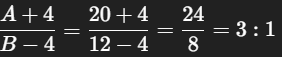
Ratio = 24 : 8 = 3 : 1.
Answer: B
One year ago, Promila was 4 times as old as her daughter Sakshi. Six years hence, Promila’s age will exceed her daughter’s age by 9 years. What is the ratio of present ages of Promila and her daughter?
- A9:2
- B11:3
- C12:5
- D13:4
- E9:4
Show answerHide answer
Answer: D
Approach: Age difference is constant; combine with the 'one year ago' multiple.
Solution: Six years hence Promila exceeds Sakshi by 9 → difference is always 9: P − S = 9.
One year ago: P − 1 = 4(S − 1) → P = 4S − 3.
4S − 3 − S = 9 → 3S = 12 → S = 4, P = 13.
Ratio = 13 : 4.
Cetking shortcut: One year ago difference 9 = 4k − k = 3k → k = 3 → ages then 12 and 3 → now 13 and 4.
Answer: D
5 kg of metal A and 20 kg of metal B are mixed to form an alloy. What is the percentage of metal A in the alloy?
- A20%
- B25%
- C40%
- D50%
- E60%
Show answerHide answer
Answer: A
Approach: Part ÷ total × 100.
Solution: Total alloy = 5 + 20 = 25 kg.
% of A = 5/25 × 100 = 20%.
Why the other options are wrong: 25% comes from 5/20 (wrong base).
Answer: A
A’s salary is 40% of B’s salary which is 25% of C’s salary. What % of C’s salary is A’s salary?
- A5%
- B10%
- C15%
- D20%
- E40%
Show answerHide answer
Answer: B
Approach: Multiply chained percentages.
Solution: Let C = 100. B = 25% of 100 = 25. A = 40% of 25 = 10.
A is 10% of C.
Answer: B
After successive discounts of 12% and 5% an article was sold for Rs. 209. What was the original price of the article?
- A226
- B250
- C252
- D269
- E209
Show answerHide answer
Answer: B
Approach: Final price = MP × 0.88 × 0.95.
Solution: 0.88 × 0.95 = 0.836.
0.836 × MP = 209 → MP = 209 ÷ 0.836 = 250.
Cetking shortcut: Check options: 250 × 0.88 = 220, 220 × 0.95 = 209 ✔.
Answer: B
The cost of an article is 64% of marked price. Calculate the percent gain after allowing a discount of 12%?
- A37.5%
- B48%
- C50.5%
- D52%
- E64%
Show answerHide answer
Answer: A
Approach: Assume MP = 100.
Solution: CP = 64.
SP after 12% discount = 88.
Profit = 88 − 64 = 24.
Gain % = 24/64 × 100 = 37.5%.
Answer: A
Komal buys an article at a discount of 25%. At what % above the cost price should he sell it to make a profit of 25% over the original list price?
- A25
- B30
- C40
- D66.67
- E50
Show answerHide answer
Answer: D
Approach: Let list price = 100.
Solution: CP = 100 − 25% = 75.
Required SP = 100 + 25% of 100 = 125.
% above CP = (125 − 75)/75 × 100 = 50/75 × 100 = 66.67%.
Why the other options are wrong: 50% uses the list price as base; 25% ignores the discount.
Answer: D
Rs. 8400 is divided among A, B, C, and D in such a way that the shares of A and B, B and C as well as C and D are in the ratios of 2:3, 4:5, and 6:7 respectively. What will be the share of A?
- A1280
- B1320
- C8210
- D8400
- E4200
Show answerHide answer
Answer: A
Approach: Build one continued ratio A : B : C : D.
Solution: A:B = 2:3, B:C = 4:5 → make B equal (LCM 12): A:B:C = 8:12:15.
C:D = 6:7 → make C equal (LCM of 15 and 6 = 30): A:B:C:D = 16:24:30:35.
Sum = 16 + 24 + 30 + 35 = 105 parts.
A = 16/105 × 8400 = 16 × 80 = 1280.
Cetking shortcut: A:B:C:D = (2·4·6) : (3·4·6) : (3·5·6) : (3·5·7) = 48:72:90:105 = 16:24:30:35.
Answer: A
The ratio of incomes of two persons is 5:3 and that of their expenditures is 9:5. If they save Rs 2600 and Rs 1800 respectively, their incomes are?
- A9000, 5400
- B10000, 6000
- C6000, 3600
- D8000, 4800
- E2600, 1800
Show answerHide answer
Answer: D
Approach: Incomes 5x, 3x; expenditures 9y, 5y.
Solution: 5x − 9y = 2600 …(1)
3x − 5y = 1800 …(2)
(1)×5: 25x − 45y = 13000; (2)×9: 27x − 45y = 16200.
Subtract: 2x = 3200 → x = 1600.
Incomes = 5 × 1600 = 8000 and 3 × 1600 = 4800.
Check: expenditures 8000 − 2600 = 5400, 4800 − 1800 = 3000 → 5400:3000 = 9:5 ✔
Cetking shortcut: Option check — subtract savings from each option's incomes and test 9:5: only D gives 5400:3000 = 9:5.
Answer: D
The price of the item X rises by Rs 40 per year and that of item Y by Rs 15 per year. If the price of item X and Y in the year 2002 was Rs 420 and Rs 630 respectively, in which year the price of item X will be Rs 40 more than the price of item Y?
- A2010
- B2011
- C2012
- D2013
- E2014
Show answerHide answer
Answer: C
Approach: Track the gap Y − X year by year.
Solution: In 2002, Y − X = 630 − 420 = 210 (Y higher).
Each year X gains 40 − 15 = 25 on Y.
Required: X − Y = +40 → total change needed = 210 + 40 = 250.
Years = 250 ÷ 25 = 10 → 2002 + 10 = 2012.
Answer: C
A class starts at 10 am and lasts till 1.27 pm. Four periods are held during this interval. After every period, 5 minutes are given free to the students. What is the exact duration of each period?
- A42min
- B48min
- C51min
- D53min
- E60min
Show answerHide answer
Answer: B
Approach: Total time = 4 periods + 3 breaks (no break after the last period).
Solution: 10:00 am to 1:27 pm = 3 h 27 min = 207 min.
Breaks = 3 × 5 = 15 min.
Period time = 207 − 15 = 192 min → each period = 192 ÷ 4 = 48 min.
Answer: B
A town is supplied with water from a big overhead tank which is fed with a constant volume of water regularly. When the tank is full, if 32000 gallons are used daily, the supply fails in 50 days. However, if 37000 gallons are used daily, the supply lasts for 40 days only. How much water can be used daily without the supply ever failing?
- A12000 gallons
- B15000 gallons
- C18000 gallons
- D20000 gallons
- E32 gallons
Show answerHide answer
Answer: A
Approach: Let tank capacity = C, daily inflow = S.
Solution: C + 50S = 50 × 32000 = 16,00,000
C + 40S = 40 × 37000 = 14,80,000
Subtract: 10S = 1,20,000 → S = 12,000 gallons/day.
If daily use = inflow = 12,000 gallons, the level never drops → supply never fails.
Cetking shortcut: This is the 'grass-grows / cattle-graze' pattern: inflow = (D1·T1 − D2·T2)/(T1 − T2).
Answer: A
Sixteen men can complete a work in twelve days. Twenty-four children can complete the same work in eighteen days. Twelve men and eight children started working and after eight days three more children joined them. How many days will they now take to complete the remaining work?
- A2
- B4
- C6
- D8
- E10
Show answerHide answer
Answer: B
Approach: Express work in child-days.
Solution: Work = 16 × 12 = 192 man-days = 24 × 18 = 432 child-days → 1 man = 432/192 = 2.25 children.
12 men + 8 children = 27 + 8 = 35 child-units.
Work in 8 days = 35 × 8 = 280 → remaining = 432 − 280 = 152.
Now 35 + 3 = 38 child-units → days = 152 ÷ 38 = 4.
Answer: B
A motorist covers a distance of 39 km in 45 minutes by moving at a speed of x kmph for the first 15 minutes, then moving at a double the speed for the next 20 minutes and then again moving at his original speed for the rest of the journey. Then, x is equal to :
- A31.2
- B36
- C40
- D52
- E39
Show answerHide answer
Answer: B
Approach: Sum the distances of the three segments.
Solution: Segment times: 15 min = 1/4 h (speed x), 20 min = 1/3 h (speed 2x), 10 min = 1/6 h (speed x).
Distance = x/4 + 2x/3 + x/6 = (3x + 8x + 2x)/12 = 13x/12.
13x/12 = 39 → x = 36 km/h.
Cetking shortcut: Effective 'x-minutes' = 15 + 2×20 + 10 = 65 min at speed x → 39 km in 65 min → x = 39 × 60/65 = 36.
Answer: B
A boat takes 8 hours to cover a distance while traveling upstream, whereas while traveling downstream it takes 6 hours. If the speed of the current is 4 kmph, what is the speed of the boat in still water?
- A12
- B16
- C28
- D14
- E8
Show answerHide answer
Answer: C
Approach: Distance is equal both ways.
Solution: 8(x − 4) = 6(x + 4) → 8x − 32 = 6x + 24 → 2x = 56 → x = 28 km/h.
Cetking shortcut: Speeds are in ratio 6:8 = 3:4 (up:down) → difference 1 part = 2 × current = 8 → part = 8 → still water = (3 + 4)/2 × 8 = 28.
Answer: C
Two trains each 100m long, moving in opposite directions, cross each other in 8 sec. If one is moving twice as fast as other, then what is the speed of faster train?
- A30
- B45
- C60
- D75
- E80
Show answerHide answer
Answer: C
Approach: Relative speed = (sum of lengths) ÷ time.
Solution: Relative speed = (100 + 100)/8 = 25 m/s.
Speeds x and 2x → 3x = 25 → faster = 2x = 50/3 m/s.
In km/h: 50/3 × 18/5 = 60 km/h.
Answer: C
A can contains a mixture of liquids, A and B in ratio 7:5. When 9 litres of mixture are drawn off and the can is filled with B, the ratio of A and B becomes 7:9. How many litres A was contained by the can initially?
- A10
- B20
- C21
- D25
- E35
Show answerHide answer
Answer: C
Approach: A is untouched by the replacement except for the removed share.
Solution: Let the can hold 12k litres: A = 7k, B = 5k.
9 litres drawn: A removed = 9 × 7/12 = 5.25, B removed = 3.75.
After adding 9 litres of B: A = 7k − 5.25, B = 5k + 5.25.
(7k − 5.25)/(5k + 5.25) = 7/9 → 63k − 47.25 = 35k + 36.75 → 28k = 84 → k = 3.
Initial A = 7k = 21 litres.
Cetking shortcut: Total stays 12k. A goes from 7/12 to 7/16 of it → A × (1 − 9/12k) = 7/16·12k → 7k − 5.25 = 5.25k → k = 3.
Answer: C
A group of students decided to collect as many paise from each member of the group as is the number of members. If the total collection amounts to Rs. 59.29, what is the number of members in the group?
- A57
- B67
- C77
- D87
- E79
Show answerHide answer
Answer: C
Approach: Total = n² paise.
Solution: Rs 59.29 = 5929 paise.
n² = 5929 → n = 77 (since 77² = 5929).
Cetking shortcut: 5929 ends in 9 → root ends in 3 or 7; 70² = 4900 and 80² = 6400 → 77.
Answer: C
What is the smallest number to be subtracted from 549162 in order to make it perfect square?
- A28
- B32
- C62
- D81
- E55
Show answerHide answer
Answer: D
Approach: Find the largest square ≤ 549162.
Solution: 740² = 547,600; 741² = 549,081; 742² = 550,564 (too big).
549,162 − 549,081 = 81.
Cetking shortcut: 741² = 740² + 740 + 741 = 547,600 + 1,481 = 549,081.
Answer: D
When 52416 is divided by 312, the quotient is 168. What will be the quotient when 52.416 is divided by 0.0168?
- A3.12
- B312
- C3120
- D31.2
- E168
Show answerHide answer
Answer: C
Approach: Use 52416 ÷ 168 = 312 (equivalent to the given fact) and adjust decimals.
Solution: Given 52416 ÷ 312 = 168 ⇔ 52416 ÷ 168 = 312.
52.416 ÷ 0.0168 = (52416 × 10⁻³) ÷ (168 × 10⁻⁴) = 312 × 10 = 3120.
Answer: C
A watch which gains uniformly is 2 min low at noon on Monday and is 4 min. 48sec fast at 2pm on the following Monday. When was it correct?
- A2pm on Tuesday
- B2pm on Wednesday
- C2pm on Thursday
- D1pm on Friday
- E2pm on Monday
Show answerHide answer
Answer: B
Approach: Error changes from −2 min to +4 min 48 s uniformly.
Solution: Time elapsed: Monday 12 noon → next Monday 2 pm = 7 days 2 h = 170 h.
Total gain = 2 min + 4 min 48 s = 6 min 48 s = 6.8 min.
To be correct it must gain 2 min → time needed = 170 × 2/6.8 = 50 h.
Monday 12 noon + 50 h = Wednesday 2 pm.
Answer: B
The angle of elevation of a ladder leaning against a wall is 60° and the foot of the ladder is 4.6m away from wall. What is the length of the ladder?
- A2.3
- B9.2
- C4.6
- D7.8
- E1.1
Show answerHide answer
Answer: B
Approach: Ladder = hypotenuse; distance from wall = adjacent side.
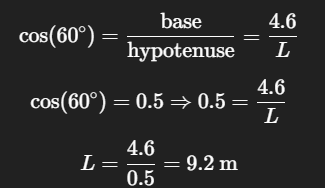
Solution: cos 60° = 4.6 / L → 1/2 = 4.6 / L → L = 9.2 m.
Answer: B
A box contains 10 white and 10 black balls. What is the probability of drawing 2 balls of the same color?
- A9/19
- B3/38
- C10/29
- D5/49
- E7/39
Show answerHide answer
Answer: A
Approach: Combinations without replacement.
Solution: Total ways = ²⁰C₂ = 190.
Both white = ¹⁰C₂ = 45; both black = 45 → favourable = 90.
P = 90/190 = 9/19.
Cetking shortcut: First ball any colour; second must match: 9 of remaining 19 → 9/19.
Answer: A
A speaks truth in 75% cases and B in 80% of the cases, in what percentage of cases are they likely to contradict each other, in narrating the same incident?
- A5%
- B15%
- C35%
- D45%
- E55%
Show answerHide answer
Answer: C
Approach: P(exactly one truthful).
Solution: A true, B lies = 0.75 × 0.20 = 0.15.
A lies, B true = 0.25 × 0.80 = 0.20.
Total = 0.35 = 35%.
Answer: C
Find the odd man out
331, 482, 551, 263, 383, 242, 111
- A263
- B383
- C242
- D111
- E551
Show answerHide answer
Answer: B
Approach: Product of digits.
Solution: 331 → 3×3×1 = 9 = 3²
482 → 4×8×2 = 64 = 8²
551 → 5×5×1 = 25 = 5²
263 → 2×6×3 = 36 = 6²
383 → 3×8×3 = 72 (not a perfect square)
242 → 2×4×2 = 16 = 4²
111 → 1 = 1²
Only 383 breaks the pattern.
Why the other options are wrong: 263, 242, 111, 551 all give perfect-square digit products.
Answer: B
Find the wrong number in the series
789, 645, 545, 481, 440, 429, 425
- A645
- B545
- C481
- D440
- E429
Show answerHide answer
Answer: D
Approach: Successive differences.
Solution: 789 − 144 (12²) = 645
645 − 100 (10²) = 545
545 − 64 (8²) = 481
481 − 36 (6²) = 445 (given 440 ✘)
445 − 16 (4²) = 429 ✔
429 − 4 (2²) = 425 ✔
The wrong term is 440; it should be 445.
Answer: D
The length of the rectangle is 18cm, and breadth is 10cm. When the length is increased to 25cm, what will be the breadth of the rectangle if the area remains the same?
- A7
- B7.1
- C7.2
- D7.3
- E7.7
Show answerHide answer
Answer: C
Approach: Area constant.
Solution: Area = 18 × 10 = 180 cm².
New breadth = 180 ÷ 25 = 7.2 cm.
Answer: C
Questions 141–144 share this
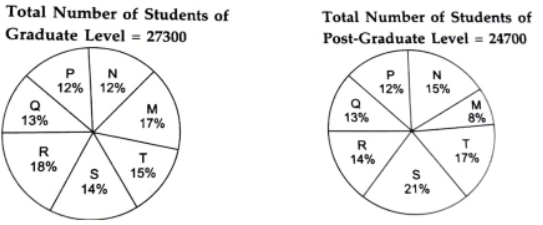
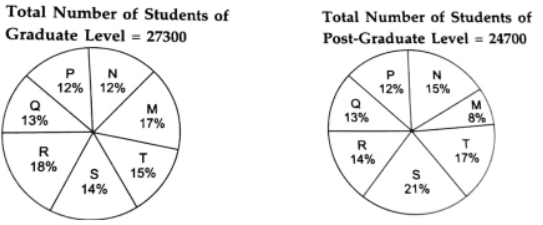
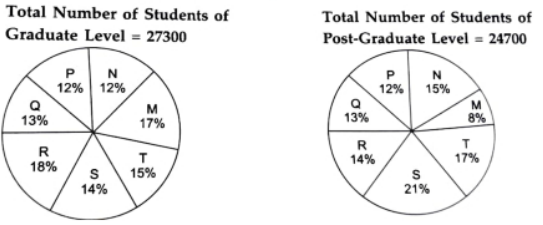
The following pie-charts show the distribution of students of graduate and post-graduate levels in 7 different institutes: M, N, P, Q, R, S, and T in a town. Study the pie-charts carefully and answer the questions given below:
Distribution of students at graduate and post-graduate levels in seven institutes – M, N, P, Q, R, S and T
How many students of institutes M and S are studying at graduate level?
- A7516
- B8463
- C9127
- D9404
- E9900
Show answerHide answer
Answer: B
Approach: Add the shares of M and S in the graduate pie, then take that % of 27,300.
Solution: Graduate pie: M = 17%, S = 14% → 31%.
31% of 27,300 = 0.31 × 27,300 = 8,463.
Cetking shortcut: 1% of 27,300 = 273 → 31 × 273 = 8,463.
Answer: B
Refer to the passage above ↑
Total number of students studying at post-graduate level from institutes N and P is
- A5601
- B5944
- C6669
- D7004
- E9127
Show answerHide answer
Answer: C
Approach: Add the PG shares of N and P, then take that % of 24,700.
Solution: Post-graduate pie: N = 15%, P = 12% → 27%.
27% of 24,700 = 0.27 × 24,700 = 6,669.
Cetking shortcut: 1% = 247 → 27 × 247 = 6,669.
Answer: C
Refer to the passage above ↑
What is the total number of graduate and post-graduate level students in institute R?
- A8320
- B7916
- C9116
- D8372
- E7004
Show answerHide answer
Answer: D
Approach: R's graduate count + R's PG count.
Solution: Graduate: 18% of 27,300 = 4,914.
Post-graduate: 14% of 24,700 = 3,458.
Total = 4,914 + 3,458 = 8,372.
Cetking shortcut: Units digits: 18×273 ends in 4, 14×247 ends in 8 → sum ends in 2; only 8,372 ends in 2.
Answer: D
Refer to the passage above ↑
What is the ratio between the number of students studying at post-graduate and graduate levels respectively from institute S?
- A23:15
- B17:27
- C11:21
- D19:14
- E13:17
Show answerHide answer
Answer: D
Approach: PG(S) : G(S) = (21% × 24,700) : (14% × 27,300).
Solution: PG = 0.21 × 24,700 = 5,187; G = 0.14 × 27,300 = 3,822.
Ratio = (21 × 247) : (14 × 273) = (21 × 13 × 19) : (14 × 3 × 7 × 13) = (21 × 19) : (14 × 21) = 19 : 14.
Cetking shortcut: 247 = 13 × 19 and 273 = 13 × 21 → cancels to 19:14 in one line.
Answer: D
In a hotel 60% has a vegetarian lunch while 30% had non-vegetarian lunch and 15% has both types of lunch. If 96 people were present, how many did not eat either type of lunch?
- A20
- B24
- C26
- D28
- E30
Show answerHide answer
Answer: B
Approach: Use percentages for the union, then convert once.
Solution: Union = 60% + 30% − 15% = 75%.
Neither = 100% − 75% = 25%.
25% of 96 = 24.
Answer: B
Questions 146–148 share this
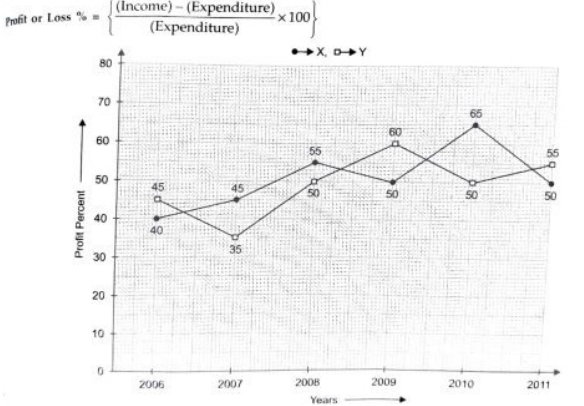
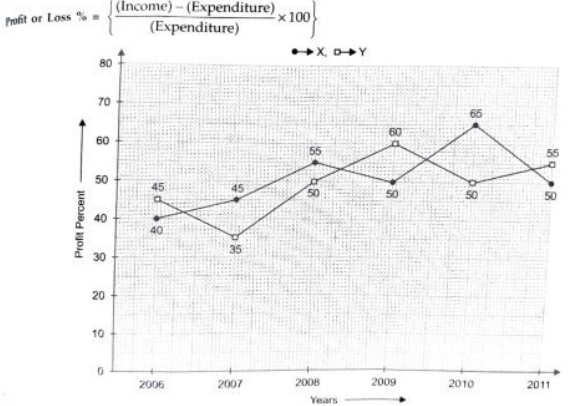
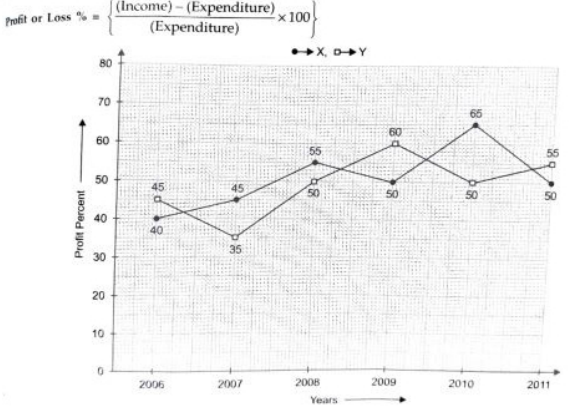
The following line graph gives the % profit earned by 2 companies X and Y during period 2006-11. Study the line graph and answer the questions that are based on it.
% profit earned by Companies X and Y Given Years
If the expenditure of company Y in 2007 was Rs. 220 cr, what was its income in that year?
- A312
- B283
- C297
- D275
- E261
Show answerHide answer
Answer: C
Approach: Income = E × (1 + P/100).
Solution: From the graph, Y's profit % in 2007 = 35%.
Income = 220 × 1.35 = 297 crore.
Answer: C
Refer to the passage above ↑
If the Income of 2 companies were equal in 2009, what was the ratio of expenditure of company X to that of company Y in that year?
- A6:5
- B5:6
- C11:6
- D16:15
- E15:16
Show answerHide answer
Answer: D
Approach: E = I ÷ (1 + P/100); incomes equal.
Solution: From the graph, 2009: X = 50%, Y = 60%.
EX = I/1.5, EY = I/1.6.
EX : EY = 1/1.5 : 1/1.6 = 1.6 : 1.5 = 16 : 15.
Why the other options are wrong: 15:16 (E) results from reading X as 60% and Y as 50%; 6:5 / 5:6 ignore the '1 +' in the income formula.
Cetking shortcut: X has the lower profit %, so X must spend more → ratio > 1 → only 6:5, 11:6, 16:15 survive; 160:150 = 16:15.
Answer: D
Refer to the passage above ↑
The incomes of the companies X and Y in 2010 were in ratio 3:4 respectively. What was the respective ratio of their expenditure in 2010?
- A15:22
- B14:19
- C7:22
- D27:35
- E33:40
Show answerHide answer
Answer: A
Approach: Divide each income by (1 + profit%).
Solution: From the graph, 2010: X = 65%, Y = 50%.
EX : EY = 3/1.65 : 4/1.5 = (3 × 1.5) : (4 × 1.65) = 4.5 : 6.6 = 45 : 66 = 15 : 22.
Answer: A
A bath can be filled by the cold water pipe in 10 minutes and by the hot water pipe in 15 minutes. A person leaves the bathroom after turning on both the pipes. He returns just when the bath should have been full. Finding, however, the waste pipe was open, he closes it. In 4 minutes more, the bath is full. In what time will the waste water pipe empty it?
- A6 min
- B8 min
- C9 min
- D12 min
- E10 min
Show answerHide answer
Answer: C
Approach: Water lost through the waste pipe = water added in the extra 4 minutes.
Solution: Inlets together: 1/10 + 1/15 = 1/6 per min → bath should fill in 6 min.
Extra 4 min with both inlets adds 4/6 = 2/3 of the bath.
So the waste pipe drained 2/3 of the bath in 6 min → full bath in 6 × 3/2 = 9 min.
Answer: C
X and Y can do a piece of work in 20 days and 12 days respectively. X started the work alone and then, after 4 days, Y joined him till the completion of the work. How long did the work last?
- A6 days
- B10 days
- C15 days
- D20 days
- E32 days
Show answerHide answer
Answer: B
Approach: LCM method — total work = 60 units.
Solution: X = 60/20 = 3 units/day, Y = 60/12 = 5 units/day.
X alone 4 days = 12 units → remaining 48 units.
Together 8 units/day → 48/8 = 6 days.
Total duration = 4 + 6 = 10 days.
Answer: B
DESECRATE
- ADefile
- BProtect
- CPurify
- DHonour
- ESanctify
Show answerHide answer
Answer: A
Approach: Synonym — find the word closest in meaning to DESECRATE.
Solution: Desecrate = to violate or spoil something sacred (de- = remove + sacred).
Defile = to make something holy impure or dishonour it — the same meaning.
Why the other options are wrong:
B. Protect — guarding something sacred; opposite in spirit.
C. Purify — making clean/holy; an antonym.
D. Honour — showing respect; an antonym.
E. Sanctify — making holy; the direct antonym.
Cetking shortcut: Four options (Protect, Purify, Honour, Sanctify) are all 'positive/holy' words — the odd negative one is the synonym.
Answer: A
CANTANKEROUS
- AQuarrelsome
- BCheerful
- CEasygoing
- DPleasant
- ENice
Show answerHide answer
Answer: A
Approach: Synonym — find the word closest in meaning to CANTANKEROUS.
Solution: Cantankerous = bad-tempered, argumentative, uncooperative.
Quarrelsome = inclined to argue or fight — the same meaning.
Why the other options are wrong:
B. Cheerful — happy; opposite.
C. Easygoing — relaxed, tolerant; opposite.
D. Pleasant — agreeable; opposite.
E. Nice — kind; opposite.
Cetking shortcut: B, C, D, E are all positive words with the same flavour — the only negative word must be the synonym.
Answer: A
Questions 153–155 share this
The last twenty years have witnessed an explosion of growth opportunities for women in industry, especially at the decision-making level. Today, more and more young women have a chance to walk the competitive edge and prove that their abilities are at par with, if not better than, those of their male colleagues.
However, as they are beginning to storm the traditional male bastions of management, they are finding out that the roads to success are paved with difficulties. They discover very early in their career that the battle for supremacy in corporate organizations calls into play not only the forces of power, control and dominance, but issues of gender, attitude and acceptance of women.
The first sentence of the passage implies that job opportunities.
- AFor women have increased
- Bin industry have increased
- Cfor women at the managerial level has increased
- Din the corporate sector
- Efor the men
Show answerHide answer
Answer: C
Approach: RC inference — capture the full meaning of the first sentence, including its qualifier.
Solution: Sentence 1: 'an explosion of growth opportunities for women in industry, especially at the decision-making level'.
Decision-making level = managerial level. So the sentence implies that opportunities for women at the managerial level have increased.
Why the other options are wrong:
A. For women have increased — true but incomplete; it drops the stress on the decision-making level.
B. In industry have increased — loses the subject 'for women'.
D. In the corporate sector — incomplete statement; says nothing about increase.
E. For the men — the passage is about women.
Cetking shortcut: Pick the option that contains every key word of the sentence: women + decision-making (managerial) + increase.
Answer: C
Refer to the passage above ↑
Which of the following best reflects the meaning of ‘male bastions’.
- AManagement style of male
- BManagement areas dominated by males
- CCareers for male
- DManagement abilities of male
- ECareers of women
Show answerHide answer
Answer: B
Approach: Vocabulary in context — meaning of 'male bastions'.
Solution: Bastion = fortress/stronghold. 'Storm the traditional male bastions of management' = enter the management areas that men have traditionally held and dominated.
Why the other options are wrong:
A. Management style of male — a style is not a place one 'storms'.
C. Careers for male — too broad; the passage is about management.
D. Management abilities of male — abilities are not strongholds.
E. Careers of women — opposite of 'male'.
Answer: B
Refer to the passage above ↑
According to passage, women in high position also have.
- ANot problems at all
- BSome problems
- CProblems related to power and control
- DProblem related to roles of women in society
- ECompetitive edge
Show answerHide answer
Answer: D
Approach: RC detail — read the 'not only … but' line carefully.
Solution: Last sentence: the battle calls into play 'not only the forces of power, control and dominance, but issues of gender, attitude and acceptance of women'.
The extra problems women in high positions also have are gender-related — how society sees and accepts the role of women. That is option D.
Why the other options are wrong:
A. No problems at all — contradicts 'roads to success are paved with difficulties'.
B. Some problems — too vague; does not say which.
C. Power and control — the common battle for everyone, not the additional women-specific problem.
E. Competitive edge — an opportunity, not a problem.
Cetking shortcut: 'Also' + 'not only X but Y' → the answer is Y.
Answer: D
EXTOL
- Aloud
- BGlorify
- CCelebrate
- DDisparage
- EEulogize
Show answerHide answer
Answer: D
Approach: Antonym — find the word opposite in meaning to EXTOL.
Solution: Extol = praise enthusiastically.
Disparage = speak of something as having little worth; belittle — the exact opposite.
Why the other options are wrong:
A. Loud — unrelated adjective.
B. Glorify — synonym.
C. Celebrate — synonym.
E. Eulogize — synonym (praise highly).
Cetking shortcut: Three options mean 'praise' — strike them out; the only negative verb is the antonym.
Answer: D
EXALT
- ASimplify
- BDepreciate
- CGlorify
- DEnnoble
- EAppreciate
Show answerHide answer
Answer: B
Approach: Antonym — find the word opposite in meaning to EXALT.
Solution: Exalt = raise in rank, praise highly.
Depreciate = lower in value; disparage — the opposite.
Why the other options are wrong:
A. Simplify — unrelated.
C. Glorify — synonym.
D. Ennoble — synonym (make noble).
E. Appreciate — close to a synonym.
Answer: B
FORLORN
- ADesolate
- BSad
- CWoebegone
- DElated
- EPitiable
Show answerHide answer
Answer: D
Approach: Antonym — find the word opposite in meaning to FORLORN.
Solution: Forlorn = pitifully sad and lonely.
Elated = extremely happy — the opposite.
Why the other options are wrong:
A. Desolate — synonym.
B. Sad — synonym.
C. Woebegone — synonym (sorrowful-looking).
E. Pitiable — synonym in flavour.
Cetking shortcut: Four options are 'sad' words — the one happy word is the antonym.
Answer: D
ASTUTE
- ACowardly
- BFoolish
- CWicked
- DImpolite
- EBrilliant
Show answerHide answer
Answer: B
Approach: Antonym — find the word opposite in meaning to ASTUTE.
Solution: Astute = sharp, shrewd, quick to judge a situation well.
Foolish = lacking good sense — the opposite.
Why the other options are wrong:
A. Cowardly — opposite of brave, not of clever.
C. Wicked — opposite of good, not of clever.
D. Impolite — about manners.
E. Brilliant — synonym.
Answer: B
ACCLAMATION
- ADenunciation
- BJubilation
- CPlaudits
- DApplause
- EHonour
Show answerHide answer
Answer: A
Approach: Antonym — find the word opposite in meaning to ACCLAMATION.
Solution: Acclamation = loud, enthusiastic approval.
Denunciation = public condemnation — the opposite.
Why the other options are wrong:
B. Jubilation — great joy; close to a synonym.
C. Plaudits — praise; synonym.
D. Applause — synonym.
E. Honour — positive; synonym-flavoured.
Cetking shortcut: All options except one are 'praise' words — the lone negative is the answer.
Answer: A
The squirrel nest is known as …
- AStable
- BCoop
- CDen
- DBurrow
- EDrey
Show answerHide answer
Answer: E
Approach: Animal homes — recall the special name for a squirrel's nest.
Solution: A squirrel builds a nest of twigs and leaves high in a tree; this nest is called a drey.
Completed sentence: 'The squirrel's nest is known as a drey.'
Why the other options are wrong:
A. Stable — home of a horse.
B. Coop — home of hens/poultry.
C. Den — home of a lion or wild beast.
D. Burrow — home of a rabbit or rat.
Answer: E
She used to walk in the evening …?
- Adoes she
- Bwill she
- Cwas she
- Ddidn’t she
- Ewon’t she
Show answerHide answer
Answer: D
Approach: Question tag — positive statement → negative tag, using the auxiliary of the verb.
Solution: 'She used to walk …' is simple past; 'used to' has no auxiliary of its own, so the tag uses did.
Positive statement → negative tag: '… didn't she?'
Why the other options are wrong:
A. does she — present tense and positive; both wrong.
B. will she — future, and positive.
C. was she — 'was' is not the auxiliary of 'used to'.
E. won't she — future tense.
Cetking shortcut: Statement positive → tag negative; 'used to' always takes 'didn't'.
Answer: D
He was weary of failure …?
- Adoes he
- Bwon’t he
- Cwasn’t he
- Disn’t he
- Edo he
Show answerHide answer
Answer: C
Approach: Question tag — repeat the auxiliary of the statement with opposite polarity.
Solution: The statement uses the past auxiliary was and is positive, so the tag is negative 'was': 'He was weary of failure, wasn't he?'
Why the other options are wrong:
A. does he — wrong auxiliary and polarity.
B. won't he — future tense.
D. isn't he — present tense.
E. do he — wrong auxiliary and agreement.
Answer: C
It being a holiday (A)/ all the hostel inmates (B)/ decided to celebrate (C)/ by going out to a movie. (D)/ No error (E)
- AA
- BB
- CC
- DD
- EE
Show answerHide answer
Answer: E
Approach: Error spotting — check each part; if every part is correct, mark No error.
Solution: (A) 'It being a holiday' — a correct absolute phrase (its own subject 'It').
(B) 'all the hostel inmates' — correct plural subject.
(C) 'decided to celebrate' — correct (decide + to-infinitive).
(D) 'by going out to a movie' — 'by + -ing' correctly shows how they celebrated.
No part has an error.
Why the other options are wrong:
A, B, C, D — each part is grammatically correct, as shown above.
Cetking shortcut: 'By + -ing' to show the means of an action is standard; do not change it to 'with'.
Answer: E
The higher we climb (A)/ up the mountain peak (B)/ the cooler (C)/ we feel (D)/ No error (E)
- AA
- BB
- CC
- DD
- EE
Show answerHide answer
Answer: B
Approach: Error spotting — redundancy (superfluous word).
Solution: 'The higher we climb … the cooler we feel' is the correct 'the + comparative …, the + comparative' structure, so parts (A), (C) and (D) are fine.
In (B), 'up' is superfluous because climb already means 'go up'.
Correct: 'The higher we climb the mountain peak, the cooler we feel.'
Why the other options are wrong:
A. 'The higher we climb' — correct comparative structure.
C. 'the cooler' — correct parallel comparative.
D. 'we feel' — correct verb.
E. No error — wrong, because (B) contains the redundant 'up'.
Cetking shortcut: Common redundancies in CET: climb up, return back, repeat again, revert back.
Answer: B
Questions 166–167 share this
Rationalism has been defined as the mental attitude which unreservedly accepts the supremacy of reason and aims at establishing a system of philosophy and ethics verifiable by experience and independent of all arbitrary assumptions or authority. This definition of Rationalism was framed at the inauguration of the Rationalist Press Association (RPA) in London in the year 1899.
This paragraph best supports the statement that.
- AEthics does not constitute a part of philosophy
- Bone has to accept certain beliefs to find the final truth
- Crationalism is not a set of beliefs which is devoid of verification
- Dmental attitude is independent of all assumptions.
- Eonly RPA can establish philosophy or rationalism
Show answerHide answer
Answer: C
Approach: RC — 'best supports' inference: choose what follows directly from the text.
Solution: Rationalism aims at a system of philosophy and ethics 'verifiable by experience and independent of arbitrary assumptions'.
So rationalism is not a set of beliefs without verification — option C restates this.
Why the other options are wrong:
A. Says ethics is not part of philosophy — the text puts them side by side and never says this.
B. Says one must accept certain beliefs — the text says rationalism is independent of assumptions.
D. Says 'mental attitude' in general is free of assumptions — the text says this only of rationalism's aim.
E. Says only RPA can establish rationalism — RPA only framed the definition.
Cetking shortcut: Look for a paraphrase of the key phrase ('verifiable by experience' = 'not devoid of verification').
Answer: C
Refer to the passage above ↑
Which of the following words is most nearly the same in meaning as the word ‘unreservedly’ as used in the paragraph?
- Aunilaterally
- Bcollectively
- Cpartially
- Dfully
- Econditionally
Show answerHide answer
Answer: D
Approach: Vocabulary in context — meaning of 'unreservedly'.
Solution: 'Unreservedly accepts the supremacy of reason' = accepts it without any reservation or condition = fully.
Why the other options are wrong:
A. Unilaterally — done by one side only; a different idea.
B. Collectively — done as a group.
C. Partially — opposite.
E. Conditionally — opposite (with reservations).
Answer: D
He is blind …. one eye
- Aof
- Bto
- Cwith
- Dfor
- Eby
Show answerHide answer
Answer: A
Approach: Fixed preposition with an adjective.
Solution: The intended sentence is 'He is blind … one eye'. The classic grammar-book usage (Wren & Martin) is 'blind of one eye' (in modern English also 'blind in one eye').
Among the options, 'of' is the correct preposition.
Why the other options are wrong:
B. to — 'blind to' means unaware of something (blind to his faults), not loss of sight.
C. with — no such usage with 'blind'.
D. for — no such usage.
E. by — no such usage.
Cetking shortcut: Fixed pairs: blind of an eye, lame of a leg, deaf of an ear.
Answer: A
I am vexed …. my brother
- Aat
- Bwith
- Cof
- Dfor
- Eamong
Show answerHide answer
Answer: B
Approach: Fixed preposition — 'vexed with' a person, 'vexed at' a thing.
Solution: 'My brother' is a person, so the correct preposition is with: 'I am vexed with my brother.'
Why the other options are wrong:
A. at — used for a thing: vexed at his conduct.
C. of — no such usage.
D. for — no such usage.
E. among — used for more than two people/things.
Cetking shortcut: Angry/vexed/annoyed: WITH a person, AT a thing.
Answer: B
There was no agreement …. the great powers …. a treaty to ban nuclear weapons.
- Ain, for
- Bbetween, about
- Camong, on
- Dwith, about
- Eby, of
Show answerHide answer
Answer: C
Approach: Double-blank prepositions — check both blanks.
Solution: Blank 1: 'the great powers' are more than two, so among (not 'between').
Blank 2: agreement on a subject → 'on a treaty'.
Sentence: 'There was no agreement among the great powers on a treaty to ban nuclear weapons.'
Why the other options are wrong:
A. in, for — 'agreement in the powers' is wrong.
B. between, about — 'between' is for two parties.
D. with, about — 'agreement with' needs a single other party.
E. by, of — both wrong usages.
Cetking shortcut: Eliminate on the first blank: more than two parties → only 'among' works.
Answer: C
An excessively morbid desire to steal.
- AKleptomania
- BPrevaricate
- CPeroration
- DStoic
- ESycophant
Show answerHide answer
Answer: A
Approach: One-word substitution — '-mania' = obsessive urge.
Solution: Klepto (Greek: steal) + mania (obsession) = Kleptomania, a morbid desire to steal.
Why the other options are wrong:
B. Prevaricate — to avoid telling the truth.
C. Peroration — the concluding part of a speech.
D. Stoic — a person who endures hardship without complaint.
E. Sycophant — a flatterer.
Answer: A
A lover of animals
- APhilomuse
- BPhilozoic
- CPolyglot
- DEmissary
- EZoophobia
Show answerHide answer
Answer: B
Approach: One-word substitution — use roots: philo = love, zo = animal.
Solution: Philo (love) + zoic (animals) = Philozoic, a lover of animals.
Why the other options are wrong:
A. Philomuse — a lover of the arts/learning.
C. Polyglot — a person who knows many languages.
D. Emissary — a messenger sent on a mission.
E. Zoophobia — fear of animals; opposite.
Cetking shortcut: Root splitting: philo (love) + zo (animal) — only B has both.
Answer: B
Science of human beauty
- AAetiology
- BPhysiology
- CKalology
- DCosmography
- EEtiology
Show answerHide answer
Answer: C
Approach: One-word substitution — '-logy' = study of; kalos = beauty.
Solution: Kalo (beautiful) + logy (study) = Kalology, the science of human beauty.
Why the other options are wrong:
A. Aetiology — study of causes (of disease).
B. Physiology — study of how the body functions.
D. Cosmography — mapping/description of the universe.
E. Etiology — another spelling of aetiology.
Cetking shortcut: A and E are the same word (aetiology/etiology), so both are out at once.
Answer: C
That which is fox-like
- ALeonine
- BPorine
- CCanine
- DVulpine
- EOstler
Show answerHide answer
Answer: D
Approach: One-word substitution — animal adjectives from Latin.
Solution: Latin vulpes = fox → Vulpine = fox-like.
Why the other options are wrong:
A. Leonine — lion-like.
B. Porine — not a standard animal adjective (porcine = pig-like).
C. Canine — dog-like.
E. Ostler — a stableman who looks after horses at an inn.
Cetking shortcut: Learn the set: leonine (lion), canine (dog), feline (cat), bovine (cow), equine (horse), vulpine (fox), ursine (bear), porcine (pig).
Answer: D
Study of fossils
- ANomology
- BMetallurgy
- CMetrology
- DNumismatics
- EPalaeontology
Show answerHide answer
Answer: E
Approach: One-word substitution — 'palaeo' = ancient.
Solution: Palaeo (ancient) + onto (being) + logy (study) = Palaeontology, the study of fossils.
Why the other options are wrong:
A. Nomology — study of laws.
B. Metallurgy — science of metals.
C. Metrology — science of measurement.
D. Numismatics — study of coins.
Answer: E
The angry boatman threw (A)/ the cracked oar (B)/ in the river (C)/ and returned home. (D)/ No error (E)
- AA
- BB
- CC
- DD
- EE
Show answerHide answer
Answer: C
Approach: Error spotting — 'in' (rest) vs 'into' (motion inside).
Solution: The boatman threw the oar so that it moved from his hand inside the water — this is motion, so into is required.
Correct: 'The angry boatman threw the cracked oar into the river and returned home.'
Why the other options are wrong:
A. 'The angry boatman threw' — correct.
B. 'the cracked oar' — correct.
D. 'and returned home' — correct (home without 'to').
E. No error — wrong, (C) has the error.
Cetking shortcut: Verbs of movement (throw, jump, fall, walk) + 'inside' → into.
Answer: C
Parul was trying for admission (A)/ in the engineering college (B)/ even though her parents wanted (C)/ her to take to medicine. (D)/ No error (E)
- AA
- BB
- CC
- DD
- EE
Show answerHide answer
Answer: B
Approach: Error spotting — fixed preposition with 'admission'.
Solution: 'Admission' takes to: admission to a school/college/course.
Part (B) 'in the engineering college' should be 'to the engineering college'.
Correct: 'Parul was trying for admission to the engineering college even though her parents wanted her to take to medicine.'
Why the other options are wrong:
A. 'Parul was trying for admission' — correct.
C. 'even though her parents wanted' — correct.
D. 'her to take to medicine' — correct ('take to' = adopt as a career).
E. No error — wrong, (B) has the error.
Cetking shortcut: Admission to, entrance to/into, enrol in — memorise the noun–preposition pairs.
Answer: B
This fact makes it very clear (A)/ that he had hand in the murder, (B)/ though he still (C)/ pleads innocence. (D)/ No error (E)
- AA
- BB
- CC
- DD
- EE
Show answerHide answer
Answer: B
Approach: Error spotting — fixed idiom 'have a hand in'.
Solution: 'To have a hand in' = to be involved in. Part (B) drops the article: 'that he had hand in the murder' → 'that he had a hand in the murder'.
Correct: 'This fact makes it very clear that he had a hand in the murder, though he still pleads innocence.'
Why the other options are wrong:
A. 'This fact makes it very clear' — correct (singular subject, singular verb).
C. 'though he still' — correct.
D. 'pleads innocence' — correct (present, he still pleads now).
E. No error — wrong, (B) has the error.
Answer: B
Neither of the plans (A)/ suit him and therefore (B)/ he decided not to (C)/ go out yesterday. (D)/ No error (E)
- AA
- BB
- CC
- DD
- EE
Show answerHide answer
Answer: B
Approach: Error spotting — 'Neither of + plural noun' takes a singular verb.
Solution: The subject is Neither (singular), not 'plans'. So 'suit' is wrong.
The sentence is in the past ('decided … yesterday'), so the verb should be suited.
Correct: 'Neither of the plans suited him and therefore he decided not to go out yesterday.'
Why the other options are wrong:
A. 'Neither of the plans' — correct.
C. 'he decided not to' — correct.
D. 'go out yesterday' — correct.
E. No error — wrong, (B) has the error.
Cetking shortcut: Either/Neither/Each/Every of + plural noun → singular verb.
Answer: B
This event took place … to that
- Aanterior
- Bmore anterior
- Canterior than
- Dless anterior
- Emost anterior
Show answerHide answer
Answer: A
Approach: Latin comparatives take 'to'.
Solution: Anterior (= earlier) is already a comparative of Latin origin. It is followed by to and never by 'than', 'more' or 'most'.
Correct: 'This event took place anterior to that.'
Why the other options are wrong:
B. more anterior — double comparative.
C. anterior than — Latin comparatives never take 'than'.
D. less anterior — wrong degree with a Latin comparative.
E. most anterior — wrong superlative form.
Cetking shortcut: Senior, junior, superior, inferior, prior, anterior, posterior → always '… to'.
Answer: A
Sitting in the garden, the moon was seen shining in the sky by us.
- AThe moon was seen by us in the sky
- BWe saw the moon shining in the sky
- CThe moon was seen shinning by us in the sky
- DThe moon was seen shinning in the sky by
- ENo improvement
Show answerHide answer
Answer: B
Approach: Dangling modifier — the doer of 'sitting' must come right after the comma.
Solution: As written, the sentence implies the moon was sitting in the garden. The people sitting were 'we', so 'we' must be the subject, in active voice.
Correct: 'Sitting in the garden, we saw the moon shining in the sky.'
Why the other options are wrong:
A. Keeps 'the moon' as subject — still dangling; also drops 'shining'.
C. Misspells 'shining' and keeps the dangling subject.
D. Misspelt, incomplete ('by …') and still dangling.
E. No improvement — the original is a dangling modifier.
Cetking shortcut: With an opening '-ing' phrase, the answer almost always starts with the human doer (we/he/she).
Answer: B
The contractor did not keep his promise that the work will be finished before the end of the week
- Acould
- Bshall
- CWould
- Dwas
- ENo improvement
Show answerHide answer
Answer: C
Approach: Sequence of tenses — past main verb → past form in the subordinate clause.
Solution: Main clause: 'The contractor did not keep his promise' (past). The promise clause must shift back: 'will' → would.
Correct: '… his promise that the work would be finished before the end of the week.'
Why the other options are wrong:
A. could — changes the meaning to ability, not a promise.
B. shall — present/future form; breaks sequence of tenses.
D. was — 'was be finished' is ungrammatical.
E. No improvement — 'will' is wrong after a past main verb.
Answer: C
The principal was angry on seeing a wooden broken chair lying in the corridor
- ABroken wooden chair
- BWooden and broken chair
- CBroken and wooden chair
- DBroken chair wooden
- ENo improvement
Show answerHide answer
Answer: A
Approach: Order of adjectives — opinion/condition → size → age → shape → colour → origin → material → purpose → noun.
Solution: 'Broken' describes condition (quality); 'wooden' is material. Material sits closest to the noun.
Correct: 'The principal was angry on seeing a broken wooden chair lying in the corridor.'
Why the other options are wrong:
B. 'Wooden and broken chair' — wrong order and an unnecessary 'and'.
C. 'Broken and wooden chair' — 'and' is not used between adjectives of different categories.
D. 'Broken chair wooden' — adjective after the noun; wrong.
E. No improvement — 'wooden broken' is the wrong order.
Cetking shortcut: Material adjective (wooden, golden, silk) always sits right next to the noun.
Answer: A
Anyone interested in the use of computers can learn much if you have access to a personal computer.
- Aone of them have access
- Bthey have access
- Caccess can be available
- Dhe or she has access
- ENo improvement
Show answerHide answer
Answer: D
Approach: Pronoun–antecedent agreement and consistency of person.
Solution: The antecedent is Anyone — third person, singular. 'You' (second person) is wrong, and the verb must be singular.
Correct: 'Anyone interested in the use of computers can learn much if he or she has access to a personal computer.'
Why the other options are wrong:
A. 'one of them have access' — 'one … have' is wrong agreement; 'them' has no antecedent.
B. 'they have access' — plural; formal grammar keeps 'anyone' singular.
C. 'access can be available' — awkward passive; loses the person.
E. No improvement — 'you' does not match 'anyone'.
Answer: D
Despite his old age, his movements were as spirited as a young man.
- Aa young man’s
- Bif a young man
- Cof a young man
- Dthose of a young man
- ENo improvement
Show answerHide answer
Answer: D
Approach: Faulty comparison — compare the same kind of things.
Solution: 'His movements' (plural thing) are being compared with 'a young man' (person) — illogical.
Use the plural pronoun those to stand for 'movements': '… as spirited as those of a young man.'
Why the other options are wrong:
A. 'a young man's' — elliptical and singular in form; 'those of' is the exact, plural match for 'movements'.
B. 'if a young man' — meaningless here.
C. 'of a young man' — still lacks the noun being compared.
E. No improvement — compares movements with a man.
Cetking shortcut: Plural noun compared → 'those of'; singular → 'that of'.
Answer: D
Bone of contention
- Athe reason of the quarrel
- Bthe reason for connection
- Cthe reason for a relationship
- Dthe reason for a friendship
- Ethe reason of duty
Show answerHide answer
Answer: A
Approach: Idiom meaning.
Solution: Bone of contention = the cause of a quarrel or disagreement (like a bone that two dogs fight over).
Why the other options are wrong:
B. Reason for connection — the opposite idea.
C. Reason for a relationship — unrelated.
D. Reason for a friendship — opposite.
E. Reason of duty — unrelated.
Cetking shortcut: 'Contention' = dispute; only A has a quarrel.
Answer: A
Forty winks.
- AA long sleep
- Ba siesta
- CDisquiet
- Dtoil
- EBustle
Show answerHide answer
Answer: B
Approach: Idiom meaning.
Solution: Forty winks = a short sleep or nap, usually in the daytime — the same as a siesta (short afternoon rest).
Why the other options are wrong:
A. A long sleep — opposite; forty winks is short.
C. Disquiet — anxiety.
D. Toil — hard work.
E. Bustle — busy activity.
Answer: B
Knit one’s brow
- Ato be happy
- Bto enjoy
- Cto get angry
- Dto get hungry
- Eto get thirsty
Show answerHide answer
Answer: C
Approach: Idiom meaning.
Solution: Knit one's brow = draw the eyebrows together, i.e. frown — a sign of displeasure or anger. Among the options, 'to get angry' fits.
Why the other options are wrong:
A. To be happy — a frown is not happiness.
B. To enjoy — opposite.
D. To get hungry — unrelated.
E. To get thirsty — unrelated.
Answer: C
At daggers drawn with
- Ato be friends
- Bon good terms
- Ccompatible
- DEnmity
- Ein accordance
Show answerHide answer
Answer: D
Approach: Idiom meaning.
Solution: At daggers drawn (with) = bitterly hostile, ready to fight — i.e. enmity.
Why the other options are wrong:
A. To be friends — opposite.
B. On good terms — opposite.
C. Compatible — opposite.
E. In accordance — means in agreement.
Cetking shortcut: Four options mean 'friendly/agreeing' — the lone hostile one is the answer.
Answer: D
One should love ….. country
- Aonce
- Bones
- Ctheir
- Dhis
- Eone’s
Show answerHide answer
Answer: E
Approach: Pronoun agreement — 'one' takes 'one's'.
Solution: In formal English, the pronoun one is followed by the same pronoun: 'One should love one's country.'
Why the other options are wrong:
A. once — an adverb (one time).
B. ones — plural noun; the possessive needs an apostrophe.
C. their — plural; does not match 'one'.
D. his — used in older texts, but the standard exam answer keeps 'one … one's'.
Answer: E
Questions 191–193 share this
Compact Discs (CDs) have revolutionized the music industry with their surprisingly realistic sound. The six-inch discs look like plastic sandwiches with aluminum at the centre. They have digitally recorded material that is read by laser beams, so the sound has none of the crackling of vinyl records. CDs are also virtually indestructible, and they are lighter and smaller than conventional records. Since their introduction, CDs have become more affordable and widely available. In fact, they are now sold in electronics and video stores that didn’t formerly carry records or cassettes.
There has been a phenomenal growth in the sale of CDs. Sales climbed dramatically during the second half of the 1980s. In the 1990s, sales have been greater. CDs have all but replaced records in stores and, in spite of their being less affordable than cassettes, continue to gain in popularity.
What is the main appeal of CDs?
- Asize
- Bprice
- Csound
- Davailability
- Eshape
Show answerHide answer
Answer: C
Approach: RC main idea — the topic sentence states the chief appeal.
Solution: Sentence 1: CDs revolutionised the industry 'with their surprisingly realistic sound'; the passage adds that the sound has none of the crackling of vinyl. Sound is the main appeal.
Why the other options are wrong:
A. Size — mentioned as an extra advantage (lighter, smaller).
B. Price — the passage says CDs are less affordable than cassettes.
D. Availability — a later development, not the main appeal.
E. Shape — only described, not presented as an appeal.
Answer: C
Refer to the passage above ↑
Which word ‘revolutionized’, as used in line 1 of passage, could best be replaced with?
- Amarked
- Bsurprised
- Ctaught
- Dchanged
- Eraised
Show answerHide answer
Answer: D
Approach: Vocabulary in context — replace the word and check the sentence.
Solution: 'CDs have revolutionized the music industry' = CDs have changed it radically. Substituting 'changed' keeps the meaning.
Why the other options are wrong:
A. Marked — to note or label; no idea of change.
B. Surprised — an emotion; does not fit an industry.
C. Taught — unrelated.
E. Raised — to lift; not the meaning.
Answer: D
Refer to the passage above ↑
Why does the author refer to CDs as ‘sandwiches’?
- Athey are small
- Bthey are light
- Cthey don’t crackle
- Dthey are layered
- Ethey are circular
Show answerHide answer
Answer: D
Approach: RC — explain the comparison (analogy) the author uses.
Solution: 'The six-inch discs look like plastic sandwiches with aluminum at the centre' — plastic on both sides with aluminium in the middle, just like the layers of a sandwich. So: they are layered.
Why the other options are wrong:
A. They are small — size is not what a sandwich suggests.
B. They are light — weight is mentioned separately.
C. They don't crackle — about sound, not appearance.
E. They are circular — sandwiches are not circular.
Cetking shortcut: Ask: what does a sandwich have that the CD also has? → layers with a filling.
Answer: D
He died …. grief
- Afrom
- Bby
- Cof
- Dwith
- Ein
Show answerHide answer
Answer: C
Approach: Fixed preposition with 'die'.
Solution: Die of = disease, hunger, grief, old age (internal cause).
Die from = wound, overwork, injury (external cause).
Grief is an internal emotion → 'He died of grief.'
Why the other options are wrong:
A. from — for external causes (died from a wound).
B. by — for violent means (died by the sword).
D. with — no such usage.
E. in — for a place/event (died in a battle).
Cetking shortcut: Die of illness/emotion, from injury/overwork, by violence, in an accident/battle.
Answer: C
The young one of a housefly is called …
- Afawn
- Bowlet
- Cmaggot
- Dcygnet
- Enymph
Show answerHide answer
Answer: C
Approach: Young ones of animals/insects.
Solution: A housefly lays eggs that hatch into soft, legless larvae called maggots.
Why the other options are wrong:
A. Fawn — young deer.
B. Owlet — young owl.
D. Cygnet — young swan.
E. Nymph — young of insects like grasshoppers, cockroaches, dragonflies.
Answer: C
Questions 196–198 share this
It is difficult to reconcile the ideas of different schools of thought on the question of education. Some people maintain that pupils at school should concentrate on a narrow range of subjects which will benefit them directly in their subsequent careers. Others contend that they should study a wide range of subjects so that they have not only the specialised knowledge needed for their careers but also general knowledge about the world they will have to work and live in. Supporters of the first theory state that the greatest contributions to civilisation are made by those who are most expert in their trade or profession. Those on the other side say that unless they have a broad general education, the experts will be too narrow in their outlook to have sympathy with their fellows or a proper sense of responsibility towards humanity as a whole.
What does broad general education contribute to ?
- Awithout it no one would get job
- Bit broadens one’s outlook
- Cit teaches us about the similar things
- Dspecialization is incomplete without it
- Eit concentrates on a narrow range of subjects
Show answerHide answer
Answer: B
Approach: RC specific detail — match the paraphrase.
Solution: Last sentence: without a broad general education, experts will be 'too narrow in their outlook'. So broad general education contributes to a broader outlook.
Why the other options are wrong:
A. Without it no one would get a job — not stated.
C. Teaches about similar things — not stated; it teaches a wide range.
D. Specialisation is incomplete without it — overstatement; not said.
E. Concentrates on a narrow range — describes the opposite theory.
Cetking shortcut: 'Too narrow in outlook without X' ⇒ 'X broadens outlook' — a direct flip.
Answer: B
Refer to the passage above ↑
What do the pupils need to have, for having sympathy with their fellows or a proper sense of responsibility towards humanity as a whole?
- Anarrow outlook
- Bonly expertise
- Cnarrow range of subjects
- Dbroad general education
- Efocus on their profession
Show answerHide answer
Answer: D
Approach: RC specific detail — locate the phrase in the passage.
Solution: 'Unless they have a broad general education, the experts will be too narrow in their outlook to have sympathy with their fellows or a proper sense of responsibility towards humanity as a whole.'
Why the other options are wrong:
A. Narrow outlook — this is what prevents sympathy.
B. Only expertise — the passage says expertise alone is not enough.
C. Narrow range of subjects — the first theory, which leads to narrow outlook.
E. Focus on their profession — again the first theory.
Answer: D
Refer to the passage above ↑
What do the supporters of the first theory say?
- Aexperts have done nothing to help mankind
- Bexperts have contributed most to progress in the modern world
- Cpeople with general knowledge are most useful than experts
- Dpeople with general knowledge have contributed to civilization
- Epeople with general knowledge have not contributed to civilization
Show answerHide answer
Answer: B
Approach: RC specific detail — paraphrase of the first theory's claim.
Solution: 'Supporters of the first theory state that the greatest contributions to civilisation are made by those who are most expert in their trade or profession.' Option B says the same: experts have contributed most to progress.
Why the other options are wrong:
A. Experts have done nothing to help mankind — opposite.
C. People with general knowledge are more useful than experts — the view of the other side, not the first theory.
D. People with general knowledge have contributed to civilisation — not their claim.
E. People with general knowledge have not contributed — an extreme inference; they only say experts contributed most.
Answer: B
The leaders hoped that the two countries could profit …. each other’s experience
- Afrom
- Bby
- Cwith
- Dthrough
- Eof
Show answerHide answer
Answer: A
Approach: Fixed preposition with the verb 'profit'.
Solution: 'Profit from something' = gain benefit from it. 'The leaders hoped that the two countries could profit from each other's experience.'
Why the other options are wrong:
B. by — 'profit by' is older usage, mostly with an action; 'profit from experience' is the standard collocation.
C. with — no such usage.
D. through — not idiomatic with 'profit'.
E. of — no such usage.
Answer: A
It …. too cold to go out last night, so we stayed at home.
- Ahad been
- Bhas been
- Cwas
- Dused to be
- Eis
Show answerHide answer
Answer: C
Approach: Tense — a definite past time marker takes the simple past.
Solution: 'Last night' is a finished past time, and the second clause 'so we stayed at home' is simple past. So the first verb is also simple past: 'It was too cold to go out last night.'
Why the other options are wrong:
A. had been — past perfect needs an earlier past action; not the case here.
B. has been — present perfect cannot go with 'last night'.
D. used to be — a past habit, not a single night.
E. is — present tense; clashes with 'last night'.
Cetking shortcut: Time marker 'last night/yesterday/ago' → simple past; never present perfect.
Answer: C
DIRECTION for the question: In the following question, a series is given with term/s missing. Choose the correct alternative to replace the question mark in the given series.
5, 6, 9, 15, ?, 40
- A21
- B25
- C27
- D33
- E48
Show answerHide answer
Answer: B
Approach: Second-order differences (differences form the triangular numbers).
Solution:
Differences: 6−5 = 1, 9−6 = 3, 15−9 = 6.
1, 3, 6 are triangular numbers (+2, +3, ...), so the next differences are 10 and 15.
Missing term = 15 + 10 = 25.
Check: 25 + 15 = 40 ✓
Why the other options are wrong:
A (21), C (27), D (33), E (48): none gives a difference pattern that also lands on 40.
Cetking shortcut: When the last term is given, test each option: only 25 makes both gaps (10 and 15) fit the 1, 3, 6, 10, 15 chain.
Answer: B
DIRECTION for the question: In the following question, a series is given with term/s missing. Choose the correct alternative to replace the question mark in the given series.
1, 3, 4, 8, 15, 27, ?
- A37
- B44
- C50
- D55
- E95
Show answerHide answer
Answer: C
Approach: Tribonacci rule: each term = sum of the previous three terms.
Solution:
1 + 3 + 4 = 8
3 + 4 + 8 = 15
4 + 8 + 15 = 27
Next = 8 + 15 + 27 = 50
Why the other options are wrong:
A 37, B 44, D 55, E 95: none equals 8 + 15 + 27.
Cetking shortcut: When differences (2, 1, 4, 7, 12) look irregular and terms roughly double, try sum of previous two/three terms.
Answer: C
DIRECTIONS for the question: In the following question, an alphabet series is given with term/s missing. Choose the correct alternative to replace the question mark in the given series.
A, CD, GHI, ?, UVWXY
- ALMNO
- BMNO
- CMNOP
- DNOPQ
- EOPQZ
Show answerHide answer
Answer: C
Approach: Letter groups grow by one letter; starting positions jump by +2, +4, +6, +8.
Solution:
Group sizes: 1, 2, 3, ?, 5 → the missing group has 4 letters.
Starting letters: A(1), C(3), G(7), ?, U(21).
Jumps: +2, +4, so next +6 → 13 = M, then 13 + 8 = 21 = U ✓
Missing group = MNOP.
Equivalently, letters skipped between groups: B (1), EF (2), JKL (3), QRST (4).
Why the other options are wrong:
A LMNO: starts at L (12), breaks the +6 jump.
B MNO: only 3 letters.
D NOPQ: starts at N (14).
E OPQZ: not consecutive letters.
Cetking shortcut: Count skipped letters: 1, 2, 3, 4 — after GHI skip JKL, so the group starts at M.
Answer: C
DIRECTIONS for the question: In the following question, a letter number series with one or more term/s missing as shown by ?. Choose the correct alternative to replace the question mark in the given series.
2Z5, 7Y7, 14X9, 23W11, 34V13, ?
- A27U24
- B45U15
- C47U15
- D47V14
- E23X7
Show answerHide answer
Answer: C
Approach: Three independent series inside each term: first number, letter, last number.
Solution:
First numbers: 2, 7, 14, 23, 34 → differences 5, 7, 9, 11 → next +13 = 47.
Letters: Z, Y, X, W, V → next U.
Last numbers: 5, 7, 9, 11, 13 → next 15.
Missing term = 47U15.
Why the other options are wrong:
A 27U24 and B 45U15: wrong first number.
D 47V14: letter should move to U and last number to 15.
E 23X7: repeats earlier parts.
Cetking shortcut: Check the easiest part first: the letter must be U and the last number 15 — only B and C survive; then 34 + 13 = 47 picks C.
Answer: C
DIRECTIONS for the question: In the following question, one term in the number series is wrong. Find out the wrong term
196, 169, 144, 121, 101
- A101
- B121
- C169
- D196
- E144
Show answerHide answer
Answer: A
Approach: Wrong-term series: consecutive perfect squares.
Solution:
196 = 14², 169 = 13², 144 = 12², 121 = 11², so the last term must be 10² = 100.
101 breaks the pattern → 101 is wrong.
Why the other options are wrong:
B, C, D, E: 121, 169, 196, 144 are all perfect squares in sequence.
Cetking shortcut: Numbers near 100, 121, 144... — test perfect squares first.
Answer: A
DIRECTIONS for the question: In the following question, there is a particular relationship given, similar relationship has to be identified from the alternatives provided.
CRED is related to PSQR in the same way as JMKL is related to…..?……..
- AYXZW
- BYVZX
- CUVXZ
- DWZWZ
- ERQSP
Show answerHide answer
Answer: D
Approach: Letter analogy by positional shifts.
Solution:
CRED → PSQR: C(3)→P(16) = +13, R(18)→S(19) = +1, E(5)→Q(17) = +12, D(4)→R(18) = +14.
Apply to JMKL: J(10)+13 = W(23), K(11)+12 = W(23), L(12)+14 = Z(26).
So the answer has the form W _ W Z (the same rule would give N as the 2nd letter, M+1, which no option shows).
Only option D (WZWZ) has W in the 1st and 3rd places and Z in the 4th.
Why the other options are wrong:
A YXZW, B YVZX: start with Y, not W.
C UVXZ: starts with U.
E RQSP: starts with R.
Cetking shortcut: Check just the first letter: J + 13 = W. Only option D starts with W.
Answer: D
DIRECTIONS for the question: In the following question, there is a particular relationship given, similar relationship has to be identified from the alternatives provided.
EGIK is related to WUSQ in the same way as DFHJ is related to…..?……..
- ABDFH
- BECGI
- CXVTR
- DSQOM
- EQSUV
Show answerHide answer
Answer: C
Approach: Letter analogy: each pair of positions adds up to 28.
Solution:
EGIK → WUSQ: E(5)+W(23) = 28, G(7)+U(21) = 28, I(9)+S(19) = 28, K(11)+Q(17) = 28.
So each letter → (28 − position).
DFHJ: D(4) → 24 = X, F(6) → 22 = V, H(8) → 20 = T, J(10) → 18 = R.
Answer = XVTR.
Why the other options are wrong:
A BDFH, B ECGI: move backward by small steps, not the 28-sum rule.
D SQOM: sums are 23, not 28.
E QSUV: wrong direction and spacing.
Cetking shortcut: Both words are alternate-letter runs (gap 2), so the answer must be a reverse alternate run starting one step after W: X, V, T, R.
Answer: C
DIRECTIONS for the question: In the following question, there is a some relationship between the two terms to the left of : : and the same relationship holds between the two terms to its right. Also, in each question, one term either to the right of : : or to the left of it is missing. This term is given as one of the alternatives given below the question. Choose the correct answer.
acE : bdF : : fhJ : ?
- Ajbf
- BghK
- CgiK
- DdfH
- EfhL
Show answerHide answer
Answer: C
Approach: Letter analogy: every letter moves +1, case preserved.
Solution:
acE → bdF: a→b, c→d, E→F (each +1).
fhJ → f+1 = g, h+1 = i, J+1 = K → giK.
Why the other options are wrong:
A jbf: not a +1 shift.
B ghK: second letter should be i (h + 1), not h.
D dfH: shifts backward.
E fhL: first two letters unchanged.
Cetking shortcut: The given terms are alternate letters (a, c, E / f, h, J); after +1 they stay alternate — only giK keeps the g_i spacing.
Answer: C
DIRECTIONS for the question: In the following question, there is a certain relationship between the two given numbers on one side of : : and one number is given on another side of : : while another number is to be found from the given alternatives, having the same relation with this number as the numbers of the given pair bear. Choose the correct answer.
3 : 11 : : 7 : ?
- A22
- B29
- C18
- D51
- E13
Show answerHide answer
Answer: D
Approach: Number analogy: square the number and add 2.
Solution:
3 → 3² + 2 = 9 + 2 = 11 ✓
7 → 7² + 2 = 49 + 2 = 51
Why the other options are wrong:
A 22, B 29, C 18, E 13: none equals 7² + 2; linear rules (×3+2 = 23, ×4−1 = 27) do not match any option either.
Cetking shortcut: 11 is just above 9 = 3² — check n² + k first; 49 + 2 = 51 is in the options.
Answer: D
DIRECTIONS for the question: In the following question, there is a certain relationship between the two given numbers on one side of : : and one number is given on another side of : : while another number is to be found from the given alternatives, having the same relation with this number as the numbers of the given pair bear. Choose the correct answer.
121 : 12 : : 25 : ?
- A1
- B2
- C6
- D7
- E5
Show answerHide answer
Answer: C
Approach: Number analogy: square root plus 1.
Solution:
121 → √121 = 11 → 11 + 1 = 12 ✓
25 → √25 = 5 → 5 + 1 = 6
Why the other options are wrong:
A 1, B 2: no root-based rule gives these.
D 7: √25 + 2.
E 5: just the square root, missing the +1.
Answer: C
Questions 11–14 share this
DIRECTIONS for the question: In the following figure, rectangle, square, circle, and triangle represent the region of wheat, gram, maize and rice cultivation respectively. On the basis the figure, answer the following questions.
[IMG:https://suqcijtpfeaystltekfn.supabase.co/storage/v1/object/public/cet-papers/mba-cet/2025/slot-3/CET2025-S3-Q011_q00.png]
Which area is cultivated by all four commodities?
- A7
- B8
- C9
- D2
- E1
Show answerHide answer
Answer: A
Approach: Venn diagram: find the region common to all four shapes.
Solution:
Rectangle = wheat, square = gram, circle = maize, triangle = rice. Read each numbered region by asking: inside which shapes is it?
Region 7 lies inside the rectangle, the square, the circle and the triangle at the same time.
So all four crops are grown in region 7.
Why the other options are wrong:
B 8: inside rectangle, circle, triangle but above the square — gram missing.
C 9: inside square, circle, triangle but right of the rectangle — wheat missing.
D 2: circle and triangle only.
E 1: triangle only.
Cetking shortcut: The all-shape region is always the innermost cell where the most boundaries cross — here the small cell 7.
Answer: A
Refer to the passage above ↑
Which area is cultivated by wheat and maize only?
- A8
- B6
- C5
- D4
- E3
Show answerHide answer
Answer: D
Approach: Venn diagram: region inside exactly two named shapes.
Solution:
Rectangle = wheat, square = gram, circle = maize, triangle = rice. Read each numbered region by asking: inside which shapes is it?
Wheat and maize only = inside rectangle and circle, outside square and triangle.
Region 4 is in the rectangle and circle, above the square and left of the triangle → 4.
Why the other options are wrong:
A 8: also inside the triangle (rice).
B 6: also inside the square (gram).
C 5: rectangle only.
E 3: circle only.
Answer: D
Refer to the passage above ↑
Which area is cultivated by rice only?
- A5
- B1
- C2
- D11
- E7
Show answerHide answer
Answer: B
Approach: Venn diagram: region inside one shape only.
Solution:
Rectangle = wheat, square = gram, circle = maize, triangle = rice. Read each numbered region by asking: inside which shapes is it?
Rice only = inside the triangle and outside rectangle, square and circle.
Region 1 (the tip of the triangle outside the circle) → 1.
Why the other options are wrong:
A 5: rectangle only (wheat).
C 2: triangle and circle.
D 11: square only (gram).
E 7: all four.
Answer: B
Refer to the passage above ↑
Which area is cultivated by maize only?
- A10
- B2
- C3
- D4
- E11
Show answerHide answer
Answer: C
Approach: Venn diagram: region inside one shape only.
Solution:
Rectangle = wheat, square = gram, circle = maize, triangle = rice. Read each numbered region by asking: inside which shapes is it?
Maize only = inside the circle, outside rectangle, square and triangle.
Region 3 (top of the circle) → 3.
Why the other options are wrong:
A 10: also inside the square (gram).
B 2: circle and triangle.
D 4: circle and rectangle.
E 11: square only.
Answer: C
DIRECTIONS for the question: In the following question, choose the number letter group which is different from the others.
- A18R
- B24X
- C22V
- D12M
- E16P
Show answerHide answer
Answer: D
Approach: Odd one out: number equals the alphabet position of the letter.
Solution:
18R: R = 18 ✓
24X: X = 24 ✓
22V: V = 22 ✓
16P: P = 16 ✓
12M: M = 13 ✗ → 12M is different.
Cetking shortcut: Memorise EJOTY = 5, 10, 15, 20, 25: M is just before O(15) and after J(10) → 13.
Answer: D
DIRECTIONS for the question: solve the following question and mark the best possible option
If DIAMOND is coded as VQYMKLV, How is FEMALE coded?
- ATUMYNU
- BUVNZOV
- CUVNYNV
- DTVNYNV
- ETUMZOU
Show answerHide answer
Answer: A
Approach: Coding: each letter is replaced by the letter whose position = 26 − original position.
Solution:
DIAMOND → VQYMKLV: D(4)→V(22), I(9)→Q(17), A(1)→Y(25), M(13)→M(13), O(15)→K(11), N(14)→L(12) — every pair sums to 26.
FEMALE: F(6)→20 = T, E(5)→21 = U, M(13)→13 = M, A(1)→25 = Y, L(12)→14 = N, E(5)→21 = U.
FEMALE = TUMYNU.
Why the other options are wrong:
B UVNZOV, C UVNYNV: start with U, but F → T.
D TVNYNV: E must become U, not V.
E TUMZOU: A must become Y, not Z.
Cetking shortcut: M stays M (13 + 13 = 26) — only options with M in 3rd place (A, E) survive; A → Y picks A.
Answer: A
DIRECTIONS for the question: solve the following question and mark the best possible option
If in a certain language, MACHINE is the coded as LBBIHOD, which word would be coded as SLTMFNB?
- ARKSLEMA
- BTKULGMC
- CRMSNEOA
- DTMUNGOC
- ETMUNGMC
Show answerHide answer
Answer: B
Approach: Coding: alternate −1, +1 shifts; decode by reversing them.
Solution:
MACHINE → LBBIHOD: M−1 = L, A+1 = B, C−1 = B, H+1 = I, I−1 = H, N+1 = O, E−1 = D.
To decode SLTMFNB apply +1, −1, +1, −1, +1, −1, +1:
S→T, L→K, T→U, M→L, F→G, N→M, B→C → TKULGMC.
Check: T−1 = S, K+1 = L, U−1 = T ... ✓
Why the other options are wrong:
A RKSLEMA: applies −1 everywhere.
C RMSNEOA, D TMUNGOC, E TMUNGMC: wrong direction on one or more letters.
Cetking shortcut: First letter: S came from T (code subtracts 1 at odd places) — only B, D, E start with T; second letter L came from K — only B.
Answer: B
DIRECTIONS for the question: solve the following question and mark the best possible option
In a certain code, EAT is written as 318 and CHAIR is written as 24156. what will TEACHER be written as?
- A8312346
- B8321436
- C8312436
- D8313426
- E8313134
Show answerHide answer
Answer: C
Approach: Direct letter-to-digit substitution code.
Solution:
EAT = 318 → E = 3, A = 1, T = 8.
CHAIR = 24156 → C = 2, H = 4, A = 1, I = 5, R = 6.
TEACHER = T E A C H E R = 8 3 1 2 4 3 6 = 8312436.
Why the other options are wrong:
A 8312346: H and E swapped.
B 8321436: A and C swapped.
D 8313426: C coded as 3.
E 8313134: wrong from the 4th digit.
Cetking shortcut: The first four digits 8312 (TEAC) already remove B, D, E; the 5th digit H = 4 picks C.
Answer: C
DIRECTIONS for the question: solve the following question and mark the best possible option
If a ‘man’ is called ‘girl’, ‘girl’ is called ‘women’, ‘women’ is called ‘boy’, ‘boy’ is called ‘butler’, and ‘butler’ is called ‘rogue’, who will serve in a restaurant?
- AButler
- BGirl
- CMan
- DWomen
- ERogue
Show answerHide answer
Answer: E
Approach: Substitution coding: answer with the code name of the real answer.
Solution:
In a restaurant, the person who serves is the butler (server).
In this language, 'butler' is called 'rogue'.
So the answer is Rogue.
Why the other options are wrong:
A Butler: the real word, not its code name.
B Girl, C Man, D Women: code names of other words.
Cetking shortcut: Find the real answer first, then replace it with its code word.
Answer: E
DIRECTIONS for the question: solve the following question and mark the best possible option
If ‘air’ is called ‘green’, ‘green’ is called ‘blue’, ‘blue’ is called ‘sky’, ‘sky’ is called ‘yellow’, and ‘yellow’ is called ‘water’, ‘water’ is called ‘pink’, then what is the color of clear sky?
- ABlue
- BSky
- CYellow
- DWater
- EPink
Show answerHide answer
Answer: B
Approach: Substitution coding: answer with the code name of the real answer.
Solution:
A clear sky is blue.
In this language, 'blue' is called 'sky'.
So the colour of a clear sky is Sky.
Why the other options are wrong:
A Blue: the real word, not its code.
C Yellow: code for 'sky'.
D Water: code for 'yellow'.
E Pink: code for 'water'.
Cetking shortcut: Find the real answer (blue) and read its code name (sky).
Answer: B
Questions 21–23 share this
DIRECTIONS for the question: Study the following information and answer the questions given below.
- A, B, C, D, E and F are six members of family.
- One couple has parents and children in the family.
- A is the son of C and E is the daughter of A.
- D is the daughter of F who is the mother of E.
Which among the following pair is the parents of the children?
- ABC
- BCF
- CBF
- DCD
- EAF
Show answerHide answer
Answer: E
Approach: Blood relations: draw the three-generation family tree.
Solution:
A is the son of C; E is the daughter of A → A is E's father.
F is the mother of E (and of D) → A and F are a couple.
Tree: C (and spouse B) → son A. A is married to F (F is the mother of E, A is E's father). A and F → daughters E and D.
The 'one couple with parents and children' is A–F: parents B, C above; children E, D below.
Parents of the children (E, D) = A and F.
Why the other options are wrong:
A BC: parents of A (the couple), not of the children.
B CF, C BF, D CD: mix members of different generations.
Answer: E
Refer to the passage above ↑
Which among the following pair is the parents of the couple?
- AAB
- BBC
- CAF
- DCF
- EDE
Show answerHide answer
Answer: B
Approach: Blood relations: identify the top-generation pair.
Solution:
Tree: C (and spouse B) → son A. A is married to F (F is the mother of E, A is E's father). A and F → daughters E and D.
The 'one couple with parents and children' is A–F: parents B, C above; children E, D below.
Six members: A, F (couple), E, D (children), C (A's parent) and B — the only member left, who must be C's spouse.
Parents of the couple (A–F) = B and C.
Why the other options are wrong:
A AB, C AF, D CF, E DE: each includes someone from the middle or bottom generation.
Cetking shortcut: Six people, three generations: once A–F and E, D are fixed, B and C are the only pair left for the top.
Answer: B
Refer to the passage above ↑
How many female members are there in a family of six persons?
- ATwo
- BThree
- CFour
- DFive
- ESix
Show answerHide answer
Answer: C
Approach: Blood relations: fix genders from the tree.
Solution:
Tree: C (and spouse B) → son A. A is married to F (F is the mother of E, A is E's father). A and F → daughters E and D.
The 'one couple with parents and children' is A–F: parents B, C above; children E, D below.
Female: F (mother), E and D (daughters).
Male: A (son).
B and C are a married couple → exactly one of them is female.
Females = F, E, D + one of B/C = 4.
Why the other options are wrong:
A Two, B Three: miss the female among B and C or one daughter.
D Five, E Six: A is male and one of B/C is male.
Cetking shortcut: A couple always contributes exactly one female — no need to know which of B, C is the mother.
Answer: C
DIRECTIONS for the question: solve the following question and mark the best possible option
Anil introduces Rohit as a son of the only brother of his father’s wife.
How is Rohit related to Anil?
- ACousin
- BSon
- CUncle
- DSon-in-law
- EGrandFather
Show answerHide answer
Answer: A
Approach: Blood relations: decode the chain from the end.
Solution:
Anil's father's wife = Anil's mother.
Only brother of Anil's mother = Anil's maternal uncle.
Son of Anil's maternal uncle = Anil's cousin.
Why the other options are wrong:
B Son, D Son-in-law: Rohit is in Anil's generation, not the next.
C Uncle, E Grandfather: older generations.
Cetking shortcut: 'Father's wife' is simply 'mother' — replace and the chain becomes mother's brother's son = cousin.
Answer: A
DIRECTIONS for the question: solve the following question and mark the best possible option
Deepak has a brother Anil. Deepak is the son of Prem. Bimal is Prem’s father. In terms of relationship, what is Anil of Bimal?
- ASon
- BGrandson
- CBrother
- DGrandfather
- EUncle
Show answerHide answer
Answer: B
Approach: Blood relations: two generations down.
Solution:
Deepak and Anil are brothers → both are sons of Prem.
Bimal is Prem's father.
So Anil is the son's son of Bimal → grandson.
Why the other options are wrong:
A Son: that is Prem.
C Brother, E Uncle: wrong generation.
D Grandfather: reversed relation.
Answer: B
Questions 26–29 share this
DIRECTIONS for the question: Study the following information and answer the questions given below.
A team of five is to be selected from amongst five boys A, B, C, D and E and four girls P, Q, R and S. Some criteria for selection are:
- A and S have to be together.
- P cannot be put with R.
- D and Q cannot go together.
- C and E have to be together.
- R cannot be put with B.
If two of the members are to be boys, the team will consists of ?
- AA, B, S, P, Q
- BA, D, S, Q, R
- CB, D, S, R, Q
- DC, E, S, P, Q
- ER, B, S, P, Q
Show answerHide answer
Answer: A
Approach: Selection with together / not-together rules: test each option.
Solution:
Rules: (1) A and S together, (2) P not with R, (3) D not with Q, (4) C and E together, (5) R not with B.
2 boys → 3 girls in a team of 5.
Option A: A, B, S, P, Q — boys A, B; girls S, P, Q.
A with S ✓; P without R ✓; D absent ✓; C and E both absent ✓; R absent ✓ → valid.
Why the other options are wrong:
B A, D, S, Q, R: D with Q breaks rule 3.
C B, D, S, R, Q: S without A, D with Q, R with B.
D C, E, S, P, Q: S without A.
E R, B, S, P, Q: 4 girls, and R with B.
Cetking shortcut: With only 2 boys, a pair rule (A–S or C–E) uses one boy; S is in every option, so A must be there — only options A and B (which contain A) survive, and option B fails D–Q.
Answer: A
Refer to the passage above ↑
If R one of the members, the other members of the team are ?
- AP, S, A, D
- BQ, S, A, D
- CQ, S, C, E
- DS, A, C, E
- EQ, S, R, D
Show answerHide answer
Answer: D
Approach: Selection rules: with R in the team, apply the R-related bans first.
Solution:
Rules: (1) A and S together, (2) P not with R, (3) D not with Q, (4) C and E together, (5) R not with B.
R is in → P out (rule 2), B out (rule 5).
Option D: R + S, A, C, E → A–S together ✓, C–E together ✓, no P, B, D, Q issues ✓ → valid.
Why the other options are wrong:
A P, S, A, D: P with R.
B Q, S, A, D: D with Q.
C Q, S, C, E: S without A.
E Q, S, R, D: repeats R, S without A, D with Q.
Cetking shortcut: R bans P and B — strike every option with P; then the pair rules leave only D.
Answer: D
Refer to the passage above ↑
If two of the members are girls and D is one of the members, the members of the team other than D are ?
- AP, Q, B, C
- BP, Q, C, E
- CP, S, A, B
- DP, S, C, E
- EP, Q, B, D
Show answerHide answer
Answer: C
Approach: Selection rules: D in the team, 2 girls (so 3 boys including D).
Solution:
Rules: (1) A and S together, (2) P not with R, (3) D not with Q, (4) C and E together, (5) R not with B.
D is in → Q out (rule 3). Girls must come from P, R, S, and P–R cannot be together.
If S is chosen, A must come too. Try girls P, S: team D, A, P, S + one more boy. C or E alone breaks rule 4 → the 5th is B.
Team: D, A, B, P, S — R absent so rule 5 ✓.
Girls R, S: needs A and one more boy who is not B (rule 5) and not C/E alone — impossible.
So the others are P, S, A, B.
Why the other options are wrong:
A P, Q, B, C: Q with D; C without E.
B P, Q, C, E: Q with D.
D P, S, C, E: S is in without A (rule 1).
E P, Q, B, D: Q with D, and D repeated.
Cetking shortcut: D knocks out Q at once — this removes options A, B and E; in option D, S is present without A, so only option C works.
Answer: C
Refer to the passage above ↑
If A and C are members, the other members of the team cannot be
- AB, E, S
- BD, E, S
- CE, S, P
- DP, Q, E
- EP, Q, B
Show answerHide answer
Answer: D
Approach: Selection rules: A and C force their partners S and E.
Solution:
Rules: (1) A and S together, (2) P not with R, (3) D not with Q, (4) C and E together, (5) R not with B.
A in → S must be in. C in → E must be in.
So the team is A, C, S, E + one more; the 'other members' must include both S and E.
Option D (P, Q, E) has no S → A would be without S → cannot be the team.
Why the other options are wrong:
A B, E, S → A, C, B, E, S: all rules ✓.
B D, E, S → A, C, D, E, S: all rules ✓.
C E, S, P → A, C, E, S, P: all rules ✓.
E P, Q, B: also leaves out S and E, so it fails as well; the keyed answer is D.
Cetking shortcut: Any valid 'other three' must contain both S and E — reject options missing either.
Answer: D
DIRECTIONS for the question: solve the following question and mark the best possible option
Five girls are sitting in a row. Rashi is not adjacent to Surekha or Abha. Anuradha is not adjacent to Surekha. Rashi is adjacent to Monika. Monika is at the middle in the row. Then, Anuradha is adjacent to whom out of the following?
- ARashi
- BSurekha
- CAbha
- DMonika
- ESurekha or Abha
Show answerHide answer
Answer: A
Approach: Linear arrangement of 5 with Monika fixed in the middle.
Solution:
Monika = position 3. Rashi is next to Monika → position 2 or 4.
Rashi is not next to Surekha or Abha, and Monika is on her other side, so her outer neighbour (1 or 5) must be Anuradha.
Case Rashi at 4: Anuradha at 5; Surekha and Abha at 1, 2. Anuradha is not next to Surekha ✓.
(Rashi at 2 is the mirror image.)
Anuradha's only neighbour = Rashi.
Why the other options are wrong:
B Surekha: banned next to Anuradha.
C Abha, E Surekha or Abha: they sit on the far side of Monika.
D Monika: Rashi sits between Monika and Anuradha.
Cetking shortcut: Rashi's outer neighbour cannot be Surekha or Abha → it is Anuradha; no full arrangement needed.
Answer: A
Questions 31–33 share this
DIRECTIONS for the question: Study the following information and answer the questions given below.
At the end of the cricket series, when 5 players were arranged in the ascending order of runs scored by them, O was 4th, while N was 1st. When they were arranged in descending order of wickets taken by them, K replaces O, while O replaces L. M’s position remain unchanged. K has scored more runs than M. L is having 1st rank in one ranking and fifth in another.
Who has scored highest runs in the series?
- AK
- BL
- CM
- DN
- EO
Show answerHide answer
Answer: B
Approach: Two ranking lists linked by 'replaces' clues; build both lists together.
Solution:
Runs (ascending, 1 = least): N = 1st, O = 4th. L is 1st in one list and 5th in the other; 1st is taken by N, so L = 5th in runs (most runs) and 1st in wickets.
M keeps the same rank in both lists; K scored more runs than M → M = 2nd, K = 3rd in runs.
Runs ascending: N, M, K, O, L.
Wickets descending: K takes O's place (4th), O takes L's place (5th), L = 1st, M = 2nd (unchanged), N = 3rd.
Wickets descending: L, M, N, K, O.
Highest runs = 5th in ascending order = L.
Why the other options are wrong:
A K: 3rd in runs.
C M: 2nd in runs.
D N: lowest runs.
E O: 4th in runs.
Cetking shortcut: '1st in one list, 5th in the other' with N already 1st in runs fixes L = 5th in runs immediately.
Answer: B
Refer to the passage above ↑
Who has taken lowest number of wickets?
- AL
- BM
- CN
- DK
- EO
Show answerHide answer
Answer: E
Approach: Two ranking lists: read the bottom of the wickets list.
Solution:
Runs (ascending, 1 = least): N = 1st, O = 4th. L is 1st in one list and 5th in the other; 1st is taken by N, so L = 5th in runs (most runs) and 1st in wickets.
M keeps the same rank in both lists; K scored more runs than M → M = 2nd, K = 3rd in runs.
Runs ascending: N, M, K, O, L.
Wickets descending: K takes O's place (4th), O takes L's place (5th), L = 1st, M = 2nd (unchanged), N = 3rd.
Wickets descending: L, M, N, K, O.
Lowest wickets = 5th in descending order = O (O takes L's runs rank, 5th).
Why the other options are wrong:
A L: highest wickets.
B M: 2nd.
C N: 3rd.
D K: 4th.
Cetking shortcut: 'O replaces L' puts O at L's runs rank — 5th — so O is last in wickets.
Answer: E
Refer to the passage above ↑
Who has taken the highest number of wickets?
- AL
- BM
- CN
- DK
- EO
Show answerHide answer
Answer: A
Approach: Two ranking lists: read the top of the wickets list.
Solution:
Runs (ascending, 1 = least): N = 1st, O = 4th. L is 1st in one list and 5th in the other; 1st is taken by N, so L = 5th in runs (most runs) and 1st in wickets.
M keeps the same rank in both lists; K scored more runs than M → M = 2nd, K = 3rd in runs.
Runs ascending: N, M, K, O, L.
Wickets descending: K takes O's place (4th), O takes L's place (5th), L = 1st, M = 2nd (unchanged), N = 3rd.
Wickets descending: L, M, N, K, O.
Highest wickets = 1st in descending order = L.
Why the other options are wrong:
B M: 2nd.
C N: 3rd.
D K: 4th (took O's 4th rank).
E O: last.
Answer: A
DIRECTIONS for the question: In the following question, some groups of letters are given. All of which, except one, share a common similarity while one is different. Choose the odd man out.
- ADAH
- BIFM
- CROV
- DQNT
- ESPW
Show answerHide answer
Answer: D
Approach: Odd one out: letter-gap pattern within each group.
Solution:
DAH: D(4)→A(1) = −3, A→H(8) = +7
IFM: −3, +7
ROV: −3, +7
SPW: −3, +7
QNT: Q(17)→N(14) = −3, N→T(20) = +6 → odd one out.
Cetking shortcut: All start with −3; only check the second gap — QNT is the one that falls short by one.
Answer: D
DIRECTIONS for the question: In the following question, 5 numbers are given. Out of these, four are alike in certain way, but the rest one is different. Choose the one which is different from the four number?
- A6
- B12
- C18
- D9
- E7
Show answerHide answer
Answer: E
Approach: Odd one out: divisibility.
Solution:
6 = 3×2, 12 = 3×4, 18 = 3×6, 9 = 3×3 — all multiples of 3.
7 is not a multiple of 3 → odd one out.
Why the other options are wrong:
A 6, B 12, C 18, D 9: all multiples of 3. (Even/odd splits 3 vs 2, so it cannot single out one number.)
Cetking shortcut: Look for a property shared by exactly four numbers; even/odd splits 3–2 and is rejected.
Answer: E
Questions 36–39 share this
DIRECTIONS for the question: Study the following information carefully and answer the question that follows.
Of the six men of literature A, B, C, D, E and F being considered here, two belonged to the 17th century, three to the 19th and one to the 20th century. Four were recognized as great poets, three as great novelists and three as great dramatists. One contributed to Bengali literature, two to Hindi, two to Marathi and one to Tamil. The 20th century writer wrote poetry only and contributed to Marathi literature and the other Marathi writer contributed to poetry, novel and drama. One Hindi writer and the only Tamil writer belonged to the 19th century. The former contributed to poetry and novel while the latter to novel and drama. The Bengali writer belonged to the 17th century and contributed to poetry only. A belonged to the 20th century, B wrote drama only, C contributed to Marathi literature, D was a Hindi poet and novelist and belonged to the 19th century, and F contributed to poetry only.
To which language did B contribute?
- ABengali
- BHindi
- CMarathi
- DTamil
- EEnglish
Show answerHide answer
Answer: B
Approach: Matrix puzzle: fill writer × century × branch × language from fixed clues.
Solution:
A = 20th century → the 20th-century writer is Marathi, poetry only. C is the other Marathi writer → poetry, novel, drama.
D = Hindi, poetry + novel, 19th.
Poets (4): A, C, D + one more. F writes poetry only, so F is the 4th poet; the Bengali writer writes poetry only → F = Bengali, 17th.
Left: B and E, languages Hindi (2nd) and Tamil. Tamil writer does novel + drama; B does drama only → B = Hindi, E = Tamil (19th, novel + drama).
Check: novelists C, D, E (3) ✓; dramatists B, C, E (3) ✓.
| Writer | Century | Branch | Language |
|---|
| A | 20th | Poetry only | Marathi |
| B | 17th/19th | Drama only | Hindi |
| C | 19th/17th | Poetry, Novel, Drama | Marathi |
| D | 19th | Poetry, Novel | Hindi |
| E | 19th | Novel, Drama | Tamil |
| F | 17th | Poetry only | Bengali |
B contributed to
Hindi.
Why the other options are wrong:
A Bengali: F.
C Marathi: A and C.
D Tamil: E (novel + drama, but B is drama only).
E English: no English writer in the set.
Cetking shortcut: B 'drama only' cannot be the Tamil writer (novel + drama), and Bengali/Marathi are taken — Hindi by elimination.
Answer: B
Refer to the passage above ↑
Among this who is Tamil writer?
- AA
- BB
- CE
- DF
- ED
Show answerHide answer
Answer: C
Approach: Matrix puzzle: read the Tamil row.
Solution:
A = 20th century → the 20th-century writer is Marathi, poetry only. C is the other Marathi writer → poetry, novel, drama.
D = Hindi, poetry + novel, 19th.
Poets (4): A, C, D + one more. F writes poetry only, so F is the 4th poet; the Bengali writer writes poetry only → F = Bengali, 17th.
Left: B and E, languages Hindi (2nd) and Tamil. Tamil writer does novel + drama; B does drama only → B = Hindi, E = Tamil (19th, novel + drama).
Check: novelists C, D, E (3) ✓; dramatists B, C, E (3) ✓.
| Writer | Century | Branch | Language |
|---|
| A | 20th | Poetry only | Marathi |
| B | 17th/19th | Drama only | Hindi |
| C | 19th/17th | Poetry, Novel, Drama | Marathi |
| D | 19th | Poetry, Novel | Hindi |
| E | 19th | Novel, Drama | Tamil |
| F | 17th | Poetry only | Bengali |
Tamil writer =
E.
Why the other options are wrong:
A A: Marathi.
B B: Hindi (drama only).
D F: Bengali.
E D: Hindi.
Answer: C
Refer to the passage above ↑
To which branch of literature did A contribute?
- APoetry
- BNovel
- CDrama
- DDrama and Novel
- EDrama and Poetry
Show answerHide answer
Answer: A
Approach: Matrix puzzle: direct clue on the 20th-century writer.
Solution:
A belongs to the 20th century, and the 20th-century writer wrote poetry only (Marathi).
A contributed to Poetry.
Why the other options are wrong:
B Novel, C Drama, D Drama and Novel, E Drama and Poetry: A wrote poetry only.
Cetking shortcut: Direct read — no grid needed: A = 20th century = poetry only.
Answer: A
Refer to the passage above ↑
Among these, who was Bengali writer?
- AA
- BB
- CE
- DF
- ED
Show answerHide answer
Answer: D
Approach: Matrix puzzle: identify the Bengali writer.
Solution:
The Bengali writer wrote poetry only. The poetry-only writers are A (Marathi, 20th) and F.
So the Bengali writer is F.
Why the other options are wrong:
A A: Marathi.
B B: Hindi.
C E: Tamil.
E D: Hindi.
Cetking shortcut: Two 'poetry only' people: A is Marathi, so the other one (F) is Bengali.
Answer: D
DIRECTIONS for the question: Solve the following question and mark the best possible option.
Five children are sitting in a row. S is sitting next to P but not T. K is sitting next to R who is sitting on the extreme left and T is not sitting next to K. who is sitting adjacent to S?
- AK and P
- BR and P
- COnly P
- DP and T
- ER and K
Show answerHide answer
Answer: A
Approach: Linear arrangement of 5 with an extreme-end anchor.
Solution:
R is at the extreme left (1); K is next to R → K = 2.
T is not next to K → T is not 3, so T = 4 or 5.
If T = 4, S and P take 3 and 5 — not adjacent ✗.
So T = 5; S is not next to T → S = 3, P = 4.
Row: R, K, S, P, T → S sits between K and P.
Why the other options are wrong:
B R and P: R is at position 1.
C Only P: K is also next to S.
D P and T: S cannot be next to T.
E R and K: R is not next to S.
Answer: A
DIRECTIONS for the question: Solve the following question and mark the best possible option.
Rashik walk 20m North. Then he turns right and walk 30m. Then he turns right and walk 35m. Then turns left and walk 15m. Then again turn left and walk 15m. In which direction and how many metres away is he from his original position?
- A15m West
- B30m East
- C30m West
- D45m East
- E45m West
Show answerHide answer
Answer: D
Approach: Direction sense: track coordinates (East = +x, North = +y).
Solution:
Start (0, 0).
20 m North → (0, 20).
Right = East, 30 m → (30, 20).
Right = South, 35 m → (30, −15).
Left = East, 15 m → (45, −15).
Left = North, 15 m → (45, 0).
He is 45 m East of the start.
Why the other options are wrong:
A 15 m West, C 30 m West, E 45 m West: he only ever moves East horizontally.
B 30 m East: forgets the second 15 m eastward leg.
Cetking shortcut: North moves: +20 −35 +15 = 0; East moves: 30 + 15 = 45 → straight East 45 m.
Answer: D
DIRECTION for the question: Solve the following question and mark the best possible option.
A child is looking for his father. He went 90 metres in the East before turning to his right. He went 20 metres before turning to his right again to look for his father at his uncle's place 30 metres from this point. His father was not there. From here he went 100 metres to the North before meeting his father in a street. How far did the son meet his father from the starting point?
- A80m
- B100m
- C140m
- D260m
- E90m
Show answerHide answer
Answer: B
Approach: Direction sense: net displacement and Pythagoras.
Solution:
Start (0, 0). 90 m East → (90, 0).
Right = South, 20 m → (90, −20).
Right = West, 30 m → (60, −20) (uncle's place).
100 m North → (60, 80).
Distance = √(60² + 80²) = √(3600 + 6400) = √10000 = 100 m.
Why the other options are wrong:
A 80 m: only the north–south part.
C 140 m: adds 60 + 80.
D 260 m: total path walked.
E 90 m: only the first leg.
Cetking shortcut: 60 and 80 form a 3-4-5 triple (×20) → 100 directly.
Answer: B
DIRECTIONS for the question: Solve the following question and mark the best possible option.
P, Q, R, S, T, U, V, W are sitting around round table in same order, for group discussion at equal distances. Their position are clockwise. If V sits in North, then what will be position of S?
- AEast
- BSouth-East
- CSouth
- DSouth-West
- ENorth
Show answerHide answer
Answer: D
Approach: Circular arrangement mapped on the 8 compass points.
Solution:
8 people at equal distances = 8 compass points, 45° apart, clockwise order P, Q, R, S, T, U, V, W.
V = North; moving clockwise: W = NE, P = E, Q = SE, R = S, S = South-West, T = W, U = NW.
Why the other options are wrong:
A East: P.
B South-East: Q.
C South: R.
E North: V.
Cetking shortcut: S is 5 places clockwise after V (or 3 places anticlockwise): N → NW → W → SW.
Answer: D
DIRECTIONS for the question: Solve the following question and mark the best possible option.
P, Q, R and S are playing a game of carrom. P, R and S, Q are partners. S is to the right of R who is facing West. Then, Q is facing?
- ANorth
- BSouth
- CEast
- DWest
- ESouth-West
Show answerHide answer
Answer: A
Approach: Direction sense on a square table: partners sit opposite and face each other.
Solution:
R faces West → R sits on the East side.
R's right hand points North → S sits on the North side, facing South.
Q is S's partner → Q sits opposite S, on the South side, facing North.
(P sits on the West side facing East.)
Why the other options are wrong:
B South: that is the direction S faces.
C East: P's facing direction.
D West: R's facing direction.
E South-West: no player faces a diagonal.
Cetking shortcut: Partners always face opposite directions: S faces South, so Q faces North.
Answer: A
DIRECTIONS for the question: Solve the following question and mark the best possible option.
There are 4 towns P, Q, R and T. Q is to the South-West of P, R is to the east of Q and South-east of P, and T is to the North of R in line with Q and P. In which direction of P is T located?
- ASouth-East
- BNorth
- CNorth-East
- DEast
- EWest
Show answerHide answer
Answer: C
Approach: Direction sense with coordinates: T lies on line QP extended.
Solution:
Put P at (0, 0). Q is South-West → Q = (−1, −1).
R is East of Q and South-East of P → R = (1, −1).
T is North of R and on the line Q–P (the line y = x) → T = (1, 1).
(1, 1) from P(0, 0) is North-East.
Why the other options are wrong:
A South-East: that is R.
B North: T has an East component.
D East: T is above P's level.
E West: T is on the right of P.
Cetking shortcut: Line Q→P runs towards NE; extending it past P keeps going NE — T must be NE of P.
Answer: C
Questions 46–47 share this
Direction for the question: Read the following information carefully and answer the question given below it:
Eight students A, B, C, D, E, F, G and H are planning to enjoy racing. There are only two cars and following are the conditions:
- One car can accommodate maximum five and minimum four students.
- A will sit in the same car in which D is sitting but H is not in the same car.
- B and C can't sit in the same car in which D is sitting.
- F will sit in the car of four people only along with A and E but certainly not with G.
If H and G are sitting in the same car, who are the other 2 students sitting in the same car?
- AB and C
- BC and D
- CB and D
- DE and B
- EF and A
Show answerHide answer
Answer: A
Approach: Grouping into two cars: build the forced car first.
Solution:
Rules: car size 4–5; A with D, H not with A/D; B and C not with D; F rides in the car of four with A and E, not with G.
Car 1 (four people) = F, A, E + D (A must be with D) → A, D, E, F.
Car 2 = remaining B, C, G, H (H, B, C cannot be with D; G cannot be with F) ✓
H and G are in car 2, so the other two students there are B and C.
Why the other options are wrong:
B C and D, C B and D: D is in car 1 with A.
D E and B: E is in car 1.
E F and A: car 1.
Cetking shortcut: Car of four = F, A, E + A's partner D. Everyone else is in the other car.
Answer: A
Refer to the passage above ↑
If E and A are sitting in the same car, which of the following statements are true?
- A5 student in same car
- BB is sitting in same car
- CF is not in same car
- DG is not in same car
- EH is in same car
Show answerHide answer
Answer: D
Approach: Grouping into two cars: check statements about A and E's car.
Solution:
Rules: car size 4–5; A with D, H not with A/D; B and C not with D; F rides in the car of four with A and E, not with G.
Car 1 (four people) = F, A, E + D (A must be with D) → A, D, E, F.
Car 2 = remaining B, C, G, H (H, B, C cannot be with D; G cannot be with F) ✓
A and E are in car 1 = A, D, E, F.
A. 5 students — false (4).
B. B in the same car — false (car 2).
C. F not in the same car — false (F is there).
D. G not in the same car — true (G is in car 2).
E. H in the same car — false (car 2).
Cetking shortcut: F refuses G, so G is never with A, E, F.
Answer: D
Questions 48–50 share this
Direction for the question: Read the following information carefully and answer the question given below it:
The sum of the incomes of A and B is more than that of C and D taken together. The sum of the incomes of A and C is the same as that of B and D taken together. Moreover, A earns half as much as the sum of the incomes of B and D.
Whose income is the highest?
- AA
- BB
- CC
- DD
- EA or C
Show answerHide answer
Answer: B
Approach: Convert the statements into equations and compare.
Solution:
Given: (1) A + B > C + D, (2) A + C = B + D, (3) A = ½(B + D).
From (3): B + D = 2A. Put in (2): A + C = 2A → C = A.
Put C = A in (1): A + B > A + D → B > D.
Since B + D = 2A and B > D: B > A > D.
Order: B > A = C > D.
Highest income = B.
Why the other options are wrong:
A A, C C, E A or C: A = C, and both are below B.
D D: lowest.
Cetking shortcut: A is the average of B and D, so A lies between them; A = C, and B > D puts B on top.
Answer: B
Refer to the passage above ↑
which of the statement is not correct?
- AA earns more than B
- BB earns more than D
- CC earns more than D
- DB earns more than C
- EB earns highest income
Show answerHide answer
Answer: A
Approach: Use the derived order to test each statement.
Solution:
Given: (1) A + B > C + D, (2) A + C = B + D, (3) A = ½(B + D).
From (3): B + D = 2A. Put in (2): A + C = 2A → C = A.
Put C = A in (1): A + B > A + D → B > D.
Since B + D = 2A and B > D: B > A > D.
Order: B > A = C > D.
A. A earns more than B — false (B > A).
B. B earns more than D — true.
C. C earns more than D — true (C = A > D).
D. B earns more than C — true.
E. B earns the highest — true.
Answer: A
Refer to the passage above ↑
If A’s income be Rs 80,000 per annum and the difference between the incomes of B and D be the same as A’s income, B’s income is?
- A40,000
- B60,000
- C80,000
- D1,20,000
- E20,000
Show answerHide answer
Answer: D
Approach: Sum and difference of two unknowns.
Solution:
A = 80,000 → B + D = 2A = 1,60,000.
B − D = A = 80,000 (B > D from the earlier result).
Adding: 2B = 2,40,000 → B = 1,20,000 (and D = 40,000).
Why the other options are wrong:
A 40,000: that is D.
B 60,000, E 20,000: do not satisfy B + D = 1,60,000 with B − D = 80,000.
C 80,000: that is A (= C).
Cetking shortcut: B = (sum + difference)/2 = (1,60,000 + 80,000)/2.
Answer: D
Questions 51–52 share this
Following questions are based on the alphabet-series given below.
A B C D E F G H I J K L M N O P Q R S T U V W X Y Z
If the above alphabet is written in the reverse order, which will be the eighth letter to the right of O?
- AF
- BG
- CV
- DW
- EA
Show answerHide answer
Answer: B
Approach: Reverse the alphabet, then count positions to the right of the given letter.
Solution:
Reversed order: Z Y X W V U T S R Q P O N M L K J I H G F E D C B A.
In this order, the letters to the right of O are N, M, L, K, J, I, H, G ...
Counting 8 places: N(1), M(2), L(3), K(4), J(5), I(6), H(7), G(8).
Why the other options are wrong:
A (F): this is the 9th letter to the right.
C (V), D (W): these are to the LEFT of O in the reversed order.
E (A): this is the last letter of the reversed series, not the 8th from O.
Cetking shortcut: In the reversed series, moving right from a letter means going backwards in the normal alphabet. O = 15, so 15 − 8 = 7, which is G.
Answer: B
Refer to the passage above ↑
If the above alphabet is written in the reverse order, which will be the fifth letter to the left of the ninth letter from the right?
- AP
- BN
- CD
- DW
- EM
Show answerHide answer
Answer: B
Approach: Reverse the alphabet, locate the reference letter from the right end, then count to its left.
Solution:
Reversed order: Z Y X W V U T S R Q P O N M L K J I H G F E D C B A.
Ninth letter from the right end (A is 1st): A, B, C, D, E, F, G, H, I.
Fifth letter to the left of I: J(1), K(2), L(3), M(4), N(5).
Why the other options are wrong:
A (P): this is the 7th letter to the left of I.
C (D): this is to the right of I, not the left.
D (W): far to the left; it is the 4th letter from the left end.
E (M): this is only the 4th letter to the left of I.
Cetking shortcut: In the reversed series, the k-th letter from the right is simply the k-th letter of the normal alphabet (9th = I). Left in the reversed series = forward in the normal alphabet: I + 5 = N.
Answer: B
In the following question, an alphabet series is given with term/s missing. Choose the correct alternative to replace the question mark in the given series.
ADVENTURE, DVENTURE, DVENTUR, ?, VENTU
- ADVENT
- BVENTURE
- CVENTUR
- DDVENTU
- EADVENT
Show answerHide answer
Answer: C
Approach: Letter-deletion series: remove the first and last letters alternately.
Solution:
ADVENTURE → DVENTURE: first letter A removed.
DVENTURE → DVENTUR: last letter E removed.
DVENTUR → ? : remove the first letter D, giving VENTUR.
Check: VENTUR → VENTU (last letter R removed), which matches the next term.
Why the other options are wrong:
A (DVENT): two letters are dropped from the end at once.
B (VENTURE): brings back the E that was already removed.
D (DVENTU): drops the last letter twice in a row and breaks the alternation.
E (ADVENT): brings back the A that was already removed.
Cetking shortcut: Each term is one letter shorter than the one before. The missing term must have 6 letters and lie inside both DVENTUR and VENTU, so it is VENTUR.
Answer: C
In the following question, a word has been given, followed by four other words, one of which cannot be formed by using the letters of the given word. Find that word.
PRESIDENTIAL
- ADIGITAL
- BARDENT
- CSLEEP
- DDENTAL
- EPRESIDE
Show answerHide answer
Answer: A
Approach: Word formation: every letter of the option, with its repeat count, must be present in the given word.
Solution:
PRESIDENTIAL letters: P, R, E×2, S, I×2, D, N, T, A, L.
DIGITAL needs G, which is not in PRESIDENTIAL, so it cannot be formed.
Why the other options are wrong:
B (ARDENT): A, R, D, E, N, T are all available.
C (SLEEP): S, L, E, E, P are available (PRESIDENTIAL has two E's).
D (DENTAL): D, E, N, T, A, L are all available.
E (PRESIDE): P, R, E, S, I, D, E are available (two E's needed, two present).
Cetking shortcut: Check each option for a letter that is missing from the given word first. G in DIGITAL is not in PRESIDENTIAL, so you can stop there.
Answer: A
In the following question, five numbers are given. Out of these, four are alike in a certain way but one is different. Choose the one which is different from the rest four.
- A27
- B125
- C343
- D729
- E1321
Show answerHide answer
Answer: E
Approach: Odd one out: check for a common power pattern.
Solution:
27 = 3³, 125 = 5³, 343 = 7³, 729 = 9³: each is the cube of an odd number.
1321 is not a perfect cube (10³ = 1000, 11³ = 1331). So 1321 is the odd one.
Why the other options are wrong:
A, B, C, D: all are cubes of 3, 5, 7 and 9, so they belong to the group.
Cetking shortcut: Know the cubes up to 12³. Note that 1321 is a near-miss for 11³ = 1331.
Answer: E
How many times will you write even numerals if you write all the numbers from 291 to 300?
- A11
- B13
- C15
- D17
- E21
Show answerHide answer
Answer: C
Approach: Count the even digits (0, 2, 4, 6, 8) written in each number. Zero is an even digit.
Solution:
291, 293, 295, 297, 299: one even digit each (the 2), so 5 × 1 = 5.
292, 294, 296, 298: two even digits each, so 4 × 2 = 8.
300: two zeros, which are even digits, so 2.
Total = 5 + 8 + 2 = 15.
Why the other options are wrong:
B (13): counts only 291 to 299 and leaves out the two zeros of 300.
A (11), D (17), E (21): these do not match a digit-by-digit count.
Cetking shortcut: Do the 290s as a block: the hundreds digit 2 gives 9, the even units digits (2, 4, 6, 8) give 4, and 300 gives 2 more: 9 + 4 + 2 = 15.
Answer: C
Nitin ranks eighteenth in a class of 49 students. What is his rank from the last?
- A18
- B19
- C31
- D32
- E33
Show answerHide answer
Answer: D
Approach: Rank from the other end = Total + 1 − rank from this end.
Solution:
Total = 49 and rank from the top = 18.
Rank from the last = 49 + 1 − 18 = 32.
Why the other options are wrong:
C (31): uses 49 − 18 and forgets the +1.
E (33): adds 1 twice.
A (18), B (19): these just repeat or shift the given rank.
Cetking shortcut: Ranks from both ends always add up to Total + 1: 18 + 32 = 50.
Answer: D
The train for Lucknow leaves every two and a half hours from New Delhi Railway Station. An announcement was made at the station that the train for Lucknow had left 40 minutes ago and the next train will leave at 18:00 hrs. At what time was the announcement made?
- A15:30 hrs
- B17:10 hrs
- C16:00 hrs
- D15:50 hrs
- E16:10 hrs
Show answerHide answer
Answer: E
Approach: Work backwards from the next departure using the fixed train interval.
Solution:
Trains leave every 2 h 30 min. The next train is at 18:00.
So the previous train left at 18:00 − 2:30 = 15:30.
The announcement was made 40 min after that: 15:30 + 0:40 = 16:10.
Why the other options are wrong:
A (15:30): this is when the previous train left, not when the announcement was made.
B (17:10): adds 40 min to the wrong reference time.
C (16:00), D (15:50): wrong offsets from 15:30.
Cetking shortcut: Announcement time = next departure − interval + time since the last departure = 18:00 − 2:30 + 0:40 = 16:10.
Answer: E
If the day before yesterday was Saturday, what day will fall on the day after tomorrow?
- AFriday
- BThursday
- CWednesday
- DTuesday
- ESunday
Show answerHide answer
Answer: C
Approach: Calendar shift: move day by day from the reference day.
Solution:
Day before yesterday = Saturday, so yesterday = Sunday and today = Monday.
Tomorrow = Tuesday, so the day after tomorrow = Wednesday.
Why the other options are wrong:
D (Tuesday): this is tomorrow.
E (Sunday): this is yesterday.
A (Friday), B (Thursday): these count backwards.
Cetking shortcut: The day before yesterday is −2 and the day after tomorrow is +2, so the gap is 4 days: Saturday + 4 = Wednesday.
Answer: C
Mohini went to the movies 9 days ago. She goes to the movies only on Thursday. What day of the week is today?
- AThursday
- BSaturday
- CSunday
- DTuesday
- EWednesday
Show answerHide answer
Answer: B
Approach: Day counting with remainder mod 7.
Solution:
She went 9 days ago, on a Thursday.
9 = 7 + 2. After 7 days it is Thursday again, and 2 more days gives Saturday.
Why the other options are wrong:
A (Thursday): this is the day 7 days later, not 9.
C (Sunday): this is 3 days after Thursday.
D (Tuesday): this counts back 2 days instead of forward.
E (Wednesday): this is Thursday − 1.
Cetking shortcut: Today = Thursday + (9 mod 7) = Thursday + 2 = Saturday.
Answer: B
In the following question, the given equation becomes correct due to the interchange of two signs. One of the five alternatives under it specifies the interchange of signs in the equation which, when made, will make the equation correct. Find the correct alternative.
5+3×8−12÷4=3
- A+ and -
- B- and ÷
- C+ and x
- D÷ and +
- Ex and ÷
Show answerHide answer
Answer: B
Approach: Sign interchange: swap the two signs in the equation, then evaluate using BODMAS.
Solution:
Given: 5 + 3 × 8 − 12 ÷ 4 = 3. As written, the left side is 5 + 24 − 3 = 26, so a swap is needed.
Swap − and ÷: 5 + 3 × 8 ÷ 12 − 4.
3 × 8 = 24, then 24 ÷ 12 = 2, so 5 + 2 − 4 = 3. ✔
Why the other options are wrong:
A (+ and −): 5 − 3 × 8 + 12 ÷ 4 = 5 − 24 + 3 = −16.
C (+ and ×): 5 × 3 + 8 − 12 ÷ 4 = 15 + 8 − 3 = 20.
D (÷ and +): 5 ÷ 3 × 8 − 12 + 4 is not a whole number, so it is not 3.
E (× and ÷): 5 + 3 ÷ 8 − 12 × 4 is negative.
Cetking shortcut: The target 3 is small, so the large product 3 × 8 = 24 must be cut down. A swap that puts ÷ next to it does this: 24 ÷ 12 = 2.
Answer: B
In the following question, the given equation becomes correct due to the interchange of two signs. One of the five alternatives under it specifies the interchange of signs in the equation which, when made, will make the equation correct. Find the correct alternative.
16-8÷4+5x2 = 8
- A÷ and x
- B- and ÷
- C+ and -
- D- and x
- E- and +
Show answerHide answer
Answer: B
Approach: Sign interchange: swap the two signs in the equation, then evaluate using BODMAS.
Solution:
Given: 16 − 8 ÷ 4 + 5 × 2 = 8. As written, the left side is 16 − 2 + 10 = 24, so a swap is needed.
Swap − and ÷: 16 ÷ 8 − 4 + 5 × 2.
16 ÷ 8 = 2 and 5 × 2 = 10, so 2 − 4 + 10 = 8. ✔
Why the other options are wrong:
A (÷ and ×): 16 − 8 × 4 + 5 ÷ 2 = 16 − 32 + 2.5 = −13.5.
D (− and ×): 16 × 8 ÷ 4 + 5 − 2 = 32 + 3 = 35.
C (+ and −) and E (− and +) name the same swap, so they cannot both be right. As printed, this + and − swap also evaluates to 16 + 2 − 10 = 8, so only B is the intended (− and ÷) swap.
Cetking shortcut: Look for a swap that turns the large 16 into a small term (16 ÷ 8 = 2). Here that is − and ÷.
Answer: B
In the following question, the given equation becomes correct due to the interchange of two signs. One of the five alternatives under it specifies the interchange of signs in the equation which, when made, will make the equation correct. Find the correct alternative.
9 +5÷4x3-6 = 12
- A+ and x
- B÷ and +
- C÷ and -
- D+ and -
- Ex and -
Show answerHide answer
Answer: C
Approach: Sign interchange: swap the two signs in the equation, then evaluate using BODMAS.
Solution:
Given: 9 + 5 ÷ 4 × 3 − 6 = 12.
Swap ÷ and −: 9 + 5 − 4 × 3 ÷ 6.
4 × 3 = 12 and 12 ÷ 6 = 2, so 9 + 5 − 2 = 12. ✔
Why the other options are wrong:
A (+ and ×): 9 × 5 ÷ 4 + 3 − 6 is not a whole number, so it is not 12.
B (÷ and +): 9 ÷ 5 + 4 × 3 − 6 = 1.8 + 12 − 6 = 7.8.
D (+ and −): 9 − 5 ÷ 4 × 3 + 6 = 15 − 3.75 = 11.25.
E (× and −): 9 + 5 ÷ 4 − 3 × 6 = 10.25 − 18, which is negative.
Cetking shortcut: Options whose swap leaves 5 ÷ 4 in place give a fraction, so drop them at once. The answer must move the ÷ away from 5.
Answer: C
In a garden, there are 10 rows and 12 columns of mango trees. The distance between the two trees is 2 meters and a distance of one metre is left from all sides of the boundary of the garden. What is the length of the garden?
- A20m
- B22m
- C24m
- D26m
- E28m
Show answerHide answer
Answer: C
Approach: Trees in a line: n trees have (n − 1) gaps. Add the margin at both ends.
Solution:
The length runs along the longer side, which has 12 trees (columns).
Gaps between 12 trees = 11, so 11 × 2 m = 22 m.
Add the 1 m margin at each end: 22 + 1 + 1 = 24 m.
(Width check: 10 trees → 9 × 2 + 2 = 20 m, which is option A, the trap.)
Why the other options are wrong:
A (20 m): this is the width, using the 10 rows.
B (22 m): leaves out the 1 m margins.
D (26 m), E (28 m): count 12 gaps or add extra margin.
Cetking shortcut: Length = (trees − 1) × gap + 2 × margin = 11 × 2 + 2 = 24.
Answer: C
A father is now three times as old as his son. Five years back, he was four times as old as his son. What is the age of the son (in years)?
- A12
- B15
- C18
- D20
- E22
Show answerHide answer
Answer: B
Approach: Age equations: form the present and past relations, then solve.
Solution:
Let the son's age be S. Then the father's age is 3S.
Five years ago: 3S − 5 = 4(S − 5) = 4S − 20.
So S = 20 − 5 = 15. (Father = 45. Check: 40 = 4 × 10 ✔)
Cetking shortcut: Check the options: 15 gives a father of 45, and five years ago 40 = 4 × 10 ✔. 12 gives 31 vs 4 × 7 = 28 ✗.
Answer: B
The 30 members of a club decided to play a badminton singles tournament. Every time a member loses a game, he is out of the tournament. There are no ties. What is the minimum number of matches that must be played to determine the winner?
- A15
- B29
- C61
- D60
- E30
Show answerHide answer
Answer: B
Approach: Knockout tournament: each match knocks out exactly one player.
Solution:
To find a winner, 30 − 1 = 29 players must be knocked out.
Each match knocks out exactly one player, so 29 matches are needed.
Why the other options are wrong:
A (15): this is only the first round (30 ÷ 2).
E (30): this counts the winner as knocked out too.
C (61), D (60): these count twice the matches or include extra rounds.
Cetking shortcut: For any knockout with n players, the number of matches = n − 1. Byes do not change this.
Answer: B
A number of friends decided to go on a picnic and planned to spend Rs. 96 on eatables. Four of them, however, did not turn up. As a consequence, the remaining ones had to contribute Rs. 4 each extra. The number of those who attended the picnic was?
- A8
- B12
- C16
- D24
- E92
Show answerHide answer
Answer: A
Approach: Equal sharing: form an equation from the per-head change.
Solution:
Let the original number of friends be n. Then 96/(n − 4) − 96/n = 4.
96 × 4 / [n(n − 4)] = 4, so n(n − 4) = 96.
n = 12 (12 × 8 = 96). Those who attended = 12 − 4 = 8.
Check: 96/12 = 8 each, 96/8 = 12 each, an extra Rs. 4 ✔.
Why the other options are wrong:
B (12): this is the planned number, not the number who attended.
C, D, E: these do not satisfy n(n − 4) = 96.
Cetking shortcut: Test the options as the number who attended (a): the planned number is a + 4, and 96/a − 96/(a + 4) must be 4. a = 8 gives 12 − 8 = 4 ✔.
Answer: A
A father tells his son, "I was of your present age when you were born". If the father is 36 now, how old was the boy five years back?
- A13
- B15
- C17
- D20
- E27
Show answerHide answer
Answer: A
Approach: Age difference stays the same for life.
Solution:
'I was your present age when you were born' means the age gap = the son's present age (x).
Father = x + x = 2x = 36, so x = 18.
Son five years back = 18 − 5 = 13.
Why the other options are wrong:
D (20): this is not tied to the gap.
B (15), C (17): these subtract the wrong number of years from 18.
E (27): this does not fit the age gap.
Cetking shortcut: The father's present age is twice the son's present age, so the son is 36/2 = 18. Then subtract 5.
Answer: A
In a town, 65% of people watched the news on television, 40% read a newspaper and 25% read a newspaper and watched the news on television also. What percent of people neither watched the news on television nor read a newspaper?
- A5
- B10
- C15
- D20
- E25
Show answerHide answer
Answer: D
Approach: Two-set Venn diagram: n(A ∪ B) = n(A) + n(B) − n(A ∩ B).
Solution:
TV = 65%, newspaper = 40%, both = 25%.
At least one = 65 + 40 − 25 = 80%.
Neither = 100 − 80 = 20%.
Why the other options are wrong:
A (5%): this is 105 − 100 with the overlap left out.
E (25%): this is the 'both' value.
B (10%), C (15%): these are arithmetic slips.
Cetking shortcut: Neither = 100 − (A + B − both) = 100 − 80 = 20.
Answer: D
In a group of 15 people, 7 read French, 8 read English while 3 of them read none of these two. How many of them read French and English both?
- A0
- B3
- C4
- D5
- E6
Show answerHide answer
Answer: B
Approach: Two-set Venn diagram: n(F ∪ E) = n(F) + n(E) − n(F ∩ E).
Solution:
People who read at least one = 15 − 3 = 12.
12 = 7 + 8 − both, so both = 3.
Why the other options are wrong:
A (0): this assumes no overlap, but 7 + 8 = 15 > 12.
C, D, E: these do not fit 7 + 8 − x = 12.
Cetking shortcut: Both = (F + E) − (Total − Neither) = 15 − 12 = 3.
Answer: B
Questions 71–73 share this
According to a certain code,
- 'min fin gin bin' means 'trains are always late';
- 'gin cin hin' means 'drivers were always punished';
- 'bin cin vin rin' means 'drivers stopped all trains'; and
- 'din kin fin vin' means 'all passengers were late';
‘Drivers’ were ‘late’ would be written as?
- Amin chin din
- Bfin chin din
- Cfin din gin
- Dgin hin min
- Edin kin fin
Show answerHide answer
Answer: B
Approach: Word-code decoding: a word common to two sentences has the code common to them.
Solution:
Decode by comparing statements in pairs:
(1) min fin gin bin = trains are always late; (2) gin cin hin = drivers were always punished;
(3) bin cin vin rin = drivers stopped all trains; (4) din kin fin vin = all passengers were late.
(1)&(2): gin = always. (2)&(3): cin = drivers. (1)&(3): bin = trains. (1)&(4): fin = late. (3)&(4): vin = all.
So min = are (from 1) and rin = stopped (from 3). From (2), hin = were or punished. From (4), din and kin = passengers and were.
'Drivers were late' needs cin (drivers), fin (late) and a code for 'were'.
Only option B has both fin and the drivers code ('chin' as printed, which stands for cin), plus din, a possible code for 'were'. So B.
Why the other options are wrong:
A: has min (= are) and no fin (late).
C: has gin (= always) and no code for drivers.
D: gin hin min = always / are + were or punished, with no late and no drivers.
E: din kin fin has no code for drivers.
Cetking shortcut: Find the sure codes first: drivers = cin and late = fin. Then pick the only option that has both.
Answer: B
Refer to the passage above ↑
Which word is represented by ‘vin’?
- Aall
- Blate
- Ctrains
- Ddrivers
- Ealways
Show answerHide answer
Answer: A
Approach: Word-code decoding: a word common to two sentences has the code common to them.
Solution:
Decode by comparing statements in pairs:
(1) min fin gin bin = trains are always late; (2) gin cin hin = drivers were always punished;
(3) bin cin vin rin = drivers stopped all trains; (4) din kin fin vin = all passengers were late.
(1)&(2): gin = always. (2)&(3): cin = drivers. (1)&(3): bin = trains. (1)&(4): fin = late. (3)&(4): vin = all.
So min = are (from 1) and rin = stopped (from 3). From (2), hin = were or punished. From (4), din and kin = passengers and were.
Statements (3) and (4) share only the word 'all' and only the code 'vin'. So vin = all.
Why the other options are wrong:
B (late): this is fin, common to (1) and (4).
C (trains): this is bin, common to (1) and (3).
D (drivers): this is cin, common to (2) and (3).
E (always): this is gin, common to (1) and (2).
Cetking shortcut: Find which sentences contain 'vin', then find the one word they share: only 'all'.
Answer: A
Refer to the passage above ↑
‘hin min kin’ would mean
- AAlways late train
- Bpassengers are punished
- Call passengers train
- Dpassengers are late
- Edrivers late trains
Show answerHide answer
Answer: B
Approach: Word-code decoding: decode each code word, then match the meaning.
Solution:
Decode by comparing statements in pairs:
(1) min fin gin bin = trains are always late; (2) gin cin hin = drivers were always punished;
(3) bin cin vin rin = drivers stopped all trains; (4) din kin fin vin = all passengers were late.
(1)&(2): gin = always. (2)&(3): cin = drivers. (1)&(3): bin = trains. (1)&(4): fin = late. (3)&(4): vin = all.
So min = are (from 1) and rin = stopped (from 3). From (2), hin = were or punished. From (4), din and kin = passengers and were.
min = are. hin = were or punished. kin = passengers or were.
'are' must be in the answer. Only option B has 'are', with punished (hin) and passengers (kin). So B.
Why the other options are wrong:
A: 'always late train' needs gin, fin and bin.
C: 'all passengers train' needs vin and bin, and does not have 'are' (min).
D: 'late' is fin, which is not in hin min kin.
E: 'drivers late trains' needs cin, fin and bin.
Cetking shortcut: min = are is certain, so look only at options containing 'are'.
Answer: B
In the following question, three statements are given, followed by three conclusions numbered I, II, III. You have to take the given statements to be true even if they seem to be at variance with commonly known facts. Read all the conclusions and then decide which of the given conclusion/s logically follows from the given statements, disregarding commonly known facts.
Statements: Some hills are rivers. Some rivers are deserts. All deserts are roads.
Conclusions: I. Some roads are tigers. II. Some roads are hills. III. Some deserts are hills.
- ANone follows
- BOnly one follows
- COnly I and II follow
- DOnly II and III follow
- EAll follow
Show answerHide answer
Answer: A
Approach: Syllogism: draw the possible Venn diagram and test each conclusion.
Solution:
Hills–Rivers: some (partial overlap). Rivers–Deserts: some. Deserts ⊂ Roads.
I. Some roads are tigers: tigers are not mentioned at all, so ✗.
II. Some roads are hills: hills meet rivers, but that part may lie outside deserts and roads. Not certain, so ✗.
III. Some deserts are hills: deserts meet rivers in a different part from hills. Not certain, so ✗.
No conclusion must be true, so None follows.
Why the other options are wrong:
B, C, D, E: each needs at least one of I, II, III to follow, and none does.
Cetking shortcut: Two 'some' statements in a chain (some + some) never give a definite conclusion. Here hills reach roads only through two 'some' links, so nothing follows.
Answer: A
If it was Saturday on 17th December, 2002 what was the day on 22nd December, 2004?
- AMonday
- BTuesday
- CWednesday
- DSunday
- EFriday
Show answerHide answer
Answer: D
Approach: Odd-days method: count the extra days beyond full weeks.
Solution:
17 Dec 2002 → 17 Dec 2003: 365 days = 1 odd day.
17 Dec 2003 → 17 Dec 2004: 366 days (29 Feb 2004 falls inside) = 2 odd days.
17 Dec 2004 → 22 Dec 2004: 5 days.
Total = 1 + 2 + 5 = 8, and 8 mod 7 = 1 odd day.
Saturday + 1 = Sunday.
Why the other options are wrong:
A (Monday): needs 2 odd days in total; treating 2004 as an ordinary year gives 1 + 1 + 5 = 7, which is Saturday (not offered), so this is a slip in the odd-day count.
C (Wednesday), B (Tuesday), E (Friday): wrong odd-day totals.
Cetking shortcut: Each ordinary year moves the day by 1 and each leap year by 2. Here 1 + 2 + 5 = 8 ≡ 1, so the answer is Sunday.
Answer: D
The following question consists of five figures marked A, B, C, D and E (Problem Figures) followed by five other figures marked 1, 2, 3, 4 and 5 called the Answer Figures. Select a figure from amongst the Answer Figures which will continue the same series as established by the five Problem Figures.
- A
 (Answer Figure 1)
 - B
 (Answer Figure 2)
 - C
 (Answer Figure 3)
 - D
 (Answer Figure 4)
 - E
 (Answer Figure 5)
Show answerHide answer
Answer: A
Approach: Figure series: track each element separately (symbol type, symbol position, star position).
Solution:
Main symbol cycles: bulb (A) → leaf (B) → flower (C) → bulb (D) → leaf (E) → so the next is flower.
Each symbol type keeps its orientation when it comes back (bulb A = bulb D, leaf B = leaf E). So the flower must look exactly as in C: tilted, with the stalk at the lower left.
The star alternates top-right (A, C, E) and bottom-left (B, D), so the next figure has the star at the bottom-left.
The main symbol alternates between the edge/corner and the centre region (A edge, B centre, C corner, D centre, E edge), so the next is in the centre.
Figure 1 has the tilted flower, same as C, in the centre with the star at the bottom-left.
Why the other options are wrong:
4, 5: the flower is upright (rotated), not as in C.
2: the flower head is drawn differently (rotated head), not the same as C.
3: very close to 1, but the head is not drawn exactly as in C. Compare the petals carefully.
Cetking shortcut: In a three-symbol cycle, the next symbol is a copy of the figure three steps back (C), so match against C.
Answer: A
The following question consists of five figures marked A, B, C, D and E (Problem Figures) followed by five other figures marked 1, 2, 3, 4 and 5 called the Answer Figures. Select a figure from amongst the Answer Figures which will continue the same series as established by the five Problem Figures.
- A
 (Answer Figure 1)
 - B
 (Answer Figure 2)
 - C
 (Answer Figure 3)
 - D
 (Answer Figure 4)
 - E
 (Answer Figure 5)
Show answerHide answer
Answer: D
Approach: Figure series: track the position of the shaded pair and the type of shading.
Solution:
Shaded pair positions: A top + bottom tips, B left pair, C left pair, D top + bottom tips, E right pair, so the next is right pair again (each side appears twice).
When a position repeats, the two shadings swap: A (top = horizontal, bottom = vertical) → D (top = vertical, bottom = horizontal). B (upper = horizontal, lower = vertical) → C (upper = vertical, lower = horizontal).
E has the right pair with upper = vertical and lower = horizontal, so the next has the right pair with upper = horizontal and lower = vertical.
That is figure 4.
Why the other options are wrong:
1: right pair, but the shading is the same as in E (not swapped).
2, 3: top and bottom tips, which is the wrong position.
5: cross-hatched centre, a new element not in the series.
Cetking shortcut: Look for the repeat-and-swap pattern: whenever a shaded pair comes back to the same spot, its two shadings change places.
Answer: D
The following question consists of five figures marked A, B, C, D and E (Problem Figures) followed by five other figures marked 1, 2, 3, 4 and 5 called the Answer Figures. Select a figure from amongst the Answer Figures which will continue the same series as established by the five Problem Figures.
- A
 (Answer Figure 1)
 - B
 (Answer Figure 2)
 - C
 (Answer Figure 3)
 - D
 (Answer Figure 4)
 - E
 (Answer Figure 5)
Show answerHide answer
Answer: B
Approach: Figure series: track the inner symbols, the small circle and the black triangle separately.
Solution:
Inner symbols: 1 star, 1 square, 1 '?', 2 stars, 2 squares, so the next is 2 '?' in a horizontal row (like D and E).
Small circle moves 45° clockwise each step: right → bottom-right → bottom → bottom-left → left, so the next is top-left.
Black triangle moves 45° anticlockwise each step: bottom-right → right → top-right → top → top-left, so the next is left.
Figure 2 has '??' side by side, the circle at top-left and the triangle at left.
Why the other options are wrong:
1: only one '?'.
3: the triangle is at the top.
4: has three squares.
5: the two '?' are stacked vertically.
Cetking shortcut: Track the two outer markers separately. They move in opposite directions, 45° each step.
Answer: B
The following question consists of four figures marked A, B, C and D (Problem Figures) followed by five other figures marked 1, 2, 3, 4 and 5 called the Answer Figures. Select a figure from amongst the Answer Figures which will continue the same series as established by the four Problem Figures.
- A
 (Answer Figure 1)
 - B
 (Answer Figure 2)
 - C
 (Answer Figure 3)
 - D
 (Answer Figure 4)
 - E
 (Answer Figure 5)
Show answerHide answer
Answer: B
Approach: Figure series: one curve is removed at each step, taking left and right sides in turn.
Solution:
A: both sides have a top curl, a middle bulge and a bottom curl.
B: the left bottom curl becomes straight.
C: the right bottom curl becomes straight.
D: the left middle bulge becomes straight.
Next: the right middle bulge becomes straight, leaving both sides straight with only the two top curls. That is figure 2.
Why the other options are wrong:
1: the right side still has its bulge and bottom curl (a step backwards).
3: the left top curl has gone and the right bulge is back.
4: the right top is cut off before the bulge is removed.
5: removes the left top curl, skipping the right bulge that comes first.
Cetking shortcut: Count the curves left in each figure: 6, 5, 4, 3, so the next must have exactly 2 curves left (the two top curls).
Answer: B
The following question consists of four figures marked A, B, C and D (Problem Figures) followed by five other figures marked 1, 2, 3, 4 and 5 called the Answer Figures. Select a figure from amongst the Answer Figures which will continue the same series as established by the four Problem Figures.
- A
 (Answer Figure 1)
 - B
 (Answer Figure 2)
 - C
 (Answer Figure 3)
 - D
 (Answer Figure 4)
 - E
 (Answer Figure 5)
Show answerHide answer
Answer: C
Approach: Figure series: the figures alternate between two layouts; track each shape's move within its layout.
Solution:
A and C use a corner layout with the star in the centre. B and D use a middle-row layout (triangle, circle, square) with the star in a corner.
A → C: the circle moves diagonally (top-left → bottom-right), the triangle moves up one place (bottom-left → top-left) and the square moves up one place (bottom-right → top-right). The star stays in the centre.
Apply the same moves to C: the circle goes diagonally back (bottom-right → top-left), the triangle moves up, wrapping round (top-left → bottom-left), and the square moves up, wrapping round (top-right → bottom-right).
Result: circle top-left, star centre, triangle bottom-left, square bottom-right. That is figure 3, the same as A.
Why the other options are wrong:
1, 2: the square is at the top-right (the layout of C, not the next step).
4: the square is in the centre.
5: the star is at the top, not the centre.
Cetking shortcut: Two layouts alternate (A, C, E vs B, D), and within the A–C–E chain the shapes come back to A's arrangement.
Answer: C
Following question consists of two sets of figures.
Figures (A, B, C and D) constitute the Problem Set.
Figures (1, 2, 3, 4 and 5) constitute the Answer Set.
There is a definite relationship between figures A and B.
Establish a similar relationship between figures C and D by selecting a suitable figure from the Answer Set that would replace the question mark (?) in figure D.
- A
 (Answer Figure 1)
 - B
 (Answer Figure 2)
 - C
 (Answer Figure 3)
 - D
 (Answer Figure 4)
 - E
 (Answer Figure 5)
Show answerHide answer
Answer: E
Approach: Figure analogy: apply the A → B change to C, one element at a time.
Solution:
A → B: both shapes are cut to half their width (square → narrow rectangle, big square → tall rectangle), and the inner element appears as a solid black dot.
C → D: both triangles are halved down the middle, giving a small right triangle and a tall right triangle, with a solid black dot inside the tall one.
Figure 5 shows exactly this: a small right triangle and a tall right triangle with a black dot.
Why the other options are wrong:
1: a plus-shape, a different family of shapes.
2: circles, not halved triangles.
3: right triangles, but the inner dot is a hollow circle, not solid black as in B.
4: an open L-shape, not a closed triangle.
Cetking shortcut: Halving is the main change. Of the options, only 3 and 5 halve the triangle, and the solid dot of B points to 5.
Answer: E
Following question consists of two sets of figures.
Figures (A, B, C and D) constitute the Problem Set.
Figures (1, 2, 3, 4 and 5) constitute the Answer Set.
There is a definite relationship between figures A and B.
Establish a similar relationship between figures C and D by selecting a suitable figure from the Answer Set that would replace the question mark (?) in figure D.
- A
 (Answer Figure 1)
 - B
 (Answer Figure 2)
 - C
 (Answer Figure 3)
 - D
 (Answer Figure 4)
 - E
 (Answer Figure 5)
Show answerHide answer
Answer: C
Approach: Figure analogy: in A → B, each matching pair of parts joins into one closed shape.
Solution:
A → B: the two small squares become one small square (top-right). The V and the inverted V join into a diamond. The two side curves ) ( join into a lens lying flat at the bottom.
C → D: the two small circles become one small circle (top-right). The U and the inverted U (∩) join into a closed rounded oval. The two side bars with semicircle bumps join into one horizontal line with a circle in the middle, at the bottom.
Figure 3 has an oval, a small circle at top-right, and a horizontal line with a circle at the bottom.
Why the other options are wrong:
1: the bottom element is an X-like crossing, not a line with a circle.
2: has no line-with-circle element, and the oval is nested inside a lens.
4: keeps the side bars separate (no merging).
5: has a double line with concentric circles, which adds extra parts.
Cetking shortcut: Count parts: each pair in C must become one part in D, so D must have exactly 3 parts.
Answer: C
The following question, a related pair of figures (unnumbered) is followed by five other figures marked 1, 2, 3, 4 and 5. Out of the five numbered pairs, select the pair that has a relationship similar to that in the unnumbered pair.
- A
 (Answer Figure 1)
 - B
 (Answer Figure 2)
 - C
 (Answer Figure 3)
 - D
 (Answer Figure 4)
 - E
 (Answer Figure 5)
Show answerHide answer
Answer: A
Approach: Figure analogy (pair): find how figure II is made from figure I, then test each pair.
Solution:
In the given pair, figure II is figure I turned through 180°. The square moves from top to bottom, and the arrow at the bottom-right pointing up moves to the top-left pointing down.
Pair 1: the flag at the top-left with the Z-line, turned through 180°, gives the flag at the bottom-right, as shown. ✔
Why the other options are wrong:
2: figure II is a top-to-bottom flip (water image), not a 180° turn. The dot stays on the same side.
3: figure II is a flip; the arrow keeps pointing right instead of reversing.
4: figure II is a left-right mirror image (5 → 2-like).
5: the S-curve is flipped, not turned.
Cetking shortcut: To tell a turn from a flip, watch one marked element. In a 180° turn it moves to the diagonally opposite corner and points the opposite way.
Answer: A
The following question, a related pair of figures (unnumbered) is followed by five other figures marked 1, 2, 3, 4 and 5. Out of the five numbered pairs, select the pair that has a relationship similar to that in the unnumbered pair.
- A
 (Answer Figure 1)
 - B
 (Answer Figure 2)
 - C
 (Answer Figure 3)
 - D
 (Answer Figure 4)
 - E
 (Answer Figure 5)
Show answerHide answer
Answer: A
Approach: Figure analogy (pair): the number of sectors in the circle sets the number of sides of the polygon.
Solution:
Given pair: a circle cut into 4 sectors (2 lines) → a triangle (3 sides). So sides = sectors − 1.
Pair 1: a circle cut into 6 sectors (3 lines) → a pentagon (5 sides) = 6 − 1. ✔
Why the other options are wrong:
2: a triangle → a circle, which reverses the type of figure.
3: 8 sectors → a square (4 sides). It should be 7 sides.
4: 6 sectors → a hexagon (6 sides). It should be 5.
5: a decorated circle → a diamond (4 sides); the count does not fit.
Cetking shortcut: Count the sectors in figure I and subtract 1. Only the pentagon fits (6 − 1 = 5).
Answer: A
The following question, a related pair of figures (unnumbered) is followed by five other figures marked 1, 2, 3, 4 and 5. Out of the five numbered pairs, select the pair that has a relationship similar to that in the unnumbered pair.
- A
 (Answer Figure 1)
 - B
 (Answer Figure 2)
 - C
 (Answer Figure 3)
 - D
 (Answer Figure 4)
 - E
 (Answer Figure 5)
Show answerHide answer
Answer: E
Approach: Figure analogy (pair): track each element (semicircle, shaded quarter, arrow, dot) from I to II.
Solution:
Given pair: the semicircle on the left becomes a semicircle on top. The black quarter stays at the top-left. The arrow pointing right becomes a stem pointing down, and its head is reversed into a fork (tail). The dot stays at the lower right.
This is a reflection across the top-left to bottom-right diagonal, plus reversing the arrowhead.
Pair 5: the top semicircle (black at the top-right) becomes a left semicircle (black at the bottom-left). The down-arrow becomes a line to the right ending in a fork. The dot stays at the lower right. Every element follows the rule. ✔
Why the other options are wrong:
1: the black part ends up on the wrong side of the bowl (a turn, not the given reflection).
2: the rectangle's shading is reversed (white-black-white becomes black-white-black). In the given pair the shading never changes.
3: the semicircle moves to the right, not to the left.
4: the small square's shading changes (filled → hollow) and an extra mark appears.
Cetking shortcut: Check the shading first. In the given pair the shaded part keeps its look, so any pair whose shading changes (2, 4) is out at once.
Answer: E
In the following problem, out of the five figures marked (a), (b), (c), (d), and (e), four are similar in a certain manner. However, one figure is not like the other four. Choose the figure which is different from the rest.
- A
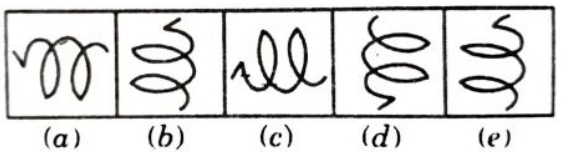 (Answer Figure 1)
 - B
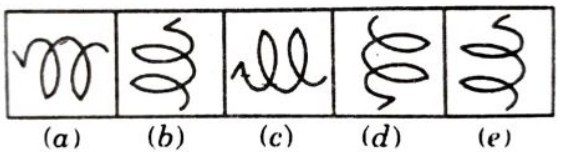 (Answer Figure 2)
 - C
 (Answer Figure 3)
 - D
 (Answer Figure 4)
 - E
 (Answer Figure 5)
Show answerHide answer
Answer: C
Approach: Figure classification: compare the figures as turned versions of one coil.
Solution:
Figures (a), (b), (d) and (e) are the same two-loop spring, only turned (rotated) to different positions.
In (c) the loops open the other way: it is the water image (top-to-bottom flip) of (a). A flip cannot be made by turning, so (c) is the odd one.
Why the other options are wrong:
(a), (b), (d), (e): each can be turned to match the others.
Cetking shortcut: When all the figures look alike, test whether each one is a turned copy or a flipped copy. The flipped one is the odd one out.
Answer: C
In the following problem, out of the five figures marked (a), (b), (c), (d), and (e), four are similar in a certain manner. However, one figure is not like the other four. Choose the figure which is different from the rest.
- A
 (Answer Figure 1)
 - B
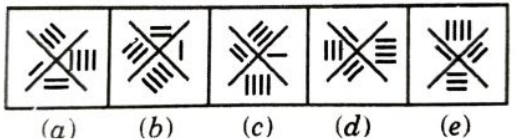 (Answer Figure 2)
 - C
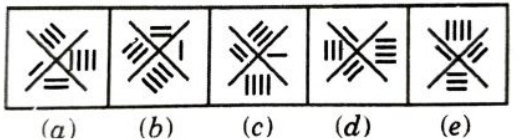 (Answer Figure 3)
 - D
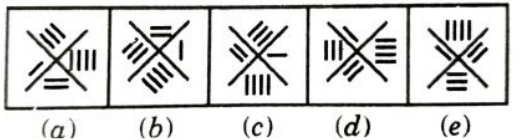 (Answer Figure 4)
 - E
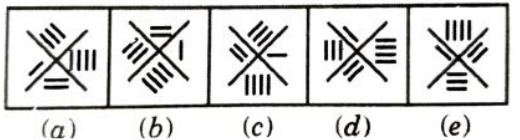 (Answer Figure 5)
Show answerHide answer
Answer: B
Approach: Figure classification: compare how the line groups are arranged around the central cross.
Solution:
Each figure has a cross with four groups of 1, 2, 3 and 4 short lines in the four spaces.
In (b), the groups are placed in a different order around the cross from the other figures, so (b) is the odd one.
Why the other options are wrong:
(a), (c), (d), (e): these follow the common arrangement (as per the Cetking key).
Answer: B
In the following problem, out of the five figures marked (a), (b), (c), (d), and (e), four are similar in a certain manner. However, one figure is not like the other four. Choose the figure which is different from the rest.
- A
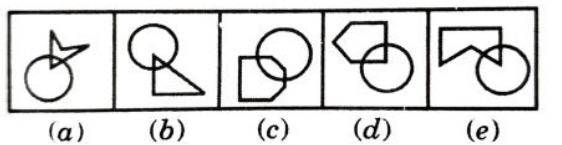 (Answer Figure 1)
 - B
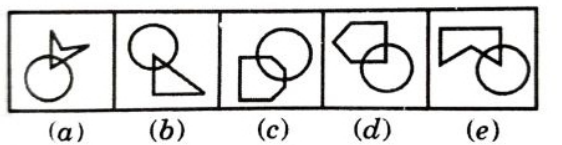 (Answer Figure 2)
 - C
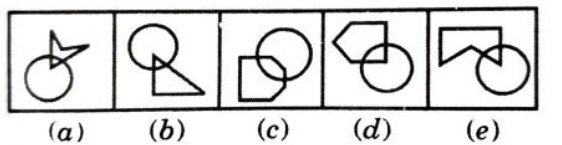 (Answer Figure 3)
 - D
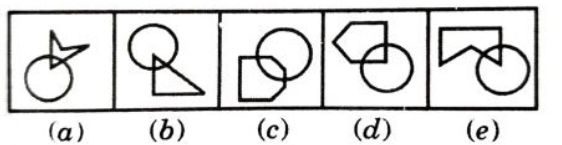 (Answer Figure 4)
 - E
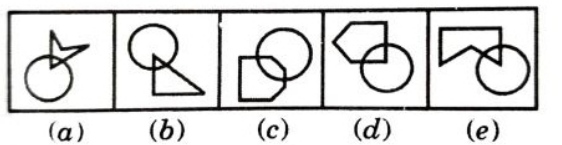 (Answer Figure 5)
Show answerHide answer
Answer: C
Approach: Figure classification: count how many corners of the polygon lie inside the circle.
Solution:
(a): one corner of the star-shape is inside the circle.
(b): one corner of the triangle is inside the circle.
(d), (e): one corner of the polygon is inside the circle.
(c): the cut corner of the polygon gives two corners inside the circle. So (c) is the odd one.
Why the other options are wrong:
(a), (b), (d), (e): exactly one corner inside the circle.
Cetking shortcut: For overlap figures, check what is inside the overlap: corners, number of crossing points, or which shape is on top.
Answer: C
In the following question, there are two problem figures (un-numbered figures) followed by five answer figures (numbered as 1, 2, 3, 4, and 5). There are certain common characteristics/properties between the two problem figures. Select a figure from amongst the answer figures which shows similar characteristics/properties as shown by the problem figures.
- A
 (Answer Figure 1)
 - B
 (Answer Figure 2)
 - C
 (Answer Figure 3)
 - D
 (Answer Figure 4)
 - E
 (Answer Figure 5)
Show answerHide answer
Answer: C
Approach: Common property: find the feature that both problem figures share.
Solution:
The triangle has lines from its centre to all 3 corners. The square has lines from its centre to all 4 corners (the two diagonals).
Common property: a regular polygon with lines from the centre to every corner.
Figure 3: a hexagon with lines from the centre to all 6 corners. ✔
Why the other options are wrong:
1: a rectangle cut by lines to the midpoints of its sides, not to the corners.
2: an envelope shape whose lines do not meet at the centre.
4: a hexagon with an inscribed rhombus; the lines do not run from the centre.
5: a pentagon with crossing lines, not lines from the centre to each corner.
Cetking shortcut: Check whether every corner is joined to the centre. One missed corner rules the figure out.
Answer: C
In the following question, there are two problem figures (un-numbered figures) followed by five answer figures (numbered as 1, 2, 3, 4, and 5). There are certain common characteristics/properties between the two problem figures. Select a figure from amongst the answer figures which shows similar characteristics/properties as shown by the problem figures.
- A
 (Answer Figure 1)
 - B
 (Answer Figure 2)
 - C
 (Answer Figure 3)
 - D
 (Answer Figure 4)
 - E
 (Answer Figure 5)
Show answerHide answer
Answer: C
Approach: Common property: find the feature that both problem figures share.
Solution:
Both figures are split by a vertical line. One side has one more horizontal line than the other, and the lines on the two sides do not line up.
Rectangle: left side 2 lines, right side 1 line. Triangle: left side 2 lines, right side 3 lines.
Figure 3 (circle): left side 3 lines, right side 4 lines, staggered. ✔
Why the other options are wrong:
1: the roof and the horizontal lines on the two sides line up.
2: left 3 lines vs right 1 line, a difference of 2.
4, 5: the line counts or the staggering do not fit the pattern.
Cetking shortcut: Count the horizontal lines on each side of the vertical divider. The counts must differ by exactly 1.
Answer: C
In the following question, from amongst the figures marked (1), (2), (3), and (4), select the one which satisfies the same conditions of placement of the dot as in fig. (X). If the correct figure which satisfies the same conditions of placement of the dot as in fig. (X) is not there in the given alternatives (1), (2), (3), and (4), then choose option (e) None of these.
- A
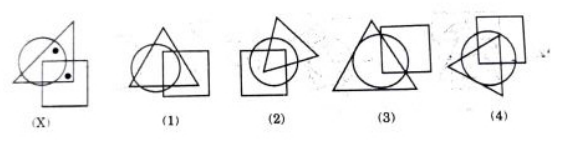 (Figure (1))
 - B
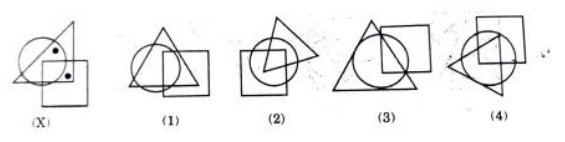 (Figure (2))
 - C
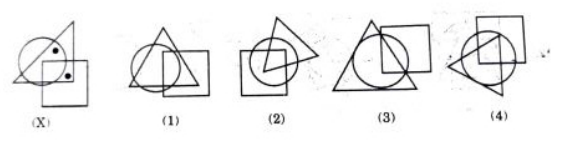 (Figure (3))
 - D
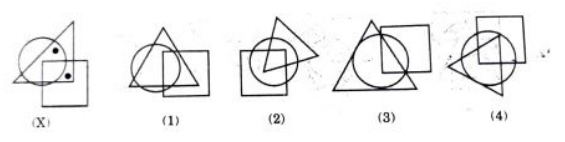 (Figure (4))
 - E
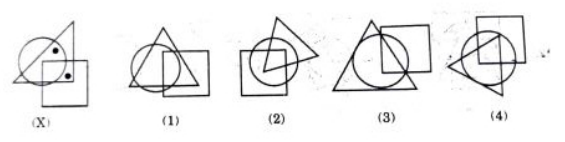 (None of these (e))
Show answerHide answer
Answer: A
Approach: Dot placement: note which shapes contain each dot, then look for the same regions in the options.
Solution:
In fig. (X): the upper dot is inside the circle and the triangle, but outside the square.
The lower dot is inside the triangle and the square, but outside the circle.
Required: a region common to circle and triangle only, AND a region common to triangle and square only.
Figure (1): the circle and triangle overlap on the left, away from the square ✔. The triangle and square overlap on the right, outside the circle ✔.
Why the other options are wrong:
(2): the triangle–square overlap lies entirely inside the circle, so there is no triangle-and-square-only region.
(3), (4): the circle sits inside the overlaps, so one of the two regions is missing.
(e) None of these: figure (1) works.
Cetking shortcut: Write each dot as a code, e.g. C+T and T+S. Then check only for those two regions in each option.
Answer: A
In the following question, find out which of the answer figures (a), (b), (c) and (d) completes the figure matrix?
If the correct figure to complete the figure matrix is not there in the given alternatives (a), (b), (c) and (d), then choose option (e) None of these.
- A
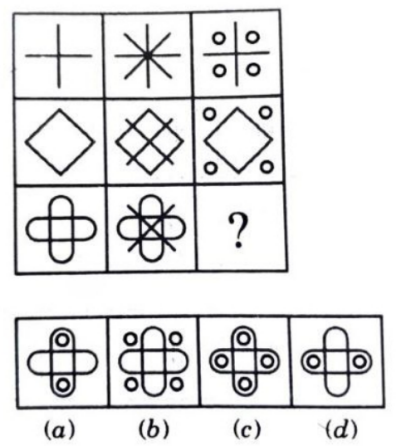 (Alternative (a))
 - B
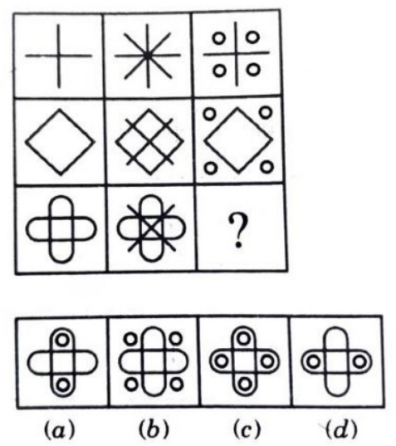 (Alternative (b))
 - C
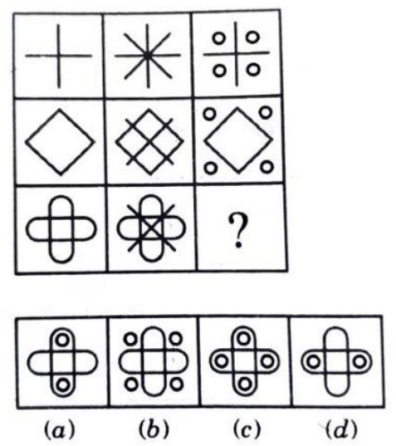 (Alternative (c))
 - D
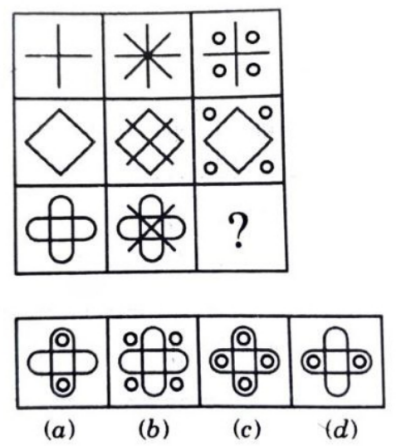 (Alternative (d))
 - E
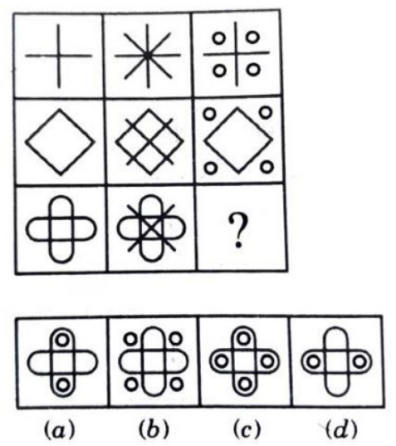 (None of these (e))
Show answerHide answer
Answer: B
Approach: Figure matrix: find the row rule and apply it to row 3.
Solution:
Row 1: plus → plus with extra spokes → plus with 4 small circles in the corners.
Row 2: diamond → diamond with crossing lines → diamond with 4 small circles in the corners.
So the third figure = the first figure + 4 small circles at the four corners.
Row 3: the cross of two rounded bars + 4 small circles at the corners = figure (b).
Why the other options are wrong:
(a), (c), (d): the small circles are drawn inside the rounded bars, not at the corners.
(e) None of these: (b) fits.
Cetking shortcut: Compare column 1 with column 3 in each row. The only change is the 4 corner circles.
Answer: B
In the following question, find out which of the answer figures (a), (b), (c) and (d) completes the figure matrix?
If the correct figure to complete the figure matrix is not there in the given alternatives (a), (b), (c) and (d), then choose option (e) None of these.
- A
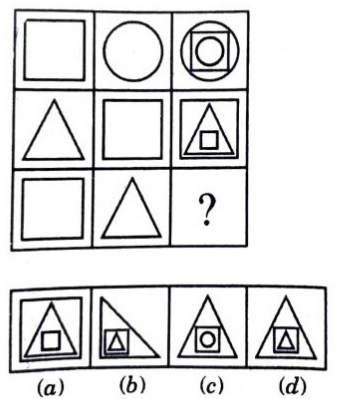 (Alternative (a))
 - B
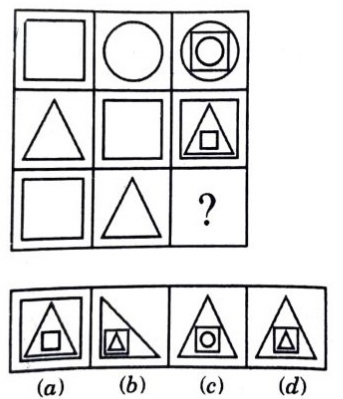 (Alternative (b))
 - C
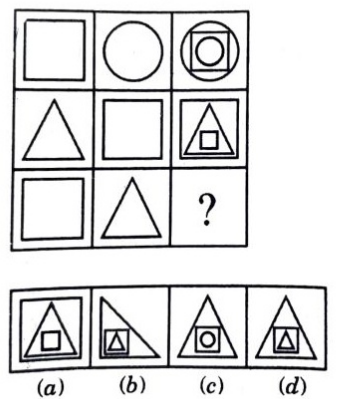 (Alternative (c))
 - D
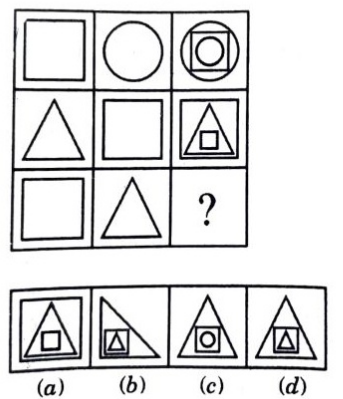 (Alternative (d))
 - E
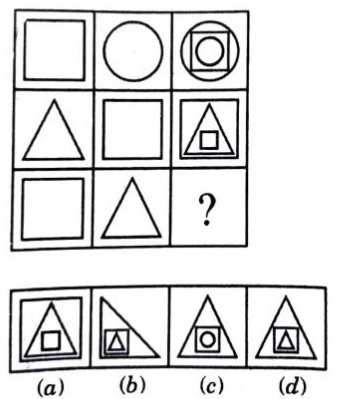 (None of these (e))
Show answerHide answer
Answer: D
Approach: Figure matrix: find how the third figure is built from the first two.
Solution:
Row 1: square, circle → circle (outer) ⊃ square ⊃ small circle (inner).
Row 2: triangle, square → square (outer) ⊃ triangle ⊃ small square (inner).
Rule: outer = 2nd figure, middle = 1st figure, inner = 2nd figure again.
Row 3: square, triangle → triangle (outer) ⊃ square ⊃ small triangle (inner) = figure (d).
Why the other options are wrong:
(a): a square outer frame with a square inside, so the order is wrong.
(b): a right triangle, not the same triangle.
(c): a small circle at the centre, so the inner shape is wrong.
(e) None of these: (d) fits.
Cetking shortcut: The outermost and innermost shapes are both the 2nd figure. Look for the option with a triangle both outside and in the centre.
Answer: D
In the following question, choose the correct water-image of the Fig. (X) from amongst the four alternatives (a), (b), (c) and (d) given along with it.
If the correct water-image of the Fig. (X) is not there in the given alternatives (a), (b), (c) and (d) then choose option (e) None of these.
- A
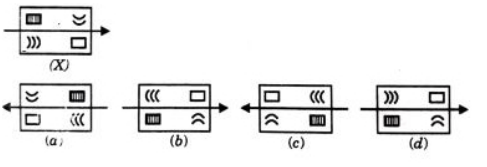 (Alternative (a))
 - B
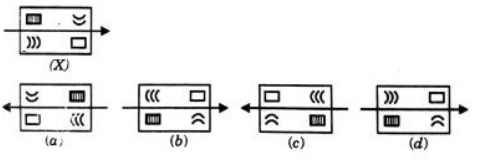 (Alternative (b))
 - C
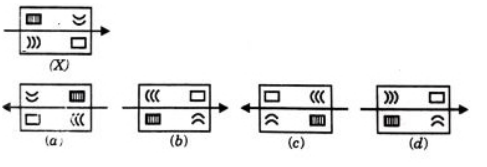 (Alternative (c))
 - D
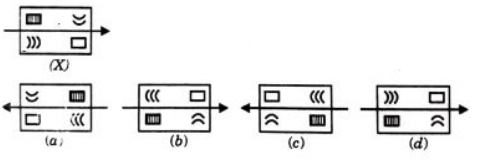 (Alternative (d))
 - E
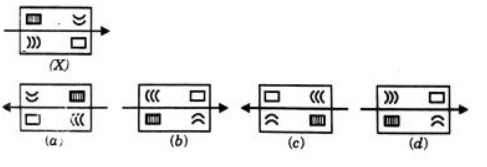 (None of these (e))
Show answerHide answer
Answer: D
Approach: Water image: flip top-to-bottom. Left and right stay the same, and each element turns upside down.
Solution:
Fig. (X): top row = black rectangle (left), downward chevrons ∨∨ (right). Bottom row = arcs ))) (left), empty rectangle (right). The arrow points right.
Water image: top row = arcs ))) (left), empty rectangle (right). Bottom row = black rectangle (left), chevrons turned upward ∧∧ (right). The arrow still points right.
Figure (d) matches exactly.
Why the other options are wrong:
(a), (c): the arrow points left, which is a mirror (left-right) change.
(b): the arcs face the other way, (((, which is a left-right change.
(e) None of these: (d) fits.
Cetking shortcut: In a water image, horizontal arrows and left-right curves (like ))) ) keep their direction. Only up-down features flip.
Answer: D
In the following question, choose the correct water-image of the Fig. (X) from amongst the four alternatives (a), (b), (c) and (d) given along with it.
If the correct water-image of the Fig. (X) is not there in the given alternatives (a), (b), (c) and (d) then choose option (e) None of these.
- A
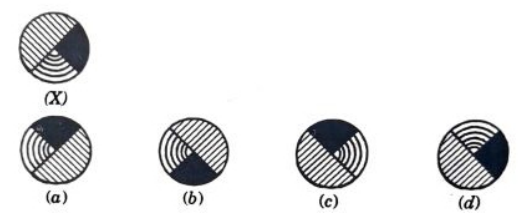 (Alternative (a))
 - B
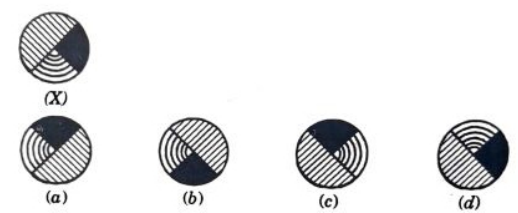 (Alternative (b))
 - C
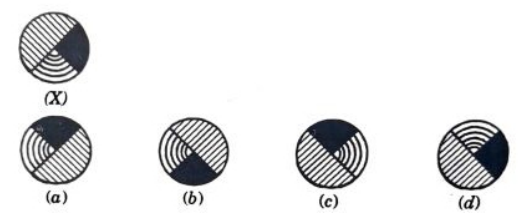 (Alternative (c))
 - D
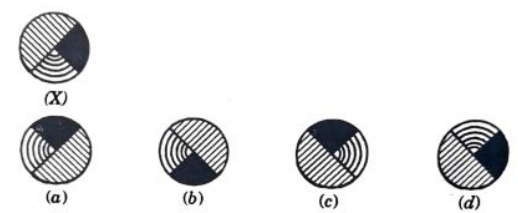 (Alternative (d))
 - E
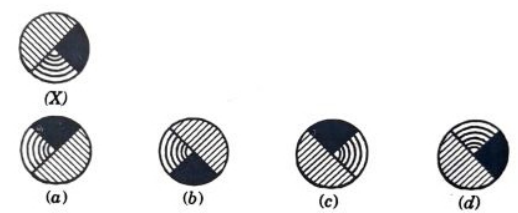 (None of these (e))
Show answerHide answer
Answer: D
Approach: Water image: flip top-to-bottom. Left and right stay the same, and the slant of hatching lines reverses.
Solution:
Fig. (X): the upper-left half is hatched (\), the right sector is black, and the bottom sector has concentric arcs.
Water image: the hatched half goes to the lower left with the lines slanting the other way (/), the black sector stays on the right, and the arcs move to the top sector.
Figure (d) matches exactly.
Why the other options are wrong:
(a), (c): the black sector is at the top.
(b): the black sector is at the bottom.
(e) None of these: (d) fits.
Cetking shortcut: Track the one black sector first. It must stay on the right side, which already leaves only (d).
Answer: D
In the following question, you are given a fig. (X) followed by four alternative figures (a), (b), (c), and (d) such that fig. (X) is embedded in one of them. Trace out the alternative figure which contains fig. (X) as its part. If Fig. (X) is not embedded in the given alternatives (a), (b), (c), and (d) then choose option (e) None of these.
- A
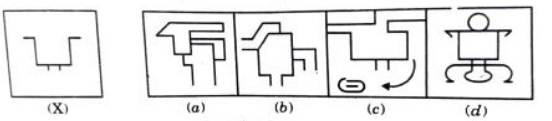 (Alternative (a))
 - B
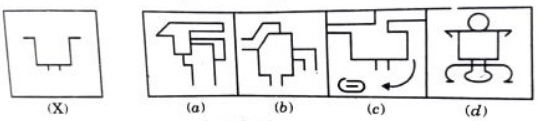 (Alternative (b))
 - C
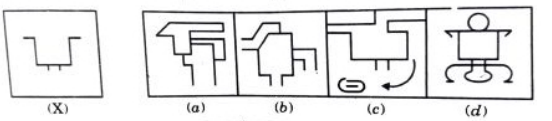 (Alternative (c))
 - D
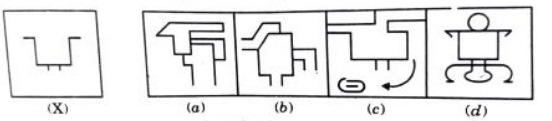 (Alternative (d))
 - E
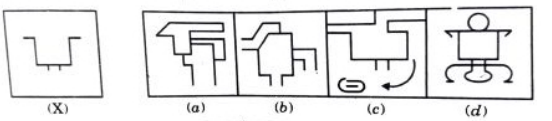 (None of these (e))
Show answerHide answer
Answer: C
Approach: Embedded figure: trace the exact shape (same size and orientation) inside each option.
Solution:
Fig. (X): a flat-bottomed U with short arms bent outward at the top, and two short ticks hanging below the base.
Figure (c): the top line drops into a U-shaped box whose base has two short ticks below it, which is exactly fig. (X). ✔
Why the other options are wrong:
(a), (b): these have stepped outlines, and no base has two ticks hanging down.
(d): the person-like figure's body is a box, not a U with ticks.
(e) None of these: (c) contains fig. (X).
Cetking shortcut: Find the most unusual feature first (here, the two ticks under the base), then check the rest of the shape there.
Answer: C
In the following question, you are given a fig. (X) followed by four alternative figures (a), (b), (c), and (d) such that fig. (X) is embedded in one of them. Trace out the alternative figure which contains fig. (X) as its part. If Fig. (X) is not embedded in the given alternatives (a), (b), (c), and (d) then choose option (e) None of these.
- A
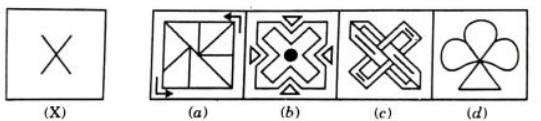 (Alternative (a))
 - B
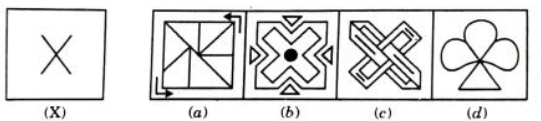 (Alternative (b))
 - C
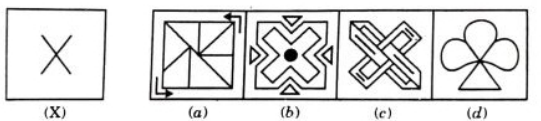 (Alternative (c))
 - D
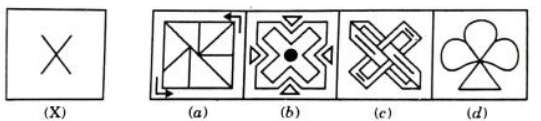 (Alternative (d))
 - E
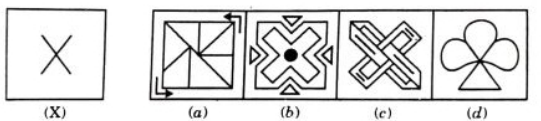 (None of these (e))
Show answerHide answer
Answer: D
Approach: Embedded figure: trace the exact shape (same size and orientation) inside each option.
Solution:
Fig. (X): a simple X, two straight lines crossing at their middle.
Figure (d): at the centre of the clover, the two side lobe edges and the two sides of the triangle meet in straight lines through one point, forming the X. ✔
Why the other options are wrong:
(a): the lines meet at the diagonal but not as an X of the same proportions.
(b): the X is drawn with double (outlined) bars, not single lines.
(c): an outlined, interlocking X made of bands, not single lines.
(e) None of these: (d) contains fig. (X).
Cetking shortcut: Rule out the options where the X is drawn with double lines (b, c). Fig. (X) has single lines.
Answer: D
In the following question, find the number of triangles
- A11
- B13
- C15
- D17
- E19
Show answerHide answer
Answer: C
Approach: Counting triangles: name every point and list triangles systematically.
Solution:
Name the corners A (top-left), B (top-right), C (bottom-right), D (bottom-left), the centre O, and P, the point on AO joined to B and D.
Triangles on the sides of the rectangle: ABC, ABD, ACD, BCD (4).
Triangles with O: ABO, BCO, CDO, ADO (4).
Triangles with P: ABP, ADP, BCP, CDP, BDP, BOP, DOP (7).
Total = 4 + 4 + 7 = 15.
Why the other options are wrong:
A (11), B (13): these miss the large triangles through P (BCP, CDP) or the big half-triangles.
D (17), E (19): these count four-sided shapes or overlaps more than once.
Cetking shortcut: Fix one vertex at a time (all triangles using P, then O, then corners only). This avoids double counting.
Answer: C
In the following question, find the number of squares in the given figure.
- A32
- B30
- C29
- D28
- E42
Show answerHide answer
Answer: B
Approach: Squares in an n × n grid = 1² + 2² + ... + n².
Solution:
The figure is a 4 × 4 grid.
1 × 1 squares: 16. 2 × 2 squares: 9. 3 × 3 squares: 4. 4 × 4 squares: 1.
Total = 16 + 9 + 4 + 1 = 30.
Why the other options are wrong:
A (32), C (29), D (28): miscounts of one of the sizes.
E (42): adds rectangles, which are not squares.
Cetking shortcut: For an n × n grid, the total number of squares = n(n + 1)(2n + 1)/6 = 4 × 5 × 9/6 = 30.
Answer: B
In the following question, from amongst the figures marked (1), (2), (3), and (4) select the one which satisfies the same conditions of placement of the dot as in fig. (X). If the correct figure which satisfies the same conditions of placement of the dot as in fig. (X) is not there in the given alternatives (1), (2), (3), and (4) then choose option (5) None of these.
- A
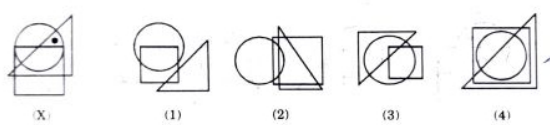 (Figure (1))
 - B
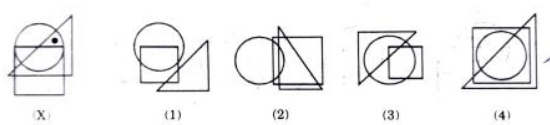 (Figure (2))
 - C
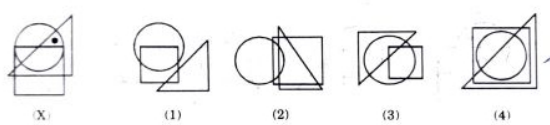 (Figure (3))
 - D
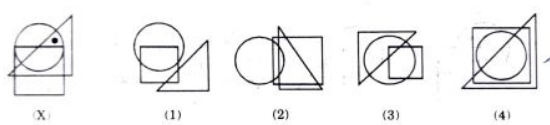 (Figure (4))
 - E
 (None of these (5))
Show answerHide answer
Answer: C
Approach: Dot placement: note which shapes contain the dot, then look for the same region in the options.
Solution:
In fig. (X), the dot is inside the circle and the triangle, but outside the square (above the square's top edge).
Required: a region common to the circle and the triangle only.
Figure (3): part of the circle lies inside the large triangle and outside the small square ✔.
Why the other options are wrong:
(1): the triangle does not overlap the circle.
(2): every circle–triangle overlap lies inside the square.
(4): the circle lies inside the square, so no circle-and-triangle-only region exists.
(5) None of these: (3) fits.
Cetking shortcut: Write the dot's code (C+T, not S), then rule out any option where the circle is inside the square or does not touch the triangle.
Answer: C