Two trains P and Q start simultaneously in the opposite direction from two points A and B and arrive at their destinations 25 and 16 hours respectively after their meeting each other. At what speed does the second train Q travel if the first train travels at 100 km/h?
- A100
- B125
- C120
- D140
- E115
Show answerHide answer
Answer: B
Approach: Trains meeting rule: SP/SQ = √(tQ/tP), where t = time taken after meeting.
Solution:
Time of P after meeting tP = 25 h; time of Q after meeting tQ = 16 h.
SP/SQ = √(16/25) = 4/5
100/SQ = 4/5 ⇒ SQ = 100 × 5/4 = 125 km/h
Cetking shortcut: The train that takes LESS time after meeting is FASTER — so Q > 100; only 120, 125, 140, 115 qualify, and √(25/16) = 5/4 gives 125.
Answer: B
The sum of present ages of Anish, Ajay and Anvit is 75 years. If 5 years ago the ratio of their ages was 3:4:5. What is the present age of Ajay?
- A65
- B28
- C32
- D44
- E25
Show answerHide answer
Answer: E
Approach: Ages with a past ratio — add the years back to each part.
Solution:
5 years ago: Anish = 3x, Ajay = 4x, Anvit = 5x.
Present ages: 3x+5, 4x+5, 5x+5 ⇒ sum = 12x + 15 = 75 ⇒ 12x = 60 ⇒ x = 5.
Ajay now = 4x + 5 = 20 + 5 = 25 years.
Cetking shortcut: Sum 5 years ago = 75 − 15 = 60; Ajay's share = 4/12 × 60 = 20; add 5 ⇒ 25.
Answer: E
Amit cycled from his house to the garden at speed of 12 km/hr and cam back to his house at the speed of 6 km/hr. if the total time taken by Amit to complete the journey was 6 hours, then find the distance between Amit's House and garden?
- A32
- B28
- C24
- D36
- E40
Show answerHide answer
Answer: C
Approach: Distance = Speed × Time; same distance both ways.
Solution:
Let one-way distance = D km.
Time going = D/12, time returning = D/6.
D/12 + D/6 = 6 ⇒ (D + 2D)/12 = 6 ⇒ 3D = 72 ⇒ D = 24 km.
Cetking shortcut: Average speed for equal distances = 2×12×6/(12+6) = 8 km/h; total distance = 8 × 6 = 48 km, one way = 24 km.
Answer: C
What is the probability of getting a red numbered card greater than 6 from a well shuffled deck of 52 cards?
- A4/13
- B2/13
- C5/13
- D3/13
- E6/13
Show answerHide answer
Answer: B
Approach: Probability = favourable cards / 52.
Solution:
Red suits: hearts and diamonds (13 each).
Numbered cards greater than 6: 7, 8, 9, 10 ⇒ 4 per suit.
Favourable = 4 × 2 = 8 ⇒ P = 8/52 = 2/13.
Why the other options are wrong:
A 4/13: counts all four suits (16 cards).
C, D, E: include face cards or the 6 itself.
Cetking shortcut: Per suit 4 of 13 cards qualify; red = half the deck ⇒ (4/13) × (1/2) = 2/13.
Answer: B
A bag contains 10 black balls 5 red balls and 5 white balls and a ball is drawn randomly from it. what is the probability of getting either a red or a white ball.
- A1/4
- B1/2
- C3/4
- D1
- E4/5
Show answerHide answer
Answer: B
Approach: Addition rule for mutually exclusive events.
Solution:
Total balls = 10 + 5 + 5 = 20.
Red or white = 5 + 5 = 10.
P = 10/20 = 1/2.
Cetking shortcut: P(red or white) = 1 − P(black) = 1 − 10/20 = 1/2.
Answer: B
In how many ways can the word “ESPECIALLY “ be arranged such that all the vowels always come together?
- A42600
- B25200
- C10080
- D30240
- E29242
Show answerHide answer
Answer: D
Approach: Vowels together: tie the vowels into one block, divide by repeats.
Solution:
ESPECIALLY = E, S, P, E, C, I, A, L, L, Y (10 letters).
Vowels: E, E, I, A (4); consonants: S, P, C, L, L, Y (6, L repeated).
Units to arrange = 1 vowel block + 6 consonants = 7 ⇒ 7!/2! = 2520 (2! for the two Ls).
Inside the block: 4!/2! = 12 (2! for the two Es).
Total = 2520 × 12 = 30240.
Why the other options are wrong:
B 25200, C 10080: forget one of the repeat divisions or the block's internal arrangement.
A, E: no standard method gives them.
Cetking shortcut: Answer must be divisible by 7!/2! = 2520 — only 25200, 10080 and 30240 are; 2520 × 12 = 30240.
Answer: D
The market value of a share is 35% of the face value and 30% less than the selling price. find the profit or loss percentage
- A50% loss
- B50% profit
- C49% profit
- D48% loss
- E45% profit
Show answerHide answer
Answer: A
Approach: Percent-of chain: fix Face Value = 100 and convert each statement.
Solution:
Let Face Value (FV) = ₹100 ⇒ Market Value (MV) = 35% of 100 = ₹35.
MV is 30% less than SP ⇒ MV = 0.70 × SP ⇒ SP = 35/0.70 = ₹50.
Taking FV as the cost (the share was bought at par), loss = 100 − 50 = ₹50.
Loss % = 50/100 × 100 = 50% loss.
Why the other options are wrong:
B 50% profit: sign reversed — SP (50) is below cost (100).
C, D, E: arithmetic slips; no route gives 49%, 48% or 45%.
Cetking shortcut: SP = 35/0.7 = 50 = half the face value ⇒ 50% loss straight away.
Answer: A
it was sunday on 12 february. 1882 what was the day on 12 february 1885?
- AWednesday
- BThursday
- CFriday
- DSaturday
- ESunday
Show answerHide answer
Answer: B
Approach: Odd days: each ordinary year adds 1 odd day, a leap year adds 2 — but only if its 29 February falls inside the interval.
Solution:
12 Feb 1882 → 12 Feb 1883: no 29 Feb in between ⇒ 1 odd day.
12 Feb 1883 → 12 Feb 1884: 29 Feb 1884 comes AFTER 12 Feb 1884 ⇒ 1 odd day.
12 Feb 1884 → 12 Feb 1885: includes 29 Feb 1884 ⇒ 2 odd days.
Total = 1 + 1 + 2 = 4 odd days ⇒ Sunday + 4 = Thursday.
Why the other options are wrong:
A Wednesday: only 3 odd days (ignores the leap day).
C Friday: 5 odd days — counts the leap day twice or counts 1884 from 1 Jan.
D, E: wrong count.
Cetking shortcut: 3 years apart = 3 odd days + 1 for every 29 Feb crossed (only 29 Feb 1884) = 4.
Answer: B
The outer rolling surface of eight similar small rollers having a radius of 9 cm and length as 12 cm are to be painted at a rate of Rs 15 /cm.what will be the total cost of painting ( in Rs) ?
- A80788.7
- B80488.7
- C81280.5
- D81388.8
- E82487.2
Show answerHide answer
Answer: D
Approach: Curved surface area of a cylinder = 2πrh; cost = area × rate (π = 3.14, which the options are built on).
Solution:
CSA of one roller = 2 × 3.14 × 9 × 12 = 678.24 cm².
CSA of 8 rollers = 678.24 × 8 = 5425.92 cm².
Cost = 5425.92 × 15 = ₹81388.8.
Why the other options are wrong:
With π = 22/7 the cost is ≈ ₹81463 — not offered, so the paper clearly uses π = 3.14.
A, B, C, E: do not match 216π × 8 × 15 for any standard π.
Cetking shortcut: Cost = 2πrh × 8 × 15 = 25920π; 25920 × 3.14 = 81388.8.
Answer: D
A courtyard is 30 meters long and 20 meters broad and is to be paved with bricks of dimensions 15cm by 10 cm what will be the number of bricks required?
- A25000
- B30000
- C40000
- D35000
- E42000
Show answerHide answer
Answer: C
Approach: Number of tiles = area of floor / area of one tile (same units).
Solution:
Courtyard area = 30 m × 20 m = 600 m².
Brick = 15 cm × 10 cm = 0.15 m × 0.10 m = 0.015 m².
Number of bricks = 600 / 0.015 = 40000.
Cetking shortcut: Work in cm: (3000 × 2000)/(15 × 10) = 200 × 200 = 40000.
Answer: C
A man invested X rupees for Y years at a rate of 3.25% per annum simple interest. if he received 3.25 X after Y years find the value of Y?
- A68.22
- B67.32
- C65.33
- D69.23
- E71.32
Show answerHide answer
Answer: D
Approach: Simple interest: SI = P × R × T / 100, with SI = Amount − Principal.
Solution:
Amount = 3.25X ⇒ SI = 3.25X − X = 2.25X.
2.25X = X × 3.25 × Y / 100 ⇒ 225 = 3.25Y.
Y = 225 / 3.25 = 69.23 years.
Why the other options are wrong:
Using SI = 3.25X (forgetting to subtract principal) gives 100 — not an option; A, B, C, E are calculation slips.
Cetking shortcut: Y = (Amount/P − 1) × 100 / R = 2.25 × 100 / 3.25 = 900/13 ≈ 69.23.
Answer: D
A mixture containing 43% of acid is mixed with another mixture containing 82% acid in the ratio 10:9.find the percentage of acid in the mixture formed?
- A60.45%
- B61.25%
- C64.25%
- D63.2%
- E61.47%
Show answerHide answer
Answer: E
Approach: Weighted average (alligation) of concentrations.
Solution:
Acid % = (43 × 10 + 82 × 9)/(10 + 9)
= (430 + 738)/19 = 1168/19 = 61.47%.
Why the other options are wrong:
A 60.45%, B 61.25%, C 64.25%, D 63.2%: arithmetic slips; 62.5% would be the simple average, which ignores the 10:9 weights.
Cetking shortcut: Answer must be slightly below the simple average 62.5% (more of the weaker mixture): 43 + 39 × 9/19 = 43 + 18.47 = 61.47%.
Answer: E
Two trains cross each other at a speed of 70 KMPH and 50 KMPH respectively. if the total length of both the trains is 1500 m find the time in which they cross each other the trains were moving in opposite direction?
- A43 second
- B41 second
- C45 second
- D49 second
- E42 second
Show answerHide answer
Answer: C
Approach: Trains in opposite directions: relative speed = sum of speeds; distance = sum of lengths.
Solution:
Relative speed = 70 + 50 = 120 km/h = 120 × 5/18 = 100/3 m/s.
Distance to cover = 1500 m (total length).
Time = 1500 ÷ (100/3) = 45 s.
Why the other options are wrong:
Using the difference of speeds (20 km/h) gives 270 s — not offered; A, B, D, E are slips.
Cetking shortcut: 1500 × 18/(120 × 5) = 1500 × 3/100 = 45 s.
Answer: C
The speed of the stream is 25 KMPH the speed of the boat downstream is 15 m/s. find the speed of the boat in Still water?
- A8.06
- B6.05
- C5.23
- D7.05
- E8.56
Show answerHide answer
Answer: A
Approach: Downstream speed = boat speed + stream speed (same units).
Solution:
Stream = 25 km/h = 25 × 5/18 = 6.944 m/s.
Downstream = 15 m/s ⇒ boat in still water = 15 − 6.944 = 8.056 ≈ 8.06 m/s.
Why the other options are wrong:
E 8.56, D 7.05, B 6.05, C 5.23: arithmetic or conversion slips.
Cetking shortcut: Convert 15 m/s to km/h: 54 km/h; boat = 54 − 25 = 29 km/h = 29 × 5/18 = 8.06 m/s.
Answer: A
the speeds of A,B and C are 15 m/s, 67 Kmph and 1020 m/ minute. if they start running in the same direction find the maximum difference between any two of them after 8 hours 30 minutes and 39 seconds.
- A111.399 km
- B112.289 km
- C109.243 km
- D108.221 km
- E110.606 km
Show answerHide answer
Answer: E
Approach: Gap between two runners in the same direction = (difference of speeds) × time; max gap is between fastest and slowest.
Solution:
Speeds in m/s: A = 15; B = 67 × 5/18 ≈ 18.61; C = 1020/60 = 17.
Fastest = B, slowest = A ⇒ speed difference = 18.61 − 15 = 3.61 m/s.
Time = 8 h 30 min 39 s = 30600 + 39 = 30639 s.
Maximum gap = 3.61 × 30639 ≈ 110606.8 m ≈ 110.606 km (rounding the speed to 3.61 m/s; the unrounded 3.6111 gives 110.64 km, still closest to E).
Why the other options are wrong:
Ignoring the 39 seconds gives ≈ 110.47 km — not offered.
A, B, C, D: other pairs/slips; B−C and C−A gaps are far smaller (≈ 49 km and ≈ 61 km).
Cetking shortcut: Only the fastest-minus-slowest pair matters: 3.61 m/s × 30639 s.
Answer: E
5 men or 7 women can do a piece of work in 28 days. find the time required by 7 men and 5 women to complete the task?
- A9 days
- B13 days
- C11 days
- D12 days
- E10 days
Show answerHide answer
Answer: B
Approach: Convert men and women to a common efficiency unit.
Solution:
5 men ≡ 7 women (both finish in 28 days) ⇒ 1 man = 7 units/day, 1 woman = 5 units/day.
Total work = 5 × 7 × 28 = 980 units.
7 men + 5 women per day = 49 + 25 = 74 units.
Time = 980 / 74 ≈ 13.24 days ⇒ about 13 days.
Why the other options are wrong:
A 9, C 11, D 12, E 10 days: all are further from 13.24 than 13 is; no other reading of the data gives them.
Cetking shortcut: Express everything in women: 7M + 5W = 9.8W + 5W = 14.8W; days = 7 × 28/14.8 ≈ 13.24.
Answer: B
Two pipes can fill a tank in 10 minutes together if the efficiency of the first pipe is 8 times the efficiency of the second pipe find the time required to fill the tank using the second pipe alone.
- A88 minutes
- B87 minutes
- C89 minutes
- D90 minutes
- E93 minutes
Show answerHide answer
Answer: D
Approach: Efficiency method for pipes.
Solution:
Efficiency ratio first : second = 8 : 1 ⇒ together 9 units/min.
Tank = 9 × 10 = 90 units.
Second pipe alone = 90 / 1 = 90 minutes.
Cetking shortcut: Second pipe does 1/9 of the joint rate ⇒ takes 9 × 10 = 90 minutes.
Answer: D
Find the ratio of investment of Ajay to Vijay if Ajay invests after 6 months of Vijay's investment and Vijay invests after 3 months of commencement of business. It is known that their profit-sharing ratio after 1 year of commencement of business is 2:3.
- A2 : 1
- B1 : 3
- C3 : 1
- D1: 2
- E4 : 1
Show answerHide answer
Answer: A
Approach: Partnership: profit share ∝ capital × time.
Solution:
Vijay joins after 3 months ⇒ invests for 12 − 3 = 9 months.
Ajay joins 6 months after Vijay (month 9) ⇒ invests for 3 months.
A × 3 : V × 9 = 2 : 3 ⇒ 3A × 3 = 2 × 9V ⇒ 9A = 18V ⇒ A : V = 2 : 1.
Why the other options are wrong:
D 1:2: inverts the ratio.
B, C, E: wrong durations (e.g. 6 months for Ajay).
Cetking shortcut: Capital ratio = profit ratio ÷ time ratio = (2/3) ÷ (3/9) = 2 ⇒ 2 : 1.
Answer: A
A mixture contains milk and water in a ratio of 7:11. When 7 liters of water is added, the ratio changes to 7:13. Find the quantity of milk in the initial mixture.
- A23.5
- B24.8
- C22.4
- D24.5
- E25.3
Show answerHide answer
Answer: D
Approach: Milk stays constant when water is added.
Solution:
Initially milk = 7x, water = 11x.
After adding 7 L water: 7x/(11x + 7) = 7/13 ⇒ 91x = 77x + 49 ⇒ 14x = 49 ⇒ x = 3.5.
Milk = 7 × 3.5 = 24.5 L.
Cetking shortcut: Milk part fixed at 7; water goes 11 → 13, so 2 parts = 7 L ⇒ 1 part = 3.5 L ⇒ milk = 24.5 L.
Answer: D
The cost price of an article is twice the discount. if the discount is 40% of the selling price find the profit or loss percent
- A25% loss
- B25% profit
- C20% loss
- D20 % profit
- E30% profit
Show answerHide answer
Answer: B
Approach: Assume SP = 100 and translate each statement.
Solution:
Discount = 40% of SP = ₹40.
CP = 2 × discount = ₹80.
Profit = 100 − 80 = ₹20 ⇒ Profit % = 20/80 × 100 = 25% profit.
Why the other options are wrong:
D 20% profit: divides profit by SP instead of CP.
A, C: SP is above CP, so it cannot be a loss.
E: arithmetic slip.
Cetking shortcut: CP = 0.8 × SP ⇒ SP/CP = 5/4 ⇒ 25% profit.
Answer: B
There are 1450 cars in the factory. The factory produces 8 cars hourly. If the sales of the factory are 80 cars per day, what will be the sale percentage to the total cars held by the factory after 7 days. It is known that the factory runs 8 hours daily.
- A28.6%
- B27.5%
- C29.5%
- D24.54%
- E26.74%
Show answerHide answer
Answer: C
Approach: Percentage of sales to total cars held (opening stock + production) over 7 days; the garbled hourly figure is 8 cars.
Solution:
Production = 8 cars/hour × 8 hours = 64 cars/day ⇒ 7 days = 448 cars.
Total cars held in 7 days = 1450 + 448 = 1898.
Cars sold in 7 days = 80 × 7 = 560.
Sale % = 560/1898 × 100 = 29.5%.
Why the other options are wrong:
With 6 cars/hour (doc's reading) the figures give 31.35% (sales/1786) or 45.68% (sales/closing stock) — neither is an option, so 6 is not the intended value.
A 28.6%, B 27.5%, D 24.54%, E 26.74%: correspond to non-integer hourly production (≈ 9.1, 10.5, 14.9, 11.5 cars) — not sensible.
Cetking shortcut: Back-solve: 560/0.295 ≈ 1898 ⇒ production = 448 = 7 × 64 = 7 × 8 × 8 — a clean 8 cars/hour, so C.
Answer: C
There are two children named p and q . If it is known that the ages of p and q are in a ratio of 4:20. and the sum of their ages is 10 years and 6months. Find the age of q
- A5 years
- B8 years
- C4 years
- D7 years
- E6 years
Show answerHide answer
Answer: B
Approach: Ratio split of a total.
Solution:
p : q = 4 : 20 = 1 : 5.
Sum = 10 years 6 months = 10.5 years ⇒ 6 parts = 10.5 ⇒ 1 part = 1.75.
q = 5 × 1.75 = 8.75 years = 8 years 9 months.
Why the other options are wrong:
Only B (8 years) carries q's age in whole years; A 5, C 4, D 7, E 6 years do not fit 5/6 of 10.5.
Cetking shortcut: q = 5/6 × 10.5 = 8.75 ⇒ 8 years (9 months).
Answer: B
The average runs scored by 3 players is 160 per match. Their runs are in a ratio 4:6:2. What will be the average it the player who scored the minimum runs hits a century in the next match and the other two play with the same runs?
- A160.5
- B166.66
- C162.5
- D168.5
- E162.5
Show answerHide answer
Answer: B
Approach: Average = total runs / number of players; recompute the total for the next match.
Solution:
Total runs per match = 3 × 160 = 480; ratio 4 : 6 : 2 (12 parts) ⇒ 160, 240, 80.
Next match: lowest scorer (80) scores 100; the other two score the same 160 and 240.
New total = 160 + 240 + 100 = 500.
Average for the match = 500/3 = 166.66.
Why the other options are wrong:
C/E 162.5, A 160.5, D 168.5: none equals 500/3; combining both matches (980/6 = 163.33) is not what is asked and is not an option either.
Cetking shortcut: Only the lowest scorer changes by +20 ⇒ average rises by 20/3 = 6.66 ⇒ 160 + 6.66 = 166.66.
Answer: B
One-third of the sum of all prime numbers greater than two but less than 20 is the square of which number?
- A5
- B6
- C7
- D8
- E9
Show answerHide answer
Answer: A
Approach: List the primes, add, divide by 3, take the square root.
Solution:
Primes greater than 2 and less than 20: 3, 5, 7, 11, 13, 17, 19.
Sum = 75 ⇒ one-third = 25 = 5².
Cetking shortcut: One-third must be a perfect square: 25, 36, 49… ⇒ sum 75, 108, 147…; the sum of odd primes below 20 is 75 ⇒ 5.
Answer: A
Village P has a population of 78000 which is decreasing at the rate 1800 per year. Village Q has a population of 54000, which is increasing at the rate of 600 per year. in how many years will the population of the two villages be equal?
- A14
- B15
- C10
- D12
- E13
Show answerHide answer
Answer: C
Approach: Equate the two linear population expressions.
Solution:
P after x years = 78000 − 1800x.
Q after x years = 54000 + 600x.
78000 − 1800x = 54000 + 600x ⇒ 24000 = 2400x ⇒ x = 10 years.
Cetking shortcut: Gap 24000 closes at 1800 + 600 = 2400 per year ⇒ 10 years.
Answer: C
What is the value of (26+(42(23-20) + 2-(2(5*80-100))+16-4))?
- A-434
- B434
- C-443
- D-453
- E435
Show answerHide answer
Answer: A
Approach: BODMAS — innermost brackets first.
Solution:
23 − 20 = 3 ⇒ 42 × 3 = 126.
5 × 80 − 100 = 300 ⇒ 2 × 300 = 600.
Inside: 126 + 2 − 600 + 16 − 4 = −460.
26 + (−460) = −434.
Why the other options are wrong:
B 434: sign error.
C −443, D −453, E 435: arithmetic slips.
Cetking shortcut: Sign check: −600 dominates ⇒ answer must be negative, leaving only A, C, D.
Answer: A
Find the value of 2a³-[3a³+4a²-{2a³-7a³}+5a³-7a²]
- A-11a³+3a²
- B7a²+3a³
- C11a³-3a²
- D-11a³-3a²
- E11a³-2a²
Show answerHide answer
Answer: A
Approach: Remove brackets from the innermost outward, flipping signs after a minus.
Solution:
{2a³ − 7a³} = −5a³ ⇒ −{…} = +5a³.
Inside [ ]: 3a³ + 4a² + 5a³ + 5a³ − 7a² = 13a³ − 3a².
2a³ − [13a³ − 3a²] = 2a³ − 13a³ + 3a² = −11a³ + 3a².
Why the other options are wrong:
C 11a³ − 3a²: whole sign reversed.
D −11a³ − 3a²: forgets to flip the a² sign.
B, E: wrong coefficients.
Cetking shortcut: Put a = 1: 2 − [3 + 4 + 5 + 5 − 7] = 2 − 10 = −8; only A gives −11 + 3 = −8.
Answer: A
A drum of kerosene is ¾ full. When 50 liters of kerosene is drawn from it, it remains 11/16 full, What is the capacity of the drum?
- A900
- B750
- C800
- D850
- E875
Show answerHide answer
Answer: C
Approach: Fraction removed × capacity = quantity drawn.
Solution:
3/4 − 11/16 = 12/16 − 11/16 = 1/16 of the drum.
1/16 × capacity = 50 L ⇒ capacity = 800 L.
Cetking shortcut: Drop in fraction = 1/16 ⇒ 16 × 50 = 800.
Answer: C
Sujit and Suraj each have some money. If Sujit gives Rs. 10 to Suraj, then Suraj will have twice the money left with Sujit. But, if Suraj gives Rs. 10 to Sujit, then they both have an equal amount of money. How much money does Sujit have?
- ARs 70
- BRs 80
- CRs 60
- DRs 50
- ERs 40
Show answerHide answer
Answer: D
Approach: Form two linear equations from the two exchanges.
Solution:
Let Sujit = S, Suraj = R.
Suraj gives ₹10 ⇒ equal: S + 10 = R − 10 ⇒ R = S + 20.
Sujit gives ₹10 ⇒ R + 10 = 2(S − 10) ⇒ S + 30 = 2S − 20 ⇒ S = 50.
Check: R = 70; 70 + 10 = 80 = 2 × 40 ✓.
Why the other options are wrong:
A ₹70: that is Suraj's money.
B, C, E: fail the checks.
Cetking shortcut: Test options: S = 50 ⇒ R = 70 ⇒ 80 vs 40 ✓ twice.
Answer: D
Find the value of 0.081³+0.009³+0.002187*0.09
- A0.000729
- B0.00729
- C0.0000729
- D0.0729
- E0.729
Show answerHide answer
Answer: A
Approach: Identity (a + b)³ = a³ + b³ + 3ab(a + b) with a = 0.081, b = 0.009.
Solution:
3ab = 3 × 0.081 × 0.009 = 0.002187 and a + b = 0.09.
So 0.081³ + 0.009³ + 0.002187 × 0.09 = a³ + b³ + 3ab(a + b) = (a + b)³.
(0.09)³ = 0.000729.
Why the other options are wrong:
B, C, D, E: same digits 729 with the decimal misplaced — (0.09)³ has 6 decimal places.
Cetking shortcut: Spot 0.002187 = 3 × 0.081 × 0.009 and 0.09 = 0.081 + 0.009 ⇒ cube of 0.09.
Answer: A
A sum of Rs 8.75 is made up of 105 coins, which are of either 10 paise or 5 paise. How many 5 paise coins are there?
- A40
- B38
- C37
- D39
- E35
Show answerHide answer
Answer: E
Approach: Two-variable coin equation (or alligation on coin values).
Solution:
₹8.75 = 875 paise. Let 10-paise coins = x ⇒ 5-paise coins = 105 − x.
10x + 5(105 − x) = 875 ⇒ 5x + 525 = 875 ⇒ x = 70.
5-paise coins = 105 − 70 = 35.
Cetking shortcut: If all 105 were 5-paise: 525 p; extra 350 p comes from 10-paise coins at 5 p each ⇒ 70 of them ⇒ 35 five-paise coins.
Answer: E
Find the HCF of 405, 585, 765, 900
- A45
- B90
- C35
- D15
- E50
Show answerHide answer
Answer: A
Approach: HCF = product of common primes with lowest powers.
Solution:
405 = 3⁴ × 5; 585 = 3² × 5 × 13; 765 = 3² × 5 × 17; 900 = 2² × 3² × 5².
Common: 3² × 5 = 45.
Why the other options are wrong:
B 90: 405 is odd, so 2 cannot be a factor.
C 35: 7 does not divide any.
D 15: a common factor, but not the highest.
E 50: 405 is not divisible by 2 or 25.
Cetking shortcut: Check options from the largest: 90 fails (405 odd), 50 fails, 45 divides all four ⇒ 45.
Answer: A
Akshay has completely put each of three liquids, 558 liters of petrol, 682 liters of diesel and 589 liters of kerosene in bottles of equal size without mixing with any of the above three types of liquids such that each bottle is completely filled. What is the least possible number of bottles required?
- A56
- B59
- C63
- D66
- E60
Show answerHide answer
Answer: B
Approach: Largest equal bottle size = HCF of the volumes; bottles = sum of volumes ÷ HCF.
Solution:
558 = 2 × 3² × 31; 682 = 2 × 11 × 31; 589 = 19 × 31 ⇒ HCF = 31 L.
Bottles = 558/31 + 682/31 + 589/31 = 18 + 22 + 19 = 59.
Cetking shortcut: Differences 682 − 589 = 93 = 3 × 31 and 589 = 19 × 31 point straight to 31; total 1829/31 = 59.
Answer: B
Three runners, Harshad, Aniket, and Rajesh, running around a circular track can complete one revolution in 12, 18 and 24 minutes respectively. After how many minutes will they meet at the starting point?
- A70
- B73
- C75
- D72
- E76
Show answerHide answer
Answer: D
Approach: Meeting again at the start = LCM of individual lap times.
Solution:
12 = 2² × 3; 18 = 2 × 3²; 24 = 2³ × 3.
LCM = 2³ × 3² = 72 minutes.
Cetking shortcut: Check multiples of 24: 24, 48, 72 — 72 is the first divisible by 18.
Answer: D
Three wheels can complete 25, 21 and 16 revolutions per minute respectively. There is a red spot on each wheel that touches the ground at time zero. After how much time, all these spots will simultaneously touch the ground again?
- A58 second
- B60 second
- C62 second
- D59 second
- E61 second
Show answerHide answer
Answer: B
Approach: Spots touch the ground together after the LCM of the time per revolution; LCM of fractions = LCM(numerators)/HCF(denominators).
Solution:
Time per revolution: 1/25, 1/21, 1/16 minute.
LCM = LCM(1, 1, 1)/HCF(25, 21, 16) = 1/1 = 1 minute = 60 seconds.
Why the other options are wrong:
A 58, C 62, D 59, E 61 s: none is a whole number of revolutions for all three wheels (e.g. in 59 s the 25-rpm wheel turns 24.58 times).
Cetking shortcut: In 1 minute every wheel completes a whole number of turns (25, 21, 16); 25, 21, 16 share no common factor, so nothing shorter works.
Answer: B
If X,Y & Z are three numbers such that LCM of X & Y is X and LCM of Y & Z is Y then find the HCF of X, Y and Z
- AX
- BY
- CZ
- DXY
- EYZ
Show answerHide answer
Answer: C
Approach: LCM(a, b) = a means b divides a.
Solution:
LCM(X, Y) = X ⇒ Y is a factor of X.
LCM(Y, Z) = Y ⇒ Z is a factor of Y.
So Z | Y | X ⇒ Z divides all three and is the largest such number ⇒ HCF = Z.
Why the other options are wrong:
A X, B Y: X and Y do not divide Z (unless equal).
D XY, E YZ: an HCF cannot exceed the smallest number.
Cetking shortcut: Try numbers: X = 12, Y = 6, Z = 3 ⇒ HCF = 3 = Z.
Answer: C
how many prime numbers are less than 100?
- A20
- B22
- C24
- D25
- E23
Show answerHide answer
Answer: D
Approach: Count primes below 100 decade by decade.
Solution:
1–10: 2, 3, 5, 7 (4); 11–20: 11, 13, 17, 19 (4); 21–30: 23, 29 (2); 31–40: 31, 37 (2); 41–50: 41, 43, 47 (3);
51–60: 53, 59 (2); 61–70: 61, 67 (2); 71–80: 71, 73, 79 (3); 81–90: 83, 89 (2); 91–100: 97 (1).
Total = 4 + 4 + 2 + 2 + 3 + 2 + 2 + 3 + 2 + 1 = 25.
Cetking shortcut: Fact to memorise: 25 primes below 100 (and 168 below 1000).
Answer: D
Find the sum of first 100 even natural numbers
- A10100
- B11020
- C10080
- D10050
- E10070
Show answerHide answer
Answer: A
Approach: Sum of first n even natural numbers = n(n + 1).
Solution:
2 + 4 + … + 200 = 2(1 + 2 + … + 100) = 2 × 100 × 101/2 = 100 × 101 = 10100.
Why the other options are wrong:
D 10050: uses n(n+1)/2 × 2 wrongly or 100 × 100.5.
B, C, E: arithmetic slips.
Cetking shortcut: n(n + 1) = 100 × 101 = 10100.
Answer: A
In how many ways the number 3234 can be written as the product of 2 numbers which are coprime to each other?
- A7
- B9
- C8
- D10
- E11
Show answerHide answer
Answer: C
Approach: Number of ways to write N as a product of two co-prime factors = 2k−1, k = number of distinct primes of N.
Solution:
3234 = 2 × 3 × 7² × 11 ⇒ distinct primes: 2, 3, 7, 11 ⇒ k = 4.
Each prime power must go wholly to one factor ⇒ 2⁴ = 16 ordered splits.
Unordered pairs = 16/2 = 8 (including 1 × 3234).
Why the other options are wrong:
B 9, D 10, E 11: overcount; A 7: excludes the pair 1 × 3234, which is co-prime.
Cetking shortcut: Just count distinct primes: k = 4 ⇒ 2³ = 8.
Answer: C
Given that 1²+3²+5²+7²+9²=165, then what is the value of 3²+9²+15²+21²+27²?
- A1485
- B1385
- C990
- D495
- E995
Show answerHide answer
Answer: A
Approach: Scaling: every term is 3 times an odd number, so each square is 9 times.
Solution:
3² + 9² + 15² + 21² + 27² = 3²(1² + 3² + 5² + 7² + 9²)
= 9 × 165 = 1485.
Why the other options are wrong:
D 495: multiplies by 3 instead of 9.
C 990: multiplies by 6.
B, E: slips.
Cetking shortcut: Factor out 3² = 9 ⇒ 9 × 165 = 1485.
Answer: A
Find the square root of 4a²+9b²+c²+12ab-6bc-4ac
- A2a + b – 3c
- B2a – 3b - c
- C2a – 3b – c
- D2a + 3b – c
- E2a + b – 2c
Show answerHide answer
Answer: D
Approach: Match with (x + y + z)² = x² + y² + z² + 2xy + 2yz + 2zx.
Solution:
Square terms give 2a, 3b, c (signs to fix).
+12ab = 2(2a)(3b) ⇒ 2a and 3b have the same sign.
−4ac = 2(2a)(−c) and −6bc = 2(3b)(−c) ⇒ c has the opposite sign.
So the expression = (2a + 3b − c)² ⇒ square root = 2a + 3b − c.
Why the other options are wrong:
B / C 2a − 3b − c: would make the ab term −12ab.
A 2a + b − 3c, E 2a + b − 2c: squares give b², not 9b².
Cetking shortcut: Only the sign pattern matters: ab positive, ac and bc negative ⇒ c alone is negative ⇒ D.
Answer: D
If X +Y+Z= 0 then what is value of (x+y) (y+z) (x+z)?
- AX²+ Y²+ Z²
- B(X+ Y + Z) ²
- C-XYZ
- DXYZ
- E(X+Y+Z) ³
Show answerHide answer
Answer: C
Approach: Use x + y + z = 0 to replace each pair sum by the negative of the third.
Solution:
x + y = −z, y + z = −x, x + z = −y.
(x + y)(y + z)(x + z) = (−z)(−x)(−y) = −xyz.
Why the other options are wrong:
D xyz: misses one minus sign (three negatives give a negative).
A, B, E: B and E are 0 here; A is unrelated.
Cetking shortcut: Take x = 1, y = 1, z = −2: (2)(−1)(−1) = 2 and −xyz = 2 ✓.
Answer: C
How many number are there between 55 and 3815 which are multiple of 5 and divisible by 3?
- A249
- B250
- C251
- D252
- E238
Show answerHide answer
Answer: C
Approach: Multiples of 5 and 3 = multiples of LCM 15; count terms of the AP.
Solution:
First multiple of 15 above 55 = 60; last below 3815 = 3810 (15 × 254).
Count = (3810 − 60)/15 + 1 = 250 + 1 = 251.
Why the other options are wrong:
B 250: forgets the +1.
D 252: includes an extra end term.
A 249, E 238: slips.
Cetking shortcut: ⌊3815/15⌋ − ⌊55/15⌋ = 254 − 3 = 251.
Answer: C
The sum of three numbers in AP is 48. The sum of their squares is 800. Find the smallest number among following.
- A10
- B12
- C11
- D9
- E13
Show answerHide answer
Answer: B
Approach: Three numbers in AP: take them as a − d, a, a + d.
Solution:
Sum = 3a = 48 ⇒ a = 16.
Sum of squares = 3a² + 2d² = 800 ⇒ 768 + 2d² = 800 ⇒ d² = 16 ⇒ d = 4.
Numbers: 12, 16, 20 ⇒ smallest = 12.
Why the other options are wrong:
A 10 ⇒ 10, 16, 22: squares sum 840.
C 11, D 9, E 13: squares sum 818, 866, 786 — not 800.
Cetking shortcut: Middle term = 48/3 = 16; test options: 12, 16, 20 ⇒ 144 + 256 + 400 = 800 ✓.
Answer: B
Find the product of 968427 and 3493
- A3382715511
- B3382715523
- C3382756879
- D3328778965
- E3357729673
Show answerHide answer
Answer: A
Approach: Last-digit check, then a rough size check.
Solution:
Units digit: 7 × 3 = 21 ⇒ product ends in 1 ⇒ only A (…511) qualifies.
Size check: 968427 × 3493 ≈ 9.68 × 10⁵ × 3.49 × 10³ ≈ 3.38 × 10⁹ ✓.
Exact: 968427 × 3493 = 3382715511.
Why the other options are wrong:
B …523, C …879, D …965, E …673: wrong units digit.
Cetking shortcut: Units digit 7 × 3 → 1 eliminates every option except A.
Answer: A
on dividing 30879 by a certain number the question is 67 and the remainder is 327. find the divisor
- A476
- B456
- C466
- D444
- E457
Show answerHide answer
Answer: B
Approach: Dividend = Divisor × Quotient + Remainder.
Solution:
30879 = 67 × d + 327.
67d = 30879 − 327 = 30552.
d = 30552/67 = 456 (remainder 327 < 456 ✓).
Why the other options are wrong:
A 476, C 466, D 444, E 457: 67 × each + 327 ≠ 30879 (e.g. 67 × 457 + 327 = 30946).
Cetking shortcut: Units digit: 67 × d must end in 2 (…879 − …327) ⇒ 7 × d ends in 2 ⇒ d ends in 6: options 476, 456, 466 — then 30552/67 = 456.
Answer: B
Find remainder when 354¹⁷⁶- 346¹⁷⁶ is divided by 700.
- A5
- B0
- C2
- D4
- E3
Show answerHide answer
Answer: B
Approach: aⁿ − bⁿ is divisible by (a + b) when n is even.
Solution:
n = 176 is even ⇒ 354¹⁷⁶ − 346¹⁷⁶ is divisible by 354 + 346 = 700.
Remainder = 0.
Why the other options are wrong:
A, C, D, E: non-zero remainders are impossible since 700 divides the expression exactly.
Cetking shortcut: Spot 354 + 346 = 700 and the even power ⇒ remainder 0 instantly.
Answer: B
How many factors of 19! Are there, whose units digits is 5?
- A1298
- B1296
- C1295
- D1297
- E1291
Show answerHide answer
Answer: B
Approach: A factor ends in 5 ⇔ it is odd and a multiple of 5. Count factors with power of 2 = 0 and power of 5 ≥ 1.
Solution:
19! = 2¹⁶ × 3⁸ × 5³ × 7² × 11 × 13 × 17 × 19 (powers: 3 → ⌊19/3⌋ + ⌊19/9⌋ = 8; 5 → 3; 7 → 2).
Choices: 2 → 1 (only 0); 3 → 9; 5 → 3 (1 to 3); 7 → 3; 11, 13, 17, 19 → 2 each.
Count = 1 × 9 × 3 × 3 × 2 × 2 × 2 × 2 = 1296.
Why the other options are wrong:
A, C, D, E: off by small amounts — usually from including 5⁰ (gives 1728) or miscounting the power of 3.
Cetking shortcut: Odd part of 19! has (8+1)(3+1)(2+1)·2⁴ = 1728 factors; drop the 5⁰ ones (1/4) ⇒ 1728 × 3/4 = 1296.
Answer: B
What number will replace A if 3313A is divisble by 33?
- A4
- B5
- C2
- D6
- E8
Show answerHide answer
Answer: C
Approach: Divisible by 33 ⇔ divisible by 3 and by 11.
Solution:
Divisibility by 11: alternating sum of 3, 3, 1, 3, A = 3 − 3 + 1 − 3 + A = A − 2 ⇒ A = 2.
Divisibility by 3: 3 + 3 + 1 + 3 + 2 = 12 ✓.
Check: 33132 = 33 × 1004 ✓.
Why the other options are wrong:
A 4, D 6: digit sums 14, 16 — fail divisibility by 3.
B 5, E 8: pass the 3-test but fail the 11-test.
Cetking shortcut: Apply the stricter 11-test first — it fixes A = 2 in one line.
Answer: C
which of the following divides 3⁴⁵+ 3⁴⁶ + 3⁴⁷ + 3⁴⁸ + 3⁴⁹
- A3
- B5
- C2
- D11
- E4
Show answerHide answer
Answer: A
Approach: Take out the common factor 3⁴⁵.
Solution:
3⁴⁵ + 3⁴⁶ + 3⁴⁷ + 3⁴⁸ + 3⁴⁹ = 3⁴⁵(1 + 3 + 9 + 27 + 81) = 3⁴⁵ × 121 = 3⁴⁵ × 11².
So the sum is divisible by 3 (every term is a power of 3).
Why the other options are wrong:
B 5, C 2, E 4: the sum is odd and has no factor 5 (3⁴⁵ × 11² only).
D 11: also divides the sum (121 = 11²), so two options are valid; A is the stored key.
Cetking shortcut: Factor 3⁴⁵ out ⇒ 3⁴⁵ × 121: prime factors are only 3 and 11.
Answer: A
In this question, four words are given in bold. One of these words given in bold may be wrongly spelt or inappropriate, in the context of the sentence. Find out the word that is inappropriately or wrongly spelt, if any. That word is your answer, If all the words given in bold are correctly spelt or appropriate in the context of the sentence, then mark 'All correct as your answer.
The book is full of updated and contemparary commentary.
- AFull
- BUpdated
- CContemparary
- DCommentary
- EAll correct
Show answerHide answer
Answer: C
Approach: Spelling check of each bold word.
Solution: Full, updated and commentary are spelt correctly and fit the sentence. 'Contemparary' is a misspelling — the correct form is contemporary (con-tem-po-rary), meaning modern / of the present time.
Why the other options are wrong:
A: 'full' is correct and fits ('full of').
B: 'updated' is correct.
D: 'commentary' is correct.
E: one word is misspelt.
Cetking shortcut: Split long words into syllables: con-tem-po-ra-ry — the 'po' syllable is the usual trap.
Answer: C
In this question, four words are given in bold. One of these words given in bold may be wrongly spelt or inappropriate, in the context of the sentence. Find out the word that is inappropriately or wrongly spelt, if any. That word is your answer, If all the words given in bold are correctly spelt or appropriate in the context of the sentence, then mark 'All correct as your answer.
We are now facing stiff competing from foreign companies manufacturing similar products.
- AStiff
- BCompeting
- CManufacturing
- DSimilar
- EAll correct
Show answerHide answer
Answer: B
Approach: Word form — an adjective needs a noun after it.
Solution: 'Stiff' is an adjective and must qualify a noun: 'face stiff competition from foreign companies'. 'Competing' is a verb/participle form and makes the phrase ungrammatical. Manufacturing and similar are correct.
Why the other options are wrong:
A: 'stiff competition' is the standard collocation.
C: 'companies manufacturing similar products' is a correct participle phrase.
D: 'similar products' is correct.
E: 'competing' is wrong.
Cetking shortcut: Remember the collocation 'stiff competition' — the noun is fixed.
Answer: B
In this question, four words are given in bold. One of these words given in bold may be wrongly spelt or inappropriate, in the context of the sentence. Find out the word that is inappropriately or wrongly spelt, if any. That word is your answer, If all the words given in bold are correctly spelt or appropriate in the context of the sentence, then mark 'All correct as your answer.
Small industries in India are facing huge presure.
- AIndustries
- BFacing
- CHuge
- DPresure
- EAll correct
Show answerHide answer
Answer: D
Approach: Spelling check of each bold word.
Solution: Industries, facing and huge are correct. The sentence prints 'presure', which is misspelt — the correct spelling is pressure with double 's'. So the fourth bold word is the answer.
Why the other options are wrong:
A: 'industries' is correct (y → ies).
B: 'facing' is correct.
C: 'huge' is correct.
E: one word is misspelt.
Answer: D
In this question, four words are given in bold. One of these words given in bold may be wrongly spelt or inappropriate, in the context of the sentence. Find out the word that is inappropriately or wrongly spelt, if any. That word is your answer, If all the words given in bold are correctly spelt or appropriate in the context of the sentence, then mark 'All correct as your answer.
Another benefit is that technology can be quickly adapted to clients needs.
- ABenefit
- BTechnology
- CAdapted
- DNeeds
- EAll correct
Show answerHide answer
Answer: E
Approach: Spelling and usage check of each bold word.
Solution: 'Benefit', 'technology', 'adapted' (= modified to suit) and 'needs' are all spelt correctly and fit the meaning: technology can be quickly modified to suit clients' needs. Hence all are correct.
Why the other options are wrong:
A: 'benefit' — correct spelling (single 'f', single 't').
B: 'technology' — correct.
C: 'adapted' is the right word (adapt = modify to suit); 'adopted' would be wrong here.
D: 'needs' — correct.
Cetking shortcut: Adapt (modify) vs adopt (take up) is the usual trap in such sentences — here 'adapted to needs' is right.
Answer: E
In this question, four words are given in bold. One of these words given in bold may be wrongly spelt or inappropriate, in the context of the sentence. Find out the word that is inappropriately or wrongly spelt, if any. That word is your answer, If all the words given in bold are correctly spelt or appropriate in the context of the sentence, then mark 'All correct as your answer.
Traditionlly sales get a boost in the festival season.
- ATraditionlly
- BBoost
- CFestival
- DSeason
- EAll correct
Show answerHide answer
Answer: A
Approach: Spelling check of each bold word.
Solution: In the paper the first bold word is printed 'Traditionlly' — the 'a' is missing. The correct spelling is traditionally (tradition + al + ly). Boost, festival and season are correct.
Why the other options are wrong:
B: 'boost' — correct.
C: 'festival' — correct.
D: 'season' — correct.
E: one word is misspelt.
Cetking shortcut: Words ending in -ally: adjective in -al + ly (tradition-al-ly), so both 'a' and 'll' must be there.
Answer: A
Questions 156–160 share this
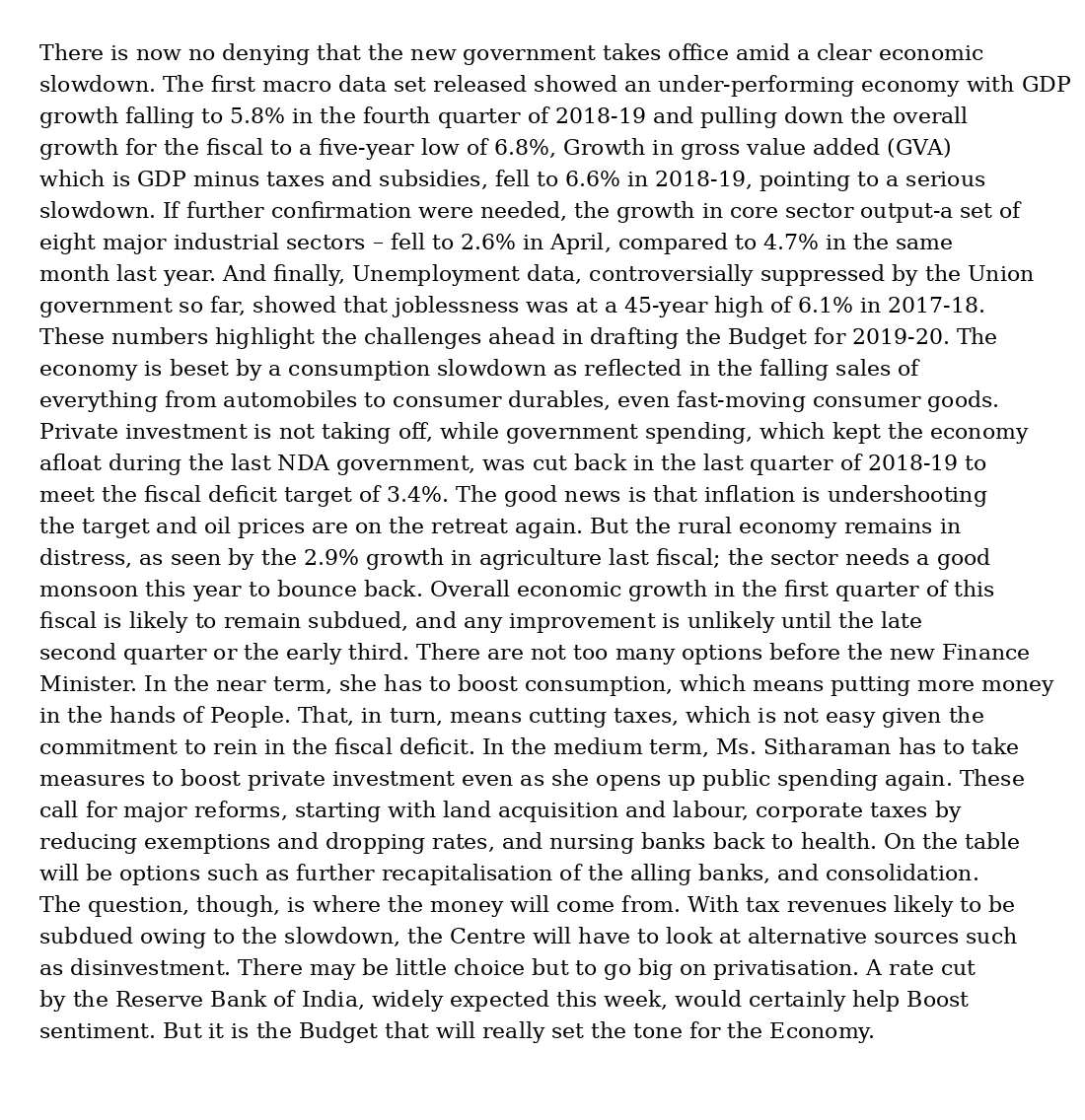
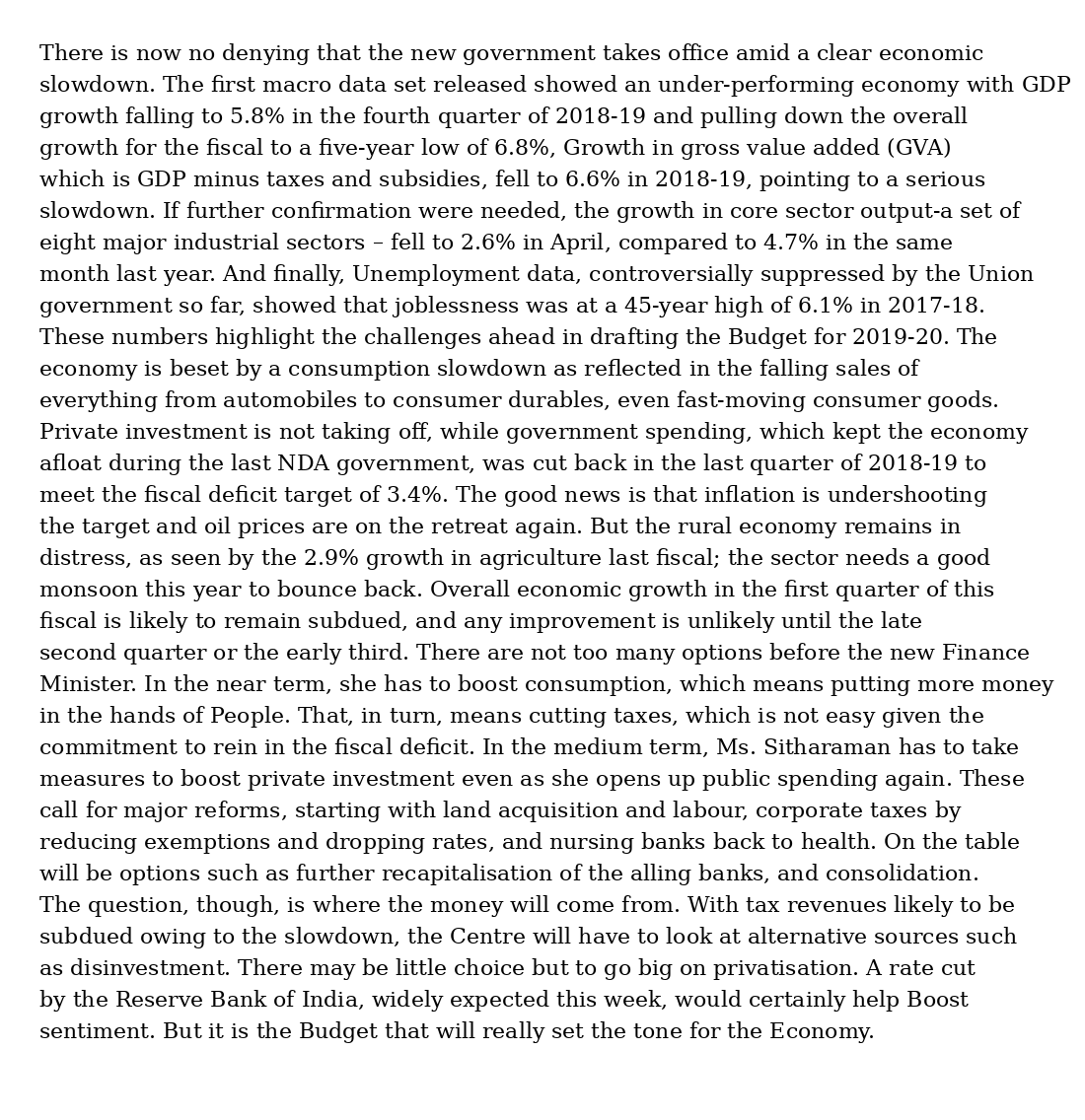
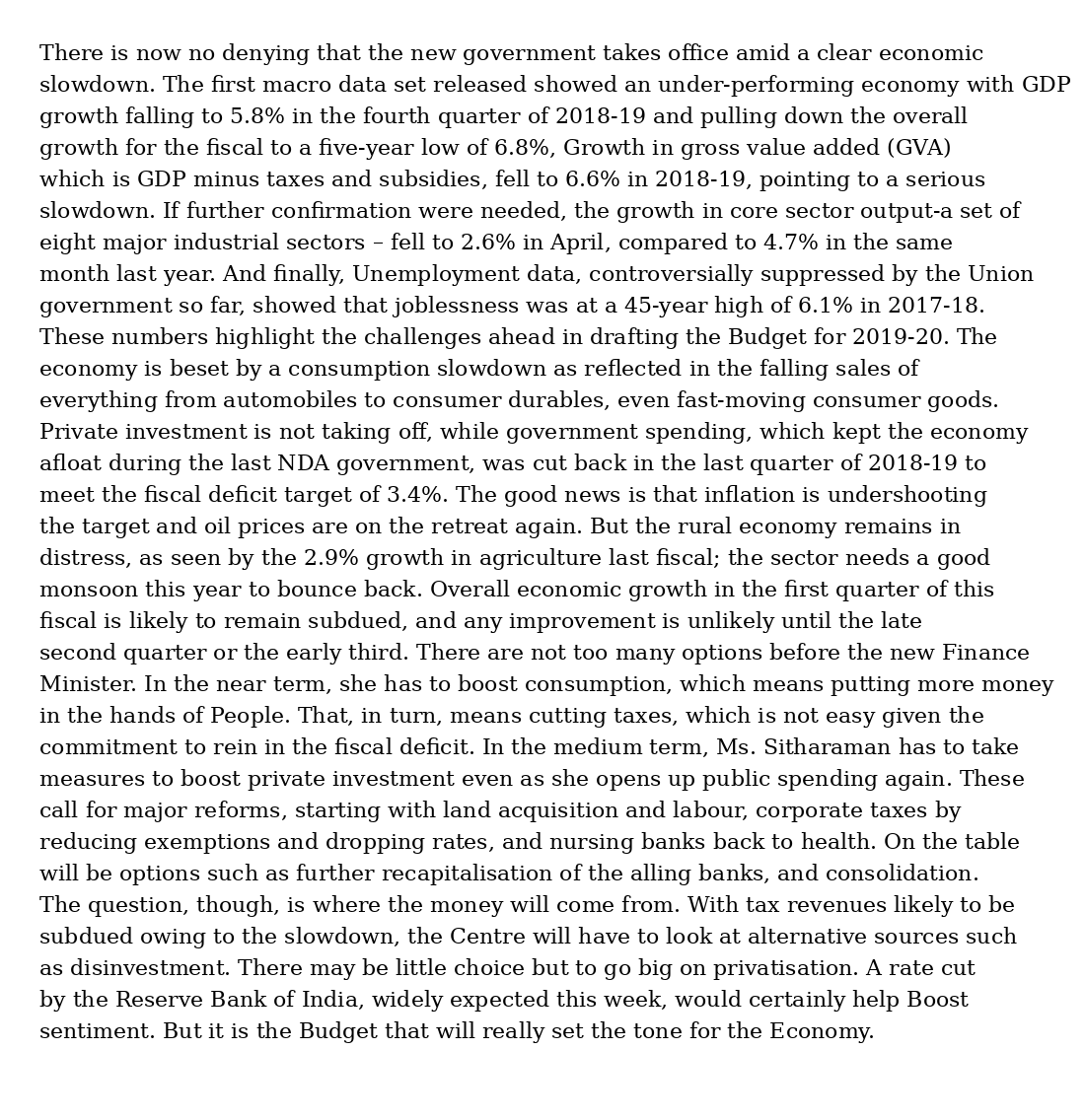
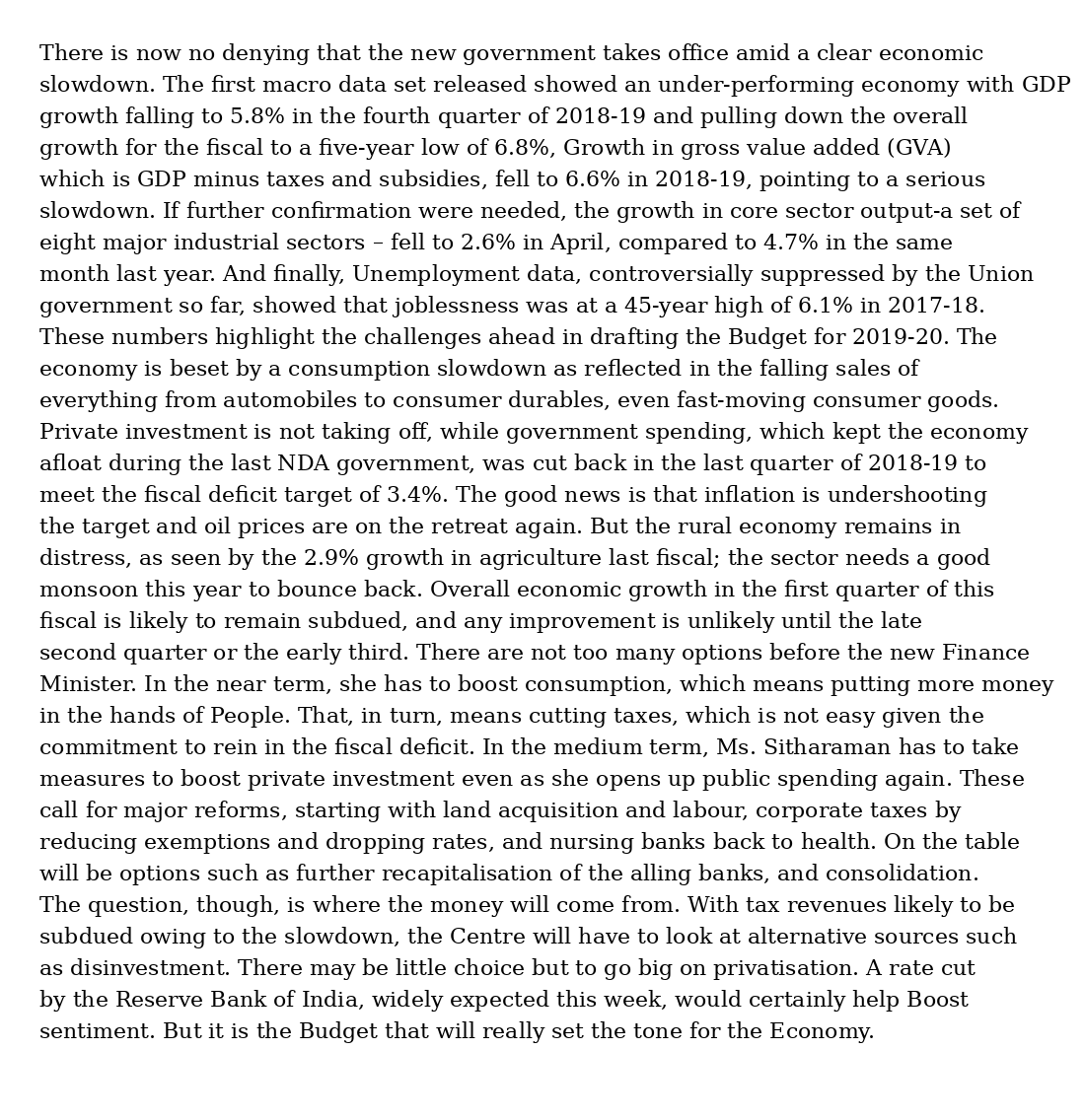
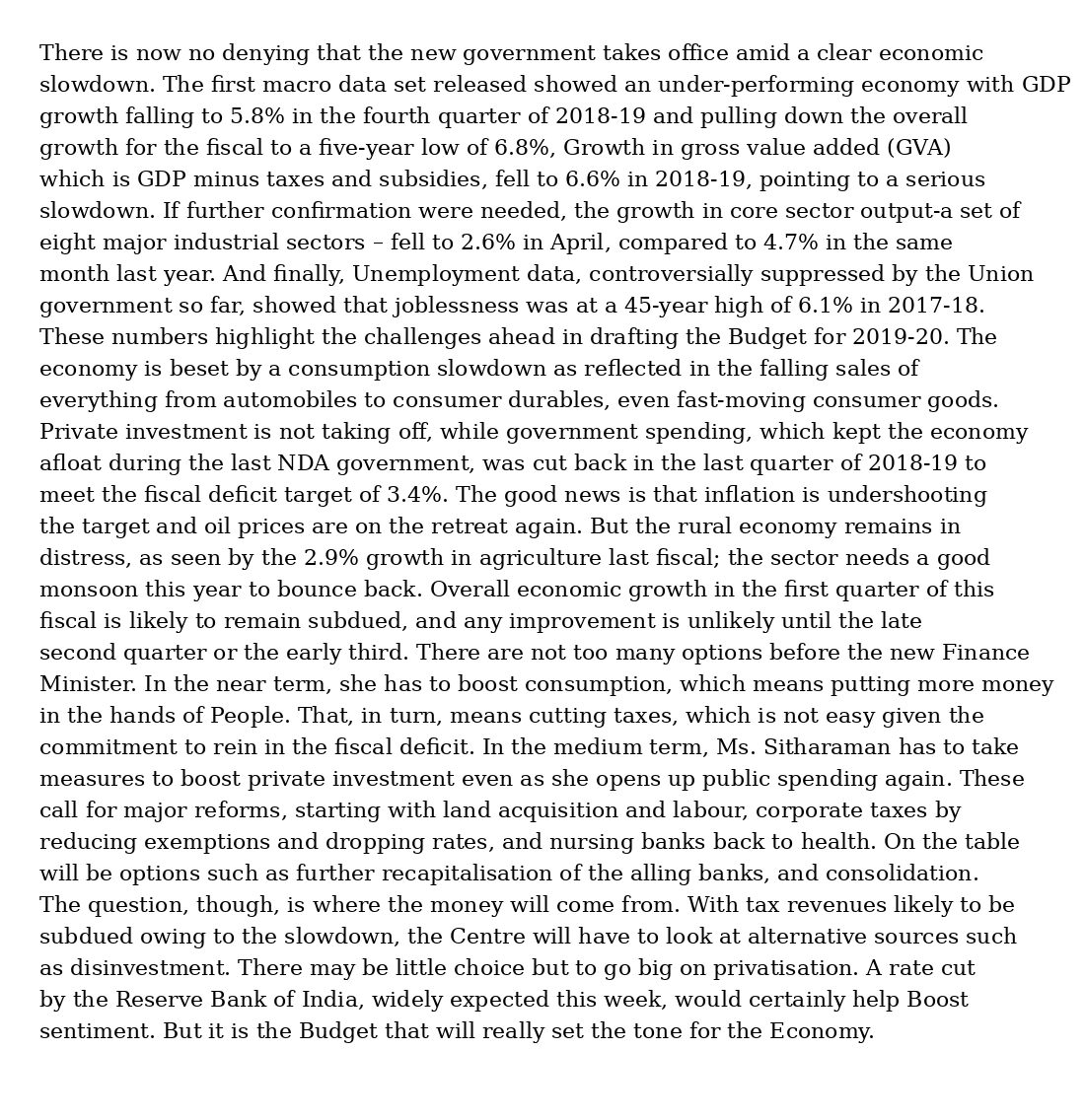
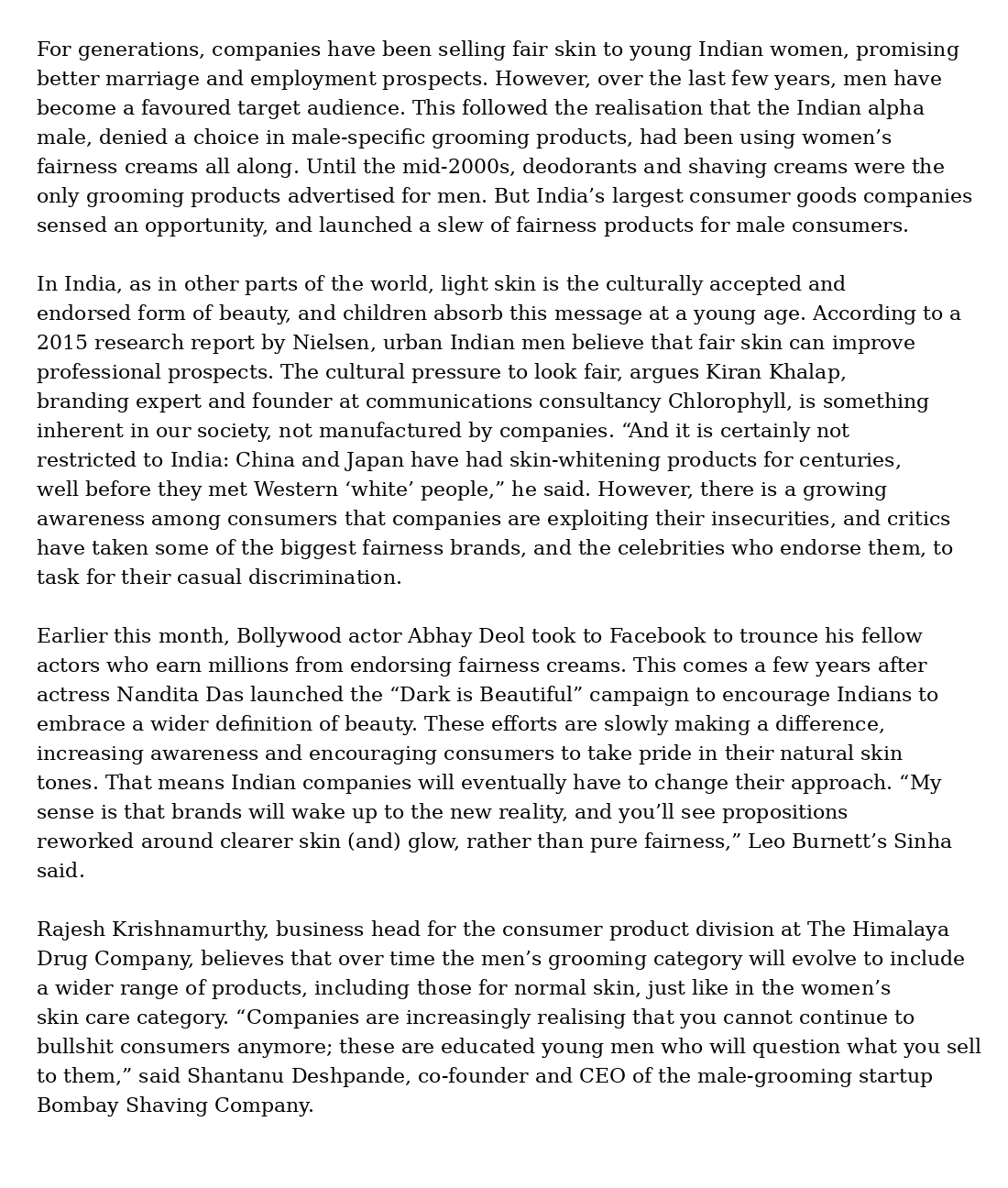
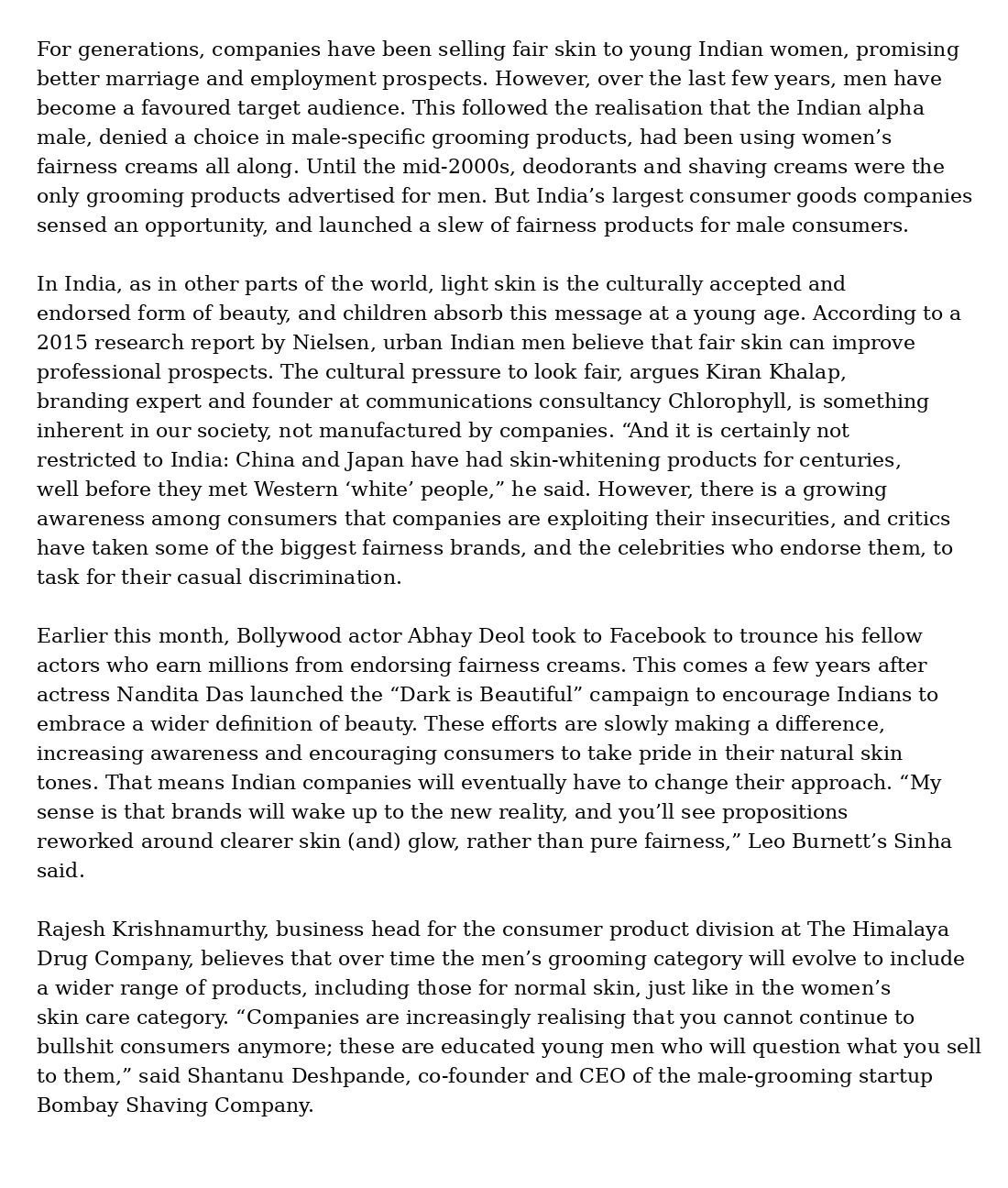
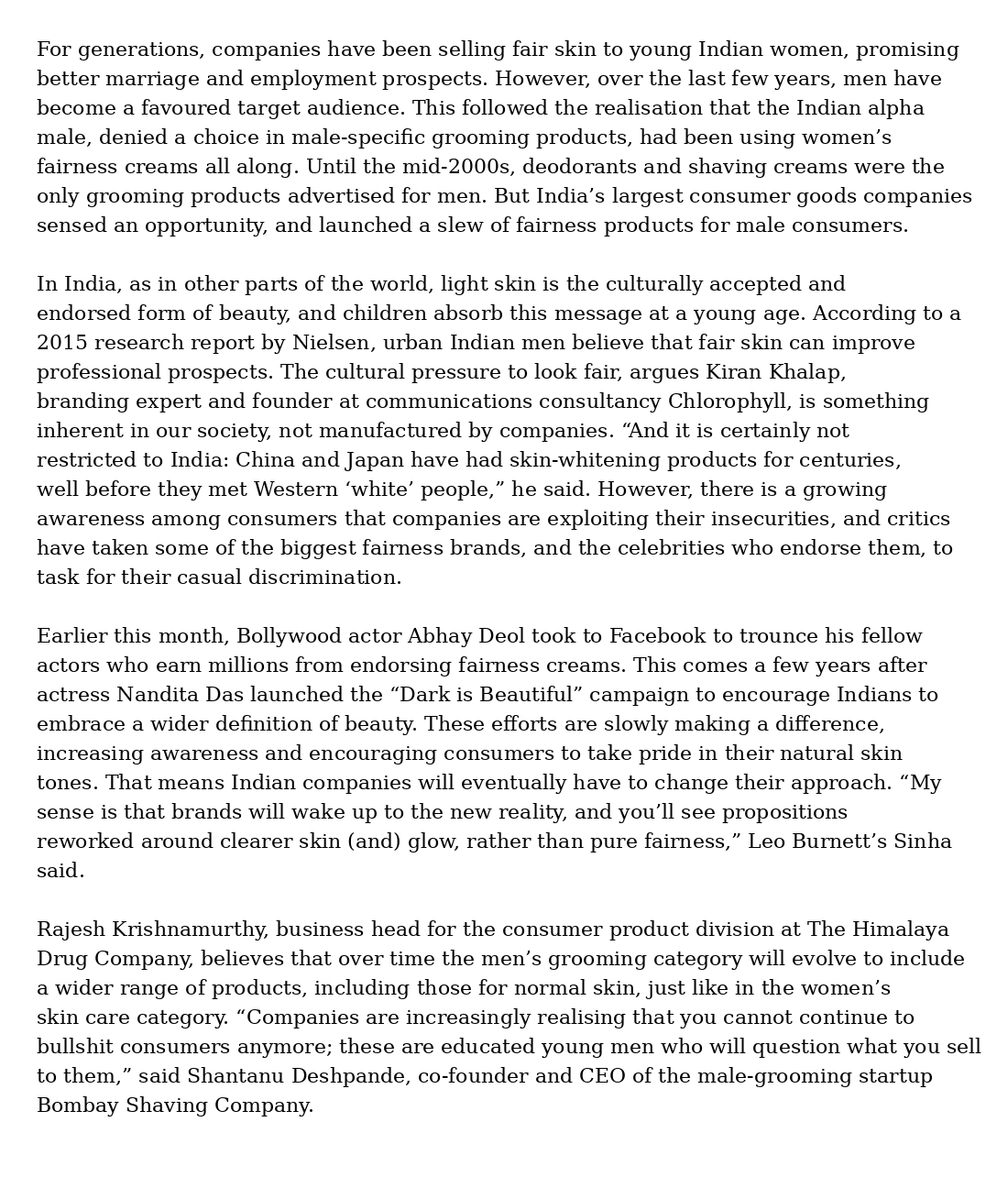
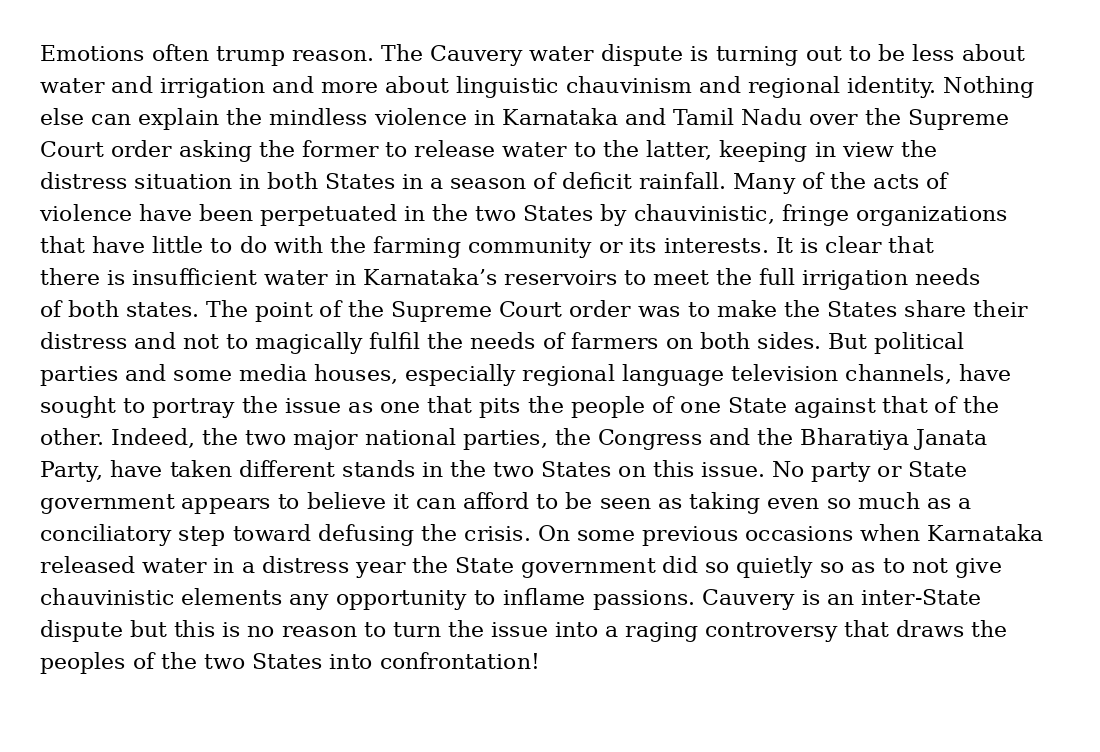
Reading Comprehension passage — shown as image.
Which of the following is closest to the meaning of beset?
- ABesiege
- BTerminate
- CFilter
- DTiny
- EHuge
Show answerHide answer
Answer: A
Approach: Vocabulary in context — read the sentence where the word appears.
Solution: The passage says 'The economy is beset by a consumption slowdown'. Beset = troubled/surrounded by problems from all sides. Besiege (surround, overwhelm) carries the same sense.
Why the other options are wrong:
B: terminate = end — unrelated.
C: filter — unrelated.
D, E: tiny / huge are size adjectives, not verbs of attack/trouble.
Cetking shortcut: Beset and besiege share the 'be-' prefix (all around) — the only verb with that sense.
Answer: A
Refer to the passage above ↑
Which of the following is / are true as per the passage?
I. There is going to be a definite rate cut by the RBI in the coming week.
II. The rural economy is in better shape than the urban
III. Government spending has increased in in the last quarter of 2018-19.
- AOnly II
- BOnly I AND II
- COnly I AND III
- DOnly II AND III
- ENone of the above
Show answerHide answer
Answer: E
Approach: Multi-statement true/false — check each statement against the passage.
Solution: I: The RBI rate cut is only 'widely expected this week' — not definite. False.
II: The passage says the rural economy 'remains in distress' (2.9% agriculture growth); it never says rural is better than urban. False.
III: Government spending 'was cut back in the last quarter of 2018-19' to meet the 3.4% fiscal deficit target — not increased. False.
None of the statements is true.
Why the other options are wrong:
A, B, D: each includes II, which is false.
C: includes I and III, both false.
Cetking shortcut: One firm reversal (III says 'increased', passage says 'cut back') kills options C and D at once.
Answer: E
Refer to the passage above ↑
Which of the following, as per the passage, indicates a slowdown in the Indian economy.
I Fall in sale levels of consumer ddurable
II Negative growth in the core sector output
III Fall in inflations levels
- AOnly I
- BOnly III
- COnly II
- DOnly I and II
- EAll I, II, AND III
Show answerHide answer
Answer: A
Approach: Multi-statement — which items does the passage give as signs of slowdown?
Solution: I: 'consumption slowdown as reflected in the falling sales of ... consumer durables' — a slowdown indicator. True.
II: Core sector growth 'fell to 2.6%' from 4.7% — slower but still positive, not negative growth. False.
III: Inflation undershooting the target is called 'the good news'. False.
Only I.
Why the other options are wrong:
B: III is presented as good news.
C, D: II says 'negative growth', but growth was +2.6%.
E: includes II and III.
Cetking shortcut: Watch for 'negative growth' vs 'fall in growth' — a classic CET distortion.
Answer: A
Refer to the passage above ↑
As per the passage, which of the following would lead to putting more money in hands of people?
I. Decrease in tax rates.
II. Increase in inflation 10
III. Increase in private investment
- AOnly I
- BOnly III
- COnly I and II
- DOnly I And III
- EOnly II
Show answerHide answer
Answer: A
Approach: Locate the 'money in the hands of people' line and see what it links to.
Solution: Passage: 'she has to boost consumption, which means putting more money in the hands of people. That, in turn, means cutting taxes'. So a decrease in tax rates puts money in people's hands — I is true. Inflation is not linked to this at all (II false). Private investment is a separate medium-term goal, not a way to put money in people's hands (III false).
Why the other options are wrong:
B, D: III — private investment is mentioned as a separate goal.
C, E: II — inflation is not linked to people's money.
Answer: A
Refer to the passage above ↑
As per the passage, which of the following reforms has NOT been mentioned in the passage to improve the investment climate?
- ALand acquisition
- BPrivatization of banks
- CAdjustment in the prevailing corporate tax
- DRecapitalization of banks
- EAll are correct
Show answerHide answer
Answer: B
Approach: NOT-mentioned question — tick each option against the reforms list.
Solution: Reforms listed: 'land acquisition and labour, corporate taxes by reducing exemptions and dropping rates, and nursing banks back to health ... further recapitalisation of the ailing banks, and consolidation'. Land acquisition (A), corporate tax adjustment (C) and bank recapitalisation (D) are all mentioned. Privatisation is mentioned only as a way to raise money, and never for banks — privatisation of banks is NOT mentioned.
Why the other options are wrong:
A: land acquisition — mentioned.
C: corporate tax (exemptions and rates) — mentioned.
D: recapitalisation of banks — mentioned.
E: not valid, since B is not mentioned.
Cetking shortcut: In EXCEPT/NOT questions, the answer often merges two passage words (privatisation + banks) that never appear together.
Answer: B
Which of the following sentences does not contribute to the main idea of the paragraph?
- AThere is evidence that digital platforms of education are badly hurting less proficient students who need expert classroom teachers
- BIn the fully digital mode, students are never in the same room with their teacher, which leaves them to depend on self-study mode more
- CA study showed that students on digital algebra courses learn much less than those who worked with a teacher in the classroom
- DDigital courses have often been seen to give students an easy passing grade without teaching them important things which affect them in the long run.
- EDigital platforms are beneficial to high achievers by providing advanced courses for knowledge enhancement
Show answerHide answer
Answer: E
Approach: Find the common theme; the odd sentence breaks theme or tone.
Solution: A–D all argue that digital education harms students: it hurts weaker students (A), leaves them to self-study (B), a study shows they learn less (C), and gives easy grades without real learning (D). E praises digital platforms for high achievers — it goes against the critical tone, so it does not contribute.
Why the other options are wrong:
A: states the main claim (harm to less proficient students).
B: explains a drawback.
C: gives evidence of the drawback.
D: adds another drawback.
Cetking shortcut: Spot the lone positive sentence in a paragraph of negatives.
Answer: E
Which of the following sentences does not contribute to the main idea of the paragraph?
- AA new survey shows that Amazon Prime has grown much more beneficial than traditional television.
- BThe streaming of television shows and the freedom of users to choose Their own shows has taken off with people,
- CAmazon Prime provides a constantly improving content library which consists of many original series, films and comedy shows that keeps it in demand.
- DAmazon Prime provides a facility for people to personize their own favorites and pause live TV.
- EDespite the success of Amazon Prime, most investors are unaware of this company
Show answerHide answer
Answer: E
Approach: Find the common theme; the odd sentence shifts focus.
Solution: A–D are about Amazon Prime's popularity and benefits for viewers: better than TV (A), freedom to choose shows (B), strong content library (C), personalised favourites and pausing live TV (D). E talks about investors being unaware of the company — a shift from viewers to investors.
Why the other options are wrong:
A: introduces the theme (Prime more beneficial than TV).
B: supports the streaming trend.
C: a viewer benefit.
D: another viewer benefit.
Cetking shortcut: Change of stakeholder (viewers → investors) marks the odd one out.
Answer: E
Which of the following sentences does not contribute to the main idea of the paragraph?
- AClimate change is threatening biodiversity.
- BAnimals may struggle to survive as their habitats are disrupted.
- CClimate change is beneficial for species adaptation
- DRising temperatures are affecting ecosystems and habitats.
- ESpecies extinction is a risk due to climate change
Show answerHide answer
Answer: C
Approach: Find the common theme; the odd sentence contradicts it.
Solution: The paragraph is about climate change threatening biodiversity: threat (A), habitats disrupted (B), rising temperatures affect ecosystems (D), extinction risk (E). C calls climate change beneficial — it contradicts the theme.
Why the other options are wrong:
A: topic sentence.
B: effect on animals.
D: cause–effect on habitats.
E: extinction risk — supports the threat.
Answer: C
Which of the following sentences does not contribute to the main idea of the paragraph?
- ASocial media changes how people interact with others
- BPeople use social media to share experiences and ideas.
- CSocial media has only positive effects on mental health.
- DComparison on social media can lead to feelings of loneliness and Anxiety.
- EBalancing online and real-life connections is important
Show answerHide answer
Answer: C
Approach: Find the common theme; the odd sentence contradicts it.
Solution: The paragraph gives a balanced view of social media: it changes interaction (A), people share ideas (B), comparison can cause loneliness and anxiety (D), balance is important (E). C says it has 'only positive effects' — contradicting D and the balanced theme.
Why the other options are wrong:
A: introduces the topic.
B: a positive use — fits a balanced view.
D: a negative effect — part of the balance.
E: the conclusion.
Cetking shortcut: Absolute words like 'only' usually signal the odd sentence.
Answer: C
Which of the following sentences does not contribute to the main idea of the paragraph?
- AEarly childhood education contributes to academic and social success.
- BQuality preschool programs help develop communication and problem-solving skills.
- CEarly education has little impact on a child’s later success
- DFoundational skills learned early are important for future success
- EEarly childhood education is vital for long-term academic achievement
Show answerHide answer
Answer: C
Approach: Find the common theme; the odd sentence contradicts it.
Solution: A, B, D and E all say early childhood education builds skills and drives later success. C says it has little impact — directly against the theme.
Why the other options are wrong:
A: main claim.
B: how preschool helps.
D: foundational skills matter.
E: restates the conclusion.
Answer: C
Reading Comprehension passage — shown as image.
As per the passage, which of the following statement is true
1 Most of the plastic present in the ocean today has originated from land.
2 In recent years, production of plastic has declined.
3 Plastic pollution is present on almost every beach
- AOnly 1
- BOnly 2
- CNone of 1,2 and 3
- DAll 1, 2, and 3
- EOnly 1 and 3
Show answerHide answer
Answer: E
Approach: Multi-statement — verify each against the passage.
Solution: 1: The ocean plastic story is 'mostly originating from where we stand, the land'. True.
2: 'global production and consumption of plastics have continued to rise' — production has not declined. False.
3: 'A simple walk on any beach, anywhere, and the plastic waste spectacle is present' — true.
So only 1 and 3.
Why the other options are wrong:
A: misses statement 3.
B: 2 is false.
C: 1 and 3 are true.
D: includes 2.
Cetking shortcut: Statement 2 reverses the 'continued to rise' trend — eliminate every option containing 2 first.
Answer: E
Questions 167–168 share this
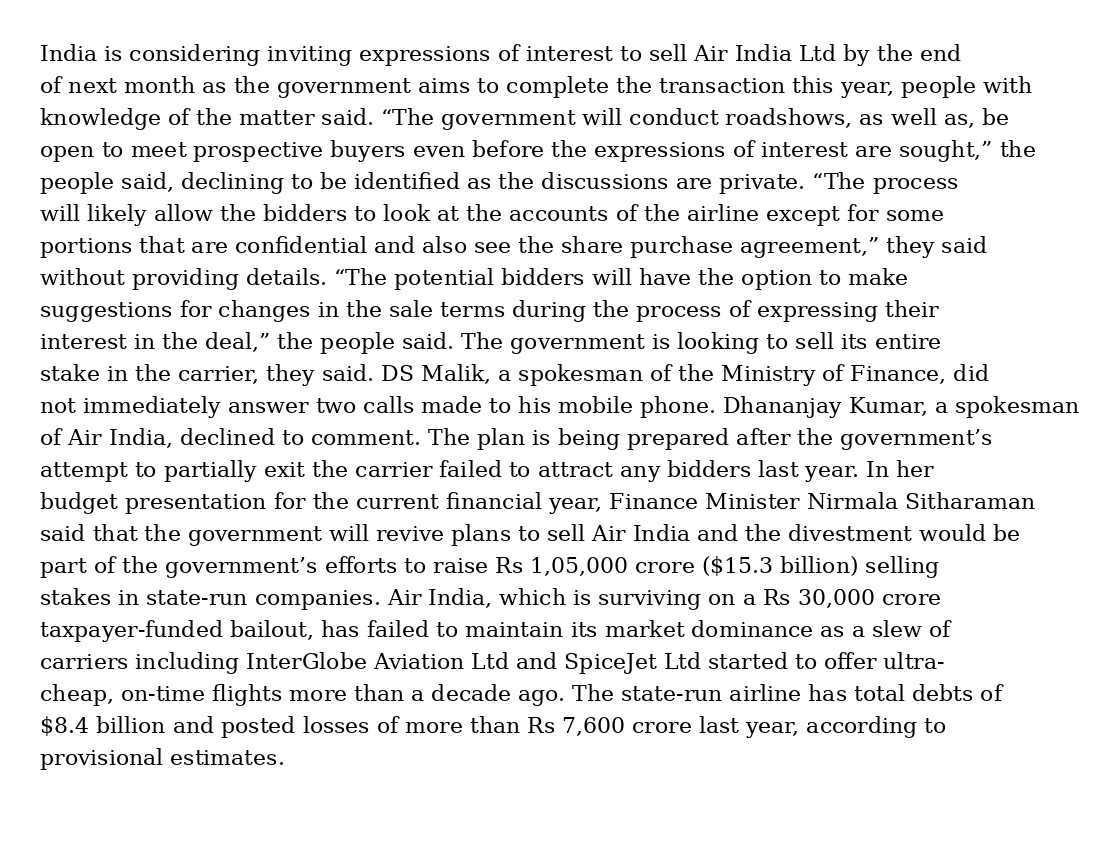
Reading Comprehension passage — shown as image.
Which among the following has been shown as the main reason for present situation of Air India in the passage?
- AAir India does not have enough money to survive in the long run though it is trying to find out.
- BAir india has lost all the deposit it had received from government last year.
- CAir India is in the process of earning deposits from the depositors and investors so that they are worried about the stake sale
- DAir India has got competition from other airlines and it has simply failed to live up the same.
- ENone of the above
Show answerHide answer
Answer: D
Approach: Find the stated cause in the passage.
Solution: Passage: Air India 'has failed to maintain its market dominance as a slew of carriers including InterGlobe Aviation and SpiceJet started to offer ultra-cheap, on-time flights more than a decade ago.' So the main reason is competition from other airlines that it could not match.
Why the other options are wrong:
A: a consequence (it survives on a bailout), not the stated reason.
B: no lost 'deposit' is mentioned.
C: no depositors or investors earning deposits are mentioned.
E: D is stated.
Answer: D
Refer to the passage above ↑
Which among the following is OPPOSITE in meaning to the word Dominance as used in the passage?
- AInferiority
- BPowerlessness
- CSubmission
- DAscendency
- ENone of the above
Show answerHide answer
Answer: A
Approach: Antonym in context — 'market dominance' means a superior, leading position.
Solution: 'Failed to maintain its market dominance' = superiority/leading position over rivals. The opposite of a superior position is inferiority (a lower, weaker position compared with others).
Why the other options are wrong:
B: powerlessness = no power at all — opposite of 'power', too extreme for market position.
C: submission = yielding to someone's control — opposite of dominating a person, not of market leadership.
D: ascendency is a synonym of dominance.
E: A fits.
Cetking shortcut: Ask what 'dominance' compares — Air India vs rivals — so the antonym must also be comparative: inferiority.
Answer: A
Questions 169–170 share this
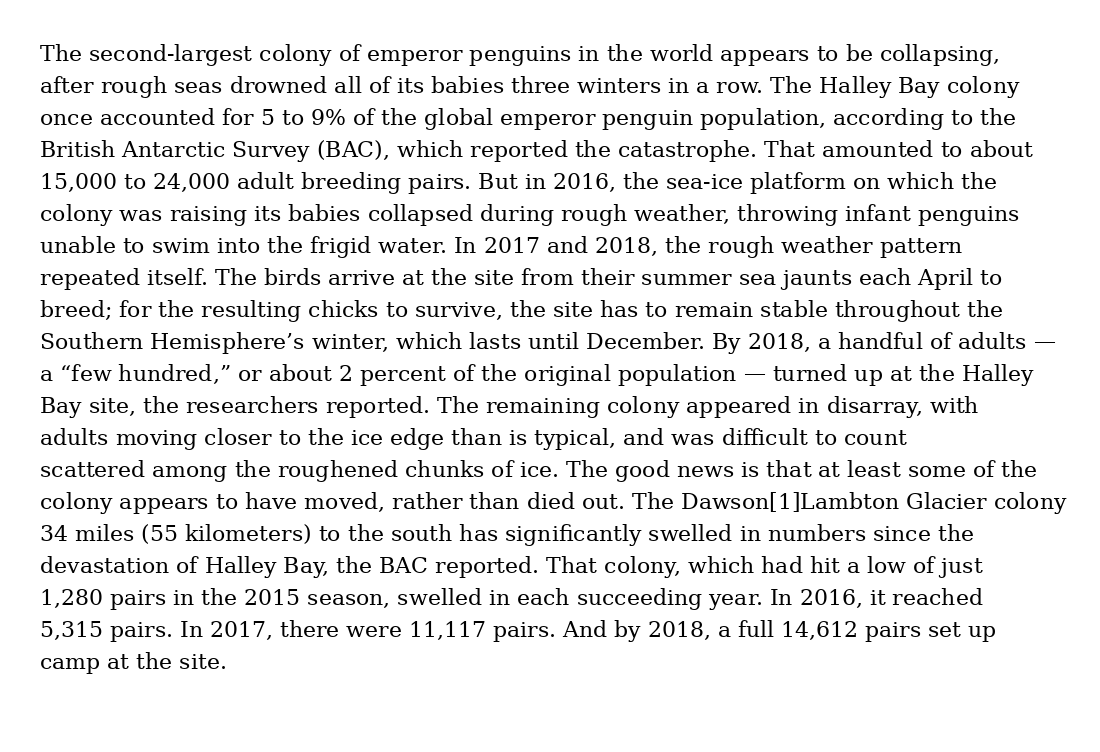
Reading Comprehension passage — shown as image.
Which of the following is antonym of “frigid” in context of passage?
- AFlexible
- BSoft
- CLukewarm
- DRigid
- EHot
Show answerHide answer
Answer: E
Approach: Antonym in context — check how 'frigid' is used.
Solution: Passage: infant penguins were thrown 'into the frigid water' — frigid = extremely cold. The opposite is hot.
Why the other options are wrong:
A, B: flexible / soft oppose 'rigid', not 'frigid'.
C: lukewarm is mildly warm — between cold and hot, not the opposite.
D: rigid only sounds like frigid.
Cetking shortcut: Don't be fooled by the rhyme frigid–rigid; context (Antarctic water) fixes the meaning as cold.
Answer: E
Refer to the passage above ↑
Which of the following is false in the context of the passage?
I The Dawson-Lambton Glacier colony died due to collapse of rough sea.
II The penguin birds breed during April every year.
III Halley Bay colony reached 5315 pairs in 2016
- AOnly I
- BOnly II
- COnly I AND III
- DOnly II AND III
- EAll I, II AND III
Show answerHide answer
Answer: C
Approach: Find the FALSE statements — check each against the passage.
Solution: I: The Dawson-Lambton colony did not die; it 'significantly swelled in numbers'. It was the Halley Bay colony that collapsed. False.
II: 'The birds arrive at the site ... each April to breed.' True.
III: 5,315 pairs in 2016 was the Dawson-Lambton colony, not Halley Bay. False.
False statements: I and III.
Why the other options are wrong:
A: misses III.
B: II is true.
D: includes II.
E: includes II.
Cetking shortcut: In 'which is false' questions, swap-of-names (Halley Bay ↔ Dawson-Lambton) is the standard trap — mark which number belongs to which colony.
Answer: C
Questions 171–175 share this
Reading Comprehension passage — shown as image.
Which of the following is/are true about Tuan?
I He was a doctor along with being a farmer.
II. He was a good-natured and kind person.
III He was a wealthy farmer who gave away his wealth to needy.
- AOnly I
- BOnly II
- COnly I AND III
- DOnly II AND III
- EAll I, II, and III
Show answerHide answer
Answer: B
Approach: Multi-statement — check each claim about Tuan.
Solution: I: Tuan only stood 'beside the village doctor to help him prepare the medicines and tend to the sick' — he was a helper, not a doctor. False.
II: 'he was a very kind and good-natured person'. True.
III: He 'had a little land' and earned from his crops — not wealthy, and no giving away of wealth. False.
Only II.
Why the other options are wrong:
A, C, E: I is false — he assisted the doctor.
D: III is false — he had a little land.
Answer: B
Refer to the passage above ↑
Which of the following is/are a/some ways in which Juan transformed himself?
I He began to work hard on his crops.
II He became more helpful towards people
III He started a small charity in in Tuan's name
- AOnly I
- BONLY III
- COnly I AND II
- DOnly II AND III
- EAll I, II and III
Show answerHide answer
Answer: A
Approach: Check what the passage says about Juan's change.
Solution: 'From that day, Juan changed himself. Within a year, he could produce much crops in his land through his hard work.' So I (worked hard on his crops) is stated. Nothing is said about him becoming more helpful (II) or starting a charity (III).
Why the other options are wrong:
B, D, E: III — no charity is mentioned.
C: II is not stated; it is an assumption.
Cetking shortcut: Stick to what is written — 'transformed' is explained only through hard work on his land.
Answer: A
Refer to the passage above ↑
What did Tuan do when he discovered Juan's son was ill?
- AHe called the village doctor who lived a few houses away
- BHe went back to his house thinking Juan deserved what he got.
- CHe rode out to the nearest hospital along with Juan’s son to get him treated.
- DHe went back to his house to get some medicine which could help Juan’s son.
- EHe rode to the nearest town to get a better doctor.
Show answerHide answer
Answer: E
Approach: Locate the sequence of events after the boy fell ill.
Solution: The village doctor could not cure the boy. Tuan 'untied his own horse and rode it ... rushed to the town that was ten miles away and fetched a more experienced doctor'. So he rode to the nearest town to get a better doctor.
Why the other options are wrong:
A: the village doctor was already there and could not cure him.
B: the opposite of what Tuan did.
C: the boy was not taken anywhere; the doctor was brought to him.
D: Tuan did not fetch medicine from his house.
Answer: E
Refer to the passage above ↑
Which among the following is opposite in meaning to the word doused as used in the passage.
- ASaturated
- BDeluged
- CWet
- DLighted
- EAll correct
Show answerHide answer
Answer: D
Approach: Antonym in context — check how 'doused' is used.
Solution: 'When the flames were doused' — doused = extinguished, put out (a fire). The opposite of putting out a fire is lighted (set alight) — the passage itself uses 'the fire that Juan had lighted'.
Why the other options are wrong:
A, B, C: saturated, deluged, wet relate to the other meaning of douse (to drench) — they are near-synonyms, not antonyms.
E: not valid — only D is opposite.
Cetking shortcut: Douse has two senses (drench / extinguish); the context 'flames were doused' decides it.
Answer: D
Refer to the passage above ↑
Which of the following gave Tuan clues that Juan had set fire to his crops ?
- AJuan has dropped a lighter with his initials in the field.
- BTuan had seen Juan carry kerosene earlier that evening.
- CA neighbour saw Juan sneak out at night and set fire to the crop.
- DThe direction from which the fire had started
- EBoth 3 and 4
Show answerHide answer
Answer: D
Approach: Find the clue the passage actually gives.
Solution: 'When the flames were doused, Tuan saw which direction the fire had started from.' Juan lived on the land next to his — the direction of the fire was the clue. No lighter, kerosene or eyewitness neighbour is mentioned (the neighbour only alerted others and saved the crops).
Why the other options are wrong:
A: no lighter is mentioned.
B: no kerosene is mentioned.
C: the neighbour saved the crops but did not see Juan set the fire.
E: includes C, which is false.
Answer: D
Choose the correct preposition to complete the sentence.
What did you make.........the lecture?
- AIn
- BAbout
- COn
- DAt
- EOf
Show answerHide answer
Answer: E
Approach: Fixed phrase: 'make (something) of' = form an opinion about.
Solution: 'What did you make of the lecture?' means 'What was your opinion of the lecture?'. The verb 'make' in this sense always takes 'of'.
Why the other options are wrong:
A: 'make in' — not used in this sense.
B: 'make about' — not idiomatic (we say 'think about').
C: 'make on' — wrong.
D: 'make at' — wrong.
Cetking shortcut: 'What do you make of it?' — learn it as a fixed opinion question.
Answer: E
Fill in the blank with the appropriate word.
I’ll help him if he… . … .
- AAsk
- BAsked
- CWill ask
- DAsks
- ENone of the above
Show answerHide answer
Answer: D
Approach: First conditional: if + simple present, will + base verb.
Solution: Main clause 'I'll help him' is future (will). In a first conditional the if-clause takes the simple present, so 'if he asks' (third person singular → asks).
Why the other options are wrong:
A: 'ask' — subject 'he' needs 'asks'.
B: 'asked' — past tense goes with 'would help' (second conditional).
C: 'will ask' — 'will' is not used in the if-clause.
E: D is correct.
Cetking shortcut: Never put 'will' in both clauses of a conditional.
Answer: D
Find if there is any grammatical error in any part of the sentence below and mark that part as your answer. If there is no error. Mark 5 as your answer.
He loosened his temper/whenever he knows/things do not take place/ as per the planning.
- AHe loosened his temper
- BWhenever he knows
- CThings do not take place
- DAs per the planning
- ENo error
Show answerHide answer
Answer: A
Approach: Idiom + tense: the idiom is 'lose one's temper'; habitual action needs simple present.
Solution: 'Whenever he knows things do not take place...' describes a habit in the present, so the main verb must be simple present. Also the idiom is 'lose one's temper', not 'loosen'. Correct: 'He loses his temper whenever he knows things do not take place as per the planning.' The error is in part 1.
Why the other options are wrong:
B: 'whenever he knows' — correct present tense for a habit.
C: 'things do not take place' — correct.
D: 'as per the planning' — acceptable.
E: part 1 has an error.
Cetking shortcut: lose (misplace/fail to keep) vs loose/loosen (not tight) — a frequent CET confusable.
Answer: A
Find if there is any grammatical error in any part of the sentence below and mark that part as your answer. If there is no error. Mark 5 as your answer.
So longer as/you are honest/and forthright, they will/support you in this task.
- ASo longer as
- BYou are honest
- CAnd forthright, they will
- DSupport you in this task
- ENo error
Show answerHide answer
Answer: A
Approach: Fixed conjunction 'so long as' (= provided that).
Solution: The correct expression is 'So long as' / 'as long as'; the comparative 'longer' cannot be used in this conjunction. Correct: 'So long as you are honest and forthright, they will support you in this task.'
Why the other options are wrong:
B: 'you are honest' — correct.
C: 'and forthright, they will' — correct.
D: 'support you in this task' — correct.
E: part 1 has an error.
Answer: A
Find if there is any grammatical error in any part of the sentence below and mark that part as your answer. If there is no error. Mark 5 as your answer.
One of the party/members were dismissed/for speaking against/ the leader.
- AOne of the party
- BMembers were dismissed
- CFor speaking against
- DThe leader
- ENo error
Show answerHide answer
Answer: B
Approach: Subject–verb agreement with 'One of the + plural noun'.
Solution: The subject is 'One of the party members' — the head word 'one' is singular, so the verb must be singular: 'One of the party members was dismissed'. 'Were' is wrong.
Why the other options are wrong:
A: 'One of the party' — correct.
C: 'for speaking against' — correct gerund after preposition.
D: 'the leader' — correct.
E: part 2 has an error.
Cetking shortcut: 'One of the + plural noun' always takes a singular verb (unless a relative clause 'who/that' follows).
Answer: B
Find if there is any grammatical error in any part of the sentence below and mark that part as your answer. If there is no error. Mark 5 as your answer.
His father promised to/ give him anything what he/wants if he/ passes in the examination.
- AHis father promised to
- BGive him anything what he
- CWants if he
- DPasses in the examination
- ENo error
Show answerHide answer
Answer: B
Approach: Relative pronoun after 'anything': use 'that' (or 'whatever'), never 'what'.
Solution: 'What' already contains its own antecedent (= the thing that), so 'anything what' doubles it. Correct: 'give him anything that he wants' or 'give him whatever he wants'. The error is in part 2.
Why the other options are wrong:
A: 'His father promised to' — correct.
C: 'wants if he' — correct.
D: 'passes in the examination' — correct (simple present after 'if'); the error is in part 2.
E: part 2 has an error.
Cetking shortcut: After all / anything / everything / nothing, the relative pronoun is 'that'.
Answer: B
Find if there is any grammatical error in any part of the sentence below and mark that part as your answer. If there is no error. Mark 5 as your answer.
Mahatma Gandhi did not solve/ all the problems of the future/ but he did solve/ problems of his own age.
- AMahatma Gandhi did not solve
- BAll the problems of the future
- Cbut he did solve
- Dproblems of his own age.
- ENo error
Show answerHide answer
Answer: D
Approach: Article usage — a plural noun made specific by an 'of' phrase takes 'the'.
Solution: The sentence is logical: Gandhi did not solve all future problems, but he did solve those of his own time. Grammatically, the contrast pairs 'all the problems of the future' with 'problems of his own age'. 'Problems of his own age' is a specific, defined set, so it needs the definite article: '...but he did solve the problems of his own age.' The error is in part 4.
Why the other options are wrong:
A: 'did not solve' — correct negative past.
B: 'all the problems of the future' — grammatical and logical (it says what he did NOT do).
C: 'but he did solve' — correct emphatic 'did'.
E: part 4 lacks the article.
Cetking shortcut: Check parallel halves of a contrast ('not ... but') — the missing word in one half is usually the error.
Answer: D
Find the correctly spelt word.
- AQuentiscence
- BQuintecence
- CQuintissense
- DQuintecsence
- EQuintessence
Show answerHide answer
Answer: E
Approach: Spelling — break the word into its roots.
Solution: Quint (fifth) + essence → quintessence: the purest or most typical example of something. Only E keeps 'quint' and the full 'essence' (e-ss-e-nce).
Why the other options are wrong:
A: 'Quentiscence' — wrong root (quen-) and wrong ending.
B: 'Quintecence' — drops 'ss' and the 's'.
C: 'Quintissense' — 'issense' is wrong.
D: 'Quintecsence' — 'cs' is wrong.
Cetking shortcut: Quint + essence: write 'essence' in full inside the word.
Answer: E
The five sentences labelled (1, 2, 3, 4, 5) given in this question, when properly sequenced, form a coherent paragraph. Each sentence is labelled with a number. Decide on the proper order for the sentences and key in this sequence of five numbers as your answer.
1. Scientists have for the first time managed to edit genes in a human embryo to repair a genetic mutation, fueling hopes that such procedures may one day be available outside laboratory conditions.
2. The cardiac disease causes sudden death in otherwise healthy young athletes and affects about one in 500 people overall.
3. Correcting the mutation in the gene would not only ensure that the child is healthy but also prevents transmission of the mutation to future generations.
4. It is caused by a mutation in a particular gene and a child will suffer from the condition even if it inherits only one copy of the mutated gene.
5. In results announced in Nature this week, scientists fixed a mutation that thickens the heart muscle, a condition called hypertrophic cardiomyopathy.
- A1,4,3,2,5
- B1,5,3,4,2
- C1,4,5,3,2
- D1,3,2,5,4
- E1,5,2,4,3
Show answerHide answer
Answer: E
Approach: General → specific chain using pronoun and definite-noun links.
Solution: 1 introduces the breakthrough (gene editing in a human embryo). 5 gives specifics: the mutation causing 'hypertrophic cardiomyopathy'. 2 'The cardiac disease' refers back to that condition. 4 'It is caused by a mutation...' explains its cause. 3 'Correcting the mutation...' gives the benefit — the natural close. Order: 1-5-2-4-3.
Why the other options are wrong:
A (1,4,3,2,5): 'It' in 4 has no antecedent after 1.
B (1,5,3,4,2): 3 'correcting the mutation' comes before the disease is described.
C (1,4,5,3,2): same problem as A.
D (1,3,2,5,4): 3 before the mutation is named.
Cetking shortcut: Anchor pair: 5 names the disease → 2 'The cardiac disease' must follow.
Answer: E
The five sentences labelled (1, 2, 3, 4, 5) given in this question, when properly sequenced, form a coherent paragraph. Each sentence is labelled with a number. Decide on the proper order for the sentences and key in this sequence of five numbers as your answer.
1. Like a driver changing tire in the middle of the highway, they hope an oncoming vehicle will not hit them before their work is done.
2. Some business executives have adopted a wait-and-see attitude.
3. Others are too busy bailing themselves out of trouble caused by the changes that have taken place around them to have any time to reflect on the future.
4. Like deer caught in the headlight of an oncoming truck, they risk being run over.
5. Discussion with several executives in both situations shows that they recognize the danger in not applying themselves to understanding the shape of the future
- A4,5,1,3,2
- B5,1,4,3,2
- C2,5,1,3,4
- D3,4,5,2,1
- E2,4,3,1,5
Show answerHide answer
Answer: E
Approach: Two-group structure: 'Some ...' → description, 'Others ...' → description, then the conclusion about 'both'.
Solution: 2 introduces 'Some business executives' with a wait-and-see attitude. 4 describes them with an image (deer caught in headlights — frozen, they risk being run over). 3 'Others...' introduces the second group, too busy bailing themselves out. 1 describes them (driver changing a tyre on the highway). 5 'executives in both situations' sums up both groups — the conclusion. Order: 2-4-3-1-5.
Why the other options are wrong:
A, B, D: do not start with 2, the only sentence that introduces the subject ('Some...').
C (2,5,1,3,4): 5 mentions 'both situations' before the second group (3) is introduced.
Cetking shortcut: 'Some ... Others ... both' is a fixed skeleton: Some-group first, Others-group next, 'both' last.
Answer: E
The five sentences labelled (1, 2, 3, 4, 5) given in this question, when properly sequenced, form a coherent paragraph. Each sentence is labelled with a number. Decide on the proper order for the sentences and key in this sequence of five numbers as your answer.
1. We have paid a terrible price for our education such as it is.
2. Wonder is marvellous but is also cruel, cruel, cruel.
3. We have educated ourselves into a world from which wonder has been banished.
4. Of course wonder is costly because it is antithesis of the anxiously worshiped security.
5. The magician world view in so far as it exists, has taken flight into science
- A2,1,5,3,4
- B1,5,4,3,2
- C2,1,3,4,5
- D3,1,4,5,2
- E4,2,1,3,5
Show answerHide answer
Answer: D
Approach: Find the strongest link pair, then build around it.
Solution: 3 'We have educated ourselves into a world from which wonder has been banished' → 1 'We have paid a terrible price for our education, such as it is' (the word 'education' links them — mandatory pair 3-1). 4 'Of course wonder is costly ... antithesis of the anxiously worshipped security' explains why we banished it. 5 'The magician world view, in so far as it exists, has taken flight into science' tells where wonder survives. 2 'Wonder is marvellous but is also cruel, cruel, cruel' closes with the emotional summary. Order: 3-1-4-5-2.
Why the other options are wrong:
A (2,1,5,3,4) and C (2,1,3,4,5): 2 → 1 has no link; 1 'our education' needs 3 before it.
B (1,5,4,3,2): 1 cannot open — 'our education, such as it is' refers back to 3.
E (4,2,1,3,5): 'Of course' in 4 cannot open a paragraph.
Cetking shortcut: 'Such as it is' and 'Of course' never open a paragraph — that alone leaves A, C or D, and only D keeps 3-1 together.
Answer: D
The five sentences labelled (1, 2, 3, 4, 5) given in this question, when properly sequenced, form a coherent paragraph. Each sentence is labelled with a number. Decide on the proper order for the sentences and key in this sequence of five numbers as your answer.
1. People started fearing a famine.
2. The monsoon failed and water tanks became almost empty.
3. Monsoon turned out to be unusually abundant and the danger was averted.
4. So, no grain could be sown by the farmers in their fields.
5. Farmers look anxiously for the next monsoon.
- A5,4,3,1,2
- B3,4,5,1,2
- C4,2,3,5,1
- D2,3,4,5,1
- E2,4,1,5,3
Show answerHide answer
Answer: E
Approach: Cause → effect → reaction → resolution timeline.
Solution: 2 the monsoon failed (cause). 4 'So, no grain could be sown' (effect — 'So' needs a cause before it). 1 people feared a famine. 5 farmers looked anxiously for the next monsoon. 3 the monsoon turned out abundant and the danger was averted (resolution). Order: 2-4-1-5-3.
Why the other options are wrong:
A, B, C: do not start with the cause (2).
D (2,3,4,5,1): the danger is averted (3) before it even arises.
Cetking shortcut: 'So' (4) must follow its cause (2); 'the danger was averted' (3) must be last.
Answer: E
Fill in the blank with the proper words given below.
Rama is not at home, he ____ just _____ for Shopping
- AIs/ gone
- BWas / going
- CHad / gone
- DWill have / be going
- EHas / gone
Show answerHide answer
Answer: E
Approach: Present perfect for a recent action with a present result.
Solution: 'Rama is not at home' (present result) because he has just gone for shopping (completed action, still relevant now). 'Just' is a present-perfect marker.
Why the other options are wrong:
A: 'is gone' — not standard in formal grammar.
B: 'was just going' — past continuous does not explain the present absence.
C: 'had gone' — past perfect needs another past reference point.
D: 'will have be going' — ungrammatical.
Cetking shortcut: 'Just' / 'already' / 'yet' + present-result context → has/have + V3.
Answer: E
Identify the correct indirect speech form of the following sentence
The old woman said to the boy, 'Please help me till he returns'.
- AThe old woman told the boy, Please help me till he returns'.
- BThe old woman said that she may please help till he returns.
- CThe old women asked that a boy may help her till he returns.
- DThe old woman ordered the boy to help him till he returned
- EThe old woman requested to the boy to help her till he returned.
Show answerHide answer
Answer: E
Approach: Direct → indirect for a request: 'said to + Please' → 'requested + object + to-infinitive'; tenses shift back; pronouns change.
Solution: 'Please' signals a request → reporting verb 'requested'. 'Help me' → 'to help her' (the old woman). 'Till he returns' → 'till he returned' (past reporting verb). E is the only option with the right verb, pronoun and tense shift.
Why the other options are wrong:
A: still in direct speech.
B: 'said that she may please help' — wrong structure and meaning.
C: 'women', 'a boy', no tense shift.
D: 'ordered' is wrong for 'please'; 'him' should be 'her'; no 'please' meaning.
Cetking shortcut: 'Please' → requested; imperative → to + verb.
Answer: E
Choose the correct alternative to replace the bold phrase in the following sentence.
I cannot force her to playing.
- AIn playing
- BFor play
- COver the play
- DWith play
- ETo play
Show answerHide answer
Answer: E
Approach: Verb pattern: force + object + to-infinitive.
Solution: 'Force' takes the pattern force someone to do something. So 'I cannot force her to play.' 'To playing' (gerund) is wrong after force.
Why the other options are wrong:
A: 'in playing' — wrong preposition and form.
B: 'for play' — wrong.
C: 'over the play' — changes meaning, ungrammatical.
D: 'with play' — wrong.
Cetking shortcut: Force / compel / allow / ask / tell + object + to + base verb.
Answer: E
Select the most appropriate meaning of the underlined idiom in the given sentence. Srilanka’s problem boils down to just one thing-lack of infrastructure for agriculture.
- AHeats up to
- BAdapt to something
- CAs a result
- DFulfill something
- ESums up to
Show answerHide answer
Answer: E
Approach: Phrasal verb meaning: 'boil down to' = can be reduced/summed up to its essence.
Solution: 'Sri Lanka's problem boils down to just one thing — lack of infrastructure for agriculture' = when summarised, the problem comes to one thing. So 'sums up to'.
Why the other options are wrong:
A: 'heats up to' — literal meaning of boil, not the idiom.
B: 'adapt to something' — unrelated.
C: 'as a result' — a connector, not a summary.
D: 'fulfill something' — unrelated.
Cetking shortcut: Literal-sense options (heats up) are planted traps in idiom questions.
Answer: E
Pick the correct grammatical sentence
- AThe bouquet of flowers were beautiful.
- BThe bouquet of flowers was beautiful.
- CThe bouquet of flowers are beautiful.
- DThe bouquet of flowers is beautifuller.
- EThe bouquet of flowers am beautifuller.
Show answerHide answer
Answer: B
Approach: Subject–verb agreement with collective head noun 'bouquet of + plural'.
Solution: The head noun is 'bouquet' (singular); 'of flowers' is only a modifier. So the verb is singular: 'The bouquet of flowers was beautiful.' 'Beautiful' takes 'more beautiful' as comparative, never 'beautifuller'.
Why the other options are wrong:
A: 'were' — agrees wrongly with 'flowers'.
C: 'are' — same error.
D: 'beautifuller' — not a word.
E: 'am' and 'beautifuller' — both wrong.
Cetking shortcut: Cover the 'of + noun' phrase and match the verb to the first noun.
Answer: B
Find the most appropriate meaning of the given idiom “Work against the clock”.
- AWork late in the night
- BWork in great hurry
- Cwork against all problems
- Dwork with concentration
- Ework with dedication
Show answerHide answer
Answer: B
Approach: Idiom meaning.
Solution: 'Work against the clock' = work very fast to finish something before a deadline. So 'work in great hurry'.
Why the other options are wrong:
A: working late at night is not implied.
C: 'against all problems' — takes 'against' literally.
D, E: concentration / dedication may accompany it but are not the meaning — the core is time pressure.
Cetking shortcut: 'Clock' = time pressure → hurry.
Answer: B
Rearrange the following six sentences (A), (B), (C), (D), (E) and (F) in a proper sequence to form a meaningful paragraph. Then answer the question that follows.
A. They had gone fishing in a creek deep inside the forest.
B. A tiger killed two fishermen in the Sunderbans last Monday.
C. But there was no trace of the missing fishermen.
D. At last the party decided to search the creeks, where they discovered their mauled half-eaten bodies.
E. The search party combed the regular fishing areas for two days.
F. When they didn’t return home in the evening, a search party was formed by the villagers.
Which of the following should be the FIFTH statement after rearrangement?
- AA
- BB
- CC
- DF
- EE
Show answerHide answer
Answer: C
Approach: Narrative order: event → background → trigger → action → result.
Solution: B states the incident (tiger killed two fishermen). A gives background (they had gone fishing in a creek). F: they didn't return, so a search party was formed. E: the party combed the regular areas for two days. C: 'But there was no trace' (contrast with E). D: 'At last' they searched the creeks and found the bodies. Order: B-A-F-E-C-D → 5th sentence is C.
Why the other options are wrong:
A (sentence A) is 2nd.
B (sentence B) is 1st.
D (sentence F) is 3rd.
E (sentence E) is 4th.
Cetking shortcut: 'But there was no trace' (C) must follow the search (E), and 'At last' (D) must be last — so C is 5th without solving the rest.
Answer: C
Questions 195–199 share this
Reading Comprehension passage — shown as image.
What is the central idea of the passage?
- AThough people endorsed skin fairness products, they are now realising that they are being taken for a ride by such products.
- BOnly men ardently use whitening creams to boost their personality.
- CThe brand marketing of fairness product companies are evolving to appease the target audience of India.
- DBrands are frivolous when it comes to campaigning of their beauty products.
- ENot any of the above
Show answerHide answer
Answer: A
Approach: Main idea — what does the whole passage build towards?
Solution: The passage traces fairness products sold first to women, then to men; notes that fairness is a cultural notion; then says there is 'growing awareness among consumers that companies are exploiting their insecurities', campaigns are 'slowly making a difference', and companies 'cannot continue to bullshit consumers anymore'. Central idea: people who bought into fairness products are now realising they are being taken for a ride.
Why the other options are wrong:
B: 'only men' — women were the original target; too narrow and false.
C: brand evolution is a predicted consequence, not the central idea; 'appease' misreads it.
D: 'frivolous campaigning' is not the passage's point.
E: A fits.
Cetking shortcut: The passage's turn ('However, there is a growing awareness...') usually carries the main idea.
Answer: A
Refer to the passage above ↑
What were the findings of the 2015 research report by Nielsen?
- AIndian urban men presumed that being fair enhanced their professional opportunities.
- BIndian urban men believed that being fair would give them better marriage and employment contracts.
- CIndian urban men would eventually question the logic behind male-grooming product advertisements.
- DIndian urban men do not endorse the concept of fairness helping them in their personal and professional life.
- ENot any of the above
Show answerHide answer
Answer: A
Approach: Direct detail — locate 'Nielsen'.
Solution: 'According to a 2015 research report by Nielsen, urban Indian men believe that fair skin can improve professional prospects.' That is option A.
Why the other options are wrong:
B: 'marriage' prospects are what companies promised women, not the Nielsen finding.
C: questioning advertisements is the Bombay Shaving Company CEO's view.
D: the opposite of the finding.
E: A matches.
Cetking shortcut: Scan for the proper noun (Nielsen) and read only that sentence.
Answer: A
Refer to the passage above ↑
With reference to the passage, why exactly was “Dark is beautiful” campaign initiated?
- ATo motivate Indians to ditch their liking for the fair skin and accept their inherent beauty.
- BTo throw light on the sinister intentions of fairness brands.
- CTo make sure that Indians do not fall prey to misleading beauty product advertisements.
- DTo encourage Indians to be sympathetic towards people with other skin tones.
- ENot any of the above
Show answerHide answer
Answer: A
Approach: Direct detail — locate 'Dark is Beautiful'.
Solution: Nandita Das launched the campaign 'to encourage Indians to embrace a wider definition of beauty', and such efforts are 'encouraging consumers to take pride in their natural skin tones'. That is: give up the fixation on fair skin and accept their inherent beauty — option A.
Why the other options are wrong:
B: exposing brands' intentions is not the stated aim.
C: misleading advertisements are not mentioned as the purpose.
D: sympathy towards others is not the purpose — it is about self-acceptance.
E: A matches.
Answer: A
Refer to the passage above ↑
Which of the following statements is not true with respect to the passage?
- ASince the inception of beauty products, men have been its most targeted audience.
- BLight skin is a culturally endorsed notion worldwide.
- CSkin whitening products existed for centuries in China and Japan.
- DDeodorants and shaving creams were the only grooming products advertised for men till the mid-2000s.
- ENot any of the above.
Show answerHide answer
Answer: A
Approach: NOT-true question — verify each statement; the false one is the answer.
Solution: A says men have been the most targeted audience 'since the inception' — false: companies sold fair skin to women 'for generations'; men became a favoured target only 'over the last few years'. B is true ('In India, as in other parts of the world, light skin is the culturally accepted...'). C is true (China and Japan had skin-whitening products for centuries). D is true ('Until the mid-2000s, deodorants and shaving creams were the only grooming products advertised for men').
Why the other options are wrong:
B: stated in paragraph 2.
C: stated (Kiran Khalap's quote).
D: stated in paragraph 1.
E: A is not true.
Cetking shortcut: Time-words like 'since inception' or 'always' are red flags in NOT-true questions.
Answer: A
Refer to the passage above ↑
Choose a similar word in meaning to the word "trounce"
- AVacillation
- BTemerity
- CLambaste
- DNefarious
- ENone of the above
Show answerHide answer
Answer: C
Approach: Vocabulary in context.
Solution: 'Abhay Deol took to Facebook to trounce his fellow actors who earn millions from endorsing fairness creams' — here trounce = attack/criticise severely. Lambaste = criticise harshly. Same meaning.
Why the other options are wrong:
A: vacillation = indecision.
B: temerity = boldness/audacity.
D: nefarious = wicked (an adjective).
E: C matches.
Cetking shortcut: Check part of speech: trounce is a verb — only 'lambaste' is a verb among the choices.
Answer: C
Reading Comprehension passage — shown as image.
What was the purpose behind the Supreme Court’s order regarding Cauvery water?
- ATo solve the irrigation needs faced by the farmers of Tamil Nadu.
- BThat the two states share their distress due to shortage of water.
- CTo fulfil the needs of the farmers in both states.
- DTo solve the irrigation needs faced by the farmers of Karnataka.
- ENot any of the above
Show answerHide answer
Answer: B
Approach: Direct detail — find the sentence on the Supreme Court order's purpose.
Solution: 'The point of the Supreme Court order was to make the States share their distress and not to magically fulfil the needs of farmers on both sides.' So the purpose was that the two states share their distress due to water shortage — option B.
Why the other options are wrong:
A, D: the order was not to solve one state's irrigation needs; water is insufficient for both.
C: explicitly rejected — 'not to magically fulfil the needs of farmers on both sides'.
E: B matches.
Cetking shortcut: The passage states the purpose and rejects option C in the same sentence.
Answer: B
Puja is the mother-in-law of Sunita who is the wife of Rohit. Rohit whose father is Gajanan, is the father of Rupali. Dhanashree is the daughter of Puja.
Find how Puja is related to Rupali?
- AGrandson
- BGrandmother
- CGranddaughter
- DAunt
- EMother-in-law
Show answerHide answer
Answer: B
Approach: Decode each link, then chain generations.
Solution:
Sunita is Rohit's wife; Puja is Sunita's mother-in-law → Puja is Rohit's mother.
Rohit is Rupali's father → Puja is the mother of Rupali's father.
So Puja is Rupali's paternal grandmother. (Gajanan is the grandfather; Dhanashree, Puja's daughter, is Rupali's aunt — extra information.)
Why the other options are wrong:
A, C: grandson/granddaughter reverse the generation and Puja is female-elder.
D: aunt is Dhanashree, not Puja.
E: Puja is mother-in-law of Sunita, not of Rupali.
Cetking shortcut: Mother-in-law of X's wife = X's mother. One step down from there = grandmother.
Answer: B
In a class, Samiksha ranks 12th from the top. Divya is 12 ranks ahead of Medha and 5 ranks behind Samiksha. Reshma who is 7th from the bottom is 29 ranks behind Medha.
How many students are there in class?
- A61
- B57
- C66
- D63
- E64
Show answerHide answer
Answer: E
Approach: Convert every 'ahead/behind' into a rank from the top, then Total = rank from top + rank from bottom − 1.
Solution:
Samiksha = 12th from top.
Divya is 5 behind Samiksha → 12 + 5 = 17th.
Divya is 12 ahead of Medha → Medha = 17 + 12 = 29th.
Reshma is 29 behind Medha → 29 + 29 = 58th from top.
Reshma is 7th from bottom → Total = 58 + 7 − 1 = 64.
Cetking shortcut: 'Behind' always adds to the rank from top, 'ahead' subtracts. Remember the −1 in the total formula.
Answer: E
There are 80 students admitted to a music school. Some students can play only violin, and some can play only harmonium. 20 children can play both violin and harmonium. If the number of students who can play violin is 30, then how many students can play harmonium? Also, how many students can play only harmonium and how many can play only violin?
- A70, 50 and 10 respectively
- B60, 45 and 12 respectively
- C65, 50 and 15 respectively
- D68, 48 and 10 respectively
- E72, 45 and 11 respectively
Show answerHide answer
Answer: A
Approach: Two-set Venn: Total = only V + only H + both (everyone plays at least one).
Solution:
Violin total = 30, both = 20 → only violin = 30 − 20 = 10.
Only harmonium = 80 − 10 − 20 = 50.
Harmonium total = 50 + 20 = 70.
So: 70, 50 and 10.
Cetking shortcut: Only option A ends with 10 for only-violin (30 − 20) — the rest can be eliminated instantly.
Answer: A
Given below are two statements, one is labeled as assertion (A) and, other one labeled as Reason (R).
Assertion (A): Sound travel slower in gases than in solids.
Reason (R): Gases have a lower density than solid.
In the light of above statements, choose the correct option from given below.
- ABoth (A) and (R) are true and (R) is correct explanation of (A)
- BBoth (A) and (R) are true but (R) is not the correct explanation of (A)
- C(A) is true but (R) is false
- D(A) is false but (R) is true
- EBoth (A) and (R) are false
Show answerHide answer
Answer: B
Approach: Assertion–Reason: check each statement's truth, then ask whether R actually causes A.
Solution:
A: Sound is slowest in gases, faster in liquids, fastest in solids → A is true.
R: Gases are much less dense than solids → R is true.
Does R explain A? Speed of sound v = √(elasticity ÷ density). Density sits in the denominator, so lower density by itself would make sound faster. Sound is slower in gases because gases have far lower elasticity (they are easily compressed, molecules weakly bound) — not because of low density.
So both are true but R is not the correct explanation.
Why the other options are wrong:
A: R is not the cause — density works the other way in v = √(E/ρ).
C, D, E: both statements are factually true.
Cetking shortcut: In A–R science questions, first test whether the reason would push the result in the stated direction; here it pushes the opposite way.
Answer: B
Given below is a statement and two assumptions. These assumptions may or may not be implicit in the statements.
Statement: The travel organization has abandoned the hill trip.
Assumption I: trip wasn’t profitable for the travel organizer
Assumption II: unsatisfactory climate led to the abandonment of the trip.
Choose the correct option below.
- AOnly assumption I follows
- BOnly assumption II follows
- CNeither assumption I nor assumption II follows
- DEither assumption I or II follows
- EBoth assumptions I and II follow
Show answerHide answer
Answer: C
Approach: An assumption is implicit only if the statement cannot make sense without it.
Solution:
The statement only reports that the hill trip was abandoned; it gives no reason.
I: Lack of profit is one possible reason, but the statement does not depend on it → not implicit.
II: Bad climate is another possible reason, equally not required → not implicit.
The trip could have been dropped for low bookings, safety, permissions, etc.
Why the other options are wrong:
A, B: each picks one speculative cause.
D: 'either-or' needs the two to be the only exhaustive possibilities — they are not.
E: neither is necessary.
Cetking shortcut: If the statement states a fact with no reason, any assumption giving a specific cause usually fails.
Answer: C
If all the letters of the word ‘ALLITERATION’ are arranged in the alphabetical order, then the position of how many letters will remain unchanged?
- ANone
- BOne
- CThree
- DTwo
- EMore than three
Show answerHide answer
Answer: D
Approach: Write the word and its alphabetical arrangement position by position and count matches.
Solution:
| Pos | 1 | 2 | 3 | 4 | 5 | 6 | 7 | 8 | 9 | 10 | 11 | 12 |
| Word | A | L | L | I | T | E | R | A | T | I | O | N |
| Sorted | A | A | E | I | I | L | L | N | O | R | T | T |
Matches at position 1 (A) and position 4 (I) only.
So two letters remain unchanged.
Cetking shortcut: Sort by counting letters (A2, E1, I2, L2, N1, O1, R1, T2) and fill positions; compare only where the same letter could land.
Answer: D
In a certain coding system, ‘rbm std bro pus ‘means ‘the puppy is beautiful’, ‘tnh pus dim std' means ‘the sparrow is red', ‘pus dim bro pus cus' means ‘the sparrow has the puppy’. What is the code for 'has'?
- ADim
- BPus
- CBro
- DStd
- Ecus
Show answerHide answer
Answer: E
Approach: Compare sentences pairwise; a word common to two sentences has the code common to both.
Solution:
S1: rbm std bro pus = the puppy is beautiful
S2: tnh pus dim std = the sparrow is red
S3: pus dim bro pus cus = the sparrow has the puppy
'the' appears twice in S3 and 'pus' appears twice → the = pus.
S1 & S2 share {the, is} and {std, pus} → is = std.
S2 & S3 share {the, sparrow} and {pus, dim} → sparrow = dim.
S1 & S3 share {the, puppy} and {pus, bro} → puppy = bro.
Left in S3: has = cus.
Why the other options are wrong:
A Dim = sparrow; B Pus = the; C Bro = puppy; D Std = is.
Answer: E
If INSTITUTE Is coded as 9510292325, then the GOVERNMENT is coded as
- A5672985143
- B5532432892
- C5432876852
- D7645954552
- E75387127590
Show answerHide answer
Answer: D
Approach: Each letter → its alphabet position; two-digit positions are reduced to their digit sum.
Solution:
Check: I9, N14→5, S19→10, T20→2, I9, T→2, U21→3, T→2, E5 → 9 5 10 2 9 2 3 2 5 = 9510292325 ✓
GOVERNMENT: G7, O15→6, V22→4, E5, R18→9, N14→5, M13→4, E5, N→5, T→2
→ 7645954552.
Why the other options are wrong:
A, B, C: start with 5, but G = 7.
E: has 11 digits and wrong values.
Cetking shortcut: G = 7 → only D and E start with 7; O→6 kills E.
Answer: D
Rajesh is two years older than Riyansh, who is twice as old as Kailash. If the total of ages of Rajesh, Riyansh and Kailash are 37, then how old is Riyansh?
- A12
- B11
- C14
- D20
- E16
Show answerHide answer
Answer: C
Approach: Form one linear equation in the youngest age.
Solution:
Let Kailash = x → Riyansh = 2x → Rajesh = 2x + 2.
x + 2x + 2x + 2 = 37 → 5x = 35 → x = 7.
Riyansh = 2 × 7 = 14.
Cetking shortcut: Riyansh must be even and (37 − 2) must split as 5x → test 14: 7 + 14 + 16 = 37 ✓.
Answer: C
In the following series, find which of the given numbers is wrong and does not follow the pattern:
21 105 525 2615 13125 65625
- A13125
- B525
- C65625
- D2615
- E105
Show answerHide answer
Answer: D
Approach: Find the constant ratio between terms.
Solution:
21 × 5 = 105, 105 × 5 = 525, 525 × 5 = 2625, 2625 × 5 = 13125, 13125 × 5 = 65625.
The term given as 2615 should be 2625 → 2615 is wrong.
Cetking shortcut: All correct terms of a ×5 series from 525 onward end in 25; 2615 does not.
Answer: D
In a certain code language, INSTITUTE is written as EOTUJUVUI. How will MEDICOVER be written that code language?
- ARFFDJJOFM
- BRFOJDFIFM
- CMFFJDJODR
- DROJDJFFSM
- ERFEJDPWFM
Show answerHide answer
Answer: E
Approach: Compare the word and its code letter by letter.
Solution:
INSTITUTE → EOTUJUVUI: first and last letters swap (I…E → E…I); each middle letter moves +1 (N→O, S→T, T→U, I→J, T→U, U→V, T→U).
MEDICOVER: swap ends → R … M; middle E D I C O V E → F E J D P W F.
Code = RFEJDPWFM.
Why the other options are wrong:
A, B, D: middle letters do not follow +1 (e.g. E→F, D→E fails).
C: ends not swapped.
Cetking shortcut: Check just the 2nd and 3rd letters: E→F, D→E → only option E has 'FE' after R.
Answer: E
In the following question, a set of words has been given out of which four are similar and one different. Choose out the odd one
- APhi
- BGamma
- CDelta
- DPeso
- EBeta
Show answerHide answer
Answer: D
Approach: Find the category shared by four words.
Solution:
Phi, Gamma, Delta, Beta are letters of the Greek alphabet.
Peso is a currency (Mexico, Philippines, etc.).
Answer: D
N is to the east of E, G is to the South of E and L is to the West of G. N is in which direction with respect to L?
- ASouth West
- BNorth West
- CSouth East
- DNorth East
- ESouth
Show answerHide answer
Answer: D
Approach: Place points on a grid with E at the origin.
Solution:
E = (0, 0). N is east of E → N = (1, 0).
G is south of E → G = (0, −1). L is west of G → L = (−1, −1).
From L to N: +2 east and +1 north → N is North-East of L.
Why the other options are wrong:
A, C, E: N is above L (north), not south.
B: N is to the east of L, not west.
Answer: D
Questions 14–18 share this
These questions are based on the following information, read the comprehension carefully and answer the questions.
In a classroom there are two rows of chairs there are six seats in each row of five people. In row -1 Ramesh, Sunil Rajesh, Rohit and Sandeep are facing South. In row 2 Suresh, Aman, yash, omkar and Raj are facing north but not necessarily in the same order
Ramesh is sitting second to the right of Rajesh while Sunil is sitting at corner. One of the two vacant seats is in one of the corners. Rohit is sitting immediately right to Sandeep. Ramesh and omkar are related in the same manner as Aman and Rohit are related. Sunil is sitting in front of Raj. Suresh is not sitting with Aman. The person who is sitting in front of Aman, is immediately left to the Sunil. Sandeep is sitting diagonally opposite to Raj.
Who is sitting next to suresh?
- AAman
- BYash
- CBoth yash and aman
- DRaj
- ESunil
Show answerHide answer
Answer: B
Approach: Two-row seating with rows facing each other — fix left/right for each row first.
Solution:
Facing each other: Row 1 faces South (its right = West), Row 2 faces North (its right = East). Number seats 1–6 from West to East.
Person in front of Aman is immediately left of Sunil → that person is at Sunil+1, so corner Sunil = seat 1, Aman = R2 seat 2.
Sunil in front of Raj → Raj = R2 seat 1. Sandeep diagonally opposite Raj → R1 seat 6; Rohit immediately right of Sandeep → R1 seat 5.
Ramesh 2nd right of Rajesh → Rajesh 4, Ramesh 2, R1 seat 3 vacant. Other vacant is a corner → R2 seat 6.
Aman (R2-2) → Rohit (R1-5) is 3 seats across; same for Ramesh (R1-2) → Omkar = R2-5. Suresh not next to Aman → Suresh 4, Yash 3.
| Seat | 1 | 2 | 3 | 4 | 5 | 6 |
| Row 1 (S) | Sunil | Ramesh | — | Rajesh | Rohit | Sandeep |
| Row 2 (N) | Raj | Aman | Yash | Suresh | Omkar | — |
Suresh (R2-4) has Yash (seat 3) and Omkar (seat 5) beside him → among the options, Yash.
Why the other options are wrong:
A, C: Aman is at seat 2, not beside Suresh (the puzzle says so).
D: Raj is at seat 1.
E: Sunil is in the other row.
Cetking shortcut: Start with the clue that ties two rows (front of Aman / left of Sunil) — it pins Sunil to a corner at once.
Answer: B
Refer to the passage above ↑
Who among the following is sitting immediately next to one of the vacant seat?
- ARamesh
- BOmkar
- CRajesh
- DAll Ramesh, Omkar and Rajesh
- ESandip
Show answerHide answer
Answer: D
Approach: Use the final two-row arrangement.
Solution:
Facing each other: Row 1 faces South (its right = West), Row 2 faces North (its right = East). Number seats 1–6 from West to East.
Person in front of Aman is immediately left of Sunil → that person is at Sunil+1, so corner Sunil = seat 1, Aman = R2 seat 2.
Sunil in front of Raj → Raj = R2 seat 1. Sandeep diagonally opposite Raj → R1 seat 6; Rohit immediately right of Sandeep → R1 seat 5.
Ramesh 2nd right of Rajesh → Rajesh 4, Ramesh 2, R1 seat 3 vacant. Other vacant is a corner → R2 seat 6.
Aman (R2-2) → Rohit (R1-5) is 3 seats across; same for Ramesh (R1-2) → Omkar = R2-5. Suresh not next to Aman → Suresh 4, Yash 3.
| Seat | 1 | 2 | 3 | 4 | 5 | 6 |
| Row 1 (S) | Sunil | Ramesh | — | Rajesh | Rohit | Sandeep |
| Row 2 (N) | Raj | Aman | Yash | Suresh | Omkar | — |
Vacant seats: R1-3 (neighbours Ramesh, Rajesh) and R2-6 (neighbour Omkar).
So Ramesh, Omkar and Rajesh all sit next to a vacant seat.
Why the other options are wrong:
A, B, C: each is correct but incomplete.
E: Sandeep is at R1-6, next to Rohit only.
Answer: D
Refer to the passage above ↑
select the pair which sits in front of vacant seats
- AYash- Rajesh
- BSuresh- sandeep
- CSandip – yash
- DRaj – sandeep
- EYash – rohit
Show answerHide answer
Answer: C
Approach: Use the final arrangement; 'in front of' = same seat number, other row.
Solution:
Facing each other: Row 1 faces South (its right = West), Row 2 faces North (its right = East). Number seats 1–6 from West to East.
Person in front of Aman is immediately left of Sunil → that person is at Sunil+1, so corner Sunil = seat 1, Aman = R2 seat 2.
Sunil in front of Raj → Raj = R2 seat 1. Sandeep diagonally opposite Raj → R1 seat 6; Rohit immediately right of Sandeep → R1 seat 5.
Ramesh 2nd right of Rajesh → Rajesh 4, Ramesh 2, R1 seat 3 vacant. Other vacant is a corner → R2 seat 6.
Aman (R2-2) → Rohit (R1-5) is 3 seats across; same for Ramesh (R1-2) → Omkar = R2-5. Suresh not next to Aman → Suresh 4, Yash 3.
| Seat | 1 | 2 | 3 | 4 | 5 | 6 |
| Row 1 (S) | Sunil | Ramesh | — | Rajesh | Rohit | Sandeep |
| Row 2 (N) | Raj | Aman | Yash | Suresh | Omkar | — |
Vacant R1-3 → in front of it sits Yash (R2-3).
Vacant R2-6 → in front of it sits Sandeep (R1-6).
Pair = Sandeep – Yash.
Why the other options are wrong:
A: Rajesh faces Suresh.
B: Suresh faces Rajesh, not a vacant seat.
D: Raj faces Sunil.
E: Rohit faces Omkar.
Answer: C
Refer to the passage above ↑
Who sits immediately next to Rajesh?
- AYash
- BRamesh
- CRohit
- DSandip
- ESuresh
Show answerHide answer
Answer: C
Approach: Use the final arrangement.
Solution:
Facing each other: Row 1 faces South (its right = West), Row 2 faces North (its right = East). Number seats 1–6 from West to East.
Person in front of Aman is immediately left of Sunil → that person is at Sunil+1, so corner Sunil = seat 1, Aman = R2 seat 2.
Sunil in front of Raj → Raj = R2 seat 1. Sandeep diagonally opposite Raj → R1 seat 6; Rohit immediately right of Sandeep → R1 seat 5.
Ramesh 2nd right of Rajesh → Rajesh 4, Ramesh 2, R1 seat 3 vacant. Other vacant is a corner → R2 seat 6.
Aman (R2-2) → Rohit (R1-5) is 3 seats across; same for Ramesh (R1-2) → Omkar = R2-5. Suresh not next to Aman → Suresh 4, Yash 3.
| Seat | 1 | 2 | 3 | 4 | 5 | 6 |
| Row 1 (S) | Sunil | Ramesh | — | Rajesh | Rohit | Sandeep |
| Row 2 (N) | Raj | Aman | Yash | Suresh | Omkar | — |
Rajesh is at R1-4; seat 3 is vacant and seat 5 is Rohit → Rohit sits immediately next to Rajesh.
Why the other options are wrong:
A, E: Yash and Suresh are in Row 2.
B: Ramesh is two seats away (vacant seat between).
D: Sandeep is at seat 6.
Answer: C
Refer to the passage above ↑
which of the following pair sit opposite to each other
- ARamesh- Aman
- BSunil – yash
- CSunil – yash, sandip- Raj
- DSandip- Raj
- ERohit- suresh, sunil- omkar
Show answerHide answer
Answer: A
Approach: Use the final arrangement; opposite = same seat number in the other row.
Solution:
Facing each other: Row 1 faces South (its right = West), Row 2 faces North (its right = East). Number seats 1–6 from West to East.
Person in front of Aman is immediately left of Sunil → that person is at Sunil+1, so corner Sunil = seat 1, Aman = R2 seat 2.
Sunil in front of Raj → Raj = R2 seat 1. Sandeep diagonally opposite Raj → R1 seat 6; Rohit immediately right of Sandeep → R1 seat 5.
Ramesh 2nd right of Rajesh → Rajesh 4, Ramesh 2, R1 seat 3 vacant. Other vacant is a corner → R2 seat 6.
Aman (R2-2) → Rohit (R1-5) is 3 seats across; same for Ramesh (R1-2) → Omkar = R2-5. Suresh not next to Aman → Suresh 4, Yash 3.
| Seat | 1 | 2 | 3 | 4 | 5 | 6 |
| Row 1 (S) | Sunil | Ramesh | — | Rajesh | Rohit | Sandeep |
| Row 2 (N) | Raj | Aman | Yash | Suresh | Omkar | — |
Opposite pairs: Sunil–Raj, Ramesh–Aman, (vacant)–Yash, Rajesh–Suresh, Rohit–Omkar, Sandeep–(vacant).
So Ramesh – Aman sit opposite each other.
Why the other options are wrong:
B, C: Sunil faces Raj, not Yash.
D: Sandeep and Raj are diagonally opposite, not directly opposite.
E: Rohit faces Omkar and Sunil faces Raj.
Answer: A
If ‘+’ means ‘÷’, ‘÷’ means’-‘, ‘-‘ means ‘×’ and ‘×’ means ‘+’, then 10+5÷3-2×9 is equal to
- A6
- B8
- C7
- D10
- E5
Show answerHide answer
Answer: E
Approach: Substitute the real operators, then apply BODMAS.
Solution:
+ → ÷, ÷ → −, − → ×, × → +.
10 + 5 ÷ 3 − 2 × 9 becomes 10 ÷ 5 − 3 × 2 + 9.
= 2 − 6 + 9 = 5.
Cetking shortcut: Rewrite the full expression once before calculating — mid-way substitution causes most errors.
Answer: E
Look carefully for the pattern and then choose which number comes next
20, 110, 210, 320,
- A454
- B452
- C440
- D461
- E425
Show answerHide answer
Answer: C
Approach: Check the differences between consecutive terms.
Solution:
110 − 20 = 90, 210 − 110 = 100, 320 − 210 = 110.
Differences increase by 10 → next difference 120.
320 + 120 = 440.
Answer: C
When a word and number arrangement machine is given an input line 10 words and numbers, it arranges them following a particular rule. The following is an illustration of input and the rearrangement
INPUT-3846 9231 7283 4731 8152 3285
STEP 1-3468 1239 2378 1347 1258 2358
STEP II- 1239 1258 1347 2358 2378 3468
STEP III-23 25 34 35 37 46
STEP IV-5 7 7 8 10 10
Step IV is the last step of the rearrangement. As per the rules followed in the above steps, find out in each of the following questions the appropriate steps for the given input.
Input: 7925 4758 2538 5628 8561 7426 3625 6245 What will addition of the numbers which is second, forth, sixth and eight from the left end in step IV
- A32
- B23
- C38
- D40
- E28
Show answerHide answer
Answer: D
Approach: Decode the machine rule from the example, then run the new input.
Solution:
Rule: Step I – digits of each number in ascending order; Step II – numbers in ascending order; Step III – keep the middle two digits; Step IV – add those two digits.
Step I: 2579 4578 2358 2568 1568 2467 2356 2456
Step II: 1568 2356 2358 2456 2467 2568 2579 4578
Step III: 56 35 35 45 46 56 57 57
Step IV: 11 8 8 9 10 11 12 12
2nd + 4th + 6th + 8th = 8 + 9 + 11 + 12 = 40.
Cetking shortcut: After Step I you only need the middle two digits of each number, and Step II order can be read off the sorted 4-digit values directly.
Answer: D
Ram walks 5 km towards South and then turns to the right. After walking 6 km he turns to the left and walks 4 km. Now in which direction is he from the starting place?
- AWest
- BSouth
- CNorth East
- DSouth West
- ENorth
Show answerHide answer
Answer: D
Approach: Track facing direction after each turn.
Solution:
Start facing South, walk 5 km → (0, −5).
Right turn while facing South → now facing West; walk 6 km → (−6, −5).
Left turn while facing West → now facing South; walk 4 km → (−6, −9).
Final point is west and south of start → South-West.
Why the other options are wrong:
A: he is also 9 km south.
B: he is also 6 km west.
C, E: he is never north of the start.
Cetking shortcut: Right of South = West; left of West = South.
Answer: D
Look carefully for the pattern, and choose which pairs of numbers comes next.
12 16 78 22 26 78 32
- A36 78
- B38 75
- C35 77
- D36 75
- E37 79
Show answerHide answer
Answer: A
Approach: Split into interleaved series of period 3.
Solution:
Positions 1, 4, 7: 12, 22, 32 → +10 each.
Positions 2, 5, 8: 16, 26, 36 → +10 each.
Positions 3, 6, 9: 78, 78, 78 → constant.
Next pair (8th, 9th) = 36, 78.
Cetking shortcut: A repeating number (78) every third term signals a period-3 interleave.
Answer: A
Sushil is taller than Aniket and Rahil is taller than Chaitanya but shorter than Vishal. Sushil is shorter than Chaitanya so who is the tallest among them?
- AChaitanya
- BSushil
- CVishal
- DAniket
- ERahil
Show answerHide answer
Answer: C
Approach: Build one chain from all comparisons.
Solution:
Vishal > Rahil > Chaitanya (Rahil taller than Chaitanya, shorter than Vishal).
Chaitanya > Sushil > Aniket.
Chain: Vishal > Rahil > Chaitanya > Sushil > Aniket → Vishal is tallest.
Answer: C
If Neetu says, “Priya’s father Omkar is the only son of my father in law Chandrakant”, then how is Ruchi, who is sister of priya, related to Chandrakant?
- ANiece
- BDaughter
- CWife
- DDaughter in law
- EGranddaughter
Show answerHide answer
Answer: E
Approach: Decode the speaker's statement, then place Ruchi.
Solution:
Neetu's father-in-law is Chandrakant; his only son is Omkar → Omkar is Neetu's husband.
Omkar is Priya's father; Ruchi is Priya's sister → Ruchi is Omkar's daughter.
Chandrakant is Omkar's father → Ruchi is Chandrakant's granddaughter.
Why the other options are wrong:
A: niece is a sibling's daughter.
B: daughter would be Omkar's sister.
C, D: wife / daughter-in-law relate to Chandrakant and Neetu, not Ruchi.
Answer: E
Questions 26–30 share this
Study the following information carefully and answer the questions given below.
Eight cars viz. H1 H2, H3, H4, H5, H6, H7 and H8 are parked in two parallel rows namely Yellow line and Blue line facing towards north such that the car standing in the Blue line faces the back side of the car standing in front of it in Yellow line. Equal number of cars stand in both the rows.
H3, stands second to the left of H4, which does not stand at any extreme end. H1 and H4 stand in different rows,. H5 is third to the right of H2. H8 does not stand at any of the extreme ends. H7, which stands in Blue line is opposite to H1.
Four of the following five are alike in a certain way and thus form a group. Which of the following does not belong to the group?
- AH2
- BH3
- CH6
- DH8
- EH5
Show answerHide answer
Answer: D
Approach: Two parallel rows facing North: fix positions by the 'not at end' and 'nth to the left/right' clues first.
Solution:
Blue line cars face the back of Yellow line cars → Yellow is the front (north) row. All face North, so left = West. Number positions 1–4 from West.
H3 is 2nd left of H4 and H4 is not at an end → H4 = 3, H3 = 1 (same row).
H5 3rd right of H2 → H2 = 1, H5 = 4 in the other row.
H1 is in a different row from H4 → H1 in the H2/H5 row (position 2 or 3).
H7 is opposite H1, so H7 is in H4's row and that row is Blue; H7 can only be at 2 → H1 = 2.
H8 not at an end → Yellow 3; H6 → Blue 4.
| 1 | 2 | 3 | 4 |
| Yellow (front) | H2 | H1 | H8 | H5 |
| Blue (behind) | H3 | H7 | H4 | H6 |
H2, H5, H3, H6 all stand at the extreme ends of their rows; H8 stands at position 3 (not an end) → H8 is the odd one.
Cetking shortcut: H8's clue already says it is not at an end — every other option is a corner car.
Answer: D
Refer to the passage above ↑
Which of the following cars is parked opposite to H4
- AH3
- BH8
- CH5
- DH1
- EH2
Show answerHide answer
Answer: B
Approach: Opposite = same position number in the other row.
Solution:
Blue line cars face the back of Yellow line cars → Yellow is the front (north) row. All face North, so left = West. Number positions 1–4 from West.
H3 is 2nd left of H4 and H4 is not at an end → H4 = 3, H3 = 1 (same row).
H5 3rd right of H2 → H2 = 1, H5 = 4 in the other row.
H1 is in a different row from H4 → H1 in the H2/H5 row (position 2 or 3).
H7 is opposite H1, so H7 is in H4's row and that row is Blue; H7 can only be at 2 → H1 = 2.
H8 not at an end → Yellow 3; H6 → Blue 4.
| 1 | 2 | 3 | 4 |
| Yellow (front) | H2 | H1 | H8 | H5 |
| Blue (behind) | H3 | H7 | H4 | H6 |
H4 is Blue-3 → opposite is Yellow-3 = H8.
Why the other options are wrong:
A: H3 is in H4's own row.
C: H5 faces H6.
D: H1 faces H7.
E: H2 faces H3.
Answer: B
Refer to the passage above ↑
Which of the following car is not parked in yellow line
- AH6
- BH2
- CH1
- DH5
- EH8
Show answerHide answer
Answer: A
Approach: Read row membership from the final arrangement.
Solution:
Blue line cars face the back of Yellow line cars → Yellow is the front (north) row. All face North, so left = West. Number positions 1–4 from West.
H3 is 2nd left of H4 and H4 is not at an end → H4 = 3, H3 = 1 (same row).
H5 3rd right of H2 → H2 = 1, H5 = 4 in the other row.
H1 is in a different row from H4 → H1 in the H2/H5 row (position 2 or 3).
H7 is opposite H1, so H7 is in H4's row and that row is Blue; H7 can only be at 2 → H1 = 2.
H8 not at an end → Yellow 3; H6 → Blue 4.
| 1 | 2 | 3 | 4 |
| Yellow (front) | H2 | H1 | H8 | H5 |
| Blue (behind) | H3 | H7 | H4 | H6 |
Yellow line: H2, H1, H8, H5. Blue line: H3, H7, H4, H6.
Among the options only H6 is not in the Yellow line.
Why the other options are wrong:
B, C, D, E: H2, H1, H5, H8 are all Yellow-line cars.
Answer: A
Refer to the passage above ↑
What is the position of H4 with respect to H3
- AImmediate left
- BSecond to the left
- CSecond to the right
- DImmediate right
- EBoth are in different rows
Show answerHide answer
Answer: C
Approach: Same-row relative position; all cars face North.
Solution:
Blue line cars face the back of Yellow line cars → Yellow is the front (north) row. All face North, so left = West. Number positions 1–4 from West.
H3 is 2nd left of H4 and H4 is not at an end → H4 = 3, H3 = 1 (same row).
H5 3rd right of H2 → H2 = 1, H5 = 4 in the other row.
H1 is in a different row from H4 → H1 in the H2/H5 row (position 2 or 3).
H7 is opposite H1, so H7 is in H4's row and that row is Blue; H7 can only be at 2 → H1 = 2.
H8 not at an end → Yellow 3; H6 → Blue 4.
| 1 | 2 | 3 | 4 |
| Yellow (front) | H2 | H1 | H8 | H5 |
| Blue (behind) | H3 | H7 | H4 | H6 |
H3 = Blue-1, H4 = Blue-3. Facing North, H4 is two places to the East = right of H3 → second to the right.
Why the other options are wrong:
A, D: there is a car (H7) between them.
B: that is H3 with respect to H4.
E: both are in the Blue line.
Answer: C
Refer to the passage above ↑
Which of the following car stands opposite to H6
- AH1
- BH5
- CH7
- DH4
- EH2
Show answerHide answer
Answer: B
Approach: Opposite = same position in the other row.
Solution:
Blue line cars face the back of Yellow line cars → Yellow is the front (north) row. All face North, so left = West. Number positions 1–4 from West.
H3 is 2nd left of H4 and H4 is not at an end → H4 = 3, H3 = 1 (same row).
H5 3rd right of H2 → H2 = 1, H5 = 4 in the other row.
H1 is in a different row from H4 → H1 in the H2/H5 row (position 2 or 3).
H7 is opposite H1, so H7 is in H4's row and that row is Blue; H7 can only be at 2 → H1 = 2.
H8 not at an end → Yellow 3; H6 → Blue 4.
| 1 | 2 | 3 | 4 |
| Yellow (front) | H2 | H1 | H8 | H5 |
| Blue (behind) | H3 | H7 | H4 | H6 |
H6 is Blue-4 → opposite is Yellow-4 = H5.
Why the other options are wrong:
A: H1 faces H7.
C, D: H7 and H4 are in H6's own row.
E: H2 faces H3.
Answer: B
find the alternative which will replace question mark
- A12
- B14
- C5
- D9
- E3
Show answerHide answer
Answer: D
Approach: Find the rule linking the side numbers to the centre number in each figure.
Solution:
Figure 1: left 7, right 6 → 7 × 6 + 5 = 47 (centre) ✓
Figure 2: left 12, right 8 → 12 × 8 + 5 = 101 ✓
Figure 3: ? × 8 + 5 = 77 → ? × 8 = 72 → ? = 9.
(Top = 5 × bottom in each figure: 45 = 5×9, 65 = 5×13, 80 = 5×16 — a separate check, not needed for ?.)
Cetking shortcut: Back-solve: (77 − 5) ÷ 8 must be a whole number — only 9 works.
Answer: D
if North is replaced by South East then east will be replaced by which of the following direction?
- ANorth East
- BSouth East
- CSouth West
- DNorth West
- ESouth
Show answerHide answer
Answer: C
Approach: Find the rotation that maps North to South-East and apply it to East.
Solution:
North → South-East is a clockwise turn of 135° (N 0°, E 90°, SE 135°).
East (90°) + 135° = 225° = South-West.
Why the other options are wrong:
A: NE is a 45° turn.
B: SE is what North became.
D: NW is the opposite (anticlockwise) result.
E: South is a 90° turn.
Cetking shortcut: Each direction moves 3 steps clockwise on the 8-point compass (N→NE→E→SE); East moves E→SE→S→SW.
Answer: C
Find the odd one from the given data
APS, EBT, IRP, OTQ, PST
- AAPS
- BEBT
- CIRP
- DOTQ
- EPST
Show answerHide answer
Answer: E
Approach: Look at a common property of the letter groups.
Solution:
APS, EBT, IRP, OTQ begin with a vowel (A, E, I, O).
PST begins with a consonant → odd one.
Cetking shortcut: Check first letters before computing gaps — vowel/consonant is the quickest test.
Answer: E
Find the odd one out
Kohima, Imphal, Indore, Ranchi, Jaipur
- AIndore
- BJaipur
- CKohima
- DRanchi
- EImphal
Show answerHide answer
Answer: A
Approach: Find the shared category.
Solution:
Kohima (Nagaland), Imphal (Manipur), Ranchi (Jharkhand), Jaipur (Rajasthan) are state capitals.
Indore is not a capital (Madhya Pradesh's capital is Bhopal).
Answer: A
- ARepudiate
- BPlaint
- CHumorous
- DIndiscreet
- ETedious
Show answerHide answer
Answer: A
Approach: Identify the relation in the first pair: antonyms.
Solution:
Ally (friend) is the opposite of foe (enemy).
Admit (accept as true) — its opposite is repudiate (deny, reject).
Why the other options are wrong:
B Plaint = complaint.
C Humorous, D Indiscreet, E Tedious have no opposite relation to 'admit'.
Answer: A
The following diagram shows the number of people who play table tennis,Chess, Carrom and Ludo.
If the total number of people is 600 Then what is the number of people who play Chess and Ludo but not carom.
- A3
- B4
- C10
- D8
- E5
Show answerHide answer
Answer: B
Approach: Read the exact Venn region.
Solution:
Chess ∩ Ludo regions: 4 (outside Carrom) and 3 (inside Carrom).
'Chess and Ludo but not Carrom' = the region inside Chess and Ludo but outside Carrom (and outside Table Tennis) = 4.
The total of 600 is not needed.
Why the other options are wrong:
A: 3 is Chess ∩ Ludo ∩ Carrom.
C: 10 is Table Tennis ∩ Chess (or Chess ∩ Carrom).
D: 8 is Carrom ∩ Ludo only.
E: 5 is TT ∩ Chess ∩ Carrom.
Answer: B
How many odd digits are there in the following series of digits, each of which is immediately preceded by an even digit, but not immediately followed by an odd digit?
728913457589691824926
- A1
- B2
- C4
- D3
- E5
Show answerHide answer
Answer: B
Approach: Scan each odd digit and test both neighbours.
Solution:
7 2 8 9 1 3 4 5 7 5 8 9 6 9 1 8 2 4 9 2 6
Odd digits preceded by an even digit: 9 (after 8), 5 (after 4), 9 (after 8), 9 (after 6), 9 (after 4).
Now 'not followed by odd': 8-9-1 ✗, 4-5-7 ✗, 8-9-6 ✓, 6-9-1 ✗, 4-9-2 ✓.
Count = 2.
Cetking shortcut: Look only for the pattern even–odd–even.
Answer: B
If 'P+Q' means P is brother of Q "P*Q' means P is sister of Q, P-Q means P is mother of Q and 'P@Q means P is father of Q then which of the following is correct about E+F@G*H?
- AG is the mother of H
- BG is the daughter of F
- CF is brother of E
- DE is sister of H
- EF is sister of E
Show answerHide answer
Answer: C
Approach: Decode each symbol and note the gender each one fixes.
Solution:
E + F → E is brother of F (E male).
F @ G → F is father of G (F male).
G * H → G is sister of H (G female).
E and F are siblings and F is male → F is the brother of E.
Why the other options are wrong:
A: G is H's sister, not mother.
D: E is male (brother), so cannot be a sister; E is H's uncle.
E: F is male (father), so not a sister.
B: G is female and F is G's father, so G is also F's daughter — this statement is also true from the data.
Answer: C
In a certain code, “SHRIJEET” is written as “QFPGHCCR”. How is “INTEREST” written in that code?
- AGLRCPCQR
- BBWKXUAA
- CGYQQGML
- DSSHXXHLH
- EGWPPNCV
Show answerHide answer
Answer: A
Approach: Compare letter positions of word and code.
Solution:
S→Q, H→F, R→P, I→G, J→H, E→C, E→C, T→R: every letter moves 2 back.
INTEREST: I→G, N→L, T→R, E→C, R→P, E→C, S→Q, T→R → GLRCPCQR.
Why the other options are wrong:
B, C, E: only 7 letters and no −2 pattern.
D: letters do not follow −2.
Cetking shortcut: I − 2 = G and N − 2 = L → only option A starts with GL.
Answer: A
Find the correct alternative which will replace the question mark.
- A103
- B129
- C156
- D98
- E132
Show answerHide answer
Answer: B
Approach: Find the rule moving around the star's outer numbers.
Solution:
9 → 17 → 33 → 65: each term = previous × 2 − 1 (9×2−1 = 17, 17×2−1 = 33, 33×2−1 = 65).
Next = 65 × 2 − 1 = 129.
Check with centre: 9 + 17 + 33 + 65 + 129 = 253 ✓
Cetking shortcut: Centre 253 − (9 + 17 + 33 + 65 = 124) = 129 directly.
Answer: B
Questions 41–45 share this
Study the information and answer the question given below.
Seven boxes are placed one above other, but not necessarily in the same order. Each of them is containing different food items. Box F does not contain biscuits. Box L is not placed above box G. The box which contains chocolate is placed immediately below box F. There are two boxes placed between box G and the box which contains chocolates. Box G is not placed above the box which contains chocolate. The box which contains burger is placed below box G. Three boxes are placed between box M and the box which contain burgers. The box which contains laddus is placed immediately below box M. The box which contains samosas is placed immediately below box H. only one box is placed between box L and box P. Neither box L nor box F contains momos. Box P does not contain samosa. Box H contains neither momos nor dry fruits. The box which contains biscuits is not placed at the top. Box I does not contain biscuit .
Which of the following box is placed just below the box which contains dry fruits?
- AP
- BH
- CG
- DL
- EI
Show answerHide answer
Answer: B
Approach: Stacked boxes: anchor on the clue chain F → chocolate → G, then split into two cases.
Solution:
Positions 1 (bottom) to 7 (top). Chocolate is just below F, and G is 3 below chocolate (two boxes between, G not above) → G = F − 4. Burger and L are below G → F = 7 or 6.
F = 6: G = 2, L = burger = 1, M = 5, P = 3; H must be 7 (H = 4 would put samosa with P), then H can only hold biscuits — at the top ✗.
F = 7: chocolate 6, G 3; L 2, P 4 (one box between). H needs a box below, so I = 1. M = 5 → burger 1 (I), laddus 4 (P); H = 6 → samosa 5 (M). (M = 6 fails: H = 5 puts samosa with P.)
Left items biscuits, momos, dry fruits for F, G, L: F not biscuits/momos → dry fruits; L not momos → biscuits; G → momos.
| 7 | F | Dry fruits |
| 6 | H | Chocolate |
| 5 | M | Samosa |
| 4 | P | Laddus |
| 3 | G | Momos |
| 2 | L | Biscuits |
| 1 | I | Burger |
Dry fruits are in F (top); the box just below is H.
Why the other options are wrong:
A P is 4th, C G is 3rd, D L is 2nd, E I is bottom — none is just below F.
Cetking shortcut: G = F − 4 with something below G forces F into the top two slots — only two cases to test.
Answer: B
Refer to the passage above ↑
How many boxes are placed between H and I?
- A2
- B3
- C4
- D1
- E5
Show answerHide answer
Answer: C
Approach: Use the final stack.
Solution:
Positions 1 (bottom) to 7 (top). Chocolate is just below F, and G is 3 below chocolate (two boxes between, G not above) → G = F − 4. Burger and L are below G → F = 7 or 6.
F = 6: G = 2, L = burger = 1, M = 5, P = 3; H must be 7 (H = 4 would put samosa with P), then H can only hold biscuits — at the top ✗.
F = 7: chocolate 6, G 3; L 2, P 4 (one box between). H needs a box below, so I = 1. M = 5 → burger 1 (I), laddus 4 (P); H = 6 → samosa 5 (M). (M = 6 fails: H = 5 puts samosa with P.)
Left items biscuits, momos, dry fruits for F, G, L: F not biscuits/momos → dry fruits; L not momos → biscuits; G → momos.
| 7 | F | Dry fruits |
| 6 | H | Chocolate |
| 5 | M | Samosa |
| 4 | P | Laddus |
| 3 | G | Momos |
| 2 | L | Biscuits |
| 1 | I | Burger |
H is at 6, I at 1 → boxes between: 5, 4, 3, 2 → 4 boxes (M, P, G, L).
Answer: C
Refer to the passage above ↑
Which of the following box contains laddus?
- AH
- BG
- CL
- DP
- EI
Show answerHide answer
Answer: D
Approach: Use the final stack.
Solution:
Positions 1 (bottom) to 7 (top). Chocolate is just below F, and G is 3 below chocolate (two boxes between, G not above) → G = F − 4. Burger and L are below G → F = 7 or 6.
F = 6: G = 2, L = burger = 1, M = 5, P = 3; H must be 7 (H = 4 would put samosa with P), then H can only hold biscuits — at the top ✗.
F = 7: chocolate 6, G 3; L 2, P 4 (one box between). H needs a box below, so I = 1. M = 5 → burger 1 (I), laddus 4 (P); H = 6 → samosa 5 (M). (M = 6 fails: H = 5 puts samosa with P.)
Left items biscuits, momos, dry fruits for F, G, L: F not biscuits/momos → dry fruits; L not momos → biscuits; G → momos.
| 7 | F | Dry fruits |
| 6 | H | Chocolate |
| 5 | M | Samosa |
| 4 | P | Laddus |
| 3 | G | Momos |
| 2 | L | Biscuits |
| 1 | I | Burger |
Laddus are immediately below M (5) → box P at 4.
Why the other options are wrong:
A H = chocolate, B G = momos, C L = biscuits, E I = burger.
Answer: D
Refer to the passage above ↑
Which of the following box is placed just below the box which contains momos?
- AThe box which contains burger
- BM
- CThe box which contains biscuits
- DG
- EI
Show answerHide answer
Answer: C
Approach: Use the final stack.
Solution:
Positions 1 (bottom) to 7 (top). Chocolate is just below F, and G is 3 below chocolate (two boxes between, G not above) → G = F − 4. Burger and L are below G → F = 7 or 6.
F = 6: G = 2, L = burger = 1, M = 5, P = 3; H must be 7 (H = 4 would put samosa with P), then H can only hold biscuits — at the top ✗.
F = 7: chocolate 6, G 3; L 2, P 4 (one box between). H needs a box below, so I = 1. M = 5 → burger 1 (I), laddus 4 (P); H = 6 → samosa 5 (M). (M = 6 fails: H = 5 puts samosa with P.)
Left items biscuits, momos, dry fruits for F, G, L: F not biscuits/momos → dry fruits; L not momos → biscuits; G → momos.
| 7 | F | Dry fruits |
| 6 | H | Chocolate |
| 5 | M | Samosa |
| 4 | P | Laddus |
| 3 | G | Momos |
| 2 | L | Biscuits |
| 1 | I | Burger |
Momos are in G (3); just below is L (2), which contains biscuits → 'the box which contains biscuits'.
Why the other options are wrong:
A burger box (I) is at 1.
B M is at 5.
D G is the momos box itself.
E I is at 1.
Answer: C
Refer to the passage above ↑
Which the following box contains burger?
- AM
- BI
- CG
- DH
- EF
Show answerHide answer
Answer: B
Approach: Use the final stack.
Solution:
Positions 1 (bottom) to 7 (top). Chocolate is just below F, and G is 3 below chocolate (two boxes between, G not above) → G = F − 4. Burger and L are below G → F = 7 or 6.
F = 6: G = 2, L = burger = 1, M = 5, P = 3; H must be 7 (H = 4 would put samosa with P), then H can only hold biscuits — at the top ✗.
F = 7: chocolate 6, G 3; L 2, P 4 (one box between). H needs a box below, so I = 1. M = 5 → burger 1 (I), laddus 4 (P); H = 6 → samosa 5 (M). (M = 6 fails: H = 5 puts samosa with P.)
Left items biscuits, momos, dry fruits for F, G, L: F not biscuits/momos → dry fruits; L not momos → biscuits; G → momos.
| 7 | F | Dry fruits |
| 6 | H | Chocolate |
| 5 | M | Samosa |
| 4 | P | Laddus |
| 3 | G | Momos |
| 2 | L | Biscuits |
| 1 | I | Burger |
Burger is in box I at the bottom (three boxes between M at 5 and burger at 1).
Why the other options are wrong:
A M = samosa, C G = momos, D H = chocolate, E F = dry fruits.
Answer: B
How many pairs of letters (both forward and backward direction) are there in the word “STRENGTHEN” each of which have as many letters between them in the word as they have between them in the English alphabetic series?
- A1
- B2
- C3
- D4
- E5
Show answerHide answer
Answer: B
Approach: Write alphabet positions; a pair qualifies when |difference in values| = gap in positions in the word.
Solution:
S19 T20 R18 E5 N14 G7 T20 H8 E5 N14 (positions 1–10).
S–T (pos 1, 2): values differ by 1, positions by 1 → no letter between in either ✓
E–G (pos 4, 6): values differ by 2 (F between), positions differ by 2 (N between) ✓
Every other pair fails, e.g. R–T (2 vs 4), G–H (1 vs 2), H–E (3 vs 1), N–T (6 vs 2).
Total = 2 pairs.
Cetking shortcut: Check each letter only against letters within ~8 places and with close alphabet values; long gaps rarely match.
Answer: B
If all the vowels of the word “TREATMENT “ are replaced by succeeding letter according to the English alphabet and all the consonant are replaced with their previous letter according to the English alphabet and then all the letters are arranged in alphabetical order, then how many letter are there between the 3rd letter from the left and 4th letter from the right in the English alphabetic series.
- A6
- B12
- C9
- D10
- E11
Show answerHide answer
Answer: D
Approach: Apply the letter changes, sort, then count letters between in the alphabet.
Solution:
TREATMENT: vowels +1 (E→F, A→B, E→F), consonants −1 (T→S, R→Q, T→S, M→L, N→M, T→S).
New letters: S Q F B S L F M S.
Alphabetical: B F F L M Q S S S.
3rd from left = F; 4th from right = 6th from left = Q.
Letters between F and Q in the alphabet: G to P = 10.
Cetking shortcut: Between letters at positions a and b = |a − b| − 1 → F(6), Q(17): 17 − 6 − 1 = 10.
Answer: D
If in the number 546839271, 1 is added to 1st 3rd 5th 7th and 9th digit and 1 is subtracted from the 2nd 4th 6th and 8th digits then all digits are arranged in descending order from left to right which of the following digit is 4th from the right end?
- A7
- B6
- C3
- D4
- E5
Show answerHide answer
Answer: D
Approach: Apply the odd/even-position changes, sort, then count from the right.
Solution:
546839271 → odd positions +1: 5→6, 6→7, 3→4, 2→3, 1→2; even positions −1: 4→3, 8→7, 9→8, 7→6.
New digits: 6 3 7 7 4 8 3 6 2.
Descending: 8 7 7 6 6 4 3 3 2.
4th from right: 2, 3, 3, 4 → 4.
Answer: D
Choose the word that best complete the comparison.
Particular: fussy :: ______ : subservient
- AMeek
- BAbove
- CCranky
- DUptight
- EClever
Show answerHide answer
Answer: A
Approach: First pair are synonyms; find a synonym of 'subservient'.
Solution:
Particular = fussy (hard to please, exacting).
Subservient = overly obedient, submissive → meek.
Why the other options are wrong:
B Above, E Clever: unrelated.
C Cranky, D Uptight: closer to 'fussy', the opposite of submissive.
Answer: A
If laptop is called fan, basket is called laptop, lift is called basket, fan is called book, and the book is called lift, which of the following is used to go on the upper floor of the building.?
- ALaptop
- BBasket
- CBook
- DFan
- ELift
Show answerHide answer
Answer: B
Approach: Find the real object, then its code name.
Solution:
A lift is used to go to an upper floor.
'Lift is called basket' → answer is Basket.
Why the other options are wrong:
E Lift: in this code, 'book' is called lift.
A, C, D: codes of other objects.
Cetking shortcut: Read the clue 'X is called Y' — the answer is always Y for the real object X.
Answer: B
Look carefully for the pattern and then choose which pair of numbers comes next
4 7 26 10 13 20 16
- A14 4
- B14 17
- C18 14
- D19 13
- E19 14
Show answerHide answer
Answer: E
Approach: Interleaved series — the terms run in groups of three, each position following its own rule.
Solution: Group the terms in threes: (4, 7, 26), (10, 13, 20), (16, ?, ?).
1st terms: 4 → 10 → 16 (+6).
2nd terms: 7 → 13 → 19 (+6).
3rd terms: 26 → 20 → 14 (−6).
So the next pair is 19, 14.
Why the other options are wrong: A (14 4), B (14 17), C (18 14) break the +6 rule for the 2nd position; D (19 13) gives −7 instead of −6 for the 3rd position.
Cetking shortcut: When a series jumps up and down, split it into groups of 2 or 3 and check each position separately.
Answer: E
which word does not belong with the others.
- AIgnore
- BShrug off
- CSpurn
- DDisregard
- EBloom
Show answerHide answer
Answer: E
Approach: Odd word out by meaning.
Solution: Ignore, shrug off, spurn and disregard all mean paying no attention to / rejecting something. Bloom means to flower or flourish, which has nothing to do with rejection.
Why the other options are wrong: A, B, C, D all belong to the 'neglect / reject' family, so they cannot be the odd one.
Answer: E
Find the word that names a necessary part of the underlined word
VIBRATION
- AMotion
- BElectricity
- CScience
- DSound
- EElectron
Show answerHide answer
Answer: A
Approach: Essential-part question — pick what the thing cannot exist without.
Solution: A vibration is a rapid back-and-forth movement. Without motion there is no vibration, so motion is a necessary part of it.
Why the other options are wrong: Electricity, science and electron are not needed for a vibration; sound is often caused by vibration but is not a required part of it.
Cetking shortcut: Ask: 'Can the word exist without this?' Only the 'no' answer is correct.
Answer: A
find out which of the answer choices completes the same relationship
Yard is to inch as quart is to
- AGallon
- BOunce
- CMilk
- DLiquid
- ESolid
Show answerHide answer
Answer: B
Approach: Unit analogy — bigger unit : smaller unit of the same quantity.
Solution: A yard is a unit of length made of smaller units, inches (1 yard = 36 inches).
A quart is a unit of volume made of smaller units, fluid ounces (1 quart = 32 fl oz).
So quart : ounce.
Why the other options are wrong: Gallon is bigger than a quart (reverses the order); milk, liquid and solid are not units.
Answer: B
find the word that completes the bottom row of words
Rule command dictate
Doze sleep _________
- ASnore
- BGovern
- CAwaken
- DHibernate
- EStringent
Show answerHide answer
Answer: D
Approach: Degree-progression analogy — each row increases in intensity.
Solution: Rule → command → dictate: increasing force of control.
Doze → sleep → ?: increasing depth/length of sleep. Hibernate (a long, deep sleep) is the next step.
Why the other options are wrong: Snore is a sound made while sleeping, not a deeper sleep; govern belongs to the first row; awaken is the opposite; stringent is unrelated.
Answer: D
Here are some words translated from an artificial language.
Tam ceno means sky blue
Cenorax means blue cheese
Aplmitl means star bright.
Which word could mean “ bright sky”.
- ACenotam
- BMitltam
- CRaxmitl
- DAplceno
- EPaexr
Show answerHide answer
Answer: B
Approach: Coding by common words — compare sentences that share a word.
Solution: Tam ceno = sky blue and Cenorax = blue cheese → common word 'blue' = ceno. So tam = sky, rax = cheese, and the order of words follows English (ceno-rax = blue cheese).
Aplmitl = star bright → apl = star, mitl = bright.
Bright sky = mitl + tam = Mitltam.
Why the other options are wrong: A uses ceno (blue); C uses rax (cheese); D uses apl (star) and ceno (blue); E has none of the needed codes.
Cetking shortcut: Fix 'sky' = tam first; only options containing tam survive (A, B), and A has ceno = blue.
Answer: B
Erratic Behavior occurs when an individual acts in a manner that lacks consistency, regularity, and uniformity. Which situation below is the best example of Erratic Behavior?
- AFatima cannot contain her anger whenever the subject of local politics is discussed.
- BViraj has just been told that he is being laid off. Before leaving his supervisor's office, he punches a hole in the door.
- CRugved has visited the dealership several times, but she still cannot decide which car to buy.
- DIn the past month, Sagar, who has been a model employee for three years, has repeatedly called in sick, forgotten important meetings, and been verbally abusive to colleagues.
- EShreya cannot control her emotions whenever students discuss about Indian army.
Show answerHide answer
Answer: D
Approach: Definition application — match the option to every part of the definition.
Solution: Erratic behaviour = acting without consistency, regularity or uniformity. Sagar was a model employee for three years and now suddenly calls in sick, forgets meetings and is abusive — a clear break from his regular pattern, i.e. inconsistent behaviour.
Why the other options are wrong: A and E show a consistent reaction (always angry/emotional on one topic); B is a single reaction to one event; C is indecision, not irregular behaviour.
Cetking shortcut: Look for the option that shows a change from a stable pattern — that is what 'lacks consistency' means.
Answer: D
There are 23 steps to reach a temple. On descending from the temple, Ram takes two steps in the same time Shyam ascends one step. If they start to work simultaneously, at which step will they meet each other from the bottom?
- A8 th
- B10 th
- C9 th
- D11 th
- E15 th
Show answerHide answer
Answer: A
Approach: Relative movement on steps — count step positions after each move.
Solution: Shyam starts at the bottom (step 0) and goes up 1 step per move; Ram starts at the top (step 23) and comes down 2 steps per move. The gap of 23 steps closes by 3 steps per move.
After 7 moves: Shyam is on step 7, Ram on step 23 − 14 = 9.
The only step between them now is step 8; in the next move both reach/cross it, so they meet at step 8 from the bottom.
Cetking shortcut: Gap ÷ combined steps = 23 ÷ 3 = 7.67 → they meet during the 8th move, i.e. on the 8th step.
Answer: A
The film director Ruturaj wants an actress for the lead role of Rosy who perfectly fits the description that appears in the original screenplay. He is not willing to consider actresses who do not resemble the character as she is described in the screenplay, no matter how talented they are. The screenplay describes Rosy as an average sized 40 something redhead, with deep brown eyes, very fair skin and a brilliant smile. The casting agent has four actresses in mind.
1) Veena is a stunning red-haired beauty who is 5’9” and in her mid twenties. Her eyes are brown and she has an olive complexion.
2) Rajani has red hair, big brown eyes, and a fair complexion. She is in her mid-forties and is 5’5”.
3) Puja is 5’4” and of medium build. She has red hair, brown eyes, and is in her early forties.
4) Sulbha is a blue-eyed redhead in her early thirties. She’s of very slight build and stands at 5’.
Which two actresses should the casting agent send to meet the director?
- AVeena, Rajani
- BRajani, Puja
- CVeena, Sulbha
- DRajani, Sulbha
- EPuja, Sulbha
Show answerHide answer
Answer: B
Approach: Selection by criteria — reject anyone who clearly contradicts a stated trait.
Solution: Rosy: average size, 40-something, red hair, deep brown eyes, very fair skin.
Veena — mid-twenties and olive complexion → rejected.
Rajani — red hair, brown eyes, fair, mid-forties, 5'5" → fits.
Puja — red hair, brown eyes, early forties, medium build → fits (nothing contradicts).
Sulbha — blue eyes, early thirties → rejected.
So send Rajani and Puja.
Why the other options are wrong: A and C include Veena (wrong age, olive skin); C, D, E include Sulbha (blue eyes, thirties).
Cetking shortcut: Strike out names on one hard fact each (Veena = age, Sulbha = eye colour); the two left are the answer.
Answer: B
Statement I. Arun has four vehicles.
Statement II: Two of the vehicles are red.
Statement III: One of the vehicles is a minivan.
if the first three statements are facts which of the following statements must also be a fact.
I. Arun has a red minivan
II. Arun has 3 cars
III. Aruns favourite colour is red
- AOnly I
- BOnly II
- CII and III
- DIII ONLY
- ENone of the statement is a known.
Show answerHide answer
Answer: E
Approach: Must-be-true check — a conclusion is valid only if the facts force it.
Solution: Facts: 4 vehicles, 2 are red, 1 is a minivan.
I. Red minivan — the minivan may or may not be one of the red ones → not certain.
II. 3 cars — the other vehicles could be bikes, trucks etc. → not certain.
III. Favourite colour red — nothing is said about preferences → not certain.
None of the three must be true.
Why the other options are wrong: A, B, C, D each claim at least one statement is certain, but every statement is only possible, not forced.
Cetking shortcut: 'Must be true' ≠ 'could be true' — if you can imagine one case where it fails, reject it.
Answer: E
4 defensive football players are chasing the opposing wide receiver who has the ball. Amol is directly behind the ball carrier. Jeet and Neeraj are side by side behind a ball. Nikhil is behind Jeet and Neeraj. Amol tries for the tackle but misses and falls. Neeraj trips. which defensive player tackles the receiver.
- ANeeraj
- BNikhil
- CJeet
- DAmol
- ERohit
Show answerHide answer
Answer: C
Approach: Positional order — remove the players who are out and take the next closest.
Solution: Order behind the ball carrier: Amol (directly behind) → Jeet and Neeraj side by side → Nikhil.
Amol misses and falls; Neeraj trips.
The closest remaining defender is Jeet (he is ahead of Nikhil), so Jeet makes the tackle.
Why the other options are wrong: Neeraj tripped and Amol fell; Nikhil is behind Jeet; Rohit is not in the chase.
Answer: C
At the football game hemanth was sitting in seat 253 manoj was sitting to the right of Hemanth in seat 254. In the seat to the left of Hemanth was gopal. Iqbal was sitting to the left of gopal. which seat is Iqbal sitting in?
- A251
- B257
- C256
- D255
- E252
Show answerHide answer
Answer: A
Approach: Seat numbering — right = higher number, left = lower number.
Solution: Hemanth = 253. Manoj is to his right in 254, so seat numbers increase to the right.
Gopal, to Hemanth's left = 252.
Iqbal, to Gopal's left = 251.
Why the other options are wrong: 252 is Gopal's seat; 254 and above are on the right side.
Cetking shortcut: Fix the direction from the one given pair (253 → 254 on the right), then step left one seat at a time.
Answer: A
Questions 63–64 share this
A weekly television show routinely stars six actors. Jeevan, Karan, Lalit, Manish, Nishant, and Omkar. Since the show has been on the air for a long time, some of the actors are good friends and some do not get along at all. In an effort to keep peace, the director sees to it that friends work together and enemies do not. Also, as the actors have become more popular, some of them need time off to do other projects. To keep the schedule working, the director has a few things she must be aware of
1) Jeevan will only work on episodes on which manish is working
2) Nishant will not work with Karan under any circumstances
3) Manish can only work every other week in order to be free to film a movie.
4) at least three of the actors must appear in every weekly episode.
In a show about Lalit getting a job at the same company jeevan already works for and Karan used to work for, all three actors will appear. which of the following is true about the other actors who may appear.
- Amanish nishant and omkar must all appear
- Bmanish may appear and nishant must appear
- Cmanish must appear and omkar may appear
- Domkar may appear and nishant may appear
- Eonly omkar may appear
Show answerHide answer
Answer: C
Approach: Conditional selection — apply each 'if' rule to the people fixed in the episode.
Solution: Fixed: Lalit, Jeevan, Karan.
Rule 1: Jeevan appears → Manish must appear.
Rule 2: Karan appears → Nishant cannot appear.
Omkar has no restriction → he may appear.
So Manish must appear and Omkar may appear.
Why the other options are wrong: A and B need Nishant, who cannot work with Karan; D also allows Nishant; E ignores that Manish is compulsory.
Cetking shortcut: Fire the rules attached to the fixed names first — they decide 'must' and 'cannot'; everyone untouched is 'may'.
Answer: C
Refer to the passage above ↑
Next week the show involves Nishant’s new car and omkar’s new refrigerator which of the following is true about the other actors who may appear?
- AManish jeevan lalit and Karan all may appear
- BJeevan lalit and karan must appear
- COnly karan may appear
- DOnly lalit may appear
- ELalit and karan must appear.
Show answerHide answer
Answer: D
Approach: Conditional selection across consecutive weeks.
Solution: Fixed: Nishant and Omkar.
Rule 2: Nishant appears → Karan cannot.
The previous episode in this set needed Manish; Rule 3 lets him work only every other week, so next week Manish is off.
Rule 1: no Manish → no Jeevan.
Only Lalit is left — and he is in fact needed to reach the minimum of three actors.
Why the other options are wrong: A and B include Karan (and Jeevan); C names Karan, who cannot work with Nishant; E includes Karan.
Cetking shortcut: Karan is out because of Nishant — that alone kills A, B, C, E.
Answer: D
Questions 65–67 share this
At a small company, parking spaces are reserved for the top executives: CEO, president, vice president, secretary, and treasurer-with the spaces lined up in that order. The parking lot guard can tell at a glance if the cars are parked correctly by Looking at the colour of the cars. The cars are yellow, green, purple, red and blue, and the executives' names are Ajay, Bipin, Chetan, Damodar, and Erik
- the car in the first space is red
- a blue car is parked between the red car and the green car
- The car in the last space is purple
- the secretary drives a yellow car
- ajay's car is parked next to damodar's
- Erik drives a green car
- Bipin’s car is parked between chetan’s and erik's
- damodar's car is parked in the last space
Which color is vice president’s car?
- AGreen
- BYellow
- CBlue
- DPurple
- ERed
Show answerHide answer
Answer: A
Approach: 5-slot matrix arrangement — place colours first, then names.
Solution: Space 1 = red, space 5 = purple. Secretary (space 4) = yellow. Blue is between red and green, so blue = 2, green = 3. Erik drives green → space 3. Damodar = space 5, Ajay next to him → space 4. Bipin between Chetan and Erik → Bipin 2, Chetan 1.
| Space | Post | Car | Executive |
|---|
| 1 | CEO | Red | Chetan |
| 2 | President | Blue | Bipin |
| 3 | Vice President | Green | Erik |
| 4 | Secretary | Yellow | Ajay |
| 5 | Treasurer | Purple | Damodar |
So the Vice President (space 3) has the green car.
Why the other options are wrong: Blue is the President's, yellow the Secretary's, purple the Treasurer's, red the CEO's.
Cetking shortcut: Start with the two fixed ends (red, purple) and the secretary's yellow — the blue/green order then falls out immediately.
Answer: A
Refer to the passage above ↑
who is the CEO
- AAjay
- BBipin
- CChetan
- DDamodar
- EErik
Show answerHide answer
Answer: C
Approach: 5-slot matrix arrangement — place colours first, then names.
Solution: Space 1 = red, space 5 = purple. Secretary (space 4) = yellow. Blue is between red and green, so blue = 2, green = 3. Erik drives green → space 3. Damodar = space 5, Ajay next to him → space 4. Bipin between Chetan and Erik → Bipin 2, Chetan 1.
| Space | Post | Car | Executive |
|---|
| 1 | CEO | Red | Chetan |
| 2 | President | Blue | Bipin |
| 3 | Vice President | Green | Erik |
| 4 | Secretary | Yellow | Ajay |
| 5 | Treasurer | Purple | Damodar |
So the CEO (space 1) is Chetan.
Why the other options are wrong: Bipin is President, Erik VP, Ajay Secretary, Damodar Treasurer.
Cetking shortcut: Start with the two fixed ends (red, purple) and the secretary's yellow — the blue/green order then falls out immediately.
Answer: C
Refer to the passage above ↑
who is secretary?
- AErik
- BDamodar
- CChetan
- DBipin
- EAjay
Show answerHide answer
Answer: E
Approach: 5-slot matrix arrangement — place colours first, then names.
Solution: Space 1 = red, space 5 = purple. Secretary (space 4) = yellow. Blue is between red and green, so blue = 2, green = 3. Erik drives green → space 3. Damodar = space 5, Ajay next to him → space 4. Bipin between Chetan and Erik → Bipin 2, Chetan 1.
| Space | Post | Car | Executive |
|---|
| 1 | CEO | Red | Chetan |
| 2 | President | Blue | Bipin |
| 3 | Vice President | Green | Erik |
| 4 | Secretary | Yellow | Ajay |
| 5 | Treasurer | Purple | Damodar |
So the Secretary (space 4) is Ajay.
Why the other options are wrong: Erik is VP, Damodar Treasurer, Chetan CEO, Bipin President.
Cetking shortcut: Start with the two fixed ends (red, purple) and the secretary's yellow — the blue/green order then falls out immediately.
Answer: E
Questions 68–72 share this
5 roommates ranjita, sanjana, Teena, ujjwala, and vajita each do one of housekeeping task.—Mopping sweeping laundry, vacuuming or dusting. One day a week Monday to Friday.
- Vajita does not vacuum and does not do her task on Tuesday
- sanjana does the dusting and does not do it on monday or Friday
- The mopping is done on Thursday
- Teena does her work which is not vacuuming on Wednesday.
- The laundry is done on Friday and not by Ujjwala
- Ranjita does her task on Monday
When does Sanjana do dusting?
- AFriday
- BMonday
- CTuesday
- DWednesday
- EThursday
Show answerHide answer
Answer: C
Approach: Day–person–task scheduling grid.
Solution: Ranjita = Monday, Teena = Wednesday. Sanjana dusts, not Mon/Fri; Wednesday is Teena's and Thursday is mopping → Sanjana = Tuesday.
Thursday and Friday remain for Ujjwala and Vajita. Laundry is on Friday and not by Ujjwala → Vajita = Friday (laundry), Ujjwala = Thursday (mopping).
Sweeping and vacuuming remain for Ranjita and Teena; Teena does not vacuum → Teena sweeps, Ranjita vacuums.
| Day | Mon | Tue | Wed | Thu | Fri |
|---|
| Person | Ranjita | Sanjana | Teena | Ujjwala | Vajita |
| Task | Vacuuming | Dusting | Sweeping | Mopping | Laundry |
Sanjana dusts on Tuesday.
Why the other options are wrong: Monday is Ranjita's, Wednesday Teena's, Thursday mopping, Friday laundry.
Cetking shortcut: Lock the days given directly (Mon, Wed), then the task tied to a day (mopping Thu, laundry Fri) — Sanjana's day is forced at once.
Answer: C
Refer to the passage above ↑
what task does Teena do on Wednesday?
- AVacuuming
- BDusting
- CMopping
- DSweeping
- ELaundry
Show answerHide answer
Answer: D
Approach: Day–person–task scheduling grid.
Solution: Ranjita = Monday, Teena = Wednesday. Sanjana dusts, not Mon/Fri; Wednesday is Teena's and Thursday is mopping → Sanjana = Tuesday.
Thursday and Friday remain for Ujjwala and Vajita. Laundry is on Friday and not by Ujjwala → Vajita = Friday (laundry), Ujjwala = Thursday (mopping).
Sweeping and vacuuming remain for Ranjita and Teena; Teena does not vacuum → Teena sweeps, Ranjita vacuums.
| Day | Mon | Tue | Wed | Thu | Fri |
|---|
| Person | Ranjita | Sanjana | Teena | Ujjwala | Vajita |
| Task | Vacuuming | Dusting | Sweeping | Mopping | Laundry |
Teena sweeps on Wednesday.
Why the other options are wrong: Vacuuming is excluded for Teena; dusting is Sanjana's; mopping Thursday; laundry Friday.
Cetking shortcut: Lock the days given directly (Mon, Wed), then the task tied to a day (mopping Thu, laundry Fri) — Sanjana's day is forced at once.
Answer: D
Refer to the passage above ↑
What day is vacuuming done?
- AFriday
- BMonday
- CTuesday
- DWednesday
- EThursday
Show answerHide answer
Answer: B
Approach: Day–person–task scheduling grid.
Solution: Ranjita = Monday, Teena = Wednesday. Sanjana dusts, not Mon/Fri; Wednesday is Teena's and Thursday is mopping → Sanjana = Tuesday.
Thursday and Friday remain for Ujjwala and Vajita. Laundry is on Friday and not by Ujjwala → Vajita = Friday (laundry), Ujjwala = Thursday (mopping).
Sweeping and vacuuming remain for Ranjita and Teena; Teena does not vacuum → Teena sweeps, Ranjita vacuums.
| Day | Mon | Tue | Wed | Thu | Fri |
|---|
| Person | Ranjita | Sanjana | Teena | Ujjwala | Vajita |
| Task | Vacuuming | Dusting | Sweeping | Mopping | Laundry |
Vacuuming is done on Monday (by Ranjita).
Why the other options are wrong: Tue = dusting, Wed = sweeping, Thu = mopping, Fri = laundry.
Cetking shortcut: Lock the days given directly (Mon, Wed), then the task tied to a day (mopping Thu, laundry Fri) — Sanjana's day is forced at once.
Answer: B
Refer to the passage above ↑
what task does vajita do?
- AVacuuming
- BDusting
- CMopping
- DSweeping
- ELaundry
Show answerHide answer
Answer: E
Approach: Day–person–task scheduling grid.
Solution: Ranjita = Monday, Teena = Wednesday. Sanjana dusts, not Mon/Fri; Wednesday is Teena's and Thursday is mopping → Sanjana = Tuesday.
Thursday and Friday remain for Ujjwala and Vajita. Laundry is on Friday and not by Ujjwala → Vajita = Friday (laundry), Ujjwala = Thursday (mopping).
Sweeping and vacuuming remain for Ranjita and Teena; Teena does not vacuum → Teena sweeps, Ranjita vacuums.
| Day | Mon | Tue | Wed | Thu | Fri |
|---|
| Person | Ranjita | Sanjana | Teena | Ujjwala | Vajita |
| Task | Vacuuming | Dusting | Sweeping | Mopping | Laundry |
Vajita does the laundry (Friday).
Why the other options are wrong: Vacuuming = Ranjita, dusting = Sanjana, mopping = Ujjwala, sweeping = Teena.
Cetking shortcut: Lock the days given directly (Mon, Wed), then the task tied to a day (mopping Thu, laundry Fri) — Sanjana's day is forced at once.
Answer: E
Refer to the passage above ↑
what day does ujjwala do her task?
- AMonday
- BTuesday
- CWednesday
- DThursday
- EFriday
Show answerHide answer
Answer: D
Approach: Day–person–task scheduling grid.
Solution: Ranjita = Monday, Teena = Wednesday. Sanjana dusts, not Mon/Fri; Wednesday is Teena's and Thursday is mopping → Sanjana = Tuesday.
Thursday and Friday remain for Ujjwala and Vajita. Laundry is on Friday and not by Ujjwala → Vajita = Friday (laundry), Ujjwala = Thursday (mopping).
Sweeping and vacuuming remain for Ranjita and Teena; Teena does not vacuum → Teena sweeps, Ranjita vacuums.
| Day | Mon | Tue | Wed | Thu | Fri |
|---|
| Person | Ranjita | Sanjana | Teena | Ujjwala | Vajita |
| Task | Vacuuming | Dusting | Sweeping | Mopping | Laundry |
Ujjwala works on Thursday (mopping).
Why the other options are wrong: Mon, Tue, Wed and Fri are taken by Ranjita, Sanjana, Teena and Vajita.
Cetking shortcut: Lock the days given directly (Mon, Wed), then the task tied to a day (mopping Thu, laundry Fri) — Sanjana's day is forced at once.
Answer: D
How many meaningful words can be formed using the 3rd 4th 6th and 7th alphabet of the word ”PUBLICATIONS “.
- AOne
- BTwo
- CNone
- DMore than three
- EThree
Show answerHide answer
Answer: C
Approach: Pick letters by position, then test anagrams.
Solution: PUBLICATIONS: P(1) U(2) B(3) L(4) I(5) C(6) A(7).
Letters: B, L, C, A.
With only one vowel (A) and the consonants B, L, C, no meaningful English word can be formed (BLAC, CLAB, CALB … are not words).
Cetking shortcut: Write the numbered word once, pick the letters, then try the vowel in each slot — four tries settle it.
Answer: C
Given below are two statements, one is labelled as Assertion (A) and the other labelled as reason (R)
Assertion (A): Steel is used in the construction of buildings and bridges.
Reason (R): Steel is more elastic and its elastic limit is high.
Choose the correct option
- ABoth A and R are true and R is the correct explanation of A
- BBoth A and R are true but R is not the correct explanation of A
- CA is correct but R is false
- DA is incorrect but R is correct
- EBoth A and R are not correct
Show answerHide answer
Answer: A
Approach: Assertion–Reason — check each statement, then whether R explains A.
Solution: A: Steel is used in buildings and bridges — true.
R: Steel is highly elastic with a high elastic limit — true; it can take large loads and return to shape without permanent deformation.
That property is exactly why steel is chosen for load-bearing structures, so R correctly explains A.
Why the other options are wrong: B denies the link that clearly exists; C, D, E call a true statement false.
Answer: A
Forest fires feed on decades-long accumulations of debris and leap from the tops of young trees into the branches of mature trees. Fires that jump from treetop to treetop can be devastating. In old-growth forests however, the shade of mature trees keeps thickets of small trees from sprouting, and the lower branches of mature trees are too high to catch the flames.
The paragraph best support the statement.
- AForest fire damage is reduced in old growth forests
- Bsmall trees should be cut down to prevent forest fire
- CMature trees should be thinned out to prevent forest fires
- DForest fires do the most damage in old growth forests
- Eold growth forests have a larger accumulation of forest debris
Show answerHide answer
Answer: A
Approach: Inference supported by the paragraph.
Solution: The paragraph says fires become devastating when they jump from young trees into tree-tops. In old-growth forests, shade stops small trees from growing and mature branches are too high to catch fire. So fire cannot climb easily there — damage is reduced.
Why the other options are wrong: B and C are recommendations the paragraph never makes; D is the opposite of the passage; E is not stated — debris accumulation is not compared.
Cetking shortcut: 'Best supported' = the option closest to what the text directly says; drop any option that gives advice.
Answer: A
which shapes come next in the sequence.
- A
- B
- C
- D
- E
Show answerHide answer
Answer: C
Approach: Two-step figure series — vertical figure turns horizontal with one symbol replaced.
Solution: A (top→bottom): − + × >. B (left→right): < × + −, i.e. A read bottom-up, with the last symbol > replaced by a new one (<).
C: C Δ O □. D: Y O Δ C — again C read bottom-up, with □ replaced by a new symbol Y.
E: ? O ● S. Next figure = E read bottom-up, horizontal, with S replaced by a new symbol: T ● O ?.
Option C shows T ● O ?.
Why the other options are wrong: A has the order T ● ? O; B uses C, an old symbol, instead of a new one; D and E drop the ●.
Cetking shortcut: Figures pair up (A–B, C–D); compare one pair, then apply the same move to E.
Answer: C
which shape comes next in the series
- A
- B
- C
- D
- E
Show answerHide answer
Answer: B
Approach: Figure series — line count grows alternately by ½ and 1, orientation alternates.
Solution: A: 1 line (vertical). B: 1½ (horizontal). C: 2½ (vertical). D: 3 (horizontal). E: 4 (vertical).
Additions: +½, +1, +½, +1 → next +½ = 4½ lines.
Orientation alternates V, H, V, H, V → next is horizontal.
Option B shows 4 full horizontal lines and a half line.
Why the other options are wrong: A has 5 full lines and no half line; C has 5 full lines and a half line (5½); D has 5 full lines and a half line with the short line on the left; E has 6 full lines.
Cetking shortcut: Count the lines (half line = ½) and write the differences — the alternating +½/+1 jumps out.
Answer: B
Find the number of triangles in the following figure
- A27
- B25
- C23
- D21
- E29
Show answerHide answer
Answer: A
Approach: Triangle counting — use the symmetry about the vertical line.
Solution: The figure is symmetric about the vertical line. Count by type:
• Triangles that have the vertical line as one side: 7 on the left and 7 on the right = 14.
• Triangles symmetric about the vertical line: the big inverted triangle, the tip below the upright triangle's base, the upright triangle, its top piece above the small inverted triangle's top edge, and the small inverted triangle = 5.
• Remaining slanted triangles formed where the sides of the big inverted triangle, the upright triangle and the small inverted triangle cross: 4 on the left and 4 on the right = 8.
Total = 14 + 5 + 8 = 27.
Cetking shortcut: In a figure symmetric about a line, count one side, double it, and add the triangles that straddle the line.
Answer: A
Find the number of triangles in the following figure
- A20
- B24
- C28
- D29
- E32
Show answerHide answer
Answer: C
Approach: Triangle counting in a 3×3 grid crossed by two long diagonals, with a small square at each end of the diagonals.
Solution: Corner squares: each is cut by one diagonal into 2 triangles → 4 × 2 = 8.
The 3×3 grid with both diagonals passing through its vertices: counting every set of three lines that bound a triangle gives 32.
Total on the figure as drawn = 32 + 8 = 40. This total does not appear among the options; the recorded key is C (28) and the figure needs faculty review.
Answer: C
select which figure will come in the next following series
- A
- B
- C
- D
- E
Show answerHide answer
Answer: C
Approach: Rotation series — each letter moves one position clockwise every step.
Solution: Fig 1: R top, L right, J bottom, T left.
Fig 2: T top, R right, L bottom, J left — every letter moved one step clockwise.
Fig 3 and Fig 4 continue the same move.
After 4 moves every letter returns to its starting place, so Fig 5 = Fig 1: R top, L right, J bottom, T left, all letters upright.
Option C matches.
Why the other options are wrong: A has T on top; B has L turned sideways and R/T positions changed; D has R mirrored; E says the figure cannot be determined, but the rule fixes it exactly.
Cetking shortcut: Four positions + one step per figure = the pattern repeats every 4 figures; the 5th figure equals the 1st.
Answer: C
Find the number of triangles in the given figure
- A12
- B18
- C22
- D26
- E28
Show answerHide answer
Answer: B
Approach: Triangle counting — count triangles at the common bottom vertex, then the rest.
Solution: Label the base midpoint M. Four lines rise from M to the ends of the two horizontal lines.
Apex M, base on the lower horizontal line: 4 rays cut it in 4 points → C(4,2) = 6.
Apex M, base on the upper horizontal line: only the 2 longer rays reach it → 1.
Apex M, third side on the left side of the big triangle: base, lower ray, upper ray → C(3,2) = 3; right side also 3.
Triangles at the top vertex: with the upper line, the lower line and the base → 3.
Two small triangles between the two horizontal lines at the left and right edges → 2.
Total = 6 + 1 + 3 + 3 + 3 + 2 = 18.
Cetking shortcut: For lines fanning out from one point, triangles with that apex = C(number of rays cut, 2) for each crossing line.
Answer: B
SELECT the correct mirror image of the given figure when the mirror is placed to the right of figure
6 4 E K P C 9 2
- A
- B
- C
- D
- E
Show answerHide answer
Answer: B
Approach: Mirror image (mirror on the right) — order reverses and each character flips left–right; top and bottom stay.
Solution: Figure: 6 4 E K P C 9 2.
The image reads 2 9 C P K E 4 6 from left to right, with every character laterally inverted.
Option B is the only one where all eight characters are correctly reversed.
Why the other options are wrong: A: P and C are not flipped. C: K is not flipped. D: P is turned upside down (that is a water-image effect, not a mirror image). E says 'cannot be determined', but option B is a valid mirror image.
Cetking shortcut: Check the asymmetric letters first (P, K, E, 4) — one wrong letter eliminates the option.
Answer: B
from the following, choose the alternative that correctly represents the water image of the word
N U C L E A R
- A
- B
- C
- D
- E
Show answerHide answer
Answer: D
Approach: Water image — figure flips top-to-bottom; left–right order stays the same.
Solution: Each letter of N U C L E A R is turned upside down in the same order. Letters that are top–bottom symmetric (C, E) look unchanged; N, U, L, A, R must appear inverted.
Only option D shows every letter correctly inverted in the original order.
Why the other options are wrong: A reverses the letter order (mirror, not water image); B has L wrongly inverted; C has U not inverted; E — a correct option exists.
Cetking shortcut: Letters with horizontal symmetry (B, C, D, E, H, I, K, O, X) stay the same in a water image — check the others.
Answer: D
which figure is the odd one out
- AA
- BB
- CC
- DD
- EE
Show answerHide answer
Answer: E
Approach: Odd figure out — compare which two lines are missing and where the short cutting line sits.
Solution: Each figure is a square with a point inside from which six lines run out to the corners or sides. Of the eight possible directions, two neighbouring side-lines are missing, leaving a 'gap' in one quadrant, and one short cutting line crosses the diagonal in one corner.
A: gap top-right, cut in the bottom-right corner. B: gap bottom-left, cut top-left. C: gap top-left, cut top-right. D: gap bottom-right, cut bottom-left.
In all four the cut sits one quadrant clockwise from the gap.
E: gap bottom-left, but the cut is in the bottom-right corner — one quadrant anticlockwise. E is the mirror image of the pattern, so it is the odd one.
Why the other options are wrong: A, B, C and D all place the cut one quadrant clockwise from the gap, so they are rotations of one another.
Cetking shortcut: Find the gap first, then note on which side of it the corner cut lies — a flipped side means a mirror image.
Answer: E
which figure is the odd one out
- A1
- B2
- C3
- D4
- E5
Show answerHide answer
Answer: B
Approach: Odd figure out — check the order in which the numbers 1–5 are placed.
Solution: Reading clockwise from the top:
Fig 1: 5, 4, 3, 2, 1. Fig 3: 1, 5, 4, 3, 2. Fig 4: 3, 2, 1, 5, 4. Fig 5: 3, 2, 1, 5, 4 — always decreasing by 1 clockwise (cyclic).
Fig 2: 4, 2, 1, 5, 3 — breaks the sequence.
Why the other options are wrong: Figures 1, 3, 4 and 5 all follow the 'decreasing clockwise' order.
Answer: B
Which figure completes the statement?
- A
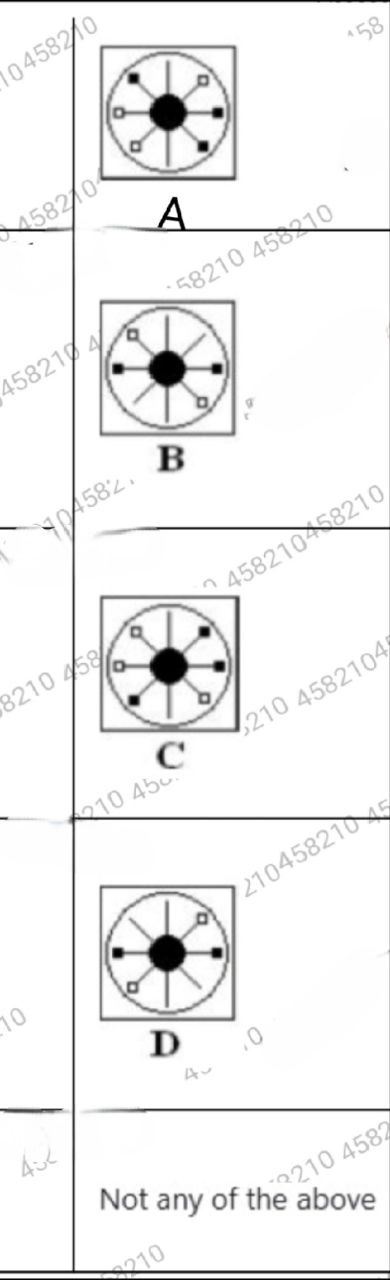
- B
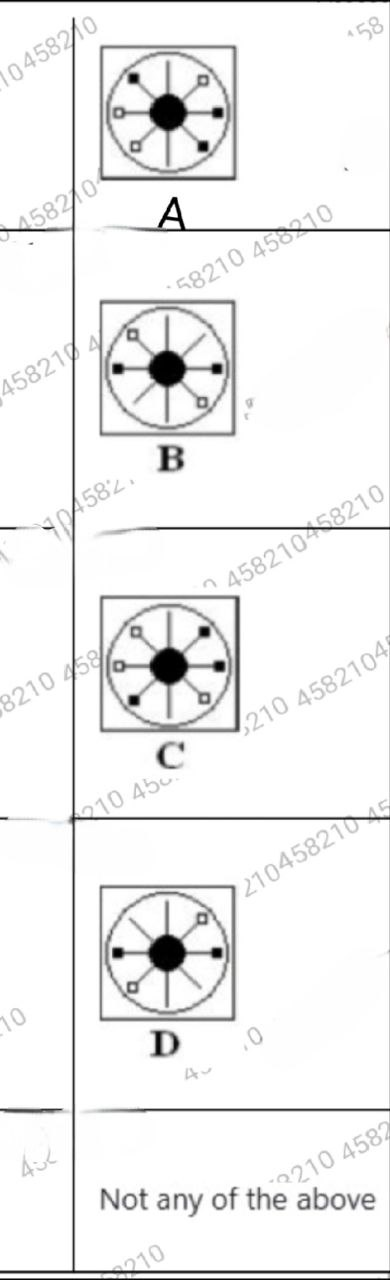
- C
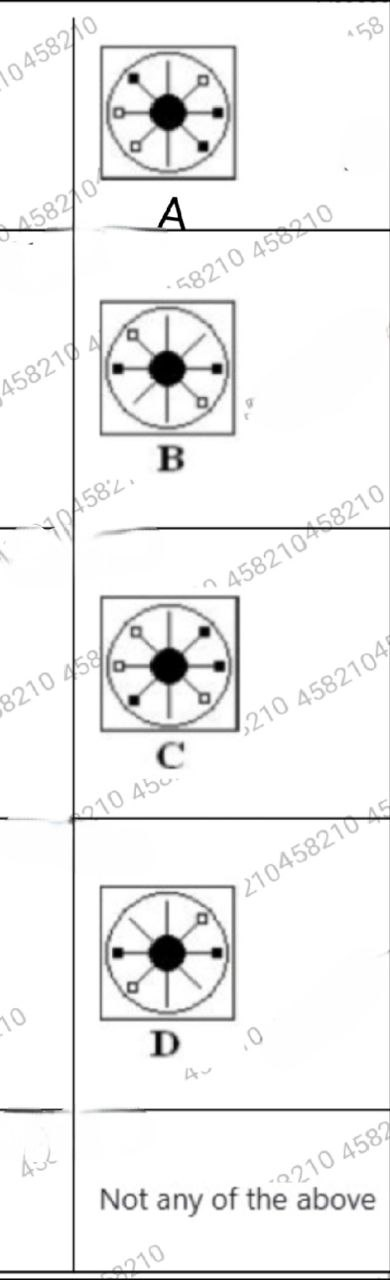
- D
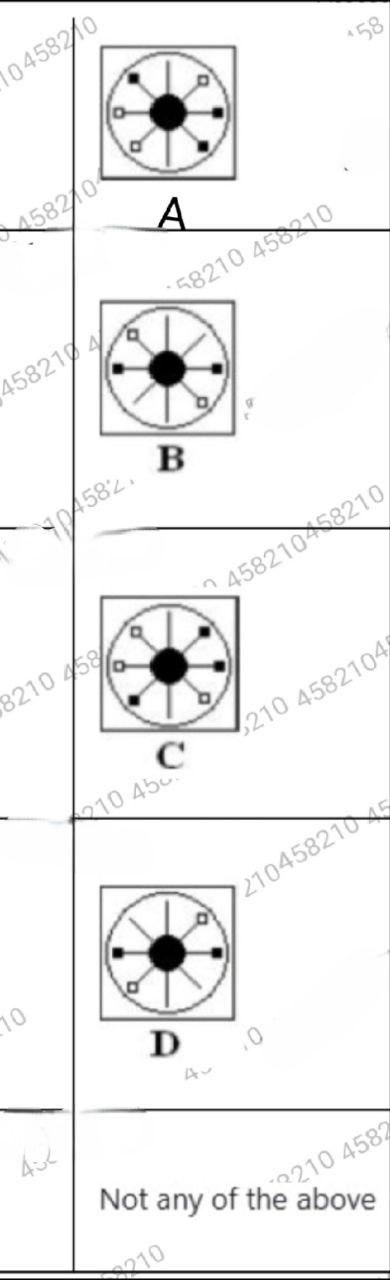
- E
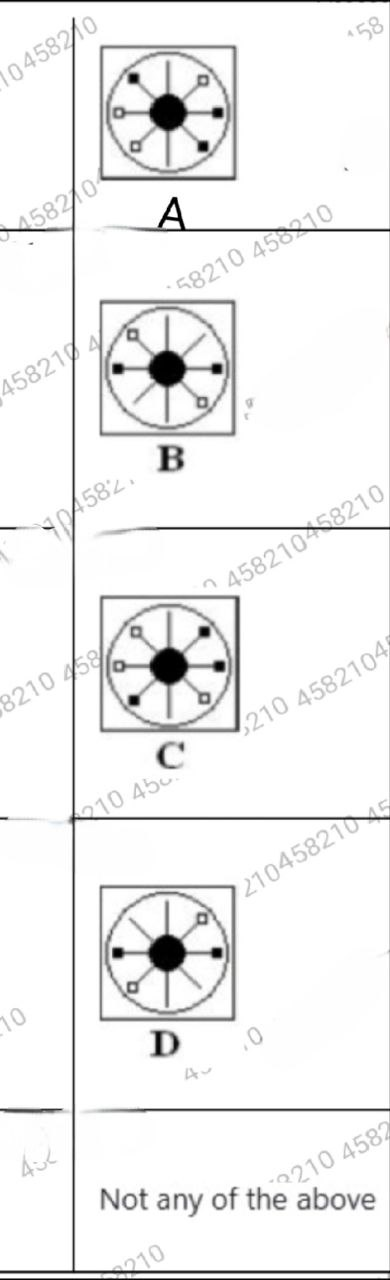
Show answerHide answer
Answer: D
Approach: Figure analogy — each pair of opposite spokes changes by a fixed shading rule.
Solution: Compare opposite ends of each spoke in Fig 1 and Fig 2:
one shaded + one unshaded → both shaded;
both shaded → both unshaded;
both unshaded → squares removed.
Apply to Fig 3: NE–SW both shaded → both unshaded; E–W one each → both shaded; NW–SE both unshaded → removed; N–S has no squares → stays a plain line.
Option D shows exactly this.
Why the other options are wrong: A, B and C do not follow the shading rule on at least one spoke; E — a matching figure exists.
Cetking shortcut: Work spoke-pair by spoke-pair, not square by square.
Answer: D
choose from the figure which figure completes the series below?
- A
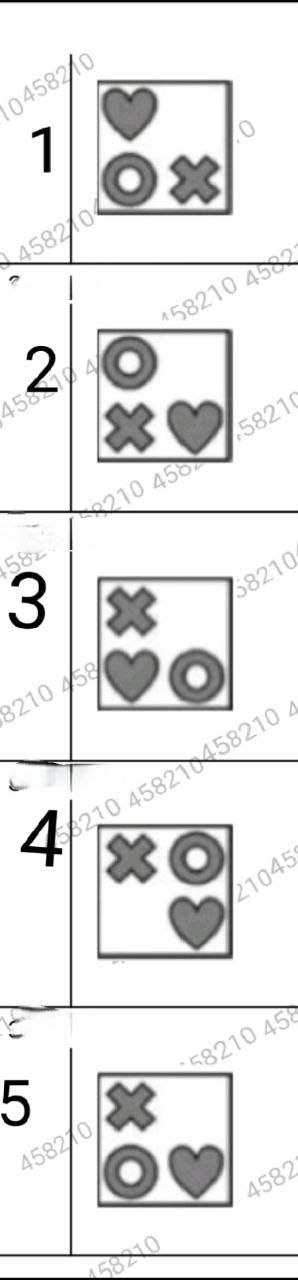
- B
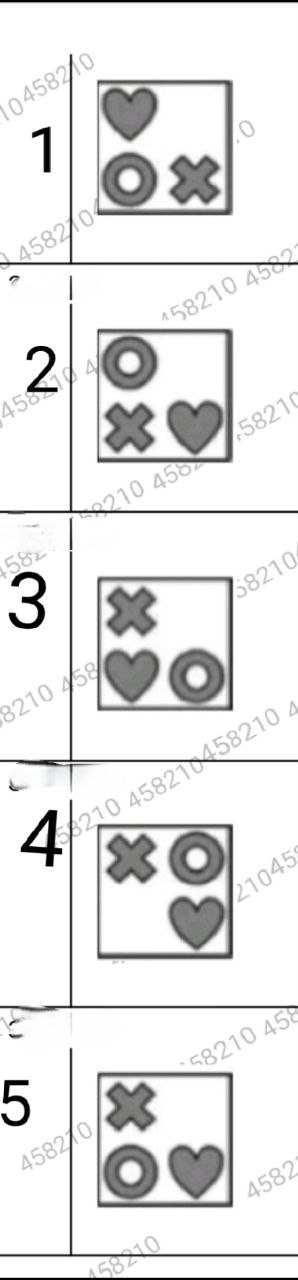
- C
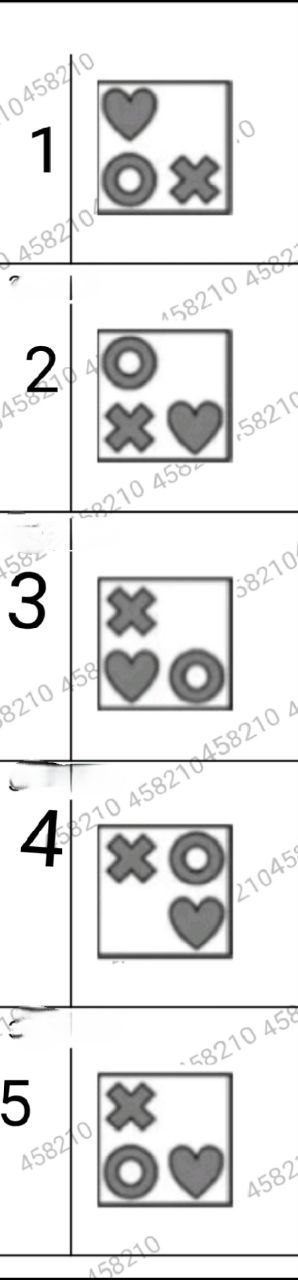
- D
- E
Show answerHide answer
Answer: E
Approach: 3×3 matrix — three fixed arrangements repeat in each row in a cyclic order.
Solution: The three arrangements are P = (× on top; ○, ♥ below), Q = (○ on top; ♥, × below), R = (♥ on top; ×, ○ below).
Row 1: P, Q, R. Row 2: R, P, Q. Row 3: Q, R, ?
Each row shifts the cycle by one, so the missing figure is P: × on top, ○ and ♥ below.
Option E matches.
Why the other options are wrong: A, B, C and D are either other arrangements already used in row 3 or new layouts.
Cetking shortcut: Each arrangement appears exactly once in every row and column — pick the one missing from row 3 and column 3.
Answer: E
choose from the option which figure completes the series below
- A
- B
- C
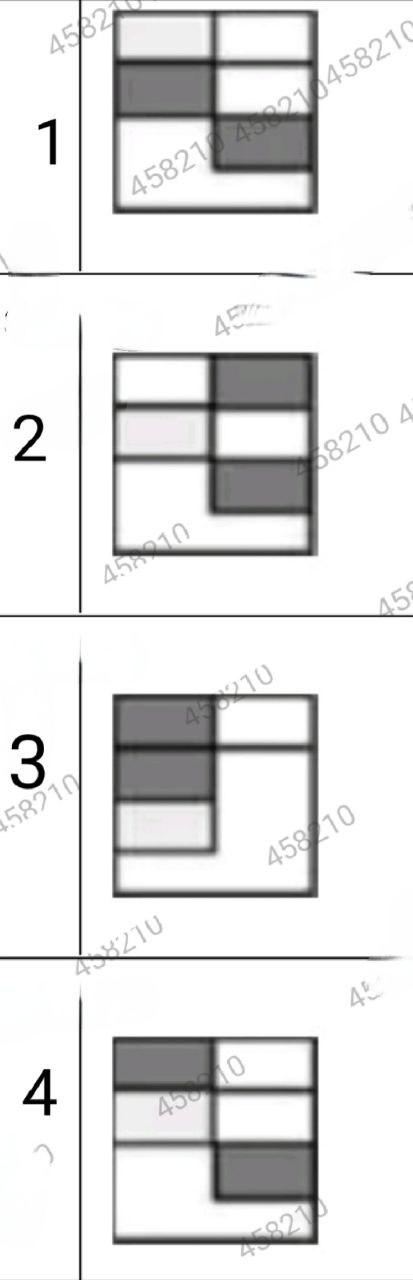
- D
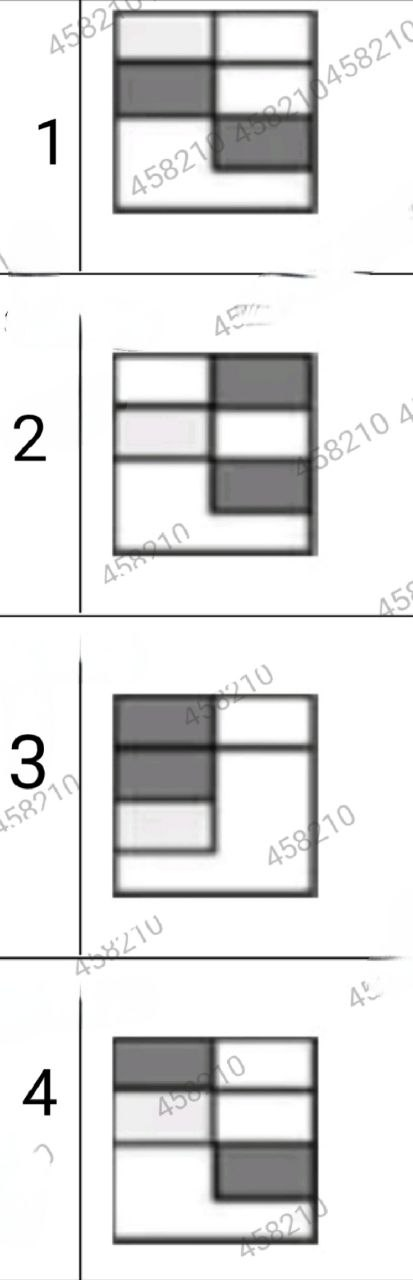
- E
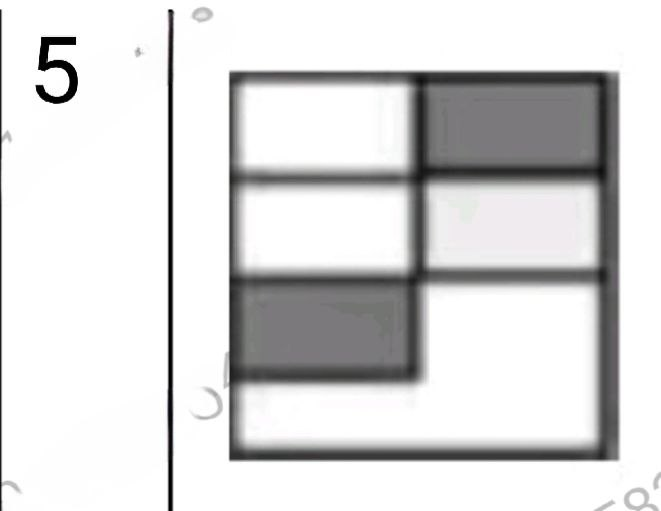
Show answerHide answer
Answer: D
Approach: Matrix superimposition — in each row, figure 1 + figure 2 = figure 3.
Solution: Row 1: dark top-left block + white top-right block = both blocks together. Row 2: light left block + dark right block = both together.
Row 3: figure 1 has a dark block on top-left with a light block below it; figure 2 has a white block at top-right and a dark block lower on the right.
Combining them: dark top-left, light below it, white top-right, dark lower-right — option D.
Why the other options are wrong: A swaps the dark and light blocks on the left; B puts a dark block at top-right; C misses the lower-right dark block; E places blocks in wrong positions.
Cetking shortcut: Verify the rule on rows 1–2 in seconds, then just overlay row 3's two figures.
Answer: D
choose the figure that follows the pattern
- A
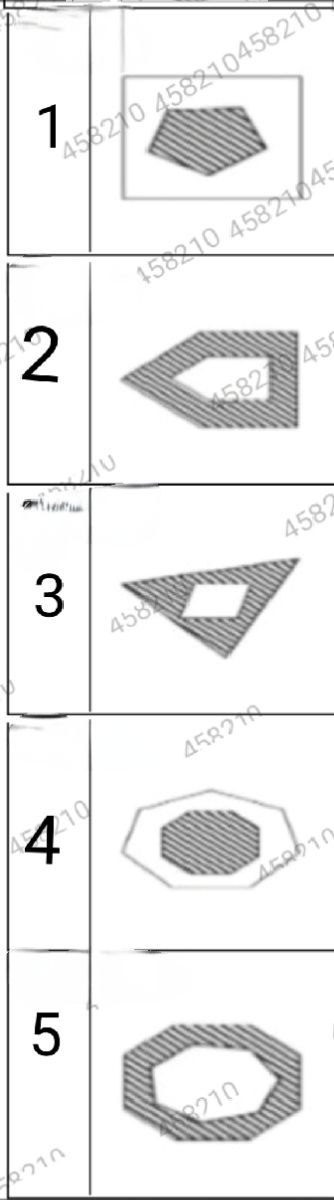
- B
- C
- D
- E
Show answerHide answer
Answer: E
Approach: Shape rule — shaded n-sided outer figure with an unshaded (n−1)-sided figure inside.
Solution: Rectangle (4) with triangle (3); heptagon (7) with hexagon (6); pentagon (5) with quadrilateral (4).
Outer shaded, inner white, inner has one side fewer.
Option E: shaded octagon (8) with white 7-sided figure inside — fits.
Why the other options are wrong: A: shaded figure inside an unshaded one. B: inner does not have one side fewer than the outer. C: triangle outside a quadrilateral (inner has more sides). D: shading reversed.
Cetking shortcut: Check shading first (outer dark, inner white) — it removes A and D at once.
Answer: E
which shape or pattern on the right belong to the two on the left
- AA
- BB
- CC
- DD
- EE
Show answerHide answer
Answer: C
Approach: Figure classification — find what the two given figures share.
Solution: Both given figures: an irregular, tilted four-sided shape containing a triangle, with opposite shading (dark outer with white triangle, white outer with dark triangle).
c: irregular dark quadrilateral with a white triangle — same features, continuing the alternation of shading.
Why the other options are wrong: a: the outer shape has more than four sides. b: outer and triangle are both unshaded. d: outer is a regular upright rectangle, unlike the irregular quadrilaterals given. e: outer is a triangle with a square inside (reversed).
Cetking shortcut: List the features (sides of outer, inner shape, shading contrast) and test each option against all of them.
Answer: C
which figure is odd one out
- AE
- BA
- CB
- DD
- EC
Show answerHide answer
Answer: E
Approach: Odd figure out — adjacency of the black boxes.
Solution: Every figure has 4 black boxes, 3 white boxes and 2 empty cells.
In figures A, B, D and E exactly two black boxes share a side (e.g. in A the middle-right and bottom-right boxes).
In figure C the four black boxes sit in the four corners — no two are adjacent.
So figure C is the odd one; it is listed as the fifth option.
Why the other options are wrong: Figures A, B, D, E each contain one adjacent pair of black boxes.
Cetking shortcut: When counts are equal in every figure, look at positions/adjacency next.
Answer: E
complete the series
- A
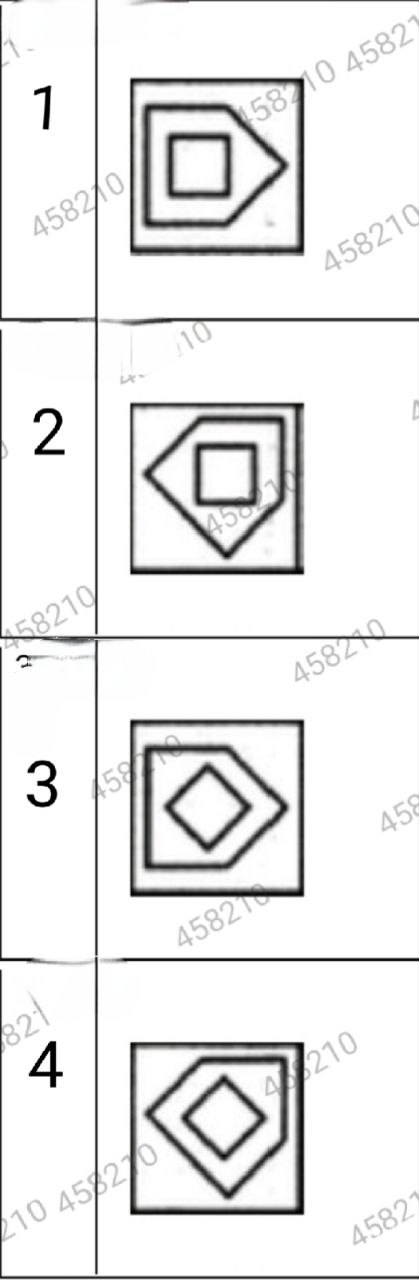
- B
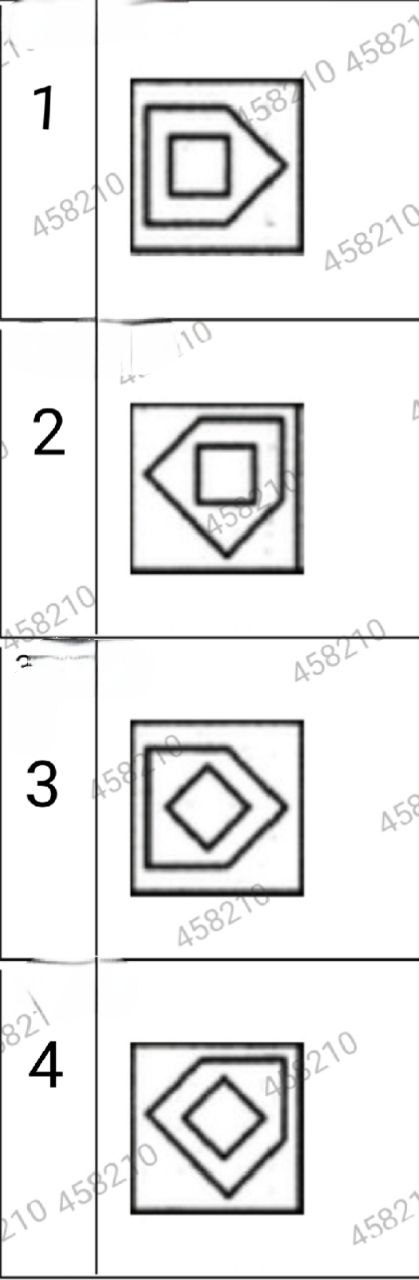
- C
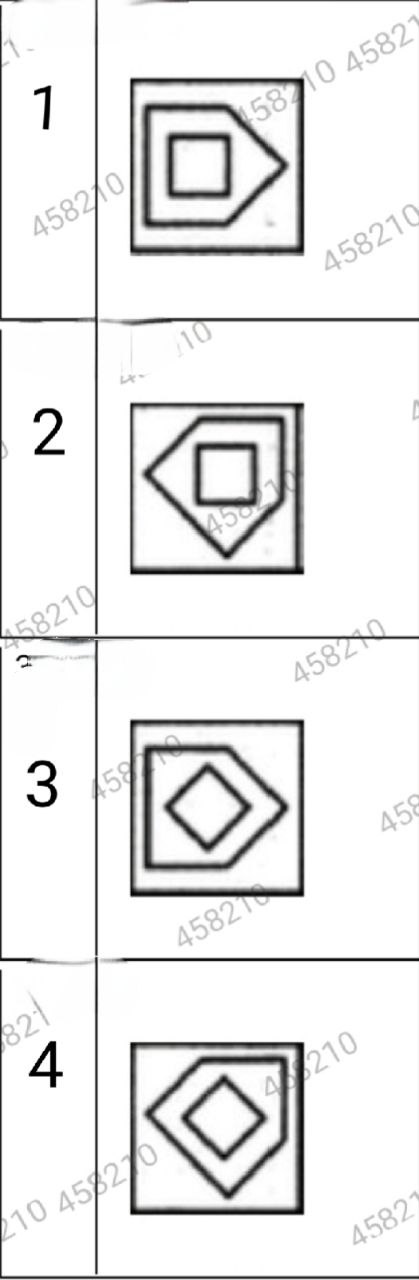
- D
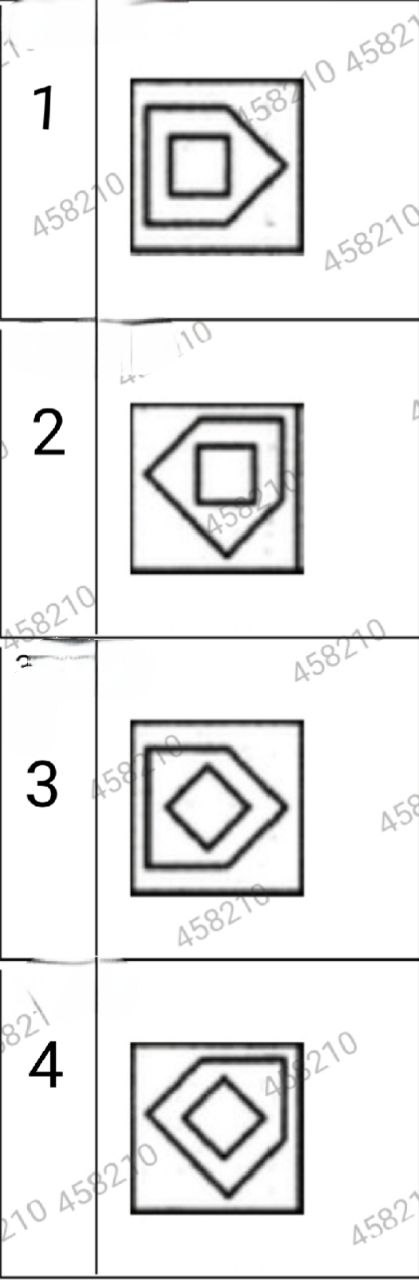
- E
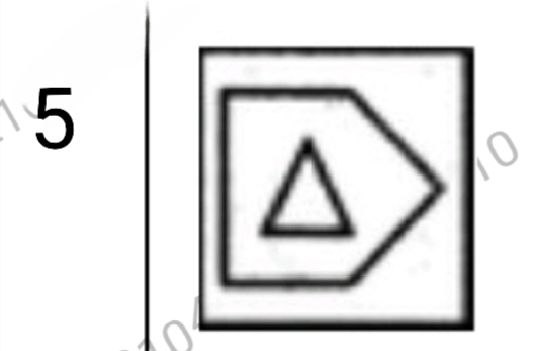
Show answerHide answer
Answer: D
Approach: Paired figure series — Fig 1 : Fig 2 :: Fig 3 : Fig 4.
Solution: Fig 1 → Fig 2: the inner diamond turns 45° and becomes the outer figure (square); the outer inverted triangle is turned upside down and goes inside.
Apply the same change to Fig 3: the inner pentagon (house shape) turns 45° and becomes the outer figure; the outer diamond is inverted (still a diamond) and goes inside.
Option D shows the house shape turned 45° outside with a diamond inside.
Why the other options are wrong: A and B have a square inside instead of the diamond; C turns the pentagon by 90°; E has a triangle inside.
Cetking shortcut: Inner ↔ outer swap questions: identify the new outer shape first, then its rotation.
Answer: D
which of the following finished patterns can be obtained from a piece of cardboard shown below?
- A1
- B2
- C3
- D4
- ENone of the above
Show answerHide answer
Answer: A
Approach: Box from a net — find which faces are adjacent and where the marks lie after folding.
Solution: In the net, the narrow strip with the small black mark lies between the cross-design face and the large plain face, and the mark is at its left end. The plain face and the cross-design face are opposite each other.
Box 1 shows the plain face in front with a plain narrow strip on top and an end flap — a valid view.
Box 2 has the black mark at the right end of the top strip; folding keeps it at the left end → not possible.
Boxes 3 and 4 show the cross-design face with a black mark on an end flap, but the mark is on a long strip, not on a flap → not possible.
Cetking shortcut: Track one distinctive mark (the black rectangle) — its position rules out most options.
Answer: A
which of the following three out of five alternative figures when fitted into each other could form a complete square
- A1,2,4
- B3,4,5
- C1,2,3
- D1,3,5
- E5, 2, 4
Show answerHide answer
Answer: D
Approach: Forming a square from pieces — match straight edges and angles.
Solution: The square's side equals the straight sides of piece 5 (L-shape with a right angle) and the long straight side of piece 3 (trapezium).
Put piece 5 in a corner of the square, along two sides. The space left is a four-sided region bounded by the opposite two sides and piece 5's slanting edge.
Piece 3 fits along the side opposite the right angle, its lower slanting edge lying exactly along piece 5's slanting edge.
The small gap left at the top is exactly the arrow-head piece 1.
Pieces 1, 3 and 5 together make a complete square.
Why the other options are wrong: Piece 4 is just a small square and piece 2 is a dart with no right angle; triples containing them leave gaps or overlap.
Cetking shortcut: Start with the piece that has a right angle and two sides equal to the square's side — it must sit in a corner.
Answer: D
which of the following three out of five alternative figures when fitted into each other could form an equilateral triangle.
- A4, 3, 2
- B2, 4, 5
- C1, 3, 4
- D3, 4, 5
- E2, 4, 5
Show answerHide answer
Answer: D
Approach: Forming an equilateral triangle from pieces — the result needs three 60° corners and equal sides.
Solution: Piece 3 (the triangle with a notch cut in one side), piece 4 (four-sided) and piece 5 (small four-sided) each have one 60° corner, so each can fill one corner of the big triangle.
Piece 3 takes the lower vertex, piece 4 the upper-left corner and piece 5 the upper-right corner; piece 5's slanting edge runs along the notch of piece 3 and its other edge meets piece 4 along a straight line.
Pieces 3, 4 and 5 together form one equilateral triangle.
Why the other options are wrong: Piece 2 has no 60° corner, so the combinations with piece 2 cannot give three equal corners; the combination 1, 3, 4 leaves gaps.
Cetking shortcut: Look for the pieces that carry the 60° corners — three corners are needed.
Answer: D
select the figure which satisfies the same condition of placement of the dot as in figure X
- A1
- B2
- C3
- D4
- ENone of the above
Show answerHide answer
Answer: A
Approach: Dot placement — find which shapes overlap at each dot of figure X, then look for an option that has the same three overlap regions.
Solution: Figure X has a square, a circle, a triangle and a tilted rectangle. Its three dots lie in:
(1) the region common to all four shapes;
(2) the region common to the square and the tilted rectangle only (outside the circle and the triangle);
(3) the region common to the triangle and the tilted rectangle only (outside the square and the circle).
Figure 1 has a circle, a triangle and two rectangles: the middle of the circle, where the triangle and both rectangles overlap, is common to all four; the top-right overlap of the two rectangles lies outside the circle and the triangle; and the lower-right part of the triangle inside the tall rectangle lies outside the circle and the other rectangle. All three regions exist.
Why the other options are wrong: Figure 2 has no region common to all four shapes; figures 3 and 4 lack at least one of the three regions.
Cetking shortcut: Find the hardest region first (the all-shape overlap); options without it are out immediately.
Answer: A
group the given figure into three classes using each figure only once.
- A1,2,5 ; 3,7,8 ; 4,6,9
- B1,7,2 ; 3,9,6 ; 4 ,5,8
- C2,3,8 ; 4,6,9 ; 1,5,7
- D5,6,9 ; 3,4,1 ; 2,7,8
- E4,5,8 ; 2,3,1 ; 9,7,8
Show answerHide answer
Answer: A
Approach: Grouping figures by the inner design.
Solution: Group 1 — 1, 2, 5: four curved arcs bending inward forming a small central square (in a circle, hexagon and square).
Group 2 — 3, 7, 8: curved lines forming a rounded square inside (square, circle, octagon).
Group 3 — 4, 6, 9: straight lines radiating from one point (triangle, hexagon, rectangle).
This is option A.
Why the other options are wrong: Every other option mixes radiating-line figures with curved-line figures (e.g. B puts 1, 7 together and 4, 5 together; E even repeats figure 8).
Cetking shortcut: Classify by the inner pattern, not the outer shape — the outer shapes vary inside each group.
Answer: A
identify the figure that complete the series
- A1
- B2
- C3
- D4
- EAll correct
Show answerHide answer
Answer: D
Approach: Pattern completion — the four squares are mirror copies of one another about the centre.
Solution: The bottom-left square is the vertical mirror of the top-left square, and the bottom-right square is the horizontal mirror of the bottom-left one. So the missing top-right square must be the vertical mirror of the bottom-right square.
It therefore needs: a long diagonal from its top-right corner running down-left and stopping at the small arc at its bottom-left corner; a shorter line from its top-left corner meeting that diagonal; a thin wedge along its bottom edge from the bottom-right corner towards the arc; and a shallow arc (not a full semicircle) on the right side.
Figure 4 has all of these.
Why the other options are wrong: Figure 1 lets the diagonal run through the arc to the corner; figure 2 has a full semicircle, far deeper than the shallow arc of the pattern; figure 3 has different internal lines; E ('all correct') is impossible since only one figure fits.
Cetking shortcut: Use the symmetry — copy the neighbouring square and mirror it.
Answer: D
find out the alternative figure that contains figure (x) as it parts
- A1
- B2
- C3
- D4
- ENone of the above
Show answerHide answer
Answer: A
Approach: Embedded figure — find figure X, same size and orientation, inside an option.
Solution: Figure X: a horizontal top line, a slanted line from its right end down to the lower left, and a short line from its left end meeting the slanted line.
In figure 1 these three lines appear in the same orientation and proportion within the overlapping shapes.
In figures 2, 3 and 4 the angle or orientation of the lines does not match.
Cetking shortcut: Look for the most distinctive part (the long slanted line from the end of a horizontal line) first.
Answer: A
select a figure which from amongst the answer figures which will continue the same series as established by the five problem series
- A
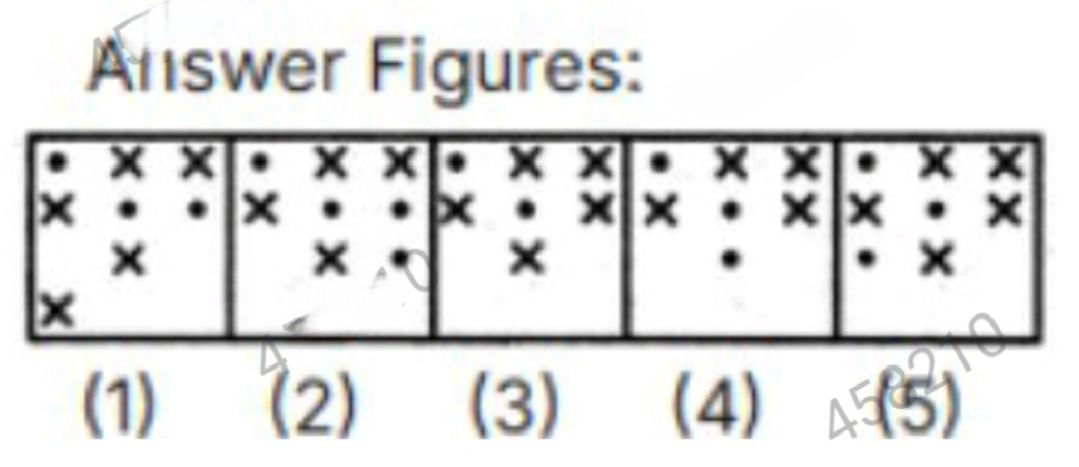
- B
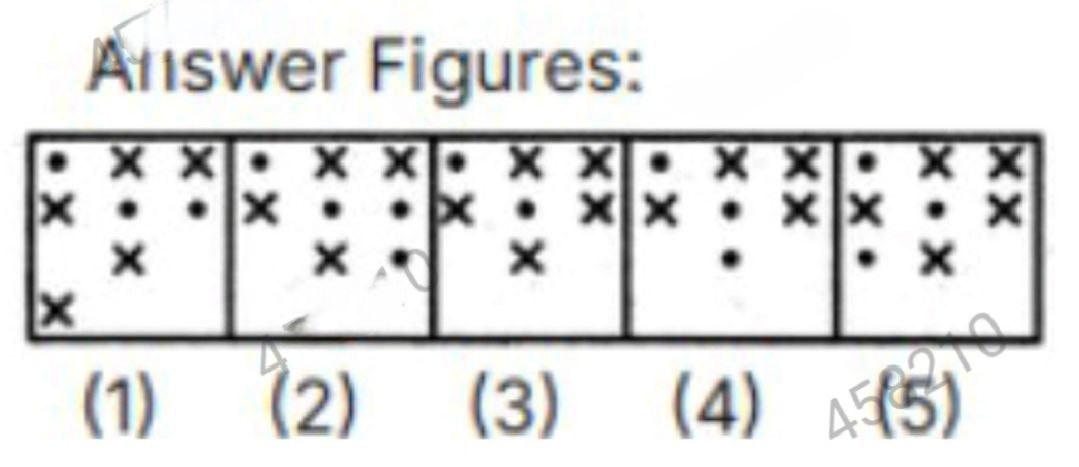
- C
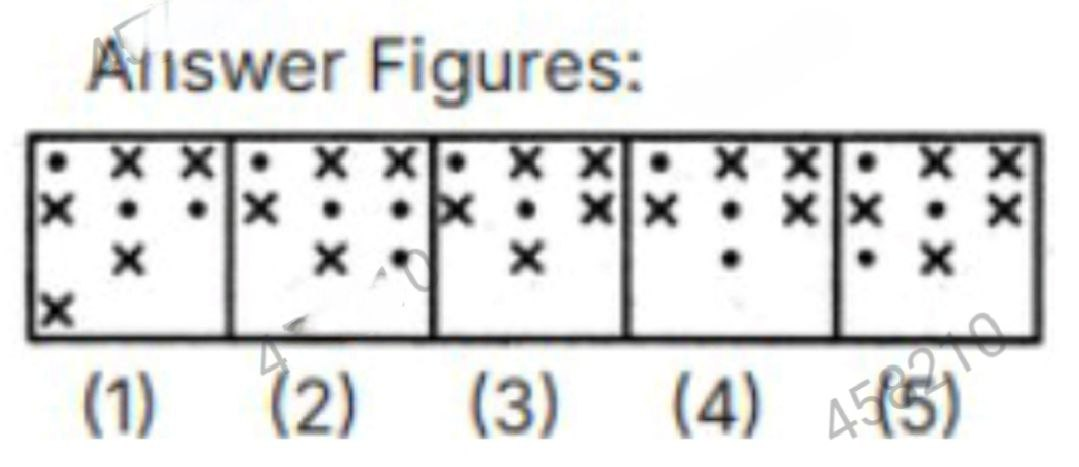
- D
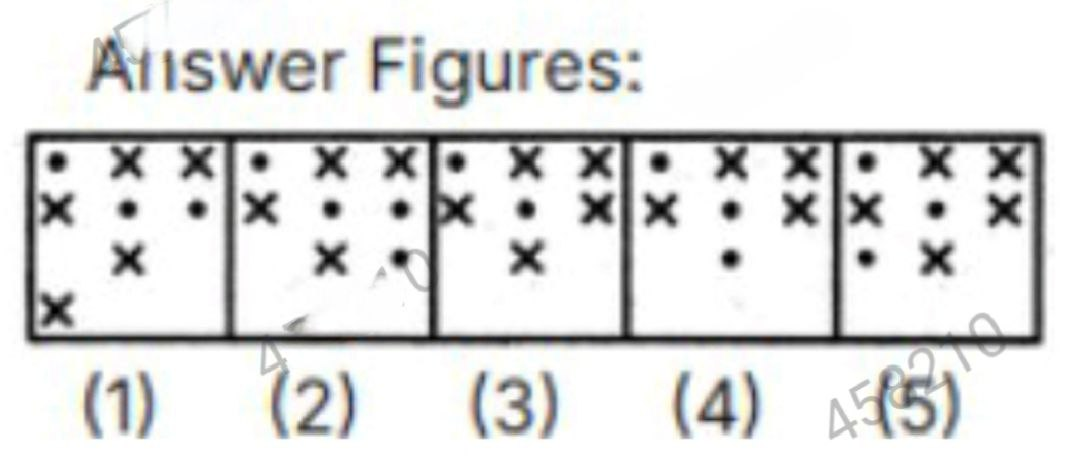
- E
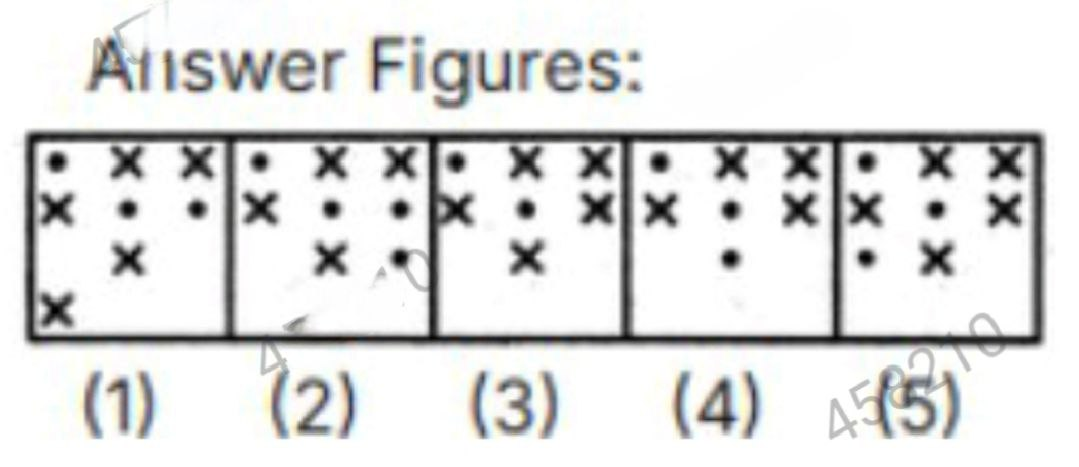
Show answerHide answer
Answer: C
Approach: Figure series — count dots and crosses in every figure.
Solution: A: 12 dots, 0 ×. B: 10 dots, 1 ×. C: 8 dots, 2 ×. D: 6 dots, 3 ×. E: 4 dots, 4 ×.
Each step: one dot becomes × and one dot disappears → × +1, dots −2.
Next figure: 5 ×, 2 dots (7 symbols in all).
Option C has exactly 5 × and 2 dots.
Why the other options are wrong: A has 5 × but 3 dots; B has 4 × and 4 dots; D has 4 × and 3 dots; E has 5 × but 3 dots.
Cetking shortcut: Total symbols drop by one each step (12, 11, 10, 9, 8 → 7) — count totals first to eliminate fast.
Answer: C