CET 2026 Slot 3 · MBA CET 2026 Attempt 1 Slot 3 · Abstract – Page 2
All 25 Abstract questions of CET 2026 Slot 3. Tap Show answer, or open the detailed solution (free login). Page 2 of 5.
DIRECTION for the question: Following question consists of two sets of figures. Figures A, B, C and D constitute the Problem Set while figures 1, 2, 3, 4 and 5 constitute the Answer Set. There is a definite relationship between figures A and B. Establish a similar relationship between figures C and D by selecting a suitable figure from the Answer Set that would replace the question mark (?) in fig (D).
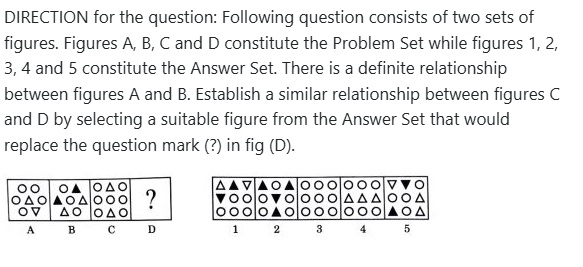
Answer: A. 1
Solution — first steps
Approach: Figure analogy — count-based change: the number of triangles doubles and half of them turn black. Solution: A: 5 circles + 2 white triangles (7 symbols).
The full step-by-step working opens with a free login.
DIRECTION for the question: Following question consists of two sets of figures. Figures A, B, C and D constitute the Problem Set while figures 1, 2, 3, 4 and 5 constitute the Answer Set. There is a definite relationship between figures A and B. Establish a similar relationship between figures C and D by selecting a suitable figure from the Answer Set that would replace the question mark (?) in fig (D).
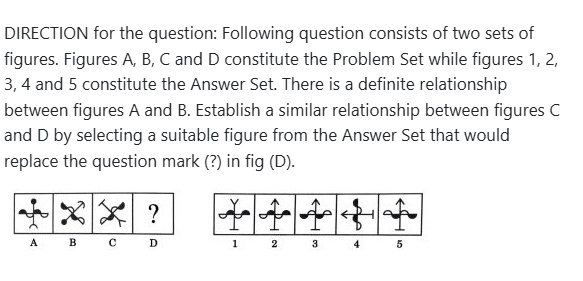
Answer: B. 2
Solution — first steps
Approach: Figure analogy — the cross-bar and the wavy line rotate by different amounts, and the fork end becomes an arrow. Solution: A → B: the wavy line turns 45° clockwise (its black end goes from left to top-left, white end from right to bottom-right).
The full step-by-step working opens with a free login.
In the following question, a related pair of figures (unnumbered) is followed by five other figures numbered as 1, 2, 3, 4 and 5. There are certain common characteristics/properties between the two problem figures (unnumbered). Out of the five numbered options, select the one that has a relationship / common characteristics/properties similar to that in the unnumbered pair :
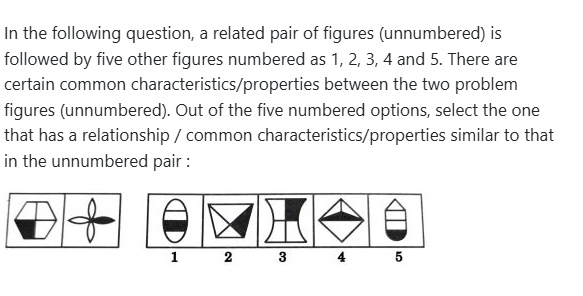
Answer: C. 3
Solution — first steps
Approach: Common-property pair — find what both given figures share. Solution: Hexagon: divided by one vertical and one horizontal line into 4 EQUAL parts, one part shaded.
The full step-by-step working opens with a free login.
In the following question, a related pair of figures (unnumbered) is followed by five other Figures numbered as 1, 2, 3, 4 and 5. There are certain common characteristics / properties between the two problem figures (unnumbered). Out of the five numbered figures, select the one that has a relationship / common characteristics / properties similar to that in the unnumbered pair.
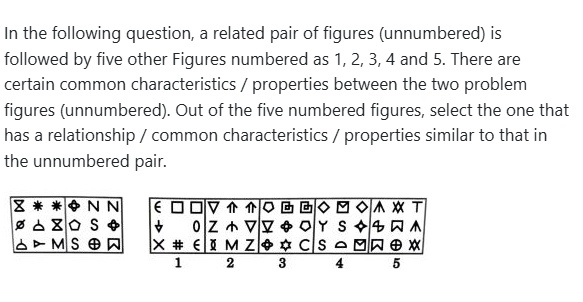
Answer: C. 3
Solution — first steps
Approach: Common-property pair — 3×3 symbol grids with a fixed repetition pattern. Solution: Grid 1: three symbols appear twice (star, hour-glass, bell) and three appear once — and the pairs sit in the SAME cells: top-middle = top-right; top-left = middle-right; centre = bottom-left.
The full step-by-step working opens with a free login.
In the following question, a related pair of figures (unnumbered) is followed by five other figures numbered as 1, 2, 3, 4 and 5. There are certain common characteristics / properties between the two problem figures (unnumbered). Out of the five numbered figures, select the one that has a relationship / common characteristics / properties similar to that in the unnumbered pair.
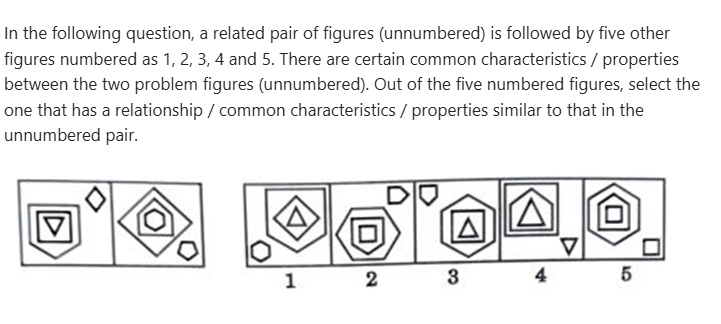
Answer: B. 2
Solution — first steps
Approach: Common-property pair — nested polygons with consecutive side counts, plus an outside symbol copying the middle shape. Solution: Figure 1: pentagon ⊃ square ⊃ triangle (5, 4, 3) — outside small diamond (4) = middle shape.
The full step-by-step working opens with a free login.