CET 2026 Slot 3 · MBA CET 2026 Attempt 1 Slot 3 · Abstract – Page 4
All 25 Abstract questions of CET 2026 Slot 3. Tap Show answer, or open the detailed solution (free login). Page 4 of 5.
In the following question, a related pair of figures (unnumbered) is followed by five other figures numbered as 1, 2, 3, 4 and 5. There are certain common characteristics / properties between the two problem figures (unnumbered). Out of the five numbered figures, select the one that has a relationship / common characteristics / properties similar to that in the unnumbered pair.
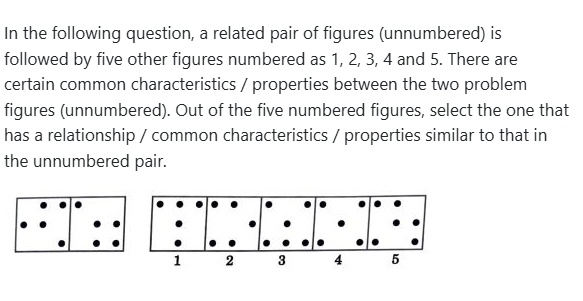
Answer: B. 2
Solution — first steps
Approach: Common-property pair — dot figures: same number of dots in an unsymmetrical (scattered) layout. Solution: Figure 1: 5 dots, arranged with no line of symmetry.
The full step-by-step working opens with a free login.
Which of the Five figure does not belong to the series?
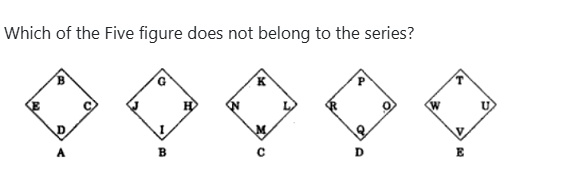
Answer: D. 4
Solution — first steps
Approach: Figure series (odd one out) — letters placed clockwise in alphabetical order. Solution: A: B (top) → C (right) → D (bottom) → E (left) — clockwise, consecutive.
The full step-by-step working opens with a free login.
DIRECTION for the question: In following question, group the following figures (1-9) into three classes on the basis of identical properties.
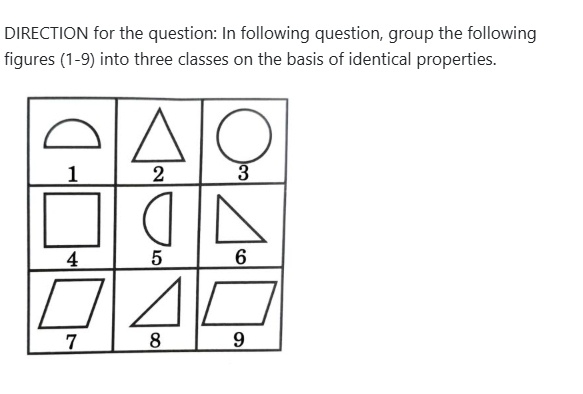
Answer: C. 1,3,5 ; 2,6,8 ; 4,7,9
Solution — first steps
Approach: Grouping figures into three classes by shape family. Solution: Curved shapes: 1 (semicircle), 3 (circle), 5 (semicircle).
The full step-by-step working opens with a free login.
DIRECTION for the question: In the following question, group the following figures (1-9) into three classes on the basis of identical properties.
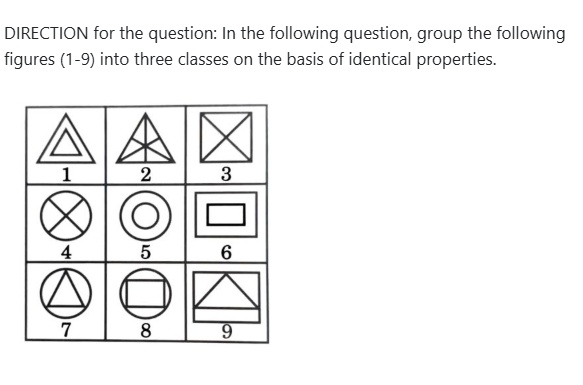
Answer: B. 1,5,6 ; 2,3,4 ; 7,8,9
Solution — first steps
Approach: Grouping figures by the kind of inner design. Solution: Same shape inside the same shape: 1 (triangle in triangle), 5 (circle in circle), 6 (rectangle in rectangle).
The full step-by-step working opens with a free login.
DIRECTION for the question: In following question, group the following figures (1-9) into three classes on the basis of identical properties.
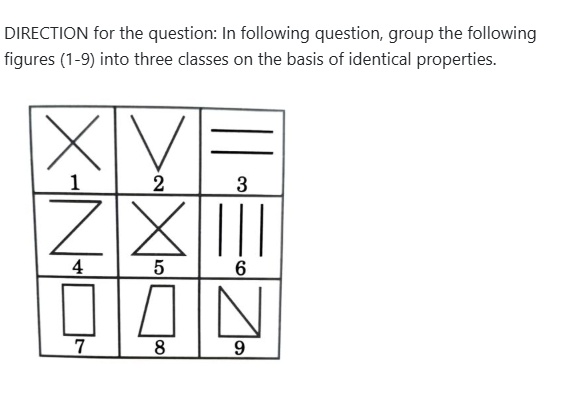
Answer: A. 1,2,3 ; 4,5,6 ; 7,8,9
Solution — first steps
Approach: Grouping figures by the number of straight lines used. Solution: Two lines: 1 (X), 2 (V), 3 (=).
The full step-by-step working opens with a free login.