CET Figure Analogy Questions with Solutions – Page 7
All 69 Figure Analogy questions from MBA CET 2023 and 2024 and 2025 and 2026 papers. Tap Show answer, or open the detailed solution (free login). Page 7 of 14.
In the following question, a related pair of figures (unnumbered) is followed by five other pairs of figures marked as (a), (b), (c), (d), and (e). Out of the five, select the pair that has a relationship similar to that in the unnumbered pair.

Answer: A. Option 1
Solution — first steps
Approach: Relate the number of parts in the circle to the number of sides of the second figure. e.
The full step-by-step working opens with a free login.
Which option from the lower row shall complete the sequence of the upper in the best manner?
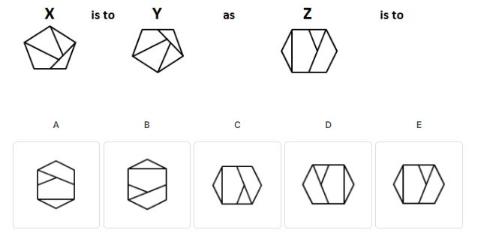
Answer: C. Option C
Solution — first steps
Approach: Find how X becomes Y, then apply the same change to Z. Solution: Y is X turned upside down: the pentagon's point moves from the top to the bottom and the inner lines flip top-to-bottom with it.
The full step-by-step working opens with a free login.
Following question consists of two sets of figures.
Figures (A, B, C and D) constitute the Problem Set.
Figures (1, 2, 3, 4 and 5) constitute the Answer Set.
There is a definite relationship between figures A and B.
Establish a similar relationship between figures C and D by selecting a suitable figure from the Answer Set that would replace the question mark (?) in figure D.

Answer: E. (Answer Figure 5)
Solution — first steps
Approach: Figure analogy: apply the A → B change to C, one element at a time. Solution: A → B: both shapes are cut to half their width (square → narrow rectangle, big square → tall rectangle), and the inner element appears as a solid black dot.
The full step-by-step working opens with a free login.
Following question consists of two sets of figures.
Figures (A, B, C and D) constitute the Problem Set.
Figures (1, 2, 3, 4 and 5) constitute the Answer Set.
There is a definite relationship between figures A and B.
Establish a similar relationship between figures C and D by selecting a suitable figure from the Answer Set that would replace the question mark (?) in figure D.
Figures (A, B, C and D) constitute the Problem Set.
Figures (1, 2, 3, 4 and 5) constitute the Answer Set.
There is a definite relationship between figures A and B.
Establish a similar relationship between figures C and D by selecting a suitable figure from the Answer Set that would replace the question mark (?) in figure D.

Answer: C. (Answer Figure 3)
Solution — first steps
Approach: Figure analogy: in A → B, each matching pair of parts joins into one closed shape. Solution: A → B: the two small squares become one small square (top-right).
The full step-by-step working opens with a free login.
The following question, a related pair of figures (unnumbered) is followed by five other figures marked 1, 2, 3, 4 and 5. Out of the five numbered pairs, select the pair that has a relationship similar to that in the unnumbered pair.

Answer: A. (Answer Figure 1)
Solution — first steps
Approach: Figure analogy (pair): find how figure II is made from figure I, then test each pair. Solution: In the given pair, figure II is figure I turned through 180°.
The full step-by-step working opens with a free login.