CET Figure Classification Questions with Solutions – Page 18
All 95 Figure Classification questions from MBA CET 2023 and 2024 and 2025 and 2026 papers. Tap Show answer, or open the detailed solution (free login). Page 18 of 19.
QUESTION
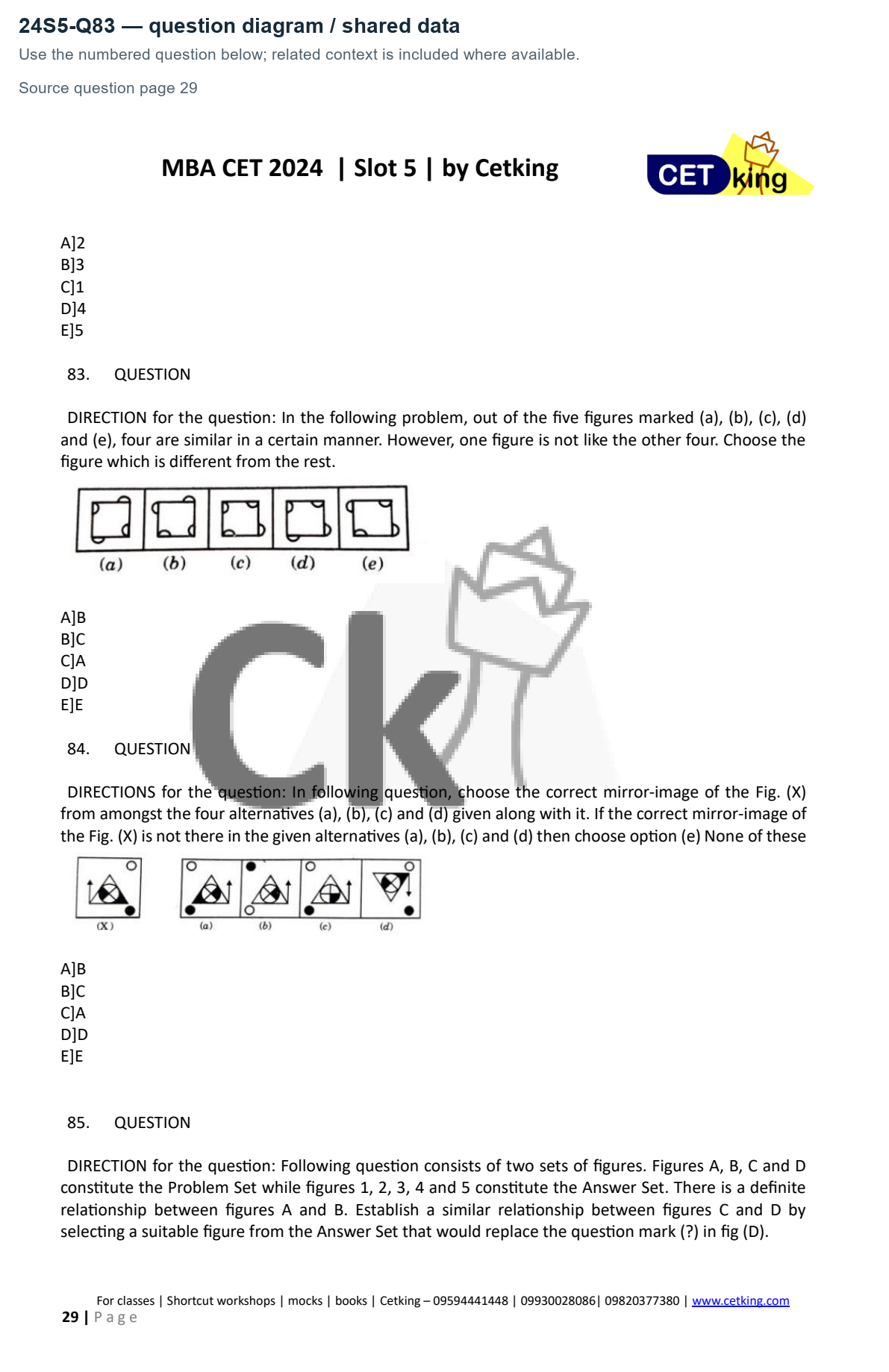
DIRECTION for the question: In the following problem, out of the five figures marked (a), (b), (c), (d)
and (e), four are similar in a certain manner. However, one figure is not like the other four. Choose the
figure which is different from the rest.
A]B
B]C
C]A
D]D
E]E
DIRECTION for the question: In the following problem, out of the five figures marked (a), (b), (c), (d)
and (e), four are similar in a certain manner. However, one figure is not like the other four. Choose the
figure which is different from the rest.
A]B
B]C
C]A
D]D
E]E
Answer: B. C
Solution — first steps
Count inward/outward semicircular tabs. Figure (c) has three inward tabs and one outward tab; each other figure has two of each.
The full step-by-step working opens with a free login.
Four options can be obtained by rotating the target grid through 0°, 90°, 180° or 270°. Which ONE requires a reflection instead? Keep all printed digits upright and compare their positions. A reflected pattern cannot be treated as a rotation.
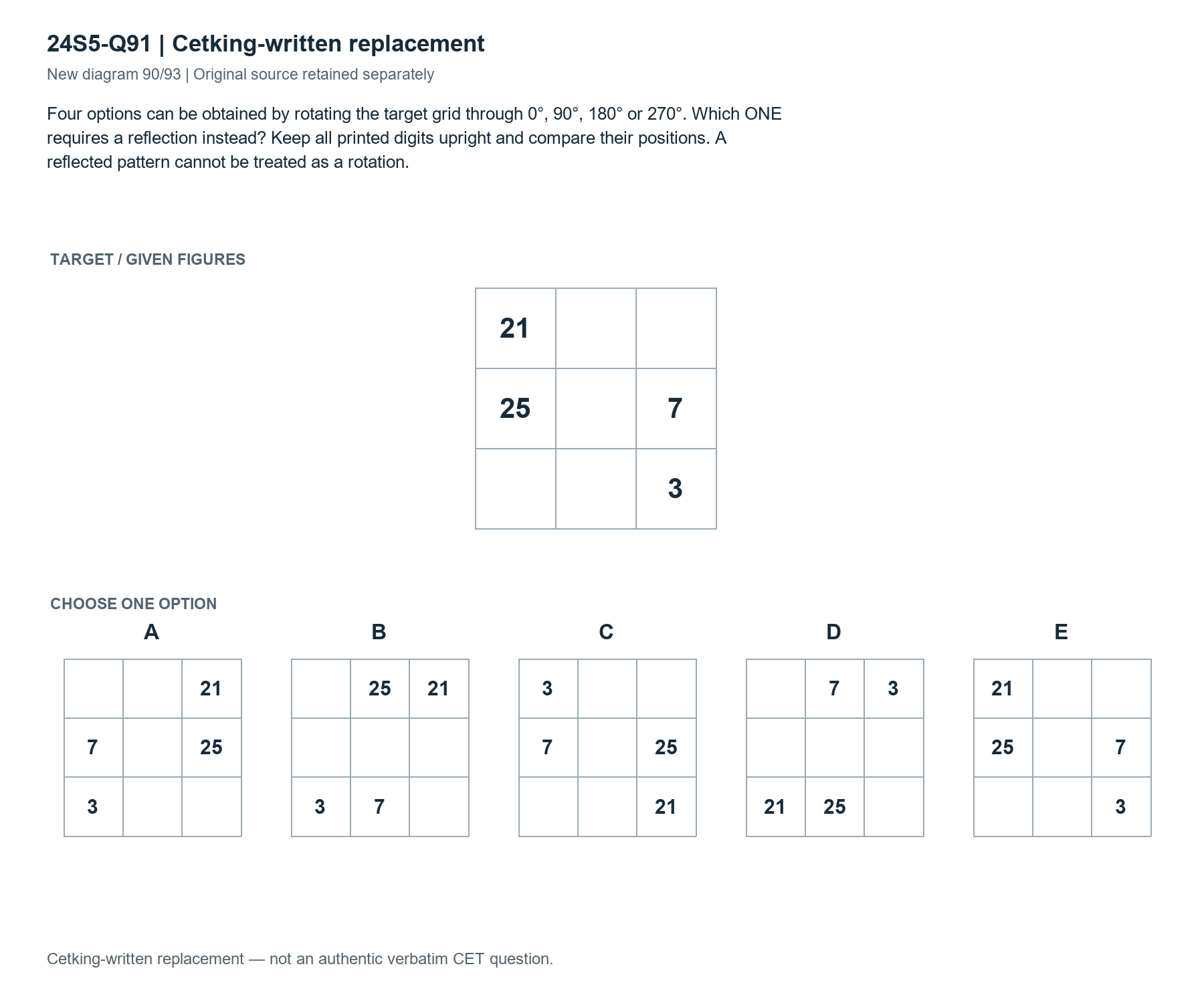
Answer: A. row 1, column 3: 21; row 2, column 1: 7; row 2, column 3: 25; row 3, column 1: 3
Solution — first steps
1. Use option B as the reference pattern: r1c2=25; r1c3=21; r3c1=3; r3c2=7.
The full step-by-step working opens with a free login.
QUESTION
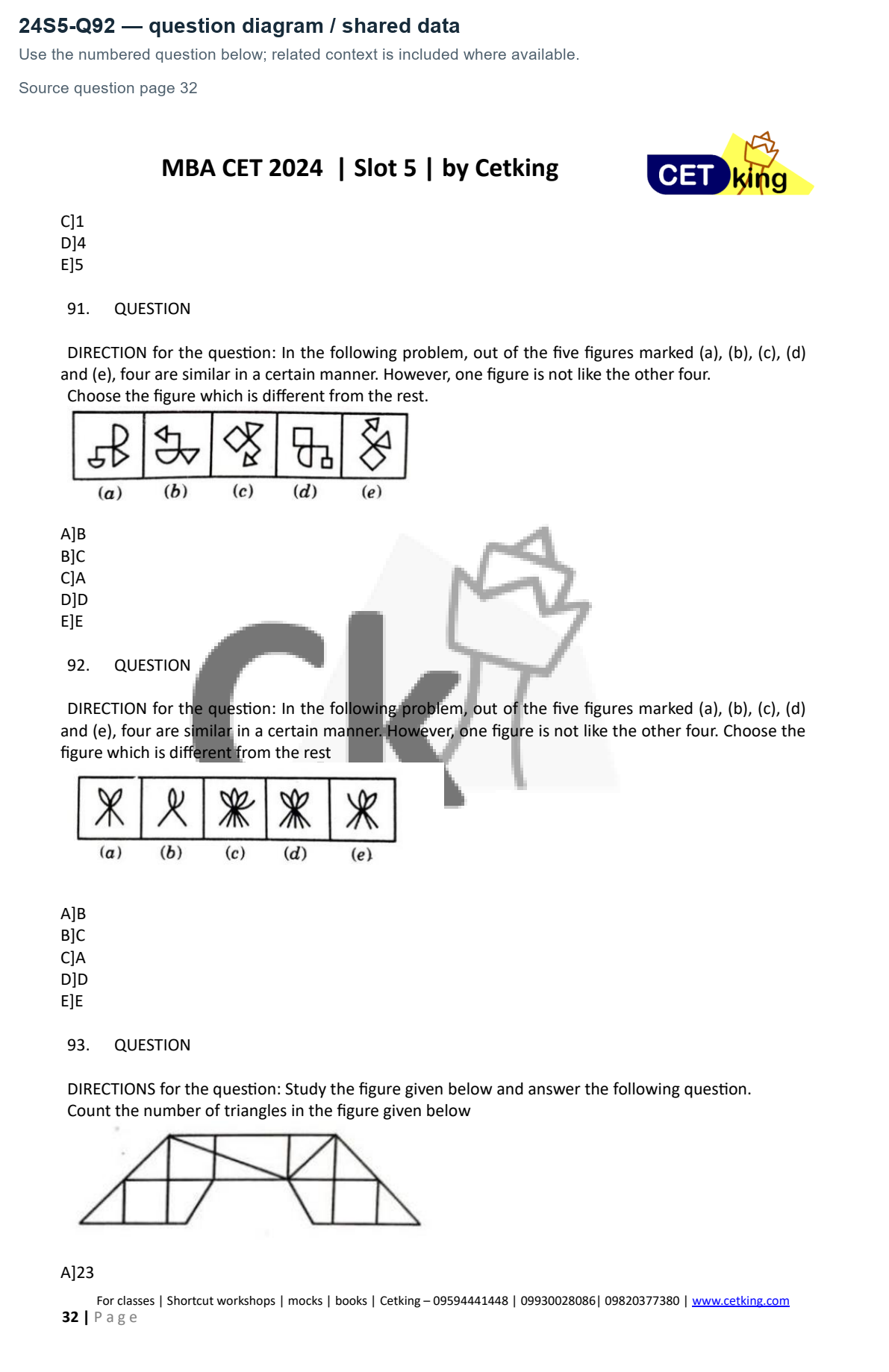
DIRECTION for the question: In the following problem, out of the five figures marked (a), (b), (c), (d)
and (e), four are similar in a certain manner. However, one figure is not like the other four. Choose the
figure which is different from the rest
A]B
B]C
C]A
D]D
E]E
DIRECTION for the question: In the following problem, out of the five figures marked (a), (b), (c), (d)
and (e), four are similar in a certain manner. However, one figure is not like the other four. Choose the
figure which is different from the rest
A]B
B]C
C]A
D]D
E]E
Answer: D. D
Solution — first steps
In (a),(b),(c),(e), the number of lower straight stems equals the number of complete upper leaves plus one: 3/2,2/1,5/4,3/2. Figure (d) has five stems but only three leaves, breaking that relation.
The full step-by-step working opens with a free login.
QUESTION
DIRECTION for the question: In the following problem, out of the five figures marked (a), (b), (c), (d)
and (e), four are similar in a certain manner. However, one figure is not like the other four. Choose the
figure which is different from the rest
A]B
B]C
C]A
D]D
E]E
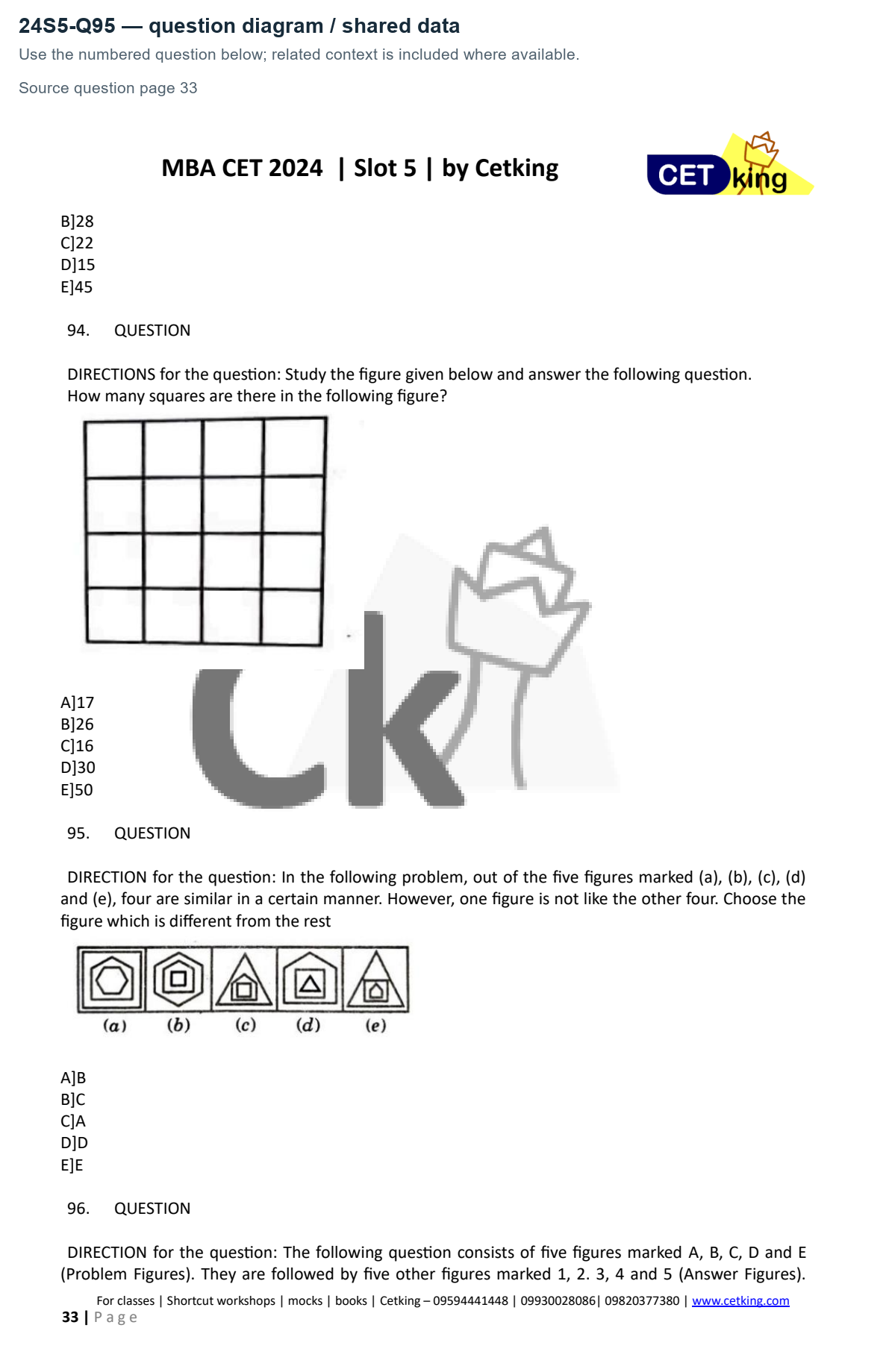
DIRECTION for the question: In the following problem, out of the five figures marked (a), (b), (c), (d)
and (e), four are similar in a certain manner. However, one figure is not like the other four. Choose the
figure which is different from the rest
A]B
B]C
C]A
D]D
E]E
Answer: B. C
Solution — first steps
1. Count polygon sides from outside inward: (a)4,5,6; (b)6,5,4; (c)3,5,4; (d)5,4,3; (e)3,4,5.
The full step-by-step working opens with a free login.
Choose the odd figure from the five panels of squares, circles and triangles in the attached question diagram.
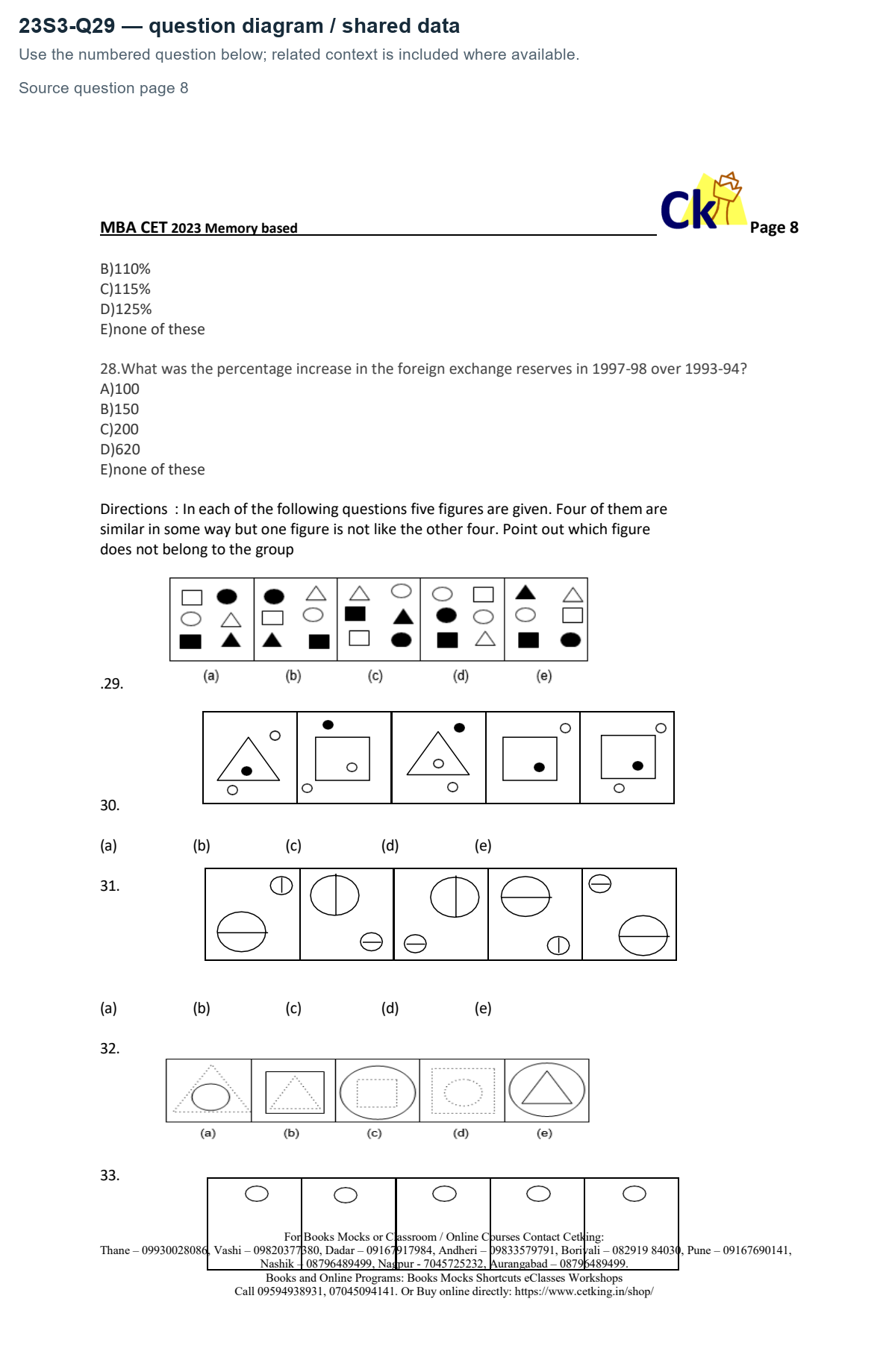
Answer: D. Figure (d) in the attached diagram
Solution — first steps
In four panels there is one hollow and one filled example of each type: square, circle, triangle. Panel(d) repeats the hollow circle and omits the filled triangle.
The full step-by-step working opens with a free login.