CET 2023 Slot 3 Question Paper with Solutions PDF – Page 11
All 200 questions of CET 2023 Slot 3. Tap Show answer, or open the detailed solution (free login). Page 11 of 42.
In the world of modern medicine, the role of genetics is rapidly expanding. Genetic testing is becoming
more common, and researchers are using genetic data to identify disease risk factors and develop new
treatments. However, there are also concerns about the potential ethical implications of genetic
research and the use of genetic information.
One potential issue is the use of genetic data in insurance and employment decisions. In some
countries, insurance companies are allowed to use genetic information to determine coverage and
premiums, and employers may use genetic information to make hiring and promotion decisions. Critics
argue that this practice is unfair and could lead to discrimination against individuals who are
genetically predisposed to certain conditions.
Another issue is the potential misuse of genetic information by law enforcement agencies. While DNA
evidence has helped solve many crimes, there are concerns about privacy and civil liberties when it
comes to genetic data. For example, law enforcement agencies may try to use genetic data to identify
individuals who have not been convicted of a crime or to determine a suspect's race or ethnicity.
Despite these concerns, there are also potential benefits of genetic research. For example, genetic
testing can help identify individuals who are at risk for certain conditions, which can lead to earlier
intervention and better outcomes. Genetic research can also lead to the development of more
targeted treatments that are tailored to an individual's genetic makeup.
What is a potential benefit of genetic testing? A) It can help identify individuals who are
at risk for certain conditions. B) It can lead to discrimination against individuals who are genetically
predisposed to certain conditions. C) It can help insurance companies determine coverage and
premiums. D) It can lead to employers hiring individuals based solely on their genetic makeup.
Answer: A. It can help identify individuals who are at risk for certain conditions.
Solution — first steps
The final paragraph identifies risk detection and earlier intervention as a benefit. A.
The full step-by-step working opens with a free login.
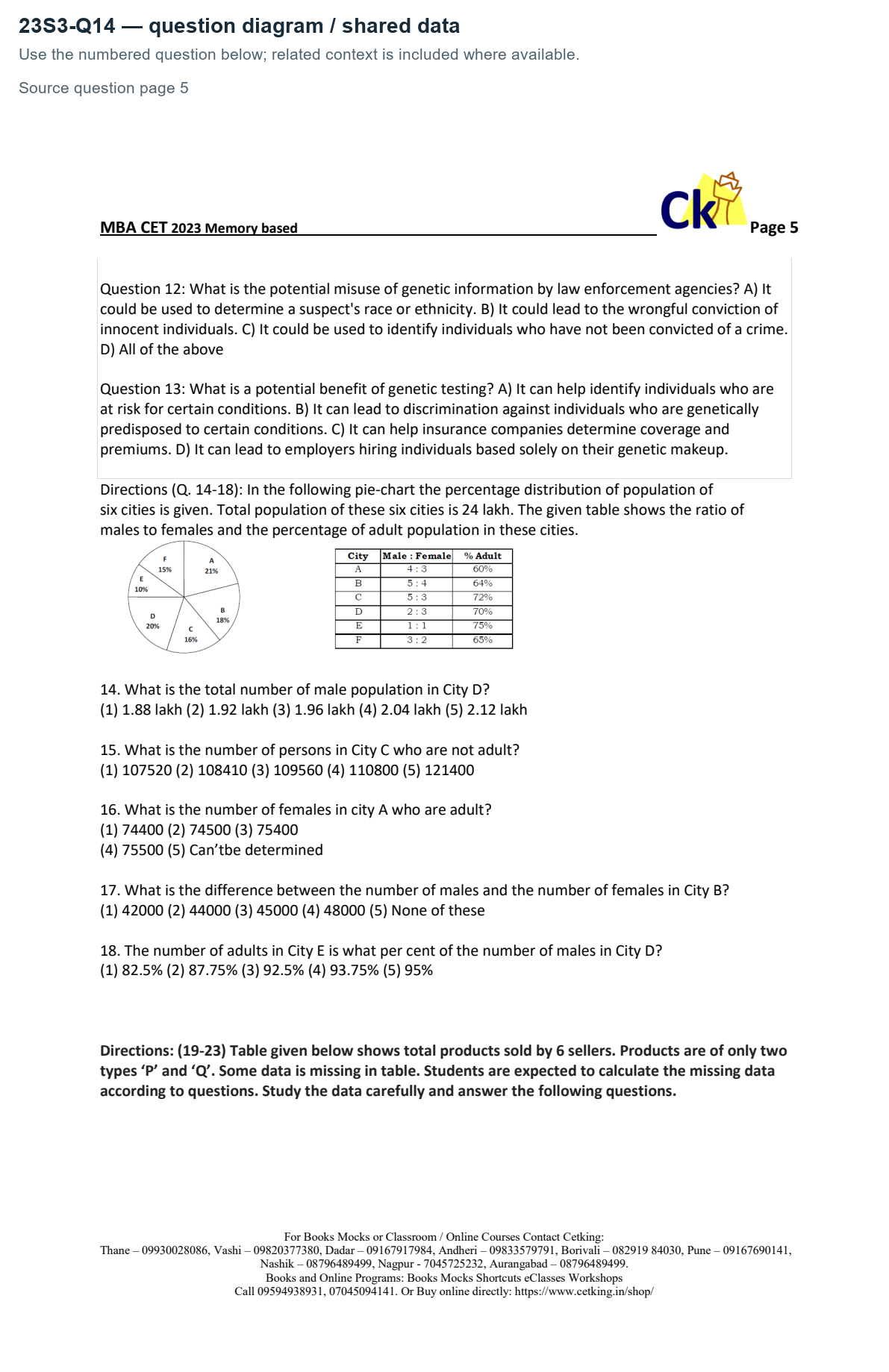
Directions (Q. 14-18): In the following pie-chart the percentage distribution of population of
six cities is given. Total population of these six cities is 24 lakh. The given table shows the ratio of
males to females and the percentage of adult population in these cities.
What is the total number of male population in City D?
(1) 1.88 lakh (2) 1.92 lakh (3) 1.96 lakh (4) 2.04 lakh (5) 2.12 lakh
Answer: B. 1.92 lakh
Solution — first steps
8lakh. Male share2/(2+3)=2/5.
The full step-by-step working opens with a free login.
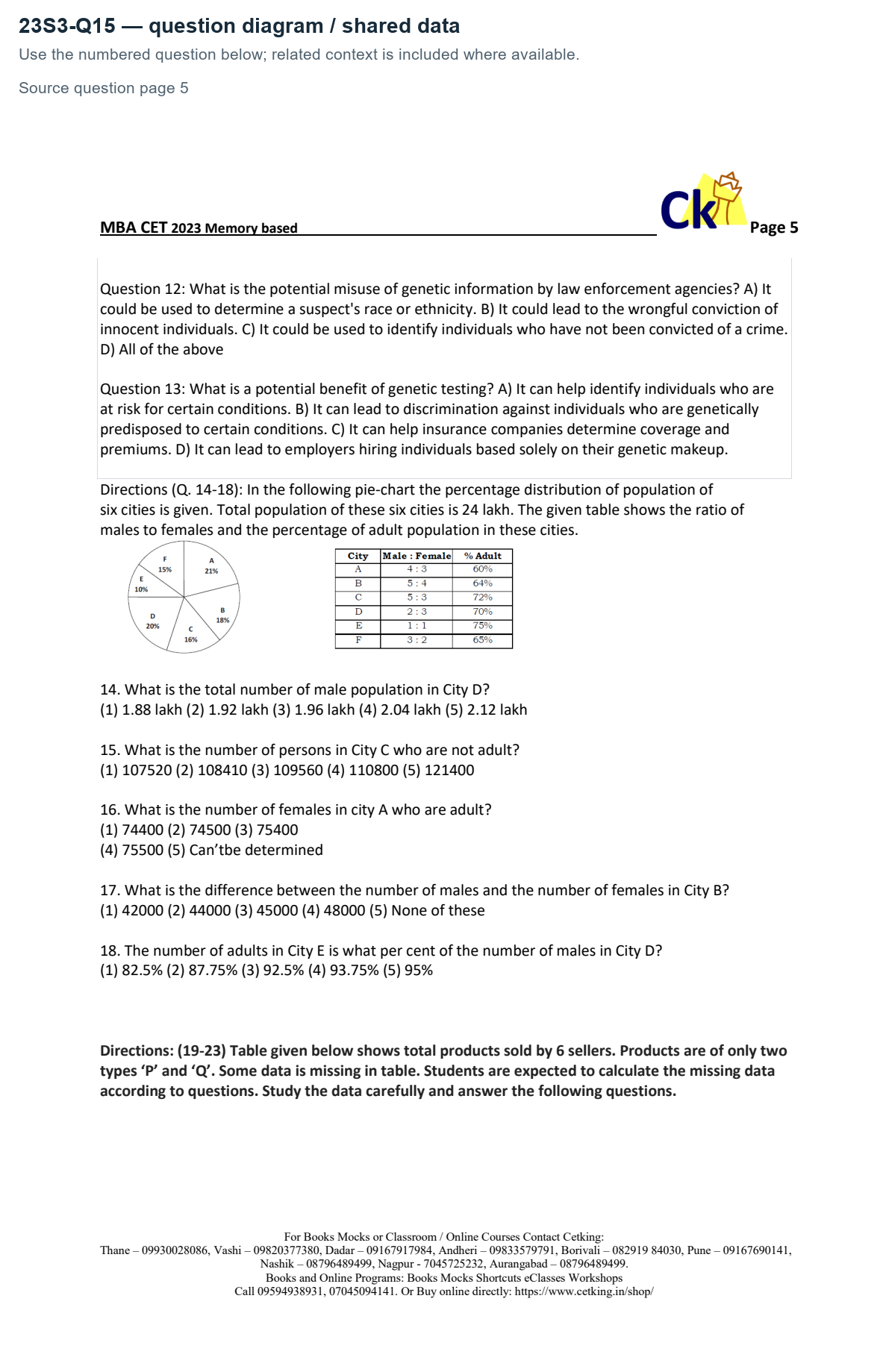
Directions (Q. 14-18): In the following pie-chart the percentage distribution of population of
six cities is given. Total population of these six cities is 24 lakh. The given table shows the ratio of
males to females and the percentage of adult population in these cities.
What is the number of persons in City C who are not adult?
(1) 107520 (2) 108410 (3) 109560 (4) 110800 (5) 121400
six cities is given. Total population of these six cities is 24 lakh. The given table shows the ratio of
males to females and the percentage of adult population in these cities.
What is the number of persons in City C who are not adult?
(1) 107520 (2) 108410 (3) 109560 (4) 110800 (5) 121400
Answer: A. 107520
Solution — first steps
CityC population=24,00,000×16%=3,84,000. Non-adults=28%×3,84,000=1,07,520.
The full step-by-step working opens with a free login.
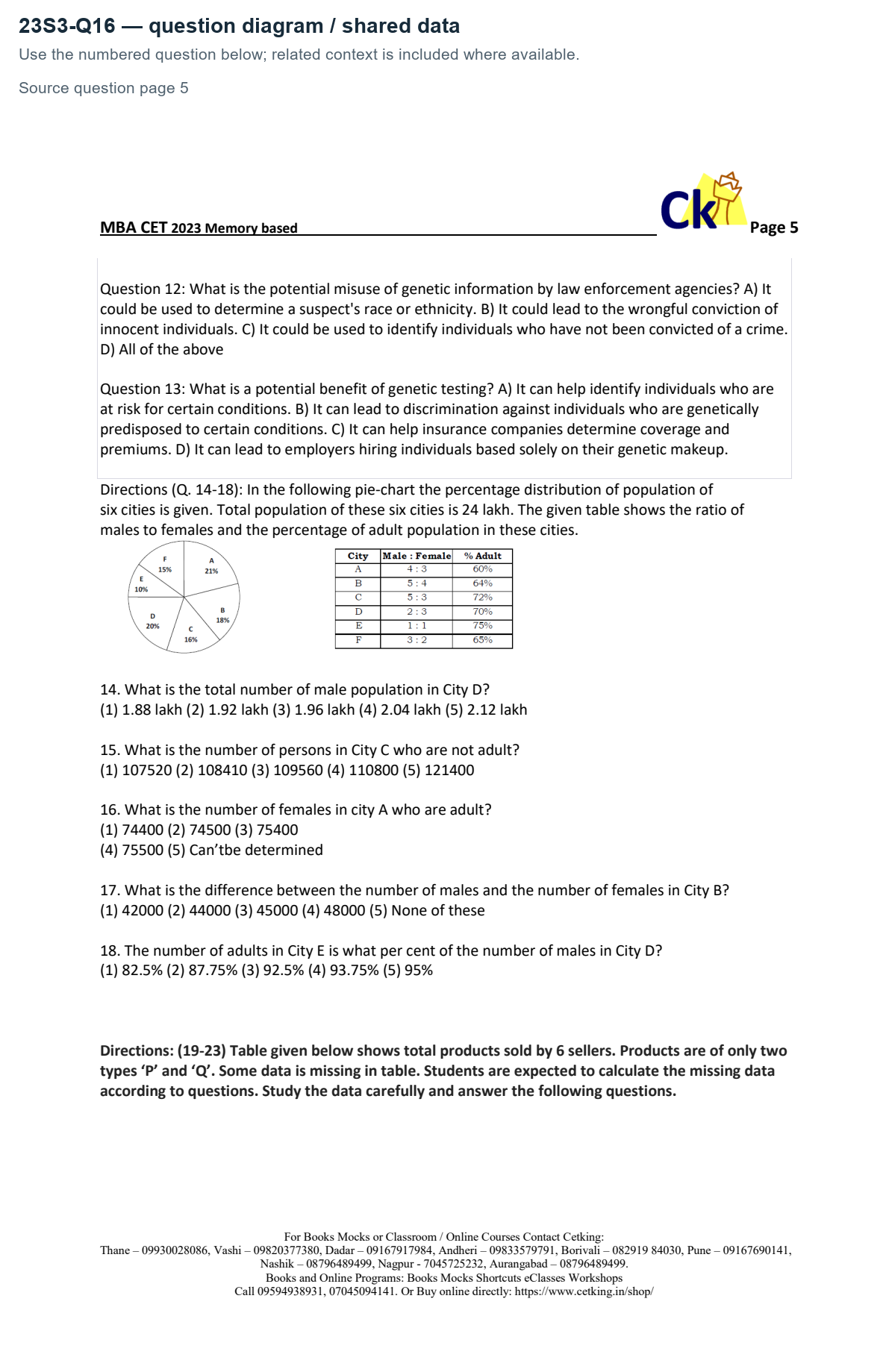
Directions (Q. 14-18): In the following pie-chart the percentage distribution of population of
six cities is given. Total population of these six cities is 24 lakh. The given table shows the ratio of
males to females and the percentage of adult population in these cities.
What is the number of females in city A who are adult?
(1) 74400 (2) 74500 (3) 75400
(4) 75500 (5) Can’tbe determined
six cities is given. Total population of these six cities is 24 lakh. The given table shows the ratio of
males to females and the percentage of adult population in these cities.
What is the number of females in city A who are adult?
(1) 74400 (2) 74500 (3) 75400
(4) 75500 (5) Can’tbe determined
Answer: E. Can’tbe determined
Solution — first steps
The table gives total adult percentage but no male/female breakdown of those adults. Total female population and total adult population do not determine their intersection.
The full step-by-step working opens with a free login.
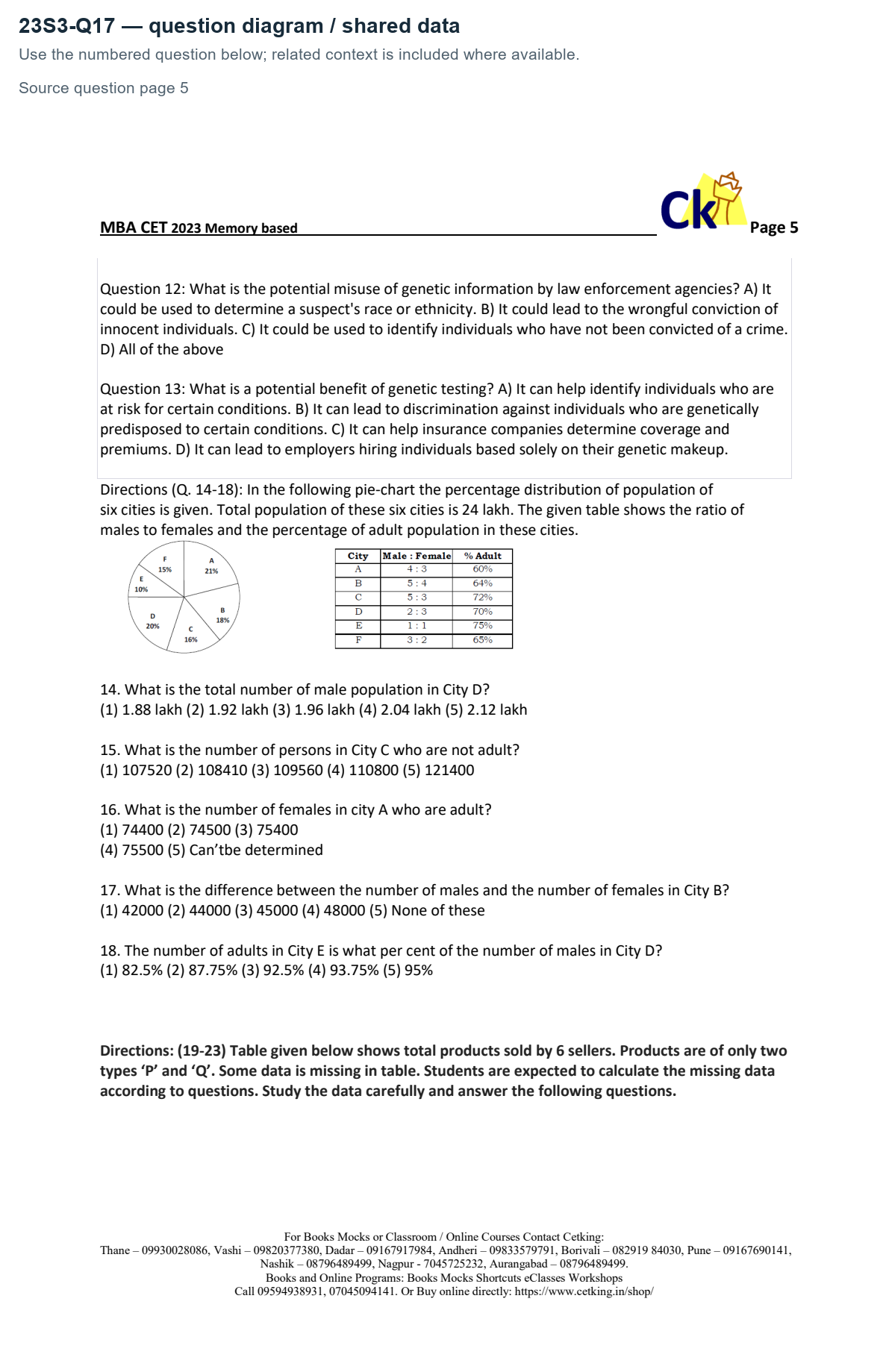
Directions (Q. 14-18): In the following pie-chart the percentage distribution of population of
six cities is given. Total population of these six cities is 24 lakh. The given table shows the ratio of
males to females and the percentage of adult population in these cities.
What is the difference between the number of males and the number of females in City B?
(1) 42000 (2) 44000 (3) 45000 (4) 48000 (5) None of these
Answer: D. 48000
Solution — first steps
CityB population=24,00,000×18%=4,32,000. Male:female5:4 implies difference1/9 of total=48,000.
The full step-by-step working opens with a free login.