DIRECTION for the question: In the following question, a series is given with term/s missing. Choose the correct alternative to replace the question mark in the given series.
589654237, 89654237, 8965423, 965423, ?
- A58965
- B65423
- C89654
- D96542
- E38965
Show answerHide answer
Answer: D ✓ official key
Approach: Alternate-end digit removal.
Solution:
589654237 → drop first digit (5) → 89654237
89654237 → drop last digit (7) → 8965423
8965423 → drop first digit (8) → 965423
965423 → next drop is the last digit (3) → 96542
Why the other options are wrong:
A (58965), C (89654), E (38965): contain digits (5/8) already removed from the front.
B (65423): drops the first digit again; the pattern alternates, so the last digit goes now.
Cetking shortcut: Compare lengths: each term is one digit shorter, so the answer must be 5 digits starting with 9 — only D.
Answer: D
DIRECTION for the question: In the following question, one term in the number series is wrong. Find out the wrong term.
125,126,124,127,123,129
- A126
- B124
- C123
- D129
- E125
Show answerHide answer
Answer: D ✓ official key
Approach: Difference series with alternating signs.
Solution:
125 → 126 (+1) → 124 (−2) → 127 (+3) → 123 (−4) → next should be 123 + 5 = 128.
The series shows 129, so 129 is the wrong term.
Why the other options are wrong:
A, B, C, E: 126, 124, 123, 125 all fit +1, −2, +3, −4.
Cetking shortcut: Write the differences first: 1, −2, 3, −4, 6 — the 6 breaks the 1-2-3-4-5 run.
Answer: D
DIRECTIONS for the question: In the following question, an alphabet series is given with term/s missing. Choose the correct alternative to replace the question mark in the given series.
SHG, RIF, QJE, PKD, ?
- ANME
- BNLB
- COLE
- DOLC
- ESRQ
Show answerHide answer
Answer: D ✓ official key
Approach: Track each letter position separately.
Solution:
1st letters: S, R, Q, P → O (−1 each step)
2nd letters: H, I, J, K → L (+1)
3rd letters: G, F, E, D → C (−1)
Next term = OLC
Why the other options are wrong:
A NME, B NLB: first letter should be O, not N.
C OLE: third letter should be C, not E.
E SRQ: repeats a different pattern entirely.
Cetking shortcut: First letter must be O (eliminates A, B, E); third must be C → D.
Answer: D
DIRECTIONS for the question: In the following question, a letter-number series is given, with one or more terms missing as shown by (?). Choose the missing term out of the given alternatives.
J2Z, K4X, I7V, ?, H16R, M22P
- AI11T
- BL11S
- CL12T
- DL11T
- EL12S
Show answerHide answer
Answer: D ✓ official key
Approach: Split the term into first letter, number and last letter.
Solution:
Numbers: 2, 4, 7, ?, 16, 22 → differences +2, +3, +4, +5, +6 → missing = 7 + 4 = 11.
Last letters: Z, X, V, ?, R, P → each −2 → missing = T.
First letters alternate: odd terms J, I, H (−1); even terms K, ?, M (+1) → missing = L.
Missing term = L11T
Why the other options are wrong:
A I11T: first letter should be L (even-position sub-series).
B L11S, E L12S: last letter must be T.
C L12T: number must be 11, not 12.
Cetking shortcut: The number 11 and the letter T alone leave only A and D; the even-position letter K→?→M gives L.
Answer: D
DIRECTIONS for the question: In the following letter series, some of the letters are missing which are given in that order as one of the alternatives below it. Choose the correct alternative.
m n o n o p q o p q r s _____
- Amnopq
- Boqrst
- Cpqrst
- Dqrstu
- Emnono
Show answerHide answer
Answer: C ✓ official key
Approach: Break the series into groups.
Solution:
m n o | n o p q | o p q r s | ...
Groups start at m, n, o → next group starts at p.
The next group therefore starts at p; among the options, the five-letter block that begins correctly is p q r s t.
Why the other options are wrong:
A mnopq, E mnono: restart from m — the start letter moves forward each group.
B oqrst: skips p and repeats o.
D qrstu: starts at q, one step too far.
Cetking shortcut: Each group starts one letter later than the previous one (m, n, o) — only C starts with p.
Answer: C
DIRECTIONS for the question : In the following question, choose one number which is similar to the numbers in the given set.
Given set : 363, 489, 579
- A562
- B471
- C382
- D281
- E666
Show answerHide answer
Answer: B ✓ official key
Approach: Test divisibility and parity.
Solution:
363: digit sum 12, odd → odd multiple of 3.
489: digit sum 21, odd → odd multiple of 3.
579: digit sum 21, odd → odd multiple of 3.
471: digit sum 12 → divisible by 3, and odd → matches.
Why the other options are wrong:
A 562 (sum 13), C 382 (sum 13), D 281 (sum 11): not divisible by 3.
E 666: divisible by 3 but even, unlike the set.
Cetking shortcut: Digit-sum test for 3 eliminates A, C, D at once; parity removes E.
Answer: B
DIRECTIONS for the question: In the following question, choose one number which is similar to the numbers in the given set.
Given set : 992, 733, 845, 632
- A114
- B326
- C425
- D947
- E858
Show answerHide answer
Answer: C ✓ official key
Approach: Look at the last digit and the digit sum of each number.
Solution:
733 → last digit 3 (prime), digit sum 13 (prime).
845 → last digit 5 (prime), digit sum 17 (prime).
632 → last digit 2 (prime), digit sum 11 (prime).
992 → last digit 2 (prime) (its digit sum 20 is the exception in the set).
425 → last digit 5 (prime), digit sum 11 (prime) → matches.
Why the other options are wrong:
A 114: last digit 4 not prime, sum 6 not prime.
B 326: sum 11 is prime but last digit 6 is not prime.
D 947: last digit 7 prime but sum 20 is not prime.
E 858: last digit 8 not prime, sum 21 not prime.
Cetking shortcut: Check the last digit first — only 425 and 947 end in a prime; the digit sum then picks 425.
Answer: C
DIRECTIONS for the question: In the following question, choose one number which is similar to the numbers in the given set.
Given set : 134, 246, 358
- A3725
- B4610
- C5720
- D6845
- E4693
Show answerHide answer
Answer: B ✓ official key
Approach: First digit + second digit = the rest of the number.
Solution:
134 → 1 + 3 = 4; 246 → 2 + 4 = 6; 358 → 3 + 5 = 8.
4610 → 4 + 6 = 10 → matches.
Why the other options are wrong:
A 3725: 3 + 7 = 10, not 25.
C 5720: 5 + 7 = 12, not 20.
D 6845: 6 + 8 = 14, not 45.
E 4693: 4 + 6 = 10, not 93.
Cetking shortcut: Options are 4-digit, so look for a pair of digits summing to a 2-digit tail — 4 + 6 = 10.
Answer: B
Complete the following analogy:
5 : 30 :: 7 : ?
- A70
- B56
- C72
- D42
- E37
Show answerHide answer
Answer: B ✓ official key
Approach: n : n × (n + 1).
Solution:
5 × 6 = 30.
7 × 8 = 56.
Why the other options are wrong:
D 42: 7 × 6 copies the multiplier, not the rule.
A 70, C 72, E 37: fit no rule linking 5 and 30.
Cetking shortcut: 30 = 5² + 5, so the answer is 7² + 7 = 56.
Answer: B
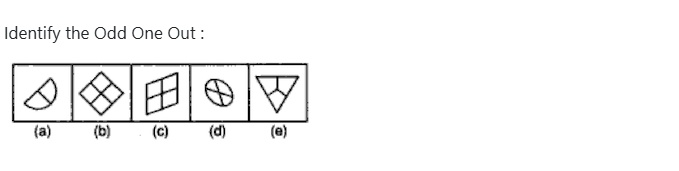
Identify the Odd One Out :
ALIDJ, ACZXV, FASJE, NDWVS, RSQOP
- AALIDJ
- BACZXV
- CFASJE
- DNDWVS
- ERSQOP
Show answerHide answer
Answer: D ✓ official key
Approach: Check each group for vowels.
Solution:
ALIDJ → A, I; ACZXV → A; FASJE → A, E; RSQOP → O.
NDWVS → no vowel → odd one.
Why the other options are wrong:
A, B, C, E: each contains at least one vowel.
Cetking shortcut: With random-looking letter groups, test vowels/consonants first.
Answer: D
DIRECTION for the question: In the following question, five numbers are given. Out of these, four are alike in a certain way, but the rest one is different. Choose the one which is different from the rest four.
a) 43 b) 53 c) 63 d)73 e) 83
- A43
- B53
- C63
- D73
- E83
Show answerHide answer
Answer: C ✓ official key
Approach: Prime check.
Solution:
43, 53, 73, 83 are all prime.
63 = 7 × 9 → composite → odd one.
Why the other options are wrong:
A 43, B 53, D 73, E 83: all prime.
Cetking shortcut: Digit sum of 63 is 9 → divisible by 3 instantly.
Answer: C
DIRECTION for the question: In the following question, five numbers are given. Out of these, four are alike in a certain way, but the rest one is different. Choose the one which is different from the rest four.
a) 2384 b) 1592 c) 3756 d) 4298 e) 3629
- A2384
- B1592
- C3756
- D4298
- E3629
Show answerHide answer
Answer: E ✓ official key
Approach: Check the last digit (parity).
Solution:
2384, 1592, 3756, 4298 end in 4, 2, 6, 8 → even.
3629 ends in 9 → odd → odd one.
Why the other options are wrong:
A, B, C, D: all even numbers.
Cetking shortcut: Look at last digits first.
Answer: E
DIRECTION for the question: In the following question, five groups of letters are given. One of these groups is different from the other four. Find the odd one.
1] MEWGN 2] PBQTX 3] DRYSN 4] CGHKV 5] HLWZP
- AMEWGN
- BPBQTX
- CDRYSN
- DCGHKV
- EHLWZP
Show answerHide answer
Answer: A ✓ official key
Approach: Check for vowels.
Solution:
PBQTX, DRYSN, CGHKV, HLWZP → no vowels.
MEWGN contains E → odd one.
Why the other options are wrong:
B, C, D, E: all consonant-only groups.
Cetking shortcut: Scan for A, E, I, O, U first.
Answer: A
DIRECTION for the question: In the following question, four of the given five pairs are alike in a certain way and hence form a group. Which one does not belong to that group?
a] LOCATE : OCLTAE b] EXAMIN : XAEIMN c] PLENTY : LEPTYN d] COWARD : OWCRAD e] ALWINS : LWANIS
- ALOCATE : OCLTAE
- BEXAMIN : XAEIMN
- CPLENTY : LEPTYN
- DCOWARD : OWCRAD
- EALWINS : LWANIS
Show answerHide answer
Answer: C ✓ official key
Approach: Split each word into two blocks of 3 and map positions.
Solution:
LOCATE: LOC → OCL (2-3-1), ATE → TAE (2-1-3).
EXAMIN: EXA → XAE (2-3-1), MIN → IMN (2-1-3).
COWARD: COW → OWC (2-3-1), ARD → RAD (2-1-3).
ALWINS: ALW → LWA (2-3-1), INS → NIS (2-1-3).
PLENTY: PLE → LEP (2-3-1), but NTY → TYN (2-3-1) — second block breaks the 2-1-3 rule → odd one.
Why the other options are wrong:
A, B, D, E: second block follows 2-1-3 (swap first two letters).
Cetking shortcut: The first blocks all match; compare only the last three letters of each code.
Answer: C
DIRECTION for the question: In the following question, four of the given five pairs are alike in a certain way and hence form a group. Which one does not belong to that group?
a] SUNDAY : NSVYDB b] MOTHER : TMPRHD c] PARENT : RPBTEO d] MOSTLY : SMPYTM e] SIMPLE : MSJEPM
- ASUNDAY : NSVYDB
- BMOTHER : TMPRHD
- CPARENT : RPBTEO
- DMOSTLY : SMPYTM
- ESIMPLE : MSJEPM
Show answerHide answer
Answer: B ✓ official key
Approach: Rule for each 3-letter half: (3rd)(1st)(2nd + 1).
Solution:
SUNDAY: SUN → N S V; DAY → Y D B → NSVYDB ✓
PARENT: PAR → R P B; ENT → T E O → RPBTEO ✓
MOSTLY: MOS → S M P; TLY → Y T M → SMPYTM ✓
SIMPLE: SIM → M S J; PLE → E P M → MSJEPM ✓
MOTHER: MOT → T M P; HER → R H F, but code shows R H D → odd one.
Why the other options are wrong:
A, C, D, E: both halves follow the rule exactly.
Cetking shortcut: Only the shifted letters (3rd and 6th of the code) need checking: V, B / P, D(✗) / B, O / P, M / J, M.
Answer: B
DIRECTION for the question: Solve the following question and mark the best possible option.
In a certain code language, BASIC is written as DDULE. How is LEADER written in that code?
- ANGCFGT
- BNHCGGU
- COGDFHT
- DOHDGHU
- EBASLEA
Show answerHide answer
Answer: B ✓ official key
Approach: Compare BASIC with DDULE letter by letter.
Solution:
B+2=D, A+3=D, S+2=U, I+3=L, C+2=E → pattern +2, +3, +2, +3, +2.
LEADER: L+2=N, E+3=H, A+2=C, D+3=G, E+2=G, R+3=U → NHCGGU.
Why the other options are wrong:
A NGCFGT: uses +2 throughout.
C OGDFHT, D OHDGHU: start with +3.
E BASLEA: no rule.
Cetking shortcut: First two letters decide it: L→N (+2), E→H (+3) — only B starts with NH.
Answer: B
In a certain code, '256' means 'red colour chalk', '589' means 'green colour flower' and '254' means 'white colour chalk'. The digit in the code that indicates 'white' is;
- A2
- B4
- C5
- D8
- E6
Show answerHide answer
Answer: B ✓ official key
Approach: Compare statements with common words.
Solution:
256 = red colour chalk; 254 = white colour chalk.
Common words colour, chalk ↔ common digits 2, 5.
So red = 6 and white = 4.
Why the other options are wrong:
A 2, C 5: shared by colour/chalk.
D 8: from green/flower.
E 6: red.
Cetking shortcut: Two statements differing in one word differ in one digit — 6 vs 4.
Answer: B
DIRECTIONS for the question: Solve the following question and mark the best possible option.
If ZIP =198 and ZAP = 246, how will u code VIP?
- A174
- B222
- C888
- D990
- E642
Show answerHide answer
Official CET key: A · Cetking's answer: B — see why below
Approach: Express each code as a multiple of a signed combination of the letters' alphabet positions.
Solution:
Positions: Z = 26, I = 9, P = 16, A = 1, V = 22.
ZIP = 198 = 6 × 33, and 33 = 26 − 9 + 16 (first − second + third).
Check with ZAP: 26 − 1 + 16 = 41; 41 × 6 = 246 ✓
Rule: code = 6 × (1st − 2nd + 3rd).
VIP: 22 − 9 + 16 = 29; 29 × 6 = 174.
Why the other options are wrong:
B 222: treats the first letter with the wrong sign (adds 6 × 4 instead of subtracting it when Z becomes V).
C 888, D 990, E 642: fit no rule consistent with ZIP and ZAP.
Cetking shortcut: Both given codes are multiples of 6; divide: 198 → 33, 246 → 41. Only the middle letter changes (I → A, 9 → 1), and 33 → 41 means the middle letter is subtracted. Then V is 4 below Z, so 33 − 4 = 29 → 29 × 6 = 174.
Answer: A
If 'sky' is 'star', 'star' is 'cloud', 'cloud' is 'earth', 'earth' is 'tree' and 'tree' is 'book' then where do the birds fly?
- ACloud
- BSky
- CStar
- DTree
- EBook
Show answerHide answer
Answer: C ✓ official key
Approach: Substitute the real answer by its code name.
Solution:
Birds fly in the sky.
'Sky' is called 'star' → answer Star.
Why the other options are wrong:
B Sky: the real word, not the coded one.
A Cloud: code of 'star'.
D Tree, E Book: codes of earth/tree.
Cetking shortcut: Find the real answer first, then read its 'is called' link once.
Answer: C
DIRECTIONS for the question: Solve the following question and mark the best possible option.
If 'sand' is called 'air', 'air', is called 'plateau', 'plateau' is called 'well', 'well' is called 'island' and 'island' is called 'sky', then from where will a woman draw water?
- AWell
- BIsland
- CSky
- DAir
- ESand
Show answerHide answer
Answer: B ✓ official key
Approach: Substitute the real answer by its code name.
Solution:
Water is drawn from a well.
'Well' is called 'island' → answer Island.
Why the other options are wrong:
A Well: real word, not the code.
C Sky: code of island.
D Air: the new name for sand. E Sand: not where water is drawn from.
Cetking shortcut: Real answer → one hop forward in the chain.
Answer: B
DIRECTION for the questions: Study the following information and answer the question given below.
Pointing to a man in a photograph, Asha said, "His mother's only daughter is my mother." How is Asha related to that man?
- ANephew
- BSister
- CWife
- DNiece
- EGrand daughter
Show answerHide answer
Answer: D ✓ official key
Approach: Decode the phrase from the inside out.
Solution:
His mother's only daughter = his sister.
His sister is Asha's mother → the man is Asha's maternal uncle.
Asha (female) is his niece.
Why the other options are wrong:
A Nephew: wrong gender.
B Sister: his sister is Asha's mother, not Asha.
C Wife, E Grand daughter: one generation off / not linked.
Cetking shortcut: 'Mother's only daughter' = sister; then it's a one-generation gap.
Answer: D
DIRECTION for the questions: Study the following information and answer the question given below.
Pointing to an old man, Kunal said, "His son is my son's uncle." How is the old man related to Kunal?
- ABrother
- BUncle
- CFather
- DGrandfather
- ENephew
Show answerHide answer
Answer: C ✓ official key
Approach: Work from Kunal's son.
Solution:
Kunal's son's uncle = Kunal's brother.
The old man's son is Kunal's brother → the old man is Kunal's father.
Why the other options are wrong:
A Brother: the brother is the old man's son.
B Uncle, D Grandfather: one generation off.
E Nephew: wrong direction.
Cetking shortcut: Son's uncle = my brother → his father = my father.
Answer: C
DIRECTION for the questions: Study the following information and answer the question given below.
A girl introduced a boy as the son of the daughter of the father of her uncle. The boy is girl's
- ABrother
- BSon
- CUncle
- DSon-in-law
- ENephew
Show answerHide answer
Answer: A ✓ official key
Approach: Decode step by step.
Solution:
Her uncle's father = her grandfather.
Grandfather's daughter = her mother (or aunt).
Son of her mother = her brother (cousin is not offered).
Why the other options are wrong:
B Son, D Son-in-law: wrong generation.
C Uncle: the boy is a grandchild of the grandfather, same generation as the girl.
E Nephew: one generation below.
Cetking shortcut: Grandfather's daughter's son is in the girl's own generation → brother.
Answer: A
DIRECTION for the questions: Study the following information and answer the question given below.
Pointing to a person, a man said to a woman, "His mother is the only daughter of your father." How was the woman related to the person?
- AAunt
- BMother
- CWife
- DDaughter
- EGrandmother
Show answerHide answer
Answer: B ✓ official key
Approach: Identify the only daughter.
Solution:
The man speaks to a woman: 'only daughter of your father' = the woman herself.
His (the person's) mother = the woman → she is his mother.
Why the other options are wrong:
A Aunt: would need a sister, but she is the only daughter.
C Wife, D Daughter, E Grandmother: wrong generation/relation.
Cetking shortcut: 'Only daughter of your father' addressed to a woman always means 'you'.
Answer: B
DIRECTION for the questions: Study the following information and answer the question given below.
Pointing to a photograph, a woman says, "This man's son's sister is my mother-in-law." How is the woman's husband related to the man in the photograph?
- AGrandson
- BSon
- CSon-in-law
- DNephew
- EBrother
Show answerHide answer
Answer: A ✓ official key
Approach: Decode the chain.
Solution:
This man's son's sister = this man's daughter.
She is the woman's mother-in-law → mother of the woman's husband.
So the husband is the son of the man's daughter → the man's grandson.
Why the other options are wrong:
B Son: the husband's mother is the man's daughter.
C Son-in-law: that is the husband's father.
D Nephew, E Brother: not linked this way.
Cetking shortcut: Mother-in-law → husband's mother; count down one generation from the man's daughter.
Answer: A
Questions 26–30 share this
DIRECTIONS for the questions: Study the following information carefully and answer the questions that follow.
In an examination, six subjects were available for a candidate of which only three had to be offered under the following conditions:
One who offered A had to offer B also and vice versa.
One who offered A could not offer E.
One who offered C or D could not offer F.
The distribution of the candidates over the subjects was as follows:
A-70; B-70; C-90; D –85; E-70; F-35
How many combinations were permitted?
- A4
- B5
- C6
- D7
- E12
Show answerHide answer
Answer: A ✓ official key
Approach: List every allowed 3-subject combination, then match subject totals.
Solution:
Rules: A ⇔ B; A ✗ E; C or D ✗ F.
With A (so B too): third subject from C, D, F (not E) → ABC, ABD, ABF.
Without A/B: choose 3 from C, D, E, F; F cannot go with C or D, so F is out → CDE.
Permitted combinations: ABC, ABD, ABF, CDE = 4.
Why the other options are wrong:
B 5, C 6, D 7, E 12: count combinations that break A⇔B, A✗E or the F rule (e.g. CEF, DEF, ABE).
Cetking shortcut: Fix the A-B pair first; the only combination without them is CDE.
Answer: A
Refer to the passage above ↑
How many candidates in all appeared for the examination?
- A120
- B130
- C140
- D380
- E440
Show answerHide answer
Answer: C ✓ official key
Approach: List every allowed 3-subject combination, then match subject totals.
Solution:
Rules: A ⇔ B; A ✗ E; C or D ✗ F.
With A (so B too): third subject from C, D, F (not E) → ABC, ABD, ABF.
Without A/B: choose 3 from C, D, E, F; F cannot go with C or D, so F is out → CDE.
Totals: F = 35 → ABF = 35. E = 70 → CDE = 70.
C = 90 = ABC + CDE → ABC = 20. D = 85 = ABD + CDE → ABD = 15.
Check: A = 20 + 15 + 35 = 70 ✓
Total = ABC + ABD + ABF + CDE = 20 + 15 + 35 + 70 = 140.
Why the other options are wrong:
D 380, E 440: not the total — adding all subject totals gives 420, which counts every candidate three times (420 ÷ 3 = 140).
Cetking shortcut: Sum of subject totals = 70+70+90+85+70+35 = 420; each candidate takes 3 subjects → 420 ÷ 3 = 140.
Answer: C
Refer to the passage above ↑
How many candidates offered the combination A + B + C?
- A15
- B20
- C35
- D70
- E100
Show answerHide answer
Answer: B ✓ official key
Approach: List every allowed 3-subject combination, then match subject totals.
Solution:
Rules: A ⇔ B; A ✗ E; C or D ✗ F.
With A (so B too): third subject from C, D, F (not E) → ABC, ABD, ABF.
Without A/B: choose 3 from C, D, E, F; F cannot go with C or D, so F is out → CDE.
Totals: F = 35 → ABF = 35. E = 70 → CDE = 70.
C = 90 = ABC + CDE → ABC = 20. D = 85 = ABD + CDE → ABD = 15.
Check: A = 20 + 15 + 35 = 70 ✓
A + B + C = 20.
Why the other options are wrong:
A 15: that is ABD.
C 35: ABF.
D 70: CDE or total A.
E 100: no combination.
Answer: B
Refer to the passage above ↑
How many candidates combined C with D?
- A15
- B20
- C35
- D70
- E120
Show answerHide answer
Answer: D ✓ official key
Approach: List every allowed 3-subject combination, then match subject totals.
Solution:
Rules: A ⇔ B; A ✗ E; C or D ✗ F.
With A (so B too): third subject from C, D, F (not E) → ABC, ABD, ABF.
Without A/B: choose 3 from C, D, E, F; F cannot go with C or D, so F is out → CDE.
C and D appear together only in CDE; E = 70 and E occurs only in CDE → C + D = 70.
Why the other options are wrong:
A 15 (ABD), B 20 (ABC), C 35 (ABF): other combinations.
E 120: no combination.
Cetking shortcut: E occurs only in CDE, so CDE = E total = 70.
Answer: D
Refer to the passage above ↑
How many candidates offered B and F?
- A15
- B20
- C35
- D70
- E240
Show answerHide answer
Answer: C ✓ official key
Approach: List every allowed 3-subject combination, then match subject totals.
Solution:
Rules: A ⇔ B; A ✗ E; C or D ✗ F.
With A (so B too): third subject from C, D, F (not E) → ABC, ABD, ABF.
Without A/B: choose 3 from C, D, E, F; F cannot go with C or D, so F is out → CDE.
F occurs only in ABF → B and F together = F total = 35.
Why the other options are wrong:
A 15 (ABD), B 20 (ABC), D 70 (CDE / total B).
E 240: no combination.
Cetking shortcut: F can only sit with A and B, so B + F = 35 directly.
Answer: C
DIRECTION for the question: Solve the following question and mark the best possible option.
Laxman went 15 km to the west from his house, then turned left and walked 20 km. He then turned East and walked 25 km and finally turning left covered 20 km. How far was he from his house?
- A5 km
- B10 km
- C40 km
- D80 km
- E60 km
Show answerHide answer
Answer: B ✓ official key
Approach: Track east-west and north-south separately.
Solution:
West 15 → turn left (facing west, left = south) 20 → east 25 → turn left (facing east, left = north) 20.
North-south: −20 + 20 = 0.
East-west: −15 + 25 = 10 km east.
Distance from house = 10 km.
Why the other options are wrong:
A 5 km: subtracts wrongly.
C 40 km: adds the two 20 km legs.
D 80 km: total distance walked.
E 60 km: no link.
Cetking shortcut: The two 20 km legs cancel; answer = 25 − 15 = 10.
Answer: B
DIRECTION for the question: Solve the following question and mark the best possible option.
If A is to the south of B and C is to the east of B, in which direction is A with respect to C?
- ANorth-east
- BNorth-west
- CSouth-east
- DSouth-west
- EWest
Show answerHide answer
Answer: D ✓ official key
Approach: Place B at the origin.
Solution:
A is south of B → A at (0, −y).
C is east of B → C at (x, 0).
From C, A is to the west and to the south → south-west.
Why the other options are wrong:
A North-east: direction of C from A (reversed).
B North-west, C South-east: one axis wrong.
E West: ignores the south component.
Cetking shortcut: A is left-and-down of C → south-west.
Answer: D
DIRECTION for the question: Solve the following question and mark the best possible option.
A is 40 m South-west of B. C is 40 m South-east of B. Then, C is in which direction of A?
- AEast
- BWest
- CNorth-east
- DSouth
- ENorth-west
Show answerHide answer
Answer: A ✓ official key
Approach: Place B at the origin.
Solution:
A: 40 m SW → (−a, −a). C: 40 m SE → (a, −a).
Same y-coordinate, C has larger x → C is due east of A.
Why the other options are wrong:
B West: A is west of C, not C of A.
C North-east, E North-west: both points are at the same level.
D South: they differ only east-west.
Cetking shortcut: Equal SW and SE legs are mirror images about the N-S line → the points are level.
Answer: A
DIRECTION for the question: Solve the following question and mark the best possible option.
P, Q, R and S are playing a game of carom. P, R and S, Q are partners. S is to the right of R who is facing west. Then, Q is facing
- ANorth
- BSouth
- CEast
- DWest
- ENorth-east
Show answerHide answer
Answer: A ✓ official key
Approach: Fix R and place the others.
Solution:
Partners sit opposite: P opposite R, S opposite Q.
R faces west → R's right side is north → S sits on the north side, facing south.
Q sits opposite S (south side) and faces the board → north.
Why the other options are wrong:
B South: that is S's facing direction.
C East: P's facing direction.
D West: R's direction.
E North-east: players face straight across the board.
Cetking shortcut: Facing west, right = north; Q opposite S faces the opposite way to S.
Answer: A
DIRECTION for the question: Solve the following question and mark the best possible option.
A boy rode his bicycle northwards, he then turned leftwards and rode one km. He again turned left and rode 2 km. Finally, he found himself exactly one km west of his starting point. How far did the boy ride northward initially?
- A1 km
- B2 km
- C3 km
- D5 km
- E11 km
Show answerHide answer
Answer: B ✓ official key
Approach: Let the first northward leg be x.
Solution:
North x → left (west) 1 km → left (south) 2 km.
Final position: (−1, x − 2). It is exactly 1 km west of start → x − 2 = 0.
x = 2 km.
Why the other options are wrong:
A 1 km: would leave him 1 km south-west.
C 3 km, D 5 km, E 11 km: leave him north/south of the start line.
Cetking shortcut: 'Exactly west' means no north-south gap: north leg = south leg = 2 km.
Answer: B
Questions 36–40 share this
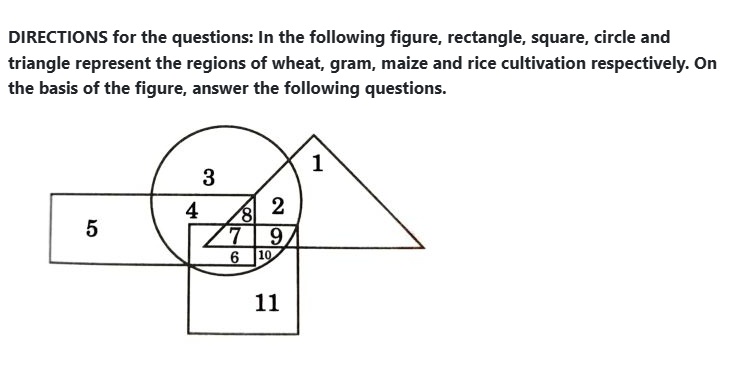
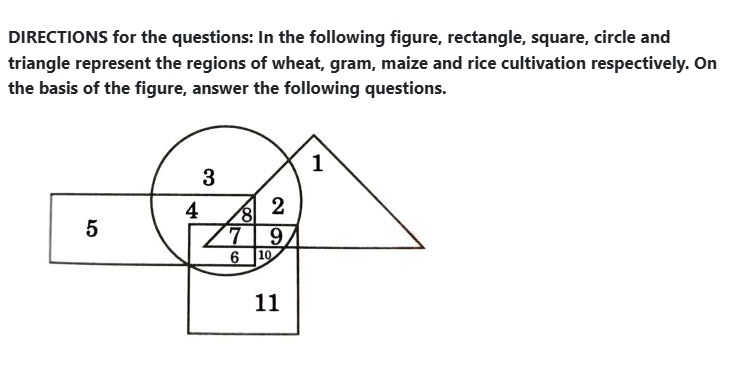
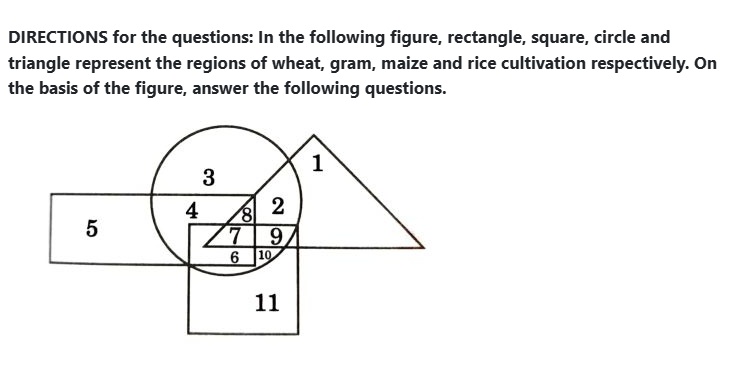
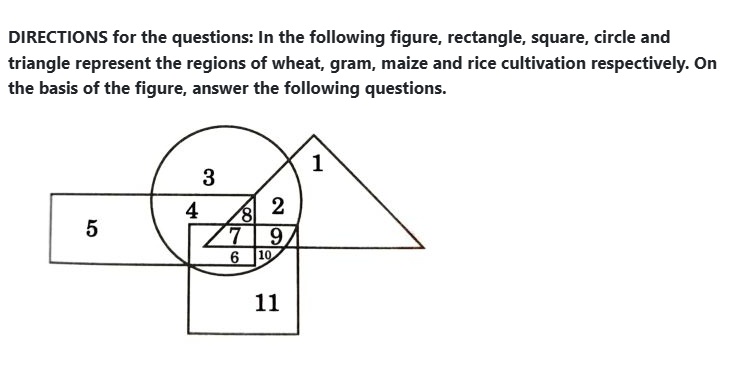
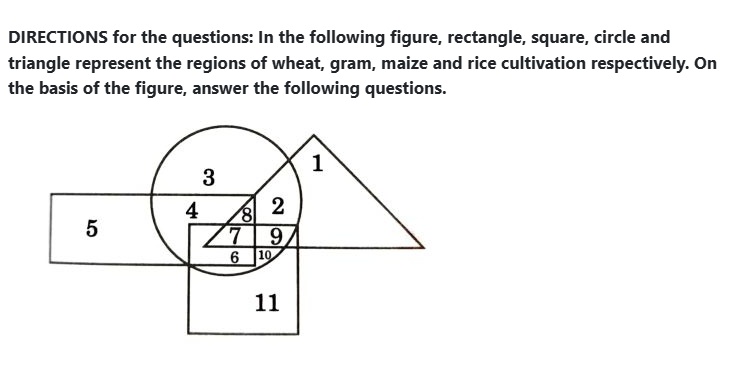
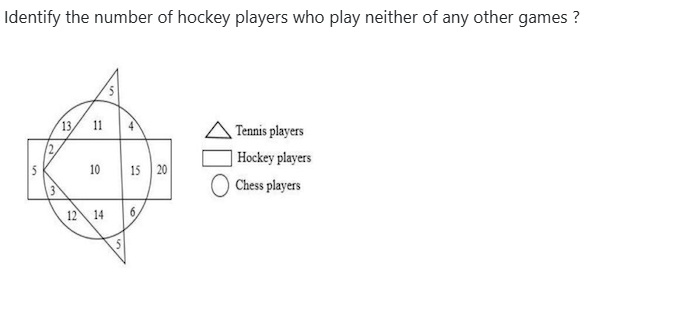
DIRECTIONS for the questions: In the following figure, rectangle, square, circle and triangle represent the regions of wheat, gram, maize and rice cultivation respectively. On the basis of the figure, answer the following questions.
Which area is cultivated by all four commodities?
- A7
- B8
- C9
- D2
- E1
Show answerHide answer
Answer: A ✓ official key
Approach: Rectangle = wheat, square = gram, circle = maize, triangle = rice; check which shapes enclose each region.
Solution:
Region map: 1 = rice only; 2 = maize + rice; 3 = maize only; 4 = wheat + maize; 5 = wheat only; 6 = wheat + maize + gram; 7 = all four; 8 = wheat + maize + rice; 9 = maize + gram + rice; 10 = maize + gram; 11 = gram only.
Region 7 lies inside the rectangle, the square, the circle and the triangle → 7.
Why the other options are wrong:
B 8: above the square (no gram).
C 9: right of the rectangle edge (no wheat).
D 2: maize + rice only.
E 1: rice only.
Cetking shortcut: Look for the region that is inside the square AND left of the rectangle's right edge AND above the triangle's base.
Answer: A
Refer to the passage above ↑
Which area is cultivated by wheat and maize only?
- A8
- B6
- C5
- D4
- E3
Show answerHide answer
Answer: D ✓ official key
Approach: Rectangle = wheat, square = gram, circle = maize, triangle = rice; check which shapes enclose each region.
Solution:
Region map: 1 = rice only; 2 = maize + rice; 3 = maize only; 4 = wheat + maize; 5 = wheat only; 6 = wheat + maize + gram; 7 = all four; 8 = wheat + maize + rice; 9 = maize + gram + rice; 10 = maize + gram; 11 = gram only.
Region 4 is inside the rectangle and the circle only → 4.
Why the other options are wrong:
A 8: also rice.
B 6: also gram.
C 5: wheat only.
E 3: maize only.
Answer: D
Refer to the passage above ↑
Which area is cultivated by rice only?
- A5
- B1
- C2
- D11
- E3
Show answerHide answer
Answer: B ✓ official key
Approach: Rectangle = wheat, square = gram, circle = maize, triangle = rice; check which shapes enclose each region.
Solution:
Region map: 1 = rice only; 2 = maize + rice; 3 = maize only; 4 = wheat + maize; 5 = wheat only; 6 = wheat + maize + gram; 7 = all four; 8 = wheat + maize + rice; 9 = maize + gram + rice; 10 = maize + gram; 11 = gram only.
Region 1 is the tip of the triangle outside every other shape → 1.
Why the other options are wrong:
A 5: wheat only.
C 2: rice + maize.
D 11: gram only.
E 3: maize only.
Answer: B
Refer to the passage above ↑
Which area is cultivated by maize only?
- A10
- B2
- C3
- D4
- E11
Show answerHide answer
Answer: C ✓ official key
Approach: Rectangle = wheat, square = gram, circle = maize, triangle = rice; check which shapes enclose each region.
Solution:
Region map: 1 = rice only; 2 = maize + rice; 3 = maize only; 4 = wheat + maize; 5 = wheat only; 6 = wheat + maize + gram; 7 = all four; 8 = wheat + maize + rice; 9 = maize + gram + rice; 10 = maize + gram; 11 = gram only.
Region 3 is inside the circle only → 3.
Why the other options are wrong:
A 10: maize + gram.
B 2: maize + rice.
D 4: maize + wheat.
E 11: gram only.
Answer: C
Refer to the passage above ↑
Which area is cultivated by rice and maize and nothing else?
- A9
- B8
- C2
- D7
- E5
Show answerHide answer
Answer: C ✓ official key
Approach: Rectangle = wheat, square = gram, circle = maize, triangle = rice; check which shapes enclose each region.
Solution:
Region map: 1 = rice only; 2 = maize + rice; 3 = maize only; 4 = wheat + maize; 5 = wheat only; 6 = wheat + maize + gram; 7 = all four; 8 = wheat + maize + rice; 9 = maize + gram + rice; 10 = maize + gram; 11 = gram only.
Region 2 is inside the circle and the triangle only → 2.
Why the other options are wrong:
A 9: also gram.
B 8: also wheat.
D 7: all four.
E 5: wheat only.
Answer: C
Questions 41–42 share this
DIRECTION for the question: Read the following information carefully and answer the question given below.
If letters from A to M were written, leaving space for one letter between every two letters, and then the remaining letters were inserted, beginning with N and ending the series with Z after M, answer the following questions:
Which letter would be third to the right of the seventh letter from the left?
- AC
- BO
- CR
- DS
- EA
Show answerHide answer
Answer: C ✓ official key
Approach: Write the new series: A–M in odd positions, N–Z in the gaps.
Solution:
Arrangement: A N B O C P D Q E R F S G T H U I V J W K X L Y M Z (positions 1–26).
7th from left = D.
Third to the right of D (position 7) = position 10 = R.
Why the other options are wrong:
A C: position 5.
B O: position 4 (counting left).
D S: position 12.
E A: position 1.
Cetking shortcut: Odd positions hold A–M: position 2k − 1 = k-th letter; even position 2k = (13 + k)-th letter. Position 10 → 13 + 5 = 18th = R.
Answer: C
Refer to the passage above ↑
Which letter would be exactly between D and K?
- AS
- BT
- CV
- DW
- EB
Show answerHide answer
Answer: B ✓ official key
Approach: Write the new series: A–M in odd positions, N–Z in the gaps.
Solution:
Arrangement: A N B O C P D Q E R F S G T H U I V J W K X L Y M Z (positions 1–26).
D is at position 7, K at position 21.
Middle position = (7 + 21) ÷ 2 = 14 → letter at 14 = T.
Why the other options are wrong:
A S: position 12.
C V: position 18.
D W: position 20.
E B: position 3.
Cetking shortcut: Even position 14 → (13 + 7)th letter = T.
Answer: B
Questions 43–45 share this
DIRECTION for the question: Study the letter-series given below and answer the questions that follow.
H D Y S M W N B Q P O C R T B L Z V E G U F
Which two neighbours in the given arrangement are farthest in the alphabetical order?
- AB and Q
- BD and Y
- CU and F
- DV and E
- EQ and O
Show answerHide answer
Answer: B ✓ official key
Approach: Compare the given arrangement with alphabetical positions.
Solution:
Series positions: 1 H, 2 D, 3 Y, 4 S, 5 M, 6 W, 7 N, 8 B, 9 Q, 10 P, 11 O, 12 C, 13 R, 14 T, 15 B, 16 L, 17 Z, 18 V, 19 E, 20 G, 21 U, 22 F.
Option pairs and gaps: B–Q = 15, D–Y = 25 − 4 = 21, U–F = 15, V–E = 17, Q–O = 2.
Largest gap = D and Y (21).
Why the other options are wrong:
A B–Q: 15.
C U–F: 15.
D V–E: 17.
E Q–O: 2 (and they are not neighbours).
Cetking shortcut: Only check option pairs — D (4) vs Y (25) is the obvious extreme.
Answer: B
Refer to the passage above ↑
Which letter has the same neighbours as in the alphabetical order though they have changed places?
- AM
- BN
- CO
- DP
- ED
Show answerHide answer
Answer: D ✓ official key
Approach: Compare the given arrangement with alphabetical positions.
Solution:
Series positions: 1 H, 2 D, 3 Y, 4 S, 5 M, 6 W, 7 N, 8 B, 9 Q, 10 P, 11 O, 12 C, 13 R, 14 T, 15 B, 16 L, 17 Z, 18 V, 19 E, 20 G, 21 U, 22 F.
P (position 10) has neighbours Q and O.
In the alphabet P lies between O and Q — same neighbours, sides swapped → P.
Why the other options are wrong:
A M: neighbours S, W.
B N: neighbours W, B.
C O: neighbours P, C.
E D: neighbours H, Y.
Cetking shortcut: Look for a run of three consecutive letters reversed — Q P O.
Answer: D
Refer to the passage above ↑
Which three letters have the same distance as they have in the alphabetical order though they have changed places?
- AHMP
- BNQZ
- CQOE
- DYLF
- EHDY
Show answerHide answer
Answer: D ✓ official key
Approach: Compare the given arrangement with alphabetical positions.
Solution:
Series positions: 1 H, 2 D, 3 Y, 4 S, 5 M, 6 W, 7 N, 8 B, 9 Q, 10 P, 11 O, 12 C, 13 R, 14 T, 15 B, 16 L, 17 Z, 18 V, 19 E, 20 G, 21 U, 22 F.
Y, L, F are at positions 3, 16, 22 → gaps 13 and 6.
In the alphabet F = 6, L = 12, Y = 25 → gaps 6 and 13.
Same distances, order reversed → YLF.
Why the other options are wrong:
A HMP: series gaps 4, 5; alphabet gaps 5, 3.
B NQZ: series gaps 2, 8; alphabet 3, 9.
C QOE: series gaps 2, 8; alphabet 10, 2.
E HDY: series gaps 1, 1; alphabet 4, 17.
Cetking shortcut: Compute only the first gap for each option and match it to an alphabet gap — Y to L is 13 in both.
Answer: D
Questions 46–47 share this
DIRECTION for the question: Study the following arrangement and mark the best possible option.
C B T A E X F I M K E U V N X O D
If all the vowels are dropped from the given arrangement, which of the following is 9th from the right end?
- AT
- BX
- CB
- DF
- EC
Show answerHide answer
Answer: A ✓ official key
Approach: Mark vowels (A, E, I, O, U) and consonants, then count carefully.
Solution:
Drop A, E, I, E, U, O → C B T X F M K V N X D (11 letters).
9th from the right = (11 − 9 + 1) = 3rd from the left = T.
Why the other options are wrong:
B X: 4th from left (8th from right).
C B: 2nd from left (10th from right).
D F: 5th from left.
E C: 1st from left.
Cetking shortcut: Position from right = n − k + 1 from left: 11 − 9 + 1 = 3.
Answer: A
Refer to the passage above ↑
How many such consonants are there which are immediately followed by a consonant and immediately preceded by a vowel?
- ASeven
- BOne
- CTwo
- DThree
- EFour
Show answerHide answer
Answer: D ✓ official key
Approach: Mark vowels (A, E, I, O, U) and consonants, then count carefully.
Solution:
Positions: 1 C, 2 B, 3 T, 4 A, 5 E, 6 X, 7 F, 8 I, 9 M, 10 K, 11 E, 12 U, 13 V, 14 N, 15 X, 16 O, 17 D.
Pattern needed: vowel, consonant, consonant.
E X F → X ✓; I M K → M ✓; U V N → V ✓.
Others fail (e.g. A E X: E is a vowel; O D: D has nothing after it). Count = 3.
Why the other options are wrong:
A Seven, E Four: count consonants without checking both neighbours.
B One, C Two: miss a match such as U V N.
Cetking shortcut: Start from each vowel that is followed by a consonant and check just the next letter.
Answer: D
Questions 48–50 share this
Direction for the question: Study the following number sequence and answer the question given below it.
5 1 4 7 3 9 8 5 7 2 6 3 1 5 8 6 3 8 5 2 2 4 3 4 9 6
How many odd numbers are there in the sequence each of which is immediately followed by an odd number?
- A8
- B2
- C3
- D6
- E5
Show answerHide answer
Official CET key: D · Cetking's answer: E — see why below
Approach: Mark each number O (odd) or E (even), then scan for the pattern.
Solution:
Sequence: 5 1 4 7 3 9 8 5 7 2 6 3 1 5 8 6 3 8 5 2 2 4 3 4 9 6.
Parity: O O E O O O E O O E E O O O E E O E O E E E O E O E.
Odd → odd pairs: (5,1), (7,3), (3,9), (5,7), (3,1), (1,5).
Count = 6.
Why the other options are wrong:
E 5: misses one overlapping pair such as (3,9) after (7,3).
A 8, B 2, C 3: miscount the pairs.
Cetking shortcut: Each run of k odd numbers gives k − 1 pairs: runs 5 1 (1), 7 3 9 (2), 5 7 (1), 3 1 5 (2) → 6.
Answer: D
Refer to the passage above ↑
How many even numbers are there in the sequence which are immediately preceded by an odd but immediately followed by an even number ?
- A1
- B2
- C3
- D4
- Emore than 4
Show answerHide answer
Answer: C ✓ official key
Approach: Mark each number O (odd) or E (even), then scan for the pattern.
Solution:
Sequence: 5 1 4 7 3 9 8 5 7 2 6 3 1 5 8 6 3 8 5 2 2 4 3 4 9 6.
Pattern needed: odd, even, even.
7 2 6 ✓; 5 8 6 ✓; 5 2 2 ✓. (9 8 5, 3 8 5, 3 4 9, 1 4 7 fail.)
Count = 3.
Why the other options are wrong:
A 1, B 2: miss a match.
D 4, E more than 4: include cases like 3 8 5 or 3 4 9.
Cetking shortcut: Check only evens that start an even pair: 2 6, 8 6, 2 2, 2 4 — then see which has an odd before it.
Answer: C
Refer to the passage above ↑
How many odd numbers are there in the sequence which are immediately preceded and also immediately followed by an even number?
- A1
- B2
- C3
- D4
- Emore than 4
Show answerHide answer
Answer: D ✓ official key
Approach: Mark each number O (odd) or E (even), then scan for the pattern.
Solution:
Sequence: 5 1 4 7 3 9 8 5 7 2 6 3 1 5 8 6 3 8 5 2 2 4 3 4 9 6.
Pattern needed: even, odd, even.
6 3 8 ✓; 8 5 2 ✓; 4 3 4 ✓; 4 9 6 ✓.
Count = 4.
Why the other options are wrong:
A 1, B 2, C 3: miss a match near the end.
E more than 4: includes cases like 4 7 3 or 8 5 7.
Cetking shortcut: Isolated odd numbers (odd with evens on both sides) are easy to spot on the parity string: E O E.
Answer: D
DIRECTION for the questions: Solve the following question and mark the best possible option.
Ravi is 7 ranks ahead of Sumit in a class of 39. If Sumit's rank is seventeenth from the last, what is Ravi's rank from the start?
- A14th
- B15th
- C16th
- D17th
- E30th
Show answerHide answer
Answer: C ✓ official key
Approach: Convert Sumit's rank from the end into a rank from the start, then move 7 places ahead.
Solution:
Sumit from start = 39 − 17 + 1 = 23rd.
Ravi is 7 ranks ahead → 23 − 7 = 16th.
Why the other options are wrong:
A 14th / B 15th: arithmetic slips (forgetting the +1 or subtracting 8–9).
D 17th: uses Sumit's rank from the end directly.
E 30th: adds 7 instead of subtracting.
Cetking shortcut: Ravi from the end = 17 + 7 = 24th, so from start = 39 − 24 + 1 = 16.
Answer: C
DIRECTION for the questions: Solve the following question and mark the best possible option.
Ajay left home for the bus stop 15 minutes earlier than usual. It takes 10 minutes to reach the stop. He reached the stop at 8.40 am. What time does he usually leave the home for the bus stop?
- A8.30 am
- B8.45 am
- C8.55 am
- D8.15 am
- E8.50 am
Show answerHide answer
Answer: B ✓ official key
Approach: Actual departure = arrival − travel time; usual departure = actual departure + 15 min.
Solution:
Reached the stop at 8.40 am; travel takes 10 min → left home today at 8.30 am.
Today he left 15 min earlier than usual → usual departure = 8.30 + 0.15 = 8.45 am.
Why the other options are wrong:
A 8.30: that is today's departure, not the usual one.
C 8.55: adds 15 min to the arrival time.
D 8.15: subtracts 15 min instead of adding.
E 8.50: adds only 10 min to the arrival.
Answer: B
Questions 53–56 share this
DIRECTIONS for the questions: Study the following information carefully and answer the question given below.
In an imaginary language, the digits 0, 1, 2, 3, 4, 5, 6, 7, 8 and 9 are substituted by a, b, c, d, e, f, g, h, i and j. And 10 is written as ba.
- A684
- B816
- C916
- D1564
- E800
Show answerHide answer
Answer: B ✓ official key
Approach: Digits 0–9 are coded a–j: a=0, b=1, c=2, d=3, e=4, f=5, g=6, h=7, i=8, j=9.
Solution:
cd = 23, ef = 45, bc = 12.
(23 + 45) × 12 = 68 × 12 = 816.
Why the other options are wrong:
A 684, C 916, D 1564, E 800: come from mis-decoding a letter (e.g. taking a = 1) or a multiplication slip.
Cetking shortcut: Unit digit check: 8 × 2 = 16 → answer ends in 6, leaving only 816 or 916; 68 × 12 is clearly below 900.
Answer: B
Refer to the passage above ↑
dc × f – (bf – d) × d is equal to
- Aabb
- Babe
- Cbce
- Dbcf
- Eaaa
Show answerHide answer
Answer: C ✓ official key
Approach: Digits 0–9 are coded a–j: a=0, b=1, c=2, d=3, e=4, f=5, g=6, h=7, i=8, j=9. Solve brackets first, then encode the answer.
Solution:
dc = 32, f = 5, bf = 15, d = 3.
32 × 5 = 160.
(15 − 3) × 3 = 12 × 3 = 36.
160 − 36 = 124 → 1 = b, 2 = c, 4 = e → bce.
Why the other options are wrong:
A abb (011), B abe (014), D bcf (125), E aaa (000): none equals 124.
Answer: C
Refer to the passage above ↑
- Adf
- Bcb
- Cbe
- Dd
- Ea
Show answerHide answer
Answer: B ✓ official key
Approach: Digits 0–9 are coded a–j: a=0, b=1, c=2, d=3, e=4, f=5, g=6, h=7, i=8, j=9. ÷ and × have equal priority → work left to right.
Solution:
baf = 105, bf = 15, d = 3.
105 ÷ 15 = 7; 7 × 3 = 21 → 2 = c, 1 = b → cb.
Why the other options are wrong:
A df = 35, C be = 14, D d = 3, E a = 0: none equals 21.
Answer: B
Refer to the passage above ↑
bee + fg - (ca × h/be) is equal to
- Abhc
- Bbic
- Cbib
- Dbja
- Eaaa
Show answerHide answer
Answer: D ✓ official key
Approach: Digits 0–9 are coded a–j: a=0, b=1, c=2, d=3, e=4, f=5, g=6, h=7, i=8, j=9. Bracket first, then add/subtract.
Solution:
bee = 144, fg = 56, ca = 20, h = 7, be = 14.
Bracket: 20 × 7 / 14 = 140 / 14 = 10.
144 + 56 − 10 = 190 → 1 = b, 9 = j, 0 = a → bja.
Why the other options are wrong:
A bhc = 172, B bic = 182, C bib = 181, E aaa = 0: none equals 190.
Answer: D
DIRECTION for the question: Solve the following question and mark the best possible option.
If × means -, + means ÷, - means × and ÷ means × and ÷ means +, then 15 – 2 ÷ 900 + 90 × 100 =?
- A190
- B180
- C- 90
- D0
- E- 60
Show answerHide answer
Answer: E ✓ official key
Approach: Substitute: × → −, + → ÷, − → ×, ÷ → +, then use BODMAS.
Solution:
15 – 2 ÷ 900 + 90 × 100
→ 15 × 2 + 900 ÷ 90 − 100
= 30 + 10 − 100
= −60.
Why the other options are wrong:
A 190 / B 180: results of doing the operations left to right without BODMAS or swapping signs.
C −90 / D 0: arithmetic slips (e.g. 900 ÷ 90 taken as 0 or 30 dropped).
Cetking shortcut: The statement prints '÷ means ×' and '÷ means +'. Since − already means ×, ÷ must mean + (with ÷ = × the result is 200, not an option).
Answer: E
Questions 58–62 share this
DIRECTION for the question: Study the following information carefully and answer the question given below.
Data on 450 candidates, who took an examination in Social Sciences, Mathematics and Science, is given below:
| Category | Number of candidates |
|---|
| Passed in all the subjects | 167 |
| Failed in all the subjects | 60 |
| Failed in Social Sciences | 175 |
| Failed in Mathematics | 199 |
| Failed in Science | 191 |
| Passed in Social Sciences only | 62 |
| Passed in Mathematics only | 48 |
| Passed in Science only | 52 |
How many failed in social science only?
- A15
- B21
- C30
- D42
- E199
Show answerHide answer
Answer: A ✓ official key
Approach: Work in 'passed' regions; failed only in SS = passed in Maths and Science only.
Setting up (common to the set): Total 450. Pass all 3 = 167, fail all 3 = 60. Pass only SS = 62, only Maths = 48, only Science = 52. Let x = pass SS & Maths only, y = pass SS & Sci only, z = pass Maths & Sci only.
Failed SS (175) = 60 + 48 + 52 + z → z = 15.
Failed Maths (199) = 60 + 62 + 52 + y → y = 25.
Failed Science (191) = 60 + 62 + 48 + x → x = 21.
Check: 167 + 60 + 62 + 48 + 52 + 21 + 25 + 15 = 450 ✓
Solution: Failed in Social Sciences only = passed Maths & Science only = z = 15.
Why the other options are wrong:
B 21 = x (failed Science only).
C 30, D 42: no region equals these.
E 199: total failed in Maths.
Cetking shortcut: Failed in X = fail-all + 'passed only' in the other two + passed both others → one subtraction gives each 'exactly two passed' region.
Answer: A
Refer to the passage above ↑
How many failed in one subject only?
- A152
- B144
- C61
- D56
- E191
Show answerHide answer
Answer: C ✓ official key
Approach: Failed exactly one ⇔ passed exactly two.
Setting up (common to the set): Total 450. Pass all 3 = 167, fail all 3 = 60. Pass only SS = 62, only Maths = 48, only Science = 52. Let x = pass SS & Maths only, y = pass SS & Sci only, z = pass Maths & Sci only.
Failed SS (175) = 60 + 48 + 52 + z → z = 15.
Failed Maths (199) = 60 + 62 + 52 + y → y = 25.
Failed Science (191) = 60 + 62 + 48 + x → x = 21.
Check: 167 + 60 + 62 + 48 + 52 + 21 + 25 + 15 = 450 ✓
Solution: x + y + z = 21 + 25 + 15 = 61.
(Also 450 − 167 − 60 − 162 = 61.)
Why the other options are wrong:
A 152 / B 144 / D 56: partial sums or wrong regions.
E 191: total failed in Science.
Answer: C
Refer to the passage above ↑
How many passed in Mathematics and at least one more subject?
- A210
- B203
- C170
- D94
- E52
Show answerHide answer
Answer: B ✓ official key
Approach: Add the two 'Maths + one other' regions and the 'all three' region.
Setting up (common to the set): Total 450. Pass all 3 = 167, fail all 3 = 60. Pass only SS = 62, only Maths = 48, only Science = 52. Let x = pass SS & Maths only, y = pass SS & Sci only, z = pass Maths & Sci only.
Failed SS (175) = 60 + 48 + 52 + z → z = 15.
Failed Maths (199) = 60 + 62 + 52 + y → y = 25.
Failed Science (191) = 60 + 62 + 48 + x → x = 21.
Check: 167 + 60 + 62 + 48 + 52 + 21 + 25 + 15 = 450 ✓
Solution: x + z + 167 = 21 + 15 + 167 = 203.
Check: total passed Maths = 450 − 199 = 251; minus Maths-only 48 = 203 ✓
Why the other options are wrong:
A 210: adds y instead of z.
C 170, D 94: partial sums.
E 52: Science only.
Cetking shortcut: (Total − failed in Maths) − passed Maths only = 251 − 48 = 203.
Answer: B
Refer to the passage above ↑
How many failed in two subjects only?
- A56
- B61
- C152
- D162
- E48
Show answerHide answer
Answer: D ✓ official key
Approach: Failed exactly two ⇔ passed exactly one.
Setting up (common to the set): Total 450. Pass all 3 = 167, fail all 3 = 60. Pass only SS = 62, only Maths = 48, only Science = 52. Let x = pass SS & Maths only, y = pass SS & Sci only, z = pass Maths & Sci only.
Failed SS (175) = 60 + 48 + 52 + z → z = 15.
Failed Maths (199) = 60 + 62 + 52 + y → y = 25.
Failed Science (191) = 60 + 62 + 48 + x → x = 21.
Check: 167 + 60 + 62 + 48 + 52 + 21 + 25 + 15 = 450 ✓
Solution: 62 + 48 + 52 = 162.
Why the other options are wrong:
A 56 / C 152 / E 48: partial sums or a single region.
B 61: failed in exactly one subject.
Answer: D
Refer to the passage above ↑
How many passed in at least in one subject?
- A450
- B390
- C304
- D167
- E60
Show answerHide answer
Answer: B ✓ official key
Approach: 'At least one' is the complement of 'none'.
Solution: 450 − 60 (failed all) = 390.
Why the other options are wrong:
A 450: includes those who failed all.
C 304: wrong sum.
D 167: passed all three.
E 60: failed all three.
Answer: B
Questions 63–65 share this
DIRECTION for the question: Study the following information carefully and answer the question given below.
The terms and conditions for getting selected in company XYZ are
Candidate should:
I. Passed class XII with at least 80% marks
II. Graduation in BBA with at least 70% marks
III. Age should be between 25 years to 35 years
IV. At least 5 years' experience in a reputed organization
V. Completed MBA with at least 70% marks
However, if an applicant fulfills all the above criteria except
A] (II) above then the matter will be referred to the General Manager
B] (IV) above, but having experience of three or more years, the matter shall be referred to the Director.
What will be decided in his case?
On the date of the interview, Deepraj was 32 years old. He passed class XII with 87% marks, and he has passed BBA with 75% marks, and MBA with 85% marks. He has experience of 5 years in ZX Pvt Ltd, which is a reputed organization.
- AThe candidate will be selected
- BThe matter will be referred to the General Manager
- CEither the candidate will not be selected
- DThe matter will be referred to the Director
- EThe matter will be referred to the Director and General Manager
Show answerHide answer
Answer: A ✓ official key
Approach: Tick each condition against the candidate's data.
Criteria: I. XII ≥ 80%; II. BBA ≥ 70%; III. age 25–35; IV. ≥ 5 yrs in a reputed organisation; V. MBA ≥ 70%.
Exceptions: fails only (II) → General Manager; fails only (IV) but has ≥ 3 yrs → Director.
Solution:
I. XII 87% ✓ II. BBA 75% ✓ III. age 32 ✓ IV. 5 yrs, reputed ✓ V. MBA 85% ✓
All five met → selected.
Why the other options are wrong:
B: needed only if (II) fails.
C: no condition fails.
D: needed only if (IV) fails.
E: no rule refers to both.
Answer: A
Refer to the passage above ↑
What will be decided in her case?
On the date of the interview, Tanya was 29 years old. She has passed class XII with 92% marks and she has passed BCA with 75% marks and MBA with 50% marks. She has an experience of 5 years in ZX Pvt Ltd.
- AThe candidate will be selected
- BThe matter will be referred to the Director
- CThe matter will be referred to the General Manager
- DEither the candidate will not be selected
- EThe candidate will be promoted as Director
Show answerHide answer
Answer: D ✓ official key
Approach: Check every condition; exceptions apply only when that single condition is the one failed.
Criteria: I. XII ≥ 80%; II. BBA ≥ 70%; III. age 25–35; IV. ≥ 5 yrs in a reputed organisation; V. MBA ≥ 70%.
Exceptions: fails only (II) → General Manager; fails only (IV) but has ≥ 3 yrs → Director.
Solution:
I. 92% ✓ II. BCA, not BBA ✗ III. 29 ✓ IV. 5 yrs ✓ V. MBA 50% ✗
Two conditions fail and (V) has no exception → not selected.
Why the other options are wrong:
A: (II) and (V) fail.
B: Director is for (IV) only.
C: GM applies only when (II) is the sole failure.
E: not a possible outcome in the rules.
Answer: D
Refer to the passage above ↑
What will be decided in her case?
On the date of the interview, Monica was 34 years old. She has passed XII class with 81% marks and passed BBA with 85% marks and MBA with 85% marks. She has an experience of 3 years in ZX Pvt Ltd.
- AThe matter will be referred to the General Manager
- BThe matter will be referred to the Director
- CEither the candidate will not be selected or data is insufficient
- DThe candidate will be selected
- EThe candidate will not be selected
Show answerHide answer
Answer: B ✓ official key
Approach: Find which condition fails, then look for a matching exception.
Criteria: I. XII ≥ 80%; II. BBA ≥ 70%; III. age 25–35; IV. ≥ 5 yrs in a reputed organisation; V. MBA ≥ 70%.
Exceptions: fails only (II) → General Manager; fails only (IV) but has ≥ 3 yrs → Director.
Solution:
I. 81% ✓ II. BBA 85% ✓ III. 34 ✓ IV. only 3 yrs ✗ (but ≥ 3) V. MBA 85% ✓
Only (IV) fails, with 3 years → refer to the Director.
Why the other options are wrong:
A: GM is for a failure in (II).
C / E: an exception covers her case.
D: (IV) is not met.
Answer: B
Direction for the Question: In the following question, there are two statements labelled as Assertion (A) and Reason (R)
Mark your answer as per codes provided below:
a] Both A and R are true and R is correct explanation of A
b] Both A and R are true but R is not correct explanation of A
c] A is true but R is false
d] A is false but R is true
e] Both A and R are false
Assertion (A) : Diamond is used for cutting glass.
Reason (R) : Diamond has a high refractive index.
- ABoth (A) and (R) are true and (R) is correct explanation of (A)
- BBoth (A) and (R) are true but (R) is not correct explanation of (A)
- C(A) is true but (R) is false
- D(A) is false but (R) is true
- EBoth (A) and (R) are false
Show answerHide answer
Answer: B ✓ official key
Approach: Check A and R separately, then ask: does R explain A?
Solution:
A: true — diamond is used to cut glass.
R: true — diamond has a very high refractive index (≈2.42), which gives its sparkle.
But cutting depends on hardness, not refractive index → R does not explain A.
Why the other options are wrong:
A: R is not the reason.
C / D / E: both statements are true.
Answer: B
Direction for the Question: In the following question, there are two statements labelled as Assertion (A) and Reason (R)
Mark your answer as per codes provided below:
a] Both A and R are true and R is correct explanation of A
b] Both A and R are true but R is not correct explanation of A
c] A is true but R is false
d] A is false but R is true
e] Both A and R are false
Assertion (A) : An electric bulb makes a ‘bang’ when it is broken.
Reason (R) : The air inside the bulb rushes out immediately on breaking.
- ABoth (A) and (R) are true and (R) is correct explanation of (A)
- BBoth (A) and (R) are true but (R) is not correct explanation of (A)
- C(A) is true but (R) is false
- D(A) is false but (R) is true
- EBoth (A) and (R) are false
Show answerHide answer
Answer: C ✓ official key
Approach: Check each statement against the science.
Solution:
A: true — a bulb makes a bang (implosion) when it breaks.
R: false — the bulb has a vacuum or low-pressure inert gas, so outside air rushes in.
Why the other options are wrong:
A / B: R is false.
D / E: A is true.
Answer: C
Direction for the Question: In the following question, there are two statements labelled as Assertion (A) and Reason (R)
Mark your answer as per codes provided below:
a] Both A and R are true and R is correct explanation of A
b] Both A and R are true but R is not correct explanation of A
c] A is true but R is false
d] A is false but R is true
e] Both A and R are false
Assertion (A) : We feel colder on mountains than on plains.
Reason (R) : Temperature decreases with altitude.
- ABoth (A) and (R) are true and (R) is correct explanation of (A)
- BBoth (A) and (R) are true but (R) is not correct explanation of (A)
- C(A) is true but (R) is false
- D(A) is false but (R) is true
- EBoth (A) and (R) are false
Show answerHide answer
Answer: A ✓ official key
Approach: Check truth, then the causal link.
Solution:
A: true — it is colder on mountains.
R: true — temperature decreases with altitude (lapse rate).
R directly explains A.
Why the other options are wrong:
B: R is the direct reason.
C / D / E: both are true.
Answer: A
Direction for the Question: In the following question, there are two statements labelled as Assertion (A) and Reason (R)
Mark your answer as per codes provided below:
a] Both A and R are true and R is correct explanation of A
b] Both A and R are true but R is not correct explanation of A
c] A is true but R is false
d] A is false but R is true
e] Both A and R are false
Assertion (A) : Leaves of plants are green.
Reason (R) : Plants contain chromoplasts, the green pigment.
- ABoth (A) and (R) are true and (R) is correct explanation of (A)
- BBoth (A) and (R) are true but (R) is not correct explanation of (A)
- C(A) is true but (R) is false
- D(A) is false but (R) is true
- EBoth (A) and (R) are false
Show answerHide answer
Answer: C ✓ official key
Approach: Check the key term in R carefully.
Solution:
A: true — leaves are green.
R: false — the green colour comes from chlorophyll in chloroplasts; chromoplasts carry yellow/orange/red pigments.
Why the other options are wrong:
A / B: R is false.
D / E: A is true.
Answer: C
Direction for the Question: In the following question, there are two statements labelled as Assertion (A) and Reason (R)
Mark your answer as per codes provided below:
a] Both A and R are true and R is correct explanation of A
b] Both A and R are true but R is not correct explanation of A
c] A is true but R is false
d] A is false but R is true
e] Both A and R are false
Assertion (A) : Water kept in earthen pots get cooled in summer.
Reason (R) : Evaporation causes cooling.
- ABoth (A) and (R) are true and (R) is correct explanation of (A)
- BBoth (A) and (R) are true but (R) is not correct explanation of (A)
- C(A) is true but (R) is false
- D(A) is false but (R) is true
- EBoth (A) and (R) are false
Show answerHide answer
Answer: A ✓ official key
Approach: Check truth, then the causal link.
Solution:
A: true — water in a matka stays cool in summer.
R: true — evaporation causes cooling.
Water seeping through the pores evaporates, so R explains A.
Why the other options are wrong:
B: R is the exact reason.
C / D / E: both are true.
Answer: A
DIRECTIONS for the question: In the following question two statements are given followed by two conclusions numbered I and II. You have to take the given statements to be true even if they seem to be at variance with commonly known facts. Read the conclusions and then decide which of the given conclusion/s logically follows from the two given statements, disregarding commonly known facts.
Give Answer
a] if only conclusion I follows;
b] if only conclusion II follows;
c] if either conclusion I or II follows;
d] if neither conclusion I or II follows;
e] if both conclusion I and II follows;
Statements:
No win is a loss.
All losses are victories.
Conclusions:
I. No victory is a win
II. Some victories are wins
- Aif only conclusion I follows;
- Bif only conclusion II follows;
- Cif either conclusion I or II follows;
- Dif neither conclusion I or II follows;
- Eif both conclusion I and II follows;
Show answerHide answer
Answer: C ✓ official key
Approach: Draw the minimum Venn, test each conclusion, then check for a complementary pair.
Solution:
No win is a loss; all losses are victories.
Wins sit outside Loss, but may or may not overlap Victory (outside the Loss part).
I (No victory is a win): not certain.
II (Some victories are wins): not certain.
Same subject and predicate, one 'No', one 'Some' → exactly one must be true → either I or II.
Why the other options are wrong:
A / B / E: neither conclusion is definite on its own.
D: ignores the complementary pair.
Cetking shortcut: Neither definite + same two terms + 'No' vs 'Some' → straight to 'either'.
Answer: C
DIRECTIONS for the question: In the following question two statements are given followed by two conclusions numbered I and II. You have to take the given statements to be true even if they seem to be at variance with commonly known facts. Read the conclusions and then decide which of the given conclusion/s logically follows from the two given statements, disregarding commonly known facts.
Give Answer
a] if only conclusion I follows;
b] if only conclusion II follows;
c] if either conclusion I or II follows;
d] if neither conclusion I or II follows;
e] if both conclusion I and II follows;
Statements:
Some pens are erasers.
All sharpeners are pens.
Conclusions:
I. All sharpeners being erasers is a possibility.
II. All erasers are pen.
- Aif only conclusion I follows;
- Bif only conclusion II follows;
- Cif either conclusion I or II follows;
- Dif neither conclusion I or II follows;
- Eif both conclusion I and II follows;
Show answerHide answer
Answer: A ✓ official key
Approach: Test the possibility case and the definite case separately.
Solution:
Some pens are erasers; all sharpeners are pens.
I: Sharpeners lie inside Pens; nothing stops all of them from also being inside Erasers → possible → follows.
II: Only 'some pens are erasers' is given; erasers can lie partly outside Pens → does not follow.
Why the other options are wrong:
B / E: II is not certain.
C: I already follows definitely.
D: I follows.
Answer: A
DIRECTIONS for the question: In the following question two statements are given followed by two conclusions numbered I and II. You have to take the given statements to be true even if they seem to be at variance with commonly known facts. Read the conclusions and then decide which of the given conclusion/s logically follows from the two given statements, disregarding commonly known facts.
Give Answer
a] if only conclusion I follows;
b] if only conclusion II follows;
c] if either conclusion I or II follows;
d] if neither conclusion I or II follows;
e] if both conclusion I and II follows;
Statements:
All squares are circles.
No circle is a triangle.
Conclusions:
I. No square is a triangle.
II. All circle are squares.
- Aif only conclusion I follows;
- Bif only conclusion II follows;
- Cif either conclusion I or II follows;
- Dif neither conclusion I or II follows;
- Eif both conclusion I and II follows;
Show answerHide answer
Answer: A ✓ official key
Approach: Use the All + No rule.
Solution:
All squares are circles; no circle is a triangle.
Squares lie inside Circles, which are fully apart from Triangles → no square is a triangle → I follows.
II reverses an 'All' statement → does not follow.
Why the other options are wrong:
B / E: II is invalid.
C: I follows definitely.
D: I follows.
Answer: A
DIRECTIONS for the question: In the following question two statements are given followed by two conclusions numbered I and II. You have to take the given statements to be true even if they seem to be at variance with commonly known facts. Read the conclusions and then decide which of the given conclusion/s logically follows from the two given statements, disregarding commonly known facts.
Give Answer
a] if only conclusion I follows;
b] if only conclusion II follows;
c] if either conclusion I or II follows;
d] if neither conclusion I or II follows;
e] if both conclusion I and II follows;
Statements:
No place is a tank.
Some places are venues.
Conclusions:
I. Some places are tanks.
II. All places are venues.
- Aif only conclusion I follows;
- Bif only conclusion II follows;
- Cif either conclusion I or II follows;
- Dif neither conclusion I or II follows;
- Eif both conclusion I and II follows;
Show answerHide answer
Answer: D ✓ official key
Approach: Check each conclusion directly against the statements.
Solution:
No place is a tank; some places are venues.
I (Some places are tanks): contradicts 'No place is a tank' → does not follow.
II (All places are venues): only 'some' is given → does not follow.
I and II use different terms, so no either-or → neither follows.
Why the other options are wrong:
A / B / E: neither conclusion is valid.
C: either-or needs a pair on the same two terms.
Answer: D
DIRECTIONS for the question: In the following question two statements are given followed by two conclusions numbered I and II. You have to take the given statements to be true even if they seem to be at variance with commonly known facts. Read the conclusions and then decide which of the given conclusion/s logically follows from the two given statements, disregarding commonly known facts.
Give Answer
a] if only conclusion I follows;
b] if only conclusion II follows;
c] if either conclusion I or II follows;
d] if neither conclusion I or II follows;
e] if both conclusion I and II follows;
Statements:
All dancers are artists.
No artist is a racer.
Conclusions:
I No dancer is a racer.
II. At least some dancers are racers.
- Aif only conclusion I follows;
- Bif only conclusion II follows;
- Cif either conclusion I or II follows;
- Dif neither conclusion I or II follows;
- Eif both conclusion I and II follows;
Show answerHide answer
Answer: A ✓ official key
Approach: Use the All + No rule.
Solution:
All dancers are artists; no artist is a racer.
Dancers lie inside Artists, which are fully apart from Racers → no dancer is a racer → I follows.
II contradicts I → does not follow.
Why the other options are wrong:
B / E: II is false.
C: 'Either' is used only when neither is definite.
D: I follows.
Answer: A
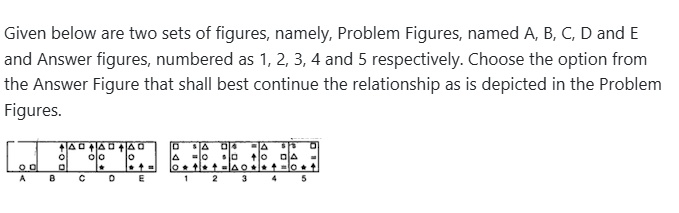
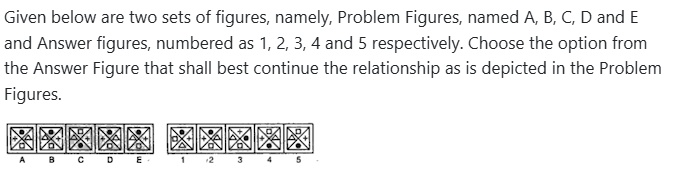
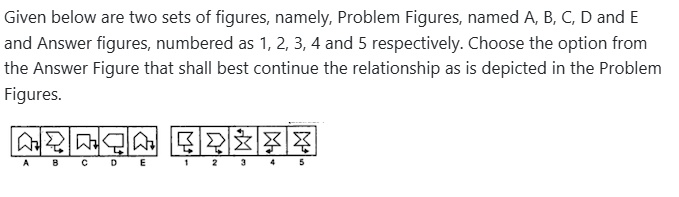
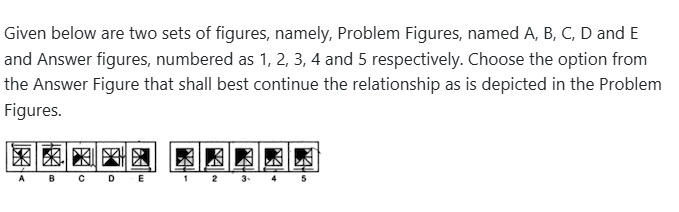
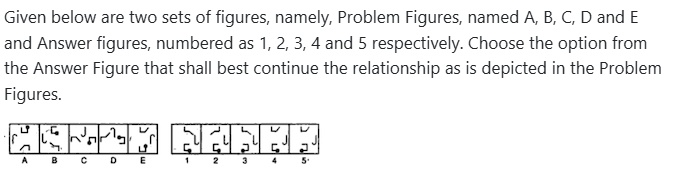
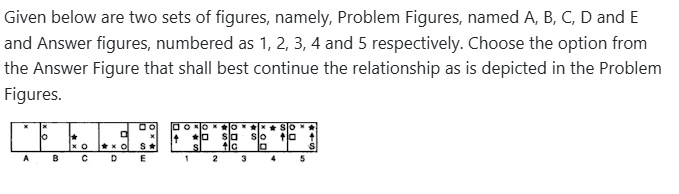
Given below are two sets of figures, namely, Problem Figures, named A, B, C, D and E and Answer figures, numbered as 1, 2, 3, 4 and 5 respectively. Choose the option from the Answer Figure that shall best continue the relationship as is depicted in the Problem Figures.
- A1
- B2
- C3
- D4
- E5
Show answerHide answer
Answer: D ✓ official key
Approach: Count the symbols and track their positions from figure to figure.
Solution:
Symbols: A = 2, B = 3, C = 4, D = 5, E = 6 → the next figure has 7.
Each step: one old symbol moves and one new symbol appears (B adds ↑, C adds △, D adds ★, E adds =).
In E: △ □ on top, ○ in the middle-left, ★ ↑ = along the bottom.
Next: the bottom row ★ ↑ =, △ and ○ stay; □ shifts down to the middle-right and the new symbol S enters at the top-right → figure 4.
Why the other options are wrong:
1, 3, 5: several of E's symbols (△, ○, the bottom row) are moved at once.
2: S is added but nothing moves, which breaks the 'one shift per step' rule.
Cetking shortcut: Keep the symbols that stay still from E (bottom row ★ ↑ =, △ top-left, ○ middle-left); only figures 2 and 4 keep them, and 4 shows the one-symbol shift.
Answer: D
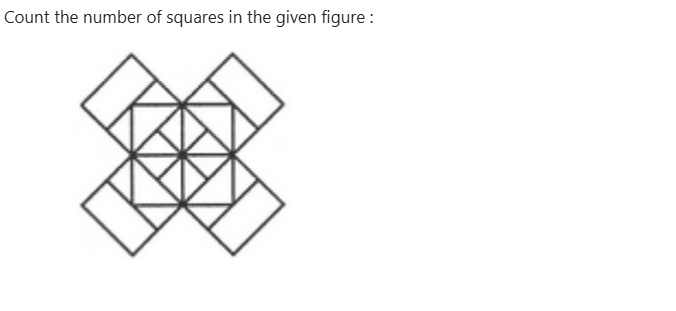
Count the number of squares in the given figure :
- A24
- B20
- C16
- D21
- E18
Show answerHide answer
Answer: E ✓ official key
Approach: Split the figure into the central upright square, the tilted diamond inside it, and the four tilted arms.
Solution:
Central upright square: 1 large + 4 quarter squares (cut by the middle cross) = 5.
Tilted diamond joining the midpoints: 1 + 4 small tilted squares (cut by the diagonals) = 5.
Four arm squares, one at each corner = 4.
Four small tilted squares between each arm and the diamond (formed by the arm's dividing line and the diagonal) = 4.
Total = 5 + 5 + 4 + 4 = 18.
Cetking shortcut: Use symmetry: count one quarter of the figure carefully, multiply by 4, then add the whole-figure squares (central square, diamond).
Answer: E
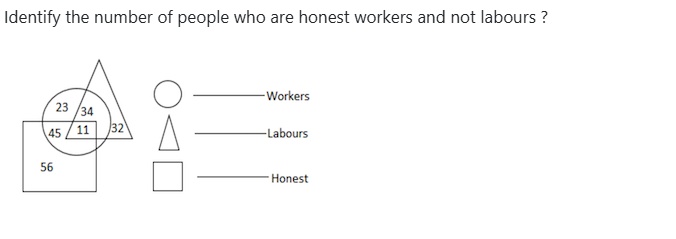
Data read from diagram:
Circle = Workers, Triangle = Labours, Square = Honest.
- Workers only: 23
- Workers and Labours, not Honest: 34
- Workers and Honest, not Labours: 45
- Workers, Labours and Honest: 11
- Labours only: 32
- Honest only: 56
Identify the number of people who are honest workers and not labours ?
- A56
- B101
- C23
- D45
- E11
Show answerHide answer
Answer: D ✓ official key
Approach: Find the region inside Circle (Workers) and Square (Honest) but outside Triangle (Labours).
Solution: Workers ∩ Honest, not Labours = 45.
Why the other options are wrong:
A 56: honest only.
B 101: 45 + 56 (adds non-workers).
C 23: workers only.
E 11: in all three (they are labours).
Answer: D
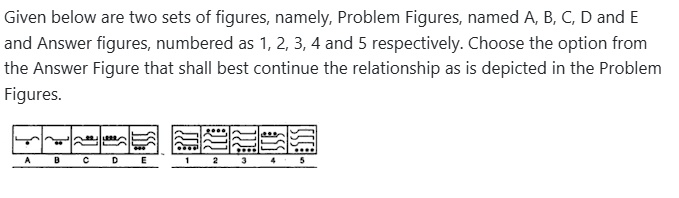
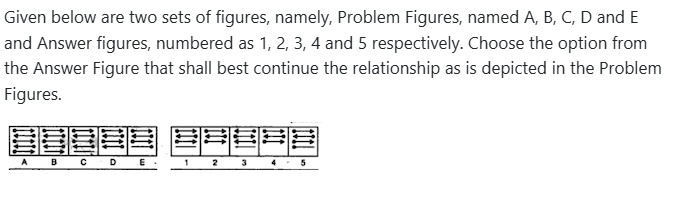
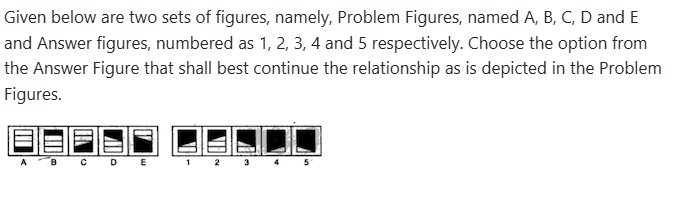
Given below are two sets of figures, namely, Problem Figures, named A, B, C, D and E and Answer figures, numbered as 1, 2, 3, 4 and 5 respectively. Choose the option from the Answer Figure that shall best continue the relationship as is depicted in the Problem Figures.
- A1
- B2
- C3
- D4
- E5
Show answerHide answer
Answer: E ✓ official key
Approach: Compare the four triangular sections (top, right, bottom, left) of each figure.
Solution:
A: top ●, right △, bottom □, left +.
B: top ●, right +, bottom □, left △.
C: top □, right +, bottom ●, left △.
D = A and E = B → the cycle is A, B, C.
So the next figure = C: top □, right +, bottom ●, left △ → figure 5.
Why the other options are wrong:
1: □ on the left, △ at the bottom.
2: same as D (A).
3: + on top.
4: □ on top but △ on the right and + on the left (mirror of C).
Answer: E
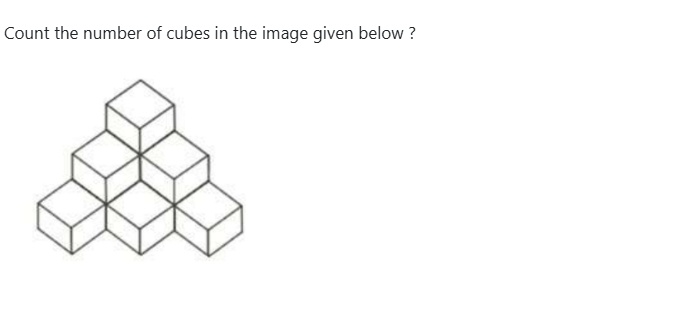
Count the number of cubes in the image given below ?
- A10
- B9
- C11
- D12
- E13
Show answerHide answer
Answer: A ✓ official key
Approach: Count layer by layer: the stack is a triangular pyramid.
Solution:
Top layer: 1 cube.
Middle layer: 3 cubes (2 visible + 1 hidden behind).
Bottom layer: 6 cubes (3 visible + 3 hidden).
Total = 1 + 3 + 6 = 10.
Why the other options are wrong:
B 9 / C 11 / D 12 / E 13: miscount the hidden cubes in the lower layers.
Cetking shortcut: A triangular (tetrahedral) stack with n layers has 1 + 3 + 6 + … cubes; for 3 layers that is 10.
Answer: A
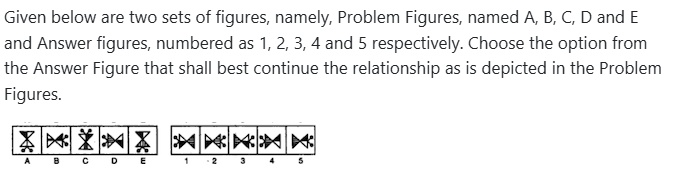
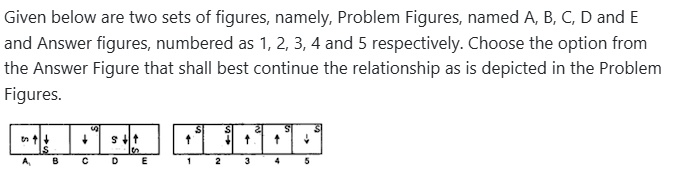
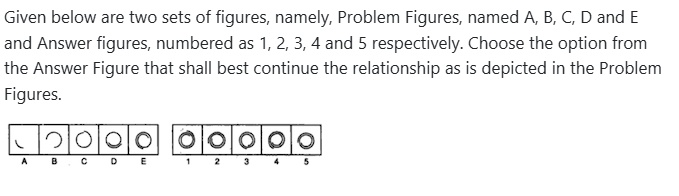
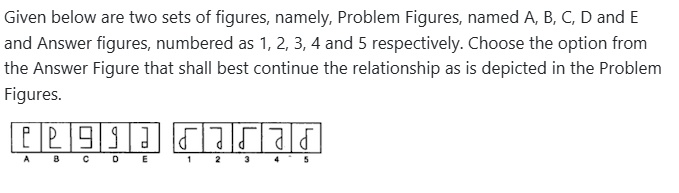
Given below are two sets of figures, namely, Problem Figures, named A, B, C, D and E and Answer figures, numbered as 1, 2, 3, 4 and 5 respectively. Choose the option from the Answer Figure that shall best continue the relationship as is depicted in the Problem Figures.
- A1
- B2
- C3
- D4
- E5
Show answerHide answer
Answer: B ✓ official key
Approach: Look for a figure that repeats.
Solution:
A: notched shape pointing up, arrow on the right going down.
B: chevron pointing right, arrow at the bottom going right.
C and D: further variants.
E is identical to A → cycle of 4 (A, B, C, D).
Next = B: right-pointing chevron with the arrow at the bottom going right → figure 2.
Why the other options are wrong:
1: flag-shaped outline, not B's chevron.
3, 4, 5: hourglass shapes that never appear in the cycle (3 and 4 also turn the arrow the wrong way).
Answer: B
Data read from diagram:
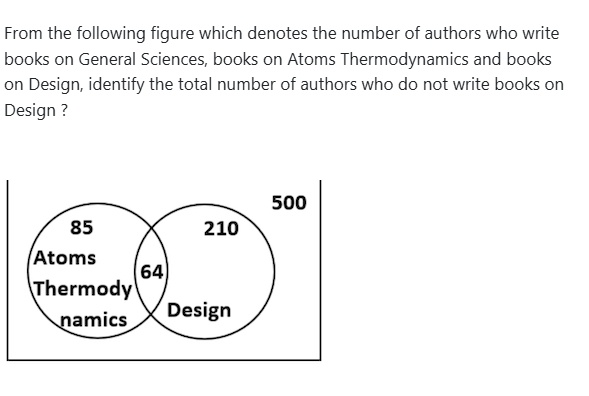
Universal set (General Sciences) = 500. Left circle = Atoms Thermodynamics, right circle = Design.
- Atoms Thermodynamics only: 85
- Both Atoms Thermodynamics and Design: 64
- Design only: 210
- Total (outer box): 500
From the following figure which denotes the number of authors who write books on General Sciences, books on Atoms Thermodynamics and books on Design, identify the total number of authors who do not write books on Design ?
- A500
- B295
- C226
- D210
- E149
Show answerHide answer
Answer: C ✓ official key
Approach: Subtract the whole Design circle from the total.
Solution:
Design circle = 64 (both) + 210 (Design only) = 274.
Not Design = 500 − 274 = 226.
(= 85 Atoms-only + 141 in neither.)
Why the other options are wrong:
A 500: the total.
B 295: 85 + 210.
D 210: Design only.
E 149: the Atoms Thermodynamics circle.
Answer: C
Given below are two sets of figures, namely, Problem Figures, named A, B, C, D and E and Answer figures, numbered as 1, 2, 3, 4 and 5 respectively. Choose the option from the Answer Figure that shall best continue the relationship as is depicted in the Problem Figures.
- A1
- B2
- C3
- D4
- E5
Show answerHide answer
Answer: E ✓ official key
Approach: Track the loops and the shading separately.
Solution:
Loops: bottom (A) → right (B) → top (C) → left (D) → bottom (E) → right next (90° anticlockwise each step). Options left: 2, 3, 5.
Shading: the hourglass turns 90° clockwise each step (A's dark upper-left half becomes B's dark upper half of the right triangle).
E is like A, so the next figure is like B: the dark shading sits in the upper half of the right (looped) triangle, and the lower half of that triangle is white → figure 5.
Why the other options are wrong:
1, 4: loops on the left.
2: grey (not black) in the upper right triangle; the shading follows a whole-figure anticlockwise turn.
3: the dark part is in the lower half of the right triangle.
Answer: E
Count the number of triangles in the given figure :
- A20
- B17
- C19
- D21
- E22
Show answerHide answer
Answer: C ✓ official key
Approach: Group the triangles by where they sit: top region, left crossing, right crossing, large spanning triangles, bottom.
Solution:
Top region (lines from the top apex): the big apex triangle on the lower line, the two top-corner triangles, and the small apex triangle above the upper line = 4.
Left crossing (upper line, lower line, left edge, the two slanted lines meeting there): 5.
Right crossing (upper line, lower line, right edge, the two slanted lines meeting there): 5.
Large spanning triangles: upper line + the two lines meeting at the bottom; the big lower-left triangle; the bottom-right triangle = 3.
Bottom: the small bottom-left corner triangle and the triangle under the lower line between the two slanted lines = 2.
Total = 4 + 5 + 5 + 3 + 2 = 19.
Cetking shortcut: For each crossing point, pair up the lines through it with a third line that cuts both. Doing this point by point avoids counting the same triangle twice.
Answer: C
Data read from diagram:
Triangle = Tennis players, Rectangle = Hockey players, Circle = Chess players.
- Tennis only: 5 (top) and 5 (bottom)
- Chess only: 13, 4, 12, 6
- Tennis and Chess, not Hockey: 11 (upper), 14 (lower)
- Chess and Hockey, not Tennis: 2, 3, 15
- Tennis, Chess and Hockey: 10
- Hockey only: 5 (left), 20 (right)
Identify the number of hockey players who play neither of any other games ?
- A5
- B20
- C28
- D23
- E25
Show answerHide answer
Answer: E ✓ official key
Approach: Find every piece of the Rectangle (Hockey) that lies outside both the Triangle (Tennis) and the Circle (Chess).
Solution: Hockey-only pieces: 5 (left) + 20 (right) = 25.
Why the other options are wrong:
A 5 / B 20: only one of the two pieces.
C 28 / D 23: add or drop a shared region by mistake.
Answer: E
Count the number of triangles in the given figure :
- A17
- B23
- C13
- D18
- E20
Show answerHide answer
Answer: E ✓ official key
Approach: Count the triangles made by the outer square and its diagonals, then the ones made by the inscribed tilted square.
Solution:
Outer square with two diagonals: 4 quarter triangles (meeting at the centre) + 4 half-square triangles = 8.
Inscribed tilted square cuts off 4 corner triangles = 4.
A diagonal passes through each corner triangle and splits it into 2 smaller triangles: 4 × 2 = 8.
Total = 8 + 4 + 8 = 20.
Cetking shortcut: Count one corner (1 corner triangle + 2 pieces = 3), multiply by 4 (12), then add the 8 from the diagonals.
Answer: E
Given below are two sets of figures, namely, Problem Figures, named A, B, C and D and Answer figures, numbered as 1, 2, 3, 4 and 5 respectively. Choose the option from the Answer Figure that shall best continue the relationship as is depicted in the Problem Figures.
- A1
- B2
- C3
- D4
- E5
Show answerHide answer
Answer: E ✓ official key
Approach: Follow how the Z's strokes change, one at a time.
Solution:
A: Z with small end-ticks.
B: the right tick folds into a short middle bar.
C: the diagonal shortens to the centre and a vertical drops from it.
D: the bottom bar returns from that vertical, so the lower part becomes a box.
Next: the remaining slanted stroke straightens and the left tick extends down. This gives a closed '6'-like shape made only of horizontal and vertical lines → figure 5.
Why the other options are wrong:
1, 2, 3, 4: each still has a slanted stroke, which the series has been removing.
Answer: E
Given below are two sets of figures, namely, Problem Figures, named A, B, C, D and E and Answer figures, numbered as 1, 2, 3, 4 and 5 respectively. Choose the option from the Answer Figure that shall best continue the relationship as is depicted in the Problem Figures.
- A1
- B2
- C3
- D4
- E5
Show answerHide answer
Answer: B ✓ official key
Approach: Track two lines you can recognise: the ball-ended line and the triangle-ended line.
Solution:
Ball line row: 1 → 2 → 4 → 1 → 3 (moves down 1, 2, 1, 2 rows, wrapping round) → next row 4. Its ball points right, right, left, left, right → right next.
Triangle line row: 3 → 4 → 2 → 3 → 1 (same moves) → next row 2, with the triangle on the left.
So the next figure has the triangle on the left in row 2 and the ball on the right in row 4. Of the options that fit, only 2 has the top line bending down at its right end, as the cycle needs → figure 2.
Why the other options are wrong:
3: open arrowhead instead of a triangle.
4: row 3 carries a forked end.
1, 5: the top line's end bends the wrong way.
Answer: B
Given below are two sets of figures, namely, Problem Figures, named A, B, C, D and E and Answer figures, numbered as 1, 2, 3, 4 and 5 respectively. Choose the option from the Answer Figure that shall best continue the relationship as is depicted in the Problem Figures.
- A1
- B2
- C3
- D4
- E5
Show answerHide answer
Answer: C ✓ official key
Approach: Look at the outer lines and the shaded sectors separately.
Solution:
Outer line pair: top (A, B) → right (C, D) → bottom (E) → stays at the bottom next (each side is used twice). Every option fits this, so the shading decides.
Shading in the 8-sector square grows from figure to figure and is carried forward from E. The next figure must keep E's shaded block and add the next sector, giving one solid block from the top-left through the left side, as in figure 3.
Why the other options are wrong:
1, 2, 4, 5: the shaded sectors are split up or in the wrong places compared with the block that has been growing.
Answer: C
Given below are two sets of figures, namely, Problem Figures, named A, B, C, D and E and Answer figures, numbered as 1, 2, 3, 4 and 5 respectively. Choose the option from the Answer Figure that shall best continue the relationship as is depicted in the Problem Figures.
- A1
- B2
- C3
- D4
- E5
Show answerHide answer
Answer: C ✓ official key
Approach: Count the lines and dots, and note which way the curls face.
Solution:
(Lines, dots): A (1,1), B (1,2), C (2,2), D (2,3), E (3,3) → next (3,4).
Each time a dot is added, the figure flips left-right (A→B, C→D), so E→F flips: curls move to the left end and the bracket ticks to the right end.
Dots: below, below, above, above, below → below next.
3 lines, 4 dots below, curls on the left, ticks pointing up on the right → figure 3.
Why the other options are wrong:
1: line ends are turned the wrong way.
2, 4: dots on top (4 also has 3 dots).
5: lines flipped upside down.
Answer: C
Given below are two sets of figures, namely, Problem Figures, named A, B, C, D and E and Answer figures, numbered as 1, 2, 3, 4 and 5 respectively. Choose the option from the Answer Figure that shall best continue the relationship as is depicted in the Problem Figures.
- A1
- B2
- C3
- D4
- E5
Show answerHide answer
Answer: B ✓ official key
Approach: Label the 6 positions TL, TR, ML, MR, BL, BR and track each symbol.
Solution:
A→B: ○ TR→MR, □ MR→ML, pin ML→TL, = TL→BL, × BL→BR, ★ drops out, new S at TR.
The same path TR→MR→ML→TL→BL→BR→out holds for B→C, C→D and D→E.
From E: + TR→MR, △ MR→ML, C ML→TL, S TL→BL, ○ BL→BR, □ drops out, new symbol at TR.
Next: TL C, TR new, ML △, MR +, BL S, BR ○ → figure 2.
Why the other options are wrong:
1: ○ in ML and □, △ at the bottom.
3: □ at TL and C at BL.
4: △ at TL and S at BR.
5: + at TL and □ at BL.
Cetking shortcut: Check just two corners: TL must be C (from ML) and BR must be ○ (from BL). Only figure 2 has both.
Answer: B
Given below are two sets of figures, namely, Problem Figures, named A, B, C, D and E and Answer figures, numbered as 1, 2, 3, 4 and 5 respectively. Choose the option from the Answer Figure that shall best continue the relationship as is depicted in the Problem Figures.
- A1
- B2
- C3
- D4
- E5
Show answerHide answer
Answer: A ✓ official key
Approach: Track the arrow and the S separately.
Solution:
Arrow position: right, left, centre, right, left → centre next. Direction: ↑ ↓ ↓ ↓ ↑ → ↑ next (it points up again after E).
S position: middle, bottom-left, top-right, middle, bottom-left → top-right next.
S tilt: tilted, upright, tilted, upright, tilted → upright next.
Next: up arrow in the centre, upright S at top-right → figure 1.
Why the other options are wrong:
2, 5: arrow points down.
3: S is mirrored.
4: S is drawn upside down rather than in the upright form used in B and D.
Answer: A
Identify the Odd One Out :
- A(a)
- B(b)
- C(c)
- D(d)
- E(e)
Show answerHide answer
Answer: D ✓ official key
Approach: Look at how the inner lines divide each shape.
Solution:
(a) semicircle cut into 2 equal halves.
(b) square cut into 4 equal squares.
(c) parallelogram cut into 4 equal parallelograms (lines join midpoints).
(e) triangle cut into 3 equal parts from its centre.
(d) ellipse cut by two slanted lines that do not run along its axes, so the 4 parts are unequal → odd one out.
Why the other options are wrong:
(a), (b), (c), (e): each is divided into equal, symmetric parts.
Answer: D
Given below are two sets of figures, namely, Problem Figures, named A, B, C, D and E and Answer figures, numbered as 1, 2, 3, 4 and 5 respectively. Choose the option from the Answer Figure that shall best continue the relationship as is depicted in the Problem Figures.
- A1
- B2
- C3
- D4
- E5
Show answerHide answer
Answer: A ✓ official key
Approach: Track the dot-ended element first, then check the other two.
Solution:
Dot-ended element: the dot points up (A), right (B), down (C), left (D), up (E). It turns 90° clockwise each step, so next it points right. Options 1, 2 and 4 show the bottom element with the dot on the right.
The step-shaped and hook-shaped elements also turn 90° and move round. Applying one more turn to E gives a step at the top falling to the right and a hook at the right curling at the bottom → figure 1.
Why the other options are wrong:
3, 5: dot element faces left.
4: top and right elements are copied from E without turning.
2: the top step rises instead of falling.
Answer: A
Given below are two sets of figures, namely, Problem Figures, named A, B, C, D and E and Answer figures, numbered as 1, 2, 3, 4 and 5 respectively. Choose the option from the Answer Figure that shall best continue the relationship as is depicted in the Problem Figures.
- A1
- B2
- C3
- D4
- E5
Show answerHide answer
Answer: A ✓ official key
Approach: Watch the bottom arrow change in each figure.
Solution:
A: 5 complete arrows.
B: 5th arrow loses its tail dot.
C: 5th loses its head (plain line).
D: 5th line removed.
E: 4th arrow (←) loses its head, keeping the dot.
Next: the 4th loses its dot → a plain line under 3 complete arrows (→, ←, →) → figure 1.
Why the other options are wrong:
2, 4: the 4th line is removed too early.
3: the arrow directions are reversed.
5: the 4th line still has its dot.
Answer: A
Given below are two sets of figures, namely, Problem Figures, named A, B, C, D and E and Answer figures, numbered as 1, 2, 3, 4 and 5 respectively. Choose the option from the Answer Figure that shall best continue the relationship as is depicted in the Problem Figures.
- A1
- B2
- C3
- D4
- E5
Show answerHide answer
Answer: B ✓ official key
Approach: Track the length of the curve and where its free end sits.
Solution:
A: quarter arc. B: about three-quarters of a circle. C: a full circle and a bit more. D and E: the curve keeps coiling inside, adding the same arc (about half a turn) each step.
The next figure adds another half turn past E's end and keeps the same direction of coiling → figure 2.
Why the other options are wrong:
1, 3, 4, 5: the free end stops short, goes past the required point, or the spiral coils the other way.
Answer: B
Given below are two sets of figures, namely, Problem Figures, named A, B, C, D and E and Answer figures, numbered as 1, 2, 3, 4 and 5 respectively. Choose the option from the Answer Figure that shall best continue the relationship as is depicted in the Problem Figures.
- A1
- B2
- C3
- D4
- E5
Show answerHide answer
Answer: A ✓ official key
Approach: Track each symbol round the 8 border cells in the anticlockwise order TL → ML → BL → BM → BR → MR → TR → TM.
Solution:
×: TM → TL (1) → BL (2) → BM (1) → MR (2) → next 1 step → TR.
○: ML → BM (2) → BR (1) → TR (2) → next 1 step → TM.
★: ML → BL (1) → BR (2) → next 1 step → MR.
S: BM → next 1 step → BR; □ stays at TL, and the new symbol ↑ enters at ML.
Next: □ ○ × on the top row, ↑ middle-left, ★ middle-right, S bottom-right → figure 1.
Why the other options are wrong:
2, 3, 5: ○ × ★ are shifted one cell along the top row.
4: × at TL and S at TR.
Answer: A
Identify two images that are odd in context of the series of images shown below :
- A1 and 4
- B3 and 5
- C4 and 6
- D2 and 3
- E3 and 4
Show answerHide answer
Answer: C ✓ official key
Approach: Compare each element across the six figures: hatched corner, '=' sign, dot with bar, two circles.
Solution:
Fixed in every figure: the dot under the short bar on the right, the hollow circle bottom-left, the solid circle bottom-right.
The hatched corner grows from figure to figure (1 → 2 → 3 → 5 → 6). Figure 4's hatched triangle is smaller than figure 3's, so it breaks the growth → odd.
The '=' sign stays in the upper middle in figures 1–5. In figure 6 it has dropped lower → odd.
Odd pair = 4 and 6.
Why the other options are wrong:
A, B, D, E: each includes a figure (1, 2, 3 or 5) that fits both patterns.
Answer: C
Given below are two sets of figures, namely, Problem Figures, named A, B, C, D and E and Answer figures, numbered as 1, 2, 3, 4 and 5 respectively. Choose the option from the Answer Figure that shall best continue the relationship as is depicted in the Problem Figures.
- A1
- B2
- C3
- D4
- E5
Show answerHide answer
Answer: D ✓ official key
Approach: Check orientation, loop shape and loop size separately.
Solution:
Orientation: A and B face the same way, C and D are their mirror image, E is turned again → the next figure faces the same way as E: stem on the right, arm at the top going left, loop at the bottom-left. Options left: 2, 4.
Loop shape: square, round, square, round, square → round next.
Loop size: small, big, big, small, small → big next.
Big semicircle at the bottom-left with the stem on the right → figure 4.
Why the other options are wrong:
1, 3, 5: stem on the left with the arm going right (wrong orientation).
2: correct orientation but the loop is small.
Answer: D
Given below are two sets of figures, namely, Problem Figures, named A, B, C, D and E and Answer figures, numbered as 1, 2, 3, 4 and 5 respectively. Choose the option from the Answer Figure that shall best continue the relationship as is depicted in the Problem Figures.
- A1
- B2
- C3
- D4
- E5
Show answerHide answer
Answer: A ✓ official key
Approach: Compare pairs: A→B, C→D, E→F.
Solution:
A: bottom strip black → B: top strip black (flipped upside down).
C: black at the bottom with a slanted edge → D: the same fill flipped to the top.
E: black fills most of the box from the bottom, edge slanting down to the right, top strip white.
Next = E flipped upside down: black from the top, edge slanting up to the right, one full white strip at the bottom → figure 1.
Why the other options are wrong:
2: too little black (two white strips).
3: the slant runs the wrong way.
4, 5: no full white strip at the bottom.
Answer: A