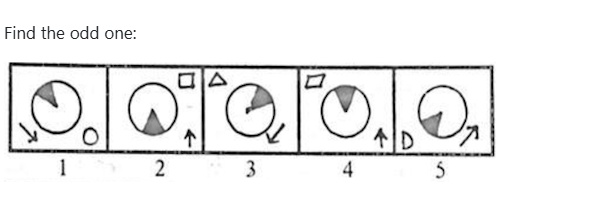
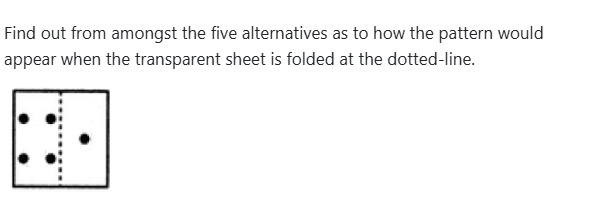
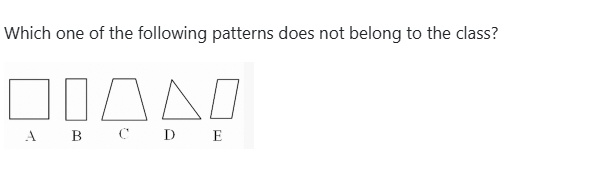
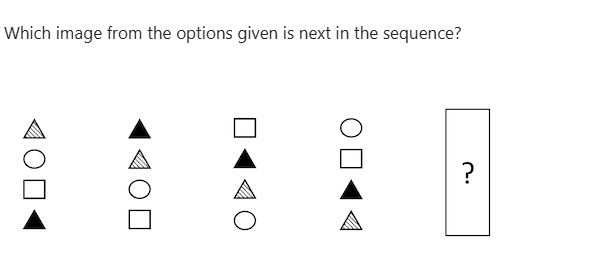
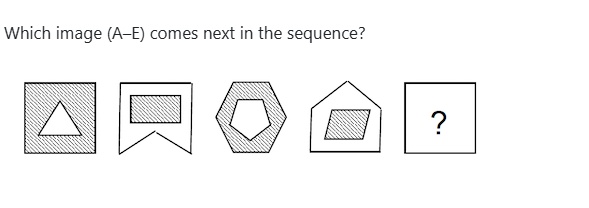
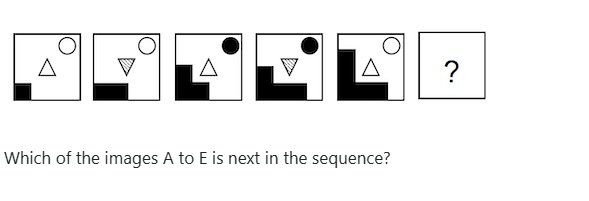
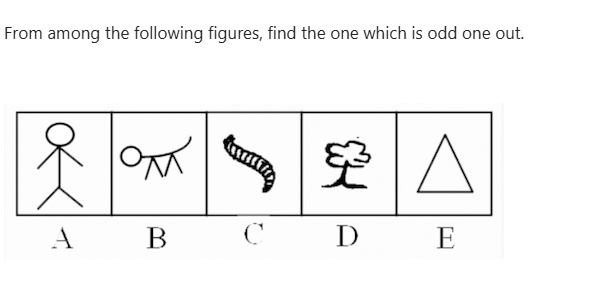
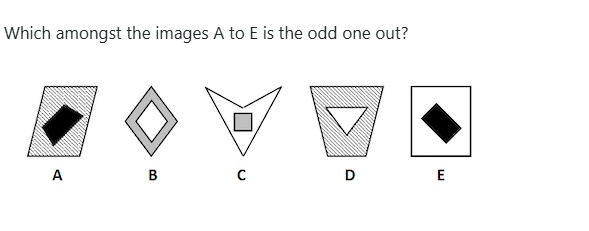
What least number must be added to 1056, so that the sum is completely divisible by 23 ?
- A2
- B4
- C3
- D5
- E1
Show answerHide answer
Answer: A ✓ official key
Approach: Remainder method: add (divisor − remainder).
Solution:
1056 ÷ 23: 23 × 45 = 1035, remainder = 1056 − 1035 = 21.
Least number to add = 23 − 21 = 2.
Check: 1058 = 23 × 46.
Cetking shortcut: Nearest multiple above: 23 × 46 = 1058 → 1058 − 1056 = 2.
Answer: A
The difference between a two-digit number and the number obtained by interchanging the positions of its digits is 36. What is the difference between the two digits of that number?
- A3
- B4
- C5
- D6
- E8
Show answerHide answer
Answer: B ✓ official key
Approach: Two-digit number 10a + b; reversing gives 10b + a; difference = 9(a − b).
Solution:
(10a + b) − (10b + a) = 9(a − b) = 36.
a − b = 36 ÷ 9 = 4.
Cetking shortcut: Difference of a number and its reverse ÷ 9 = difference of digits → 36/9 = 4.
Answer: B
From the given numbers, find a positive number which, when increased by 17, is equal to 60 times the reciprocal of the number.
- A20
- B6
- C4
- D3
- E9
Show answerHide answer
Answer: D ✓ official key
Approach: Form the equation x + 17 = 60/x and solve the quadratic.
Solution:
x + 17 = 60/x → x² + 17x − 60 = 0.
(x + 20)(x − 3) = 0 → x = 3 or x = −20.
Positive number = 3.
Check: 3 + 17 = 20 = 60/3. ✔
Cetking shortcut: Plug options: only 3 gives 20 on both sides (20 → 37 vs 3; 6 → 23 vs 10; 4 → 21 vs 15).
Answer: D
It is given that (2^32 + 1) is completely divisible by a whole number. Which of the following numbers is completely divisible by this number?
- A(2^16 + 1)
- B(2^16 - 1)
- C(2^96 + 1)
- D(2^96 - 1)
- E(2^23 + 1)
Show answerHide answer
Answer: C ✓ official key
Approach: aⁿ + bⁿ is divisible by (a + b) when n is odd.
Solution:
Let a = 2³². Then 2⁹⁶ + 1 = a³ + 1 = (a + 1)(a² − a + 1).
So 2⁹⁶ + 1 is divisible by a + 1 = 2³² + 1.
Hence any number dividing 2³² + 1 also divides 2⁹⁶ + 1.
Why the other options are wrong:
A, B: 2¹⁶ ± 1 are smaller than 2³² + 1 and are factors of 2³² − 1, not multiples of 2³² + 1.
D: 2⁹⁶ − 1 = a³ − 1 is divisible by a − 1, not a + 1.
E: 23 is not a multiple of 32.
Cetking shortcut: Look for an option whose exponent is an ODD multiple of 32 with a '+1' → 96 = 3 × 32.
Answer: C
Calculate 1397 × 1397 and choose the correct option :
- A1981709
- B1951609
- C2031719
- D1951719
- E2011609
Show answerHide answer
Answer: B ✓ official key
Approach: Square near a round number: (a − b)² = a² − 2ab + b².
Solution:
1397² = (1400 − 3)²
= 1400² − 2 × 1400 × 3 + 3²
= 1,960,000 − 8,400 + 9
= 1,951,609.
Cetking shortcut: Last digit 7² → 9 and last two digits 97² → 09 kill C and D; size ≈ 1.95 million kills A and E.
Answer: B
Solve the following mathematical expression and select the correct answer:
(53 × 2 × 106) − (47 × 2 × 94)
- A2200
- B2400
- C2000
- D1906
- E1904
Show answerHide answer
Answer: B ✓ official key
Approach: Rewrite as squares and use a² − b² = (a + b)(a − b).
Solution:
53 × 2 × 106 = 4 × 53² and 47 × 2 × 94 = 4 × 47².
Expression = 4(53² − 47²) = 4 × (53 + 47)(53 − 47)
= 4 × 100 × 6 = 2400.
(Direct check: 11236 − 8836 = 2400.)
Cetking shortcut: Spot 106 = 2 × 53 and 94 = 2 × 47 → 4(a² − b²) in one line.
Answer: B
The average of 9 numbers is 15. If the average of the first five numbers is 13 and the average of the last five numbers is 17, then what is the fifth number ?
- A13
- B18
- C15
- D16
- E12
Show answerHide answer
Answer: C ✓ official key
Approach: Overlap in averages: the 5th number is counted in both groups.
Solution:
Sum of 9 numbers = 9 × 15 = 135.
First five sum = 5 × 13 = 65; last five sum = 5 × 17 = 85.
65 + 85 = 150 counts the 5th number twice.
5th number = 150 − 135 = 15.
Cetking shortcut: Deviation method: first five −2 each (−10), last five +2 each (+10) → 5th = 15 + 0 = 15.
Answer: C
Zahir's marks were wrongly entered as 83 instead of 63 in a class test. Because of this mistake, the average marks for the class increased by 0.5. What is the number of students in the class ?
- A45
- B50
- C40
- D30
- E35
Show answerHide answer
Answer: C ✓ official key
Approach: Change in total = change in average × number of items.
Solution:
Wrong entry adds 83 − 63 = 20 to the total.
This raises the average by 0.5.
n × 0.5 = 20 → n = 40.
Cetking shortcut: Number of students = excess ÷ rise in average = 20 / 0.5 = 40.
Answer: C
The average age of a cricket team of 11 players is reduced by 2 when two senior players aged 32 and 30 are replaced by 2 youngsters of equal age. What is the age of each youngster ?
- A22
- B20
- C24
- D26
- E25
Show answerHide answer
Answer: B ✓ official key
Approach: Replacement in average: total drop = drop in average × team size.
Solution:
Average falls by 2 for 11 players → total falls by 22.
Removed ages = 32 + 30 = 62.
Two youngsters together = 62 − 22 = 40 → each = 20.
Cetking shortcut: Each youngster = (62 − 22) / 2 = 20 in one line.
Answer: B
A trader sells his articles at 10% higher than their original price. Due to higher demand, he again increases the price by 15%. Calculate the percentage of profit the trader makes ?
- A25.5%
- B26.5%
- C22%
- D27.33%
- E24.5%
Show answerHide answer
Official CET key: B · Cetking's answer: A — see why below
Approach: Successive percentage increase: a + b + ab/100.
Solution:
Assume the article's cost (original price) = 100.
After +10%: 110. After a further +15%: 110 × 1.15 = 126.5.
Profit = 126.5 − 100 = 26.5%.
Why the other options are wrong:
A (25.5%) and C (22%) miss or mis-add the 1.5% compounding term; D, E have no basis.
Cetking shortcut: 10 + 15 + (10 × 15)/100 = 26.5%.
Answer: B
A person sold a radio at a loss of 5%. Had he sold it for Rs. 210 more, he would have gained 25%. For what value should he sell it in order to gain 35% ?
- ARs. 950
- BRs. 945
- CRs. 935
- DRs. 850
- ERs. 845
Show answerHide answer
Answer: B ✓ official key
Approach: Gap between two percentages of CP equals the money gap.
Solution:
Loss 5% → SP = 0.95 CP; gain 25% → SP = 1.25 CP.
Difference = 30% of CP = Rs. 210 → CP = Rs. 700.
For 35% gain: SP = 1.35 × 700 = Rs. 945.
Cetking shortcut: 30% ↔ 210 → 1% = 7 → 135% = 945.
Answer: B
Mahan bought a bag with a 15% discount on the labeled price. He sold the bag for Rs. 2880 with a 20% profit on the labeled price. At what price did he buy the bag?
- A2400
- B2200
- C2040
- D2020
- E2025
Show answerHide answer
Answer: C ✓ official key
Approach: Work everything from the labeled (marked) price.
Solution:
SP = LP + 20% of LP = 1.2 LP = 2880 → LP = Rs. 2400.
Purchase price = LP − 15% = 0.85 × 2400 = Rs. 2040.
Cetking shortcut: 2880 ÷ 1.2 = 2400 (option A is the trap) → × 0.85 = 2040.
Answer: C
In a class, 70% of the students read Hindi. 40% of the students are boys and 20% of the girls do not read Hindi. Then determine, that what percentage of boys read Hindi ?
- A40%
- B45%
- C55%
- D44%
- E56%
Show answerHide answer
Answer: C ✓ official key
Approach: Split into boys/girls on a base of 100 students.
Solution:
Students = 100 → boys 40, girls 60.
Girls not reading Hindi = 20% of 60 = 12 → girls reading Hindi = 48.
Total reading Hindi = 70 → boys reading Hindi = 70 − 48 = 22.
% of boys reading Hindi = 22/40 × 100 = 55%.
Cetking shortcut: Take 100 students and fill a 2×2 table (boys/girls × Hindi/not).
Answer: C
Find the value of 'x' in the given mathematical expression :
88% of 370 + 24 % of 210 - x = 118
- A256
- B258
- C260
- D266
- E265
Show answerHide answer
Answer: B ✓ official key
Approach: Evaluate the percentages, then isolate x.
Solution:
88% of 370 = 325.6.
24% of 210 = 50.4.
325.6 + 50.4 − x = 118 → 376 − x = 118 → x = 258.
Cetking shortcut: The decimals .6 and .4 add to a whole number — 376 − 118 = 258.
Answer: B
In an auditorium, the management decided to increase the number of seats by 25% and the prices of a ticket were increased by 12%. Calculate the percentage increase in revenue collection for the management :
- A30%
- B40%
- C45%
- D55%
- E35%
Show answerHide answer
Answer: B ✓ official key
Approach: Revenue = seats × price → successive percentage change.
Solution:
New revenue factor = 1.25 × 1.12 = 1.40.
Increase = 40%.
Cetking shortcut: 25 + 12 + (25 × 12)/100 = 25 + 12 + 3 = 40%.
Answer: B
Questions 116–117 share this
Read the information given below carefully and answer the question that follows :
8 men and 5 women working 6 hours a day can complete the work in 4 days. Also, 4 men and 5 women working for 8 hours a day can complete the same job in 5 days. Similarly, 5 boys working 8 hours a day can complete the same job in 30 days.The work rate of each individual within a group (men, women, or boys) is uniform and constant, and these rates are additive when working together. The total amount of work required for all scenarios described is the same fixed quantity.
If 4 men, 3 women and 4 boys worked together every day for 5 hours, then in how many days would they complete the work ?
- A8
- B10
- C12
- D14
- E6
Show answerHide answer
Official CET key: A · Cetking's answer: B — see why below
Approach: Convert every group to work-hours and find relative efficiencies.
Solution:
Let m, w, b = work per hour of a man, woman, boy.
8m + 5w for 6 h × 4 days = 24 h: W = 24(8m + 5w).
4m + 5w for 8 h × 5 days = 40 h: W = 40(4m + 5w).
192m + 120w = 160m + 200w → 32m = 80w → m = 2.5w.
Take w = 2, m = 5 → W = 24(40 + 10) = 1200 units.
Boys: 5b × 8 × 30 = 1200 → b = 1.
4 men + 3 women + 4 boys = 20 + 6 + 4 = 30 units/hour.
At 5 h/day → 150 units/day → 1200 / 150 = 8 days.
Cetking shortcut: Fix units early: m : w : b = 5 : 2 : 1 and W = 1200 — then every sub-question is one division.
Answer: A
Refer to the passage above ↑
If women and children (boys) can't be employed, then how many men are minimum required to complete the job in 6 days if the working hours per day cannot exceed 9 ?
- A9
- B5
- C8
- D6
- E4
Show answerHide answer
Official CET key: B · Cetking's answer: D — see why below
Approach: Total work ÷ maximum work one man can do in the allowed time.
Solution:
From the caselet: man = 5 units/hour, total work = 1200 units (woman 2, boy 1).
Max hours in 6 days = 6 × 9 = 54 hours per man.
One man does 5 × 54 = 270 units.
Men needed = 1200 / 270 = 4.44 → round up to 5 men.
Why the other options are wrong:
A (9), C (8), D (6) are more than needed — not minimum; E (4) does only 1080 < 1200 units.
Cetking shortcut: Men alone: 1200 / 5 = 240 man-hours; 240 / 54 = 4.4 → 5.
Answer: B
If 6 men and 8 boys can do a piece of work in 10 days while 26 men and 48 boys can do the same in 2 days, the time taken by 15 men and 20 boys in doing the same type of work will be:
- A3 days
- B4 days
- C5 days
- D6 days
- E7 days
Show answerHide answer
Answer: B ✓ official key
Approach: Equate the two scenarios in man/boy-days to get the efficiency ratio.
Solution:
10(6m + 8b) = 2(26m + 48b)
60m + 80b = 52m + 96b → 8m = 16b → m = 2b.
Work = 10(6 × 2b + 8b) = 10 × 20b = 200b.
15 men + 20 boys = 30b + 20b = 50b per day.
Days = 200b / 50b = 4 days.
Cetking shortcut: Once m = 2b, convert all to boys: 20 boys × 10 days = 200 boy-days; 50 boys → 4 days.
Answer: B
The radius of a wheel is 0.25 m. The approximate number of revolutions it will make to travel a distance of 11 km will be :
- A5000
- B2000
- C7000
- D5500
- E6000
Show answerHide answer
Official CET key: C · Cetking's answer: A — see why below
Approach: Distance per revolution = circumference = 2πr.
Solution:
Circumference = 2 × (22/7) × 0.25 = 11/7 m.
Distance = 11 km = 11,000 m.
Revolutions = 11,000 ÷ (11/7) = 11,000 × 7/11 = 7000.
Cetking shortcut: 11 km and 22/7 are built to cancel: 11000 × 7/11 = 7000.
Answer: C
At a start of a seminar, the ratio of the number of male participants to the number of female participants was 3:1. During the tea break, 12 male and 4 female participants left the seminar and 6 new female participants joined the seminar. The ratio of the male to the female participants now is 2:1. What was the total number of participants at the start of the seminar ?
- A64
- B48
- C50
- D52
- E72
Show answerHide answer
Answer: A ✓ official key
Approach: Write the initial ratio with one variable and set up the new ratio.
Solution:
Start: males 3x, females x.
After break: males 3x − 12; females x − 4 + 6 = x + 2.
(3x − 12)/(x + 2) = 2 → 3x − 12 = 2x + 4 → x = 16.
Total at start = 3x + x = 4x = 64.
Cetking shortcut: Total must be a multiple of 4 (3 : 1) → 64, 48, 52, 72; test 64: 48 − 12 = 36 males, 16 + 2 = 18 females → 2 : 1 ✔
Answer: A
Three containers have capacities in the ratio 3 : 4 : 5 and are completely filled with mixtures of milk and water. The ratios of milk to water in the three containers are 4 : 1, 3 : 1, and 5 : 2 respectively. If the contents of all three containers are poured into a fourth container, determine the resulting ratio of milk to water in the fourth container.
- A153 : 33
- B157 : 53
- C151 : 48
- D5 : 2
- E17 : 3
Show answerHide answer
Answer: B ✓ official key
Approach: Find milk and water in each container on a common base, then add.
Solution:
Take capacities 3, 4, 5 litres.
Container 1 (4 : 1): milk 12/5, water 3/5.
Container 2 (3 : 1): milk 3, water 1.
Container 3 (5 : 2): milk 25/7, water 10/7.
Multiply all by 35: milk = 84 + 105 + 125 = 314; water = 21 + 35 + 50 = 106.
Milk : water = 314 : 106 = 157 : 53.
Cetking shortcut: Multiply every container by 35 (LCM of 5, 4, 7) at the start to avoid fractions.
Answer: B
A man and a boy working together can complete a certain digging work in 40 days. Their rates of work are in the ratio 8 : 5. If the boy works alone, how many days will he take to complete the same work ?
- A100
- B104
- C120
- D112
- E125
Show answerHide answer
Answer: B ✓ official key
Approach: Work = rate × time; use the efficiency ratio.
Solution:
Rates man : boy = 8 : 5 → combined 13 units/day.
Total work = 13 × 40 = 520 units.
Boy alone = 520 ÷ 5 = 104 days.
Cetking shortcut: Boy's days = 40 × 13/5 = 104.
Answer: B
A and B are partners in a business. A contributed one-fourth of the total capital for 15 months. B received two-thirds of the total profit. For how long was B's capital invested in the business ?
- A6 months
- B8 months
- C10 months
- D12 months
- E8.5 months
Show answerHide answer
Answer: C ✓ official key
Approach: Profit share ∝ capital × time.
Solution:
Capital: A = 1/4, B = 3/4 of total.
Profit: B gets 2/3 → A gets 1/3 → A : B = 1 : 2.
(1/4 × 15) : (3/4 × t) = 1 : 2
3t/4 = 2 × 15/4 = 30/4 → t = 10 months.
Cetking shortcut: Capital ratio 1 : 3, profit ratio 1 : 2 → time ratio = (1/1) : (2/3) = 15 : 10 → B = 10 months.
Answer: C
Three students A, B and C hired a computer for a month. A runs 27 floppy discs for 19 days, B runs 21 for 17 days and C runs 24 for 23 days. If, at the end of the month, the rent amounts to Rs 23,700, how much rent should be paid by C ?
- ARs. 5,600
- BRs. 8,400
- CRs. 10,600
- DRs. 15,600
- ERs. 9,200
Show answerHide answer
Official CET key: E · Cetking's answer: C — see why below
Approach: Rent shared in proportion to usage = discs × days.
Solution:
A = 27 × 19 = 513; B = 21 × 17 = 357; C = 24 × 23 = 552.
Total = 513 + 357 + 552 = 1422.
C's share = 552/1422 × 23,700.
23,700/1422 = 50/3 → 552 × 50/3 = Rs. 9,200.
Cetking shortcut: Notice 1422 × 50 = 71,100 = 3 × 23,700 → each unit = Rs. 50/3; C = 552 × 50/3 = 9200.
Answer: E
How many kilograms of tea powder costing ₹31 per kg be mixed with thirty-six kilograms of tea powder costing ₹43 per kg, such that the mixture when sold at ₹44 per kg gives a profit of 10% ?
- A12 kg
- B14 kg
- C10 kg
- D15 kg
- E13 kg
Show answerHide answer
Answer: A ✓ official key
Approach: Find the cost price of the mixture, then alligation.
Solution:
SP = 44 at 10% profit → CP of mixture = 44 / 1.1 = Rs. 40/kg.
Alligation: cheap 31, dear 43, mean 40.
Cheap : Dear = (43 − 40) : (40 − 31) = 3 : 9 = 1 : 3.
Dear = 36 kg → cheap = 36/3 = 12 kg.
Cetking shortcut: Always convert SP to CP before alligation: 44 → 40.
Answer: A
An alloy contains copper, zinc and nickel in the ratio of 5 : 3 : 2. The quantity of nickel in kg that must be added to 100 kg of this alloy to have the new ratio as 5 : 3 : 3 should be :
- A10 kg
- B12 kg
- C15 kg
- D8 kg
- E20 kg
Show answerHide answer
Answer: A ✓ official key
Approach: Only nickel changes; copper and zinc stay fixed.
Solution:
100 kg in 5 : 3 : 2 → Cu 50, Zn 30, Ni 20 kg.
New ratio 5 : 3 : 3 with Cu = 50 → 1 part = 10 kg → Ni must be 30 kg.
Nickel to add = 30 − 20 = 10 kg.
Cetking shortcut: Cu and Zn parts unchanged → Ni goes from 2 parts to 3 parts = +1 part = 10 kg.
Answer: A
The cost of Type 1 rice is Rs 15 per kg and Type 2 rice is Rs 20 per kg. If both Type 1 and Type 2 are mixed in the ratio of 2:3, then the price per kg of the mixed variety of rice is :
- A18
- B22
- C20
- D14
- E16
Show answerHide answer
Answer: A ✓ official key
Approach: Weighted average price.
Solution:
Mixed price = (2 × 15 + 3 × 20) / (2 + 3) = (30 + 60)/5 = 90/5 = Rs. 18/kg.
Cetking shortcut: Mean lies 3/5 of the way from 15 to 20: 15 + 3 = 18.
Answer: A
A person lent out a certain sum on simple interest and the same sum on compound interest at a certain rate of interest per annum. He noticed that the ratio between the difference of compound interest and simple interest of 3 years and that of 2 years is 25:8. Determine the rate of interest per annum :
- A10.5%
- B11.5%
- C12.5%
- D8%
- E10.95%
Show answerHide answer
Answer: C ✓ official key
Approach: CI − SI formulas: 2 years = P(r)², 3 years = P(r)²(3 + r), r as a fraction.
Solution:
Let r = rate as a fraction.
CI − SI (2 yrs) = P r².
CI − SI (3 yrs) = P r²(3 + r).
Ratio = (3 + r) : 1 = 25 : 8 → 3 + r = 25/8 → r = 1/8.
Rate = 12.5% p.a.
Cetking shortcut: Ratio of 3-yr to 2-yr difference = 3 + r → 25/8 − 3 = 1/8 = 12.5%.
Answer: C
What annual payment will discharge a debt of ₹50,440 due in 3 years, at the rate of 5% per annum when compounded annually ?
- ARs. 16522
- BRs. 15800
- CRs. 17754
- DRs. 18522
- ERs. 13598
Show answerHide answer
Answer: D ✓ official key
Approach: Equal annual instalments: present value of all instalments = debt (compound interest).
Solution:
Read the debt of ₹50,440 as the amount owed today, to be repaid in 3 equal annual instalments x at 5% CI.
x/1.05 + x/1.05² + x/1.05³ = 50,440.
Multiply by 1.05³ = 1.157625: x(1.1025 + 1.05 + 1) = 50,440 × 1.157625.
x × 3.1525 = 58,390.6 → x = 18,522.
Check: 18,522 = 16,000 × 1.05³, and 16,000 × 3.1525 = 50,440 exactly.
Why the other options are wrong:
If ₹50,440 were the amount due at the END of 3 years, the instalment would be 50,440/3.1525 = ₹16,000 — not among the options; A, B, C and E match neither reading.
Cetking shortcut: Instalment = 50,440 × 1.05³ / 3.1525 = 16,000 × 1.157625 = 18,522.
Answer: D
Ms. Kavita invested money in two schemes, A and B, offering compound interest @ 8 p.c.p.a. and 12 p.c.p.a. respectively. If the total amount of interest accrued through two schemes together in two years was Rs 4538 and the total amount invested was Rs 20,000, what was the amount invested in Scheme A by Kavita ?
- ARs. 6250
- BRs. 8500
- CRs. 7240
- DRs. 5000
- ERs. 5850
Show answerHide answer
Official CET key: A · Cetking's answer: C — see why below
Approach: Two-year CI factor: 8% → 16.64%, 12% → 25.44%.
Solution:
Let Scheme A = x, Scheme B = 20,000 − x.
CI on A in 2 yrs = 0.1664x; on B = 0.2544(20,000 − x).
0.1664x + 5088 − 0.2544x = 4538
0.088x = 550 → x = Rs. 6,250.
Why the other options are wrong:
B, C, D, E: plug in — e.g. D (5000): 832 + 3816 = 4648 ≠ 4538.
Cetking shortcut: If all 20,000 were at 12%, interest = 5088; actual is 550 less; each rupee moved to 8% loses 0.088 → 550/0.088 = 6250.
Answer: A
A water tank has three taps: A, B and C. A fills four buckets in 24 minutes, B fills 8 buckets in 1 hour and C fills 2 buckets in 20 minutes. If all the taps are opened together, a full tank is emptied in 2 hours. If a bucket can hold 5 liters of water, what is the capacity of the tank in liters ?
- A180
- B260
- C320
- D360
- E240
Show answerHide answer
Answer: E ✓ official key
Approach: Convert every tap to a common rate (buckets per hour), then capacity = rate × time.
Solution:
A: 4 buckets in 24 min → 10 buckets/hour.
B: 8 buckets/hour.
C: 2 buckets in 20 min → 6 buckets/hour.
Together: 24 buckets/hour → in 2 hours 48 buckets drain the tank.
Capacity = 48 × 5 = 240 litres.
Cetking shortcut: Work per minute: 1/6 + 2/15 + 1/10 = 2/5 bucket/min → 120 min × 2/5 = 48 buckets.
Answer: E
Three taps have diameters of 1 cm, 4/3 cm, and 2 cm respectively. The rate of water flow through each tap is proportional to the square of its diameter. The tap with the largest diameter can fill the tank by itself in 61 minutes. If all three taps are opened together, how long will it take to fill the tank completely ?
- A36 minutes
- B24 minutes
- C15 minutes
- D28 minutes
- E45 minutes
Show answerHide answer
Official CET key: A · Cetking's answer: E — see why below
Approach: Flow ∝ (diameter)²; add rates and divide the tank volume.
Solution:
Rates ∝ 1², (4/3)², 2² = 1, 16/9, 4.
Largest tap alone: 61 min → tank = 4 × 61 = 244 units.
Combined rate = 1 + 16/9 + 4 = 61/9 units/min.
Time = 244 ÷ (61/9) = 244 × 9/61 = 36 minutes.
Cetking shortcut: Time together = 61 × 4 ÷ (61/9) = 36 — the odd '61' is chosen so it cancels.
Answer: A
Two pipes, A and B, can fill a tank individually in 15 minutes and 20 minutes, respectively. Both pipes are opened simultaneously, but after 4 minutes, pipe A is closed. How much total time is required to fill the tank completely?
- A15 minutes 30 seconds
- B14 minutes 40 seconds
- C12 minutes 40 seconds
- D14 minutes 30 seconds
- E12 minutes 30 seconds
Show answerHide answer
Answer: B ✓ official key
Approach: Work done together, then the remaining by B alone.
Solution:
In 4 min together: 4(1/15 + 1/20) = 4 × 7/60 = 28/60.
Remaining = 32/60 = 8/15 of the tank.
B alone: (8/15) × 20 = 32/3 min = 10 min 40 s.
Total = 4 + 10 min 40 s = 14 min 40 s.
Cetking shortcut: Take tank = 60 units: A = 4, B = 3/min. 4 min → 28; left 32 → 32/3 = 10⅔ min → total 14 min 40 s.
Answer: B
Two trains, 130 m and 110 m long, are going in the same direction. The faster train takes one minute to pass the other completely. If they are moving in opposite directions, they pass each other completely in 3 seconds. Find the speed of the faster train and slower train respectively ?
- A42 m/s, 38 m/s
- B40 m/s, 36 m/s
- C52 m/s, 36 m/s
- D50 m/s, 38 m/s
- E45 m/s, 38 m/s
Show answerHide answer
Official CET key: A · Cetking's answer: B — see why below
Approach: Same direction → relative speed = difference; opposite → sum.
Solution:
Total length = 130 + 110 = 240 m.
Same direction: 240/60 = 4 m/s = a − b.
Opposite: 240/3 = 80 m/s = a + b.
a = (80 + 4)/2 = 42 m/s; b = (80 − 4)/2 = 38 m/s.
Why the other options are wrong:
B: difference 4 but sum 76. C, D, E: sum/difference do not match 80 and 4.
Cetking shortcut: Options must sum to 80 and differ by 4: only 42, 38.
Answer: A
Aman is sitting in a train which is moving at a speed of 50 km/hr. Aman observes that a goods train traveling in the opposite direction takes 9 seconds to pass him completely. If the length of the goods train is 280 metres, find its speed ?
- A60 km/hr
- B62 km/hr
- C58 km/hr
- D55 km/hr
- E50 km/hr
Show answerHide answer
Answer: B ✓ official key
Approach: Passing a person: distance = train length; opposite direction → relative speed = sum.
Solution:
Relative speed = 280 m / 9 s = 280/9 m/s = (280/9) × 18/5 = 112 km/h.
Goods train speed = 112 − 50 = 62 km/h.
Cetking shortcut: 280/9 × 3.6 = 112 → subtract 50.
Answer: B
A jogger running @ 9 km/ph alongside a railway track is 240 metres ahead of the engine of a 120 metre long train which is running @ 45 km/ph in the same direction. In how much time will the train pass the jogger ?
- A36 seconds
- B25 seconds
- C28 seconds
- D32 seconds
- E48 seconds
Show answerHide answer
Answer: A ✓ official key
Approach: Same direction → relative speed = difference; distance = gap + train length.
Solution:
Relative speed = 45 − 9 = 36 km/h = 10 m/s.
Distance to cover = 240 + 120 = 360 m.
Time = 360 / 10 = 36 s.
Cetking shortcut: 36 km/h = 10 m/s is a must-know conversion.
Answer: A
A clock is correctly set at 5:00 a.m. but loses 16 minutes every 24 hours. If the clock shows 10:00 p.m. on the fourth day, what is the actual time at that moment ?
- A1.00 p.m.
- B11.00 p.m.
- C12 p.m.
- D12 a.m.
- E11.30 a.m.
Show answerHide answer
Answer: B ✓ official key
Approach: Faulty clock: real time / clock time = 24 h / (24 h − loss).
Solution:
Clock loses 16 min per 24 h → in 24 real hours it shows 23 h 44 min = 1424 min.
From 5:00 a.m. (day 1) to 10:00 p.m. (day 4) on the clock = 3 days + 17 h = 89 h.
Real time elapsed = 89 × 1440/1424 = 89 × 90/89 = 90 h.
5:00 a.m. + 90 h = 5:00 a.m. + 3 days 18 h = 11:00 p.m. on day 4.
Cetking shortcut: 1424/1440 = 89/90 — so 89 clock-hours = 90 real hours; the clock is exactly 1 hour slow.
Answer: B
What will be the measure of angle in degrees between the two hands of an ordinary clock at 2:30 PM ?
- A105°
- B120°
- C115°
- D125°
- E110°
Show answerHide answer
Answer: A ✓ official key
Approach: Angle = |30H − 5.5M|.
Solution:
H = 2, M = 30.
Angle = |30 × 2 − 5.5 × 30| = |60 − 165| = 105°.
Cetking shortcut: At 2:30 the minute hand is at 180°, hour hand at 60° + 15° = 75° → 105°.
Answer: A
January 12, 1980, was Saturday. The day of the week on January 12, 1979 would have been :
- AFriday
- BSaturday
- CSunday
- DMonday
- ETuesday
Show answerHide answer
Answer: A ✓ official key
Approach: Odd days: an ordinary year shifts the weekday by 1.
Solution:
Jan 12, 1979 to Jan 12, 1980 contains no 29 February (1979 is not a leap year; 29 Feb 1980 comes after 12 Jan) → 365 days = 1 odd day.
Going back one year: Saturday − 1 = Friday.
Cetking shortcut: Check for Feb 29 inside the span — none here, so shift by 1.
Answer: A
Questions 140–144 share this
The following table gives the sales of batteries manufactured by a company over the years.
Number of Different Types of Batteries Sold by a Company Over the Years (Numbers in Thousands)
| Year | Types of Batteries |
|---|
| 4AH | 7AH | 32AH | 35AH | 55AH | Total |
|---|
| 1992 | 75 | 144 | 114 | 102 | 108 | 543 |
| 1993 | 90 | 126 | 102 | 84 | 126 | 528 |
| 1994 | 96 | 114 | 75 | 105 | 135 | 525 |
| 1995 | 105 | 90 | 150 | 90 | 75 | 510 |
| 1996 | 90 | 75 | 135 | 75 | 90 | 465 |
| 1997 | 105 | 60 | 165 | 45 | 120 | 495 |
| 1998 | 115 | 85 | 160 | 100 | 145 | 605 |
What was the approximate percentage increase in the sales of 55AH batteries in 1998 compared to that in 1992 ?
- A28%
- B38%
- C34%
- D25%
- E22%
Show answerHide answer
Answer: C ✓ official key
Approach: Percentage change = (new − old)/old × 100.
Solution:
55AH: 1992 = 108, 1998 = 145.
Increase = 37 → 37/108 × 100 ≈ 34.3% ≈ 34%.
Cetking shortcut: 37/108 is a bit more than 1/3 → 34%.
Answer: C
Refer to the passage above ↑
The total sales of all the seven years is the maximum for which battery ?
- A4AH
- B7AH
- C32AH
- D35AH
- E55AH
Show answerHide answer
Answer: C ✓ official key
Approach: Add each column over the seven years.
Solution:
4AH: 75+90+96+105+90+105+115 = 676
7AH: 144+126+114+90+75+60+85 = 694
32AH: 114+102+75+150+135+165+160 = 901
35AH: 102+84+105+90+75+45+100 = 601
55AH: 108+126+135+75+90+120+145 = 799
Maximum = 32AH (901 thousand).
Cetking shortcut: 32AH has three values ≥ 150 in the last four years — check it against 55AH only.
Answer: C
Refer to the passage above ↑
What is the difference in the number of 35AH batteries sold in 1993 and 1997 ?
- A24000
- B32000
- C45000
- D39000
- E46000
Show answerHide answer
Answer: D ✓ official key
Approach: Read two cells and subtract; table is in thousands.
Solution:
35AH: 1993 = 84 thousand, 1997 = 45 thousand.
Difference = 39 thousand = 39,000.
Cetking shortcut: Remember the unit (thousands).
Answer: D
Refer to the passage above ↑
The percentage of 4AH batteries sold to the total number of batteries sold was maximum in the year ?
- A1994
- B1995
- C1996
- D1997
- E1998
Show answerHide answer
Answer: D ✓ official key
Approach: Share = 4AH sales / year total; compare ratios.
Solution:
1994: 96/525 ≈ 18.3%
1995: 105/510 ≈ 20.6%
1996: 90/465 ≈ 19.4%
1997: 105/495 ≈ 21.2%
1998: 115/605 ≈ 19.0%
Maximum share in 1997.
Cetking shortcut: 1995 vs 1997: same numerator 105, smaller total in 1997 (495 < 510) → 1997 beats 1995; others are clearly below 20%.
Answer: D
Refer to the passage above ↑
In case of which battery there was a continuous decrease in sales from 1992 to 1997 ?
- A4AH
- B7AH
- C32AH
- D35AH
- E55AH
Show answerHide answer
Answer: B ✓ official key
Approach: Scan each column from 1992 to 1997 for a strictly falling run.
Solution:
7AH: 144 → 126 → 114 → 90 → 75 → 60 — falls every year.
4AH rises (75 → 90 …); 32AH and 55AH rise in 1993/1994; 35AH rises in 1994 (84 → 105).
Why the other options are wrong:
A and E rise in the first year (75 → 90; 108 → 126); C falls at first but rises in 1995 (75 → 150); D (35AH) rises from 84 to 105 in 1994.
Cetking shortcut: Reject a column at the first rise you see.
Answer: B
Questions 145–149 share this
Six fruits are sold at different rates per kg in six different cities. The rates in (Rs.) per kg at which they are sold are given below. Study the figure and answer the question that follows.
| Fruits | Cities |
|---|
| Delhi | Mumbai | Chennai | Bangalore | Agra | Amritsar |
|---|
| Apple | 83 | 96 | 55 | 90 | 88 | 66 |
| Banana | 55 | 59 | 86 | 47 | 55 | 72 |
| Carrot | 98 | 99 | 90 | 88 | 83 | 81 |
| Grapes | 75 | 34 | 45 | 79 | 75 | 69 |
| Mango | 102 | 28 | 66 | 65 | 100 | 65 |
| Orange | 69 | 98 | 32 | 79 | 105 | 91 |
If one buys 1 kg of each fruit from all the different cities, then in which city will the cost be the highest?
- ADelhi
- BMumbai
- CBangalore
- DAmritsar
- EAgra
Show answerHide answer
Answer: E ✓ official key
Approach: Add each city's column (1 kg of each fruit).
Solution:
Delhi: 83+55+98+75+102+69 = 482
Mumbai: 96+59+99+34+28+98 = 414
Bangalore: 90+47+88+79+65+79 = 448
Amritsar: 66+72+81+69+65+91 = 444
Agra: 88+55+83+75+100+105 = 506
(Chennai: 374)
Highest = Agra.
Cetking shortcut: Delhi vs Agra only: Agra beats Delhi by +5, 0, −15, 0, −2, +36 = +24.
Answer: E
Refer to the passage above ↑
What is the cost of 2 kg Banana from Amritsar, 4 kg Apple from Mumbai and 3kg Mango from Delhi?
- ARs. 798
- BRs. 807
- CRs. 834
- DRs. 877
- ERs. 896
Show answerHide answer
Official CET key: C · Cetking's answer: B — see why below
Approach: Read the three rates, multiply by quantities, add.
Solution:
Banana, Amritsar: 2 × 72 = 144.
Apple, Mumbai: 4 × 96 = 384.
Mango, Delhi: 3 × 102 = 306.
Total = 144 + 384 + 306 = Rs. 834.
Why the other options are wrong:
A (798), B (807), D (877), E (896) do not match 144 + 384 + 306.
Cetking shortcut: Unit digits: 4 + 4 + 6 = 14 → answer ends in 4 → only 834.
Answer: C
Refer to the passage above ↑
In the options given below, four out of five are alike and share some common characteristics, one of the following options is the odd man out. Find the odd man out.
- A84 kg grapes from Delhi
- B70 kg carrots from Chennai
- C63 kg mangoes from Agra
- D95 kg mangoes from Bangalore
- E60 kg oranges from Agra
Show answerHide answer
Official CET key: D · Cetking's answer: A — see why below
Approach: Compute each total cost; four are equal, one is not.
Solution:
A: 84 × 75 (Grapes, Delhi) = 6300.
B: 70 × 90 (Carrot, Chennai) = 6300.
C: 63 × 100 (Mango, Agra) = 6300.
D: 95 × 65 (Mango, Bangalore) = 6175.
E: 60 × 105 (Orange, Agra) = 6300.
Odd one = D.
Why the other options are wrong:
A, B, C, E all cost exactly Rs. 6300.
Cetking shortcut: 6300 = 2² × 3² × 5² × 7; 95 × 65 has no factor 3 or 7 → it cannot be 6300.
Answer: D
Refer to the passage above ↑
Which of the following options is cheapest to buy?
- A4 kg apple from Bangalore
- B5 kg banana from Agra
- C7 kg grapes from Mumbai
- D4 kg carrot from Amritsar
- E8 kg orange from Chennai
Show answerHide answer
Answer: C ✓ official key
Approach: Compute each cost from the table and pick the minimum.
Solution:
A: 4 × 90 = 360.
B: 5 × 55 = 275.
C: 7 × 34 = 238.
D: 4 × 81 = 324.
E: 8 × 32 = 256.
Cheapest = C (Rs. 238).
Why the other options are wrong:
A 360, B 275, D 324, E 256 — all costlier than Rs. 238.
Cetking shortcut: Only C and E are under 260 — compare 238 vs 256.
Answer: C
Refer to the passage above ↑
What is the average selling price of Orange for all the cities?
- ARs.68
- BRs.88
- CRs.74
- DRs.91
- ERs.79
Show answerHide answer
Answer: E ✓ official key
Approach: Average = sum of the row ÷ number of cities.
Solution:
Orange: 69 + 98 + 32 + 79 + 105 + 91 = 474.
Average = 474 / 6 = Rs. 79.
Cetking shortcut: Deviation from 80: −11, +18, −48, −1, +25, +11 = −6 → 80 − 1 = 79.
Answer: E
Given below is the sequence of series. Analyse the pattern of the series and find the missing next term in the series:
5, 11, 17, 23, 31, ....
- A37
- B39
- C41
- D43
- E47
Show answerHide answer
Official CET key: C · Cetking's answer: A — see why below
Approach: Prime-number series: every alternate prime.
Solution:
Primes: 2, 3, 5, 7, 11, 13, 17, 19, 23, 29, 31, 37, 41, 43 …
The series takes the 3rd, 5th, 7th, 9th, 11th primes → next is the 13th prime = 41.
(Equivalently: each term skips exactly one prime — after 31 skip 37 → 41.)
Why the other options are wrong:
A (37): the prime right after 31 — but the series always skips one prime.
B (39): not prime (3 × 13).
D (43): skips two primes.
E (47): skips three primes.
Cetking shortcut: When the gap breaks from a steady +6 (23 → 31), test the prime list.
Answer: C
Rohit walked 25 meters towards South. Then he turned to his left and walked 20 meters. He then turned to his left and walked 25 meters. He again turned to his right and walked 15 meters. At what distance is he from the starting point and in which direction?
- A35 meters, East
- B30 meters, North East
- C40 meters, East
- D60 meters, East
- E35 meters, North East
Show answerHide answer
Answer: A ✓ official key
Approach: Direction tracking with coordinates (left of South = East, left of East = North).
Solution:
Start at O(0, 0).
25 m South → (0, −25).
Facing South, left turn = East; 20 m → (20, −25).
Facing East, left turn = North; 25 m → (20, 0).
Facing North, right turn = East; 15 m → (35, 0).
Final point is on the same horizontal line as O, 20 + 15 = 35 m away, towards East.
Why the other options are wrong:
B, E: he ends exactly back on the start's East–West line (the 25 m South and 25 m North cancel), so no North-East component.
C, D: 40 / 60 m add distances wrongly; only the East moves (20 + 15) count.
Cetking shortcut: The two 25 m legs (South and North) cancel; just add the East legs 20 + 15 = 35 m East.
Answer: A
Pointing to a lady, Aradhya said, "She is the mother-in-law of the husband of my mother". How is that lady related to Aradhya?
- APaternal Grandmother
- BAunt
- CMaternal Grandmother
- DSister
- EGrand Daughter
Show answerHide answer
Answer: C ✓ official key
Approach: Decode the relation from the speaker outwards, one link at a time.
Solution:
'Husband of my mother' = Aradhya's father.
'Mother-in-law of Aradhya's father' = mother of his wife.
His wife is Aradhya's mother, so the lady is the mother of Aradhya's mother.
Mother's mother = Maternal Grandmother.
Why the other options are wrong:
A: Paternal grandmother is the father's mother, not his mother-in-law.
B, D, E: Aunt, sister and grand-daughter are not two generations above via the mother.
Cetking shortcut: 'Mother-in-law of my father' is always 'my mother's mother'.
Answer: C
Choose the Option that shall correctly complete the analogy given below :
Fish : School :: Bird : ?
- ANest
- BFlock
- CWater
- DSky
- EFeather
Show answerHide answer
Answer: B ✓ official key
Approach: Collective-noun analogy (animal : name of its group).
Solution:
A group of fish is called a 'school'.
Applying the same relation, a group of birds is called a 'flock'.
So Fish : School :: Bird : Flock.
Why the other options are wrong:
A: Nest is a bird's home, not its group.
C, D: Water and Sky are the habitats/mediums of fish and birds.
E: Feather is a body part.
Answer: B
Identify the Odd One Out :
- APituitary
- BPancreas
- CThalamus
- DAdrenal
- ETestis
Show answerHide answer
Answer: C ✓ official key
Approach: Classification — find the item whose category differs (endocrine glands vs brain part).
Solution:
Pituitary, Pancreas, Adrenal and Testis are endocrine glands — they secrete hormones into the blood.
Thalamus is a part of the brain (forebrain) that relays sensory signals; it is not a gland.
So Thalamus is the odd one out.
Why the other options are wrong:
A, B, D, E: all four are hormone-secreting glands, so they form the group.
Cetking shortcut: Hypothalamus is endocrine-related, but Thalamus is purely a brain relay centre — don't confuse the two.
Answer: C
“Her mother’s brother is the only son of my mother’s father,” Ben remarked, pointing to a girl in the photograph. What is the relationship between the girl’s mother and Ben ?
- AMother
- BSister
- CAunt
- DGrandmother
- EBrother
Show answerHide answer
Official CET key: C · Cetking's answer: B — see why below
Approach: Blood relation — identify the common person and place both sides around him.
Solution:
'The only son of my mother's father' = Ben's mother's only brother = Ben's maternal uncle (call him U).
Ben says the girl's mother's brother is U, so the girl's mother is a sister of U.
U's sisters are Ben's mother and Ben's mother's sisters.
Ben speaks of 'her mother' as a separate person from his own mother, so the standard reading is that she is another sister of U, i.e. Ben's mother's sister.
Mother's sister = Ben's Aunt.
Why the other options are wrong:
A: this would make the girl Ben's own sister, but the question treats the girl's mother as a different person from Ben's mother.
B, E: the girl's mother is one generation above Ben, so she cannot be his sister or brother.
D: grandmother is two generations above.
Cetking shortcut: Same maternal uncle for both ⇒ the two mothers are sisters ⇒ the girl's mother is Ben's (maternal) aunt.
Answer: C
Mr Deepak Mohan walks 5 km towards the south and then turns to the right. After walking 3 km he turns to the left and walks 5 km. What direction is he facing right now?
- AWest
- BSouth
- CNorth-East
- DSouth-West
- EEast
Show answerHide answer
Answer: B ✓ official key
Approach: Facing-direction tracking (right of South = West, left of West = South).
Solution:
Walks South → facing South.
Turns right: right of South is West; walks 3 km facing West.
Turns left: left of West is South; walks 5 km.
He is now facing South.
Why the other options are wrong:
A: West was the direction of the middle leg only.
C, D: no diagonal movement is involved.
E: East would need a right turn from South twice.
Cetking shortcut: A right turn followed by a left turn cancels out — he faces his original direction, South.
Answer: B
Choose the Venn diagram that best illustrates the relation between the following classes.
Passengers, Airplane, Taxi
- A
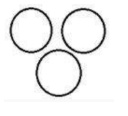
- B
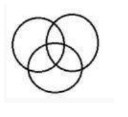
- C
- D
- E
Show answerHide answer
Official CET key: D · Cetking's answer: A — see why below
Approach: Venn diagram classification — check which pairs overlap and which are disjoint.
Solution:
Passengers and Airplane: some passengers travel by airplane → overlap.
Passengers and Taxi: some passengers travel by taxi → overlap.
Airplane and Taxi: two different vehicles, no common member → disjoint.
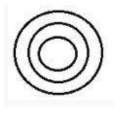
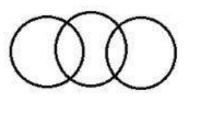
So Passengers is a middle circle overlapping both, while the end circles do not touch: three circles in a chain.
Figure D shows exactly this.
Why the other options are wrong:
A: three separate circles — ignores the passenger overlaps.
B: three mutually overlapping circles — would need something that is both airplane and taxi.
C: concentric circles — would mean one class wholly contains another.
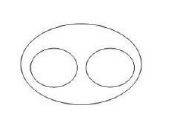
E: two disjoint sets inside one big set — would mean all airplanes and taxis are passengers.
Cetking shortcut: Two unrelated items + one item linked to both = chain diagram.
Answer: D
If REQUEST is written as S2R52TU, then how will ACID be written?
- A1394
- BIC94
- CBDJE
- DB3J4
- E1D3E
Show answerHide answer
Official CET key: E · Cetking's answer: D — see why below
Approach: Letter coding — vowels become a number, consonants shift +1.
Solution:
Decode REQUEST → S2R52TU letter by letter:
R → S (+1), E → 2, Q → R (+1), U → 5, E → 2, S → T (+1), T → U (+1).
Vowels are numbered A=1, E=2, I=3, O=4, U=5; consonants move to the next letter.
ACID: A → 1, C → D, I → 3, D → E.
Code = 1D3E.
Why the other options are wrong:
A: 1394 codes C and D by alphabet rank instead of shifting them.
B: IC94 follows no consistent rule.
D: B3J4 shifts the vowels and ranks the consonants — the reverse of the rule.
C: shifts every letter by +1, ignoring the vowel-number rule.
Cetking shortcut: Vowels become 1-5 and every consonant moves up one letter: C→D, D→E, so only E (1D3E) fits.
Answer: E
In a certain code ‘TERMINAL’ is written as ‘SDQLJOBM’. How is CREDIBLE written in that code ?
- ABQDCJCMF
- BBQDCHAKD
- CDSFEJCMF
- DDSFEHAKD
- EFEHAKDSD
Show answerHide answer
Answer: A ✓ official key
Approach: Split-half letter shift coding.
Solution:
TERMINAL = TERM | INAL; code SDQL | JOBM.
First half: T→S, E→D, R→Q, M→L (each −1).
Second half: I→J, N→O, A→B, L→M (each +1).
CREDIBLE = CRED | IBLE.
CRED −1 → BQDC; IBLE +1 → JCMF.
Code = BQDCJCMF.
Why the other options are wrong:
B: second half shifted −1 (HAKD) instead of +1.
C: first half shifted +1 instead of −1.
D: both halves shifted the wrong way.
E: halves swapped and shifted wrongly.
Cetking shortcut: Check just the first and fifth letters: C−1 = B and I+1 = J → only A starts 'B…J'.
Answer: A
Complete the given series.
D-4, F-6, H-8, J-10, ?, ?.
- AK-12, M-13
- BL-12, M-14
- CL-12, N-14
- DK-12, M-14
- EB-12, M-14
Show answerHide answer
Answer: C ✓ official key
Approach: Alphanumeric series — letter jumps +2 and the number is the letter's alphabet position.
Solution:
Letters: D, F, H, J → +2 each → L, N.
Numbers: 4, 6, 8, 10 = positions of D, F, H, J.
L = 12, N = 14.
Next two terms: L-12, N-14.
Why the other options are wrong:
A, D: K is +1 from J, not +2; also M-13 breaks the position rule.
B: M is only +1 from L.
E: B-12 — B is not the 12th letter.
Cetking shortcut: The number always equals the letter's rank — only C keeps both letters and numbers consistent.
Answer: C
At a crossing, there was a direction pole, which was showing all the four correct directions. But due to the wind, it turns in such a manner that now West pointer is showing South. Harish went in the wrong direction thinking that he was travelling East. In what direction he was actually travelling?
- ASouth
- BNorth
- CWest
- DEast
- ESouth-West
Show answerHide answer
Answer: B ✓ official key
Approach: Rotated direction pole — find the rotation, then apply it to the pointer followed.
Solution:
The West pointer now points South. Going from West to South is a 90° anticlockwise turn.
So every pointer has turned 90° anticlockwise: North→West, East→North, South→East, West→South.
Harish follows the pointer marked 'East'.
That pointer now actually points North, so he is travelling North.
Why the other options are wrong:
A: South is where the West pointer points, not the East pointer.
C: West is where the North pointer now points.
D: East would mean the pole had not turned.
E: a 90° turn cannot produce a diagonal direction.
Cetking shortcut: Opposite pointers stay opposite: West→South means East→North.
Answer: B
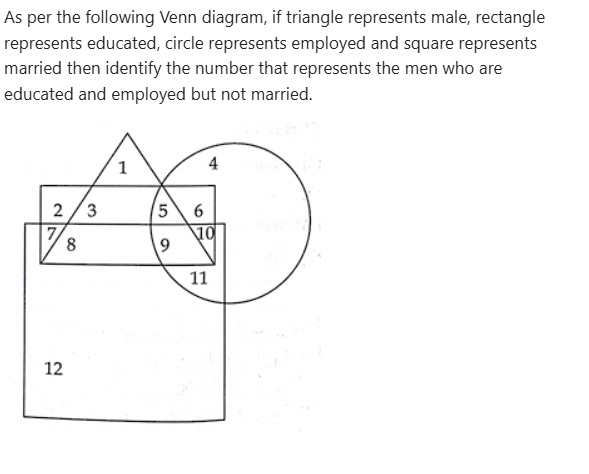
Data read from diagram:
- Shapes: triangle = male, rectangle (horizontal band) = educated, circle = employed (at right), square (large box at bottom) = married.
- 1: triangle only
- 2: rectangle only
- 3: triangle + rectangle
- 4: circle only
- 5: triangle + rectangle + circle
- 6: rectangle + circle
- 7: rectangle + square
- 8: triangle + rectangle + square
- 9: triangle + rectangle + circle + square
- 10: rectangle + circle + square
- 11: circle + square
- 12: square only
As per the following Venn diagram, if triangle represents male, rectangle represents educated, circle represents employed and square represents married then identify the number that represents the men who are educated and employed but not married.
- A3
- B9
- C5
- D8
- E11
Show answerHide answer
Official CET key: C · Cetking's answer: A — see why below
Approach: Venn diagram region reading — inside the required shapes, outside the excluded one.
Solution:
Men educated and employed but not married = inside Triangle AND Rectangle AND Circle, but outside Square.
Regions in Triangle + Rectangle + Circle: 5 and 9.
Region 9 is also inside the Square (married); region 5 lies above the square's top edge.
So the required region is 5.
Why the other options are wrong:
A: 3 is triangle + rectangle only — not employed.
B: 9 is in all four shapes — married.
D: 8 is triangle + rectangle + square — married and not employed.
E: 11 is circle + square only — neither male nor educated.
Cetking shortcut: List the regions common to the three 'yes' shapes first (5, 9), then strike the one inside the 'no' shape.
Answer: C
Find the next number in the sequence given below :
10, 22, 46, 94, ?
- A178
- B182
- C190
- D192
- E200
Show answerHide answer
Answer: C ✓ official key
Approach: Number series with ×2 + 2 rule (differences doubling).
Solution:
10 × 2 + 2 = 22
22 × 2 + 2 = 46
46 × 2 + 2 = 94
94 × 2 + 2 = 190
Check: differences 12, 24, 48 double → next 96; 94 + 96 = 190.
Cetking shortcut: Differences 12, 24, 48 double each time — add 96.
Answer: C
In a 400 m race, A runs @ 10 m/s and B @ 8 m/s. If B is given a head start of 50 m, what is the probability that A wins the race ?
- A0
- B1
- C0.50
- D0.33
- E0.88
Show answerHide answer
Answer: B ✓ official key
Approach: Time comparison in a race — certain event has probability 1.
Solution:
A runs the full 400 m: time = 400 ÷ 10 = 40 s.
B starts 50 m ahead, so runs 350 m: time = 350 ÷ 8 = 43.75 s.
A always finishes 3.75 s earlier — no chance involved.
An event that is certain has probability 1.
Why the other options are wrong:
A: 0 would mean A can never win.
C, D, E: fractional values imply uncertainty, but the speeds fix the result.
Cetking shortcut: Head start 50 m at 8 m/s is worth 6.25 s, but A already gains 10 s over 400 m (50 vs 40 s) — A wins for sure.
Answer: B
Select the odd number pair from the given alternatives.
- A15, 225
- B13, 169
- C19, 227
- D14, 196
- E12, 144
Show answerHide answer
Answer: C ✓ official key
Approach: Number-pair classification — each pair is (n, n²).
Solution:
15² = 225 ✓, 13² = 169 ✓, 14² = 196 ✓, 12² = 144 ✓.
19² = 361, but the pair shows 227 ✗.
So (19, 227) is the odd pair.
Cetking shortcut: Unit digit check: 19² must end in 1 — 227 ends in 7.
Answer: C
Five boys took part in a race. Raj finished before Mohit but behind Gaurav. Ashish finished before Sanchet but behind Mohit. Who won the race?
- ARaj
- BGaurav
- CMohit
- DAshish
- ESanchet
Show answerHide answer
Answer: B ✓ official key
Approach: Ranking by chaining 'before/behind' clues.
Solution:
Raj finished before Mohit but behind Gaurav: Gaurav > Raj > Mohit.
Ashish finished before Sanchet but behind Mohit: Mohit > Ashish > Sanchet.
Join at Mohit: Gaurav > Raj > Mohit > Ashish > Sanchet.
Gaurav finished first.
Why the other options are wrong:
A: Raj is behind Gaurav.
C, D, E: Mohit, Ashish, Sanchet are all behind Raj.
Cetking shortcut: The winner is the one never said to be 'behind' anyone — Gaurav.
Answer: B
In a class of 60 students where girls are twice that of boys, Ashwini ranked 27th from the top. If there are 9 boys ahead of Ashwini, how many girls are after her rank ?
- A23
- B21
- C22
- D24
- E27
Show answerHide answer
Answer: C ✓ official key
Approach: Rank arithmetic with a boys–girls split.
Solution:
Girls = 2 × Boys and total 60 → Boys = 20, Girls = 40.
Ashwini is 27th from top → 26 students ahead of her.
Boys ahead = 9 → Girls ahead = 26 − 9 = 17.
Ashwini is a girl, so girls up to and including her = 17 + 1 = 18.
Girls after her = 40 − 18 = 22.
Why the other options are wrong:
A: 23 forgets to exclude Ashwini herself.
B, D: arithmetic slips around 22.
E: 27 is her rank, not a count of girls.
Cetking shortcut: Girls after = Total girls − girls ahead − 1 (herself) = 40 − 17 − 1.
Answer: C
Statements: No women teacher can play. Some women teachers are athletes.
Conclusions:
1. Male athletes can play.
2. Some athletes can play.
- AOnly conclusion I follows
- BOnly conclusion II follows
- CEither I or II follows
- DNeither I nor II follows
- EBoth I and II follow
Show answerHide answer
Answer: D ✓ official key
Approach: Syllogism — 'No' + 'Some' statements; check only definite conclusions.
Solution:
No women teacher can play: the women-teacher circle is separate from 'players'.
Some women teachers are athletes: athlete circle overlaps women teachers.
Those athletes who are women teachers cannot play; about other athletes nothing is known.
I. 'Male athletes can play' — males are never mentioned → does not follow.
II. 'Some athletes can play' — only a possibility, not certain → does not follow.
Why the other options are wrong:
A, E: I introduces a new term (male athletes).
B, E: II is possible but not definite.
C: I and II are not a complementary pair, so 'either-or' cannot apply.
Cetking shortcut: From 'Some A are B' + 'No A is C' the valid conclusion is 'Some B are not C' — here 'Some athletes cannot play', which is neither option.
Answer: D
Statement: All mangoes are golden in colour. No golden colored things are cheap.
Conclusions:
I. All mangoes are cheap.
II. Golden colored mangoes are not cheap.
- AOnly conclusion I follows
- BOnly conclusion II follows
- CEither I or II follows
- DNeither I nor II follows
- EBoth I and II follow
Show answerHide answer
Answer: B ✓ official key
Approach: Syllogism — 'All' + 'No' gives a definite 'No'.
Solution:
All mangoes are golden; no golden thing is cheap.
Mangoes sit fully inside 'golden', which has no overlap with 'cheap' → no mango is cheap.
I. All mangoes are cheap — contradicts the result → does not follow.
II. Golden-coloured mangoes are not cheap — every mango is golden and not cheap → follows.
Why the other options are wrong:
A, E: I is directly contradicted.
C: 'either-or' needs one of the two always true while neither is certain; here II is certain.
D: II does follow.
Cetking shortcut: All A are B + No B is C ⇒ No A is C — a standard valid form.
Answer: B
A word arrangement machine when given an input line of words rearranges them following a particular rule in each step. The following is an illustration of the input and the steps of rearrangement.
Input : but going for crept the light sir
Step I : crept but going for the light sir
Step II : crept going light but for the sir
Step III: crept going light but for sir the
Step III is the last step for this input.
As per the rules followed in the above steps, find out in the given questions the appropriate step for the given input
Input : more fight cats cough sough acts idea
Which of the following steps would be the last step for this input ?
- AIII
- BIV
- CV
- DVI
- EVII
Show answerHide answer
Official CET key: D · Cetking's answer: B — see why below
Approach: Input–output word sorting — fix one word per step, left to right.
Solution:
Rule from the illustration: longer (5-letter) words come first in alphabetical order, then the shorter words in alphabetical order; words are placed one by one from the left.
Target for the new input: cough, fight, sough (5 letters, a→z) then acts, cats, idea, more (4 letters, a→z).
Input: more fight cats cough sough acts idea
Step I: cough more fight cats sough acts idea
Step II: cough fight more cats sough acts idea
Step III: cough fight sough more cats acts idea
Step IV: cough fight sough acts more cats idea
Step V: cough fight sough acts cats more idea
Step VI: cough fight sough acts cats idea more — final arrangement.
No word is already in its final place, so all six placements are needed.
Why the other options are wrong:
A, B, C: stopping at III, IV or V leaves the 4-letter words unsorted.
E: VII would mean placing the last word too, but it falls into place automatically.
Cetking shortcut: Count how many of the first (n − 1) positions hold the wrong word in the input — here all 6 → 6 steps.
Answer: D
Five people A,B,C,D and E are sitting in a row facing you such that D is on the left of C and B is on the right of E. A is on the right of C and B is on the left of D. If E occupies a corner position, then whose sitting in the center ?
- AA
- BB
- CC
- DD
- EE
Show answerHide answer
Answer: D ✓ official key
Approach: Linear arrangement — build the row from the 'left of / right of' clues.
Solution:
D is left of C and A is right of C → D … C … A.
B is left of D → B … D … C … A.
B is right of E → E … B … D … C … A.
Five people, five seats: E B D C A, with E at a corner as given.
Middle (3rd) seat = D.
Why the other options are wrong:
A, E: A and E are at the two ends.
B, C: B and C are 2nd and 4th.
Cetking shortcut: E at one end and the chain E-B-D-C-A uses all five — the 3rd letter is the answer.
Answer: D
There are 8 houses in a line and in each house only one boy lives with the conditions as given below:
1. Jack is not the neighbour of Simon.
2. Harry is just next to the left of Larry.
3. There is at least one to the left of Larry.
4. Paul lives in one of the two houses in the middle.
5. Mike lives in between Paul and Larry.
If at least one lives to the right of Robert and Harry is not between Taud and Larry, then which one of the following statement is not correct ?
- ARobert is not at the left end.
- BRobert is in between Simon and Taud.
- CTaud is in between Paul and Jack.
- DThere is no one to the right of Paul
- EThere are three persons to the right of Paul.
Show answerHide answer
Official CET key: C · Cetking's answer: D — see why below
Approach: Linear arrangement of 8 houses — fix the Paul–Mike–Harry–Larry block, then place the rest.
Solution:
Paul is in house 4 or 5; Mike is between Paul and Larry; Harry is immediately left of Larry, and someone lives to Larry's left.
'Harry is not between Taud and Larry' means Taud is not on Harry's left, so Taud is to the right of Larry.
Take Paul = 4, Mike = 5, Harry = 6, Larry = 7, Taud = 8.
Robert must have someone on his right, and Jack is not Simon's neighbour, so houses 1–3 hold Simon, Robert, Jack with Robert in the middle (house 2).
Row: Simon, Robert, Jack, Paul, Mike, Harry, Larry, Taud.
Statement C says Taud lies between Paul and Jack. Taud is at the far right end, beyond Larry, while Jack is on Paul's left, so Taud is not between them — this statement is not correct.
Why the other options are wrong:
A: Robert is in house 2, not at the left end — correct statement.
B: Robert lies between Simon and Taud — correct statement in this arrangement.
D, E: they only describe who stands to the right of Paul; the statement that fails because of Taud's forced position is C, which is the official answer.
Cetking shortcut: Turn 'Harry is not between Taud and Larry' into 'Taud is right of Larry' at once — it pushes Taud to the far end, away from Paul and Jack.
Answer: C
There are 64 Music books arranged in a row at central library Pune. Western Music is 25th from the left side of the row and Classical Music is 30th from the right side of the row. What is the total number of books between Western Music and Classical Music ?
- A6
- B7
- C8
- D9
- E5
Show answerHide answer
Answer: D ✓ official key
Approach: Row counting — positions from both ends.
Solution:
Total books = 64.
Western Music is 25th from left; Classical Music is 30th from right.
25 + 30 = 55 < 64, so the two books do not overlap and the gap lies between them.
Books between = 64 − 55 = 9.
Cetking shortcut: Between = Total − (left rank + right rank) when the sum is less than the total.
Answer: D
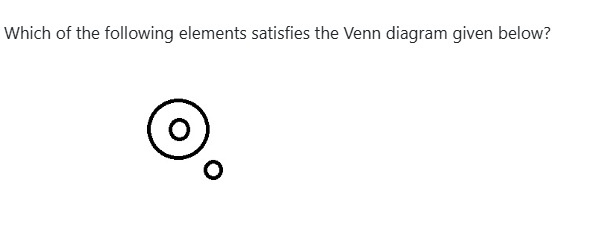
Data read from diagram: two concentric circles (a small circle inside a larger circle) and one separate small circle outside the larger circle, not touching it.
Which of the following elements satisfies the Venn diagram given below?
- AJudge, Thief, Criminal
- BFather, Mother, Parents
- CTeacher, College, Students
- DPolygons, Rectangles, Squares
- EAnimal, Birds, Living Things
Show answerHide answer
Official CET key: A · Cetking's answer: E — see why below
Approach: Match the diagram: one class inside another + one completely separate class.
Solution:
Diagram: a small circle wholly inside a bigger circle, and a third circle outside both.
A: every Thief is a Criminal (Thief inside Criminal); a Judge is neither, so Judge is separate. ✓
So Judge, Thief, Criminal fits the diagram.
Why the other options are wrong:
B: Father and Mother are two separate classes both inside Parents.
C: Teacher, College, Students are different kinds of things with no subset pattern matching.
D: Squares ⊂ Rectangles ⊂ Polygons — three nested circles, no separate one.
E: Birds ⊂ Animals ⊂ Living Things — again three nested circles.
Cetking shortcut: Look for exactly one subset pair plus one unrelated item — only A has an outsider.
Answer: A
Statements : All cups are glasses. Some glasses are bowls. No bowl is a plate.
Conclusions :
I. No cup is a plate.
II. No glass is a plate.
III. Some plates are bowls.
IV. Some cups are not glasses.
- AOnly either I or III follows
- BOnly II and III follow
- COnly III and IV follow
- DOnly I follows
- ENone follows
Show answerHide answer
Answer: E ✓ official key
Approach: Syllogism with four conclusions — accept only definite ones.
Solution:
Cups ⊂ Glasses; Glasses overlap Bowls; Bowls and Plates are disjoint.
I. No cup is a plate — cups and plates are never linked; a cup may or may not be a plate → does not follow.
II. No glass is a plate — glasses that are not bowls may be plates → does not follow.
III. Some plates are bowls — contradicts 'No bowl is a plate' → false.
IV. Some cups are not glasses — contradicts 'All cups are glasses' → false.
None of the conclusions follows.
Why the other options are wrong:
A: I and III are not complementary (III is outright false), so 'either-or' fails.
B, C, D: each includes a conclusion that is only possible or plainly false.
Cetking shortcut: 'No' links only the two terms named; it cannot be extended through a 'Some' link to cups or glasses.
Answer: E
Directions : For the Assertion (A) and Reason (R) below, choose the correct alternative
Assertion(A) : Bangladesh imports jute from India.
Reason (R) : Bangladesh has most of the jute mills.
- ABoth A and R are true and R is the correct explanation of A.
- BBoth A and R are true but R is NOT the correct explanation of A.
- CA is true but R is false.
- DBoth A and R are false.
- EA is false but R is true.
Show answerHide answer
Answer: D ✓ official key
Approach: Assertion–Reason — test each statement's truth first.
Solution:
A: Bangladesh is the world's largest exporter of raw jute; India imports raw jute from Bangladesh, not the other way round → A is false.
R: At Partition (1947) the jute-growing areas went to East Bengal (now Bangladesh) while most jute mills stayed in West Bengal (India) → R is false.
Both A and R are false.
Why the other options are wrong:
A, B, C: each needs A to be true.
E: needs R to be true, but the mills were largely in India.
Cetking shortcut: Remember the Partition fact: Bangladesh got the jute fields, India got the mills — so India buys jute from Bangladesh.
Answer: D
The following question consists of two statements, one labeled as "Assertion" and the other as "Reason". Examine the statements and select the correct answer from the options.
Assertion (A): Plastic impacts animals and the environment.
Reason (R): Many animals consume plastic as a food and eat it by accident.
- ABoth A and R are true and R is the correct explanation of A.
- BBoth A and R are true but R is not the correct explanation of A.
- CA is true, R is false
- DBoth A and R are false
- EA is false but R is true
Show answerHide answer
Answer: A ✓ official key
Approach: Assertion–Reason — check truth, then whether R explains A.
Solution:
A: Plastic harms animals and the environment — true.
R: Many animals eat plastic, mistaking it for food or swallowing it accidentally — true.
Ingestion causes choking, gut blockage and poisoning, which is a direct way plastic harms animals → R explains A.
Why the other options are wrong:
B: R is not unrelated — it gives the mechanism of the harm.
C, D, E: both statements are true.
Cetking shortcut: Ask 'A happens because R?' — 'Plastic harms animals because animals eat it' reads naturally → A.
Answer: A
Fill the blank place with the correct option given below.
FAG, GAF, HAI, IAH, _____.
- AHAK
- BHAL
- CJAK
- DJAI
- EKAH
Show answerHide answer
Answer: C ✓ official key
Approach: Letter series — alternate terms move +2; each even term is the reverse of the term before it.
Solution:
Odd terms: FAG → HAI → ?: outer letters +2 each (F→H, G→I), A stays.
Even terms: GAF = FAG reversed, IAH = HAI reversed.
The 5th term is the next odd term: H+2 = J, A, I+2 = K → JAK.
Why the other options are wrong:
A, B: HAK / HAL keep H as first letter — no +2 move.
D: JAI moves only the first letter.
E: KAH does not follow either pattern.
Cetking shortcut: Pairs (FAG, GAF), (HAI, IAH): new word then its mirror — the 5th term starts a new pair: JAK.
Answer: C
Select the option that correctly completes the given analogy. The relationship between the first pair must be applied in the same way to the second pair.
P21 : J28 :: G19 : ?
- AT17
- BC16
- CA26
- DO19
- EK11
Show answerHide answer
Official CET key: C · Cetking's answer: B — see why below
Approach: Alphanumeric analogy — letter rank shift and number shift.
Solution:
P21 → J28: P (16) → J (10) is −6; 21 → 28 is +7.
Apply to G19: G (7) − 6 = 1 → A.
19 + 7 = 26.
So G19 : A26.
Why the other options are wrong:
A: T17 — T is +13 and 17 is −2.
B: C16 — C is −4 and 16 is −3.
D: O19 — number unchanged.
E: K11 — K is +4 and 11 is −8.
Cetking shortcut: Fix the number part first: only A26 has 19 + 7 = 26.
Answer: C
Identify the odd one in this set:
253
473
143
633
847
- A253
- B473
- C143
- D633
- E847
Show answerHide answer
Answer: D ✓ official key
Approach: Number classification — divisibility by 11.
Solution:
253 = 11 × 23 ✓
473 = 11 × 43 ✓
143 = 11 × 13 ✓
847 = 11 × 77 ✓
633: alternating sum 6 − 3 + 3 = 6, not 0 or 11 → not divisible by 11 ✗
633 is the odd one.
Cetking shortcut: For a 3-digit number abc, it is a multiple of 11 when a + c = b (or a + c = b + 11): 2+3=5, 4+3=7, 1+3=4, 8+7=15=4+11; 6+3=9 ≠ 3.
Answer: D
If A + B means A is the brother of B; A – B means A is the sister of B and A x B means A is the father of B. Which of the following means that C is the son of M ?
- AM – N x C + F
- BF – C + N x M
- CN + M – F x C
- DM x N – C + F
- EF-N+C
Show answerHide answer
Answer: D ✓ official key
Approach: Coded blood relations — decode each option, looking for 'M is father of C' and 'C is male'.
Solution:
Need: M is the father (or mother) of C, and C is male.
D: M x N → M is father of N.
N – C → N is sister of C, so C is also M's child.
C + F → C is brother of F, so C is male.
Hence C is the son of M.
Why the other options are wrong:
A: M – N x C → M is sister of N, who is C's father → M is C's aunt.
B: N x M → N is father of M; C is N's brother → C is M's uncle.
C: F x C → F is C's father; M is F's sister → M is C's aunt.
E: F–N+C does not mention M at all.
Cetking shortcut: Start from options where M is followed by 'x' (father) — only D begins 'M x'.
Answer: D
The following question consists of two statements, one labeled as "Assertion" and the other as "Reason". Examine the statements and select the correct answer from the options.
Assertion (A): Business finance plays a crucial role in achieving business objectives.
Reason (R): Financial decisions have no impact on a company's growth and expansion.
- ABoth A and R are true, and R is the correct explanation of A.
- BBoth A and R are true, but R is not the correct explanation of A
- CA is true, R is false.
- DBoth A and R are false
- EA is false and R is true.
Show answerHide answer
Answer: C ✓ official key
Approach: Assertion–Reason — check truth of each statement.
Solution:
A: Business finance (raising and using funds) is essential to achieve business objectives — true.
R: Financial decisions (investment, financing, dividend) directly decide growth and expansion; saying they have 'no impact' is false.
So A is true, R is false.
Why the other options are wrong:
A, B: need R to be true.
D: A is clearly true.
E: A is true and R is false, the reverse.
Cetking shortcut: Absolute words like 'no impact' in R usually signal a false statement.
Answer: C
Complete the given series :
AYBZC, DWEXF, GUHVI, JSKTL, ?
- AMQORN
- BMQNRO
- CNQMOR
- DQMONR
- EOQRPM
Show answerHide answer
Answer: B ✓ official key
Approach: Letter series — position-wise patterns in 5-letter groups.
Solution:
Position 1: A, D, G, J → +3 → M
Position 2: Y, W, U, S → −2 → Q
Position 3: B, E, H, K → +3 → N
Position 4: Z, X, V, T → −2 → R
Position 5: C, F, I, L → +3 → O
Next group: MQNRO.
Why the other options are wrong:
A: MQORN swaps the 3rd and 5th letters.
C, D, E: wrong first letter (must be M = J + 3).
Cetking shortcut: Positions 1, 3, 5 just run through the alphabet (ABC, DEF, GHI, JKL → MNO); slot Q and R into positions 2 and 4.
Answer: B
Complete the given series.
Z10, Y20, X30, W40, ?
- AU50
- BV60
- CV50
- DU60
- ET50
Show answerHide answer
Answer: C ✓ official key
Approach: Alphanumeric series — letters step back by 1, numbers rise by 10.
Solution:
Letters: Z, Y, X, W → −1 each → V.
Numbers: 10, 20, 30, 40 → +10 → 50.
Next term: V50.
Why the other options are wrong:
A, D, E: U and T skip letters.
B: 60 skips a step of 10.
Answer: C
Shekhar's birthday falls on 20th of May and Rohit's birthday falls on 1st of the same month. If Rohit's birthday falls on Sunday, then on which day is Shekhar's birthday?
- AMonday
- BTuesday
- CWednesday
- DThursday
- EFriday
Show answerHide answer
Official CET key: E · Cetking's answer: B — see why below
Approach: Calendar — count odd days between two dates of the same month.
Solution:
Rohit's birthday: 1 May = Sunday.
Shekhar's birthday: 20 May → 20 − 1 = 19 days later.
19 ÷ 7 = 2 weeks + 5 odd days.
Sunday + 5 days = Friday (Mon 1, Tue 2, Wed 3, Thu 4, Fri 5).
Why the other options are wrong:
B: Tuesday is Sunday + 2 — a counting slip.
A, C, D: Sunday + 1, 3 or 4.
Cetking shortcut: Same weekday repeats every 7 days: 1, 8, 15 May are Sundays → 15 + 5 = 20 is Friday.
Answer: E
Aman is 16th from the left end in a row of boys and Vivek is 18th from the right end. Gagan is 11th from Aman towards the right and 3rd from Vivek towards the right end. How many boys are there in the row ?
- A40
- B42
- C48
- D41
- E43
Show answerHide answer
Official CET key: D · Cetking's answer: B — see why below
Approach: Row ranking — get one person's rank from both ends, then total = left + right − 1.
Solution:
Aman is 16th from left; Gagan is 11th to the right of Aman → Gagan is 16 + 11 = 27th from left.
Vivek is 18th from right; Gagan is 3rd from Vivek towards the right end → Gagan is 18 − 3 = 15th from right.
Total boys = 27 + 15 − 1 = 41.
Why the other options are wrong:
A, B: off by one — forgetting or double-subtracting Gagan.
C, E: adding ranks of different people.
Cetking shortcut: Convert everything to the common person (Gagan), then Total = L + R − 1.
Answer: D
Charu correctly remembers that her father's birthday is after 24 but before 29 of May. Her sister remembers that their father's birthday is after 27 but before 31 May and her brother remembers that the birthday is on an even date. On which date in May is definitely their father's birthday?
- A30
- B28
- C26
- D29
- E24
Show answerHide answer
Answer: B ✓ official key
Approach: Date range intersection.
Solution:
Charu: after 24, before 29 → 25, 26, 27, 28.
Sister: after 27, before 31 → 28, 29, 30.
Common dates: 28 only.
Brother: even date — 28 is even ✓.
Birthday = 28 May.
Why the other options are wrong:
A: 30 is outside Charu's range.
C, E: 26 and 24 are outside the sister's range (24 is outside Charu's too).
D: 29 is excluded by Charu and is odd.
Cetking shortcut: 'After 24' and 'before 29' are exclusive limits — list only the dates strictly between.
Answer: B
If + means ÷, - means x, x means +, ÷ means -, then give the value for 45 + 9 - 3 x 15 ÷ 2
- A40
- B28
- C56
- D26
- E46
Show answerHide answer
Answer: B ✓ official key
Approach: Symbol substitution, then BODMAS.
Solution:
Replace: + → ÷, − → ×, × → +, ÷ → −.
45 + 9 − 3 × 15 ÷ 2 becomes 45 ÷ 9 × 3 + 15 − 2.
45 ÷ 9 = 5; 5 × 3 = 15.
15 + 15 − 2 = 28.
Cetking shortcut: Rewrite the whole expression first, then solve — never substitute and compute at the same time.
Answer: B
If 'K' means 'minus', 'L' means 'divided by', 'M' means 'plus' and 'D' means 'multiplied by', then
117 L 3 K 5 M 12 D 8 = ?
- A145
- B130
- C150
- D125
- E110
Show answerHide answer
Answer: B ✓ official key
Approach: Letter-to-operator substitution, then BODMAS.
Solution:
K = −, L = ÷, M = +, D = ×.
117 L 3 K 5 M 12 D 8 = 117 ÷ 3 − 5 + 12 × 8.
117 ÷ 3 = 39; 12 × 8 = 96.
39 − 5 + 96 = 130.
Cetking shortcut: Division and multiplication first: 39 and 96, then 39 + 96 − 5.
Answer: B
Arrange the words given below in a meaningful sequence.
1. Elephant
2. Cat
3. Mosquito
4. Tiger
5. Whale
- A3,2,5,1,4
- B2,5,1,4,3
- C3,2,4,1,5
- D5,3,1,2,4
- E4,5,2,1,3
Show answerHide answer
Answer: C ✓ official key
Approach: Logical sequence — arrange by increasing size.
Solution:
Sizes: Mosquito (3) < Cat (2) < Tiger (4) < Elephant (1) < Whale (5).
Sequence: 3, 2, 4, 1, 5.
Why the other options are wrong:
A: puts Whale before Elephant and Tiger last.
B, D, E: start from a larger animal and break the size order.
Cetking shortcut: Smallest (mosquito) first and largest (whale) last — only C starts with 3 and ends with 5.
Answer: C
Arrange the given words in a logical and meaningful order.
1. Atomic Age
2. Metallic Age
3. Stone Age
4. Alloy Age
- A4,3,2,1
- B2,3,1,4
- C3,2,4,1
- D4,3,2,1
- E3,2,1,4
Show answerHide answer
Answer: C ✓ official key
Approach: Logical sequence — order of human technological ages.
Solution:
Stone Age came first (3).
Then the Metallic Age — copper/bronze/iron (2).
Then the Alloy Age — mixed metals like steel (4).
Finally the modern Atomic Age (1).
Sequence: 3, 2, 4, 1.
Why the other options are wrong:
A, D: the same sequence (4,3,2,1); it starts with Alloy Age.
B: starts with Metallic Age, before Stone Age.
E: puts Atomic Age before Alloy Age.
Cetking shortcut: Stone Age must come first and Atomic Age last — only C does both.
Answer: C
The age of the father is twice that of the elder son. Ten years hence the age of father will be three times that of the younger son. If the difference of ages of two sons is 15 years, the age of the father is :
- A50 Years
- B55 Years
- C60 Years
- D65 Years
- E70 Years
Show answerHide answer
Official CET key: A · Cetking's answer: C — see why below
Approach: Age equations with two sons.
Solution:
Let father = F, elder son = E, younger son = Y.
F = 2E → E = F/2.
E − Y = 15 → Y = F/2 − 15.
Ten years hence: F + 10 = 3(Y + 10) = 3(F/2 − 5) = 1.5F − 15.
0.5F = 25 → F = 50.
Check: E = 25, Y = 10; after 10 years 60 = 3 × 20 ✓.
Cetking shortcut: Test options: F must be even; F = 50 → Y = 10 → 60 = 3 × 20 ✓ in one line.
Answer: A
Consider the following information and answer the question based on it.
Out of 60 people in a colony, 10 speak only Bengali, 5 speak only Assamese, 10 speak both Hindi and Odia, 12 speak both Marathi and Hindi, 13 speak English, Tamil and Marathi, 5 speak both Assamese and Hindi and the remaining speak both Bengali and Hindi.
What is the ratio of people who speak Bengali to those who speak Marathi ?
- A15/32
- B1/2
- C3/4
- D3/5
- E5/3
Show answerHide answer
Official CET key: D · Cetking's answer: B — see why below
Approach: Group counting — add every group containing the language.
Solution:
Stated groups: 10 + 5 + 10 + 12 + 13 + 5 = 55.
Remaining (Bengali and Hindi) = 60 − 55 = 5.
Bengali speakers = only Bengali 10 + Bengali & Hindi 5 = 15.
Marathi speakers = Marathi & Hindi 12 + English, Tamil & Marathi 13 = 25.
Ratio = 15 : 25 = 3/5.
Why the other options are wrong:
A: 15/32 adds the wrong groups to Marathi.
B, C: wrong group totals.
E: 5/3 is the ratio inverted.
Cetking shortcut: Find the 'remaining' group first — it is the only missing number.
Answer: D
Some friends planned on a leisure trip where they had planned Rs.96 on eatables. 4 of them did not come. So the rest of them had to pay Rs. 4 extra each. The number of people who turned up on the trip was ;
- A4
- B8
- C12
- D16
- E24
Show answerHide answer
Answer: B ✓ official key
Approach: Equal sharing — fixed total, fewer people, higher share.
Solution:
Let the planned number be x; share = 96/x.
4 dropped out → share = 96/(x − 4).
96/(x − 4) − 96/x = 4 → 96 × 4 = 4x(x − 4) → x² − 4x − 96 = 0.
(x − 12)(x + 8) = 0 → x = 12.
People who turned up = 12 − 4 = 8. Check: 96/8 = 12, 96/12 = 8, extra 4 ✓.
Cetking shortcut: Pick factors of 96 differing by 4 with shares differing by 4: 8 and 12 people → shares 12 and 8.
Answer: B
Find out the missing number which can be replaced in the place of the question mark.
Data read from diagram: circle divided into 6 sectors; going clockwise from top-right: 4, 9, 20, 43, 90, ? (top-left sector).
- A185
- B126
- C239
- D184
- E125
Show answerHide answer
Official CET key: A · Cetking's answer: B — see why below
Approach: Number series in a circle — ×2 plus an increasing number.
Solution:
Clockwise from the top-right sector: 4, 9, 20, 43, 90, ?
4 × 2 + 1 = 9
9 × 2 + 2 = 20
20 × 2 + 3 = 43
43 × 2 + 4 = 90
90 × 2 + 5 = 185
Why the other options are wrong:
B: 126 assumes n³ + 1, which fails (2³ + 1 = 9 but 3³ + 1 = 28 ≠ 20).
C, D, E: break the ×2 + n pattern.
Cetking shortcut: Each term is a little more than double the previous — 2 × 90 = 180, so the answer is just above 180: 185.
Answer: A
Find the correct alternative which will replace the question mark?
Data read from diagram:
| Circle | Top-left | Top-right | Bottom-left | Bottom-right |
|---|
| First | 8 | 59 | 25 | 42 |
| Second | 12 | 63 | 29 | ? |
- A46
- B88
- C32
- D54
- E25
Show answerHide answer
Answer: A ✓ official key
Approach: Missing number in figure — compare corresponding cells.
Solution:
First circle: 8, 59, 25, 42. Second circle: 12, 63, 29, ?
8 → 12 (+4), 59 → 63 (+4), 25 → 29 (+4).
So 42 + 4 = 46.
Check within circles: 59 − 8 = 51 = 63 − 12, and 42 − 25 = 17 = 46 − 29 ✓.
Cetking shortcut: Every cell of the second circle is +4 over the same cell of the first.
Answer: A
Which one will replace the question mark ?
Data read from diagram:
- A20
- B26
- C27
- D32
- E36
Show answerHide answer
Answer: B ✓ official key
Approach: Missing number in grid — n² + 1 sequence read row-wise.
Solution:
Row-wise: 2, 5, 10, 17, ?, 37, 50, 65, 82.
These are n² + 1: 1²+1, 2²+1, 3²+1, 4²+1, …
Missing term = 5² + 1 = 26.
Check: 6² + 1 = 37 ✓, 9² + 1 = 82 ✓.
Cetking shortcut: Differences 3, 5, 7, … (odd numbers): 17 + 9 = 26, 26 + 11 = 37 ✓.
Answer: B
A person walks 6 km north, then 8 km west, and finally 6 km south. What is the distance from the starting point?
- A4 KM
- B6 KM
- C8 KM
- D10 KM
- E12 KM
Show answerHide answer
Answer: C ✓ official key
Approach: Direction distance — opposite legs cancel.
Solution:
Start (0, 0) → 6 km North → (0, 6).
8 km West → (−8, 6).
6 km South → (−8, 0).
Distance from start = 8 km (due West).
Why the other options are wrong:
D: 10 km uses √(6² + 8²), ignoring the return 6 km South.
A, B, E: do not match the net displacement.
Cetking shortcut: North 6 and South 6 cancel — only the 8 km West remains.
Answer: C
Location of B is north of A and location of C is east of A. The distances AB and AC are 5 km and 12 km respectively. The shortest distance (in km) between the locations B and C is ;
- A60
- B13
- C17
- D7
- E14
Show answerHide answer
Answer: B ✓ official key
Approach: Right-angled triangle from perpendicular directions (Pythagoras).
Solution:
B is North of A and C is East of A → angle BAC = 90°.
BC² = AB² + AC² = 5² + 12² = 25 + 144 = 169.
BC = 13 km.
Why the other options are wrong:
A: 60 is the product 5 × 12.
C: 17 is the path B → A → C, not the shortest distance.
D: 7 is the difference.
E: 14 has no basis.
Cetking shortcut: 5-12-13 is a standard Pythagorean triplet.
Answer: B
Pointing to a photograph of a boy Suresh said, "He is the son of the only son of my mother." How is Suresh related to that boy?
- ABrother
- BUncle
- CCousin
- DFather
- ESister
Show answerHide answer
Answer: D ✓ official key
Approach: Pointing relation — 'only son of my mother' is the speaker himself.
Solution:
Suresh is male, so 'the only son of my mother' = Suresh himself.
'He is the son of Suresh' → the boy is Suresh's son.
So Suresh is the boy's Father.
Why the other options are wrong:
A, C: brother / cousin would need the boy to be in Suresh's generation.
B: uncle would need the boy's father to be Suresh's brother, but Suresh is the only son.
E: Suresh is male, not a sister.
Cetking shortcut: A male speaker's 'mother's only son' = himself.
Answer: D
Read the Question shown below and Statement I & II that follow and then choose the most appropriate option that shall help in answering the question so asked :
Question : Find out the code for 'sky' in the code language?
Statement I : In a code language, 'sky is clear' is written as 'de ra fa'.
Statement II: In the same code language, 'make it clear' is written as 'de ga jo'.
- AThe data in Statement I alone is sufficient to answer the question, while the data in statement II alone is not sufficient to answer the question.
- BThe data in statement II alone are sufficient to answer the question, while the data in statement I alone are not sufficient to answer the qustion.
- CThe data either in Statement I alone or in Statement II alone is / are sufficient to answer the question.
- DThe data given in both Statements I and II together are not sufficient to answer the question.
- EThe data given in both Statements I and II together are necessary to answer the question.
Show answerHide answer
Answer: D ✓ official key
Approach: Data Sufficiency in coding: a word's code is fixed only when it is isolated by comparing sentences.
Solution:
Statement I: 'sky is clear' = 'de ra fa'. Three words, three codes, no order given, so 'sky' cannot be fixed.
Statement II alone: 'make it clear' = 'de ga jo'. 'sky' does not even appear, so not sufficient.
Together: the common word 'clear' takes the common code 'de'.
Left in Statement I: 'sky' and 'is' with codes 'ra' and 'fa' → either could be 'sky'.
So even both statements together cannot give the code for 'sky'.
Why the other options are wrong:
A: Statement I alone gives three possible codes for 'sky'.
B: Statement II does not contain 'sky'.
C: Neither statement alone works.
E: Even combined, 'ra'/'fa' remain undecided.
Cetking shortcut: After cancelling common words, if two unknown words still share two codes, the answer is 'not sufficient even together'.
Answer: D
Is Zamir older than Wahid?
Statement 1: Zamir was born before Shahid, and Shahid is older than Wahid.
Statement 2: Zamir and Wahid have a three-year age difference.
- AStatement 1 alone is sufficient, but statement 2 is not.
- BStatement 2 alone is sufficient, but statement 1 is not.
- CBoth statements together are sufficient, but not alone.
- DEither Statement alone is sufficient.
- EBoth statements are not sufficient.
Show answerHide answer
Answer: A ✓ official key
Approach: Data Sufficiency on age comparison: chain the inequalities.
Solution:
Statement 1: Zamir was born before Shahid ⇒ Zamir > Shahid (older).
Shahid is older than Wahid ⇒ Shahid > Wahid.
Chain: Zamir > Shahid > Wahid ⇒ Zamir is older than Wahid. Statement 1 alone answers: YES.
Statement 2: a three-year gap does not say who is older ⇒ not sufficient.
Why the other options are wrong:
B: A 3-year difference has no direction.
C: Statement 1 alone already answers it.
D: Statement 2 alone fails.
E: Statement 1 is sufficient.
Cetking shortcut: 'Born before' = 'older'. A difference without direction never answers 'who is older'.
Answer: A
Five friends- Aka, Bka, Cka, Dka and Eka are sitting in a row. Among all who is sitting in the middle ?
I. Bka is in between Eka and Cka.
II. Bka is to the right of Eka.
III. Dka is in between Aka and Eka.
Which of the following statement or statements is / are sufficient to answer the question ?
- AStatement I and II together
- BStatement II and III together
- CStatement I and III together
- DStatement I, II and III together
- EData is not sufficient
Show answerHide answer
Answer: D ✓ official key
Approach: Linear arrangement DS: build the row from the clues, reading 'between' as 'immediately between'.
Solution:
I: Bka is between Eka and Cka ⇒ block E–B–C (either direction).
II: Bka is to the right of Eka ⇒ the block reads Eka, Bka, Cka from left to right.
III: Dka is between Aka and Eka ⇒ block A–D–E. Eka already has Bka on its right, so Dka is on its left.
All three together: Aka, Dka, Eka, Bka, Cka ⇒ the middle (3rd) person is Eka.
Why the other options are wrong:
A: I + II place only E, B, C; Aka and Dka remain unplaced.
B: II + III do not link Cka to the rest of the row.
C: I + III give the two blocks but not which end of the row is left or right; Statement II fixes that direction.
E: Taken together, the three statements do fix the row.
Answer: D
Find the next term in series :
2A11, 4D13, 12G17, ?
- A36I19
- B36J21
- C48J21
- D48J23
- E46K23
Show answerHide answer
Answer: D ✓ official key
Approach: Alphanumeric series: track each part of the term separately.
Solution:
First number: 2 ×2 = 4, 4 ×3 = 12, 12 ×4 = 48.
Letter: A (+3) D (+3) G (+3) J.
Last number: 11 (+2) 13 (+4) 17 (+6) 23.
Next term: 48J23.
Why the other options are wrong:
A (36I19): wrong multiplier, letter and last number.
B (36J21): first number ×3 instead of ×4, last +4 instead of +6.
C (48J21): last number +4 instead of +6.
E (46K23): first number and letter wrong.
Cetking shortcut: Fix the easiest part first: the letter must be J (kills A, E), then the last number must be 23 (only D).
Answer: D
Complete the given series by filling in the blank place with the correct option.
P5QR, P4QS, P3QT, _____, P1QV.
- APQW
- BP2QU
- CP2UQ
- DPQ3U
- EPQV2
Show answerHide answer
Answer: B ✓ official key
Approach: Alphanumeric series: constant letters, a falling number and a rising last letter.
Solution:
P and Q stay fixed in positions 1 and 3 (P _ Q _).
Number: 5, 4, 3, 2, 1.
Last letter: R, S, T, U, V.
Missing term: P2QU.
Why the other options are wrong:
A (PQW): number missing, wrong letter.
C (P2UQ): U and Q swapped.
D (PQ3U): wrong number and position.
E (PQV2): wrong letter and position.
Cetking shortcut: Keep the format P·number·Q·letter; only B keeps it.
Answer: B
Which of the following set of letters will complete the given letter series ?
WFB, TGD, QHG, ?
- ANIJ
- BNIK
- CNJK
- DNOK
- EPJK
Show answerHide answer
Answer: B ✓ official key
Approach: Letter series: treat each letter position as its own series.
Solution:
1st letter: W (−3) T (−3) Q (−3) N.
2nd letter: F (+1) G (+1) H (+1) I.
3rd letter: B (+2) D (+3) G (+4) K.
Next group: NIK.
Why the other options are wrong:
A (NIJ): 3rd letter uses +3 again instead of +4.
C (NJK): 2nd letter jumps +2.
D (NOK): 2nd letter wrong.
E (PJK): 1st and 2nd letters wrong.
Cetking shortcut: Third letter has increasing gaps (+2, +3, +4): G + 4 = K. Last letter K rules out A; first letter N rules out E; second letter I (not J or O) leaves only B.
Answer: B
Complete the series by adding the current input in the given blank space :.
B2CD, _____, BCD4, B5CD, BC6D.
- AB 2 C 2 D
- BBC 3 D
- CB 2 C 3 D
- DBCD 7
- EB3DC
Show answerHide answer
Answer: B ✓ official key
Approach: Alphanumeric series: the subscript number rises by 1 and moves one letter to the right each time (cyclically).
Solution:
Term 1: B2CD → number 2 on B.
Term 2: number 3 on C → BC3D.
Term 3: BCD4 → number 4 on D.
Term 4: B5CD → back to B (cycle). Term 5: BC6D.
Missing term: BC3D.
Why the other options are wrong:
A, C: carry two subscripts; each term has only one.
D: number 7 is far ahead and on the wrong letter.
E: letters out of order and number on the wrong letter.
Cetking shortcut: Read the positions of the numbers B, ?, D, B, C → the cycle B, C, D gives C with number 3.
Answer: B
Look at this series: 53, 53, 40, 40, 27, 27, ... What number should come next?
- A14
- B27
- C12
- D15
- E21
Show answerHide answer
Answer: A ✓ official key
Approach: Number series: each term appears twice, then 13 is subtracted.
Solution:
53, 53 → 53 − 13 = 40, 40 → 40 − 13 = 27, 27.
27 has already appeared twice, so the next term is 27 − 13 = 14.
Why the other options are wrong:
B (27): 27 is already repeated twice.
C, D, E: do not follow the −13 step.
Cetking shortcut: Repeated-pair series: drop the duplicates (53, 40, 27, ?) and the rule is −13.
Answer: A
Directions: Select the correct option that indicates the arrangement of the following words in a logical and meaningful order.
1. Scrutiny
2. Application
3. Interview
4. Job Offer
5. Joining
- A2,4,1,5,3
- B2,1,3,4,5
- C1,3,2,4,5
- D2,1,4,3,5
- E2,3,1,4,5
Show answerHide answer
Answer: B ✓ official key
Approach: Logical sequence of a hiring process.
Solution:
A candidate first sends an Application (2).
Applications go through Scrutiny (1).
Shortlisted candidates face the Interview (3).
Selected candidates get the Job Offer (4).
Finally comes Joining (5).
Order: 2, 1, 3, 4, 5.
Why the other options are wrong:
A: Job Offer before Scrutiny and Interview.
C: Scrutiny before any Application exists.
D: Job Offer before Interview.
E: Interview before Scrutiny.
Cetking shortcut: Fix the ends first: starts with Application (2), ends with Joining (5) → B, D and E remain; Job Offer must follow Interview (kills D) and Scrutiny must precede Interview (kills E) → B.
Answer: B
If 'FISH' is written as 'EHRG' in a certain code, how would 'JUNGLE' be written in that code ?
- AITMFKD
- BITNFKD
- CKVOHMF
- DTIMFKD
- ETEMKDF
Show answerHide answer
Answer: A ✓ official key
Approach: Letter-shift coding: compare the word with its code letter by letter.
Solution:
FISH → EHRG: F−1 = E, I−1 = H, S−1 = R, H−1 = G ⇒ each letter moves back by 1.
JUNGLE: J−1 = I, U−1 = T, N−1 = M, G−1 = F, L−1 = K, E−1 = D.
Code: ITMFKD.
Why the other options are wrong:
B (ITNFKD): N not shifted.
C (KVOHMF): shifted +1 instead of −1.
D (TIMFKD): first two letters swapped.
E (TEMKDF): order scrambled.
Cetking shortcut: Check just the first two and third letters: J→I, U→T, N→M ⇒ only A.
Answer: A
In a joint family, there are ; father, mother, 3 married sons and one unmarried daughter. Of the sons, two have 2 daughters each, and one has a son. How many female members are there in the family ?
- A2
- B3
- C6
- D9
- E7
Show answerHide answer
Answer: D ✓ official key
Approach: Blood relations counting: list every female member generation by generation.
Solution:
Mother: 1.
3 married sons ⇒ their 3 wives: 3.
Unmarried daughter: 1.
Two sons have 2 daughters each: 2 × 2 = 4 (the third son's child is a son).
Total females = 1 + 3 + 1 + 4 = 9.
Why the other options are wrong:
A, B: count only one generation.
C (6): misses the daughters-in-law or granddaughters.
E (7): misses the mother and the unmarried daughter, or counts 2 daughters-in-law.
Cetking shortcut: 'Married sons' always hide wives — add them first, it is the most-missed group.
Answer: D
Following are the qualifications for the post of software engineer in a reputed company.
The candidate must : -
a - Be an engineering graduate with at least 55% marks.
b - Not be less than 20 years and not more than 28 years of age as on 1-1-2016.
c - Have passed the selection test with at least 60% marks.
d - Be willing to pay a deposit of 75,000 rupees which is to be refunded on completion of training.
However, if a candidate fulfills the above-mentioned criteria except -
I - At (a) above, but in last semester examination obtained 60% marks in the 7th semester, the case will be referred to the VP of the company.
II - At (d) above, but is ready to reimburse 25,000 and has obtained 70% in engineering career the case may be referred to the GM of the company.
Provided, Shiva Kumar, a B.Tech. graduate and is 26 years old. He has scored 76% in the selection test and is willing to pay on demand. Whether he will be selected or not ?
- AThe candidate is to be selected.
- BThe case is to be referred to the general manager.
- CThe case is to be referred to the VP.
- DThe data provided is insufficient to take any decision.
- EThe candidate is not to be selected.
Show answerHide answer
Official CET key: D · Cetking's answer: A — see why below
Approach: Selection criteria (decision making): check each condition (a)–(d) against the data; if any required fact is missing, the data is insufficient.
Solution:
(a) Engineering graduate with at least 55%: he is a B.Tech graduate, but his graduation percentage is not given ⇒ cannot be checked.
(b) Age 26: within 20–28 ⇒ satisfied.
(c) Selection test 76% ≥ 60% ⇒ satisfied.
(d) Willing to pay the deposit on demand ⇒ satisfied.
Exception I (refer to VP) needs his 7th-semester marks, and Exception II (refer to GM) needs a 70% graduation score — neither is given.
Since condition (a) cannot be verified, no decision can be taken ⇒ data insufficient.
Why the other options are wrong:
A: Selection needs condition (a) confirmed; the percentage is missing.
B: GM referral applies only to a candidate who cannot pay the full deposit; he can.
C: VP referral needs 7th-semester marks, which are not given.
E: Nothing given shows he fails any condition.
Cetking shortcut: In selection-criteria sets, first scan the candidate data for each lettered condition; a missing number (here graduation %) means 'data inadequate'.
Answer: D
Complete the following series.
4, 6, 12, 14, 28, 30, ?
- A32
- B60
- C62
- D36
- E66
Show answerHide answer
Answer: B ✓ official key
Approach: Number series with two alternating operations.
Solution:
4 + 2 = 6; 6 × 2 = 12; 12 + 2 = 14; 14 × 2 = 28; 28 + 2 = 30.
Next operation is ×2: 30 × 2 = 60.
Why the other options are wrong:
A (32): applies +2 twice in a row.
C (62): applies ×2 then +2.
D, E: fit no step of the pattern.
Cetking shortcut: Look at the jumps: +2, ×2 alternate; the last step was +2, so now ×2.
Answer: B
Choose the word that best expresses the relationship similar to that of the given pair.
Giant : Dwarf :: Genius : ?
- AWicked
- BGentle
- CIdiot
- DTiny
- EHuge
Show answerHide answer
Answer: C ✓ official key
Approach: Word analogy: opposites.
Solution:
Giant (very big) is the opposite of Dwarf (very small).
Genius (very intelligent) is opposite to Idiot (very unintelligent).
Why the other options are wrong:
A (Wicked): opposite of good, not of genius.
B (Gentle): unrelated to intelligence.
D (Tiny), E (Huge): sizes, linked to the first pair, not to Genius.
Cetking shortcut: Name the relation in one word ('opposite') before reading options; ignore size words that just echo the first pair.
Answer: C
Choose the word that best expresses the relationship similar to that of the given pair;
Mango : Fruit :: Potato : ?
- ARoot
- BFruit
- CStem
- DFlower
- EBush
Show answerHide answer
Answer: C ✓ official key
Approach: Word analogy: plant part classification.
Solution:
A mango is the fruit of the mango plant.
A potato is a stem tuber — a modified underground stem (it has eyes/buds), not a root.
So Potato : Stem.
Why the other options are wrong:
A (Root): common trap; carrot/sweet potato are roots, potato is a stem.
B (Fruit): potato is not a fruit.
D (Flower), E (Bush): wrong plant parts.
Cetking shortcut: Potato, ginger, onion (bulb) = modified stems; carrot, radish, sweet potato = roots.
Answer: C
Direction: Choose the word which is least like the other words in the options given below.
Zebra, Lion, Tiger, Horse, Giraffe.
- AZebra
- BLion
- CTiger
- DHorse
- EGiraffe
Show answerHide answer
Answer: D ✓ official key
Approach: Odd one out by category: wild vs domesticated animals.
Solution:
Zebra, Lion, Tiger and Giraffe are wild animals.
The Horse is a domesticated animal used by humans for riding and work.
So Horse is the odd one.
Why the other options are wrong:
A (Zebra): wild, though it looks like a horse.
B (Lion), C (Tiger): wild carnivores.
E (Giraffe): wild herbivore.
Cetking shortcut: When four belong to the jungle/safari, the pet/farm animal is the odd one.
Answer: D
Choose the odd pair of words;
White - Dirty,
Easy - Difficult,
Brave - Coward,
End - Beginning,
Day - Night
- AWhite- Dirty
- BEast- Difficult
- CBrave - Coward
- DEnd-Beginning
- EDay - Night
Show answerHide answer
Answer: A ✓ official key
Approach: Odd pair: check which pair is not a pair of exact opposites.
Solution:
Easy – Difficult, Brave – Coward, End – Beginning, Day – Night: all exact antonyms.
White – Dirty: the opposite of White is Black; the opposite of Dirty is Clean. Not an antonym pair.
So White – Dirty is the odd pair.
Why the other options are wrong:
B (Easy – Difficult): antonyms.
C (Brave – Coward): antonyms.
D (End – Beginning): antonyms.
E (Day – Night): antonyms.
Cetking shortcut: For each pair, ask 'is the second the exact opposite of the first?' — White's opposite is Black, so A fails at once.
Answer: A
If "light" is called "morning", "morning" is called "dark", "dark" is called "night", "night" is called "sunshine" and "sunshine" is called "dusk", when do we sleep?
- ANight
- BSunshine
- CDusk
- DDark
- EMorning
Show answerHide answer
Answer: B ✓ official key
Approach: Substitution coding: find the real answer first, then use its code name.
Solution:
In reality we sleep at night.
Given: 'night' is called 'sunshine'.
So in this language we sleep in the Sunshine.
Why the other options are wrong:
A (Night): the real word, not its code.
C (Dusk): code for sunshine.
D (Dark): code for morning.
E (Morning): code for light.
Cetking shortcut: Answer the real question, then replace that one word by its code — no need to read the whole chain.
Answer: B
Arrange the following words in a logical sequence.
1. College, 2. Child, 3. Salary, 4. School, 5. Employment
- A1, 2, 4, 3, 5
- B2, 4, 1, 5, 3
- C2, 4, 1, 3, 5
- D5, 3, 2, 1, 4
- E5, 4, 3, 2, 1
Show answerHide answer
Answer: B ✓ official key
Approach: Logical sequence of life stages.
Solution:
Child (2) → School (4) → College (1) → Employment (5) → Salary (3).
Order: 2, 4, 1, 5, 3.
Why the other options are wrong:
A: starts with College before Child.
C: Salary before Employment.
D, E: start from Employment/Salary — reverse logic.
Cetking shortcut: Salary comes only after Employment ⇒ sequence must end 5, 3: only B.
Answer: B
Arrange the following words in a logical sequence.
1. Patient, 2. Diagnosis, 3. Bill, 4. Doctor, 5. Treatment
- A1, 4, 2, 3, 5
- B1, 4, 3, 2, 3
- C1, 4, 2, 5, 3
- D4, 1, 2, 3, 5
- E5, 1, 2, 3, 4
Show answerHide answer
Answer: C ✓ official key
Approach: Logical sequence of a hospital visit.
Solution:
Patient (1) visits the Doctor (4), who makes a Diagnosis (2), then gives Treatment (5), and finally the Bill (3).
Order: 1, 4, 2, 5, 3.
Why the other options are wrong:
A: Bill before Treatment.
B: repeats 3 and puts Bill before Diagnosis.
D: Doctor before Patient and Bill before Treatment.
E: starts with Treatment.
Cetking shortcut: Bill comes last ⇒ the sequence must end in 3: B and C remain; B repeats 3 and puts Bill before Diagnosis ⇒ only C.
Answer: C
If you write down all the numbers from 1 to 100, then how many times do you write 3 ?
- A11
- B18
- C20
- D21
- E10
Show answerHide answer
Answer: C ✓ official key
Approach: Digit counting: count the digit 3 in the units place and in the tens place separately.
Solution:
Units place: 3, 13, 23, 33, 43, 53, 63, 73, 83, 93 ⇒ 10 times.
Tens place: 30, 31, …, 39 ⇒ 10 times.
33 is counted in both lists, which is right because it has two 3s.
100 has no 3. Total = 10 + 10 = 20.
Why the other options are wrong:
A (11), E (10): count only one place value.
B (18), D (21): miscount the overlap at 33.
Cetking shortcut: From 1 to 99, every non-zero digit appears 10 times in units and 10 times in tens = 20.
Answer: C
If '+' means 'minus', '×' means 'divided by', '÷' means 'plus' and '-' means 'multiplied by', then which of the following will be the value of the expression 252 × 9 - 5 + 32 ÷ 92
- A95
- B168
- C192
- D200
- E221
Show answerHide answer
Answer: D ✓ official key
Approach: Symbol substitution followed by BODMAS.
Solution:
Replace: × → ÷, − → ×, + → −, ÷ → +.
252 × 9 − 5 + 32 ÷ 92 becomes 252 ÷ 9 × 5 − 32 + 92.
252 ÷ 9 = 28; 28 × 5 = 140.
140 − 32 + 92 = 108 + 92 = 200.
Why the other options are wrong:
A, B, C, E: come from a wrong substitution or from ignoring BODMAS.
Cetking shortcut: Rewrite the whole expression first, then solve; never substitute and calculate at the same time.
Answer: D
Which of the following sets is best represented in the given diagram?
Data read from diagram: one larger circle and two smaller circles, all three separate (no overlap).
- AVegetables, Potato, Cabbage
- BAnimals, Males, Females and Hermaphrodites
- CTable, Chair, Furniture
- DCountry, States, Districts
- EAnxiety, Intelligence, Strength
Show answerHide answer
Official CET key: E · Cetking's answer: A — see why below
Approach: Venn diagram: read the relationship between the circles, not their sizes.
Solution:
The figure shows three circles (one larger, two smaller) with no overlap and none inside another ⇒ three completely unrelated sets.
Anxiety, Intelligence and Strength are three different, unrelated qualities: no one is a part of another and none is a type of another ⇒ three separate circles.
Circle size in such questions does not show a 'bigger class'; only enclosure or overlap shows a relation.
Why the other options are wrong:
A: Potato and Cabbage are vegetables ⇒ two small circles inside a big one.
B: Males, Females, Hermaphrodites are all inside Animals ⇒ nested.
C: Table and Chair are inside Furniture ⇒ nested.
D: Districts inside States inside Country ⇒ concentric circles.
Cetking shortcut: Separate circles = 'no relation at all'. Any option with a 'type of' link (vegetable, furniture, animal, country) needs enclosure and is out.
Answer: E
Read the scenario given below carefully and answer the question that follows :
Some of the cricket players are tennis players, some tennis players are hockey players, no cricket player is a hockey player.
In this case, which of the following diagrams correctly represents the above statement ?
- A
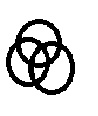
- B
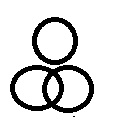
- C
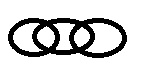
- D
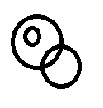
- E
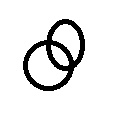
Show answerHide answer
Official CET key: C · Cetking's answer: A — see why below
Approach: Venn diagram from statements: draw pairwise relations.
Solution:
Some cricket players are tennis players ⇒ Cricket and Tennis overlap.
Some tennis players are hockey players ⇒ Tennis and Hockey overlap.
No cricket player is a hockey player ⇒ Cricket and Hockey do not touch.
So Tennis is the middle circle overlapping both sides, while Cricket and Hockey stay apart ⇒ a chain of three circles in a row: Figure C.
Why the other options are wrong:
A: all three circles overlap ⇒ some cricket players would be hockey players.
B: one circle is separate from the overlapping pair ⇒ one 'some' relation missing.
D: one circle sits inside another ⇒ suggests 'all', not 'some'.
E: only two circles.
Cetking shortcut: 'A some B, B some C, A no C' is always the three-circle chain with B in the middle.
Answer: C
Priya says about Neha: “Neha’s father is the only son of my grandfather.”
How is Priya related to Neha?
- AMother
- BSister
- CCousin Sister
- DAunt
- ENiece
Show answerHide answer
Answer: B ✓ official key
Approach: Blood relation: decode 'only son of my grandfather'.
Solution:
Priya's grandfather's only son must be Priya's father.
Priya says this person is Neha's father ⇒ both share the same father.
Priya is a female name, so Priya is Neha's Sister.
Why the other options are wrong:
A (Mother), D (Aunt), E (Niece): different generation.
C (Cousin Sister): a cousin would need a different father; the 'only son' rules that out.
Cetking shortcut: 'Only son of my grandfather' (paternal side) = 'my father'; reduce such phrases to a direct relation first.
Answer: B
In these items, identify which of the option fits most logically and simply into the space with the ?
- A

- B

- C

- D

- E

Show answerHide answer
Answer: D ✓ official key
Approach: Pattern completion in a 3×3 grid: column 1 + column 2 = column 3.
Solution:
Row 1: the corner ┌ (top + left sides) and the corner ┘ (right + bottom sides) join to make the square.
Row 2: '(' and ')' join to make the circle.
Row 3: the first cell shows the left slant and the base of a triangle (∠). The missing cell must be the remaining right slant, drawn as the mirror image of the first cell, so that both join into the triangle.
Option D is the mirror image of the first cell (right slant with base) ⇒ fits.
Why the other options are wrong:
A: same as the first cell, not its mirror.
B, C: upward/downward chevrons; they do not complete the triangle.
E: a base with two small stubs, not the right side.
Cetking shortcut: In every row cell 1 + cell 2 build the shape in cell 3: complete the triangle with the missing right-hand slant.
Answer: D
Which of the following options represents the next figure in the given series? Choose the correct answer from options (A), (B), (C), (D) and (E).
- AA
- BB
- CC
- DD
- EE
Show answerHide answer
Official CET key: D · Cetking's answer: E — see why below
Approach: Figure series with two alternating features.
Solution:
Main figure alternates: S-shaped (figures 1, 3) and Z-shaped (figures 2, 4) ⇒ figure 5 is S-shaped.
Top symbol alternates + (figures 1, 3) and × (figures 2, 4) ⇒ figure 5 has +.
Position of the top symbol also alternates: + sits on the right half, × on the left half ⇒ the + must be on the right.
Only option D has the S-shape with + on the right side.
Why the other options are wrong:
A: Z-shaped figure.
B: correct shape and +, but the + is on the left side.
C, E: carry × instead of +.
Cetking shortcut: With an alternating series, the 5th figure is a copy of figure 3 — just find the option identical to figure 3.
Answer: D
From the options available, please choose which diagram would come next in the series
- A
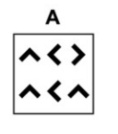
- B
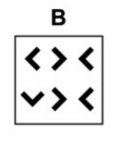
- C
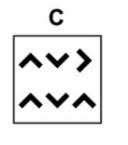
- D
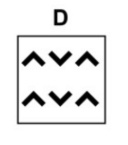
- E
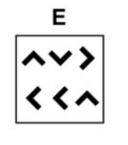
Show answerHide answer
Official CET key: C · Cetking's answer: A — see why below
Approach: Figure series: each of the six arrowheads (2 rows × 3) turns 90° clockwise, with a fixed set of positions pausing at each step.
Solution:
Number positions 1–3 (top row) and 4–6 (bottom row). Directions: R, L, U, D.
Fig 1: R L D / U L R. Fig 2: D U D / R U D ⇒ all turned 90° clockwise except position 3.
Fig 2 → Fig 3 (D U L / D U D): only positions 3 and 4 turned.
Fig 3 → Fig 4 (L R U / D R L): all turned except position 4.
Fig 4 → Fig 5 (U D U / L D U): all turned except position 3.
The 3-step cycle repeats (all-but-3, only 3 & 4, all-but-4): next step turns only positions 3 and 4.
Fig 5 → Fig 6: position 3 U → R, position 4 L → U ⇒ U D R / U D U, i.e. ∧ ∨ > / ∧ ∨ ∧ = Option C.
Why the other options are wrong:
A: top row ∧ < > changes positions 2 and 3 wrongly.
B: resembles figure 4; positions 1, 2, 5, 6 should not change from figure 5.
D: position 3 not turned (same top row as figure 5).
E: position 4 is not turned and position 5 changes when it should not.
Cetking shortcut: Compare figure 5 with each option: only positions 3 and 4 should change, each by a 90° clockwise turn — only C does that.
Answer: C
Group the given figures into three classes using each figure only once.
- A1,2,6 ; 3,4,7 ; 5
- B1,3 ; 2,6 ; 4,5,7
- C1,2,6,7 ; 3 ; 4,5
- D1,3 ; 2,4,5 ; 6,7
- E1,6 ; 4,3,5 ; 2,7
Show answerHide answer
Answer: D ✓ official key
Approach: Figure classification into three groups by what is inside the outer shape.
Solution:
Figures 1 and 3: an outer shape (circle, square) with a V-mark inside.
Figures 2, 4 and 5: an outer shape with a smaller copy of the same shape sitting on its base (circle in circle, square in square, triangle in triangle).
Figures 6 and 7: an outer shape divided by two crossing lines (+ in the circle, × in the square).
Groups: (1, 3), (2, 4, 5), (6, 7).
Why the other options are wrong:
A: puts 1 with 2 and 6, which have different inner elements.
B: splits 2 and 4/5 and puts 4, 5 with 7.
C: mixes V-mark, small-copy and cross figures.
E: splits the crossing-line pair 6, 7.
Cetking shortcut: Ignore the outer shape; classify only by the inner element (V, small copy, cross).
Answer: D
Select a suitable figure from the Answer Figures that would replace the question mark (?).
- A1
- B2
- C3
- D4
- E5
Show answerHide answer
Official CET key: B · Cetking's answer: C — see why below
Approach: Figure analogy: Fig A → Fig B rule applied to Fig C → Fig D.
Solution:
Arrow: A has 2 heads at each end; B has 1 head on the left and 3 on the right ⇒ one arrowhead moves from the left end to the right end.
Top and bottom elements: their black and white parts swap (shading is reversed).
C: top bar white-black-white, bottom bar black-white-black-white, arrow 2 heads left, 3 heads right.
So D: top bar black-white-black, bottom bar white-black-white-black, arrow 1 head left, 4 heads right ⇒ Answer Figure 2.
Why the other options are wrong:
Figure 1: arrow still has 2 heads on the left.
Figure 3: top bar not reversed.
Figure 4: bottom bar not reversed.
Figure 5: 3 heads on the left — the head moved the wrong way.
Cetking shortcut: Check the arrow first (1 left, 4 right) — it leaves only 2, 3, 4; then the reversed bars pick 2.
Answer: B
Select a figure from among the Answer Figures which will continue the same series as established by the five Problem Figures.
- A1
- B2
- C3
- D4
- E5
Show answerHide answer
Official CET key: C · Cetking's answer: B — see why below
Approach: Figure series: the figure turns clockwise by 90° and 45° alternately, and the shaded half switches side at every step.
Solution:
Track the long line (the 'base' with bent ends): A bottom → B left (90° clockwise) → C upper-left (45°) → D upper-right (90°) → E right (45°).
Next turn is 90° clockwise ⇒ the base comes to the bottom again (all answer figures have this).
Shading: seen with the base at the bottom, the black triangle is on the upper-left in A, upper-right in B, and keeps switching; in E it is on the upper-left again.
So the next figure has the base at the bottom and the black triangle on the upper-right, with the diagonal running from top-left to bottom-right.
Only Answer Figure 3 shows this.
Why the other options are wrong:
Figure 1: black part is at the lower-right.
Figure 2: black part is at the lower-left.
Figures 4 and 5: black part is at the upper-left, which repeats E's shading instead of switching.
Cetking shortcut: First fix the position of the base (bottom), then check only the side of the black triangle.
Answer: C
Choose the figure which is different from the rest.
- A1
- B2
- C3
- D4
- E5
Show answerHide answer
Answer: A ✓ official key
Approach: Dot-position classification: locate each dot relative to the circle and the triangle.
Solution:
Figure 2: one dot in circle∩triangle, one dot outside both.
Figure 3: one dot in the triangle only, one dot outside both.
Figure 4: one dot in the triangle only, one dot outside both.
Figure 5: one dot in circle∩triangle, one dot outside both.
So in figures 2–5 one dot always lies outside both shapes.
Figure 1: one dot in circle∩triangle and the other inside the circle only — no dot is outside ⇒ Figure 1 is different.
Why the other options are wrong:
Figures 2, 3, 4, 5 all have one dot outside both the circle and the triangle.
Cetking shortcut: Look only for the 'outside' dot — the figure without one is the answer.
Answer: A
Three different positions [1, 2, and 3] of the same dice are shown in the given figure. Find out the number that lies on the side that is exactly on the opposite side of number 6 of the dice ?
- A4
- B3
- C5
- D2
- E1
Show answerHide answer
Answer: A ✓ official key
Approach: Dice: find the faces adjacent to 6; the one face never adjacent and not opposite to another is opposite 6.
Solution:
Faces adjacent to 3: 6, 2 (view 1), 5, 6 (view 2), 4, 5 (view 3) ⇒ 2, 4, 5, 6 ⇒ 3 is opposite 1.
Faces adjacent to 6: 3, 2 (view 1), 3, 5 (view 2) ⇒ 2, 3, 5.
Remaining faces for the opposite of 6: 1 or 4. But 1 is already opposite 3.
So 4 is opposite 6.
Why the other options are wrong:
B (3), C (5), D (2): all appear next to 6 in the views.
E (1): 1 is opposite 3, not 6.
Cetking shortcut: Find the opposite of the most frequent face (3 ↔ 1) first; then 6's opposite is the one face left (4).
Answer: A
Which figure is different from the rest?
- AA
- BB
- CC
- DD
- EE
Show answerHide answer
Answer: C ✓ official key
Approach: Odd one out by symmetry: check the left and right halves of each figure.
Solution:
A: two identical double circles in the bottom cells ⇒ mirror symmetric.
B: crosses and dots placed the same on both sides ⇒ mirror symmetric.
D: identical rectangles in both halves ⇒ mirror symmetric.
E: black and white triangles mirrored on both halves ⇒ mirror symmetric.
C: hearts in the top-right and bottom-left cells (diagonal) ⇒ not mirror symmetric about the vertical line.
Why the other options are wrong:
A, B, D, E: each is a mirror image about the central vertical line.
Cetking shortcut: Fold every figure along its middle line in your head; the one that does not match is the odd one.
Answer: C
Which figure from the answer figures satisfies the same conditions of placement of the dots as in the problem figure?
- A
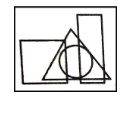
- B
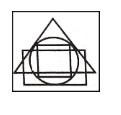
- C
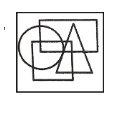
- D
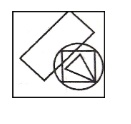
- E
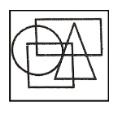
Show answerHide answer
Answer: A ✓ official key
Approach: Dot placement: write each dot's region condition, then find an answer figure with all regions available.
Solution:
Problem figure has a square, a rectangle, a triangle and a circle.
Dot 1: inside the triangle and the square only.
Dot 2: inside the triangle and the circle only.
Dot 3: inside the triangle and the rectangle only.
Needed: regions common to (triangle + square), (triangle + circle) and (triangle + rectangle), each outside the other shapes.
Figure A: the triangle overlaps the square on the left, the circle in the middle and the tall rectangle on the right, giving all three regions ⇒ fits.
Why the other options are wrong:
B: has only one four-sided figure, so the square and rectangle regions cannot both exist.
C, E: the triangle does not overlap the circle, so the triangle∩circle region is missing.
D: the triangle lies inside the square and circle, so no region is common to the triangle and the long rectangle.
Cetking shortcut: List the needed overlaps (T∩S, T∩C, T∩R) and reject an option as soon as one is missing.
Answer: A
The figure at extreme left starts the series and the figure at the extreme right is the last figure of the series. In between there are five figures; A, B, C, D and E, out of which only one does not fit into the series. Select the figure which does not fit into the series.
- AA
- BB
- CC
- DD
- EE
Show answerHide answer
Answer: D ✓ official key
Approach: Odd figure in a series: find the alternating rule from the first and last figures.
Solution:
The L-line with an arrow alternates: up-arrow at the top (figures 1, B, D, last) and down-arrow at the bottom (A, C, E).
Order of the triangle and circle also alternates: figure 1 triangle-circle, A circle-triangle, B triangle-circle, C circle-triangle.
So D should be triangle-circle, E circle-triangle, last triangle-circle (which matches).
D shows circle-triangle ⇒ D does not fit.
Why the other options are wrong:
A, B, C, E: follow both alternations.
Cetking shortcut: Mark each figure 'up/down' and 'triangle first/circle first'; the one breaking the alternation is the answer.
Answer: D
Which Shape or pattern on the right belongs with the two on the left?
- Aa
- Bb
- Cc
- Dd
- Ee
Show answerHide answer
Answer: D ✓ official key
Approach: Figure classification: list what the two given figures share, then match every feature.
Solution:
Both given figures: an outer shape with a rectangle placed diagonally (bottom-left to top-right), an upright triangle inside the rectangle, and a curved arrow outside turning clockwise.
a: triangle points down ⇒ out.
b: rectangle slants the other way (top-left to bottom-right) ⇒ out.
c: curved arrow turns anticlockwise ⇒ out.
e: a small square instead of a triangle ⇒ out.
d: diagonal rectangle with upright triangle and a clockwise arrow ⇒ belongs.
Why the other options are wrong:
A (a): inverted triangle.
B (b): rectangle slanted the other way.
C (c): anticlockwise arrow.
E (e): square inside instead of a triangle.
Cetking shortcut: Check one feature at a time across all options; each wrong option breaks exactly one feature.
Answer: D
Find the odd one out.
- A(A)
- B(B)
- C(C)
- D(D)
- E(E)
Show answerHide answer
Official CET key: D · Cetking's answer: B — see why below
Approach: Odd one out: position of the dot relative to the shaded part.
Solution:
A: shading at the bottom, dot at the top (opposite side).
B: top half shaded, dot at the bottom.
C: left half shaded, dot at the top-right.
E: right half shaded, dot at the bottom-left.
In all of these the dot is on the side opposite the shaded part.
D: the shaded quarter is at the bottom-left and the dot is at the top-left — not opposite; D also has only a quarter shaded.
Why the other options are wrong:
A, B, C, E: dot always lies opposite the shaded region.
Cetking shortcut: Draw an imaginary line from the shading through the centre — the dot should be at the other end.
Answer: D
Select the odd one out:
- A1
- B2
- C3
- D4
- E5
Show answerHide answer
Official CET key: C · Cetking's answer: D — see why below
Approach: Odd one out: count the shaded petals.
Solution:
Each flower has 4 petals and 4 straight lines.
Figures 1, 2, 4 and 5 each have exactly one shaded petal.
Figure 3 has two shaded petals (upper-left and right) ⇒ odd one.
Why the other options are wrong:
Figures 1, 2, 4, 5: one shaded petal each.
Cetking shortcut: Before analysing positions, count simple things (petals, lines, shaded parts).
Answer: C
Find the odd one:
- A1
- B2
- C3
- D4
- E5
Show answerHide answer
Answer: D ✓ official key
Approach: Odd one out: direction of the arrow compared with the shaded sector.
Solution:
1: sector points up-left, arrow points down-right (opposite).
2: sector points down, arrow points up (opposite).
3: sector points up-right, arrow points down-left (opposite).
5: sector points down-left, arrow points up-right (opposite).
4: sector points up and the arrow also points up ⇒ not opposite ⇒ odd one.
Why the other options are wrong:
1, 2, 3, 5: the arrow points opposite to the shaded sector.
Cetking shortcut: Compare the two directional elements (sector and arrow) in each box; ignore the small shapes.
Answer: D
Find out from amongst the five alternatives as to how the pattern would appear when the transparent sheet is folded at the dotted-line.
- A
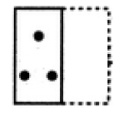
- B
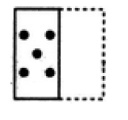
- C
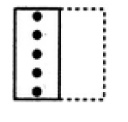
- D
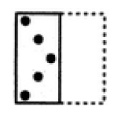
- E
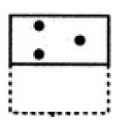
Show answerHide answer
Official CET key: B · Cetking's answer: C — see why below
Approach: Transparent sheet folding: the right half is mirrored onto the left half across the dotted line; all dots stay visible.
Solution:
Left half: four dots at the corners of a square (two near the left edge, two near the fold).
Right half: one dot in the middle row, about midway between the fold and the right edge.
Folding the right half over the left mirrors this dot to the middle row, midway between the two columns of the left half ⇒ it lands at the centre of the four dots.
Result: four corner dots with one dot in the centre (dice-5 pattern) = Figure B.
Why the other options are wrong:
A: only three dots — dots cannot disappear on a transparent sheet.
C: five dots in a single column.
D: zig-zag pattern, not the original square.
E: folded horizontally instead of along the vertical line.
Cetking shortcut: Total dots after folding = dots on both halves (4 + 1 = 5); only B and C have 5, and only B keeps the square.
Answer: B
Which one of the following patterns does not belong to the class?
- AA
- BB
- CC
- DD
- EE
Show answerHide answer
Official CET key: D · Cetking's answer: E — see why below
Approach: Odd one out by number of sides.
Solution:
A: square (4 sides). B: rectangle (4). C: trapezium (4). E: parallelogram (4).
D: triangle (3 sides) ⇒ does not belong to the class of quadrilaterals.
Why the other options are wrong:
A, B, C, E: all are quadrilaterals.
Cetking shortcut: Count sides first — it is the fastest property to check in shape-classification questions.
Answer: D
Choose the alternative that most closely resembles a water image from the given combination. US91Q4M5W3
- A
- B
- C
- D
- E
Show answerHide answer
Answer: D ✓ official key
Approach: Water image: flip top-to-bottom; the left-to-right order of the characters does not change.
Solution:
Order stays U S 9 1 Q 4 M 5 W 3 ⇒ option E (reversed order) is out.
3 is symmetric top-to-bottom, so its water image still looks like a normal 3 ⇒ options A and C (with a backward ε) are out.
9 flipped top-to-bottom has its loop at the bottom (looks like a 6): option D shows this, while option B turns the 9 into an ordinary 6 (a 180° rotation, not a flip).
Also U becomes ∩, M and W swap looks, and 4 and 1 turn upside down — all as in D.
Why the other options are wrong:
A, C: the 3 is reversed (that is a mirror image).
B: the 9 has become a plain 6 (rotated, not flipped).
E: order of characters reversed.
Cetking shortcut: Test the asymmetric characters only (9, 3, 4): check one at a time and eliminate.
Answer: D
Which image from the options given is next in the sequence?
- A
- B
- C
- D
- E
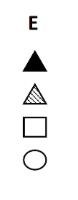
Show answerHide answer
Official CET key: C · Cetking's answer: B — see why below
Approach: Figure series: the column of four shapes moves down one place each step; the bottom shape goes to the top.
Solution:
Fig 1: hatched triangle, circle, square, black triangle.
Fig 2: black triangle, hatched triangle, circle, square.
Fig 3: square, black triangle, hatched triangle, circle.
Fig 4: circle, square, black triangle, hatched triangle.
Fig 5: hatched triangle, circle, square, black triangle (back to Fig 1) = Option C.
Why the other options are wrong:
A: square and circle swapped.
B: same as Fig 3.
D: order square, hatched, black, circle — not a shift of Fig 4.
E: order not a cyclic shift.
Cetking shortcut: Four shapes shifting cyclically repeat after 4 steps ⇒ Fig 5 = Fig 1.
Answer: C
Which image (A–E) comes next in the sequence?
- A
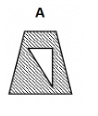
- B
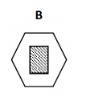
- C
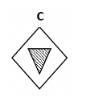
- D
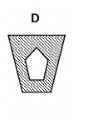
- E
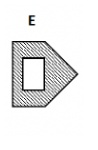
Show answerHide answer
Official CET key: A · Cetking's answer: B — see why below
Approach: Figure series: outer and inner shapes follow side counts, and shading alternates.
Solution:
Outer shape sides: 4 (square), 5 (banner), 6 (hexagon), 5 (house) ⇒ up then down: next is 4.
Inner shape sides: 3, 4, 5, 4 ⇒ always one less than the outer ⇒ next is 3 (triangle).
Shading alternates: outer shaded (1), inner shaded (2), outer shaded (3), inner shaded (4) ⇒ next: outer shaded, inner white.
Option A: shaded four-sided outer shape (trapezium) with a white triangle inside.
Why the other options are wrong:
B: hexagon outer, rectangle inner, outer white.
C: inner shaded.
D: inner pentagon (5 sides).
E: outer pentagon, inner rectangle.
Cetking shortcut: Inner sides = outer sides − 1 and shading alternates: just look for 'shaded 4-sided with white triangle'.
Answer: A
Which of the images A to E is next in the sequence?
- A
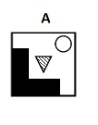
- B
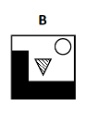
- C
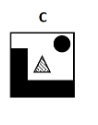
- D
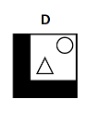
- E
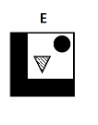
Show answerHide answer
Official CET key: B · Cetking's answer: A — see why below
Approach: Figure series with three independent elements.
Solution:
Black block: grows by one unit each step, alternately to the right and upward (right, up, right, up) ⇒ next it extends to the right, so the bottom strip reaches the right edge while the column keeps its height.
Triangle: white upright and hatched inverted alternate ⇒ next is hatched, pointing down.
Circle: white, white, black, black, white ⇒ pairs ⇒ next is white.
Option B has all three.
Why the other options are wrong:
A: black strip has not extended to the right edge.
C: upright hatched triangle and black circle.
D: white upright triangle and the black part grows upward.
E: black circle.
Cetking shortcut: Check the two easy elements first (triangle, circle): only A and B survive; the black block decides.
Answer: B
From among the following figures, find the one which is odd one out.
- AA
- BB
- CC
- DD
- EE
Show answerHide answer
Official CET key: E · Cetking's answer: B — see why below
Approach: Odd one out by meaning: living vs non-living.
Solution:
A: human figure; B: animal; C: caterpillar/worm; D: tree — all living things.
E: a triangle — a geometric shape, non-living ⇒ odd one.
Why the other options are wrong:
A, B, C, D: all show living things.
Cetking shortcut: When pictures show objects, classify them by what they represent before analysing lines.
Answer: E
Which amongst the images A to E is the odd one out?
- AA
- BB
- CC
- DD
- EE
Show answerHide answer
Official CET key: D · Cetking's answer: C — see why below
Approach: Odd one out by number of sides of the inner shape.
Solution:
A: parallelogram with a four-sided shape inside.
B: rhombus with a rhombus inside.
C: four-sided arrowhead with a square inside.
E: rectangle with a four-sided shape inside.
D: trapezium with a triangle inside ⇒ inner shape is not four-sided ⇒ odd one.
Why the other options are wrong:
A, B, C, E: four-sided outer and four-sided inner shapes.
Cetking shortcut: Count sides of both shapes in each figure; the one with a different count stands out.
Answer: D
Which of the images A to E is the odd one out?
- AA
- BB
- CC
- DD
- EE
Show answerHide answer
Official CET key: A · Cetking's answer: C — see why below
Approach: Odd one out by counting cubes.
Solution:
B: row of 3 plus one above and one below the end ⇒ 5 cubes.
C: 4 in a row plus 1 on top ⇒ 5 cubes.
D: 2 + 1 + 2 ⇒ 5 cubes.
E: plus shape ⇒ 5 cubes.
A: 2 on top, 2 in the middle, 2 at the bottom ⇒ 6 cubes ⇒ odd one.
Why the other options are wrong:
B, C, D, E: each is made of 5 cubes.
Cetking shortcut: Count blocks before thinking about shapes — count is the most common rule for cube figures.
Answer: A
Following the pattern below, select which image should be placed in Image 4?
- A
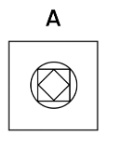
- B
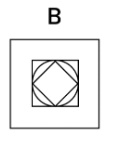
- C
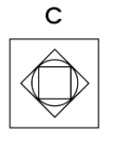
- D
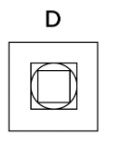
- E
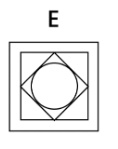
Show answerHide answer
Answer: B ✓ official key
Approach: Pattern completion: image 2 nests the shapes of image 1 by size; image 4 must nest the shapes of image 3 the same way.
Solution:
Image 1: pentagon (largest), tall triangle (medium), small triangle (smallest).
Image 2: the same shapes nested — pentagon outside, tall triangle inside it, small triangle innermost.
Image 3: square (largest), circle (medium), diamond (smallest).
So image 4: square outside, circle inscribed in it, diamond inside the circle = Option B.
Why the other options are wrong:
A: circle is the outermost shape.
C: diamond is the outermost shape.
D: a square inside the circle instead of a diamond.
E: diamond between the square and the circle.
Cetking shortcut: Order image 3's shapes by size (square > circle > diamond) and pick the option nested in that order.
Answer: B