What is the value of
(37+38+39+···+86) ?
- A3075
- B3050
- C3070
- D3010
- E3087
Show answerHide answer
Answer: A ✓ official key
Approach: Sum of an AP = number of terms × average of first and last term.
Solution:
Number of terms = 86 − 37 + 1 = 50
Average = (37 + 86)/2 = 123/2 = 61.5
Sum = 50 × 61.5 = 3075
Cetking shortcut: 50 × 61.5 = 25 × 123 = 3075 — pairing terms (37+86 = 123, 25 pairs) gives the same result.
Answer: A
The number 63_42_0 is a 7-digit number divisible by both 3 and 5. If the thousands digit is greater than the tens digit, then which of the following options gives the correct digits in the thousands place and the tens place respectively?
- A3,1
- B6,4
- C9,7
- D9,6
- E3,9
Show answerHide answer
Answer: D ✓ official key
Approach: Divisibility by 5 (last digit 0/5) and by 3 (digit sum multiple of 3), then the given order condition.
Solution:
Number: 6 3 _ 4 2 _ 0 → ends in 0, so divisible by 5 already.
Known digit sum = 6 + 3 + 4 + 2 + 0 = 15, so (first blank + second blank) must be a multiple of 3.
Check options: 3+1 = 4 ✗, 6+4 = 10 ✗, 9+7 = 16 ✗, 9+6 = 15 ✓, 3+9 = 12 ✓
Condition: first blank (called the thousands digit) > second blank (called the tens digit). 9 > 6 ✓, 3 > 9 ✗.
So the digits are 9 and 6.
Why the other options are wrong:
A (3,1), B (6,4), C (9,7): digit sum 19, 25, 31 — not divisible by 3.
E (3,9): divisible by 3, but 3 < 9 breaks the order condition.
Cetking shortcut: Since 15 is already a multiple of 3, just pick the pair whose sum is a multiple of 3 with the first digit larger.
Answer: D
What is the sum of the first 60 natural numbers?
- A1850
- B1890
- C1780
- D1875
- E1830
Show answerHide answer
Answer: E ✓ official key
Approach: Sum of first n natural numbers = n(n + 1)/2.
Solution:
n = 60
Sum = 60 × 61 / 2 = 30 × 61 = 1830
Cetking shortcut: Sum must be a multiple of 61 (and of 30): only 1830 = 30 × 61.
Answer: E
Three positive integers are such that the difference between the largest and the smallest number is 180.
The HCF of the three numbers is the greatest possible, and the smallest number is 90.
If the middle number differs from the smallest number by 60, what is the HCF of the three numbers?
- A14
- B21
- C28
- D30
- E35
Show answerHide answer
Answer: D ✓ official key
Approach: The HCF of numbers also divides every difference between them.
Solution:
Smallest = 90, largest = 90 + 180 = 270, middle = 90 + 60 = 150
HCF(90, 150, 270): 90 = 2·3²·5, 150 = 2·3·5², 270 = 2·3³·5
Common part = 2 × 3 × 5 = 30
Check via differences: HCF(60, 180, 90) = 30 ✓
Why the other options are wrong:
14, 21, 28, 35 contain a factor of 7, which does not divide 90.
Cetking shortcut: HCF must divide 90, 60 and 180 — among the options only 30 divides all three.
Answer: D
Three positive integers are in the ratio 3 : 5 : 7. The difference between the largest and the middle number is 56. The LCM of the smallest and the largest number is 588. What is the sum of the three numbers?
- A430
- B580
- C420
- D349
- E575
Show answerHide answer
Answer: C ✓ official key
Approach: Write numbers as 3k, 5k, 7k; use the difference to find k, verify with LCM.
Solution:
7k − 5k = 2k = 56 → k = 28
Numbers: 84, 140, 196
Check LCM(84, 196): 84 = 2²·3·7, 196 = 2²·7² → LCM = 2²·3·7² = 588 ✓
Sum = 15k = 15 × 28 = 420
Cetking shortcut: Sum = 15k and 2k = 56 → sum = 15 × 28 directly; the LCM is only a check.
Answer: C
Three bells ring at intervals of 30 seconds, 45 seconds, and 60 seconds.
After how much time will they ring together again?
- A90 seconds
- B180 seconds
- C120 seconds
- D240 seconds
- E300 seconds
Show answerHide answer
Answer: B ✓ official key
Approach: Bells ring together again after the LCM of their intervals.
Solution:
30 = 2·3·5, 45 = 3²·5, 60 = 2²·3·5
LCM = 2²·3²·5 = 180 seconds
Why the other options are wrong:
90 is not a multiple of 60; 120 not a multiple of 45; 240 not of 45; 300 not of 45.
Answer: B
There are two Sections, namely, C and D of a Class, consisting of 30 and 50 students respectively. If the average weight of students of Section C is 45 kg and that of Section D is 50 kg, then find the average weight of students of the Class overall ?
- A48.125 kg
- B49.250 kg
- C40.120 kg
- D41.105 kg
- E38.115 kg
Show answerHide answer
Answer: A ✓ official key
Approach: Weighted average = total weight / total students.
Solution:
Section C total = 30 × 45 = 1350 kg
Section D total = 50 × 50 = 2500 kg
Overall = (1350 + 2500)/80 = 3850/80 = 48.125 kg
Why the other options are wrong:
The average must lie between 45 and 50, and closer to 50 because Section D has more students — so C, D and E (all below 45) are impossible. B (49.25) would need D to be far larger than 50 students against 30.
Cetking shortcut: Deviation method: 45 + 5 × 50/80 = 45 + 3.125 = 48.125.
Answer: A
In an examination, the average marks of all students was 72. After correcting mistakes, the average marks of 40 students decreased from 80 to 60, while the marks of the remaining students remained unchanged. As a result, the overall average of all students became 70. Find the total number of students.
- A450
- B410
- C428
- D400
- E475
Show answerHide answer
Answer: D ✓ official key
Approach: Total change in marks = change in average × number of students.
Solution:
40 students' average falls by 80 − 60 = 20 → total falls by 40 × 20 = 800
Overall average falls by 72 − 70 = 2 → total falls by 2n
2n = 800 → n = 400
Cetking shortcut: n = (40 × 20)/2 = 400 in one line.
Answer: D
A company has 12 workers and 6 managers. The average salary of all 18 employees is Rs. 900.
- One worker whose salary was Rs. 800 is replaced by a new worker.
- One manager whose salary was Rs. 1200 is also replaced by a new manager.
After these changes, the average salary of all 18 employees becomes Rs. 910.
If the new worker earns Rs. 950, What is the salary of the new manager?
- ARs. 1324
- BRs. 1190
- CRs. 1280
- DRs. 1150
- ERs. 1230
Show answerHide answer
Answer: E ✓ official key
Approach: Change in total salary = change in average × number of employees.
Solution:
Old total = 18 × 900 = 16200; new total = 18 × 910 = 16380 → increase = 180
Worker change: 950 − 800 = +150
Manager change must be 180 − 150 = +30
New manager = 1200 + 30 = Rs. 1230
Cetking shortcut: Total rise 18 × 10 = 180; worker accounts for 150, manager +30.
Answer: E
The present ages of A, B, and C are in the ratio 6 : 8 : 10. Five years ago, the sum of the ages of A and B was equal to the age of C at that time. Find the total present age of A, B, and C.
- A114
- B120
- C100
- D145
- E180
Show answerHide answer
Official CET key: B · Cetking's answer: A — see why below
Approach: Ages in ratio → write as 6k, 8k, 10k and apply the past-age condition.
Solution:
As printed: (6k − 5) + (8k − 5) = 10k − 5 → 14k − 10 = 10k − 5 → k = 5/4 → total 24k = 30, which is not among the options.
The official key (120) corresponds to k = 5: A = 30, B = 40, C = 50.
This k satisfies the condition when it reads 'ten years ago, the sum of the ages of A and B equalled C's present age': (30 − 10) + (40 − 10) = 50 = C ✓ → 14k − 20 = 10k → k = 5.
Total = 24k = 24 × 5 = 120
Why the other options are wrong:
A (114), C (100), D (145): not multiples of 24, so they cannot be 24k for a whole-number k.
E (180): k = 7.5 (ages 45, 60, 75) fits neither the printed nor the corrected condition.
Cetking shortcut: Total = 24k, so the answer must be a multiple of 24 — only 120 (and 180) qualify; test k = 5 first.
Answer: B
Simplify:
((3⁴ × 2³ − 5³)/7) + √256 − (2/5) × (25/4) + 0.75 × 8
- A90.53
- B91.25
- C98.75
- D94.21
- E98.50
Show answerHide answer
Answer: D ✓ official key
Approach: BODMAS — evaluate powers and roots, then division/multiplication, then addition/subtraction.
Solution:
3⁴ × 2³ = 81 × 8 = 648; 648 − 5³ = 648 − 125 = 523
523/7 = 74.714
√256 = 16
(2/5) × (25/4) = 50/20 = 2.5
0.75 × 8 = 6
Total = 74.714 + 16 − 2.5 + 6 = 94.214 ≈ 94.21
Cetking shortcut: Only 523/7 is non-terminating; the rest add to 16 − 2.5 + 6 = 19.5, so answer = 74.71 + 19.5 = 94.21.
Answer: D
When Ravi was born:
- His father was 30 years older than his brother.
- His mother was 26 years older than his sister.
- His brother is 4 years older than his sister.
After 6 years, the average age of the family (Ravi, his brother, his sister, his father, and his mother) shall be 22 years. What was the age of his mother when Ravi was born?
- A40 years
- B30 years
- C35 years
- D46 years
- E48 years
Show answerHide answer
Answer: B ✓ official key
Approach: Age differences never change; build every age from the sister's age at Ravi's birth.
Solution:
At Ravi's birth let sister = s. Then brother = s + 4, father = (s + 4) + 30 = s + 34, mother = s + 26, Ravi = 0.
Sum at Ravi's birth = 0 + s + (s + 4) + (s + 34) + (s + 26) = 4s + 64
6 years later each of the 5 members is 6 years older: sum = 4s + 64 + 30 = 4s + 94
Average 22 → sum = 5 × 22 = 110 → 4s + 94 = 110 → s = 4
Mother's age at Ravi's birth = s + 26 = 30 years
Cetking shortcut: Total after 6 years = 110 → total at birth = 110 − 30 = 80 = 4s + 64 → s = 4 → mother = 30.
Answer: B
In a town of 2000 people, 60% are males. Out of the males, 40% are literate. If 55% of the total population is literate, what percentage of females is literate?
- A67.5%
- B72.5%
- C70.5%
- D77.5%
- E80.5%
Show answerHide answer
Answer: D ✓ official key
Approach: Split population into males/females and subtract literate males from total literates.
Solution:
Males = 60% of 2000 = 1200; females = 800
Literate males = 40% of 1200 = 480
Total literate = 55% of 2000 = 1100
Literate females = 1100 − 480 = 620
Female literacy = 620/800 × 100 = 77.5%
Cetking shortcut: Alligation: 0.6 × 40 + 0.4 × f = 55 → 24 + 0.4f = 55 → f = 77.5.
Answer: D
Ramesh spends 25% of his income on rent, 30% of the remaining on food, and 20% of the remaining on transport. If he saves ₹21,000, find the amount spent on transport.
- A₹4,250
- B₹5,550
- C₹5,250
- D₹6,200
- E₹5,150
Show answerHide answer
Answer: C ✓ official key
Approach: Successive percentages apply to the remaining amount each time.
Solution:
After rent: 75% of I remains
Food = 30% of 0.75I = 0.225I → remaining 0.525I
Transport = 20% of 0.525I = 0.105I → savings = 0.42I
0.42I = 21000 → I = 50000
Transport = 0.105 × 50000 = ₹5,250
Cetking shortcut: Savings = 0.75 × 0.70 × 0.80 = 0.42 of income; transport = savings × 0.2/0.8 = 21000/4 = 5250.
Answer: C
The salary of P is 60% more than Q, while the salary of R is 20% less than the total salary of P and Q together.
If Q's salary is ₹30,000, find the salary of R.
- A₹62,400
- B₹60,500
- C₹61,700
- D₹60,850
- E₹72,400
Show answerHide answer
Answer: A ✓ official key
Approach: Convert each 'more/less than' into a multiplier.
Solution:
Q = 30000; P = 1.6 × 30000 = 48000
P + Q = 78000
R = 80% of 78000 = 62400
Cetking shortcut: R = 0.8 × 2.6Q = 2.08 × 30000 = 62400.
Answer: A
The marked price of an article is ₹2500. Two successive discounts of 10% and 5% are allowed. Even then, the shopkeeper earns a 20% profit.
Find the cost price of the article.
- A₹2137.50
- B₹2257.50
- C₹1668.50
- D₹1752.75
- E₹1781.25
Show answerHide answer
Answer: E ✓ official key
Approach: Find SP after successive discounts, then CP = SP / (1 + profit%).
Solution:
SP = 2500 × 0.90 × 0.95 = 2250 × 0.95 = 2137.50
SP = 1.2 × CP → CP = 2137.50/1.2 = ₹1781.25
Why the other options are wrong:
A (₹2137.50) is the selling price, not the cost price.
Cetking shortcut: CP = 2500 × 0.9 × 0.95 / 1.2 = 2500 × 0.7125 = 1781.25.
Answer: E
A shopkeeper marks an article 40% above its cost price. He offers a two-stage discount — first a 10% discount, and then an additional 5% discount on the reduced price. Find his overall profit percentage if the cost price of the article is Rs. 200.
- A26.8%
- B30%
- C25.4%
- D19.7%
- E14.5%
Show answerHide answer
Answer: D ✓ official key
Approach: Apply mark-up then successive discounts as multipliers on CP.
Solution:
MP = 200 × 1.4 = 280
After 10%: 280 × 0.9 = 252
After 5%: 252 × 0.95 = 239.40
Profit = 239.40 − 200 = 39.40 → 39.40/200 = 19.7%
Cetking shortcut: 1.4 × 0.9 × 0.95 = 1.197 → 19.7% profit.
Answer: D
A person bought a book and a novel for ₹2800. He sold the book at 10% profit and the novel at 15.25% profit. If his overall profit was 13%, then what is the difference between the cost prices of the book and the novel?
- ARs. 200
- BRs. 400
- CRs. 350
- DRs. 450
- ERs. 389
Show answerHide answer
Answer: B ✓ official key
Approach: Overall profit is a weighted average of the two profit rates (alligation).
Solution:
Let book = b, novel = 2800 − b
0.10b + 0.1525(2800 − b) = 0.13 × 2800 = 364
427 − 0.0525b = 364 → b = 1200; novel = 1600
Difference = 1600 − 1200 = ₹400
Cetking shortcut: Alligation: book : novel = (15.25 − 13) : (13 − 10) = 2.25 : 3 = 3 : 4 → 1200 : 1600 → difference = 2800/7 = 400.
Answer: B
Three pipes X, Y and Z can fill a tank completely in 24 minutes, 12 minutes and 8 minutes respectively.
All three pipes are opened together when the tank is empty.
- Pipe X fills solution A
- Pipe Y fills solution B
- Pipe Z fills solution C
After 4 minutes, what is the proportion of solution C in the tank?
- A1/2
- B1/4
- C1/3
- D2/3
- E3/4
Show answerHide answer
Answer: A ✓ official key
Approach: Each pipe's share in the tank is proportional to its filling rate.
Solution:
Rates per minute: X = 1/24, Y = 1/12 = 2/24, Z = 1/8 = 3/24
Ratio X : Y : Z = 1 : 2 : 3
Share of C (from Z) = 3/(1 + 2 + 3) = 3/6 = 1/2
(After 4 min: 4/24 + 8/24 + 12/24 = 1 → tank exactly full, no overflow issue.)
Cetking shortcut: Times 24 : 12 : 8 → rates 1 : 2 : 3; the 4 minutes do not matter.
Answer: A
Two pipes A and B together can fill a cistern in 4 hours. Had they been opened separately, then B would have taken 6 hours more than A to fill the cistern. How much time will be taken by A to fill the cistern by itself?
- A8 hours
- B6 hours
- C10 hours
- D7 hours
- E4 hours
Show answerHide answer
Answer: B ✓ official key
Approach: Combined rate = sum of individual rates; form a quadratic in A's time.
Solution:
Let A take a hours, B take a + 6 hours
1/a + 1/(a + 6) = 1/4
4(2a + 6) = a(a + 6) → a² − 2a − 24 = 0
(a − 6)(a + 4) = 0 → a = 6 hours
Cetking shortcut: Option test: A = 6 → B = 12 → 1/6 + 1/12 = 3/12 = 1/4 ✓ — quick to verify.
Answer: B
Two outlet pipes P and Q are connected to a full tank. Pipe P alone can empty the tank in 12 minutes and pipe Q alone can empty it in 18 minutes.
If both pipes are opened together, how long will it take to empty the tank completely?
- A6.2 minutes
- B5.4 minutes
- C6.8 minutes
- D7.2 minutes
- E4.5 minutes
Show answerHide answer
Official CET key: D · Cetking's answer: B — see why below
Approach: Two outlets work together → add their emptying rates.
Solution:
P empties 1/12 per min, Q empties 1/18 per min
Together = 1/12 + 1/18 = 3/36 + 2/36 = 5/36 per min
Time = 36/5 = 7.2 minutes
Why the other options are wrong:
Time must lie between 6 (if both were as fast as P: 12/2) and 9 (if both were as slow as Q: 18/2) → B (5.4) and E (4.5) are impossible; 6.2 and 6.8 do not equal 36/5.
Cetking shortcut: Two jobs together: T = ab/(a + b) = 12 × 18 / 30 = 7.2.
Answer: D
A and B start a business together.
- A invests ₹1,20,000 at the beginning.
- After 4 months, B joins the business with ₹90,000.
- After another 4 months, A adds ₹30,000 to his investment, while B withdraws ₹30,000 from his capital.
At the end of 1 year, in what ratio should A and B share the profit?
- A10:7
- B9:8
- C13:5
- D14:9
- E14:5
Show answerHide answer
Official CET key: C · Cetking's answer: A — see why below
Approach: Profit share ∝ capital × time; split each partner's investment into periods.
Solution:
A: ₹1,20,000 for 8 months = 9,60,000; then ₹1,50,000 for 4 months = 6,00,000 → total 15,60,000
B: joins at month 4 with ₹90,000 for 4 months = 3,60,000; then ₹60,000 for 4 months = 2,40,000 → total 6,00,000
A : B = 15,60,000 : 6,00,000 = 156 : 60 = 13 : 5
Why the other options are wrong:
A (10:7), B (9:8), D (14:9), E (14:5) come from wrong periods — e.g. giving B 12 months or ignoring the mid-year top-up/withdrawal.
Cetking shortcut: Work in ₹10,000 units and months: A = 12×8 + 15×4 = 156, B = 9×4 + 6×4 = 60 → 13 : 5.
Answer: C
A invests ₹6,000 in a business for 8 months, and B invests ₹9,000 for 12 months. If the total profit at the end of the year is ₹3,000, find A's share.
- A₹923.08
- B₹933.07
- C₹813.06
- D₹863.02
- E₹683.05
Show answerHide answer
Answer: A ✓ official key
Approach: Profit share ∝ capital × time.
Solution:
A = 6000 × 8 = 48,000; B = 9000 × 12 = 1,08,000
A : B = 48 : 108 = 4 : 9
A's share = 3000 × 4/13 = ₹923.08
Cetking shortcut: 13 parts of 3000 → one part ≈ 230.77; A = 4 parts = 923.08.
Answer: A
A, B, and C start a business with capitals in the ratio 3 : 4 : 5.
- A invests for 12 months,
- B invests for 9 months,
- C invests for 6 months.
If the total profit at the end of the year is ₹36,000, find C's share.
- A₹10,582.24
- B₹11,682.21
- C₹12,772.34
- D₹14,792.37
- E₹10,588.24
Show answerHide answer
Answer: E ✓ official key
Approach: Profit share ∝ capital ratio × months.
Solution:
A = 3 × 12 = 36, B = 4 × 9 = 36, C = 5 × 6 = 30
Total = 102 parts
C's share = 36000 × 30/102 = 36000 × 5/17 = ₹10,588.24
Why the other options are wrong:
A (₹10,582.24) is a near-miss decoy: 180000/17 = 10588.235…, so the digits must end in 588.
Cetking shortcut: 36 : 36 : 30 = 6 : 6 : 5 → C = 5/17 of 36000.
Answer: E
A clock shows 7 O'clock in the morning. By how much angle will the hours hand rotate when the clock shows 11:30 O'clock in the morning?
- A40°
- B125°
- C135°
- D150°
- E90°
Show answerHide answer
Answer: C ✓ official key
Approach: The hour hand moves 30° per hour (0.5° per minute).
Solution:
From 7:00 to 11:30 = 4.5 hours
Rotation = 4.5 × 30° = 135°
Cetking shortcut: Hour hand: 0.5° per minute → 270 min × 0.5 = 135°.
Answer: C
A can complete a work in 12 days and B can complete the same work in 18 days. A and B start the work together, but after 4 days, A leaves the work. C then joins B and together they finish the remaining work in 5 days. If the total wages paid for the work is ₹7200 and wages are divided in proportion to the work done, What is the C's share of the wages?
- ARs. 1675
- BRs. 1079
- CRs. 1200
- DRs. 1145
- ERs. 1935
Show answerHide answer
Answer: C ✓ official key
Approach: Wages are split by the fraction of work each person does.
Solution:
A's rate = 1/12, B's rate = 1/18 per day
First 4 days (A + B): 4 × (1/12 + 1/18) = 4 × 5/36 = 5/9 done
Remaining work = 4/9, done by B + C in 5 days
B's part in those 5 days = 5/18
C's work = 4/9 − 5/18 = 8/18 − 5/18 = 3/18 = 1/6
C's wages = 7200 × 1/6 = ₹1200
Cetking shortcut: Only C's fraction matters: 4/9 − 5/18 = 1/6 → 7200/6.
Answer: C
A train of length 100 metres is moving at a speed of 72 km/h. A man is walking in the same direction at a speed of 6 km/h. How much time will the train take to completely pass the man?
- A6.45 seconds
- B5.45 seconds
- C3.25 seconds
- D7.35 seconds
- E4.23 seconds
Show answerHide answer
Answer: B ✓ official key
Approach: Same direction → relative speed = difference; distance = train length.
Solution:
Relative speed = 72 − 6 = 66 km/h = 66 × 5/18 = 55/3 m/s
Time = 100 ÷ (55/3) = 300/55 = 5.45 s
Cetking shortcut: Time = length × 18/(5 × relative km/h) = 100 × 18/330 = 5.45 s.
Answer: B
A train 150 m long is running at 54 km/h. It crosses a bridge in 20 seconds. Find the length of the bridge.
- A250 m
- B340 m
- C150 m
- D190 m
- E140 m
Show answerHide answer
Official CET key: C · Cetking's answer: A — see why below
Approach: Crossing a bridge: distance = train length + bridge length.
Solution:
54 km/h = 54 × 5/18 = 15 m/s
Distance in 20 s = 15 × 20 = 300 m
Bridge = 300 − 150 = 150 m
Why the other options are wrong:
A (250 m): not consistent — 150 + 250 = 400 m would need 26.7 s at 15 m/s.
Cetking shortcut: 15 m/s × 20 s = 300 m total; subtract the train.
Answer: C
Two trains of length 350m and 250m completely cross each other when running in same and opposite direction in 10 sec. and 5 sec. respectively. Find the speed of faster train in kmph?
- A328 km/h
- B324 km/h
- C454 km/h
- D226 km/h
- E594 km/h
Show answerHide answer
Answer: B ✓ official key
Approach: Same direction → difference of speeds; opposite → sum; distance = sum of lengths.
Solution:
Total length = 350 + 250 = 600 m
Same direction: a − b = 600/10 = 60 m/s
Opposite direction: a + b = 600/5 = 120 m/s
Faster train a = (60 + 120)/2 = 90 m/s = 90 × 18/5 = 324 km/h
Cetking shortcut: Faster = half of (sum + difference) = 90 m/s → × 3.6 = 324 km/h.
Answer: B
A 30-litre mixture of milk and water is in the ratio 2 : 1. 15 litres of the mixture is removed and replaced with pure milk. This process is repeated one more time. What is the final ratio of milk to water in the mixture?
- A10:1
- B12:5
- C8:3
- D11:1
- E15:7
Show answerHide answer
Answer: D ✓ official key
Approach: Track milk and water after each removal (half the mixture) and refill with milk.
Solution:
Start: milk 20 L, water 10 L
Remove 15 L (half): milk 10, water 5; add 15 milk → milk 25, water 5
Remove 15 L (half): milk 12.5, water 2.5; add 15 milk → milk 27.5, water 2.5
Milk : water = 27.5 : 2.5 = 11 : 1
Cetking shortcut: Water is never added, so it halves each time: 10 → 5 → 2.5. Milk = 30 − 2.5 = 27.5 → 11 : 1.
Answer: D
Tea worth ₹120 per kg and ₹150 per kg are mixed with a third variety of tea in the ratio 1 : 2 : 3. If the cost price of the mixture is ₹165 per kg, what is the cost price per kg of the third variety of tea?
- A₹150 per kg
- B₹290 per kg
- C₹190 per kg
- D₹180 per kg
- E₹100 per kg
Show answerHide answer
Answer: C ✓ official key
Approach: Weighted average of prices with weights 1 : 2 : 3.
Solution:
(1 × 120 + 2 × 150 + 3 × x)/6 = 165
120 + 300 + 3x = 990 → 3x = 570 → x = 190
Cetking shortcut: Deviations from 165: −45 × 1 + (−15) × 2 = −75 must be balanced by 3(x − 165) = 75 → x = 190.
Answer: C
A container contains 60 litres of milk. Some milk is replaced by water twice. Each time 12 litres of mixture is replaced. After the two replacements, What is the final ratio of milk to water?
- A16:9
- B18:7
- C17:3
- D11:4
- E15:4
Show answerHide answer
Answer: A ✓ official key
Approach: Repeated replacement: milk left = initial × (1 − x/V)ⁿ.
Solution:
Milk left = 60 × (1 − 12/60)² = 60 × (4/5)² = 60 × 16/25 = 38.4 L
Water = 60 − 38.4 = 21.6 L
Milk : water = 38.4 : 21.6 = 16 : 9
Cetking shortcut: Milk fraction = (4/5)² = 16/25 → milk : water = 16 : 9 directly.
Answer: A
A wooden toy is in the form of a cone surmounted on a hemisphere. The diameter of the base of the cone is 6 cm and its height is 4 cm. Find the cost of painting the toy at the rate of ₹5 per 1000 cm².
- A₹0.52
- B₹0.83
- C₹0.43
- D₹0.29
- E₹0.37
Show answerHide answer
Answer: A ✓ official key
Approach: Painted surface = curved surface of cone + curved surface of hemisphere (shared base not painted).
Solution:
r = 6/2 = 3 cm, cone height h = 4 cm → slant l = √(3² + 4²) = 5 cm
Cone CSA = πrl = π × 3 × 5 = 15π
Hemisphere CSA = 2πr² = 2π × 9 = 18π
Total = 33π = 33 × 3.1416 ≈ 103.67 cm²
Cost = 103.67 × 5/1000 = ₹0.518 ≈ ₹0.52
Cetking shortcut: 33π ≈ 103.7 cm²; ₹5 per 1000 cm² = ₹0.005 per cm² → ≈ ₹0.52.
Answer: A
A triangular pennant has a base of 10 cm and a height of 8 cm. The same amount of cloth is used to make a rectangular banner whose length is 5 cm. Find the breadth of the rectangle.
- A10 cm
- B8 cm
- C12 cm
- D6 cm
- E14 cm
Show answerHide answer
Answer: B ✓ official key
Approach: Equal cloth → equal area: ½ × base × height = length × breadth.
Solution:
Triangle area = ½ × 10 × 8 = 40 cm²
Rectangle: 5 × b = 40 → b = 8 cm
Answer: B
A cylindrical tank has a diameter of 10 m and a height of 6 m. Find the volume of water it can hold.
- A481.73 m³
- B351.49 m³
- C471.24 m³
- D341.74 m³
- E321.63 m³
Show answerHide answer
Answer: C ✓ official key
Approach: Volume of cylinder = πr²h.
Solution:
r = 10/2 = 5 m, h = 6 m
V = π × 25 × 6 = 150π = 150 × 3.1416 = 471.24 m³
Cetking shortcut: 150π: 150 × 3.14 = 471 → only 471.24 matches.
Answer: C
What day of the week was 15th August, 2010?
- ASunday
- BMonday
- CTuesday
- DThursday
- ESaturday
Show answerHide answer
Answer: A ✓ official key
Approach: Odd-days method: count odd days from a known reference (multiple of 400 years = 0 odd days).
Solution:
Years 1–2000 complete → 0 odd days (2000 is a multiple of 400)
2001–2009: 9 years incl. 2 leap years (2004, 2008) → 9 + 2 = 11 → 4 odd days
2010 up to 15 Aug: Jan 3, Feb 0, Mar 3, Apr 2, May 3, Jun 2, Jul 3, Aug (15) 1 → 17 → 3 odd days
Total = 0 + 4 + 3 = 7 → 0 odd days → Sunday
Cetking shortcut: Anchor on Independence Day: 15 Aug 1947 was a Friday; 63 years later with 16 leap days (1948–2008) → 79 → 2 odd days → Friday + 2 = Sunday.
Answer: A
If 15th August 2012 was a Wednesday, then what day of the week was 26th January 1998?
- ASaturday
- BMonday
- CTuesday
- DWednesday
- EFriday
Show answerHide answer
Answer: B ✓ official key
Approach: Count odd days between the two dates and move backward from the known day.
Solution:
26 Jan 1998 → 26 Jan 2012 = 14 years with 3 leap days (Feb 2000, 2004, 2008) → 14 + 3 = 17 → 3 odd days
26 Jan 2012 → 15 Aug 2012: Jan 5, Feb 29 (leap) 1, Mar 3, Apr 2, May 3, Jun 2, Jul 3, Aug 15 → 1 → total 20 → 6 odd days
Total = 3 + 6 = 9 → 2 odd days
15 Aug 2012 is 2 days ahead of 26 Jan 1998 → Wednesday − 2 = Monday
Cetking shortcut: Move back 2 weekdays from Wednesday → Monday.
Answer: B
An accurate clock shows 3 o'clock in the afternoon. Through how many degrees will the hour hand rotate when the clock shows 9 o'clock of the same evening?
- A140°
- B170°
- C180°
- D110°
- E100°
Show answerHide answer
Answer: C ✓ official key
Approach: Hour hand moves 30° per hour.
Solution:
3 pm to 9 pm = 6 hours
Rotation = 6 × 30° = 180°
Answer: C
What is the angle between the hour and minute hands of a clock at 8:00?
- A110°
- B150°
- C180°
- D190°
- E120°
Show answerHide answer
Answer: E ✓ official key
Approach: Angle = |30H − 5.5M|.
Solution:
At 8:00: H = 8, M = 0 → 30 × 8 = 240°
Smaller angle = 360° − 240° = 120°
Cetking shortcut: Minute hand at 12, hour hand at 8 → 4 hour-gaps × 30° = 120°.
Answer: E
A book has 15 pages: 1 cover page, 9 theory pages (fixed order), and 5 drawing pages. The cover page is always first. The drawing pages must remain together but can be in any order. What is the probability that the pages are arranged according to the requirement?
- A10·8! / 14!
- B10·5! / 14!
- C10·8! / 10!
- D8·5! / 13!
- E10·8! / 7!
Show answerHide answer
Official CET key: B · Cetking's answer: A — see why below
Approach: Probability = favourable arrangements / total arrangements, with the cover fixed first.
Solution:
Total: cover is first, other 14 distinct pages in any order → 14!
Favourable: tie the 5 drawing pages into one block → 9 theory pages + 1 block = 10 units
Theory pages have a fixed order, so only the block's position varies: 10 positions
Drawing pages inside the block: 5!
Favourable = 10 × 5!
P = 10 · 5! / 14!
Why the other options are wrong:
A (10·8!/14!): 8! has no meaning here — only the 5 drawing pages permute.
C and E: denominator must be 14! (all arrangements after the cover).
D (8·5!/13!): wrong count of units and total.
Cetking shortcut: 'Fixed order' items act as identical slots: choose the block's slot (10 ways) × 5!.
Answer: B
Questions 141–145 share this
Directions: Study the following information carefully and answer the question that follows.
Natasha wants to pursue her B. Tech from ADC University, India, but to be able to afford it, she has to take an education loan. The loan agreement guaranteed to pay 80% of all her expenses. This way she only had to bear the remaining costs. She had to pay the rent for her new apartment was Rs. 550 per month. She then paid her tuition fee for the current semester worth Rs. 25000. On an average she spent Rs. 340 on utilities and groceries per month. Given that, Natasha's course lasted a total of two years (comprising of 2 semesters per year) and the bank gave 80% of the total expenses of two years at the beginning of her course
How much did the bank have to pay in total for two years on behalf of Natasha?
- ARs. 90308
- BRs. 85428
- CRs. 97088
- DRs. 90288
- ERs. 92286
Show answerHide answer
Answer: C ✓ official key
Approach: Total 2-year expenses (24 months, 4 semesters) × 80%.
Solution:
Rent = 550 × 24 = 13,200
Tuition = 25,000 × 4 semesters = 1,00,000
Utilities & groceries = 340 × 24 = 8,160
Total = 1,21,360
Bank pays 80% = 0.8 × 1,21,360 = Rs. 97,088
Cetking shortcut: Monthly items together = 890 × 24 = 21,360; + 1,00,000 tuition; × 0.8.
Answer: C
Refer to the passage above ↑
If the bank charges simple interest at the rate of 9% per annum, then find the total interest amount that Natasha paid after 2 years. (Assume she pays off the entire loan after 2 years of completion of course)
- ARs. 17075.84
- BRs. 17005.48
- CRs. 17975.84
- DRs. 16845.48
- ERs. 17475.84
Show answerHide answer
Answer: E ✓ official key
Approach: Simple interest = P × R × T / 100 on the loan amount.
Solution:
Principal = loan from Q1 = Rs. 97,088
SI for 2 years at 9% = 97,088 × 9 × 2/100 = 97,088 × 0.18 = Rs. 17,475.84
Why the other options are wrong:
A and C are the correct value shifted by −400 and +500; B and D are unrelated decoys — only 0.18 × 97,088 = 17,475.84 is exact.
Cetking shortcut: 18% of 97,088: 10% = 9,708.8, 8% = 7,767.04 → 17,475.84.
Answer: E
Refer to the passage above ↑
The annual expenditure on utilities is what percent less than the annual expenditure on rent?
- A28.15%
- B38.18%
- C37%
- D42.10%
- E40.28%
Show answerHide answer
Answer: B ✓ official key
Approach: Percent less = (rent − utilities)/rent × 100.
Solution:
Annual rent = 550 × 12 = 6,600
Annual utilities (& groceries) = 340 × 12 = 4,080
Percent less = (6,600 − 4,080)/6,600 × 100 = 2,520/6,600 × 100 = 38.18%
Why the other options are wrong:
Dividing by the wrong base (utilities, 2,520/4,080 = 61.8%) or mis-subtracting gives the other values — 'less than rent' means divide by rent.
Cetking shortcut: Monthly figures give the same %: 210/550 = 38.18%.
Answer: B
Refer to the passage above ↑
Natasha gets an internship for a period of 3 months. The company where she'll be doing internship pays Rs. 12000 per month. The utilities and rent for these 3 months is approximately what percentage of the total amount she will earn from the internship?
- A7.41%
- B5.41%
- C17.41%
- D15.41%
- E12.41%
Show answerHide answer
Answer: A ✓ official key
Approach: Expense as a percentage of income for the same 3 months.
Solution:
Rent + utilities for 3 months = (550 + 340) × 3 = 2,670
Internship earnings = 12,000 × 3 = 36,000
% = 2,670/36,000 × 100 = 7.41%
Cetking shortcut: Monthly: 890/12,000 = 7.41% — the 3 months cancel.
Answer: A
Refer to the passage above ↑
Natasha decides to live with her relatives for 6 months so she will not have to pay for rent and utilities. How much shall she save on rent and utilities if she decides to stay with her relatives for 6 months?
- ARs. 8340
- BRs. 3640
- CRs. 5340
- DRs. 8940
- ERs. 7970
Show answerHide answer
Answer: C ✓ official key
Approach: Saving = 6 months of rent + utilities.
Solution:
Monthly = 550 + 340 = 890
6 months = 890 × 6 = Rs. 5,340
Answer: C
Questions 146–150 share this
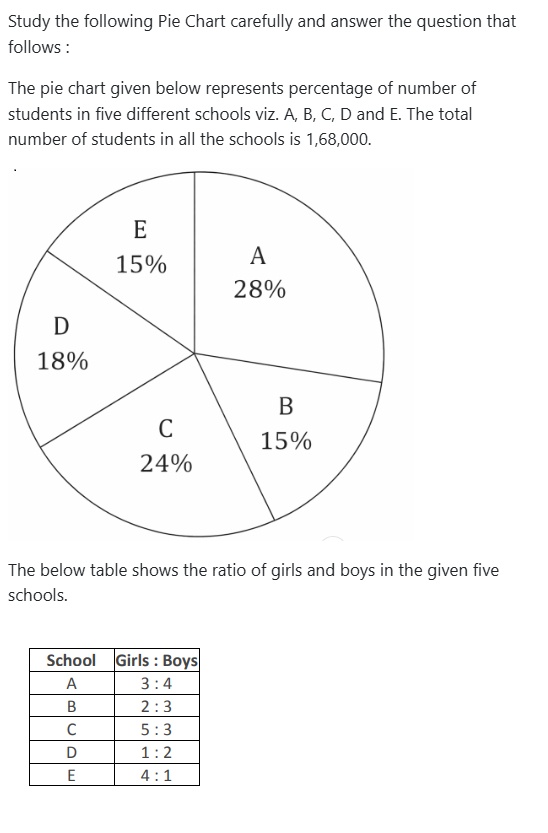
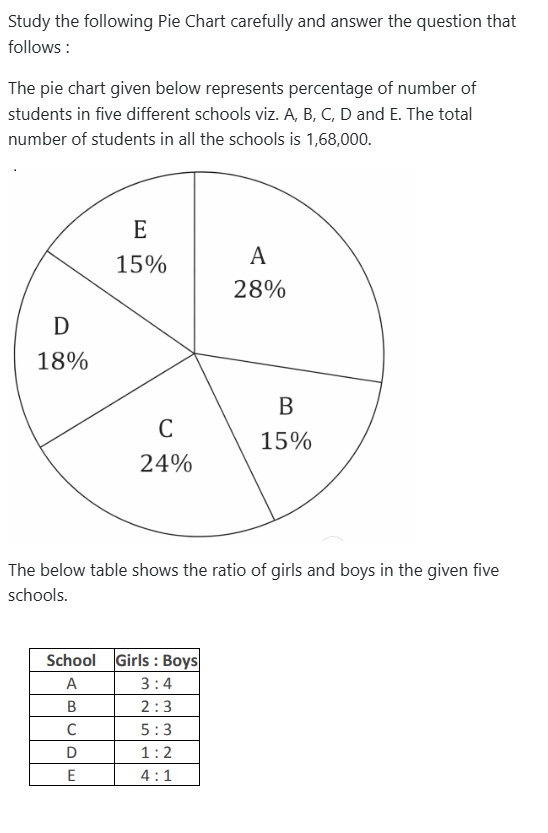
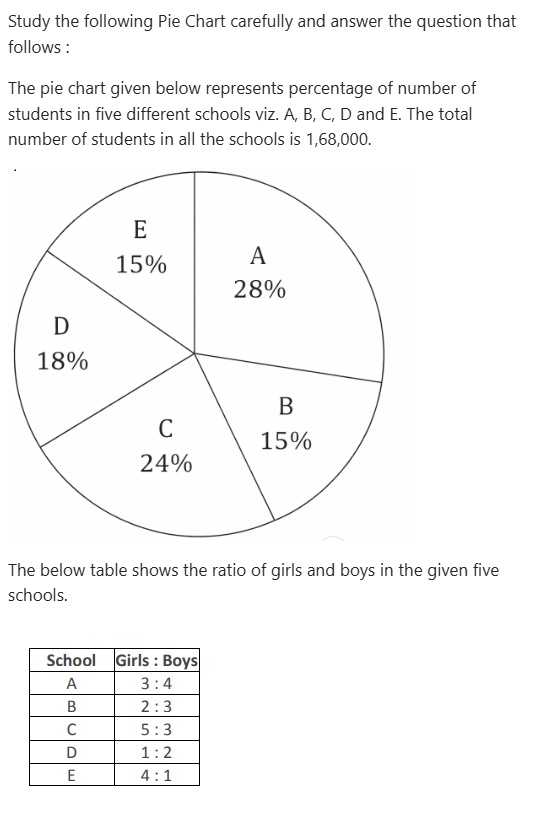
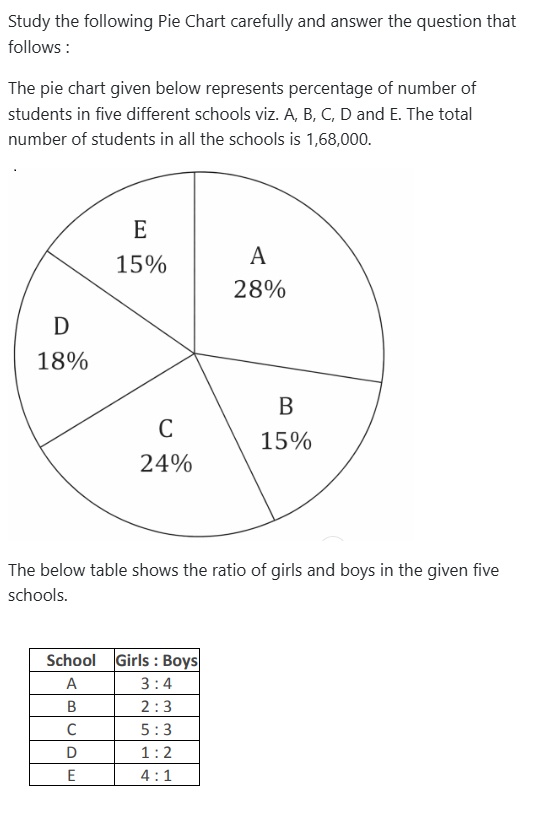
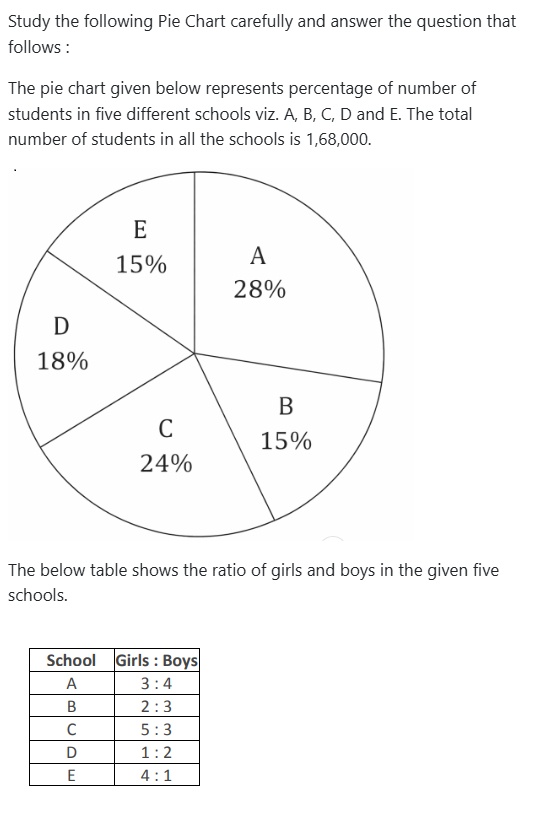
Study the following Pie Chart carefully and answer the question that follows :
The pie chart given below represents percentage of number of students in five different schools viz. A, B, C, D and E. The total number of students in all the schools is 1,68,000.
Data read from chart:
| School | Percentage of students |
|---|
| A | 28% |
| B | 15% |
| C | 24% |
| D | 18% |
| E | 15% |
The below table shows the ratio of girls and boys in the given five schools.
| School | Girls : Boys |
|---|
| A | 3 : 4 |
| B | 2 : 3 |
| C | 5 : 3 |
| D | 1 : 2 |
| E | 4 : 1 |
Find the ratio of number of girls from each school.
- A1:2:2:4:5
- B3:5:7:9:8
- C4:2:5:2:4
- D1:2:3:2:1
- E5:2:6:7:4
Show answerHide answer
Answer: C ✓ official key
Approach: Girls in each school = school total × girls' share; reduce to simplest ratio.
Solution:
Totals (of 1,68,000): A 28% = 47,040; B 15% = 25,200; C 24% = 40,320; D 18% = 30,240; E 15% = 25,200
Girls: A 3/7 × 47,040 = 20,160; B 2/5 × 25,200 = 10,080; C 5/8 × 40,320 = 25,200; D 1/3 × 30,240 = 10,080; E 4/5 × 25,200 = 20,160
Divide by 5,040: 4 : 2 : 5 : 2 : 4
Cetking shortcut: Work in % only: A 28 × 3/7 = 12, B 15 × 2/5 = 6, C 24 × 5/8 = 15, D 18 × 1/3 = 6, E 15 × 4/5 = 12 → 12:6:15:6:12 = 4:2:5:2:4.
Answer: C
Refer to the passage above ↑
If 14.28% students of school A change their school and go to school D, what will be the percentage change in the number of students of school D.
- A11.11%
- B22.22%
- C33.33%
- D12.18%
- E14.15%
Show answerHide answer
Answer: B ✓ official key
Approach: 14.28% = 1/7; move that many students from A to D and find D's % rise.
Solution:
A = 47,040 → 1/7 × 47,040 = 6,720 students move
D = 30,240 → new D = 36,960
% change = 6,720/30,240 × 100 = 22.22%
Cetking shortcut: In % terms: 28 × 1/7 = 4 points added to D's 18 → 4/18 = 22.22%.
Answer: B
Refer to the passage above ↑
What is the ratio of average number of students from School A and D to that of the average number of students from School B, C and E?
- A18 : 23
- B14 : 25
- C23 : 18
- D8 : 9
- E27 : 19
Show answerHide answer
Answer: C ✓ official key
Approach: Compare averages using the pie percentages (same total cancels).
Solution:
Average of A and D = (28 + 18)/2 = 23%
Average of B, C, E = (15 + 24 + 15)/3 = 54/3 = 18%
Ratio = 23 : 18
Why the other options are wrong:
A (18 : 23) is the reversed ratio.
Cetking shortcut: No need for absolute numbers — percentages of the same total give the ratio directly.
Answer: C
Refer to the passage above ↑
The number of students in School E is what percentage of the difference between the number of students in School C and School B?
- A156.76%
- B186.67%
- C60%
- D166.67%
- E74%
Show answerHide answer
Answer: D ✓ official key
Approach: Express E as a percentage of (C − B), working on pie percentages.
Solution:
E = 15%; C − B = 24% − 15% = 9%
15/9 × 100 = 166.67%
Why the other options are wrong:
B (186.67%) and A (156.76%) are near-miss decoys; C (60%) is the inverse (9/15).
Cetking shortcut: 15/9 = 5/3 = 166.67%.
Answer: D
Refer to the passage above ↑
Find the average number of boys in all the schools combined?
- A15784
- B16464
- C17840
- D16465
- E15400
Show answerHide answer
Answer: B ✓ official key
Approach: Boys in each school = school total × boys' share; average over 5 schools.
Solution:
A 4/7 × 47,040 = 26,880
B 3/5 × 25,200 = 15,120
C 3/8 × 40,320 = 15,120
D 2/3 × 30,240 = 20,160
E 1/5 × 25,200 = 5,040
Total boys = 82,320 → average = 82,320/5 = 16,464
Why the other options are wrong:
D (16,465) is a one-off decoy; the exact average is 16,464.
Cetking shortcut: Total girls (from Q1) = 85,680 → boys = 1,68,000 − 85,680 = 82,320 → ÷ 5 = 16,464.
Answer: B
Questions 151–155 share this
Read the passage carefully and answer the question that follows. Choose the correct alternative from the given options based only on the information in the passage.
Women empowerment refers to the process of enabling women to have equal access to education, employment, decision-making, and social freedoms, thereby enhancing their capacity to contribute meaningfully to society. Historically, gender inequality has been a persistent issue across cultures, often manifesting in restricted access to resources, limited participation in governance, and social discrimination. In recent decades, however, increasing awareness, legal reforms, and advocacy have paved the way for greater opportunities and recognition of women’s rights.
Education is widely recognized as a cornerstone of women empowerment. When women are educated, they not only gain knowledge and skills but also develop confidence and the ability to make informed decisions. Studies show that higher levels of female literacy correlate with improved health outcomes, reduced child mortality, and economic growth. Education empowers women to challenge societal norms, pursue careers, and participate actively in civic life.
Economic independence further strengthens women’s empowerment. Employment opportunities, access to financial resources, and entrepreneurship enable women to contribute to family income and community development. Economic empowerment reduces vulnerability to exploitation and social marginalization, giving women greater control over their personal and professional lives.
Social and political participation is another critical aspect. Representation in decision-making bodies ensures that policies reflect women’s perspectives and address issues like gender-based violence, maternal health, and workplace equality. Grassroots movements, non-governmental organizations, and international frameworks such as the Sustainable Development Goals have been instrumental in promoting gender equity worldwide.
Despite these advancements, challenges persist. Cultural biases, discriminatory laws, and societal expectations continue to impede full empowerment. Women in rural areas or marginalized communities often face compounded barriers, including limited access to education and economic opportunities. Moreover, empowerment is not merely about external opportunities; it also involves challenging internalized stereotypes and fostering self-efficacy.
Promoting women empowerment requires a multi-pronged approach: legislative measures, educational initiatives, financial inclusion, mentorship programs, and societal awareness campaigns. Empowerment is not just a moral imperative but also a strategic necessity, as gender equity enhances societal resilience, economic growth, and social justice. A society that empowers women invests in its own sustainable development and ensures that every individual can realize their potential without prejudice.
Which of the following is identified as a continuing barrier to women empowerment?
- AInternational frameworks
- BCultural biases and discriminatory laws
- CAccess to education
- DMentorship programs
- EGrassroots movements
Show answerHide answer
Answer: B ✓ official key
Approach: Specific detail — locate the paragraph that talks about what still blocks empowerment.
Solution: Para 5 opens with "Despite these advancements, challenges persist" and names them: cultural biases, discriminatory laws and societal expectations that "continue to impede full empowerment". So the continuing barrier is option B.
Why the other options are wrong:
A: International frameworks (SDGs) are described as having promoted gender equity.
C: Access to education is an enabler; only limited access is a barrier, not access itself.
D: Mentorship programs are listed among the solutions in the last paragraph.
E: Grassroots movements are credited with promoting equity.
Cetking shortcut: "Barrier" questions point to the "Despite… challenges persist" paragraph; any option that appears in the solutions list is out.
Answer: B
Refer to the passage above ↑
Which of the following best captures the author’s perspective on women empowerment?
- AIt is primarily a moral obligation of governments
- BIt is limited to educational attainment
- CIt is achievable only through legal reforms
- DIt depends solely on grassroots activism
- EIt is a multi-faceted process requiring societal, economic, and political efforts
Show answerHide answer
Answer: E ✓ official key
Approach: Author's perspective / main idea — combine what every paragraph says.
Solution: The passage treats empowerment through education (para 2), economic independence (para 3), social and political participation (para 4) and internal change (para 5), and ends: "Promoting women empowerment requires a multi-pronged approach" — legal, educational, financial, mentorship and awareness efforts. That is a multi-faceted process needing societal, economic and political efforts — option E.
Why the other options are wrong:
A: The author says it is "not just a moral imperative" and never makes it a duty of governments alone.
B: Education is one pillar, not the limit.
C: "Only through legal reforms" contradicts the multi-pronged approach.
D: "Solely" grassroots activism is an extreme word the passage never supports.
Cetking shortcut: Options with "only", "solely", "limited to", "primarily" are almost always wrong in main-idea questions; the broad, balanced option wins.
Answer: E
Refer to the passage above ↑
Which of the following best explains the statement that empowerment involves “challenging internalized stereotypes”?
- AWomen must reject all cultural values
- BEmpowerment requires psychological and social transformation
- CLegal reforms alone are insufficient
- DEducation replaces economic independence
- EPolitical participation precedes self-confidence
Show answerHide answer
Answer: B ✓ official key
Approach: Inference / meaning of a phrase — read the sentence around "internalized stereotypes".
Solution: Para 5: "empowerment is not merely about external opportunities; it also involves challenging internalized stereotypes and fostering self-efficacy." Internalized stereotypes are limiting beliefs women hold about themselves; challenging them is an inner (psychological) change, and doing so also shifts social norms. So empowerment needs psychological and social transformation — option B.
Why the other options are wrong:
A: Rejecting "all cultural values" is extreme; only biased stereotypes are challenged.
C: True elsewhere in spirit, but it does not explain this phrase about inner beliefs.
D: The passage never says education replaces economic independence.
E: No sequence between political participation and self-confidence is given.
Cetking shortcut: "Not merely external… also internal" — look for the option that mentions the inner/psychological side.
Answer: B
Refer to the passage above ↑
Which of the following situations, if true, would most weaken the author’s argument regarding women empowerment as a driver of sustainable development?
- AEducational access leads to higher workforce participation
- BIncreased political representation of women fails to influence policy decisions
- CEconomic participation of women reduces vulnerability to exploitation
- DCountries with higher female literacy show long-term economic stability
- EWomen-led households demonstrate improved health and education outcomes
Show answerHide answer
Answer: B ✓ official key
Approach: Weaken — attack the link the author relies on: participation and representation lead to better outcomes and sustainable development.
Solution: The author argues that representation in decision-making "ensures that policies reflect women's perspectives" and that empowerment drives growth, resilience and sustainable development. If increased political representation of women fails to influence policy decisions, one of the mechanisms through which empowerment is supposed to deliver these results breaks down. So B weakens the argument.
Why the other options are wrong:
A: Education raising workforce participation supports the argument.
C: Reduced vulnerability to exploitation is exactly what para 3 claims — supports.
D: Female literacy with economic stability supports the growth link.
E: Better health and education outcomes support the argument.
Cetking shortcut: In weaken questions, four options usually restate the passage (support); the only one that says a claimed effect does NOT happen is the answer.
Answer: B
Refer to the passage above ↑
Which of the following best describes the role of education in women empowerment as presented in the passage?
- AIt functions primarily as a means of political mobilization
- BIt serves as a foundational catalyst enabling multiple forms of empowerment
- CIt is effective only when supported by economic reforms
- DIt benefits society indirectly by reducing population growth
- EIt is limited to improving literacy statistics
Show answerHide answer
Answer: B ✓ official key
Approach: Specific detail with paraphrase — how para 2 describes education.
Solution: Para 2: "Education is widely recognized as a cornerstone of women empowerment." It gives knowledge, skills, confidence and decision-making ability, and lets women "challenge societal norms, pursue careers, and participate actively in civic life" — i.e. it unlocks social, economic and civic empowerment. A cornerstone that enables many forms = a foundational catalyst — option B.
Why the other options are wrong:
A: Political mobilization is only one outcome; "primarily" is unsupported.
C: The passage never makes education conditional on economic reforms.
D: Population growth is not mentioned.
E: "Limited to literacy statistics" contradicts the wide benefits listed.
Cetking shortcut: "Cornerstone" = "foundation" — match the passage's key word to its synonym in the options.
Answer: B
Questions 156–160 share this
Read the passage carefully and answer the question that follows. Choose the correct alternative from the given options based only on the information in the passage.
In the digital age, cyber crime has emerged as one of the most complex and rapidly evolving threats to individuals, organizations, and governments. Cyber crime refers to illegal activities conducted using computers, digital networks, or the internet, ranging from identity theft and online fraud to hacking, ransomware attacks, and cyber terrorism. As societies increasingly rely on digital infrastructure for communication, finance, healthcare, and governance, the potential impact of cyber crime has expanded exponentially.
One of the most alarming features of cyber crime is its anonymity. Unlike traditional crimes, cyber offences often transcend geographical boundaries, making it difficult for law enforcement agencies to identify perpetrators and enforce jurisdiction. A cyber criminal operating from one country can target victims across multiple continents within seconds. This borderless nature not only complicates investigations but also necessitates international cooperation, which is often hindered by differing legal frameworks and enforcement priorities.
Another critical dimension of cyber crime is its psychological manipulation. Many cyber attacks rely less on technical sophistication and more on exploiting human vulnerabilities. Phishing emails, fraudulent messages, and social engineering tactics deceive users into revealing sensitive information such as passwords, banking details, or one-time verification codes. Despite advances in cybersecurity technology, human error remains one of the weakest links in digital security systems.
The economic consequences of cyber crime are equally severe. Businesses suffer financial losses due to data breaches, operational disruptions, and reputational damage. Small and medium enterprises, often lacking robust cybersecurity infrastructure, are particularly vulnerable. On a broader scale, cyber crime can destabilize national economies by targeting financial institutions, stock markets, and critical infrastructure such as power grids and transportation systems.
Governments and organizations have responded by strengthening cybersecurity laws, investing in advanced detection technologies, and promoting digital literacy among citizens. However, cyber criminals continuously adapt, employing artificial intelligence, encrypted communication, and decentralized networks to evade detection. This ongoing arms race underscores the need for a holistic approach that combines technological innovation, legal reform, international collaboration, and public awareness.
Ultimately, combating cyber crime is not solely the responsibility of authorities or technology experts. Individuals must remain vigilant, adopt safe online practices, and understand that convenience in the digital world often comes with hidden risks. Only through collective effort can the pervasive threat of cyber crime be effectively mitigated.
According to the passage, which factor most significantly contributes to the persistence of cyber crime?
- AInsufficient internet penetration
- BExcessive dependence on artificial intelligence
- COverregulation by governments
- DAnonymity and borderless nature of digital networks
- ELack of interest from law enforcement agencies
Show answerHide answer
Answer: D ✓ official key
Approach: Specific detail — what the passage calls the most alarming, hard-to-tackle feature.
Solution: Para 2: "One of the most alarming features of cyber crime is its anonymity… cyber offences often transcend geographical boundaries, making it difficult for law enforcement agencies to identify perpetrators and enforce jurisdiction." This borderless nature also complicates investigations and international cooperation. Among the options, only D (anonymity and borderless nature) is a factor the passage gives for crime persisting.
Why the other options are wrong:
A: Insufficient internet penetration — the passage says the opposite: society increasingly relies on digital networks.
B: AI is used by criminals to evade detection; "excessive dependence on AI" is not the cause given.
C: Governments are said to strengthen laws; overregulation is never mentioned.
E: Law enforcement is hindered by jurisdiction, not by lack of interest.
Cetking shortcut: Human error is also discussed, but it is not among the options — pick the only option that matches a passage cause word for word.
Answer: D
Refer to the passage above ↑
Which of the following can be most reasonably inferred from the passage regarding technological advancement in cybersecurity?
- ATechnological progress has reduced cyber crime to a manageable level
- BAdvanced technology alone is insufficient without human and legal intervention
- CArtificial intelligence has benefited defenders more than cyber criminals
- DTechnological innovation has made cyber crime easier to eliminate
- EIncreased digitalization automatically ensures better cyber safety
Show answerHide answer
Answer: B ✓ official key
Approach: Inference — combine para 3 and para 5 on technology.
Solution: Para 3: "Despite advances in cybersecurity technology, human error remains one of the weakest links." Para 5: criminals keep adapting, so a "holistic approach that combines technological innovation, legal reform, international collaboration, and public awareness" is needed. Hence technology alone is insufficient without human and legal intervention — option B.
Why the other options are wrong:
A: The passage calls cyber crime a rapidly evolving, expanding threat, not manageable.
C: Criminals also use AI; no claim that defenders benefited more.
D: Elimination is never suggested — only mitigation through collective effort.
E: More digitalization actually expands the impact of cyber crime.
Cetking shortcut: "Holistic approach" in the passage = "X alone is insufficient" in the options.
Answer: B
Refer to the passage above ↑
If the author were to strengthen the argument about individual responsibility in combating cyber crime, which of the following statements would be most effective?
- AA significant proportion of cyber fraud succeeds due to users ignoring basic security practices
- BMost cyber criminals possess advanced degrees in computer science
- CGovernments invest heavily in cybersecurity infrastructure
- DInternational cooperation against cyber crime is improving
- ECyber crime predominantly targets large financial institutions
Show answerHide answer
Answer: A ✓ official key
Approach: Strengthen — find the fact that makes individual vigilance matter.
Solution: The last paragraph says combating cyber crime is not only for authorities; "individuals must remain vigilant, adopt safe online practices". Para 3 adds that attacks exploit human vulnerabilities. If a significant share of cyber fraud succeeds because users ignore basic security practices, individual behaviour directly decides outcomes — this strengthens the claim most. Option A.
Why the other options are wrong:
B: Criminals' degrees say nothing about users' role.
C: Government investment points to authorities, not individuals.
D: International cooperation is again institutional.
E: If crime mainly targets large institutions, individual vigilance matters less — this weakens.
Cetking shortcut: For "individual responsibility", the strengthener must mention individuals/users — only A does.
Answer: A
Refer to the passage above ↑
The phrase “ongoing arms race” in the passage most nearly implies that:
- ACyber criminals will eventually overpower governments
- BBoth defenders and offenders continuously evolve their strategies
- CCyber crime will soon become obsolete
- DMilitary involvement is essential to prevent cyber crime
- ETechnological development favors criminals over institutions
Show answerHide answer
Answer: B ✓ official key
Approach: Vocabulary in context — meaning of a metaphor.
Solution: An arms race is a contest in which each side keeps building better weapons in response to the other. In para 5, governments invest in detection technology while "cyber criminals continuously adapt" with AI and encryption. So the phrase means both defenders and offenders keep evolving their strategies — option B.
Why the other options are wrong:
A: Predicts a winner; the phrase implies a continuing contest with no winner yet.
C: Contradicts "ongoing".
D: "Arms" is a metaphor; no military role is suggested.
E: The passage does not say technology favours criminals.
Cetking shortcut: Metaphor questions: take the literal meaning (two sides out-building each other) and map it onto the context.
Answer: B
Refer to the passage above ↑
According to the passage, which of the following groups is described as being particularly vulnerable to cyber crime?
- ASmall and medium enterprises
- BGovernment intelligence agencies
- CLarge multinational corporations
- DEducational institutions
- ETechnology startups
Show answerHide answer
Answer: A ✓ official key
Approach: Specific detail — scan for the phrase "particularly vulnerable".
Solution: Para 4: "Small and medium enterprises, often lacking robust cybersecurity infrastructure, are particularly vulnerable." Option A.
Why the other options are wrong:
B: Government intelligence agencies are not mentioned.
C: Large multinationals are not singled out.
D: Educational institutions are not mentioned.
E: Startups are not mentioned.
Cetking shortcut: The question quotes the exact phrase — scan for it and read that sentence only.
Answer: A
Questions 161–165 share this
Read the passage carefully and answer the questions that follow. Choose the correct alternative from the given options based only on the information in the passage.
Tariffs have long been a significant instrument in the economic policy of the United States, used to regulate international trade, protect domestic industries, and exert geopolitical influence. A tariff is essentially a tax imposed on imported goods, making foreign products more expensive in the domestic market. The stated objective behind imposing tariffs is often to safeguard local manufacturers from cheaper imports and to encourage domestic production. However, the broader economic implications of tariffs are complex and frequently debated.
In recent decades, the USA has employed tariffs not merely as a revenue-generating mechanism but as a strategic tool to address trade imbalances. When the value of imports significantly exceeds exports, policymakers argue that tariffs can reduce dependency on foreign goods and revive domestic industries. For instance, tariffs on steel and aluminum were justified on grounds of national security, with the argument that a strong domestic metals industry is essential for defense preparedness. Such measures, however, often invite retaliation from trading partners, resulting in trade wars that can disrupt global supply chains.
Critics of tariffs contend that while they may offer short-term protection to specific sectors, they impose long-term costs on the economy. Higher import prices are often passed on to consumers, leading to inflationary pressures. Moreover, domestic firms that rely on imported raw materials may face increased production costs, reducing their competitiveness in both domestic and international markets. Economists frequently emphasize that tariffs distort market efficiency by interfering with the principle of comparative advantage, under which countries specialize in producing goods they can make most efficiently.
The impact of US tariffs extends beyond national borders. Developing countries that depend heavily on exports to the American market can experience reduced demand, affecting employment and economic growth. At the same time, multinational corporations may reconfigure their supply chains to circumvent tariffs, shifting production to alternative countries rather than bringing it back to the USA. This outcome often contradicts the original intent of tariff policies.
Thus, while tariffs remain a powerful policy instrument for the United States, their effectiveness depends on careful calibration. When used indiscriminately, tariffs risk triggering economic inefficiencies, diplomatic tensions, and unintended consequences that may outweigh their perceived benefits.
The author suggests that tariffs may fail to revive domestic manufacturing mainly because:
- ADomestic labor is unavailable
- BMultinational firms shift supply chains instead
- CConsumers stop purchasing goods altogether
- DExports increase excessively
- ETariffs are too low to be effective
Show answerHide answer
Answer: B ✓ official key
Approach: Specific detail / cause — para 4 on the unintended outcome of tariffs.
Solution: Para 4: "multinational corporations may reconfigure their supply chains to circumvent tariffs, shifting production to alternative countries rather than bringing it back to the USA. This outcome often contradicts the original intent of tariff policies." So tariffs fail to revive domestic manufacturing because firms relocate supply chains — option B.
Why the other options are wrong:
A: Domestic labour availability is never discussed.
C: Consumers pay higher prices; they do not stop buying altogether.
D: Exports are not said to rise excessively.
E: The size of tariffs is never called too low.
Cetking shortcut: "Contradicts the original intent" is the passage's own signal for why the policy fails.
Answer: B
Refer to the passage above ↑
The reference to the principle of “comparative advantage” serves to emphasize that tariffs:
- AIncrease government revenue
- BEncourage specialization
- CEnhance economic cooperation
- DDisrupt efficient allocation of resources
- EPromote technological innovation
Show answerHide answer
Official CET key: D · Cetking's answer: B — see why below
Approach: Function of a reference — why does the author bring in comparative advantage?
Solution: Para 3: "Economists frequently emphasize that tariffs distort market efficiency by interfering with the principle of comparative advantage, under which countries specialize in producing goods they can make most efficiently." The principle is cited to show what tariffs damage: the efficient allocation of resources through specialization. So tariffs disrupt efficient allocation — option D.
Why the other options are wrong:
A: Revenue is mentioned in para 2, not in connection with comparative advantage.
B: Comparative advantage itself encourages specialization; tariffs interfere with it — B reverses the author's point.
C: Tariffs trigger trade wars, not cooperation.
E: Innovation is not discussed.
Cetking shortcut: Ask "what does the reference say about tariffs?", not "what does the term mean?" — that separates D from B.
Answer: D
Refer to the passage above ↑
Which of the following can be most logically inferred about the long-term impact of US tariffs on employment?
- AEmployment effects will vary, potentially offsetting gains with losses
- BJob creation will exceed job losses in import-dependent industries
- CEmployment will uniformly increase across all domestic sectors
- DTariffs will eliminate unemployment in protected industries
- EEmployment in exporting sectors will remain unaffected
Show answerHide answer
Answer: A ✓ official key
Approach: Inference — weigh protection gains against losses described in paras 3–4.
Solution: Tariffs offer "short-term protection to specific sectors" (jobs saved there), but firms using imported raw materials face higher costs and lower competitiveness, retaliation disrupts trade, and production may shift abroad. Gains in protected sectors can therefore be offset by losses elsewhere — mixed, varying employment effects, option A.
Why the other options are wrong:
B: Job creation exceeding losses is not supported; the author stresses long-term costs.
C: "Uniformly increase across all sectors" is extreme.
D: "Eliminate unemployment" is extreme.
E: Exporting sectors face retaliation, so they are not unaffected.
Cetking shortcut: In a balanced passage (short-term gain vs long-term cost), the hedged option ("vary", "potentially") is the safe inference.
Answer: A
Refer to the passage above ↑
It can be inferred from the passage that the national security justification for tariffs is:
- AEntirely symbolic in nature
- BUniversally accepted by economists
- CFree from economic consequences
- DEconomically uncontested and effective
- EUsed to legitimize protectionist measures beyond pure economics
Show answerHide answer
Answer: E ✓ official key
Approach: Inference about author's attitude — how does the author present the national-security argument?
Solution: Para 2: tariffs on steel and aluminium "were justified on grounds of national security". The author then shows these measures invite retaliation and trade wars, and para 3 says tariffs mainly protect specific sectors at a cost. So national security is presented as a justification used to legitimize protectionist measures, beyond pure economic reasoning — option E.
Why the other options are wrong:
A: "Entirely symbolic" is extreme; the author does not dismiss it as empty.
B: Economists criticise tariffs; not universally accepted.
C: Retaliation and trade wars are economic consequences.
D: The passage contests tariffs' economic effects.
Cetking shortcut: Words like "justified on grounds of" signal a rationale offered by policymakers, which the author treats with scepticism.
Answer: E
Refer to the passage above ↑
From the author’s analysis, when are tariffs least effective?
- AApplied temporarily during economic crises
- BDomestic industries lack competitive capacity
- CUsed selectively on strategic commodities
- DTrading partners depend heavily on US imports
- ETariffs are accompanied by subsidies
Show answerHide answer
Answer: B ✓ official key
Approach: Inference — when does protection fail to deliver?
Solution: Para 3: tariffs offer only short-term protection, raise input costs for domestic firms and reduce "their competitiveness in both domestic and international markets"; they distort efficiency. If domestic industries already lack competitive capacity, a tariff only shelters them temporarily while their costs rise further, so the policy is least effective then — option B.
Why the other options are wrong:
A: Temporary crisis use is not discussed as a failure condition.
C: Selective use on strategic goods fits the author's call for "careful calibration" — this is the more effective case.
D: Partners depending on US imports is not discussed.
E: Subsidies are not discussed.
Cetking shortcut: The conclusion warns against indiscriminate use; option C describes careful use, so eliminate it and pick the weak-industry case.
Answer: B
Questions 166–170 share this
Read the passage carefully and answer the questions that follow. Choose the correct alternative from the given options based only on the information in the passage.
The global automobile industry is undergoing a fundamental transformation as electric vehicles (EVs) steadily move from the periphery to the mainstream. Driven by concerns over climate change, volatile fossil fuel prices, and tightening emission regulations, governments and manufacturers alike are increasingly investing in electric mobility. What was once considered a niche technology limited by high costs and inadequate infrastructure is now being positioned as the cornerstone of future transportation systems.
One of the most significant drivers of EV adoption is technological advancement in battery systems. Improvements in lithium-ion batteries have enhanced energy density, reduced charging time, and lowered production costs. Simultaneously, research into solid-state batteries promises even greater efficiency and safety. These innovations are gradually addressing the persistent concerns of range anxiety and long charging durations that once deterred potential buyers. However, battery production still relies heavily on rare minerals such as lithium and cobalt, raising questions about long-term sustainability and geopolitical dependence.
Infrastructure development plays an equally critical role in shaping the future of electric vehicles. Urban areas in many countries are witnessing a rapid expansion of public charging stations, while private players are experimenting with fast-charging networks and battery-swapping models. Nevertheless, the uneven distribution of charging infrastructure—particularly in rural and developing regions—continues to impede widespread adoption. Without a reliable and accessible charging ecosystem, consumer confidence in EVs may remain fragile.
Economic considerations further complicate the EV narrative. Although the total cost of ownership of electric vehicles is often lower due to reduced fuel and maintenance expenses, the initial purchase price remains relatively high. Government subsidies and tax incentives have temporarily bridged this gap, but their gradual withdrawal in some markets raises concerns about long-term affordability. Moreover, the transition to electric mobility threatens traditional automotive employment structures, necessitating large-scale reskilling of the workforce.
Despite these challenges, the future of electric vehicles appears increasingly inevitable. Major automakers have announced timelines to phase out internal combustion engines, while advancements in renewable energy integration strengthen the environmental case for EVs. The success of electric mobility, however, will ultimately depend on a coordinated approach involving technological innovation, infrastructure expansion, supportive policies, and consumer acceptance. Rather than a sudden revolution, the rise of electric vehicles is likely to be a gradual yet irreversible evolution.
Which of the following is identified as a major factor encouraging the adoption of electric vehicles?
- ADecline in public transport systems
- BRising fuel prices and emission regulations
- CComplete elimination of fossil fuels
- DUniform global charging infrastructure
- EReduction in automobile manufacturing
Show answerHide answer
Answer: B ✓ official key
Approach: Specific detail — para 1 lists the drivers of EV adoption.
Solution: Para 1: EV adoption is "Driven by concerns over climate change, volatile fossil fuel prices, and tightening emission regulations". Option B matches.
Why the other options are wrong:
A: Public transport is not mentioned.
C: Fossil fuels are not said to be eliminated.
D: Charging infrastructure is described as uneven, not uniform.
E: Manufacturing is not said to fall.
Cetking shortcut: "Driven by" in the first paragraph is the answer line.
Answer: B
Refer to the passage above ↑
What is the main concern related to battery production mentioned in the passage?
- ALow energy efficiency
- BExcessive charging time
- CHigh maintenance requirements
- DDependence on rare minerals
- ELack of technological innovation
Show answerHide answer
Answer: D ✓ official key
Approach: Specific detail — para 2 on battery production.
Solution: Para 2: "battery production still relies heavily on rare minerals such as lithium and cobalt, raising questions about long-term sustainability and geopolitical dependence." Option D.
Why the other options are wrong:
A: Energy density has improved.
B: Charging time has been reduced.
C: Maintenance is lower for EVs (para 4).
E: Innovation (solid-state batteries) is ongoing.
Cetking shortcut: Look for the "However" sentence in the battery paragraph — it carries the concern.
Answer: D
Refer to the passage above ↑
Which of the following can be inferred about the relationship between EVs and renewable energy?
- AEVs are environmentally beneficial only with renewable integration
- BEVs increase dependence on fossil fuels
- CRenewable energy adoption slows EV growth
- DEVs increase dependence on fossil fuels
- EEVs discourage investment in renewable sources
Show answerHide answer
Answer: A ✓ official key
Approach: Inference — the link between EVs and renewable energy in the last paragraph.
Solution: Last paragraph: "advancements in renewable energy integration strengthen the environmental case for EVs." So the environmental benefit of EVs depends on clean power; EVs charged on fossil-fuel electricity deliver much less. Option A captures this conditional relationship.
Why the other options are wrong:
B: EVs increasing fossil-fuel dependence contradicts the passage.
C: Renewables strengthen, not slow, EV growth.
D: Same as B — contradicts the passage.
E: Discouraging renewable investment is never suggested.
Cetking shortcut: B and D are identical options, so neither can be the single correct answer — eliminate both at once.
Answer: A
Refer to the passage above ↑
Suppose a country rapidly shifts to electric vehicles without simultaneously expanding renewable energy capacity or upgrading its electricity grid. Based on the arguments in the passage, which of the following is the most likely outcome?
- AThe environmental benefits of EVs may be partially undermined despite increased adoption
- BEVs will become completely unsustainable in the long run
- CBattery technology development will slow down significantly
- DCharging infrastructure will automatically adapt to increased demand
- EEmployment in the automobile sector will remain unaffected
Show answerHide answer
Answer: A ✓ official key
Approach: Application — apply the passage's conditions to a new scenario.
Solution: The passage says renewable integration strengthens the environmental case for EVs and that success needs a coordinated approach (technology, infrastructure, policy). A fast EV shift without renewable capacity or grid upgrades means EVs run on fossil-heavy power and strain the grid, so their environmental benefit is partially undermined despite higher adoption — option A.
Why the other options are wrong:
B: "Completely unsustainable" is extreme.
C: Battery R&D is not linked to grid capacity.
D: The passage stresses that infrastructure needs deliberate expansion; it does not adapt automatically.
E: The passage says the transition threatens traditional auto jobs.
Cetking shortcut: Moderate words ("may be partially") beat absolutes ("completely", "automatically") in application questions.
Answer: A
Refer to the passage above ↑
Which of the following best describes the main reason why charging infrastructure is crucial for the future growth of electric vehicles, as per the passage?
- AIt eliminates the need for government subsidies
- BIt directly reduces the cost of battery production
- CIt helps overcome consumer hesitation related to accessibility and reliability
- DIt replaces the need for technological innovation
- EIt ensures uniform EV adoption across all countries
Show answerHide answer
Answer: C ✓ official key
Approach: Specific detail / reason — para 3 on infrastructure.
Solution: Para 3: uneven charging infrastructure "continues to impede widespread adoption. Without a reliable and accessible charging ecosystem, consumer confidence in EVs may remain fragile." So infrastructure matters because it removes consumer hesitation about access and reliability — option C.
Why the other options are wrong:
A: Subsidies are a separate economic issue.
B: Infrastructure does not cut battery production costs.
D: Technology and infrastructure are both needed; neither replaces the other.
E: "Uniform adoption across all countries" is extreme.
Cetking shortcut: Match "reliable and accessible" in the passage to "accessibility and reliability" in the option.
Answer: C
In the following question, an idiom is used in a sentence. Choose the option that shows the correct meaning of the idiom.
After weeks of negotiation, the lawyer decided to play hardball to get a better settlement.A. The lawyer used aggressive tactics.
B. The lawyer was being lenient.
C. The lawyer avoided confrontation.
D. The lawyer postponed the negotiation.
E. The lawyer revealed all secrets.
- AThe lawyer used aggressive tactics.
- BThe lawyer was being lenient.
- CThe lawyer avoided confrontation.
- DThe lawyer postponed the negotiation.
- EThe lawyer revealed all secrets.
Show answerHide answer
Answer: A ✓ official key
Approach: Idiom meaning — "play hardball".
Solution: "play hardball" means to act in a tough, aggressive, uncompromising way to get what you want. A lawyer seeking a better settlement after weeks of talks turns tough — he used aggressive tactics.
Why the other options are wrong:
B: Lenient is the opposite.
C: Avoiding confrontation is the opposite.
D: Nothing is postponed.
E: Revealing secrets is unrelated.
Cetking shortcut: Context "to get a better settlement" already points to a forceful move — only A is forceful.
Answer: A
In the following question, an idiom is used in a sentence. Choose the option that shows the correct meaning of the idiom.
Sentence:He tried to beat around the bush instead of giving a straight answer to the manager’s question.A. He avoided giving a direct answer.
B. He gave a clear and direct answer.
C. He played aggressively.
D. He revealed a secret.
E. He made a reckless decision.
- AHe avoided giving a direct answer.
- BHe gave a clear and direct answer.
- CHe played aggressively.
- DHe revealed a secret.
- EHe made a reckless decision.
Show answerHide answer
Answer: A ✓ official key
Approach: Idiom meaning — "beat around the bush".
Solution: "beat around the bush" means to avoid talking about the main point directly. "instead of giving a straight answer" confirms it: he avoided giving a direct answer.
Why the other options are wrong:
B: Clear and direct answer is the opposite.
C: Playing aggressively is "play hardball", not this idiom.
D: No secret is revealed.
E: No decision is made.
Cetking shortcut: The sentence itself contrasts the idiom with "a straight answer" — pick its opposite.
Answer: A
In the following question, a part of the sentence is highlighted. Choose the option that shows the correct meaning of the phrase.
Sentence:The manager asked the team to
pull their socks up before the deadline.
A. work harder
B. relax
C. slow down
D. take a break
E. quit
- Awork harder
- Brelax
- Cslow down
- Dtake a break
- Equit
Show answerHide answer
Answer: A ✓ official key
Approach: Idiom meaning — "pull one's socks up".
Solution: "pull one's socks up" means to make a greater effort and improve one's performance. A manager says it to a team before a deadline — work harder.
Why the other options are wrong:
B: Relax is the opposite.
C: Slow down is the opposite.
D: Taking a break is the opposite.
E: Quit is unrelated.
Answer: A
In the following question, a part of the sentence is highlighted. Choose the option that shows the correct meaning of the phrase.
Sentence:During the debate, he decided to
take the bull by the horns and address the controversial issue directly.
A. avoid the issue
B. confront the issue boldly
C. complain about the issue
D. delay taking action
E. ignore the problem
- Aavoid the issue
- Bconfront the issue boldly
- Ccomplain about the issue
- Ddelay taking action
- Eignore the problem
Show answerHide answer
Answer: B ✓ official key
Approach: Idiom meaning — "take the bull by the horns".
Solution: "take the bull by the horns" means to face a difficult situation boldly and directly. "address the controversial issue directly" confirms: confront the issue boldly.
Why the other options are wrong:
A: Avoiding is the opposite.
C: Complaining is not confronting.
D: Delaying is the opposite.
E: Ignoring is the opposite.
Answer: B
In the following question, a part of the sentence is highlighted. Choose the option that shows the correct meaning of the phrase.
Sentence:The CEO warned the staff
not to rest on their laurels after the successful project.
A. avoid becoming complacent
B. stop working immediately
C. relax and enjoy success
D. compete with others
E. boast about achievements
- Aavoid becoming complacent
- Bstop working immediately
- Crelax and enjoy success
- Dcompete with others
- Eboast about achievements
Show answerHide answer
Answer: A ✓ official key
Approach: Idiom meaning — "rest on one's laurels".
Solution: "rest on one's laurels" means to be satisfied with past success and stop trying, i.e. become complacent. "Not to rest on their laurels" after a success = avoid becoming complacent.
Why the other options are wrong:
B: Stopping work immediately is too literal.
C: Relaxing and enjoying success is what resting on laurels is — the CEO warns against it.
D: Competing is unrelated.
E: Boasting is a different idea.
Answer: A
Choose the correct sentence:
A. He gained an valuable information during the seminar.
B. He gained the valuable information during seminar.
C. He gained valuable information during the seminar.
D. He gained a valuable information during the seminar.
E. He gained valuable informations during the seminar.
- AHe gained an valuable information during the seminar.
- BHe gained the valuable information during seminar.
- CHe gained valuable information during the seminar.
- DHe gained a valuable information during the seminar.
- EHe gained valuable informations during the seminar.
Show answerHide answer
Answer: C ✓ official key
Approach: Uncountable nouns — "information" takes no a/an and no plural.
Solution: "Information" is uncountable: it cannot take "a/an" and has no plural "informations". "Valuable information" (no article) is correct, and "the seminar" needs the definite article as a specific event. He gained valuable information during the seminar.
Why the other options are wrong:
A: "an valuable information" — wrong article and article with an uncountable noun.
B: "during seminar" drops the needed article; "the valuable information" implies specific info not mentioned before.
D: "a valuable information" — uncountable noun with "a".
E: "informations" — uncountable noun pluralised.
Cetking shortcut: Uncountable-noun list to remember: information, advice, furniture, luggage, equipment, news, knowledge.
Answer: C
Choose the correct sentence:
A. When Ramesh met Suresh, he was nervous.
B. When Ramesh met Suresh, the latter was nervous.
C. When Ramesh met Suresh, he felt anxiety.
D. When Ramesh met Suresh, nervousness was present.
E. When Ramesh met Suresh, his nervousness increased.
- AWhen Ramesh met Suresh, he was nervous.
- BWhen Ramesh met Suresh, the latter was nervous.
- CWhen Ramesh met Suresh, he felt anxiety.
- DWhen Ramesh met Suresh, nervousness was present.
- EWhen Ramesh met Suresh, his nervousness increased.
Show answerHide answer
Answer: B ✓ official key
Approach: Pronoun ambiguity — a pronoun must point clearly to one noun.
Solution: "When Ramesh met Suresh, he was nervous" — "he" could be Ramesh or Suresh. Option B uses "the latter" (= the second-named person, Suresh), removing the ambiguity. B is the correct sentence.
Why the other options are wrong:
A: "he" is ambiguous.
C: "he" is still ambiguous.
D: Whose nervousness is unclear; awkward and vague.
E: "his" is ambiguous.
Cetking shortcut: When two same-gender people are named, any option still using he/his/him is out.
Answer: B
In the following sentence, one part of the sentence has an error. Find out that particular part and select the appropriate option. If there is no error in the sentence, choose E as your answer.
The number of students (A)who has applied (B)for the scholarship (C)is increasing.(D)
- AThe number of students
- Bwho has applied
- Cfor the scholarship
- Dis increasing.
- ENo error
Show answerHide answer
Answer: B ✓ official key
Approach: Subject–verb agreement in a relative clause.
Solution: "The number of students … is increasing" — "the number" is singular, so "is" (D) is correct. But the relative pronoun "who" refers to "students" (plural), so its verb must be plural: "who have applied". Error in part B.
Why the other options are wrong:
A: "The number of students" is correct.
C: "for the scholarship" is correct.
D: "is increasing" agrees with singular "the number".
E: There is an error in B.
Cetking shortcut: "The number of" → singular verb; "A number of" → plural verb. Then check every relative clause against its own antecedent.
Answer: B
In the following sentence, one part of the sentence has an error. Find out that particular part and select the appropriate option. If there is no error in the sentence, choose E as your answer.
Hardly had he (A)entered the room (B)when the lights (C)went off suddenly. (D)
- AHardly had he
- Bentered the room
- Cwhen the lights
- Dwent off suddenly.
- ENo error
Show answerHide answer
Answer: E ✓ official key
Approach: Correlative "Hardly … when" with inversion.
Solution: "Hardly had he entered the room when the lights went off suddenly." "Hardly" at the start needs inversion ("had he") and pairs with "when" (not "than"); past perfect "had entered" for the earlier action, simple past "went off" for the later one. No error.
Why the other options are wrong:
A: "Hardly had he" is the correct inverted form.
B: "entered the room" — correct past participle.
C: "when" is the right partner for "hardly".
D: "went off suddenly" — correct simple past.
Cetking shortcut: Pairs to memorise: Hardly/Scarcely … when; No sooner … than.
Answer: E
In each question, a part of the sentence is made bold. Below are given alternatives to the bold part at (A), (B), (C) and (D) which may improve the sentence. Choose the correct alternative. In case no replacement is needed, mark (E) as your answer.
The committee expressed serious doubts on the feasibility of the proposal.
A. on feasibility of the proposal
B. about the feasibility of proposal
C. over feasibility of the proposal
D. about the feasibility of the proposal
E. No correction required
- Aon feasibility of the proposal
- Babout the feasibility of proposal
- Cover feasibility of the proposal
- Dabout the feasibility of the proposal
- ENo correction required
Show answerHide answer
Answer: D ✓ official key
Approach: Preposition after "doubts" + use of articles.
Solution: We have doubts about something (not "on"). "The feasibility of the proposal" needs "the" before both nouns because a specific feasibility of a specific proposal is meant. So: "expressed serious doubts about the feasibility of the proposal" — D.
Why the other options are wrong:
A: Keeps wrong "on" and drops "the".
B: "of proposal" drops the needed article.
C: "over" is not idiomatic here and "the" is dropped.
E: "doubts on" is incorrect.
Cetking shortcut: Fix the preposition first (about), then pick the option that keeps every article.
Answer: D
In each question, a part of the sentence is made bold. Below are given alternatives to the bold part at (A), (B), (C) and (D) which may improve the sentence. Choose the correct alternative. In case no replacement is needed, mark (E) as your answer.
The proposal was discussed in detail by all the senior members of the committee.
A. in details by all senior members of committee
B. with detail by all the senior members of the committee
C. in detail by all the senior members of the committees
D. in details by all the senior member of the committee
E. No correction required
- Ain details by all senior members of committee
- Bwith detail by all the senior members of the committee
- Cin detail by all the senior members of the committees
- Din details by all the senior member of the committee
- ENo correction required
Show answerHide answer
Answer: E ✓ official key
Approach: Fixed phrase "in detail" and noun agreement.
Solution: "Discussed in detail" is the fixed phrase (singular "detail", preposition "in"); "all the senior members of the committee" is correct — plural members, one committee. Nothing needs changing.
Why the other options are wrong:
A: "in details" is wrong; articles dropped.
B: "with detail" is not idiomatic.
C: "committees" changes the meaning to many committees.
D: "in details" and "all the senior member" are wrong.
Cetking shortcut: If the given part already uses the standard phrase, check each option for the one change it makes — every change here introduces an error.
Answer: E
In each question, a part of the sentence is made bold. Below are given alternatives to the bold part at (A), (B), (C) and (D) which may improve the sentence. Choose the correct alternative. In case no replacement is needed, mark (E) as your answer.
The scientist attributed the unexpected results to the errors occurred during the experiment.
A. to the errors occurred during experiment
B. to the errors occurring during the experiment
C. for the errors occurred during the experiment
D. for the errors occurring during experiment
E. No correction required
- Ato the errors occurred during experiment
- Bto the errors occurring during the experiment
- Cfor the errors occurred during the experiment
- Dfor the errors occurring during experiment
- ENo correction required
Show answerHide answer
Answer: B ✓ official key
Approach: Intransitive verbs cannot form a passive participle; "attribute X to Y".
Solution: "Attribute … to" is the correct preposition. "Occur" is intransitive, so "errors occurred during" (passive-style reduced clause) is wrong; the reduced relative clause must be active: "errors occurring during the experiment" (= errors that occurred). "The experiment" keeps the article. Option B.
Why the other options are wrong:
A: "errors occurred" (wrong participle) and "during experiment" (missing article).
C: "attributed … for" is wrong; "occurred" also wrong.
D: "for" is wrong and the article is dropped.
E: The original has the wrong participle "occurred".
Cetking shortcut: Intransitive verbs (occur, happen, arise, exist) never give a past-participle adjective clause — use the -ing form or "that occurred".
Answer: B
Given below are sentences labelled A, B, C, D and E in jumbled order. Arrange them in the correct sequence to form a meaningful and coherent paragraph.
A. This shift has forced organizations to rethink traditional management practices.
B. For decades, productivity was measured primarily in terms of output per hour.
C. Consequently, companies now emphasize innovation and adaptability over mere efficiency.
D. However, the rise of the digital economy has altered the very definition of productivity.
E. In knowledge-driven industries, creativity often outweighs routine efficiency.
- ABDAEC
- BBDEAC
- CDBAEC
- DBADEC
- EDEBAC
Show answerHide answer
Answer: B ✓ official key
Approach: Para jumble — opener, contrast word, example, pronoun reference, conclusion.
Solution: B opens with the past view ("For decades, productivity was measured…"). D contrasts with "However, the rise of the digital economy has altered the definition". E explains how: in knowledge-driven industries creativity outweighs routine efficiency. A — "This shift" refers to the change described in D–E — forced organizations to rethink management. C — "Consequently, companies now emphasize innovation…" — is the result and closing line. Order: BDEAC.
Why the other options are wrong:
A: BDAEC puts "This shift" before E, separating E from the definition change it explains.
C: DBAEC opens with "However", which needs a prior idea.
D: BADEC uses "This shift" before any shift is mentioned.
E: DEBAC opens with "However" and puts the past view in the middle.
Cetking shortcut: Openers with "However/Consequently/This" cannot start the paragraph — only B can, which cuts options C and E instantly; then D-E is the link (definition change → its example).
Answer: B
In each of the following question, a sentence is given in active voice. Choose the option that correctly changes it into passive voice without altering the meaning.
Active Voice:
The committee had approved the budget before the CEO reviewed it.
A. The budget had been approved by the committee before the CEO reviewed it.
B. The budget has been approved by the committee before the CEO reviewed it.
C. The budget was approved by the committee before the CEO reviewed it.
D. The budget had approved by the committee before the CEO reviewed it.
E. The budget had being approved by the committee before the CEO reviewed it.
- AThe budget had been approved by the committee before the CEO reviewed it.
- BThe budget has been approved by the committee before the CEO reviewed it.
- CThe budget was approved by the committee before the CEO reviewed it.
- DThe budget had approved by the committee before the CEO reviewed it.
- EThe budget had being approved by the committee before the CEO reviewed it.
Show answerHide answer
Answer: A ✓ official key
Approach: Active to passive — keep the tense; past perfect → had been + V3.
Solution: Active: "The committee had approved the budget" (past perfect). Passive of past perfect = had been + past participle: "The budget had been approved by the committee". The time clause "before the CEO reviewed it" stays unchanged. Option A.
Why the other options are wrong:
B: "has been approved" changes to present perfect.
C: "was approved" changes to simple past and loses the earlier-action sense.
D: "had approved" is active — no "been".
E: "had being" is ungrammatical.
Cetking shortcut: Tense map: had + V3 → had been + V3; only the subordinate clause stays as it is.
Answer: A
In each of the following questions, a sentence is given in direct speech. Choose the option that correctly converts it into indirect speech without changing the meaning.
Direct Speech:
The teacher said, “I am assigning the homework today.”
A. The teacher said that he is assigning the homework today.
B. The teacher said that she was assigning the homework that day.
C. The teacher said that I am assigning the homework today.
D. The teacher said that he was assigning the homework today.
E. The teacher said that she is assigning the homework that day.
- AThe teacher said that he is assigning the homework today.
- BThe teacher said that she was assigning the homework that day.
- CThe teacher said that I am assigning the homework today.
- DThe teacher said that he was assigning the homework today.
- EThe teacher said that she is assigning the homework that day.
Show answerHide answer
Answer: B ✓ official key
Approach: Direct to indirect — backshift the tense and change time words.
Solution: Reporting verb "said" is past, so: "am assigning" → "was assigning"; "I" → he/she (the teacher); "today" → "that day". "The teacher said that she was assigning the homework that day." Option B is the only one with both changes.
Why the other options are wrong:
A: Keeps present "is" and "today".
C: Keeps first person "I" and present tense.
D: Backshifts tense but keeps "today".
E: Changes "that day" but keeps present "is".
Cetking shortcut: Check two things only: past tense verb + "that day" — just B has both.
Answer: B
In each of the following questions, a word is given. Choose the option that is the closest synonym of the word.
Word: Imminent
- ADelayed
- BPending
- CLikely to occur soon
- DAvoidable
- EUncertain
Show answerHide answer
Answer: C ✓ official key
Approach: Word meaning — Imminent.
Solution: "Imminent" means about to happen very soon (an imminent storm). Closest: likely to occur soon.
Why the other options are wrong:
A: Delayed is the opposite.
B: Pending means awaiting a decision — not necessarily soon.
D: Avoidable is unrelated.
E: Uncertain is unrelated.
Answer: C
In each of the following questions, a word is given. Choose the option that is the closest synonym of the word.
Word: Sycophant
- ACritic
- BFlatterer
- CRebel
- DEnemy
- ELeader
Show answerHide answer
Answer: B ✓ official key
Approach: Word meaning — Sycophant.
Solution: A "sycophant" is a person who flatters powerful people to gain advantage — a flatterer, a yes-man.
Why the other options are wrong:
A: Critic is nearly the opposite.
C: Rebel is the opposite attitude.
D: Enemy is unrelated.
E: Leader is unrelated.
Answer: B
In each of the following questions, a word is given. Choose the option that is the closest synonym of the word.
Word: Ephemeral
- APermanent
- BLasting
- CShort-lived
- DEternal
- EBountiful
Show answerHide answer
Answer: C ✓ official key
Approach: Word meaning — Ephemeral.
Solution: "Ephemeral" means lasting a very short time — short-lived (from Greek "lasting a day").
Why the other options are wrong:
A: Permanent is the antonym.
B: Lasting is the antonym.
D: Eternal is the antonym.
E: Bountiful means plentiful — unrelated.
Cetking shortcut: Three options (permanent, lasting, eternal) mean the same thing, so they cancel out — the odd one is the answer.
Answer: C
DIRECTIONS for the question:
In the question below, a word is given in bold, which is followed by five options of the pair of synonyms or antonyms of the given word in bold. Choose that pair as your answer.
Given word : INITIAL
- Afundamental-major
- Bpersonalise-unique
- Cforemost-lone
- Dleading-solitary
- Eprimary-final
Show answerHide answer
Answer: E ✓ official key
Approach: Synonym–antonym pair — find the option whose two words are a synonym and an antonym of the given word.
Solution: "Initial" means first, at the beginning. Primary (first in order) is a synonym; final (last) is its antonym. So "primary–final" is the required pair.
Why the other options are wrong:
A: fundamental, major — neither is a direct synonym or antonym of initial.
B: personalise, unique — unrelated (a play on "initials").
C: foremost can mean first, but lone is unrelated.
D: leading is close, but solitary is unrelated.
Cetking shortcut: Look for the antonym first — "final" is the only clear opposite of "initial".
Answer: E
In each of the following questions, a word is given. Choose the option that is the closest antonym of the word.
Word: Soporific
- ASleep-inducing
- BBoring
- CStimulating
- DDull
- EMonotonous
Show answerHide answer
Answer: C ✓ official key
Approach: Word meaning — Soporific (antonym).
Solution: "Soporific" means causing sleep or drowsiness (sopor = deep sleep). Its antonym is stimulating (rousing, energizing).
Why the other options are wrong:
A: Sleep-inducing is the synonym.
B: Boring is close to the meaning, not opposite.
D: Dull is close to the meaning.
E: Monotonous is close to the meaning.
Cetking shortcut: Four options (sleep-inducing, boring, dull, monotonous) are all on the same side; the only opposite-side word is the answer.
Answer: C
Choose the sentence in which “equivocal” is used correctly.
A. His equivocal bravery inspired the troops.
B. She gave an equivocal answer that avoided a clear commitment.
C. The equivocal sunset painted the sky beautifully.
D. His equivocal honesty impressed the jury.
E. The chef prepared an equivocal meal.
- AHis equivocal bravery inspired the troops.
- BShe gave an equivocal answer that avoided a clear commitment.
- CThe equivocal sunset painted the sky beautifully.
- DHis equivocal honesty impressed the jury.
- EThe chef prepared an equivocal meal.
Show answerHide answer
Answer: B ✓ official key
Approach: Correct usage — apply the word's meaning to each sentence.
Solution: "Equivocal" means ambiguous, open to more than one interpretation, often to avoid commitment. "She gave an equivocal answer that avoided a clear commitment" uses it exactly — the answer was deliberately vague.
Why the other options are wrong:
A: "Equivocal bravery" makes no sense — bravery is not ambiguous speech.
C: A sunset cannot be equivocal.
D: Equivocal honesty is contradictory and would not impress a jury.
E: A meal cannot be equivocal.
Cetking shortcut: Equivocal describes statements, answers, results or evidence — look for a word like "answer" or "reply".
Answer: B
In the following question, a word is given followed by five answer choices. Select the option that is closest in meaning correctly explains the usage of the given word.
The manager’s pragmatic approach helped resolve the crisis quickly.
Pragmatic means :
- AIdealistic
- BTheoretical
- CPractical
- DEmotional
- EPhilosophical
Show answerHide answer
Answer: C ✓ official key
Approach: Meaning in context.
Solution: "Pragmatic" means dealing with things sensibly and realistically, focused on what works — practical. A pragmatic approach resolving a crisis quickly fits.
Why the other options are wrong:
A: Idealistic is the opposite.
B: Theoretical is the opposite.
D: Emotional is unrelated.
E: Philosophical is close to theoretical — opposite in sense.
Answer: C
Choose the word that best fits the blank:
The committee’s decision was widely criticized as _________, since it ignored years of empirical research.
- Ameticulous
- Bdeliberate
- Carbitrary
- Djudicious
- Emethodical
Show answerHide answer
Answer: C ✓ official key
Approach: Fill in the blank — use the clue: "widely criticized" + "ignored years of empirical research".
Solution: A decision that ignores evidence and is criticized for it is one made without reason — arbitrary (based on whim, not on evidence or logic).
Why the other options are wrong:
A: Meticulous (very careful) is praise.
B: Deliberate (intentional) does not explain why ignoring research is criticized.
D: Judicious (wise) is praise.
E: Methodical (systematic) is praise.
Cetking shortcut: The blank needs a negative word; four options are positive, so arbitrary is the only fit.
Answer: C
Choose the word that best fits the blank:
The apology issued by the corporation was dismissed as _________, failing to address the underlying ethical concerns.
- Aconciliatory
- Bforthright
- Cunequivocal
- Dmagnanimous
- Evacuous
Show answerHide answer
Answer: E ✓ official key
Approach: Fill in the blank — use the clue: "dismissed as" + "failing to address the underlying concerns".
Solution: An apology that is dismissed and fails to address the real issues is empty and lacking substance — vacuous.
Why the other options are wrong:
A: Conciliatory (aiming to make peace) describes any apology; not a criticism.
B: Forthright (direct, honest) is praise.
C: Unequivocal (clear) is praise for an apology.
D: Magnanimous (generous) is praise.
Cetking shortcut: "Dismissed as ___" always needs a negative word; only vacuous is negative.
Answer: E
Choose the word that best fits the blank:
The novel deliberately _________ conventional storytelling techniques to challenge the reader.
- Areinforces
- Beschews
- Ccodifies
- Dreiterates
- Econsolidates
Show answerHide answer
Answer: B ✓ official key
Approach: Fill in the blank — use the clue: "deliberately" + "to challenge the reader".
Solution: To challenge the reader, the novel must avoid conventional techniques. Eschews = deliberately avoids or shuns.
Why the other options are wrong:
A: Reinforces is the opposite.
C: Codifies (systematizes) supports convention.
D: Reiterates (repeats) supports convention.
E: Consolidates (strengthens) supports convention.
Cetking shortcut: Four options mean "keep or strengthen"; the one meaning "avoid" stands out.
Answer: B
In the question a sentence is given followed by a blank. You are provided with three fragments I, II and III. You have to identify which fragment/fragments can carry forward the given sentence in the most logical way so as to make the sentence coherent and contextually correct.
The policy proposal has been widely debated, _________ its long-term implications remaining unclear.
I. despite
II. owing to
III. with
- AOnly I
- BOnly III
- CI and II
- DII and III
- EOnly II
Show answerHide answer
Answer: B ✓ official key
Approach: Connector fit — meaning and grammar of each fragment before "its implications remaining unclear".
Solution: The second half is an absolute phrase (noun + -ing): "its long-term implications remaining unclear". III. "with" introduces such a phrase to add an accompanying circumstance: "widely debated, with its long-term implications remaining unclear" — correct. I. "despite" creates contrast, but unclear implications are not a reason a proposal would not be debated — illogical. II. "owing to" would turn the phrase into the cause of the debate; the sentence only reports two facts side by side (debated + implications unclear), so a causal link is not supported. Only III fits naturally — option B.
Why the other options are wrong:
A: "despite" gives a false contrast.
C: Both I and II fail.
D: II does not fit.
E: II does not fit.
Cetking shortcut: Pattern "…, ____ + noun + -ing" is the classic slot for "with" (absolute construction).
Answer: B
In each question a sentence is given followed by a blank. You are provided with three fragments I, II and III. You have to identify which fragment/fragments can carry forward the given sentence in the most logical way so as to make the sentence coherent and contextually correct.
The startup failed to scale operations, _________ adequate funding and strategic mentorship.
I. lacking
II. in spite of
III. because it lacked
- AOnly I
- BOnly III
- CI and III
- DII and III
- EOnly II
Show answerHide answer
Answer: C ✓ official key
Approach: Cause connector — the blank must give the reason for failing to scale.
Solution: The startup failed because it had no funding or mentorship. I. "lacking" (participle phrase = since it lacked) works: "failed to scale operations, lacking adequate funding…". III. "because it lacked" states the cause directly. II. "in spite of" means despite having — illogical, since funding would help scaling. I and III — option C.
Why the other options are wrong:
A: Misses III, which also fits.
B: Misses I, which also fits.
D: II is illogical.
E: II is illogical.
Cetking shortcut: Decide the relation first (cause vs contrast); then keep every fragment that expresses cause.
Answer: C
In each question a sentence is given followed by a blank. You are provided with three fragments I, II and III. You have to identify which fragment/fragments can carry forward the given sentence in the most logical way so as to make the sentence coherent and contextually correct.
The rapid expansion of social media has been _________ misinformation and declining public trust becoming major concerns.
I. accompanied by
II. responsible for
III. marked by
- AOnly I
- BOnly III
- CI and III
- DII and III
- EOnly II
Show answerHide answer
Official CET key: C · Cetking's answer: A — see why below
Approach: Fragment fit — the structure "has been ___ X and Y becoming major concerns".
Solution: The sentence describes developments that came along with social media's growth. I. "accompanied by": "has been accompanied by misinformation and declining public trust becoming major concerns" — growth occurring alongside these problems; fits. III. "marked by": the expansion has been characterized by these concerns; fits in meaning and grammar. II. "responsible for" asserts direct causation — that social media alone caused misinformation and declining trust — a sweeping claim the neutral sentence does not support, so it is rejected. I and III — option C.
Why the other options are wrong:
A: Misses III, which also fits.
B: Misses I, which also fits.
D: II overstates causation.
E: II overstates causation.
Cetking shortcut: "Accompanied by" and "marked by" both describe what came with something — if one fits, test the other the same way.
Answer: C
Question contains a sentence with a blank. Choose the option that best completes the sentence meaningfully and grammatically.
The scientist’s claims, though initially dismissed as _________, were later validated through rigorous experimentation.
- Aempirical
- Bspeculative
- Cmethodical
- Dorthodox
- Esystematic
Show answerHide answer
Answer: B ✓ official key
Approach: Fill in the blank — use the clue: "though initially dismissed as" vs "later validated through rigorous experimentation".
Solution: "Though" sets up a contrast: claims first dismissed, later proved. Before proof, they were seen as unproven guesswork — speculative (based on conjecture, not evidence).
Why the other options are wrong:
A: Empirical (based on evidence) is what they later became — no contrast.
C: Methodical is praise.
D: Orthodox (conventional) claims would not be dismissed.
E: Systematic is praise.
Cetking shortcut: The blank is the opposite of "validated through experimentation" — find the word meaning "unproven".
Answer: B
Question contains a sentence with a blank. Choose the option that best completes the sentence meaningfully and grammatically.
The novel’s refusal to offer easy moral conclusions renders it _________ rather than inaccessible.
- Aabstruse
- Bambiguous
- Cincoherent
- Dsimplistic
- Edidactic
Show answerHide answer
Answer: B ✓ official key
Approach: Fill in the blank — use the clue: "refusal to offer easy moral conclusions" + "rather than inaccessible".
Solution: A novel that offers no easy moral conclusions is open to several interpretations — ambiguous. "Rather than inaccessible" says this openness is a quality, not a barrier to understanding, so the blank must be a word that is not a synonym of inaccessible.
Why the other options are wrong:
A: Abstruse means hard to understand — a synonym of inaccessible, so "abstruse rather than inaccessible" says nothing.
C: Incoherent is a flaw, not the result of withholding conclusions.
D: Simplistic contradicts "refusal to offer easy conclusions".
E: Didactic (morally instructive) is the opposite of refusing moral conclusions.
Cetking shortcut: "X rather than Y" needs X different from Y — strike any option that means "inaccessible".
Answer: B
In the following set of numbers, if 1 is added to the last digit and then the order of the digits is reversed, and then the numbers are arranged in ascending order, which of the following original numbers will be fourth in the arrangement?
567, 284, 696, 865, 738
- A696
- B284
- C738
- D567
- E865
Show answerHide answer
Answer: D ✓ official key
Approach: Apply the operations in the given order to each number, then rank the results.
Solution:
Add 1 to the last digit: 567→568, 284→285, 696→697, 865→866, 738→739.
Reverse the digits: 568→865, 285→582, 697→796, 866→668, 739→937.
Ascending order: 582 (284), 668 (865), 796 (696), 865 (567), 937 (738).
4th position = 865, which came from the original number 567.
Cetking shortcut: After reversing, only the original first digit becomes the last digit and the new first digit is (last digit + 1) — rank by that leading digit: 2→5, 8→6, 6→7, 5→8, 7→9; the 4th is 567.
Answer: D
Find the number of pairs of alphabets in the English word PHYSICAL that have as many alphabets between them in the given word as they have in the actual English alphabet series ?
- AOne
- BFour
- CZero
- DTwo
- EThree
Show answerHide answer
Answer: D ✓ official key
Approach: For every pair of letters, compare the gap in the word with the gap in the alphabet.
Solution:
Word positions: P1 H2 Y3 S4 I5 C6 A7 L8.
Alphabet values: P16 H8 Y25 S19 I9 C3 A1 L12.
A pair qualifies when |word-position difference| = |alphabet-value difference|.
P–S: word gap 4−1 = 3, alphabet gap 19−16 = 3 ✓
I–L: word gap 8−5 = 3, alphabet gap 12−9 = 3 ✓
Every other pair fails (e.g. H–I: word gap 3, alphabet gap 1; C–A: 1 vs 2).
Total qualifying pairs = 2.
Cetking shortcut: Write the alphabet values under the word and scan each letter only against letters within a few places; large value jumps (Y=25, A=1) can be ignored quickly.
Answer: D
The sum of the squares of two odd numbers is 11570. The square of one of the number is 5329. What is the other number ?
- A83
- B75
- C77
- D79
- E73
Show answerHide answer
Answer: D ✓ official key
Approach: Subtract the known square from the total and take the square root.
Solution:
Known square = 5329 = 73².
Other square = 11570 − 5329 = 6241.
√6241: ends in 1 → root ends in 1 or 9; 80² = 6400, so the root is just below 80 → 79² = 6241.
Other number = 79.
Cetking shortcut: Square-ending check: 6241 ends in 1, so only 79 (or 71/81) can work — among the options only 79 fits.
Answer: D
If the digits in the number 79246358 are arranged in descending order from left to right, then, what will be the difference between the digits which are third from the right and second from the left in the new arrangement ?
- AThree
- BOne
- CFive
- DTwo
- EFour
Show answerHide answer
Answer: E ✓ official key
Approach: Rearrange the digits, then read positions from each end.
Solution:
Digits of 79246358 in descending order: 9 8 7 6 5 4 3 2.
Second from the left = 8.
Third from the right (2, 3, 4) = 4.
Difference = 8 − 4 = 4.
Answer: E
Determine the number which will come in place of ' ? ' in the following given series :
0 9 0 1 9 0 1 2 9 0 1 2 3 9 0 1 2 3 4 9 0 1 2 3 4 5 9 0 1 2 3 4 5 ?
- A0
- B6
- C9
- D4
- E5
Show answerHide answer
Official CET key: B · Cetking's answer: A — see why below
Approach: Break the series into repeating blocks that end in 9.
Solution:
Group the terms at every 9:
0 | 9
0 1 | 9
0 1 2 | 9
0 1 2 3 | 9
0 1 2 3 4 | 9
0 1 2 3 4 5 | 9
0 1 2 3 4 5 | ?
Each block counts up from 0 one step further than the previous block before the 9.
The last block must be 0 1 2 3 4 5 6 (then 9 would follow).
Why the other options are wrong:
0 – a block restarts with 0 only after a 9; here 5 is followed by the next count.
9 – the block 0–5 already appeared; this block must go one step further.
4, 5 – would repeat or go backwards within a counting block.
Cetking shortcut: Use 9 as a separator — the length of each block before 9 grows by one.
Answer: B
Determine the number which will come in place of ' ? ' in the following given series :
5, 13, 29, ?, 125, 253
- A65
- B83
- C81
- D61
- E59
Show answerHide answer
Answer: D ✓ official key
Approach: Ratio of about 2 between terms → test ×2 + constant.
Solution:
5 × 2 + 3 = 13
13 × 2 + 3 = 29
29 × 2 + 3 = 61
61 × 2 + 3 = 125
125 × 2 + 3 = 253 ✓
Cetking shortcut: Differences are 8, 16, ?, ?, 128 — doubling: 8, 16, 32, 64, 128 → 29 + 32 = 61.
Answer: D
Determine the number of Cubes in the figure given below :
- A15
- B11
- C10
- D13
- E9
Show answerHide answer
Answer: C ✓ official key
Approach: Count each visible top face as a column and add the hidden cubes supporting it.
Solution:
The figure is a stepped pyramid seen from a corner, with three levels of top faces.
Top level: 1 column, 3 cubes high → 3 cubes.
Middle level: 2 columns, 2 cubes high → 4 cubes.
Front level: 3 columns, 1 cube high → 3 cubes.
Total = 3 + 4 + 3 = 10.
(Layer-wise: 1 on top + 3 in the middle layer + 6 in the bottom layer = 10.)
Why the other options are wrong: 9 or fewer misses hidden support cubes; 11, 13, 15 count cubes that the stepped shape does not need.
Cetking shortcut: A corner-stack pyramid with 1-2-3 visible tops is the triangular-number stack 1 + 3 + 6 = 10.
Answer: C
Identify the Odd One Out :
4 12 42 196 1005 6066 42511
- A6066
- B12
- C1005
- D196
- E42
Show answerHide answer
Answer: E ✓ official key
Approach: Fast growth with increasing multipliers → test ×n + n².
Solution:
4 × 2 + 2² = 12 ✓
12 × 3 + 3² = 45 (series shows 42 ✗)
45 × 4 + 4² = 196 ✓
196 × 5 + 5² = 1005 ✓
1005 × 6 + 6² = 6066 ✓
6066 × 7 + 7² = 42511 ✓
Only 42 breaks the rule; it should be 45.
Cetking shortcut: Check the term that the next step uses — 196 needs 45 before it (45 × 4 + 16), so 42 is the wrong term.
Answer: E
Determine the number which will come in place of ' ? ' in the following given series :
1.5, 4, 20, 126, ?, 10265
- A1024
- B1142
- C1044
- D1052
- E1548
Show answerHide answer
Official CET key: A · Cetking's answer: D — see why below
Approach: Multipliers grow as even numbers (2, 4, 6, 8, 10) with a square added each step.
Solution:
Rule: next = previous × 2n + n².
1.5 × 2 + 1² = 4
4 × 4 + 2² = 20
20 × 6 + 3² = 129 (printed as 126)
126 × 8 + 4² = 1008 + 16 = 1024
1024 × 10 + 5² = 10240 + 25 = 10265 ✓
Cetking shortcut: Work backwards from the last term: 10265 − 25 = 10240 = 1024 × 10. Only 1024 among the options gives 10265 with ×10; e.g. 1052 × 10 = 10520 already exceeds it.
Answer: A
Determine the number which will come in place of ' ? ' in the following given series :
89250, 17850, 7140, 1428, 571.2, ?
- A114.24
- B116.64
- C246.48
- D228.48
- E126.12
Show answerHide answer
Answer: A ✓ official key
Approach: Check successive ratios.
Solution:
89250 ÷ 5 = 17850
17850 ÷ 2.5 = 7140
7140 ÷ 5 = 1428
1428 ÷ 2.5 = 571.2
571.2 ÷ 5 = 114.24
Cetking shortcut: Divisors alternate 5, 2.5 — the next divisor is 5, and 571.2 ÷ 5 = 114.24 (÷10 × 2).
Answer: A
Determine the number which will come in place of ' ? ' in the following given series :
3, 1731, ?, 3243, 3459, 3523
- A3127
- B3731
- C2713
- D2371
- E2731
Show answerHide answer
Answer: E ✓ official key
Approach: Differences are cubes of decreasing even numbers.
Solution:
3 + 12³ (1728) = 1731
1731 + 10³ (1000) = 2731
2731 + 8³ (512) = 3243
3243 + 6³ (216) = 3459
3459 + 4³ (64) = 3523 ✓
Cetking shortcut: Read the known differences first: 3459 − 3243 = 216 = 6³ and 3523 − 3459 = 64 = 4³ → cubes of 12, 10, 8, 6, 4; then 1731 + 1000 = 2731.
Answer: E
Identify the Odd One Out :
- ASword
- BHammer
- CBlade
- DKnife
- EDagger
Show answerHide answer
Answer: B ✓ official key
Approach: Group by function — bladed (cutting) items vs others.
Solution: Sword, blade, knife and dagger all cut with a sharp edge. A hammer strikes/pounds and has no cutting edge, so it is the odd one.
Why the other options are wrong:
Sword – long bladed weapon.
Blade – the cutting edge itself.
Knife – bladed cutting tool.
Dagger – short bladed weapon.
Answer: B
Identify the Odd One Out :
- AQuay
- BBow
- CMast
- DDeck
- EStern
Show answerHide answer
Answer: A ✓ official key
Approach: Identify the common category — parts of a ship.
Solution: Bow (front), stern (rear), mast (pole for sails) and deck (floor) are all parts of a ship. A quay is a platform on the shore where ships dock — it is not part of the ship.
Why the other options are wrong:
Bow – front of the ship.
Mast – vertical pole on the ship.
Deck – floor of the ship.
Stern – back of the ship.
Answer: A
Identify the Odd One Out :
- ATricolour
- BTrilogy
- CTrifle
- DTrident
- ETricycle
Show answerHide answer
Answer: C ✓ official key
Approach: Check whether the prefix 'tri-' carries the meaning 'three'.
Solution: Tricolour (three colours), trilogy (three works), trident (three-pronged spear), tricycle (three wheels) all use tri- = three. 'Trifle' means something of little value (or a dessert) — 'tri' here is not a prefix meaning three.
Why the other options are wrong: Tricolour, Trilogy, Trident, Tricycle all mean 'three of something'.
Answer: C
Identify the Odd One Out :
- AAssassinate
- BMurder
- CStab
- DKidnap
- EKill
Show answerHide answer
Answer: D ✓ official key
Approach: Group by the nature of the act — causing physical harm/death.
Solution: Assassinate, murder and kill mean taking a life; stab is a violent attack that injures or kills. Kidnap means abducting a person — it involves no killing or wounding, so it is the odd one.
Why the other options are wrong: Assassinate, Murder, Kill – causing death; Stab – violent physical attack with a weapon.
Answer: D
In a special Word Arrangement Machine, when the operator gives an input line of words, then the machine rearranges it in every step following a certain rule.
Following is an illustration of an input line of words and various steps of rearrangement.
Input: gone are take enough brought station
Step 1: take gone are enough brought station
Step 2: take are gone enough brought station
Step 3: take are station gone enough brought
Step 4: take are station brought gone enough
And Step 4 is the last step for this input.
Now, find out an appropriate step in the following question following the above rule.
Question :
Input : car on star quick demand fat
What will be the third step for this input ?
- Astar demand car quick on fat
- Bstar car quick demand on fat
- Cstar quick car fat on demand
- Don quick car on fat demand
- Ecar quick star demand on fat
Show answerHide answer
Answer: B ✓ official key
Approach: Decode the rule from the example — alternately place the alphabetically last and first remaining words from the left.
Solution:
Example: take (last) → are (first) → station (2nd last) → brought (2nd first); gone, enough already fall in place.
New input: car on star quick demand fat. Alphabetical order: car, demand, fat, on, quick, star.
Step 1: star to front → star car on quick demand fat (car is now already 2nd).
Step 2: next largest quick to 3rd → star car quick on demand fat.
Step 3: next smallest demand to 4th → star car quick demand on fat.
(on, fat are then already in order, so Step 3 is also the last step.)
Why the other options are wrong:
A – demand placed before car/quick.
C – quick placed second; car is the smallest and must be second.
D – repeats 'on' and drops star.
E – car first; the largest word (star) must lead.
Answer: B
An electronic device when fed with the numbers, rearranges them in a particular order following certain rules. The following is a step-by-step process of rearrangement for the given input of numbers.
Input :- 85 16 36 04 19 97 63 09
Step I :- 97 85 16 36 04 19 63 09
Step II :- 97 85 63 16 36 04 19 09
Step III :- 97 85 63 36 16 04 19 09
Step IV :- 97 85 63 36 19 16 04 09
Step V :- 97 85 63 36 19 16 09 04
Step V is the last step in the machine.
Which of the following will be the last step for the below given input in the same machine?
Input : 03 31 43 22 11 09
- AStep II
- BStep IV
- CStep V
- DStep I
- EStep III
Show answerHide answer
Official CET key: C · Cetking's answer: B — see why below
Approach: From the example, each step moves the next largest number to the next position from the left; a step is skipped if the number is already in place.
Solution:
Input: 03 31 43 22 11 09
Step I: 43 03 31 22 11 09
Step II: 43 31 03 22 11 09
Step III: 43 31 22 03 11 09
Step IV: 43 31 22 11 03 09
Step V: 43 31 22 11 09 03 → fully descending.
Last step = Step V.
Why the other options are wrong: After Steps I–IV, 03 and 09 are still out of order, so the machine needs Step V.
Cetking shortcut: Steps = number of placements needed. Here no number is already in its final place before it is moved, so 6 numbers need 5 placements (the last one falls in place).
Answer: C
The admission ticket for an exhibition bears a password which is changed after every clock hour based on set of words chosen for each day.
The following is an illustration of the code and steps of rearrangement for subsequent clock hours.
The time is 9 a.m. to 3 p.m.
Day's first password :
First Batch ----- 9 a.m. to 10 a.m.
is not ready cloth simple harmony burning
Second Batch ----- 10 a.m. to 11 a.m.
ready not is cloth burning harmony simple
Third Batch ----- 11 a.m. to 12 noon
cloth is not ready simple harmony burning
Fourth Batch ----- 12 noon to 1 p.m.
not is cloth ready burning harmony simple
Fifth Batch ----- 1 p.m. to 2 p.m.
ready cloth is not simple harmony burning and so on.
If the password for 11 a.m. to 12 noon was --- "soap shy miss pen yet the she", what was the password for the first batch ?
- Ashy miss pen soap yet the she
- Bmiss shy soap pen she the yet
- Csoap pen miss shy she the yet
- Dyet the she soap miss shy pen
- Eshy soap pen miss she the yet
Show answerHide answer
Official CET key: A · Cetking's answer: D — see why below
Approach: Compare batches two apart — Batch 1 → Batch 3 → Batch 5 follow one fixed rearrangement.
Solution:
Label Batch 1 words 1–7: is(1) not(2) ready(3) cloth(4) simple(5) harmony(6) burning(7).
Batch 3 = cloth is not ready simple harmony burning = 4 1 2 3 5 6 7.
Check Batch 3 → Batch 5: ready cloth is not simple harmony burning = again 4 1 2 3 5 6 7 ✓.
So Batch 3 = (4th word, 1st, 2nd, 3rd, 5th, 6th, 7th) of Batch 1. Reverse it: Batch 1 = (2nd, 3rd, 4th, 1st, 5th, 6th, 7th) of Batch 3.
Batch 3 given: soap shy miss pen yet the she.
Batch 1 = shy miss pen soap yet the she.
Why the other options are wrong: B, C, E reverse the last three words (that happens only in the even batches); D moves the last three words to the front.
Cetking shortcut: The last three words stay fixed between Batch 1 and Batch 3 — keep only options ending 'yet the she' (A only).
Answer: A
An electronic device rearranges numbers step-by-step in a particular order according to set of rules.
The device stops when the final result is obtained.
Input: 84 15 35 04 18 96 62 08
Step 1: 96 84 15 35 04 18 62 08
Step 2: 96 84 62 15 35 04 18 08
Step 3: 96 84 62 35 15 04 18 08
Step 4: 96 84 62 35 18 15 04 08
Step 5: 96 84 62 35 18 15 08 04
Step 5 is the last step for this input.
Now, find out an appropriate step in the following question following the above rule.
Question :
Input: 16 09 24 28 15 04
What will be the third step for this input ?
- A28 24 16 15 04 09
- B28 24 15 16 04 09
- C28 24 09 16 15 04
- D28 24 16 15 09 04
- E24 28 15 16 09 04
Show answerHide answer
Answer: D ✓ official key
Approach: Each step moves the next largest number to the next place from the left; numbers already in place are skipped.
Solution:
Input: 16 09 24 28 15 04
Step 1: 28 to front → 28 16 09 24 15 04
Step 2: 24 to 2nd → 28 24 16 09 15 04 (16 is now already 3rd)
Step 3: 15 to 4th → 28 24 16 15 09 04 (final)
Why the other options are wrong:
A – 04 before 09: neither has been moved yet, so they keep input order (09, 04).
B – 15 before 16 is not descending.
C – 09 cannot come before 16 after 24 is placed.
E – 24 before 28: the largest number goes first.
Answer: D
A word arranging device rearranges words step-by-step in a particular order according to set of rules.
The device stops when the final result is obtained.
Input: but going for crept te light sir
Step 1: crept but going for te light sir
Step 2: crept going light but for te sir
Step 3: crept going light but for sir te
Step 3 is the last step for this input.
Now, find out an appropriate step in the following question following the above rules.
Question :
Input: more fight cats cough sough acts idea
What will be the last step for this input ?
- Acough fight sough acts cats idea more
- Bcough more fight sough acts idea cats
- Ccats more fight cough sough acts idea
- Dcough fight sough acts cats more idea
- Ecough fight sough acts more cats idea
Show answerHide answer
Official CET key: A · Cetking's answer: D — see why below
Approach: Read the final step of the example — words end in descending order of length, and alphabetically within the same length.
Solution:
Example final: crept going light (5 letters, A→Z) | but for sir (3 letters, A→Z) | te (2 letters).
New input: more fight cats cough sough acts idea.
5-letter words: cough, fight, sough (A→Z).
4-letter words: acts, cats, idea, more (A→Z).
Last step: cough fight sough acts cats idea more.
Why the other options are wrong:
B – 'more' placed among 5-letter words.
C – starts with a 4-letter word.
D – 'more' before 'idea' breaks alphabetical order.
E – 'more' before 'cats' and 'idea'.
Cetking shortcut: For a 'last step' question you only need the final ordering rule, not the intermediate steps.
Answer: A
Six family members Pankaj, Gopi, Chetan, Dinesh, Akash and Vyom are standing around a circular table. Gopi is between Vyom and Chetan. Pankaj is between Akash and Dinesh. Vyom is to the immediate left of Dinesh. Who is exactly opposite Dinesh ?
- AVyom
- BGopi
- CPankaj
- DChetan
- EAkash
Show answerHide answer
Official CET key: D · Cetking's answer: E — see why below
Approach: Chain the 'between' clues into one continuous order around the table.
Solution:
Vyom is immediately left of Dinesh → Vyom and Dinesh are neighbours.
Gopi is between Vyom and Chetan → Chetan – Gopi – Vyom – Dinesh in a row.
Pankaj is between Akash and Dinesh → Dinesh – Pankaj – Akash.
Full circle: Chetan, Gopi, Vyom, Dinesh, Pankaj, Akash (Akash next to Chetan).
With 6 seats, the person opposite is 3 seats away: from Dinesh → Pankaj (1), Akash (2), Chetan (3).
Why the other options are wrong: Vyom and Pankaj are Dinesh's neighbours; Gopi and Akash are 2 seats away.
Cetking shortcut: In a 6-seat circle, opposite = the third person in either direction — direction of facing does not matter.
Answer: D
In a School, there are 147 people, the ratio of girls : boys is 1:6. These are standing in a row. Soumya is a girl who stands 15th from the top of that row and 7 girls are in front of her. How many boys are behind her ?
- A121
- B123
- C126
- D119
- E120
Show answerHide answer
Official CET key: D · Cetking's answer: E — see why below
Approach: Split the people ahead of Soumya into girls and boys.
Solution:
Girls : Boys = 1 : 6 → girls = 147 × 1/7 = 21, boys = 126.
Soumya is 15th → 14 people are in front of her.
7 of them are girls → 14 − 7 = 7 boys in front.
Boys behind her = 126 − 7 = 119.
Cetking shortcut: Boys behind = total boys − (people ahead − girls ahead) = 126 − 7 = 119.
Answer: D
Study the below given five numbers carefully and answer the question that follows :
6208 2571 7032 4817 5064
If the numbers are arranged in asceding order from left to right, then what shall be the product of the third digit of the first even number from left and the second digit of the first odd number from the right side of the formed series ?
- A42
- B56
- C48
- D0
- E30
Show answerHide answer
Answer: C ✓ official key
Approach: Sort, then locate each required number from the correct end.
Solution:
Ascending: 2571, 4817, 5064, 6208, 7032.
First even number from the left: 2571 odd, 4817 odd, 5064 even → third digit = 6.
First odd number from the right: 7032 even, 6208 even, 5064 even, 4817 odd → second digit = 8.
Product = 6 × 8 = 48.
Cetking shortcut: Only the last digit decides odd/even — scan the unit digits (1, 7, 4, 8, 2) instead of whole numbers.
Answer: C
Find the missing term :
3X, 7V, 13T, 21R, ?
- A31P
- B27N
- C31Q
- D29P
- E37P
Show answerHide answer
Answer: A ✓ official key
Approach: Track the number part and the letter part separately.
Solution:
Numbers: 3, 7, 13, 21 → differences +4, +6, +8 → next +10 → 31.
Letters: X(24), V(22), T(20), R(18) → −2 each → P(16).
Next term = 31P.
Why the other options are wrong: 31Q – letter step broken; 27N, 29P, 37P – number differences do not continue +10.
Answer: A
Study the given series properly and answer the question that follows :
B @ C 7 N R % 5 $ G 6 K M & 4 S # P U 5
Question : How many alphabets of Eglish laguage are present in the series which are preceded by a symbol and followed by a number in the given arrangement?
- AOne
- BThree
- CFour
- DZero
- ETwo
Show answerHide answer
Answer: E ✓ official key
Approach: Check every letter for the pattern Symbol – Letter – Number.
Solution:
Series: B @ C 7 N R % 5 $ G 6 K M & 4 S # P U 5
@ C 7 → symbol, letter, number ✓
$ G 6 → symbol, letter, number ✓
# P U → P is followed by a letter ✗
Other letters (B, N, R, K, M, S, U) are not preceded by a symbol.
Count = 2.
Cetking shortcut: Start from each symbol and look only at the next two items — there are just 5 symbols to check.
Answer: E
If the digits of the number series given below were to be rearranged in ascending order and then the numbers so formed were to be arranged in descending order, what would be the second digit of the third highest number of the new series ?
435 224 786 823 902
- A3
- B0
- C2
- D8
- E9
Show answerHide answer
Answer: A ✓ official key
Approach: Rearrange digits within each number, then rank the new numbers.
Solution:
Digits ascending in each: 435→345, 224→224, 786→678, 823→238, 902→029.
Descending order: 678, 345, 238, 224, 029.
Third highest = 238 → second digit = 3.
Answer: A
Given below are Two Statements, followed by Two Conclusions, A and B. Assume both Statements are true [even if they contradict common knowledge].
Then based on the Statements, choose the Conclusion(s) which logically follow(s) from the Two Statements.
Statement I : All students who study regularly pass exams.
Statement II : John studies regularly.
Conclusion :
A : John is a student.
B : John will pass the exams.
- AOnly Conclusion A follows
- BOnly Conclusion B follows
- CEither Conclusion A or Conclusion B follows
- DNeither Conclusion A nor Conclusion B follows
- EBoth Conclusion A and Conclusion B follow
Show answerHide answer
Official CET key: E · Cetking's answer: B — see why below
Approach: Apply 'All who do X do Y' to the person who does X — the examiner reads Statement II in the context of Statement I (John as one of the students).
Solution:
Statement I talks about students who study regularly; Statement II places John in that group by saying he studies regularly.
Read this way, John is one of the students → Conclusion A follows.
Students who study regularly all pass → John will pass → Conclusion B follows.
Hence both conclusions follow (as per the official key).
Note: In strict syllogism logic, Statement II never says John is a student, so A cannot be derived and B depends on A — a strict reading would give 'Neither'. The official key treats John as a student in context.
Why the other options are wrong (official reading):
A / B – each alone ignores that the context makes both true.
C – 'Either' is only for complementary pairs, which these are not.
D – rejects the contextual reading the key uses.
Answer: E
Given below are Two Statements, followed by Two Conclusions, A and B. Assume both Statements are true [even if they contradict common knowledge].
Then based on the Statements, choose the Conclusion(s) which logically follow(s) from the Two Statements.
Statements : All dogs are mammals.
Some mammals are cats.
Conclusion :
A : All dogs are cats.
B : Some cats are dogs.
- AOnly Conclusion A follows
- BOnly Conclusion B follows
- CEither Conclusion A or Conclusion B follows
- DNeither Conclusion A nor Conclusion B follows
- EBoth Conclusion A and Conclusion B follow
Show answerHide answer
Answer: D ✓ official key
Approach: Venn method — draw the least-overlap case.
Solution:
Dogs lie fully inside Mammals. Cats overlap Mammals partly.
Draw Cats overlapping Mammals in a region outside Dogs — both statements stay true and Dogs and Cats never meet.
A: All dogs are cats ✗ (not even some are certain).
B: Some cats are dogs ✗ (no overlap is forced).
Neither follows.
Why the other options are wrong: A, B, E need a definite dog–cat overlap; C (either) needs a complementary pair — A and B are not complementary.
Cetking shortcut: 'All + Some' with the common term (mammals) not distributed in both gives no definite conclusion.
Answer: D
Given below are Two Statements, followed by Two Conclusions, A and B. Assume both Statements are true [even if they contradict common knowledge].
Then based on the Statements, choose the Conclusion(s) which logically follow(s) from the Two Statements.
Statement : All bags are cakes.
All lamps are cakes.
Conclusion :
A : Some lamps are bags.
B : No lamp is a bag.
- AOnly Conclusion A follows
- BOnly Conclusion B follows
- CEither Conclusion A or Conclusion B follows
- DNeither Conclusion A nor Conclusion B follows
- EBoth Conclusion A and Conclusion B follow
Show answerHide answer
Answer: C ✓ official key
Approach: Check for a complementary (either–or) pair when no definite conclusion exists.
Solution:
Bags and Lamps are both inside Cakes, with no stated relation between them.
So 'Some lamps are bags' is not certain and 'No lamp is a bag' is not certain individually.
But the two are complementary: either some lamps are bags or none are — one must be true.
Hence Either A or B follows.
Why the other options are wrong: A only / B only – neither is definite; Neither – ignores the complementary pair; Both – they contradict each other.
Cetking shortcut: Same subject–predicate pair, one 'Some' and one 'No', neither definite → Either–or.
Answer: C
Given below are Two Statements, followed by Two Conclusions, A and B. Assume both Statements are true [even if they contradict common knowledge].
Then based on the Statements, choose the Conclusion(s) which logically follow(s) from the Two Statements.
Statements : All roads are poles.
No pole is a house.
Conclusion :
A : Some roads are houses.
B : Some houses are poles.
- AOnly Conclusion A follows
- BOnly Conclusion B follows
- CEither Conclusion A or Conclusion B follows
- DNeither Conclusion A nor Conclusion B follows
- EBoth Conclusion A and Conclusion B follow
Show answerHide answer
Answer: D ✓ official key
Approach: Combine 'All' with 'No' through the middle term.
Solution:
All roads are poles, and no pole is a house → no road is a house (definite).
A: Some roads are houses — contradicts the definite 'No road is a house' ✗.
B: Some houses are poles — contradicts 'No pole is a house' ✗.
Neither follows.
Why the other options are wrong: A, B, E need conclusions that directly contradict the statements; C needs a complementary pair, which is absent.
Answer: D
Given below are Two Statements, followed by Two Conclusions, A and B. Assume both Statements are true [even if they contradict common knowledge].
Then based on the Statements, choose the Conclusion(s) which logically follow(s) from the Two Statements.
Statements : All pens are chalk.
All chairs are chalk.
Conclusion :
A : Some pens are chairs.
B : Some chalks are pens.
- AOnly Conclusion A follows
- BOnly Conclusion B follows
- CEither Conclusion A or Conclusion B follows
- DNeither Conclusion A nor Conclusion B follows
- EBoth Conclusion A and Conclusion B follow
Show answerHide answer
Answer: B ✓ official key
Approach: Two 'All' statements into the same set give no link between the subsets, but each 'All' can be converted to 'Some'.
Solution:
Pens and Chairs both lie inside Chalk; they may or may not overlap.
A: Some pens are chairs — not certain ✗.
B: All pens are chalk → some chalks are pens (conversion of 'All') ✓.
Only B follows.
Why the other options are wrong: A only / Both – pen–chair overlap is not forced; Either – A and B are not complementary; Neither – misses the valid conversion in B.
Cetking shortcut: 'All X are Y' always gives 'Some Y are X' — check for this conversion first.
Answer: B
A person is sixth in the queue from either end. How many people are there in the queue ?
- A12
- B10
- C11
- D9
- E13
Show answerHide answer
Answer: C ✓ official key
Approach: Total = position from left + position from right − 1.
Solution:
Total = 6 + 6 − 1 = 11 (the person is counted in both positions, so subtract once).
Answer: C
If the alphabets from T to Z are interchanged in opposite direction by the alphabets A to G of the English language alphabet series in such way tthat A takes the positions of T and so on, then which will be the third alphabet to the right of the18th letter from the left ?
- AD
- BE
- CC
- DF
- EB
Show answerHide answer
Official CET key: E · Cetking's answer: B — see why below
Approach: Rewrite only the changed part of the alphabet, then count positions.
Solution:
A–G swap places with T–Z, with A taking T's place: positions 20–26 now read A B C D E F G (and T–Z move to positions 1–7).
18th letter from the left is still R (positions 8–19 are unchanged).
Third letter to the right of the 18th = position 21.
Position 21 now holds B.
Why the other options are wrong: C, D, E, F sit at positions 22–25 after the swap — they come from counting 4–7 places instead of 3, or from starting at the wrong letter.
Cetking shortcut: Positions 8–19 never change, so only map position 21 → A at 20, B at 21.
Answer: E
The positions of the first and the sixth digit in the number 5109238674 are interchanged. Similarly, the positions of the second and seventh digit are interchanged and so on. Which of the following will be the third digit from the right end after the rearrangement ?
- A1
- B0
- C5
- D6
- E4
Show answerHide answer
Answer: B ✓ official key
Approach: Swapping digit k with digit k+5 for all k simply exchanges the first half and second half.
Solution:
Original: 5 1 0 9 2 | 3 8 6 7 4
Swap 1↔6, 2↔7, 3↔8, 4↔9, 5↔10 → 3 8 6 7 4 | 5 1 0 9 2
From the right: 2 (1st), 9 (2nd), 0 (3rd).
Cetking shortcut: The new last five digits are the old first five (5 1 0 9 2), so 3rd from the right = old 3rd digit = 0.
Answer: B
In a certain code language, 2345 means DEAR, 9876 means LOVE, and 5342 means READ.
What does 6798 mean in that code ?
- AEOLV
- BOLEV
- CVELO
- DEVOL
- EEVLO
Show answerHide answer
Official CET key: E · Cetking's answer: D — see why below
Approach: Map each digit to its letter by position.
Solution:
2345 = DEAR → 2=D, 3=E, 4=A, 5=R (READ = 5342 confirms).
9876 = LOVE → 9=L, 8=O, 7=V, 6=E.
6798 → 6=E, 7=V, 9=L, 8=O → EVLO.
Why the other options are wrong: EVOL swaps 9 and 8 (reads 6789); EOLV, OLEV, VELO put letters in the wrong positions.
Answer: E
If 4 * 5 = 42, 6 * 3 = 38 and 7 * 8 = 114, find the value of 9 * 6 :
- A108
- B110
- C113
- D115
- E109
Show answerHide answer
Official CET key: B · Cetking's answer: D — see why below
Approach: Test simple combinations of product and sum on the given pairs.
Solution:
Rule: a * b = 2ab + 2.
4 * 5 = 2 × 20 + 2 = 42 ✓
6 * 3 = 2 × 18 + 2 = 38 ✓
7 * 8 = 2 × 56 + 2 = 114 ✓
9 * 6 = 2 × 54 + 2 = 110.
Cetking shortcut: All results are even and just above double the product (40→42, 36→38, 112→114) — answer = 2 × 54 + 2.
Answer: B
In a certain code, 15789 is written as XTZAL and 2346 is written as NPSU. How is 235491 written in that code ?
- ANBTSLR
- BNPTULX
- CPNTSLZ
- DNPTSLX
- ENPTLSX
Show answerHide answer
Answer: D ✓ official key
Approach: Build a digit → letter table from both codes.
Solution:
15789 = XTZAL → 1=X, 5=T, 7=Z, 8=A, 9=L.
2346 = NPSU → 2=N, 3=P, 4=S, 6=U.
235491 → N P T S L X = NPTSLX.
Why the other options are wrong: NBTSLR – B and R are not in the code; NPTULX – 4 coded as U; PNTSLZ – 2 and 3 swapped, 1 as Z; NPTLSX – 4 and 9 swapped.
Answer: D
If, in a special code language, red means blue, blue means green, green means orange, orange means pink and pink means black, then what is the colour of clear sky in that language ?
- AGreen
- BBlue
- COrange
- DPink
- ERed
Show answerHide answer
Answer: A ✓ official key
Approach: Find the real colour, then its code word.
Solution:
A clear sky is blue.
In the code, 'blue' is called 'green'.
So the colour of a clear sky is green in that language.
Why the other options are wrong: Blue – the real colour, not its code; Red – the word that means blue; Orange, Pink – codes for other colours.
Answer: A
Determine the number that shall come in place of the ' ? ' :
51, 66, ?, 102, 123, 146
- A85
- B81
- C84
- D83
- E82
Show answerHide answer
Answer: D ✓ official key
Approach: Check differences.
Solution:
Known differences: 123 − 102 = 21, 146 − 123 = 23 → differences rise by 2.
Sequence of differences: 15, 17, 19, 21, 23.
66 + 17 = 83; check 83 + 19 = 102 ✓.
Answer: D
Determine the number that shall come in place of ' ? ' :
- A92
- B81
- C63
- D71
- E49
Show answerHide answer
Official CET key: C · Cetking's answer: D — see why below
Approach: Find one rule that turns the first two numbers of a row into the third.
Solution:
Rule: third = 2 × first − second − 8.
Row 1: 2 × 67 − 25 − 8 = 134 − 33 = 101 ✓
Row 2: 2 × 61 − 17 − 8 = 122 − 25 = 97 ✓
Row 3: 2 × 45 − 19 − 8 = 90 − 27 = 63.
Why the other options are wrong: 71 = 2 × 45 − 19 forgets the −8 that rows 1 and 2 need; 92, 81, 49 fit no rule consistent with both rows.
Cetking shortcut: Compute 2 × first − second for the known rows (109, 105): both exceed the third number by exactly 8 — apply the same to row 3.
Answer: C
Count the number of Triangles in the figure given below :
- A36
- B29
- C32
- D17
- E38
Show answerHide answer
Official CET key: A · Cetking's answer: C — see why below
Approach: Label the points and count triangles region by region (each quarter of the figure is identical).
Solution:
Lines: the 4 sides, both diagonals through centre O, the full horizontal and vertical lines through O, and 8 star lines (each corner joins the two inner star points next to it).
Triangles using only the corner points and O: 4 halves cut by each diagonal (e.g. TL-BL-BR) = 4, plus the 4 central triangles (TL-O-TR etc.) = 4 → 8.
Each of the 4 sides of the figure has: 2 triangles on the side through its midpoint and O (e.g. TL-Mt-O, TR-Mt-O), 2 thin triangles through the star point and the midpoint (TL-Mt-Pt, TR-Mt-Pt), 2 through the star point and O (TL-Pt-O, TR-Pt-O) and 1 star tip (TL-Pt-TR) → 7 per side × 4 = 28.
Total = 8 + 28 = 36.
Cetking shortcut: The figure has 4-fold symmetry — count the triangles touching one side (7) and multiply by 4, then add the 8 triangles made by the diagonals and sides alone.
Answer: A
The first two circles shown below follow a certain definite pattern. Consider the same pattern for the the third circle too and determine the number that shall come in place of ' ? ' in the third circle ?
Data read from figure (each circle split into four quadrants, top-left, top-right, bottom-left, bottom-right): Circle 1: 10, 0, 8, 8. Circle 2: 9, 3, 6, 7. Circle 3: 8, ?, 4, 6.
- A6
- B9
- C7
- D10
- E8
Show answerHide answer
Answer: E ✓ official key
Approach: Find a rule inside each circle linking the top-right number with the other three.
Solution:
Rule: top-right = (top-left − bottom-left) × (bottom-right − bottom-left).
Circle 1: (10 − 8) × (8 − 8) = 2 × 0 = 0 ✓
Circle 2: (9 − 6) × (7 − 6) = 3 × 1 = 3 ✓
Circle 3: (8 − 4) × (6 − 4) = 4 × 2 = 8.
Cetking shortcut: A 0 in circle 1 hints at a product with a zero factor — bottom-left = bottom-right (8, 8) there, so test (BR − BL) as a factor.
Answer: E
- A888604.73
- B788808.63
- C777806.63
- D776608.13
- E777706.53
Show answerHide answer
Answer: C ✓ official key
Approach: Write 999.79 as 1000 − 0.21 and multiply.
Solution:
777.97 × 1000 = 777970
777.97 × 0.21 = 163.3737
777970 − 163.3737 = 777806.6263 ≈ 777806.63
Cetking shortcut: The answer must be just under 777970 by about 160 → only 777806.63 lies in that range (777706.53 is 100 too low).
Answer: C
A, B, C and D play a game of cards. A says to B. "If I give you 8 cards, you will have as many as C has and I shall have 3 less than what C has. Also if I take 6 cards from C, I shall have twice as many as D has." If B and D together have 50 cards, how many cards does A have ?
- A41
- B49
- C39
- D40
- E37
Show answerHide answer
Answer: D ✓ official key
Approach: Translate each statement into an equation in A, B, C, D.
Solution:
A gives 8 to B: B + 8 = C and A − 8 = C − 3 → A = C + 5, B = C − 8.
A takes 6 from C: A + 6 = 2D → D = (C + 11)/2.
B + D = 50 → (C − 8) + (C + 11)/2 = 50 → 2C − 16 + C + 11 = 100 → 3C = 105 → C = 35.
A = 35 + 5 = 40 (B = 27, D = 23; check: 40 + 6 = 46 = 2 × 23 ✓).
Cetking shortcut: A + 6 must be even (= 2D), so A is even — only 40 among the options; verify once.
Answer: D
Aruna cuts a cake into two halves and cuts one of such half into smaller pieces of equal size. Each of the small pieces is twenty grams in weight. If she has seven pieces of the cake in all with her, what was the weight of the original cake ?
- A140 grams
- B240 grams
- C480 grams
- D250 grams
- E220 grams
Show answerHide answer
Official CET key: B · Cetking's answer: C — see why below
Approach: Count how many pieces come from the cut half.
Solution:
7 pieces in all = 1 uncut half + 6 small pieces.
The 6 small pieces make up the other half: 6 × 20 = 120 g.
Each half = 120 g → whole cake = 2 × 120 = 240 grams.
Why the other options are wrong: 140 g – treats all 7 pieces as 20 g each; 480 g – doubles twice; 220 g, 250 g – no consistent split.
Answer: B
Find the smallest number which leaves a remainder of 3 when divided by 5, 6, 7 and 8 but leaves no remainder when divided by 9 ?
- A1683
- B1598
- C1458
- D1692
- E1703
Show answerHide answer
Answer: A ✓ official key
Approach: Number = LCM(5, 6, 7, 8) × k + 3, then force divisibility by 9.
Solution:
LCM(5, 6, 7, 8) = 840 → N = 840k + 3.
840 = 9 × 93 + 3, so N ≡ 3k + 3 (mod 9).
Need 3k + 3 divisible by 9 → k + 1 divisible by 3 → smallest k = 2.
N = 1680 + 3 = 1683 (digit sum 18 ✓ divisible by 9).
Cetking shortcut: Options must be (multiple of 840) + 3 and have digit sum divisible by 9 — only 1683 (1680 + 3, digit sum 18).
Answer: A
There are 5 bus stops, A, B, C, D and E at regular intervals. C is not the middle stop, A and E are not the terminal bus stops. C comes twice as many stops before D in the upward journey as B comes after A.
Which of the following shall be the correct sequence of the journey in the downwards direction ?
- ABACED
- BDABEC
- CDECBA
- DBADEC
- EBEADC
Show answerHide answer
Official CET key: D · Cetking's answer: C — see why below
Approach: Put the stops in positions 1–5 (upward) and test the gap condition: C is 2x stops before D while B is x stops after A.
Solution:
Terminals (1 and 5) can only be B, C or D (A and E are not terminals); C ≠ 3.
x = 1 → C is 2 before D, B is just after A.
• C = 1, D = 3 → A, B, E fill 2, 4, 5 with A–B adjacent → A = 4, B = 5, E = 2.
• C = 2, D = 4 → spots 1, 3, 5 have no adjacent pair for A–B ✗.
Upward: C E D A B → Downward (reverse): B A D E C.
(x = 2 gives C A E B D upward → D B E A C downward, which is not among the options.)
Why the other options are wrong: (reverse each to get the upward order)
A – upward D E C A B: C is the middle stop ✗.
B – upward C E B A D: B comes before A, not after ✗.
C – upward A B C E D: A is a terminal stop ✗.
E – upward C D A E B: C is 1 stop before D but B is 2 after A — the ratio is reversed ✗.
Answer: D
The triangle represents Women, rectangle represents Doctors and the circle represents Lawyers. Then, determine the number which represents Women that are Lawyers but not Doctors ?
- A8
- B3
- C12
- D10
- E2
Show answerHide answer
Answer: B ✓ official key
Approach: Find the region inside the triangle and the circle but outside the rectangle.
Solution:
Triangle = Women, Circle = Lawyers, Rectangle = Doctors.
Region 3 lies inside the triangle and the circle, above the rectangle's top edge → women lawyers who are not doctors.
Why the other options are wrong:
10 – inside all three (women lawyers who are doctors).
12 – triangle and rectangle, outside the circle (women doctors, not lawyers).
8 – circle and rectangle only (male lawyer-doctors).
2 – not a region in the figure.
Answer: B
Study the given diagram carefully and choose the option that it most correctly describes :
- AStationery, Pens, Pigeons
- BDoctors, Mothers, Sons-in-law
- CBureaucrats, Men, Women
- DBalls, Wickets, Aliens
- EExtroverts, Women, Tall
Show answerHide answer
Official CET key: E · Cetking's answer: B — see why below
Approach: Three mutually overlapping circles need every pair and all three together to be able to overlap.
Solution:
Extroverts, Women, Tall: a person can be any combination — an extrovert, a woman and tall, or any two, or one — so all three sets overlap, exactly as drawn.
Why the other options are wrong:
A – Pens are inside Stationery; Pigeons are separate.
B – Mothers (female) and Sons-in-law (male) cannot overlap.
C – Men and Women do not overlap.
D – Balls, Wickets, Aliens are three separate things.
Answer: E
In the diagram, circle represents intelligent persons, square represents hard working persons, triangle represents post graduate persons, rectangle represents loyal persons. Study the diagram carefully and determine the persons who are intelligent, hard working and loyal but are not post graduates ?
- A5
- B4
- C9
- D6
- E11
Show answerHide answer
Official CET key: B · Cetking's answer: D — see why below
Approach: Pick the region inside circle, square and rectangle but outside the triangle.
Solution:
Circle = intelligent, Square = hard working, Rectangle (tilted) = loyal, Triangle = post graduate.
Region 4 lies inside the circle, inside the square and inside the tilted rectangle, and below the triangle's base → intelligent, hard working, loyal, not post graduate.
Why the other options are wrong:
5 – circle and rectangle but outside the square (not hard working).
6 – circle only.
9 – no such region in the figure.
11 – inside the triangle (post graduate).
Answer: B
Data read from diagram: Running only 13; Running and Cycling only 4; Cycling only 15; Running and Swimming only 10; all three 5; Cycling and Swimming only 7; Swimming only 14.
The diagram shown below represents the numbers of people who like Running, Cycling and Swimming. If randomly, a person was to be selected based on the diagram, what is the probability that the randomly chosen person likes Running and Cycling both ?
- A2 : 5
- B1 : 3
- C9 : 68
- D1 : 20
- E4 : 13
Show answerHide answer
Answer: C ✓ official key
Approach: Venn diagram probability — favourable region ÷ total of all regions.
Solution:
Regions from the figure: Running only 13, Cycling only 15, Swimming only 14, Running∩Cycling only 4, Running∩Swimming only 10, Cycling∩Swimming only 7, all three 5.
Total people = 13 + 15 + 14 + 4 + 10 + 7 + 5 = 68.
Likes Running AND Cycling = (R∩C only) + (all three) = 4 + 5 = 9.
Probability = 9/68, i.e. 9 : 68 as written in the options.
Why the other options are wrong:
A (2 : 5), B (1 : 3), D (1 : 20), E (4 : 13): none has denominator 68 — the total of the diagram.
Taking only the '4' region (4/68 = 1 : 17) forgets the centre region, which also likes both.
Cetking shortcut: The denominator must be the full total (68); only option C has it.
Answer: C
If P + Q means, P is the mother of Q; P - Q means, P is the brother Q; P % Q means, P is the father of Q and P x Q means, P is the sister of Q, then, which of the following shows that P is the maternal uncle of Q ?
- AN - M x Q % S
- BP - M + N x Q
- CQ - N + M x P
- DQ - S % P
- EP + S x N - Q
Show answerHide answer
Answer: B ✓ official key
Approach: Coded blood relations — decode each symbol and build the family chain.
Solution:
Maternal uncle of Q = brother of Q's mother.
Option B: P − M + N × Q.
P − M → P is the brother of M (P is male).
M + N → M is the mother of N.
N × Q → N is the sister of Q, so M is also the mother of Q.
P is the brother of Q's mother → P is the maternal uncle of Q.
Why the other options are wrong:
A: starts with N, not P — says nothing about P.
C: Q − N + M × P → Q is the brother of N, N is the mother of M, M is the sister of P → Q is the maternal uncle of P (reverse of what is asked).
D: Q − S % P → S is the father of P; Q is S's brother → Q is P's paternal uncle (reverse, and paternal).
E: P + S → P is the mother of S, so P is female — cannot be an uncle.
Cetking shortcut: Answer must start with 'P −' (P is a brother) and the middle link must be '+' (mother) — only B.
Answer: B
If A + B means, A is the brother of B; A - B means, A is the sister of B and A x B means, A is the father of B. Which of the following means that C is the son of M ?
- AN + M - F x C
- BF x N - M x C
- CM x N - C + F
- DF - C + N x M
- EM - N x C + F
Show answerHide answer
Answer: C ✓ official key
Approach: Coded blood relations — C must be male and a child of M.
Solution:
Option C: M × N − C + F.
M × N → M is the father of N.
N − C → N is the sister of C, so C is also M's child.
C + F → C is the brother of F, so C is male.
C is a male child of M → C is the son of M.
Why the other options are wrong:
A: N + M − F × C → F is the father of C; M is F's sister → M is C's aunt.
B: F × N − M × C → M is the father of C, but C's gender is never fixed (no '+' after C), so C may be a daughter.
D: F − C + N × M → N is the father of M; C is N's brother → C is M's uncle.
E: M − N × C → M is a sister of N, who is C's father → M is C's aunt.
Cetking shortcut: C must appear after M's child link and must be followed by '+' (brother) to fix gender — only option C.
Answer: C
Veena who is the sister-in-law of Ashok, is the daughter-in-law of Kalyani. Dheeraj is the father of Sudeep, who is the only brother of Ashok. How is Kalyani related to Ashok?
- AMother
- BSister-in-law
- CMother-in-law
- DPaternal Aunt
- EWife
Show answerHide answer
Answer: A ✓ official key
Approach: Blood relations — locate the married couple, then the parents.
Solution:
Sudeep is the only brother of Ashok, so Sudeep and Ashok share the same parents (Dheeraj is their father).
Veena is Ashok's sister-in-law and Kalyani's daughter-in-law → Veena is the wife of Kalyani's son.
The only brother of Ashok is Sudeep, so Veena is Sudeep's wife and Sudeep is Kalyani's son.
Kalyani is Sudeep's mother (Dheeraj's wife) and therefore Ashok's mother.
Why the other options are wrong:
B, C, E: these are in-law/spouse relations — Kalyani is in the generation above Ashok.
D: a paternal aunt would be Dheeraj's sister; Kalyani is the mother-in-law of Sudeep's wife, i.e. Sudeep's mother.
Answer: A
If A + B means, A is the sister of B; A x B means, A is the wife of B, A % B means, A is the father of B and A - B means, A is the brother of B. Which of the following means T is the daughter of P ?
- AP x Q % R + T - S
- BP x S % R + S + Q
- CP x Q % R + S + T
- DP x Q % R - T + S
- EP x Q % R + S - T
Show answerHide answer
Answer: D ✓ official key
Approach: Coded blood relations — T must be female and P's child.
Solution:
Option D: P × Q % R − T + S.
P × Q → P is the wife of Q.
Q % R → Q is the father of R, so P is R's mother.
R − T → R is the brother of T, so T is also P's child.
T + S → T is the sister of S, so T is female.
T is a female child of P → T is P's daughter.
Why the other options are wrong:
A: T − S → T is a brother (male) → son, not daughter.
B: T does not appear at all.
C: T is the last term — her gender is never stated.
E: T is the last term — gender unknown.
Cetking shortcut: T must be followed by '+' (sister) in the code — only option D.
Answer: D
Read the information with respect to relationships between family members is concerned carefully and answer the question that follows :
A3P means A is the mother of P
A4P means A is the brother of P
A9P means A is the husband of P
A5P means A is the daughter of P
Which of the following means that K is the mother-in-law of M ?
- AM9N3K4J
- BM9K5S4M
- CK3J9N4M
- DK5J9M3N
- EM9N5K3J
Show answerHide answer
Answer: E ✓ official key
Approach: Number-coded blood relations — decode, then check K is a female parent of M's spouse.
Solution:
Option E: M9N5K3J.
M9N → M is the husband of N.
N5K → N is the daughter of K.
K3J → K is the mother of J, so K is female.
K is the mother of M's wife N → K is M's mother-in-law.
Why the other options are wrong:
A: M9N3K4J → N (M's wife) is the mother of K, so K is M's son, not mother-in-law.
B: M9K → K is M's wife, not her mother.
C: K3J9N4M → K is J's mother, J is N's husband and N is M's brother — K is never the mother of M's spouse.
D: K5J9M3N → K is the daughter of J, and J is M's husband → K is M's daughter, not mother-in-law.
Cetking shortcut: Mother-in-law of M = mother of M's spouse: look for 'M9_' followed by '_5K' (daughter of K) and confirm K is female.
Answer: E
Arrange the words given below in a meaningful sequence :
1. Police 2. Punishment 3. Crime 4. Trial 5. Judgement
- A3, 1, 5, 4, 2
- B3, 1, 5, 2, 4
- C4, 1, 5, 3, 2
- D1, 2, 3, 4, 5
- E3, 1, 4, 5, 2
Show answerHide answer
Answer: E ✓ official key
Approach: Logical sequence of words — follow the real-life order of events.
Solution:
A crime (3) is committed → the police (1) investigate → a trial (4) is held → the judgement (5) is given → punishment (2) follows.
Sequence = 3, 1, 4, 5, 2.
Why the other options are wrong:
A, B: put judgement before trial or punishment before judgement.
C: starts with trial — there is no trial before a crime.
D: starts with police and puts punishment second.
Cetking shortcut: Fix the first (Crime) and last (Punishment) words, then only E remains.
Answer: E
Arrange the words given below in a meaningful sequence :
1. Yarn 2. Plant 3. Saree 4. Cotton 5. Cloth
- A2, 4, 1, 5, 3
- B3, 1, 4, 5, 2
- C4, 3, 2, 1, 5
- D4, 1, 5, 3, 2
- E2, 1, 5, 4, 3
Show answerHide answer
Answer: A ✓ official key
Approach: Logical sequence — follow the production chain.
Solution:
Plant (2) → Cotton (4) → Yarn (1) → Cloth (5) → Saree (3).
Sequence = 2, 4, 1, 5, 3.
Why the other options are wrong:
B, C, D: start with Saree or Cotton — the chain begins with the plant.
E: puts Yarn before Cotton — yarn is spun from cotton.
Cetking shortcut: Start = Plant and End = Saree leaves only A.
Answer: A
Arrange the words given below in a meaningful sequence :
1. Poverty 2. Population 3. Death 4. Unemployment 5. Disease
- A3, 1, 4, 5, 2
- B2, 4, 1, 5, 3
- C4, 1, 5, 3, 2
- D2, 4, 5, 1, 3
- E2, 1, 4, 5, 3
Show answerHide answer
Official CET key: B · Cetking's answer: D — see why below
Approach: Logical sequence — cause-and-effect chain of a social problem.
Solution:
A rising population (2) leads to unemployment (4).
Unemployment causes poverty (1).
Poverty leads to disease (5) (poor nutrition, no healthcare).
Disease ends in death (3).
Sequence = 2, 4, 1, 5, 3.
Why the other options are wrong:
A, C: do not begin with Population, the root cause.
D (2, 4, 5, 1, 3): puts Disease before Poverty — unemployment leads directly to poverty, and poverty then breeds disease.
E (2, 1, 4, 5, 3): puts Poverty before Unemployment — poverty is the result of unemployment.
Cetking shortcut: Each word must be the direct cause of the next: unemployment → poverty is the direct link.
Answer: B
Arrange the words given below in a meaningful sequence :
1. Meter 2. Mile 3. Millimeter 4. Centimeter 5. Kilometer
- A3, 4, 1, 2, 5
- B4, 3, 1, 5, 2
- C3, 4, 1, 5, 2
- D2, 4, 1, 3, 5
- E3, 4, 5, 1, 2
Show answerHide answer
Answer: C ✓ official key
Approach: Logical sequence — arrange units of length from smallest to largest.
Solution:
Millimetre (3) < Centimetre (4) < Metre (1) < Kilometre (5) < Mile (2).
1 mile ≈ 1.609 km, so Mile comes after Kilometre.
Sequence = 3, 4, 1, 5, 2.
Why the other options are wrong:
A: puts Mile before Kilometre.
B, D: do not start with the smallest unit (millimetre).
E: puts Kilometre before Metre.
Cetking shortcut: Remember 1 mile ≈ 1.6 km — that decides the last two positions.
Answer: C
Arrange the words given below in a meaningful sequence :
1. Diagnosis 2. Doctor 3. Prescription 4. Medicine 5. Recovery
- A1, 2, 3, 4, 5
- B2, 1, 3, 4, 5
- C2, 1, 4, 3, 5
- D1, 2, 4, 3, 5
- E4, 1, 2, 5, 3
Show answerHide answer
Answer: B ✓ official key
Approach: Logical sequence — order of a medical treatment.
Solution:
A patient first goes to the Doctor (2).
The doctor makes a Diagnosis (1).
Then writes a Prescription (3).
The patient takes the Medicine (4).
Finally comes Recovery (5). Sequence = 2, 1, 3, 4, 5.
Why the other options are wrong:
A, D: begin with diagnosis — diagnosis needs a doctor first.
C: medicine before prescription — medicine is bought as per the prescription.
E: starts with medicine and ends with prescription.
Cetking shortcut: Doctor first, Recovery last → only B and C; prescription comes before medicine → B.
Answer: B
A group of hikers begin their journey by walking 7 km north along a straight path. Then, they turn right and head 6 km east towards a nearby town. Finally, they turn right again and walk 7 km south, finding themselves in a new location. How far are they now from their original starting point ?
- A6 km
- B9 km
- C5 km
- D8 km
- E7 km
Show answerHide answer
Answer: A ✓ official key
Approach: Direction sense — net displacement using N–S and E–W components.
Solution:
Take start as (0, 0).
7 km North → (0, 7).
Turn right (facing East), 6 km → (6, 7).
Turn right again (facing South), 7 km → (6, 0).
North and South cancel; distance from start = 6 km (due East).
Why the other options are wrong:
B, C, D, E: come from adding paths or using Pythagoras wrongly — the 7 km legs cancel exactly.
Cetking shortcut: Equal and opposite legs cancel; only the 6 km East leg remains.
Answer: A
Scoralis mentioned pointing in a direction that his home is towards the West. Later, he realised that he pointed correctly in the direction of his home, but West was exactly to the right of where he pointed. Which direction was he pointing at ?
- ANorth
- BNorth-east
- CWest
- DSouth
- EEast
Show answerHide answer
Answer: D ✓ official key
Approach: Direction sense — fix the facing direction from the 'right-hand' clue.
Solution:
West is exactly to the right of the direction he pointed.
If you face South, your right hand points West.
So he was pointing towards South (his home is South, not West).
Why the other options are wrong:
A North: right side would be East.
B North-East: right side would be South-East.
C West: right side would be North.
E East: right side would be South.
Cetking shortcut: Right of X = X turned 90° clockwise; so X = West turned 90° anticlockwise = South.
Answer: D
Hrishnan walked 20 m towards the north. Then, he turned right and walked 30 m. Then, he turned right and walked 35 m. Then, he turned left and walked 15 m. Finally, he turned left and walked 15 m. Finally, then in which direction and how many meters is he from the starting position ?
- A45 m West
- B45 m East
- C30 m West
- D30 m East
- E15 m West
Show answerHide answer
Answer: B ✓ official key
Approach: Direction sense — track each turn with coordinates.
Solution:
Start (0, 0), facing North; walk 20 m → (0, 20).
Turn right (East), 30 m → (30, 20).
Turn right (South), 35 m → (30, −15).
Turn left (from South, left = East), 15 m → (45, −15).
Turn left (from East, left = North), 15 m → (45, 0).
Final point is 45 m due East of the start.
Why the other options are wrong:
A: correct distance but wrong side (West).
C, D: 30 m ignores the extra 15 m East leg.
E: 15 m West mixes up the left turn from South.
Cetking shortcut: Add East moves: 30 + 15 = 45; North–South: +20 − 35 + 15 = 0 → 45 m East.
Answer: B
An ordinary clock is so placed that at 2:00 p.m., the minute hand points towards North-West. In which direction would the hour hand of this clock point at 6:00 p.m. ?
- ASouth-East
- BNorth-West
- CNorth-East
- DSouth-West
- EEast
Show answerHide answer
Answer: A ✓ official key
Approach: Clock-orientation direction — rotate the whole dial so 12 points to the given direction.
Solution:
At 2:00 p.m. the minute hand points at 12, so the '12' mark faces North-West.
So the '6' mark (opposite 12) faces South-East.
At 6:00 p.m. the hour hand points at 6.
Hence the hour hand points South-East.
Why the other options are wrong:
B North-West: that is where 12 points, not 6.
C North-East, D South-West: these are the 3 and 9 marks (90° away).
E East: not an angle consistent with the rotated dial.
Cetking shortcut: At any 'o'clock', the minute hand shows where 12 is; 6 is always directly opposite.
Answer: A
J, K, L, M, N, O, P and R are eight huts. L is 2 km east of K. J is 1 km north of K and Q is 2 km south of J. P is 1 km west of Q while M is 3 km east of P and O is 2 km north of P. R is situated right in the middle of K and L, while N is just in the middle of Q and M. Find the distance between the huts K and P ?
- A1.61 km
- B1.51 km
- C1.31 km
- D1.41 km
- E1.23 km
Show answerHide answer
Answer: D ✓ official key
Approach: Direction sense with coordinates — place K at the origin.
Solution:
K = (0, 0). J is 1 km north of K → J = (0, 1).
Q is 2 km south of J → Q = (0, −1).
P is 1 km west of Q → P = (−1, −1).
KP = √(1² + 1²) = √2 ≈ 1.41 km.
(L, M, N, O, R are not needed for this question.)
Why the other options are wrong:
A 1.61, B 1.51, C 1.31, E 1.23: none equals √2 = 1.414.
Cetking shortcut: A 1 km × 1 km offset always gives √2 ≈ 1.41 km.
Answer: D
If '-' stands for '+', '+' stands for 'x', 'x' stands for '-', then which one of the following is correct ?
- A22 + 7 - 3 x 9 = 148
- B44 - 9 + 6 x 11 = 86
- C7 + 28 - 3 x 52 = 127
- D22 - 0 + 0 x 11 = 0
- E33 x 5 - 10 + 20 = 228
Show answerHide answer
Answer: E ✓ official key
Approach: Mathematical operations — replace the symbols, then apply BODMAS.
Solution:
Code: '−' means +, '+' means ×, '×' means −.
Option E: 33 × 5 − 10 + 20 becomes 33 − 5 + 10 × 20 = 33 − 5 + 200 = 228 ✓.
Check the rest: B: 44 + 9 × 6 − 11 = 87 ≠ 86. C: 7 × 28 + 3 − 52 = 147 ≠ 127. D: 22 + 0 × 0 − 11 = 11 ≠ 0.
Note: option A, 22 + 7 − 3 × 9 → 22 × 7 + 3 − 9 = 154 + 3 − 9 = 148, also balances under the same code; the keyed answer is E.
Why the other options are wrong:
B, C, D: fail after substitution (87, 147 and 11 instead of 86, 127 and 0).
Cetking shortcut: Substitute only the operators, then do × before + and −; reject an option the moment it misses the target.
Answer: E
If the following equation has to be balanced, then the signs of which of the following mathematical signs options will have to be used in place of A, B, C respectively?
24 A 6 B 12 C 16 = 0
- A- and ÷ and +
- B- and - and +
- C÷ and + and ÷
- D÷ and - and ÷
- E÷ and + and -
Show answerHide answer
Answer: E ✓ official key
Approach: Balancing an equation — try the given sign sets with BODMAS.
Solution:
Option E: 24 ÷ 6 + 12 − 16.
= 4 + 12 − 16 = 0 ✓.
Why the other options are wrong:
A: 24 − 6 ÷ 12 + 16 = 24 − 0.5 + 16 = 39.5.
B: 24 − 6 − 12 + 16 = 22.
C: 24 ÷ 6 + 12 ÷ 16 = 4 + 0.75 = 4.75.
D: 24 ÷ 6 − 12 ÷ 16 = 4 − 0.75 = 3.25.
Cetking shortcut: To reach 0 the last sign must subtract 16; 24 ÷ 6 + 12 = 16 fits instantly.
Answer: E
If :
64 x 52 = 17
48 x 56 = 23
74 x 35 = 19 ;
then find :
84 x 37 = ?
- A32
- B23
- C21
- D20
- E22
Show answerHide answer
Answer: E ✓ official key
Approach: Number pattern — sum of all digits on the left side.
Solution:
64 × 52 → 6 + 4 + 5 + 2 = 17 ✓.
48 × 56 → 4 + 8 + 5 + 6 = 23 ✓.
74 × 35 → 7 + 4 + 3 + 5 = 19 ✓.
84 × 37 → 8 + 4 + 3 + 7 = 22.
Why the other options are wrong:
A 32, B 23, C 21, D 20: none equals the digit sum 22.
Cetking shortcut: When results are small (under 40) for 2-digit 'products', test the digit sum first.
Answer: E
Two trains A and B are running in opposite directions and cross a man standing on the platform in 27 seconds and 17 seconds respectively. They cross each other in 23 seconds. Find the ratio of the speeds of the two trains. A and B ?
- A2 : 3
- B3 : 1
- C3 : 4
- D27 : 17
- E3 : 2
Show answerHide answer
Answer: E ✓ official key
Approach: Trains crossing each other — lengths from 'crossing a man', then relative speed.
Solution:
Let speeds be a and b. Length of A = 27a, length of B = 17b.
Opposite directions: (27a + 17b) / (a + b) = 23.
27a + 17b = 23a + 23b → 4a = 6b → a : b = 3 : 2.
Why the other options are wrong:
A 2 : 3: the reverse ratio.
D 27 : 17: ratio of times, not speeds.
B, C: do not satisfy 4a = 6b.
Cetking shortcut: Speed ratio = (T − t₂) : (t₁ − T) = (23 − 17) : (27 − 23) = 6 : 4 = 3 : 2.
Answer: E
A train 800 metres long is running at a speed of 78 km/hr. If it crosses a tunnel in 1 minute, then find the length of the tunnel (in meters) ?
- A630
- B320
- C500
- D550
- E540
Show answerHide answer
Answer: C ✓ official key
Approach: Train crossing a tunnel — distance covered = train length + tunnel length.
Solution:
Speed = 78 km/h = 78 × 5/18 = 65/3 m/s.
Time = 1 minute = 60 s.
Distance = 65/3 × 60 = 1300 m.
Tunnel = 1300 − 800 = 500 m.
Why the other options are wrong:
A 630, B 320, D 550, E 540: do not give 1300 m when added to 800 m.
Cetking shortcut: 78 km/h for 1 minute = 78000/60 = 1300 m directly.
Answer: C
The position of how many digits in the number 351462987 will remain unchanged after the digits are rearranged in ascending order of the number ?
- AOne
- BFour
- CZero
- DThree
- ETwo
Show answerHide answer
Answer: E ✓ official key
Approach: Digit rearrangement — compare each position before and after sorting.
Solution:
Original: 3 5 1 4 6 2 9 8 7.
Ascending: 1 2 3 4 5 6 7 8 9.
Position 4: 4 → 4 (same). Position 8: 8 → 8 (same).
All other positions change. Unchanged digits = 2 (4 and 8).
Why the other options are wrong:
A One: misses one of the two matches.
B Four, D Three: count digits that only moved slightly.
C Zero: overlooks 4 and 8.
Cetking shortcut: With digits 1–9 sorted, a digit stays only if digit = its position number: check 'is the 4th digit 4?' etc.
Answer: E
Anu and Vinay are ranked seventh and eleventh respectively from the top in a class of thirty one students. What will be their respective ranks from the bottom in the class ?
- A25th and 21st
- B25th and 20th
- C20th and 24th
- D24th and 21st
- E24th and 20th
Show answerHide answer
Answer: A ✓ official key
Approach: Ranking — rank from bottom = total − rank from top + 1.
Solution:
Anu: 31 − 7 + 1 = 25th from the bottom.
Vinay: 31 − 11 + 1 = 21st from the bottom.
Why the other options are wrong:
B, E: use 20th for Vinay (forgot +1).
C, D: use 24th for Anu (forgot +1) or mix the order.
Cetking shortcut: Top rank + bottom rank = total + 1 = 32 → 32 − 7 = 25, 32 − 11 = 21.
Answer: A
Mohan is taller than Shyam but shorter than Ramesh. Ramesh is taller than Rajat but shorter than Gautam. If Shyam is taller than Rajat, then who is the shortest among all ?
- ARajat
- BRamesh
- CMohan
- DShyam
- EGautam
Show answerHide answer
Answer: A ✓ official key
Approach: Height comparison — chain the inequalities.
Solution:
Mohan > Shyam and Ramesh > Mohan → Ramesh > Mohan > Shyam.
Gautam > Ramesh > Rajat.
Shyam > Rajat.
Combined: Gautam > Ramesh > Mohan > Shyam > Rajat → Rajat is the shortest.
Why the other options are wrong:
B Ramesh, C Mohan, D Shyam: each is taller than at least Rajat.
E Gautam is the tallest.
Cetking shortcut: Find the person who is never on the 'taller' side of any statement — Rajat.
Answer: A
Prashant leaves his house at 20 minutes to Seven in the morning and reaches Hemant's house in 25 minutes where they eat a light breakfast and after 15 minutes, they leave for their office, which takes them another 35 minutes. At what time do they leave Hemant's house to go to the office ?
- A8:05 AM
- B7:55 AM
- C7:50 AM
- D7:20 AM
- E7:45 AM
Show answerHide answer
Answer: D ✓ official key
Approach: Time calculation — add the durations in order; stop at the asked event.
Solution:
20 minutes to seven = 6:40 AM.
Travel 25 min → reaches Hemant's house at 7:05 AM.
Breakfast 15 min → they leave Hemant's house at 7:20 AM.
(The 35-minute office trip is after the asked event — not needed.)
Why the other options are wrong:
B 7:55: adds the 35-minute office journey to 7:20 (that is the arrival at office, not the departure).
A 8:05: an arithmetic slip.
C 7:50, E 7:45: misread '20 minutes to seven' or the durations.
Cetking shortcut: Read exactly which moment is asked — departure from Hemant's, not arrival at office.
Answer: D
Identify the Odd One Out :
- AA
- BB
- CC
- DD
- EE
Show answerHide answer
Official CET key: C · Cetking's answer: D — see why below
Approach: Figure classification — check how the two black circles are connected.
Solution:
Every figure has a hexagon with 5 small circles (2 black, 3 white) joined by lines.
A, B, D, E: the two black circles are never joined directly — each black circle is linked only to white circles.
C: the left black circle is joined directly to the central black circle.
So C is the odd one out.
Why the other options are wrong:
A, B, D, E all follow the rule 'no black–black line'; their different layouts are just rotations/rearrangements.
Cetking shortcut: Count circles first (all have 2 black + 3 white), then check the connections between same-colour circles.
Answer: C
Identify the figure that shall complete the series correctly :
- A
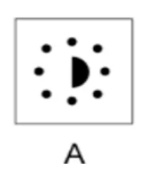
- B
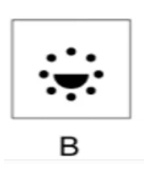
- C
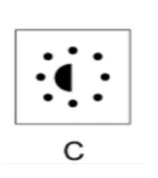
- D
- E
Show answerHide answer
Answer: C ✓ official key
Approach: Figure series — rotation of the black semicircle plus alternating size of the dot ring.
Solution:
The black semicircle turns 90° anticlockwise each step: curve up → curve left → curve down → curve right → curve up.
So figure 6 must have the curve facing left (flat side on the right).
The ring of 8 dots alternates: compact (1, 3, 5) and spread out (2, 4); figure 6 must have the spread ring.
Option C has the left-facing semicircle with the wider dot ring.
Why the other options are wrong:
A: semicircle faces right.
B, D: semicircle faces down.
E: semicircle faces left but with the tight dot ring of figures 1, 3, 5.
Cetking shortcut: Same position as figure 2 is expected (4-step cycle), so the answer must look like figure 2 → C.
Answer: C
In the following set of six figures, four figures share similar features, while two figures are different from the rest. Which are the two figures that are different ?
- A1 and 6
- B2 and 4
- C3 and 4
- D4 and 6
- E5 and 6
Show answerHide answer
Answer: D ✓ official key
Approach: Figure classification — compare the L-shape and the position of the dot.
Solution:
Each figure is an L-shaped corner inside a circle, with one dot placed relative to the long (vertical) arm.
The official key groups figures 4 and 6 as the two different figures.
Figure 6: the dot sits beside the long arm on the side away from the short arm.
Figure 4: the L opens the same way as figure 6 (corner at bottom-left), with the dot beyond the tip of the long arm.
The remaining figures 1, 2, 3 and 5 are taken as the matching set.
Answer: D
Two among the following figures in the question are out of place.
Identify those figures from the given set of figures.
- A4 and 5
- B1 and 4
- C3 and 4
- D2 and 6
- E3 and 5
Show answerHide answer
Official CET key: C · Cetking's answer: E — see why below
Approach: Figure series (out-of-place figures) — count the hatch lines in the top-left corner.
Solution:
Hatch lines: figure 1 = 2, figure 2 = 3, figure 3 = 5, figure 4 = 4, figure 5 = 6, figure 6 = 7.
The series should increase by one line each step: 2, 3, 4, 5, 6, 7.
Figures 3 and 4 have swapped places (5 before 4).
So figures 3 and 4 are out of place.
Why the other options are wrong:
A 4 and 5, B 1 and 4, D 2 and 6, E 3 and 5: swapping these pairs does not give a clean +1 series.
Cetking shortcut: Count only the changing element (hatch lines); everything else (circles, dots, '=' sign) is constant.
Answer: C
The figure at extreme left starts the series and the figure at the extreme right is the last figure of the series. In between there are five figures; A, B, C, D and E, out of which only one does not fit into the series. Select the figure which does not fit into the series :
- AA
- BB
- CC
- DD
- EE
Show answerHide answer
Answer: D ✓ official key
Approach: Figure series (wrong figure) — alternate pattern of the arrow and the order of the two shapes.
Solution:
Figures alternate between two states.
Arrow up (figures 1, B, D, last): triangle comes first, then circle.
Arrow down (A, C, E): circle comes first, then triangle.
Figure D has the arrow up but shows circle then triangle — it breaks the rule.
Why the other options are wrong:
A, C, E: arrow down with circle–triangle order ✓.
B: arrow up with triangle–circle order ✓.
Cetking shortcut: Compare every alternate figure with the first and last figures, which are given correct.
Answer: D
Choose the Odd One Out :
- AI
- BII
- CIII
- DIV
- EV
Show answerHide answer
Answer: E ✓ official key
Approach: Figure classification — direction in which the four hooked ends curl.
Solution:
Each figure is a cross (I and V diagonal, II–IV upright) with a hook at every arm end.
In I, II, III and IV the hooks all curl in the same rotational sense (they are rotations of one another).
In V the hooks curl the opposite way — V is the mirror image of I, not a rotation of it.
So V is the odd one out.
Why the other options are wrong:
I–IV: can be turned into one another by rotation only; V cannot.
Cetking shortcut: Compare the two X-shaped figures (I and V) first — if they are mirror images, one of them is the odd one.
Answer: E
Given here is a figure which is embedded in one of the answer figures.
Choose the figure which has the given figure embedded in it ?
- A
- B
- C
- D
- E
Show answerHide answer
Official CET key: C · Cetking's answer: A — see why below
Approach: Embedded figure — trace the exact outline, including the zig-zag top edge.
Solution:
The given figure is a square whose top edge carries two V-shaped notches: from each top-left corner a line slopes down-right, then rises steeply to the top edge.
Option C is made of two side-by-side cells; in each cell a line runs from the top-left down-right and meets a steep diagonal that rises to the top-right corner.
These two cells together give exactly the two notches under one straight top edge, inside a square boundary.
So the figure is embedded in C.
Why the other options are wrong:
A: has slanted lines and triangles, but no two identical notches hanging from one top edge.
B, D, E: their zig-zag lines are irregular or open; the closed square with two equal notches cannot be traced.
Cetking shortcut: Look for two repeated identical notches — only C has a repeated (two-cell) structure.
Answer: C
Count the exact number of triangles in the given figure ?
- A8
- B10
- C13
- D11
- E9
Show answerHide answer
Answer: B ✓ official key
Approach: Counting triangles — label the points and count systematically.
Solution:
Label T (top), L (left), R (right), B (bottom) of the inscribed rhombus; P and Q are the extra points on the circle (upper-left and upper-right); X is where chord PR cuts TL.
Lower half: LRB → 1.
Upper half without PR: TLR, TPL, TQR → 3.
Triangles using chord PR: PTX, PXL, PRL, PRT, XRL, XTR → 6.
Total = 1 + 3 + 6 = 10.
Why the other options are wrong:
A 8, E 9: miss some of the triangles cut by chord PR.
C 13, D 11: count curved regions between chords and the circle, which are not triangles.
Cetking shortcut: Count triangles line by line: first those without the extra chord, then those that use it.
Answer: B
Find the number of triangles in the given figure ?
- A8
- B11
- C9
- D10
- E12
Show answerHide answer
Official CET key: D · Cetking's answer: C — see why below
Approach: Counting triangles in a pentagram (five-pointed star).
Solution:
The star has 5 points (tip triangles) → 5 small triangles.
Each tip plus the two adjoining pieces forms a large triangle using one full side of the star; the five lines form 5 such big triangles (each line with the two lines that cross it at the far end).
The central pentagon is not a triangle.
Total = 5 + 5 = 10.
Why the other options are wrong:
C 9: misses one large triangle.
A 8, B 11, E 12: do not match the 5 + 5 structure.
Cetking shortcut: Pentagram = 10 triangles (5 tips + 5 large) — a standard result to remember.
Answer: D
Count the number of squares in the given figure ?
- A26
- B31
- C19
- D28
- E27
Show answerHide answer
Answer: E ✓ official key
Approach: Counting squares on a partial 5 × 5 grid.
Solution:
Draw the grid with 6 lines each way (0–5). Lines 0, 2, 3, 5 run across the whole figure; lines 1 and 4 exist only on the inner square (from 1 to 4).
1 × 1 squares: 13.
2 × 2 squares: 8.
3 × 3 squares: 5 (the inner square and 4 others).
4 × 4 squares: 0 (no complete border).
5 × 5 square: 1 (outer boundary).
Total = 13 + 8 + 5 + 0 + 1 = 27.
Why the other options are wrong:
A 26: misses the outer square.
B 31, D 28: count rectangles or incomplete squares.
C 19: counts only the small and the obvious large squares.
Cetking shortcut: Count size by size (1×1, 2×2, …) and check all four sides of each candidate exist.
Answer: E
Which figure is the odd one out?
- AA
- BB
- CC
- DD
- EE
Show answerHide answer
Answer: E ✓ official key
Approach: Figure classification — how the four corner dots are joined.
Solution:
In A, B, C and D every corner dot is joined to the central dot (straight or curved lines), forming an X through the centre.
In E two dots are joined by right-angled bent lines and not all four corner dots meet at the centre.
So E is the odd one out.
Why the other options are wrong:
A, C: straight X through the centre.
B, D: curved arms, but all four still meet at the central dot.
Cetking shortcut: Check the common rule 'all four arms meet at the centre' — only E fails.
Answer: E
Given below is a set of picture, the first of which is named, A, B, C, and D respectively. Pictures A and B share a certain relationship. Ascertain from the second set of pictures that are numbered, 1, 2, 3, 4 and 5, which image when put in place of box D, will continue the same relationship between C and D as is seen between A and B :
- A1
- B2
- C3
- D4
- E5
Show answerHide answer
Answer: C ✓ official key
Approach: Figure analogy — rotate, shade, then add a mirror-image copy.
Solution:
A → B: the half-circle (curve left, flat right) is rotated 90° clockwise so the curve is on top, shaded black, and its white mirror image is added below the flat edge, making a full circle.
Apply to C: the notched shape (notch on the left, flat on the right) rotated 90° clockwise has the notch on top and the flat edge at the bottom; shade it black.
Add its white mirror image below: a white part with the notch at the bottom.
Figure 3 shows exactly this: black top with a notch on top, white bottom with a notch at the bottom.
Why the other options are wrong:
1, 2: the black part has a pointed (arrow) top, not a notch.
4: the lower white part is pointed/crossed, not a mirror image.
5: colours are reversed (white top, black bottom).
Cetking shortcut: Reverse-check: in B the black half is on top — so only figures with a black top (1–4) survive; then match the notch.
Answer: C
Select a figure from among the Answer Figures which will continue the same series as established by the five Problem Figures.
- A1
- B2
- C3
- D4
- E5
Show answerHide answer
Answer: E ✓ official key
Approach: Figure series — the big and small symbols swap in pairs.
Solution:
(A) big 1, small s → (B) big S, small 1: the two symbols swap size and side.
(C) big triangle, small hook → (D) big hook, small triangle: swap again.
(E) big L, small trapezium → next: big trapezium, small L on the right, both upright.
Answer figure 5 shows a big upright trapezium with a small upright L on its right.
Why the other options are wrong:
1: the small symbol is a reversed L (J).
2: the trapezium is inverted.
3: brings new symbols, breaking the swap.
4: puts the small L on the left.
Cetking shortcut: Spot the swap in A→B and C→D; then figure F is just E with the two symbols swapped.
Answer: E
A sheet of paper with numbers as marked in the front and nothing on the reverse is folded into a dice in such a way that the numbers appear on the outside.
Find which of the following pairs of numbers shall surely lie on the two opposite end of each other of the dice so formed ?
- A3 and 4
- B3 and 6
- C2 and 4
- D1 and 5
- E5 and 6
Show answerHide answer
Answer: D ✓ official key
Approach: Dice from a net — faces separated by one face in a straight line are opposite.
Solution:
The column 4–3–6–2 is a straight strip of four faces: 4 is opposite 6 and 3 is opposite 2.
1 is attached to the left of 3, and 5 is attached to the right of 2.
When folded, 1 and 5 end up on the two remaining faces, on opposite sides of the strip.
So 1 and 5 are opposite.
Why the other options are wrong:
A 3 and 4, C 2 and 4: adjacent in the strip.
B 3 and 6, E 5 and 6: adjacent (they share an edge after folding).
Cetking shortcut: In a straight line of faces, alternate faces are opposite; the two side flaps are opposite each other.
Answer: D
Count the number of triangles in the figure given below ?
- A26
- B27
- C33
- D17
- E28
Show answerHide answer
Answer: E ✓ official key
Approach: Counting triangles — three squares in a row, each with both diagonals.
Solution:
In one square with both diagonals: 4 small triangles + 4 half-square triangles = 8.
Three squares → 3 × 8 = 24.
Across two adjacent squares: the diagonals of the two squares meet at their shared corner and form a triangle on the top edge and one on the bottom edge → 2 per adjacent pair.
Two adjacent pairs → 4.
Total = 24 + 4 = 28.
Why the other options are wrong:
A 26, B 27: miss some two-square triangles.
C 33: double-counts.
D 17: counts only small triangles and a few half-squares.
Cetking shortcut: Use the per-square value 8, then add the triangles that span two squares.
Answer: E
Count the number of rhombus in the given figure ?
- A13
- B17
- C14
- D12
- E15
Show answerHide answer
Answer: C ✓ official key
Approach: Counting rhombuses — treat the figure as a tilted 4 × 4 grid with some lines missing.
Solution:
Turn the figure 45° so it becomes a square grid with lines 0–4 each way.
Full lines: the borders and the middle line in each direction; the other inner lines are drawn only part-way.
1 × 1 rhombuses: 8.
2 × 2 rhombuses: 5.
3 × 3: none have all four sides drawn → 0.
4 × 4: the whole figure → 1.
Total = 8 + 5 + 0 + 1 = 14.
Why the other options are wrong:
D 12, A 13: miss some 2 × 2 rhombuses or the outer one.
E 15, B 17: count shapes with a missing side.
Cetking shortcut: Rotate the figure mentally into a square grid; then it is a 'count the squares' question.
Answer: C
Count the number of circles in the given figure ?
- A11
- B13
- C14
- D17
- E12
Show answerHide answer
Answer: B ✓ official key
Approach: Counting circles — outer ring and inner cluster separately.
Solution:
Outer circles: 2 at the top, 1 at the left, 1 at the right, 2 at the bottom → 6.
Inner cluster: centre-top 1, upper-left and upper-right 2, centre 1, lower-left and lower-right 2, centre-bottom 1 → 7.
Total = 6 + 7 = 13.
Why the other options are wrong:
A 11, E 12: miss inner overlapping circles.
C 14, D 17: count lens-shaped overlaps as extra circles.
Cetking shortcut: Count by rows from top to bottom and tick each full circle once.
Answer: B
Identify the figure that shall come in place of the box marked as ' ? ' :
- A
- B
- C
- D
- E
Show answerHide answer
Answer: E ✓ official key
Approach: Figure series — alternating position of the five dots.
Solution:
Figure 1: five dots along the top row.
Figure 2: five dots down the left column.
Figure 3: top row again.
Figure 4 must be the left column again.
Why the other options are wrong:
A: dots in the second row.
B, D: dots in a middle/second column.
C: dots along the diagonal.
Cetking shortcut: Alternating series: figure 4 = figure 2.
Answer: E
Identify the figure that shall come in place of the box marked as ' ? ' :
- A
- B
- C
- D
- E
Show answerHide answer
Answer: B ✓ official key
Approach: Figure series — a line of five dots rotating by 45° each step.
Solution:
Figure 1: vertical line (middle column).
Figure 2: diagonal from bottom-left to top-right (45° clockwise).
Figure 3: horizontal line (middle row) (another 45°).
Figure 4: next 45° turn gives the diagonal from top-left to bottom-right.
Why the other options are wrong:
A: an irregular pattern, not a straight line.
C: the same diagonal as figure 2 (no rotation).
D, E: vertical lines — the line has already passed vertical.
Cetking shortcut: Vertical → / → horizontal → \ : the line is turning like a clock hand.
Answer: B
Identify the figure that shall come in place of the box marked as ' ? ' :
- A
- B
- C
- D
- E
Show answerHide answer
Answer: A ✓ official key
Approach: Figure series — two independent dot groups: an alternating pair and a sliding row of three.
Solution:
Top two dots alternate: (row 1, col 1)+(row 2, col 2) in figures 1 and 3; (row 1, col 2)+(row 2, col 1) in figure 2. So figure 4 has (row 1, col 2)+(row 2, col 1).
Row-3 block of three dots moves one column right each time (wrapping around): columns 5-1-2 → 1-2-3 → 2-3-4 → next 3-4-5.
Option A: top dots at (1, 2) and (2, 1), row 3 dots at columns 3, 4, 5 ✓.
Why the other options are wrong:
B, C, D, E: either the top pair is wrong or the row of three is not at columns 3–5.
Cetking shortcut: Split the dots into groups and track each group separately.
Answer: A
Determine the number of lines in the figure given below :
- A13
- B14
- C12
- D17
- E10
Show answerHide answer
Answer: B ✓ official key
Approach: Counting straight lines — count each full straight line once, even if it passes through several cells.
Solution:
Vertical lines: 5.
Horizontal lines: 3 (top, middle, bottom).
Diagonals: the two corner-to-corner diagonals of the whole figure are single straight lines (each passes through two cells) → 2.
Other diagonals inside the four cells → 4.
Total = 5 + 3 + 2 + 4 = 14.
Why the other options are wrong:
D 17: counts segments instead of full straight lines.
A 13, C 12, E 10: miss vertical or diagonal lines.
Cetking shortcut: Check which cell diagonals line up into one long straight line before counting.
Answer: B
How many minimum straight lines will be needed to make the figure shown below ?
- A17
- B19
- C13
- D10
- E15
Show answerHide answer
Answer: C ✓ official key
Approach: Minimum straight lines — merge every set of collinear segments.
Solution:
Horizontal: top edge and bottom edge of the two squares → 2.
Vertical: left, middle and right sides → 3.
Lines sloping up (/): the diagonal of the left square continues into the left side of the right roof → 1; the right edge of the left lower triangle continues into the right square's diagonal → 1; plus the left side of the left roof and the right edge of the right lower triangle → 2. Total 4.
Lines sloping down (\): by symmetry → 4.
Total = 2 + 3 + 4 + 4 = 13.
Why the other options are wrong:
A 17, B 19: count segments rather than full lines.
D 10: merges segments that are not collinear.
E 15: misses that the diagonals continue into the triangle sides.
Cetking shortcut: Extend each diagonal with a ruler-eye: it runs straight into the next triangle's edge.
Answer: C
Given below are five figures, one of which does not fix into the others to make a square. Identify the figure that does not fix into the other figures ?
- AA
- BB
- CC
- DD
- EE
Show answerHide answer
Answer: C ✓ official key
Approach: Pairing pieces into squares — find which shapes have complementary edges.
Solution:
Each piece has a straight base and sides; its top edge is jagged.
A pairs with E: A's notched top fits into E's notched top when one is turned upside down.
B pairs with D: the small step in B's edge matches the step in D's edge.
C's profile (a step on the right with a sloping edge) has no matching partner, so C does not fit with the others.
Why the other options are wrong:
A, B, D, E: each has a complementary partner that completes a square.
Cetking shortcut: Turn one piece upside down in your mind and slide it onto another — matching notches complete the square.
Answer: C
Identify the Odd One Out :
- A(a)
- B(b)
- C(c)
- D(d)
- E(e)
Show answerHide answer
Answer: A ✓ official key
Approach: Figure classification — symmetry about the horizontal line.
Solution:
Each box has a horizontal line through its middle.
(b), (c), (d), (e): the lower half is the mirror (water) image of the upper half.
(a): the parallelogram is slanted — its lower half is not the mirror image of its upper half.
So (a) is the odd one out.
Why the other options are wrong:
(b) dots and curves, (c) star halves, (d) bell halves, (e) S-curves: all reflect across the line.
Cetking shortcut: Fold each figure along the horizontal line — only the parallelogram fails to match.
Answer: A
Two images of the same dice are shown in the figure below. Find out the number that shall be on the top of the dice when the number 4 is at the bottom of the dice ?
- A5
- B3
- C6
- D1
- E2
Show answerHide answer
Answer: D ✓ official key
Approach: Dice — the face adjacent to all others in the views is opposite the missing number.
Solution:
View 1: 1 is adjacent to 3 and 2.
View 2: 1 is adjacent to 5 and 6.
So 1 is adjacent to 2, 3, 5 and 6 → 1 is opposite 4.
With 4 at the bottom, 1 is on top.
Why the other options are wrong:
A 5, B 3, C 6, E 2: all are adjacent to 1, so they are side faces, not opposite 4.
Cetking shortcut: The common face in both views is adjacent to the four others shown, so it is opposite the unseen number.
Answer: D