The HCF of 2472, 1284, and a third number N is 12.
If their LCM is 2³ × 3² × 5 × 103 × 107, then which of the following could be the value of N?
- A2² × 3² × 7
- B2² × 3³ × 103
- C2² × 3² × 5
- D3³ × 103
- E2² × 3²
Show answerHide answer
Answer: C ✓ official key
Approach: HCF takes the lowest power of each common prime; LCM takes the highest power of every prime.
Solution:
2472 = 2³ × 3 × 103 and 1284 = 2² × 3 × 107.
HCF of all three = 12 = 2² × 3 → N must be divisible by 2² × 3, and N's power of 2 is at most 3.
LCM = 2³ × 3² × 5 × 103 × 107. The two given numbers supply 2³, 103, 107 but only 3¹ and no 5.
So N must supply 3² (exactly, not 3³) and 5¹, and must not bring any new prime.
Minimum such N = 2² × 3² × 5 = 180 → matches option C.
Why the other options are wrong:
- A: contains 7 and no 5 → LCM would have 7 and lack 5.
- B: 3³ makes LCM contain 3³, and 5 is missing.
- D: no factor 2² → HCF would become 3, not 12; also 3³ and no 5.
- E: no 5 → LCM would lack 5.
Cetking shortcut: Look only for the prime missing from the two given numbers (here 5) plus the exact power 3² — only C has both.
Answer: C
The smallest perfect square number that is exactly divisible by 2, 3, 4, 6, 9, 18, 30, and 60 is k², where k is a natural number.What is the sum of all prime factors of k?
- A8
- B9
- C10
- D11
- E12
Show answerHide answer
Answer: C ✓ official key
Approach: Least perfect square divisible by a set = LCM of the set made to have all even exponents.
Solution:
LCM(2, 3, 4, 6, 9, 18, 30, 60) = 2² × 3² × 5 = 180.
Exponent of 5 is odd → multiply by 5: 180 × 5 = 900 = 30².
k = 30 = 2 × 3 × 5.
Sum of prime factors of k = 2 + 3 + 5 = 10.
Cetking shortcut: Primes appearing anywhere in the list are 2, 3, 5 — k must contain each, so the sum is 10 directly.
Answer: C
Find the remainder when 73 + 75 + 78 + 57 + 197 is divided by 34.
- A2
- B4
- C5
- D7
- E9
Show answerHide answer
Answer: B ✓ official key
Approach: Remainder of a sum = remainder of the sum of individual remainders.
Solution:
Sum = 73 + 75 + 78 + 57 + 197 = 480.
34 × 14 = 476.
480 − 476 = 4.
Cetking shortcut: Remainders by 34: 5 + 7 + 10 + 23 + 27 = 72 → 72 − 68 = 4.
Answer: B
In a sanctuary, there are horses and ostriches. Each animal has one head. The total number of heads is 86 and the total number of legs is 250. How many ostriches are there?
- A45
- B46
- C47
- D48
- E49
Show answerHide answer
Answer: C ✓ official key
Approach: Heads–legs problem: two linear equations in two unknowns.
Solution:
Let horses = h, ostriches = o.
Heads: h + o = 86. Legs: 4h + 2o = 250.
Halve legs: 2h + o = 125 → subtract heads equation: h = 39.
o = 86 − 39 = 47.
Cetking shortcut: If all 86 were ostriches → 172 legs; extra 250 − 172 = 78 legs ÷ 2 per horse = 39 horses → ostriches = 47.
Answer: C
There are two examination halls, X and Y.
Statement I:
If 15 students are shifted from hall X to hall Y, then the number of students in both halls, becomes equal.
Statement II:
If 25 students are shifted from hall Y to hall X, then the number of students in hall X becomes twice the number of students in hall Y.
Based on the above statements, answer the following question:
The number of students in halls, X and Y, respectively, is:
- A90, 60
- B105, 75
- C120, 90
- D135, 105
- E140, 60
Show answerHide answer
Answer: D ✓ official key
Approach: Translate each transfer statement into a linear equation and solve.
Solution:
Let hall X = x, hall Y = y.
I: x − 15 = y + 15 → x − y = 30.
II: x + 25 = 2(y − 25) → x = 2y − 75.
Substitute: 2y − 75 − y = 30 → y = 105, x = 135.
Check: 135+25 = 160 = 2 × 80 = 2 × (105−25). ✓
Cetking shortcut: Only options with x − y = 30 survive (A, B, C, D); test II on them — only 135, 105 gives 160 = 2 × 80.
Answer: D
The sum of three numbers in a GP is 26 and their product is 216. What are the three numbers?
- A16, 6, 4
- B4, 6, 16
- C9, 6, 11
- D2, 6, 18
- E5, 7, 14
Show answerHide answer
Answer: D ✓ official key
Approach: Three numbers in GP: take them as a/r, a, ar so the product is a³.
Solution:
Product a³ = 216 → a = 6.
Sum: 6/r + 6 + 6r = 26 → 6/r + 6r = 20 → 3r² − 10r + 3 = 0.
r = 3 or 1/3 → numbers 2, 6, 18.
Check: 2 + 6 + 18 = 26, 2 × 6 × 18 = 216. ✓
Why the other options are wrong:
- A, B: 4, 6, 16 sums to 26 but 6/4 ≠ 16/6 (not a GP); product 384.
- C: 9, 6, 11 is not a GP; product 594.
- E: 5, 7, 14 is not a GP; product 490.
Cetking shortcut: Middle term of a 3-term GP = cube root of the product = 6; then check which option has 6² = first × third (2 × 18 = 36).
Answer: D
Find the next number in the given series:
650, 601, 565, 540, 524, ?
- A520
- B518
- C515
- D514
- E512
Show answerHide answer
Answer: C ✓ official key
Approach: Difference series — differences are consecutive perfect squares.
Solution:
Differences: 650→601 = −49, 601→565 = −36, 565→540 = −25, 540→524 = −16.
These are −7², −6², −5², −4² → next is −3² = −9.
524 − 9 = 515.
Cetking shortcut: Whenever differences are 49, 36, 25… think squares immediately.
Answer: C
Find the missing number in the following series:
94, 118, 158, ?, 286, 374
- A198
- B206
- C214
- D226
- E232
Show answerHide answer
Answer: C ✓ official key
Approach: Second-difference series — the differences grow by a constant 16.
Solution:
Known differences: 118 − 94 = 24, 158 − 118 = 40 (+16).
Next differences: 56, 72, 88.
Missing term = 158 + 56 = 214.
Check: 214 + 72 = 286, 286 + 88 = 374. ✓
Cetking shortcut: Use the end: 374 − 286 = 88, so the difference before is 72 → 286 − 72 = 214.
Answer: C
Find the value of (1 − 1/3)(1 − 1/4)(1 − 1/5)...(1 − 1/100)
- A99/100
- B2/100
- C1
- D101/100
- E101/100
Show answerHide answer
Answer: B ✓ official key
Approach: Telescoping product: (1 − 1/n) = (n − 1)/n.
Solution:
Product = (2/3)(3/4)(4/5)…(99/100).
Every numerator cancels the previous denominator.
Only the first numerator (2) and last denominator (100) remain → 2/100 (= 1/50).
Why the other options are wrong:
- A: 99/100 is just the last factor.
- C: the product of fractions less than 1 cannot be 1.
- D, E: 101/100 is greater than 1 — impossible for a product of proper fractions (D and E are identical in the paper).
Cetking shortcut: First numerator over last denominator.
Answer: B
If
x + 1/x = 2,
then the value of
(2x² + 2)/(3x² + 5x + 3)
is:
- A4/11
- B1/2
- C1 (3/4)
- D2 (1/3)
- E1
Show answerHide answer
Answer: A ✓ official key
Approach: x + 1/x = 2 forces x = 1 (for real x).
Solution:
x + 1/x = 2 → x² − 2x + 1 = 0 → (x − 1)² = 0 → x = 1.
(2x² + 2)/(3x² + 5x + 3) = (2 + 2)/(3 + 5 + 3) = 4/11.
Cetking shortcut: Divide numerator and denominator by x: 2(x + 1/x) / (3(x + 1/x) + 5) = 4/(6 + 5) = 4/11.
Answer: A
Given that
√13 = 3.605 and √130 = 11.40
find the value of
√1.3 + √1300 + √0.013
- A36.164
- B36.304
- C37.164
- D37.304
- E38.304
Show answerHide answer
Answer: D ✓ official key
Approach: Shift the decimal in pairs: √(13 × 100ⁿ) and √(130 × 100ⁿ) only move the decimal point.
Solution:
√1.3 = √(130/100) = √130 / 10 = 11.40 / 10 = 1.140.
√1300 = √(13 × 100) = 10√13 = 36.05.
√0.013 = √(130/10000) = √130 / 100 = 0.114.
Sum = 1.140 + 36.05 + 0.114 = 37.304.
Cetking shortcut: Count digits in pairs from the decimal point: 1.3 → 130 family, 1300 → 13 family, 0.013 → 130 family. No √10 needed.
Answer: D
The average of the first ten odd prime numbers excluding the smallest and the largest among them is
- A15.5
- B16.2
- C17.5
- D18.4
- E19.2
Show answerHide answer
Answer: A ✓ official key
Approach: List the primes, drop the end values, then average.
Solution:
First ten odd primes: 3, 5, 7, 11, 13, 17, 19, 23, 29, 31.
Exclude smallest 3 and largest 31.
Sum of remaining 8 = 5 + 7 + 11 + 13 + 17 + 19 + 23 + 29 = 124.
Average = 124 / 8 = 15.5.
Cetking shortcut: Total of all ten = 158; 158 − 34 = 124; 124/8 = 15.5.
Answer: A
The average salary per head of all the workers in a company is ₹9000 The average salary of 15 officers is ₹5000 and the average salary per head of the remaining workers is ₹10,000 Find the total number of workers in the company.
- A75
- B80
- C50
- D40
- E30
Show answerHide answer
Answer: A ✓ official key
Approach: Weighted average / alligation of two groups.
Solution:
Let total workers = n.
9000n = 15 × 5000 + (n − 15) × 10000.
9000n = 75000 + 10000n − 150000 → 1000n = 75000 → n = 75.
Cetking shortcut: Alligation: officers are 4000 below average, others 1000 above → officers : others = 1 : 4 → 15 : 60 → total 75.
Answer: A
If A : B = 3 : 4
B : C = 8 : 10
C : D = 15 : 17
and if A+B+C+D=212
then the value of D is ?
- A68
- B65
- C76
- D85
- E90
Show answerHide answer
Answer: A ✓ official key
Approach: Chain the ratios by making the common term equal.
Solution:
A : B = 3 : 4 = 6 : 8 and B : C = 8 : 10 → A : B : C = 6 : 8 : 10.
C : D = 15 : 17; make C = 30 (LCM of 10 and 15): A : B : C = 18 : 24 : 30 and C : D = 30 : 34.
A : B : C : D = 18 : 24 : 30 : 34, total 106 parts.
1 part = 212 / 106 = 2 → D = 34 × 2 = 68.
Cetking shortcut: 212 = 2 × 10⁶, so the answer must be 2 × (D's parts); only 68 = 2 × 34 fits once C is scaled to 30.
Answer: A
Mr Sharma owns 2505 rice bags and distributes them among his three sons Aman Rohit and Suresh in a certain ratio Out of the total bags received by each of them Aman sells 30 bags Rohit donates 30 bags and Suresh loses 25 bags Now the ratio of bags with them is 46 : 41 : 34 respectively How many bags did Rohit receive from his father.
- A840
- B850
- C870
- D890
- E900
Show answerHide answer
Answer: B ✓ official key
Approach: Write the final quantities as ratio multiples k, then add back what was removed.
Solution:
After changes: Aman = 46k, Rohit = 41k, Suresh = 34k.
Original: Aman = 46k + 30, Rohit = 41k + 30, Suresh = 34k + 25.
Total: 121k + 85 = 2505 → 121k = 2420 → k = 20.
Rohit received 41 × 20 + 30 = 850.
Cetking shortcut: 2505 − 85 = 2420 is divisible by 121 (= 46 + 41 + 34) → k = 20 at once.
Answer: B
Five years ago, the average age of P and Q was 15 years. After 5 more years, the average age of P, Q, and R will be 25 years. If R is currently 5 years younger than Q, what will be the age of R after 10 years?
- A20
- B25
- C30
- D35
- E40
Show answerHide answer
Official CET key: C · Cetking's answer: E — see why below
Approach: Convert every average into a total at a fixed time point, then shift ages carefully.
Solution:
5 years ago: P + Q = 2 × 15 = 30 → now P + Q = 40.
5 years from now: (P + Q + 10) + (R + 5) = 3 × 25 = 75.
50 + R + 5 = 75 → R = 20 (present age).
Check with R = Q − 5: Q = 25, P = 15 → consistent.
R after 10 years = 20 + 10 = 30.
Why the other options are wrong:
- E (40): does not satisfy the totals; R is 20 now, so 30 after 10 years.
- A (20): R's present age, not after 10 years.
- B, D: do not satisfy the totals.
Cetking shortcut: Total of P, Q at +5 years = 30 + 2 × 10 = 50; three-person total 75 → R at +5 = 25 → R at +10 = 30.
Answer: C
An engineering college has only four batches that contain 20, 40, 60 and 80 students respectively. The pass percentage of these classes, are 10%, 20%, 30% and 40% respectively. Find the pass percentage of the entire college.
- A25%
- B30%
- C28%
- D32%
- E35%
Show answerHide answer
Answer: B ✓ official key
Approach: Overall pass % = total passed / total students (weighted, not simple average).
Solution:
Total students = 20 + 40 + 60 + 80 = 200.
Passed = 10% of 20 + 20% of 40 + 30% of 60 + 40% of 80 = 2 + 8 + 18 + 32 = 60.
Pass % = 60/200 × 100 = 30%.
Cetking shortcut: Weights 1 : 2 : 3 : 4 → (10 + 40 + 90 + 160)/10 = 30%.
Answer: B
Anita mixes two mixtures of milk and water. She mixes 40 litres of the first mixture containing 20% water and 60 litres of the second mixture containing 30% water. Find the percentage of water in the final mixture.
- A24%
- B26%
- C28%
- D30%
- E32%
Show answerHide answer
Answer: B ✓ official key
Approach: Add the actual water quantities and divide by total volume.
Solution:
Water in first = 20% of 40 = 8 L.
Water in second = 30% of 60 = 18 L.
Total water = 26 L in 100 L → 26%.
Cetking shortcut: Weighted average: (40 × 20 + 60 × 30)/100 = 26%.
Answer: B
A machine costs ₹3,20,000 at present. If its value depreciates at the rate of 5% per annum, what will be the value of the machine after 6 years?
- A₹2,45,760
- B₹2,52,000
- C₹2,35,230
- D₹2,30,400
- E₹2,60,000
Show answerHide answer
Answer: C ✓ official key
Approach: Depreciation: Value = P(1 − r/100)ⁿ.
Solution:
Value = 3,20,000 × (0.95)⁶.
(0.95)² = 0.9025; (0.95)³ = 0.857375; (0.95)⁶ = 0.857375² ≈ 0.73509.
Value ≈ 3,20,000 × 0.73509 ≈ ₹2,35,229 ≈ ₹2,35,230.
Cetking shortcut: Binomial: (1 − 0.05)⁶ ≈ 1 − 0.30 + 0.0375 − 0.0025 ≈ 0.735 → 3,20,000 × 0.735 ≈ 2,35,200 → C.
Answer: C
The price of raw materials has increased by 15%. Labour cost has also increased from 25% of the cost of raw material to 30% of the cost of raw material. By how much percentage should the usage of raw materials be reduced so as to keep the total cost the same?
- A15.2 %
- B16.4 %
- C18.6 %
- D19.8 %
- E20 %
Show answerHide answer
Answer: B ✓ official key
Approach: Fix the old total cost; let usage of raw material become a fraction u and keep total cost equal.
Solution:
Old: raw material cost = 100, labour = 25% of 100 = 25, total = 125.
New price of raw material = 115 per old unit of usage; labour = 30% of raw material cost.
New total = 115u + 0.30 × 115u = 149.5u.
149.5u = 125 → u = 0.8361.
Reduction in usage = (1 − 0.8361) × 100 ≈ 16.4%.
Cetking shortcut: Reduction = 1 − 125/149.5 = 24.5/149.5 ≈ 16.4%.
Answer: B
A dishonest shopkeeper uses a 900 gram weight instead of a 1 kilogram weight. He sells goods per kilogram at the same price at which he buys one kilogram. What is his profit percentage?
- A10%
- B11 (1/9)%
- C12 (1/2)%
- D15%
- E9 %
Show answerHide answer
Answer: B ✓ official key
Approach: False weight: Profit % = error / (true value given) × 100.
Solution:
Let CP of 1 kg = ₹100.
He gives 900 g (cost ₹90) but charges ₹100.
Profit = 10 on cost 90 → 10/90 × 100 = 11 1/9 %.
Cetking shortcut: Profit % = shortfall / weight actually given = 100/900 = 1/9 = 11.11%.
Answer: B
A person sold an article for ₹3600 and got a profit of 20%. Had he sold the article for ₹3150, how much profit would he have got?
- A4 %
- B5 %
- C6 %
- D7 %
- E8 %
Show answerHide answer
Answer: B ✓ official key
Approach: Find CP from the first sale, then profit % for the new SP.
Solution:
CP = 3600 / 1.2 = ₹3000.
New SP = 3150 → profit = 150.
Profit % = 150/3000 × 100 = 5%.
Cetking shortcut: 3150/3600 = 7/8 of the old SP → 1.2 × 7/8 = 1.05 → 5% profit.
Answer: B
A certain sum amounts to ₹575 at 5% simple interest in the same time in which ₹750 amounts to ₹840 at 4% simple interest. What is the original sum?
- A₹480
- B₹500
- C₹520
- D₹540
- E₹560
Show answerHide answer
Answer: B ✓ official key
Approach: Use the second loan to find time, then reverse simple interest for the first.
Solution:
Second case: SI = 840 − 750 = 90 = 750 × 4 × t/100 → t = 3 years.
First case: Amount = P(1 + 5 × 3/100) = 1.15P = 575.
P = 575 / 1.15 = ₹500.
Cetking shortcut: Test options: 500 × 1.15 = 575 ✓ directly.
Answer: B
A train crosses a pole in 8 seconds. If the length of the train is 200 metres, find the speed of the train.
- A18 km/h
- B72 km/h
- C90 km/h
- D25 m/s
- E30 m/s
Show answerHide answer
Answer: C ✓ official key
Approach: Crossing a pole: distance = length of the train.
Solution:
Speed = 200 m / 8 s = 25 m/s.
In km/h: 25 × 18/5 = 90 km/h.
Why the other options are wrong:
- A, B: wrong conversions (18 and 72 km/h = 5 and 20 m/s).
- D: 25 m/s is numerically the same speed as 90 km/h; the official key takes the km/h form.
- E: 30 m/s = 108 km/h.
Cetking shortcut: m/s → km/h: multiply by 3.6.
Answer: C
A person covers half of his journey at 30 km/h, one-third at 40 km/h, and the remaining part at 20 km/h.What is his average speed for the whole journey?
- A26 km/h
- B27 km/h
- C28 km/h
- D30 km/h
- E32 km/h
Show answerHide answer
Answer: D ✓ official key
Approach: Average speed = total distance / total time (not the mean of speeds).
Solution:
Take total distance = 6 units (LCM of 2 and 3): parts 3, 2, 1.
Time = 3/30 + 2/40 + 1/20 = 0.1 + 0.05 + 0.05 = 0.2.
Average speed = 6 / 0.2 = 30 km/h.
Cetking shortcut: Better: take distance = 120 km → 60/30 + 40/40 + 20/20 = 2 + 1 + 1 = 4 h → 120/4 = 30.
Answer: D
Two pipes A and B can fill a tank in 24 minutes and 32 minutes respectively. If both the pipes are opened simultaneously, after how much time should B be closed so that the tank is full in 18 minutes?
- A8 minutes
- B9 minutes
- C7 minutes
- D15 minutes
- E24 minutes
Show answerHide answer
Answer: A ✓ official key
Approach: Work done by each pipe = rate × time it stays open.
Solution:
A works all 18 min: 18/24 = 3/4 of the tank.
B must fill the remaining 1/4: x/32 = 1/4 → x = 8 min.
B should be closed after 8 minutes.
Cetking shortcut: Remaining fraction × B's time = 1/4 × 32 = 8.
Answer: A
A cistern is normally filled in 6 hours but takes 4 hours longer to fill because of a leak in its bottom. If the cistern is full, the leak will empty it in how much time?
- A15 hours
- B16 hours
- C12 hours
- D20 hours
- E24 hours
Show answerHide answer
Answer: A ✓ official key
Approach: Leak rate = filling rate without leak − net rate with leak.
Solution:
Pipe alone: 1/6 per hour; with leak the tank takes 10 h → 1/10 per hour.
Leak rate = 1/6 − 1/10 = (5 − 3)/30 = 1/15.
The leak empties a full tank in 15 hours.
Cetking shortcut: Leak time = (6 × 10)/(10 − 6) = 60/4 = 15 h.
Answer: A
Three diggers dug a ditch of 324 m deep in six days working simultaneously. During one shift, the third digger digs as many metres more than the second as the second digs more than the first. The third digger’s work in 10 days is equal to the first digger’s work in 14 days. How many metres does the first digger dig per shift?
- A15 m
- B18 m
- C21 m
- D12 m
- E30 m
Show answerHide answer
Answer: A ✓ official key
Approach: Rates in AP: first = x, second = x + d, third = x + 2d; use the 10-day/14-day equality.
Solution:
10(x + 2d) = 14x → 20d = 4x → x = 5d.
Rates: 5d, 6d, 7d → together 18d per day (one shift per day).
6 days: 6 × 18d = 108d = 324 → d = 3.
First digger = 5d = 15 m per shift.
Why the other options are wrong:
- B (18 m): second digger's rate (6d).
- C (21 m): third digger's rate (7d).
- D, E: do not satisfy 10 × third = 14 × first.
Cetking shortcut: Third : first = 14 : 10 = 7 : 5 → rates 5 : 6 : 7; daily total 324/6 = 54 = 18 parts → 1 part = 3 → first = 15.
Answer: A
If the speed of a boat in still water is 8 km/h and the rate of stream is 4 km/h, what is the upstream speed of the boat?
- A12 km/h
- B8 km/h
- C6 km/h
- D4 km/h
- E3 km/h
Show answerHide answer
Answer: D ✓ official key
Approach: Upstream speed = boat speed − stream speed.
Solution:
Upstream = 8 − 4 = 4 km/h.
Why the other options are wrong:
- A: 12 km/h is the downstream speed (8 + 4).
Answer: D
In a 24-hour period, the hour and minute hands of a clock are at right angles to each other excluding all positions where the hands overlap or are directly opposite. How many such right-angle positions occur?
- A40
- B42
- C44
- D46
- E48
Show answerHide answer
Answer: C ✓ official key
Approach: In 12 hours the hands are at right angles 22 times (not 24); double it for a day.
Solution:
In 12 hours the minute hand gains 11 full rounds on the hour hand.
Each round produces 2 right angles → 22 right angles in 12 hours.
In 24 hours: 22 × 2 = 44.
Overlaps and straight-line positions are separate events and are not counted anyway.
Why the other options are wrong:
- E (48): assumes 2 per hour × 24 — ignores that the hands gain only 22 rounds in a day.
- A, B, D: miscounts.
Cetking shortcut: Right angles = 44, straight (opposite) = 22, coincide = 22 in a day — memorise this triplet.
Answer: C
In the year 2026, Republic Day of India falls on a Monday. On which day of the week will Children’s Day in India fall in the same year?
- AThursday
- BFriday
- CSaturday
- DSunday
- EMonday
Show answerHide answer
Answer: C ✓ official key
Approach: Count odd days from 26 January to 14 November (2026 is not a leap year).
Solution:
Odd days after 26 Jan: Jan 5, Feb 0, Mar 3, Apr 2, May 3, Jun 2, Jul 3, Aug 3, Sep 2, Oct 3, Nov 14 → 0.
Total = 5 + 0 + 3 + 2 + 3 + 2 + 3 + 3 + 2 + 3 + 0 = 26 → 26 mod 7 = 5.
(Check: 292 days = 41 weeks + 5 days.)
Monday + 5 = Saturday.
Cetking shortcut: Month codes: 26 Jan Monday → 14 Nov is 292 days later; 292 = 287 + 5 → Monday + 5 = Saturday.
Answer: C
A bag contains 5 red and 7 green balls. Two balls are drawn one after the other, with replacement of the first ball before drawing the second. What is the probability that both balls drawn are red?
- A5/12
- B25/144
- C5/24
- D35/144
- E1/2
Show answerHide answer
Answer: B ✓ official key
Approach: With replacement the draws are independent: multiply probabilities.
Solution:
P(red) = 5/12 on each draw.
P(both red) = 5/12 × 5/12 = 25/144.
Why the other options are wrong:
- A: probability of a single red.
- C, D: mix of without-replacement / red-green products (35/144 = one red and one green in a fixed order).
Answer: B
In a class, 30% of the students passed Mathematics, 20% passed Science, and 10% passed both subjects. If a student is selected at random, what is the probability that the student has passed Mathematics or Science?
- A2/5
- B3/4
- C5/3
- D3/10
- E1/2
Show answerHide answer
Answer: A ✓ official key
Approach: Addition rule: P(M ∪ S) = P(M) + P(S) − P(M ∩ S).
Solution:
P(M ∪ S) = 0.30 + 0.20 − 0.10 = 0.40 = 2/5.
Why the other options are wrong:
- B, E: too large; would require fewer students in both.
- C: 5/3 > 1 — impossible as a probability.
- D: 3/10 is P(Maths) alone.
Answer: A
The volume V of a pyramid varies jointly as its height h and the area of its base .A pyramid has a base area of 48 dm² and a height of 150 cm, giving a volume of 240 dm³.Find the area of the base (in cm²) of another pyramid whose volume is 420 dm³ and whose height is 180 cm.
- A4200 cm²
- B7000 cm²
- C7200 cm²
- D8400 cm²
- E5600 cm²
Show answerHide answer
Answer: B ✓ official key
Approach: Joint variation: V = kAh. Keep all units in dm.
Solution:
150 cm = 15 dm, 180 cm = 18 dm.
240 = k × 48 × 15 → k = 240/720 = 1/3.
420 = (1/3) × A × 18 → A = 420/6 = 70 dm².
70 dm² = 70 × 100 cm² = 7000 cm².
Cetking shortcut: A₂ = A₁ × (V₂/V₁) × (h₁/h₂) = 48 × 7/4 × 5/6 = 70 dm²; 1 dm² = 100 cm².
Answer: B
A tank measures 99 cm × 120 cm × 80 cm. It is to be filled using a cylindrical bucket of radius 12 cm and height 20 cm. If the bucket is filled up to 75% of its height each time, what is the minimum number of times the bucket must be used to completely fill the tank?
- A120
- B130
- C140
- D135
- E145
Show answerHide answer
Answer: C ✓ official key
Approach: Number of fills = tank volume / volume carried per fill (π = 22/7).
Solution:
Tank = 99 × 120 × 80 = 9,50,400 cm³.
Water per fill = π × 12² × (75% of 20 = 15) = (22/7) × 144 × 15 = 47520/7 cm³.
Fills = 950400 × 7 / 47520 = 140.
Cetking shortcut: 99 = 9 × 11 and 7 pairs with 22/7 — the numbers are built to cancel; 950400 ÷ 6788.57 = 140 exactly with π = 22/7.
Answer: C
The diameters of two cones are equal. If their slant heights be in the ratio 5:7, find the ratio of their curved surface areas.
- A25 : 7
- B25 : 49
- C5 : 49
- D5 : 7
- E7 : 12
Show answerHide answer
Answer: D ✓ official key
Approach: Curved surface area of a cone = πrl.
Solution:
Equal diameters → equal r.
CSA₁ : CSA₂ = πrl₁ : πrl₂ = l₁ : l₂ = 5 : 7.
Why the other options are wrong:
- B: squares the ratio (that would be for similar figures' areas).
- A, C, E: no basis.
Answer: D
Four of the following five number pairs are alike in a certain way. Which one does not belong to that group?
15 – 46, 12 – 37, 9 – 28, 8 – 33, 20 – 61
- A20–61
- B8–33
- C9–28
- D12–37
- E5 – 46
Show answerHide answer
Answer: B ✓ official key
Approach: Find the rule linking the two numbers of each pair: second = 3 × first + 1.
Solution:
15 → 46 (45 + 1), 12 → 37 (36 + 1), 9 → 28 (27 + 1), 20 → 61 (60 + 1).
8 → 3 × 8 + 1 = 25, but the pair shows 33 → odd one out.
Why the other options are wrong:
- A, C, D, E: all follow ×3 + 1 (E is the stem's 15–46 pair, printed as '5 – 46' in the option).
Answer: B
Four of the following five are alike in a certain way and so form a group. Which one of the following does not belong to that group?
123, 25, 341, 218, 62
- A62
- B218
- C341
- D25
- E123
Show answerHide answer
Answer: B ✓ official key
Approach: Compare each number with the nearby perfect cube.
Solution:
25 = 3³ − 2, 62 = 4³ − 2, 123 = 5³ − 2, 341 = 7³ − 2.
218 = 6³ + 2 → the only one with +2 → odd one out.
Why the other options are wrong:
- A, C, D, E: all are n³ − 2.
Cetking shortcut: Numbers just below/above 27, 64, 125, 216, 343 → test cubes first.
Answer: B
Five men and four women are seated in a row such that all the four women always sit together.In how many different ways can they be seated?
- A720
- B4,320
- C8,640
- D17,280
- E34,560
Show answerHide answer
Answer: D ✓ official key
Approach: Women together → treat them as one block.
Solution:
Units: 5 men + 1 women-block = 6 → 6! = 720 ways.
Women inside the block: 4! = 24 ways.
Total = 720 × 24 = 17,280.
Why the other options are wrong:
- A: forgets the internal 4! arrangement.
- B, C: partial counts (e.g. 6! × 3!, 6! × 4!/2).
- E: double-counts (×2).
Answer: D
How many words can be formed out of the letters of the word 'EDUCATION' such that vowels occupy the odd positions?
- A1440
- B2880
- C2840
- D2480
- E720
Show answerHide answer
Answer: B ✓ official key
Approach: Place vowels in their allowed positions, then consonants in the rest.
Solution:
EDUCATION: 9 distinct letters — vowels E, U, A, I, O (5), consonants D, C, T, N (4).
Odd positions 1, 3, 5, 7, 9 = 5 places → vowels: 5! = 120.
Remaining 4 even places → consonants: 4! = 24.
Total = 120 × 24 = 2880.
Why the other options are wrong:
- A: halves the answer (counts only one group fully).
- E: only 5! × 3! style partial count.
- C, D: arithmetic misreads of 2880.
Cetking shortcut: 5 vowels exactly fill 5 odd slots → answer is simply 5! × 4!.
Answer: B
Questions 141–145 share this
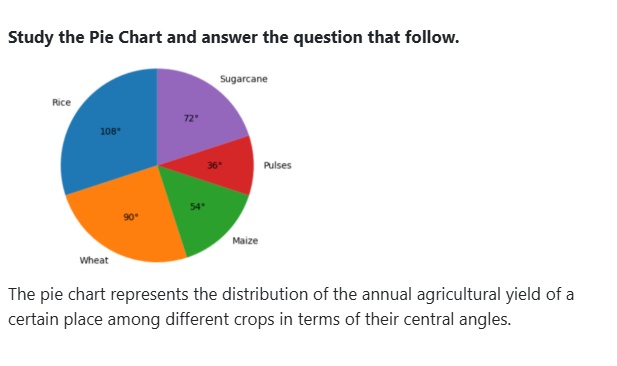
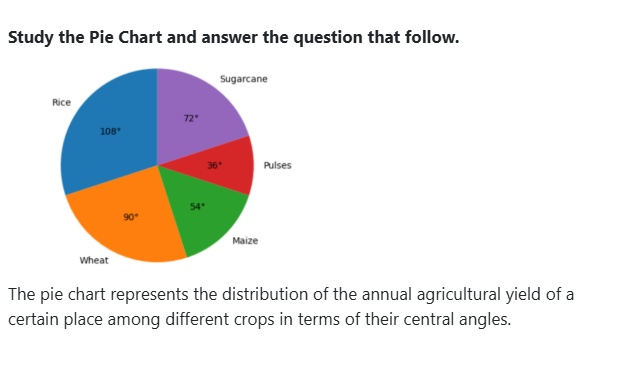
Study the Pie Chart and answer the question that follow.
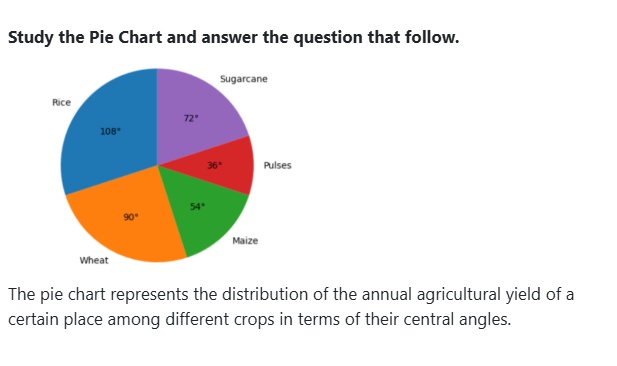
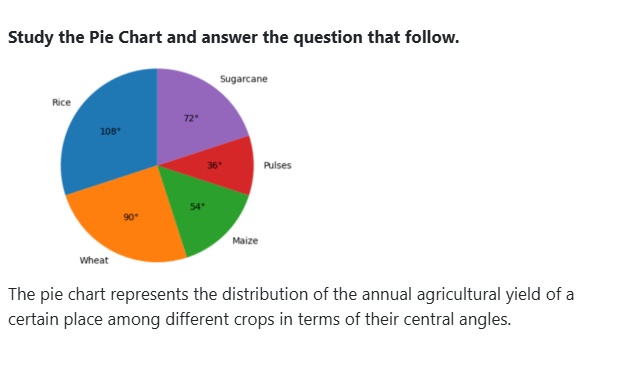
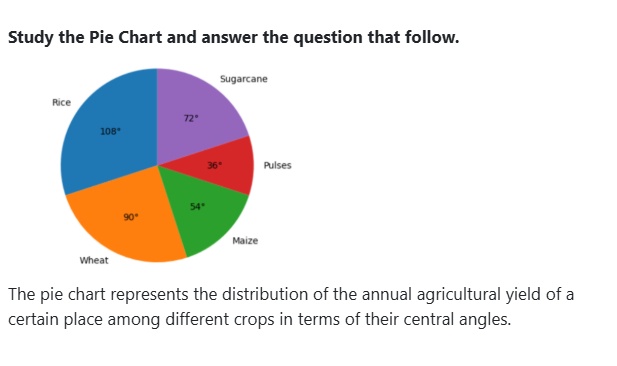
The pie chart represents the distribution of the annual agricultural yield of a certain place among different crops in terms of their central angles.
Data read from chart:
| Crop | Central angle |
|---|
| Rice | 108° |
| Wheat | 90° |
| Maize | 54° |
| Pulses | 36° |
| Sugarcane | 72° |
If the total annual agricultural production is 4800 tonnes, what is the difference between the production of Rice and Wheat?
- A120 tonnes
- B180 tonnes
- C240 tonnes
- D300 tonnes
- E360 tonnes
Show answerHide answer
Answer: C ✓ official key
Approach: Value = (central angle / 360°) × total.
Solution:
Rice − Wheat = 108° − 90° = 18°.
18/360 × 4800 = 4800/20 = 240 tonnes.
Cetking shortcut: Work with the angle difference directly: 1° = 4800/360 = 13.33 t → 18° = 240 t.
Answer: C
Refer to the passage above ↑
If the production of Sugarcane is increased by 20%, what will be its new percentage share (approx.) in total production, assuming others remain constant?
- A20%
- B23%
- C25%
- D28 %
- E40 %
Show answerHide answer
Answer: B ✓ official key
Approach: Increase one sector and recompute its share over the NEW total.
Solution:
Sugarcane = 72/360 = 20% of total (take total = 100).
After 20% increase: 20 × 1.2 = 24; new total = 100 + 4 = 104.
New share = 24/104 × 100 ≈ 23.08% ≈ 23%.
Why the other options are wrong:
- A: ignores the increase.
- C: uses a 25% increase and/or forgets the total grows.
- D, E: overstated shares.
Cetking shortcut: If a part p% grows by r%, new share = p(1 + r)/(100 + pr) → 24/104.
Answer: B
Refer to the passage above ↑
If Rice production decreases by 10% and Wheat production increases by 10%, which crop will have the highest production?
- ARice
- BWheat
- CSugarcane
- DMaize
- EPulses
Show answerHide answer
Answer: B ✓ official key
Approach: Apply the changes to the sector angles and compare.
Solution:
Rice: 108 × 0.9 = 97.2°.
Wheat: 90 × 1.1 = 99°.
Others unchanged: Sugarcane 72°, Maize 54°, Pulses 36°.
Wheat (99°) is now the highest.
Why the other options are wrong:
- A: Rice drops to 97.2°, below Wheat.
- C, D, E: 72°, 54°, 36° are far below.
Answer: B
Refer to the passage above ↑
The production of Rice, Wheat, and Sugarcane together exceeds the production of Maize and Pulses by what ratio?
- A2 : 1
- B3 : 1
- C4 : 1
- D5 : 2
- E7 : 3
Show answerHide answer
Answer: B ✓ official key
Approach: Compare the summed angles of the two groups.
Solution:
Rice + Wheat + Sugarcane = 108 + 90 + 72 = 270°.
Maize + Pulses = 54 + 36 = 90°.
Ratio = 270 : 90 = 3 : 1.
Why the other options are wrong:
- A (2 : 1): ratio of the excess (270 − 90 = 180) to 90 — the question asks for the ratio of the two totals.
- C, D, E: do not match 270 : 90.
Cetking shortcut: The two groups make the whole 360°: 90° vs 270° → 1 : 3 instantly.
Answer: B
Refer to the passage above ↑
If the production of Pulses is decreased by 20% and the production of Sugarcane is increased by 20%, while the total production remains unchanged, which of the following will be true?
- APulses will have the lowest production
- BSugarcane will have higher production than Wheat
- CSugarcane will have equal production as Rice
- DPulses will have higher production than Maize
- ERice will lose its top position
Show answerHide answer
Answer: A ✓ official key
Approach: Apply the changes to the angles and test each statement.
Solution:
Pulses: 36 × 0.8 = 28.8°. Sugarcane: 72 × 1.2 = 86.4°.
Others: Rice 108°, Wheat 90°, Maize 54°.
Pulses (28.8°) is still the lowest → A is true.
Why the other options are wrong:
- B: Sugarcane 86.4° < Wheat 90°.
- C: 86.4° ≠ Rice 108°.
- D: Pulses 28.8° < Maize 54°.
- E: Rice 108° remains on top.
Cetking shortcut: Pulses was already the smallest and it only falls — A is true without calculating.
Answer: A
Questions 146–150 share this
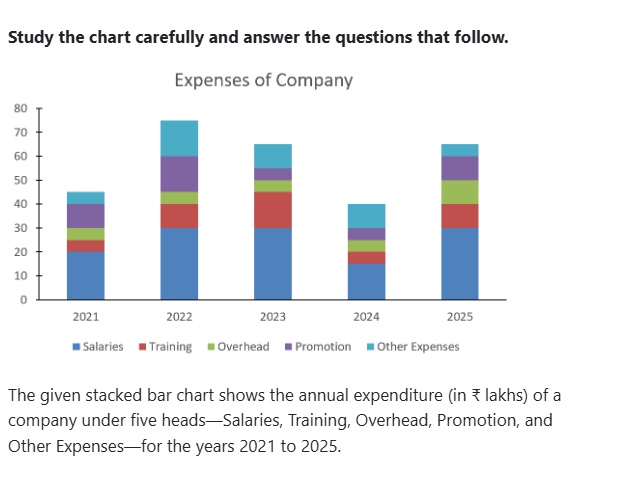
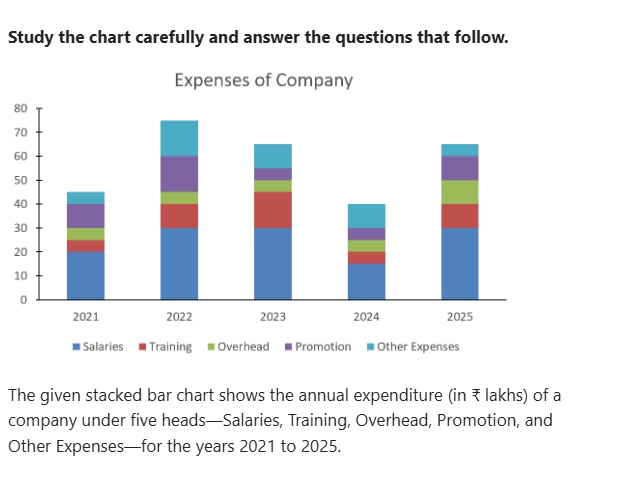
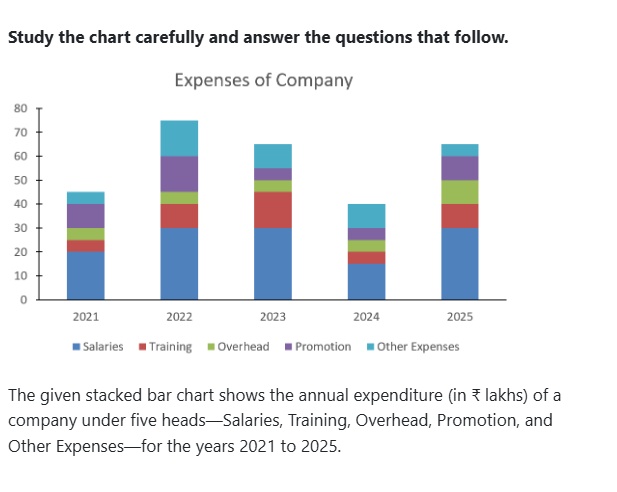
Study the chart carefully and answer the questions that follow.
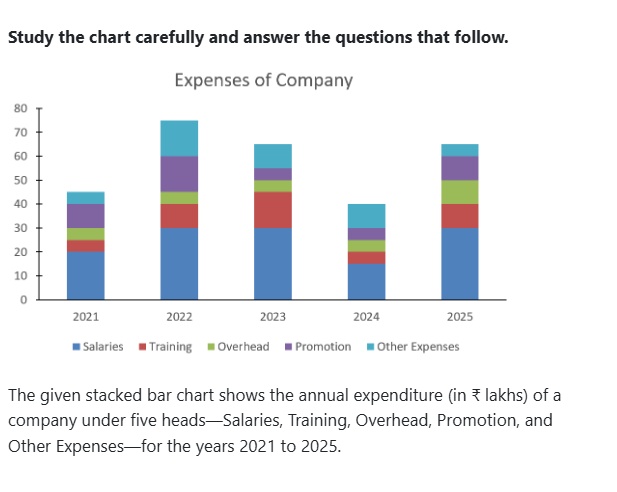
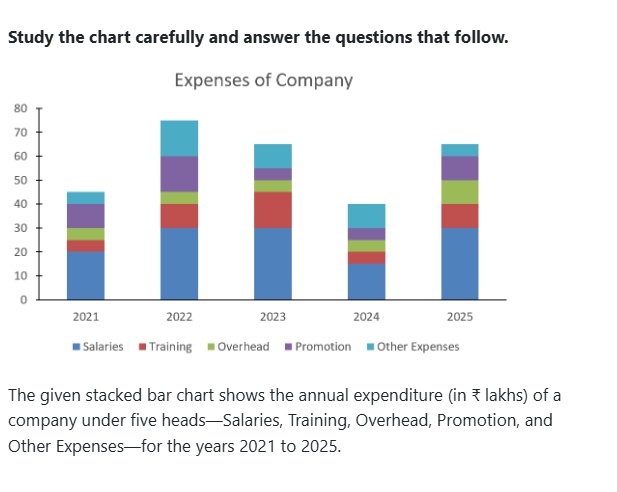
Chart title: Expenses of Company (stacked bar chart; legend: Salaries, Training, Overhead, Promotion, Other Expenses; years 2021 to 2025).
The given stacked bar chart shows the annual expenditure (in ₹ lakhs) of a company under five heads—Salaries, Training, Overhead, Promotion, and Other Expenses—for the years 2021 to 2025.
Data read from chart (₹ lakhs, segment values estimated from stack boundaries):
| Year | Salaries | Training | Overhead | Promotion | Other Expenses | Total |
|---|
| 2021 | 20 | 5 | 5 | 10 | 5 | 45 |
| 2022 | 30 | 10 | 5 | 15 | 15 | 75 |
| 2023 | 30 | 15 | 5 | 5 | 10 | 65 |
| 2024 | 15 | 5 | 5 | 5 | 10 | 40 |
| 2025 | 30 | 10 | 10 | 10 | 5 | 65 |
The average annual expenditure on Training from 2021 to 2025 is approximately what percentage of the average annual Salaries expenditure for the same period?
- A36 %
- B32 %
- C46%
- D50%
- E54%
Show answerHide answer
Answer: A ✓ official key
Approach: Ratio of averages over the same period = ratio of totals.
Solution:
Training: 5 + 10 + 15 + 5 + 10 = 45 → average 9.
Salaries: 20 + 30 + 30 + 15 + 30 = 125 → average 25.
9/25 × 100 = 36%.
Cetking shortcut: Skip averages: 45/125 = 36%.
Answer: A
Refer to the passage above ↑
The difference between Salaries and Training expenses was maximum in which year?
- A2022 and 2025
- B2021 and 2024
- C2022 and 2024
- D2021 and 2023
- E2023 and 2025
Show answerHide answer
Answer: A ✓ official key
Approach: Read the Salaries and Training segments for each year and subtract.
Solution:
2021: 20 − 5 = 15; 2022: 30 − 10 = 20; 2023: 30 − 15 = 15; 2024: 15 − 5 = 10; 2025: 30 − 10 = 20.
Maximum difference 20 occurs in 2022 and 2025.
Why the other options are wrong:
- B: 2021 (15), 2024 (10).
- C: 2024 is the minimum.
- D: 15 each.
- E: 2023 gives only 15.
Answer: A
Refer to the passage above ↑
Based on the given data, in which year was the total expenditure highest?
- A2021
- B2022
- C2023
- D2024
- E2025
Show answerHide answer
Answer: B ✓ official key
Approach: Total expenditure = height of the full stacked bar.
Solution:
Totals: 2021 = 45, 2022 = 75, 2023 = 65, 2024 = 40, 2025 = 65.
Highest = 2022 (75).
Cetking shortcut: Just compare bar tops — no segment reading needed.
Answer: B
Refer to the passage above ↑
The total expenditure on Training is equal to the total expenditure of which of the following years?
- A2023
- B2024
- C2022
- D2021
- E2025
Show answerHide answer
Answer: D ✓ official key
Approach: Sum the Training segments and match with a year's bar total.
Solution:
Training total = 5 + 10 + 15 + 5 + 10 = 45.
Year totals: 2021 = 45, 2022 = 75, 2023 = 65, 2024 = 40, 2025 = 65.
45 matches 2021.
Answer: D
Refer to the passage above ↑
Considering only the years in which Training expenditure exceeds Promotion expenditure by at least ₹10 lakhs, what is the total expenditure on Overhead in those years?
- A₹20 lakhs
- B₹30 lakhs
- C₹ 5 lakhs
- D₹10 lakhs
- E₹ 25 lakhs
Show answerHide answer
Official CET key: C · Cetking's answer: B — see why below
Approach: Filter the years by the condition, then add Overhead for those years.
Solution:
Training − Promotion: 2021: 5 − 10 = −5; 2022: 10 − 15 = −5; 2023: 15 − 5 = 10; 2024: 5 − 5 = 0; 2025: 10 − 10 = 0.
Only 2023 satisfies 'at least ₹10 lakh'.
Overhead in 2023 = 50 − 45 = ₹5 lakh.
Why the other options are wrong:
- A, B, E: add Overhead of years that fail the condition (e.g. all five years = 30).
- D: misreads the 2023 Overhead segment as 10 (or adds 2025's 10).
Cetking shortcut: Only one bar (2023) has a tall Training and a thin Promotion segment — read just that bar.
Answer: C
Questions 151–155 share this
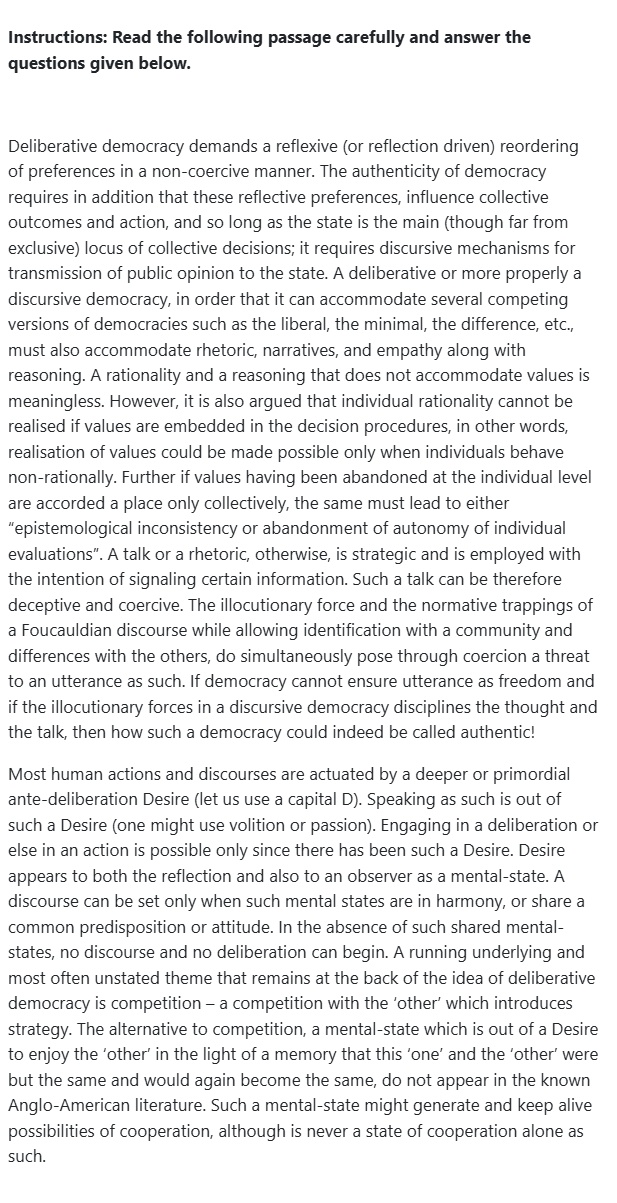
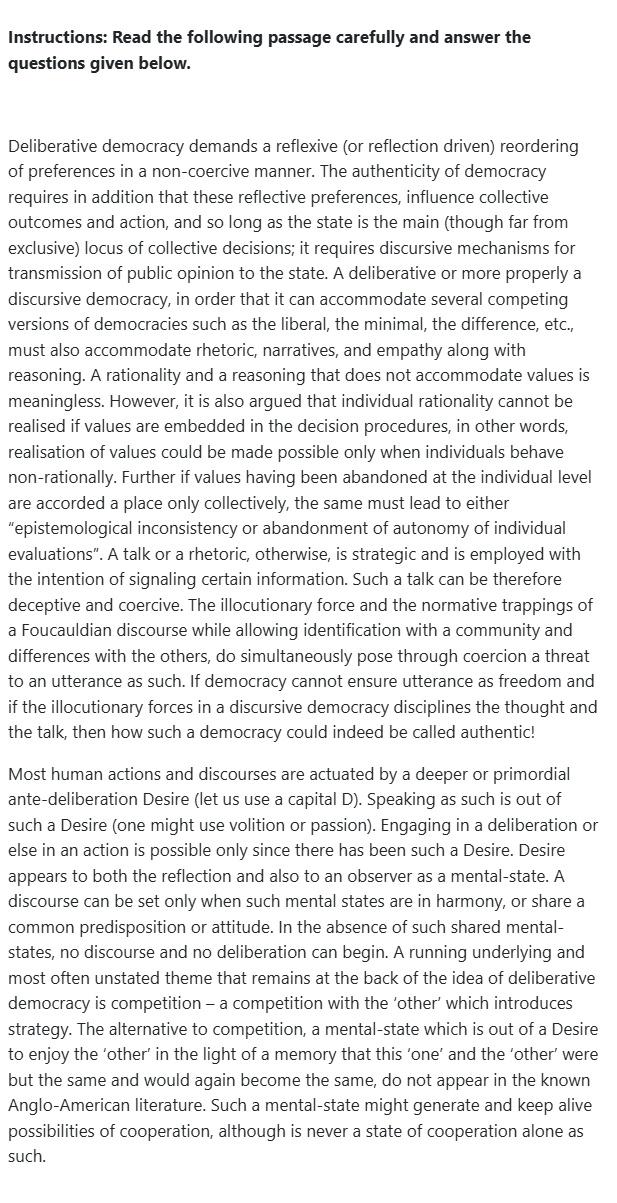
Which of the following follows from the passage above?
- AA rhetoric laden talk can generate authentic democratic collective choice.
- BIrrational persons alone can have values.
- CAuthenticity of democracy requires a strong reflection-action interaction.
- DA paradigm of competition alone can sustain an authentic democracy.
- Edemocracy requires a weak reflection-action interaction.
Show answerHide answer
Answer: C ✓ official key
Approach: Inference — paraphrase the second sentence of the passage.
Solution: Line 2: "The authenticity of democracy requires in addition that these reflective preferences influence collective outcomes and action." Reflection (reordering of preferences) must flow into action (collective outcomes). That is a strong reflection–action interaction — exactly option C.
Why the other options are wrong:
A: Rhetoric-laden talk is called strategic, "deceptive and coercive" — a threat to authenticity, not its source.
B: The passage says values may be realised only when individuals behave non-rationally; it never says only irrational persons have values.
D: Competition is an unstated theme that introduces strategy; 'alone can sustain' is unsupported and extreme.
E: Direct opposite of C — reflection must influence action, so the link is strong, not weak.
Cetking shortcut: When two options are exact opposites (C vs E), one of them is usually the answer — check which one the text supports.
Answer: C
Refer to the passage above ↑
Desire as ante-deliberation driving action refer to
- AIrrationality of deliberation.
- BUselessness of deliberation.
- CDesire to act without thinking.
- DTemporal inconsistency in a position that argues for deliberative action constituting democracy.
- EThoughtlessness of deliberation.
Show answerHide answer
Answer: D ✓ official key
Approach: Inference — decode 'ante' (= before) and see what it does to the deliberative-democracy argument.
Solution: Para 2: "Most human actions and discourses are actuated by a deeper or primordial ante-deliberation Desire… Engaging in a deliberation or else in an action is possible only since there has been such a Desire." So something non-deliberative comes before every deliberation. A position that says democracy is constituted by deliberative action is then undercut by its own starting point — a temporal (before/after) inconsistency. Option D captures this.
Why the other options are wrong:
A, B, E: The passage does not call deliberation irrational, useless or thoughtless — Desire is what makes deliberation possible.
C: Desire is the source of deliberation, not a substitute for it; the passage never says people act without thinking.
Cetking shortcut: 'Ante' = before (ante-date, ante-room). The only option dealing with timing/sequence is D.
Answer: D
Refer to the passage above ↑
Which of the following is true from the passage?
- AAuthor argues that democracy is bound to fail.
- BAuthor argues that Desire is primal.
- CAuthor argues for an end to primal desire so that an end to competition can come through.
- DAuthor argues - democracy demands are not reflexive
- EAuthor argues - democracy demands a reflexive reordering of preferences in a non-coercive manner.
Show answerHide answer
Answer: E ✓ official key
Approach: Specific detail — match an option to a sentence in the passage.
Solution: Sentence 1: "Deliberative democracy demands a reflexive (or reflection driven) reordering of preferences in a non-coercive manner." Option E reproduces this almost word for word.
Why the other options are wrong:
A: The author questions authenticity under coercion; never says democracy is bound to fail.
B: Desire is described as primordial, but that is not the claim being argued about democracy; E is the stated thesis.
C: The author says Desire makes deliberation possible; there is no call to end it.
D: Contradicts sentence 1 — democracy demands reflexive reordering.
Cetking shortcut: 'Which is true' with a near-verbatim option of the first sentence — take it after a quick check of the rest.
Answer: E
Refer to the passage above ↑
A Foucauldian discourse as used in the passage does NOT refer to :
- Adiscourse based on power.
- Bcommunity based discourse.
- Cstrategic discourse.
- Dunplanned discourse
- Enon-strategic discourse.
Show answerHide answer
Official CET key: C · Cetking's answer: E — see why below
Approach: NOT question — list what the passage attributes to Foucauldian discourse, then find the label it does not carry.
Solution: The passage says two separate things. (1) "A talk or a rhetoric, otherwise, is strategic and is employed with the intention of signalling certain information." (2) "The illocutionary force and the normative trappings of a Foucauldian discourse, while allowing identification with a community and differences with the others, do simultaneously pose through coercion a threat…" So Foucauldian discourse = power-based (normative force, coercion, discipline), community-based (identification with a community), and it works without a deliberate plan: the norms discipline thought on their own (non-strategic, unplanned). Strategy, the intentional signalling of information, is the mark of rhetoric. So Foucauldian discourse does NOT refer to strategic discourse.
Why the other options are wrong:
A: Power-based — its 'illocutionary force' and coercion are power.
B: Community-based — it allows 'identification with a community'.
D, E: Unplanned / non-strategic — fits: the discipline comes from norms, not from a speaker's intent.
Cetking shortcut: In NOT questions on dense passages, map each option to a phrase; the one that belongs to a different subject in the passage (here rhetoric) is the odd one.
Answer: C
Refer to the passage above ↑
Which of the following word is closest to the word ‘primordial’ as used in the passage above ?
- AElemental
- BAnarchist
- CAnimalistic
- DNihilistic
- EDiscursive
Show answerHide answer
Answer: A ✓ official key
Approach: Vocabulary in context.
Solution: "A deeper or primordial ante-deliberation Desire" — the Desire is the original, most basic force behind action. Primordial = existing from the beginning, fundamental. Elemental = basic, fundamental, primary.
Why the other options are wrong:
B: Anarchist — against authority; unrelated.
C: Animalistic — beast-like; primordial is about origin, not animal nature.
D: Nihilistic — rejecting all values; unrelated.
E: Discursive — related to discourse/rambling; unrelated.
Cetking shortcut: 'Deeper or primordial' — the word 'deeper' already tells you it means basic/fundamental.
Answer: A
Instructions: Select the most appropriate option to fill in the blank.
Biology is the study of _____.
- AEarth
- BAnimals
- CLife
- DDisease
- ESociety
Show answerHide answer
Answer: C ✓ official key
Approach: Word root — bio = life, -logy = study of.
Solution: Bio-logy = study of life and living organisms.
Why the other options are wrong:
A: Earth — geology.
B: Animals — zoology (only one part of biology).
D: Disease — pathology.
E: Society — sociology.
Cetking shortcut: Break the word: bio + logy.
Answer: C
Instructions: Select the most appropriate option to fill in the blank.
Anthropology is the study of _____.
- ACulture
- BSociety
- CHumans
- DBehavior
- EFossils
Show answerHide answer
Answer: C ✓ official key
Approach: Word root — anthropos = human.
Solution: Anthropo-logy = study of humans as a whole: biological, cultural and social.
Why the other options are wrong:
A: Culture — only cultural anthropology.
B: Society — sociology.
D: Behavior — psychology.
E: Fossils — palaeontology.
Cetking shortcut: Anthropo- as in philanthropy (love of humans).
Answer: C
Instructions: Select the most appropriate option to fill in the blank.
Archaeology is the study of _____.
- AAnimals
- BEarth layers
- CPast Culture of humans
- DWeather
- EFossils
Show answerHide answer
Answer: C ✓ official key
Approach: Word root — archaios = ancient.
Solution: Archaeo-logy = study of the past culture of humans through artefacts, sites and remains.
Why the other options are wrong:
A: Animals — zoology.
B: Earth layers — geology/stratigraphy.
D: Weather — meteorology.
E: Fossils — palaeontology.
Answer: C
Instructions: Select the most appropriate option to fill in the blank.
Psychology is the study of _____.
- ABrain only
- BSociety
- CCulture
- DMind and behavior
- EEmotions only
Show answerHide answer
Answer: D ✓ official key
Approach: Word root — psyche = mind/soul.
Solution: Psycho-logy = scientific study of the mind and behaviour.
Why the other options are wrong:
A: Brain only — neuroscience; 'only' makes it too narrow.
B: Society — sociology.
C: Culture — anthropology.
E: Emotions only — too narrow.
Cetking shortcut: Reject any option with 'only' in a definition question.
Answer: D
Instructions: Select the most appropriate option to fill in the blank.
Geology is the study of _____.
- AAtmosphere
- BClimate
- CEarth
- DEnvironment
- EOceans
Show answerHide answer
Answer: C ✓ official key
Approach: Word root — geo = earth.
Solution: Geo-logy = study of the Earth, its rocks and physical processes.
Why the other options are wrong:
A: Atmosphere — meteorology.
B: Climate — climatology.
D: Environment — environmental science/ecology.
E: Oceans — oceanography.
Cetking shortcut: Geo- as in geography, geometry (earth-measuring).
Answer: C
Questions 161–165 share this
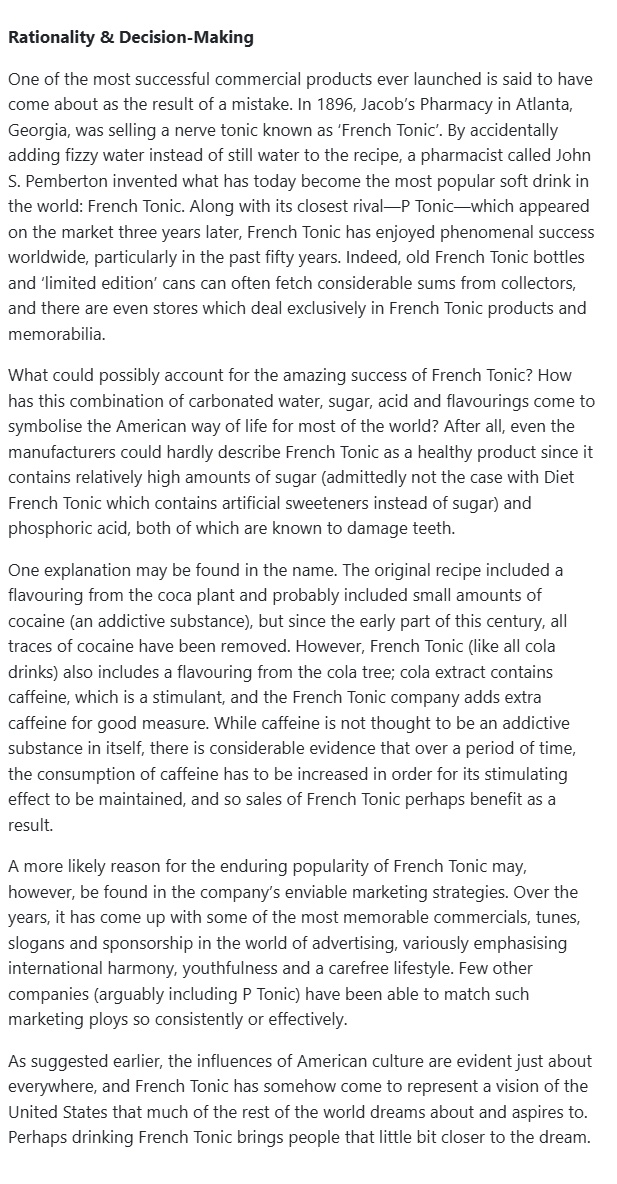
According to the paragraph, ‘cans can often fetch considerable sums’ means the same as:
- AFrench Tonic is quite expensive in some parts of the world.
- Bcollectors consider carefully how much they are paying for a can of French Tonic.
- CTechnological innovation is sufficient to achieve sustainability
- DSome collectors will only drink French Tonic in exclusive stores.
- ECertain French Tonic cans are worth a lot of money as collectable items.
Show answerHide answer
Official CET key: D · Cetking's answer: E — see why below
Approach: Phrase meaning in context.
Solution: Para 1: "old French Tonic bottles and 'limited edition' cans can often fetch considerable sums from collectors, and there are even stores which deal exclusively in French Tonic products and memorabilia." To 'fetch a sum' = to be sold for that amount. So the phrase means certain cans are worth a lot of money as collectable items — option E. The official MahaCET key marks D, linking the phrase to the very next clause about exclusive stores; the passage, however, speaks of stores selling products and memorabilia, not of collectors drinking there.
Why the other options are wrong:
A: About the price of the drink, not of collectable cans.
B: Collectors paying 'carefully' is not the sense of 'fetch'.
C: Technological innovation/sustainability — unrelated to the passage.
D (official key): The exclusive-stores detail is in the passage, but it is about stores dealing in products and memorabilia, not collectors drinking.
Cetking shortcut: 'Fetch' + money = sell for. Match the option that keeps both 'cans' and 'collectors'.
Answer: D (official MahaCET key; the text-based meaning of the phrase is E)
Refer to the passage above ↑
According to the paragraph, the author uses ‘for good measure’ to emphasize the fact that:
- AThere is a lot of caffeine in French Tonic.
- BThe amount of caffeine in French Tonic is carefully measured.
- CThe extra caffeine improves the taste of French Tonic.
- DThe extra caffeine balances the amount found naturally in the cola extract.
- EThe extra caffeine is healthy for the drinkers of French Tonic.
Show answerHide answer
Answer: A ✓ official key
Approach: Idiom in context.
Solution: Para 3: "cola extract contains caffeine… and the French Tonic company adds extra caffeine for good measure." The idiom means 'in addition, as an extra'. The author stresses that caffeine is already present and more is added — so the drink has a lot of caffeine (and the next lines link this to repeat sales).
Why the other options are wrong:
B: Literal reading of 'measure'; the idiom does not mean careful measurement.
C: Taste is never mentioned.
D: 'Balance' is opposite — extra caffeine adds to, not balances, the natural amount.
E: Health benefit not claimed; the passage says the drink is hardly healthy.
Answer: A
Refer to the passage above ↑
According to the paragraph, ‘French Tonic has enjoyed phenomenal success’ suggests that the author:
- AThinks that the success of French Tonic is very strange.
- BBelieves that the success of French Tonic has been impressive.
- CThinks that the success of French Tonic is beyond explanation.
- DRather disapproves of the success of French Tonic.
- EConsiders the success of French Tonic to be undeserved.
Show answerHide answer
Answer: B ✓ official key
Approach: Tone through word choice.
Solution: "French Tonic has enjoyed phenomenal success worldwide" — phenomenal = extraordinary, remarkable. The author is describing the success as impressive (he even calls it 'amazing success' in para 2).
Why the other options are wrong:
A, C: 'Strange' / 'beyond explanation' — the author goes on to explain it (name, caffeine, marketing).
D, E: No disapproval or 'undeserved' judgement in this sentence.
Answer: B
Refer to the passage above ↑
Describing French Tonic’s marketing strategies as ‘enviable’ in the paragraph, the author means that:
- AThe strategies are based on envy.
- BFrench Tonic’s marketing staff is encouraged to be envious of each other’s ideas.
- CPeople are persuaded to buy French Tonic because they are envious of others.
- DRivals are envious of the French Tonic Company’s successful methods of marketing.
- EFrench Tonic’s marketing strategies are enviable.
Show answerHide answer
Answer: D ✓ official key
Approach: Word meaning, confirmed by the next sentences.
Solution: Para 4: "the company's enviable marketing strategies… Few other companies (arguably including P Tonic) have been able to match such marketing ploys." Enviable = arousing envy in others because it is so good. So rivals envy French Tonic's successful marketing.
Why the other options are wrong:
A: Strategies are not 'based on envy'.
B: Staff envying each other — not stated.
C: Customers buying out of envy — not stated.
E: Restates the word without explaining what the author means.
Cetking shortcut: An option that merely repeats the question's word (E) is almost never the 'meaning' answer.
Answer: D
Refer to the passage above ↑
It can be inferred from the last sentence of the passage that:
- AMost people would like to live in America.
- BMany people wish for a lifestyle like they imagine most Americans have.
- CDrinking French Tonic reminds a lot of people of visiting America.
- DLiving in the United States is a bit like living in a dream.
- EDrinking French Tonic is part of the American dream.
Show answerHide answer
Answer: B ✓ official key
Approach: Inference from the final sentence plus the one before it.
Solution: "French Tonic has somehow come to represent a vision of the United States that much of the rest of the world dreams about and aspires to. Perhaps drinking French Tonic brings people that little bit closer to the dream." The 'dream' is an imagined American way of life that people aspire to — so many people wish for a lifestyle like they imagine Americans have.
Why the other options are wrong:
A: 'Live in America' is too literal and too strong ('most people').
C: Nothing about remembering visits to America.
D: Says nothing about real life in the US.
E: The drink is a route to the dream, not a part of the 'American dream' idea.
Answer: B
Questions 166–170 share this
Comparison between two countries becomes difficult because
A. the countries differ in their internal political systems.
B. each country has its own culture and natural resources which differ from those of others.
C. the countries with homogeneous backgrounds are many in number.
- AOnly A
- BOnly B
- COnly A and B
- DAll the three A, B and C
- EOnly C
Show answerHide answer
Answer: C ✓ official key
Approach: Check each statement against the first sentence.
Solution: "It is difficult to compare countries because various factors such as size, Culture, History, Geography, natural endowments, geopolitics and internal polity come into play."
A (different internal political systems) = internal polity ✔
B (own culture and natural resources) = culture, natural endowments ✔
C (many countries with homogeneous backgrounds) — not stated ✘
So only A and B.
Why the other options are wrong:
A, B alone: each misses one supported statement.
D, E: include C, which is not in the passage.
Answer: C
Refer to the passage above ↑
Which of the following have the Chinese identified as their pitfall(s) from their past?
A. Lack of orientation of Science and Technology towards economic growth.
B. Lack of mechanisms in their economic activities to promote use of Science and Technology.
C. Neglect of Science and Technology as a strategic measure for empowerment.
- AOnly A and B
- BOnly B and C
- COnly A and C
- DAll the three A, B and C
- EOnly A
Show answerHide answer
Answer: D ✓ official key
Approach: Match each statement to the 'lessons from past performance' sentences.
Solution: Para 3: (1) "failure to promote science and technology as strategic tools for empowerment" = C ✔ (2) "absence of mechanisms and motivations in their economic activity to promote dependence on science and technology" = B ✔ (3) "their scientific and technological efforts were not oriented… achievements were not converted into productive forces as they were too far removed from China's immediate economic and social needs" = A ✔. All three are stated.
Why the other options are wrong:
A, B, C, E: each leaves out at least one pitfall the passage lists.
Cetking shortcut: The passage lists three lessons in three consecutive sentences — when three statements map to three sentences, choose 'all three'.
Answer: D
Refer to the passage above ↑
Which of the following is/are the expected result/s of China’s new visions?
A. To augment peoples’ standard of living.
B. To tackle pressure effectively brought on by the population.
C. To utilize modern technology for bringing the latent power under control.
- AOnly A and B
- BOnly B and C
- COnly A and C
- DAll the three A, B and C
- EOnly B
Show answerHide answer
Official CET key: D · Cetking's answer: A — see why below
Approach: Match each statement to the 'Chinese vision is therefore aimed at…' sentence.
Solution: "The Chinese vision is therefore aimed at exploiting state-of-art science and technology to enhance the nation's overall power and strength, to improve the people's living standards, … and to effectively control and alleviate pressures brought on by population resources and the environment."
A (augment standard of living) ✔
B (tackle population pressure) ✔
C (use modern technology to harness the nation's power) — paraphrase of the first aim ✔
All three are expected results.
Why the other options are wrong:
A (Only A and B): misses the first aim — using modern S&T for national power.
B, C, E: each leaves out a stated aim.
Cetking shortcut: One sentence lists the aims — tick every option that maps to a clause of that sentence.
Answer: D
Refer to the passage above ↑
Which of the following is the essence of the contents of the passage?
- AEnormous population of the country can be positively utilized for developments.
- BScientific and Technological principles may not necessarily be instrumental in economic growth.
- CHarmonious development of a country can take place even in the absence of technology upgradation.
- DEconomic growth needs to be driven by science and technology
- EScientific innovations do not necessarily lead to any improvements in economic growth of a country
Show answerHide answer
Answer: D ✓ official key
Approach: Main idea — the claim repeated across paragraphs.
Solution: Para 2: growth "by relying on advances in science and technology is pivotal". Para 3: S&T "constitute premier productive forces… can propel economic and social development". The whole passage says economic growth needs to be driven by science and technology.
Why the other options are wrong:
A: Population is a pressure to alleviate, not a resource to use.
B, E: Contradict the passage — S&T is the engine of growth.
C: Contradicts the passage — development needs technology upgradation.
Cetking shortcut: Three of the five options deny the S&T–growth link; the passage asserts it — that leaves D.
Answer: D
Refer to the passage above ↑
According to the passage, China’s long-term goal in science and technology is to
- Acompletely eliminate dependence on agriculture.
- Bachieve parity with advanced nations in defense, science, and technology.
- Crestrict technological development to civilian sectors only.
- Dfocus only on short-term economic gains.
- Eavoid investment in research and development.
Show answerHide answer
Answer: B ✓ official key
Approach: Specific detail — last sentence of the passage.
Solution: "…to enable parity in defense, science and technology with the advanced world." Also: "The aim is to bridge an overall gap with the advanced world."
Why the other options are wrong:
A: Agriculture is to be improved ('agricultural production'), not eliminated.
C: The passage emphasises defence technologies — opposite of 'civilian only'.
D: Targets run to 2020 and beyond — long-term, not short-term.
E: There is 'special emphasis on research and development' — opposite.
Answer: B
Questions 171–175 share this
According to the passage, all of the following are not true, except:
- ATraditional theories failed to calculate the effects of global warming.
- BFall in temperatures in the Antarctic is in accordance with the traditional theories.
- CEffect of global warming is the maximum at the Poles.
- DEffect of global warming on Antarctica is on unexpected lines.
- EEffect of global warming on Antarctica is on expected lines.
Show answerHide answer
Answer: D ✓ official key
Approach: Decode the double negative — 'all are not true, except' means pick the one true statement.
Solution: Passage: "Traditional theories of climate change have held that the effects of global warming ought to be magnified at the Poles. Nonetheless… the Antarctic is definitely getting cooler." Antarctica is 'bucking the trend', the 'only one of Earth's seven continents to react differently'. So the effect on Antarctica is on unexpected lines — D is true.
Why the other options are wrong:
A: Theories did not 'fail to calculate' effects; they predicted magnification at the Poles.
B: Antarctic cooling goes against traditional theory.
C: Only the theory claims this; Antarctica is cooling, so not established as true.
E: Direct opposite of D.
Cetking shortcut: D and E are opposites — one of them is the true statement; 'bucking the trend' decides it.
Answer: D
Refer to the passage above ↑
According to the passage, it can be said that
- AAntarctica has become warmer than the other continents of the world.
- BAntarctica has become colder than the Earth over the last 35 years.
- CThe decade growth in temperature is much higher for Antarctica than the Earth itself.
- DThe average temperature rise for the decade 1979–1998 was more than the average rise in temperature over the last 100 years.
- EBoth the Arctic and Antarctic are getting cooler with global warming.
Show answerHide answer
Answer: B ✓ official key
Approach: Specific detail — test each option against the numbers in the passage.
Solution: "while temperatures in every other continent have risen over the past century, Antarctica has become appreciably colder over the past 35 years and continues to cool." Earth: +0.06°C a decade (100 years); Antarctic: −0.7°C a decade. So, compared with the warming Earth, Antarctica has become colder over the last 35 years — B.
Why the other options are wrong:
A: Opposite — Antarctica is cooling.
C: Antarctic 'decade growth' is negative (a fall of 0.7°C a decade).
D: Compares a 1979–1998 figure with a century-long average — not a like-for-like comparison, and the question asks about Antarctica; B is the statement the passage states directly.
E: The Arctic is getting warmer; only the Antarctic is cooling.
Answer: B
Refer to the passage above ↑
It can be inferred from the passage that:
- AOur knowledge and our theories about global climate change fails to explain what is happening across the globe.
- BIt is a matter of great contradiction that we failed to understand the full impact of global climatic change.
- CWe could not understand the importance of global climatic change.
- DIt was difficult for us to understand the full implication of global climatic change.
- EThe threat of global warming is accentuated due to what is happening in Antarctica.
Show answerHide answer
Answer: B ✓ official key
Approach: Inference — follow the passage's repeated word 'contradiction'.
Solution: The passage opens with pundits "blowing hot and cold", shows Antarctica cooling against traditional theory, says earlier sea-level estimates "will have to be suitably revised", asks "what is the mystery", and ends with "here's another contradiction" — icebergs breaking away in a cooling South. The inference: it is a matter of great contradiction that we have not understood the full impact of global climatic change — B.
Why the other options are wrong:
A: Too broad — the theories still explain the global warming trend; only Antarctica is the exception.
C: 'Importance' is never in doubt; the gap is in understanding effects.
D: Close, but drops the passage's key idea of contradiction — B states it.
E: The Antarctic cooling, if anything, runs against the warming trend; no 'accentuated threat' is drawn.
Cetking shortcut: When the passage literally uses a word (contradiction) twice, the inference option that carries it is usually the answer.
Answer: B
Refer to the passage above ↑
According to the passage, factors affecting the temperature profile of Arctic do not include
- Aocean currents.
- Bgreenhouse effects.
- Cdeforestation
- Dloosening of the ice sheets.
- Eglobal warming.
Show answerHide answer
Answer: C ✓ official key
Approach: NOT/EXCEPT detail — tick off every option the passage mentions.
Solution: Para 2: emissions waft to the North Pole "creating a greenhouse effect, warming the air and loosening the ice sheets"; "complex interplay of ocean currents" changes temperatures; the whole passage is about global warming. Deforestation is not mentioned anywhere.
Why the other options are wrong:
A, B, D, E: each is named in the passage as part of the temperature story.
Cetking shortcut: Outside knowledge is the trap in EXCEPT questions — the unmentioned item is the answer.
Answer: C
Refer to the passage above ↑
According to the passage, the most important factor for global warming is
- Ahot summers.
- Bincreased human activity.
- Cshrinking biodiversity.
- Dincreasing pollution levels.
- Epolluting factories.
Show answerHide answer
Answer: B ✓ official key
Approach: Specific detail.
Solution: "Climatologists are, however, unanimous… the Earth as a whole is becoming warmer — and largely due to increased human activity."
Why the other options are wrong:
A: Hot summers are an effect/symptom, not the cause.
C: Shrinking biodiversity is listed as an observed change, not a cause.
D, E: Narrower subsets; the passage names human activity.
Answer: B
Directions: From the following sentences, choose the grammatically correct sentence.
- AIt looks likes it is going to rain this afternoon.
- BIt looks as if it is going to rain this afternoon.
- CIt looks as if it is going to raining today afternoon.
- DIt looks like it is going to rain today's afternoon.
- EIt looks likes it is going to rain today afternoon.
Show answerHide answer
Answer: B ✓ official key
Approach: Spot the error in each option: verb form, idiom, time expression.
Solution: B: "It looks as if it is going to rain this afternoon." — correct linking phrase, correct 'going to + base verb', idiomatic time phrase.
Why the other options are wrong:
A, E: 'looks likes' — wrong verb form after 'it looks'.
C: 'going to raining' — needs base verb 'rain'; also 'today afternoon'.
D: 'today's afternoon' is not idiomatic — 'this afternoon'.
Cetking shortcut: 'Today morning/afternoon/evening' is always wrong — use 'this'.
Answer: B
Directions: From the following sentences, choose the grammatically correct sentence.
- AA belief that he is humble and being really humble is what makes him so likeable.
- BA belief that he is humble and being really humble are what makes him so likable.
- CBelieving that he is humble and really being humble is what makes him so likeable.
- DBelieving that he is humble and really being humble are what makes him so likable.
- EA beliefs that he is humble and being really humble are what makes him so likable.
Show answerHide answer
Answer: C ✓ official key
Approach: Parallelism first, then agreement.
Solution: The two subject parts must be in the same form: "Believing that he is humble and really being humble" — two gerunds, parallel. The pair is presented as one combined quality that makes him likeable, so it takes the singular 'is what makes'. ('Likeable' and 'likable' are both accepted spellings — spelling is not the issue.)
Why the other options are wrong:
A, B, E: 'A belief… and being' mixes a noun with a gerund — not parallel; E also has 'A beliefs'.
D: Parallel, but the plural 'are' clashes with the singular 'makes' in the same clause.
Cetking shortcut: Eliminate non-parallel options first (A, B, E), then choose between C and D on agreement with 'makes'.
Answer: C
Change the voice of the following sentence:
People believe that the committee will announce the results tomorrow.
- AIt is believed that the committee will announce the results tomorrow.
- BThe results are believed that the committee will announce tomorrow.
- CIt was believed that the committee will announce the results tomorrow.
- DIt is believed that the results will be announced by the committee tomorrow.
- EThe results will be believed to announce by the committee tomorrow.
Show answerHide answer
Answer: D ✓ official key
Approach: Passive of a reporting verb + that-clause.
Solution: Step 1: People believe → It is believed (tense stays present).
Step 2: the committee will announce the results → the results will be announced by the committee.
Combined: "It is believed that the results will be announced by the committee tomorrow."
Why the other options are wrong:
A: Only half the sentence changes voice.
B: 'The results are believed that…' — ungrammatical structure.
C: 'was believed' — wrong tense (original is present).
E: 'believed to announce' — wrong meaning and form; needs 'to be announced'.
Cetking shortcut: In 'change the voice' questions, the option that converts every active clause usually wins.
Answer: D
Directions: From the following sentences, choose the grammatically correct sentence.
- AI can understand my sister better than my mother.
- BI can understand my sister more than my mother.
- CI can better understand my sister than my mother.
- DI can understand my sister better than I can understand my mother.
- EI can understands my sister more than my mother.
Show answerHide answer
Answer: D ✓ official key
Approach: Ambiguous comparison.
Solution: "I can understand my sister better than my mother" has two readings: (i) better than I understand my mother, (ii) better than my mother understands my sister. D removes the doubt: "I can understand my sister better than I can understand my mother."
Why the other options are wrong:
A, B, C: Same ambiguity; B also uses 'more' where 'better' fits 'understand'.
E: 'I can understands' — modal must take base verb.
Cetking shortcut: In comparison questions, prefer the option that repeats the verb to make both sides clear.
Answer: D
Directions: From the following sentences, choose the grammatically correct sentence.
- AShe said that Raj had a fall last week and he had been injured.
- BShe said that Raj had fallen the previous week and he had injured.
- CShe said that Raj had had a fall last week and he was injured.
- DShe said that Raj had had a fall the previous week and he had been injured.
- EShe saids that Raj had a fall last week and he had been injured.
Show answerHide answer
Answer: D ✓ official key
Approach: Reported speech — shift tense back and change time words.
Solution: Direct: "Raj had a fall last week and he was injured." Reported after 'She said': had a fall → had had a fall; last week → the previous week; was injured → had been injured. Only D does all three.
Why the other options are wrong:
A: Keeps 'had a fall' and 'last week'.
B: 'he had injured' — no object; needs passive 'had been injured'.
C: Keeps 'last week'; 'was injured' not shifted.
E: 'She saids' — wrong verb form.
Cetking shortcut: Look for 'the previous week / the day before' — options keeping 'last week/yesterday' are out.
Answer: D
Directions: From the following sentences, choose the grammatically correct sentence.
- AIn speaking with the Minister, he denied that there were any payoffs involved in the deal.
- BWhile speaking with the Minister, we were informed that there were no payoffs in the deal.
- CWhile speaking with the Minister, the Minister denied that there were any payoffs in the deal.
- DIn speaking with the Minister, he denied to the journalists that there were any payoffs in the deal.
- EAt speaking with the Ministers, the Minister denied that there was any payoffs in the deal.
Show answerHide answer
Answer: B ✓ official key
Approach: Dangling modifier — who is doing the 'speaking'?
Solution: The subject right after the comma must be the person speaking with the Minister. In B: "While speaking with the Minister, we were informed…" — we were speaking with the Minister. Logical and grammatical.
Why the other options are wrong:
A, D: 'he' is unclear — 'he' (the Minister?) speaking with the Minister; 'In speaking' is also awkward here.
C: The Minister speaking with the Minister — illogical.
E: 'At speaking' is wrong; 'there was any payoffs' — agreement error.
Cetking shortcut: Read the -ing phrase and the first noun after the comma together; if they don't make sense as doer + action, reject.
Answer: B
Directions: From the following sentences, choose the grammatically correct sentence.
- AShe intended to get married to him, but then she goes and breaks relations with him.
- BShe intends to get married to him, but then she goes and breaks relations with him.
- CShe intended to get married to him, but then she went and broke relations with him.
- DShe intended to get married to him, but then she will go and break relations with him.
- EShe intended to get married to him, but then she will go and breaks relations with him.
Show answerHide answer
Answer: C ✓ official key
Approach: Tense consistency.
Solution: 'Intended' sets the time in the past, so the following actions must also be past: "She intended to get married to him, but then she went and broke relations with him."
Why the other options are wrong:
A: intended (past) + goes/breaks (present) — tense clash.
B: intends… goes and breaks — reads as a habitual present; not the completed past event the sentence narrates.
D: intended (past) + will go (future) — illogical.
E: 'will go and breaks' — tense clash and wrong verb form.
Answer: C
Directions: From the following sentences, choose the grammatically correct sentence.
- AOf all the students in the class whom do you think the teacher likes the most?
- BOf all the students in the class who do you think the teacher likes the most?
- CWho do you think the teacher likes the best of all students in the class?
- DIn the class, who do you think the teacher likes the most of all the students?
- EWho do you think the teachers likes the best of all students in the class?
Show answerHide answer
Answer: A ✓ official key
Approach: Pronoun case — who (subject) vs whom (object).
Solution: Strip the inserted clause 'do you think': the teacher likes ___ the most. The blank is the object of 'likes' → 'him/her' → whom. A: "Of all the students in the class, whom do you think the teacher likes the most?" — formally correct, with 'the most' for a superlative among many.
Why the other options are wrong:
B, C, D: 'who' used as object of 'likes'.
E: 'who' as object and 'the teachers likes' — agreement error.
Cetking shortcut: He/him test: if the answer would be 'him', use whom.
Answer: A
Directions: From the following sentences, choose the grammatically correct sentence.
- AIn 2009, she was promoted to the position of General Manager, Systems.
- BShe was promoted in 2009 to a General Manager, Systems post.
- CShe was promoted to a General Manager, Systems position in 2009.
- DShe was promoted in 2009 to General Manager, Systems.
- EShe were promoted in 2009 to a General Manager, Systems post.
Show answerHide answer
Official CET key: D · Cetking's answer: B — see why below
Approach: Articles with designations + concision.
Solution: When a person is promoted, appointed or elected to a unique post, the title takes no article: "She was promoted in 2009 to General Manager, Systems." D does this cleanly and concisely.
Why the other options are wrong:
A: Grammatical but wordy ('to the position of'); D is the tighter standard form.
B, C: 'a General Manager, Systems post/position' — indefinite article before a unique designation; clumsy.
E: 'She were' — subject–verb agreement error.
Cetking shortcut: With 'promoted to / appointed as / elected', drop the article before a specific title.
Answer: D
In the following question, a part of the sentence is bold. Below are five alternatives (A), (B), (C), (D), and (E) to the bold part. Choose the option that best improves the sentence grammatically and contextually.
Hardly had the train arrived when the passengers start boarding.
- Awhen the passengers were starting to board
- Bwhen the passengers started boarding
- Cthan the passengers started boarding
- Dthan the passengers start boarding
- Ewhen the passengers had started boarding
Show answerHide answer
Answer: B ✓ official key
Approach: Fixed conjunction pair Hardly… when.
Solution: Structure: Hardly had + subject + past participle … when + simple past. "Hardly had the train arrived when the passengers started boarding."
Why the other options are wrong:
A: Past continuous 'were starting' — not the simple past this structure needs.
C, D: 'than' goes with 'No sooner', not 'Hardly'; D also keeps present 'start'.
E: Past perfect in the second clause — boarding came after arrival, so simple past.
Cetking shortcut: Hardly/Scarcely → when; No sooner → than.
Answer: B
Choose the option closest in meaning to the ‘Stipulation’
- Aimitation
- Bsignal
- Cexcitement
- Drequirement
- Edislike
Show answerHide answer
Answer: D ✓ official key
Approach: Synonym — direct vocabulary.
Solution: Stipulation (noun) = a condition laid down as part of an agreement, e.g. 'The contract has a stipulation that payment be made in 30 days.' Closest: requirement.
Why the other options are wrong:
A: imitation — copying.
B: signal — sign.
C: excitement — thrill.
E: dislike — aversion.
Cetking shortcut: Stipulate = specify as a condition → stipulation = requirement.
Answer: D
Choose the option closest in meaning to the ‘Eloquent’
- Aelusive
- Barticulate
- Cbest
- Dmeaningful
- Emantle
Show answerHide answer
Answer: B ✓ official key
Approach: Synonym — direct vocabulary.
Solution: Eloquent = expressing ideas fluently and persuasively. Articulate = able to express ideas clearly and effectively.
Why the other options are wrong:
A: elusive — hard to catch.
C: best — superlative, unrelated.
D: meaningful — significant, not about expression.
E: mantle — a cloak/role.
Cetking shortcut: Root 'loqu' = speak (loquacious, soliloquy) → eloquent is about speech.
Answer: B
Choose the option closest in meaning to the ‘Defendant’
- Aaccused
- Bappellant
- Carrogant
- Ddefoliant
- Epill
Show answerHide answer
Answer: A ✓ official key
Approach: Synonym — legal vocabulary.
Solution: Defendant = the person against whom a charge or claim is brought in court → the accused.
Why the other options are wrong:
B: appellant — one who appeals a decision.
C: arrogant — proud.
D: defoliant — chemical that strips leaves (sound-alike trap).
E: pill — tablet.
Answer: A
Choose the option closest in meaning to the ‘Abase’
- Aadjourn
- Bdegrade
- Chumble
- Dpacify
- Etablet
Show answerHide answer
Answer: B ✓ official key
Approach: Synonym — choose the closest of two near options.
Solution: Abase (verb) = to lower someone in dignity, rank or esteem. Degrade = to lower in rank or dignity — exact match.
Why the other options are wrong:
A: adjourn — postpone.
C: humble — near, but milder and also an adjective; degrade is the direct sense of 'lower in dignity'.
D: pacify — calm.
E: tablet — unrelated noun.
Cetking shortcut: a-base → bring to a 'base' (low) level → degrade.
Answer: B
Choose the option closest in meaning to the ‘Aplomb’
- Acomposure
- Bribald
- Crepose
- Dconcern
- Ecast away
Show answerHide answer
Answer: A ✓ official key
Approach: Synonym — direct vocabulary.
Solution: Aplomb = self-confidence and calmness in a demanding situation, e.g. 'She handled the press with aplomb.' Closest: composure.
Why the other options are wrong:
B: ribald — vulgar, coarse humour.
C: repose — rest, sleep; not poise under pressure.
D: concern — worry, the opposite feel.
E: cast away — discard.
Answer: A
Directions: Choose the best option.
This is a ...........on his character.
- Atable
- Bblue
- Cslur
- Dstatement
- Eweakness
Show answerHide answer
Answer: C ✓ official key
Approach: Collocation — which noun goes with 'on his character'?
Solution: "This is a slur on his character" — slur = an insinuation or remark that damages someone's reputation. 'A slur on' is the standard collocation.
Why the other options are wrong:
A: table — meaningless here.
B: blue — not a noun that fits.
D: statement — 'a statement on his character' is neutral and unidiomatic; the phrase implies damage.
E: weakness — would be 'in', not 'on', his character.
Cetking shortcut: Slur / slight / reflection / blot + on someone's character.
Answer: C
Directions: Choose the best option.
The ...........of the state is efficient.
- Aadministration
- Bdemocracy
- Cpolicy
- Dautocracy
- Eplutocracy
Show answerHide answer
Answer: A ✓ official key
Approach: Fit the noun to the adjective 'efficient'.
Solution: Efficiency describes functioning/management. "The administration of the state is efficient" — the running of the state is efficient.
Why the other options are wrong:
B, D, E: democracy, autocracy, plutocracy are forms of government, not things judged on efficiency.
C: policy — a policy is judged effective/sound; 'policy of the state is efficient' is unidiomatic.
Answer: A
Directions: Choose the best option.
The ...........of private limited companies is in the hands of its directors.
- Amanagers
- Badministrators
- Cmanagement
- Ddepartment
- Esociety
Show answerHide answer
Answer: C ✓ official key
Approach: Meaning + agreement.
Solution: "The ___ of private limited companies is in the hands of its directors." We need a singular noun meaning 'running/control'. Management fits: control of the company rests with the directors.
Why the other options are wrong:
A, B: plural (managers, administrators) — disagree with 'is'; also people cannot be 'in the hands of' directors in this sense.
D: department — a unit, not control.
E: society — unrelated.
Cetking shortcut: Check the verb: 'is' rules out plural options instantly.
Answer: C
Directions: Choose the best option.
Ram the prince of Ayodhya ...........his siblings.
- Aadorned
- Badored
- Cvitiated
- Dendangered
- Eabhorred
Show answerHide answer
Answer: B ✓ official key
Approach: Meaning + confusable pair adored/adorned.
Solution: Ram is known for his love for his brothers: "Ram, the prince of Ayodhya, adored his siblings" — loved them deeply.
Why the other options are wrong:
A: adorned — decorated; does not fit people as object here.
C: vitiated — spoiled/corrupted.
D: endangered — put at risk.
E: abhorred — hated; opposite tone.
Answer: B
Directions: Choose the best option.
The Christmas tree was ...........with stars and other decorative items.
- Aadorned
- Bendowed
- Cencased
- Denticed
- Eencompassed
Show answerHide answer
Answer: A ✓ official key
Approach: Meaning + collocation 'adorned with'.
Solution: "The Christmas tree was adorned with stars and other decorative items" — decorated with.
Why the other options are wrong:
B: endowed with — provided with a quality/talent/fund.
C: encased — enclosed in a case.
D: enticed — tempted.
E: encompassed — surrounded/included.
Cetking shortcut: 'Decorative items' in the sentence is the clue — pick the word meaning decorated.
Answer: A
Instructions: Choose the correct meaning of the proverb/idiom from the alternatives given below.
The meaning of 'Above board' is:
- ASecretive
- BDishonest
- CHonest
- DCareless
- EConfusing
Show answerHide answer
Answer: C ✓ official key
Approach: Idiom meaning.
Solution: Above board = done openly and honestly, with nothing hidden (from card players keeping hands above the table). E.g. 'The deal was completely above board.'
Why the other options are wrong:
A, B: secretive/dishonest — opposites.
D, E: careless/confusing — unrelated.
Answer: C
Instructions: Choose the correct meaning of the proverb/idiom from the alternatives given below.
The idiom 'Account for' means:
- AIgnore completely
- BTake revenge
- CHide the truth
- DProvide an explanation for
- EArgue loudly
Show answerHide answer
Answer: D ✓ official key
Approach: Phrasal verb meaning.
Solution: Account for = to give an explanation or reason for something. E.g. 'He could not account for the missing money.'
Why the other options are wrong:
A: Ignore completely — opposite.
B: Take revenge — unrelated.
C: Hide the truth — opposite.
E: Argue loudly — unrelated.
Answer: D
Instructions: Choose the correct meaning of the proverb/idiom from the alternatives given below.
'All agog' refers to being:
- AAngry and upset
- BBored and tired
- CSilent and calm
- DIn a state of excitement
- EAfraid and nervous
Show answerHide answer
Answer: D ✓ official key
Approach: Idiom meaning.
Solution: All agog = in a state of eager excitement or curiosity. E.g. 'The children were all agog at the circus.'
Why the other options are wrong:
A, E: angry / afraid — wrong emotion.
B, C: bored / calm — opposite of excitement.
Answer: D
Instructions: Choose the correct meaning of the proverb/idiom from the alternatives given below.
The expression 'Hair standing on end' shows:
- AHappiness
- BConfidence
- CLaziness
- DA sign of fear and surprise
- EPride
Show answerHide answer
Answer: D ✓ official key
Approach: Idiom meaning.
Solution: (Make) one's hair stand on end = to cause great fear, horror or shock. E.g. 'The ghost story made my hair stand on end.'
Why the other options are wrong:
A, B, E: happiness, confidence, pride — positive feelings; wrong.
C: laziness — unrelated.
Answer: D
Instructions: Choose the correct meaning of the proverb/idiom from the alternatives given below.
'Throw in the towel' means:
- ATo surrender or give up
- BTo start a new journey
- CTo criticize someone harshly
- DTo celebrate victory
- ETo hide one’s true feelings
Show answerHide answer
Answer: A ✓ official key
Approach: Idiom meaning.
Solution: Throw in the towel (from boxing, where a towel thrown into the ring signals surrender) = to give up, admit defeat.
Why the other options are wrong:
B: start a new journey — unrelated.
C: criticise harshly — unrelated.
D: celebrate victory — opposite.
E: hide feelings — unrelated.
Answer: A
What option shall come in the blank space in the number series given below :
7, 10, 35, 13, __, 40, 19, 22
- A16
- B18
- C23
- D31
- E28
Show answerHide answer
Official CET key: A · Cetking's answer: C — see why below
Approach: Interleaved series — a +3 series with two odd terms (35, 40) inserted after every two terms.
Solution:
Mark the terms that clearly break the flow: 35 and 40.
Remaining terms: 7, 10, 13, __, 19, 22 → each term is +3.
13 + 3 = 16, and 16 + 3 = 19 confirms it.
Full series: 7, 10, [35], 13, 16, [40], 19, 22 — the inserted terms themselves rise by 5 (35 → 40).
Why the other options are wrong: 18, 23, 31, 28 do not keep the 13 → ? → 19 gap of +3, +3.
Cetking shortcut: When one or two terms are far out of line, strike them out first and read the remaining series.
Answer: A
OLPA, QLRA, SLTA, _____, WLXA Fill the blank of the series
- AOLPA
- BULVA
- CKLMA
- DLLMA
- EULAV
Show answerHide answer
Answer: B ✓ official key
Approach: Letter-position shift in each slot of a 4-letter group.
Solution:
1st letter: O, Q, S, ?, W → +2 each → U.
2nd letter: L constant.
3rd letter: P, R, T, ?, X → +2 each → V.
4th letter: A constant.
Missing term = U L V A.
Why the other options are wrong: OLPA repeats the first term; KLMA and LLMA move backwards; ULAV swaps the last two letters.
Answer: B
Choose the pair that best represents a similar relationship to the one expressed in the original pair of words.
SPY : CLANDESTINE
- AAccountant : Meticulous
- BFurrier : Rambunctious
- CLawyer : Ironic
- DShepherd : Garrulous
- EAstronaut : Opulent
Show answerHide answer
Answer: A ✓ official key
Approach: Analogy — person : quality essential to that person's work.
Solution:
A spy must work in a clandestine (secret) way — secrecy is the defining trait of the job.
An accountant must be meticulous (careful, precise) — precision is the defining trait of that job.
Why the other options are wrong:
B: a furrier need not be rambunctious (noisy, unruly).
C: a lawyer is not defined by being ironic.
D: a shepherd need not be garrulous (talkative).
E: an astronaut is not defined by being opulent (rich).
Answer: A
Which word does NOT belong with the others :
Demonstrate
Camouflage
Illustrate
Exemplify
Exhibit
- ADemonstrate
- BExemplify
- CCamouflage
- DExhibit
- EIllustrate
Show answerHide answer
Answer: C ✓ official key
Approach: Odd one out by meaning.
Solution:
Demonstrate, Illustrate, Exemplify, Exhibit — all mean to show / make visible.
Camouflage means to hide / disguise — the opposite idea.
Why the other options are wrong: A, B, D, E all belong to the 'show' group.
Answer: C
Arun is the son of Chitra; Chitra and Qadira are sisters; Zara is the mother of Qadira and Prem is the son of Zara. Which of the following statements is true ?
- APrem and Arun are cousins
- BPrem is the maternal uncle of Arun
- CQadira is the maternal grandmother of Arun
- DChitra and zara are sisters
- EPrem is grandfather of Arun
Show answerHide answer
Answer: B ✓ official key
Approach: Build the family tree from the given links.
Solution:
Zara is the mother of Qadira; Chitra and Qadira are sisters → Zara is also Chitra's mother.
Prem is Zara's son → Prem is the brother of Chitra.
Arun is Chitra's son → Prem is the brother of Arun's mother = maternal uncle of Arun.
Why the other options are wrong:
A: Prem is Arun's uncle, not cousin.
C: Qadira is Arun's maternal aunt; Zara is the grandmother.
D: Zara is Chitra's mother.
E: Prem is one generation above Arun, not two.
Answer: B
If P + Q means P is the daughter of Q; P - Q means P is the brother of Q; P % Q means P is the father of Q and P x Q means P is the sister of Q. Which of the following means I is the niece of J?
- AJ - N % C x I
- BI x C - N % J
- CJ + M x C % I
- DI x C + N – J
- EN – C % M + I
Show answerHide answer
Answer: D ✓ official key
Approach: Decode each symbol and look for: I is female, I is the child of J's sibling.
Solution: Option D: I × C + N – J
I × C → I is the sister of C (I is female).
C + N → C is the daughter of N → I is also N's child.
N – J → N is the brother of J.
So I is the daughter of J's brother → I is J's niece.
Why the other options are wrong:
A: J – N % C × I → I is N's child, but I's gender is not fixed (could be nephew).
B: I × C – N % J → C is brother of N, N is father of J → I is J's aunt.
C: J + M × C % I → J is M's daughter, M is C's sister, C is I's father → I and J are cousins.
E: N – C % M + I → M is the daughter of I, so I is a parent (C's wife), not a niece of J.
Cetking shortcut: A niece needs a female marker on I — only options starting with 'I ×' (I is sister) qualify; check those first.
Answer: D
In the question below is given a statement followed by two conclusions numbered I and II. You have to assume everything in the statement to be true, then consider the two conclusions together and decide which of them logically follows beyond a reasonable doubt from the information given in the statement.
Give answer:
(1) If only conclusion I follows
(2) If only conclusion II follows
(3) If either I or II follows
(4) If neither I nor II follows and
(5) If both I and II follow.
The distance of 1000 km by road between Mumbai and Jafra will be reduced to 300 km by sea. This will lead to a saving of Rs.10 crores per annum on fuel.
Conclusions:
I. Transportation by sea is cheaper than by road
II. Fuel must be saved to the greatest extent
- A1
- B2
- C3
- D4
- E5
Show answerHide answer
Official CET key: B · Cetking's answer: A — see why below
Approach: A conclusion must follow from the statement itself — no outside assumptions.
Solution:
Conclusion I: The statement says only that the distance and the fuel bill fall. Total transport cost by sea (ships, ports, handling, time) is not compared with road, so 'sea transport is cheaper' is a broader claim than the data — it does not follow beyond reasonable doubt.
Conclusion II: The statement presents the fuel saving as the whole point of switching to sea transport, so the aim of saving fuel is taken as given → II follows.
Hence only II follows → option (2).
Why the other options are wrong: (1) and (5) need I, which compares total costs the statement never gives; (3) is for complementary pairs; (4) ignores the fuel-saving purpose.
Cetking shortcut: In CET, a conclusion that generalises (‘X is cheaper than Y’) from one specific case is usually rejected.
Answer: B
In the question below is given a statement followed by two conclusions numbered I and II. You have to assume everything in the statement to be true, then consider the two conclusions together and decide which of them logically follows beyond a reasonable doubt from the information given in the statement.
Give answer:
(1) If only conclusion I follows
(2) If only conclusion II follows
(3) If either I or II follows
(4) If neither I nor II follows and
(5) If both I and II follow.
Statement:
All the organised persons find time for rest. Rutuja, in spite of her very busy schedule, finds time for rest.
Conclusions:
I. Rutuja is an organised person
II. Rutuja is an industrious person
- A1
- B2
- C3
- D4
- E5
Show answerHide answer
Official CET key: E · Cetking's answer: A — see why below
Approach: Statement–conclusion read in the setter's intended sense: the example is offered to illustrate the rule.
Solution:
Statement: organised people find time for rest; Rutuja, despite a very busy schedule, finds time for rest.
Conclusion I: Rutuja is presented as managing rest in spite of a heavy schedule — the hallmark of the organised person the first line describes → I is taken to follow.
Conclusion II: 'Very busy schedule' directly tells us she works hard → she is industrious → II follows.
Hence both follow → option (5).
Why the other options are wrong: (1) ignores the clear 'very busy schedule' clue for II; (2) ignores the link between the rule and the example; (3) applies only to complementary pairs; (4) rejects both stated clues.
Note: In a pure syllogism question, 'All organised → rest' cannot be reversed; this item is framed as a statement–conclusion, where the intended reading accepts I.
Answer: E
In a certain code, COMPUTER is written as PMOCRETU, how is DECIPHER written in that code?
- AICEDERHP
- BURETQMNL
- CFVNHQAER
- DICEDREHP
- EICEDPREH
Show answerHide answer
Answer: D ✓ official key
Approach: Split the word into two halves and reverse each half.
Solution:
COMPUTER = COMP | UTER → PMOC | RETU = PMOCRETU ✓
DECIPHER = DECI | PHER → ICED | REHP = ICEDREHP.
Why the other options are wrong: A (ICEDERHP) and E (ICEDPREH) misreverse the second half; B and C use letter shifts that the example does not show.
Cetking shortcut: If the coded word uses exactly the same letters, it is a position code — test 'reverse halves' first.
Answer: D
In a certain code, HARYANA is written as 8197151, How is DELHI written in that code ?
- A45389
- B32167
- C45321
- D49723
- E42379
Show answerHide answer
Official CET key: A · Cetking's answer: B — see why below
Approach: Letter → alphabet position; two-digit positions are reduced to their digit sum.
Solution:
HARYANA: H=8, A=1, R=18→1+8=9, Y=25→2+5=7, A=1, N=14→1+4=5, A=1 → 8197151 ✓
DELHI: D=4, E=5, L=12→1+2=3, H=8, I=9 → 45389.
Why the other options are wrong: 32167, 45321, 49723, 42379 do not match D=4, E=5 and the digit-sum rule for L.
Cetking shortcut: D=4, E=5 already leaves only A (45389) and C (45321); I=9 settles it.
Answer: A
Find the logical sequence of words
1. Trillion
2. Thousand
3. Billion
4. Hundred
5. Million
- A1,2, 4, 3,5
- B1,5,3,2,4
- C4,2,3,5,1
- D4,2,5,3,1
- E1,2,5,3,4
Show answerHide answer
Answer: D ✓ official key
Approach: Arrange the number names in increasing value.
Solution:
Hundred (10²) < Thousand (10³) < Million (10⁶) < Billion (10⁹) < Trillion (10¹²)
= 4, 2, 5, 3, 1.
Why the other options are wrong: A, B, E start from Trillion and break the order; C places Billion before Million.
Answer: D
What does the area marked 1 in the figure given below represent ?
Figure: Venn diagram of four overlapping circles labelled Honest, Advocates, Swimmers and Europeans, with regions marked P, A, Q, 1, 2, B, D, 4, 3, S, C, R.
- AAll Honest European swimmers
- BAll honest advocates who are swimmers
- CAll non- European advocates who are honest swimmers
- DAll non- Europeans who are honest swimmers
- EAll Honest European advocates who are swimmers
Show answerHide answer
Official CET key: C · Cetking's answer: E — see why below
Approach: Read which circles contain the region and which do not.
Solution:
Region 1 lies inside the Honest (yellow), Advocates (green) and Swimmers (olive) circles.
It lies just left of the Europeans (purple) circle — outside it (region 2 is the one inside all four).
So region 1 = honest advocates who are swimmers and NOT European.
Why the other options are wrong:
A: says European and omits advocates.
B: does not exclude Europeans (that covers regions 1 and 2).
D: omits advocates.
E: European advocates who are honest swimmers = region 2.
Cetking shortcut: For any region, list IN-circles and OUT-circles; the right option names both.
Answer: C
If × means –, + means ÷, – means × and ÷ means +, then 11 – 2 ÷ 700 + 70 × 50 = ?
- A10
- B-10
- C-18
- D-32
- E-24
Show answerHide answer
Official CET key: C · Cetking's answer: A — see why below
Approach: Replace symbols, then apply BODMAS.
Solution:
Rules: × → –, + → ÷, – → ×, ÷ → +.
11 – 2 ÷ 700 + 70 × 50 becomes 11 × 2 + 700 ÷ 70 – 50
= 22 + 10 – 50
= –18.
Why the other options are wrong: 10 / –10 / –32 / –24 come from wrong substitution or from solving left to right without BODMAS.
Cetking shortcut: Rewrite the whole expression first, then compute — never substitute and calculate at the same time.
Answer: C
Given below are two statements, one is labelled as Assertion (A) and other one is labelled as Reason (R).
Assertion (A) : India’s Republic Day falls on 26th January.
Reason (R) : The Constitution of India, declaring India as a ‘Republic’, came into force on 26th January 1950.
In light of the above statements, choose the correct answer from the options given below :
- ABoth (A) and (R) are true and (R) is the correct explanation of (A).
- BBoth (A) and (R) are true but (R) is NOT the correct explanation of (A).
- C(A) is true but (R) is false.
- D(A) is false but (R) is true.
- EBoth (A) and (R) are false.
Show answerHide answer
Answer: A ✓ official key
Approach: Assertion–Reason: check truth of each, then whether R explains A.
Solution:
A: Republic Day is 26 January — true.
R: The Constitution came into force on 26 January 1950, making India a Republic — true.
We celebrate Republic Day on that date precisely because the Constitution came into force then → R explains A.
Why the other options are wrong: B denies the causal link; C, D, E call a true statement false.
Answer: A
Direction: Study the following instructions carefully and then choose the most appropriate option :
a. If only I is strong
b. If only II is strong
c. If either I or II is strong
d. If neither I nor II is strong
e. If both I and II are strong
Statement : Should parents educate both their daughters and sons equally or the sons must be made more educated so that they can help in financial matters of the family.
Arguments :
(I) No, sons must be made more educated as they are more intelligent than daughters.
(II) Sons must be made more educated since daughters get married and go to another place.
- AIf only I is strong
- BIf only II is strong
- CIf either I or II is strong
- DIf neither I nor II is strong
- EIf both I and II are strong
Show answerHide answer
Answer: D ✓ official key
Approach: A strong argument is relevant, logical and not based on prejudice.
Solution:
I: 'sons are more intelligent than daughters' — a baseless gender stereotype → weak.
II: 'daughters get married and go away' — a social prejudice, and it does not justify giving less education → weak.
Neither argument is strong.
Why the other options are wrong: A, B, E treat a prejudiced argument as strong; C needs two strong, complementary arguments.
Answer: D
If Neha says, “Priyanka’s father Omveer is the only son of my Father-in-law Chandrapal”, then how is Ruchi, who is the sister of Priyanka, related to Chandrapal ?
- ANiece
- BDaughter
- CWife
- DDaughter-in-law
- EGrand Daughter
Show answerHide answer
Answer: E ✓ official key
Approach: Decode the speaker's relation step by step.
Solution:
Chandrapal is Neha's father-in-law; his only son Omveer must be Neha's husband.
Priyanka is Omveer's daughter → Chandrapal's granddaughter.
Ruchi is Priyanka's sister → also Omveer's daughter → Chandrapal's granddaughter.
Why the other options are wrong: Niece, daughter, wife, daughter-in-law are the wrong generation or link (Neha is the daughter-in-law).
Answer: E
If the letters in the word 'CREATION' are rearranged as they appear in the English alphabet then the position of how many letters will remain unchanged after the rearrangement ?
- ATwo
- BOne
- CThree
- DFour
- EFive
Show answerHide answer
Answer: B ✓ official key
Approach: Sort the letters alphabetically and compare position by position.
Solution:
Original: C R E A T I O N
Sorted: A C E I N O R T
Position 3: E = E — the only match.
All other positions differ.
Answer: B
How many pairs of letters are there in the word ‘BEAUTIFYING’ which have as many letters between them as are in the ordinary English Alphabet series ?
- AOne
- BTwo
- CThree
- DFour
- EFive
Show answerHide answer
Answer: D ✓ official key
Approach: For each pair, letters between them in the word must equal letters between them in the alphabet (count both forward and backward pairs).
Solution: B(1) E(2) A(3) U(4) T(5) I(6) F(7) Y(8) I(9) N(10) G(11)
E–I: 3 letters between in word (A,U,T), alphabet E→I has F,G,H = 3 ✓
U–T: adjacent in word, adjacent in alphabet (T,U) ✓
U–Y: 3 between in word (T,I,F), alphabet U→Y has V,W,X = 3 ✓
I–G (positions 9, 11): 1 between (N), alphabet G→I has H = 1 ✓
Total = 4 pairs.
Cetking shortcut: Check each letter only against the next 4–5 letters; far-apart pairs rarely match.
Answer: D
In a school, final selection list of the class 12th students who opted for extracurricular activities was posted in the corridor. In the list Vinay was ranked 18th from the top and 36th from the bottom among those who got selected. 12 students did not opt for any extracurricular activity and 7 were disqualified from it. How many students were there in the class ?
- A61
- B72
- C57
- D65
- E82
Show answerHide answer
Answer: B ✓ official key
Approach: Total in a list = rank from top + rank from bottom – 1.
Solution:
Selected students = 18 + 36 – 1 = 53.
Add those not in the list: 12 (did not opt) + 7 (disqualified) = 19.
Class strength = 53 + 19 = 72.
Why the other options are wrong: 61 / 57 / 65 omit one group or miscount Vinay; 82 adds wrongly.
Answer: B
In a row of 68 people, Smita is 22nd from the left and Riya is 17th from the right. Counting from the left end, what will be the position of Priya who is sitting exactly in the middle of Smita and Riya ?
- A27
- B41
- C37
- D34
- E39
Show answerHide answer
Answer: C ✓ official key
Approach: Convert both positions to the same end, then take the midpoint.
Solution:
Riya from left = 68 – 17 + 1 = 52.
Smita = 22nd from left.
Middle position = (22 + 52) ÷ 2 = 37.
Why the other options are wrong: 34 is the middle of the whole row; others come from not converting Riya's position.
Answer: C
Ranjita & Rampal are playing a game, Ranjita writes down all the natural numbers from 1 to 100, how many times will Ranjita write four in the said given list ?
- A25
- B35
- C20
- D32
- E15
Show answerHide answer
Answer: C ✓ official key
Approach: Count the digit 4 in the units place and the tens place separately.
Solution:
Units place: 4, 14, 24, …, 94 → 10 times.
Tens place: 40, 41, …, 49 → 10 times (44 counted again here — it has two 4s).
100 has no 4.
Total = 10 + 10 = 20.
Why the other options are wrong: 15 counts tens only partly; 25/32/35 over-count.
Cetking shortcut: For any digit 1–9 in 1 to 100, the count is always 20.
Answer: C
At Rajendra’s Birthday party, there are exactly 57 persons including Rajendra. All of them shake hand with each other. Find the total number of handshakes ?
- A1596
- B1725
- C1675
- D1634
- E1553
Show answerHide answer
Answer: A ✓ official key
Approach: Each handshake is a pair of people → ⁿC₂.
Solution:
Handshakes = 57 × 56 ÷ 2
= 57 × 28
= 1596.
Answer: A
Insert the missing character in the following
Figure: a rectangle divided by its diagonals and a horizontal midline into triangular regions. Top row left to right: E, J, 15, 17, E, L. Bottom row: J, N, 24, 29, ?, C. (Letters sit in the outer triangles, numbers in the inner regions.)
- AM
- BL
- CZ
- DR
- EQ
Show answerHide answer
Answer: C ✓ official key
Approach: Letter positions in the outer triangles add up to the number in the adjoining inner region.
Solution:
Top-left: E(5) + J(10) = 15 ✓
Bottom-left: J(10) + N(14) = 24 ✓
Top-right: E(5) + L(12) = 17 ✓
Bottom-right: ? + C(3) = 29 → ? = 26 = Z.
Why the other options are wrong: M(13), L(12), R(18), Q(17) do not make the total 29.
Cetking shortcut: Number next to two letters in a figure → try the sum of their alphabet positions first.
Answer: C
Insert the missing character
- AM
- BN
- CL
- DT
- EQ
Show answerHide answer
Answer: A ✓ official key
Approach: Column rule with alphabet positions: row 1 – row 2 = row 3.
Solution:
Column 1: E(5) – A(1) = 4 = D ✓
Column 2: J(10) – C(3) = 7 = G ✓
Column 3: O(15) – B(2) = 13 = M.
Why the other options are wrong: N(14), L(12), T(20), Q(17) do not give 15 – 2.
Answer: A
The question below consists of a question and two statements numbered I and II given below it. You have to decide whether the data provided in the statements are sufficient to answer the question. Read both the statements and give answer:
Question : What is the cost of flooring a rectangular hall ?
Statement I: The difference between the length and breadth of the rectangle is 5 cm.
Statement II: The perimeter of the rectangular hall is 50 cm
Statement III: The cost of flooring 100 cm² area is Rs. 1000.
- AEither statement III alone or statements I and II together are sufficient.
- BOnly statement III is sufficient.
- COnly statement I and III is sufficient.
- DOnly statement II is sufficient
- EStatement I, II, and III together are sufficient.
Show answerHide answer
Answer: E ✓ official key
Approach: Cost of flooring = area × rate; area needs both length and breadth.
Solution:
I: L – B = 5 → one equation.
II: 2(L + B) = 50 → L + B = 25.
I + II: L = 15, B = 10 → area = 150 cm².
III: rate = Rs 1000 per 100 cm² → cost = 150 × 10 = Rs 1500.
All three statements are needed.
Why the other options are wrong: III alone has no area; I + II alone have no rate; any two statements leave one unknown.
Answer: E
Question below consists of a question and two statements numbered I and II given below it. You have to decide whether the data provided in the statements are sufficient to answer the question. Read both the statements and give answer:
Question : If a rope is cut into three pieces of unequal length, what is the length of the shortest of these pieces of rope?
Statement I : The combined length of the longer two pieces of rope is 17 meters.
Statement II : The combined length of the shorter two pieces of rope is 15 meters.
- AThe data in statements I alone is sufficient to answer the question, while the data in statement II alone is not sufficient to answer the question.
- BThe data in statements II alone is sufficient to answer the question, while the data in statement I alone is not sufficient to answer the question.
- CEither Statement I or Statement II alone is sufficient to answer the question.
- DThe data in both the statements I and II is not sufficient to answer the question.
- EThe data in both the statements I and II together is necessary to answer the question.
Show answerHide answer
Answer: D ✓ official key
Approach: Count unknowns vs independent equations.
Solution:
Let the pieces be x < y < z.
I: y + z = 17.
II: x + y = 15.
Together: 2 equations, 3 unknowns, total length not given.
Check: (7, 8, 9) and (6.6, 8.4, 8.6) both satisfy x + y = 15, y + z = 17, x < y < z — but the shortest piece differs.
Hence even both together are not sufficient.
Why the other options are wrong: A, B, C claim one statement alone works; E claims the pair is enough — it is not.
Answer: D
There are six members, P, Q, R, S, T and U in a family. T is the brother of P's husband. U is the mother of T. Q is the daughter of S and P and granddaughter of R. How is R related to T ?
- ABrother
- BUncle
- CFather
- DSon
- ENephew
Show answerHide answer
Answer: C ✓ official key
Approach: Build the tree for six members.
Solution:
Q is the daughter of S and P → S is P's husband.
T is the brother of P's husband → T is S's brother.
U is T's mother → U is also S's mother.
Q is R's granddaughter; the only member left for the grandfather slot is R → R is U's husband, father of S and T.
So R is T's father.
Why the other options are wrong: R is one generation above T, so brother, son and nephew are out; uncle would need R to be a sibling of T's parent.
Answer: C
The following questions consist of two words each that have a certain relationship to each other, followed by four lettered pairs of words. Select the lettered pair that has the same relationship as the original pair of words.
Hymn : Praise
- APrayer : Congregation
- BLarge : Mammoth
- CLullaby : Child
- DDirge : Grief
- ELiturgy : Rite
Show answerHide answer
Answer: D ✓ official key
Approach: Analogy — a type of song : the feeling it expresses.
Solution:
A hymn is a song of praise.
A dirge is a song of grief (a lament for the dead).
Why the other options are wrong:
A: a congregation sings a prayer — performer, not emotion.
B: mammoth is a degree of large.
C: a lullaby is sung to a child — audience, not emotion.
E: a liturgy is a form of rite — type, not emotion.
Answer: D
Find the missing number
- A42
- B37
- C30
- D22
- E34
Show answerHide answer
Answer: E ✓ official key
Approach: Row rule: (1st × 4th) – (2nd + 3rd) = 5th.
Solution:
Row 1: 4 × 2 – (5 + 3) = 8 – 8 = 0 ✓
Row 2: 7 × 4 – (3 + 4) = 28 – 7 = 21 ✓
Row 3: 6 × 5 – (4 + 4) = 30 – 8 = 22 ✓
Row 4: 9 × 5 – (6 + 5) = 45 – 11 = 34.
Cetking shortcut: A 0 in the result column signals equal parts cancelling — look for (product) – (sum) = 0 in that row.
Answer: E
Which one set of letters when sequentially placed at the gaps in the given letter series shall complete it :
an__nn__ana__na__nan__a
- Annan
- Baanan
- Cnanna
- Dnaana
- Eaaana
Show answerHide answer
Answer: B ✓ official key
Approach: Fill the blanks so the series becomes a repeating block.
Solution:
Fill with a, a, n, a, n:
ananna | ananna | ananna
= ananna | ananna | ananna — the block 'ananna' repeats three times.
Why the other options are wrong: A has only 4 letters for 5 gaps; C, D, E break the repeating block.
Cetking shortcut: Total length 18 with 5 gaps → try a 6-letter repeating block.
Answer: B
Which one of the given responses would be a meaningful order of the following ?
1. Epilogue
2. Chapter
3. Index
4. Prologue
5. Cover
- A3, 4, 2, 1, 5
- B5, 3, 4, 2, 1
- C1, 5, 2, 4, 3
- D5, 3, 4, 1, 2
- E5, 2, 4, 3, 1
Show answerHide answer
Answer: B ✓ official key
Approach: Order the parts as a reader meets them in a book.
Solution:
Cover comes first; the epilogue is the last part of the text.
Prologue comes before the chapters.
Only option B keeps Cover first, Prologue → Chapter, and Epilogue last: 5, 3, 4, 2, 1 (Cover, Index, Prologue, Chapter, Epilogue) — here 'Index' is read as the contents list at the front.
Why the other options are wrong:
A, C: do not start with the cover.
D: places Epilogue before Chapter.
E: places Chapter before Prologue.
Cetking shortcut: Fix the sure ends (Cover first, Epilogue last) and the sure pair (Prologue before Chapter) — only one option survives.
Answer: B
Look carefully for the pattern in the series given below and then choose which pair of numbers comes next :
28, 25, 5, 21, 18, 5, 14
- A10,5
- B10, 7
- C5, 10
- D11,8
- E11, 5
Show answerHide answer
Answer: E ✓ official key
Approach: Interleaved series — main terms with alternating differences, and a fixed 5 after every two terms.
Solution:
Main terms: 28 → 25 (–3) → 21 (–4) → 18 (–3) → 14 (–4) → next –3 = 11.
Pattern of the series: two main terms, then 5 → 28, 25, 5, 21, 18, 5, 14, 11, 5.
Why the other options are wrong: 10 uses –4 twice in a row; (5, 10) and (11, 8) break the 'two terms then 5' rhythm.
Answer: E
Choose the option that shall come in place of ' ? ' :
AZ, GT, MN, ?, YB
- APW
- BST
- CRX
- DSH
- EHS
Show answerHide answer
Answer: D ✓ official key
Approach: Track first and second letters separately.
Solution:
First letters: A(1), G(7), M(13), ?, Y(25) → +6 each → S(19).
Second letters: Z(26), T(20), N(14), ?, B(2) → –6 each → H(8).
Missing term = SH.
Why the other options are wrong: HS reverses the pair; PW, ST, RX fail one of the ±6 rules.
Cetking shortcut: Each pair is a letter and its opposite (A–Z, G–T, M–N) — S's opposite is H.
Answer: D
Pritam starts from his house and walked straight for 10 metres towards North and turned left and walked 25 metres. He then turned right and walked 5 metres and again turned right and walked 25 metres. Which direction is he facing now ?
- AEast
- BNorth
- CWest
- DSouth
- ESouth-west
Show answerHide answer
Answer: A ✓ official key
Approach: Track the facing direction after each turn.
Solution:
Walks North 10 m.
Turns left → faces West, walks 25 m.
Turns right → faces North, walks 5 m.
Turns right → faces East, walks 25 m.
He is now facing East.
Answer: A
Five birds are sitting on a tree. The Pigeon is to the right of the Parrot. The Sparrow is above the Parrot. The Crow is next to the Pigeon. The Crane is below the Crow. Which bird is at the centre ?
- APigeon
- BCrow
- CCrane
- DSparrow
- EParrot
Show answerHide answer
Answer: A ✓ official key
Approach: Place the birds on a small grid.
Solution:
Pigeon is right of Parrot → Parrot, Pigeon.
Crow is next to Pigeon (on the other side) → Parrot, Pigeon, Crow in one row.
Sparrow is above Parrot; Crane is below Crow.
Pigeon is the middle of the main row and of the whole figure.
| Sparrow | | |
| Parrot | Pigeon | Crow |
| | Crane |
Answer: A
Choose the option that shall correctly come in place of ' ? ' :
16, ?, 21, 30, 46, 71, 107
- A18
- B25
- C35
- D17
- E45
Show answerHide answer
Answer: D ✓ official key
Approach: Differences are consecutive squares.
Solution:
107 – 71 = 36 (6²), 71 – 46 = 25 (5²), 46 – 30 = 16 (4²), 30 – 21 = 9 (3²).
So ? → 21 is 2² = 4 → ? = 17, and 16 → 17 is 1² = 1 ✓.
Answer: D
Study the number series given below and answer the question that follows:
253, 883, 535, 738, 467
What will be the resultant figure if the first digit of the second lowest number divides the second digit of the highest number ?
- A4
- B5
- C10
- D12
- E2
Show answerHide answer
Answer: E ✓ official key
Approach: Sort the numbers, pick the required digits, then divide.
Solution:
Ascending: 253, 467, 535, 738, 883.
Second lowest = 467 → first digit = 4.
Highest = 883 → second digit = 8.
'4 divides 8' → 8 ÷ 4 = 2.
Answer: E
Study the regulations given here under and answer the Question that follows :
Regulations :
(i) If 'A × B' means 'A is father of B'.
(ii) If 'A + B' means 'A is wife of B'.
(iii) If 'A ÷ B' means 'A is daughter of B'.
(iv) If 'A – B' means 'A is son of B'.
Question :
What will come in the place of the question mark, to establish that Q is the nephew of T in the expression 'Q ? R ÷ S × T'
- A+
- B×
- C–
- D÷
- Ex and ÷
Show answerHide answer
Official CET key: C · Cetking's answer: D — see why below
Approach: Decode the known links, then choose the symbol that makes Q a male child of T's sibling.
Solution:
R ÷ S → R is the daughter of S.
S × T → S is the father of T.
So R and T are siblings (R is T's sister).
For Q to be T's nephew, Q must be the son of R → 'Q – R' (Q is son of R).
Q – R ÷ S × T → Q is the son of T's sister → nephew.
Why the other options are wrong:
A (+): Q would be R's wife.
B (×): Q would be R's father.
D (÷): Q would be R's daughter → niece, not nephew.
E: is not a single symbol.
Answer: C
The age of Raju is twice the age of Sharad and half the age of Somnath, Sharad is elder than Moreshwar. Who is the eldest ?
- ASharad
- BMoreshwar
- CSomnath
- DRaju
- ERaju and Sharad are of same age are both oldest
Show answerHide answer
Answer: C ✓ official key
Approach: Turn the statements into an age chain.
Solution:
Raju = 2 × Sharad → Raju > Sharad.
Raju = ½ × Somnath → Somnath = 2 × Raju → Somnath > Raju.
Sharad > Moreshwar.
Chain: Somnath > Raju > Sharad > Moreshwar → Somnath is the eldest.
Answer: C
Given below is a question and two statements numbered I and II. You have to decide whether the data provided in the statements are sufficient to answer the question.
Question : What is the speed (in meters per hour) of a motorboat in still water ?
Statement I: The motorboat covers 100 km downstream in 10 hours.
Statement II: The motorboat covers 60 km in still water in 10 hours.
- AThe data in statements I alone is sufficient to answer the question, while the data in statement II alone is not sufficient to answer the question.
- BThe data in statements II alone is sufficient to answer the question, while the data in statement I alone is not sufficient to answer the question.
- CEither Statement I or Statement II alone is sufficient to answer the question.
- DThe data in both the statements I and II is not sufficient to answer the question.
- EThe data in both the statements I and II together is necessary to answer the question.
Show answerHide answer
Answer: B ✓ official key
Approach: Still-water speed needs either a still-water figure or both downstream and upstream data.
Solution:
I: downstream speed = 100 ÷ 10 = 10 km/h = boat + stream; stream speed unknown → not sufficient.
II: in still water, 60 km in 10 h → 6 km/h = 6000 m/h → sufficient.
Why the other options are wrong: A and C trust I alone; D ignores II; E — II needs no help from I.
Answer: B
Study the given series carefully and answer the question based on it.
H 8 & 5 T O 9 # V 6 P $ 7 W F * 1 N L 4 ? 3 / C Q U ! A 2 > J
Question : If all the even numbers are skipped from the series then find the product of the numbers that come between second vowel from right end and $?
- A22
- B24
- C21
- D40
- E32
Show answerHide answer
Answer: C ✓ official key
Approach: Rewrite the series without even numbers, then locate the two markers.
Solution:
Remove 8, 6, 4, 2:
H & 5 T O 9 # V P $ 7 W F * 1 N L ? 3 / C Q U ! A > J
Vowels from the right: A (1st), U (2nd).
Between $ and U: 7 W F * 1 N L ? 3 / C Q → numbers 7, 1, 3.
Product = 7 × 1 × 3 = 21.
Why the other options are wrong: 24/40/32 keep even numbers or use the wrong vowel; 22 is an arithmetic slip.
Answer: C
Read the series given below carefully and answer the question that follows:
CLIP467, SING262, TANK738, GOAL369, PEAR573
Question : If first letter of the words attached to even numbers is replaced by letter 'P' and the first letter of the words attached to odd numbers is replaced by 'F' then determine as to how many meaningful English words can be formed ?
- A4
- B5
- C3
- D2
- E6
Show answerHide answer
Answer: A ✓ official key
Approach: Classify each number as even/odd, replace the first letter, then test for real words.
Solution:
CLIP467 (odd) → F → FLIP ✓
SING262 (even) → P → PING ✓
TANK738 (even) → P → PANK ✗
GOAL369 (odd) → F → FOAL ✓
PEAR573 (odd) → F → FEAR ✓
Meaningful words: FLIP, PING, FOAL, FEAR = 4.
Answer: A
Figure: a large central circle containing 5, surrounded by five small overlapping circles containing 406 (left), ? (top), 3 (right), 16 (bottom right), 81 (bottom left).
Find the missing character in the figure given here under :
- A2031
- B1
- C1625
- D835
- E2120
Show answerHide answer
Answer: A ✓ official key
Approach: The centre number 5 drives the chain around the outer circles: next = previous × 5 + 1.
Solution: Going clockwise from the right:
3 × 5 + 1 = 16
16 × 5 + 1 = 81
81 × 5 + 1 = 406
406 × 5 + 1 = 2031 → the top circle.
Why the other options are wrong: 1625 and 2120 do not fit ×5 + 1 from 406; 1 and 835 break the growth.
Cetking shortcut: Ratio of consecutive outer numbers ≈ centre number → try ×centre ± small constant.
Answer: A
T % U 4 ) 6 & K Y ^ A 2 $ 8 L G | 3 M @ F P 7 ! C ~ H 9 Q : E 1 B 5
Based on the series give above four of the following five options are alike in a certain way and thus form a group. Which of the following does not belong to the group ?
A. 4&U
B. 6Y)
C. 7~P
D. 9EH
E. 15E
- A4&U
- B6Y)
- C7~P
- D9EH
- E15E
Show answerHide answer
Answer: E ✓ official key
Approach: Map each option to its positions in the series (X, X+3, X–1).
Solution:
Positions: U=3, 4=4, )=5, 6=6, &=7, Y=9, P=22, 7=23, ~=26, H=27, 9=28, E=31, 1=32, 5=34.
A: 4(4), &(7), U(3) → X, X+3, X–1 ✓
B: 6(6), Y(9), )(5) ✓
C: 7(23), ~(26), P(22) ✓
D: 9(28), E(31), H(27) ✓
E: 1(32), 5(34), E(31) → 2nd element is X+2, not X+3 ✗
Answer: E
DEN, RAT, EAR, OWL, CUB
If all the words in the series given above are arranged as per the ordinary English Dictionary are ordered from left to right, then find that which of the following is the third letter of the second word from the right end ?
- AN
- BR
- CC
- DL
- EW
Show answerHide answer
Answer: D ✓ official key
Approach: Dictionary order, then count from the right.
Solution:
Sorted: CUB, DEN, EAR, OWL, RAT.
Second from right = OWL.
Third letter of OWL = L.
Answer: D
Shreya walked 20 m towards the north. Then she turned right and walks 30 m. Then she turns right and walks 35 m. Then she turns left and walks 15 m. Finally she turns left and walks 15 m. In which direction and how many meters is she from the starting position ?
- A15 m West
- B30 m East
- C30 m south
- D45 m East
- E35 m North
Show answerHide answer
Answer: D ✓ official key
Approach: Coordinates — North +y, East +x.
Solution:
Start (0, 0). North 20 → (0, 20).
Right → East 30 → (30, 20).
Right → South 35 → (30, –15).
Left → East 15 → (45, –15).
Left → North 15 → (45, 0).
She is 45 m East of the start.
Cetking shortcut: Net N–S: 20 – 35 + 15 = 0; net E–W: 30 + 15 = 45 East.
Answer: D
In a coded language P, Q, R, $, #, & are represented by 5, 8, 12, 10, 3 and 7 respectively.
When any two symbols are used together then one of them represents hour hand and another represents minute hand in a clock.
For e.g.
P& represents 5: 35 AM in clock.
#R represents 4: 00 AM in clock.
Priya sets her alarm at P# so that she gets ready and catches train at Q$. How much time she thinks she requires?
Note – Consider all time as AM
- A3 hr 45 min
- B3 hr 15 min
- C3 hr 50 min
- D3 hr 20 min
- E3 hr 35 min
Show answerHide answer
Answer: E ✓ official key
Approach: First symbol = hour hand position, second symbol = minute hand position (number × 5 minutes).
Solution:
Codes: P=5, Q=8, R=12, $=10, #=3, &=7.
Check: P& → hour 5, minute hand at 7 → 35 min → 5:35 ✓
Alarm P# → hour 5, minute hand at 3 → 15 min → 5:15 AM.
Train Q$ → hour 8, minute hand at 10 → 50 min → 8:50 AM.
Time needed = 8:50 – 5:15 = 3 hr 35 min.
(The printed example '#R = 4:00' should read 3:00 by the same rule; it does not affect the answer.)
Answer: E
A father tells his son, "I was 3 times of your present age when you were born." If the father's present age is 48 years, how old was the boy 4 years ago ?
- A8 years
- B12 years
- C32 years
- D16 years
- E14 years
Show answerHide answer
Answer: A ✓ official key
Approach: Father's age at son's birth = father's age now – son's age now.
Solution:
Let son = x. Father then = 48 – x.
48 – x = 3x → 4x = 48 → x = 12.
Son 4 years ago = 12 – 4 = 8 years.
Answer: A
In the question, find out the alternative which will replace the question mark.
Prologue : Epilogue : : Dawn : ?
- AAfternoon
- BMorning
- CEvening
- DNight
- EDusk
Show answerHide answer
Answer: E ✓ official key
Approach: Analogy — beginning : end.
Solution:
Prologue opens a book; epilogue closes it.
Dawn opens the day; dusk closes it.
Why the other options are wrong: Afternoon and morning are mid-day parts; evening is a period, not the exact closing point; night is the following phase — dusk is the true counterpart of dawn.
Answer: E
Study the following information and answer the question that follows :
A word and number arrangement machine when given an input line of words and numbers rearranges them following a particular rule in each step. The following is an illustration of input and rearrangement.
Input: quick fire 15 28 39 war 19 yellow
Step I: yellow quick fire 15 28 39 war 19
Step II: yellow 15 quick fire 28 39 war 19
Step III: yellow 15 war quick fire 28 39 19
Step IV: yellow 15 war 19 quick fire 28 39
Step V: yellow 15 war 19 quick 28 fire 39
Step V is the last step of the above input.
Input: 36 Sky 19 Night 90 55 Bear Lotus White
What is the third element from the right end in step III and second element from the left end in step V respectively?
- A55 - 19
- BWhite - 19
- CBear – white
- DSky – 90
- E19 – 55
Show answerHide answer
Official CET key: A · Cetking's answer: C — see why below
Approach: Input–output: words in reverse alphabetical order alternate with numbers in ascending order, one element placed per step.
Solution:
Words (Z→A): White, Sky, Night, Lotus, Bear. Numbers (ascending): 19, 36, 55, 90.
Input: 36 Sky 19 Night 90 55 Bear Lotus White
Step I: White 36 Sky 19 Night 90 55 Bear Lotus
Step II: White 19 36 Sky Night 90 55 Bear Lotus
Step III: White 19 Sky 36 Night 90 55 Bear Lotus → 3rd from right = 55
Steps IV–V only rearrange from position 4 onward, so the 2nd element from left stays 19.
Answer: 55 – 19.
Why the other options are wrong: B and E swap the elements; C and D come from sorting words alphabetically (A→Z) or moving all numbers at once.
Cetking shortcut: Once positions 1–2 are fixed (Step II), the second element from the left never changes.
Answer: A
Study the following information and answer the question that follows :
A word and number arrangement machine when given an input line of words and numbers rearranges them following a particular rule in each step. The following is an illustration of input and rearrangement.
Input: quick fire 15 28 39 war 19 yellow
Step I: yellow quick fire 15 28 39 war 19
Step II: yellow 15 quick fire 28 39 war 19
Step III: yellow 15 war quick fire 28 39 19
Step IV: yellow 15 war 19 quick fire 28 39
Step V: yellow 15 war 19 quick 28 fire 39
Step V is the last step of the above input.
Input : age die 72 53 35 hold goal 26
How many steps will be required to complete the rearrangement ?
- AThree
- BFour
- CFive
- DSix
- ETwo
Show answerHide answer
Answer: D ✓ official key
Approach: Input–output machine that places ONE element per step, alternating word (reverse alphabetical) and number (ascending).
Solution:
Example rule: yellow (step I), 15 (II), war (III), 19 (IV), then quick and 28 … final: yellow 15 war 19 quick 28 fire 39.
Words in reverse alphabetical order: hold, goal, die, age. Numbers ascending: 26, 35, 53, 72.
Input: age die 72 53 35 hold goal 26
Step I: hold age die 72 53 35 goal 26
Step II: hold 26 age die 72 53 35 goal
Step III: hold 26 goal age die 72 53 35
Step IV: hold 26 goal 35 age die 72 53
Step V: hold 26 goal 35 die age 72 53
Step VI: hold 26 goal 35 die 53 age 72 — final arrangement.
Why the other options are wrong:
Three/Four/Five: stop before 53 and 72 are in place. Two: far too few — one element moves per step.
Cetking shortcut: Count elements that are NOT already in their final position; here 6 of 8 need a move (age and 72 fall into place automatically), so 6 steps.
Answer: D
Read the information given below carefully and answer the question that follows :
In a particular college, sixty students were studious. Ten among them were also among the top sport performers. How many top sports performers were in the college ?
Statement A : Sixty percent of the top sports performers were not studious.
Statement B : All the top sports performers were not necessarily studious.
- AThe question can be answered by using the statement A alone but not by using the statement B alone
- BThe question can be answered by using the statement B alone but not by using the statement A alone.
- CThe question can be answered by using either of the statements alone
- DThe question can be answered by using both the statements together but not by either of the statements alone.
- EThe question cannot be answered on the basis of the two statements.
Show answerHide answer
Answer: A ✓ official key
Approach: Data sufficiency with overlapping groups (studious ∩ top sports performers).
Solution:
Studious and top sports performer (both) = 10.
Statement A: 60% of top sports performers are NOT studious ⇒ 40% of them are studious.
0.4x = 10 ⇒ x = 25 top sports performers. Sufficient.
Statement B: 'not necessarily studious' gives no number or ratio ⇒ x cannot be found. Not sufficient.
So A alone is sufficient, B alone is not.
Why the other options are wrong:
B/C: B carries no quantity. D: A already answers alone. E: A answers it.
Cetking shortcut: In DS, a statement with no number, ratio or exact relation (like B) is almost always insufficient.
Answer: A
Read the statements given below carefully and answer the question follows:
Statement I: The height of the triangle is 8 cm.
Statement II: The triangle is an isosceles.
Question : What is the area of a triangle ABC of base 12 cm ?
- AThe data in statements I alone is sufficient to answer the question, while the data in statement II alone is not sufficient to answer the question.
- BThe data in statements II alone is sufficient to answer the question, while the data in statement I alone is not sufficient to answer the question.
- CEither Statement I or Statement II alone is sufficient to answer the question.
- DThe data in both the statements I and II is not sufficient to answer the question.
- EThe data in both the statements I and II together is necessary to answer the question.
Show answerHide answer
Answer: A ✓ official key
Approach: Area of triangle = ½ × base × height; check which statement gives the height.
Solution:
Base = 12 cm (given).
Statement I: height = 8 cm ⇒ Area = ½ × 12 × 8 = 48 cm². Sufficient.
Statement II: 'isosceles' gives no length, so height is unknown. Not sufficient.
Hence I alone is sufficient, II alone is not.
Why the other options are wrong:
B/C: II gives no measurement. D: I clearly suffices. E: II is not needed.
Cetking shortcut: Base + height = area, for any triangle — the shape type is irrelevant.
Answer: A
Study the Statement and Conclusion given below carefully and select the most appropriate option :
Statement
A ≤ B < C;
A ≥ D;
C ≤ F
Conclusions
I. D < C
II. F ≥ D
- AOnly Conclusion I is true
- BOnly Conclusion II is true
- CEither of Conclusions I or II is true
- DNeither Conclusion I nor II is true
- EBoth Conclusions I and II are true
Show answerHide answer
Official CET key: A · Cetking's answer: D — see why below
Approach: Direct inequality chain; combine the statements through the common elements.
Solution:
Statements: A ≤ B < C, A ≥ D, C ≤ F.
Conclusion I (D < C): D ≤ A ≤ B < C ⇒ D < C. True.
Conclusion II (F ≥ D): F ≥ C > B ≥ A ≥ D ⇒ F > D strictly (the '<' between B and C makes it strict).
As per the exam convention, a '≥' conclusion follows only when equality is possible; here F can never equal D, so II is treated as not following.
Hence only Conclusion I is true.
Why the other options are wrong:
B: II is not accepted (only F > D is established) and I is true. C: 'either' needs a complementary pair — not the case here. D: I clearly follows. E: II does not follow under the convention.
Cetking shortcut: When a strict sign (< or >) sits anywhere in the chain, the result is strict — a '≥ / ≤' conclusion then fails under the CET/bank convention.
Answer: A
Identify the Odd One Out :
TPIL, RNJF, SOKL, YUQM, LATW
- ARNJF
- BSOKL
- CYUQM
- DLATW
- ETPIL
Show answerHide answer
Answer: A ✓ official key
Approach: Odd one out among letter groups — look for a simple common property (vowels).
Solution:
TPIL → contains I (vowel).
SOKL → contains O.
YUQM → contains U.
LATW → contains A.
RNJF → R, N, J, F — no vowel at all.
So RNJF is the odd one.
Why the other options are wrong:
SOKL, YUQM, LATW, TPIL each contain exactly one vowel, so they belong together.
Cetking shortcut: Before testing letter gaps, scan for vowels — it's the quickest check in odd-one-out letter groups.
Answer: A
In certain code 'FROZEN' is written as 'OFAPSG'. Then how would 'MOLTEN' be written in that code ?
- AOFPOMN
- BOFSMPN
- COFUMPN
- DOFUMON
- EOFUNPM
Show answerHide answer
Answer: C ✓ official key
Approach: Coding by reversing the word and shifting each letter +1.
Solution:
FROZEN reversed = N E Z O R F.
+1 to each: N→O, E→F, Z→A, O→P, R→S, F→G ⇒ OFAPSG ✓.
MOLTEN reversed = N E T L O M.
+1: N→O, E→F, T→U, L→M, O→P, M→N ⇒ OFUMPN.
Why the other options are wrong:
OFPOMN, OFSMPN, OFUMON, OFUNPM each break the +1 shift at one or more positions (T→U, L→M, O→P, M→N).
Cetking shortcut: Both words end in 'EN', so both codes start 'OF'; just code the remaining reversed letters T L O M → U M P N.
Answer: C
If :
agnoscrenia means poisonous spider
delanocrenia means poisonous snake
agnosdeery means brown spider
What could mean "black widow spider"?
- Adeeryclostagnos
- Bagnosdelano
- Cagnosvitriblunin
- Dtrymuttiagnos
- Eruetclogandelano
Show answerHide answer
Answer: C ✓ official key
Approach: Artificial-language coding: match repeated chunks to repeated words, and keep word order.
Solution:
agnos-crenia = poisonous spider; delano-crenia = poisonous snake ⇒ crenia = poisonous, agnos = spider, delano = snake.
agnos-deery = brown spider ⇒ deery = brown.
Order: the noun comes FIRST, the describing word after it (agnos + crenia, agnos + deery).
'black widow spider' must start with agnos and must not use crenia/deery/delano ⇒ agnos + vitriblunin.
Why the other options are wrong:
A: has deery (brown) and puts agnos last. B: delano = snake. D: agnos at the end — wrong word order. E: delano (snake), no agnos.
Cetking shortcut: Fix the known roots first, then use word ORDER to separate the last two candidates.
Answer: C
Choose the pair that best represents a similar relationship to the one expressed in the original pair of words.
DEPENDABLE : CAPRICIOUS
- Afallible : cantankerous
- Bincorrigible : guilty
- Ccapable : inept
- Dmalleable : limpid
- Eerasable : obtuse
Show answerHide answer
Answer: C ✓ official key
Approach: Word analogy — DEPENDABLE and CAPRICIOUS are antonyms.
Solution:
Dependable = reliable, consistent. Capricious = unpredictable, changing on a whim. So the pair is opposites.
capable (able, competent) : inept (incompetent) — also opposites.
Why the other options are wrong:
fallible : cantankerous — unrelated (liable to err / bad-tempered). incorrigible : guilty — not opposites. malleable : limpid — unrelated (pliable / clear). erasable : obtuse — unrelated.
Answer: C
Raman facing North and moves 20 km, then he turned to his right and moves 20 km and then he moves 10 km in North-East, then he turned to his right and moves 20 km and then he turned to his right and moves 20 km, and again he turned to his left and moves 20 km. Now in which direction is Raman facing ?
- ASouth-East
- BNorth-West
- CNorth-East
- DSouth- West
- ENorth
Show answerHide answer
Answer: A ✓ official key
Approach: Direction sense — track only the facing direction through each turn.
Solution:
Start facing North; moves 20 km North.
Turns right ⇒ East (20 km).
Moves 10 km North-East ⇒ now facing North-East.
Turns right (90°) from NE ⇒ South-East (20 km).
Turns right from SE ⇒ South-West (20 km).
Turns left from SW ⇒ South-East (20 km).
Final facing direction: South-East.
Cetking shortcut: Only the turns matter for facing direction — ignore all distances.
Answer: A
Each of P, Q, T, A and B have different heights. T is taller than P and B but shorter than A and Q. P is not the shortest, determine who is the tallest in the group ?
- AA
- BQ
- CEither P or B
- DP
- EEither A or Q
Show answerHide answer
Answer: E ✓ official key
Approach: Ranking by comparison — split people into 'taller than T' and 'shorter than T'.
Solution:
T is taller than P and B ⇒ P, B are below T.
T is shorter than A and Q ⇒ A, Q are above T.
Order: {A, Q} > T > {P, B}. 'P is not the shortest' ⇒ B is shortest, but nothing compares A with Q.
So the tallest is either A or Q.
Why the other options are wrong:
A alone / Q alone: A vs Q is never compared. Either P or B / P: both are shorter than T.
Answer: E
What will come in the place of (?) in the following series :
4 , 2 , ?, 7.5, 26.25, 118.125
- A5
- B4
- C3.5
- D4.5
- E3
Show answerHide answer
Answer: E ✓ official key
Approach: Multiplicative series with multipliers rising by 1 each step.
Solution:
Multipliers: ×0.5, ×1.5, ×2.5, ×3.5, ×4.5.
4 × 0.5 = 2
2 × 1.5 = 3
3 × 2.5 = 7.5 ✓
7.5 × 3.5 = 26.25 ✓
26.25 × 4.5 = 118.125 ✓
Cetking shortcut: Find a ratio from the known end: 118.125 ÷ 26.25 = 4.5, 26.25 ÷ 7.5 = 3.5 ⇒ multipliers fall by 1 going back ⇒ ?: 7.5 ÷ 2.5 = 3.
Answer: E
Study the following information carefully and answer the question that follows :
Each of the six friend - A, B, C, D, E and F - scored different marks in an examination. C scored more than only A and E. D scored less than only B. E did not score the least. The one who scored the third highest marks scored 81 marks. E scored 62 marks.
The person who scored the maximum scored 13 marks more than F's marks. Which of the following can be D's score ?
- A81
- B67
- C89
- D78
- E75
Show answerHide answer
Answer: C ✓ official key
Approach: Ranking puzzle — fix positions from 'more than only' / 'less than only' clues, then use the given marks.
Solution:
C scored more than only A and E ⇒ C is 4th (two people below him).
D scored less than only B ⇒ B is 1st, D is 2nd.
E did not score the least ⇒ E is 5th, A is 6th. Remaining F is 3rd.
3rd highest = F = 81. E = 62.
Maximum (B) = F + 13 = 94.
D lies between B and F: 81 < D < 94 ⇒ only 89 fits.
Why the other options are wrong:
81: that is F's score (all scores are different). 67, 78, 75: below F's 81, but D is 2nd.
Cetking shortcut: 'More than only X and Y' = exactly two below; 'less than only B' = exactly one above — place these first.
Answer: C
In the question below, the statement is followed by two assumptions numbered I and II. Decide which of the assumptions is implicit in the statement.
Statement:
Market trends are changing continuously and with increasing competitiveness, the consumer demands with respect to the prices and quality are gradually increasing.
Assumptions:
I. The consumers did not care for the prices and quality earlier.
II. Market competitiveness is not favourable for the consumer.
- Aonly assumption 'I' is implicit.
- Bonly assumption 'II' is implicit.
- Ceither assumption I or II is implicit.
- Dneither I nor II assumption is implicit.
- Eif both I and II assumptions are implicit.
Show answerHide answer
Answer: D ✓ official key
Approach: Statement–assumption: an assumption must be something the statement takes for granted.
Solution:
Statement: competition is rising and consumer demands on price and quality are 'gradually increasing'.
I: 'Consumers did not care earlier' — 'increasing' means demands were lower before, not absent. Too extreme ⇒ not implicit.
II: 'Competitiveness is not favourable for consumers' — the statement suggests consumers are gaining (they demand more); nothing says competition hurts them ⇒ not implicit.
Neither assumption is implicit.
Why the other options are wrong:
A/E: I is an exaggeration of 'increasing'. B/E: II contradicts the tone of the statement. C: 'either' needs I and II to be complementary — they are not.
Cetking shortcut: Words like 'did not care at all' convert 'more' into 'none' — reject such extreme assumptions.
Answer: D
If COMBUSTION is written as XLNYFHGRLM, how will ALLITERATION be written in the same code ?
- AZOORGVIZGRLM
- BZOOGIMLRGVZL
- CMRLZOOGIVZPT
- DLOOPRVITZQME
- EPOOBLZRITQNV
Show answerHide answer
Answer: A ✓ official key
Approach: Opposite-letter (reverse alphabet) coding: each letter is replaced by its pair that sums to 27.
Solution:
C(3)→X(24), O(15)→L(12), M(13)→N(14), B(2)→Y(25) … sum 27 each time ⇒ opposite-letter code.
ALLITERATION: A→Z, L→O, L→O, I→R, T→G, E→V, R→I, A→Z, T→G, I→R, O→L, N→M.
Code: ZOORGVIZGRLM.
Why the other options are wrong:
ZOOGIMLRGVZL, MRLZOOGIVZPT, LOOPRVITZQME, POOBLZRITQNV — each breaks the A↔Z, L↔O pairing at the very first letters.
Cetking shortcut: Remember the opposite pairs (A-Z, B-Y … M-N); A→Z and L→O already leave only option A.
Answer: A
14, 28, 20, 40, 32, 64, ?
Determine the option that shall come in place of ' ? ' :
- A52
- B56
- C61
- D62
- E58
Show answerHide answer
Answer: B ✓ official key
Approach: Alternating operations series: ×2, −8.
Solution:
14 × 2 = 28
28 − 8 = 20
20 × 2 = 40
40 − 8 = 32
32 × 2 = 64
64 − 8 = 56
Cetking shortcut: Every second term doubles (14, 20, 32 → 28, 40, 64); the next step is the −8 one.
Answer: B
If the following series is written in reverse order and then all the vowels are deleted, which will be the 15th letter from the right in the new series?
A B C D E F G H I J K L M N O P Q R S T U V W X Y Z
- AL
- BS
- CM
- DT
- EV
Show answerHide answer
Answer: B ✓ official key
Approach: Alphabet manipulation — reverse, delete vowels, then count position.
Solution:
Reversed: Z Y X W V U T S R Q P O N M L K J I H G F E D C B A.
Delete A, E, I, O, U ⇒ Z Y X W V T S R Q P N M L K J H G F D C B (21 letters).
15th from the right = (21 − 15 + 1) = 7th from the left.
Z(1) Y(2) X(3) W(4) V(5) T(6) S(7).
Why the other options are wrong:
L, M, T, V are at other positions (T is 6th, V 5th from left).
Cetking shortcut: n-th from right = (total − n + 1)-th from left; 21 − 15 + 1 = 7.
Answer: B
A, B, C, D, E and F are sitting around the round table with equal distances. F is sitting opposite to E and between A and D. C is sitting to the right side of E and opposite to A. Who are the neighbours of A ?
- AF and D
- BE and C
- CE and F
- DB and F
- EB and D
Show answerHide answer
Answer: D ✓ official key
Approach: Circular seating (6 persons, facing centre); fix the opposite pairs first.
Solution:
F is opposite E, and F sits between A and D ⇒ A and D are F's two neighbours.
C is next to E (on E's right) and opposite A.
Seats 1–6: E = 1, F = 4. A and D take seats 3 and 5.
If C = 2 (beside E), A = 5 (opposite), D = 3, B = 6.
A's neighbours: seat 4 (F) and seat 6 (B).
(With C on the other side the figure is a mirror — A's neighbours are still B and F.)
Why the other options are wrong:
F and D: D is on F's other side, not next to A. E and C / E and F: C sits opposite A and E is two seats away. B and D: D is not adjacent to A.
Cetking shortcut: A's neighbours always include F (F is between A and D); only option D has F with a person other than D or E.
Answer: D
Read the information given below carefully and choose the best alternative
:
Statements: The old order changed yielding place to new.
Conclusions:
I. Change is the law of nature.
II. Discard old ideas because they are old.
- AOnly I follows
- BOnly II follows
- CEither I or II follows
- DNeither I nor II follows
- EBoth I and II follow
Show answerHide answer
Answer: A ✓ official key
Approach: Statement–conclusion: accept what follows directly; reject extreme or unsupported claims.
Solution:
Statement: the old order changed, making way for the new.
I: 'Change is the law of nature' — the statement is a classic expression of exactly this idea ⇒ follows.
II: 'Discard old ideas because they are old' — the statement says old was replaced, not that age alone is a reason to discard. Extreme ⇒ does not follow.
Why the other options are wrong:
B/E: II is an extreme prescription. C: I and II are not complementary. D: I clearly follows.
Answer: A
Questions 69–70 share this
Read the given information carefully and answer the question that follows :
Lihaan walks 8m towards south from his office to reach park. Then takes a left and walks 15m to reach traffic signal. Then he turns 90 degree in anti-clock wise direction and walks 8m to reach a coffee shop. From the coffee shop he takes left and walks 8m to reach home.
What is the shortest distance between Lihaan's office and Traffic signal?
- A30 m
- B25 m
- C17 m
- D15 m
- E22 m
Show answerHide answer
Answer: C ✓ official key
Approach: Direction sense with coordinates; shortest distance by Pythagoras.
Solution:
Take office = (0, 0).
8 m South ⇒ park = (0, −8).
Facing South, a left turn = East; 15 m ⇒ traffic signal = (15, −8).
Office to signal: √(15² + 8²) = √(225 + 64) = √289 = 17 m.
Cetking shortcut: 8–15–17 is a Pythagorean triplet — spot it and answer instantly.
Answer: C
Refer to the passage above ↑
Park is in which direction with respect to Lihaan's Home?
- ASouth-West
- BSouth
- CNorth-West
- DNorth
- EEast
Show answerHide answer
Answer: A ✓ official key
Approach: Direction sense — plot all points, then compare park and home.
Solution:
Office (0, 0) → park (0, −8) → signal (15, −8).
At the signal he faces East; 90° anticlockwise ⇒ North; 8 m ⇒ coffee shop (15, 0).
Facing North, left = West; 8 m ⇒ home (7, 0).
Park (0, −8) relative to home (7, 0): 7 m West and 8 m South ⇒ South-West.
Why the other options are wrong:
South/North/East: park is both west and south of home, so a pure direction is wrong. North-West: park is lower (south), not north.
Cetking shortcut: Direction of X w.r.t. Y = look from Y towards X; here both x and y decrease ⇒ South-West.
Answer: A
Questions 71–72 share this
Read the given information carefully and answer the question that follows :
Direction:
When a word and number arrangement machine is given an input line of words and numbers, it arranges them following a particular rule. The following is an illustration of Input and rearrangement.
Input: Stand 30 Worse Urge 41 52 Zoom 61 Xage 36 89 Veer
Step I: Stand Urge 30 Worse 41 52 Zoom 61 Xage 36 89 Veer
Step II: Stand Urge 89 61 30 Worse 41 52 Zoom Xage 36 Veer
Step III: Stand urge 89 61 Veer Worse 30 41 52 Zoom Xage 36
Step IV: stand Urge 89 61 Veer Worse 52 41 30 Zoom Xage 36
Step V: stand Urge 89 61 Veer Worse 52 41 Xage Zoom 30 36
Step VI: Stand Urge 89 61 Veer Worse 52 41 Xage Zoom 36 30
Step VI is the last step of the above input. As per the rules followed in the above step, find out the appropriate step for the given output.
Input: Oral 11 Micy 25 Pink 47 81 Pick 49 Vineet 16 Neenu
Problem: Which of the following terms exactly comes between 49 and Pick in step III?
- APink
- B11
- CVineet
- DOral
- E49
Show answerHide answer
Official CET key: D · Cetking's answer: C — see why below
Approach: Input–output: words placed two at a time alphabetically, numbers two at a time in descending order, alternating.
Solution:
Rule from the illustration: odd steps bring the next TWO words in alphabetical order to the front block; even steps bring the next TWO numbers in descending order; everything else keeps its original order.
New input: Oral 11 Micy 25 Pink 47 81 Pick 49 Vineet 16 Neenu
Words (A→Z): Micy, Neenu, Oral, Pick, Pink, Vineet. Numbers (high→low): 81, 49, 47, 25, 16, 11.
Step I: Micy Neenu Oral 11 25 Pink 47 81 Pick 49 Vineet 16
Step II: Micy Neenu 81 49 Oral 11 25 Pink 47 Pick Vineet 16
Step III: Micy Neenu 81 49 Oral Pick 11 25 Pink 47 Vineet 16
Step IV: Micy Neenu 81 49 Oral Pick 47 25 11 Pink Vineet 16
Step V: Micy Neenu 81 49 Oral Pick 47 25 Pink Vineet 11 16
Step VI: Micy Neenu 81 49 Oral Pick 47 25 Pink Vineet 16 11
In Step III: … 81 49 Oral Pick … ⇒ Oral is between 49 and Pick.
Why the other options are wrong:
Pink: comes after Pick, near 47. 11: after Pick. Vineet: still at the far end in Step III. 49: one of the two named terms itself.
Cetking shortcut: Only Steps I–III are needed: after Step II (81 49) the next words are Oral and Pick, so Oral lands right after 49.
Answer: D
Refer to the passage above ↑
Problem: How many elements are there between 25 and 47 in step V?
- AZero
- BThree
- CTwo
- DFive
- EFour
Show answerHide answer
Official CET key: A · Cetking's answer: C — see why below
Approach: Input–output: replay the same pair-wise rule up to Step V.
Solution:
Rule from the illustration: odd steps bring the next TWO words in alphabetical order to the front block; even steps bring the next TWO numbers in descending order; everything else keeps its original order.
New input: Oral 11 Micy 25 Pink 47 81 Pick 49 Vineet 16 Neenu
Words (A→Z): Micy, Neenu, Oral, Pick, Pink, Vineet. Numbers (high→low): 81, 49, 47, 25, 16, 11.
Step I: Micy Neenu Oral 11 25 Pink 47 81 Pick 49 Vineet 16
Step II: Micy Neenu 81 49 Oral 11 25 Pink 47 Pick Vineet 16
Step III: Micy Neenu 81 49 Oral Pick 11 25 Pink 47 Vineet 16
Step IV: Micy Neenu 81 49 Oral Pick 47 25 11 Pink Vineet 16
Step V: Micy Neenu 81 49 Oral Pick 47 25 Pink Vineet 11 16
Step VI: Micy Neenu 81 49 Oral Pick 47 25 Pink Vineet 16 11
In Step V: … Oral Pick 47 25 Pink … ⇒ 47 and 25 sit next to each other ⇒ zero elements between them.
Why the other options are wrong:
Two, Three, Four, Five: all assume 25 and 47 are still at their input positions; by Step IV they were placed together as the second number pair.
Cetking shortcut: 47 and 25 are the 3rd and 4th largest numbers — they move together in Step IV and stay adjacent afterwards.
Answer: A
Questions 73–75 share this
Study the following information carefully and answer the question that follows :
Seven persons from P to V come in a meeting room. V came just before Q. Only three persons came between R and S. S came immediately after P. No one came between P and Q such that Q came before P. Only one person came between R and T.
Who came first in the meeting room?
- AQ
- BR
- CS
- DT
- EP
Show answerHide answer
Official CET key: D · Cetking's answer: B — see why below
Approach: Linear order puzzle — build the fixed block first, then slide it.
Solution:
Q came immediately before P (no one between them, Q first) and V just before Q ⇒ block V Q P; S immediately after P ⇒ block V Q P S.
Three persons between R and S ⇒ R is 4 places before S (or after it).
Try S = 4: R would be at 0 or 8 — impossible.
S = 5 (V2 Q3 P4 S5): R = 1, then T (one between R and T) = 3 — taken. ✗
S = 6 (V3 Q4 P5 S6): R = 2, T = 4 — taken. ✗
S = 7 (V4 Q5 P6 S7): R = 3, T = 1 (5 is taken) ✓, U = 2.
Final order: T, U, R, V, Q, P, S.
First person: T.
Why the other options are wrong:
Q: Q is 5th. R: R is 3rd. S: S is last. P: P is 6th.
Cetking shortcut: Four people form one rigid block (V Q P S) in a line of 7 — only 4 positions to test.
Answer: D
Refer to the passage above ↑
How many persons came in between R and Q?
- A4
- B3
- C2
- D5
- E1
Show answerHide answer
Official CET key: E · Cetking's answer: A — see why below
Approach: Use the final order from the arrangement.
Solution:
Q came immediately before P (no one between them, Q first) and V just before Q ⇒ block V Q P; S immediately after P ⇒ block V Q P S.
Three persons between R and S ⇒ R is 4 places before S (or after it).
Try S = 4: R would be at 0 or 8 — impossible.
S = 5 (V2 Q3 P4 S5): R = 1, then T (one between R and T) = 3 — taken. ✗
S = 6 (V3 Q4 P5 S6): R = 2, T = 4 — taken. ✗
S = 7 (V4 Q5 P6 S7): R = 3, T = 1 (5 is taken) ✓, U = 2.
Final order: T, U, R, V, Q, P, S.
R is 3rd, Q is 5th ⇒ only V (4th) is between them ⇒ 1 person.
Why the other options are wrong:
4, 3, 2, 5: come from a wrong order; positions 3 and 5 have exactly one place between them.
Cetking shortcut: Persons between positions a and b = |a − b| − 1 = 5 − 3 − 1 = 1.
Answer: E
Refer to the passage above ↑
Who came just before R?
- AP
- BQ
- CT
- DS
- EU
Show answerHide answer
Answer: E ✓ official key
Approach: Use the final order from the arrangement.
Solution:
Q came immediately before P (no one between them, Q first) and V just before Q ⇒ block V Q P; S immediately after P ⇒ block V Q P S.
Three persons between R and S ⇒ R is 4 places before S (or after it).
Try S = 4: R would be at 0 or 8 — impossible.
S = 5 (V2 Q3 P4 S5): R = 1, then T (one between R and T) = 3 — taken. ✗
S = 6 (V3 Q4 P5 S6): R = 2, T = 4 — taken. ✗
S = 7 (V4 Q5 P6 S7): R = 3, T = 1 (5 is taken) ✓, U = 2.
Final order: T, U, R, V, Q, P, S.
R is 3rd ⇒ the person just before R (2nd) is U.
Why the other options are wrong:
P, Q, S: all come after R (positions 6, 5, 7). T: T is 1st, two places before R.
Answer: E
Choose the figure which is different from the rest.
- A1
- B2
- C3
- D4
- E5
Show answerHide answer
Answer: B ✓ official key
Approach: Odd figure out — check whether each letter is a mirror image or a rotated letter.
Solution:
(1) Я = mirror image of R.
(3) mirror image of Q (tail turns to the left).
(4) Ƨ = mirror image of S.
(5) mirror image of Z.
(2) is G turned upside down (rotated 180°) — its bar/hook is at the top, whereas a mirror G would keep the bar at the lower half.
So figure (2) is different.
Why the other options are wrong:
Figures 1, 3, 4, 5 are all plain lateral (mirror) images of R, Q, S, Z.
Cetking shortcut: In 'mirror letters' sets, check where the cross-bar/tail sits — a rotated letter moves it top↔bottom, a mirror only left↔right.
Answer: B
DIRECTION for the question: The following question consists of five figures marked A, B, C, D and E (Problem Figures) followed by five other figures marked 1, 2. 3, 4 and 5 called the Answer Figures. Select a figure from amongst the Answer Figures which will continue the same series as established by the five Problem Figures.
- A1
- B2
- C3
- D4
- E5
Show answerHide answer
Answer: A ✓ official key
Approach: Figure series — two changes at once: the flag-stick rotates 90° clockwise each step, and the count goes 1, 1, 2, 2, 3, 3.
Solution:
A: 1 vertical stick, flag at top. B: 1 horizontal stick, flag at the right end hanging down (A turned 90° clockwise).
C: 2 sticks, flag at bottom. D: 2 sticks, flag at left. E: 3 sticks, flag at top.
Next: 3 sticks, rotated 90° clockwise from E ⇒ horizontal sticks with the flag at the RIGHT end, hanging below the line — same orientation as B.
Figure 1 shows exactly this.
Why the other options are wrong:
2 and 5: four sticks. 3: flags above the line (wrong orientation). 4: flags placed away from the end / wrong side.
Cetking shortcut: Figures two apart (A, C, E or B, D) are 180° apart; so the next figure copies B's orientation with three sticks.
Answer: A
DIRECTION for the question: The following question consists of five figures marked A, B, C, D and E (Problem Figures) followed by five other figures marked 1, 2. 3, 4 and 5 called the Answer Figures. Select a figure from amongst the Answer Figures which will continue the same series as established by the five Problem Figures.
- A1
- B2
- C3
- D4
- E5
Show answerHide answer
Answer: C ✓ official key
Approach: Figure series with a repeating cycle.
Solution:
Figure E is identical to figure A ⇒ the series repeats every 4 figures: A, B, C, D, A(=E), …
So the next figure must be the same as B.
Answer figure 3 is an exact copy of B (same two symbols, same orientation and hooks).
Why the other options are wrong:
1, 2, 4, 5: each differs from B in the shape or orientation of at least one of the two symbols.
Cetking shortcut: Whenever the last problem figure equals an earlier one, simply copy the figure that came after it.
Answer: C
On the left there are three figures that are alike. On the right there are five more figures: find which of these is most like the three figures on the left ?
- Aa
- Bb
- Cc
- Dd
- Ee
Show answerHide answer
Answer: B ✓ official key
Approach: Figure classification — identify what the three left figures share.
Solution:
Each left figure: a single straight line with ONE small UNSHADED SQUARE on it (its position and the line's angle vary).
(b) is a line with one unshaded square on it ⇒ same type.
Why the other options are wrong:
(a) has a triangle. (c) square is shaded. (d) has a circle. (e) has two squares.
Cetking shortcut: Ignore the angle/position of the line — they vary in the given figures, so they can't be the rule.
Answer: B
Following question consists of two sets of figures. Figures A, B, C and D constitute the Problem Set while Figures 1, 2, 3, 4 and 5 constitute the Answer Set. There is a definite relationship between figures A and B. Establish a similar relationship between figures C and D by selecting a suitable figure from the Answer Set that would replace the question mark (?) in fig (D).
- A1
- B2
- C3
- D4
- E5
Show answerHide answer
Answer: C ✓ official key
Approach: Figure analogy — every PAIR of matching parts in A merges into ONE part in B.
Solution:
A → B: the two V's (top and bottom) join into a diamond; the two curved brackets join into a lens/oval at the bottom; the two small squares become one square at top-right.
C: the ∪ and ∩ join into a rounded rectangle (left); the two small circles become one circle (top-right); the two side lines join into one horizontal line at the bottom, keeping the circle where they met.
Figure 3 shows rounded rectangle + one small circle at top-right + a line with a circle at the bottom.
Why the other options are wrong:
1: keeps the crossing lines unmerged. 2: puts the oval inside an extra shape and loses the bottom line. 4: keeps brackets/circles separate. 5: doubles the line and circle.
Answer: C
DIRECTION for the question: Following question consists of two sets of figures. Figures A, B, C and D constitute the Problem Set while figures 1, 2, 3, 4 and 5 constitute the Answer Set. There is a definite relationship between figures A and B. Establish a similar relationship between figures C and D by selecting a suitable figure from the Answer Set that would replace the question mark (?) in fig (D).
- A1
- B2
- C3
- D4
- E5
Show answerHide answer
Answer: A ✓ official key
Approach: Figure analogy — count-based change: the number of triangles doubles and half of them turn black.
Solution:
A: 5 circles + 2 white triangles (7 symbols).
B: 3 circles + 4 triangles (2 black, 2 white) — two circles became triangles; triangles doubled 2 → 4, and 2 of the 4 are black.
C: 7 circles + 2 white triangles (9 symbols).
D should have: 4 triangles (2 black + 2 white) and 5 circles.
Figure 1: Δ ▲ ∇ / ▼ ○ ○ / ○ ○ ○ ⇒ 4 triangles (2 black, 2 white), 5 circles ✓.
Why the other options are wrong:
2: 4 triangles but all black. 3: no triangles. 4: 3 white triangles, none black. 5: 5 triangles.
Cetking shortcut: When symbols just look 'reshuffled', count each symbol type and colour in A and B — the counts usually carry the rule.
Answer: A
DIRECTION for the question: Following question consists of two sets of figures. Figures A, B, C and D constitute the Problem Set while figures 1, 2, 3, 4 and 5 constitute the Answer Set. There is a definite relationship between figures A and B. Establish a similar relationship between figures C and D by selecting a suitable figure from the Answer Set that would replace the question mark (?) in fig (D).
- A1
- B2
- C3
- D4
- E5
Show answerHide answer
Answer: B ✓ official key
Approach: Figure analogy — the cross-bar and the wavy line rotate by different amounts, and the fork end becomes an arrow.
Solution:
A → B: the wavy line turns 45° clockwise (its black end goes from left to top-left, white end from right to bottom-right).
The straight bar turns 135° anticlockwise (ball: top → bottom-left; forked end: bottom → top-right) and the fork becomes an arrow-head.
C: bar from top-left (T-end) to bottom-right (fork); wavy line from bottom-left (white end) to top-right (black end).
Apply the rule: wavy line 45° clockwise ⇒ horizontal, white end left, black end right. Bar 135° anticlockwise ⇒ vertical, fork (now arrow) at top, T-end at bottom.
Figure 2 matches: vertical bar with arrow up and T-base, horizontal wave with black hump at the right end.
Why the other options are wrong:
1: fork not changed into an arrow. 3 and 5: wave colours on the wrong ends. 4: bar horizontal and wave vertical — the rotation is wrong.
Cetking shortcut: Track one marked end of each element (black end, fork end) rather than the whole figure.
Answer: B
In the following question, a related pair of figures (unnumbered) is followed by five other figures numbered as 1, 2, 3, 4 and 5. There are certain common characteristics/properties between the two problem figures (unnumbered). Out of the five numbered options, select the one that has a relationship / common characteristics/properties similar to that in the unnumbered pair :
- A1
- B2
- C3
- D4
- E5
Show answerHide answer
Answer: C ✓ official key
Approach: Common-property pair — find what both given figures share.
Solution:
Hexagon: divided by one vertical and one horizontal line into 4 EQUAL parts, one part shaded.
Four-petal flower: 4 equal petals, one shaded.
Rule: a figure divided into 4 identical parts with exactly one part shaded.
Figure 3: the concave shape is cut by a vertical and a horizontal line into 4 equal quarters, one shaded ✓.
Why the other options are wrong:
1: 4 horizontal bands of unequal size. 2: diagonals of a trapezium give unequal triangles. 4: diamond parts are unequal. 5: pencil shape parts are unequal.
Cetking shortcut: Check 'equal parts' — most distractors also have one shaded part but unequal divisions.
Answer: C
In the following question, a related pair of figures (unnumbered) is followed by five other Figures numbered as 1, 2, 3, 4 and 5. There are certain common characteristics / properties between the two problem figures (unnumbered). Out of the five numbered figures, select the one that has a relationship / common characteristics / properties similar to that in the unnumbered pair.
- A1
- B2
- C3
- D4
- E5
Show answerHide answer
Answer: C ✓ official key
Approach: Common-property pair — 3×3 symbol grids with a fixed repetition pattern.
Solution:
Grid 1: three symbols appear twice (star, hour-glass, bell) and three appear once — and the pairs sit in the SAME cells: top-middle = top-right; top-left = middle-right; centre = bottom-left.
Grid 2: N at top-middle and top-right; flower-cross at top-left and middle-right; S at centre and bottom-left — the same pattern.
Figure 3: double-square at top-middle & top-right; pentagon at top-left & middle-right; flower-cross at centre & bottom-left ✓.
Why the other options are wrong:
1: one cell is empty. 2, 4, 5: repeated symbols sit in other cells / repeat a different number of times.
Cetking shortcut: Mark the three repeated pairs in one given grid; check only those cell positions in the options.
Answer: C
In the following question, a related pair of figures (unnumbered) is followed by five other figures numbered as 1, 2, 3, 4 and 5. There are certain common characteristics / properties between the two problem figures (unnumbered). Out of the five numbered figures, select the one that has a relationship / common characteristics / properties similar to that in the unnumbered pair.
- A1
- B2
- C3
- D4
- E5
Show answerHide answer
Answer: B ✓ official key
Approach: Common-property pair — nested polygons with consecutive side counts, plus an outside symbol copying the middle shape.
Solution:
Figure 1: pentagon ⊃ square ⊃ triangle (5, 4, 3) — outside small diamond (4) = middle shape.
Figure 2: diamond ⊃ pentagon ⊃ hexagon (4, 5, 6) — outside small pentagon (5) = middle shape.
Rule: three nested shapes with consecutive sides; the outside symbol has the same sides as the MIDDLE one.
Figure 2: hexagon ⊃ pentagon ⊃ square (6, 5, 4) with an outside pentagon (5) ✓.
Why the other options are wrong:
1: outside hexagon ≠ middle square. 3: hexagon–square–triangle is not consecutive. 4: outside triangle ≠ middle shape. 5: outside square ≠ middle pentagon.
Cetking shortcut: Look at the small outside symbol first — it must match the middle shape; that alone leaves option 2.
Answer: B
How many triangles are there in the following figure ?
- A21
- B23
- C25
- D27
- E45
Show answerHide answer
Answer: D ✓ official key
Approach: Counting triangles — group by type (tips, halves, centre-based, big).
Solution:
The star is two big triangles; three lines run from three star points through the centre, cutting three of the six tips in half.
Small half-tips: 3 tips × 2 = 6
Whole tips (all 6 star points): 6
Triangles with one vertex at the centre and one at a lower star point (a cut tip + adjoining piece): 6
Triangle on the bottom side of the upright big triangle with its apex at the centre: 1
Halves of big triangles cut by the lines (upright triangle cut by 2 lines = 4 halves, inverted cut by 1 line = 2 halves): 6
Big triangles: 2
Total = 6 + 6 + 6 + 1 + 6 + 2 = 27.
Cetking shortcut: Count systematically by size; the 6 'half big triangles' are the ones most often missed.
Answer: D
Study the figure given below and answer the question that follows :
How many squares are there in the following figure ?
- A18
- B19
- C25
- D27
- E33
Show answerHide answer
Answer: D ✓ official key
Approach: Counting squares on a 5×5 unit layout — count by side length.
Solution:
Treat the outer square as 5 × 5 units; two full vertical and two full horizontal lines plus an inner 3 × 3 square.
Side 1: 9 cells of the inner 3 × 3 grid + 4 small squares in the middle of each outer side = 13
Side 2: 4 inside the inner square (2 × 2 blocks) + 4 corner squares of the outer frame = 8
Side 3: the inner square + 4 squares of side 3 anchored at each outer corner = 5
Side 5: the outer square = 1
Total = 13 + 8 + 5 + 1 = 27.
Cetking shortcut: Count by size (1, 2, 3, …) — never by 'pieces', which double-counts.
Answer: D
DIRECTION for the question: Following question consists of two sets of figures. Figures A, B, C and D constitute the Problem Set while figures 1, 2, 3, 4 and 5 constitute the Answer Set. There is a definite relationship between figures A and B. Establish a similar relationship between figures C and D by selecting a suitable figure from the Answer Set that would replace the question mark (?) in fig (D).
- A1
- B2
- C3
- D4
- E5
Show answerHide answer
Answer: E ✓ official key
Approach: Figure analogy — the whole figure rotates 90° anticlockwise and black ↔ white.
Solution:
A: top black dot, left white rectangle, right white triangle, bottom black trapezium.
Rotate 90° anticlockwise: top→left, left→bottom, bottom→right, right→top; then swap colours.
B: left white dot, bottom black rectangle, right white trapezium, top black triangle ✓.
C: top white parallelogram, left black triangle (pointing in), right black dot, bottom white pentagon.
Rotate + swap ⇒ left black parallelogram, bottom white triangle (pointing up, towards the circle), right black pentagon, top white dot.
Figure 5 matches.
Why the other options are wrong:
1: colours swapped but the figure is not rotated. 2: bottom triangle points away from the circle. 3 and 4: the dot stays black, so colours are not swapped.
Cetking shortcut: Track one element (e.g., the dot): top → left and black → white; then check the rest only in the surviving options.
Answer: E
DIRECTION for the question: Following question consists of two sets of figures. Figures A, B, C and D constitute the Problem Set while figures 1, 2, 3, 4 and 5 constitute the Answer Set. There is a definite relationship between figures A and B. Establish a similar relationship between figures C and D by selecting a suitable figure from the Answer Set that would replace the question mark (?) in fig (D).
- A1
- B2
- C3
- D4
- E5
Show answerHide answer
Answer: C ✓ official key
Approach: Figure analogy — the frame turns 45°, the arrow moves 90° anticlockwise and the dot-line moves 45° anticlockwise.
Solution:
A → B: the diamond frame becomes an upright square (45° turn).
Arrow: from the left point (pointing in) to the bottom side (pointing in) — 90° anticlockwise.
Dot-line: from towards the right point to towards the top-right corner — 45° anticlockwise.
C: arrow from the top point, dot-line towards the left point.
D: upright square; arrow 90° anticlockwise ⇒ from the left side pointing right; dot-line 45° anticlockwise ⇒ towards the bottom-left corner.
Figure 3 matches.
Why the other options are wrong:
1: arrow comes from the top-left corner. 2 and 4: frame is still a diamond. 5: dot-line goes straight down, not to the corner.
Cetking shortcut: Settle the frame first (must be an upright square) — that removes 2 and 4 at once.
Answer: C
In the following question, a related pair of figures (unnumbered) is followed by five other figures numbered as 1, 2, 3, 4 and 5. There are certain common characteristics / properties between the two problem figures (unnumbered). Out of the five numbered figures, select the one that has a relationship / common characteristics / properties similar to that in the unnumbered pair.
- A1
- B2
- C3
- D4
- E5
Show answerHide answer
Answer: C ✓ official key
Approach: Common-property pair — the bottom-left symbol is the top-right symbol turned upside down (mirror + water image = 180° rotation).
Solution:
In both given squares, the diagonal splits the square; the symbol in the lower-left half is the upper-right symbol rotated by 180°.
Figure 3: the upper-right 'M-like' zig-zag appears in the lower-left as a 'W', i.e. rotated 180° ✓.
Why the other options are wrong:
1: the symbol is copied unchanged. 2, 4, 5: the lower symbol is only a single mirror/water image (or differently shaded), not a 180° turn of the upper one.
Cetking shortcut: Mirror + water image together = 180° rotation; check the symbol's 'top' end landing at the bottom.
Answer: C
In the following question, a related pair of figures (unnumbered) is followed by five other figures numbered as 1, 2, 3, 4 and 5. There are certain common characteristics / properties between the two problem figures (unnumbered). Out of the five numbered figures, select the one that has a relationship / common characteristics / properties similar to that in the unnumbered pair.
- A1
- B2
- C3
- D4
- E5
Show answerHide answer
Answer: B ✓ official key
Approach: Common-property pair — dot figures: same number of dots in an unsymmetrical (scattered) layout.
Solution:
Figure 1: 5 dots, arranged with no line of symmetry.
Figure 2: 5 dots, again with an irregular scattered layout (the dots have only shifted positions).
Rule: exactly 5 dots in an irregular, non-patterned arrangement.
Figure 2 of the options: 5 dots (two top, one right-middle, two bottom) in an irregular layout ✓.
Why the other options are wrong:
1: 5 dots but a symmetric T-shape. 3: 6 dots. 4: 5 dots but the symmetric dice-five/X pattern. 5: 6 dots.
Cetking shortcut: Count dots first (removes 3 and 5), then reject the neat symmetric patterns.
Answer: B
Which of the Five figure does not belong to the series?
- A1
- B2
- C3
- D4
- E5
Show answerHide answer
Answer: D ✓ official key
Approach: Figure series (odd one out) — letters placed clockwise in alphabetical order.
Solution:
A: B (top) → C (right) → D (bottom) → E (left) — clockwise, consecutive.
B: G → H → I → J clockwise.
C: K → L → M → N clockwise.
E: T → U → V → W clockwise.
D: P (top), O (right), Q (bottom), R (left) — clockwise reads P, O, Q, R; for the pattern it should be O, P, Q, R.
So figure D (option 4) does not belong.
Why the other options are wrong:
Figures A, B, C, E all follow the clockwise consecutive order starting from the top.
Cetking shortcut: Read every figure from the top going clockwise — the one that isn't A-B-C-D-like breaks the series.
Answer: D
DIRECTION for the question: In following question, group the following figures (1-9) into three classes on the basis of identical properties.
- A1,3,5 ; 2,6,9 ; 4,7,8
- B2,3,4 ; 5,6,8 ; 9,1,7
- C1,3,5 ; 2,6,8 ; 4,7,9
- D3,2,4 ; 6,5,8 ; 7,9,1
- E1,2,3 ; 4,5,6 ; 7,8,9
Show answerHide answer
Answer: C ✓ official key
Approach: Grouping figures into three classes by shape family.
Solution:
Curved shapes: 1 (semicircle), 3 (circle), 5 (semicircle).
Triangles: 2, 6, 8.
Four-sided figures: 4 (square), 7 (parallelogram), 9 (parallelogram).
Grouping: 1,3,5 ; 2,6,8 ; 4,7,9.
Why the other options are wrong:
A: puts 9 (four-sided) with triangles and 8 (triangle) with quadrilaterals. B, D, E: mix shapes from different families.
Cetking shortcut: Find one sure group (triangles 2, 6, 8) — only option C has it.
Answer: C
DIRECTION for the question: In the following question, group the following figures (1-9) into three classes on the basis of identical properties.
- A1,2,3 ; 4,5,8 ; 6,7,9
- B1,5,6 ; 2,3,4 ; 7,8,9
- C1,3,5 ; 2,4,8 ; 6,7,9
- D1,4,7 ; 2,5,8 ; 3,6,9
- E1,2,3 ; 4,5,6 ; 7,8,9
Show answerHide answer
Answer: B ✓ official key
Approach: Grouping figures by the kind of inner design.
Solution:
Same shape inside the same shape: 1 (triangle in triangle), 5 (circle in circle), 6 (rectangle in rectangle).
Crossing lines inside: 2 (lines meeting in the triangle), 3 (X in square), 4 (X in circle).
A different shape inside: 7 (triangle in circle), 8 (rectangle in circle), 9 (triangle in rectangle).
Grouping: 1,5,6 ; 2,3,4 ; 7,8,9.
Why the other options are wrong:
A, C, D, E: each mixes 'same-inside-same' figures with 'different-inside' or 'crossed-line' figures.
Cetking shortcut: The 'same shape inside itself' group (1, 5, 6) appears only in option B.
Answer: B
DIRECTION for the question: In following question, group the following figures (1-9) into three classes on the basis of identical properties.
- A1,2,3 ; 4,5,6 ; 7,8,9
- B1,3,5 ; 2,4,6 ; 7,8,9
- C1,5,9 ; 3,6,2 ; 4,7,8
- D1,9,7 ; 2,8,5 ; 3,4,6
- E1,2,3 ; 4,5,9 ; 6,7,8,
Show answerHide answer
Answer: A ✓ official key
Approach: Grouping figures by the number of straight lines used.
Solution:
Two lines: 1 (X), 2 (V), 3 (=).
Three lines: 4 (Z), 5 (crossed lines with a base), 6 (three verticals).
Four lines: 7 (rectangle), 8 (trapezium), 9 (N with a base).
Grouping: 1,2,3 ; 4,5,6 ; 7,8,9.
Why the other options are wrong:
B, C, D, E: each mixes figures with different line counts.
Cetking shortcut: For figures made of plain strokes, count the lines first — it's the most common rule.
Answer: A
DIRECTION for the question: In following question, group the following figures (1-9) into three classes on the basis of identical properties.
- A1,4,7 ; 3,6,9 ; 2,5,8
- B1,6,9 ; 2,4,7 ; 3,5,8
- C1,4,7 ; 2,6,9 ; 3,5,8
- D1,5,7 ; 2,6,9 ; 3,4,8
- E1,2,3 ; 4,5,6 ; 7,8,9
Show answerHide answer
Answer: C ✓ official key
Approach: Grouping figures by outer frame type.
Solution:
Square frame with a small circle in each corner: 1, 4, 7.
Triangular/pointed shapes with black (shaded) corners: 2, 6, 9.
Cup / goblet / mushroom shapes standing on a base: 3, 5, 8.
Grouping: 1,4,7 ; 2,6,9 ; 3,5,8.
Why the other options are wrong:
A: puts 3 with the black-cornered shapes. B, D, E: break the corner-circle group or mix cup shapes with others.
Cetking shortcut: Spot the most obvious class (square with four corner circles: 1, 4, 7), then pick between A and C.
Answer: C
DIRECTION for the question: In following question, group the following figures (1-9) into three classes on the basis of identical properties.
- A1,2,5 ; 3,7,8 ; 4,6,9
- B1,7,2 ; 3,6,9 ; 4,5,8
- C2,3,8 ; 4,6,9 ; 1,5,7
- D5,6,9 ; 3,4,1 ; 2,7,8
- E1,2,3 ; 4,5,6 ; 7,8,9
Show answerHide answer
Answer: A ✓ official key
Approach: Grouping figures by the direction of the curved lines inside.
Solution:
Curves bending inward towards the centre (back-to-back arcs): 1, 2, 5.
Curves bulging outward, forming a rounded centre: 3, 7, 8.
Straight lines fanning out from one point: 4, 6, 9.
Grouping: 1,2,5 ; 3,7,8 ; 4,6,9.
Why the other options are wrong:
B, C, D, E: each mixes inward-curve figures with outward-curve or fan figures.
Cetking shortcut: The fan group (4, 6, 9) is easiest to spot — options A and C have it; then check the curve direction in 1 vs 3.
Answer: A
DIRECTIONS for the question: Study the figure given below and answer the following question.
How many squares are there in the following figure?
- A20
- B33
- C18
- D14
- E45
Show answerHide answer
Answer: C ✓ official key
Approach: Counting squares — straight and tilted, by size.
Solution:
Central square (ABCD) is cut by a vertical and a horizontal midline, by a tilted square (diamond) joining the side midpoints, and by short diagonals inside the diamond. Four tilted rectangles/squares stick out at the corners, each split lengthwise in half.
Small tilted squares inside the diamond (around the centre): 4
Quarter squares of the central square: 4
Tilted corner squares (the four arms): 4
Larger tilted squares made of an arm's inner half + the adjoining part of the diamond: 4
The diamond (square on the side midpoints): 1
Central square ABCD: 1
Total = 4 + 4 + 4 + 4 + 1 + 1 = 18.
Cetking shortcut: Tilted squares are easy to miss — count straight ones first, then tilted ones by size.
Answer: C
DIRECTIONS for the question: Study the figure given below and answer the question that follows :
What is the minimum number of different colours required to paint the figure given above such that no two adjacent regions have the same colour ?
- A3
- B4
- C5
- D6
- E7
Show answerHide answer
Answer: A ✓ official key
Approach: Minimum colours — map colouring of concentric rings.
Solution:
Outer ring: 8 segments in a cycle — an even cycle needs only 2 colours, alternating (1, 2, 1, 2 …).
Next ring (undivided): touches every outer segment ⇒ colour 3.
Next ring: 6 segments (even cycle) touching ring 3 ⇒ alternate colours 1 and 2.
Next ring (undivided): touches all 6 segments ⇒ colour 3.
Centre circle: touches only colour 3 ⇒ colour 1.
Minimum = 3 (two alternating colours for the segments + one for the solid rings).
Why the other options are wrong:
4, 5, 6, 7: more than needed — an even number of segments in each ring lets two colours alternate.
Cetking shortcut: A ring with an EVEN number of segments needs 2 colours; an ODD number would need 3. Solid rings in between take one extra colour.
Answer: A
What is the minimum number of straight lines that is needed to construct the figure shown here under :
- A11
- B13
- C15
- D21
- E50
Show answerHide answer
Answer: B ✓ official key
Approach: Minimum straight lines — extend every collinear piece into one line.
Solution:
Treat the two squares as 2 × 1 units, with roofs on top and V-shapes below.
Horizontal lines: top edge, bottom edge = 2.
Vertical lines: left, middle, right = 3.
Slanting '/' lines: left-square diagonal continuing into the right roof; right-square diagonal continuing down into the left V; left roof's left edge; right V's right edge = 4.
Slanting '\' lines: left-square diagonal continuing down into the right V; right-square diagonal continuing up into the left roof; right roof's right edge; left V's left edge = 4.
Total = 2 + 3 + 4 + 4 = 13.
Why the other options are wrong:
11: undercounts — the outer roof and V edges are separate lines. 15, 21, 50: count one straight line in several pieces.
Cetking shortcut: Before counting, extend each diagonal — here every square diagonal continues into a roof or V edge.
Answer: B