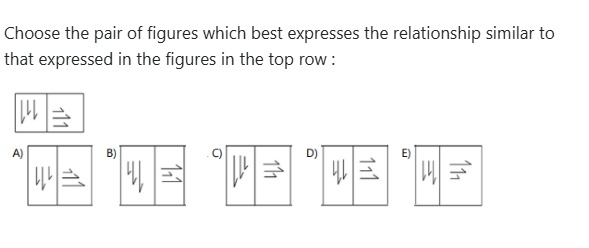
If A : B = 2 : 3 and B : C = 4 : 5, find the ratio A : C.
- A2:5
- B8:15
- C3:5
- D8:12
- E6:15
Show answerHide answer
Answer: B ✓ official key
Approach: Chain two ratios by making the common term (B) equal.
Solution:
A : B = 2 : 3 and B : C = 4 : 5.
Make B equal: LCM of 3 and 4 = 12.
A : B = 8 : 12 and B : C = 12 : 15.
So A : B : C = 8 : 12 : 15 ⇒ A : C = 8 : 15.
Why the other options are wrong:
A (2:5) – simply multiplies the outer terms, ignoring B.
C (3:5) – uses B's term from the second ratio wrongly.
D (8:12) – this is A : B, not A : C.
E (6:15) – multiplies 2 × 3 instead of 2 × 4.
Cetking shortcut: A : C = (2 × 4) : (3 × 5) = 8 : 15 — multiply the 'A-side' numerators and the 'C-side' denominators directly.
Answer: B
The ratio of the present ages of a mother and her daughter is 7:1. Four years ago, the ratio of their ages was 19:1. What will be the mother's age 4 years from now?
- A42 years
- B38 years
- C46 years
- D36 years
- E40 years
Show answerHide answer
Answer: C ✓ official key
Approach: Ages in ratio — form one equation from the past ratio.
Solution:
Present ages: mother = 7x, daughter = x.
4 years ago: (7x − 4)/(x − 4) = 19/1.
7x − 4 = 19x − 76 ⇒ 12x = 72 ⇒ x = 6.
Mother now = 42 years (daughter 6; 4 years ago 38 : 2 = 19 : 1 ✓).
Mother 4 years from now = 42 + 4 = 46 years.
Why the other options are wrong:
A (42) – mother's present age; the question asks 4 years later.
B (38) – mother's age 4 years ago.
D, E (36, 40) – do not satisfy both ratios.
Cetking shortcut: Options test: the present age must be a multiple of 7 and (age − 4) : (age/7 − 4) = 19 : 1; 42 → 38 : 2 = 19 : 1 instantly.
Answer: C
Find the difference between the place value and the face value of the digit 7 in the number 4782.
- A700
- B7
- C693
- D782
- E707
Show answerHide answer
Answer: C ✓ official key
Approach: Place value = digit × its positional value; face value = the digit itself.
Solution:
In 4782, 7 is in the hundreds place.
Place value = 7 × 100 = 700.
Face value = 7.
Difference = 700 − 7 = 693.
Why the other options are wrong:
A (700) – place value only.
B (7) – face value only.
D (782) – the number after the 4, not a place value.
E (707) – adds instead of subtracts.
Cetking shortcut: Difference = digit × (place − 1) = 7 × 99 = 693.
Answer: C
What is the units digit of the product 15 * 22 * 37 * 44?
- A2
- B5
- C0
- D4
- E8
Show answerHide answer
Answer: C ✓ official key
Approach: Units digit of a product depends only on the units digits of the factors.
Solution:
Units digits: 5, 2, 7, 4.
5 × 2 = 10 → units digit 0.
Anything × (number ending in 0) ends in 0.
Units digit of 15 × 22 × 37 × 44 = 0.
Why the other options are wrong:
A, D, E (2, 4, 8) – come from ignoring the 5 × 2 pair.
B (5) – 5 × odd ends in 5, but here 5 meets an even number.
Cetking shortcut: A factor ending in 5 together with any even factor always gives units digit 0.
Answer: C
Six bells commence tolling together and toll at intervals of 2, 4, 6, 8, 10, and 12 seconds, respectively. In 30 minutes, how many times do they toll together?
- A15
- B16
- C30
- D31
- E12
Show answerHide answer
Answer: B ✓ official key
Approach: Bells toll together at multiples of the LCM of their intervals; count the start too.
Solution:
LCM(2, 4, 6, 8, 10, 12) = 2³ × 3 × 5 = 120 s = 2 min.
In 30 min they toll together every 2 min: 30 / 2 = 15 times after the start.
Add the toll at the start (time 0): 15 + 1 = 16.
Why the other options are wrong:
A (15) – forgets the toll at the beginning.
C, D (30, 31) – assume they meet every minute.
E (12) – wrong LCM (150 s).
Cetking shortcut: 'Commence together' = add 1 to (total time ÷ LCM).
Answer: B
Three numbers are in the ratio of 3:4:5, and their least common multiple (LCM) is 2400. Their highest common factor (HCF) is
- A40
- B80
- C120
- D200
- E15
Show answerHide answer
Answer: A ✓ official key
Approach: For numbers in ratio a:b:c with a, b, c co-prime, numbers = ax, bx, cx; HCF = x and LCM = x × LCM(a, b, c).
Solution:
Numbers = 3x, 4x, 5x (3, 4, 5 pairwise co-prime).
LCM = x × LCM(3, 4, 5) = 60x.
60x = 2400 ⇒ x = 40.
HCF = x = 40 (numbers 120, 160, 200).
Why the other options are wrong:
B (80), C (120), D (200) – 120 and 200 are actual numbers, not the HCF; 80 is 2x.
E (15) – no basis.
Cetking shortcut: HCF = LCM ÷ (3 × 4 × 5) = 2400 ÷ 60 = 40.
Answer: A
Solve: 15% of 200 + 20% of 150 =
- A50
- B55
- C60
- D65
- E70
Show answerHide answer
Answer: C ✓ official key
Approach: Direct percentage of a number.
Solution:
15% of 200 = 0.15 × 200 = 30.
20% of 150 = 0.20 × 150 = 30.
Sum = 30 + 30 = 60.
Cetking shortcut: x% of y = y% of x: 15% of 200 = 200% of 15 = 30.
Answer: C
Solve: 0.2 * 0.2 + 0.3 * 0.3 + 2 * 0.2 * 0.3
- A0.025
- B0.25
- C0.5
- D0.05
- E0.6
Show answerHide answer
Answer: B ✓ official key
Approach: Recognise the identity a² + b² + 2ab = (a + b)².
Solution:
a = 0.2, b = 0.3.
0.2 × 0.2 + 0.3 × 0.3 + 2 × 0.2 × 0.3 = (0.2 + 0.3)².
= (0.5)² = 0.25.
Check: 0.04 + 0.09 + 0.12 = 0.25.
Why the other options are wrong:
A (0.025) – decimal placed wrongly.
C (0.5) – forgets to square a + b.
D (0.05), E (0.6) – arithmetic slips.
Cetking shortcut: Spot a² + b² + 2ab at a glance → (a + b)²; no multiplication needed.
Answer: B
What is the smallest number by which 675 should be multiplied to obtain a perfect cube?
- A2
- B3
- C5
- D6
- E9
Show answerHide answer
Answer: C ✓ official key
Approach: Prime-factorise; every prime's power must be a multiple of 3 for a perfect cube.
Solution:
675 = 25 × 27 = 3³ × 5².
3³ is already a cube; 5² needs one more 5.
Multiply by 5: 675 × 5 = 3375 = 15³.
Why the other options are wrong:
A (2), D (6) – introduce a new prime 2.
B (3) – 3⁴ would spoil the cube.
E (9) – makes 3⁵.
Cetking shortcut: Group primes in triples; the missing members form the multiplier.
Answer: C
Which of the following numbers is a perfect square?
- A4410
- B2362
- C7921
- D5688
- E1253
Show answerHide answer
Answer: C ✓ official key
Approach: Perfect squares end in 0, 1, 4, 5, 6, 9 and have a matching square root near √N.
Solution:
2362 (ends in 2), 5688 (ends in 8), 1253 (ends in 3) – squares never end in 2, 3, 8 → rejected.
4410 – ends in a single 0; a square ending in 0 must end in 00 → rejected.
7921: 89² = (90 − 1)² = 8100 − 180 + 1 = 7921 ✓.
Why the other options are wrong:
A (4410) – odd number of trailing zeros.
B, D, E – last digits 2, 8, 3 are impossible for squares.
Cetking shortcut: Last-digit test removes four options in seconds; verify the survivor with (90 − 1)².
Answer: C
Calculate the average of the first 50 natural numbers.
- A25
- B25.5
- C26
- D50.5
- E51
Show answerHide answer
Answer: B ✓ official key
Approach: Average of the first n natural numbers = (n + 1)/2.
Solution:
Sum of 1 to 50 = 50 × 51 / 2 = 1275.
Average = 1275 / 50 = 25.5.
Or directly (50 + 1)/2 = 25.5.
Why the other options are wrong:
A (25) – uses n/2.
C (26) – rounding up.
D (50.5), E (51) – use n + 1 or (n + 1) without halving.
Cetking shortcut: In any AP the average = (first + last)/2 = (1 + 50)/2.
Answer: B
A batsman has a certain average of runs for 11 innings. In the 12th inning, he makes a score of 90 runs, thereby increasing his average by 5. His new average is:
- A30
- B40
- C45
- D50
- E35
Show answerHide answer
Answer: E ✓ official key
Approach: Total runs after 12 innings = 12 × new average; set it equal to old total + 90.
Solution:
Let the old average (11 innings) = x.
New average = x + 5 over 12 innings.
12(x + 5) = 11x + 90 ⇒ 12x + 60 = 11x + 90 ⇒ x = 30.
New average = 30 + 5 = 35.
Why the other options are wrong:
A (30) – the old average.
B, C, D (40, 45, 50) – do not balance the totals.
Cetking shortcut: New average = score − (old innings × increase) = 90 − 11 × 5 = 35.
Answer: E
A number when divided by 5 leaves a remainder of 3. What is the remainder when the square of that number is divided by 5?
- A1
- B2
- C3
- D4
- E0
Show answerHide answer
Answer: D ✓ official key
Approach: Remainders multiply: rem(N²) = rem(r²).
Solution:
N = 5k + 3, so N leaves remainder 3.
N² leaves the same remainder as 3² = 9 when divided by 5.
9 = 5 × 1 + 4 ⇒ remainder 4.
Check: N = 8, N² = 64 = 5 × 12 + 4 ✓.
Why the other options are wrong:
C (3) – assumes the remainder stays the same.
A, B, E – arithmetic slips.
Cetking shortcut: Pick the smallest such number (3): 3² = 9 → remainder 4.
Answer: D
Which of the following fractions is the smallest?
- A7/6
- B7/9
- C4/5
- D5/7
- E9/11
Show answerHide answer
Answer: D ✓ official key
Approach: Compare fractions by decimals or by 'gap from 1'.
Solution:
7/6 = 1.17 (greater than 1).
7/9 = 0.778, 4/5 = 0.800, 5/7 = 0.714, 9/11 = 0.818.
Smallest = 5/7 = 0.714.
Why the other options are wrong:
A (7/6) – more than 1, the largest.
B (7/9 = 0.778), C (4/5 = 0.8), E (9/11 = 0.818) – all above 0.714.
Cetking shortcut: For fractions of the form (n − k)/n, compare the gap k/n: 5/7 is short by 2/7 ≈ 0.29, the biggest gap → smallest fraction.
Answer: D
The ratio of the ages of A and B is 3:4. After 10 years, the ratio of their ages will be 4:5. What is the sum of their present ages?
- A60 years
- B70 years
- C80 years
- D50 years
- E90 years
Show answerHide answer
Answer: B ✓ official key
Approach: Ages in ratio — the future ratio gives one equation.
Solution:
Present ages: A = 3x, B = 4x.
(3x + 10)/(4x + 10) = 4/5.
15x + 50 = 16x + 40 ⇒ x = 10.
Ages 30 and 40 (after 10 years 40 : 50 = 4 : 5 ✓). Sum = 70.
Why the other options are wrong:
A (60), C (80), D (50), E (90) – sum must be 7x and satisfy the future ratio; only 70 does.
Cetking shortcut: Sum must be a multiple of 7 (3x + 4x) → only 70 among options.
Answer: B
The average age of 15 students is 18 years. If the teacher's age is added, the average increases by 1 year. What is the teacher's age?
- A32 years
- B34 years
- C35 years
- D33 years
- E30 years
Show answerHide answer
Answer: B ✓ official key
Approach: Sum = average × count; new person's value = new sum − old sum.
Solution:
Sum of 15 students = 15 × 18 = 270.
With teacher: 16 people, average 19 ⇒ sum = 16 × 19 = 304.
Teacher's age = 304 − 270 = 34 years.
Why the other options are wrong:
E (30), A (32), D (33) – D adds 15 to the old average 18; others are arithmetic slips.
C (35) – uses 16 × 1 added to the new average (16 + 19).
Cetking shortcut: Teacher = new average + (old count × increase) = 19 + 15 × 1 = 34.
Answer: B
The price of sugar is increased by 20%. By how much percent must a household reduce its consumption so as not to increase the expenditure?
- A20.33%
- B16.66%
- C25.50%
- D15.33%
- E10.66%
Show answerHide answer
Answer: B ✓ official key
Approach: Expenditure = price × consumption; keep the product constant.
Solution:
New price = 1.2 × old.
Consumption must become 1/1.2 = 5/6 of old.
Reduction = 1 − 5/6 = 1/6 = 16.66%.
Formula: r/(100 + r) × 100 = 20/120 × 100 = 16.66%.
Why the other options are wrong:
A (20.33%) – assumes the cut equals the rise.
C, D, E – arithmetic slips.
Cetking shortcut: 20% = 1/5 rise ⇒ cut = 1/(5 + 1) = 1/6 = 16.66%.
Answer: B
A man spends 35% of his income on food, 25% on children's education, and 80% of the remaining on house rent. What percent of his income is he left with?
- A8%
- B10%
- C12%
- D15%
- E6%
Show answerHide answer
Answer: A ✓ official key
Approach: Successive spending — apply the 80% to the remaining income only.
Solution:
Food + education = 35% + 25% = 60% ⇒ remaining = 40%.
Rent = 80% of 40% = 32%.
Left = 40% − 32% = 8% of income.
Why the other options are wrong:
E (6%), B (10%), C (12%), D (15%) – come from taking 80% of the whole income or mixing bases.
Cetking shortcut: Left = 40% × 20% = 8%.
Answer: A
By selling 12 oranges for a rupee, a man loses 20%. How many for a rupee should he sell to gain 20%?
- A8
- B10
- C15
- D16
- E9
Show answerHide answer
Answer: A ✓ official key
Approach: Fix the cost of one orange from the loss case, then price it for the gain.
Solution:
SP of 1 orange = Re 1/12 at 20% loss ⇒ CP = (1/12)/0.8 = 5/48.
For 20% gain: SP = 1.2 × 5/48 = 1/8.
So he must sell 8 oranges for a rupee.
Why the other options are wrong:
C (15), D (16) – sell more per rupee, i.e. a bigger loss.
B (10), E (9) – do not reach 20% gain.
Cetking shortcut: Count × (1 + profit%) is constant: 12 × 0.8 = n × 1.2 ⇒ n = 8.
Answer: A
A man bought an article and sold it at a gain of 5%. If he had bought it at 5% less and sold it for Rs. 1 less, he would have made a profit of 10%. The cost price of the article is:
- ARs. 100
- BRs. 150
- CRs. 200
- DRs. 250
- ERs. 300
Show answerHide answer
Answer: C ✓ official key
Approach: Set CP = 100x and compare the two scenarios.
Solution:
Original: CP = 100x, SP = 105x.
New: CP = 95x, SP = 105x − 1, profit 10% ⇒ SP = 1.1 × 95x = 104.5x.
105x − 1 = 104.5x ⇒ 0.5x = 1 ⇒ x = 2.
CP = Rs. 200. Check: 190 → 209 = 10% profit ✓.
Why the other options are wrong:
A, B, D, E – on testing, the two SPs do not differ by Rs. 1.
Cetking shortcut: Difference in the two SPs = 105% − (110% of 95%) = 105% − 104.5% = 0.5% of CP = Rs. 1 ⇒ CP = 200.
Answer: C
A, B, and C enter into a partnership with a capital in which A's contribution is Rs. 10,000. If out of a total profit of Rs. 1000, A gets Rs. 500 and B gets Rs. 300, then C's capital is:
- ARs. 4000
- BRs. 5000
- CRs. 6000
- DRs. 9000
- ERs. 4500
Show answerHide answer
Answer: A ✓ official key
Approach: Same time period ⇒ profit ratio = capital ratio.
Solution:
C's profit = 1000 − 500 − 300 = Rs. 200.
Profit ratio A : B : C = 500 : 300 : 200 = 5 : 3 : 2.
A's 5 parts = Rs. 10,000 ⇒ 1 part = Rs. 2,000.
C's capital = 2 × 2,000 = Rs. 4,000.
Why the other options are wrong:
C (6000) – this is B's capital.
B (5000) – A's half, not C's.
D, E – no basis in the ratio.
Cetking shortcut: C's capital = 10,000 × 200/500 = Rs. 4,000.
Answer: A
A and B started a partnership business investing some amount in the ratio of 3 : 5. C joined them after six months with an amount equal to that of B. In what proportion should the profit at the end of one year be distributed among A, B and C?
- A3 : 5 : 2
- B3 : 5 : 5
- C6 : 10 : 5
- D3 : 7 : 8
- E6 : 10 : 3
Show answerHide answer
Answer: C ✓ official key
Approach: Profit ratio = capital × time.
Solution:
Capitals: A = 3k, B = 5k, C = 5k (equal to B).
Time: A and B 12 months, C 6 months.
A : B : C = 3 × 12 : 5 × 12 : 5 × 6 = 36 : 60 : 30 = 6 : 10 : 5.
Why the other options are wrong:
A (3:5:2), B (3:5:5) – ignore that C invested only for 6 months or scale wrongly.
D (3:7:8), E (6:10:3) – wrong time/amount for C.
Cetking shortcut: Halve C's capital for half the time: 3 : 5 : 2.5 = 6 : 10 : 5.
Answer: C
If 12 carpenters working 6 hours a day can make 460 chairs in 24 days, how many chairs will 18 carpenters make in 36 days working 8 hours a day?
- A1260
- B1320
- C1400
- D1380
- E1200
Show answerHide answer
Answer: D ✓ official key
Approach: Work ∝ men × days × hours: M₁D₁H₁/W₁ = M₂D₂H₂/W₂.
Solution:
Case 1: 12 × 24 × 6 = 1728 man-hours for 460 chairs.
Case 2: 18 × 36 × 8 = 5184 man-hours.
5184/1728 = 3 ⇒ chairs = 460 × 3 = 1380.
Why the other options are wrong:
A (1260), B (1320), C (1400), E (1200) – miss one of the factors (e.g. 18/12 × 36/24 = 2.25 alone).
Cetking shortcut: Multiply the factor changes: (18/12) × (36/24) × (8/6) = 1.5 × 1.5 × 4/3 = 3.
Answer: D
A contractor undertook to do a certain piece of work in 9 days. He employed a certain number of men, but 6 of them were absent from the very first day, and the rest could finish the work in 15 days. The number of men originally employed were:
- A12
- B15
- C18
- D20
- E24
Show answerHide answer
Answer: B ✓ official key
Approach: Total man-days of work stay constant.
Solution:
Let x men be employed: work = 9x man-days.
Actually (x − 6) men took 15 days: work = 15(x − 6).
9x = 15x − 90 ⇒ 6x = 90 ⇒ x = 15.
Why the other options are wrong:
A (12) – with 6 present, 6 × 15 = 90 ≠ 108.
C (18), D (20), E (24) – 9x ≠ 15(x − 6).
Cetking shortcut: Absent men × 15 days = extra days (15 − 9) × x ⇒ 6 × 15 = 6x ⇒ x = 15.
Answer: B
A cistern has a leak which would empty it in 8 hours. A tap is turned on which admits 6 liters a minute into the cistern and it is now emptied in 12 hours. What is the capacity of the cistern?
- A8000 liters
- B8240 liters
- C8640 liters
- D9000 liters
- E9600 liters
Show answerHide answer
Answer: C ✓ official key
Approach: Net rate = leak rate − inlet rate; find the tap's rate as a fraction of the tank.
Solution:
Leak alone empties in 8 h ⇒ −1/8 per hour.
With tap on, it empties in 12 h ⇒ net −1/12 per hour.
Tap rate = 1/8 − 1/12 = 1/24 tank per hour ⇒ tap fills the tank in 24 h.
Tap gives 6 L/min = 360 L/h ⇒ capacity = 24 × 360 = 8640 L.
Why the other options are wrong:
A, B, D, E – result from wrong time (e.g. 20 h or 25 h) or not converting minutes to hours.
Cetking shortcut: Tap time = (8 × 12)/(12 − 8) = 24 h; capacity = 24 × 60 × 6 = 8640.
Answer: C
A tank is filled in 5 hours by three pipes A, B, and C. The pipe C is twice as fast as B, and B is twice as fast as A. How much time will pipe A alone take to fill the tank?
- A20 hours
- B25 hours
- C30 hours
- D35 hours
- E40 hours
Show answerHide answer
Answer: D ✓ official key
Approach: Use efficiencies: total work = combined efficiency × time.
Solution:
Let A = 1 unit/h ⇒ B = 2, C = 4 (C twice B, B twice A).
Combined = 7 units/h; tank filled in 5 h ⇒ capacity = 35 units.
A alone = 35/1 = 35 hours.
Why the other options are wrong:
A (20), B (25), C (30), E (40) – wrong efficiency ratios (e.g. 1 : 2 : 3).
Cetking shortcut: A alone time = 5 × (1 + 2 + 4)/1 = 35 h.
Answer: D
A, B, and C can do a piece of work in 20, 30, and 60 days respectively. In how many days can A do the work if he is assisted by B and C on every third day?
- A10 days
- B12 days
- C15 days
- D16 days
- E18 days
Show answerHide answer
Answer: C ✓ official key
Approach: Work in 3-day cycles using LCM units.
Solution:
Total work = LCM(20, 30, 60) = 60 units. Efficiencies: A = 3, B = 2, C = 1 per day.
Days 1 and 2: A alone = 3 + 3 = 6 units.
Day 3: A + B + C = 3 + 2 + 1 = 6 units.
One 3-day cycle = 12 units ⇒ 60/12 = 5 cycles = 15 days (finishes exactly at the end of a cycle).
Why the other options are wrong:
A (10), B (12) – assume help every day or every second day.
D (16), E (18) – add extra days after the work is already done.
Cetking shortcut: Cycle work = 1/5 of the job ⇒ 5 cycles × 3 days = 15.
Answer: C
If 6 men and 8 boys can do a piece of work in 10 days while 26 men and 48 boys can do the same in 2 days, the time taken by 15 men and 20 boys in doing the same type of work will be:
- A4
- B5
- C6
- D7
- E8
Show answerHide answer
Answer: A ✓ official key
Approach: Equate total work from both groups to find the man : boy efficiency.
Solution:
10(6M + 8B) = 2(26M + 48B) ⇒ 60M + 80B = 52M + 96B ⇒ 8M = 16B ⇒ 1M = 2B.
Work = 10 × (6 × 2 + 8)B = 10 × 20B = 200 boy-days.
15 men + 20 boys = 30B + 20B = 50B.
Time = 200/50 = 4 days.
Why the other options are wrong:
B (5) – uses 1M = 1.5B or similar slip.
C, D, E – wrong efficiency relation.
Cetking shortcut: Convert everyone into boys (1M = 2B) and divide total boy-days by the new strength.
Answer: A
A train 108 m long moving at a speed of 50 km/hr crosses a train 112 m long coming from the opposite direction in 6 seconds. The speed of the second train is:
- A48 km/hr
- B54 km/hr
- C66 km/hr
- D82 km/hr
- E90 km/hr
Show answerHide answer
Answer: D ✓ official key
Approach: Opposite directions ⇒ relative speed = sum; distance = sum of lengths.
Solution:
Distance = 108 + 112 = 220 m; time = 6 s.
Relative speed = 220/6 = 110/3 m/s = 110/3 × 18/5 = 132 km/h.
Speed of second train = 132 − 50 = 82 km/h.
Why the other options are wrong:
A (48), B (54), C (66) – use relative speed as a difference or forget the conversion.
E (90) – arithmetic slip.
Cetking shortcut: 220 m in 6 s ⇒ 220 × 3.6/6 = 132 km/h; subtract 50.
Answer: D
A train overtakes two persons who are walking in the same direction in which the train is going, at the rate of 2 km/hr and 4 km/hr and passes them completely in 9 and 10 seconds respectively. The length of the train is:
- A45 m
- B50 m
- C54 m
- D72 m
- E60 m
Show answerHide answer
Answer: B ✓ official key
Approach: Same direction ⇒ relative speed = difference; train length is the same in both cases.
Solution:
Let train speed = v km/h. Relative speeds: (v − 2) and (v − 4) km/h.
L = (v − 2) × 5/18 × 9 = (v − 4) × 5/18 × 10.
9v − 18 = 10v − 40 ⇒ v = 22 km/h.
L = 20 × 5/18 × 9 = 50 m (check: 18 × 5/18 × 10 = 50 m ✓).
Why the other options are wrong:
A (45), C (54), D (72), E (60) – do not give the same length from both persons.
Cetking shortcut: Test options: 50 m in 9 s = 20 km/h relative and in 10 s = 18 km/h relative — the 2 km/h gap matches the walkers' 4 − 2.
Answer: B
A merchant has 1000 kg of sugar, part of which he sells at 8% profit and the rest at 18% profit. He gains 14% on the whole. The quantity sold at 18% profit is:
- A400 kg
- B500 kg
- C600 kg
- D640 kg
- E700 kg
Show answerHide answer
Answer: C ✓ official key
Approach: Alligation on profit percentages.
Solution:
Profits: 8% and 18%; mean 14%.
Quantity at 8% : quantity at 18% = (18 − 14) : (14 − 8) = 4 : 6 = 2 : 3.
Quantity at 18% = 3/5 × 1000 = 600 kg.
Why the other options are wrong:
A (400 kg) – this is the part sold at 8%.
B (500 kg) – would give an average of 13%.
D, E – average would exceed 14%.
Cetking shortcut: 14% is closer to 18% than to 8% ⇒ more than half (600) is at 18%.
Answer: C
A vessel is filled with liquid, 3 parts of which are water and 5 parts syrup. How much of the mixture must be drawn off and replaced with water so that the mixture may be half water and half syrup?
- A1/3
- B1/4
- C2/7
- D1/7
- E1/5
Show answerHide answer
Answer: E ✓ official key
Approach: Replacement: only syrup is removed-and-not-replaced; track the syrup fraction.
Solution:
Syrup = 5/8 of the vessel. Draw off fraction f and replace with water.
Syrup left = 5/8 × (1 − f). Need it = 1/2.
1 − f = (1/2)/(5/8) = 4/5 ⇒ f = 1/5.
Why the other options are wrong:
A (1/3), B (1/4), C (2/7), D (1/7) – leave syrup at 5/12, 15/32, 25/56, 15/28 of the vessel, not 1/2.
Cetking shortcut: Fraction to replace = 1 − (target syrup / present syrup) = 1 − (4/8 ÷ 5/8) = 1/5.
Answer: E
A sum of money at simple interest doubles itself in 8 years. What is the rate of interest per annum?
- A10.50%
- B12%
- C12.50%
- D15%
- E20%
Show answerHide answer
Answer: C ✓ official key
Approach: Simple interest: I = PRT/100.
Solution:
Doubles ⇒ interest = principal ⇒ I = P.
P = P × R × 8/100 ⇒ R = 100/8 = 12.5%.
Why the other options are wrong:
A, B, D, E – give interest ≠ P in 8 years (e.g. 12% → 96%).
Cetking shortcut: SI doubling: R × T = 100 ⇒ R = 100/8.
Answer: C
What will be the compound interest on Rs. 1000 at 10% per annum for 1 year, when the interest is compounded half-yearly?
- ARs. 100
- BRs. 110
- CRs. 105
- DRs. 102.50
- ERs. 112.50
Show answerHide answer
Answer: D ✓ official key
Approach: Half-yearly compounding: halve the rate, double the periods.
Solution:
Rate per half-year = 5%; periods = 2.
Amount = 1000 × 1.05² = 1000 × 1.1025 = 1102.50.
CI = 1102.50 − 1000 = Rs. 102.50.
Why the other options are wrong:
A (100) – simple interest / annual compounding.
B, C, E – arithmetic slips.
Cetking shortcut: CI for 2 periods at r% = 2r + r²/100 = 10 + 0.25 = 10.25% of 1000.
Answer: D
The diagonals of a rhombus are 24 cm and 10 cm. The perimeter of the rhombus is:
- A52 cm
- B56 cm
- C68 cm
- D72 cm
- E60 cm
Show answerHide answer
Answer: A ✓ official key
Approach: Diagonals of a rhombus bisect each other at right angles.
Solution:
Half-diagonals = 12 cm and 5 cm.
Side = √(12² + 5²) = √169 = 13 cm.
Perimeter = 4 × 13 = 52 cm.
Why the other options are wrong:
B, C, D, E – use full diagonals or add them instead of using Pythagoras.
Cetking shortcut: 5–12–13 triplet: half-diagonals 5 and 12 ⇒ side 13.
Answer: A
Three solid cubes of sides 3 cm, 4 cm, and 5 cm are melted to form a new solid cube. The side of the new cube is:
- A6 cm
- B8 cm
- C9 cm
- D12 cm
- E7 cm
Show answerHide answer
Answer: A ✓ official key
Approach: Melting conserves volume.
Solution:
Total volume = 3³ + 4³ + 5³ = 27 + 64 + 125 = 216 cm³.
New side = ∛216 = 6 cm.
Why the other options are wrong:
B, C, D, E – add sides (12) or cube-roots incorrectly.
Cetking shortcut: Remember 3³ + 4³ + 5³ = 6³.
Answer: A
In a 500 m race, the ratio of the speeds of two contestants A and B is 3 : 4. A has a start of 140 m. Then, A wins by:
- A10 m
- B20 m
- C30 m
- D40 m
- E60 m
Show answerHide answer
Answer: B ✓ official key
Approach: Races with a head start — compare the times to finish.
Solution:
A runs 500 − 140 = 360 m at speed 3 ⇒ time = 120 units.
In 120 units B runs 4 × 120 = 480 m.
When A finishes, B is 500 − 480 = 20 m short ⇒ A wins by 20 m.
Why the other options are wrong:
A (10), C (30), D (40), E (60) – wrong time base (e.g. using 500 m for A).
Cetking shortcut: Distance ratio = speed ratio: B covers 360 × 4/3 = 480 m while A covers 360 m.
Answer: B
Three runners A, B and C run a race, with runner A finishing 12 meters ahead of runner B and 18 meters ahead of runner C, while runner B finishes 8 meters ahead of runner C. Each runner travels the entire distance at a constant speed. What was the length of the race?
- A36 m
- B24 m
- C60 m
- D72 m
- E48 m
Show answerHide answer
Answer: E ✓ official key
Approach: Constant speeds ⇒ speed ratios chain: (A/B) × (B/C) = (A/C).
Solution:
Let the race length = L. When A finishes, B has run L − 12 and C has run L − 18.
When B finishes, C has run L − 8 ⇒ C/B = (L − 8)/L.
Also C/B = (L − 18)/(L − 12).
(L − 8)/L = (L − 18)/(L − 12) ⇒ L² − 20L + 96 = L² − 18L ⇒ 2L = 96 ⇒ L = 48 m.
Check: A : B : C = 48 : 36 : 30; B/C = 36/30 = 48/40 ✓.
Why the other options are wrong:
A (36), B (24), C (60), D (72) – fail the chained ratio check.
Cetking shortcut: B beats C by 6 m over the last L − 12 m and by 8 m over L m: 6/(L − 12) = 8/L ⇒ L = 48.
Answer: E
In a single throw of two dice, find the probability of getting a sum of 7 or 11.
- A1/6
- B1/9
- C7/36
- D5/36
- E2/9
Show answerHide answer
Answer: E ✓ official key
Approach: Classical probability with two dice: 36 outcomes.
Solution:
Sum 7: (1,6), (2,5), (3,4), (4,3), (5,2), (6,1) = 6 ways.
Sum 11: (5,6), (6,5) = 2 ways.
Mutually exclusive ⇒ favourable = 8; P = 8/36 = 2/9.
Why the other options are wrong:
A (1/6) – sum 7 only.
B (1/9) – 4/36, undercounts.
C (7/36), D (5/36) – miscounted pairs.
Cetking shortcut: Remember: P(sum 7) = 6/36 and P(sum 11) = 2/36.
Answer: E
How many 3-digit numbers can be formed from the digits 2, 3, 5, 6, 7 and 9, which are divisible by 5 and none of the digits is repeated?
- A5
- B10
- C15
- D20
- E25
Show answerHide answer
Answer: D ✓ official key
Approach: Divisible by 5 ⇒ units digit is 0 or 5; only 5 is available.
Solution:
Units digit fixed = 5 (1 way).
Hundreds digit: any of the remaining 5 digits.
Tens digit: any of the remaining 4 digits.
Total = 5 × 4 × 1 = 20.
Why the other options are wrong:
A (5) – fills only one free place.
C (15), E (25) – allow repetition or wrong count.
B (10) – uses combinations (5C2).
Cetking shortcut: Fix the restricted place first, then fill the rest: 5P2 = 20.
Answer: D
Questions 141–145 share this
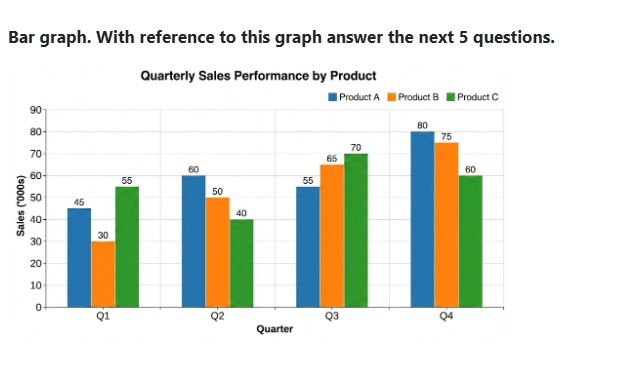
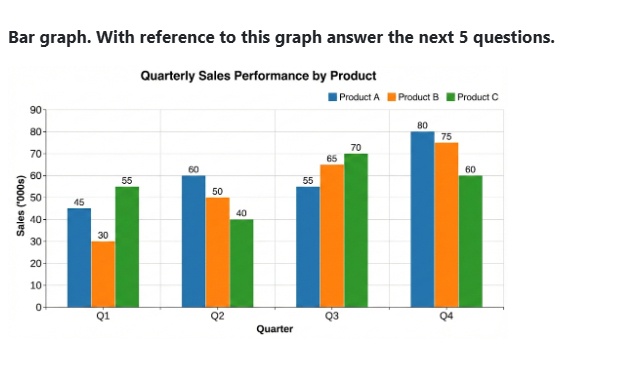
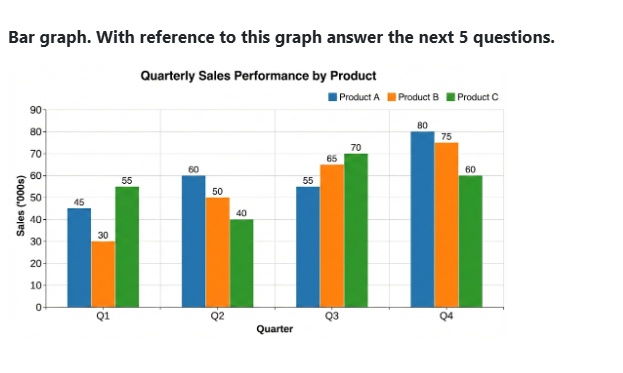
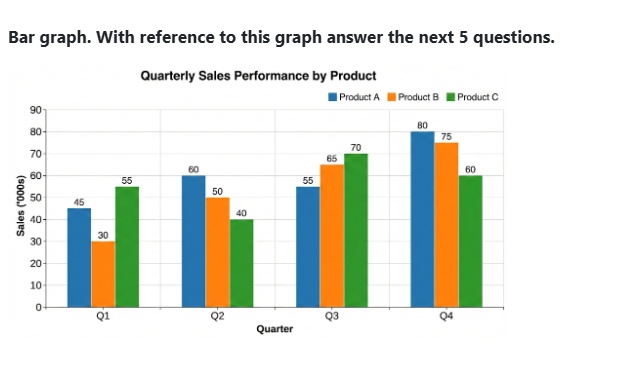
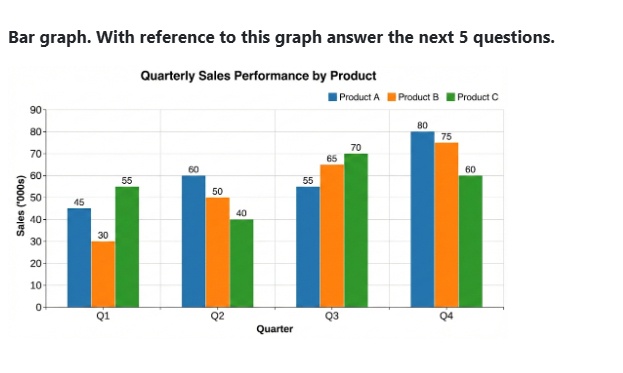
Bar graph. With reference to this graph answer the next 5 questions.
Quarterly Sales Performance by Product (Sales ('000s))
Data read from chart:
| Quarter | Product A | Product B | Product C |
|---|
| Q1 | 45 | 30 | 55 |
| Q2 | 60 | 50 | 40 |
| Q3 | 55 | 65 | 70 |
| Q4 | 80 | 75 | 60 |
What is the average sales of Product B across all four quarters?
- A50
- B55
- C60
- D65
- E52.5
Show answerHide answer
Answer: B ✓ official key
Approach: Average = sum of the four quarterly values ÷ 4.
Solution:
Product B: Q1 = 30, Q2 = 50, Q3 = 65, Q4 = 75 (in '000s).
Sum = 30 + 50 + 65 + 75 = 220.
Average = 220/4 = 55.
Why the other options are wrong:
A (50) – Q2 value only.
C (60), D (65) – read another product or a single quarter.
E (52.5) – arithmetic slip.
Cetking shortcut: Pair the ends: (30 + 75) + (50 + 65) = 105 + 115 = 220.
Answer: B
Refer to the passage above ↑
Which quarter witnessed the highest total sales for all three products combined?
- AQ1
- BQ2
- CQ3
- DQ4
- EQ3 and Q4 have equal sales
Show answerHide answer
Answer: D ✓ official key
Approach: Add the three bars of each quarter and compare.
Solution:
Q1 = 45 + 30 + 55 = 130.
Q2 = 60 + 50 + 40 = 150.
Q3 = 55 + 65 + 70 = 190.
Q4 = 80 + 75 + 60 = 215 → highest.
Why the other options are wrong:
A, B – clearly lower totals.
C (Q3) – 190 < 215.
E – Q3 and Q4 are not equal (190 vs 215).
Cetking shortcut: Q4 has the two tallest bars (80, 75) and its third bar (60) is only 10 below Q3's 70 — Q4 wins by inspection.
Answer: D
Refer to the passage above ↑
What is the percentage increase in sales of Product A from Q1 to Q4?
- A75%
- B80%
- C77.78%
- D43.75%
- E56.25%
Show answerHide answer
Answer: C ✓ official key
Approach: Percentage increase = (new − old)/old × 100.
Solution:
Product A: Q1 = 45, Q4 = 80.
Increase = 80 − 45 = 35.
% increase = 35/45 × 100 = 7/9 × 100 = 77.78%.
Why the other options are wrong:
D (43.75%) – divides by the new value 80 (35/80).
A (75%), B (80%) – rounding or wrong base.
E (56.25%) – wrong values.
Cetking shortcut: 35/45 = 7/9 = 77.78% (memorise ninths: 1/9 = 11.11%).
Answer: C
Refer to the passage above ↑
What is the ratio of the total sales of Product C to the total sales of Product A?
- A4:11
- B15:16
- C16:15
- D7:11
- E8:15
Show answerHide answer
Answer: B ✓ official key
Approach: Find each product's annual total, then simplify the ratio.
Solution:
Product C total = 55 + 40 + 70 + 60 = 225.
Product A total = 45 + 60 + 55 + 80 = 240.
C : A = 225 : 240 = 15 : 16 (divide by 15).
Why the other options are wrong:
C (16:15) – ratio reversed (A : C).
A, D, E – not supported by the totals.
Cetking shortcut: Both totals are multiples of 15: 225 = 15 × 15, 240 = 15 × 16.
Answer: B
Refer to the passage above ↑
In which quarter did Product B have the lowest share of the total sales?
- AQ1
- BQ2
- CQ3
- DQ4
- EQ1 and Q2
Show answerHide answer
Answer: A ✓ official key
Approach: Share = Product B ÷ quarter total; compare fractions.
Solution:
Q1: 30/130 = 23.1%.
Q2: 50/150 = 33.3%.
Q3: 65/190 = 34.2%.
Q4: 75/215 = 34.9%.
Lowest share = Q1.
Why the other options are wrong:
B, C, D – each above 33%.
E – Q1 and Q2 shares differ (23.1% vs 33.3%).
Cetking shortcut: In Q1, B (30) is less than a quarter of 130; in every other quarter B is about one-third of the total.
Answer: A
Questions 146–150 share this
Answer the next 5 questions based on the pie chart shown here.
Directions: Answer the questions based on the pie chart provided, which depicts the budget allocation of a startup company for the financial year 2024.
Data read from chart:
| Category | Share of budget |
|---|
| Salaries | 35% |
| Marketing | 25% |
| R&D | 15% |
| Infrastructure | 15% |
| Miscellaneous | 10% |
If the total budget of the company is Rs. 20 Crores, what is the difference between the amount spent on 'Salaries' and 'Infrastructure'?
- ARs. 3 Crores
- BRs. 4 Crores
- CRs. 5 Crores
- DRs. 2.5 Crores
- ERs. 3.5 Crores
Show answerHide answer
Answer: B ✓ official key
Approach: Convert the percentage difference into an amount.
Solution:
Salaries = 35%, Infrastructure = 15%.
Difference = 20% of the budget.
20% of Rs. 20 crore = Rs. 4 crore.
Why the other options are wrong:
A (3 Cr) – uses 15% difference.
C (5 Cr) – uses Marketing 25%.
D, E – arithmetic slips.
Cetking shortcut: Subtract percentages first, then convert once: 20% × 20 = 4.
Answer: B
Refer to the passage above ↑
The expenditure on 'R&D' is what percent less than the expenditure on 'Marketing'?
- A10%
- B40%
- C60%
- D25%
- E33.33%
Show answerHide answer
Answer: B ✓ official key
Approach: 'Percent less than' uses the compared-to value (Marketing) as base.
Solution:
Marketing = 25%, R&D = 15%.
Difference = 10.
% less = 10/25 × 100 = 40%.
Why the other options are wrong:
A (10%) – the percentage-point difference, not percent.
E (33.33%) – uses a wrong base (10/30).
C (60%) – R&D as % of Marketing.
D (25%) – Marketing's share.
Cetking shortcut: R&D/Marketing = 15/25 = 60% ⇒ 40% less.
Answer: B
Refer to the passage above ↑
What is the central angle corresponding to the sector for 'Salaries'?
- A108 degrees
- B120 degrees
- C135 degrees
- D126 degrees
- E144 degrees
Show answerHide answer
Answer: D ✓ official key
Approach: Central angle = share % × 360°.
Solution:
Salaries = 35%.
Angle = 0.35 × 360° = 126°.
Why the other options are wrong:
A (108°) – 30%.
B (120°) – one-third.
C (135°) – 37.5%.
E (144°) – 40%.
Cetking shortcut: 1% = 3.6° ⇒ 35 × 3.6 = 126°.
Answer: D
Refer to the passage above ↑
If the company decides to cut the 'Miscellaneous' budget by half and add that amount to 'R&D', what will be the new percentage share of 'R&D'?
- A18%
- B25%
- C20%
- D22.5%
- E17.5%
Show answerHide answer
Answer: C ✓ official key
Approach: Budget total is unchanged — just move share from one sector to another.
Solution:
Miscellaneous = 10%; half of it = 5%.
This 5% is moved to R&D: 15% + 5% = 20%.
Total stays 100%, so the new R&D share = 20%.
Why the other options are wrong:
E (17.5%) – adds half of half.
A (18%), D (22.5%) – wrong amount moved.
B (25%) – adds the whole 10%.
Cetking shortcut: Transfers inside the same total don't change the base, so add percentages directly.
Answer: C
Refer to the passage above ↑
What is the ratio of expenditure on 'Marketing' and 'Miscellaneous' together to the expenditure on 'Salaries'?
- A3:5
- B1:1
- C5:7
- D4:5
- E7:5
Show answerHide answer
Answer: B ✓ official key
Approach: Add the two shares and compare with Salaries.
Solution:
Marketing + Miscellaneous = 25% + 10% = 35%.
Salaries = 35%.
Ratio = 35 : 35 = 1 : 1.
Why the other options are wrong:
C (5:7) – Marketing alone to Salaries.
E (7:5) – Salaries to Marketing.
A, D – not supported by the data.
Cetking shortcut: Ratios of amounts = ratios of percentages; no need for the total budget.
Answer: B
Choose the option that correctly completes the given series.
2, 6, 14, 30, 62, ?
- A124
- B126
- C128
- D129
- E136
Show answerHide answer
Answer: B ✓ official key
Approach: Multiplicative series: next term = previous × 2 + 2.
Solution:
2 × 2 + 2 = 6
6 × 2 + 2 = 14
14 × 2 + 2 = 30
30 × 2 + 2 = 62
62 × 2 + 2 = 126
Cetking shortcut: Differences 4, 8, 16, 32 double each time, so the next difference is 64: 62 + 64 = 126. Also every term = 2n+1 − 2.
Answer: B
Choose the option that correctly completes the series:
5, 14, 41, 122, ?
- A245
- B365
- C371
- D374
- E380
Show answerHide answer
Answer: B ✓ official key
Approach: Multiplicative series: next term = previous × 3 − 1.
Solution:
5 × 3 − 1 = 14
14 × 3 − 1 = 41
41 × 3 − 1 = 122
122 × 3 − 1 = 365
Cetking shortcut: Differences 9, 27, 81 are powers of 3, so the next difference is 243: 122 + 243 = 365.
Answer: B
Choose the option that correctly completes the given series
7, 20, 47, 94, 167, ?
- A272
- B274
- C276
- D278
- E280
Show answerHide answer
Answer: A ✓ official key
Approach: Difference table — second differences in AP.
Solution:
Terms: 7, 20, 47, 94, 167
1st differences: 13, 27, 47, 73
2nd differences: 14, 20, 26 (rising by 6)
Next 2nd difference = 26 + 6 = 32
Next 1st difference = 73 + 32 = 105
Next term = 167 + 105 = 272
Answer: A
Choose the option that correctly completes the series:
4, 18, 48, 100, ?, 294
- A126
- B168
- C180
- D192
- E200
Show answerHide answer
Answer: C ✓ official key
Approach: Power-based series: term = n³ − n² = n²(n − 1), n = 2, 3, 4…
Solution:
2³ − 2² = 4
3³ − 3² = 18
4³ − 4² = 48
5³ − 5² = 100
6³ − 6² = 216 − 36 = 180
Check: 7³ − 7² = 343 − 49 = 294 ✓
Cetking shortcut: Factor each term: 4 = 2²×1, 18 = 3²×2, 48 = 4²×3, 100 = 5²×4 → 6²×5 = 180.
Answer: C
Choose the option that correctly completes the given series.
6, 24, 60, 120, 210, ?
- A336
- B330
- C360
- D390
- E420
Show answerHide answer
Answer: A ✓ official key
Approach: Power-based series: term = n³ − n = (n − 1) × n × (n + 1).
Solution:
6 = 1×2×3, 24 = 2×3×4, 60 = 3×4×5
120 = 4×5×6, 210 = 5×6×7
Next = 6×7×8 = 336
Cetking shortcut: Second differences 18, 24, 30 rise by 6 → next 36; differences 18, 36, 60, 90 → next 126; 210 + 126 = 336.
Answer: A
In question, a pair of words has a specific relationship. Select the option that best represents a similar relationship.
Prologue : Novel :: Preamble : ?
- ASpeech
- BLaw
- CPoem
- DDrama
- EAction
Show answerHide answer
Answer: B ✓ official key
Approach: Part-to-whole analogy: the formal opening section of a text.
Solution:
A prologue is the introductory section of a novel/play.
A preamble is the introductory statement of a law, statute or constitution (e.g. the Preamble to the Constitution).
Why the other options are wrong:
A Speech – has an opening, not formally a preamble.
C Poem – an introduction to a poem is a proem/prelude.
D Drama – the introduction to a drama is itself a prologue.
E Action – not a text at all.
Answer: B
In question, a pair of words has a specific relationship. Select the option that best represents a similar relationship.
Obstinate : Yielding :: Optimistic : ?
- ACheerful
- BHopeful
- CPessimistic
- DConfident
- EPositive
Show answerHide answer
Answer: C ✓ official key
Approach: Antonym analogy.
Solution:
Obstinate (stubborn, unyielding) ↔ Yielding — opposites.
Optimistic (expecting the best) ↔ Pessimistic — opposites.
Why the other options are wrong:
A Cheerful, B Hopeful, D Confident, E Positive – all synonyms or near-synonyms of optimistic.
Answer: C
In question, a pair of words has a specific relationship. Select the option that best represents a similar relationship.
Cartography : Map :: Lexicography : ?
- ABook
- BLanguage
- CDictionary
- DGrammar
- EAlphabet
Show answerHide answer
Answer: C ✓ official key
Approach: Field of work : its product.
Solution:
Cartography → makes maps.
Lexicography → compiles dictionaries.
Why the other options are wrong:
A Book – too general.
B Language – subject of linguistics.
D Grammar – studied by grammarians.
E Alphabet – not the output of lexicography.
Answer: C
In question, a pair of words has a specific relationship. Select the option that best represents a similar relationship.
Panacea : Universal :: Antidote : ?
- ARare
- BSpecific
- CCurative
- DMedicinal
- EPreventive
Show answerHide answer
Answer: B ✓ official key
Approach: Object : defining scope.
Solution:
Panacea = a remedy for all ills → its defining quality is universal.
Antidote = a remedy against a particular poison → its defining quality is specific.
Why the other options are wrong:
A Rare – not a defining feature.
C Curative / D Medicinal – true of both, so not the parallel quality.
E Preventive – an antidote counteracts after exposure; it does not prevent.
Answer: B
In question, a pair of words has a specific relationship. Select the option that best represents a similar relationship.
Opaque : Transparent :: Cryptic : ?
- AObvious
- BHidden
- CConfusing
- DSecret
- EVague
Show answerHide answer
Answer: A ✓ official key
Approach: Antonym analogy.
Solution:
Opaque (cannot be seen through) ↔ Transparent.
Cryptic (mysterious, hard to understand) ↔ Obvious.
Why the other options are wrong:
B Hidden, C Confusing, D Secret, E Vague – all synonyms of cryptic.
Answer: A
Which word does not belong to the group?
A. Cello
B. Violin
C. Guitar
D. Harp
E. Flute
- ACello
- BViolin
- CGuitar
- DHarp
- EFlute
Show answerHide answer
Answer: E ✓ official key
Approach: Classification by category (instrument family).
Solution:
Cello, Violin, Guitar, Harp – all string instruments (sound from vibrating strings).
Flute – a wind instrument (sound from vibrating air column).
Why the other options are wrong:
A–D are all string instruments, so none of them is the odd one.
Answer: E
Find the odd one out.
A. 121
B. 169
C. 289
D. 361
E. 441
- A121
- B169
- C289
- D361
- E441
Show answerHide answer
Answer: E ✓ official key
Approach: Number classification: square of a prime vs square of a composite.
Solution:
121 = 11², 169 = 13², 289 = 17², 361 = 19² → squares of primes.
441 = 21² and 21 = 3 × 7 is composite.
Cetking shortcut: Know squares 11²–25² by heart; check the bases for primality.
Answer: E
A coding scheme substitutes each digit with a symbol as shown below:
| Digit | Code |
|---|
| 1 | @ |
| 2 | # |
| 3 | $ |
| 4 | % |
| 5 | & |
| 6 | * |
| 7 | ! |
| 8 | ^ |
| 9 | ? |
| 0 | + |
Each digit is coded individually using the above scheme.
After coding, the entire coded sequence is written in reverse order.
What will be the code for 9036412?
- A# @ % * $ + ?
- B? + $ * % @ #
- C# @ % * $ ? +
- D# @ % $ * + ?
- E# @ % * + $ ?
Show answerHide answer
Official CET key: A · Cetking's answer: E — see why below
Approach: Digit-to-symbol substitution followed by reversal.
Solution:
Number: 9 0 3 6 4 1 2
Code each digit: 9 → ?, 0 → +, 3 → $, 6 → *, 4 → %, 1 → @, 2 → #
Coded string: ? + $ * % @ #
Reverse it: # @ % * $ + ?
Why the other options are wrong:
B – the coded string without reversing.
C – last two symbols swapped (? +).
D – $ and * swapped.
E – + and $ swapped.
Cetking shortcut: Reversing the code = coding the number read backwards: 2146309 → # @ % * $ + ?.
Answer: A
Which is different from the rest?
A. 6
B. 28
C. 496
D. 8128
E. 1024
- A6
- B28
- C496
- D8128
- E1024
Show answerHide answer
Answer: E ✓ official key
Approach: Number classification: perfect numbers.
Solution:
6 = 1 + 2 + 3; 28 = 1 + 2 + 4 + 7 + 14 → perfect.
496 and 8128 are the next two perfect numbers.
1024 = 2¹⁰; its proper divisors add up to 1023 ≠ 1024 → not perfect.
Cetking shortcut: Even perfect numbers have the form 2p−1(2p − 1): 6, 28, 496, 8128 — memorise them.
Answer: E
Find the odd one out.
A. 135
B. 357
C. 579
D. 579
E. 791
- A135
- B357
- C579
- D579
- E791
Show answerHide answer
Answer: E ✓ official key
Approach: Digit pattern within each number.
Solution:
135 → 1, 3, 5 (+2, +2); 357 → 3, 5, 7; 579 → 5, 7, 9.
791 → 7, 9, 1: after 9 the next should be 11, so the pattern breaks.
Second check: digit sums 9, 15, 21 are multiples of 3; 7 + 9 + 1 = 17 is not.
Why the other options are wrong:
A, B, C, D – all follow the +2 digit step and are divisible by 3.
Answer: E
If “MOON” is coded as “LNLM” and “SUN” is coded as “RVM” then using the same pattern, “STAR” can be coded as:
- ARSBQ
- BRSUQ
- CRUSB
- DRTAQ
- ERSBP
Show answerHide answer
Answer: A ✓ official key
Approach: Letter-shift code: each consonant moves one letter back, each vowel moves one letter forward (as in SUN → RVM).
Solution:
SUN → RVM: S − 1 = R, U + 1 = V, N − 1 = M.
STAR: S − 1 = R, T − 1 = S, A + 1 = B, R − 1 = Q.
Code = R S B Q.
Why the other options are wrong:
B RSUQ – A is shifted to U instead of B.
C RUSB – T becomes U and the letters are out of order.
D RTAQ – T and A are left unchanged.
E RSBP – R becomes P (−2) instead of Q.
Cetking shortcut: First letter must be R and last must be Q; A and B both fit, but the vowel A must go forward to B, so A is the answer.
Answer: A
If “PENCIL” is coded as “QFODJM”, how is “MARKER” coded using the same pattern?
- ANBSLSF
- BNBSLFS
- CNBSLTF
- DNBTLSF
- ENBQLSF
Show answerHide answer
Answer: B ✓ official key
Approach: Uniform +1 letter shift.
Solution:
PENCIL → QFODJM: every letter +1.
MARKER: M→N, A→B, R→S, K→L, E→F, R→S → NBSLFS.
Why the other options are wrong:
A NBSLSF – E and R codes swapped.
C NBSLTF – R coded as T.
D NBTLSF – R coded as T.
E NBQLSF – R coded as Q.
Answer: B
If ENGINE is coded as GLIGPC, how is MOTOR coded using same pattern?
- AOMVMT
- BOVMAT
- COVMVT
- DOAVMT
- EVMAOT
Show answerHide answer
Answer: A ✓ official key
Approach: Alternating letter shift (+2, −2, +2, …).
Solution:
ENGINE → GLIGPC: E+2=G, N−2=L, G+2=I, I−2=G, N+2=P, E−2=C.
MOTOR: M+2=O, O−2=M, T+2=V, O−2=M, R+2=T → OMVMT.
Why the other options are wrong:
B OVMAT, C OVMVT, D OAVMT – second letter must be O − 2 = M.
E VMAOT – first letter must be M + 2 = O.
Cetking shortcut: Check just the first two letters (O, M): only option A starts OM.
Answer: A
In a certain language, if CHAIR = 49 and TABLE = 50 then BENCH = ?
- A46
- B45
- C44
- D43
- E42
Show answerHide answer
Answer: E ✓ official key
Approach: Numeric code from the sum of letter positions.
Solution:
CHAIR = 3 + 8 + 1 + 9 + 18 = 39 → 39 + 10 = 49 ✓
TABLE = 20 + 1 + 2 + 12 + 5 = 40 → 40 + 10 = 50 ✓
BENCH = 2 + 5 + 14 + 3 + 8 = 32 → 32 + 10 = 42
Cetking shortcut: Both examples are 'sum + 10'; one check is enough to confirm the constant.
Answer: E
In a certain language, if MILK = 47, then TEA = ?
- A24
- B29
- C28
- D30
- E32
Show answerHide answer
Answer: C ✓ official key
Approach: Numeric code from the sum of letter positions.
Solution:
MILK = 13 + 9 + 12 + 11 = 45 → 45 + 2 = 47 ✓
TEA = 20 + 5 + 1 = 26 → 26 + 2 = 28
Answer: C
P is the father of Q. R is the sister of P.
How is R related to Q?
- AAunt
- BMother
- CBrother
- DCousin
- ESister
Show answerHide answer
Answer: A ✓ official key
Approach: Two-generation relation.
Solution:
P is Q's father.
R is P's sister → R is the sister of Q's father.
Father's sister = aunt.
Answer: A
Pointing to a woman, Aarav said,“She is the mother of the only son of my father’s sister.”
How is the woman related to Aarav?
- ASister
- BMother
- CCousin
- DAunt
- ENiece
Show answerHide answer
Answer: D ✓ official key
Approach: Pointing-type relation — decode right to left.
Solution:
My father's sister = Aarav's aunt.
Her only son = Aarav's cousin.
Mother of that son = the father's sister herself → aunt.
Why the other options are wrong:
C Cousin – that is the son, not the woman.
A, B, E – no link to sister, mother or niece.
Answer: D
Pointing to a woman, Rahul said, “She is the mother of my father’s only daughter.” How is she related to Rahul?
- AMother
- BSister
- CAunt
- DGrandmother
- EMother-in-law
Show answerHide answer
Answer: A ✓ official key
Approach: Pointing-type relation.
Solution:
Rahul is male, so his father's only daughter is Rahul's sister.
The mother of Rahul's sister = Rahul's mother.
Answer: A
A is the brother of B.
C is the father of A.
D is the brother of E.
E is the daughter of B.
Then how A is related to D?
- AUncle
- BFather
- CFather-in-law
- DCousin
- EGrandfather
Show answerHide answer
Answer: A ✓ official key
Approach: Build a family tree.
Solution:
C is the father of A; A is the brother of B → A and B are siblings.
E is B's daughter; D is E's brother → D is B's son.
A is the brother of D's parent → A is D's uncle (true whether B is father or mother).
Why the other options are wrong:
B Father – D's parent is B, not A.
D Cousin – A is one generation above D.
C, E – no in-law or grandparent link; C is the grandfather.
Answer: A
Pointing to a man at a party, Rohan said,
“He is the son of the only daughter of the father of my mother’s husband.”
How is the man related to Rohan?
- ABrother
- BCousin
- CUncle
- DGrandfather
- ENephew
Show answerHide answer
Answer: B ✓ official key
Approach: Long relation chain — reduce step by step.
Solution:
My mother's husband = Rohan's father.
Father of my father = paternal grandfather.
Only daughter of the grandfather = father's sister (paternal aunt).
Son of the paternal aunt = Rohan's cousin.
Why the other options are wrong:
A Brother – he is not a child of Rohan's parents.
C Uncle – would be grandfather's son.
D Grandfather / E Nephew – wrong generation.
Answer: B
Seven books P, Q, R, S, T, U, V are to be placed on a shelf.
- P is placed immediately to the right of Q.
- R is placed immediately to the left of S.
- T is placed at the extreme left.
- V is placed immediately to the right of R.
Which book is in the middle?
- AP
- BQ
- CR
- DS
- EU
Show answerHide answer
Official CET key: C · Cetking's answer: A — see why below
Approach: Block method for a linear arrangement of 7 (positions 1–7, middle = 4).
Solution:
T is at the extreme left → position 1.
Q–P is a 2-book block (P immediately right of Q).
R is immediately next to both S and V, so R is the centre of a 3-book block S–R–V (V on R's right, S on the other side).
Positions 2–7 hold U, the Q–P block and the S–R–V block. Taking U next to T and the Q–P block at the right end gives
T U S R V Q P → position 4 (middle) = R.
Why the other options are wrong:
A P – from T U Q P R V S, which puts S two places away from R, breaking the R–S clue.
B Q, D S, E U – none of these is the centre of a block that touches the middle seat in the intended order.
Answer: C
Eight friends A, B, C, D, E, F, G, H are sitting in a row.
- A is third from the left.
- B is fifth from the right.
- C sits to the immediate right of B.
- D is between F and G.
- H sits to the left of E.
Who sits at 6th from left?
- AA
- BD
- CG
- DC
- EB
Show answerHide answer
Official CET key: C · Cetking's answer: D — see why below
Approach: Fix definite positions, then place blocks (8 seats, left to right).
Solution:
A is 3rd from left → seat 3.
B is 5th from right → 8 − 5 + 1 = seat 4.
C is immediately right of B → seat 5.
Free seats: 1, 2, 6, 7, 8. D is between F and G → a 3-seat block F–D–G, which only fits in 6–7–8.
H is left of E → H = 1, E = 2.
Seats 6 and 8 are F/G, so 6th from left is F or G; F is not offered → G.
Why the other options are wrong:
A A – seat 3.
B D – seat 7 (centre of the block).
D C – seat 5.
E B – seat 4.
Cetking shortcut: Only a 3-seat gap can hold the F–D–G block; seats 6–8 is the only one.
Answer: C
Six friends A, B, C, D, E, F are sitting around a circular table facing the centre.
- A sits second to the left of B
- F is to the right of A
- C sits opposite A
- D sits immediately to the right of C
Who sits exactly the opposite of B?
- AA
- BB
- CD
- DE
- EC
Show answerHide answer
Answer: D ✓ official key
Approach: Circular arrangement, 6 seats, all facing centre (left = clockwise).
Solution:
Fix B at seat 1; seats numbered 1–6 clockwise.
A is 2nd to the left of B → seat 3.
C is opposite A → seat 6.
D is immediately right of C → seat 5.
F is to the right of A → seat 2.
E takes the last seat → 4.
Opposite of B (seat 1) is seat 4 → E.
Why the other options are wrong:
A A – opposite C.
B B – the person asked about.
C D – opposite F.
E C – opposite A.
Cetking shortcut: Opposite pairs: A–C is given, D and F sit beside them, so the only pair left for B is E.
Answer: D
Questions 29–30 share this
Study the following information carefully and answer the question that follows.
Eight friends P, Q, R, S, T, U, V, W are sitting around a circular table facing the centre.
- P sits second to the right of Q.
- W sits opposite S.
- T sits immediate to the left of U.
- V sits between P and R
- R sits opposite Q.
Who sits immediate right of P?
- AQ
- BV
- CR
- DS
- ET
Show answerHide answer
Answer: B ✓ official key
Approach: Circular arrangement, 8 seats, all facing centre (left = clockwise).
Solution:
Fix Q at seat 1; seats numbered 1–8 clockwise.
P is 2nd to the right of Q → seat 7.
R is opposite Q → seat 5.
V is between P and R → seat 6.
Free seats 2, 3, 4, 8. The only opposite pair among them is 4–8 → W and S.
T is immediately left of U → U = 2, T = 3.
Final (clockwise from Q): Q, U, T, W/S, R, V, P, S/W.
Immediate right of P (seat 7) = seat 6 → V.
Why the other options are wrong:
A Q – 2nd to P's left.
C R – 2nd to P's right.
D S / E T – not adjacent to P on the right.
Answer: B
Refer to the passage above ↑
- AV
- BW
- CP
- DS
- EU
Show answerHide answer
Official CET key: C · Cetking's answer: D — see why below
Approach: Circular arrangement, 8 seats, all facing centre (left = clockwise).
Solution:
Fix Q at seat 1; seats numbered 1–8 clockwise.
P is 2nd to the right of Q → seat 7.
R is opposite Q → seat 5.
V is between P and R → seat 6.
Free seats 2, 3, 4, 8. The only opposite pair among them is 4–8 → W and S.
T is immediately left of U → U = 2, T = 3.
Final (clockwise from Q): Q, U, T, W/S, R, V, P, S/W.
T is at seat 3 → opposite seat 7 → P.
Why the other options are wrong:
A V – seat 6, faces U (seat 2).
B W / D S – they face each other (4–8).
E U – sits next to T.
Answer: C
A man walks 15 m South, turns right and walks 10 m, then turns left and walks 5 m. In which direction is he facing now?
- ANorth
- BSouth
- CEast
- DWest
- ENorth-East
Show answerHide answer
Answer: B ✓ official key
Approach: Track the facing direction after each turn.
Solution:
Walks South → facing South.
Turns right → facing West.
Turns left → facing South.
Cetking shortcut: One right + one left cancel out, so he faces his original direction, South. Distances are irrelevant.
Answer: B
A man starts facing North. He turns 90° clockwise, then 180° anticlockwise, then 90° clockwise. Which direction is he facing now?
- ANorth
- BSouth
- CEast
- DWest
- ENorth-East
Show answerHide answer
Answer: A ✓ official key
Approach: Net rotation.
Solution:
+90° (clockwise) − 180° (anticlockwise) + 90° (clockwise) = 0°.
Net rotation 0° → still facing North.
Answer: A
A person walks 10 m North-East, then 10 m South-East. In which direction is he from start?
- AEast
- BWest
- CNorth
- DSouth
- ESouth-East
Show answerHide answer
Answer: A ✓ official key
Approach: Resolve each diagonal into components.
Solution:
10 m NE = 10/√2 m North + 10/√2 m East.
10 m SE = 10/√2 m South + 10/√2 m East.
North and South cancel; net = 10√2 m due East.
Answer: A
Amol decides to explore his surroundings. First, he walks 5 km north, passing a small grove of trees. Then, he changes direction and walks 3 km east, reaching an open meadow. From there, he moves 2 km south towards a small pond, and finally, he heads 3 km west, arriving at another spot. How far is Amol from where he originally started?
- A3 km
- B4 km
- C2 km
- D5 km
- E8 km
Show answerHide answer
Answer: A ✓ official key
Approach: Net displacement along each axis.
Solution:
North–South: 5 N − 2 S = 3 km North.
East–West: 3 E − 3 W = 0.
Distance from start = 3 km.
Answer: A
Anjali said, pointing in a direction:“My school is towards the South-West.”
Later she realized that she pointed correctly towards her school, but South-West was exactly behind her.
Which direction was Anjali pointing in?
- ANorth-East
- BNorth-West
- CSouth
- DSouth-East
- EWest
Show answerHide answer
Answer: A ✓ official key
Approach: Opposite directions.
Solution:
South-West was exactly behind her, so she was facing the opposite of South-West.
Opposite of South-West = North-East; she pointed straight ahead, i.e. North-East.
Answer: A
How many such pairs of letters are there in the word “SEPARATION” which have as many letters between them in the word as in the English alphabetical series?
- A1
- B2
- C3
- D4
- E5
Show answerHide answer
Official CET key: E · Cetking's answer: C — see why below
Approach: Compare position difference in the word with position difference in the alphabet.
Solution:
S E P A R A T I O N = positions 1–10; letter values S19 E5 P16 A1 R18 A1 T20 I9 O15 N14.
E(2)–A(6): word gap 4, alphabet gap 5 − 1 = 4 ✓
P(3)–R(5): gap 2, 18 − 16 = 2 ✓
P(3)–T(7): gap 4, 20 − 16 = 4 ✓
R(5)–T(7): gap 2, 20 − 18 = 2 ✓
O(9)–N(10): gap 1, 15 − 14 = 1 ✓
Total = 5 pairs.
Cetking shortcut: For each letter, scan right only as far as the word allows and check both A→Z and Z→A directions.
Answer: E
If all the letters of “SATELLITE” are arranged in alphabetical order, how many letters keep their original positions?
- A2
- B1
- C3
- D4
- E0
Show answerHide answer
Official CET key: C · Cetking's answer: E — see why below
Approach: Sort and compare position-wise.
Solution:
Original: S A T E L L I T E
Sorted: A E E I L L S T T
Position 5: L = L ✓
Position 6: L = L ✓
Position 8: T = T ✓
All other positions differ → 3 letters unchanged.
Why the other options are wrong:
E 0 – overlooks positions 5, 6 and 8.
A 2 / B 1 / D 4 – miscounts.
Answer: C
If the letter of the words ‘FUTURISTIC’ are arranged in alphabetic order from left to right then what would be the third letter of the meaningful English word formed using third, fifth, sixth and eighth letter of the word formed after arranging?
- AI
- BU
- CR
- DS
- ET
Show answerHide answer
Answer: A ✓ official key
Approach: Sort, pick positions, form a word.
Solution:
FUTURISTIC letters sorted: C F I I R S T T U U.
3rd = I, 5th = R, 6th = S, 8th = T.
Meaningful word from I, R, S, T = STIR.
3rd letter of STIR = I.
Answer: A
Each consonant of the word “EDUCATION” is changed to the previous letter and each vowel to the next letter in the English alphabetical series. After arranging the new letters alphabetically, which letter will be the 4th from the left?
- AJ
- BB
- CV
- DC
- EF
Show answerHide answer
Answer: E ✓ official key
Approach: Two-rule letter change, then alphabetical sort.
Solution:
E D U C A T I O N
Vowels +1: E→F, U→V, A→B, I→J, O→P
Consonants −1: D→C, C→B, T→S, N→M
New letters: F C V B B S J P M
Sorted: B B C F J M P S V → 4th from left = F.
Answer: E
If all the consonants of the word “CONGRATULATE” are changed to second succeeding letter in the English alphabet and all the vowels are changed to their next nearest vowel, then how many letters are there in the alphabet series between the 4th and 9th letters of the newly formed word?
- A5
- B2
- C3
- D4
- E1
Show answerHide answer
Answer: D ✓ official key
Approach: Two-rule letter change, then gap counting.
Solution:
C O N G R A T U L A T E
Consonants +2: C→E, N→P, G→I, R→T, T→V, L→N
Vowels → next vowel: O→U, A→E, U→A, E→I
New word: E U P I T E V A N E V I
4th letter = I, 9th letter = N.
Letters between I and N: J, K, L, M → 4.
Cetking shortcut: Only positions 4 (G) and 9 (L) matter: G + 2 = I, L + 2 = N; N − I − 1 = 14 − 9 − 1 = 4.
Answer: D
Questions 41–45 share this
The question is based on the following alphabet and digit series.
D 5 P K U 8 Z M C I 6 O Q U E 1 T N R 4 G B A 9 F S O 2 H J V 7 Y X 3
How many vowels are there in the above arrangement which is immediately followed by a digit?
- A2
- B3
- C1
- D4
- E5
Show answerHide answer
Official CET key: E · Cetking's answer: D — see why below
Approach: Element-by-element scan of the series.
Solution:
Vowels in order: U(5), I(10), O(12), U(14), E(15), A(23), O(27).
Followed by a digit: U 8, I 6, E 1, A 9, O 2.
O(12) → Q and U(14) → E do not count.
Total = 5.
Cetking shortcut: Scan the digits instead: look at the element just before each digit — 5, 8, 6, 1, 4, 9, 2, 7, 3 → vowels before 8, 6, 1, 9, 2.
Answer: E
Refer to the passage above ↑
If all the vowels are deleted from the above arrangement, then which of the following letters/digits is 10th to from left?
- A9
- BR
- CG
- DQ
- E4
Show answerHide answer
Answer: D ✓ official key
Approach: Delete, then count.
Solution:
Vowels up to Q: U(5), I(10), O(12) are removed.
New series from left: D 5 P K 8 Z M C 6 Q …
10th from left = Q.
Cetking shortcut: Original position 13 (Q) minus 3 vowels before it = 10.
Answer: D
Refer to the passage above ↑
Which of the following letters/digits is 7th to the right of 13th from the right end?
- AJ
- BQ
- C6
- DE
- E2
Show answerHide answer
Official CET key: A · Cetking's answer: E — see why below
Approach: Position arithmetic.
Solution:
Positions: 1 D, 2 5, 3 P, 4 K, 5 U, 6 8, 7 Z, 8 M, 9 C, 10 I, 11 6, 12 O, 13 Q, 14 U, 15 E, 16 1, 17 T, 18 N, 19 R, 20 4, 21 G, 22 B, 23 A, 24 9, 25 F, 26 S, 27 O, 28 2, 29 H, 30 J, 31 V, 32 7, 33 Y, 34 X, 35 3 (35 elements).
13th from right = 35 − 13 + 1 = 23rd from left = A.
7th to the right of it = 23 + 7 = 30th from left = J.
Why the other options are wrong:
E 2 – result of starting at G (21st) by miscounting from the right.
B Q, C 6, D E – lie to the left, not the right.
Cetking shortcut: 7th to the right of 13th from right = (13 − 7) = 6th from right = J.
Answer: A
Refer to the passage above ↑
How many consonants are there in the above arrangement which is immediately preceded by a consonant and immediately followed by a vowel?
- A3
- B2
- C4
- D5
- E1
Show answerHide answer
Official CET key: C · Cetking's answer: B — see why below
Approach: Scan for the pattern consonant–CONSONANT–vowel.
Solution:
P K U → K ✓
M C I → C ✓
G B A → B ✓
F S O → S ✓
No other consonant is followed by a vowel with a consonant before it (Q in O Q U has a vowel before it).
Total = 4.
Cetking shortcut: Start from each vowel and look at the two elements to its left — both must be consonants: U(5), I(10), A(23), O(27) qualify.
Answer: C
Refer to the passage above ↑
What will be the sum of all even numbers in the given arrangement?
- A12
- B14
- C16
- D18
- E20
Show answerHide answer
Answer: E ✓ official key
Approach: Filter and add.
Solution:
Digits: 5, 8, 6, 1, 4, 9, 2, 7, 3.
Even digits: 8, 6, 4, 2.
Sum = 8 + 6 + 4 + 2 = 20.
Answer: E
In a row of boys, Amar is 8th from the left and 15th from the right. How many boys are there in the row?
- A23
- B20
- C21
- D22
- E18
Show answerHide answer
Answer: D ✓ official key
Approach: Rank formula.
Solution:
Total = 8 + 15 − 1 = 22 (Amar is counted twice).
Answer: D
Five meetings A, B, C, D, E are scheduled on five different days from Monday to Friday.
Conditions:
- D was scheduled on Tuesday.
- B was scheduled immediately after D.
- C was scheduled before E.
- A was not on Monday.
Which meeting was scheduled on Monday?
- AB
- BA
- CE
- DC
- ED
Show answerHide answer
Answer: D ✓ official key
Approach: Day-wise scheduling, Monday–Friday.
Solution:
D = Tuesday; B is immediately after D → Wednesday.
Monday, Thursday, Friday remain for A, C, E.
A is not on Monday; E cannot be on Monday because C must be before E.
So Monday = C (A and E take Thursday/Friday).
Why the other options are wrong:
A B – Wednesday.
B A – barred from Monday.
C E – must come after C.
E D – Tuesday.
Answer: D
Five students P, Q, R, S, T are ranked based on marks.
P is better than Q but worse than R.
S is better than T but worse than Q.
- AP
- BQ
- CR
- DS
- ET
Show answerHide answer
Answer: A ✓ official key
Approach: Merge the inequality chains.
Solution:
P better than Q, worse than R → R > P > Q.
S better than T, worse than Q → Q > S > T.
Combined: R > P > Q > S > T → 2nd = P.
Answer: A
Among A, B, C, D, E:
- A is taller than B but shorter than D
- C is taller than E but shorter than A
- AD
- BA
- CE
- DC
- EB
Show answerHide answer
Answer: A ✓ official key
Approach: Merge the height chains.
Solution:
D > A > B (A taller than B, shorter than D).
A > C > E (C taller than E, shorter than A).
A is taller than B, C, E and only D is taller than A → tallest = D.
Answer: A
Five students P, Q, R, S, T are ranked by marks.
Conditions:
- P scored more than Q but less than R
- S scored more than T but less than Q
Question: Who is ranked third?
- AR
- BP
- CS
- DQ
- ET
Show answerHide answer
Answer: D ✓ official key
Approach: Merge the inequality chains.
Solution:
P > Q and P < R → R > P > Q.
S > T and S < Q → Q > S > T.
Combined: R > P > Q > S > T → 3rd = Q.
Answer: D
Arrange the given words in a meaningful and logical sequence. Then, choose the correct sequence from the options.
1.Novice 2.Advanced Beginner 3.Intermediate 4.Expert 5.Master
- A2-1-3-4-5
- B1-2-3-4-5
- C1-3-2-4-5
- D2-1-4-3-5
- E1-2-4-3-5
Show answerHide answer
Answer: B ✓ official key
Approach: Order stages of skill development from lowest to highest.
Solution: Skill grows in stages: Novice (1) → Advanced Beginner (2) → Intermediate (3) → Expert (4) → Master (5).
Sequence: 1-2-3-4-5.
Why the other options are wrong: A and D put Advanced Beginner before Novice; C and E swap middle stages (Intermediate/Expert).
Cetking shortcut: This is the Dreyfus skill model – the order is already as listed.
Answer: B
Arrange the given words in a meaningful and logical sequence. Then, choose the correct sequence from the options.
1.Thought 2.Concept 3.Theory 4.Hypothesis 5.Law
- A1-2-4-3-5
- B2-1-4-3-5
- C1-2-3-4-5
- D1-4-2-3-5
- E2-4-1-3-5
Show answerHide answer
Answer: A ✓ official key
Approach: Order the stages of building scientific knowledge.
Solution: A Thought (1) is refined into a Concept (2); a Concept leads to a testable Hypothesis (4); a tested hypothesis becomes a Theory (3); a theory proven universally becomes a Law (5).
Sequence: 1-2-4-3-5.
Why the other options are wrong: B starts with Concept before Thought; C puts Theory before Hypothesis; D and E put Hypothesis before Concept or Concept after Hypothesis.
Cetking shortcut: Remember: Hypothesis → Theory → Law is the fixed scientific tail; only check the first two.
Answer: A
Which one would be a meaningful order of the following?
1. Consultation
2. Illness
3. Doctor
4. Treatment
5. Recovery
- A4 3 1 2 5
- B2 3 4 1 5
- C5 1 4 3 2
- D2 3 1 4 5
- E3 1 4 2 5
Show answerHide answer
Answer: D ✓ official key
Approach: Order the events of a patient's journey.
Solution: First comes Illness (2), then the patient goes to the Doctor (3), gets a Consultation (1), receives Treatment (4) and finally Recovery (5).
Sequence: 2 3 1 4 5.
Why the other options are wrong: A and C start with Treatment/Recovery; B puts Treatment before Consultation; E starts with Doctor before Illness.
Cetking shortcut: Start = cause (Illness), End = result (Recovery): only B and D survive; Consultation must precede Treatment → D.
Answer: D
Arrange the given words in a meaningful and logical sequence. Then, choose the correct sequence from the options.
1.Inflation 2.Demand 3.Reduced Purchasing Power 4.Price Rise 5.Consumption
- A2-5-3-4-1
- B2-4-1-3-5
- C2-5-4-1-3
- D5-2-4-1-3
- E5-3-2-4-1
Show answerHide answer
Official CET key: C · Cetking's answer: B — see why below
Approach: Order the cause-and-effect chain of inflation.
Solution: Demand (2) leads to Consumption (5); rising consumption pushes Price Rise (4); sustained price rise is Inflation (1); inflation causes Reduced Purchasing Power (3).
Sequence: 2-5-4-1-3.
Why the other options are wrong: A ends with Inflation and puts Reduced Purchasing Power before Price Rise; B moves Consumption to the end, though consumption is what drives prices; D and E start with Consumption before Demand.
Cetking shortcut: End of chain = final effect (Reduced Purchasing Power) → only C and D end in 3; demand must come before consumption → C.
Answer: C
Arrange the given words in a meaningful and logical sequence. Then, choose the correct sequence from the options.
1.Assumption 2.Validation 3.Observation 4.Inference 5.Conclusion
- A1-3-4-5-2
- B3-1-2-4-5
- C1-4-3-5-2
- D3-4-1-5-2
- E1-3-2-4-5
Show answerHide answer
Answer: B ✓ official key
Approach: Order the steps of logical/scientific reasoning.
Solution: We begin with Observation (3), form an Assumption (1), test it through Validation (2), draw an Inference (4) and finally reach a Conclusion (5).
Sequence: 3-1-2-4-5.
Why the other options are wrong: A, C and E start with Assumption without observing first; D puts Validation at the very end after the Conclusion.
Cetking shortcut: Observation must be first and Conclusion last → only B fits.
Answer: B
In the question, certain mathematical operations are redefined. Find the value of the given expression using the new meanings of the symbols.
If + means ×, × means –, ÷ means + & – means ÷,
then Find 200 – 20 ÷ 5 + 20 × 3+10 = ?
- A160
- B90
- C145
- D77
- E80
Show answerHide answer
Official CET key: E · Cetking's answer: D — see why below
Approach: Replace each symbol with its new meaning, then apply BODMAS.
Solution: Given: + → ×, × → −, ÷ → +, − → ÷.
200 – 20 ÷ 5 + 20 × 3 + 10 becomes 200 ÷ 20 + 5 × 20 − 3 × 10.
Division/multiplication first: 200 ÷ 20 = 10; 5 × 20 = 100; 3 × 10 = 30.
Then: 10 + 100 − 30 = 80.
Cetking shortcut: Rewrite the whole expression once with new symbols before calculating – substituting on the fly causes most errors.
Answer: E
If ‘when’ means ‘x’, ‘you’ means ‘÷’, ‘come’ means ‘-’ and ‘will’ means ‘+’, then what will be the value of “8 when 12 will 16 you 2 come 10”?
- A31
- B45
- C86
- D94
- E98
Show answerHide answer
Answer: D ✓ official key
Approach: Replace the words with operators and apply BODMAS.
Solution: when = ×, will = +, you = ÷, come = −.
8 × 12 + 16 ÷ 2 − 10 = 96 + 8 − 10 = 94.
Cetking shortcut: Do ÷ and × first: 96 and 8, then add/subtract.
Answer: D
Which of the following equation will be correct if ÷ & +, 12 & 18 are interchanged with each other?
- A(90 × 18) + 18 = 60
- B(18 + 6) ÷ 12 = 2
- C(72 ÷ 18) × 18 = 72
- D(12 + 6) × 18 = 36
- E(36 ÷ 18) + 12 = 4
Show answerHide answer
Official CET key: D · Cetking's answer: E — see why below
Approach: Interchange ÷ ↔ + and 12 ↔ 18 in each option and check which equation holds.
Solution: Option D: (12 + 6) × 18 = 36 → (18 ÷ 6) × 12 = 3 × 12 = 36 ✔.
Check others: A → (90 × 12) ÷ 12 = 90 ≠ 60; B → (12 ÷ 6) + 18 = 20 ≠ 2; C → (72 + 12) × 12 = 1008 ≠ 72; E → (36 + 12) ÷ 18 = 2.67 ≠ 4.
Why the other options are wrong: A gives 90, B gives 20, C gives 1008, E gives 2.67 – none equal the RHS.
Cetking shortcut: Start with options whose RHS is small and has both 12 and 18 in it – D works immediately.
Answer: D
If P means –, Q means ×, R means ÷ & S means +, then what will be the value of given equation?
14 Q 3 P 12 S 4 R 2 = ?
- A18
- B30
- C32
- D22
- E36
Show answerHide answer
Official CET key: C · Cetking's answer: D — see why below
Approach: Replace letters with operators and apply BODMAS.
Solution: P = −, Q = ×, R = ÷, S = +.
14 Q 3 P 12 S 4 R 2 = 14 × 3 − 12 + 4 ÷ 2.
= 42 − 12 + 2 = 32.
Cetking shortcut: Multiplication and division first: 42 and 2; then 42 − 12 + 2.
Answer: C
If
P $ Q, means divide
P # Q, means subtract
P% Q, means Add
P @Q, means multiply
then, 70 # 30% 80$ 20@ 10 = ?
- A65
- B87
- C80
- D81
- E89
Show answerHide answer
Answer: C ✓ official key
Approach: Decode the symbols and apply BODMAS.
Solution: $ = ÷, # = −, % = +, @ = ×.
70 # 30 % 80 $ 20 @ 10 = 70 − 30 + 80 ÷ 20 × 10.
80 ÷ 20 = 4; 4 × 10 = 40.
70 − 30 + 40 = 80.
Cetking shortcut: Division and multiplication left to right first: 80 ÷ 20 × 10 = 40.
Answer: C
In a certain language, if CAKE = 24, then BREAD = ?
- A30
- B35
- C32
- D37
- E33
Show answerHide answer
Answer: B ✓ official key
Approach: Letter-position sum plus number of letters.
Solution: CAKE: C3 + A1 + K11 + E5 = 20; 20 + 4 letters = 24 ✔.
BREAD: B2 + R18 + E5 + A1 + D4 = 30; 30 + 5 letters = 35.
Cetking shortcut: When the code is slightly above the letter sum, check whether the gap equals the word length.
Answer: B
The question below consists of a question and three statements numbered I, II and III given below it. You have to decide whether the data provided in the statements are sufficient to answer the question. Read all the statements and give answer:
What is the rate of the compound interest?
Statement I: A sum of 1000, amounts to 1331 at the rate of compound interest
Statement II: The amount was invested for the period of three years
Statement III: The simple interest received on that amount in one year is equal to the compound interest received on that amount in the first year.
- AThe data in statements I and III together are sufficient to answer the question, while the data in statement II are not sufficient to answer the question.
- BThe data in statements I and II together are sufficient to answer the question, while the data in statement III are not sufficient to answer the question.
- CThe data in statement I, II and III together are not sufficient to answer the question.
- DThe data in statement only I and II together or only statement III are sufficient.
- EThe data in all the statements I, II and III together are necessary to answer the question.
Show answerHide answer
Official CET key: E · Cetking's answer: B — see why below
Approach: Data sufficiency on compound interest: need principal, amount, time and the compounding period.
Solution: I: P = 1000, A = 1331 → A/P = 1.331 = (1.1)³, but the time and how often interest is compounded are unknown.
II: time = 3 years.
III: SI for one year = CI for the first year. This holds only when interest is compounded annually (with half-yearly or quarterly compounding the first-year CI would exceed SI). So III fixes the compounding period as yearly.
Using I + II + III: (1 + r)³ = 1.331 with annual compounding → r = 10%.
Without III the compounding period is not stated, so all three statements are needed.
Why the other options are wrong: A: without time (II) the power of (1 + r) is unknown. B: without III the compounding frequency is not fixed. C: the three statements together do give 10%. D: III alone gives no numbers.
Cetking shortcut: In CI data sufficiency questions, ask: principal? amount? time? compounding period? A statement that tells you the compounding period is not redundant.
Answer: E
The question below consists of a question and two statements numbered I and II given below it. You have to decide whether the data provided in the statements are sufficient to answer the question. Read both the statements and give answer:
Is ‘A’ an odd number?
Statement I: When A is multiplied with a number then the product is an even number.
Statement II: When ‘A’ is added with the product of two odd numbers then the number thus obtained is an even number.
- AThe data in statements I alone is sufficient to answer the question, while the data in statement II alone is not sufficient to answer the question.
- BThe data in statements II alone is sufficient to answer the question, while the data in statement I alone is not sufficient to answer the question.
- CEither Statement I or Statement II alone is sufficient to answer the question.
- DThe data in both the statements I and II is not sufficient to answer the question.
- EThe data in both the statements I and II together is necessary to answer the question.
Show answerHide answer
Answer: B ✓ official key
Approach: Parity rules: odd × odd = odd; odd + odd = even; even + odd = odd.
Solution: I: A × (some number) = even. If the other number is even, A can be odd or even → not sufficient.
II: odd × odd = odd. A + odd = even → A must be odd → sufficient.
So II alone is sufficient, I alone is not.
Why the other options are wrong: A: I alone cannot decide. C: I is not sufficient. D and E: II alone already answers it.
Cetking shortcut: Any 'product is even' statement with an unknown multiplier is useless for parity.
Answer: B
The question below consists of a question and two statements numbered I and II given below it. You have to decide whether the data provided in the statements are sufficient to answer the question. Read both the statements and give answer:
C alone can complete a work in 15 days, then in how many days A, B and C together will complete the work if they start simultaneously?
Statement I: If A and B start simultaneously then they together can complete the work in 5.625 days.
Statement II: B and C start simultaneously then they together can complete the work in 9 days.
- AThe data in statements I alone is sufficient to answer the question, while the data in statement II alone is not sufficient to answer the question.
- BThe data in statements II alone is sufficient to answer the question, while the data in statement I alone is not sufficient to answer the question.
- CEither Statement I or Statement II alone is sufficient to answer the question.
- DThe data in both the statements I and II is not sufficient to answer the question.
- EThe data in both the statements I and II together is necessary to answer the question.
Show answerHide answer
Answer: A ✓ official key
Approach: Work rates: A+B+C rate = (A+B) rate + C rate.
Solution: C's rate = 1/15 per day.
I: (A+B) finish in 5.625 = 45/8 days → rate 8/45.
A+B+C rate = 8/45 + 3/45 = 11/45 → 45/11 days → I alone sufficient.
II: B+C finish in 9 days → B = 1/9 − 1/15 = 2/45, but A is unknown → not sufficient.
Why the other options are wrong: B: II gives no information on A. C: II alone fails. D/E: I alone already answers it.
Cetking shortcut: Since C is given, you only need the combined A+B rate – look for the statement that gives it directly.
Answer: A
The question below consists of a question and two statements numbered I and II given below it. You have to decide whether the data provided in the statements are sufficient to answer the question. Read both the statements and give answer:
What is the probability of picking three green balls from a bag of 49 balls containing 24 red balls?
Statement I: The number of red balls in the bag is twice the number of blue balls in the bag
Statement II: The number of white balls in the bag is one less than the number of green balls in the bag. There are balls of five different colours in the bag
- AThe data in statements I alone is sufficient to answer the question, while the data in statement II alone is not sufficient to answer the question.
- BThe data in statements II alone is sufficient to answer the question, while the data in statement I alone is not sufficient to answer the question.
- CEither Statement I or Statement II alone is sufficient to answer the question.
- DThe data in both the statements I and II is not sufficient to answer the question.
- EThe data in both the statements I and II together is necessary to answer the question.
Show answerHide answer
Official CET key: D · Cetking's answer: C — see why below
Approach: To find P(3 green), you need the exact number of green balls.
Solution: Total = 49, red = 24.
I: blue = 24/2 = 12 → green unknown.
II: white = green − 1 and there are 5 colours → green unknown.
I + II: red + blue = 36, so green + white + (5th colour) = 13 → 2g − 1 + x = 13 with x unknown (x ≥ 1) → g can be anything from 2 to 6.
Green count is still not fixed → not sufficient even together.
Why the other options are wrong: A, B, C: neither statement alone fixes green. E: even together the 5th colour's count is unknown.
Cetking shortcut: Count the unknowns: after I and II there are still two unknowns (green and the 5th colour) and one equation.
Answer: D
In the following letter series, one letter is missing and is represented by ( ? ). Choose the correct letter from the given options that will complete the series.
C, H, P, ( ? ), O, F
- AY
- BZ
- CB
- DA
- EC
Show answerHide answer
Answer: D ✓ official key
Approach: Letter positions with increasing gaps (cyclic alphabet).
Solution: C(3) → H(8): +5; H(8) → P(16): +8; next gap +11: 16 + 11 = 27 → 27 − 26 = 1 = A.
Check: A(1) + 14 = 15 = O ✔; O(15) + 17 = 32 − 26 = 6 = F ✔.
Gaps +5, +8, +11, +14, +17.
Cetking shortcut: Write positions under letters; gaps increasing by 3 is a classic CET pattern. Wrap past Z by subtracting 26.
Answer: D
In the following letter series, one letter is missing and is represented by ( ? ). Choose the correct letter from the given options.
Z, T, M, ( ? ), V, L
- AE
- BF
- CG
- DH
- EI
Show answerHide answer
Answer: A ✓ official key
Approach: Letter positions with decreasing steps (cyclic alphabet).
Solution: Z(26) → T(20): −6; T → M(13): −7; next −8: 13 − 8 = 5 = E.
Check: E(5) − 9 = −4 → −4 + 26 = 22 = V ✔; V(22) − 10 = 12 = L ✔.
Cetking shortcut: Backward gaps −6, −7, −8, −9, −10; add 26 when you go below A.
Answer: A
Observe the pattern given below. Find the missing number.
Data read from diagram (three cross-shaped figures, each with five numbers):
| Figure | Top | Right | Centre | Left | Bottom |
|---|
| 1 | 11 | 44 | 110 | 22 | 33 |
| 2 | 16 | 40 | 112 | 24 | 32 |
| 3 | ? | 12 | 114 | 23 | 34 |
- A36
- B56
- C52
- D45
- E75
Show answerHide answer
Official CET key: D · Cetking's answer: B — see why below
Approach: Centre number = sum of the four outer numbers.
Solution: Figure 1: 11 + 44 + 22 + 33 = 110 ✔.
Figure 2: 16 + 40 + 24 + 32 = 112 ✔.
Figure 3: ? + 12 + 23 + 34 = 114 → ? = 114 − 69 = 45.
Cetking shortcut: When the centre is much larger than the arms and close across figures, test the plain sum first.
Answer: D
In the following question find the missing letter?
- AP
- BR
- CQ
- DV
- ES
Show answerHide answer
Answer: B ✓ official key
Approach: Letter positions: third column = first + second in each row.
Solution: Row 1: F(6) + I(9) = 15 = O ✔.
Row 2: A(1) + J(10) = 11 = K ✔.
Row 3: E(5) + M(13) = 18 = R.
Cetking shortcut: Convert to numbers immediately; row-wise sums are the first test.
Answer: B
In the following question find the missing number?
- A4
- B2
- C3
- D5
- E6
Show answerHide answer
Official CET key: C · Cetking's answer: D — see why below
Approach: Column rule: (row 1 × row 2) ÷ row 3 = row 4.
Solution: Column 1: 18 × 12 = 216; 216 ÷ 3 = 72 ✔.
Column 3: 32 × 16 = 512; 512 ÷ 4 = 128 ✔.
Column 2: 24 × 14 = 336; 336 ÷ ? = 112 → ? = 3.
Cetking shortcut: The large bottom row usually comes from a product; divide the product by the bottom value to find the link.
Answer: C
Find the odd one out.
A. 49
B. 16
C. 4
D. 36
E. 100
- A49
- B16
- C4
- D36
- E100
Show answerHide answer
Official CET key: A · Cetking's answer: C — see why below
Approach: Classify by parity of the perfect squares.
Solution: All numbers are perfect squares: 49 = 7², 16 = 4², 4 = 2², 36 = 6², 100 = 10².
49 is the only odd number (square of an odd number); all the others are even squares of even numbers.
Why the other options are wrong: 16, 4, 36 and 100 share the property 'even square of an even number', so none of them is the odd one.
Cetking shortcut: If all items share one property (perfect squares), look at a second property: parity, primes, digit sums.
Answer: A
Below are two statements, followed by two conclusions. Assume both statements are true, even if they contradict common knowledge. Read the conclusions and choose which one logically follows from the two statements.
Statements:
1. All pens are pencils.
2. Some pens are erasers.
Conclusions:
I. Some pencils are erasers.
II. Some erasers are pencils.
- AOnly conclusion I follows
- BOnly conclusion II follows
- CEither I or II follows
- DNeither I nor II follows
- EBoth I and II follow
Show answerHide answer
Answer: E ✓ official key
Approach: Syllogism: All A are B + Some A are C → Some B are C (and its converse).
Solution: 'All pens are pencils' and 'Some pens are erasers' → the pens that are erasers are also pencils → Some pencils are erasers (I follows).
'Some' statements convert: Some erasers are pencils (II follows).
Why the other options are wrong: A and B miss that I and II are conversions of each other; C applies only to complementary pairs; D ignores the definite overlap.
Cetking shortcut: If I follows, its direct conversion II also follows – mark both.
Answer: E
Below are two statements, followed by two conclusions. Assume both statements are true, even if they contradict common knowledge. Read the conclusions and choose which one logically follows from the two statements.
Statements:
1. Some books are pens.
2. Some pens are erasers.
Conclusions:
I. All books are erasers.
II. Some erasers are books.
- AOnly conclusion I follows
- BOnly conclusion II follows
- CEither I or II follows
- DNeither I nor II follows
- EBoth I and II follow
Show answerHide answer
Answer: D ✓ official key
Approach: Syllogism: Some + Some gives no definite conclusion.
Solution: 'Some books are pens' and 'Some pens are erasers' – the pens that are books and the pens that are erasers need not overlap.
I: 'All books are erasers' – not definite. II: 'Some erasers are books' – not definite.
Neither follows, and they do not form a complementary pair, so 'either' is ruled out.
Why the other options are wrong: A, B, E claim a definite link that does not exist; C needs a complementary pair (Some/No on the same terms), which is not the case here.
Cetking shortcut: Some + Some = no conclusion – decide in five seconds.
Answer: D
At the end of a business conference all the 16 people present, shake hands with each other only once. How many handshakes were there altogether?
- A115
- B120
- C110
- D75
- E85
Show answerHide answer
Answer: B ✓ official key
Approach: Each handshake is a pair of people: ⁿC₂.
Solution: Number of handshakes = ¹⁶C₂ = 16 × 15 / 2 = 120.
Cetking shortcut: n(n − 1)/2 – for 16 people, 8 × 15 = 120.
Answer: B
Two bus tickets from city A to B and three tickets from city A to C cost Rs. 77 but three tickets from city A to B and two tickets from city A to C cost Rs. 73. What are the fares for cities B and C from A ?
- ARs. 4, Rs. 23
- BRs. 13, Rs. 17
- CRs. 15, Rs. 14
- DRs. 17, Rs. 15
- ERs. 14, Rs. 21
Show answerHide answer
Answer: B ✓ official key
Approach: Two linear equations in two variables.
Solution: Let B and C be the fares. 2B + 3C = 77 and 3B + 2C = 73.
Adding: 5B + 5C = 150 → B + C = 30.
Subtracting: (3B + 2C) − (2B + 3C) = B − C = −4.
B = 13, C = 17.
Check: 2(13) + 3(17) = 26 + 51 = 77 ✔.
Cetking shortcut: Symmetric coefficients → add and subtract the equations. Or test options: only B gives 2B + 3C = 77.
Answer: B
Identify the Odd One Out :
- AA
- BB
- CC
- DD
- EE
Show answerHide answer
Official CET key: E · Cetking's answer: C — see why below
Approach: Classify by the types of shapes used in each figure.
Solution: A: only stars and triangles. B: only squares and circles. C: only squares and circles. D: only stars and triangles.
E: stars and squares – the only figure that mixes a shape from each family.
So the figures pair up (A–D, B–C) and E is the odd one.
Why the other options are wrong: A and D share the star–triangle set; B and C share the square–circle set, so none of them is unique.
Cetking shortcut: Ignore shading and position first; list which shape types appear in each figure.
Answer: E
Which one of the following images from a, b, c, d, e is the odd one out?
- Aa
- Bb
- Cc
- Dd
- Ee
Show answerHide answer
Official CET key: B · Cetking's answer: C — see why below
Approach: Count the small squares on each side of the dividing line.
Solution: a: 3 and 2 (difference 1, total 5). b: 1 and 3 (difference 2, total 4). c: 4 and 5 (difference 1, total 9). d: 5 and 4 (difference 1, total 9). e: 2 and 3 (difference 1, total 5).
In every figure except b, the two parts differ by exactly one square, so the total is odd. In b they differ by 2.
Why the other options are wrong: a, c, d, e all follow the 'differ by one' rule; the direction of the dividing line does not matter.
Cetking shortcut: Count dots per region – line direction is a distractor.
Answer: B
Identify the Odd One Out :
- Aa
- Bb
- Cc
- Dd
- Ee
Show answerHide answer
Official CET key: B · Cetking's answer: C — see why below
Approach: Relate the hatching direction to the arrow direction.
Solution: a: hatching '\' and arrow ↙ – perpendicular. c: hatching '/' and arrow ↘ – perpendicular. d: '/' and ↘ – perpendicular. e: '\' and ↙ – perpendicular.
b: hatching '/' and arrow ↙ – the arrow runs parallel to the hatching. So b is the odd one.
Why the other options are wrong: a, c, d, e all have the arrow at right angles to the hatch lines; the top shapes and their colours are distractors.
Cetking shortcut: When all figures share the same layout, compare the two directional elements (lines vs arrow) with each other.
Answer: B
Which of the images given as alternative A to E will replace '?' in the question series.
- AA
- BB
- CC
- DD
- EE
Show answerHide answer
Official CET key: A · Cetking's answer: D — see why below
Approach: Track the order of the four symbols – one swap happens at each step.
Solution: Write top to bottom (O = grey circle, T = triangle, X = crossed circle, S = star).
Fig 1: O T X S → Fig 2: T O X S (swap positions 1–2) → Fig 3: T X O S (swap 2–3) → Fig 4: T X S O (swap 3–4) → Fig 5: O X S T (swap 4–1).
Next swap repeats the cycle (positions 1–2): X O S T.
Option A shows X, O, S, T from top to bottom.
Why the other options are wrong: The swaps run 1-2, 2-3, 3-4, 4-1 and then repeat, so the next swap is 1-2; B, C, D and E come from other swaps of O X S T.
Cetking shortcut: Look for one pair changing places between figures, and note which pair moves next.
Answer: A
Which of the images A to E goes in the missing part of the sequence?
- AA
- BB
- CC
- DD
- EE
Show answerHide answer
Answer: B ✓ official key
Approach: Two operations take turns: (i) swap T and L and mirror the L; (ii) flip the figure top-to-bottom.
Solution: Fig 1 → Fig 2: T and L swap places and the L is mirrored (chevron unchanged).
Fig 2 → Fig 3: the figure is flipped top-to-bottom (chevron points down at the top, L becomes ┐ at bottom-left, T at bottom-right).
Fig 3 → ?: apply (i) again – T moves to bottom-left, the L moves to bottom-right and is mirrored to ┌; chevron stays at the top pointing down.
? → Fig 5: applying (ii) gives back Fig 1 ✔.
Option B matches.
Why the other options are wrong: A keeps ┌ on the left (no swap); C, D and E have the chevron pointing up, so the flip has already happened.
Cetking shortcut: Use the last figure as a check: the missing figure must lead back to Fig 5.
Answer: B
Which of the images A to E goes in the missing part of the sequence?
- AA
- BB
- CC
- DD
- EE
Show answerHide answer
Official CET key: D · Cetking's answer: C — see why below
Approach: Track three things separately: outer shape, inner rectangle orientation, inner shading.
Solution: Outer shape cycle: hexagon → circle → diamond → hexagon → circle → diamond.
Inner rectangle: vertical, horizontal, vertical, horizontal → vertical → horizontal.
Inner shading in pairs: hatched, hatched, white, white → hatched, hatched.
So ? = dark circle with a vertical hatched rectangle = D.
Why the other options are wrong: A has a horizontal white rectangle; B and E have the wrong outer shape and a black inner; C has a white circle (the circle in this series is dark).
Cetking shortcut: Split the figure into features and run a separate cycle for each.
Answer: D
In the question given below which one of the answer figures should come after the problem figures given, if the sequence were continued?
- A1
- B2
- C3
- D4
- E5
Show answerHide answer
Official CET key: C · Cetking's answer: B — see why below
Approach: Alternate steps: the figure detaches from the dots and turns 180°, then a new figure attaches.
Solution: A: a 3-line shape is attached to 3 dots at the top. B: the same shape turns 180° (∨ → ∧), drops away from the dots and the dots stay at the top.
C: a 2-line '<' is attached to 2 dots on the right.
So D: the '<' turns 180° into '>' and moves away from the dots; the 2 dots stay on the right (top and bottom).
Option 3 shows '>' with 2 dots on the right.
Why the other options are wrong: 1 keeps a third line (stem); 2 has 3 dots; 4 and 5 keep '<' without the 180° turn.
Cetking shortcut: Match element counts first (2 lines, 2 dots) – this leaves only 3 and 4.
Answer: C
In the question given below which one of the answer figures should come after the problem figures given, if the sequence were continued ?
- A1
- B2
- C3
- D4
- E5
Show answerHide answer
Answer: B ✓ official key
Approach: The two elements swap places and swap single/double outlines at each step.
Solution: A: double circle at top-left, single ∧ at bottom-right.
B: the elements swap places (∧ to top-left, circle to bottom-right) and the outlines swap (∧ becomes double, circle becomes single).
C: single arc at top-left, double square at bottom-right.
So D: the square goes to top-left as a single outline, the arc goes to bottom-right as a double arc.
Option 2 matches.
Why the other options are wrong: 1 and 3 do not swap places; 4 keeps the square double; 5 puts the double square at the top and the arc single.
Cetking shortcut: Two rules – position swap and single/double swap – check both.
Answer: B
Complete the series.
- AA
- BB
- CC
- DD
- EE
Show answerHide answer
Official CET key: D · Cetking's answer: A — see why below
Approach: The arrow moves along the sides of the triangle in a fixed cycle.
Solution: Fig 1: arrow along the base pointing right.
Fig 2: arrow along the right side pointing up.
Fig 3: arrow along the left side pointing down.
Fig 4: back to the base pointing right – a cycle of 3 (base → right side up → left side down).
Fig 5 = Fig 2: arrow along the right side pointing up = D.
Why the other options are wrong: A and C repeat the base arrow; B shows the left-side position, which comes after the right side; E has the right-side arrow pointing down.
Cetking shortcut: Find the cycle length (3) and repeat: the 5th figure = the 2nd figure.
Answer: D
Which shape or pattern on the right completes the second pair in the same way as the first pair?
- Aa
- Bb
- Cc
- Dd
- Ee
Show answerHide answer
Answer: B ✓ official key
Approach: Outer and inner shapes swap, and the shape that becomes the outer one is mirrored.
Solution: Pair 1: hexagon (outer) with a clipped square inside → clipped square becomes the outer shape (mirrored, cut corners switch sides) and the hexagon goes inside.
Pair 2: circle (outer) with a pentagon pointing right → the pentagon becomes the outer shape, mirrored to point left, with the circle inside.
Option b shows a left-pointing pentagon with a circle inside.
Why the other options are wrong: a keeps the pentagon pointing right; c and d keep the circle as the outer shape; e separates the two shapes.
Cetking shortcut: In outer/inner analogies, check the swap first, then any flip.
Answer: B
Which shape on the right continues the pattern in the same way as the first two figures ?
- Aa
- Bb
- Cc
- Dd
- Ee
Show answerHide answer
Answer: B ✓ official key
Approach: The three shapes move up one place (cyclically) and only the middle shape is shaded.
Solution: Fig 1 (top to bottom): circle, black square, triangle.
Fig 2: square, grey triangle, circle – every shape moved up one place, the top one went to the bottom, and the middle shape is shaded.
Next: triangle, shaded circle, square.
Option b: triangle, grey circle, square ✔.
Why the other options are wrong: a has an inverted triangle at the top and the wrong order; c has circle at the top; d is horizontal; e is the reverse order with the top shape shaded.
Cetking shortcut: Track only the top shape: circle → square → triangle; then check that the middle shape is filled.
Answer: B
The question consists of five figures. A, B, C, D and E are called problem figures, followed by five figures marked 1, 2, 3, 4 and 5 called the answer figures. Select a figure from among answer figures which will continue the same series as established by the five problem figures.
- A1
- B2
- C3
- D4
- E5
Show answerHide answer
Official CET key: D · Cetking's answer: A — see why below
Approach: Three linked rules: outer shape becomes inner, the stick's head becomes the new outer shape, and the stick turns 90° clockwise.
Solution: A → B: hexagon (outer) goes inside, the square head of the stick becomes the outer square; the stick turns 90° clockwise (vertical on the right → horizontal at the top).
B → C: square goes inside, arrow head (triangle) becomes the outer triangle. C → D and D → E follow the same rule.
E: outer house shape, stick on the right with a round head at the top.
Next: the house goes inside, the round head becomes the outer circle, and the stick moves to the top (horizontal) with a new head at the right end.
Option 4 matches.
Why the other options are wrong: 5 keeps the house as the outer shape; 1 has a square inside; 2 has a trapezium outside; 3 has the head at the wrong end.
Cetking shortcut: Use the outer shape first: it must be a circle (E's stick head) with a house inside – only 3 and 4; then check the stick direction.
Answer: D
DIRECTION for the question: In following question, group the following figures (1-9) into three classes on the basis of identical properties.
- A1, 3, 9; 2, 4, 6; 5, 7, 8
- B1, 5, 9; 2, 4, 6; 3, 7, 8
- C1, 2, 5; 3, 6, 7; 4, 8, 9
- D1, 5, 9; 2, 3, 6; 4, 8, 7
- E1, 4, 8; 2, 7, 5; 3, 6, 9
Show answerHide answer
Official CET key: D · Cetking's answer: B — see why below
Approach: Group figures by a shared property.
Solution: Plain outline figures with no internal lines: 1 (rectangle), 5 (square), 9 (triangle).
Containers / 3-D vessels: 2 (bucket), 3 (cylinder), 6 (pot).
Shapes divided into four parts by two lines: 4 (circle with ×), 7 (rhombus with +), 8 (square with ×).
Groups: 1, 5, 9; 2, 3, 6; 4, 8, 7.
Why the other options are wrong: A, B, C, E split at least one natural group (e.g. B puts the cylinder 3 with 7 and 8; A puts 1 with 3 and 9).
Cetking shortcut: Fix the most obvious group first (2, 3, 6 vessels) and check which options contain it.
Answer: D
Find the number of squares in the figure.
- A20
- B21
- C18
- D26
- E15
Show answerHide answer
Official CET key: C · Cetking's answer: B — see why below
Approach: Count squares size by size, then add the separate corner squares.
Solution: Central 3 × 3 grid: 1 × 1 squares = 9, 2 × 2 squares = 4, 3 × 3 square = 1 → 14.
Corner squares: 4 (the diagonals inside them do not create new squares).
The two diagonals cross only once, so no tilted squares are formed.
Total = 14 + 4 = 18.
Cetking shortcut: For an n × n grid: 1² + 2² + … + n² (for 3 × 3: 14). Then add separate pieces.
Answer: C
Choose the correct water image of the given problem figure from the answer figures.
- AA
- BB
- CC
- DD
- EE
Show answerHide answer
Official CET key: A · Cetking's answer: B — see why below
Approach: Water image = flip top to bottom; left and right stay the same.
Solution: Problem figure: top half – one circle; bottom half – circle (left) and black square (right).
After flipping top to bottom: top half – circle (left), black square (right); bottom half – one circle.
Option A matches.
Why the other options are wrong: B, C, D and E contain a black diamond that is not in the problem figure (D also has a white square instead of the black one).
Cetking shortcut: Left–right order does not change in a water image; only up and down swap.
Answer: A
Identify the number of quadrangles in the figure given below ?
- A30
- B25
- C28
- D32
- E35
Show answerHide answer
Official CET key: A · Cetking's answer: C — see why below
Approach: Grid of parallelograms: choose 2 slanted lines and 2 horizontal lines.
Solution: Slanted lines: 5; horizontal lines: 3.
Quadrilaterals = ⁵C₂ × ³C₂ = 10 × 3 = 30.
Cetking shortcut: For any m × n grid of parallel lines: C(m+1, 2) × C(n+1, 2).
Answer: A
Choose the image that completes the pattern
- A1
- B2
- C3
- D4
- E5
Show answerHide answer
Official CET key: B · Cetking's answer: C — see why below
Approach: Arrows on either side of a shared edge mirror each other: if one points toward the edge, so does the other; if one points away, so does the other.
Solution: Check a solved pair: the top triangle's arrow points up (away from the edge) and the triangle below points down (away) – they mirror each other.
For '?': the triangle below has an arrow pointing up toward the shared base → '?' needs an arrow pointing down to its base.
The left neighbour's arrow points away from the shared edge → '?' needs an arrow pointing inward (↘) from its left side.
The right neighbour's arrow points away from the shared edge → '?' needs an inward arrow (↙) from its right side.
So: ↓ outward to the base, and two arrows pointing inward from the sides = option 2.
Why the other options are wrong: 1 and 4 have side arrows pointing outward; 3 and 5 have the vertical arrow pointing up.
Cetking shortcut: Solve one edge at a time – the base edge alone removes 3 and 5.
Answer: B
If a clock shows the time as 11:15, then what will be the time shown by its mirror image ?
- A11 : 40
- B9 : 45
- C7 : 35
- D12 : 45
- E10 : 45
Show answerHide answer
Official CET key: D · Cetking's answer: E — see why below
Approach: Mirror time = 11:60 − actual time (for times between 1:00 and 11:59).
Solution: 11:60 − 11:15 = 0:45, which is shown as 12:45.
The figure confirms it: the hour hand near 11 reflects to near 1, the minute hand at 3 reflects to 9 → about 12:45.
Why the other options are wrong: E comes from the wrong subtraction (11:60 − 1:15 = 10:45); A, B and C have no connection with the reflection.
Cetking shortcut: Subtract from 11:60; if the result's hour is 0, write 12.
Answer: D
Find the number of squares in the figure shown below ?
- A6
- B9
- C7
- D10
- E12
Show answerHide answer
Answer: B ✓ official key
Approach: Count the grid squares, then the tilted square formed by the diagonals.
Solution: Rectangle = 3 × 2 grid of unit squares.
1 × 1 squares: 6. 2 × 2 squares: 2 → 8.
Diagonals: the four diagonal lines joining the centre-left node, the top node, the right-middle node and the bottom node form one tilted square → 1.
Total = 8 + 1 = 9.
Cetking shortcut: In an m × n grid, 1 × 1 squares = mn, 2 × 2 squares = (m−1)(n−1); then look for a diamond formed by the diagonals.
Answer: B
Three forms of the same dice are shown below. In this dice, which digit will be on the surface opposite to the digit 4 ?
- A5
- B1
- C2
- D3
- E6
Show answerHide answer
Official CET key: A · Cetking's answer: B — see why below
Approach: A number that appears next to 4 on any view cannot be opposite it.
Solution: 4 is on top in all three views.
Neighbours of 4: 3, 6 (view I), 2, 3 (view II), 1, 2 (view III) → 1, 2, 3, 6.
The only number left is 5 → 5 is opposite 4.
Why the other options are wrong: 1, 2, 3 and 6 are all seen next to 4, so none of them can be opposite.
Cetking shortcut: List all neighbours of the given face; the face not listed is the opposite one.
Answer: A
Four forms of a dice are shown below. In this dice which word will be on the surface opposite to the word D?
- AA
- BE
- CB
- DC
- EF
Show answerHide answer
Official CET key: A · Cetking's answer: E — see why below
Approach: Find the opposite of C first, then eliminate the neighbours of D.
Solution: Neighbours of C: B, A (I), A, E (II), D, E (III), D, B (IV) → A, B, D, E. So C is opposite F.
Neighbours of D: C, E (III), C, B (IV) → B, C, E.
Left for D: A and F. F is opposite C, so D is opposite A.
Why the other options are wrong: B, C, E are seen next to D; F is opposite C, so it cannot be opposite D.
Cetking shortcut: Fixing one opposite pair first (C–F) often settles the second.
Answer: A
Identify the option that shall come in place of the box having ' ? ' symbol :
- AA
- BB
- CC
- DD
- EE
Show answerHide answer
Answer: C ✓ official key
Approach: Analogy A : B :: C : D – the top and bottom compartments swap contents.
Solution: A: top × ●, bottom □ ○. B: top □ ○, bottom × ● – the contents swap.
D: top × ● △, bottom || □ ○. So C must be D before the swap: top || □ ○, bottom × ● △.
Option C matches.
Why the other options are wrong: A and B keep × ● △ on top; D and E change the order of the symbols within a row.
Cetking shortcut: Work backwards from D using the same swap.
Answer: C
Find the figure which shall correctly come in place of the box with ' ? ' :
- A1
- B2
- C3
- D4
- E5
Show answerHide answer
Official CET key: D · Cetking's answer: A — see why below
Approach: Analogy 1 : 2 :: 3 : 4 – the inner shape becomes the outer one, the outer shape becomes the arrow's tail, and the arrow turns 135° anticlockwise.
Solution: Fig 1: square (outer), circle (inner), arrow pointing up-left. Fig 2: circle becomes the frame, the square becomes the arrow's tail, the arrow points down (135° anticlockwise).
Fig 3: circle (outer), square (inner), arrow pointing up-right.
Fig 4: the square becomes the frame, the circle becomes the tail, and the arrow turns 135° anticlockwise → pointing left.
Option 4: square frame, arrow pointing left with a circle tail.
Why the other options are wrong: 1 has the wrong frame (circle) and tail (square); 2 and 3 have vertical arrows; 5 has no tail.
Cetking shortcut: First decide the frame (square) and tail (circle): only 2 and 4 remain; then check the arrow direction.
Answer: D
Choose the pair of figures which best expresses the relationship similar to that expressed in the figures in the top row :
- AA
- BB
- CC
- DD
- EE
Show answerHide answer
Official CET key: C · Cetking's answer: B — see why below
Approach: Figure analogy: the first figure turns 90° anticlockwise to become the second, and the order of the line lengths follows the same pattern.
Solution: Top pair: three vertical lines with barbs pointing down → three horizontal lines with barbs pointing right (a 90° anticlockwise turn). The lengths of the lines and the sides of the barbs follow the same pattern.
In option C the vertical group again becomes a horizontal group pointing right, with the same pattern of line lengths and barb sides as the top pair.
Why the other options are wrong: A changes the barb positions; B and D change the order of the line lengths; E has only two horizontal lines, so one element is lost.
Cetking shortcut: Check the number of lines first (E fails), then the arrow direction, then the order of lengths.
Answer: C
Which of the given images from A, B, C, D, E is the odd one out?
- AA
- BB
- CC
- DD
- EE
Show answerHide answer
Official CET key: E · Cetking's answer: C — see why below
Approach: Check each figure's line of symmetry.
Solution: A, B, C and D are each symmetric about the vertical centre line (the left half mirrors the right half).
E is symmetric about the horizontal centre line (the top half mirrors the bottom) but not about the vertical line.
So E is the odd one.
Why the other options are wrong: A–D all share vertical-axis symmetry; colours and counts are distractors.
Cetking shortcut: Fold each grid mentally along the vertical centre line first.
Answer: E