Let’s Crack CET 2027

Your CET check-up · tap a ring to see yours

MBA CET 2026 Slot 5 question paper with solutions

200 questions · Quantitative Aptitude 50 · Verbal Ability 50 · Logical Reasoning 75 · Abstract Reasoning 25. Tap Show answer on any question for the answer and Cetking's solution. Where Cetking’s answer differs from the official CET key, both are shown with the reasoning.

Q101EasyNumbers

If 'n' is any odd number greater than 1, then

n(n² − 1)

  1. is divisible by 15 always
  2. is divisible by 24 always
  3. is divisible by 48 always
  4. is divisible by 96 always
  5. is divisible by 100 always
Show answerHide answer

Answer: B official key

Approach: n(n² − 1) = (n − 1)·n·(n + 1) is a product of three consecutive integers.

Solution:
n(n² − 1) = (n − 1)·n·(n + 1).
Any three consecutive integers contain a multiple of 3 → divisible by 3.
n is odd, so (n − 1) and (n + 1) are consecutive even numbers; one of them is a multiple of 4 → product of the two is divisible by 2 × 4 = 8.
So the expression is divisible by 3 × 8 = 24 for every odd n > 1.
Check n = 3: 3 × 8 = 24 (divisible by 24, not by 48/96/100/15).

Why the other options are wrong:

  • A (15): n = 3 gives 24, not divisible by 5.
  • C (48), D (96): n = 3 gives 24 — fails.
  • E (100): n = 3 gives 24 — fails.

Cetking shortcut: Plug the smallest allowed value n = 3 → 24. Every 'always' option larger than 24 or not dividing 24 is out instantly.

Answer: B
Q102MediumRatios

The ratio of the sum of two positive numbers to their difference is

(2x + 1) : (x − 1), x ≠ 1

If the ratio of the larger number to the smaller number is an integer, then which of the following must be true?

  1. x = 3
  2. x = 4
  3. x = 5
  4. x = 6
  5. x=7
Show answerHide answer

Answer: B official key

Approach: Componendo–dividendo converts (sum : difference) into (larger : smaller).

Solution:
Let the numbers be a > b. (a + b)/(a − b) = (2x + 1)/(x − 1).
Componendo–dividendo: a/b = [(2x + 1) + (x − 1)] / [(2x + 1) − (x − 1)] = 3x/(x + 2).
Test options: x = 3 → 9/5; x = 4 → 12/6 = 2 ✓; x = 5 → 15/7; x = 6 → 18/8; x = 7 → 21/9.
Only x = 4 makes a : b an integer.

Why the other options are wrong:

  • A, C, D, E: give 9/5, 15/7, 9/4, 7/3 — not integers.

Cetking shortcut: 3x/(x + 2) = 3 − 6/(x + 2), so (x + 2) must divide 6 → x + 2 = 6 → x = 4 (x + 2 = 3 gives x = 1, excluded).

Answer: B
Q103EasyNumber Series (Quant)

Find the missing term in the following series.

6, ? , 21 ,33, 48

  1. 10
  2. 14
  3. 12
  4. 18
  5. 20
Show answerHide answer

Answer: C official key

Approach: Difference series — differences grow by 3.

Solution:
Known gaps: 33 − 21 = 12, 48 − 33 = 15 → differences rise by 3.
So the earlier gaps are 6 and 9: 6 + 6 = 12, 12 + 9 = 21 ✓.
Missing term = 12.

Why the other options are wrong:

  • A (10), B (14), D (18), E (20): break the +6, +9, +12, +15 pattern (e.g. 14 → gaps 8, 7).

Cetking shortcut: Work backwards from the known end: 21 − 9 = 12.

Answer: C

Q104EasyNumber Series (Quant)

In the following question, a number series is given with one term missing.
Find the missing term from the given alternatives.

456.5, 407, 368.5, 341, 324.5, ?

  1. 309
  2. 319
  3. 317
  4. 323
  5. 321
Show answerHide answer

Answer: B official key
Approach: Second-difference series — the gaps fall by a constant 11.

Solution:
Differences: 456.5 − 407 = 49.5; 407 − 368.5 = 38.5; 368.5 − 341 = 27.5; 341 − 324.5 = 16.5.
Gaps fall by 11 each time: 49.5, 38.5, 27.5, 16.5 → next gap = 5.5.
Next term = 324.5 − 5.5 = 319.

Why the other options are wrong:

  • A (309), C (317), D (323), E (321): imply gaps 15.5, 7.5, 1.5, 3.5 — none continues the −11 pattern.

Cetking shortcut: Once the first two gaps (49.5, 38.5) show a drop of 11, keep dropping the gap by 11: 16.5 → 5.5, so 324.5 − 5.5 = 319.

Answer: B
Q105EasyHCF LCM

Find the HCF of (63/9), 5 (6/17) and (42/51).

  1. (1/17)
  2. (2/17)
  3. (7/17)
  4. (14/17)
  5. (1/51)
Show answerHide answer

Answer: C official key

Approach: HCF of fractions = HCF of numerators ÷ LCM of denominators.

Solution:
63/9 = 7 = 7/1; 5 (6/17) = (85 + 6)/17 = 91/17; 42/51 = 14/17 (lowest terms).
HCF of numerators (7, 91, 14) = 7.
LCM of denominators (1, 17, 17) = 17.
HCF = 7/17.

Why the other options are wrong:

  • A (1/17), B (2/17): numerator HCF is 7, not 1 or 2.
  • D (14/17): 14 does not divide 7 or 91.
  • E (1/51): comes from using 51 without reducing 42/51.

Cetking shortcut: Always reduce each fraction to lowest terms first — 42/51 → 14/17 — then the common denominator 17 is obvious.

Answer: C

Q106MediumNumber Series (Quant)

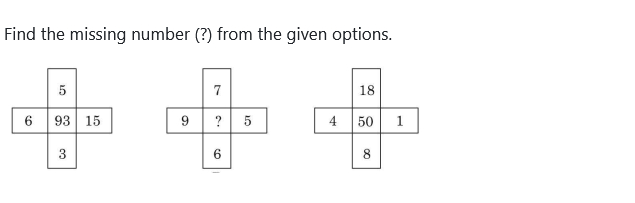
Find the missing number (?) from the given options.

Figure: three cross-shaped boxes (top, left, centre, right, bottom).

CrossTopLeftCentreRightBottom
15693153
279?56
31845018
Figure for MBA CET 2026 Slot 5 question 106
  1. 27
  2. 19
  3. 76
  4. 89
  5. 58
Show answerHide answer

Answer: D official key

Approach: Figure number puzzle — find the rule using the two complete crosses.

Solution:
Cross 1 (top 5, left 6, right 15, bottom 3): 5 × 15 + 6 × 3 = 75 + 18 = 93 ✓.
Cross 3 (top 18, left 4, right 1, bottom 8): 18 × 1 + 4 × 8 = 18 + 32 = 50 ✓.
Rule: centre = (top × right) + (left × bottom).
Cross 2 (top 7, left 9, right 5, bottom 6): 7 × 5 + 9 × 6 = 35 + 54 = 89.

Why the other options are wrong:

  • A (27), B (19), C (76), E (58): do not satisfy top×right + left×bottom for cross 2.

Cetking shortcut: Try products of 'diagonal-neighbour' pairs first; check the rule on both complete figures before applying it.

Answer: D

Q107EasySimplification

What will come in place of question mark (?) in the given expression ?

(39.3 × 53.4) + (26.7 × 5.9) = ?

  1. 2246.15
  2. 2251.85
  3. 2256.15
  4. 2261.50
  5. 2270.25
Show answerHide answer

Answer: C official key

Approach: Direct multiplication of decimals, then addition.

Solution:
39.3 × 53.4 = 2098.62.
26.7 × 5.9 = 157.53.
Sum = 2098.62 + 157.53 = 2256.15.

Why the other options are wrong:

  • A, B, D, E: arithmetic slips — only 2256.15 matches the exact sum.

Cetking shortcut: 39.3 × 53.4 = 40 × 53.4 − 0.7 × 53.4 = 2136 − 37.38 = 2098.62; 26.7 × 5.9 = 26.7 × 6 − 2.67 = 157.53; total 2256.15.

Answer: C

Q108EasySurds & Indices

If x = (7 − 4√3), then the value of (x + (1/x)) is:

  1. 3√3
  2. 8√3
  3. 14
  4. 14 + 8√3
  5. 14 - 8√3
Show answerHide answer

Answer: C official key

Approach: Reciprocal of a surd by rationalising (conjugate).

Solution:
1/x = 1/(7 − 4√3) × (7 + 4√3)/(7 + 4√3) = (7 + 4√3)/(49 − 48) = 7 + 4√3.
x + 1/x = (7 − 4√3) + (7 + 4√3) = 14.

Why the other options are wrong:

  • A, B: surd terms cancel, so no √3 can remain.
  • D, E: forget that the conjugate's surd part cancels with x's.

Cetking shortcut: When a² − b = 1 (here 49 − 48), the reciprocal of a − √b is simply a + √b, so x + 1/x = 2a = 14.

Answer: C

Q109EasyEquations Basics

The sum of two integers, when multiplied with each of the numbers separately, gives 4332 and 8664, respectively. Find the difference between the two numbers.

  1. 19
  2. 28
  3. 38
  4. 48
  5. 76
Show answerHide answer

Answer: C official key

Approach: Add the two equations to get (sum)².

Solution:
Let the integers be a, b: (a + b)·a = 4332, (a + b)·b = 8664.
Adding: (a + b)² = 12996 → a + b = 114.
a = 4332/114 = 38, b = 8664/114 = 76.
Difference = 76 − 38 = 38.

Why the other options are wrong:

  • A (19), B (28), D (48): do not come from a + b = 114.
  • E (76): that is the larger number, not the difference.

Cetking shortcut: Ratio of products = a : b = 4332 : 8664 = 1 : 2 → b = 2a, (3a)·a = 4332 → a² = 1444 → a = 38; difference = a = 38.

Answer: C

Q110EasyTime Speed Distance

A man travels three equal distances at speeds 30 km/h, 40 km/h, and 60 km/h, respectively.
What is the average speed of the man for the entire journey?

  1. 40 km/h
  2. 42 km/h
  3. 45 km/h
  4. 48 km/h
  5. 50 km/h
Show answerHide answer

Answer: A official key

Approach: Equal distances → average speed is the harmonic mean.

Solution:
Average speed = 3 / (1/30 + 1/40 + 1/60).
LCM 120: 1/30 + 1/40 + 1/60 = (4 + 3 + 2)/120 = 9/120.
Average speed = 3 × 120/9 = 40 km/h.

Why the other options are wrong:

  • The arithmetic mean would be ≈ 43.3, which is not an option; B (42), C (45), D (48), E (50) are not the harmonic mean.

Cetking shortcut: Take distance = LCM 120 km each leg: times 4 + 3 + 2 = 9 h for 360 km → 40 km/h.

Answer: A

Q111MediumAges

Rohan’s age after 8 years will be two-fifths of his father Mahesh’s age.
12 years ago, the ratio of their ages was 1 : 4.
What is Mahesh’s present age?

  1. 72 years
  2. 84 years
  3. 88 years
  4. 92 years
  5. 96 years
Show answerHide answer

Official CET key: D · Cetking's answer: B — see why below

Approach: Form two linear equations from the future and past age conditions.

Solution:
Let Rohan = R, Mahesh = M (present).
After 8 years: R + 8 = (2/5)(M + 8) → 5R + 40 = 2M + 16 → 5R = 2M − 24 … (1)
12 years ago: (R − 12)/(M − 12) = 1/4 → 4R − 48 = M − 12 → M = 4R − 36 … (2)
Substitute (2) in (1): 5R = 8R − 72 − 24 → 3R = 96 → R = 32.
M = 4 × 32 − 36 = 92 years.
Check: after 8 years 40 and 100 → 40 = 2/5 × 100 ✓; 12 years ago 20 : 80 = 1 : 4 ✓.

Why the other options are wrong:

  • A (72): 1 : 4 gives Rohan = 27; after 8 years 35 ≠ 2/5 × 80 = 32.
  • B (84): Rohan would be 30 (from 1:4), but 38 ≠ 2/5 × 92.
  • C (88), E (96): fail one of the two conditions.

Cetking shortcut: Option check with the 1:4 condition: M − 12 must be divisible by 4 and R = (M − 12)/4 + 12; only M = 92 (R = 32) then satisfies 40 : 100 = 2 : 5.

Answer: D

Q112EasyPercentages

Two numbers are 18% less and 42% less than a third number.
If the third number is increased by 25%, what percentage is the second number of the first number now?

  1. 57.14 %
  2. 70.73 %
  3. 76.73 %
  4. 79.14 %
  5. 84.73 %
Show answerHide answer

Answer: B official key

Approach: Fix the third number at 100; the increase in the third number does not change the other two.

Solution:
Third = 100 → first = 100 − 18 = 82, second = 100 − 42 = 58.
Increasing the third number by 25% does not affect the first and second numbers.
Second as % of first = 58/82 × 100 = 70.73%.

Why the other options are wrong:

  • A (57.14%), C (76.73%), D (79.14%), E (84.73%): come from rescaling the first two numbers or using the wrong base.

Cetking shortcut: The 25% increase is a distractor — the ratio 58 : 82 stays the same; 58/82 ≈ 0.707.

Answer: B

Q113EasyInterest

Ritika borrowed some money at the rate of 6% per annum for the first 3 years, 9% per annum for the next 5 years, and 13% per annum for the remaining period.
If she paid a total simple interest of ₹8,160 at the end of 11 years, how much money did she borrow?

  1. ₹8,000
  2. ₹9,000
  3. ₹10,000
  4. ₹12,000
  5. ₹15,000
Show answerHide answer

Answer: A official key

Approach: Simple interest with changing rates — add the rate × time products.

Solution:
Periods: 3 years at 6%, 5 years at 9%, remaining 11 − 8 = 3 years at 13%.
Total SI% = 6 × 3 + 9 × 5 + 13 × 3 = 18 + 45 + 39 = 102%.
102% of P = 8160 → P = 8160 × 100/102 = ₹8,000.

Why the other options are wrong:

  • B, C, D, E: give total interest of ₹9,180, ₹10,200, ₹12,240 and ₹15,300 respectively.

Cetking shortcut: Total SI% = Σ(rate × years); principal = SI × 100/(total %).

Answer: A

Q114EasyInterest

The population of a town increases at a rate of 12% per annum.
If a population of a town was 7,500 at the end of 2018, what will be its population at the end of 2021?

  1. 10,368
  2. 10,537
  3. 10,684
  4. 10,752
  5. 10,920
Show answerHide answer

Official CET key: B · Cetking's answer: A — see why below

Approach: Population growth works like compound interest: P(1 + r/100)ⁿ.

Solution:
End 2018 → end 2021 = 3 years.
Population = 7500 × (1.12)³.
1.12² = 1.2544; 1.2544 × 1.12 = 1.404928.
7500 × 1.404928 = 10,536.96 ≈ 10,537.

Why the other options are wrong:

  • A (10,368): = 7500 × 1.3824 — 1.12³ is 1.4049, not 1.3824.
  • C, D, E: over-estimates — exceed 7500 × 1.405.

Cetking shortcut: Successive 12%: 7500 → 8400 → 9408 → 9408 + 1128.96 = 10,536.96.

Answer: B

Q115EasyProfit Loss

A sells an article to B at a profit of 20%.
B sells it to C at a profit of 25%.
C sells it to D at a loss of 10%.
D sells it back to A at a profit of 12½%.

If A finally pays ₹486 to get back the article, what was the original cost price of the article for A?

  1. ₹300
  2. ₹320
  3. ₹360
  4. ₹400
  5. ₹450
Show answerHide answer

Answer: B official key
Approach: Successive profit/loss — multiply the factors.

Solution:
Let A's cost price = x.
A → B at +20%: 1.2x; B → C at +25%: 1.2 × 1.25 = 1.5x; C → D at −10%: 1.5 × 0.9 = 1.35x; D → A at +12.5%: 1.35 × 1.125 = 1.51875x.
1.51875x = 486 → x = 486/1.51875 = ₹320.

Why the other options are wrong:

  • A, C, D, E: give final prices of ₹455.6, ₹546.75, ₹607.5, ₹683.4 — not ₹486.

Cetking shortcut: Fractions: 6/5 × 5/4 × 9/10 × 9/8 = 243/160 → x = 486 × 160/243 = 2 × 160 = 320.

Answer: B
Q116EasyMixtures

A mixture contains alcohol and water in the ratio 4:3. If 5 liters of water is added to the mixture, the ratio of alcohol to water becomes 4:5.
What is the quantity of alcohol in the original mixture?

  1. 8 liters
  2. 10 liters
  3. 12 liters
  4. 16 liters
  5. 20 litres
Show answerHide answer

Answer: B official key
Approach: Alcohol stays constant when water is added.

Solution:
Original: alcohol 4k, water 3k.
After adding 5 L water: 4k/(3k + 5) = 4/5.
20k = 12k + 20 → 8k = 20 → k = 2.5.
Alcohol = 4 × 2.5 = 10 litres.

Why the other options are wrong:

  • A (8), C (12), D (16), E (20): with alcohol 4k fixed, these give water increase ≠ 5 L.

Cetking shortcut: Alcohol part '4' is the same in both ratios, so water goes from 3 to 5 parts: 2 parts = 5 L → 1 part = 2.5 L → alcohol = 4 × 2.5 = 10 L.

Answer: B
Q117EasyProfit Loss

A trader first incurs a loss of x % on an article and then makes a profit of y %. If the final selling price equals the original cost price, then the relation between x and y is:

  1. x = y
  2. y = 100x/(100 − x)
  3. y = 100x/(100 + x)
  4. y = x + (x²/100)
  5. y = x − 1
Show answerHide answer

Answer: B official key

Approach: Gain needed to recover a loss is measured on the reduced price.

Solution:
Let CP = 100. After x% loss, price = 100 − x.
A gain of y% on (100 − x) must bring it back to 100: (100 − x)(1 + y/100) = 100.
1 + y/100 = 100/(100 − x) → y/100 = x/(100 − x).
y = 100x/(100 − x).

Why the other options are wrong:

  • A (x = y): ignores that the base changed.
  • C: uses (100 + x) as base — that is the formula for losing back a gain.
  • D, E: not derived from the base-change equation.

Cetking shortcut: Test x = 50: price 50 must double → y = 100. Only 100x/(100 − x) = 100 ✓.

Answer: B

Q118EasyPartnership

A, B, and C entered into a partnership.
A received 3/5 of the total profit.
B and C shared the remaining profit equally.
If C initially received ₹400 less than A, what was the total profit?

  1. ₹800
  2. ₹1,000
  3. ₹1,200
  4. ₹1,600
  5. ₹1,800
Show answerHide answer

Answer: B official key

Approach: Express each partner's share as a fraction of total profit.

Solution:
A = 3/5 of total.
Remaining 2/5 split equally → B = C = 1/5 of total.
A − C = 3/5 − 1/5 = 2/5 of total = ₹400.
Total = 400 × 5/2 = ₹1,000.

Why the other options are wrong:

  • A (₹800): would make the gap ₹320.
  • C, D, E: make the gap ₹480, ₹640, ₹720.

Cetking shortcut: Shares A : B : C = 3 : 1 : 1; gap of 2 parts = 400 → 1 part = 200 → 5 parts = 1000.

Answer: B

Q119EasyTime & Work

A man can complete a work in 20 days. With the help of a boy, the same work is completed in 12 days. If the total earning for the work is ₹500 and the amount is divided in proportion to the work done by each, what is the share of the boy?

  1. ₹150
  2. ₹180
  3. ₹200
  4. ₹220
  5. ₹240
Show answerHide answer

Answer: C official key

Approach: Wages are divided in the ratio of work done (= ratio of 1-day work when they work together).

Solution:
Man's 1-day work = 1/20; together = 1/12.
Boy's 1-day work = 1/12 − 1/20 = (5 − 3)/60 = 1/30.
Work ratio man : boy = 1/20 : 1/30 = 3 : 2.
Boy's share = 2/5 × 500 = ₹200.

Why the other options are wrong:

  • E (₹240), D (₹220), B (₹180), A (₹150): not 2/5 of ₹500.

Cetking shortcut: In 12 days the man alone does 12/20 = 3/5 of the work → boy does 2/5 → 2/5 × 500 = 200.

Answer: C

Q120EasyPercentages

The expenditure and savings of an employee are in the ratio 4 : 1. His income increases by 12%, but at the same time his expenditure also increases by 18%.
What is the approximate percentage change in his savings?

  1. Increase by 8%
  2. Decrease by 12%
  3. Increase by 12 %
  4. Decrease by 8 %
  5. Decrease by 6%
Show answerHide answer

Answer: B official key

Approach: Savings = Income − Expenditure; apply each change in units.

Solution:
Expenditure : savings = 4 : 1 → income = 5, expenditure = 4, savings = 1.
New income = 5 × 1.12 = 5.60; new expenditure = 4 × 1.18 = 4.72.
New savings = 5.60 − 4.72 = 0.88.
Change = (0.88 − 1)/1 × 100 = −12% → decrease by 12%.

Why the other options are wrong:

  • A, C: savings cannot rise when expenditure grows faster than income here.
  • D (−8%): arithmetic slip; E (−6%): just subtracts 12% − 18%.

Cetking shortcut: Change in savings = 5 × 12 − 4 × 18 = 60 − 72 = −12 (on base 1 × 100) → −12%.

Answer: B

Q121MediumTime Speed Distance

A and B are two stations 480 km apart. A train starts from A at 9:30 a.m. and travels towards B at 72 km/h. Another train starts from B at 10:15 a.m. and travels towards A at 48 km/h. At what time do the two trains meet?

  1. 1:30 p.m.
  2. 1:45 p.m.
  3. 1:48 p.m.
  4. 2:00 p.m.
  5. 2:15 p.m.
Show answerHide answer

Official CET key: C · Cetking's answer: B — see why below

Approach: Head start, then relative speed for trains moving towards each other.

Solution:
From 9:30 to 10:15 = 45 min = 3/4 h; train A covers 72 × 3/4 = 54 km alone.
Gap at 10:15 = 480 − 54 = 426 km.
Relative speed (towards each other) = 72 + 48 = 120 km/h.
Time = 426/120 = 3.55 h = 3 h 33 min.
Meeting time = 10:15 + 3:33 = 1:48 p.m.

Why the other options are wrong:

  • A (1:30), B (1:45): ignore part of the time — 3.55 h is 3 h 33 min, not 3 h 30 min.
  • D (2:00) would need 3.75 h after 10:15; E (2:15) comes from 480/120 = 4 h after 10:15, ignoring A's 54 km head start.

Cetking shortcut: 0.55 h × 60 = 33 min — convert decimals of an hour carefully; 3.5 h would be 3 h 30 min.

Answer: C

Q122EasyTime Speed Distance

A rabbit takes 6 hops while a dog takes 5 hops in the same time. If 4 hops of the dog equal 5 hops of the rabbit, what is the ratio of their speeds (Rabbit : Dog)?

  1. 5 : 4
  2. 6 : 5
  3. 24 : 25
  4. 25 : 24
  5. 5 : 6
Show answerHide answer

Answer: C official key

Approach: Speed = (hops per unit time) × (length of one hop).

Solution:
4 dog hops = 5 rabbit hops → rabbit hop : dog hop = 4 : 5. Let rabbit hop = 4, dog hop = 5 units.
In the same time: rabbit 6 hops = 6 × 4 = 24 units; dog 5 hops = 5 × 5 = 25 units.
Speed ratio rabbit : dog = 24 : 25.

Why the other options are wrong:

  • A (5 : 4), D (25 : 24): reverse the hop-length ratio.
  • B (6 : 5): uses only hop counts.
  • E (5 : 6): inverse of hop counts.

Cetking shortcut: Speed ratio = (hop-rate ratio) × (hop-length ratio) = (6/5) × (4/5) = 24/25.

Answer: C

Q123MediumClocks & Calendars

Between 1 hour and 12 hours, how many times will the hour hand and minute hand be together (coincide)?

  1. 9 times
  2. 11 times
  3. 13 times
  4. 10 times
  5. 14 times
Show answerHide answer

Answer: B official key

Approach: The hands coincide 11 times in every 12 hours, once every 65 5/11 min.

Solution:
From 1 o'clock up to 12 o'clock the hands coincide at about 1:05, 2:11, 3:16, 4:22, 5:27, 6:33, 7:38, 8:44, 9:49, 10:54 — that is 10 times — and again at 12:00.
Total = 10 + 1 = 11 times.

Why the other options are wrong:

  • A (9), C (13), E (14): not consistent with one coincidence every 65 5/11 min.
  • D (10): leaves out the 12:00 coincidence.
  • 12 would assume one coincidence per hour, which is wrong because the hands do not meet between 11 and 1 o'clock except at 12.

Cetking shortcut: In 12 hours → 11 times; in 24 hours → 22 times. Between 11 and 1 o'clock the hands meet only once (at 12).

Answer: B

Q124EasyClocks & Calendars

The calendar of the year 2010 will be the same as the calendar of which of the following year?

  1. 2012
  2. 2014
  3. 2021
  4. 2017
  5. 2020
Show answerHide answer

Answer: C official key

Approach: Calendars repeat when total odd days ≡ 0 (mod 7) and leap-year status matches.

Solution:
2010 is an ordinary year (1 odd day).
Odd days from 2010 to 2020: 11 years with 3 leap years (2012, 2016, 2020) → 11 + 3 = 14 ≡ 0 (mod 7).
So 1 Jan 2021 is the same weekday as 1 Jan 2010, and 2021 is also an ordinary year → same calendar.

Why the other options are wrong:

  • A (2012), E (2020): leap years — cannot match an ordinary year's calendar.
  • B (2014): 2010–2013 give 1 + 1 + 2 + 1 = 5 odd days.
  • D (2017): 2010–2016 give 9 ≡ 2 odd days.

Cetking shortcut: Ordinary years: the 1st year after a leap year repeats after 6 years; the 2nd and 3rd years after a leap year repeat after 11 years. 2010 is the 2nd year after 2008 → 2010 + 11 = 2021.

Answer: C

Q125EasyQuadrilaterals

The diagonal of a rectangle is 17 cm and its perimeter is 46 cm. What is the area of the rectangle?

  1. 48 cm²
  2. 68 cm²
  3. 108 cm²
  4. 120 cm²
  5. 132 cm²
Show answerHide answer

Answer: D official key

Approach: Use (l + b)² = l² + b² + 2lb.

Solution:
Perimeter 46 → l + b = 23.
Diagonal 17 → l² + b² = 289.
(l + b)² = 529 = 289 + 2lb → 2lb = 240 → lb = 120 cm².
(Sides 15 and 8: 15 + 8 = 23, 15² + 8² = 289 ✓.)

Why the other options are wrong:

  • A, B, C, E: do not satisfy 2lb = 529 − 289.

Cetking shortcut: Spot the Pythagorean triple 8-15-17 with 8 + 15 = 23 → area 120.

Answer: D

Q126EasyQuadrilaterals

The difference between the lengths of the two parallel sides of a trapezium is 4 cm. The perpendicular distance between them is 19 cm. If the area of the trapezium is 475 cm², find the lengths of both the parallel sides of the trapezium?

  1. 29 cm, 25 cm
  2. 28 cm, 24 cm
  3. 27 cm, 23 cm
  4. 26 cm, 22 cm
  5. 25 cm, 21 cm
Show answerHide answer

Answer: C official key

Approach: Area of trapezium = ½ (sum of parallel sides) × height.

Solution:
½ (a + b) × 19 = 475 → a + b = 50.
a − b = 4.
a = 27 cm, b = 23 cm.

Why the other options are wrong:

  • A (54), B (52), D (48), E (46): sums are not 50.

Cetking shortcut: Only the option whose two sides add to 50 works — check sums directly.

Answer: C

Q127EasyCircles

The radius of a circular wheel is 1 (3/4) m. How many revolutions will it make in travelling 11 km?

  1. 500
  2. 1000
  3. 1500
  4. 2000
  5. 2500
Show answerHide answer

Answer: B official key

Approach: Distance = number of revolutions × circumference.

Solution:
r = 1¾ m = 7/4 m.
Circumference = 2πr = 2 × 22/7 × 7/4 = 11 m.
11 km = 11,000 m.
Revolutions = 11,000/11 = 1000.

Why the other options are wrong:

  • A (500): takes the diameter 3.5 m as the radius (circumference 22 m).
  • C, D, E: wrong circumference or km→m conversion.

Cetking shortcut: r = 7/4 cancels with π = 22/7 → circumference 11 m, and 11 km ÷ 11 m = 1000.

Answer: B

Q128EasyNumber Series (Quant)

Identify the Odd One Out :

7, 12, 19, 26, 39, 52

  1. 19
  2. 26
  3. 39
  4. 12
  5. 52
Show answerHide answer

Answer: B official key

Approach: Difference series with consecutive odd differences.

Solution:
Expected differences: +5, +7, +9, +11, +13.
7 + 5 = 12 ✓, 12 + 7 = 19 ✓, 19 + 9 = 28 (given 26 ✗), 28 + 11 = 39 ✓, 39 + 13 = 52 ✓.
26 is the odd one out (should be 28).

Why the other options are wrong:

  • A (19), C (39), D (12), E (52): all fit the +5, +7, +9, +11, +13 pattern.

Cetking shortcut: Check the term from both sides: 39 − 11 = 28 confirms the correct value, so 26 is wrong.

Answer: B

Q129EasyNumber Series (Quant)

Identify the one that does not belong to this group.

120, 720, 5040, 40320, 52480

  1. 120
  2. 5040
  3. 40320
  4. 52480
  5. 720
Show answerHide answer

Answer: D official key

Approach: Factorial pattern.

Solution:
120 = 5!, 720 = 6!, 5040 = 7!, 40320 = 8!.
52480 is not a factorial (9! = 362880).
So 52480 does not belong.

Why the other options are wrong:

  • A, B, C, E: 5!, 7!, 8!, 6! — all factorials.

Cetking shortcut: Ratios of consecutive terms 6, 7, 8 reveal factorials; 52480/40320 is not an integer.

Answer: D

Q130EasyNumber Series (Quant)

Which one does not belong to group?

9:32, 13:44, 8:30, 10:35, 7:26

  1. 9:32
  2. 13:44
  3. 8:30
  4. 10:35
  5. 7:26
Show answerHide answer

Answer: C official key

Approach: Pair relation: second = 3 × first + 5.

Solution:
9 → 3 × 9 + 5 = 32 ✓; 13 → 44 ✓; 10 → 35 ✓; 7 → 26 ✓.
8 → 3 × 8 + 5 = 29, but given 30 ✗.
8 : 30 is the odd one.

Why the other options are wrong:

  • A, B, D, E: all satisfy second = 3 × first + 5.

Cetking shortcut: Take two pairs to fix a linear rule (9→32, 10→35 → slope 3, intercept 5) and test the rest.

Answer: C

Q131EasyProbability

A box contains one dozen mangoes. One-third of the mangoes are bad. If three mangoes are chosen at random from the box, what is the probability that at least one of the selected mangoes is good?

  1. 1/55
  2. 51/55
  3. 53/55
  4. 54/55
  5. 3/55
Show answerHide answer

Answer: D official key

Approach: 'At least one' = 1 − P(none).

Solution:
Total mangoes = 12; bad = 12/3 = 4; good = 8.
P(all three bad) = ⁴C₃/¹²C₃ = 4/220 = 1/55.
P(at least one good) = 1 − 1/55 = 54/55.

Why the other options are wrong:

  • A (1/55): that is P(all bad).
  • B (51/55), C (53/55): wrong count of all-bad selections.
  • E (3/55): no meaning here.

Cetking shortcut: When 'at least one' appears, compute the single complementary case — here only 4 ways to pick 3 bad mangoes.

Answer: D

Q132EasyProbability

Three unbiased coins are tossed simultaneously. What is the probability of getting at least two heads?

  1. 1/8
  2. 3/8
  3. 1/2
  4. 5/8
  5. 2/8
Show answerHide answer

Answer: C official key

Approach: List outcomes of 3 coins (8 equally likely).

Solution:
Total outcomes = 2³ = 8.
At least two heads: HHT, HTH, THH, HHH = 4 outcomes.
P = 4/8 = 1/2.

Why the other options are wrong:

  • A (1/8): only HHH.
  • B (3/8): exactly two heads.
  • D (5/8), E (2/8): miscounts.

Cetking shortcut: By symmetry, P(≥ 2 heads) = P(≥ 2 tails), and they cover all outcomes → each is 1/2.

Answer: C

Q133MediumTime Speed Distance

In a 100 m race, A runs at a speed of 8 km per hour. A gives B a start of 4 m and still beats him by 15 seconds. What is the speed of B?

  1. 4.5 km/h
  2. 5.2 km/h
  3. 5.8 km/h
  4. 6.4 km/h
  5. 7 km/h
Show answerHide answer

Official CET key: C · Cetking's answer: B — see why below

Approach: Race with head start — B covers less distance but takes 15 s more.

Solution:
A's speed = 8 km/h = 8 × 5/18 = 20/9 m/s.
A's time for 100 m = 100 ÷ 20/9 = 45 s.
B starts 4 m ahead → runs 96 m, and finishes 15 s after A → 45 + 15 = 60 s.
B's speed = 96/60 = 1.6 m/s = 1.6 × 18/5 = 5.76 km/h ≈ 5.8 km/h.

Why the other options are wrong:

  • A (4.5), B (5.2), D (6.4), E (7): none equals 96 m in 60 s (5.76 km/h); they come from using a wrong distance or time for B.

Cetking shortcut: Convert once: 96 m in 60 s = 96 × 60 m/h = 5.76 km/h.

Answer: C

Q134EasyPipes and Cisterns

Two pipes P and Q can fill a cistern in 12 minutes and 15 minutes respectively. Both pipes are opened together, but at the end of 3 minutes pipe P is closed. How much longer will the cistern take to fill completely?

  1. 8 (1/4) minutes
  2. 8 (3/4) minutes
  3. 5 minutes
  4. 8 (1/2) minutes
  5. 6 minutes
Show answerHide answer

Answer: A official key

Approach: Work done together for 3 min, then the remaining by Q alone.

Solution:
P = 1/12, Q = 1/15 per minute; together = 1/12 + 1/15 = (5 + 4)/60 = 9/60 = 3/20.
In 3 min: 3 × 3/20 = 9/20 filled.
Remaining = 1 − 9/20 = 11/20.
Q alone: 11/20 × 15 = 165/20 = 8¼ minutes.

Why the other options are wrong:

  • B (8¾), D (8½): arithmetic slips in 11/20 × 15.
  • C (5), E (6): do not equal (11/20) ÷ (1/15) = 8¼ min; they come from a wrong rate for the remaining work.

Cetking shortcut: Q works all the time: Q's total time t → t/15 + 3/12 = 1 → t = 11.25 min → after the first 3 min: 8¼ min.

Answer: A

Q135EasyProbability

Four events A, B, C and D are mutually exclusive and exhaustive.
If
P(A) = 1/3 P(B),
P(B) = 1/4 P(C),
P(C) = 1/5 P(D),

then find the value of P(D).

  1. 1/2
  2. 3/15
  3. 15/19
  4. 15/31
  5. 7/12
Show answerHide answer

Answer: C official key

Approach: Mutually exclusive and exhaustive → probabilities add to 1.

Solution:
Let P(D) = x. Then P(C) = x/5, P(B) = x/20, P(A) = x/60.
x + x/5 + x/20 + x/60 = 1 → x(60 + 12 + 3 + 1)/60 = 1 → 76x/60 = 1.
x = 60/76 = 15/19.

Why the other options are wrong:

  • A (1/2), B (3/15), E (7/12): do not make the four probabilities sum to 1.
  • D (15/31): wrong denominator from mis-adding the parts.

Cetking shortcut: Ratio A : B : C : D = 1 : 3 : 12 : 60 → total 76 parts → P(D) = 60/76 = 15/19.

Answer: C

Q136EasyInterest

Find the compound interest on ₹1250 for 1½ years at 5% per annum, if interest is payable semi-annually.

  1. ₹96.11
  2. ₹91.24
  3. ₹95.31
  4. ₹100.01
  5. ₹120.22
Show answerHide answer

Official CET key: A · Cetking's answer: C — see why below

Approach: Half-yearly compounding: half the rate, double the periods.

Solution:
Rate per half-year = 5/2 = 2.5%; periods = 1½ × 2 = 3.
Amount = 1250 × (1.025)³.
1.025² = 1.050625; × 1.025 = 1.076890625.
Amount = 1250 × 1.076890625 = 1346.11.
CI = 1346.11 − 1250 = ₹96.11.

Why the other options are wrong:

  • C (₹95.31): arithmetic slip in 1.025³ (gives amount 1345.31).
  • B (₹91.24), D (₹100.01), E (₹120.22): do not equal 1250 × 1.025³ − 1250.

Cetking shortcut: Successive 2.5%: 1250 → 1281.25 → 1313.28 → 1346.11 → CI = 96.11.

Answer: A

Q137EasyTrains Boats

Train A, 600 mts long is running at 80 kmph. How much time will it take to cross a man sitting in another train which is 400 mtres long, running at 64 kmph in the opposite direction?

  1. 10 seconds
  2. 12 seconds
  3. 15 seconds
  4. 18 seconds
  5. 21 seconds
Show answerHide answer

Answer: C official key

Approach: Crossing a man (a point) — only the moving train's length counts.

Solution:
Relative speed (opposite directions) = 80 + 64 = 144 km/h = 144 × 5/18 = 40 m/s.
Train A must pass a man sitting in the other train → distance = length of train A = 600 m (the 400 m length is irrelevant).
Time = 600/40 = 15 s.

Why the other options are wrong:

  • A (10 s): 400/40 — uses the other train's length.
  • B, D, E: need relative speeds of 50, 33.3 or 28.6 m/s — wrong addition/conversion.

Cetking shortcut: If both lengths (1000 m) were used you'd get 25 s — not in options — a hint that only 600 m counts.

Answer: C

Q138EasyTrains Boats

A boat travels 10 km upstream in 30 minutes and the same distance downstream in 25 minutes. What is the speed of the river current (in km/h)?

  1. 1 km/h
  2. 2 km/h
  3. 3 km/h
  4. 4 km/h
  5. 5 km/h
Show answerHide answer

Answer: B official key

Approach: Speed of current = (downstream − upstream)/2.

Solution:
Upstream speed = 10/(30/60) = 20 km/h.
Downstream speed = 10/(25/60) = 24 km/h.
Current = (24 − 20)/2 = 2 km/h.

Why the other options are wrong:

  • D (4): forgets to divide the difference by 2.
  • A, C, E: arithmetic slips in converting minutes to hours.

Cetking shortcut: Boat speed = (24 + 20)/2 = 22, current = 2 — both from the two speeds in one line.

Answer: B

Q139EasyPercentages

In an election contested by two candidates, one candidate secured 30% of the total votes and still lost the election by 500 votes. What was the total number of votes cast?

  1. 1000
  2. 1250
  3. 1500
  4. 1750
  5. 2000
Show answerHide answer

Answer: B official key

Approach: Winning margin as a percentage of total votes.

Solution:
Two candidates: loser 30%, winner 70%.
Margin = 70% − 30% = 40% of total = 500.
Total = 500 × 100/40 = 1250.

Why the other options are wrong:

  • A (1000): margin would be 400.
  • C, D, E: margins 600, 700, 800.

Cetking shortcut: 40% ↔ 500 → 10% ↔ 125 → 100% ↔ 1250.

Answer: B

Q140MediumPercentages

In a city, domestic electricity charges are as follows:

₹4.20 per unit for the first 100 units,

₹5.80 per unit for consumption above 100 units

A fixed meter charge of ₹120 per month is applicable.
Electricity duty at 10% is charged only on energy charges, not on the fixed charge.

If a household consumed 168 units of electricity for one month, what will be the total electricity bill?

  1. ₹1016
  2. ₹1136
  3. ₹1192
  4. ₹1312
  5. ₹1368
Show answerHide answer

Answer: A official key

Approach: Slab billing; duty only on energy charges.

Solution:
First 100 units: 100 × 4.20 = ₹420.
Next 68 units: 68 × 5.80 = ₹394.40.
Energy charges = ₹814.40.
Duty 10% of 814.40 = ₹81.44.
Fixed meter charge = ₹120 (no duty).
Total = 814.40 + 81.44 + 120 = ₹1015.84 → ₹1016 (bill rounded to the nearest rupee).

Why the other options are wrong:

  • B (₹1136): adds the ₹120 fixed charge twice.
  • C (₹1192): charges all 168 units at ₹5.80.
  • D, E: overcharge / duty on wrong base.

Cetking shortcut: Energy × 1.1 + 120: 814.4 × 1.1 = 895.84 → + 120 = 1015.84.

Answer: A

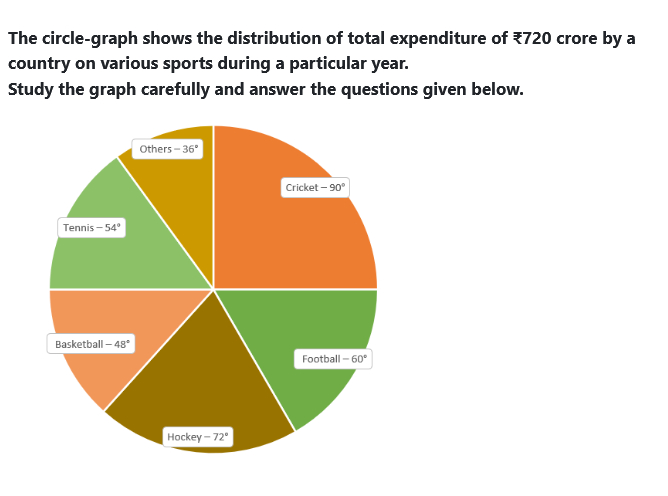
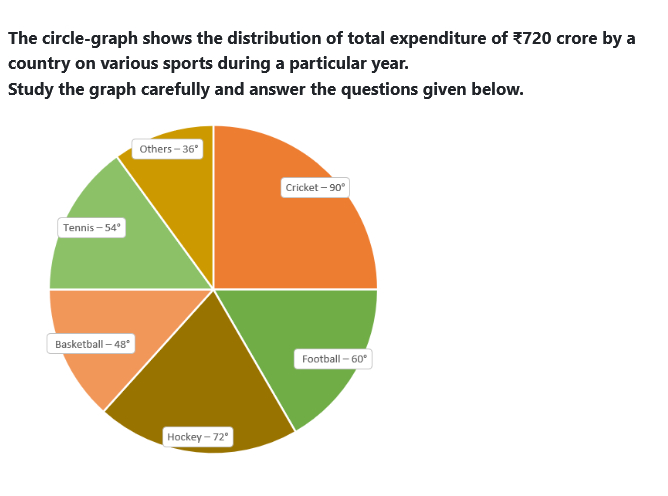
Q141EasyPie Chart

Questions 141–145 share this

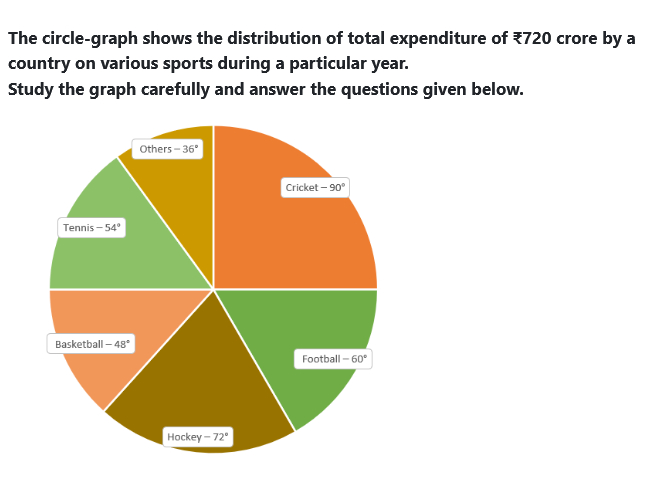
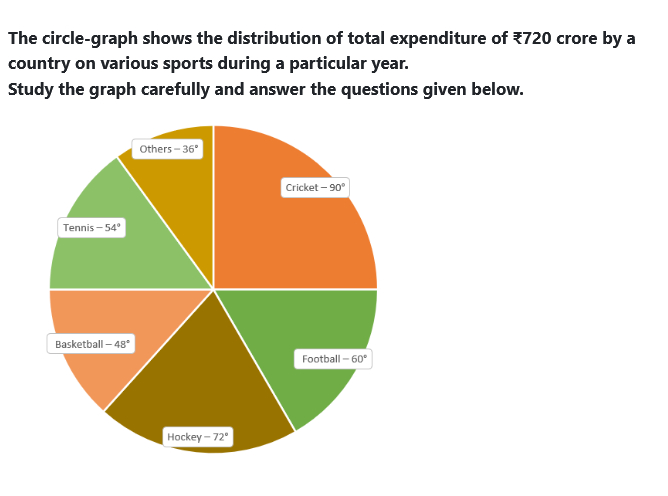
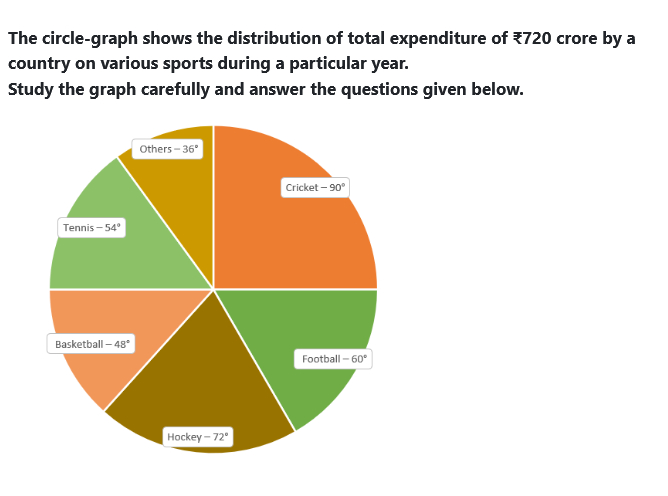
The circle-graph shows the distribution of total expenditure of ₹720 crore by a country on various sports during a particular year.
Study the graph carefully and answer the questions given below.

Data read from chart:

SportCentral angle
Cricket90°
Football60°
Hockey72°
Basketball48°
Tennis54°
Others36°
Figure for MBA CET 2026 Slot 5 question 141

What is the expenditure on Cricket?

  1. ₹150 crore
  2. ₹162 crore
  3. ₹180 crore
  4. ₹200 crore
  5. ₹216 crore
Show answerHide answer

Answer: C official key

Approach: Pie chart: value = (angle/360) × total.

Solution:
Total = ₹720 crore → each degree = 720/360 = ₹2 crore.
Cricket = 90° × 2 = ₹180 crore.

Why the other options are wrong:

  • A, B, D, E: correspond to 75°, 81°, 100°, 108° — not 90°.

Cetking shortcut: 90° is a quarter of the circle → 720/4 = 180.

Answer: C

Q142EasyPie Chart

Refer to the passage above ↑

What is the difference between the average expenditure on Cricket and Football and the expenditure on Hockey?

Figure for MBA CET 2026 Slot 5 question 142
  1. ₹4 crore
  2. ₹5 crore
  3. ₹6 crore
  4. ₹7 crore
  5. ₹10 crore
Show answerHide answer

Answer: C official key

Approach: Convert each angle to value at ₹2 crore per degree.

Solution:
Cricket = 90 × 2 = 180; Football = 60 × 2 = 120 (₹ crore).
Average of Cricket and Football = (180 + 120)/2 = 150.
Hockey = 72 × 2 = 144.
Difference = 150 − 144 = ₹6 crore.

Why the other options are wrong:

  • A, B, D, E: correspond to angle differences of 2°, 2.5°, 3.5°, 5° — the actual difference is 3°.

Cetking shortcut: Work in degrees: average (90 + 60)/2 = 75°, Hockey 72° → 3° × 2 = ₹6 crore.

Answer: C

Q143EasyPie Chart

Refer to the passage above ↑

If ₹36 crore is transferred from Cricket to Basketball, what will be the new ratio of expenditure on Cricket to Basketball?

Figure for MBA CET 2026 Slot 5 question 143
  1. 11 : 9
  2. 10 : 9
  3. 12:11
  4. 18 : 7
  5. 7 : 6
Show answerHide answer

Official CET key: C · Cetking's answer: B — see why below

Approach: Find each value, transfer the amount, then reduce the ratio.

Solution:
Cricket = 90 × 2 = ₹180 crore; Basketball = 48 × 2 = ₹96 crore.
After transferring ₹36 crore: Cricket = 180 − 36 = 144; Basketball = 96 + 36 = 132.
Ratio = 144 : 132 = 12 : 11.

Why the other options are wrong:

  • B (10 : 9): mis-simplifies 144 : 132.
  • A, D, E: wrong base values or transfer in the wrong direction.

Cetking shortcut: In degrees: ₹36 crore = 18°. Cricket 90 − 18 = 72°, Basketball 48 + 18 = 66° → 72 : 66 = 12 : 11.

Answer: C

Q144EasyPie Chart

Refer to the passage above ↑

Expenditure on Tennis is what percent less than the combined expenditure on Hockey and Others?

Figure for MBA CET 2026 Slot 5 question 144
  1. 20%
  2. 25%
  3. 30%
  4. 50 %
  5. 55 %
Show answerHide answer

Official CET key: D · Cetking's answer: B — see why below

Approach: Percent less = (difference/larger base) × 100.

Solution:
Tennis = 54 × 2 = ₹108 crore.
Hockey + Others = (72 + 36) × 2 = ₹216 crore.
Tennis is less by (216 − 108)/216 × 100 = 50%.

Why the other options are wrong:

  • B (25%): misreads the Tennis/Others values.
  • A, C, E: wrong base or arithmetic.

Cetking shortcut: Degrees: 54 vs 72 + 36 = 108 → Tennis is exactly half → 50% less.

Answer: D

Q145EasyPie Chart

Refer to the passage above ↑

The expenditure on Cricket is equal to the expenditure on which of the following combinations?

Figure for MBA CET 2026 Slot 5 question 145
  1. Football + Others
  2. Hockey + Basketball
  3. Tennis + Others
  4. Football + Basketball
  5. Basketball + Tennis
Show answerHide answer

Official CET key: C · Cetking's answer: D — see why below

Approach: Compare angles directly — equal angles mean equal expenditure.

Solution:
Cricket = 90°.
Tennis + Others = 54° + 36° = 90° ✓ → equal to Cricket (₹180 crore each).

Why the other options are wrong:

  • A: Football + Others = 96°.
  • B: Hockey + Basketball = 120°.
  • D: Football + Basketball = 108°.
  • E: Basketball + Tennis = 102°.

Cetking shortcut: No conversion needed — just add the angles of each pair and look for 90°.

Answer: C

Q146EasyTables

Questions 146–150 share this

Directions

The following table shows the number of different types of solar panels sold by a company over a period of five years (2021–2025). The figures are given in thousands. Study the data carefully and answer the questions that follow.

YearType AType BType CType D
2021120958065
20221351109070
202315012510585
2024165140120100
2025180155135115

What is the total number of solar panels (all types) sold by the company in 2023?

  1. 420 thousand
  2. 445 thousand
  3. 465 thousand
  4. 480 thousand
  5. 495 thousand
Show answerHide answer

Answer: C official key

Approach: Add the 2023 row.

Solution:
2023: Type A 150 + Type B 125 + Type C 105 + Type D 85.
Total = 465 thousand.

Why the other options are wrong:

  • A, B, D, E: arithmetic slips — the 2023 row adds to exactly 465.

Cetking shortcut: Pair friendly numbers: (150 + 85) + (125 + 105) = 235 + 230 = 465.

Answer: C

Q147EasyTables

Refer to the passage above ↑

In which year was the difference between sales of Type A and Type D solar panels the minimum?

  1. 2021
  2. 2022
  3. 2023
  4. 2024
  5. 2025
Show answerHide answer

Answer: A official key

Approach: Compute A − D for each year.

Solution:
2021: 120 − 65 = 55.
2022: 135 − 70 = 65; 2023: 150 − 85 = 65; 2024: 165 − 100 = 65; 2025: 180 − 115 = 65.
Minimum difference = 55 in 2021.

Why the other options are wrong:

  • B, C, D, E: each has a difference of 65 thousand.

Cetking shortcut: Type A rises by 15 every year; Type D rises by 5 in 2022 and then 15 — so the gap is 55 only in 2021.

Answer: A

Q148EasyTables

Refer to the passage above ↑

What is the average annual sale of Type B solar panels over the five years?

  1. 120 thousand
  2. 125 thousand
  3. 130 thousand
  4. 135 thousand
  5. 140 thousand
Show answerHide answer

Official CET key: B · Cetking's answer: A — see why below

Approach: Average = sum of the column ÷ 5.

Solution:
Type B: 95 + 110 + 125 + 140 + 155 = 625.
Average = 625/5 = 125 thousand.

Why the other options are wrong:

  • A (120): wrong sum (600).
  • C, D, E: averages of other columns or arithmetic slips.

Cetking shortcut: The values are in AP (+15) → average = middle term (2023) = 125.

Answer: B

Q149EasyTables

Refer to the passage above ↑

Sales of Type C solar panels in 2025 are approximately what percent more than sales of Type C in 2021?

  1. 50%
  2. 59 %
  3. 65%
  4. 69 %
  5. 75%
Show answerHide answer

Answer: D official key

Approach: Percentage increase = (new − old)/old × 100.

Solution:
Type C: 2021 = 80, 2025 = 135.
Increase = 55; % increase = 55/80 × 100 = 68.75% ≈ 69%.

Why the other options are wrong:

  • A (50%), B (59%), C (65%), E (75%): wrong base (e.g. 55/135 ≈ 41%) or misread values.

Cetking shortcut: 55/80 = 11/16 = 0.6875 → 69%.

Answer: D

Q150EasyTables

Refer to the passage above ↑

The ratio of total sales of all types in 2021 to that in 2025 is

  1. 2 : 3
  2. 4 : 5
  3. 8 : 13
  4. 9 : 11
  5. 11 : 13
Show answerHide answer

Official CET key: C · Cetking's answer: B — see why below

Approach: Find both row totals and simplify the ratio.

Solution:
2021 total = 120 + 95 + 80 + 65 = 360.
2025 total = 180 + 155 + 135 + 115 = 585.
360 : 585 = (÷45) 8 : 13.

Why the other options are wrong:

  • A (2 : 3): would need 2025 = 540.
  • B (4 : 5), D (9 : 11), E (11 : 13): do not reduce from 360 : 585.

Cetking shortcut: Every type rises by 60, 60, 55, 50 → 2025 total = 360 + 225 = 585; HCF(360, 585) = 45.

Answer: C

Other MBA CET 2026 papers

Practise these in the Arena

Take timed tests built around MBA CET topics and see where you stand.

Open the Arena