Show answerHide answer
Official CET key: B · Cetking's answer: C — see why below
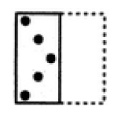
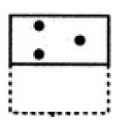
Approach: Transparent sheet folding: the right half is mirrored onto the left half across the dotted line; all dots stay visible.
Solution:
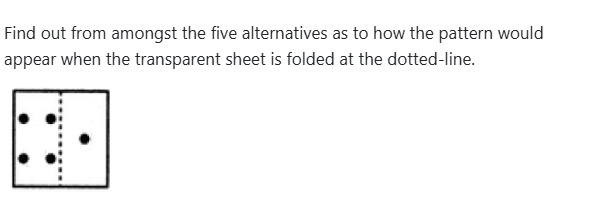
Left half: four dots at the corners of a square (two near the left edge, two near the fold).
Right half: one dot in the middle row, about midway between the fold and the right edge.
Folding the right half over the left mirrors this dot to the middle row, midway between the two columns of the left half ⇒ it lands at the centre of the four dots.
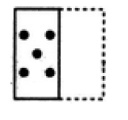
Result: four corner dots with one dot in the centre (dice-5 pattern) = Figure B.
Why the other options are wrong:
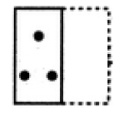
A: only three dots — dots cannot disappear on a transparent sheet.
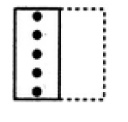
C: five dots in a single column.
D: zig-zag pattern, not the original square.
E: folded horizontally instead of along the vertical line.
Cetking shortcut: Total dots after folding = dots on both halves (4 + 1 = 5); only B and C have 5, and only B keeps the square.
Answer: B