CET 2025 Slot 1 · Quant – Page 9
All 50 Quant questions of CET 2025 Slot 1. Tap Show answer, or open the detailed solution (free login). Page 9 of 12.
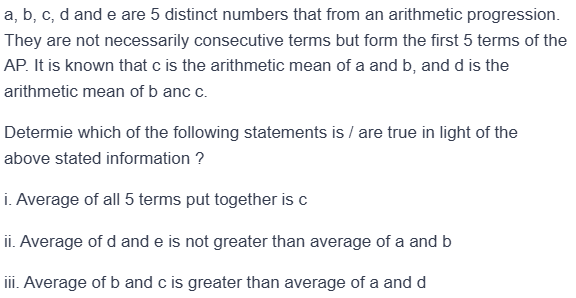
a, b, c, d and e are 5 distinct numbers that from an arithmetic progression. They are not necessarily consecutive terms but form the first 5 terms of the AP. It is known that c is the arithmetic mean of a and b, and d is the arithmetic mean of b anc c.
Determie which of the following statements is / are true in light of the above stated information ?
i. Average of all 5 terms put together is c
ii. Average of d and e is not greater than average of a and b
iii. Average of b and c is greater than average of a and d
Determie which of the following statements is / are true in light of the above stated information ?
i. Average of all 5 terms put together is c
ii. Average of d and e is not greater than average of a and b
iii. Average of b and c is greater than average of a and d
Answer: A. i and ii only
Solution — first steps
Approach: Place a, b, c, d on a number line, then fit e. Solution: Take a = 0, b = 4k (k ≠ 0).
The full step-by-step working opens with a free login.
Vijay buys some eggs. After bringing the eggs home, he finds two to be rotten and throws them away. Of the remaining eggs, he puts five-ninth in his fridge, and brings the rest to his mother, Rashmi's house. She cooks two eggs and puts the rest in her fridge. If her fridge cannot hold more than five eggs, what is the maximum possible number of eggs bought by Vijay ?

Answer: B. 11
Solution — first steps
Approach: Inequality from the fridge limit + whole-number condition. 75) x = 11: 9 good eggs, 5 in his fridge, 4 to mother, she cooks 2, 2 go in her fridge ✓ Why the other options are wrong: A (17): 15 good eggs → 5/9 × 15 = 8⅓ eggs — impossible.
The full step-by-step working opens with a free login.
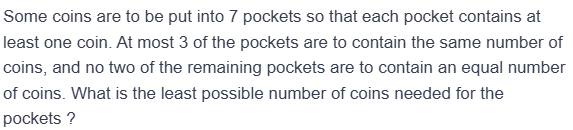
Some coins are to be put into 7 pockets so that each pocket contains at least one coin. At most 3 of the pockets are to contain the same number of coins, and no two of the remaining pockets are to contain an equal number of coins. What is the least possible number of coins needed for the pockets ?
Answer: A. 17
Solution — first steps
Approach: Greedy: three pockets with the smallest count, four with the next distinct values. Solution: 3 pockets × 1 coin = 3 Remaining 4 pockets must be distinct and ≠ 1 → 2, 3, 4, 5 = 14 Total = 3 + 14 = 17 Check: 3 × 2 + (1, 3, 4, 5) = 19 and 3 × 3 + (1, 2, 4, 5) = 21 → larger Why the other options are wrong: B (7): needs all 7 pockets with 1 coin — breaks 'at most 3 same'.
The full step-by-step working opens with a free login.
Read the Question given below and choose the option that is sufficient to answer the Question.
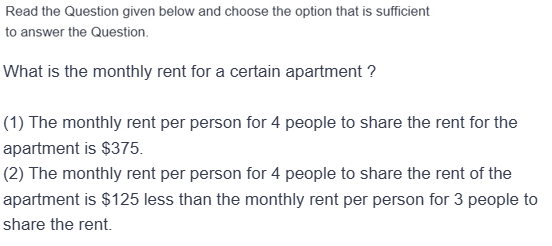
What is the monthly rent for a certain apartment ?
(1) The monthly rent per person for 4 people to share the rent for the apartment is $375.
(2) The monthly rent per person for 4 people to share the rent of the apartment is $125 less than the monthly rent per person for 3 people to share the rent.
What is the monthly rent for a certain apartment ?
(1) The monthly rent per person for 4 people to share the rent for the apartment is $375.
(2) The monthly rent per person for 4 people to share the rent of the apartment is $125 less than the monthly rent per person for 3 people to share the rent.
Answer: D. Each statement alone is sufficient
Solution — first steps
Approach: Test each statement separately for a unique rent R. Solution: Statement 1: R/4 = 375 → R = $1500 → sufficient Statement 2: R/3 − R/4 = 125 → R/12 = 125 → R = $1500 → sufficient Each statement alone is sufficient Why the other options are wrong: A, B: ignore that the other statement also works alone.
The full step-by-step working opens with a free login.
If a certain wheel turns at a constant rate of x revolutions per minute, how many revolutions will the wheel make in k seconds ?

Answer: A. kx/60
Solution — first steps
Approach: Convert k seconds to minutes and multiply by the rate. Solution: Rate = x revolutions per minute = x/60 revolutions per second In k seconds: (x/60) × k = kx/60 Why the other options are wrong: B, D: divide by k — revolutions must grow with time.
The full step-by-step working opens with a free login.