CET 2023 Slot 1 Question Paper with Solutions PDF – Page 20
All 200 questions of CET 2023 Slot 1. Tap Show answer, or open the detailed solution (free login). Page 20 of 42.
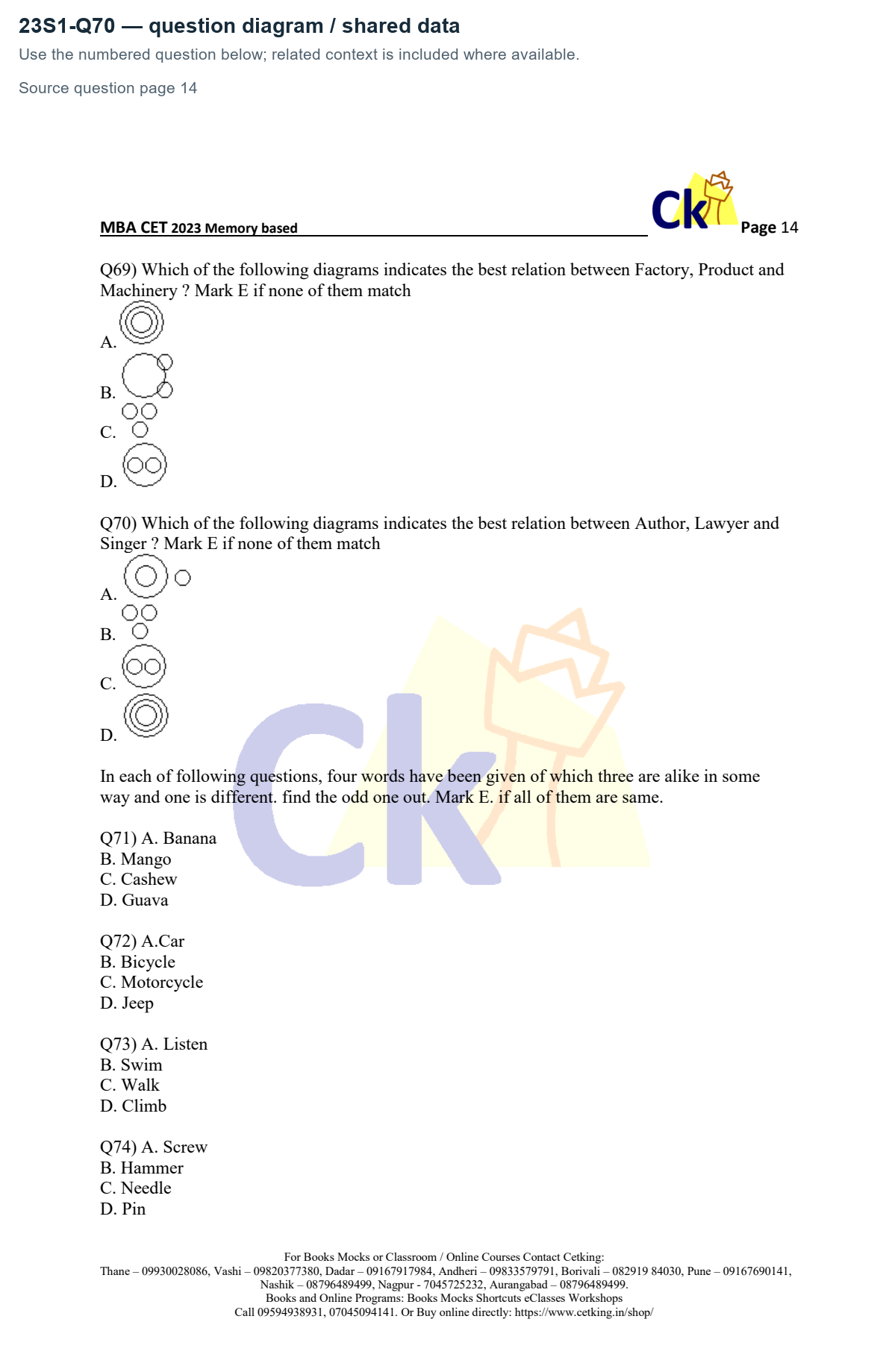
Which of the following diagrams indicates the best relation between Author, Lawyer and
Singer ? Mark E if none of them match
A.
B.
C.
D.
In each of following questions, four words have been given of which three are alike in some
way and one is different. find the odd one out. Mark E. if all of them are same.
Singer ? Mark E if none of them match
A.
B.
C.
D.
In each of following questions, four words have been given of which three are alike in some
way and one is different. find the odd one out. Mark E. if all of them are same.
Answer: E. if all of them are same.
Solution — first steps
A person may be an author,lawyer,singer in any combination, so the three sets should overlap pairwise and jointly. None ofA–D depicts this.
The full step-by-step working opens with a free login.
Direction (76-80) Read following passage carefully and answer the given questions. Mark E if
none of the option is correct.
Ever since the dawn of civilization, persons in power have tried to control education .
During the Christian Era, the ecclesiastics controlled the institution of education and diffused
among the people the gospel of the Bible and religious teachings.
They taught the poor people to be meek and to earn their bread with the sweat of their brow.
while the priests and the landlords. lived in luxury. During the Renaissance, education passed
from the clutches of the priests into the hands of the prince. It became more secular. Thus,
under the control of the monarch, education began to preach the infallibility of the monarch
which meant that the king could do no wrong. With the advent of Industrial Revolution,
education no longer remained the privilege of the baron class, but was thrown open to the new
rich merchant class. The philosophy in vogue during this period was that of 'Laissez Faire ---
restricting the function of the state to merely keeping law and order, while in actual practice the
law of the jungle prevailed in the form of free competition and the survival of the fittest.
During the Christian Era, the institution of the education was controlled by
A. the monarchs
B. the secular leaders of the society
C. the common people
D. the church and the priests
Answer: D. the church and the priests
Solution — first steps
The passage says ecclesiastics controlled education during the Christian era. Thus church and priests,D.
The full step-by-step working opens with a free login.
Direction (76-80) Read following passage carefully and answer the given questions. Mark E if
none of the option is correct.
Ever since the dawn of civilization, persons in power have tried to control education .
During the Christian Era, the ecclesiastics controlled the institution of education and diffused
among the people the gospel of the Bible and religious teachings.
They taught the poor people to be meek and to earn their bread with the sweat of their brow.
while the priests and the landlords. lived in luxury. During the Renaissance, education passed
from the clutches of the priests into the hands of the prince. It became more secular. Thus,
under the control of the monarch, education began to preach the infallibility of the monarch
which meant that the king could do no wrong. With the advent of Industrial Revolution,
education no longer remained the privilege of the baron class, but was thrown open to the new
rich merchant class. The philosophy in vogue during this period was that of 'Laissez Faire ---
restricting the function of the state to merely keeping law and order, while in actual practice the
law of the jungle prevailed in the form of free competition and the survival of the fittest.
During the Renaissance, education was controlled by
A. the common people
B. the secular leaders of the society
C. the princes
D. the church and the priests
Answer: C. the princes
Solution — first steps
The passage explicitly says Renaissance education passed into the hands of the prince. C.
The full step-by-step working opens with a free login.
Direction (76-80) Read following passage carefully and answer the given questions. Mark E if
none of the option is correct.
Ever since the dawn of civilization, persons in power have tried to control education .
During the Christian Era, the ecclesiastics controlled the institution of education and diffused
among the people the gospel of the Bible and religious teachings.
They taught the poor people to be meek and to earn their bread with the sweat of their brow.
while the priests and the landlords. lived in luxury. During the Renaissance, education passed
from the clutches of the priests into the hands of the prince. It became more secular. Thus,
under the control of the monarch, education began to preach the infallibility of the monarch
which meant that the king could do no wrong. With the advent of Industrial Revolution,
education no longer remained the privilege of the baron class, but was thrown open to the new
rich merchant class. The philosophy in vogue during this period was that of 'Laissez Faire ---
restricting the function of the state to merely keeping law and order, while in actual practice the
law of the jungle prevailed in the form of free competition and the survival of the fittest.
Under the control of monarch, education began to preach
A. that kings were gods
B. that the king was infallible
C. that the king, like common man could also do wrong
D. none of the above
Answer: B. that the king was infallible
Solution — first steps
The passage calls the monarch infallible, meaning unable to do wrong. B.
The full step-by-step working opens with a free login.
Direction (76-80) Read following passage carefully and answer the given questions. Mark E if
none of the option is correct.
Ever since the dawn of civilization, persons in power have tried to control education .
During the Christian Era, the ecclesiastics controlled the institution of education and diffused
among the people the gospel of the Bible and religious teachings.
They taught the poor people to be meek and to earn their bread with the sweat of their brow.
while the priests and the landlords. lived in luxury. During the Renaissance, education passed
from the clutches of the priests into the hands of the prince. It became more secular. Thus,
under the control of the monarch, education began to preach the infallibility of the monarch
which meant that the king could do no wrong. With the advent of Industrial Revolution,
education no longer remained the privilege of the baron class, but was thrown open to the new
rich merchant class. The philosophy in vogue during this period was that of 'Laissez Faire ---
restricting the function of the state to merely keeping law and order, while in actual practice the
law of the jungle prevailed in the form of free competition and the survival of the fittest.
With the advent of Industrial Revolution, education
A. was the sole privilege of the baron class
B. was thrown open to the new rich merchant class
C. was free for the poor
D. none of the above
Answer: B. was thrown open to the new rich merchant class
Solution — first steps
The passage explicitly opens education to the newly rich merchant class after the Industrial Revolution. B.
The full step-by-step working opens with a free login.