Let’s Crack CET 2027

Log in to track · your CET progress

Clocks – MBA CET questions with solutions

10 questions · CET 2025–2026 · Easy 6 · Medium 4 · Hard 0. Newest paper first. Full papers

Q137MediumCET 2026 · Attempt 2 Slot 2 · Q137
A clock is correctly set at 5:00 a.m. but loses 16 minutes every 24 hours. If the clock shows 10:00 p.m. on the fourth day, what is the actual time at that moment ?
  1. 1.00 p.m.
  2. 11.00 p.m.
  3. 12 p.m.
  4. 12 a.m.
  5. 11.30 a.m.
Show answerHide answer

Answer: B official key

Approach: Faulty clock: real time / clock time = 24 h / (24 h − loss).

Solution:
Clock loses 16 min per 24 h → in 24 real hours it shows 23 h 44 min = 1424 min.
From 5:00 a.m. (day 1) to 10:00 p.m. (day 4) on the clock = 3 days + 17 h = 89 h.
Real time elapsed = 89 × 1440/1424 = 89 × 90/89 = 90 h.
5:00 a.m. + 90 h = 5:00 a.m. + 3 days 18 h = 11:00 p.m. on day 4.

Cetking shortcut: 1424/1440 = 89/90 — so 89 clock-hours = 90 real hours; the clock is exactly 1 hour slow.

Answer: B
Q138EasyCET 2026 · Attempt 2 Slot 2 · Q138
What will be the measure of angle in degrees between the two hands of an ordinary clock at 2:30 PM ?
  1. 105°
  2. 120°
  3. 115°
  4. 125°
  5. 110°
Show answerHide answer

Answer: A official key

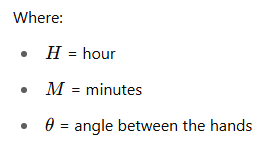
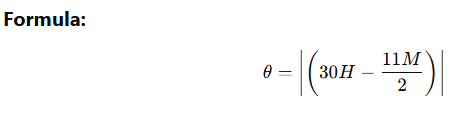
Approach: Angle = |30H − 5.5M|.

Solution:
H = 2, M = 30.
Angle = |30 × 2 − 5.5 × 30| = |60 − 165| = 105°.

Cetking shortcut: At 2:30 the minute hand is at 180°, hour hand at 60° + 15° = 75° → 105°.

Answer: A

Q123MediumCET 2026 · Slot 5 · Q123

Between 1 hour and 12 hours, how many times will the hour hand and minute hand be together (coincide)?

  1. 9 times
  2. 11 times
  3. 13 times
  4. 10 times
  5. 14 times
Show answerHide answer

Answer: B official key

Approach: The hands coincide 11 times in every 12 hours, once every 65 5/11 min.

Solution:
From 1 o'clock up to 12 o'clock the hands coincide at about 1:05, 2:11, 3:16, 4:22, 5:27, 6:33, 7:38, 8:44, 9:49, 10:54 — that is 10 times — and again at 12:00.
Total = 10 + 1 = 11 times.

Why the other options are wrong:

  • A (9), C (13), E (14): not consistent with one coincidence every 65 5/11 min.
  • D (10): leaves out the 12:00 coincidence.
  • 12 would assume one coincidence per hour, which is wrong because the hands do not meet between 11 and 1 o'clock except at 12.

Cetking shortcut: In 12 hours → 11 times; in 24 hours → 22 times. Between 11 and 1 o'clock the hands meet only once (at 12).

Answer: B

Q130MediumCET 2026 · Slot 3 · Q130
In a 24-hour period, the hour and minute hands of a clock are at right angles to each other excluding all positions where the hands overlap or are directly opposite. How many such right-angle positions occur?
  1. 40
  2. 42
  3. 44
  4. 46
  5. 48
Show answerHide answer

Answer: C official key

Approach: In 12 hours the hands are at right angles 22 times (not 24); double it for a day.

Solution:
In 12 hours the minute hand gains 11 full rounds on the hour hand.
Each round produces 2 right angles → 22 right angles in 12 hours.
In 24 hours: 22 × 2 = 44.
Overlaps and straight-line positions are separate events and are not counted anyway.

Why the other options are wrong:

  • E (48): assumes 2 per hour × 24 — ignores that the hands gain only 22 rounds in a day.
  • A, B, D: miscounts.

Cetking shortcut: Right angles = 44, straight (opposite) = 22, coincide = 22 in a day — memorise this triplet.

Answer: C

Q125EasyCET 2026 · Slot 1 · Q125

A clock shows 7 o'clock in the morning. By how much angle will the hour hand rotate when the clock shows 11:30 in the morning?

  1. 40°
  2. 125°
  3. 135°
  4. 150°
  5. 90°
Show answerHide answer

Answer: C official key

  1. From 7:00 to 11:30 is 4.5 hours.
  2. Hour hand moves 30° per hour: 4.5 × 30 = 135°.

Why not the others:

  • (A) 40°: wrong.
  • (B) 125°: wrong.
  • (D) 150°: that is 5 hours.
  • (E) 90°: that is 3 hours.

Quick check: 0.5° per minute × 270 minutes = 135°.

Answer: (C)

Q138EasyCET 2026 · Slot 1 · Q138
An accurate clock shows 3 o'clock in the afternoon. Through how many degrees will the hour hand rotate when the clock shows 9 o'clock of the same evening?
  1. 140°
  2. 170°
  3. 180°
  4. 110°
  5. 100°
Show answerHide answer

Answer: C official key

  1. 3 pm to 9 pm = 6 hours.
  2. Hour hand rotates 30 degrees per hour: 6 x 30 = 180 degrees.

Why not the others:

  • (A) 140: wrong.
  • (B) 170: wrong.
  • (D) 110: wrong.
  • (E) 100: wrong.

Quick check: Half a full turn = 180.

Answer: (C)

Q139EasyCET 2026 · Slot 1 · Q139
What is the angle between the hour and minute hands of a clock at 8:00?
  1. 110°
  2. 150°
  3. 180°
  4. 190°
  5. 120°
Show answerHide answer

Answer: E official key

  1. At 8:00 minute hand at 12, hour hand at 8.
  2. Angle = 8 x 30 = 240 degrees, smaller angle = 360 - 240 = 120 degrees.

Why not the others:

  • (A) 110: wrong.
  • (B) 150: that is at 5:00/7:00.
  • (C) 180: that is 6:00.
  • (D) 190: wrong.

Quick check: 4 hour-gaps x 30 = 120.

Answer: (E)

Q144EasyCET 2025 · Slot 5 · Q144

An accurate clock shows 8 o'clock in the morning. Through how may degrees will the hour hand rotate when the clock shows 2 o'clock in the afternoon?

  1. 144 degrees
  2. 160 degrees
  3. 180 degrees
  4. 90 degrees
  5. 125 degrees
Show answerHide answer

Answer: C

Approach: The hour hand moves 30° per hour.

Solution:
8 a.m. to 2 p.m. = 6 hours
Rotation = 6 × 30° = 180°

Why the other options are wrong:
A/B/D/E: not multiples of 30° for whole hours (except D = 3 hours).

Answer: C

Q149EasyCET 2025 · Slot 4 · Q149

The angle between the minute hand and the hour hand of a clock when the time is 4.20, is

  1. 3 degree
  2. 5 degree
  3. 8 degree
  4. 10 degree
  5. 12 degree
Show answerHide answer

Answer: D

Approach: Clock angle formula.

Solution:
At 4:20, H = 4, M = 20.
Angle = |30 × 4 − 5.5 × 20| = |120 − 110| = 10°.

Why the other options are wrong:
A, B, C, E: not |120 − 110|.

Cetking shortcut: Minute hand at 4 exactly (120°); hour hand has moved 20 × 0.5 = 10° past 4 ⇒ 10°.

Answer: D

Solution figure for question 149Solution figure for question 149Solution figure for question 149
Q134MediumCET 2025 · Slot 3 · Q134
A watch which gains uniformly is 2 min low at noon on Monday and is 4 min. 48sec fast at 2pm on the following Monday. When was it correct?
  1. 2pm on Tuesday
  2. 2pm on Wednesday
  3. 2pm on Thursday
  4. 1pm on Friday
  5. 2pm on Monday
Show answerHide answer

Answer: B

Approach: Error changes from −2 min to +4 min 48 s uniformly.

Solution: Time elapsed: Monday 12 noon → next Monday 2 pm = 7 days 2 h = 170 h.
Total gain = 2 min + 4 min 48 s = 6 min 48 s = 6.8 min.
To be correct it must gain 2 min → time needed = 170 × 2/6.8 = 50 h.
Monday 12 noon + 50 h = Wednesday 2 pm.

Answer: B

Practise these in the Arena

Take timed tests built around MBA CET topics and see where you stand.

Open the Arena
Compare CET 2027 programmes
BooksProMocksProShortcutsProBest valueCompletePro
Priceincl. GST₹1,999Inclusive of GST₹2,799₹2,999Inclusive of GST₹10,000₹14,999Inclusive of GST₹18,000₹19,999Inclusive of GST
Planning — Syllabus, Plans, Cutoffs, Strategies
Weekly Plans✓✓✓✓
Pro Calculators✓✓✓✓
MockNiti✓✓—✓
CET Study — Improvement
Purple Books✓——✓
100 G Strategy Shortcuts¹——✓✓
10 Sacred Art of Tukka²——✓✓
Cetking Bibles✓✓✓✓
Practice — From Zero to Expert with timer
40 Mocks—✓—✓
10 PYQs—✓—✓
30 Sectionals✓✓—✓
Arena Pro✓✓✓✓
GDPI — Interview Ready
GDPI Prep———✓
CMAT 2027 Program for +⁠₹100—

Not ready yet? Try our FREE Pack — 1 Full Length Mock, 5 PYQs, Calculators, Arena Access, Weekly Plan

Try for Free
  • ¹ 100 Sacred Art of Shortcuts workshops (Recorded + Live)
  • ² 10 Sacred Art of Tukka workshops (Recorded + Live)

What next

Admit cards · CAT admit card · © Cetking Universe · Terms & Privacy · By using this site, you agree to Cetking's Terms.