Let’s Crack CET 2027

Your CET check-up · tap a ring to see yours

Number Series (Quant) – MBA CET questions with solutions

17 questions · CET 2025–2026 · Easy 15 · Medium 2 · Hard 0. Newest paper first. Full papers

Q150MediumCET 2026 · Attempt 2 Slot 2 · Q150
Given below is the sequence of series. Analyse the pattern of the series and find the missing next term in the series:
5, 11, 17, 23, 31, ....
  1. 37
  2. 39
  3. 41
  4. 43
  5. 47
Show answerHide answer

Official CET key: C · Cetking's answer: A — see why below

Approach: Prime-number series: every alternate prime.

Solution:
Primes: 2, 3, 5, 7, 11, 13, 17, 19, 23, 29, 31, 37, 41, 43 …
The series takes the 3rd, 5th, 7th, 9th, 11th primes → next is the 13th prime = 41.
(Equivalently: each term skips exactly one prime — after 31 skip 37 → 41.)

Why the other options are wrong:
A (37): the prime right after 31 — but the series always skips one prime.
B (39): not prime (3 × 13).
D (43): skips two primes.
E (47): skips three primes.

Cetking shortcut: When the gap breaks from a steady +6 (23 → 31), test the prime list.

Answer: C
Q109EasyCET 2026 · Attempt 2 Slot 1 · Q109

Find the missing number in the series:

7, 22, 24, 73, 75, ?

  1. 150
  2. 226
  3. 225
  4. 95
  5. 81
Show answerHide answer

Answer: B official key

Approach: Alternating operations series: ×3 + 1, then +2.

Solution:
7 × 3 + 1 = 22
22 + 2 = 24
24 × 3 + 1 = 73
73 + 2 = 75
75 × 3 + 1 = 226

Why the other options are wrong:
C (225) is ×3 without +1; A (150) is ×2; D, E break the pattern.

Cetking shortcut: Jumps of +2 every alternate term signal a two-operation cycle; the other step is ×3 + 1.

Answer: B

Q110EasyCET 2026 · Attempt 2 Slot 1 · Q110

Find the missing number in the following series:

16, 40, 140, 630, ?, 22522.5

  1. 3485
  2. 3380
  3. 3930
  4. 3465
  5. 3845
Show answerHide answer

Answer: D official key

Approach: Multiplier series with the multiplier rising by 1.

Solution:
16 × 2.5 = 40
40 × 3.5 = 140
140 × 4.5 = 630
630 × 5.5 = 3465
Check: 3465 × 6.5 = 22,522.5 ✓

Cetking shortcut: A fractional last term (22522.5) hints at ×(n.5) multipliers; verify with the last term.

Answer: D

Q125EasyCET 2026 · Attempt 2 Slot 1 · Q125

Find the odd number in the following series:

216, 214, 211, 206, 200, 188

  1. 206
  2. 188
  3. 211
  4. 200
  5. 214
Show answerHide answer

Answer: D official key

Approach: Differences follow consecutive primes.

Solution:
Differences should be −2, −3, −5, −7, −11.
216 − 2 = 214, 214 − 3 = 211, 211 − 5 = 206, 206 − 7 = 199, 199 − 11 = 188.
The series shows 200 instead of 199, so 200 is the odd one.

Why the other options are wrong:
A, B, C, E all fit the prime-difference pattern.

Cetking shortcut: 188 fits only from 199 (199 − 11), which confirms 200 is wrong.

Answer: D

Q126EasyCET 2026 · Attempt 2 Slot 1 · Q126

Find the odd one out from the following numbers:

510, 254, 126, 64, 30, 14, 6

  1. 254
  2. 126
  3. 64
  4. 30
  5. 6
Show answerHide answer

Answer: C official key

Approach: Each term = (previous − 2) ÷ 2, i.e. terms are 2ⁿ − 2.

Solution:
510 = 2⁹ − 2, 254 = 2⁸ − 2, 126 = 2⁷ − 2, next should be 2⁶ − 2 = 62.
Then 30 = 2⁵ − 2, 14 = 2⁴ − 2, 6 = 2³ − 2.
64 breaks the pattern (should be 62).

Cetking shortcut: All numbers except 64 are 2 less than a power of 2.

Answer: C

Q103EasyCET 2026 · Slot 5 · Q103

Find the missing term in the following series.

6, ? , 21 ,33, 48

  1. 10
  2. 14
  3. 12
  4. 18
  5. 20
Show answerHide answer

Answer: C official key

Approach: Difference series — differences grow by 3.

Solution:
Known gaps: 33 − 21 = 12, 48 − 33 = 15 → differences rise by 3.
So the earlier gaps are 6 and 9: 6 + 6 = 12, 12 + 9 = 21 ✓.
Missing term = 12.

Why the other options are wrong:

  • A (10), B (14), D (18), E (20): break the +6, +9, +12, +15 pattern (e.g. 14 → gaps 8, 7).

Cetking shortcut: Work backwards from the known end: 21 − 9 = 12.

Answer: C

Q104EasyCET 2026 · Slot 5 · Q104

In the following question, a number series is given with one term missing.
Find the missing term from the given alternatives.

456.5, 407, 368.5, 341, 324.5, ?

  1. 309
  2. 319
  3. 317
  4. 323
  5. 321
Show answerHide answer

Answer: B official key

Approach: Second-difference series — the gaps fall by a constant 11.

Solution:
Differences: 456.5 − 407 = 49.5; 407 − 368.5 = 38.5; 368.5 − 341 = 27.5; 341 − 324.5 = 16.5.
Gaps fall by 11 each time: 49.5, 38.5, 27.5, 16.5 → next gap = 5.5.
Next term = 324.5 − 5.5 = 319.

Why the other options are wrong:

  • A (309), C (317), D (323), E (321): imply gaps 15.5, 7.5, 1.5, 3.5 — none continues the −11 pattern.

Cetking shortcut: Once the first two gaps (49.5, 38.5) show a drop of 11, keep dropping the gap by 11: 16.5 → 5.5, so 324.5 − 5.5 = 319.

Answer: B

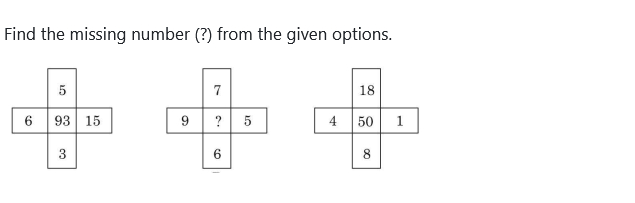
Q106MediumCET 2026 · Slot 5 · Q106

Find the missing number (?) from the given options.

Figure: three cross-shaped boxes (top, left, centre, right, bottom).

CrossTopLeftCentreRightBottom
15693153
279?56
31845018
Figure for MBA CET 2026 Slot 5 question 106
  1. 27
  2. 19
  3. 76
  4. 89
  5. 58
Show answerHide answer

Answer: D official key

Approach: Figure number puzzle — find the rule using the two complete crosses.

Solution:
Cross 1 (top 5, left 6, right 15, bottom 3): 5 × 15 + 6 × 3 = 75 + 18 = 93 ✓.
Cross 3 (top 18, left 4, right 1, bottom 8): 18 × 1 + 4 × 8 = 18 + 32 = 50 ✓.
Rule: centre = (top × right) + (left × bottom).
Cross 2 (top 7, left 9, right 5, bottom 6): 7 × 5 + 9 × 6 = 35 + 54 = 89.

Why the other options are wrong:

  • A (27), B (19), C (76), E (58): do not satisfy top×right + left×bottom for cross 2.

Cetking shortcut: Try products of 'diagonal-neighbour' pairs first; check the rule on both complete figures before applying it.

Answer: D

Q128EasyCET 2026 · Slot 5 · Q128

Identify the Odd One Out :

7, 12, 19, 26, 39, 52

  1. 19
  2. 26
  3. 39
  4. 12
  5. 52
Show answerHide answer

Answer: B official key

Approach: Difference series with consecutive odd differences.

Solution:
Expected differences: +5, +7, +9, +11, +13.
7 + 5 = 12 ✓, 12 + 7 = 19 ✓, 19 + 9 = 28 (given 26 ✗), 28 + 11 = 39 ✓, 39 + 13 = 52 ✓.
26 is the odd one out (should be 28).

Why the other options are wrong:

  • A (19), C (39), D (12), E (52): all fit the +5, +7, +9, +11, +13 pattern.

Cetking shortcut: Check the term from both sides: 39 − 11 = 28 confirms the correct value, so 26 is wrong.

Answer: B

Q129EasyCET 2026 · Slot 5 · Q129

Identify the one that does not belong to this group.

120, 720, 5040, 40320, 52480

  1. 120
  2. 5040
  3. 40320
  4. 52480
  5. 720
Show answerHide answer

Answer: D official key

Approach: Factorial pattern.

Solution:
120 = 5!, 720 = 6!, 5040 = 7!, 40320 = 8!.
52480 is not a factorial (9! = 362880).
So 52480 does not belong.

Why the other options are wrong:

  • A, B, C, E: 5!, 7!, 8!, 6! — all factorials.

Cetking shortcut: Ratios of consecutive terms 6, 7, 8 reveal factorials; 52480/40320 is not an integer.

Answer: D

Q130EasyCET 2026 · Slot 5 · Q130

Which one does not belong to group?

9:32, 13:44, 8:30, 10:35, 7:26

  1. 9:32
  2. 13:44
  3. 8:30
  4. 10:35
  5. 7:26
Show answerHide answer

Answer: C official key

Approach: Pair relation: second = 3 × first + 5.

Solution:
9 → 3 × 9 + 5 = 32 ✓; 13 → 44 ✓; 10 → 35 ✓; 7 → 26 ✓.
8 → 3 × 8 + 5 = 29, but given 30 ✗.
8 : 30 is the odd one.

Why the other options are wrong:

  • A, B, D, E: all satisfy second = 3 × first + 5.

Cetking shortcut: Take two pairs to fix a linear rule (9→32, 10→35 → slope 3, intercept 5) and test the rest.

Answer: C

Q107EasyCET 2026 · Slot 3 · Q107

Find the next number in the given series:

650, 601, 565, 540, 524, ?

  1. 520
  2. 518
  3. 515
  4. 514
  5. 512
Show answerHide answer

Answer: C official key

Approach: Difference series — differences are consecutive perfect squares.

Solution:
Differences: 650→601 = −49, 601→565 = −36, 565→540 = −25, 540→524 = −16.
These are −7², −6², −5², −4² → next is −3² = −9.
524 − 9 = 515.

Cetking shortcut: Whenever differences are 49, 36, 25… think squares immediately.

Answer: C

Q108EasyCET 2026 · Slot 3 · Q108

Find the missing number in the following series:

94, 118, 158, ?, 286, 374

  1. 198
  2. 206
  3. 214
  4. 226
  5. 232
Show answerHide answer

Answer: C official key

Approach: Second-difference series — the differences grow by a constant 16.

Solution:
Known differences: 118 − 94 = 24, 158 − 118 = 40 (+16).
Next differences: 56, 72, 88.
Missing term = 158 + 56 = 214.
Check: 214 + 72 = 286, 286 + 88 = 374. ✓

Cetking shortcut: Use the end: 374 − 286 = 88, so the difference before is 72 → 286 − 72 = 214.

Answer: C

Q137EasyCET 2026 · Slot 3 · Q137
Four of the following five number pairs are alike in a certain way. Which one does not belong to that group?

15 – 46, 12 – 37, 9 – 28, 8 – 33, 20 – 61

  1. 20–61
  2. 8–33
  3. 9–28
  4. 12–37
  5. 5 – 46
Show answerHide answer

Answer: B official key

Approach: Find the rule linking the two numbers of each pair: second = 3 × first + 1.

Solution:
15 → 46 (45 + 1), 12 → 37 (36 + 1), 9 → 28 (27 + 1), 20 → 61 (60 + 1).
8 → 3 × 8 + 1 = 25, but the pair shows 33 → odd one out.

Why the other options are wrong:

  • A, C, D, E: all follow ×3 + 1 (E is the stem's 15–46 pair, printed as '5 – 46' in the option).

Answer: B

Q138EasyCET 2026 · Slot 3 · Q138
Four of the following five are alike in a certain way and so form a group. Which one of the following does not belong to that group?

123, 25, 341, 218, 62

  1. 62
  2. 218
  3. 341
  4. 25
  5. 123
Show answerHide answer

Answer: B official key

Approach: Compare each number with the nearby perfect cube.

Solution:
25 = 3³ − 2, 62 = 4³ − 2, 123 = 5³ − 2, 341 = 7³ − 2.
218 = 6³ + 2 → the only one with +2 → odd one out.

Why the other options are wrong:

  • A, C, D, E: all are n³ − 2.

Cetking shortcut: Numbers just below/above 27, 64, 125, 216, 343 → test cubes first.

Answer: B

Q140EasyCET 2026 · Slot 2 · Q140

DIRECTION for the question: Find the next number in the sequence

7, 26, 63, 124, 215, 342, (---)

  1. 481
  2. 400
  3. 511
  4. 391
  5. 421
Show answerHide answer

Answer: C official key

Approach: Compare each term with a perfect cube.

Solution: 7 = 2³ − 1, 26 = 3³ − 1, 63 = 4³ − 1, 124 = 5³ − 1, 215 = 6³ − 1, 342 = 7³ − 1.
Next = 8³ − 1 = 512 − 1 = 511.

Why the other options are wrong:
A (481), E (421), D (391), B (400): none is 8³ − 1.

Cetking shortcut: Differences 19, 37, 61, 91, 127 rise by 18, 24, 30, 36 → next difference 169 → 342 + 169 = 511.

Answer: C

Q141EasyCET 2025 · Slot 1 · Q141
Choose the correct option that should come next in the series given below :
2, 1, (1/2), (1/4), ...
Figure for MBA CET 2025 Slot 1 question 141
  1. 1/16
  2. 2/8
  3. 1/3
  4. 1/32
  5. 1/8
Show answerHide answer

Answer: E

Approach: Identify the common ratio.

Solution:
2 → 1 → ½ → ¼: each term is half the previous one
Next term = ¼ × ½ = 1/8

Why the other options are wrong:
A (1/16), D (1/32): skip one or two terms.
B (2/8): equals 1/4, the current term.
C (1/3): breaks the halving pattern.

Answer: E

Practise these in the Arena

Take timed tests built around MBA CET topics and see where you stand.

Open the Arena
