Let’s Crack CET 2027

Your CET check-up · tap a ring to see yours

Scheduling Based – MBA CET questions with solutions

19 questions · CET 2025–2026 · Easy 2 · Medium 14 · Hard 3. Newest paper first. Full papers

Q18MediumCET 2026 · Slot 5 · Q18

Read the Information given below carefully and answer the Question that follows :

Masoomeh Restaurant, stays open every Monday to Saturday but is closed on all Sundays. On Mondays, Tuesdays and Thursdays, only Lunch is served. On Wednesdays, Fridays, and Saturdays, just dinner is served.

The Restaurant's floors are polished and plants are watered only on days that the Restaurant is open for business, according to the following schedule :

√Plants are watered two days each week, but never on consecutive days and never on the same day that floors are polished ;

√Floors are polished on Monday and two other days each week, but never on consecutive days and never on the same day that plants are watered.

According to the given schedule, the Restaurant's floors are polished on :

  1. Either Tuesday or Wednesday
  2. Either Wednesday or Thursday
  3. Either Monday or Wednesday
  4. Either Tuesday or Friday
  5. Either Friday or Saturday
Show answerHide answer

Answer: B official key

Approach: Scheduling with non-consecutive and exclusion rules.

Solution:
Open days: Mon–Sat. Floors: Monday + 2 more days, no two consecutive → Tuesday is out.
Possible extra pairs from Wed–Sat (non-consecutive): {Wed, Fri}, {Wed, Sat}, {Thu, Sat}.
Check watering (2 non-consecutive days from the rest):
{Mon, Wed, Fri} → water Tue & Thu / Tue & Sat / Thu & Sat ✓
{Mon, Wed, Sat} → water Tue & Thu / Tue & Fri ✓
{Mon, Thu, Sat} → water Tue & Fri / Wed & Fri ✓
Every valid schedule polishes on Wednesday or Thursday → Either Wednesday or Thursday.

Why the other options are wrong:
A) Tuesday is never possible (next to Monday); {Mon, Thu, Sat} has neither Tue nor Wed.
C) Monday is fixed every week, so it is not an 'either' choice.
D) Tuesday is impossible and {Mon, Wed, Sat} has no Friday.
E) Friday or Saturday also holds in every valid schedule, but the key is B (Wednesday or Thursday).

Answer: B
Q73HardCET 2026 · Slot 5 · Q73

Read the information given below carefully and answer the question that follows :

An academic research journal plans to publish 18 research papers, written by eight authors (A, B, C, D, E, F, G, and H) in four issues of the journal scheduled in January, April, July and October. Each of the research papers was written by exactly one of the eight authors. Five papers were scheduled in each of the first two issues, while four were scheduled in each of the last two issues. Every author wrote at least one paper and at most three papers. The total number of papers written by A, D, G and H was double the total number of papers written by the other four authors. Four of the authors were from India and two each were from Japan and China. Each author belonged to exactly one of the three areas — Manufacturing, Automation and Logistics. Four of the authors were from the Logistics area and two were from the Automation area. As per the journal policy, none of the authors could have more than one paper in any issue of the journal. The following additional facts are also known :

1. F, an Indian author from the Logistics area, wrote only one paper. It was scheduled in the October issue.
2. A was from the Automation area and did not have a paper scheduled in the October issue.
3. None of the Indian authors were from the Manufacturing area and none of the Japanese or Chinese authors were from the Automation area.
4. A and H were from different countries, but had their papers scheduled in exactly the same issues.
5. C and E, both Chinese authors from different areas, had the same number of papers scheduled. Further, E had papers scheduled in consecutive issues of the journal but C did not.
6. B, from the Logistics area, had a paper scheduled in the April issue of the journal.
7. B and G belonged to the same country. None of their papers were scheduled in the same issue of the journal.
8. D, a Japanese author from the Manufacturing area, did not have a paper scheduled in the July issue.
9. C and H belonged to different areas.

Question :

How many research papers were written by Indian authors ?

  1. 11
  2. 7
  3. 10
  4. 8
  5. 4
Show answerHide answer

Official CET key: D · Cetking's answer: E — see why below

Approach: Fix paper counts from the totals, then countries from the area rules.

Solution:
18 papers; A + D + G + H = 2 × (B + C + E + F) → A + D + G + H = 12, B + C + E + F = 6.
Max 3 each → A = D = G = H = 3.
F = 1 → B + C + E = 5, with C = E.
Countries: C, E Chinese; D Japanese; F Indian. B and G share a country → both Indian (Japan has only 2 places).
A is from Automation; Japanese/Chinese are never in Automation → A is Indian. A and H differ → H is Japanese.
Indians: A, B, F, G.
G (3 papers) shares no issue with B, and B has an April paper → G is in Jan, Jul, Oct, so B can use only April → B = 1, C = E = 2.
Papers by Indians = A 3 + G 3 + B 1 + F 1 = 8.

Why the other options are wrong:
C (10) takes B = 3; B (7) ignores B's paper; A, E do not fit the forced counts.

Answer: D

Q47EasyCET 2026 · Slot 4 · Q47

Five meetings A, B, C, D, E are scheduled on five different days from Monday to Friday.

Conditions:

  1. D was scheduled on Tuesday.
  2. B was scheduled immediately after D.
  3. C was scheduled before E.
  4. A was not on Monday.

Which meeting was scheduled on Monday?

  1. B
  2. A
  3. E
  4. C
  5. D
Show answerHide answer

Answer: D official key

Approach: Day-wise scheduling, Monday–Friday.

Solution:
D = Tuesday; B is immediately after D → Wednesday.
Monday, Thursday, Friday remain for A, C, E.
A is not on Monday; E cannot be on Monday because C must be before E.
So Monday = C (A and E take Thursday/Friday).

Why the other options are wrong:
A B – Wednesday.
B A – barred from Monday.
C E – must come after C.
E D – Tuesday.

Answer: D

Q68MediumCET 2025 · Slot 6 · Q68
Passage / data for this question
5 roommates ranjita, sanjana, Teena, ujjwala, and vajita each do one of housekeeping task.—Mopping sweeping laundry, vacuuming or dusting. One day a week Monday to Friday.
  • Vajita does not vacuum and does not do her task on Tuesday
  • sanjana does the dusting and does not do it on monday or Friday
  • The mopping is done on Thursday
  • Teena does her work which is not vacuuming on Wednesday.
  • The laundry is done on Friday and not by Ujjwala
  • Ranjita does her task on Monday
When does Sanjana do dusting?
  1. Friday
  2. Monday
  3. Tuesday
  4. Wednesday
  5. Thursday
Show answerHide answer

Answer: C

Approach: Day–person–task scheduling grid.

Solution: Ranjita = Monday, Teena = Wednesday. Sanjana dusts, not Mon/Fri; Wednesday is Teena's and Thursday is mopping → Sanjana = Tuesday.
Thursday and Friday remain for Ujjwala and Vajita. Laundry is on Friday and not by Ujjwala → Vajita = Friday (laundry), Ujjwala = Thursday (mopping).
Sweeping and vacuuming remain for Ranjita and Teena; Teena does not vacuum → Teena sweeps, Ranjita vacuums.

DayMonTueWedThuFri
PersonRanjitaSanjanaTeenaUjjwalaVajita
TaskVacuumingDustingSweepingMoppingLaundry
Sanjana dusts on Tuesday.

Why the other options are wrong: Monday is Ranjita's, Wednesday Teena's, Thursday mopping, Friday laundry.

Cetking shortcut: Lock the days given directly (Mon, Wed), then the task tied to a day (mopping Thu, laundry Fri) — Sanjana's day is forced at once.

Answer: C

Q69MediumCET 2025 · Slot 6 · Q69
Passage / data for this question
5 roommates ranjita, sanjana, Teena, ujjwala, and vajita each do one of housekeeping task.—Mopping sweeping laundry, vacuuming or dusting. One day a week Monday to Friday.
  • Vajita does not vacuum and does not do her task on Tuesday
  • sanjana does the dusting and does not do it on monday or Friday
  • The mopping is done on Thursday
  • Teena does her work which is not vacuuming on Wednesday.
  • The laundry is done on Friday and not by Ujjwala
  • Ranjita does her task on Monday
what task does Teena do on Wednesday?
  1. Vacuuming
  2. Dusting
  3. Mopping
  4. Sweeping
  5. Laundry
Show answerHide answer

Answer: D

Approach: Day–person–task scheduling grid.

Solution: Ranjita = Monday, Teena = Wednesday. Sanjana dusts, not Mon/Fri; Wednesday is Teena's and Thursday is mopping → Sanjana = Tuesday.
Thursday and Friday remain for Ujjwala and Vajita. Laundry is on Friday and not by Ujjwala → Vajita = Friday (laundry), Ujjwala = Thursday (mopping).
Sweeping and vacuuming remain for Ranjita and Teena; Teena does not vacuum → Teena sweeps, Ranjita vacuums.

DayMonTueWedThuFri
PersonRanjitaSanjanaTeenaUjjwalaVajita
TaskVacuumingDustingSweepingMoppingLaundry
Teena sweeps on Wednesday.

Why the other options are wrong: Vacuuming is excluded for Teena; dusting is Sanjana's; mopping Thursday; laundry Friday.

Cetking shortcut: Lock the days given directly (Mon, Wed), then the task tied to a day (mopping Thu, laundry Fri) — Sanjana's day is forced at once.

Answer: D

Q70MediumCET 2025 · Slot 6 · Q70
Passage / data for this question
5 roommates ranjita, sanjana, Teena, ujjwala, and vajita each do one of housekeeping task.—Mopping sweeping laundry, vacuuming or dusting. One day a week Monday to Friday.
  • Vajita does not vacuum and does not do her task on Tuesday
  • sanjana does the dusting and does not do it on monday or Friday
  • The mopping is done on Thursday
  • Teena does her work which is not vacuuming on Wednesday.
  • The laundry is done on Friday and not by Ujjwala
  • Ranjita does her task on Monday
What day is vacuuming done?
  1. Friday
  2. Monday
  3. Tuesday
  4. Wednesday
  5. Thursday
Show answerHide answer

Answer: B

Approach: Day–person–task scheduling grid.

Solution: Ranjita = Monday, Teena = Wednesday. Sanjana dusts, not Mon/Fri; Wednesday is Teena's and Thursday is mopping → Sanjana = Tuesday.
Thursday and Friday remain for Ujjwala and Vajita. Laundry is on Friday and not by Ujjwala → Vajita = Friday (laundry), Ujjwala = Thursday (mopping).
Sweeping and vacuuming remain for Ranjita and Teena; Teena does not vacuum → Teena sweeps, Ranjita vacuums.

DayMonTueWedThuFri
PersonRanjitaSanjanaTeenaUjjwalaVajita
TaskVacuumingDustingSweepingMoppingLaundry
Vacuuming is done on Monday (by Ranjita).

Why the other options are wrong: Tue = dusting, Wed = sweeping, Thu = mopping, Fri = laundry.

Cetking shortcut: Lock the days given directly (Mon, Wed), then the task tied to a day (mopping Thu, laundry Fri) — Sanjana's day is forced at once.

Answer: B

Q71MediumCET 2025 · Slot 6 · Q71
Passage / data for this question
5 roommates ranjita, sanjana, Teena, ujjwala, and vajita each do one of housekeeping task.—Mopping sweeping laundry, vacuuming or dusting. One day a week Monday to Friday.
  • Vajita does not vacuum and does not do her task on Tuesday
  • sanjana does the dusting and does not do it on monday or Friday
  • The mopping is done on Thursday
  • Teena does her work which is not vacuuming on Wednesday.
  • The laundry is done on Friday and not by Ujjwala
  • Ranjita does her task on Monday
what task does vajita do?
  1. Vacuuming
  2. Dusting
  3. Mopping
  4. Sweeping
  5. Laundry
Show answerHide answer

Answer: E

Approach: Day–person–task scheduling grid.

Solution: Ranjita = Monday, Teena = Wednesday. Sanjana dusts, not Mon/Fri; Wednesday is Teena's and Thursday is mopping → Sanjana = Tuesday.
Thursday and Friday remain for Ujjwala and Vajita. Laundry is on Friday and not by Ujjwala → Vajita = Friday (laundry), Ujjwala = Thursday (mopping).
Sweeping and vacuuming remain for Ranjita and Teena; Teena does not vacuum → Teena sweeps, Ranjita vacuums.

DayMonTueWedThuFri
PersonRanjitaSanjanaTeenaUjjwalaVajita
TaskVacuumingDustingSweepingMoppingLaundry
Vajita does the laundry (Friday).

Why the other options are wrong: Vacuuming = Ranjita, dusting = Sanjana, mopping = Ujjwala, sweeping = Teena.

Cetking shortcut: Lock the days given directly (Mon, Wed), then the task tied to a day (mopping Thu, laundry Fri) — Sanjana's day is forced at once.

Answer: E

Q72MediumCET 2025 · Slot 6 · Q72
Passage / data for this question
5 roommates ranjita, sanjana, Teena, ujjwala, and vajita each do one of housekeeping task.—Mopping sweeping laundry, vacuuming or dusting. One day a week Monday to Friday.
  • Vajita does not vacuum and does not do her task on Tuesday
  • sanjana does the dusting and does not do it on monday or Friday
  • The mopping is done on Thursday
  • Teena does her work which is not vacuuming on Wednesday.
  • The laundry is done on Friday and not by Ujjwala
  • Ranjita does her task on Monday
what day does ujjwala do her task?
  1. Monday
  2. Tuesday
  3. Wednesday
  4. Thursday
  5. Friday
Show answerHide answer

Answer: D

Approach: Day–person–task scheduling grid.

Solution: Ranjita = Monday, Teena = Wednesday. Sanjana dusts, not Mon/Fri; Wednesday is Teena's and Thursday is mopping → Sanjana = Tuesday.
Thursday and Friday remain for Ujjwala and Vajita. Laundry is on Friday and not by Ujjwala → Vajita = Friday (laundry), Ujjwala = Thursday (mopping).
Sweeping and vacuuming remain for Ranjita and Teena; Teena does not vacuum → Teena sweeps, Ranjita vacuums.

DayMonTueWedThuFri
PersonRanjitaSanjanaTeenaUjjwalaVajita
TaskVacuumingDustingSweepingMoppingLaundry
Ujjwala works on Thursday (mopping).

Why the other options are wrong: Mon, Tue, Wed and Fri are taken by Ranjita, Sanjana, Teena and Vajita.

Cetking shortcut: Lock the days given directly (Mon, Wed), then the task tied to a day (mopping Thu, laundry Fri) — Sanjana's day is forced at once.

Answer: D

Q41MediumCET 2025 · Slot 4 · Q41
Passage / data for this question

Study the following information and answer the question that follows:

Seven specialist doctors, P, Q, R, S, T, U and V, visit a polyclinic on any one of the four days in a week, i.e. on Tuesday, Wednesday, Friday or Saturday.

At least one doctor but not more than two doctors visit the polyclinic on each of these days. Each of them is a specialist in different fields - ENT, Orthopaedics, Paediatrics, Neurology, ophthalmology, Radiology and Oncology.

S visits on Friday with Radiologist, Paediatrician does not visit on Saturday nor with T and V.
Oncologist U visits alone on Tuesday.
Q visits on Wednesday and he is not a Paediatrician.
R visits on Wednesday.
V is not a Radiologist.
Paediatrician visits with ENT specialist.
Neurologist visits on Friday.
P is neither Orthopaedics nor Radiologist.

On which of the following days do the specialists in Orthopaedic and Ophthalmology visit?

  1. Tuesday
  2. Wednesday
  3. Friday
  4. Saturday
  5. Tuesday and Saturday
Show answerHide answer

Answer: D

Approach: Day scheduling with specialities — count slots first, then place fixed people.

Solution:
U (Oncologist) is alone on Tuesday → the other 6 doctors fill Wed, Fri, Sat with at most 2 each → exactly 2 per day.
Wednesday: Q and R.
Friday: S and the Radiologist (S visits with the Radiologist, so S is not the Radiologist). The Neurologist visits on Friday → S = Neurologist.
Remaining P, T, V fill Friday's second slot (the Radiologist) and Saturday. V is not Radiologist, P is not Radiologist → T = Radiologist, Friday. P and V → Saturday.
Paediatrician not on Saturday, not with T or V, and visits with ENT → the Wednesday pair. Q is not Paediatrician → R = Paediatrician, Q = ENT.
Saturday: Orthopaedics and Ophthalmology; P is not Orthopaedics → P = Ophthalmologist, V = Orthopaedics.

DayDoctors
TuesdayU – Oncology
WednesdayQ – ENT, R – Paediatrics
FridayS – Neurology, T – Radiology
SaturdayP – Ophthalmology, V – Orthopaedics

Orthopaedics (V) and Ophthalmology (P) both visit on Saturday.

Why the other options are wrong:
A: Tuesday has only the Oncologist.
B: Wednesday has ENT and Paediatrics.
C: Friday has Neurology and Radiology.
E: both are on Saturday only.

Cetking shortcut: 7 doctors, 4 days, max 2 per day, one day with 1 → every other day has exactly 2. Fix that before anything else.

Answer: D

Q42MediumCET 2025 · Slot 4 · Q42
Passage / data for this question

Study the following information and answer the question that follows:

Seven specialist doctors, P, Q, R, S, T, U and V, visit a polyclinic on any one of the four days in a week, i.e. on Tuesday, Wednesday, Friday or Saturday.

At least one doctor but not more than two doctors visit the polyclinic on each of these days. Each of them is a specialist in different fields - ENT, Orthopaedics, Paediatrics, Neurology, ophthalmology, Radiology and Oncology.

S visits on Friday with Radiologist, Paediatrician does not visit on Saturday nor with T and V.
Oncologist U visits alone on Tuesday.
Q visits on Wednesday and he is not a Paediatrician.
R visits on Wednesday.
V is not a Radiologist.
Paediatrician visits with ENT specialist.
Neurologist visits on Friday.
P is neither Orthopaedics nor Radiologist.

What is the profession of S?

  1. Oncologist
  2. Neurologist
  3. Radiologist
  4. Ophthalmologist
  5. ENT
Show answerHide answer

Answer: B

Approach: Day scheduling with specialities — count slots first, then place fixed people.

Solution:
U (Oncologist) is alone on Tuesday → the other 6 doctors fill Wed, Fri, Sat with at most 2 each → exactly 2 per day.
Wednesday: Q and R.
Friday: S and the Radiologist (S visits with the Radiologist, so S is not the Radiologist). The Neurologist visits on Friday → S = Neurologist.
Remaining P, T, V fill Friday's second slot (the Radiologist) and Saturday. V is not Radiologist, P is not Radiologist → T = Radiologist, Friday. P and V → Saturday.
Paediatrician not on Saturday, not with T or V, and visits with ENT → the Wednesday pair. Q is not Paediatrician → R = Paediatrician, Q = ENT.
Saturday: Orthopaedics and Ophthalmology; P is not Orthopaedics → P = Ophthalmologist, V = Orthopaedics.

DayDoctors
TuesdayU – Oncology
WednesdayQ – ENT, R – Paediatrics
FridayS – Neurology, T – Radiology
SaturdayP – Ophthalmology, V – Orthopaedics

S is the Neurologist: S visits on Friday with the Radiologist, so S is not the Radiologist, and the Neurologist must be on Friday.

Why the other options are wrong:
A: Oncologist is U (Tuesday).
C: Radiologist is S's companion T.
D: Ophthalmologist is P (Saturday).
E: ENT is Q (Wednesday).

Answer: B

Q43MediumCET 2025 · Slot 4 · Q43
Passage / data for this question

Study the following information and answer the question that follows:

Seven specialist doctors, P, Q, R, S, T, U and V, visit a polyclinic on any one of the four days in a week, i.e. on Tuesday, Wednesday, Friday or Saturday.

At least one doctor but not more than two doctors visit the polyclinic on each of these days. Each of them is a specialist in different fields - ENT, Orthopaedics, Paediatrics, Neurology, ophthalmology, Radiology and Oncology.

S visits on Friday with Radiologist, Paediatrician does not visit on Saturday nor with T and V.
Oncologist U visits alone on Tuesday.
Q visits on Wednesday and he is not a Paediatrician.
R visits on Wednesday.
V is not a Radiologist.
Paediatrician visits with ENT specialist.
Neurologist visits on Friday.
P is neither Orthopaedics nor Radiologist.

What is the specialty of P?

  1. ENT
  2. Ophthalmologist
  3. Neurologist
  4. Paediatrics
  5. Radiologist
Show answerHide answer

Answer: B

Approach: Day scheduling with specialities — count slots first, then place fixed people.

Solution:
U (Oncologist) is alone on Tuesday → the other 6 doctors fill Wed, Fri, Sat with at most 2 each → exactly 2 per day.
Wednesday: Q and R.
Friday: S and the Radiologist (S visits with the Radiologist, so S is not the Radiologist). The Neurologist visits on Friday → S = Neurologist.
Remaining P, T, V fill Friday's second slot (the Radiologist) and Saturday. V is not Radiologist, P is not Radiologist → T = Radiologist, Friday. P and V → Saturday.
Paediatrician not on Saturday, not with T or V, and visits with ENT → the Wednesday pair. Q is not Paediatrician → R = Paediatrician, Q = ENT.
Saturday: Orthopaedics and Ophthalmology; P is not Orthopaedics → P = Ophthalmologist, V = Orthopaedics.

DayDoctors
TuesdayU – Oncology
WednesdayQ – ENT, R – Paediatrics
FridayS – Neurology, T – Radiology
SaturdayP – Ophthalmology, V – Orthopaedics

P is the Ophthalmologist.

Why the other options are wrong:
A: ENT is Q.
C: Neurologist is S.
D: Paediatrics is R.
E: P is not the Radiologist (given); T is.

Answer: B

Q44MediumCET 2025 · Slot 4 · Q44
Passage / data for this question

Study the following information and answer the question that follows:

Seven specialist doctors, P, Q, R, S, T, U and V, visit a polyclinic on any one of the four days in a week, i.e. on Tuesday, Wednesday, Friday or Saturday.

At least one doctor but not more than two doctors visit the polyclinic on each of these days. Each of them is a specialist in different fields - ENT, Orthopaedics, Paediatrics, Neurology, ophthalmology, Radiology and Oncology.

S visits on Friday with Radiologist, Paediatrician does not visit on Saturday nor with T and V.
Oncologist U visits alone on Tuesday.
Q visits on Wednesday and he is not a Paediatrician.
R visits on Wednesday.
V is not a Radiologist.
Paediatrician visits with ENT specialist.
Neurologist visits on Friday.
P is neither Orthopaedics nor Radiologist.

On which day of the week does T visit?

  1. Wednesday
  2. Tuesday
  3. Friday
  4. Saturday
  5. Tuesday or Saturday
Show answerHide answer

Answer: C

Approach: Day scheduling with specialities — count slots first, then place fixed people.

Solution:
U (Oncologist) is alone on Tuesday → the other 6 doctors fill Wed, Fri, Sat with at most 2 each → exactly 2 per day.
Wednesday: Q and R.
Friday: S and the Radiologist (S visits with the Radiologist, so S is not the Radiologist). The Neurologist visits on Friday → S = Neurologist.
Remaining P, T, V fill Friday's second slot (the Radiologist) and Saturday. V is not Radiologist, P is not Radiologist → T = Radiologist, Friday. P and V → Saturday.
Paediatrician not on Saturday, not with T or V, and visits with ENT → the Wednesday pair. Q is not Paediatrician → R = Paediatrician, Q = ENT.
Saturday: Orthopaedics and Ophthalmology; P is not Orthopaedics → P = Ophthalmologist, V = Orthopaedics.

DayDoctors
TuesdayU – Oncology
WednesdayQ – ENT, R – Paediatrics
FridayS – Neurology, T – Radiology
SaturdayP – Ophthalmology, V – Orthopaedics

T (Radiologist) visits on Friday with S.

Why the other options are wrong:
A: Wednesday is Q and R.
B: Tuesday is U alone.
D, E: Saturday is P and V.

Answer: C

Q55MediumCET 2025 · Slot 4 · Q55
Passage / data for this question

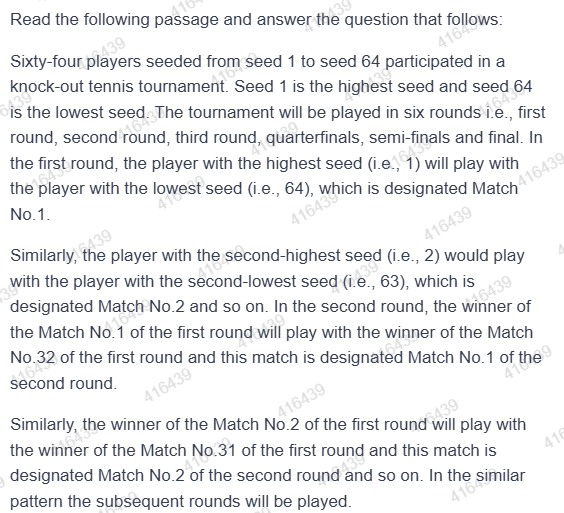
Sixty-four players seeded from seed 1 to seed 64 participated in a knock-out tennis tournament. Seed 1 is the highest seed and seed 64 is the lowest seed. The tournament will be played in six rounds i.e., first round, second round, third round, quarterfinals, semi-finals and final. In the first round, the player with the highest seed (i.e., 1) will play with the player with the lowest seed (i.e., 64), which is designated Match No.1.

Similarly, the player with the second-highest seed (i.e., 2) would play with the player with the second-lowest seed (i.e., 63), which is designated Match No.2 and so on. In the second round, the winner of the Match No.1 of the first round will play with the winner of the Match No.32 of the first round and this match is designated Match No.1 of the second round.

Similarly, the winner of the Match No.2 of the first round will play with the winner of the Match No.31 of the first round and this match is designated Match No.2 of the second round and so on. In the similar pattern the subsequent rounds will be played.

If the player seeded 43 won the tournament, then which of the following players cannot be the runner-up?
Figure for MBA CET 2025 Slot 4 question 55Figure for MBA CET 2025 Slot 4 question 55
  1. Player seeded 42
  2. Player seeded 44
  3. Player seeded 46
  4. Player seeded 45
  5. Player seeded 40
Show answerHide answer

Answer: C

Approach: Knockout bracket: the runner-up must come from the opposite half of the draw to the winner.

Solution:
Bracket rule (from the set): Round-1 match of seed s = min(s, 65−s); Round-2 match = min(m, 33−m); Round-3 match = min(m, 17−m); quarter-final = min(m, 9−m); semi-final = min(m, 5−m). Two seeds meet in the first round in which their numbers become equal.
Seed 43: 22 → 11 → 6 → QF 3 → SF 2 (lower half).
Seed 46: 19 → 14 → 3 → QF 3 → SF 2. Same Round-3 match as 43, so 46 would meet 43 in Round 3 and can never reach the final against him.
Seed 44: 21 → 12 → 5 → QF 4 → SF 1 (upper half) – can be runner-up. Seed 45: 20 → 13 → 4 → QF 4 → SF 1 – can. Seed 40: 25 → 8 → 8 → QF 1 → SF 1 – can.
So seed 46 cannot be the runner-up.

Why the other options are wrong:
B (44), D (45), E (40): all are in the other half (SF 1), so each can meet 43 in the final.
A (42): 23 → 10 → 7 → QF 2 → SF 2 — it is also in 43's half (they would meet in the semi-final), so strictly 42 also cannot be runner-up; the key takes 46, which sits in 43's own quarter.

Cetking shortcut: Fold the seed number: s → 65−s if s>32, then 33−, 17−, 9−, 5−. Same final number = same half.

Answer: C

Q56MediumCET 2025 · Slot 4 · Q56
Passage / data for this question

Sixty-four players seeded from seed 1 to seed 64 participated in a knock-out tennis tournament. Seed 1 is the highest seed and seed 64 is the lowest seed. The tournament will be played in six rounds i.e., first round, second round, third round, quarterfinals, semi-finals and final. In the first round, the player with the highest seed (i.e., 1) will play with the player with the lowest seed (i.e., 64), which is designated Match No.1.

Similarly, the player with the second-highest seed (i.e., 2) would play with the player with the second-lowest seed (i.e., 63), which is designated Match No.2 and so on. In the second round, the winner of the Match No.1 of the first round will play with the winner of the Match No.32 of the first round and this match is designated Match No.1 of the second round.

Similarly, the winner of the Match No.2 of the first round will play with the winner of the Match No.31 of the first round and this match is designated Match No.2 of the second round and so on. In the similar pattern the subsequent rounds will be played.

Who could be the lowest seeded player facing the player seeded 12 in the finals?
Figure for MBA CET 2025 Slot 4 question 56Figure for MBA CET 2025 Slot 4 question 56
  1. 57
  2. 63
  3. 62
  4. 59
  5. 65
Show answerHide answer

Answer: B

Approach: Knockout bracket: the final opponent must come from the half opposite to seed 12.

Solution:
Bracket rule (from the set): Round-1 match of seed s = min(s, 65−s); Round-2 match = min(m, 33−m); Round-3 match = min(m, 17−m); quarter-final = min(m, 9−m); semi-final = min(m, 5−m). Two seeds meet in the first round in which their numbers become equal.
Seed 12: 12 → 12 → 5 → QF 4 → SF 1 (upper half). Opponent must be in SF 2.
Try the lowest seeds first: seed 64: 1 → 1 → 1 → 1 → SF 1 (same half as 12) – not possible.
Seed 63: 2 → 2 → 2 → QF 2 → SF 2 (opposite half) – possible.
So the lowest-seeded player who can face seed 12 in the final is seed 63.

Why the other options are wrong:
A (57), C (62), D (59): all are higher seeds than 63, so not the lowest possible.
E (65): no such seed in a 64-player draw.

Cetking shortcut: Start from 64 and move upward; the first seed that lands in the other half is the answer.

Answer: B

Q57HardCET 2025 · Slot 4 · Q57
Passage / data for this question

Sixty-four players seeded from seed 1 to seed 64 participated in a knock-out tennis tournament. Seed 1 is the highest seed and seed 64 is the lowest seed. The tournament will be played in six rounds i.e., first round, second round, third round, quarterfinals, semi-finals and final. In the first round, the player with the highest seed (i.e., 1) will play with the player with the lowest seed (i.e., 64), which is designated Match No.1.

Similarly, the player with the second-highest seed (i.e., 2) would play with the player with the second-lowest seed (i.e., 63), which is designated Match No.2 and so on. In the second round, the winner of the Match No.1 of the first round will play with the winner of the Match No.32 of the first round and this match is designated Match No.1 of the second round.

Similarly, the winner of the Match No.2 of the first round will play with the winner of the Match No.31 of the first round and this match is designated Match No.2 of the second round and so on. In the similar pattern the subsequent rounds will be played.

If one of the matches was between the players seeded 23 and 46, then one of the matches in the tournament can be between players seeded
Figure for MBA CET 2025 Slot 4 question 57Figure for MBA CET 2025 Slot 4 question 57
  1. 9 and 13
  2. 6 and 18
  3. 5 and 51
  4. 20 and 35
  5. 17 and 15
Show answerHide answer

Answer: A

Approach: Knockout bracket: if 23 met 46, find the round of that meeting and who was eliminated on the way.

Solution:
Bracket rule (from the set): Round-1 match of seed s = min(s, 65−s); Round-2 match = min(m, 33−m); Round-3 match = min(m, 17−m); quarter-final = min(m, 9−m); semi-final = min(m, 5−m). Two seeds meet in the first round in which their numbers become equal.
Seed 23: 23 → 10 → 7 → QF 2 → SF 2. Seed 46: 19 → 14 → 3 → QF 3 → SF 2.
Different quarters, same half ⇒ 23 vs 46 is the semi-final. So every other player of quarters 2 and 3 was knocked out inside his own quarter and never played anyone outside it.
9 and 13: 9 → 9 → 8 → QF 1; 13 → 13 → 4 → QF 4 — both in the other half; QF 1 vs QF 4 is the other semi-final, so 9 vs 13 is possible.
6 (QF 3) & 18 (QF 2): could only meet in the semi-final, which is 23 vs 46 – impossible.
5 & 51, 20 & 35, 17 & 15: each pair could meet only in the final, but 51, 35 (QF 3) and 15 (QF 2) were already eliminated – impossible.

Cetking shortcut: Players from the quarters of 23 and 46 are "frozen" inside their own quarters; reject any pair that needs one of them to go beyond it.

Answer: A

Q46HardCET 2025 · Slot 2 · Q46
Passage / data for this question

Which of the following may be true?

Figure for MBA CET 2025 Slot 2 question 46
  1. Puneet scored 0 in the 5th test
  2. Urvisha scored 4 in the 8th test
  3. Urvisha scored 2 in the 1st test
  4. Puneet scored 4 in the 3rd test
  5. Urvisha scored 3 in the 2nd test
Show answerHide answer

Answer: C

Approach: Turn the clues into equations and list all cases (scores are integers 0–4).

Solution:
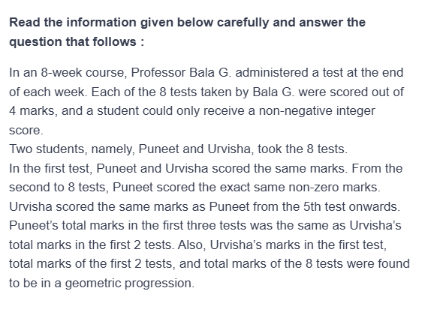
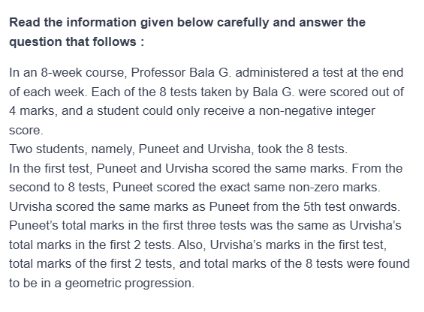
Let both score a in test 1; Puneet scores p (≠ 0) in each of tests 2–8; Urvisha scores U2, U3, U4 and then p in tests 5–8.
Puneet's first three = Urvisha's first two: a + 2p = a + U2 → U2 = 2p ≤ 4 → p = 1 or 2.
GP: a, a + 2p, total (a + 6p + U3 + U4) → (a + 2p)² = a(a + 6p + U3 + U4) → a(2p + U3 + U4) = 4p².
Valid cases:

p (Puneet, tests 2–8)U2 = 2pa (test 1, both)U3 + U4
1212
1220
2424
2440
(A) Puneet's 5th test = p ≠ 0 ✗. (B) Urvisha's 8th = p ≤ 2 ✗. (C) a = 2 occurs in two cases ✓. (D) Puneet's 3rd = p ≤ 2 ✗. (E) U2 = 2p is 2 or 4, never 3 ✗.

Cetking shortcut: U2 = 2p ≤ 4 immediately caps all of Puneet's tests 2–8 at 2 – that kills A, B, D, E.

Answer: C

Q47MediumCET 2025 · Slot 2 · Q47
Passage / data for this question

If Puneet scored 4 marks in the first test, how many marks did Urvisha score in the third test?

Figure for MBA CET 2025 Slot 2 question 47
  1. 0
  2. 1
  3. 3
  4. 2
  5. 4
Show answerHide answer

Answer: A

Approach: Use the case table from the set with a = 4.

Solution:
Let both score a in test 1; Puneet scores p (≠ 0) in each of tests 2–8; Urvisha scores U2, U3, U4 and then p in tests 5–8.
Puneet's first three = Urvisha's first two: a + 2p = a + U2 → U2 = 2p ≤ 4 → p = 1 or 2.
GP: a, a + 2p, total (a + 6p + U3 + U4) → (a + 2p)² = a(a + 6p + U3 + U4) → a(2p + U3 + U4) = 4p².
Puneet's 1st test = a = 4 → a(2p + U3 + U4) = 4p² → 2p + U3 + U4 = p².
p = 1: 2 + U3 + U4 = 1 ✗; p = 2: 4 + U3 + U4 = 4 → U3 = U4 = 0.
Urvisha's 3rd test = 0.

Answer: A

Q34MediumCET 2025 · Slot 1 · Q34

Seven experts, N, G, M, W, J, K and L give expert advice sessions to school students. These sessions can take place either before the school, during lunch period or after the school. In scheduling these sessions, the following conditions are followed. At least two experts must hold the sessions before school. At least three experts must hold their sessions after school. M is not available after school and J is available only after school. W always takes extra session during lunch. G will take session before school only if N is also scheduled before school.

Then, all the following statements could be true except :

  1. Twice as many expert take session after the school as before the school
  2. J will not take session during lunch period
  3. The same number of expert take session before school as lunch
  4. The same number of expert take session after school as lunch
  5. The same number of expert take session before school as after school
Show answerHide answer

Answer: D

Approach: Slot counting with minimums (7 experts, one slot each; W at lunch).

Solution:
Before ≥ 2, After ≥ 3, W is at lunch → Lunch ≤ 7 − 2 − 3 = 2.
So After (≥ 3) can never equal Lunch (≤ 2) → statement D is impossible.
Check the rest: A — Before 2, After 4, Lunch 1 (W) is possible.
B — J is only after school, so J is never at lunch (true).
C — Before 2, Lunch 2, After 3 is possible (e.g. N, G before; W, M lunch; J, K, L after).
E — Before 3, After 3, Lunch 1 is possible (N, G, M before; J, K, L after).

Cetking shortcut: Lunch has at most 2 people and After has at least 3 — any option equating them is out.

Answer: D

Q38EasyCET 2025 · Slot 1 · Q38

Visheshbar who is a food inspector has to inspect five restaurants A, B, C, D and E. Further, if he inspects B, he cannot inspect C immediately. If he inspects A, he cannot go to E after that. Which of the following can be the correct order of his inspection?

  1. ABCDE
  2. DCABE
  3. DCBEA
  4. DCBAE
  5. CDBEA
Show answerHide answer

Answer: C

Approach: Option testing against two conditions.

Solution:
Condition 1: C cannot come immediately after B.
Condition 2: once A is inspected, E cannot come later.
A ABCDE — B then C ✗.
B DCABE — A before E ✗.
C DCBEA — B is followed by E (not C) ✓; A is last, so nothing comes after it ✓.
D DCBAE — A before E ✗.
So DCBEA is a valid order.

Note: CDBEA (option E) also satisfies both conditions as printed; the key marks DCBEA.

Answer: C

Practise these in the Arena

Take timed tests built around MBA CET topics and see where you stand.

Open the Arena