Let’s Crack CET 2027

Your CET check-up · tap a ring to see yours

Cubes – MBA CET questions with solutions

12 questions · CET 2025–2026 · Easy 10 · Medium 2 · Hard 0. Newest paper first. Full papers

Q19MediumCET 2026 · Slot 5 · Q19

Count the number of Cubes in the figure given below :
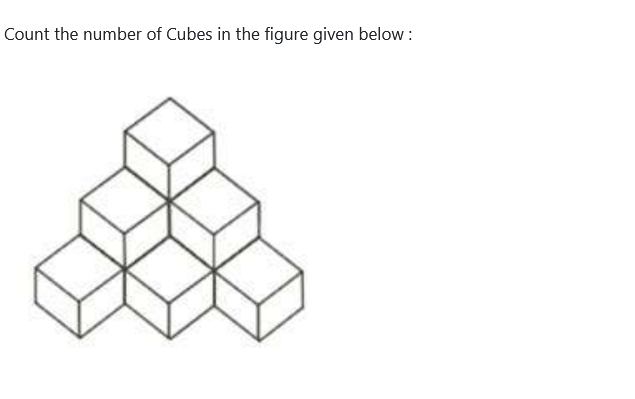
Figure for MBA CET 2026 Slot 5 question 19
  1. 9
  2. 13
  3. 8
  4. 11
  5. 10
Show answerHide answer

Official CET key: E · Cetking's answer: D — see why below

Approach: Count a stepped pyramid layer by layer, including hidden supporting cubes.

Solution:
The figure is a corner pyramid: each visible upper cube rests on cubes behind/below it.
Top layer: 1 cube
Middle layer: 2 visible + 1 hidden = 3 cubes (1 + 2)
Bottom layer: 3 visible + 3 hidden = 6 cubes (1 + 2 + 3)
Total = 1 + 3 + 6 = 10

Cetking shortcut: A triangular pyramid with n steps has triangular-number layers: 1 + 3 + 6 + … ; for 3 steps = 10.

Answer: E
Q96EasyCET 2026 · Slot 2 · Q96
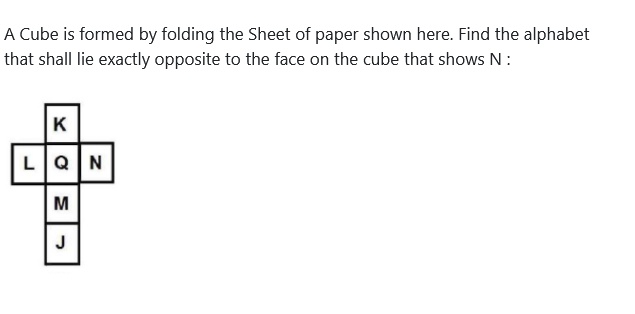
A Cube is formed by folding the Sheet of paper shown here. Find the alphabet that shall lie exactly opposite to the face on the cube that shows N :
Figure for MBA CET 2026 Slot 2 question 96
  1. K
  2. J
  3. L
  4. M
  5. Q
Show answerHide answer

Answer: C official key

Approach: In a cube net, faces in a straight line with one face between them are opposite.

Solution:
Net: column K–Q–M–J, with L and N on either side of Q.
Column: K opposite M, Q opposite J (alternate faces).
Row: L – Q – N → L opposite N.
Face opposite N = L.

Why the other options are wrong:
A (K), D (M), E (Q): share an edge with N when folded.
B (J): J is opposite Q, and adjacent to N.

Cetking shortcut: Skip one face in any straight row/column of the net → opposite pair.

Answer: C

Q93MediumCET 2025 · Slot 6 · Q93
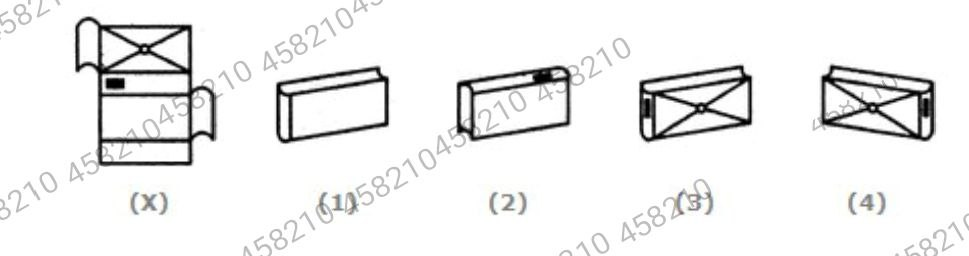
which of the following finished patterns can be obtained from a piece of cardboard shown below?
Figure for MBA CET 2025 Slot 6 question 93
  1. 1
  2. 2
  3. 3
  4. 4
  5. None of the above
Show answerHide answer

Answer: A

Approach: Box from a net — find which faces are adjacent and where the marks lie after folding.

Solution: In the net, the narrow strip with the small black mark lies between the cross-design face and the large plain face, and the mark is at its left end. The plain face and the cross-design face are opposite each other.
Box 1 shows the plain face in front with a plain narrow strip on top and an end flap — a valid view.
Box 2 has the black mark at the right end of the top strip; folding keeps it at the left end → not possible.
Boxes 3 and 4 show the cross-design face with a black mark on an end flap, but the mark is on a long strip, not on a flap → not possible.

Cetking shortcut: Track one distinctive mark (the black rectangle) — its position rules out most options.

Answer: A

Q46EasyCET 2025 · Slot 5 · Q46
Passage / data for this question

The following questions are based on the information given below:

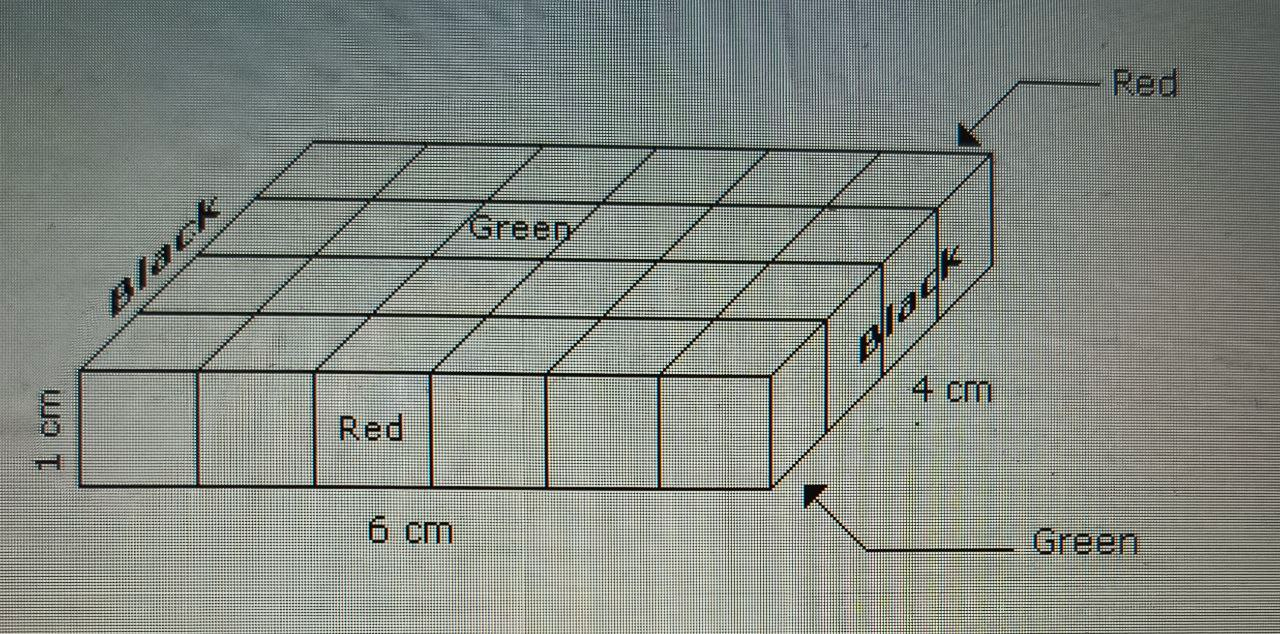
A cuboid shaped wooden block is 6 cm in length, 4 cm in breadth and 1 cm in height.
Two faces measuring 4 cm x 1 cm are coloured black.
Two faces measuring 6 cm x 1 cm are coloured red.
Two faces measuring 6 cm x 4 cm are coloured green
The block is divided into 6 equal cubes of side 1 cm (from 6 cm side), 4 equal cubes of side 1 cm (from 4 cm side).

How many cubes having red, green and black colours on at least one side of the cube will be formed ?

  1. 16
  2. 8
  3. 4
  4. 12
  5. 24
Show answerHide answer

Answer: C

Approach: Painted cuboid — cubes touching three different colours.

Solution: The block is 6 × 4 × 1 → 6 × 4 × 1 = 24 unit cubes in a single layer.
Because the height is 1, every cube has green on its top and bottom (the two 6 × 4 faces).
Black = the two 4 × 1 end faces (4 cubes each, 8 in all). Red = the two 6 × 1 side faces (6 cubes each).
Corner cubes (4): green, green, red, black. Edge non-corner cubes: green, green + one of red/black. Inner cubes: (6 − 2) × (4 − 2) = 8, green on two faces only.
Red, green and black together only where a red side meets a black end — the 4 corners → 4.

Why the other options are wrong:
A 16 — border cubes, but most have only two colours.
B 8 — inner cubes (green only) or black cubes.
D 12, E 24 — overcounts.

Cetking shortcut: Three different colours on one small cube = corner cube; a flat block has 4 such corners.

Answer: C

Solution figure for question 46
Q47EasyCET 2025 · Slot 5 · Q47
Passage / data for this question

The following questions are based on the information given below:

A cuboid shaped wooden block is 6 cm in length, 4 cm in breadth and 1 cm in height.
Two faces measuring 4 cm x 1 cm are coloured black.
Two faces measuring 6 cm x 1 cm are coloured red.
Two faces measuring 6 cm x 4 cm are coloured green
The block is divided into 6 equal cubes of side 1 cm (from 6 cm side), 4 equal cubes of side 1 cm (from 4 cm side).

How many small cubes will be formed ?

  1. 24
  2. 12
  3. 64
  4. 20
  5. 6
Show answerHide answer

Answer: A

Approach: Number of unit cubes = volume ÷ 1.

Solution: 6 × 4 × 1 = 24 cubes of side 1 cm.

Answer: A

Q48EasyCET 2025 · Slot 5 · Q48
Passage / data for this question

The following questions are based on the information given below:

A cuboid shaped wooden block is 6 cm in length, 4 cm in breadth and 1 cm in height.
Two faces measuring 4 cm x 1 cm are coloured black.
Two faces measuring 6 cm x 1 cm are coloured red.
Two faces measuring 6 cm x 4 cm are coloured green
The block is divided into 6 equal cubes of side 1 cm (from 6 cm side), 4 equal cubes of side 1 cm (from 4 cm side).

How many cubes will have 4 coloured sides and two non-coloured sides?

  1. 4
  2. 8
  3. 12
  4. 16
  5. 20
Show answerHide answer

Answer: A

Approach: Count coloured faces per position.

Solution: The block is 6 × 4 × 1 → 6 × 4 × 1 = 24 unit cubes in a single layer.
Because the height is 1, every cube has green on its top and bottom (the two 6 × 4 faces).
Black = the two 4 × 1 end faces (4 cubes each, 8 in all). Red = the two 6 × 1 side faces (6 cubes each).
Corner cubes (4): green, green, red, black. Edge non-corner cubes: green, green + one of red/black. Inner cubes: (6 − 2) × (4 − 2) = 8, green on two faces only.
4 coloured faces = green, green, red, black → only the corner cubes → 4.
(Edge cubes have 3 coloured faces; inner cubes have 2.)

Why the other options are wrong:
B 8 — inner cubes, which have only 2 coloured faces.
C 12 — edge cubes (3 coloured faces): 2 × 4 + 2 × 2 = 12.
D, E — no position gives these.

Answer: A

Q49EasyCET 2025 · Slot 5 · Q49
Passage / data for this question

The following questions are based on the information given below:

A cuboid shaped wooden block is 6 cm in length, 4 cm in breadth and 1 cm in height.
Two faces measuring 4 cm x 1 cm are coloured black.
Two faces measuring 6 cm x 1 cm are coloured red.
Two faces measuring 6 cm x 4 cm are coloured green
The block is divided into 6 equal cubes of side 1 cm (from 6 cm side), 4 equal cubes of side 1 cm (from 4 cm side).

How many cubes will have green colour on two sides and rest of the four sides having no colour ?

  1. 4
  2. 8
  3. 12
  4. 16
  5. 10
Show answerHide answer

Answer: B

Approach: Green on two sides only = cubes not on the border.

Solution: The block is 6 × 4 × 1 → 6 × 4 × 1 = 24 unit cubes in a single layer.
Because the height is 1, every cube has green on its top and bottom (the two 6 × 4 faces).
Black = the two 4 × 1 end faces (4 cubes each, 8 in all). Red = the two 6 × 1 side faces (6 cubes each).
Corner cubes (4): green, green, red, black. Edge non-corner cubes: green, green + one of red/black. Inner cubes: (6 − 2) × (4 − 2) = 8, green on two faces only.
Border cubes = 24 − inner = 24 − (4 × 2) = 16.
Only green (top and bottom) = inner cubes = (6 − 2) × (4 − 2) = 8.

Why the other options are wrong:
A 4 — corner cubes.
C 12 — edge non-corner cubes.
D 16 — all border cubes.

Cetking shortcut: Inner cubes of an l × b one-layer block = (l − 2)(b − 2).

Answer: B

Q50EasyCET 2025 · Slot 5 · Q50
Passage / data for this question

The following questions are based on the information given below:

A cuboid shaped wooden block is 6 cm in length, 4 cm in breadth and 1 cm in height.
Two faces measuring 4 cm x 1 cm are coloured black.
Two faces measuring 6 cm x 1 cm are coloured red.
Two faces measuring 6 cm x 4 cm are coloured green
The block is divided into 6 equal cubes of side 1 cm (from 6 cm side), 4 equal cubes of side 1 cm (from 4 cm side).

How many cubes will remain if the cubes having black and green colors are removed ?

  1. 8
  2. 12
  3. 16
  4. 20
  5. 10
Show answerHide answer

Answer: C

Approach: Remove cubes that carry black (all of them carry green).

Solution: The block is 6 × 4 × 1 → 6 × 4 × 1 = 24 unit cubes in a single layer.
Because the height is 1, every cube has green on its top and bottom (the two 6 × 4 faces).
Black = the two 4 × 1 end faces (4 cubes each, 8 in all). Red = the two 6 × 1 side faces (6 cubes each).
Corner cubes (4): green, green, red, black. Edge non-corner cubes: green, green + one of red/black. Inner cubes: (6 − 2) × (4 − 2) = 8, green on two faces only.
Black-and-green cubes = cubes on the two black end faces = 4 + 4 = 8.
Remaining = 24 − 8 = 16.

Why the other options are wrong:
A 8 — that is the number removed.
B 12, D 20, E 10 — wrong count of black cubes.

Cetking shortcut: Since every cube is green, "black and green" simply means "black": 2 ends × 4 cubes = 8.

Answer: C

Q49EasyCET 2025 · Slot 4 · Q49

A cube is divided into 343 identical cubelets. Each cut is made parallel to some surface of the cube. But before doing that the cube is colored with green on one set of adjacent faces, red on the second and blue on the third set. How many minimum cuts you have made?

  1. 15
  2. 18
  3. 12
  4. 7
  5. 13
Show answerHide answer

Answer: B

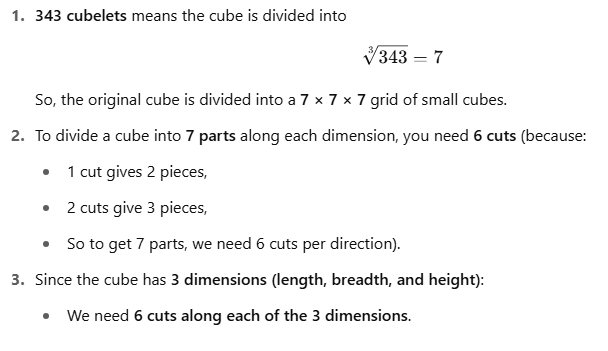
Approach: Cube cutting — n3 cubelets; 'set of faces' means a pair of opposite faces.

Solution:
343 = 73 → the cube is cut into 7 slices along each of the 3 directions.
7 slices need 6 cuts in one direction.
Total minimum cuts = 6 × 3 = 18.

Why the other options are wrong:
D (7): is the number of slices per edge, not cuts.
A, C, E: do not equal 3 × (n − 1).

Cetking shortcut: Minimum cuts for n × n × n = 3(n − 1).

Answer: B

Solution figure for question 49
Q50EasyCET 2025 · Slot 4 · Q50

A cube is divided into 343 identical cubelets. Each cut is made parallel to some surface of the cube. But before doing that the cube is colored with green on one set of adjacent faces, red on the second and blue on the third set. How many cubelets are coloured with exactly two colours?

  1. 49
  2. 55
  3. 60
  4. 25
  5. 45
Show answerHide answer

Answer: C

Approach: Cube cutting — n3 cubelets; 'set of faces' means a pair of opposite faces.

Solution:
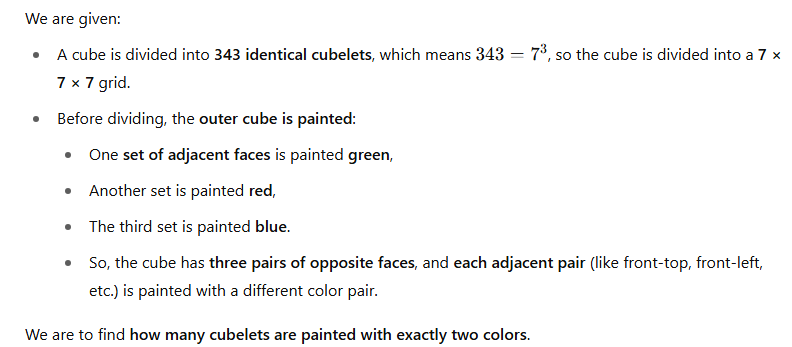
343 = 73 → n = 7.
Each of the 3 colours is on one pair of opposite faces, so every edge of the big cube joins two faces of different colours.
Corner cubelets touch 3 faces → 3 colours (8 of them).
Edge cubelets excluding corners touch exactly 2 faces → exactly 2 colours.
Per edge: n − 2 = 5 cubelets; 12 edges → 12 × 5 = 60.

Why the other options are wrong:
A (49): is one face's total (7 × 7).
D (25): one face's inner cubelets (5 × 5).
B (55), E (45): miscount of edges.

Cetking shortcut: Exactly two colours (opposite faces same colour) = 12(n − 2).

Answer: C

Solution figure for question 50Solution figure for question 50
Q93EasyCET 2025 · Slot 2 · Q93
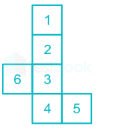
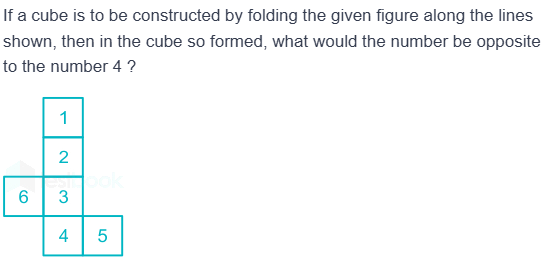
If a cube is to be constructed by folding the given figure along the lines shown, then in the cube so formed, what would the number be opposite to the number 4?
Figure for MBA CET 2025 Slot 2 question 93
  1. 1
  2. 2
  3. 3
  4. 5
  5. 6
Show answerHide answer

Answer: B

Approach: In a straight strip of faces in a net, alternate faces are opposite.

Solution:
The vertical strip is 1, 2, 3, 4 → 1 is opposite 3 and 2 is opposite 4.
6 (left of 3) and 5 (right of 4) are the remaining pair → 5 is opposite 6.
So the face opposite 4 is 2.

Answer: B

Q85EasyCET 2025 · Slot 1 · Q85

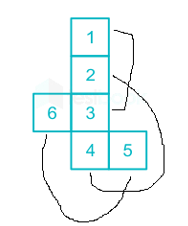
If a cube is to be constructed by folding the given figure along the lines shown, then in the cube so formed, what would the number be opposite to the number 4 ?

Figure for MBA CET 2025 Slot 1 question 85
  1. 1
  2. 2
  3. 3
  4. 5
  5. 6
Show answerHide answer

Answer: B

Approach: In a net, faces separated by one face in a straight line are opposite.

Solution:
Column 1-2-3-4: 1 is opposite 3, 2 is opposite 4.
6 (left of 3) and 5 (right of 4) fold onto opposite sides → 5 opposite 6.
So the number opposite 4 is 2.

Why the other options are wrong:
1 / 3: both adjacent to 4 (1 and 3 are opposite each other).
5 / 6: they are opposite each other, so adjacent to 4.

Cetking shortcut: Skip-one rule: in any straight line of the net, alternate faces are opposite.

Answer: B

Solution figure for question 85

Practise these in the Arena

Take timed tests built around MBA CET topics and see where you stand.

Open the Arena