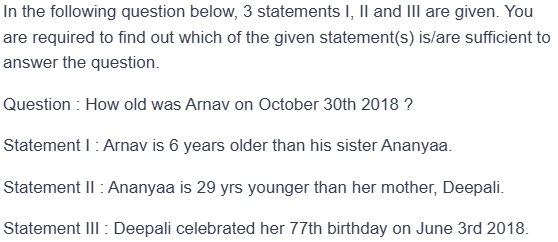
Read the Question shown below and Statement I & II that follow and then choose the most appropriate option that shall help in answering the question so asked :
Question : Find out the code for 'sky' in the code language?
Statement I : In a code language, 'sky is clear' is written as 'de ra fa'.
Statement II: In the same code language, 'make it clear' is written as 'de ga jo'.
- The data in Statement I alone is sufficient to answer the question, while the data in statement II alone is not sufficient to answer the question.
- The data in statement II alone are sufficient to answer the question, while the data in statement I alone are not sufficient to answer the qustion.
- The data either in Statement I alone or in Statement II alone is / are sufficient to answer the question.
- The data given in both Statements I and II together are not sufficient to answer the question.
- The data given in both Statements I and II together are necessary to answer the question.
Show answerHide answer
Answer: D official key
Approach: Data Sufficiency in coding: a word's code is fixed only when it is isolated by comparing sentences.
Solution:
Statement I: 'sky is clear' = 'de ra fa'. Three words, three codes, no order given, so 'sky' cannot be fixed.
Statement II alone: 'make it clear' = 'de ga jo'. 'sky' does not even appear, so not sufficient.
Together: the common word 'clear' takes the common code 'de'.
Left in Statement I: 'sky' and 'is' with codes 'ra' and 'fa' → either could be 'sky'.
So even both statements together cannot give the code for 'sky'.
Why the other options are wrong:
A: Statement I alone gives three possible codes for 'sky'.
B: Statement II does not contain 'sky'.
C: Neither statement alone works.
E: Even combined, 'ra'/'fa' remain undecided.
Cetking shortcut: After cancelling common words, if two unknown words still share two codes, the answer is 'not sufficient even together'.
Answer: D