Let’s Crack CET 2027

Your CET check-up · tap a ring to see yours

Factors – MBA CET questions with solutions

9 questions · CET 2025–2026 · Easy 6 · Medium 3 · Hard 0. Newest paper first. Full papers

Q104MediumCET 2026 · Attempt 2 Slot 2 · Q104
It is given that (2^32 + 1) is completely divisible by a whole number. Which of the following numbers is completely divisible by this number?
  1. (2^16 + 1)
  2. (2^16 - 1)
  3. (2^96 + 1)
  4. (2^96 - 1)
  5. (2^23 + 1)
Show answerHide answer

Answer: C official key

Approach: aⁿ + bⁿ is divisible by (a + b) when n is odd.

Solution:
Let a = 2³². Then 2⁹⁶ + 1 = a³ + 1 = (a + 1)(a² − a + 1).
So 2⁹⁶ + 1 is divisible by a + 1 = 2³² + 1.
Hence any number dividing 2³² + 1 also divides 2⁹⁶ + 1.

Why the other options are wrong:
A, B: 2¹⁶ ± 1 are smaller than 2³² + 1 and are factors of 2³² − 1, not multiples of 2³² + 1.
D: 2⁹⁶ − 1 = a³ − 1 is divisible by a − 1, not a + 1.
E: 23 is not a multiple of 32.

Cetking shortcut: Look for an option whose exponent is an ODD multiple of 32 with a '+1' → 96 = 3 × 32.

Answer: C
Q109EasyCET 2026 · Slot 4 · Q109
What is the smallest number by which 675 should be multiplied to obtain a perfect cube?
  1. 2
  2. 3
  3. 5
  4. 6
  5. 9
Show answerHide answer

Answer: C official key

Approach: Prime-factorise; every prime's power must be a multiple of 3 for a perfect cube.

Solution:
675 = 25 × 27 = 3³ × 5².
3³ is already a cube; 5² needs one more 5.
Multiply by 5: 675 × 5 = 3375 = 15³.

Why the other options are wrong:
A (2), D (6) – introduce a new prime 2.
B (3) – 3⁴ would spoil the cube.
E (9) – makes 3⁵.

Cetking shortcut: Group primes in triples; the missing members form the multiplier.

Answer: C

Q139MediumCET 2025 · Slot 6 · Q139
In how many ways the number 3234 can be written as the product of 2 numbers which are coprime to each other?
  1. 7
  2. 9
  3. 8
  4. 10
  5. 11
Show answerHide answer

Answer: C

Approach: Number of ways to write N as a product of two co-prime factors = 2k−1, k = number of distinct primes of N.

Solution:
3234 = 2 × 3 × 7² × 11 ⇒ distinct primes: 2, 3, 7, 11 ⇒ k = 4.
Each prime power must go wholly to one factor ⇒ 2⁴ = 16 ordered splits.
Unordered pairs = 16/2 = 8 (including 1 × 3234).

Why the other options are wrong:
B 9, D 10, E 11: overcount; A 7: excludes the pair 1 × 3234, which is co-prime.

Cetking shortcut: Just count distinct primes: k = 4 ⇒ 2³ = 8.

Answer: C

Q150EasyCET 2025 · Slot 6 · Q150
which of the following divides 3⁴⁵+ 3⁴⁶ + 3⁴⁷ + 3⁴⁸ + 3⁴⁹
  1. 3
  2. 5
  3. 2
  4. 11
  5. 4
Show answerHide answer

Answer: A

Approach: Take out the common factor 3⁴⁵.

Solution:
3⁴⁵ + 3⁴⁶ + 3⁴⁷ + 3⁴⁸ + 3⁴⁹ = 3⁴⁵(1 + 3 + 9 + 27 + 81) = 3⁴⁵ × 121 = 3⁴⁵ × 11².
So the sum is divisible by 3 (every term is a power of 3).

Why the other options are wrong:
B 5, C 2, E 4: the sum is odd and has no factor 5 (3⁴⁵ × 11² only).
D 11: also divides the sum (121 = 11²), so two options are valid; A is the stored key.

Cetking shortcut: Factor 3⁴⁵ out ⇒ 3⁴⁵ × 121: prime factors are only 3 and 11.

Answer: A

Q103EasyCET 2025 · Slot 5 · Q103

How many distinct prime factors are there in 9900?

  1. 7
  2. 4
  3. 11
  4. 5
  5. 15
Show answerHide answer

Answer: B

Approach: Prime factorise and count the different primes.

Solution:
9900 = 99 × 100
99 = 3² × 11; 100 = 2² × 5²
9900 = 2² × 3² × 5² × 11
Distinct primes: 2, 3, 5, 11 → 4

Why the other options are wrong:
A (7), C (11), D (5), E (15): confuse distinct primes with total prime factors (2+2+2+1 = 7) or with number of factors.

Answer: B

Q103EasyCET 2025 · Slot 3 · Q103
Which of the following numbers is divisible by 11?
  1. 4823718
  2. 4832718
  3. 8423718
  4. 8432718
  5. 4833777
Show answerHide answer

Answer: B

Approach: Divisibility test for 11 (alternate-digit difference).

Solution: Odd-place digits (from right) minus even-place digits:
A. 4823718: (8+7+2+4) − (1+3+8) = 21 − 12 = 9 → no
B. 4832718: (8+7+3+4) − (1+2+8) = 22 − 11 = 11 → divisible ✔
C. 8423718: (8+7+2+8) − (1+3+4) = 25 − 8 = 17 → no
D. 8432718: (8+7+3+8) − (1+2+4) = 26 − 7 = 19 → no
E. 4833777: (7+7+3+4) − (7+3+8) = 21 − 18 = 3 → no

Cetking shortcut: A and B differ only by swapping two adjacent digits (2,3); a swap changes the difference by 2 each step — test one pair and you know the other.

Answer: B

Q104MediumCET 2025 · Slot 3 · Q104
If the seven-digit number 876p37q is divisible by 225, then the values of p and q respectively are?
  1. 0 and 3
  2. 9 and 0
  3. 0 and 5
  4. 9 and 5
  5. 9 and 3
Show answerHide answer

Answer: C

Approach: 225 = 25 × 9 → apply both divisibility tests.

Solution: Divisible by 25 → last two digits 7q must be 00, 25, 50 or 75 → 7q = 75 → q = 5.
Divisible by 9 → digit sum 8 + 7 + 6 + p + 3 + 7 + 5 = 36 + p must be a multiple of 9 → p = 0 (or 9).
Both p = 0 and p = 9 pass the tests; the standard answer takes the smaller digit, so p = 0 and q = 5.

Why the other options are wrong: A, B, E have q = 3 or 0 → 73/70 not divisible by 25; D (9, 5) also satisfies both divisibility tests, so the question is ambiguous; the stored answer is the smaller-digit pair C.

Cetking shortcut: Fix q from the 25-rule first — it eliminates A, B, E instantly.

Answer: C

Q28EasyCET 2025 · Slot 2 · Q28

If a seven-digit number 876p37q is divisible by 225, then the values of p and q respectively are:

  1. 0 and 9
  2. 5 and 0
  3. 3 and 9
  4. 0 and 5
  5. 9 and 0
Show answerHide answer

Answer: D

Approach: 225 = 9 × 25 → test divisibility by 25 and by 9.

Solution:
By 25: last two digits 7q must be 00, 25, 50 or 75 → 75 → q = 5.
By 9: 8 + 7 + 6 + p + 3 + 7 + 5 = 36 + p must be a multiple of 9 → p = 0 or 9.
Options offer only (p, q) = (0, 5).

Why the other options are wrong: q = 9 or 0 makes the last two digits 79 or 70, not divisible by 25.

Cetking shortcut: Only one option has q = 5 → D.

Answer: D

Q103EasyCET 2025 · Slot 1 · Q103
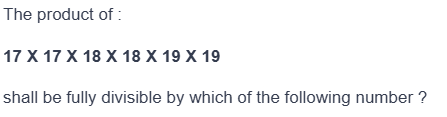
The product of : 17 X 17 X 18 X 18 X 19 X 19 shall be fully divisible by which of the following number ?
Figure for MBA CET 2025 Slot 1 question 103
  1. 971
  2. 173
  3. 646
  4. 23
  5. 5813
Show answerHide answer

Answer: C

Approach: Prime-factorise the product and each option.

Solution:
Product = 17² × 18² × 19² = 2² × 3⁴ × 17² × 19²
Prime factors available: 2, 3, 17, 19 only
646 = 2 × 17 × 19 → all three present → divides fully

Why the other options are wrong:
A: 971 is a prime not in the product.
B: 173 is a prime not in the product.
D: 23 is a prime not in the product.
E: 5813 is odd and not divisible by 3, 17 or 19, so it has a prime factor outside the product.

Cetking shortcut: Any option containing a prime other than 2, 3, 17, 19 is out — only 646 = 2 × 17 × 19 survives.

Answer: C

Solution figure for question 103

Practise these in the Arena

Take timed tests built around MBA CET topics and see where you stand.

Open the Arena