In questions below, each passage consist of six sentences. The first and sixth sentence are given in the beginning. The middle four sentences in each have been removed and jumbled up. These are labelled as P, Q, R and S. Find out the proper order for the four sentences.
| S1: | In the middle of one side of the square sits the Chairman of the committee, the most important person in the room. |
| P : | For a committee is not just a mere collection of individuals. |
| Q : | On him rests much of the responsibility for the success or failure of the committee. |
| R : | While this is happening we have an opportunity to get the 'feel' of this committee. |
| S : | As the meeting opens, he runs briskly a number of formalities. |
| S6: | From the moment its members meet, it begins to have a sort of nebulous life of its own. |
Find out the proper order for the four sentences.
- AQSRP
- BQSPR
- CQRPS
- DPQSR
- ERQSP
Show answerHide answer
Answer: A ✓ official key
Approach: Para jumble — pronoun links and time markers.
Solution: S1 introduces the Chairman → Q 'On him rests much of the responsibility…' (him = Chairman). → S 'As the meeting opens, he runs briskly through formalities.' → R 'While this is happening we … get the feel of this committee' (this = the formalities). → P 'For a committee is not just a mere collection of individuals' — explains why it has a 'feel', and leads into S6 'it begins to have a … life of its own'. Order: QSRP.
Why the other options are wrong:
B (QSPR): P cannot precede R — 'While this is happening' needs S directly before it.
C (QRPS): R's 'this' would have nothing to refer to.
D (PQSR), E (RQSP): Q's 'him' must come right after S1's Chairman.
Cetking shortcut: Lock pronoun links: S1→Q (him), S→R (this is happening), P→S6 (it = committee).
Answer: A
In questions below, each passage consist of six sentences. The first and sixth sentence are given in the beginning. The middle four sentences in each have been removed and jumbled up. These are labelled as P, Q, R and S. Find out the proper order for the four sentences.
S1: Smoke oozed up between the planks.
P : Passengers were told to be ready to quit the ship.
Q : The rising gale fanned the smouldering fire.
R : Everyone now knew there was fire on board.
S : Flames broke out here and there.
S6: Most people bore the shock bravely.
Find out the proper order for the four sentences.
- AQPSR
- BPSRQ
- CSRQP
- DQRSP
- ESPQR
Show answerHide answer
Answer: C ✓ official key
Approach: Para jumble — narrative sequence of a ship fire.
Solution: S1: smoke oozes up. → S 'Flames broke out here and there' (smoke turns into visible fire). → R 'Everyone now knew there was fire on board' (the flames make it known). → Q 'The rising gale fanned the smouldering fire' (it spreads, the danger grows). → P 'Passengers were told to be ready to quit the ship' — the order to which S6 'Most people bore the shock bravely' reacts. Order: SRQP.
Why the other options are wrong:
A (QPSR), B (PSRQ): evacuation (P) cannot come before everyone knows about the fire (R).
D (QRSP): R's 'now knew' needs a visible cause — flames (S) — before it.
E (SPQR): the order to quit (P) must lead into S6, so P is last.
Cetking shortcut: Fix the ends first: P must be last (it sets up 'bore the shock'), and 'now knew' (R) needs S before it → S R … P.
Answer: C
In questions below, each passage consist of six sentences. The first and sixth sentence are given in the beginning. The middle four sentences in each have been removed and jumbled up. These are labelled as P, Q, R and S. Find out the proper order for the four sentences.
S1: The city is almost a slum and stinks most of time.
P : The slush on the road did not deter them.
Q : The occasional slips and falls were considered a small price to pay for the trip.
R : They were excited, fascinated by the sight of fresh snow on the roads.
S : Even so, it looked beautiful to tourists of various categories.
S6: But some visitors came away with the unforgettable sight of young labours scantily clad.
Find out the proper order for the four sentences.
- ASPQR
- BRSPQ
- CQSPR
- DSQRP
- EPSQR
Show answerHide answer
Answer: A ✓ official key
Approach: Para jumble — contrast marker and pronoun chain.
Solution: S1: the city is almost a slum and stinks. → S 'Even so, it looked beautiful to tourists' (contrast with S1). → P 'The slush on the road did not deter them' (them = tourists). → Q 'The occasional slips and falls were … a small price to pay' (slips follow from slush). → R 'They were excited, fascinated by the sight of fresh snow' — the upbeat note that S6 contrasts with 'But some visitors came away with … young labourers scantily clad.' Order: SPQR.
Why the other options are wrong:
B (RSPQ): 'They' in R has no referent after S1.
C (QSPR), E (PSQR): 'Even so' (S) must directly answer S1's slum description.
D (SQRP): 'slips and falls' (Q) needs the slush (P) before it.
Cetking shortcut: 'Even so' signals the sentence right after the negative opener → S first; then 'slush → slips'.
Answer: A
In questions below, each passage consist of six sentences. The first and sixth sentence are given in the beginning. The middle four sentences in each have been removed and jumbled up. These are labelled as P, Q, R and S. Find out the proper order for the four sentences.
S1: The heart is pump of life.
P : They have even succeeded in heart transplants.
Q : Nowadays surgeons are able to stop a patients heart and carry out complicated operations.
R : A few years ago it was impossible to operate on a patient whose heart was not working properly.
S : If heart stops we die in about five minutes.
S6: All this was made possible by the invention of heart-lung machine.
Find out the proper order for the four sentences.
- ASPRQ
- BSRQP
- CSQRP
- DPRQS
- ERPQS
Show answerHide answer
Official CET key: B · Cetking's answer: C — see why below
Approach: Para jumble — past vs present contrast.
Solution: S1: the heart is the pump of life. → S 'If the heart stops we die in about five minutes' (why it is vital). → R 'A few years ago it was impossible to operate on a patient whose heart was not working' (past). → Q 'Nowadays surgeons are able to stop a patient's heart and operate' (present). → P 'They have even succeeded in heart transplants' (the climax). → S6 'All this was made possible by the heart-lung machine.' Order: SRQP.
Why the other options are wrong:
A (SPRQ): 'They' in P (surgeons) appears before surgeons are mentioned.
C (SQRP): 'Nowadays' (Q) should follow the 'few years ago' (R) contrast, not precede it.
D (PRQS), E (RPQS): S explains S1 and must come first; P cannot open.
Cetking shortcut: Time pair rule: 'a few years ago' → 'nowadays' → 'even' (climax).
Answer: B
In the question below, the passage consist of six sentences. The first and sixth sentence are given in the beginning and end respectively. The middle four sentences in each have been removed and jumbled up. These are labelled as P, Q, R and S. Find out the proper order for the four sentences.
S1: For decades, American society has been called a melting pot
P : Differences remained - in appearance, mannerisms, customs, speech, religion and more.
Q : The term has long been a cliche and half-truth.
R : But homogenisation was never achieved.
S : Yes, immigrants from diverse cultures and traditions did cast off vestiges of their native lands and become almost imperceptibly woven in to the American fabric.
S6: In recent years, such differences accentuated by the arrival of immigrants from Asia and other parts of the world in the United States - have become something to celebrate and to nurture.
Find out the proper order for the four sentences.
- AQRSP
- BSQRP
- CPQRS
- DPQSR
- ESQPR
Show answerHide answer
Answer: B ✓ official key
Approach: Para jumble — concession ('Yes…') then rebuttal ('But…').
Solution: S1: America has been called a melting pot. → S 'Yes, immigrants … did cast off vestiges of their native lands and become … woven into the American fabric' (the part that is true). → Q 'The term has long been a cliché and half-truth' (only half true). → R 'But homogenisation was never achieved' (the untrue half). → P 'Differences remained — in appearance, mannerisms, customs…' → S6 'such differences … have become something to celebrate.' Order: SQRP.
Why the other options are wrong:
A (QRSP): 'Yes, immigrants did…' (S) cannot come after 'homogenisation was never achieved' (R).
C (PQRS), D (PQSR): 'Differences remained' (P) must come just before S6's 'such differences'.
E (SQPR): R's 'But homogenisation…' must precede P, which illustrates it.
Cetking shortcut: Anchor P before S6 ('differences' → 'such differences'), then R before P.
Answer: B
This passage consists of jumbled up sentences / parts of sentence. Rearrange the sentences as per the proper order and identify the third sentence after rearrangement
a. everybody had exactly the same amount of money,
b. however, they forget that very few people would work at all,
c. One common mistake that many people have made is that,
d. if it were not for the money their work brings them,
e. they think it would be a very good thing if
f. and that without work there would be no money
g. no matter whether they worked hard or lived idly,
- Aa
- Bb
- Cd
- Df
- Eg
Show answerHide answer
Answer: A ✓ official key
Approach: Build the sentence using capitalisation and connectors (that / if / however / and that).
Solution: c is the only capitalised opener ('One common mistake ... is that,').
'is that, they think' → e; e ends with 'if' → needs a clause: a.
g ('no matter whether ...') qualifies a; b ('however, they forget') gives the counter-point.
b's 'very few people would work at all' → d's condition 'if it were not for the money ...'; f ('and that ...') is a second 'forget that' clause and closes.
Correct order: c – e – a – g – b – d – f
'One common mistake that many people have made is that, (c) they think it would be a very good thing if (e) everybody had exactly the same amount of money, (a) no matter whether they worked hard or lived idly, (g) however, they forget that very few people would work at all, (b) if it were not for the money their work brings them, (d) and that without work there would be no money (f).'
Third part = a.
Cetking shortcut: Lock c-e-a from grammar alone — the third slot is found without solving the full chain.
Answer: A
This passage consists of jumbled up sentences / parts of sentence. Rearrange the sentences as per the proper order and identify the sixth sentence after rearrangement.
a. everybody had exactly the same amount of money,
b. however, they forget that very few people would work at all,
c. One common mistake that many people have made is that,
d. if it were not for the money their work brings them,
e. they think it would be a very good thing if
f. and that without work there would be no money
g. no matter whether they worked hard or lived idly,
- Aa
- Bb
- Cc
- Dd
- Ef
Show answerHide answer
Answer: D ✓ official key
Approach: Build the full chain first, then read off the position asked.
Solution: c is the only capitalised opener ('One common mistake ... is that,').
'is that, they think' → e; e ends with 'if' → needs a clause: a.
g ('no matter whether ...') qualifies a; b ('however, they forget') gives the counter-point.
b's 'very few people would work at all' → d's condition 'if it were not for the money ...'; f ('and that ...') is a second 'forget that' clause and closes.
Correct order: c – e – a – g – b – d – f
'One common mistake that many people have made is that, (c) they think it would be a very good thing if (e) everybody had exactly the same amount of money, (a) no matter whether they worked hard or lived idly, (g) however, they forget that very few people would work at all, (b) if it were not for the money their work brings them, (d) and that without work there would be no money (f).'
Sixth part = d.
Cetking shortcut: b–d–f is a fixed tail: 'they forget that X would not work if not for money, and that without work no money'.
Answer: D
This passage consists of jumbled up sentences / parts of sentence. Rearrange the sentences as per the proper order and identify the second sentence after rearrangement.
a. also, at several places in the desert
b. A great part of Arabia is desert
c. The sand is so hot that you cannot walk over it with your bare feet in the daytime
d. here there is nothing but sand and rock
e. one can find springs of water
f. so deep that the sun cannot dry them up
g. that come from deep down under the ground
- Aa
- Bc
- Cd
- Df
- Eg
Show answerHide answer
Answer: C ✓ official key
Approach: Opener + pointer word: b introduces the desert, d's 'here' points back to it.
Solution: b opens (capitalised, introduces Arabia's desert); d's 'here' refers back to the desert.
c follows d: 'sand' was just mentioned, so 'The sand is so hot ...'.
a ('also, at several places in the desert') adds a new point → e (one can find springs of water) → g (that come from deep down) → f (so deep that ...).
Correct order: b – d – c – a – e – g – f
'A great part of Arabia is desert (b); here there is nothing but sand and rock (d). The sand is so hot that you cannot walk over it with your bare feet in the daytime (c). Also, at several places in the desert (a) one can find springs of water (e) that come from deep down under the ground (g), so deep that the sun cannot dry them up (f).'
Second part = d.
Cetking shortcut: Demonstratives/adverbs like 'here', 'there', 'this' attach immediately after the noun they refer to.
Answer: C
This passage consists of jumbled up sentences / parts of sentence. Rearrange the sentences as per the proper order and identify the fourth sentence after rearrangement.
a. also, at several places in the desert
b. A great part of Arabia is desert
c. The sand is so hot that you cannot walk over it with your bare feet in the daytime
d. here there is nothing but sand and rock
e. one can find springs of water
f. so deep that the sun cannot dry them up
g. that come from deep down under the ground
- Aa
- Bc
- Cd
- Df
- Eg
Show answerHide answer
Answer: A ✓ official key
Approach: Build the full chain first, then read off the position asked.
Solution: b opens (capitalised, introduces Arabia's desert); d's 'here' refers back to the desert.
c follows d: 'sand' was just mentioned, so 'The sand is so hot ...'.
a ('also, at several places in the desert') adds a new point → e (one can find springs of water) → g (that come from deep down) → f (so deep that ...).
Correct order: b – d – c – a – e – g – f
'A great part of Arabia is desert (b); here there is nothing but sand and rock (d). The sand is so hot that you cannot walk over it with your bare feet in the daytime (c). Also, at several places in the desert (a) one can find springs of water (e) that come from deep down under the ground (g), so deep that the sun cannot dry them up (f).'
Fourth part = a.
Cetking shortcut: e-g-f is a fixed relative chain (springs → that come from deep → so deep that ...), so a must sit just before it.
Answer: A
This passage consists of jumbled up sentences / parts of sentence. Rearrange the sentences as per the proper order and identify the second sentence after rearrangement.
a. partly according to the climate in which they live
b. The people of which it is made up
c. The human race is spread all over the world
d. and partly according to the kind of food
e. which their country produces
f. from the polar region to the tropics
g. eat different kinds of food
- Aa
- Bc
- Cd
- De
- Ef
Show answerHide answer
Answer: E ✓ official key
Approach: Opener + phrase that completes it.
Solution: c is the capitalised opener: 'The human race is spread all over the world'.
f extends the spread: 'from the polar region to the tropics'.
b ('The people of which it is made up') + g ('eat different kinds of food') + a ('partly according to the climate ...') + d ('and partly according to the kind of food') + e ('which their country produces').
Correct order: c – f – b – g – a – d – e. Second part = f.
Cetking shortcut: 'partly ... and partly ...' fixes a before d; 'which their country produces' must follow 'kind of food' — the tail a-d-e locks fast.
Answer: E
Given below are sentences labelled A, B, C, D and E in jumbled order. Arrange them in the correct sequence to form a meaningful and coherent paragraph.
A. This shift has forced organizations to rethink traditional management practices.
B. For decades, productivity was measured primarily in terms of output per hour.
C. Consequently, companies now emphasize innovation and adaptability over mere efficiency.
D. However, the rise of the digital economy has altered the very definition of productivity.
E. In knowledge-driven industries, creativity often outweighs routine efficiency.
- ABDAEC
- BBDEAC
- CDBAEC
- DBADEC
- EDEBAC
Show answerHide answer
Answer: B ✓ official key
Approach: Para jumble — opener, contrast word, example, pronoun reference, conclusion.
Solution: B opens with the past view ("For decades, productivity was measured…"). D contrasts with "However, the rise of the digital economy has altered the definition". E explains how: in knowledge-driven industries creativity outweighs routine efficiency. A — "This shift" refers to the change described in D–E — forced organizations to rethink management. C — "Consequently, companies now emphasize innovation…" — is the result and closing line. Order: BDEAC.
Why the other options are wrong:
A: BDAEC puts "This shift" before E, separating E from the definition change it explains.
C: DBAEC opens with "However", which needs a prior idea.
D: BADEC uses "This shift" before any shift is mentioned.
E: DEBAC opens with "However" and puts the past view in the middle.
Cetking shortcut: Openers with "However/Consequently/This" cannot start the paragraph — only B can, which cuts options C and E instantly; then D-E is the link (definition change → its example).
Answer: B
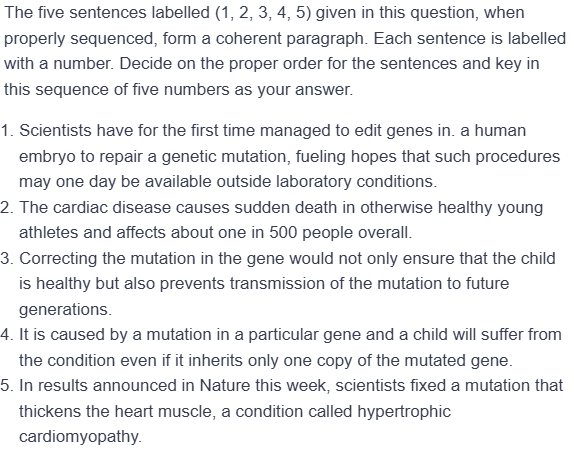
The five sentences labelled (1, 2, 3, 4, 5) given in this question, when properly sequenced, form a coherent paragraph. Each sentence is labelled with a number. Decide on the proper order for the sentences and key in this sequence of five numbers as your answer.
1. Scientists have for the first time managed to edit genes in a human embryo to repair a genetic mutation, fueling hopes that such procedures may one day be available outside laboratory conditions.
2. The cardiac disease causes sudden death in otherwise healthy young athletes and affects about one in 500 people overall.
3. Correcting the mutation in the gene would not only ensure that the child is healthy but also prevents transmission of the mutation to future generations.
4. It is caused by a mutation in a particular gene and a child will suffer from the condition even if it inherits only one copy of the mutated gene.
5. In results announced in Nature this week, scientists fixed a mutation that thickens the heart muscle, a condition called hypertrophic cardiomyopathy.
- A1,4,3,2,5
- B1,5,3,4,2
- C1,4,5,3,2
- D1,3,2,5,4
- E1,5,2,4,3
Show answerHide answer
Answer: E
Approach: General → specific chain using pronoun and definite-noun links.
Solution: 1 introduces the breakthrough (gene editing in a human embryo). 5 gives specifics: the mutation causing 'hypertrophic cardiomyopathy'. 2 'The cardiac disease' refers back to that condition. 4 'It is caused by a mutation...' explains its cause. 3 'Correcting the mutation...' gives the benefit — the natural close. Order: 1-5-2-4-3.
Why the other options are wrong:
A (1,4,3,2,5): 'It' in 4 has no antecedent after 1.
B (1,5,3,4,2): 3 'correcting the mutation' comes before the disease is described.
C (1,4,5,3,2): same problem as A.
D (1,3,2,5,4): 3 before the mutation is named.
Cetking shortcut: Anchor pair: 5 names the disease → 2 'The cardiac disease' must follow.
Answer: E
The five sentences labelled (1, 2, 3, 4, 5) given in this question, when properly sequenced, form a coherent paragraph. Each sentence is labelled with a number. Decide on the proper order for the sentences and key in this sequence of five numbers as your answer.
1. Like a driver changing tire in the middle of the highway, they hope an oncoming vehicle will not hit them before their work is done.
2. Some business executives have adopted a wait-and-see attitude.
3. Others are too busy bailing themselves out of trouble caused by the changes that have taken place around them to have any time to reflect on the future.
4. Like deer caught in the headlight of an oncoming truck, they risk being run over.
5. Discussion with several executives in both situations shows that they recognize the danger in not applying themselves to understanding the shape of the future
- A4,5,1,3,2
- B5,1,4,3,2
- C2,5,1,3,4
- D3,4,5,2,1
- E2,4,3,1,5
Show answerHide answer
Answer: E
Approach: Two-group structure: 'Some ...' → description, 'Others ...' → description, then the conclusion about 'both'.
Solution: 2 introduces 'Some business executives' with a wait-and-see attitude. 4 describes them with an image (deer caught in headlights — frozen, they risk being run over). 3 'Others...' introduces the second group, too busy bailing themselves out. 1 describes them (driver changing a tyre on the highway). 5 'executives in both situations' sums up both groups — the conclusion. Order: 2-4-3-1-5.
Why the other options are wrong:
A, B, D: do not start with 2, the only sentence that introduces the subject ('Some...').
C (2,5,1,3,4): 5 mentions 'both situations' before the second group (3) is introduced.
Cetking shortcut: 'Some ... Others ... both' is a fixed skeleton: Some-group first, Others-group next, 'both' last.
Answer: E
The five sentences labelled (1, 2, 3, 4, 5) given in this question, when properly sequenced, form a coherent paragraph. Each sentence is labelled with a number. Decide on the proper order for the sentences and key in this sequence of five numbers as your answer.
1. We have paid a terrible price for our education such as it is.
2. Wonder is marvellous but is also cruel, cruel, cruel.
3. We have educated ourselves into a world from which wonder has been banished.
4. Of course wonder is costly because it is antithesis of the anxiously worshiped security.
5. The magician world view in so far as it exists, has taken flight into science
- A2,1,5,3,4
- B1,5,4,3,2
- C2,1,3,4,5
- D3,1,4,5,2
- E4,2,1,3,5
Show answerHide answer
Answer: D
Approach: Find the strongest link pair, then build around it.
Solution: 3 'We have educated ourselves into a world from which wonder has been banished' → 1 'We have paid a terrible price for our education, such as it is' (the word 'education' links them — mandatory pair 3-1). 4 'Of course wonder is costly ... antithesis of the anxiously worshipped security' explains why we banished it. 5 'The magician world view, in so far as it exists, has taken flight into science' tells where wonder survives. 2 'Wonder is marvellous but is also cruel, cruel, cruel' closes with the emotional summary. Order: 3-1-4-5-2.
Why the other options are wrong:
A (2,1,5,3,4) and C (2,1,3,4,5): 2 → 1 has no link; 1 'our education' needs 3 before it.
B (1,5,4,3,2): 1 cannot open — 'our education, such as it is' refers back to 3.
E (4,2,1,3,5): 'Of course' in 4 cannot open a paragraph.
Cetking shortcut: 'Such as it is' and 'Of course' never open a paragraph — that alone leaves A, C or D, and only D keeps 3-1 together.
Answer: D
The five sentences labelled (1, 2, 3, 4, 5) given in this question, when properly sequenced, form a coherent paragraph. Each sentence is labelled with a number. Decide on the proper order for the sentences and key in this sequence of five numbers as your answer.
1. People started fearing a famine.
2. The monsoon failed and water tanks became almost empty.
3. Monsoon turned out to be unusually abundant and the danger was averted.
4. So, no grain could be sown by the farmers in their fields.
5. Farmers look anxiously for the next monsoon.
- A5,4,3,1,2
- B3,4,5,1,2
- C4,2,3,5,1
- D2,3,4,5,1
- E2,4,1,5,3
Show answerHide answer
Answer: E
Approach: Cause → effect → reaction → resolution timeline.
Solution: 2 the monsoon failed (cause). 4 'So, no grain could be sown' (effect — 'So' needs a cause before it). 1 people feared a famine. 5 farmers looked anxiously for the next monsoon. 3 the monsoon turned out abundant and the danger was averted (resolution). Order: 2-4-1-5-3.
Why the other options are wrong:
A, B, C: do not start with the cause (2).
D (2,3,4,5,1): the danger is averted (3) before it even arises.
Cetking shortcut: 'So' (4) must follow its cause (2); 'the danger was averted' (3) must be last.
Answer: E
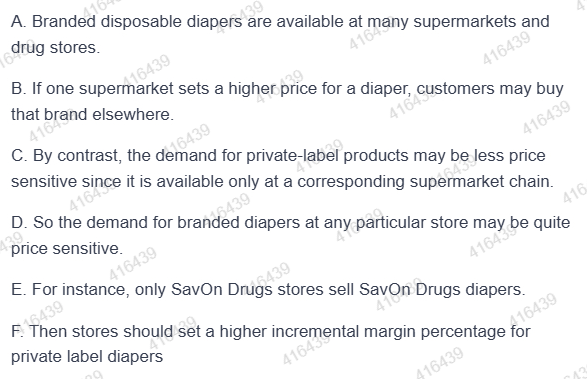
The sentences given in each question, when properly sequenced, form a coherent paragraph. Each sentence is labelled with a letter. Choose the most logical order of sentences from among the given choices to construct a coherent paragraph.
A. Branded disposable diapers are available at many supermarkets and drug stores.
B. If one supermarket sets a higher price for a diaper, customers may buy that brand elsewhere.
C. By contrast, the demand for private-label products may be less price sensitive since it is available only at a corresponding supermarket chain.
D. So the demand for branded diapers at any particular store may be quite price sensitive.
E. For instance, only SavOn Drugs stores sell SavOn Drugs diapers.
F. Then stores should set a higher incremental margin percentage for private label diapers
- AABCDEF
- BABCEDF
- CADBCEF
- DAEDBCF
- EAEDCFB
Show answerHide answer
Answer: C
Approach: Logical chain — fact, consequence, reason, contrast, example, conclusion.
Solution: A states the fact (branded diapers are sold everywhere). D draws the consequence with "So": demand at any one store is price sensitive. B explains why: a customer can simply buy the brand elsewhere. C begins the contrast ("By contrast") with private labels, available only at one chain. E gives the example of that private label (SavOn). F concludes with "Then": stores should keep a higher margin on private labels. Order: A-D-B-C-E-F.
Why the other options are wrong:
A (ABCDEF) / B (ABCEDF): put B before D, so the "So" in D no longer follows the availability fact it depends on.
D (AEDBCF): E is an example of a private label and cannot come before C introduces private labels.
E (AEDCFB): same E-misplacement, and B (branded-diaper reasoning) cannot come after the conclusion F.
Cetking shortcut: Link words decide it: "So" (D) right after the fact, "By contrast" (C) opens the second half, "For instance" (E) must follow what it exemplifies, "Then" (F) closes.
Answer: C
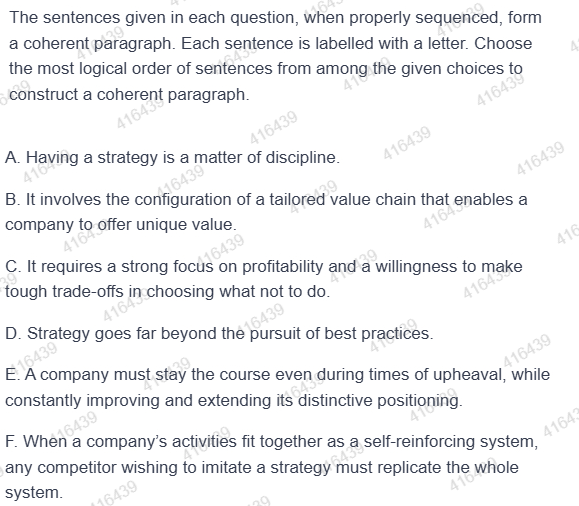
Rearrange the sentences given in the question into a proper sequence.
A. Having a strategy is a matter of discipline.
B. It involves the configuration of a tailored value chain that enables a company to offer unique value.
C. It requires a strong focus on profitability and a willingness to make tough trade-offs in choosing what not to do.
D. Strategy goes far beyond the pursuit of best practices.
E. A company must stay the course even during times of upheaval, while constantly improving and extending its distinctive positioning.
F. When a company's activities fit together as a self-reinforcing system, any competitor wishing to imitate a strategy must replicate the whole system.
- AACEDBF
- BACBDEF
- CDCBEFA
- DABCEDF
- EDABCEF
Show answerHide answer
Answer: A
Approach: Pronoun pairing + two idea blocks (discipline, then configuration).
Solution: Block 1 — discipline: A introduces "having a strategy is a matter of discipline"; C ("It requires... trade-offs") explains that discipline; E continues it (stay the course during upheaval). Block 2 — beyond best practices: D opens the new idea; B ("It involves the configuration of a tailored value chain") explains D; F ends with the system-fit consequence. Order: A-C-E-D-B-F.
Why the other options are wrong:
B (ACBDEF): B's "It involves configuration" explains D, so B cannot precede D.
C (DCBEFA) / E (DABCEF): A is the natural opener of the discipline block; ending with A or splitting A-C-E breaks it.
D (ABCEDF): B (value chain) is not about discipline and does not follow A.
Cetking shortcut: Each "It" (B, C) must sit right after the sentence it refers to: C after A (discipline), B after D (strategy beyond best practices).
Answer: A
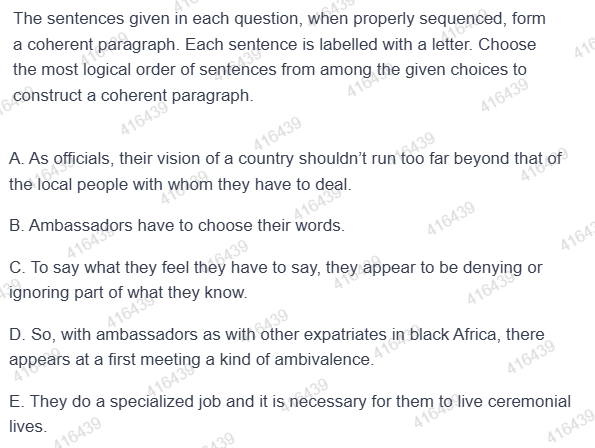
Rearrange the sentences given in the question into a proper sequence.
A. As officials, their vision of a country shouldn't run too far beyond that of the local people with whom they have to deal.
B. Ambassadors have to choose their words.
C. To say what they feel they have to say, they appear to be denying or ignoring part of what they know.
D. So, with ambassadors as with other expatriates in black Africa, there appears at a first meeting a kind of ambivalence.
E. They do a specialized job and it is necessary for them to live ceremonial lives.
- ABCEDA
- BBEDAC
- CBEADC
- DBCDEA
- EBACDE
Show answerHide answer
Answer: C
Approach: General statement, reasons, conclusion with "So", then explanation of the conclusion.
Solution: B opens (ambassadors must choose their words). E explains their position (specialized job, ceremonial lives). A adds the constraint "As officials..." (their vision must stay close to the local people's). D concludes with "So" — there is an ambivalence at a first meeting. C explains that ambivalence: to say what they must, they appear to deny part of what they know. Order: B-E-A-D-C.
Why the other options are wrong:
A (BCEDA) / D (BCDEA): C explains the ambivalence and cannot come before D introduces it.
B (BEDAC): "So" in D needs both reasons (E and A) before it.
E (BACDE): E (specialized job) describes ambassadors generally and belongs right after B, not at the end.
Cetking shortcut: All options start with B; locate the "So" conclusion (D) and its explanation (C) as the final pair.
Answer: C
Rearrange the sentences given in the question into a proper sequence.
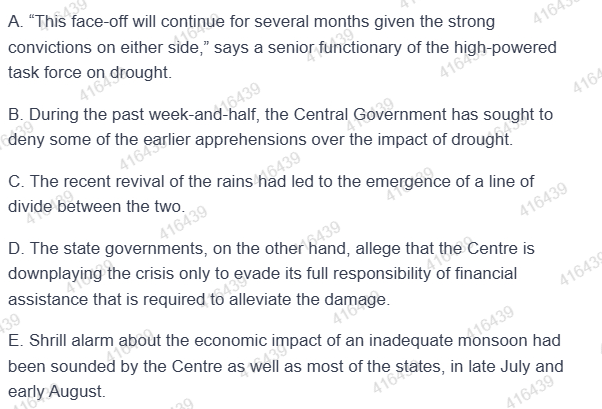
A. "This face-off will continue for several months given the strong convictions on either side," says a senior functionary of the high-powered task force on drought.
B. During the past week-and-half, the Central Government has sought to deny some of the earlier apprehensions over the impact of drought.
C. The recent revival of the rains had led to the emergence of a line of divide between the two.
D. The state governments, on the other hand, allege that the Centre is downplaying the crisis only to evade its full responsibility of financial assistance that is required to alleviate the damage.
E. Shrill alarm about the economic impact of an inadequate monsoon had been sounded by the Centre as well as most of the states, in late July and early August.
- AEBCDA
- BDBACE
- CBDCAE
- DECBDA
- EECBAD
Show answerHide answer
Answer: D
Approach: Chronology + "the two" reference + "on the other hand" pair.
Solution: E sets the background: both the Centre and the states had sounded the alarm. C — rains revived and a divide emerged "between the two" (Centre and states, named in E). B gives the Centre's side; D ("on the other hand") gives the states' side. A quotes an official on this face-off. Order: E-C-B-D-A.
Why the other options are wrong:
A (EBCDA): C's divide must be introduced before the two sides are described.
B (DBACE) / C (BDCAE): "the two" in C needs E first; D's "on the other hand" needs B before it.
E (ECBAD): A comments on the face-off and must come after both sides (B and D).
Cetking shortcut: "The two" (C) points straight back to E, and "on the other hand" (D) must follow B — only ECBDA keeps both.
Answer: D
Rearrange the sentences given in the question into a proper sequence.
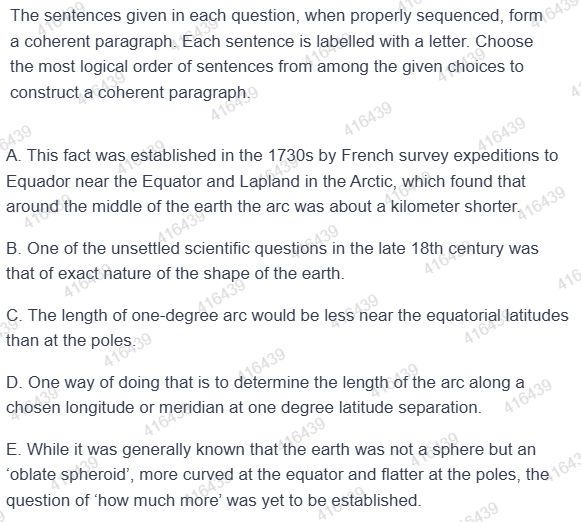
A. This fact was established in the 1730s by French survey expeditions to Equador near the Equator and Lapland in the Arctic, which found that around the middle of the earth the arc was about a kilometer shorter.
B. One of the unsettled scientific questions in the late 18th century was that of exact nature of the shape of the earth.
C. The length of one-degree arc would be less near the equatorial latitudes than at the poles.
D. One way of doing that is to determine the length of the arc along a chosen longitude or meridian at one degree latitude separation.
E. While it was generally known that the earth was not a sphere but an 'oblate spheroid', more curved at the equator and flatter at the poles, the question of 'how much more' was yet to be established.
- ABECAD
- BBEDCA
- CEDACB
- DEBDCA
- EBEDAC
Show answerHide answer
Answer: B
Approach: Question, refinement, method, expected result, confirmation.
Solution: B poses the question (exact shape of the earth). E narrows it: it was known to be an oblate spheroid, but "how much more" was open. D gives the method ("One way of doing that" = establishing how much more). C states what the method predicts (arc shorter near the equator). A confirms "This fact" with the 1730s expeditions. Order: B-E-D-C-A.
Why the other options are wrong:
A (BECAD): D's "doing that" must directly follow the open question in E, not come last.
C (EDACB) / D (EBDCA): B is the clear opener introducing the topic.
E (BEDAC): "This fact" in A refers to C, so C must precede A.
Cetking shortcut: "This fact" (A) needs a stated fact (C) just before it; "doing that" (D) needs a task (E) just before it — BEDCA.
Answer: B
Rearrange the following five sentences in a proper sequence to form a meaningful paragraph.
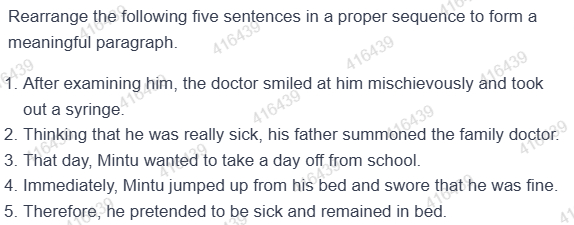
1. After examining him, the doctor smiled at him mischievously and took out a syringe.
2. Thinking that he was really sick, his father summoned the family doctor.
3. That day, Mintu wanted to take a day off from school.
4. Immediately, Mintu jumped up from his bed and swore that he was fine.
5. Therefore, he pretended to be sick and remained in bed.
- A35214
- B35241
- C15234
- D34215
- E35412
Show answerHide answer
Answer: A
Approach: Narrative chronology.
Solution: 3 sets the scene (Mintu wants a day off). 5 follows with "Therefore" (he pretends to be sick). 2: his father believes it and calls the doctor. 1: the doctor examines him and takes out a syringe. 4: "Immediately" Mintu jumps up and says he is fine. Order: 3-5-2-1-4.
Why the other options are wrong:
B (35241): 4 (reaction) cannot come before 1 (the syringe that causes it).
C (15234): the doctor cannot appear before he is summoned.
D (34215): Mintu cannot jump up "immediately" before anything happens.
E (35412): same problem — 4 before the doctor is called.
Cetking shortcut: Find the trigger-reaction pair: syringe (1) → jumps up (4) must be the last two.
Answer: A
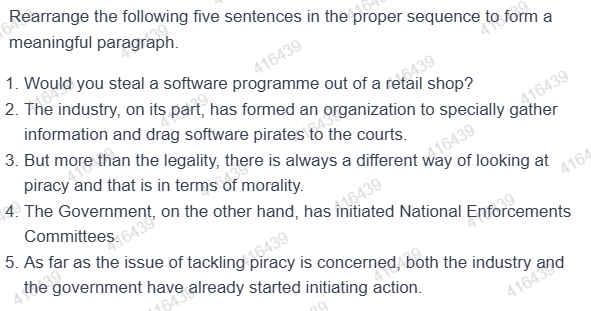
Rearrange the following five sentences in the proper sequence to form a meaningful paragraph.
1. Would you steal a software programme out of a retail shop?
2. The industry, on its part, has formed an organization to specially gather information and drag software pirates to the courts.
3. But more than the legality, there is always a different way of looking at piracy and that is in terms of morality.
4. The Government, on the other hand, has initiated National Enforcements Committees.
5. As far as the issue of tackling piracy is concerned, both the industry and the government have already started initiating action.
- A15243
- B53241
- C52413
- D52431
- E51243
Show answerHide answer
Answer: D
Approach: General statement → two parallel examples → shift → closing question.
Solution: 5 introduces the topic: both the industry and the government have acted. 2 ("The industry, on its part") and 4 ("The Government, on the other hand") give the two actions in that order. 3 shifts from legality to morality. 1 ends with the moral question to the reader. Order: 5-2-4-3-1.
Why the other options are wrong:
A (15243) / E (51243): the rhetorical question 1 fits after the morality point, not as the opener here.
B (53241): 3 ("more than the legality") must come after the legal actions 2 and 4.
C (52413): puts the moral question 1 before 3, which first introduces the morality angle.
Cetking shortcut: "Both the industry and the government" (5) names the order: industry (2), then government (4).
Answer: D
Arrange the following sentences into a coherent paragraph:
A. Whatever that might be on Europa—far from the Sun, and beneath kilometres of ice—it will not be sunlight.
B. The final ingredient for a habitable world is a source of energy for life to exploit.
C. On Earth almost every living thing ultimately depends on photosynthesis for its energy...
D. Their inhabitants do not benefit from sunlight directly...
E. That is a bit of a problem.
- AD, E, C, B, A
- BC, E, B, A, D
- CA, B, E, D, C
- DB, A, E, C, D
- EE, D, B, C, A
Show answerHide answer
Answer: D
Approach: Find the opener that introduces the idea, then follow pronoun/reference links.
Solution: B opens the topic: the final ingredient for a habitable world is an energy source.
A applies it to Europa: whatever 'that' (the energy source) is there, it will not be sunlight.
E reacts: 'That is a bit of a problem.'
C explains why it is a problem: on Earth almost everything depends on photosynthesis.
D gives the exception: 'Their inhabitants' (of places without sunlight) do not use sunlight directly.
Order: B, A, E, C, D.
Why the other options are wrong:
A (D…): D begins with 'Their', which needs an antecedent – cannot open.
B (C, E…): 'That is a bit of a problem' after C makes no sense – photosynthesis on Earth is not a problem.
C (A…): A's 'that' refers to the energy source in B, so A cannot open.
E (E…): E is a reaction and cannot open the paragraph.
Cetking shortcut: Pair A–E: 'it will not be sunlight' → 'That is a bit of a problem'. Only option D has B-A-E together.
Answer: D
Read the following statements, numbered as A, B, C, D, and E carefully, and determine which option is most logically chronologically ordered.
Statements:
A. The treaty tests of a budget deficit no bigger than 3% of the GDP and a public debt converging towards a ceiling of 60% of a GDP seemed impossible for Italy to pass by 1999.
B. That Belgium also had a public debt above 100 percent of GDP helped, as did a special euro tax Mr. Prodi introduced.
C. Into the uncompromising environment came the first of a series of external shocks. One of the earliest was entry into the European single currency, the euro, in 1999.
D. But when it became clear in 1997 that Spain was determined to join from the start, Romano Prodi, then Italian prime minister, decided that Italy, as a founder member of the bloc, must be there too.
E. Germany had more or less designed the 1992 Maastricht treaty’s convergence criteria to keep out a profligate, chronically indebted Italy.
- AE, D, B, A, C
- BC, E, B, A, D
- CE, B, C, A, D
- DC, B, D, E, A
- EC, E, A, D, B
Show answerHide answer
Answer: E
Approach: Use time markers (1992, 1997, 1999) and linking words ('But', 'That … also').
Solution: C introduces the topic: an external shock – entry into the euro in 1999.
E gives the background: Germany designed the 1992 Maastricht criteria to keep Italy out.
A states those tests seemed impossible for Italy to pass by 1999.
D – 'But' in 1997 Prodi decided Italy must join anyway.
B – what helped: Belgium's similar debt and a special euro tax.
Order: C, E, A, D, B.
Why the other options are wrong:
A (E, D, B, A, C): A (tests seemed impossible) after B (what helped Italy pass) breaks the logic.
B (C, E, B, A, D): B ('helped') comes before Italy even decided to join (D).
C (E, B, C, A, D): B has nothing to have 'helped' yet.
D (C, B, D, E, A): B again too early; E (1992 background) after D (1997) breaks chronology.
Cetking shortcut: B ('That Belgium also … helped') must follow D (Prodi's decision) – only option E has D→B.
Answer: E
Sentence Arrangement
Arrange the sentences A, B, C, and D to form a coherent paragraph:
A. It begins with an ordinary fever and a moderate cough.
B. India could be under attack from a class of germs that cause what are called atypical pneumonias.
C. Slowly, a sore throat progresses to bronchitis and then pneumonia and respiratory complications.
D. It appears like the ordinary flu, but baffled doctors find that the usual drugs don’t work.
- ABCDA
- BABCD
- CADCB
- DBDCA
- EBDAC
Show answerHide answer
Answer: E
Approach: Open with the general claim, then describe the illness from first symptom to worst stage.
Solution: B introduces the topic: India could be under attack from germs causing atypical pneumonias.
D: 'It appears like ordinary flu' but drugs don't work – the deceptive nature.
A: 'It begins with an ordinary fever and a moderate cough' – the start of the disease.
C: 'Slowly' it progresses to bronchitis, pneumonia and respiratory complications – the end stage.
Order: B, D, A, C.
Why the other options are wrong:
A (BCDA): C (worst stage) cannot come before A (how it begins).
B (ABCD): 'It' in A has no antecedent as an opener.
C (ADCB): A cannot open; B is the topic sentence.
D (BDCA): progression (C) before beginning (A) breaks the sequence.
Cetking shortcut: 'Begins' (A) must come before 'slowly progresses' (C) – only E has A before C after B.
Answer: E
Sentence Arrangement
Sentences:
A. I sat there frowning at the checkered tablecloth, chewing the bitter cud of insight.
B. That wintry afternoon in Matheran, waiting in that little French restaurant, I was feeling humiliated and depressed.
C. Even the prospect of seeing a dear friend failed to cheer me as it usually did.
D. Because of certain miscalculations on my part, a project of considerable importance in my life had fallen through.
- ABDCA
- BDBCA
- CCDAB
- DBCAD
- EBACD
Show answerHide answer
Answer: A
Approach: Narrative order: setting and mood → cause of the mood → effect → final picture.
Solution: B sets the scene: that wintry afternoon, waiting in a French restaurant, I felt humiliated and depressed.
D gives the cause: a project had fallen through because of my miscalculations.
C shows the effect: even the prospect of meeting a dear friend did not cheer me.
A closes the image: I sat frowning at the tablecloth, 'chewing the bitter cud of insight'.
Order: B, D, C, A.
Why the other options are wrong:
B (DBCA): D ('Because of…') as an opener leaves the setting for later.
C (CDAB): C's 'Even the prospect…' needs a mood established first.
D (BCAD): the cause (D) placed at the end is illogical.
E (BACD): C ('Even…') should follow the cause, not A.
Cetking shortcut: Mood (B) → reason (D) is the strongest pair; only option A has B immediately followed by D.
Answer: A
(see figure)
- A12345
- B32514
- C15243
- D51243
- E12435
Show answerHide answer
Answer: C
Approach: Para jumble: general news → specific case → explain the disease → its cause → benefit of correcting it.
Solution: 1 (scientists edited genes in a human embryo for the first time) is the opener. 5 gives the specific result: a fix for the mutation behind hypertrophic cardiomyopathy. 2 'The cardiac disease…' describes that disease. 4 'It is caused by a mutation…' gives its cause. 3 'Correcting the mutation…' ends with the benefit. Order: 1-5-2-4-3.
Why the other options are wrong:
A 12345: 2 ('The cardiac disease') cannot come before the disease is named in 5.
B 32514, D 51243: 3 and 5 cannot open; 5 needs 1's context.
E 12435: same problem as A.
Cetking shortcut: 'The cardiac disease' (definite article) must follow the sentence that names it (5), so 5-2 is a fixed pair; only C has 1-5-2.
Answer: C
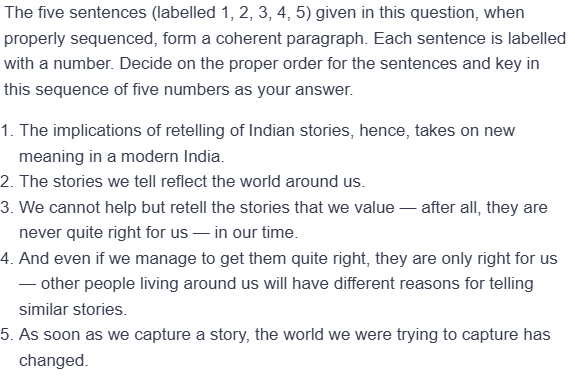
(see figure)
- A43215
- B23541
- C25341
- D25314
- E13542
Show answerHide answer
Answer: C
Approach: Para jumble: general claim → problem → consequence → extension → conclusion ('hence').
Solution: 2 'The stories we tell reflect the world around us' is the general opener. 5: once we capture a story, the world has already changed. 3: so we cannot help retelling stories, since they are never quite right for our time. 4 'And even if we get them right…' extends 3. 1, with 'hence', concludes about retelling Indian stories in modern India. Order: 2-5-3-4-1.
Why the other options are wrong:
A 43215: 4 starts with 'And even if', so it cannot open.
B 23541: 3 needs 5's idea of a changed world before it.
D 25314: 1 ('hence') must conclude, not 4.
E 13542: 1 has 'hence', so it cannot open.
Cetking shortcut: 'Hence' marks the concluding sentence and 'And even if…' must follow its partner (3-4); only C has both.
Answer: C
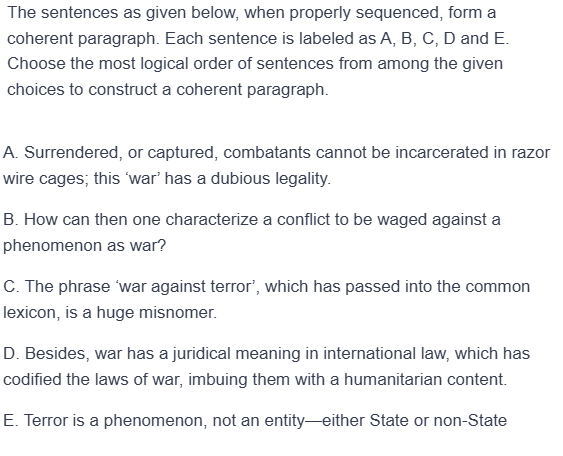
(see figure)
- AECDBA
- BBECDA
- CEBCAD
- DCDEAB
- ECEBDA
Show answerHide answer
Answer: E
Approach: Para jumble: claim → reason → question → second reason ('Besides') → consequence.
Solution: C states the claim: 'war against terror' is a misnomer. E gives the reason: terror is a phenomenon, not an entity. B follows: so how can a conflict against a phenomenon be called war? D adds a second reason with 'Besides': war has a legal meaning. A ends with an example of that legal problem: captured combatants in cages, 'dubious legality'. Order: C-E-B-D-A.
Why the other options are wrong:
A ECDBA, C EBCAD: E cannot open; it explains a claim not yet made.
B BECDA: B's 'then' needs an earlier reason.
D CDEAB: 'Besides' (D) must come after the first reason (E).
Cetking shortcut: 'Besides' adds a second point, so it needs the first point (E-B) before it; E-B is a fixed pair.
Answer: E
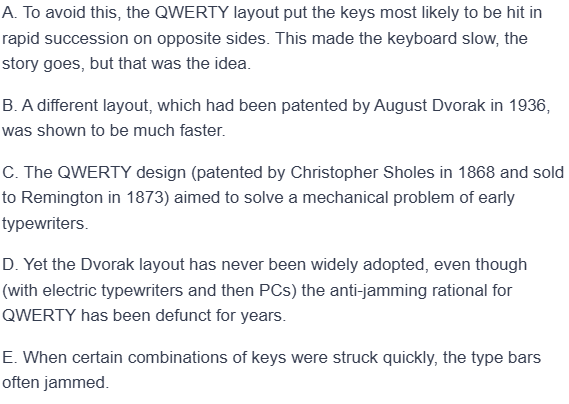
The sentences as given below, when properly sequenced, form a coherent paragraph. Each sentence is labeled as A, B, C, D and E. Choose the most logical order of sentences from among the given choices to construct a coherent paragraph. (see figure)
- ACEABD
- BCAEBD
- CCBAED
- DECABD
- EABDCE
Show answerHide answer
Answer: A
Approach: Para jumble: history → problem → design response → better alternative → why it was not adopted.
Solution: C introduces the QWERTY design and its aim, to solve a mechanical problem. E describes the problem: type bars jammed. A begins 'To avoid this' and gives QWERTY's solution, slower by design. B introduces Dvorak's faster layout. D begins 'Yet', so Dvorak was never adopted. Order: C-E-A-B-D.
Why the other options are wrong:
B CAEBD: 'this' in A needs the jamming problem (E) first.
C CBAED: B (Dvorak) before the QWERTY story ends.
D ECABD: E opens without context.
E ABDCE: A's 'this' has nothing to refer to.
Cetking shortcut: 'To avoid this' (A) must follow the problem (E), and 'Yet the Dvorak layout' (D) must follow B; only CEABD keeps both pairs.
Answer: A