Let’s Crack CET 2027

Your CET check-up · tap a ring to see yours

Sequences and Series – MBA CET questions with solutions

11 questions · CET 2025–2026 · Easy 7 · Medium 3 · Hard 1. Newest paper first. Full papers

Q129EasyCET 2026 · Attempt 2 Slot 1 · Q129

Find the sum of all numbers divisible by 6 between 100 and 400.

  1. 11,850
  2. 12,300
  3. 12,450
  4. 12,600
  5. 12,900
Show answerHide answer

Answer: C official key

Approach: AP sum of multiples in a range.

Solution:
First multiple of 6 above 100 = 102; last below 400 = 396.
Number of terms = (396 − 102)/6 + 1 = 50.
Sum = 50/2 × (102 + 396) = 25 × 498 = 12,450.

Cetking shortcut: Sum = 6 × (17 + 18 + … + 66) = 6 × 50 × 83/2 = 12,450.

Answer: C
Q106EasyCET 2026 · Slot 3 · Q106
The sum of three numbers in a GP is 26 and their product is 216. What are the three numbers?
  1. 16, 6, 4
  2. 4, 6, 16
  3. 9, 6, 11
  4. 2, 6, 18
  5. 5, 7, 14
Show answerHide answer

Answer: D official key

Approach: Three numbers in GP: take them as a/r, a, ar so the product is a³.

Solution:
Product a³ = 216 → a = 6.
Sum: 6/r + 6 + 6r = 26 → 6/r + 6r = 20 → 3r² − 10r + 3 = 0.
r = 3 or 1/3 → numbers 2, 6, 18.
Check: 2 + 6 + 18 = 26, 2 × 6 × 18 = 216. ✓

Why the other options are wrong:

  • A, B: 4, 6, 16 sums to 26 but 6/4 ≠ 16/6 (not a GP); product 384.
  • C: 9, 6, 11 is not a GP; product 594.
  • E: 5, 7, 14 is not a GP; product 490.

Cetking shortcut: Middle term of a 3-term GP = cube root of the product = 6; then check which option has 6² = first × third (2 × 18 = 36).

Answer: D

Q101EasyCET 2026 · Slot 1 · Q101

What is the value of
(37+38+39+···+86) ?

  1. 3075
  2. 3050
  3. 3070
  4. 3010
  5. 3087
Show answerHide answer

Answer: A official key

Approach: Sum of an AP = number of terms × average of first and last term.

Solution:
Number of terms = 86 − 37 + 1 = 50
Average = (37 + 86)/2 = 123/2 = 61.5
Sum = 50 × 61.5 = 3075

Cetking shortcut: 50 × 61.5 = 25 × 123 = 3075 — pairing terms (37+86 = 123, 25 pairs) gives the same result.

Answer: A

Q103EasyCET 2026 · Slot 1 · Q103

What is the sum of the first 60 natural numbers?

  1. 1850
  2. 1890
  3. 1780
  4. 1875
  5. 1830
Show answerHide answer

Answer: E official key

Approach: Sum of first n natural numbers = n(n + 1)/2.

Solution:
n = 60
Sum = 60 × 61 / 2 = 30 × 61 = 1830

Cetking shortcut: Sum must be a multiple of 61 (and of 30): only 1830 = 30 × 61.

Answer: E

Q138EasyCET 2025 · Slot 6 · Q138
Find the sum of first 100 even natural numbers
  1. 10100
  2. 11020
  3. 10080
  4. 10050
  5. 10070
Show answerHide answer

Answer: A

Approach: Sum of first n even natural numbers = n(n + 1).

Solution:
2 + 4 + … + 200 = 2(1 + 2 + … + 100) = 2 × 100 × 101/2 = 100 × 101 = 10100.

Why the other options are wrong:
D 10050: uses n(n+1)/2 × 2 wrongly or 100 × 100.5.
B, C, E: arithmetic slips.

Cetking shortcut: n(n + 1) = 100 × 101 = 10100.

Answer: A

Q144EasyCET 2025 · Slot 6 · Q144
The sum of three numbers in AP is 48. The sum of their squares is 800. Find the smallest number among following.
  1. 10
  2. 12
  3. 11
  4. 9
  5. 13
Show answerHide answer

Answer: B

Approach: Three numbers in AP: take them as a − d, a, a + d.

Solution:
Sum = 3a = 48 ⇒ a = 16.
Sum of squares = 3a² + 2d² = 800 ⇒ 768 + 2d² = 800 ⇒ d² = 16 ⇒ d = 4.
Numbers: 12, 16, 20 ⇒ smallest = 12.

Why the other options are wrong:
A 10 ⇒ 10, 16, 22: squares sum 840.
C 11, D 9, E 13: squares sum 818, 866, 786 — not 800.

Cetking shortcut: Middle term = 48/3 = 16; test options: 12, 16, 20 ⇒ 144 + 256 + 400 = 800 ✓.

Answer: B

Q102EasyCET 2025 · Slot 5 · Q102

Find the sum of first 90 even natural numbers.

  1. 8180
  2. 8190
  3. 9180
  4. 8100
  5. 8150
Show answerHide answer

Answer: B

Approach: Sum of first n even natural numbers = n(n + 1).

Solution:
Even numbers: 2 + 4 + … + 180 = 2(1 + 2 + … + 90)
= 2 × 90 × 91/2 = 90 × 91
= 8190

Cetking shortcut: n(n+1) directly: 90 × 91 = 8190. Option D (8100 = 90²) is the sum of the first 90 odd numbers — a trap.

Answer: B

Q124MediumCET 2025 · Slot 2 · Q124
T = {3,11,19,...,467}, an AP with d = 8. Max subset S such that no two elements of S add up to 470?
  1. 32
  2. 34
  3. 29
  4. 28
  5. 30
Show answerHide answer

Answer: E

Approach: Pair up terms that add to 470; take at most one from each pair.

Solution:
Number of terms = (467 − 3)/8 + 1 = 59.
Pairs adding to 470: (3, 467), (11, 459), … — the middle term is 235 (3 + 8 × 29), and 235 + 235 = 470 needs two equal elements, so 235 has no partner.
Pairs = (59 − 1)/2 = 29. Take one from each pair + 235 → 29 + 1 = 30.

Cetking shortcut: Odd number of terms symmetric about 235: max = (n + 1)/2 = 30.

Answer: E

Q125MediumCET 2025 · Slot 2 · Q125
8436 steel balls stacked in layers: 1, 3, 6, 10,... (triangular numbers). How many layers?
  1. 32
  2. 34
  3. 36
  4. 38
  5. 24
Show answerHide answer

Answer: C

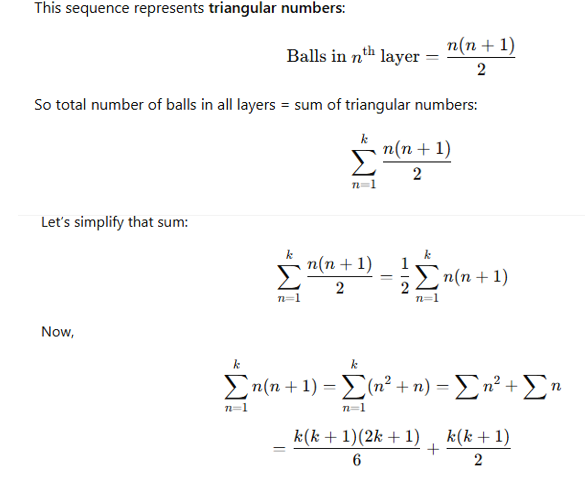
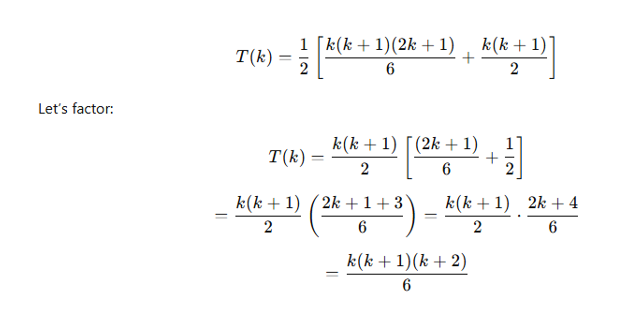
Approach: Total balls in n triangular layers = tetrahedral number n(n + 1)(n + 2)/6.

Solution:
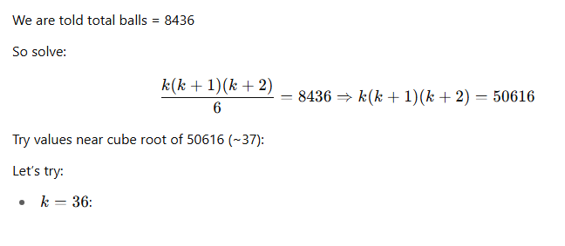
n(n + 1)(n + 2)/6 = 8436 → n(n + 1)(n + 2) = 50616.
∛50616 ≈ 37 → try 36 × 37 × 38 = 50616 ✓
So n = 36 layers. (Check n = 38: 38 × 39 × 40/6 = 9880 ≠ 8436.)

Cetking shortcut: 8436 × 6 = 50616 ends in 6; 36 × 37 × 38 ends in 6 (6 × 7 × 8 = 336), 38 × 39 × 40 ends in 0 — so 36.

Answer: C

Q135HardCET 2025 · Slot 1 · Q135
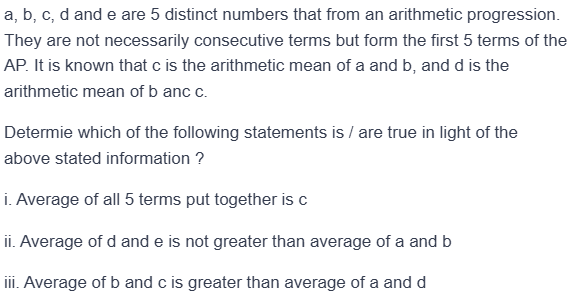
a, b, c, d and e are 5 distinct numbers that from an arithmetic progression. They are not necessarily consecutive terms but form the first 5 terms of the AP. It is known that c is the arithmetic mean of a and b, and d is the arithmetic mean of b anc c.
Determie which of the following statements is / are true in light of the above stated information ?
i. Average of all 5 terms put together is c
ii. Average of d and e is not greater than average of a and b
iii. Average of b and c is greater than average of a and d
Figure for MBA CET 2025 Slot 1 question 135
  1. i and ii only
  2. i and iii only
  3. ii and iii only
  4. ii only
  5. i ,ii and iii
Show answerHide answer

Answer: A

Approach: Place a, b, c, d on a number line, then fit e.

Solution:
Take a = 0, b = 4k (k ≠ 0). c = mean of a, b = 2k; d = mean of b, c = 3k
0, 2k, 3k, 4k plus e must be 5 equally spaced values → e = k (common gap k)
So a = 0, e = k, c = 2k, d = 3k, b = 4k
i. Average = (0 + k + 2k + 3k + 4k)/5 = 2k = c → true
ii. Avg(d, e) = 2k, Avg(a, b) = 2k → 'not greater' → true
iii. Avg(b, c) = 3k vs Avg(a, d) = 1.5k → greater only if k > 0; for a decreasing AP (k < 0) it fails → not necessarily true

Why the other options are wrong:
B, C, E: treat iii as always true, but it reverses for a decreasing AP.
D: misses statement i, which holds for every k.

Cetking shortcut: Equalities and 'not greater' (here an equality) survive a sign flip of k; a strict 'greater' comparison does not.

Answer: A

Q150MediumCET 2025 · Slot 1 · Q150
There are 8436 steel balls, each with a radius of 1 centimeter, stacked in a pile, with 1 ball on top, 3 balls in the second layer, 6 in the third layer, 10 in the fourth, and so on. Determine the number of horizontal layers in the pile ?
Figure for MBA CET 2025 Slot 1 question 150
  1. 32
  2. 36
  3. 96
  4. 34
  5. 24
Show answerHide answer

Answer: B

Approach: Sum of triangular numbers = n(n+1)(n+2)/6.

Solution:
Layers: 1, 3, 6, 10, … = n(n+1)/2
Total = n(n+1)(n+2)/6 = 8436
n(n+1)(n+2) = 50616
Cube root of 50616 ≈ 37 → try 36 × 37 × 38 = 50616 ✓
n = 36 layers

Why the other options are wrong:
A (32), D (34): give 5984 and 7140 balls.
E (24): 2600 balls.
C (96): far too many.

Cetking shortcut: n³/6 ≈ 8436 → n³ ≈ 50600 → n ≈ 37 → the middle of three consecutive numbers is 37, so n = 36.

Answer: B

Solution figure for question 150Solution figure for question 150Solution figure for question 150

Practise these in the Arena

Take timed tests built around MBA CET topics and see where you stand.

Open the Arena