Let’s Crack CET 2027

Your CET check-up · tap a ring to see yours

Direct Indirect – MBA CET questions with solutions

14 questions · CET 2025–2026 · Easy 11 · Medium 3 · Hard 0. Newest paper first. Full papers

Q196EasyCET 2026 · Attempt 2 Slot 2 · Q196

In the question below the sentence is in Direct/Indirect speech. From the given alternatives, choose the one which best expresses the given sentence in Indirect/Direct speech.

She said that her brother was getting married.

  1. She said, "Her brother is getting married."
  2. She told, "Her brother is getting married."
  3. She said, "My brother is getting married."
  4. She said, "My brother was getting married."
  5. She said, "Our brother was getting married."
Show answerHide answer

Answer: C official key

Approach: Indirect → direct speech — reverse the pronoun and tense shifts.

Solution: Indirect: 'She said that her brother was getting married.' In direct speech the speaker refers to herself: 'her brother' → 'my brother'; the backshifted 'was getting' → 'is getting'; 'said that' → said, "…". Result: She said, "My brother is getting married."

Why the other options are wrong:
A: 'Her brother' — the speaker would say 'my'.
B: 'told' needs an object (told me/him); and 'Her' is wrong.
D: 'was getting' keeps the indirect backshift.
E: 'Our brother' changes the meaning.

Answer: C
Q197MediumCET 2026 · Attempt 2 Slot 2 · Q197

In the question below the sentence have been given in Direct/Indirect speech. From the given alternatives, choose the one which best expresses the given sentence in Indirect/Direct speech.

She exclaimed with sorrow that was a very miserable plight.

  1. She said with sorrow, "What a pity it is!"
  2. She said, "What a mystery it is!"
  3. She said, "What a miserable sight it is!"
  4. She said, "What a miserable plight it is!"
  5. She cried, "What a miserable plight it is!"
Show answerHide answer

Answer: D official key

Approach: Indirect → direct speech of an exclamation.

Solution: 'Exclaimed with sorrow that was a very miserable plight' → an exclamatory sentence: What a miserable plight it is! 'that was' → 'it is' (tense and demonstrative restored); 'exclaimed with sorrow' becomes the reporting verb 'said', with sorrow carried by the exclamation. Result: She said, "What a miserable plight it is!"

Why the other options are wrong:
A: 'pity' changes the content.
B: 'mystery' changes the content.
C: 'sight' changes 'plight'.
E: 'cried' suggests shouting/weeping — a different reporting verb, not the standard conversion.

Cetking shortcut: In narration questions, first eliminate options that change the content words (pity, mystery, sight).

Answer: D

Q198EasyCET 2026 · Attempt 2 Slot 2 · Q198

In the question below the sentence is given in Direct/Indirect speech. From the given alternatives, choose the one which best expresses the given sentence in Indirect/Direct speech.

"Are you alone, my son?" asked a soft voice close behind me.

  1. A soft voice asked that what I was doing there alone.
  2. A soft voice said to me are you alone son.
  3. A soft voice from my back asked If I was alone.
  4. A soft voice close behind me asked If I was alone.
  5. A soft voice behind me yelled If I was alone.
Show answerHide answer

Answer: D official key

Approach: Direct → indirect speech of a yes/no question.

Solution: Yes/no question → 'asked if/whether'; 'you' → 'I' (the person addressed is the narrator 'me'); 'are' → 'was'; question order → statement order; the vocative 'my son' is dropped. The reporting detail 'close behind me' is kept. Result: 'A soft voice close behind me asked if I was alone.'

Why the other options are wrong:
A: Adds 'what I was doing there' — changes the question.
B: Still direct-question form, no tense/pronoun change.
C: 'from my back' changes 'close behind me'.
E: 'yelled' contradicts 'soft voice'.

Answer: D

Q199EasyCET 2026 · Attempt 2 Slot 2 · Q199

In the question below the sentence is in Direct/Indirect speech. From the given alternatives, choose the one which best expresses the given sentence in Indirect/Direct speech.

She said to her friend, "I know where is everyone".

  1. She told that she knew where was everyone.
  2. She told her friend that she knew where everyone was.
  3. She told her friend that she knew where is everyone.
  4. She told her friend that she knows where was everyone.
  5. She asked her friend where everyone was.
Show answerHide answer

Answer: B official key

Approach: Direct → indirect statement with an embedded question.

Solution: 'Said to her friend' → 'told her friend'; 'I' → 'she'; 'know' → 'knew'; the embedded clause 'where is everyone' must take statement order and backshift: 'where everyone was'. Result: 'She told her friend that she knew where everyone was.'

Why the other options are wrong:
A: Drops 'her friend' (told needs an object) and keeps question order 'where was everyone'.
C: 'where is everyone' — no backshift, question order.
D: 'knows' not backshifted; 'where was everyone' wrong order.
E: 'asked' — the original is a statement, not a question.

Cetking shortcut: Embedded questions never keep question word order: 'where everyone was'.

Answer: B

Q197EasyCET 2026 · Slot 5 · Q197

Change the following sentence into indirect speech:
He said, “I will complete the project tomorrow.”

A. He said that he would complete the project tomorrow.

B. He said that he will complete the project tomorrow.

C. He said that he would complete the project the next day.

D. He said he would have completed the project the next day.

E. He said that he shall have complete the project tomorrow

  1. A
  2. B
  3. C
  4. D
  5. E
Show answerHide answer

Answer: C official key

Approach: Reported speech rules: pronoun, tense and time-word shifts.

Solution: 'I' → 'he'; 'will complete' → 'would complete'; 'tomorrow' → 'the next day'. Result: 'He said that he would complete the project the next day.'

Why the other options are wrong:
A — 'tomorrow' not changed.
B — 'will' not changed.
D — 'would have completed' wrongly changes the meaning to a completed action.
E — 'shall have complete' is ungrammatical and keeps 'tomorrow'.

Answer: C

Q170MediumCET 2026 · Slot 4 · Q170

DIRECTION for the question: In the following question a sentence has been in Direct Speech. Out of the alternatives provided select the one which best expresses the same sentence in Indirect Speech.

He said, “I clean my teeth twice a day.”

  1. He said that he cleaned his teeth twice a day.
  2. He said that he cleans his teeth twice a day.
  3. He said that he used to clean his teeth twice a day.
  4. He said that he is used to cleaning his teeth twice a day.
  5. He said he is cleaning his teeth twice a day.
Show answerHide answer

Answer: B official key

Approach: Indirect speech: habitual facts / still-true statements may keep the present tense.

Solution: Direct: He said, "I clean my teeth twice a day." This is a daily habit that remains true.
I → he; 'my' → his; reporting verb 'said' → 'said that'.
Since it is a habitual action, the present tense is retained: 'He said that he cleans his teeth twice a day.'

Why the other options are wrong:
A 'cleaned': strict back-shift; it ignores the habitual-action rule, under which a habit that is still true keeps the present tense.
C 'used to clean': suggests a past habit that has stopped, wrong meaning.
D 'is used to cleaning': means 'is accustomed to', different meaning.
E 'is cleaning': continuous tense, wrong for a habit.

Answer: B

Q171EasyCET 2026 · Slot 4 · Q171

DIRECTION for the question: In the following question a sentence has been in Direct/Indirect Speech. Out of the alternatives provided select the one which best expresses the same sentence in Indirect/Direct Speech.

He said, “I saw a book here.”

  1. He said that he saw a book here.
  2. He said that he saw a book there.
  3. He said that he had seen a book here.
  4. He said that he had seen a book there.
  5. He said that he see a book here.
Show answerHide answer

Answer: D official key

Approach: Indirect speech: tense back-shift plus change of place words.

Solution: Reporting verb 'said' is past, so: saw (simple past) → had seen (past perfect).
I → he; here → there (the speaker is no longer at that place).
Result: 'He said that he had seen a book there.'

Why the other options are wrong:
A 'saw a book here': no back-shift, no change of 'here'.
B 'saw a book there': place word changed but tense not back-shifted.
C 'had seen a book here': tense right, 'here' not changed.
E 'he see a book here': ungrammatical.

Cetking shortcut: Two changes are needed (tense + place), so pick the only option with both.

Answer: D

Q172EasyCET 2026 · Slot 4 · Q172

DIRECTION for the question: In the following question a sentence has been in Direct/Indirect Speech. Out of the alternatives provided select the one which best expresses the same sentence in Indirect/Direct Speech.

“Please don’t go away”, she said.

  1. She said to please her and not go away.
  2. She told me not to go away.
  3. She begged that I not go away.
  4. She begged me not to go away.
  5. She said me not to go away.
Show answerHide answer

Answer: D official key

Approach: Imperative sentences: said → requested/begged/ordered + object + (not) to + verb; drop 'please'.

Solution: 'Please' shows a plea, so the reporting verb becomes 'begged'. Negative imperative 'don't go' → 'not to go'. The listener (me) is the object.
Result: 'She begged me not to go away.'

Why the other options are wrong:
A 'said to please her': misreads 'please' as a verb; ungrammatical.
B 'told me not to go away': grammatical but loses the request tone.
C 'begged that I not go away': awkward; the standard pattern is begged + object + to-infinitive.
E 'said me not to': 'say' cannot take a personal object without 'to'.

Answer: D

Q180MediumCET 2026 · Slot 3 · Q180

Directions: From the following sentences, choose the grammatically correct sentence.

  1. She said that Raj had a fall last week and he had been injured.
  2. She said that Raj had fallen the previous week and he had injured.
  3. She said that Raj had had a fall last week and he was injured.
  4. She said that Raj had had a fall the previous week and he had been injured.
  5. She saids that Raj had a fall last week and he had been injured.
Show answerHide answer

Answer: D official key

Approach: Reported speech — shift tense back and change time words.

Solution: Direct: "Raj had a fall last week and he was injured." Reported after 'She said': had a fall → had had a fall; last week → the previous week; was injured → had been injured. Only D does all three.

Why the other options are wrong:
A: Keeps 'had a fall' and 'last week'.
B: 'he had injured' — no object; needs passive 'had been injured'.
C: Keeps 'last week'; 'was injured' not shifted.
E: 'She saids' — wrong verb form.

Cetking shortcut: Look for 'the previous week / the day before' — options keeping 'last week/yesterday' are out.

Answer: D

Q194EasyCET 2026 · Slot 2 · Q194

In the following sentence, the words in bold are gramatically wrong. Choose the option which is grammatically correct and expresses the meaning of sentence correctly.

I asked her that how she got time to write all these books.

  1. that how did she got
  2. that how she was getting
  3. how did she getting
  4. how she got
  5. that how did she get
Show answerHide answer

Answer: D official key

Approach: Reported (indirect) question rules.

Solution: Direct: 'How did you get time ...?' → Reported: 'I asked her how she got time to write all these books.'
Rule 1: the wh-word ('how') is the connector — do not add 'that'.
Rule 2: use statement order (subject + verb), so no 'did' and no inversion.

Why the other options are wrong:
A — extra 'that' and 'did ... got' (double past).
B — extra 'that'; past continuous changes meaning.
C — question order and 'did ... getting' is ungrammatical.
E — extra 'that' and question inversion.

Cetking shortcut: Any option with 'that how' or 'did she' is out — only D survives.

Answer: D

Q185EasyCET 2026 · Slot 1 · Q185

In each of the following questions, a sentence is given in direct speech. Choose the option that correctly converts it into indirect speech without changing the meaning.

Direct Speech:
The teacher said, “I am assigning the homework today.”

A. The teacher said that he is assigning the homework today.
B. The teacher said that she was assigning the homework that day.
C. The teacher said that I am assigning the homework today.
D. The teacher said that he was assigning the homework today.
E. The teacher said that she is assigning the homework that day.

  1. The teacher said that he is assigning the homework today.
  2. The teacher said that she was assigning the homework that day.
  3. The teacher said that I am assigning the homework today.
  4. The teacher said that he was assigning the homework today.
  5. The teacher said that she is assigning the homework that day.
Show answerHide answer

Answer: B official key

Approach: Direct to indirect — backshift the tense and change time words.

Solution: Reporting verb "said" is past, so: "am assigning" → "was assigning"; "I" → he/she (the teacher); "today" → "that day". "The teacher said that she was assigning the homework that day." Option B is the only one with both changes.

Why the other options are wrong:
A: Keeps present "is" and "today".
C: Keeps first person "I" and present tense.
D: Backshifts tense but keeps "today".
E: Changes "that day" but keeps present "is".

Cetking shortcut: Check two things only: past tense verb + "that day" — just B has both.

Answer: B

Q189EasyCET 2025 · Slot 6 · Q189
Identify the correct indirect speech form of the following sentence
The old woman said to the boy, 'Please help me till he returns'.
  1. The old woman told the boy, Please help me till he returns'.
  2. The old woman said that she may please help till he returns.
  3. The old women asked that a boy may help her till he returns.
  4. The old woman ordered the boy to help him till he returned
  5. The old woman requested to the boy to help her till he returned.
Show answerHide answer

Answer: E

Approach: Direct → indirect for a request: 'said to + Please' → 'requested + object + to-infinitive'; tenses shift back; pronouns change.

Solution: 'Please' signals a request → reporting verb 'requested'. 'Help me' → 'to help her' (the old woman). 'Till he returns' → 'till he returned' (past reporting verb). E is the only option with the right verb, pronoun and tense shift.

Why the other options are wrong:
A: still in direct speech.
B: 'said that she may please help' — wrong structure and meaning.
C: 'women', 'a boy', no tense shift.
D: 'ordered' is wrong for 'please'; 'him' should be 'her'; no 'please' meaning.

Cetking shortcut: 'Please' → requested; imperative → to + verb.

Answer: E

Q187EasyCET 2025 · Slot 4 · Q187
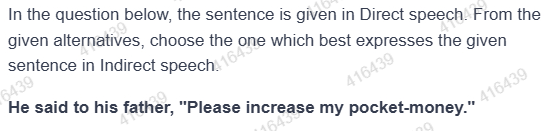
In the question given below, the sentence is given in Direct speech. Choose the alternative which best expresses the given sentence in Indirect speech: He said to his father, "Please increase my pocket-money."
Figure for MBA CET 2025 Slot 4 question 187
  1. Option A
  2. Option B
  3. Option C
  4. Option D
  5. Option E
Show answerHide answer

Answer: C

Approach: Direct to indirect — imperative with "Please".

Solution: A request beginning with "Please" becomes "requested + object + to-infinitive"; "my" changes to "his". So: "He requested his father to increase his pocket-money."

Why the other options are wrong:
A keeps the direct speech with quotes.
B "pleaded his father ... please ... my": keeps "please" and "my" — not converted.
D "asked his father to": loses the polite request sense of "Please".
E "asked ... if he could": turns a request into a question.

Cetking shortcut: "Please" in direct speech → "requested" in indirect speech.

Answer: C

Q195EasyCET 2025 · Slot 4 · Q195
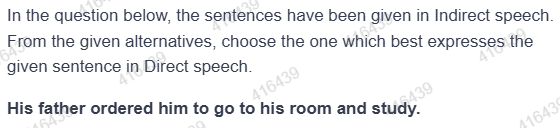
In the question given below, the sentence is given in Indirect speech. Choose the one which best expresses the given sentence in Direct speech: His father ordered him to go to his room and study.
Figure for MBA CET 2025 Slot 4 question 195
  1. Option A
  2. Option B
  3. Option C
  4. Option D
  5. Option E
Show answerHide answer

Answer: A

Approach: Indirect to direct — order (imperative).

Solution: "Ordered him to go to his room and study" → a command in direct speech: His father said, "Go to your room and study." The pronoun "his" becomes "your", the order of actions (go, then study) is kept, and no added tone word is needed.

Why the other options are wrong:
B "Go and study in your room": changes the structure of the order.
C "shouted ... right now ... study room": adds words not in the original.
D "said firmly" / E "said politely": add a tone adverb and reorder the actions.

Cetking shortcut: Keep exactly the content of the order; reject options that add adverbs (firmly, politely, right now).

Answer: A

Practise these in the Arena

Take timed tests built around MBA CET topics and see where you stand.

Open the Arena