Let’s Crack CET 2027

Your CET check-up · tap a ring to see yours

Input Output – MBA CET questions with solutions

32 questions · CET 2025–2026 · Easy 10 · Medium 22 · Hard 0. Newest paper first. Full papers

Q20MediumCET 2026 · Attempt 2 Slot 2 · Q20

A word arrangement machine when given an input line of words rearranges them following a particular rule in each step. The following is an illustration of the input and the steps of rearrangement.

Input : but going for crept the light sir

Step I : crept but going for the light sir

Step II : crept going light but for the sir

Step III: crept going light but for sir the

Step III is the last step for this input.

As per the rules followed in the above steps, find out in the given questions the appropriate step for the given input

Input : more fight cats cough sough acts idea
Which of the following steps would be the last step for this input ?
  1. III
  2. IV
  3. V
  4. VI
  5. VII
Show answerHide answer

Official CET key: D · Cetking's answer: B — see why below

Approach: Input–output word sorting — fix one word per step, left to right.

Solution:
Rule from the illustration: longer (5-letter) words come first in alphabetical order, then the shorter words in alphabetical order; words are placed one by one from the left.
Target for the new input: cough, fight, sough (5 letters, a→z) then acts, cats, idea, more (4 letters, a→z).
Input: more fight cats cough sough acts idea
Step I: cough more fight cats sough acts idea
Step II: cough fight more cats sough acts idea
Step III: cough fight sough more cats acts idea
Step IV: cough fight sough acts more cats idea
Step V: cough fight sough acts cats more idea
Step VI: cough fight sough acts cats idea more — final arrangement.
No word is already in its final place, so all six placements are needed.

Why the other options are wrong:
A, B, C: stopping at III, IV or V leaves the 4-letter words unsorted.
E: VII would mean placing the last word too, but it falls into place automatically.

Cetking shortcut: Count how many of the first (n − 1) positions hold the wrong word in the input — here all 6 → 6 steps.

Answer: D
Q21MediumCET 2026 · Slot 5 · Q21

In a word arrangement machine, when an input line of words is given, the machine rearranges it in every step following a certain rule.

Following is an illustration of an input line of words and various steps of rearrangement.

Input: gone are take enough brought station
Step 1: take gone are enough brought station
Step 2: take are gone enough brought station
Step 3: take are station gone enough brought
Step 4: take are station brought gone enough

Step 4 is the last step for this input.

Now, find out an appropriate step in the following question following the above rule.

Input: car on star quick demand fat

What will be the third step for this input ?

  1. star fat demand on quick car
  2. star car demand quick on fat
  3. star on demand quick car fat
  4. star car quick demand on fat
  5. star quick car demand on fat
Show answerHide answer

Official CET key: D · Cetking's answer: C — see why below

Approach: Word arrangement — alternately place the alphabetically last word and the alphabetically first word of the remaining words, from the left.

Solution:
Illustration: take (last) → are (first) → station (2nd last) → brought (2nd first); a word already in place costs no step.
Order: car, demand, fat, on, quick, star.
Input: car on star quick demand fat
Step I: star car on quick demand fat (star to position 1; car is now already 2nd, so no separate step)
Step II: star car quick on demand fat (quick to position 3)
Step III: star car quick demand on fat (demand to position 4)
Now 'on' and 'fat' are already in place → Step III is the last step.

Why the other options are wrong:
A), B), C), E) — none follows the last/first alternation (e.g. C puts 'on' second instead of 'car').

Cetking shortcut: Write the final output first (star car quick demand on fat) — if it appears in the options for an early step, check whether some words were already in place.

Answer: D

Q22EasyCET 2026 · Slot 5 · Q22

An electronic device when fed with the numbers, rearranges them in a particular order following certain rules.

The following is a step-by-step process of rearrangement for the given input of numbers.

Input - 85 16 36 04 19 97 63 09

Step I - 97 85 16 36 04 19 63 09

Step II - 97 85 63 16 36 04 19 09

Step III - 97 85 63 36 16 04 19 09

Step IV - 97 85 63 36 19 16 04 09

Step V - 97 85 63 36 19 16 09 04

Step V is the last step.

Which of the following will be the last step for the input given below :

Input : 03 31 43 22 11 09

  1. Step IV
  2. Step III
  3. Step II
  4. Step V
  5. Step I
Show answerHide answer

Official CET key: D · Cetking's answer: B — see why below

Approach: Each step brings the next largest number to the next position from the left (descending order).

Solution:
Input: 03 31 43 22 11 09
Step I: 43 03 31 22 11 09
Step II: 43 31 03 22 11 09
Step III: 43 31 22 03 11 09
Step IV: 43 31 22 11 03 09
Step V: 43 31 22 11 09 03 → fully descending
Last step = Step V

Cetking shortcut: Steps = numbers that are not already in their final position when their turn comes; here only the last number (03) falls into place automatically → 6 − 1 = 5.

Answer: D

Q23MediumCET 2026 · Slot 5 · Q23

The admission ticket for an exhibition bears a password which is changed after every clock hour based on set of words chosen for each day.

Following is an illustration of the code and steps of rearrangement for subsequent clock hours.

The time is 9 a.m. to 3 p.m.

Day's first password :

First Batch ----- 9 a.m. to 10 a.m.
is not ready cloth simple harmony burning

Second Batch ----- 10 a.m. to 11 a.m.
ready not is cloth burning harmony simple

Third Batch ----- 11 a.m. to 12 noon
cloth is not ready simple harmony burning

Fourth Batch ----- 12 noon to 1 p.m.
not is cloth ready burning harmony simple

Fifth Batch ----- 1 p.m. to 2 p.m.
ready cloth is not simple harmony burning and so on.

Taking the given sequence, if the password for 11 a.m. to 12 noon was ;

soap shy miss pen yet the she

Then find the password for the first batch ?

  1. shy miss pen soap yet the she
  2. the she yet soap pen shy
  3. pen miss shy soap she the yet
  4. soap pen miss shy she the yet
  5. soap shy miss pen yet the she
Show answerHide answer

Official CET key: A · Cetking's answer: E — see why below

Approach: Find the position mapping between Batch 1 and Batch 3, then reverse it.

Solution:
Batch 1: is(1) not(2) ready(3) cloth(4) simple(5) harmony(6) burning(7)
Batch 3: cloth is not ready simple harmony burning = positions 4, 1, 2, 3, 5, 6, 7 of Batch 1
So Batch 1 = Batch 3's words in positions 2, 3, 4, 1, 5, 6, 7.
Batch 3 (11–12): soap shy miss pen yet the she
Batch 1 = shy, miss, pen, soap, yet, the, she → shy miss pen soap yet the she

Why the other options are wrong:
B) has only six words and a wrong order.
C), D) reorder the last three words, but positions 5–7 stay unchanged between Batch 1 and Batch 3.
E) is just the given Batch 3 password.

Answer: A

Q24EasyCET 2026 · Slot 5 · Q24

Direction: An electronic device rearranges numbers step-by-step in a particular order according to a set of rules. The device stops when the final result is obtained. In this case the device stops at Step V

Input: 85 16 36 04 19 97 63 09
Step I: 97 85 16 36 04 19 63 09
Step II: 97 85 63 16 36 04 19 09
Step III: 97 85 63 36 16 04 19 09
Step IV: 97 85 63 36 19 16 04 09
Step V: 97 85 63 36 19 16 09 04

Study the above arrangement carefully and then answer the following question that follows :

Which of the following will be Step III for the input below?

Input: 09 25 16 30 32 18 17 06

  1. 32 30 25 09 16 18 17 06
  2. 32 25 09 30 18 16 18 06
  3. 32 30 09 26 16 18 17 06
  4. 32 30 09 25 16 17 18 06
  5. 32 09 25 16 30 18 17 06
Show answerHide answer

Official CET key: A · Cetking's answer: D — see why below

Approach: Each step brings the next largest number to the next position from the left.

Solution:
Input: 09 25 16 30 32 18 17 06
Step I: 32 09 25 16 30 18 17 06
Step II: 32 30 09 25 16 18 17 06
Step III: 32 30 25 09 16 18 17 06

Why the other options are wrong:
B) repeats 18 and drops 17.
C) contains 26, which is not in the input.
D) does not move 25 and swaps 17/18.
E) is only Step I with 30 not moved.

Answer: A

Q25MediumCET 2026 · Slot 5 · Q25

When a machine is given an input which includes a line of words and numbers, the output received is arranged in a particular manner. Given below is an illustration of input along with the steps followed to get its output :

Input: 34 lights ink 56 78 online defeat 99 orange range 87 22

Step I: 22 34 lights ink 56 78 online 99 orange range 87 defeat

Step II: 34 22 lights 56 78 online 99 orange range 87 defeat ink

Step III: 56 34 22 78 online 99 orange range 87 defeat ink lights

Step IV: 78 56 34 22 99 orange range 87 defeat ink lights online

Step V: 87 78 56 34 22 99 range defeat ink lights online orange

Step VI: 99 87 78 56 34 22 defeat ink lights online orange range

Step VI is the final step of the above input.

Now, based on the same pattern, find the output for the input given below.

Input : 67 54 thankful message listing 23 45 known booklist 90 quit 88

How many steps will be required to get the final output ?

  1. 3
  2. 5
  3. 6
  4. 4
  5. 7
Show answerHide answer

Answer: C official key

Approach: Each step moves one number (ascending, to the front) and one word (alphabetical, to the end).

Solution:
Illustration: Step I puts 22 in front and 'defeat' at the end; Step II puts 34 in front and 'ink' at the end, and so on — one number + one word per step; 6 pairs → 6 steps.
New input numbers: 67, 54, 23, 45, 90, 88 (six); words: thankful, message, listing, known, booklist, quit (six).
Final output: 90 88 67 54 45 23 booklist known listing message quit thankful.
No pair is already in place at the start, so 6 pairs need 6 steps.

Answer: C

Q50MediumCET 2026 · Slot 3 · Q50

Study the following information and answer the question that follows :

A word and number arrangement machine when given an input line of words and numbers rearranges them following a particular rule in each step. The following is an illustration of input and rearrangement.

Input: quick fire 15 28 39 war 19 yellow
Step I: yellow quick fire 15 28 39 war 19
Step II: yellow 15 quick fire 28 39 war 19
Step III: yellow 15 war quick fire 28 39 19
Step IV: yellow 15 war 19 quick fire 28 39
Step V: yellow 15 war 19 quick 28 fire 39
Step V is the last step of the above input.

Input: 36 Sky 19 Night 90 55 Bear Lotus White

What is the third element from the right end in step III and second element from the left end in step V respectively?

  1. 55 - 19
  2. White - 19
  3. Bear – white
  4. Sky – 90
  5. 19 – 55
Show answerHide answer

Official CET key: A · Cetking's answer: C — see why below

Approach: Input–output: words in reverse alphabetical order alternate with numbers in ascending order, one element placed per step.

Solution:
Words (Z→A): White, Sky, Night, Lotus, Bear. Numbers (ascending): 19, 36, 55, 90.
Input: 36 Sky 19 Night 90 55 Bear Lotus White
Step I: White 36 Sky 19 Night 90 55 Bear Lotus
Step II: White 19 36 Sky Night 90 55 Bear Lotus
Step III: White 19 Sky 36 Night 90 55 Bear Lotus → 3rd from right = 55
Steps IV–V only rearrange from position 4 onward, so the 2nd element from left stays 19.
Answer: 55 – 19.

Why the other options are wrong: B and E swap the elements; C and D come from sorting words alphabetically (A→Z) or moving all numbers at once.

Cetking shortcut: Once positions 1–2 are fixed (Step II), the second element from the left never changes.

Answer: A

Q51MediumCET 2026 · Slot 3 · Q51

Study the following information and answer the question that follows :

A word and number arrangement machine when given an input line of words and numbers rearranges them following a particular rule in each step. The following is an illustration of input and rearrangement.

Input: quick fire 15 28 39 war 19 yellow

Step I: yellow quick fire 15 28 39 war 19

Step II: yellow 15 quick fire 28 39 war 19

Step III: yellow 15 war quick fire 28 39 19

Step IV: yellow 15 war 19 quick fire 28 39

Step V: yellow 15 war 19 quick 28 fire 39

Step V is the last step of the above input.

Input : age die 72 53 35 hold goal 26
How many steps will be required to complete the rearrangement ?
  1. Three
  2. Four
  3. Five
  4. Six
  5. Two
Show answerHide answer

Answer: D official key

Approach: Input–output machine that places ONE element per step, alternating word (reverse alphabetical) and number (ascending).

Solution:
Example rule: yellow (step I), 15 (II), war (III), 19 (IV), then quick and 28 … final: yellow 15 war 19 quick 28 fire 39.
Words in reverse alphabetical order: hold, goal, die, age. Numbers ascending: 26, 35, 53, 72.
Input: age die 72 53 35 hold goal 26
Step I: hold age die 72 53 35 goal 26
Step II: hold 26 age die 72 53 35 goal
Step III: hold 26 goal age die 72 53 35
Step IV: hold 26 goal 35 age die 72 53
Step V: hold 26 goal 35 die age 72 53
Step VI: hold 26 goal 35 die 53 age 72 — final arrangement.

Why the other options are wrong:
Three/Four/Five: stop before 53 and 72 are in place. Two: far too few — one element moves per step.

Cetking shortcut: Count elements that are NOT already in their final position; here 6 of 8 need a move (age and 72 fall into place automatically), so 6 steps.

Answer: D

Q71MediumCET 2026 · Slot 3 · Q71
Passage / data for this question

Read the given information carefully and answer the question that follows :

Direction:

When a word and number arrangement machine is given an input line of words and numbers, it arranges them following a particular rule. The following is an illustration of Input and rearrangement.

Input: Stand 30 Worse Urge 41 52 Zoom 61 Xage 36 89 Veer

Step I: Stand Urge 30 Worse 41 52 Zoom 61 Xage 36 89 Veer

Step II: Stand Urge 89 61 30 Worse 41 52 Zoom Xage 36 Veer

Step III: Stand urge 89 61 Veer Worse 30 41 52 Zoom Xage 36

Step IV: stand Urge 89 61 Veer Worse 52 41 30 Zoom Xage 36

Step V: stand Urge 89 61 Veer Worse 52 41 Xage Zoom 30 36

Step VI: Stand Urge 89 61 Veer Worse 52 41 Xage Zoom 36 30

Step VI is the last step of the above input. As per the rules followed in the above step, find out the appropriate step for the given output.

Input: Oral 11 Micy 25 Pink 47 81 Pick 49 Vineet 16 Neenu

Problem: Which of the following terms exactly comes between 49 and Pick in step III?
  1. Pink
  2. 11
  3. Vineet
  4. Oral
  5. 49
Show answerHide answer

Official CET key: D · Cetking's answer: C — see why below

Approach: Input–output: words placed two at a time alphabetically, numbers two at a time in descending order, alternating.

Solution:
Rule from the illustration: odd steps bring the next TWO words in alphabetical order to the front block; even steps bring the next TWO numbers in descending order; everything else keeps its original order.
New input: Oral 11 Micy 25 Pink 47 81 Pick 49 Vineet 16 Neenu
Words (A→Z): Micy, Neenu, Oral, Pick, Pink, Vineet. Numbers (high→low): 81, 49, 47, 25, 16, 11.
Step I: Micy Neenu Oral 11 25 Pink 47 81 Pick 49 Vineet 16
Step II: Micy Neenu 81 49 Oral 11 25 Pink 47 Pick Vineet 16
Step III: Micy Neenu 81 49 Oral Pick 11 25 Pink 47 Vineet 16
Step IV: Micy Neenu 81 49 Oral Pick 47 25 11 Pink Vineet 16
Step V: Micy Neenu 81 49 Oral Pick 47 25 Pink Vineet 11 16
Step VI: Micy Neenu 81 49 Oral Pick 47 25 Pink Vineet 16 11
In Step III: … 81 49 Oral Pick … ⇒ Oral is between 49 and Pick.

Why the other options are wrong:
Pink: comes after Pick, near 47. 11: after Pick. Vineet: still at the far end in Step III. 49: one of the two named terms itself.

Cetking shortcut: Only Steps I–III are needed: after Step II (81 49) the next words are Oral and Pick, so Oral lands right after 49.

Answer: D

Q72MediumCET 2026 · Slot 3 · Q72
Passage / data for this question

Read the given information carefully and answer the question that follows :

Direction:

When a word and number arrangement machine is given an input line of words and numbers, it arranges them following a particular rule. The following is an illustration of Input and rearrangement.

Input: Stand 30 Worse Urge 41 52 Zoom 61 Xage 36 89 Veer

Step I: Stand Urge 30 Worse 41 52 Zoom 61 Xage 36 89 Veer

Step II: Stand Urge 89 61 30 Worse 41 52 Zoom Xage 36 Veer

Step III: Stand urge 89 61 Veer Worse 30 41 52 Zoom Xage 36

Step IV: stand Urge 89 61 Veer Worse 52 41 30 Zoom Xage 36

Step V: stand Urge 89 61 Veer Worse 52 41 Xage Zoom 30 36

Step VI: Stand Urge 89 61 Veer Worse 52 41 Xage Zoom 36 30

Step VI is the last step of the above input. As per the rules followed in the above step, find out the appropriate step for the given output.

Input: Oral 11 Micy 25 Pink 47 81 Pick 49 Vineet 16 Neenu

Problem: How many elements are there between 25 and 47 in step V?
  1. Zero
  2. Three
  3. Two
  4. Five
  5. Four
Show answerHide answer

Official CET key: A · Cetking's answer: C — see why below

Approach: Input–output: replay the same pair-wise rule up to Step V.

Solution:
Rule from the illustration: odd steps bring the next TWO words in alphabetical order to the front block; even steps bring the next TWO numbers in descending order; everything else keeps its original order.
New input: Oral 11 Micy 25 Pink 47 81 Pick 49 Vineet 16 Neenu
Words (A→Z): Micy, Neenu, Oral, Pick, Pink, Vineet. Numbers (high→low): 81, 49, 47, 25, 16, 11.
Step I: Micy Neenu Oral 11 25 Pink 47 81 Pick 49 Vineet 16
Step II: Micy Neenu 81 49 Oral 11 25 Pink 47 Pick Vineet 16
Step III: Micy Neenu 81 49 Oral Pick 11 25 Pink 47 Vineet 16
Step IV: Micy Neenu 81 49 Oral Pick 47 25 11 Pink Vineet 16
Step V: Micy Neenu 81 49 Oral Pick 47 25 Pink Vineet 11 16
Step VI: Micy Neenu 81 49 Oral Pick 47 25 Pink Vineet 16 11
In Step V: … Oral Pick 47 25 Pink … ⇒ 47 and 25 sit next to each other ⇒ zero elements between them.

Why the other options are wrong:
Two, Three, Four, Five: all assume 25 and 47 are still at their input positions; by Step IV they were placed together as the second number pair.

Cetking shortcut: 47 and 25 are the 3rd and 4th largest numbers — they move together in Step IV and stay adjacent afterwards.

Answer: A

Q51EasyCET 2026 · Slot 2 · Q51

Study the following information carefully and answer the given question:

A word and number arrangement device when given an input line of words and numbers rearranges them following a particular pattern in each step. The following is an illustration of input and rearrangement.

Input: 18 Quickly Teacher Pacer 40 28 86 Heaven
Step 1: Heave Quickl Teache Pace 40 28 86 18
Step 2: Heave 18 Quickl Teache Pace 40 28 86
Step 3: Heav 18 Pac 28 Quick Teach 40 86
Step 4: Hea 18 Pa 28 Quic 40 Teac 86
Step 5: He 18 P 28 Qui 40 Tea 86

And Step 5 is the last step of the above input.

As per the pattern followed in the above steps, find out in each of the following questions the appropriate step for the given input.

Input: 20 Quicker towel Parker 41 29 87 Harness

Which of the following will be the last step of the rearrangement?
  1. 3
  2. 4
  3. 5
  4. 6
  5. 7
Show answerHide answer

Answer: C official key

Approach: Find what decides the last step in the illustration, then apply it to the new input.

Solution:
In the illustration, Step 1 drops the last letter of every word and moves the smallest number to the end; Step 2 only shifts that number behind the first word; Steps 3, 4 and 5 each drop one more letter from every word. The machine stops when the shortest word, Pacer (5 letters), is down to 1 letter: Pace (Step 1), Pace (Step 2), Pac, Pa, P (Step 5).
New input: 20 Quicker towel Parker 41 29 87 Harness. The shortest word is towel (5 letters), the same length as Pacer; the others (Parker 6, Quicker 7, Harness 7) are longer.
So towel reaches 1 letter in Step 5, and the arrangement is complete there: Har 20 Pa 29 Qui 41 t 87.

Why the other options are wrong:
A (3), B (4): the shortest word still has 2 or more letters at these steps.
D (6), E (7): the process has already stopped at Step 5.

Cetking shortcut: Here the last step number equals the length of the shortest word (5 letters, Step 5); compare only the shortest word with the illustration.

Answer: C

Q52MediumCET 2026 · Slot 2 · Q52

Read the information carefully and answer the question given below.

A word arrangement machine when given an input of words, rearranges them by following a particular rule in each step. The following is an illustration of input and steps rearrangement.

Input: 9 cat box 2 65 solve 47 when
Step 1: 65 9 cat box 2 solve 47 when
Step 2: 65 box 9 cat 2 solve 47 when
Step 3: 65 box 47 9 cat 2 solve when
Step 4: 65 box 47 cat 9 2 solve when
Step 5: 65 box 47 cat 9 solve 2 when

This is the final arrangement and Step 5 is the last step.

As per the rules followed in the given input, answer the question given below for the following input.

INPUT: denizen 41 denial 18 28 denitrify 5 63 denim denigrate

What is the difference between 80 and the number which is fourth from right end in step 5?
  1. 67
  2. 77
  3. 65
  4. 80
  5. 62
Show answerHide answer

Answer: E official key

Approach: Machine places one element per step: numbers in descending order alternating with words in alphabetical order (number, word, number, word …).

Solution:
Rule from illustration: 65 box 47 cat 9 solve 2 when → largest number, 1st word, next number, 2nd word …; one element moved per step.
New input: denizen 41 denial 18 28 denitrify 5 63 denim denigrate.
Numbers descending: 63, 41, 28, 18, 5. Words alphabetical (all start "deni"): denial, denigrate, denim, denitrify, denizen.
Step 1: 63 denizen 41 denial 18 28 denitrify 5 denim denigrate
Step 2: 63 denial denizen 41 18 28 denitrify 5 denim denigrate
Step 3: 63 denial 41 denizen 18 28 denitrify 5 denim denigrate
Step 4: 63 denial 41 denigrate denizen 18 28 denitrify 5 denim
Step 5: 63 denial 41 denigrate 28 denizen 18 denitrify 5 denim
From the right: denim (1), 5 (2), denitrify (3), 18 (4). Fourth from right = 18.
Required difference = 80 − 18 = 62.

Why the other options are wrong:
A (67) = 80 − 13, B (77) = 80 − 3, C (65) = 80 − 15, D (80) = 80 − 0: none of 13, 3, 15, 0 sits 4th from right in Step 5.

Cetking shortcut: Words sharing a long prefix (deni-) are ranked by the 5th letter: a < g < m < t < z.

Answer: E

Q53MediumCET 2026 · Slot 2 · Q53
Passage / data for this question

Study the following information carefully and answer the given question:

A word and number arrangement machine when given an input line of words and numbers, rearranges them following a particular rule in each step. The following is an illustration of input and rearrangement. (All the numbers are two digit numbers).

Input: monk 79 bill rock 34 73 hole 80 sand fog 22 jam 60 99
Step I: sand 99 monk 79 bill rock 34 73 hole 80 fog 22 jam 60
Step II: sand rock 99 80 monk 79 bill 34 73 hole fog 22 jam 60
Step III: sand rock monk 99 80 79 bill 34 73 hole fog 22 jam 60
Step IV: sand rock monk 99 80 79 jam 73 bill 34 hole fog 22 60
Step V: sand rock monk 99 80 79 jam hole 73 60 bill 34 fog 22
Step VI: sand rock monk 99 80 79 jam hole fog 73 60 34 bill 22

And Step VI is the last step of the above input, as the desired arrangement is obtained.

As per the rule followed in the above steps, find out in each of the following questions the appropriate step for the given input.

Input: 23 mat belt 50 car 36 73 hay 66 owl 40 sell fool 47

How many elements (words or numbers) are there between '50' and '36' in the sixth step?
  1. Three
  2. Four
  3. Two
  4. Five
  5. one
Show answerHide answer

Answer: D official key

Approach: Input–output: words in reverse alphabetical order and numbers in descending order, arranged in blocks of three words + three numbers, one word and one number per step.

Solution:
Rule from illustration: each step brings the next word in reverse alphabetical order into the word block at the front and the next largest number into the number block; elements are placed in groups of three words followed by three numbers (sand rock monk 99 80 79, then jam hole fog 73 60 34 …). The rest keep their order.
New input: 23 mat belt 50 car 36 73 hay 66 owl 40 sell fool 47.
Words (reverse alphabetical): sell, owl, mat, hay, fool, car, belt. Numbers (descending): 73, 66, 50, 47, 40, 36, 23.
Step I: sell 73 23 mat belt 50 car 36 hay 66 owl 40 fool 47
Step II: sell owl 73 66 23 mat belt 50 car 36 hay 40 fool 47
Step III: sell owl mat 73 66 50 23 belt car 36 hay 40 fool 47
Step IV: sell owl mat 73 66 50 hay 47 23 belt car 36 40 fool
Step V: sell owl mat 73 66 50 hay fool 47 40 23 belt car 36
Step VI: sell owl mat 73 66 50 hay fool car 47 40 36 23 belt
In Step VI, between 50 and 36 lie: hay, fool, car, 47, 40 → 5 elements.

Why the other options are wrong:
A (Three), B (Four), C (Two), E (one): miscounts; exactly five elements (hay, fool, car, 47, 40) sit between 50 and 36.

Cetking shortcut: Write only the finished front part of Step VI (sell owl mat 73 66 50 hay fool car 47 40 36) — the question needs nothing else.

Answer: D

Q54MediumCET 2026 · Slot 2 · Q54
Passage / data for this question

Study the following information carefully and answer the given question:

A word and number arrangement machine when given an input line of words and numbers, rearranges them following a particular rule in each step. The following is an illustration of input and rearrangement. (All the numbers are two digit numbers).

Input: monk 79 bill rock 34 73 hole 80 sand fog 22 jam 60 99
Step I: sand 99 monk 79 bill rock 34 73 hole 80 fog 22 jam 60
Step II: sand rock 99 80 monk 79 bill 34 73 hole fog 22 jam 60
Step III: sand rock monk 99 80 79 bill 34 73 hole fog 22 jam 60
Step IV: sand rock monk 99 80 79 jam 73 bill 34 hole fog 22 60
Step V: sand rock monk 99 80 79 jam hole 73 60 bill 34 fog 22
Step VI: sand rock monk 99 80 79 jam hole fog 73 60 34 bill 22

And Step VI is the last step of the above input, as the desired arrangement is obtained.

As per the rule followed in the above steps, find out in each of the following questions the appropriate step for the given input.

Input: 23 mat belt 50 car 36 73 hay 66 owl 40 sell fool 47

In which step are '47 23 belt car' found in same order?
  1. 2
  2. 3
  3. 4
  4. 5
  5. 6
Show answerHide answer

Official CET key: C · Cetking's answer: B — see why below

Approach: Same machine as the previous question: build steps until the string "47 23 belt car" appears.

Solution:
Rule from illustration: each step brings the next word in reverse alphabetical order into the word block at the front and the next largest number into the number block; elements are placed in groups of three words followed by three numbers (sand rock monk 99 80 79, then jam hole fog 73 60 34 …). The rest keep their order.
New input: 23 mat belt 50 car 36 73 hay 66 owl 40 sell fool 47.
Words (reverse alphabetical): sell, owl, mat, hay, fool, car, belt. Numbers (descending): 73, 66, 50, 47, 40, 36, 23.
Step I: sell 73 23 mat belt 50 car 36 hay 66 owl 40 fool 47
Step II: sell owl 73 66 23 mat belt 50 car 36 hay 40 fool 47
Step III: sell owl mat 73 66 50 23 belt car 36 hay 40 fool 47
Step IV: sell owl mat 73 66 50 hay 47 23 belt car 36 40 fool
Step V: sell owl mat 73 66 50 hay fool 47 40 23 belt car 36
Step VI: sell owl mat 73 66 50 hay fool car 47 40 36 23 belt
"47 23 belt car" appears consecutively only in Step IV (… hay 47 23 belt car 36 40 fool).

Why the other options are wrong:
A (2), B (3): 47 has not yet moved next to 23 (Step III: … 50 23 belt car 36 hay 40 fool 47).
D (5), E (6): fool and 40 are inserted, breaking the run (Step V: … 47 40 23 belt car 36).

Cetking shortcut: The remaining elements keep their input order (23 belt car …); just find the step where 47 is placed right before 23 — that is the step in which 47 enters the number block (Step IV).

Answer: C

Q55MediumCET 2026 · Slot 2 · Q55

Study the following information and answer the question given below:

An alphabetical machine, when given an input of words rearranges them following a particular rule in each step. The following is an illustration of input and step of rearrangement.

INPUT: COVER LAYER MINIMUM CONTROL AMAZE UNIQUE INITIAL ENTER FINAL EXIT
Step I: COVER LAYER MINIMUM CONTROL AMAZE INITIAL ENTER FINAL
Step II: COVER LAYER MINIMUM CONTROL FINAL
Step III: CONTROL COVER FINAL LAYER MINIMUM
Step IV: COVER FINAL LAYER CONTROL MINIMUM

Step IV is the final step of the arrangement.

As per the rule followed in the above steps, find out in each of the following questions the appropriate step for the given input.

INPUT: FILES GRADE INSIDE AWARE ADVANCE PAIRS FOREIGN ALTER OVER TOWARDS

Which word is given between the words FOREIGN and TOWARDS in step I?
  1. ALTER
  2. ADVANCE
  3. AWARE
  4. GRADE
  5. CONTROL
Show answerHide answer

Answer: A official key

Approach: Step I of the machine removes every word with an even number of letters; the remaining words keep their order.

Solution:
Illustration: COVER(5) LAYER(5) MINIMUM(7) CONTROL(7) AMAZE(5) UNIQUE(6) INITIAL(7) ENTER(5) FINAL(5) EXIT(4).
Step I drops UNIQUE(6) and EXIT(4) — the only even-length words — and keeps the rest in order. ✔
New input: FILES(5) GRADE(5) INSIDE(6) AWARE(5) ADVANCE(7) PAIRS(5) FOREIGN(7) ALTER(5) OVER(4) TOWARDS(7).
Remove INSIDE and OVER → Step I: FILES GRADE AWARE ADVANCE PAIRS FOREIGN ALTER TOWARDS.
Word between FOREIGN and TOWARDS = ALTER.

Why the other options are wrong:
B (ADVANCE), C (AWARE), D (GRADE): these lie before FOREIGN.
E (CONTROL): not in the new input at all.

Cetking shortcut: Count letters first whenever words disappear in an input-output step — odd/even length or vowel-start rules are the usual filters.

Answer: A

Q16MediumCET 2026 · Slot 1 · Q16

In a special Word Arrangement Machine, when the operator gives an input line of words, then the machine rearranges it in every step following a certain rule.

Following is an illustration of an input line of words and various steps of rearrangement.

Input: gone are take enough brought station

Step 1: take gone are enough brought station
Step 2: take are gone enough brought station
Step 3: take are station gone enough brought
Step 4: take are station brought gone enough

And Step 4 is the last step for this input.

Now, find out an appropriate step in the following question following the above rule.
Question :
Input : car on star quick demand fat
What will be the third step for this input ?
  1. star demand car quick on fat
  2. star car quick demand on fat
  3. star quick car fat on demand
  4. on quick car on fat demand
  5. car quick star demand on fat
Show answerHide answer

Answer: B official key

Approach: Decode the rule from the example — alternately place the alphabetically last and first remaining words from the left.

Solution:
Example: take (last) → are (first) → station (2nd last) → brought (2nd first); gone, enough already fall in place.
New input: car on star quick demand fat. Alphabetical order: car, demand, fat, on, quick, star.
Step 1: star to front → star car on quick demand fat (car is now already 2nd).
Step 2: next largest quick to 3rd → star car quick on demand fat.
Step 3: next smallest demand to 4th → star car quick demand on fat.
(on, fat are then already in order, so Step 3 is also the last step.)

Why the other options are wrong:
A – demand placed before car/quick.
C – quick placed second; car is the smallest and must be second.
D – repeats 'on' and drops star.
E – car first; the largest word (star) must lead.

Answer: B

Q17EasyCET 2026 · Slot 1 · Q17

An electronic device when fed with the numbers, rearranges them in a particular order following certain rules. The following is a step-by-step process of rearrangement for the given input of numbers.

Input :- 85 16 36 04 19 97 63 09
Step I :- 97 85 16 36 04 19 63 09
Step II :- 97 85 63 16 36 04 19 09
Step III :- 97 85 63 36 16 04 19 09
Step IV :- 97 85 63 36 19 16 04 09
Step V :- 97 85 63 36 19 16 09 04

Step V is the last step in the machine.

Which of the following will be the last step for the below given input in the same machine?
Input : 03 31 43 22 11 09
  1. Step II
  2. Step IV
  3. Step V
  4. Step I
  5. Step III
Show answerHide answer

Official CET key: C · Cetking's answer: B — see why below

Approach: From the example, each step moves the next largest number to the next position from the left; a step is skipped if the number is already in place.

Solution:
Input: 03 31 43 22 11 09
Step I: 43 03 31 22 11 09
Step II: 43 31 03 22 11 09
Step III: 43 31 22 03 11 09
Step IV: 43 31 22 11 03 09
Step V: 43 31 22 11 09 03 → fully descending.
Last step = Step V.

Why the other options are wrong: After Steps I–IV, 03 and 09 are still out of order, so the machine needs Step V.

Cetking shortcut: Steps = number of placements needed. Here no number is already in its final place before it is moved, so 6 numbers need 5 placements (the last one falls in place).

Answer: C

Q18MediumCET 2026 · Slot 1 · Q18

The admission ticket for an exhibition bears a password which is changed after every clock hour based on set of words chosen for each day.

The following is an illustration of the code and steps of rearrangement for subsequent clock hours.

The time is 9 a.m. to 3 p.m.

Day's first password :

First Batch ----- 9 a.m. to 10 a.m.
is not ready cloth simple harmony burning

Second Batch ----- 10 a.m. to 11 a.m.
ready not is cloth burning harmony simple

Third Batch ----- 11 a.m. to 12 noon
cloth is not ready simple harmony burning

Fourth Batch ----- 12 noon to 1 p.m.
not is cloth ready burning harmony simple

Fifth Batch ----- 1 p.m. to 2 p.m.
ready cloth is not simple harmony burning and so on.

If the password for 11 a.m. to 12 noon was --- "soap shy miss pen yet the she", what was the password for the first batch ?
  1. shy miss pen soap yet the she
  2. miss shy soap pen she the yet
  3. soap pen miss shy she the yet
  4. yet the she soap miss shy pen
  5. shy soap pen miss she the yet
Show answerHide answer

Official CET key: A · Cetking's answer: D — see why below

Approach: Compare batches two apart — Batch 1 → Batch 3 → Batch 5 follow one fixed rearrangement.

Solution:
Label Batch 1 words 1–7: is(1) not(2) ready(3) cloth(4) simple(5) harmony(6) burning(7).
Batch 3 = cloth is not ready simple harmony burning = 4 1 2 3 5 6 7.
Check Batch 3 → Batch 5: ready cloth is not simple harmony burning = again 4 1 2 3 5 6 7 ✓.
So Batch 3 = (4th word, 1st, 2nd, 3rd, 5th, 6th, 7th) of Batch 1. Reverse it: Batch 1 = (2nd, 3rd, 4th, 1st, 5th, 6th, 7th) of Batch 3.
Batch 3 given: soap shy miss pen yet the she.
Batch 1 = shy miss pen soap yet the she.

Why the other options are wrong: B, C, E reverse the last three words (that happens only in the even batches); D moves the last three words to the front.

Cetking shortcut: The last three words stay fixed between Batch 1 and Batch 3 — keep only options ending 'yet the she' (A only).

Answer: A

Q19EasyCET 2026 · Slot 1 · Q19

An electronic device rearranges numbers step-by-step in a particular order according to set of rules.

The device stops when the final result is obtained.

Input: 84 15 35 04 18 96 62 08
Step 1: 96 84 15 35 04 18 62 08
Step 2: 96 84 62 15 35 04 18 08
Step 3: 96 84 62 35 15 04 18 08
Step 4: 96 84 62 35 18 15 04 08
Step 5: 96 84 62 35 18 15 08 04

Step 5 is the last step for this input.

Now, find out an appropriate step in the following question following the above rule.
Question :
Input: 16 09 24 28 15 04
What will be the third step for this input ?
  1. 28 24 16 15 04 09
  2. 28 24 15 16 04 09
  3. 28 24 09 16 15 04
  4. 28 24 16 15 09 04
  5. 24 28 15 16 09 04
Show answerHide answer

Answer: D official key

Approach: Each step moves the next largest number to the next place from the left; numbers already in place are skipped.

Solution:
Input: 16 09 24 28 15 04
Step 1: 28 to front → 28 16 09 24 15 04
Step 2: 24 to 2nd → 28 24 16 09 15 04 (16 is now already 3rd)
Step 3: 15 to 4th → 28 24 16 15 09 04 (final)

Why the other options are wrong:
A – 04 before 09: neither has been moved yet, so they keep input order (09, 04).
B – 15 before 16 is not descending.
C – 09 cannot come before 16 after 24 is placed.
E – 24 before 28: the largest number goes first.

Answer: D

Q20MediumCET 2026 · Slot 1 · Q20

A word arranging device rearranges words step-by-step in a particular order according to set of rules.

The device stops when the final result is obtained.

Input: but going for crept te light sir

Step 1: crept but going for te light sir
Step 2: crept going light but for te sir
Step 3: crept going light but for sir te

Step 3 is the last step for this input.

Now, find out an appropriate step in the following question following the above rules.
Question :
Input: more fight cats cough sough acts idea
What will be the last step for this input ?
  1. cough fight sough acts cats idea more
  2. cough more fight sough acts idea cats
  3. cats more fight cough sough acts idea
  4. cough fight sough acts cats more idea
  5. cough fight sough acts more cats idea
Show answerHide answer

Official CET key: A · Cetking's answer: D — see why below

Approach: Read the final step of the example — words end in descending order of length, and alphabetically within the same length.

Solution:
Example final: crept going light (5 letters, A→Z) | but for sir (3 letters, A→Z) | te (2 letters).
New input: more fight cats cough sough acts idea.
5-letter words: cough, fight, sough (A→Z).
4-letter words: acts, cats, idea, more (A→Z).
Last step: cough fight sough acts cats idea more.

Why the other options are wrong:
B – 'more' placed among 5-letter words.
C – starts with a 4-letter word.
D – 'more' before 'idea' breaks alphabetical order.
E – 'more' before 'cats' and 'idea'.

Cetking shortcut: For a 'last step' question you only need the final ordering rule, not the intermediate steps.

Answer: A

Q21MediumCET 2025 · Slot 6 · Q21

When a word and number arrangement machine is given an input line 10 words and numbers, it arranges them following a particular rule. The following is an illustration of input and the rearrangement

INPUT-3846 9231 7283 4731 8152 3285

STEP 1-3468 1239 2378 1347 1258 2358

STEP II- 1239 1258 1347 2358 2378 3468

STEP III-23 25 34 35 37 46

STEP IV-5 7 7 8 10 10

Step IV is the last step of the rearrangement. As per the rules followed in the above steps, find out in each of the following questions the appropriate steps for the given input.

Input: 7925 4758 2538 5628 8561 7426 3625 6245 What will addition of the numbers which is second, forth, sixth and eight from the left end in step IV

  1. 32
  2. 23
  3. 38
  4. 40
  5. 28
Show answerHide answer

Answer: D

Approach: Decode the machine rule from the example, then run the new input.

Solution:
Rule: Step I – digits of each number in ascending order; Step II – numbers in ascending order; Step III – keep the middle two digits; Step IV – add those two digits.
Step I: 2579 4578 2358 2568 1568 2467 2356 2456
Step II: 1568 2356 2358 2456 2467 2568 2579 4578
Step III: 56 35 35 45 46 56 57 57
Step IV: 11 8 8 9 10 11 12 12
2nd + 4th + 6th + 8th = 8 + 9 + 11 + 12 = 40.

Cetking shortcut: After Step I you only need the middle two digits of each number, and Step II order can be read off the sorted 4-digit values directly.

Answer: D

Q36MediumCET 2025 · Slot 5 · Q36

A number arrangement machine, when given a particular input, rearranges it following a particular rule. The following is an illustration of the input and the stages of arrangement.

Input : 245, 316, 436, 519, 868, 710, 689
Step I 710, 316, 436, 519, 868, 245, 689
Step II 710, 316, 245, 519, 868, 436, 689
Step III: 710, 316, 245, 436, 868, 519, 689
Step IV: 710, 316, 245, 436, 519, 868, 689

Step IV is the last step of input. How many steps will be required to get the final output from the following input ?
Input : 544, 653, 325, 688, 461, 231, 857

  1. 4
  2. 5
  3. 6
  4. 3
  5. 2
Show answerHide answer

Answer: B

Approach: Input–output: selection-sort by digit sum, one swap per step.

Solution: Example digit sums: 245(11), 316(10), 436(13), 519(15), 868(22), 710(8), 689(23). Each step swaps the next-smallest-digit-sum number into the next position; a number already in place costs no step.
New input with digit sums: 544(13), 653(14), 325(10), 688(22), 461(11), 231(6), 857(20).
Step I: 231 ↔ 544 → 231, 653, 325, 688, 461, 544, 857
Step II: 325 ↔ 653 → 231, 325, 653, 688, 461, 544, 857
Step III: 461 ↔ 653 → 231, 325, 461, 688, 653, 544, 857
Step IV: 544 ↔ 688 → 231, 325, 461, 544, 653, 688, 857
653 already in place; Step V: 857 ↔ 688 → 231, 325, 461, 544, 653, 857, 688 (final).
Total = 5 steps.

Cetking shortcut: Replace each number by its digit sum (13, 14, 10, 22, 11, 6, 20) and run the swaps on these small numbers — far faster than copying full rows.

Answer: B

Q37MediumCET 2025 · Slot 5 · Q37
Passage / data for this question

A word and number arrangement machine, when given an input line of words and numbers, rearranges them following a particular rule at each step. The following is an illustration of input and rearrangement:

Input : exam 81 56 over down up 16 64
Step I : down exam 81 56 over up 16 64
Step II : down 81 exam 56 over up 16 64
Step III : down 81 exam 64 56 over up 16
Step IV : down 81 exam 64 over 56 up 16

Step IV is the last step of the rearrangement of the above input.

As per the rule followed in the above steps, answer the following questions.

Input: 98 11 64 22 but will an it
Which of the following will be step VI?

  1. Step VI not possible as Step V is the last step
  2. an 98 but 64 it 22 11 will
  3. an 98 but 64 it 22 will 11
  4. an 11 but 22 it 64 will 98
  5. an 11 but 22 it 64 98 will
Show answerHide answer

Answer: C

Approach: Input–output: alternate word (A→Z) and number (high→low), one placement per step.

Solution: Rule (from the example): words in alphabetical order and numbers in descending order alternate, starting with a word. Each step moves the next required element into the next position, shifting the rest right; if the required element is already in place, no step is used.
Input: 98 11 64 22 but will an it
Step I: an 98 11 64 22 but will it (98 is already in 2nd place, so nothing moves for it)
Step II: an 98 but 11 64 22 will it
Step III: an 98 but 64 11 22 will it
Step IV: an 98 but 64 it 11 22 will
Step V: an 98 but 64 it 22 11 will
Step VI: an 98 but 64 it 22 will 11 (final).

Why the other options are wrong:
A — Step VI exists (it is the last step).
B — that is Step V.
D, E — numbers in ascending order; the rule is descending.

Cetking shortcut: Write the final output first (an 98 but 64 it 22 will 11); the last step is always the final output, so check whether the asked step is the last one.

Answer: C

Q38MediumCET 2025 · Slot 5 · Q38
Passage / data for this question

A word and number arrangement machine, when given an input line of words and numbers, rearranges them following a particular rule at each step. The following is an illustration of input and rearrangement:

Input : exam 81 56 over down up 16 64
Step I : down exam 81 56 over up 16 64
Step II : down 81 exam 56 over up 16 64
Step III : down 81 exam 64 56 over up 16
Step IV : down 81 exam 64 over 56 up 16

Step IV is the last step of the rearrangement of the above input.

As per the rule followed in the above steps, answer the following questions.

Input: 32 now 20 gift 53 box 62 at
Which of the following will be Step IV?

  1. at 62 box 53 32 now 20 gift
  2. at 62 box 53 gift 32 now 20
  3. at 62 box 53 gift 20 now 32
  4. at 62 box 53 gift 32 20 now
  5. Step IV is not possible as Step III is the last step
Show answerHide answer

Answer: A

Approach: Same machine rule.

Solution: Rule (from the example): words in alphabetical order and numbers in descending order alternate, starting with a word. Each step moves the next required element into the next position, shifting the rest right; if the required element is already in place, no step is used.
Input: 32 now 20 gift 53 box 62 at
Step I: at 32 now 20 gift 53 box 62
Step II: at 62 32 now 20 gift 53 box
Step III: at 62 box 32 now 20 gift 53
Step IV: at 62 box 53 32 now 20 gift
(Step V: at 62 box 53 gift 32 now 20 — final.)

Why the other options are wrong:
B — that is Step V (final output).
C, D — numbers not in descending order of placement.
E — Step III is not the last step.

Cetking shortcut: Step IV must have exactly four elements placed (at 62 box 53) followed by the rest in their original relative order: 32 now 20 gift.

Answer: A

Q39MediumCET 2025 · Slot 5 · Q39
Passage / data for this question

A word and number arrangement machine, when given an input line of words and numbers, rearranges them following a particular rule at each step. The following is an illustration of input and rearrangement:

Input : exam 81 56 over down up 16 64
Step I : down exam 81 56 over up 16 64
Step II : down 81 exam 56 over up 16 64
Step III : down 81 exam 64 56 over up 16
Step IV : down 81 exam 64 over 56 up 16

Step IV is the last step of the rearrangement of the above input.

As per the rule followed in the above steps, answer the following questions.

Input: pay by 18 36 nose ear 72 54
Which of the following steps will be the last step?

  1. 3
  2. 4
  3. 5
  4. 6
  5. 7
Show answerHide answer

Answer: D

Approach: Same machine rule — count steps till the final output.

Solution: Rule (from the example): words in alphabetical order and numbers in descending order alternate, starting with a word. Each step moves the next required element into the next position, shifting the rest right; if the required element is already in place, no step is used.
Input: pay by 18 36 nose ear 72 54
Step I: by pay 18 36 nose ear 72 54
Step II: by 72 pay 18 36 nose ear 54
Step III: by 72 ear pay 18 36 nose 54
Step IV: by 72 ear 54 pay 18 36 nose
Step V: by 72 ear 54 nose pay 18 36
Step VI: by 72 ear 54 nose 36 pay 18 (final — pay and 18 are already in place).
Last step = 6.

Cetking shortcut: Final output has 8 places; count how many fall into place by themselves (here the last two) — 8 − 2 = 6 steps.

Answer: D

Q61EasyCET 2025 · Slot 5 · Q61
Passage / data for this question

A person is asked to put in a basket one apple when ordered 'One', one guava when ordered 'Two', one orange when ordered 'Three' and is asked to take out from the basket one apple and one guava both when ordered 'Four' The order sequence executed by the person is as follows

1 2 3 3 2 1 4 2 3 1 4 2 2 3 3 1 4 1 1 3 2 3 4

How many fruits will be there in the basket at the end of the above order sequence?

  1. 10
  2. 11
  3. 12
  4. 13
  5. 14
Show answerHide answer

Answer: B

Approach: Net count: every 1/2/3 adds one fruit, every 4 removes two fruits.

Solution: Sequence: 1 2 3 3 2 1 4 | 2 3 1 4 | 2 2 3 3 1 4 | 1 1 3 2 3 4
Count: '1' = 6, '2' = 6, '3' = 7, '4' = 4 (total 23 orders).
Fruits added = 6 + 6 + 7 = 19.
Fruits removed = 4 × 2 = 8 (each '4' removes one apple and one guava).
Fruits left = 19 − 8 = 11.
(Check: before every '4' there is at least one apple and one guava in the basket, so every removal is possible.)

Cetking shortcut: Total left = (number of orders) − 3 × (number of 4s) = 23 − 12 = 11.

Answer: B

Q62EasyCET 2025 · Slot 5 · Q62
Passage / data for this question

A person is asked to put in a basket one apple when ordered 'One', one guava when ordered 'Two', one orange when ordered 'Three' and is asked to take out from the basket one apple and one guava both when ordered 'Four' The order sequence executed by the person is as follows

1 2 3 3 2 1 4 2 3 1 4 2 2 3 3 1 4 1 1 3 2 3 4

How many guavas will be there in the basket at the end of the above order sequence?

  1. 1
  2. 2
  3. 3
  4. 4
  5. 5
Show answerHide answer

Answer: B

Approach: Track guavas only: '2' adds one guava, '4' removes one guava.

Solution: Sequence: 1 2 3 3 2 1 4 | 2 3 1 4 | 2 2 3 3 1 4 | 1 1 3 2 3 4
Count: '1' = 6, '2' = 6, '3' = 7, '4' = 4 (total 23 orders).
Guavas added = number of 2s = 6.
Guavas removed = number of 4s = 4.
Running check: 1, 2 → 4 → 1; 2 → 2 → 4 → 1; 2, 2 → 3 → 4 → 2; 2 → 3 → 4 → 2.
Guavas left = 6 − 4 = 2.

Cetking shortcut: Guavas = (#2) − (#4).

Answer: B

Q63EasyCET 2025 · Slot 5 · Q63
Passage / data for this question

A person is asked to put in a basket one apple when ordered 'One', one guava when ordered 'Two', one orange when ordered 'Three' and is asked to take out from the basket one apple and one guava both when ordered 'Four' The order sequence executed by the person is as follows

1 2 3 3 2 1 4 2 3 1 4 2 2 3 3 1 4 1 1 3 2 3 4

How many apples will be there in the basket at the end of the above order sequence?

  1. 1
  2. 2
  3. 3
  4. 4
  5. 5
Show answerHide answer

Answer: B

Approach: Track apples only: '1' adds one apple, '4' removes one apple.

Solution: Sequence: 1 2 3 3 2 1 4 | 2 3 1 4 | 2 2 3 3 1 4 | 1 1 3 2 3 4
Count: '1' = 6, '2' = 6, '3' = 7, '4' = 4 (total 23 orders).
Apples added = number of 1s = 6.
Apples removed = number of 4s = 4.
Running check: after '1 2 3 3 2 1' apples = 2, '4' → 1; '1' → 2, '4' → 1; '1' → 2, '4' → 1; '1 1' → 3, '4' → 2.
Apples left = 6 − 4 = 2.

Cetking shortcut: Apples = (#1) − (#4).

Answer: B

Q71MediumCET 2025 · Slot 4 · Q71
Passage / data for this question

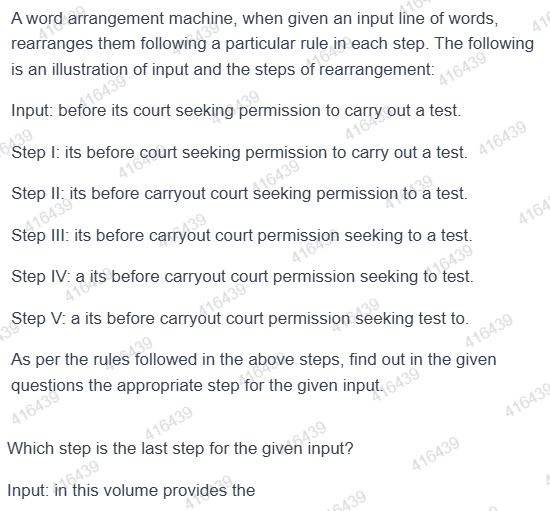
A word arrangement machine, when given an input line of words, rearranges them following a particular rule in each step. The following is an illustration of input and the steps of rearrangement:

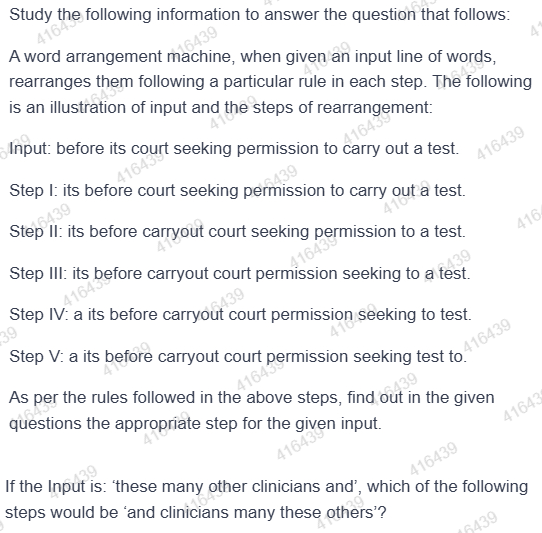
Input: before its court seeking permission to carry out a test.
Step I: its before court seeking permission to carry out a test.
Step II: its before carryout court seeking permission to a test.
Step III: its before carryout court permission seeking to a test.
Step IV: a its before carryout court permission seeking to test.
Step V: a its before carryout court permission seeking test to.

As per the rules followed in the above steps, find out in the given questions the appropriate step for the given input.

Which step is the last step for the given input?
Input: in this volume provides the
Figure for MBA CET 2025 Slot 4 question 71
  1. 1
  2. 2
  3. 3
  4. 4
  5. 5
Show answerHide answer

Answer: C

Approach: Input–output (word sorting): one word is fixed per step in alphabetical order.

Solution:
Rule used: in each step the machine fixes the next word in dictionary (alphabetical) order at the left, after the words already fixed.
Input: in this volume provides the. Alphabetical order: in, provides, the, this, volume.
Step I: "in" is fixed first (already in place) — in this volume provides the.
Step II: "provides" is fixed — in provides this volume the.
Step III: "the" is fixed — in provides the this volume.
Now "this" and "volume" are already in order, so the arrangement is complete at Step III.

Cetking shortcut: Write the sorted order first; the last step is the step that fixes the last word that is out of place.

Answer: C

Q72EasyCET 2025 · Slot 4 · Q72
Passage / data for this question

A word arrangement machine, when given an input line of words, rearranges them following a particular rule in each step. The following is an illustration of input and the steps of rearrangement:

Input: before its court seeking permission to carry out a test.
Step I: its before court seeking permission to carry out a test.
Step II: its before carryout court seeking permission to a test.
Step III: its before carryout court permission seeking to a test.
Step IV: a its before carryout court permission seeking to test.
Step V: a its before carryout court permission seeking test to.

As per the rules followed in the above steps, find out in the given questions the appropriate step for the given input.

If the Input is: 'these many other clinicians and', which of the following steps would be 'and clinicians many these others'?
Figure for MBA CET 2025 Slot 4 question 72
  1. 1
  2. 2
  3. 3
  4. 4
  5. 5
Show answerHide answer

Answer: C

Approach: Input–output (word sorting): fix one word per step in alphabetical order.

Solution:
Rule used: in each step the machine fixes the next word in dictionary (alphabetical) order at the left, after the words already fixed.
Input: these many other clinicians and. Alphabetical order: and, clinicians, many, other, these.
Step I: and these many other clinicians.
Step II: and clinicians these many other.
Step III: and clinicians many these other.
Step III matches the given line (the paper prints "others" for "other").

Cetking shortcut: Count how many words from the left are already in sorted order in the target line: and, clinicians, many = 3 ⇒ Step III.

Answer: C

Q73MediumCET 2025 · Slot 4 · Q73
Passage / data for this question

A word arrangement machine, when given an input line of words, rearranges them following a particular rule in each step. The following is an illustration of input and the steps of rearrangement:

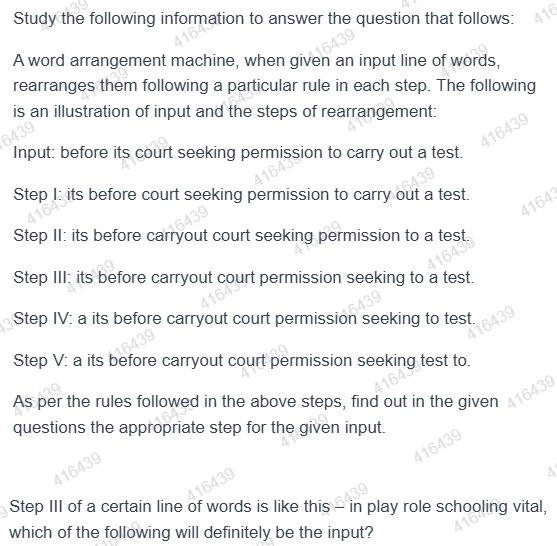
Input: before its court seeking permission to carry out a test.
Step I: its before court seeking permission to carry out a test.
Step II: its before carryout court seeking permission to a test.
Step III: its before carryout court permission seeking to a test.
Step IV: a its before carryout court permission seeking to test.
Step V: a its before carryout court permission seeking test to.

As per the rules followed in the above steps, find out in the given questions the appropriate step for the given input.

Step III of a certain line of words is like this – in play role schooling vital, which of the following will definitely be the input?
Figure for MBA CET 2025 Slot 4 question 73
  1. in play schooling vital role
  2. schooling play vital role in
  3. in schooling play vital role
  4. in schooling play role vital
  5. in schooling vital role play
Show answerHide answer

Answer: B

Approach: Input–output (reverse): the machine moves one word per step into its alphabetical place at the left; the input that needs exactly three such moves to reach this line is the answer.

Solution:
Step III: in play role schooling vital (the first three words in, play, role are fixed).
Option B: schooling play vital role in → Step I: in schooling play vital role → Step II: in play schooling vital role → Step III: in play role schooling vital ✔ (three moves needed).
A (in play schooling vital role): only role is out of place — one move.
C (in schooling play vital role), D (in schooling play role vital), E (in schooling vital role play): in is already first, so only two moves are needed.

Why the other options are wrong:
A, C, D, E all reach the line in fewer than three steps, so it would not be Step III.

Cetking shortcut: An input that reaches this line only at Step III must have its first three sorted words (in, play, role) all out of place.

Answer: B

Q74EasyCET 2025 · Slot 4 · Q74
Passage / data for this question

A word arrangement machine, when given an input line of words, rearranges them following a particular rule in each step. The following is an illustration of input and the steps of rearrangement:

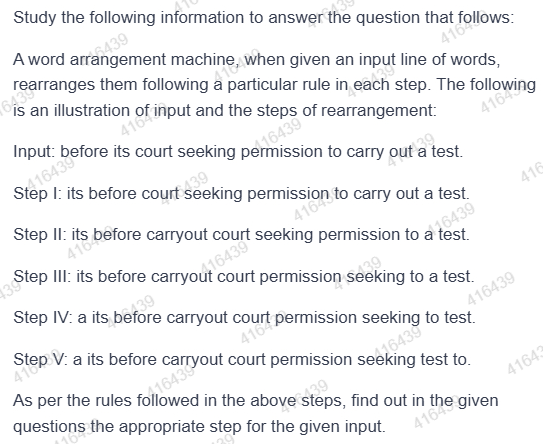
Input: before its court seeking permission to carry out a test.
Step I: its before court seeking permission to carry out a test.
Step II: its before carryout court seeking permission to a test.
Step III: its before carryout court permission seeking to a test.
Step IV: a its before carryout court permission seeking to test.
Step V: a its before carryout court permission seeking test to.

As per the rules followed in the above steps, find out in the given questions the appropriate step for the given input.

Which of the following will be Step II for an input – modern man is becoming a chronic victim?
Figure for MBA CET 2025 Slot 4 question 74Figure for MBA CET 2025 Slot 4 question 74
  1. a becoming modern man is chronic victim
  2. a becoming chronic modern man is victim
  3. a modern man is becoming chronic victim
  4. a becoming chronic is man modern victim
  5. a modern becoming chronic is man victim
Show answerHide answer

Answer: A

Approach: Input–output (word sorting): fix one word per step in alphabetical order.

Solution:
Rule used: in each step the machine fixes the next word in dictionary (alphabetical) order at the left, after the words already fixed.
Input: modern man is becoming a chronic victim. Alphabetical order: a, becoming, chronic, is, man, modern, victim.
Step I: a modern man is becoming chronic victim.
Step II: a becoming modern man is chronic victim.

Why the other options are wrong:
B: this is Step III (chronic also fixed).
C: "becoming" is missing from its place — not a valid step.
D, E: words appear out of the machine's order.

Cetking shortcut: At Step II exactly two words (a, becoming) are fixed at the left; the rest keep input order.

Answer: A

Practise these in the Arena

Take timed tests built around MBA CET topics and see where you stand.

Open the Arena