Let’s Crack CET 2027

Your CET check-up · tap a ring to see yours

Mathematical Operations – MBA CET questions with solutions

35 questions · CET 2025–2026 · Easy 25 · Medium 8 · Hard 2. Newest paper first. Full papers

Q38EasyCET 2026 · Attempt 2 Slot 2 · Q38

If + means ÷, - means x, x means +, ÷ means -, then give the value for 45 + 9 - 3 x 15 ÷ 2

  1. 40
  2. 28
  3. 56
  4. 26
  5. 46
Show answerHide answer

Answer: B official key

Approach: Symbol substitution, then BODMAS.

Solution:
Replace: + → ÷, − → ×, × → +, ÷ → −.
45 + 9 − 3 × 15 ÷ 2 becomes 45 ÷ 9 × 3 + 15 − 2.
45 ÷ 9 = 5; 5 × 3 = 15.
15 + 15 − 2 = 28.

Cetking shortcut: Rewrite the whole expression first, then solve — never substitute and compute at the same time.

Answer: B
Q39EasyCET 2026 · Attempt 2 Slot 2 · Q39

If 'K' means 'minus', 'L' means 'divided by', 'M' means 'plus' and 'D' means 'multiplied by', then
117 L 3 K 5 M 12 D 8 = ?

  1. 145
  2. 130
  3. 150
  4. 125
  5. 110
Show answerHide answer

Answer: B official key

Approach: Letter-to-operator substitution, then BODMAS.

Solution:
K = −, L = ÷, M = +, D = ×.
117 L 3 K 5 M 12 D 8 = 117 ÷ 3 − 5 + 12 × 8.
117 ÷ 3 = 39; 12 × 8 = 96.
39 − 5 + 96 = 130.

Cetking shortcut: Division and multiplication first: 39 and 96, then 39 + 96 − 5.

Answer: B

Q71EasyCET 2026 · Attempt 2 Slot 2 · Q71

If you write down all the numbers from 1 to 100, then how many times do you write 3 ?

  1. 11
  2. 18
  3. 20
  4. 21
  5. 10
Show answerHide answer

Answer: C official key

Approach: Digit counting: count the digit 3 in the units place and in the tens place separately.

Solution:
Units place: 3, 13, 23, 33, 43, 53, 63, 73, 83, 93 ⇒ 10 times.
Tens place: 30, 31, …, 39 ⇒ 10 times.
33 is counted in both lists, which is right because it has two 3s.
100 has no 3. Total = 10 + 10 = 20.

Why the other options are wrong:
A (11), E (10): count only one place value.
B (18), D (21): miscount the overlap at 33.

Cetking shortcut: From 1 to 99, every non-zero digit appears 10 times in units and 10 times in tens = 20.

Answer: C

Q20EasyCET 2026 · Slot 5 · Q20

Find the number that shall come in place of "?" in the given table :

7362
2854
1124
421?
  1. 3
  2. 7
  3. 5
  4. 4
  5. 6
Show answerHide answer

Official CET key: D · Cetking's answer: E — see why below

Approach: Constant column sum.

Solution:
Column 1: 7 + 2 + 1 + 4 = 14
Column 2: 3 + 8 + 1 + 2 = 14
Column 3: 6 + 5 + 2 + 1 = 14
Column 4: 2 + 4 + 4 + ? = 14 → ? = 4

Cetking shortcut: In number grids test row sums and column sums first — here the column sums are all equal.

Answer: D

Q26EasyCET 2026 · Slot 5 · Q26

Which interchange of sign will make the following equation correct :

10 + 10 ÷ 10 – 10 × 10 = 10

  1. + and -
  2. - and X
  3. ÷ and +
  4. ÷ and -
  5. + and X
Show answerHide answer

Official CET key: E · Cetking's answer: C — see why below

Approach: Swap the two signs everywhere, then evaluate with BODMAS.

Solution:
Given: 10 + 10 ÷ 10 − 10 × 10 = 10 + 1 − 100 = −89 (wrong as it stands).
Interchange + and ×: 10 × 10 ÷ 10 − 10 + 10
= 100 ÷ 10 − 10 + 10
= 10 − 10 + 10 = 10 ✓

Why the other options are wrong:
A) 10 − 10 ÷ 10 + 10 × 10 = 10 − 1 + 100 = 109 ✗
C) 10 ÷ 10 + 10 − 10 × 10 = 1 + 10 − 100 = −89 ✗
B) 10 + 10 ÷ 10 × 10 − 10 = 10 + 10 − 10 = 10 and D) 10 + 10 − 10 ÷ 10 × 10 = 10 + 10 − 10 = 10 also balance under BODMAS — the official key is E.

Cetking shortcut: With all numbers equal to 10, look for a swap that makes 10 × 10 ÷ 10 = 10 and leaves '− 10 + 10' to cancel.

Answer: E

Q27EasyCET 2026 · Slot 5 · Q27

If :

R stands for -

A stands for +

B stands for ÷

C stands for X

Then determine the value of the given equation [without applying the BODMAS Rule] ?

25 A 37 C 2 B 4 R 1 = ?

  1. 32.5
  2. 35.5
  3. 42.5
  4. 45.5
  5. 52.5
Show answerHide answer

Official CET key: C · Cetking's answer: D — see why below

Approach: Replace letters by signs and evaluate.

Solution:
25 A 37 C 2 B 4 R 1 → 25 + 37 × 2 ÷ 4 − 1
The key's value comes from the usual order of operations:
37 × 2 = 74, 74 ÷ 4 = 18.5
25 + 18.5 − 1 = 42.5
(Strict left-to-right work gives 62 × 2 = 124, ÷ 4 = 31, − 1 = 30, which is not an option — so the options are built on the BODMAS value.)

Cetking shortcut: If the left-to-right value is not in the options, switch to BODMAS — the paper's options reveal the intended method.

Answer: C

Q28MediumCET 2026 · Slot 5 · Q28

If :

X means addition

- means division

÷ means subtraction

+ means multiplication

Then, which of the following equation is correct ?

Solve without applying BODMAS Rule

  1. 16 + 5 ÷ 10 X 4 - 3 = 9
  2. 16 + 5 ÷ 10 X 3 - 6 = 7
  3. 16 - 5 X 10 ÷ 4 + 3 = 12
  4. 16 + 5 - 10 X 4 ÷ 3 = 9
  5. 16 X 5 ÷ 9 - 4 + 10 = 8
Show answerHide answer

Answer: D official key

Approach: Substitute the signs (X → +, − → ÷, ÷ → −, + → ×) and evaluate left to right.

Solution:
D) 16 + 5 − 10 X 4 ÷ 3 → 16 × 5 ÷ 10 + 4 − 3
16 × 5 = 80, 80 ÷ 10 = 8, 8 + 4 = 12, 12 − 3 = 9 ✓

Why the other options are wrong:
A) 16 × 5 − 10 + 4 ÷ 3 = (80 − 10 + 4) ÷ 3 = 24.67 ≠ 9
B) 16 × 5 − 10 + 3 ÷ 6 = 73 ÷ 6 ≈ 12.17 ≠ 7
C) 16 ÷ 5 + 10 − 4 × 3 = 9.2 × 3 = 27.6 ≠ 12
E) 16 + 5 − 9 ÷ 4 × 10 = 12 ÷ 4 × 10 = 30 ≠ 8

Answer: D

Q30MediumCET 2026 · Slot 5 · Q30

Which two signs should be interchanged to make the given equation correct :

12 + 156 ÷ 13 × 6 – 100 = 50

  1. + and ×
  2. ÷ and –
  3. – and ×
  4. + and -
  5. ÷ and ×
Show answerHide answer

Official CET key: A · Cetking's answer: D — see why below

Approach: Try each interchange and evaluate with BODMAS.

Solution:
Interchange + and ×: 12 × 156 ÷ 13 + 6 − 100
12 × 156 = 1872, 1872 ÷ 13 = 144
144 + 6 − 100 = 50 ✓

Why the other options are wrong:
B) 12 + 156 − 13 × 6 ÷ 100 ≈ 167.2
C) 12 + 156 ÷ 13 − 6 × 100 = −576
D) 12 − 156 ÷ 13 × 6 + 100 = 40
E) 12 + 156 × 13 ÷ 6 − 100 = 250

Cetking shortcut: 156 = 12 × 13, so 12 × 156 ÷ 13 = 144 instantly.

Answer: A

Q56EasyCET 2026 · Slot 4 · Q56

In the question, certain mathematical operations are redefined. Find the value of the given expression using the new meanings of the symbols.

If + means ×, × means –, ÷ means + & – means ÷,

then Find 200 – 20 ÷ 5 + 20 × 3+10 = ?

  1. 160
  2. 90
  3. 145
  4. 77
  5. 80
Show answerHide answer

Official CET key: E · Cetking's answer: D — see why below

Approach: Replace each symbol with its new meaning, then apply BODMAS.

Solution: Given: + → ×, × → −, ÷ → +, − → ÷.
200 – 20 ÷ 5 + 20 × 3 + 10 becomes 200 ÷ 20 + 5 × 20 − 3 × 10.
Division/multiplication first: 200 ÷ 20 = 10; 5 × 20 = 100; 3 × 10 = 30.
Then: 10 + 100 − 30 = 80.

Cetking shortcut: Rewrite the whole expression once with new symbols before calculating – substituting on the fly causes most errors.

Answer: E

Q57EasyCET 2026 · Slot 4 · Q57

If ‘when’ means ‘x’, ‘you’ means ‘÷’, ‘come’ means ‘-’ and ‘will’ means ‘+’, then what will be the value of “8 when 12 will 16 you 2 come 10”?

  1. 31
  2. 45
  3. 86
  4. 94
  5. 98
Show answerHide answer

Answer: D official key

Approach: Replace the words with operators and apply BODMAS.

Solution: when = ×, will = +, you = ÷, come = −.
8 × 12 + 16 ÷ 2 − 10 = 96 + 8 − 10 = 94.

Cetking shortcut: Do ÷ and × first: 96 and 8, then add/subtract.

Answer: D

Q58MediumCET 2026 · Slot 4 · Q58

Which of the following equation will be correct if ÷ & +, 12 & 18 are interchanged with each other?

  1. (90 × 18) + 18 = 60
  2. (18 + 6) ÷ 12 = 2
  3. (72 ÷ 18) × 18 = 72
  4. (12 + 6) × 18 = 36
  5. (36 ÷ 18) + 12 = 4
Show answerHide answer

Official CET key: D · Cetking's answer: E — see why below

Approach: Interchange ÷ ↔ + and 12 ↔ 18 in each option and check which equation holds.

Solution: Option D: (12 + 6) × 18 = 36 → (18 ÷ 6) × 12 = 3 × 12 = 36 ✔.
Check others: A → (90 × 12) ÷ 12 = 90 ≠ 60; B → (12 ÷ 6) + 18 = 20 ≠ 2; C → (72 + 12) × 12 = 1008 ≠ 72; E → (36 + 12) ÷ 18 = 2.67 ≠ 4.

Why the other options are wrong: A gives 90, B gives 20, C gives 1008, E gives 2.67 – none equal the RHS.

Cetking shortcut: Start with options whose RHS is small and has both 12 and 18 in it – D works immediately.

Answer: D

Q59EasyCET 2026 · Slot 4 · Q59

If P means –, Q means ×, R means ÷ & S means +, then what will be the value of given equation?

14 Q 3 P 12 S 4 R 2 = ?

  1. 18
  2. 30
  3. 32
  4. 22
  5. 36
Show answerHide answer

Official CET key: C · Cetking's answer: D — see why below

Approach: Replace letters with operators and apply BODMAS.

Solution: P = −, Q = ×, R = ÷, S = +.
14 Q 3 P 12 S 4 R 2 = 14 × 3 − 12 + 4 ÷ 2.
= 42 − 12 + 2 = 32.

Cetking shortcut: Multiplication and division first: 42 and 2; then 42 − 12 + 2.

Answer: C

Q60EasyCET 2026 · Slot 4 · Q60

If

P $ Q, means divide

P # Q, means subtract

P% Q, means Add

P @Q, means multiply

then, 70 # 30% 80$ 20@ 10 = ?

  1. 65
  2. 87
  3. 80
  4. 81
  5. 89
Show answerHide answer

Answer: C official key

Approach: Decode the symbols and apply BODMAS.

Solution: $ = ÷, # = −, % = +, @ = ×.
70 # 30 % 80 $ 20 @ 10 = 70 − 30 + 80 ÷ 20 × 10.
80 ÷ 20 = 4; 4 × 10 = 40.
70 − 30 + 40 = 80.

Cetking shortcut: Division and multiplication left to right first: 80 ÷ 20 × 10 = 40.

Answer: C

Q13EasyCET 2026 · Slot 3 · Q13

If × means –, + means ÷, – means × and ÷ means +, then 11 – 2 ÷ 700 + 70 × 50 = ?

  1. 10
  2. -10
  3. -18
  4. -32
  5. -24
Show answerHide answer

Official CET key: C · Cetking's answer: A — see why below

Approach: Replace symbols, then apply BODMAS.

Solution:
Rules: × → –, + → ÷, – → ×, ÷ → +.
11 – 2 ÷ 700 + 70 × 50 becomes 11 × 2 + 700 ÷ 70 – 50
= 22 + 10 – 50
= –18.

Why the other options are wrong: 10 / –10 / –32 / –24 come from wrong substitution or from solving left to right without BODMAS.

Cetking shortcut: Rewrite the whole expression first, then compute — never substitute and calculate at the same time.

Answer: C

Q29MediumCET 2026 · Slot 3 · Q29
45320
734421
644522
9655?
Find the missing number
  1. 42
  2. 37
  3. 30
  4. 22
  5. 34
Show answerHide answer

Answer: E official key

Approach: Row rule: (1st × 4th) – (2nd + 3rd) = 5th.

Solution:
Row 1: 4 × 2 – (5 + 3) = 8 – 8 = 0 ✓
Row 2: 7 × 4 – (3 + 4) = 28 – 7 = 21 ✓
Row 3: 6 × 5 – (4 + 4) = 30 – 8 = 22 ✓
Row 4: 9 × 5 – (6 + 5) = 45 – 11 = 34.

Cetking shortcut: A 0 in the result column signals equal parts cancelling — look for (product) – (sum) = 0 in that row.

Answer: E

Q66EasyCET 2026 · Slot 2 · Q66

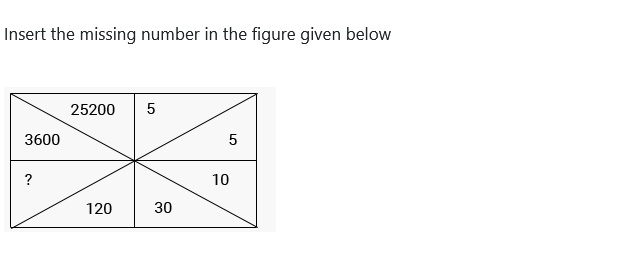
Figure: a rectangle divided by its two diagonals, a vertical centre line and a horizontal centre line into 8 triangular regions. Numbers: top triangle 25200 (left of vertical line) and 5 (right of vertical line); left triangle 3600 (upper) and ? (lower); right triangle 5 (upper) and 10 (lower); bottom triangle 120 (left of vertical line) and 30 (right of vertical line).

Insert the missing number in the figure given below
Figure for MBA CET 2026 Slot 2 question 66
  1. 600
  2. 400
  3. 360
  4. 500
  5. 550
Show answerHide answer

Answer: A official key

Approach: Numbers in the 8 regions form a chain, read clockwise, with multipliers ×1, ×2, ×3 …

Solution:
Start at the top-right region (5) and go clockwise:
5 ×1 = 5 (right-upper), 5 ×2 = 10 (right-lower), 10 ×3 = 30 (bottom-right), 30 ×4 = 120 (bottom-left),
120 ×5 = 600 (left-lower, the ?), 600 ×6 = 3600 (left-upper) ✔, 3600 ×7 = 25200 (top-left) ✔.

Why the other options are wrong:
B (400), C (360), D (500), E (550): none gives 3600 when multiplied by 6.

Cetking shortcut: Large neighbours like 3600 and 25200 signal factorial-type growth: 25200/3600 = 7, so check 3600/6 = 600 directly.

Answer: A

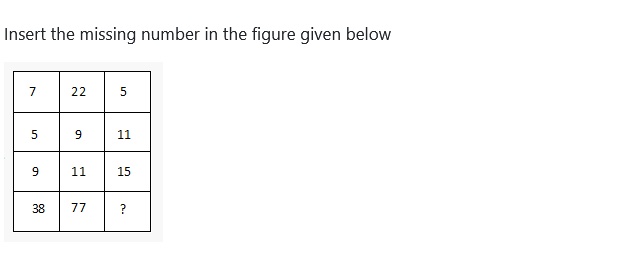
Q67MediumCET 2026 · Slot 2 · Q67

Figure (3 columns x 4 rows grid):

7225
5911
91115
3877?
Insert the missing number in the figure given below
Figure for MBA CET 2026 Slot 2 question 67
  1. 200
  2. 180
  3. 190
  4. 150
  5. 160
Show answerHide answer

Official CET key: E · Cetking's answer: B — see why below

Approach: Column rule: (2nd number × 3rd number) − 1st number = bottom number.

Solution:
Column 1: 5 × 9 − 7 = 45 − 7 = 38 ✔
Column 2: 9 × 11 − 22 = 99 − 22 = 77 ✔
Column 3: 11 × 15 − 5 = 165 − 5 = 160.

Why the other options are wrong:
A (200), B (180), C (190), D (150): none fits the rule that works for both known columns.

Cetking shortcut: Bottom row numbers close to a product of the two middle numbers (38 ≈ 45, 77 ≈ 99) → test product minus the top number.

Answer: E

Q68MediumCET 2026 · Slot 2 · Q68
45320
734421
644522
9655?
Insert the missing number in the following question?
  1. 34
  2. 42
  3. 44
  4. 45
  5. 38
Show answerHide answer

Answer: A official key

Approach: Row rule: (1st × 4th) − (2nd + 3rd) = 5th.

Solution:
Row 1: 4 × 2 − (5 + 3) = 8 − 8 = 0 ✔
Row 2: 7 × 4 − (3 + 4) = 28 − 7 = 21 ✔
Row 3: 6 × 5 − (4 + 4) = 30 − 8 = 22 ✔
Row 4: 9 × 5 − (6 + 5) = 45 − 11 = 34.

Why the other options are wrong:
B (42), C (44), D (45), E (38): do not satisfy the rule verified on three rows (45 is just the product, ignoring the subtraction).

Cetking shortcut: The 0 in row 1 is the giveaway: some product must equal a sum — 4×2 = 5+3.

Answer: A

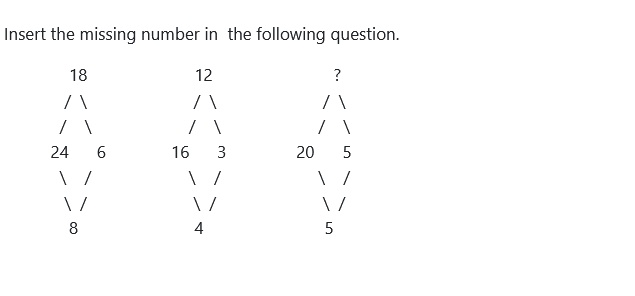
Q69EasyCET 2026 · Slot 2 · Q69

Three inverted-V/diamond number diagrams:
Diagram 1: top 18; middle 24 (left) and 6 (right); bottom 8.
Diagram 2: top 12; middle 16 (left) and 3 (right); bottom 4.
Diagram 3: top ?; middle 20 (left) and 5 (right); bottom 5.

Insert the missing number in the following question.
Figure for MBA CET 2026 Slot 2 question 69
  1. 25
  2. 35
  3. 64
  4. 20
  5. 56
Show answerHide answer

Answer: D official key

Approach: Top = (left × right) ÷ bottom.

Solution:
Figure 1: 24 × 6 ÷ 8 = 144 ÷ 8 = 18 ✔
Figure 2: 16 × 3 ÷ 4 = 48 ÷ 4 = 12 ✔
Figure 3: 20 × 5 ÷ 5 = 100 ÷ 5 = 20.

Why the other options are wrong:
A (25), B (35), C (64), E (56): do not satisfy (left × right) ÷ bottom.

Cetking shortcut: When bottom divides the product cleanly in every figure, test product ÷ bottom first.

Answer: D

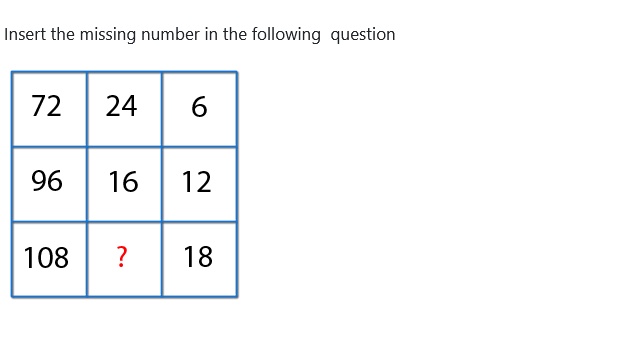
Q70EasyCET 2026 · Slot 2 · Q70
72246
961612
108?18
Insert the missing number in the following question
Figure for MBA CET 2026 Slot 2 question 70
  1. 18
  2. 20
  3. 16
  4. 12
  5. 22
Show answerHide answer

Answer: D official key

Approach: Row rule: (2nd × 3rd) ÷ 2 = 1st.

Solution:
Row 1: 24 × 6 = 144, ÷ 2 = 72 ✔
Row 2: 16 × 12 = 192, ÷ 2 = 96 ✔
Row 3: ? × 18 ÷ 2 = 108 → ? × 18 = 216 → ? = 12.

Why the other options are wrong:
A (18): 18 × 18 / 2 = 162.
B (20): 180.
C (16): 144.
E (22): 198 — none equals 108.

Cetking shortcut: Check ratio 1st ÷ (2nd × 3rd): 72/144 = 96/192 = ½ → constant.

Answer: D

Q74EasyCET 2026 · Slot 2 · Q74
If × stands for –, + means ×, ÷ means + and – means ÷, then what is the value of the given expression ?
175 – 25 ÷ 5 + 20 × 3 + 10 = ?
  1. 80
  2. 85
  3. 92
  4. 77
  5. 65
Show answerHide answer

Answer: D official key

Approach: Replace symbols, then apply BODMAS.

Solution:
Given: × → −, + → ×, ÷ → +, − → ÷.
175 – 25 ÷ 5 + 20 × 3 + 10 becomes 175 ÷ 25 + 5 × 20 − 3 × 10.
= 7 + 100 − 30
= 77.

Why the other options are wrong:
A (80), B (85), C (92), E (65): arise from left-to-right evaluation or a wrong substitution.

Cetking shortcut: Rewrite the whole expression once before calculating — substituting while computing causes most errors.

Answer: D

Q75EasyCET 2026 · Slot 2 · Q75

In a certain code language, the symbols ×, –, ÷, and + do not represent their usual meanings.

Instead:

  • × is used for division (÷)
  • – is used for multiplication (×)
  • ÷ is used for addition (+)
  • + is used for subtraction (–)
Using this information, find the value of the expression:
(5–17÷5)×9+13
  1. -3
  2. 3
  3. 2
  4. -4
  5. 5
Show answerHide answer

Answer: A official key

Approach: Replace symbols, then apply BODMAS.

Solution:
Given: × → ÷, − → ×, ÷ → +, + → −.
(5 – 17 ÷ 5) × 9 + 13 becomes (5 × 17 + 5) ÷ 9 − 13.
= (85 + 5) ÷ 9 − 13 = 90 ÷ 9 − 13
= 10 − 13 = −3.

Why the other options are wrong:
B (3): sign error.
C (2), D (−4), E (5): wrong substitution or order of operations.

Answer: A

Q36EasyCET 2026 · Slot 1 · Q36
If 4 * 5 = 42, 6 * 3 = 38 and 7 * 8 = 114, find the value of 9 * 6 :
  1. 108
  2. 110
  3. 113
  4. 115
  5. 109
Show answerHide answer

Official CET key: B · Cetking's answer: D — see why below

Approach: Test simple combinations of product and sum on the given pairs.

Solution:
Rule: a * b = 2ab + 2.
4 * 5 = 2 × 20 + 2 = 42 ✓
6 * 3 = 2 × 18 + 2 = 38 ✓
7 * 8 = 2 × 56 + 2 = 114 ✓
9 * 6 = 2 × 54 + 2 = 110.

Cetking shortcut: All results are even and just above double the product (40→42, 36→38, 112→114) — answer = 2 × 54 + 2.

Answer: B

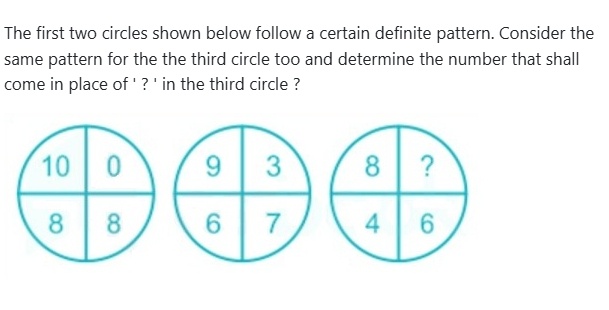
Q42HardCET 2026 · Slot 1 · Q42

The first two circles shown below follow a certain definite pattern. Consider the same pattern for the the third circle too and determine the number that shall come in place of ' ? ' in the third circle ?

Data read from figure (each circle split into four quadrants, top-left, top-right, bottom-left, bottom-right): Circle 1: 10, 0, 8, 8. Circle 2: 9, 3, 6, 7. Circle 3: 8, ?, 4, 6.

Figure for MBA CET 2026 Slot 1 question 42
  1. 6
  2. 9
  3. 7
  4. 10
  5. 8
Show answerHide answer

Answer: E official key

Approach: Find a rule inside each circle linking the top-right number with the other three.

Solution:
Rule: top-right = (top-left − bottom-left) × (bottom-right − bottom-left).
Circle 1: (10 − 8) × (8 − 8) = 2 × 0 = 0 ✓
Circle 2: (9 − 6) × (7 − 6) = 3 × 1 = 3 ✓
Circle 3: (8 − 4) × (6 − 4) = 4 × 2 = 8.

Cetking shortcut: A 0 in circle 1 hints at a product with a zero factor — bottom-left = bottom-right (8, 8) there, so test (BR − BL) as a factor.

Answer: E

Q67MediumCET 2026 · Slot 1 · Q67
If '-' stands for '+', '+' stands for 'x', 'x' stands for '-', then which one of the following is correct ?
  1. 22 + 7 - 3 x 9 = 148
  2. 44 - 9 + 6 x 11 = 86
  3. 7 + 28 - 3 x 52 = 127
  4. 22 - 0 + 0 x 11 = 0
  5. 33 x 5 - 10 + 20 = 228
Show answerHide answer

Answer: E official key

Approach: Mathematical operations — replace the symbols, then apply BODMAS.

Solution:
Code: '−' means +, '+' means ×, '×' means −.
Option E: 33 × 5 − 10 + 20 becomes 33 − 5 + 10 × 20 = 33 − 5 + 200 = 228 ✓.
Check the rest: B: 44 + 9 × 6 − 11 = 87 ≠ 86. C: 7 × 28 + 3 − 52 = 147 ≠ 127. D: 22 + 0 × 0 − 11 = 11 ≠ 0.
Note: option A, 22 + 7 − 3 × 9 → 22 × 7 + 3 − 9 = 154 + 3 − 9 = 148, also balances under the same code; the keyed answer is E.

Why the other options are wrong:
B, C, D: fail after substitution (87, 147 and 11 instead of 86, 127 and 0).

Cetking shortcut: Substitute only the operators, then do × before + and −; reject an option the moment it misses the target.

Answer: E

Q68EasyCET 2026 · Slot 1 · Q68
If the following equation has to be balanced, then the signs of which of the following mathematical signs options will have to be used in place of A, B, C respectively?
24 A 6 B 12 C 16 = 0
  1. - and ÷ and +
  2. - and - and +
  3. ÷ and + and ÷
  4. ÷ and - and ÷
  5. ÷ and + and -
Show answerHide answer

Answer: E official key

Approach: Balancing an equation — try the given sign sets with BODMAS.

Solution:
Option E: 24 ÷ 6 + 12 − 16.
= 4 + 12 − 16 = 0 ✓.

Why the other options are wrong:
A: 24 − 6 ÷ 12 + 16 = 24 − 0.5 + 16 = 39.5.
B: 24 − 6 − 12 + 16 = 22.
C: 24 ÷ 6 + 12 ÷ 16 = 4 + 0.75 = 4.75.
D: 24 ÷ 6 − 12 ÷ 16 = 4 − 0.75 = 3.25.

Cetking shortcut: To reach 0 the last sign must subtract 16; 24 ÷ 6 + 12 = 16 fits instantly.

Answer: E

Q69EasyCET 2026 · Slot 1 · Q69
If :
64 x 52 = 17
48 x 56 = 23
74 x 35 = 19 ;
then find :
84 x 37 = ?
  1. 32
  2. 23
  3. 21
  4. 20
  5. 22
Show answerHide answer

Answer: E official key

Approach: Number pattern — sum of all digits on the left side.

Solution:
64 × 52 → 6 + 4 + 5 + 2 = 17 ✓.
48 × 56 → 4 + 8 + 5 + 6 = 23 ✓.
74 × 35 → 7 + 4 + 3 + 5 = 19 ✓.
84 × 37 → 8 + 4 + 3 + 7 = 22.

Why the other options are wrong:
A 32, B 23, C 21, D 20: none equals the digit sum 22.

Cetking shortcut: When results are small (under 40) for 2-digit 'products', test the digit sum first.

Answer: E

Q19EasyCET 2025 · Slot 6 · Q19

If ‘+’ means ‘÷’, ‘÷’ means’-‘, ‘-‘ means ‘×’ and ‘×’ means ‘+’, then 10+5÷3-2×9 is equal to

  1. 6
  2. 8
  3. 7
  4. 10
  5. 5
Show answerHide answer

Answer: E

Approach: Substitute the real operators, then apply BODMAS.

Solution:
+ → ÷, ÷ → −, − → ×, × → +.
10 + 5 ÷ 3 − 2 × 9 becomes 10 ÷ 5 − 3 × 2 + 9.
= 2 − 6 + 9 = 5.

Cetking shortcut: Rewrite the full expression once before calculating — mid-way substitution causes most errors.

Answer: E

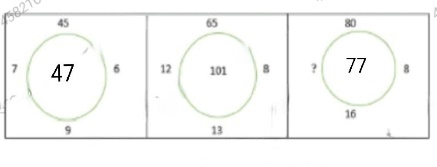
Q31EasyCET 2025 · Slot 6 · Q31

find the alternative which will replace question mark

Figure for MBA CET 2025 Slot 6 question 31
  1. 12
  2. 14
  3. 5
  4. 9
  5. 3
Show answerHide answer

Answer: D

Approach: Find the rule linking the side numbers to the centre number in each figure.

Solution:
Figure 1: left 7, right 6 → 7 × 6 + 5 = 47 (centre) ✓
Figure 2: left 12, right 8 → 12 × 8 + 5 = 101 ✓
Figure 3: ? × 8 + 5 = 77 → ? × 8 = 72 → ? = 9.
(Top = 5 × bottom in each figure: 45 = 5×9, 65 = 5×13, 80 = 5×16 — a separate check, not needed for ?.)

Cetking shortcut: Back-solve: (77 − 5) ÷ 8 must be a whole number — only 9 works.

Answer: D

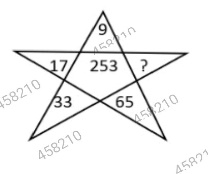
Q40EasyCET 2025 · Slot 6 · Q40

Find the correct alternative which will replace the question mark.

Figure for MBA CET 2025 Slot 6 question 40
  1. 103
  2. 129
  3. 156
  4. 98
  5. 132
Show answerHide answer

Answer: B

Approach: Find the rule moving around the star's outer numbers.

Solution:
9 → 17 → 33 → 65: each term = previous × 2 − 1 (9×2−1 = 17, 17×2−1 = 33, 33×2−1 = 65).
Next = 65 × 2 − 1 = 129.
Check with centre: 9 + 17 + 33 + 65 + 129 = 253 ✓

Cetking shortcut: Centre 253 − (9 + 17 + 33 + 65 = 124) = 129 directly.

Answer: B

Q56MediumCET 2025 · Slot 3 · Q56
How many times will you write even numerals if you write all the numbers from 291 to 300?
  1. 11
  2. 13
  3. 15
  4. 17
  5. 21
Show answerHide answer

Answer: C

Approach: Count the even digits (0, 2, 4, 6, 8) written in each number. Zero is an even digit.

Solution:
291, 293, 295, 297, 299: one even digit each (the 2), so 5 × 1 = 5.
292, 294, 296, 298: two even digits each, so 4 × 2 = 8.
300: two zeros, which are even digits, so 2.
Total = 5 + 8 + 2 = 15.

Why the other options are wrong:
B (13): counts only 291 to 299 and leaves out the two zeros of 300.
A (11), D (17), E (21): these do not match a digit-by-digit count.

Cetking shortcut: Do the 290s as a block: the hundreds digit 2 gives 9, the even units digits (2, 4, 6, 8) give 4, and 300 gives 2 more: 9 + 4 + 2 = 15.

Answer: C

Q66EasyCET 2025 · Slot 3 · Q66
The 30 members of a club decided to play a badminton singles tournament. Every time a member loses a game, he is out of the tournament. There are no ties. What is the minimum number of matches that must be played to determine the winner?
  1. 15
  2. 29
  3. 61
  4. 60
  5. 30
Show answerHide answer

Answer: B

Approach: Knockout tournament: each match knocks out exactly one player.

Solution:
To find a winner, 30 − 1 = 29 players must be knocked out.
Each match knocks out exactly one player, so 29 matches are needed.

Why the other options are wrong:
A (15): this is only the first round (30 ÷ 2).
E (30): this counts the winner as knocked out too.
C (61), D (60): these count twice the matches or include extra rounds.

Cetking shortcut: For any knockout with n players, the number of matches = n − 1. Byes do not change this.

Answer: B

Q67EasyCET 2025 · Slot 2 · Q67
Which interchange of signs makes this equation correct?
10 + 10 + 10 − 10 × 10 = 1000
  1. + and ÷
  2. + and ×
  3. ÷ and −
  4. × and −
  5. + and ×
Show answerHide answer

Answer: B

Approach: Swap the two signs everywhere they occur, then apply BODMAS.

Solution:
Swap + and ×: 10 × 10 × 10 − 10 + 10 = 1000 − 10 + 10 = 1000 ✓.

Why the other options are wrong:
A (+ ↔ ÷): 10 ÷ 10 ÷ 10 − 10 × 10 = 0.1 − 100 ✗.
C (÷ ↔ −): 10 + 10 + 10 ÷ 10 × 10 = 30 ✗.
D (× ↔ −): 10 + 10 + 10 × 10 − 10 = 110 ✗.

Cetking shortcut: A big right-hand side (1000) needs multiplications on the left — try swapping + with × first.

Answer: B

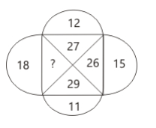
Q88EasyCET 2025 · Slot 2 · Q88
Figure out the number that shall come in place of '?':
Figure for MBA CET 2025 Slot 2 question 88
  1. 12
  2. 25
  3. 30
  4. 42
  5. 35
Show answerHide answer

Answer: C

Approach: Relate each inner number to the two outer numbers beside it.

Solution:
Outer: top 12, right 15, bottom 11, left 18. Inner: top 27, right 26, bottom 29, left ?.
Top inner 27 = 12 + 15 (top + right).
Right inner 26 = 15 + 11 (right + bottom).
Bottom inner 29 = 11 + 18 (bottom + left).
Left inner = 18 + 12 (left + top) = 30.

Cetking shortcut: Inner sum (27 + 26 + 29 + ?) = 2 × outer sum (56) = 112 → ? = 30.

Answer: C

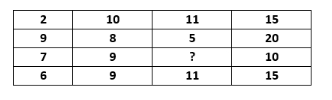
Q94HardCET 2025 · Slot 2 · Q94
The numbers are arranged in a certain order. In one place a question mark '?' is given.
Find out which one of the option numbers will replace '?':
Figure for MBA CET 2025 Slot 2 question 94
  1. 18
  2. 12
  3. 13
  4. 15
  5. 17
Show answerHide answer

Answer: E

Approach: Compare the middle two numbers of a column with its top and bottom numbers.

Solution:
Column 4: top 15, bottom 15; middle 20 + 10 = 30 = 15 + 15.
Column 3: top 11, bottom 11; middle 5 + ? must equal 11 + 11 = 22 → ? = 17.

Answer: E

Practise these in the Arena

Take timed tests built around MBA CET topics and see where you stand.

Open the Arena