Let’s Crack CET 2027

Your CET check-up · tap a ring to see yours

Pattern Completion – MBA CET questions with solutions

22 questions · CET 2025–2026 · Easy 8 · Medium 11 · Hard 3. Newest paper first. Full papers

Q76EasyCET 2026 · Attempt 2 Slot 2 · Q76
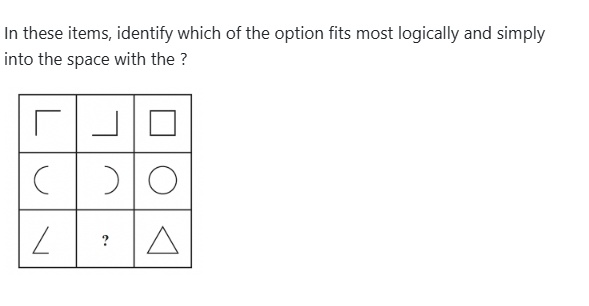
In these items, identify which of the option fits most logically and simply into the space with the ?
Figure for MBA CET 2026 Attempt 2 Slot 2 question 76
  1. Option A
  2. Option B
  3. Option C
  4. Option D
  5. Option E
Show answerHide answer

Answer: D official key

Approach: Pattern completion in a 3×3 grid: column 1 + column 2 = column 3.

Solution:
Row 1: the corner ┌ (top + left sides) and the corner ┘ (right + bottom sides) join to make the square.
Row 2: '(' and ')' join to make the circle.
Row 3: the first cell shows the left slant and the base of a triangle (∠). The missing cell must be the remaining right slant, drawn as the mirror image of the first cell, so that both join into the triangle.
Option D is the mirror image of the first cell (right slant with base) ⇒ fits.

Why the other options are wrong:
A: same as the first cell, not its mirror.
B, C: upward/downward chevrons; they do not complete the triangle.
E: a base with two small stubs, not the right side.

Cetking shortcut: In every row cell 1 + cell 2 build the shape in cell 3: complete the triangle with the missing right-hand slant.

Answer: D
Q100EasyCET 2026 · Attempt 2 Slot 2 · Q100
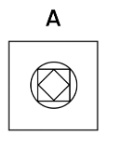
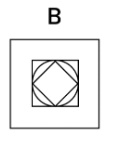
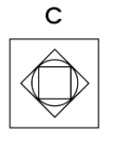
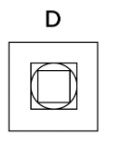
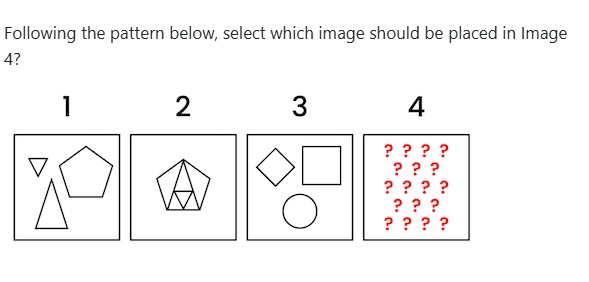
Following the pattern below, select which image should be placed in Image 4?
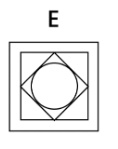
Figure for MBA CET 2026 Attempt 2 Slot 2 question 100
  1. Option A
  2. Option B
  3. Option C
  4. Option D
  5. Option E
Show answerHide answer

Answer: B official key

Approach: Pattern completion: image 2 nests the shapes of image 1 by size; image 4 must nest the shapes of image 3 the same way.

Solution:
Image 1: pentagon (largest), tall triangle (medium), small triangle (smallest).
Image 2: the same shapes nested — pentagon outside, tall triangle inside it, small triangle innermost.
Image 3: square (largest), circle (medium), diamond (smallest).
So image 4: square outside, circle inscribed in it, diamond inside the circle = Option B.

Why the other options are wrong:
A: circle is the outermost shape.
C: diamond is the outermost shape.
D: a square inside the circle instead of a diamond.
E: diamond between the square and the circle.

Cetking shortcut: Order image 3's shapes by size (square > circle > diamond) and pick the option nested in that order.

Answer: B

Q76MediumCET 2026 · Slot 5 · Q76

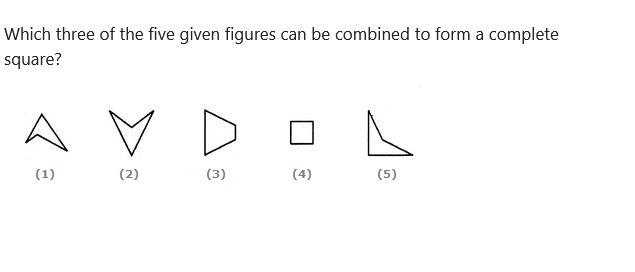
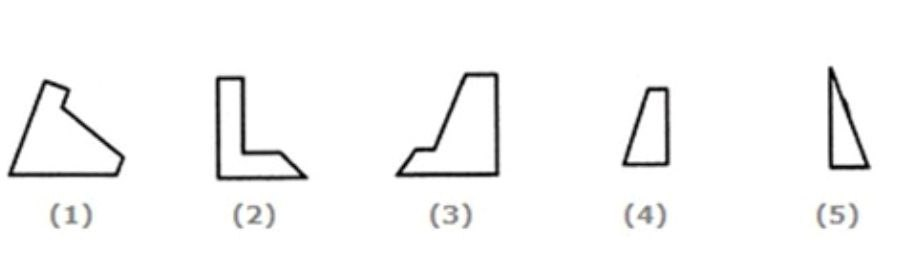
Which three of the five given figures can be combined to form a complete square?

Figure for MBA CET 2026 Slot 5 question 76
  1. 1, 2, 4
  2. 3, 4, 5
  3. 1, 2, 3
  4. 1, 3, 5
  5. 1, 5, 2
Show answerHide answer

Answer: D official key

Approach: A square has four right-angle corners and straight sides; find three pieces whose areas and edges fill it exactly.

Solution:
Piece 5 has a right-angle corner with two full-length straight sides, so it forms one corner of the square (left and bottom sides).
Piece 3 is a trapezium whose long vertical side is as long as the square's side; it forms the opposite (right) side, and its lower slanted edge lies against the slanted edge of piece 5.
The remaining gap, between the top side and the slanted edges of pieces 5 and 3, is exactly the arrow-head (dart) shape of piece 1.
Pieces 1, 3 and 5 together make a complete square (their areas also add up to the square on piece 5's side).

Why the other options are wrong:
Piece 4 is a small square that no neighbouring piece can complete (A, B). Pieces 2 and 1 are both darts: two darts leave the trapezium and the right-angle corner unmatched (A, C, E).

Answer: D

Q94MediumCET 2026 · Slot 5 · Q94

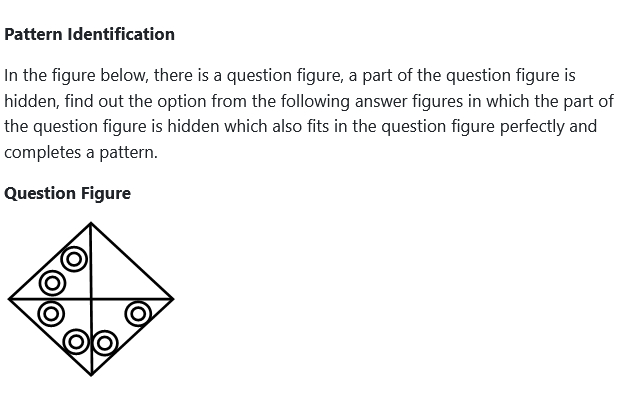
Pattern Identification

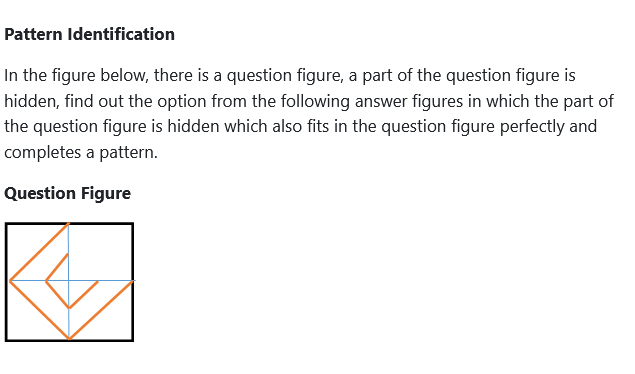
In the figure below, there is a question figure, a part of the question figure is hidden, find out the option from the following answer figures in which the part of the question figure is hidden which also fits in the question figure perfectly and completes a pattern.

Question Figure

Figure for MBA CET 2026 Slot 5 question 94
  1. Option A
  2. Option B
  3. Option C
  4. Option D
  5. Option E
Show answerHide answer

Answer: C official key

Approach: The square is split into four quadrants; the missing top-right quadrant must continue the lines that meet the axes.

Solution:
Outer orange line: a diamond through the midpoints of the sides — present in three quadrants, so the top-right quadrant needs the diagonal from the top midpoint to the right midpoint (top-left corner to bottom-right corner of the quadrant).
Inner orange line: it ends on the vertical axis above the centre and on the horizontal axis to the right of the centre, so the top-right quadrant needs a short line parallel to the diagonal, near the quadrant's bottom-left corner (close to the centre).
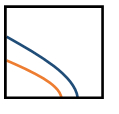
Option C has exactly these two lines.

Why the other options are wrong:
A: short line near the top-right corner. B, D: diagonals slope the wrong way. E: curved lines.

Answer: C

Q95MediumCET 2026 · Slot 5 · Q95

Pattern Identification

In the figure below, there is a question figure, a part of the question figure is hidden, find out the option from the following answer figures in which the part of the question figure is hidden which also fits in the question figure perfectly and completes a pattern.

Question Figure

Figure for MBA CET 2026 Slot 5 question 95
  1. Option A
  2. Option B
  3. Option C
  4. Option D
  5. Option E
Show answerHide answer

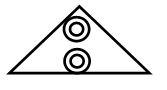
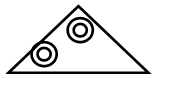
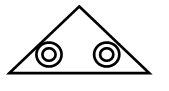
Official CET key: C · Cetking's answer: D — see why below

Approach: Use the symmetry of the other three quadrants.

Solution:
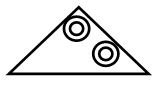
The diamond is split into four right-angled quadrants, each with two ring symbols.
Top-left: both rings lie along the outer (slanted) edge.
The bottom quadrants mirror each other about the vertical axis.
So the top-right quadrant mirrors the top-left: two rings along its outer edge.
The answer pieces show the quadrant turned so its outer edge is the base; option C has the two rings along the base.

Why the other options are wrong:
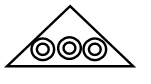
A, B, D: rings along a short side, not the outer edge. E: three rings.

Answer: C

Q92HardCET 2026 · Slot 4 · Q92
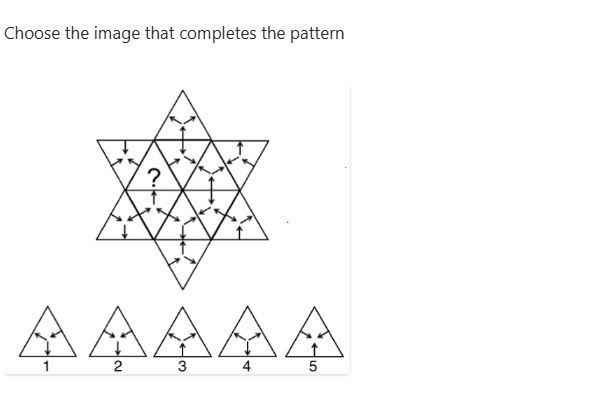
Choose the image that completes the pattern
Figure for MBA CET 2026 Slot 4 question 92
  1. 1
  2. 2
  3. 3
  4. 4
  5. 5
Show answerHide answer

Official CET key: B · Cetking's answer: C — see why below

Approach: Arrows on either side of a shared edge mirror each other: if one points toward the edge, so does the other; if one points away, so does the other.

Solution: Check a solved pair: the top triangle's arrow points up (away from the edge) and the triangle below points down (away) – they mirror each other.
For '?': the triangle below has an arrow pointing up toward the shared base → '?' needs an arrow pointing down to its base.
The left neighbour's arrow points away from the shared edge → '?' needs an arrow pointing inward (↘) from its left side.
The right neighbour's arrow points away from the shared edge → '?' needs an inward arrow (↙) from its right side.
So: ↓ outward to the base, and two arrows pointing inward from the sides = option 2.

Why the other options are wrong: 1 and 4 have side arrows pointing outward; 3 and 5 have the vertical arrow pointing up.

Cetking shortcut: Solve one edge at a time – the base edge alone removes 3 and 5.

Answer: B

Q76MediumCET 2026 · Slot 2 · Q76
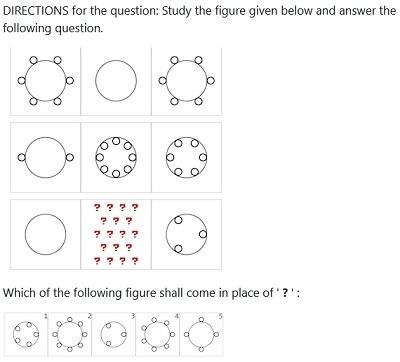
DIRECTIONS for the question: Study the figure given below and answer the following question.
Which of the following figure shall come in place of ' ? ':
Figure for MBA CET 2026 Slot 2 question 76
  1. 1
  2. 2
  3. 3
  4. 4
  5. 5
Show answerHide answer

Answer: C official key

Approach: 3×3 figure matrix: small circles outside the big circle and inside it cancel each other; column 3 shows the net result of columns 1 and 2.

Solution:
Row 1: 6 outside + 0 → 6 outside (column 3) ✔
Row 2: 2 outside + 8 inside → 2 cancel 2 → 6 inside (column 3) ✔
Row 3: 0 + ? = 3 inside (column 3) → ? must have 3 small circles inside the big circle.
Figure 3 is the only option with exactly 3 small circles inside.

Why the other options are wrong:
1: 5 inside.
2 and 4: 8 / 7 circles, some outside.
5: 4 circles outside.

Cetking shortcut: Row 3, column 1 is empty, so the missing figure is simply a copy of column 3 in count and side.

Answer: C

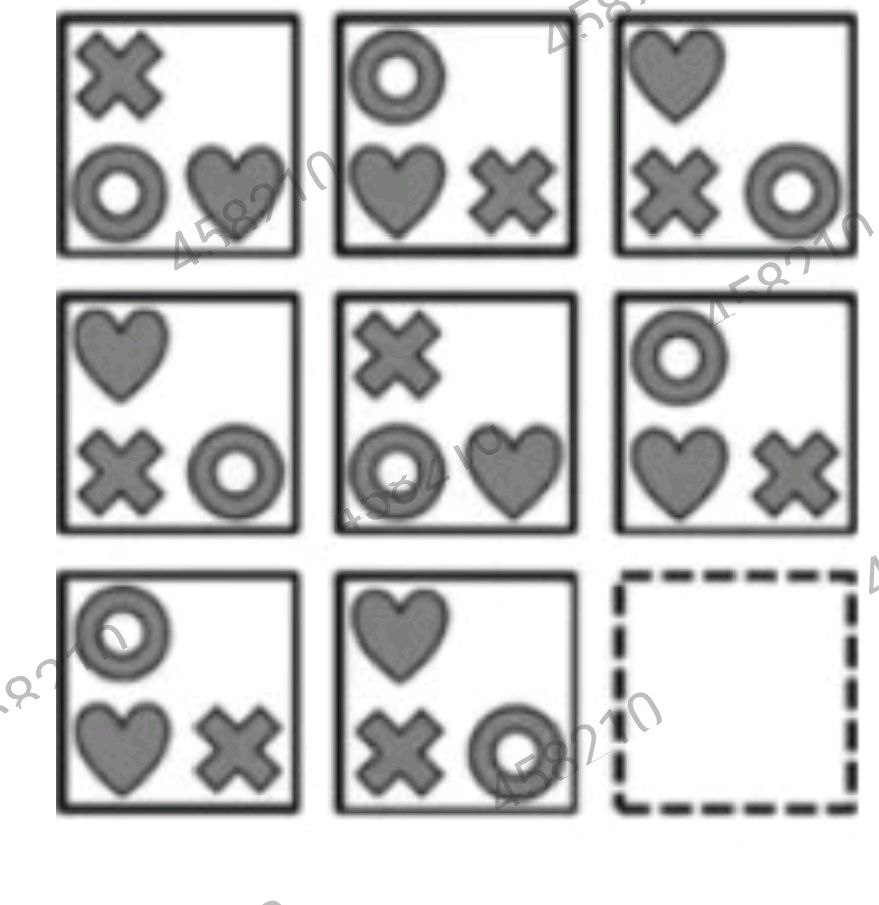
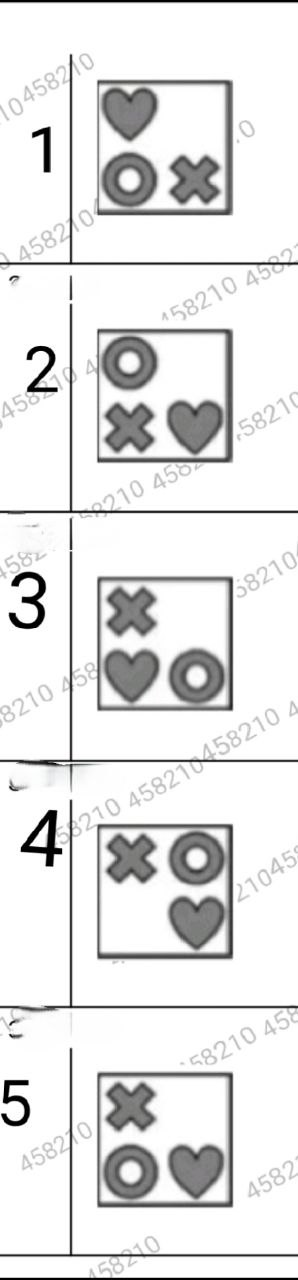
Q87EasyCET 2025 · Slot 6 · Q87
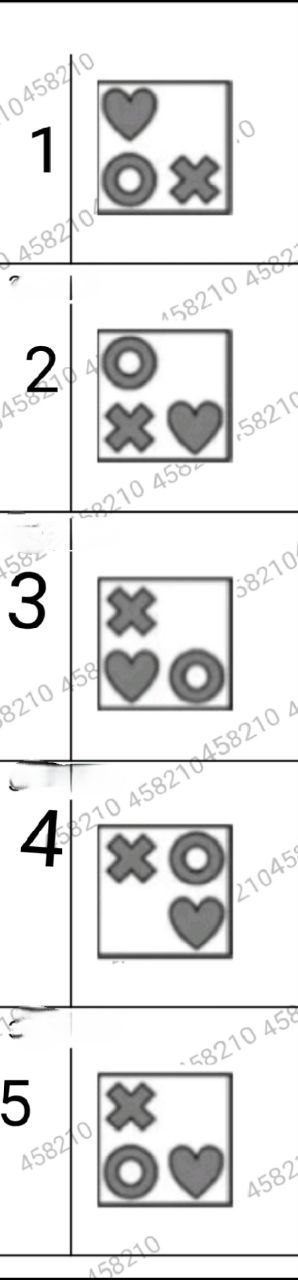
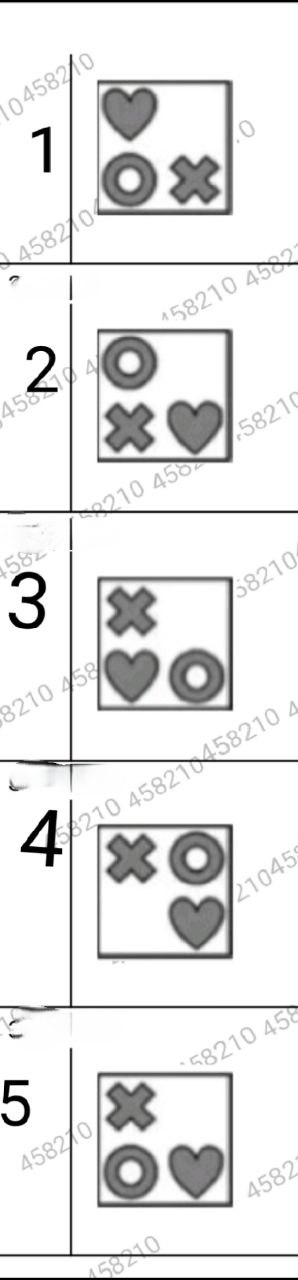
choose from the figure which figure completes the series below?
Figure for MBA CET 2025 Slot 6 question 87Figure for MBA CET 2025 Slot 6 question 87
  1. Option A
  2. Option B
  3. Option C
  4. Option D
  5. Option E
Show answerHide answer

Answer: E

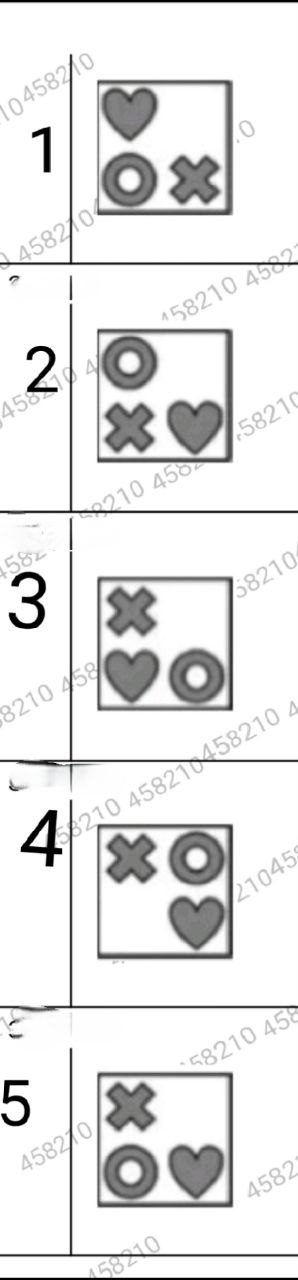
Approach: 3×3 matrix — three fixed arrangements repeat in each row in a cyclic order.

Solution: The three arrangements are P = (× on top; ○, ♥ below), Q = (○ on top; ♥, × below), R = (♥ on top; ×, ○ below).
Row 1: P, Q, R. Row 2: R, P, Q. Row 3: Q, R, ?
Each row shifts the cycle by one, so the missing figure is P: × on top, ○ and ♥ below.
Option E matches.

Why the other options are wrong: A, B, C and D are either other arrangements already used in row 3 or new layouts.

Cetking shortcut: Each arrangement appears exactly once in every row and column — pick the one missing from row 3 and column 3.

Answer: E

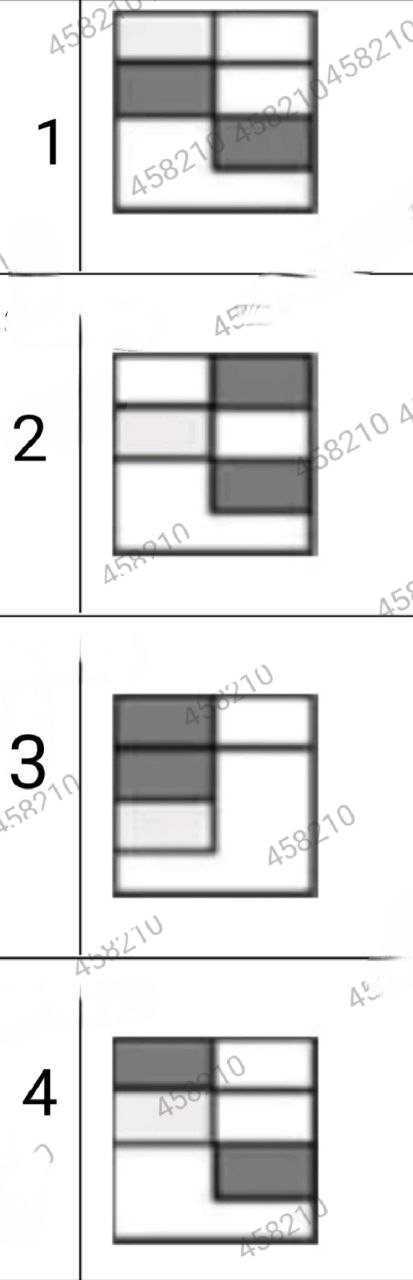
Q88EasyCET 2025 · Slot 6 · Q88
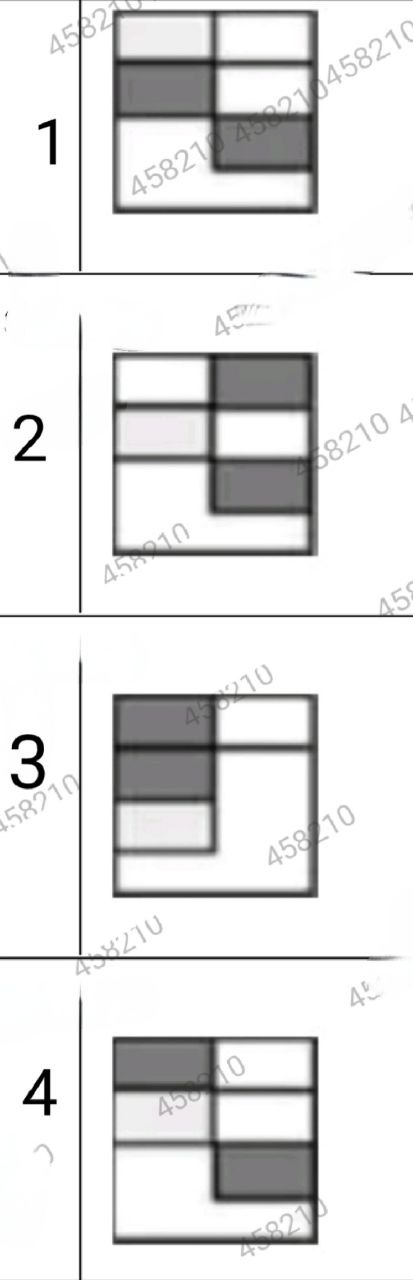
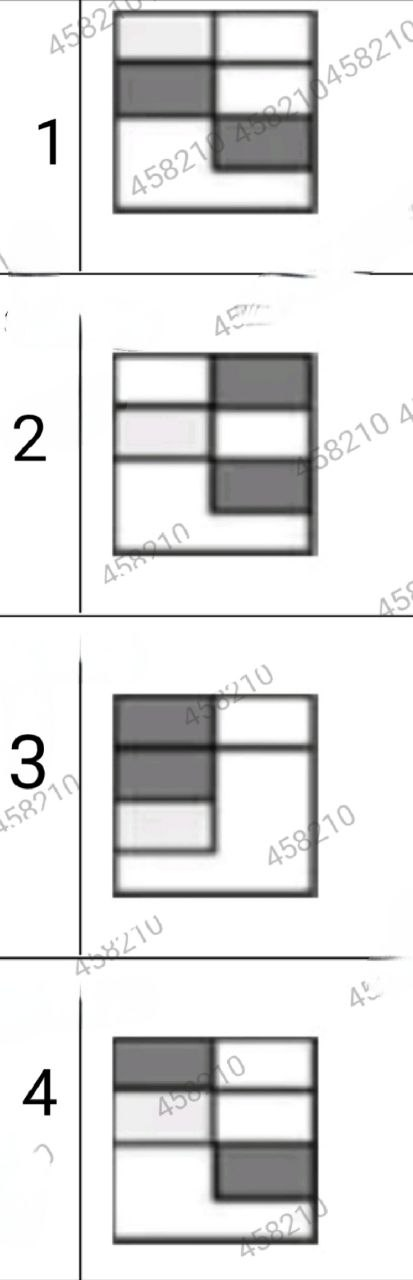
choose from the option which figure completes the series below
Figure for MBA CET 2025 Slot 6 question 88Figure for MBA CET 2025 Slot 6 question 88Figure for MBA CET 2025 Slot 6 question 88
  1. Option A
  2. Option B
  3. Option C
  4. Option D
  5. Option E
Show answerHide answer

Answer: D

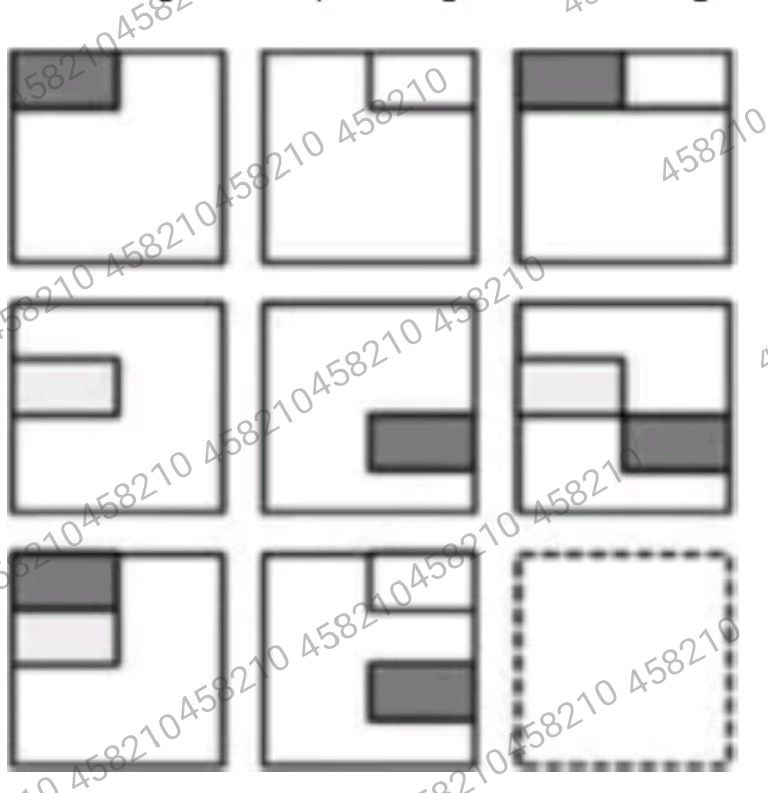
Approach: Matrix superimposition — in each row, figure 1 + figure 2 = figure 3.

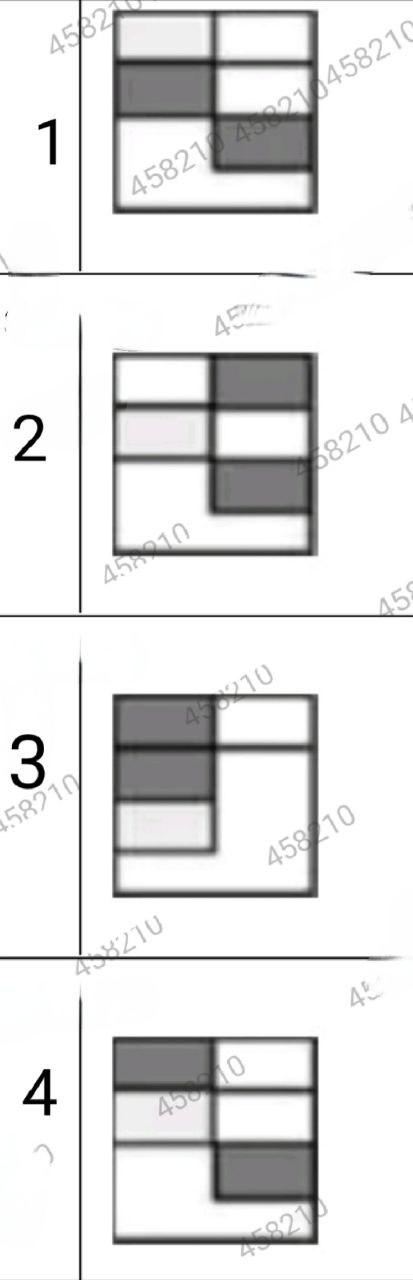
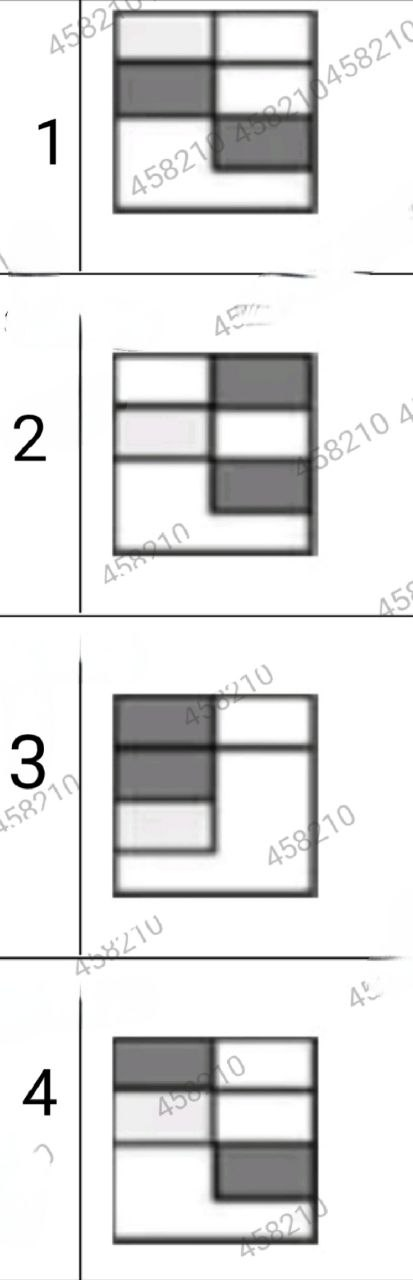
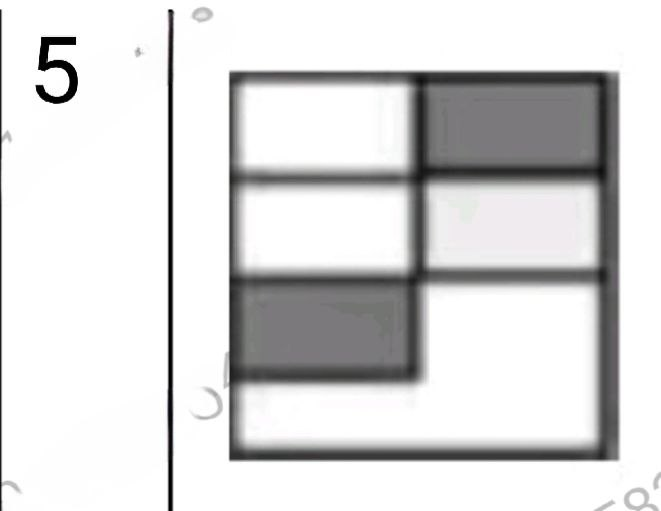
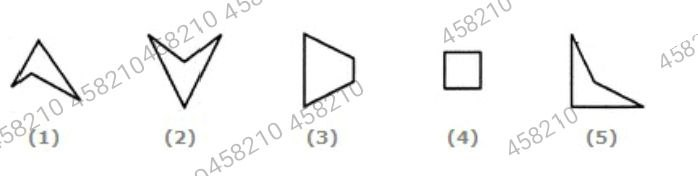
Solution: Row 1: dark top-left block + white top-right block = both blocks together. Row 2: light left block + dark right block = both together.
Row 3: figure 1 has a dark block on top-left with a light block below it; figure 2 has a white block at top-right and a dark block lower on the right.
Combining them: dark top-left, light below it, white top-right, dark lower-right — option D.

Why the other options are wrong: A swaps the dark and light blocks on the left; B puts a dark block at top-right; C misses the lower-right dark block; E places blocks in wrong positions.

Cetking shortcut: Verify the rule on rows 1–2 in seconds, then just overlay row 3's two figures.

Answer: D

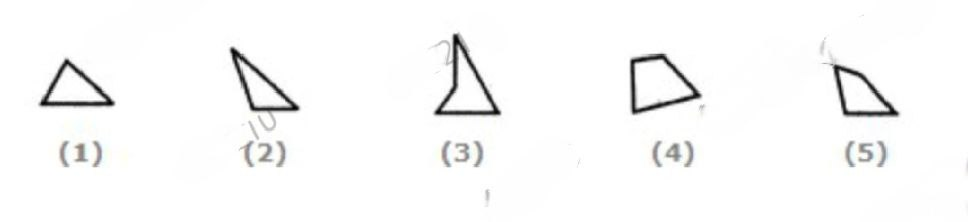
Q94MediumCET 2025 · Slot 6 · Q94
which of the following three out of five alternative figures when fitted into each other could form a complete square
Figure for MBA CET 2025 Slot 6 question 94
  1. 1,2,4
  2. 3,4,5
  3. 1,2,3
  4. 1,3,5
  5. 5, 2, 4
Show answerHide answer

Answer: D

Approach: Forming a square from pieces — match straight edges and angles.

Solution: The square's side equals the straight sides of piece 5 (L-shape with a right angle) and the long straight side of piece 3 (trapezium).
Put piece 5 in a corner of the square, along two sides. The space left is a four-sided region bounded by the opposite two sides and piece 5's slanting edge.
Piece 3 fits along the side opposite the right angle, its lower slanting edge lying exactly along piece 5's slanting edge.
The small gap left at the top is exactly the arrow-head piece 1.
Pieces 1, 3 and 5 together make a complete square.

Why the other options are wrong: Piece 4 is just a small square and piece 2 is a dart with no right angle; triples containing them leave gaps or overlap.

Cetking shortcut: Start with the piece that has a right angle and two sides equal to the square's side — it must sit in a corner.

Answer: D

Q95MediumCET 2025 · Slot 6 · Q95
which of the following three out of five alternative figures when fitted into each other could form an equilateral triangle.
Figure for MBA CET 2025 Slot 6 question 95
  1. 4, 3, 2
  2. 2, 4, 5
  3. 1, 3, 4
  4. 3, 4, 5
  5. 2, 4, 5
Show answerHide answer

Answer: D

Approach: Forming an equilateral triangle from pieces — the result needs three 60° corners and equal sides.

Solution: Piece 3 (the triangle with a notch cut in one side), piece 4 (four-sided) and piece 5 (small four-sided) each have one 60° corner, so each can fill one corner of the big triangle.
Piece 3 takes the lower vertex, piece 4 the upper-left corner and piece 5 the upper-right corner; piece 5's slanting edge runs along the notch of piece 3 and its other edge meets piece 4 along a straight line.
Pieces 3, 4 and 5 together form one equilateral triangle.

Why the other options are wrong: Piece 2 has no 60° corner, so the combinations with piece 2 cannot give three equal corners; the combination 1, 3, 4 leaves gaps.

Cetking shortcut: Look for the pieces that carry the 60° corners — three corners are needed.

Answer: D

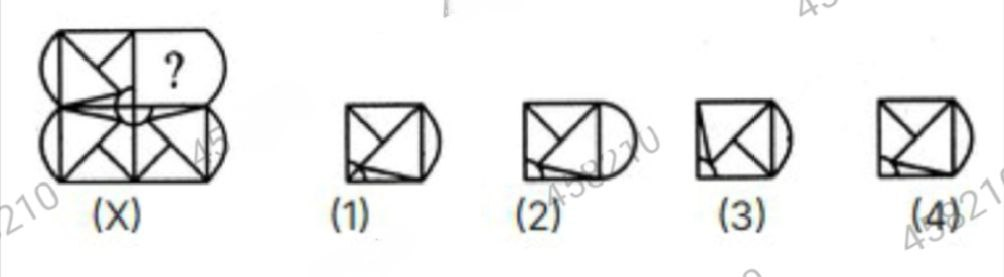
Q98MediumCET 2025 · Slot 6 · Q98
identify the figure that complete the series
Figure for MBA CET 2025 Slot 6 question 98
  1. 1
  2. 2
  3. 3
  4. 4
  5. All correct
Show answerHide answer

Answer: D

Approach: Pattern completion — the four squares are mirror copies of one another about the centre.

Solution: The bottom-left square is the vertical mirror of the top-left square, and the bottom-right square is the horizontal mirror of the bottom-left one. So the missing top-right square must be the vertical mirror of the bottom-right square.
It therefore needs: a long diagonal from its top-right corner running down-left and stopping at the small arc at its bottom-left corner; a shorter line from its top-left corner meeting that diagonal; a thin wedge along its bottom edge from the bottom-right corner towards the arc; and a shallow arc (not a full semicircle) on the right side.
Figure 4 has all of these.

Why the other options are wrong: Figure 1 lets the diagonal run through the arc to the corner; figure 2 has a full semicircle, far deeper than the shallow arc of the pattern; figure 3 has different internal lines; E ('all correct') is impossible since only one figure fits.

Cetking shortcut: Use the symmetry — copy the neighbouring square and mirror it.

Answer: D
Q97HardCET 2025 · Slot 5 · Q97

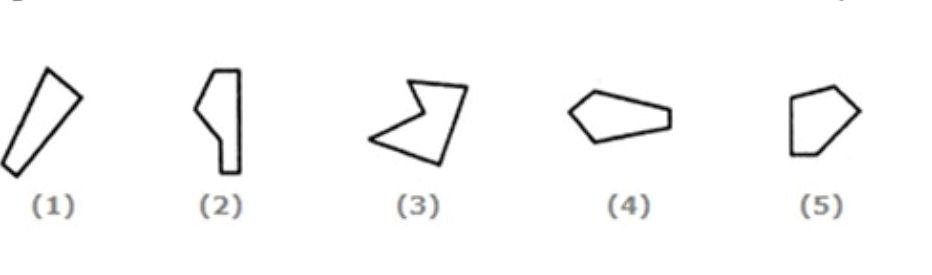
Select the alternative which represents three out of the five alternative figures which, when fitted into each other, would form a complete square.

Figure for MBA CET 2025 Slot 5 question 97
  1. 123
  2. 124
  3. 135
  4. 145
  5. 142
Show answerHide answer

Answer: D

Approach: Forming a square: the three pieces must have a total area equal to a square and their edges must match along slants and right angles.

Solution: The pieces are of very different sizes, so first test areas. Piece 5 (a thin right triangle) and piece 4 (a narrow trapezium with two right angles) are small; pieces 1 and 3 are the largest; piece 2 is an L-shape.
Piece 5 sits along one side of the square: its vertical leg is a full side. Its slanting side (hypotenuse) lies against the long slanting right edge of piece 1.
Piece 4 fills the top corner on the other side: its slanting side fits piece 1's left slanted edge, and its two right angles give the corner of the square.
Piece 1's base then forms the bottom side of the square. Together pieces 1, 4 and 5 fill the square exactly (side about 96 units on the drawing).
Checking every other triple by area and edge-fitting, none of them closes into a square.

Why the other options are wrong:
A 123, B 124, C 135, E 142 – each includes piece 2 or piece 3, whose L-shape or notched edge leaves a gap or overlap with the others.

Cetking shortcut: Match slanted edges first – piece 4 and piece 5 slants both lock onto piece 1, so 1, 4, 5 go together.

Answer: D
Q98HardCET 2025 · Slot 5 · Q98

Select the alternative which represents three out of the five alternative figures which when fitted into each other would form a complete square.

Figure for MBA CET 2025 Slot 5 question 98
  1. 135
  2. 123
  3. 145
  4. 235
  5. 435
Show answerHide answer

Answer: A

Approach: Forming a square: the three pieces must have a total area equal to a square and their edges must lock together along slants and straight sides.

Solution: Piece 1 is a long tapered strip that is as tall as the whole square; it runs down one side of the square, its long straight edge forming that side.
Piece 3 (the one with a notched slanting edge) fills the lower left of the square.
Piece 5 (the small five-sided piece with a pointed top) fits into the upper left, filling the gap left between piece 1 and piece 3.
Together pieces 1, 3 and 5 close up exactly into a square. No other combination of three pieces (for example 1, 2 and 3) fits without a gap or overlap.

Why the other options are wrong:
B 123, C 145, D 235, E 435 – each uses a piece (2 or 4) whose edges do not match the strip of piece 1 and the notch of piece 3, so a square cannot be closed.

Cetking shortcut: Find the piece that is as long as a full side of the square (piece 1), then see which two pieces fill the remaining side.

Answer: A

Q92EasyCET 2025 · Slot 3 · Q92
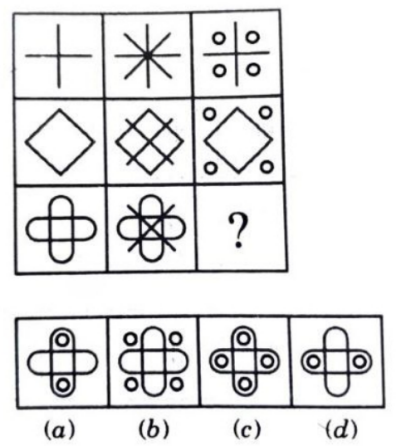
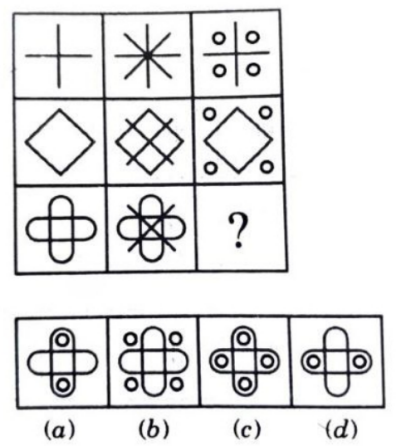
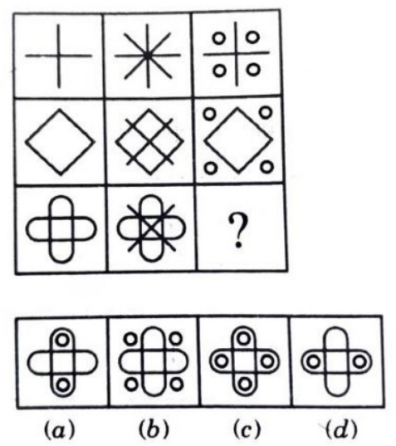
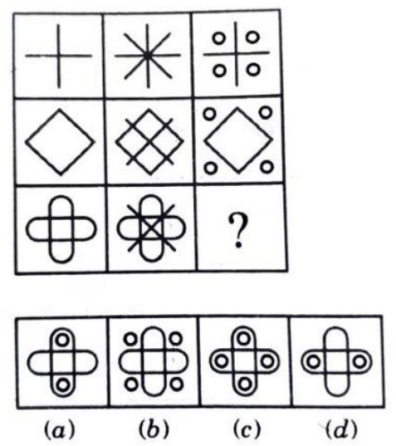
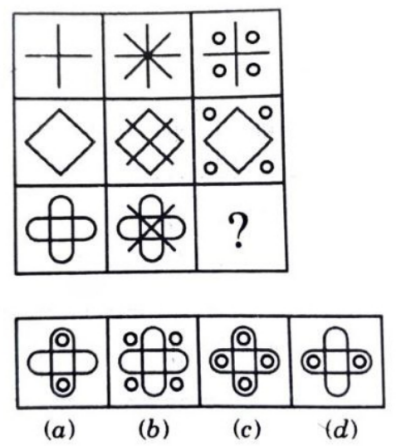
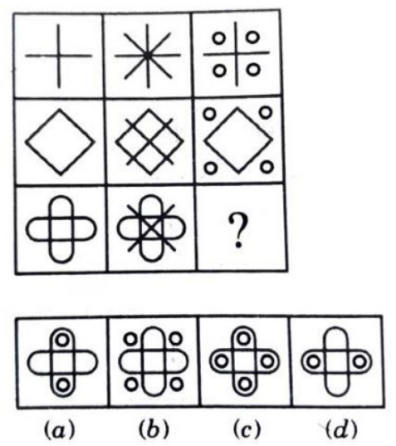
In the following question, find out which of the answer figures (a), (b), (c) and (d) completes the figure matrix?
If the correct figure to complete the figure matrix is not there in the given alternatives (a), (b), (c) and (d), then choose option (e) None of these.
Figure for MBA CET 2025 Slot 3 question 92
  1. Option A(Alternative (a))
  2. Option B(Alternative (b))
  3. Option C(Alternative (c))
  4. Option D(Alternative (d))
  5. Option E(None of these (e))
Show answerHide answer

Answer: B

Approach: Figure matrix: find the row rule and apply it to row 3.

Solution:
Row 1: plus → plus with extra spokes → plus with 4 small circles in the corners.
Row 2: diamond → diamond with crossing lines → diamond with 4 small circles in the corners.
So the third figure = the first figure + 4 small circles at the four corners.
Row 3: the cross of two rounded bars + 4 small circles at the corners = figure (b).

Why the other options are wrong:
(a), (c), (d): the small circles are drawn inside the rounded bars, not at the corners.
(e) None of these: (b) fits.

Cetking shortcut: Compare column 1 with column 3 in each row. The only change is the 4 corner circles.

Answer: B

Q93EasyCET 2025 · Slot 3 · Q93
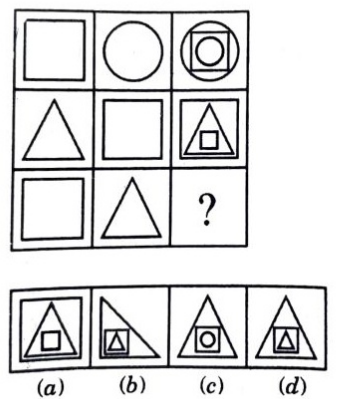
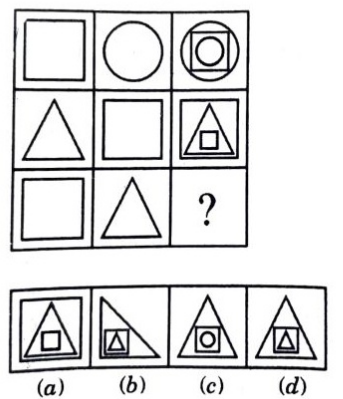
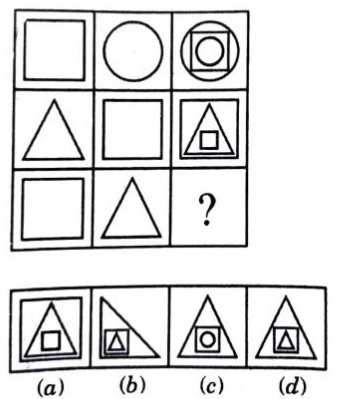
In the following question, find out which of the answer figures (a), (b), (c) and (d) completes the figure matrix?
If the correct figure to complete the figure matrix is not there in the given alternatives (a), (b), (c) and (d), then choose option (e) None of these.
Figure for MBA CET 2025 Slot 3 question 93
  1. Option A(Alternative (a))
  2. Option B(Alternative (b))
  3. Option C(Alternative (c))
  4. Option D(Alternative (d))
  5. Option E(None of these (e))
Show answerHide answer

Answer: D
Approach: Figure matrix: find how the third figure is built from the first two.

Solution:
Row 1: square, circle → circle (outer) ⊃ square ⊃ small circle (inner).
Row 2: triangle, square → square (outer) ⊃ triangle ⊃ small square (inner).
Rule: outer = 2nd figure, middle = 1st figure, inner = 2nd figure again.
Row 3: square, triangle → triangle (outer) ⊃ square ⊃ small triangle (inner) = figure (d).

Why the other options are wrong:
(a): a square outer frame with a square inside, so the order is wrong.
(b): a right triangle, not the same triangle.
(c): a small circle at the centre, so the inner shape is wrong.
(e) None of these: (d) fits.

Cetking shortcut: The outermost and innermost shapes are both the 2nd figure. Look for the option with a triangle both outside and in the centre.

Answer: D
Q74EasyCET 2025 · Slot 2 · Q74
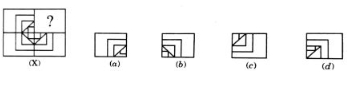
Select a figure from amongst the four alternatives a), b), c) and d), which, when placed in the blank space of fig. (X), would complete the pattern.
If the correct figure is not among a), b), c), or d), then choose option e) None of these.
Figure for MBA CET 2025 Slot 2 question 74
  1. Option (a)
  2. Option (b)
  3. Option (c)
  4. Option (d)
  5. None of these
Show answerHide answer

Answer: B

Approach: The figure is symmetric about its vertical centre line; the missing quarter mirrors the top-left quarter.

Solution:
Top-left quarter: nested L-shapes closing towards the centre (bottom-right corner) with a diagonal across the smallest square.
Its mirror image in the top-right quarter must have the nested L-shapes closing towards the bottom-left corner, with the diagonal in the smallest square running from its top-left to its bottom-right.
Option (b) shows exactly this.

Why the other options are wrong:
(a) and (c): L-shapes close towards the wrong corner.
(d): correct corner but the diagonal slopes the other way.

Answer: B

Q75MediumCET 2025 · Slot 2 · Q75
Select the figure from amongst the four alternatives (a), (b), (c) and (d), which, when placed in the blank space of fig. (X) would complete the pattern. If the correct figure to complete the pattern of fig. (X) is not there in the given alternatives (a), (b), (c) and (d) then choose option (e) None of these.
Figure for MBA CET 2025 Slot 2 question 75
  1. Option A
  2. Option B
  3. Option C
  4. Option D
  5. None of these
Show answerHide answer

Answer: C

Approach: Find the rule that every quarter of figure (X) follows.

Solution:
Every quarter has quarter-circle arcs at its top-right and bottom-left corners, plus one arc at the corner touching the centre of (X) (these four centre arcs form the central circle).
Top-right quarter: top-right + bottom-left (centre). Bottom-left quarter: bottom-left + top-right (centre). Bottom-right quarter: top-right + bottom-left + top-left (centre).
So the top-left quarter needs arcs at top-right, bottom-left and bottom-right (centre) corners — three arcs.
Option (c) shows exactly these three arcs.

Why the other options are wrong:
(a): arcs at the wrong pair of corners.
(b): misses the centre arc, leaving the central circle incomplete.
(d): four arcs — one too many.

Cetking shortcut: First complete the obvious shape across the centre (the circle); that alone removes (a) and (b).

Answer: C

Q77MediumCET 2025 · Slot 1 · Q77

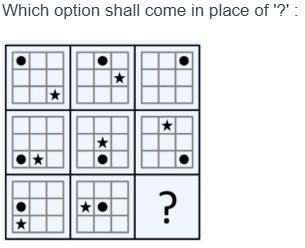
Which option shall come in place of '?' :

Figure for MBA CET 2025 Slot 1 question 77Figure for MBA CET 2025 Slot 1 question 77
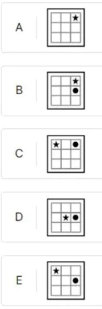
  1. A
  2. B
  3. C
  4. D
  5. E
Show answerHide answer

Answer: E

Approach: Each row has its own path for the dot and the star inside the 3 × 3 grid.

Solution:
Row 1: dot moves left → right along the top row; star moves bottom → top along the right column (in fig 3 it sits under the dot).
Row 2: dot moves left → right along the bottom row; star moves bottom → top along the middle column.
Row 3: dot moves left → right along the middle row (r2c1 → r2c2 → r2c3); star moves bottom → top along the left column (r3c1 → r2c1 → r1c1).
Missing figure: star top-left, dot middle-right → option E.

Why the other options are wrong:
A: no dot; star top-right.
B: dot and star in the right column.
C: dot top-right, not middle-right.
D: both in the middle row.

Cetking shortcut: In each row one symbol travels along a row, the other along a column – one cell per figure.

Answer: E

Q78EasyCET 2025 · Slot 1 · Q78

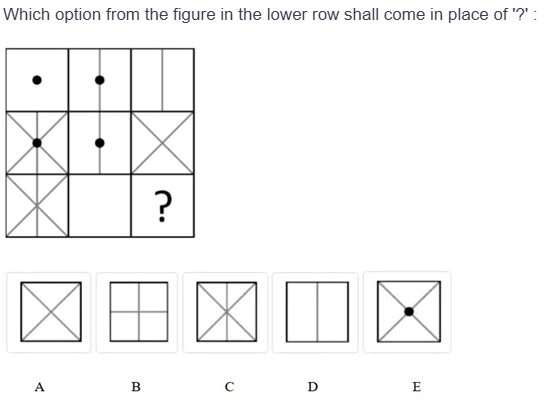
Which option from the figure in the lower row shall come in place of '?' :

Figure for MBA CET 2025 Slot 1 question 78
  1. A
  2. B
  3. C
  4. D
  5. E
Show answerHide answer

Answer: C

Approach: Row rule: figure 3 = figure 1 superimposed on figure 2 with common parts cancelled.

Solution:
Row 1: dot ⊕ (dot + vertical line) → dot cancels → vertical line ✓.
Row 2: (cross + vertical + dot) ⊕ (vertical + dot) → cross only ✓.
Row 3: (cross + vertical) ⊕ blank → cross + vertical line.

Why the other options are wrong:
A: cross without the vertical line.
B: plus sign (vertical + horizontal).
D: only vertical line.
E: cross with a dot.

Cetking shortcut: When the middle figure of the last row is blank, the answer is just the first figure.

Answer: C

Q91MediumCET 2025 · Slot 1 · Q91

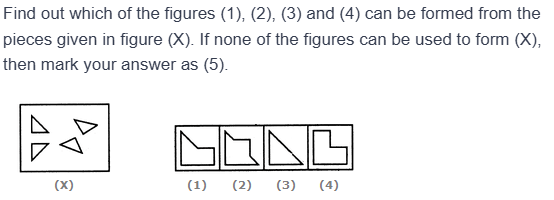
Find out which of the figures (1), (2), (3) and (4) can be formed from the pieces given in figure (X). If none of the figures can be used to form (X), then mark your answer as (5).

Figure for MBA CET 2025 Slot 1 question 91
  1. 1
  2. 2
  3. 3
  4. 4
  5. None
Show answerHide answer

Answer: C

Approach: Compare the total area and the edge directions of the pieces with each outline.

Solution:
All four pieces in X are identical right-angled isosceles triangles (legs a, hypotenuse a√2), so the total area is 4 × a²/2 = 2a².
Four such triangles tile a bigger right-angled isosceles triangle with legs 2a (area 2a²) → figure (3).
Figures (1), (2) and (4) have notched/stepped outlines and noticeably larger areas than 2a², so the pieces cannot form them.
So the answer is figure (3).

Why the other options are wrong:
(1), (2), (4): stepped outlines with more area than the four pieces together.
None (5): figure (3) can be formed.

Cetking shortcut: Check piece shapes first: four equal right isosceles triangles join into one bigger right isosceles triangle.

Answer: C

Q92MediumCET 2025 · Slot 1 · Q92

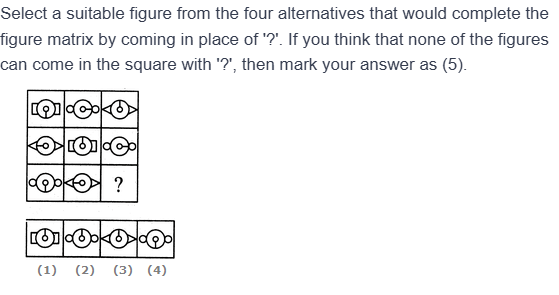
Select a suitable figure from the four alternatives that would complete the figure matrix by coming in place of '?'. If you think that none of the figures can come in the square with '?', then mark your answer as (5).

Figure for MBA CET 2025 Slot 1 question 92
  1. 1
  2. 2
  3. 3
  4. 4
  5. None
Show answerHide answer

Answer: A

Approach: Two rules: each row contains one rectangle-, one circle- and one triangle-attachment; the lollipop stick rotates by 90° along a row.

Solution:
Row 1 attachments: rectangles, circles, triangles; Row 2: triangles, rectangles, circles; Row 3: circles, triangles, ? → rectangles.
Stick direction in row 3: down → left → next 90° clockwise step = up (same turning as row 2: left → up → right).
Required figure: rectangles on the sides with the stick pointing up → figure (1) = option A.

Why the other options are wrong:
(2), (4): circles already used in row 3.
(3): triangles already used in row 3.
None (5): figure (1) fits.

Cetking shortcut: Use the side-attachment rule first – it alone leaves only figure (1).

Answer: A

Practise these in the Arena

Take timed tests built around MBA CET topics and see where you stand.

Open the Arena