Let’s Crack CET 2027

Your CET check-up · tap a ring to see yours

PnC – MBA CET questions with solutions

24 questions · CET 2025–2026 · Easy 12 · Medium 11 · Hard 1. Newest paper first. Full papers

Q46EasyCET 2026 · Slot 5 · Q46

In how many ways 11 identical toys be placed in 3 distinct boxes such that no box is empty ?

  1. 54
  2. 42
  3. 72
  4. 45
  5. 66
Show answerHide answer

Answer: D official key

Approach: Identical objects into distinct boxes, none empty → (n − 1)C(r − 1).

Solution:
n = 11 toys, r = 3 boxes
Ways = (11 − 1)C(3 − 1) = 10C2 = (10 × 9)/2 = 45

Cetking shortcut: Put 1 toy in each box first; distribute the remaining 8 freely: (8 + 2)C2 = 10C2 = 45.

Answer: D
Q47MediumCET 2026 · Slot 5 · Q47

7 digit number comprises of only 2's and 3's. How many of these 7 digit numbers shall be multiples of 12 ?

  1. 22
  2. 10
  3. 12
  4. 15
  5. 11
Show answerHide answer

Official CET key: E · Cetking's answer: C — see why below

Approach: Divisible by 12 ⇔ divisible by 4 and by 3.

Solution:
Divisible by 4: last two digits from {22, 23, 32, 33} → only 32 works.
First 5 digits: let k of them be 2 and (5 − k) be 3.
Digit sum = 2k + 3(5 − k) + 3 + 2 = 20 − k
Divisible by 3 → 20 − k ∈ {18, 15} → k = 2 or k = 5
k = 2: 5C2 = 10 numbers; k = 5: 5C5 = 1 number
Total = 10 + 1 = 11

Cetking shortcut: Fix the ending first (32), then the count of 2's in the rest must make the sum a multiple of 3.

Answer: E

Q48MediumCET 2026 · Slot 5 · Q48

Arnav wants to print all numbers from 100 to 10000 on a blank paper, how many times would the digit 3 be printed by Arnav on the paper ?

  1. 3890
  2. 3840
  3. 3980
  4. 3970
  5. 4020
Show answerHide answer

Official CET key: C · Cetking's answer: B — see why below

Approach: Count the digit 3 in 0000–9999, then remove 0–99.

Solution:
In 0000–9999 each of the 4 places shows 3 exactly 1000 times → 4 × 1000 = 4000.
In 0–99: units place 10 times (3, 13, …, 93) + tens place 10 times (30–39) = 20.
10000 has no 3.
From 100 to 10000 = 4000 − 20 = 3980

Cetking shortcut: Each digit appears equally in every place: places × 10^(places−1) = 4 × 1000, then subtract the excluded range.

Answer: C

Q49MediumCET 2026 · Slot 5 · Q49

How many numbers of up to 5 digits can be created by using the digits 1, 2, 3 and 5 each, at least once, such that the numbers are always a multiple of 15 ?

  1. 19
  2. 13
  3. 12
  4. 11
  5. 16
Show answerHide answer

Official CET key: C · Cetking's answer: D — see why below

Approach: Multiple of 15 ⇔ ends in 5 (digit 0 unavailable) and digit sum divisible by 3.

Solution:
All of 1, 2, 3, 5 must appear → at least 4 digits.
4 digits: 1 + 2 + 3 + 5 = 11, not divisible by 3 → none.
5 digits: one extra digit x from {1, 2, 3, 5}; sum = 11 + x must be divisible by 3 → x = 1 (sum 12).
Digits 1, 1, 2, 3, 5 with 5 fixed at the end.
Arrange 1, 1, 2, 3 in the first four places = 4!/2! = 12

Cetking shortcut: Check the 4-digit sum first (11) — the only fix to reach a multiple of 3 within the allowed digits is one more 1.

Answer: C

Q50MediumCET 2026 · Slot 5 · Q50

In how many ways can the alphabets of the word ATTITUDE be rearranged in such a way that no two T's are adjacent to each other ?

  1. 2400
  2. 2420
  3. 1420
  4. 3220
  5. 2600
Show answerHide answer

Answer: A official key

Approach: Gap method — arrange the other letters, then place the T's in separate gaps.

Solution:
ATTITUDE: 8 letters; T × 3, and A, I, U, D, E all distinct.
Arrange A, I, U, D, E: 5! = 120 ways.
They create 6 gaps; choose 3 for the identical T's: 6C3 = 20.
Total = 120 × 20 = 2400

Answer: A

Q74EasyCET 2026 · Slot 4 · Q74

At the end of a business conference all the 16 people present, shake hands with each other only once. How many handshakes were there altogether?

  1. 115
  2. 120
  3. 110
  4. 75
  5. 85
Show answerHide answer

Answer: B official key

Approach: Each handshake is a pair of people: ⁿC₂.

Solution: Number of handshakes = ¹⁶C₂ = 16 × 15 / 2 = 120.

Cetking shortcut: n(n − 1)/2 – for 16 people, 8 × 15 = 120.

Answer: B

Q140EasyCET 2026 · Slot 4 · Q140
How many 3-digit numbers can be formed from the digits 2, 3, 5, 6, 7 and 9, which are divisible by 5 and none of the digits is repeated?
  1. 5
  2. 10
  3. 15
  4. 20
  5. 25
Show answerHide answer

Answer: D official key

Approach: Divisible by 5 ⇒ units digit is 0 or 5; only 5 is available.

Solution:
Units digit fixed = 5 (1 way).
Hundreds digit: any of the remaining 5 digits.
Tens digit: any of the remaining 4 digits.
Total = 5 × 4 × 1 = 20.

Why the other options are wrong:
A (5) – fills only one free place.
C (15), E (25) – allow repetition or wrong count.
B (10) – uses combinations (5C2).

Cetking shortcut: Fix the restricted place first, then fill the rest: 5P2 = 20.

Answer: D

Q22EasyCET 2026 · Slot 3 · Q22

At Rajendra’s Birthday party, there are exactly 57 persons including Rajendra. All of them shake hand with each other. Find the total number of handshakes ?

  1. 1596
  2. 1725
  3. 1675
  4. 1634
  5. 1553
Show answerHide answer

Answer: A official key

Approach: Each handshake is a pair of people → ⁿC₂.

Solution:
Handshakes = 57 × 56 ÷ 2
= 57 × 28
= 1596.

Answer: A

Q139EasyCET 2026 · Slot 3 · Q139
Five men and four women are seated in a row such that all the four women always sit together.In how many different ways can they be seated?
  1. 720
  2. 4,320
  3. 8,640
  4. 17,280
  5. 34,560
Show answerHide answer

Answer: D official key

Approach: Women together → treat them as one block.

Solution:
Units: 5 men + 1 women-block = 6 → 6! = 720 ways.
Women inside the block: 4! = 24 ways.
Total = 720 × 24 = 17,280.

Why the other options are wrong:

  • A: forgets the internal 4! arrangement.
  • B, C: partial counts (e.g. 6! × 3!, 6! × 4!/2).
  • E: double-counts (×2).

Answer: D

Q140EasyCET 2026 · Slot 3 · Q140
How many words can be formed out of the letters of the word 'EDUCATION' such that vowels occupy the odd positions?
  1. 1440
  2. 2880
  3. 2840
  4. 2480
  5. 720
Show answerHide answer

Answer: B official key

Approach: Place vowels in their allowed positions, then consonants in the rest.

Solution:
EDUCATION: 9 distinct letters — vowels E, U, A, I, O (5), consonants D, C, T, N (4).
Odd positions 1, 3, 5, 7, 9 = 5 places → vowels: 5! = 120.
Remaining 4 even places → consonants: 4! = 24.
Total = 120 × 24 = 2880.

Why the other options are wrong:

  • A: halves the answer (counts only one group fully).
  • E: only 5! × 3! style partial count.
  • C, D: arithmetic misreads of 2880.

Cetking shortcut: 5 vowels exactly fill 5 odd slots → answer is simply 5! × 4!.

Answer: B

Q137EasyCET 2026 · Slot 2 · Q137

DIRECTION for the question: Solve the following question and mark the best possible option.

In how many different ways can the letters of the word OPTICAL can be arranged in such a way that the vowels always come together?

  1. 120
  2. 720
  3. 2160
  4. 4320
  5. 6
Show answerHide answer

Answer: B official key

Approach: Block method.

Solution: OPTICAL has 7 distinct letters: vowels O, I, A (3); consonants P, T, C, L (4).
Vowel block + 4 consonants = 5 units → 5! = 120 ways.
Vowels inside the block: 3! = 6 ways.
Total = 120 × 6 = 720.

Why the other options are wrong:
A (120): forgets internal arrangement.
E (6): only the internal arrangement.
C, D: wrong block counts.

Answer: B

Q106MediumCET 2025 · Slot 6 · Q106
In how many ways can the word “ESPECIALLY “ be arranged such that all the vowels always come together?
  1. 42600
  2. 25200
  3. 10080
  4. 30240
  5. 29242
Show answerHide answer

Answer: D

Approach: Vowels together: tie the vowels into one block, divide by repeats.

Solution:
ESPECIALLY = E, S, P, E, C, I, A, L, L, Y (10 letters).
Vowels: E, E, I, A (4); consonants: S, P, C, L, L, Y (6, L repeated).
Units to arrange = 1 vowel block + 6 consonants = 7 ⇒ 7!/2! = 2520 (2! for the two Ls).
Inside the block: 4!/2! = 12 (2! for the two Es).
Total = 2520 × 12 = 30240.

Why the other options are wrong:
B 25200, C 10080: forget one of the repeat divisions or the block's internal arrangement.
A, E: no standard method gives them.

Cetking shortcut: Answer must be divisible by 7!/2! = 2520 — only 25200, 10080 and 30240 are; 2520 × 12 = 30240.

Answer: D

Q146HardCET 2025 · Slot 5 · Q146

Three Englishmen and three Frenchmen work for the same company Each of them knows a secret not known to others. They need to exchange these secrets over person-to-person phone calls so that eventually each person knows all six secrets. None of the Frenchmen knows English, and only one Englishman knows French. What is the minimum number of phone calls needed for the above purpose?

  1. 10
  2. 9
  3. 8
  4. 7
  5. 6
Show answerHide answer

Answer: C

Approach: Treat it as a gossip problem with a restriction: only the bilingual Englishman (E3) can talk to both groups. Use the 4-call core trick so that only 8 calls are needed.

Solution:
Englishmen E1, E2, E3 (E3 knows French); Frenchmen F1, F2, F3.
1. E1–E3 (English) and 2. E2–E3 (English): E3 now knows E1, E2, E3.
3. F1–F2 (French): they know F1, F2.
4. E3–F3 (French): both know E1, E2, E3, F3.
5. F1–E3 (French): both now know all 6 secrets.
6. F2–F3 (French): both now know all 6 secrets.
7. E3–E1 and 8. E3–E2 (English): E1 and E2 now know all 6.
Every call uses a language both speakers know, and everyone knows all six secrets after 8 calls.
8 is also the minimum: for 6 people at least 2n − 4 = 8 calls are needed even with no language restriction.

Why the other options are wrong:
A (10) and B (9): possible but not minimal — e.g. 'gather at E3 then spread' takes 9.
D (7), E (6): fewer than the 2n − 4 = 8 lower bound, so impossible.

Answer: C

Q147EasyCET 2025 · Slot 5 · Q147

In a chess competition involving some boys and girls of a school: every student had to play exactly one game with every other student It was found that in 45 games both the players were girls, and in 190 games both were boys. The number of games in which one player was a boy and the other was a girl is

  1. 215
  2. 230
  3. 200
  4. 180
  5. 250
Show answerHide answer

Answer: C

Approach: Games among n players = nC2; mixed games = boys × girls.

Solution:
Girls: G(G − 1)/2 = 45 → G(G − 1) = 90 = 10 × 9 → G = 10
Boys: B(B − 1)/2 = 190 → B(B − 1) = 380 = 20 × 19 → B = 20
Boy-girl games = 20 × 10 = 200

Cetking shortcut: Recognise 45 = 10C2 and 190 = 20C2 instantly.

Answer: C

Q137MediumCET 2025 · Slot 4 · Q137

From a group of 7 men and 6 women, five persons are to be selected to form a committee so that at least 3 men are there on the committee. In how many ways can it be done?

  1. 700
  2. 695
  3. 756
  4. 823
  5. 633
Show answerHide answer

Answer: C

Approach: Combinations — case-wise addition.

Solution:
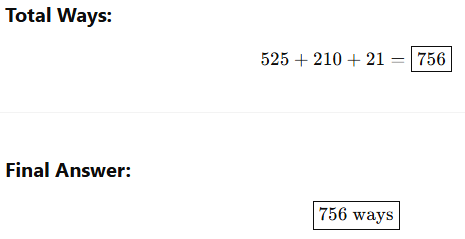
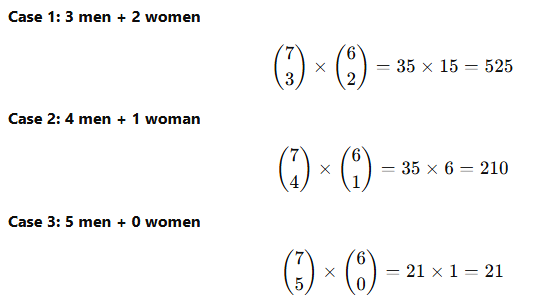
3 men + 2 women: 7C3 × 6C2 = 35 × 15 = 525.
4 men + 1 woman: 7C4 × 6C1 = 35 × 6 = 210.
5 men: 7C5 = 21.
Total = 525 + 210 + 21 = 756.

Why the other options are wrong:
A, B, D, E: miss a case or miscount 6C2 = 15.

Answer: C

Solution figure for question 137Solution figure for question 137
Q138EasyCET 2025 · Slot 4 · Q138

In how many ways can the letters of the word 'LEADER' be arranged?

  1. 360
  2. 240
  3. 180
  4. 210
  5. 270
Show answerHide answer

Answer: A

Approach: Permutations with identical letters.

Solution:
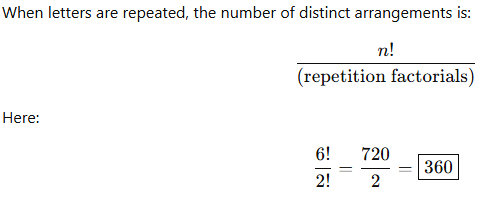
LEADER: 6 letters with E repeated twice (L, A, D, R once).
Arrangements = 6!/2! = 720/2 = 360.

Why the other options are wrong:
B, C, D, E: not 720/2.

Answer: A

Solution figure for question 138
Q139EasyCET 2025 · Slot 4 · Q139

How many 4-letter words with or without meaning, can be formed out of the letters of the word, 'LOGARITHMS', if repetition of letters is not allowed?

  1. 6000
  2. 5075
  3. 5040
  4. 3500
  5. 4090
Show answerHide answer

Answer: C

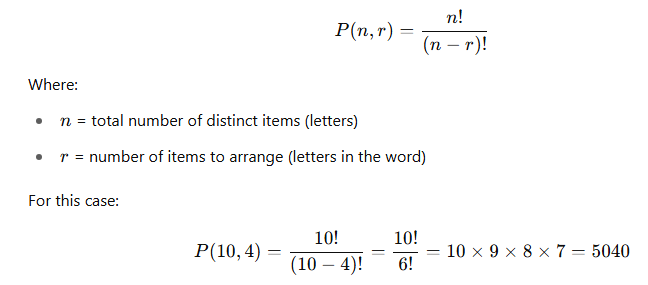
Approach: nPr for ordered selections.

Solution:
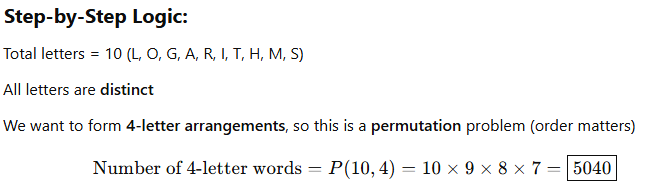
LOGARITHMS has 10 distinct letters (L, O, G, A, R, I, T, H, M, S).
4-letter words without repetition = 10P4 = 10 × 9 × 8 × 7 = 5040.

Why the other options are wrong:
A, B, D, E: not 10 × 9 × 8 × 7.

Answer: C

Solution figure for question 139Solution figure for question 139
Q3MediumCET 2025 · Slot 2 · Q3

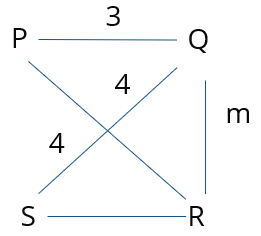
P, Q, R and S are four towns. One can travel between P and Q along 3 direct paths, between Q and S along 4 direct paths, and between P and R along 4 direct paths. There is no direct path between P and S, while there are few direct paths between Q and R, and between R and S. One can travel from P to S either via Q, or via R, or via Q followed by R, respectively, in exactly 62 possible ways. One can also travel from Q to R either directly, or via P, or via S, in exactly 27 possible ways. Then, the number of direct paths between Q and R is.

  1. 9
  2. 5
  3. 4
  4. 6
  5. 7
Show answerHide answer

Answer: E

Approach: Multiplication principle for routes; set up equations in the unknown path counts.

Solution:
Let Q–R = m direct paths and R–S = n direct paths; P–Q = 3, Q–S = 4, P–R = 4, P–S = 0.
P to S: P→Q→S = 3×4 = 12; P→R→S = 4n; P→Q→R→S = 3mn.
12 + 4n + 3mn = 62 → 4n + 3mn = 50 … (1)
Q to R: direct = m; Q→P→R = 3×4 = 12; Q→S→R = 4n.
m + 12 + 4n = 27 → m + 4n = 15 … (2)
(1) − (2): 3mn − m = 35 → m(3n − 1) = 35 = 7 × 5.
3n − 1 = 5 gives n = 2, m = 7; check (2): 7 + 8 = 15 ✓.

Cetking shortcut: From (2), m = 15 − 4n; try n = 1, 2, 3 → only n = 2 (m = 7) satisfies (1): 8 + 42 = 50.

Answer: E

Solution figure for question 3
Q42MediumCET 2025 · Slot 2 · Q42

In how many ways can the letters of the word MATHEMATICS be arranged so that all the vowels always come together?

  1. 11
  2. 4989600
  3. 20660
  4. 120960
  5. 120800
Show answerHide answer

Answer: D

Approach: Glue the vowels into one block; divide by factorials of repeated letters.

Solution:
MATHEMATICS: 11 letters; vowels A, A, E, I; consonants M, M, T, T, H, C, S.
Units = 7 consonants + 1 vowel block = 8 → 8!/(2! × 2!) = 40320/4 = 10,080 (M and T repeat).
Inside the block: 4!/2! = 12 (A repeats).
Total = 10,080 × 12 = 1,20,960.

Why the other options are wrong: 4989600 is all arrangements with no condition (11!/(2!2!2!)); 120800 and 20660 are calculation slips; 11 is the letter count.

Answer: D

Q53EasyCET 2025 · Slot 2 · Q53
There are 6 boxes numbered 1–6. Each is filled with a red or green ball such that at least one green ball exists, and green balls are consecutively numbered. Total ways?
  1. 21
  2. 33
  3. 11
  4. 60
  5. 52
Show answerHide answer

Answer: A

Approach: Count blocks of consecutive boxes (a block of length k in n boxes can start at n − k + 1 places).

Solution:
The green balls form one unbroken block of length k (k = 1 to 6); every other box is red.
k = 1: 6 ways; k = 2: 5; k = 3: 4; k = 4: 3; k = 5: 2; k = 6: 1.
Total = 6 + 5 + 4 + 3 + 2 + 1 = 21.

Cetking shortcut: Number of consecutive blocks in n positions = n(n + 1)/2 = 6 × 7/2 = 21.

Answer: A

Q118MediumCET 2025 · Slot 2 · Q118
How many four-digit numbers, divisible by 6, can be formed using the digits 0, 2, 3, 4, 6, such that no digit is used more than once and 0 is not in the left-most position?
  1. 50
  2. 72
  3. 108
  4. 52
  5. 64
Show answerHide answer

Answer: A

Approach: Divisible by 6 = even last digit + digit sum divisible by 3. Pick the digit set first, then arrange.

Solution:
Sum of 0, 2, 3, 4, 6 = 15. Dropping one digit must leave a multiple of 3 → drop 0, 3 or 6.
{2, 3, 4, 6}: last digit 2/4/6 (3 ways) × 3! = 18.
{0, 2, 4, 6}: all even; arrangements without leading 0 = 4! − 3! = 18.
{0, 2, 3, 4}: ends in 0 → 3! = 6; ends in 2 → first digit from {3, 4} (2) × 2 = 4; ends in 4 → 4. Total 14.
Total = 18 + 18 + 14 = 50.

Cetking shortcut: Check the total digit sum first (15) — only drop digits that are multiples of 3.

Answer: A

Q143MediumCET 2025 · Slot 2 · Q143
What shall be the arithmetic mean of all the distinct numbers that can be obtained by rearranging the digits in 1421, including itself?
  1. 3333
  2. 2448
  3. 2222
  4. 2442
  5. 2592
Show answerHide answer

Answer: C

Approach: By symmetry each position holds each digit equally often; average digit × 1111.

Solution:
Digits 1, 1, 2, 4 → distinct arrangements = 4!/2! = 12.
In each place, the average digit = (1 + 1 + 2 + 4)/4 = 2.
Average number = 2 × 1000 + 2 × 100 + 2 × 10 + 2 = 2 × 1111 = 2222.

Cetking shortcut: Mean of all permutations = (digit sum / number of digits) × 111…1.

Answer: C

Q199EasyCET 2025 · Slot 2 · Q199
In how many ways can 8 identical pens be distributed among Aai, Bai, and Cai so that Aai gets at least 1 pen, Bai gets at least 2 pens, and Cai gets at least 3 pens?
  1. 4
  2. 3
  3. 2
  4. 6
  5. 5
Show answerHide answer

Answer: D

Approach: Identical items with minimums: give the minimums first, then distribute the rest freely (stars and bars).

Solution: Minimums: Aai 1 + Bai 2 + Cai 3 = 6 pens.
Remaining = 8 − 6 = 2 pens, distributed freely among 3 people.
Non-negative solutions of x + y + z = 2: C(2 + 3 − 1, 3 − 1) = C(4, 2) = 6.
(List: 200, 020, 002, 110, 101, 011.)

Cetking shortcut: Ways to give r identical items to n people (zero allowed) = C(r + n − 1, n − 1).

Answer: D

Q117MediumCET 2025 · Slot 1 · Q117
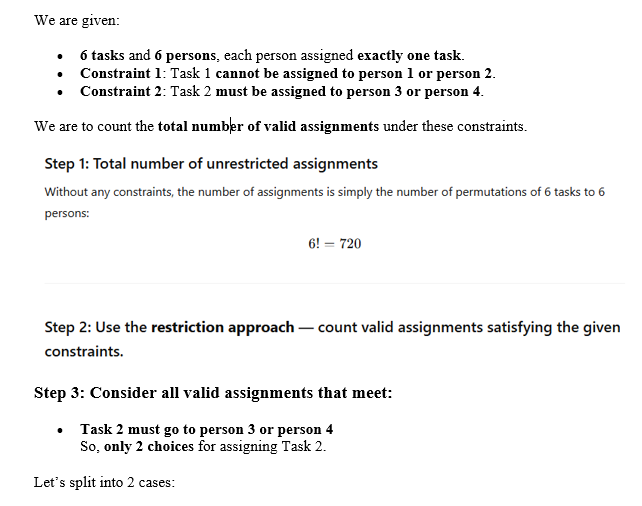
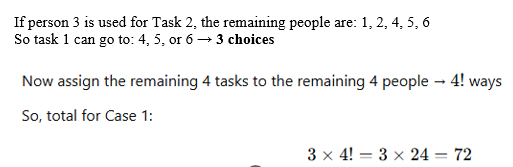
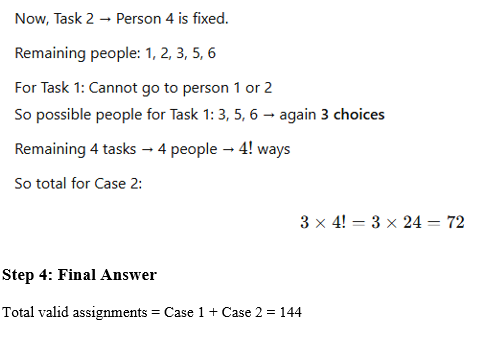
There are 6 tasks and 6 persons. Task 1 cannot be assigned either to person 1 or person 2. Task 2 must be assigned to either person 3 or person 4. Every person is to be assigned one task. In how many ways can the assignment be done ?
Figure for MBA CET 2025 Slot 1 question 117
  1. 72ways
  2. 192ways
  3. 360ways
  4. 144ways
  5. 256ways
Show answerHide answer

Answer: D

Approach: Fundamental counting principle, most-restricted task first.

Solution:
Task 2 → person 3 or person 4: 2 ways
Task 1 → not person 1, not person 2, not the person who took Task 2: 6 − 3 = 3 ways
Remaining 4 tasks → remaining 4 persons: 4! = 24 ways
Total = 2 × 3 × 24 = 144

Why the other options are wrong:
B (192): forgets that Task 2's person is used up (2 × 4 × 24).
A (72): counts only one choice for Task 2.
C (360), E (256): no valid counting gives these.

Answer: D

Solution figure for question 117Solution figure for question 117Solution figure for question 117Solution figure for question 117

Practise these in the Arena

Take timed tests built around MBA CET topics and see where you stand.

Open the Arena