Let’s Crack CET 2027

Your CET check-up · tap a ring to see yours

Sentence Improvement – MBA CET questions with solutions

27 questions · CET 2025–2026 · Easy 19 · Medium 8 · Hard 0. Newest paper first. Full papers

Q190EasyCET 2026 · Attempt 2 Slot 1 · Q190

Choose the grammatically correct sentence.

A. Hardly had the meeting begun when several members left early.
B. Hardly had the meeting begun than several members left early.
C. Hardly the meeting had begun when several members left early.
D. Hardly had begun the meeting when several members left early.
E. Hardly had the meeting begun and several members left early.

  1. Hardly had the meeting begun when several members left early.
  2. Hardly had the meeting begun than several members left early.
  3. Hardly the meeting had begun when several members left early.
  4. Hardly had begun the meeting when several members left early.
  5. Hardly had the meeting begun and several members left early.
Show answerHide answer

Answer: A official key

Approach: Correlative conjunction + inversion rule.

Solution: Rule: Hardly / Scarcely + had + subject + past participle + when + past simple.
A: 'Hardly had the meeting begun when several members left early.' — correct inversion and correct pairing.

Why the other options are wrong:
B: 'Hardly… than' is wrong; 'than' goes with 'No sooner'.
C: No inversion after 'Hardly' — 'Hardly the meeting had begun' is wrong.
D: Wrong word order — subject must come between 'had' and 'begun'.
E: 'Hardly… and' — wrong correlative.

Cetking shortcut: Hardly → when; No sooner → than. Then check inversion.

Answer: A
Q191EasyCET 2026 · Attempt 2 Slot 1 · Q191

Choose the grammatically correct sentence.

A. No sooner did the bell ring than the students rush out of the classroom.
B. No sooner had the bell rung when the students rushed out of the classroom.
C. No sooner had the bell rung than the students rushed out of the classroom.
D. No sooner the bell had rung than the students rushed out.
E. No sooner had rung the bell than students rushed out.

  1. No sooner did the bell ring than the students rush out of the classroom.
  2. No sooner had the bell rung when the students rushed out of the classroom.
  3. No sooner had the bell rung than the students rushed out of the classroom.
  4. No sooner the bell had rung than the students rushed out.
  5. No sooner had rung the bell than students rushed out.
Show answerHide answer

Answer: C official key

Approach: Correlative conjunction + inversion + tense consistency.

Solution: Rule: No sooner + had + subject + past participle + than + past simple.
C: 'No sooner had the bell rung than the students rushed out of the classroom.' — inversion, correct pair, both clauses in past.

Why the other options are wrong:
A: 'Rush' is present tense — breaks the past sequence.
B: 'No sooner… when' — wrong correlative.
D: Missing inversion ('the bell had rung').
E: Wrong word order — 'had rung the bell'.

Cetking shortcut: No sooner → than; then make sure the second verb is past simple.

Answer: C

Q185EasyCET 2026 · Slot 5 · Q185

In the question, a part of the sentence is made bold. Below are given alternatives to the bold part at (A), (B), (C) and (D) which may improve the sentence. Choose the correct alternative. In case no replacement is needed, mark (E) as your answer.

It is essential for an entrepreneur to keep his cheek upwards despite failures and setbacks.

  1. to keep his chin upwards despite
  2. to keep his cheek up despite
  3. to keep his chin up despite
  4. to keep his chin up despite of
  5. No correction required
Show answerHide answer

Answer: C official key

Approach: Fix the idiom, then check the preposition.

Solution: The idiom is 'keep one's chin up' = stay positive in difficulty. So 'to keep his chin up despite failures and setbacks'.

Why the other options are wrong:
A — 'chin upwards' is not the idiom.
B — 'cheek' is wrong.
D — 'despite of' is ungrammatical.
E — the original 'cheek upwards' is wrong.

Cetking shortcut: Remember: despite = in spite of; never 'despite of'.

Answer: C

Q187EasyCET 2026 · Slot 5 · Q187

In the question, a part of the sentence is made bold. Below are given alternatives to the bold part at (A), (B), (C) and (D) which may improve the sentence. Choose the correct alternative. In case no replacement is needed, mark (E) as your answer.

Effective breathing brings health to our organs, balances the nervous system, and calms the mind.

  1. bringing health to our organs
  2. brings health in our organs
  3. bringing health into to our organs
  4. will bring health to our organs
  5. No correction required
Show answerHide answer

Answer: E official key

Approach: Check subject–verb agreement and parallelism.

Solution: Subject 'Effective breathing' (singular) takes three present-tense verbs: brings health to our organs, balances the nervous system, and calms the mind — parallel and correct. 'Bring health to' is the correct preposition.

Why the other options are wrong:
A, C — 'bringing' breaks parallelism and leaves no main verb; C also has 'into to'.
B — 'health in our organs' is the wrong preposition.
D — 'will bring' breaks the present-tense series.

Answer: E

Q200EasyCET 2026 · Slot 5 · Q200

Choose the correct alternative to replace the bold phrase in the following sentence.

I cannot force her to climbing.

  1. In climbing
  2. For climb
  3. Over the climb
  4. With climb
  5. To climb
Show answerHide answer

Answer: E official key

Approach: Verb pattern: force + object + to + base verb.

Solution: 'I cannot force her to climb.' 'To climbing' is wrong because 'force' takes an infinitive, not 'to + -ing'.

Why the other options are wrong:
A In climbing, B For climb, C Over the climb, D With climb — none fits the 'force + object + to-infinitive' pattern.

Answer: E

Q164EasyCET 2026 · Slot 4 · Q164

Directions: In the following question, a part of the sentence is bold and italicized. Pick the alternative that best replaces the bold and italicized part. Select 'No improvement' if none of the given alternatives improve the sentence.

The boy told his teacher to explain the passage.

  1. called his teacher
  2. said to his teacher
  3. asked his teacher
  4. spoke his teacher
  5. No improvement
Show answerHide answer

Answer: C official key

Approach: Verb pattern: verb + object + to-infinitive must suit the meaning (request vs command).

Solution: 'Told his teacher to explain' sounds like an order, which does not fit a boy speaking to his teacher. A request is expressed by 'asked + object + to-infinitive'.
Correct: 'The boy asked his teacher to explain the passage.'

Why the other options are wrong:
A 'called his teacher to explain': means summoned, wrong sense.
B 'said to his teacher to explain': 'say' does not take object + to-infinitive.
D 'spoke his teacher': 'speak' needs 'to'; ungrammatical.
E The original is inappropriate in tone, so it needs improvement.

Answer: C

Q165EasyCET 2026 · Slot 4 · Q165

Directions: In the following question, a part of the sentence is bold and italicized. Pick the alternative that best replaces the bold and italicized part. Select 'No improvement' if none of the given alternatives improve the sentence.

Helen Keller’s efforts to rehabilitate herself despite her triple handicap.

  1. manage
  2. reinstate
  3. readapt
  4. rehabilitation
  5. No improvement
Show answerHide answer

Answer: E official key

Approach: Check the part of speech and meaning of the highlighted word.

Solution: After 'efforts to' we need a verb (to-infinitive). 'Rehabilitate' is a verb meaning to restore to a normal, useful life after illness or disability, which is exactly what Helen Keller did despite her triple handicap. So no improvement is needed.

Why the other options are wrong:
A 'manage herself': vague, loses the idea of restoring.
B 'reinstate herself': means restore to a post or position, wrong sense.
C 'readapt herself': weaker and not the standard term for overcoming a disability.
D 'rehabilitation': a noun, cannot follow 'to' here.

Answer: E

Q166MediumCET 2026 · Slot 4 · Q166

Directions: In the following question, a part of the sentence is bold and italicized. Pick the alternative that best replaces the bold and italicized part. Select 'No improvement' if none of the given alternatives improve the sentence.

He never tells the truth.

  1. says
  2. utters
  3. speaks
  4. lives
  5. No improvement
Show answerHide answer

Answer: C official key

Approach: Collocation: which verb the exam expects with 'the truth'.

Solution: Traditional grammar books pair 'truth' with SPEAK: 'He never speaks the truth' (and 'tell' with lies, stories, jokes). So 'speaks' replaces 'tells'.

Why the other options are wrong:
A 'says the truth': 'say' does not collocate with 'the truth'.
B 'utters the truth': unidiomatic.
D 'lives the truth': changes the meaning.
E 'No improvement': 'tells the truth' is common in everyday English, but CET follows the textbook collocation 'speak the truth', so an improvement is expected.

Cetking shortcut: In CET-style sentence improvement, the textbook pairings win: speak the truth, tell a lie, make a mistake, do one's duty.

Answer: C

Q176EasyCET 2026 · Slot 3 · Q176

Directions: From the following sentences, choose the grammatically correct sentence.

  1. It looks likes it is going to rain this afternoon.
  2. It looks as if it is going to rain this afternoon.
  3. It looks as if it is going to raining today afternoon.
  4. It looks like it is going to rain today's afternoon.
  5. It looks likes it is going to rain today afternoon.
Show answerHide answer

Answer: B official key

Approach: Spot the error in each option: verb form, idiom, time expression.

Solution: B: "It looks as if it is going to rain this afternoon." — correct linking phrase, correct 'going to + base verb', idiomatic time phrase.

Why the other options are wrong:
A, E: 'looks likes' — wrong verb form after 'it looks'.
C: 'going to raining' — needs base verb 'rain'; also 'today afternoon'.
D: 'today's afternoon' is not idiomatic — 'this afternoon'.

Cetking shortcut: 'Today morning/afternoon/evening' is always wrong — use 'this'.

Answer: B

Q179EasyCET 2026 · Slot 3 · Q179

Directions: From the following sentences, choose the grammatically correct sentence.

  1. I can understand my sister better than my mother.
  2. I can understand my sister more than my mother.
  3. I can better understand my sister than my mother.
  4. I can understand my sister better than I can understand my mother.
  5. I can understands my sister more than my mother.
Show answerHide answer

Answer: D official key

Approach: Ambiguous comparison.

Solution: "I can understand my sister better than my mother" has two readings: (i) better than I understand my mother, (ii) better than my mother understands my sister. D removes the doubt: "I can understand my sister better than I can understand my mother."

Why the other options are wrong:
A, B, C: Same ambiguity; B also uses 'more' where 'better' fits 'understand'.
E: 'I can understands' — modal must take base verb.

Cetking shortcut: In comparison questions, prefer the option that repeats the verb to make both sides clear.

Answer: D

Q181MediumCET 2026 · Slot 3 · Q181

Directions: From the following sentences, choose the grammatically correct sentence.

  1. In speaking with the Minister, he denied that there were any payoffs involved in the deal.
  2. While speaking with the Minister, we were informed that there were no payoffs in the deal.
  3. While speaking with the Minister, the Minister denied that there were any payoffs in the deal.
  4. In speaking with the Minister, he denied to the journalists that there were any payoffs in the deal.
  5. At speaking with the Ministers, the Minister denied that there was any payoffs in the deal.
Show answerHide answer

Answer: B official key

Approach: Dangling modifier — who is doing the 'speaking'?

Solution: The subject right after the comma must be the person speaking with the Minister. In B: "While speaking with the Minister, we were informed…" — we were speaking with the Minister. Logical and grammatical.

Why the other options are wrong:
A, D: 'he' is unclear — 'he' (the Minister?) speaking with the Minister; 'In speaking' is also awkward here.
C: The Minister speaking with the Minister — illogical.
E: 'At speaking' is wrong; 'there was any payoffs' — agreement error.

Cetking shortcut: Read the -ing phrase and the first noun after the comma together; if they don't make sense as doer + action, reject.

Answer: B

Q183MediumCET 2026 · Slot 3 · Q183

Directions: From the following sentences, choose the grammatically correct sentence.

  1. Of all the students in the class whom do you think the teacher likes the most?
  2. Of all the students in the class who do you think the teacher likes the most?
  3. Who do you think the teacher likes the best of all students in the class?
  4. In the class, who do you think the teacher likes the most of all the students?
  5. Who do you think the teachers likes the best of all students in the class?
Show answerHide answer

Answer: A official key

Approach: Pronoun case — who (subject) vs whom (object).

Solution: Strip the inserted clause 'do you think': the teacher likes ___ the most. The blank is the object of 'likes' → 'him/her' → whom. A: "Of all the students in the class, whom do you think the teacher likes the most?" — formally correct, with 'the most' for a superlative among many.

Why the other options are wrong:
B, C, D: 'who' used as object of 'likes'.
E: 'who' as object and 'the teachers likes' — agreement error.

Cetking shortcut: He/him test: if the answer would be 'him', use whom.

Answer: A

Q185EasyCET 2026 · Slot 3 · Q185

In the following question, a part of the sentence is bold. Below are five alternatives (A), (B), (C), (D), and (E) to the bold part. Choose the option that best improves the sentence grammatically and contextually.

Hardly had the train arrived when the passengers start boarding.

  1. when the passengers were starting to board
  2. when the passengers started boarding
  3. than the passengers started boarding
  4. than the passengers start boarding
  5. when the passengers had started boarding
Show answerHide answer

Answer: B official key

Approach: Fixed conjunction pair Hardly… when.

Solution: Structure: Hardly had + subject + past participle … when + simple past. "Hardly had the train arrived when the passengers started boarding."

Why the other options are wrong:
A: Past continuous 'were starting' — not the simple past this structure needs.
C, D: 'than' goes with 'No sooner', not 'Hardly'; D also keeps present 'start'.
E: Past perfect in the second clause — boarding came after arrival, so simple past.

Cetking shortcut: Hardly/Scarcely → when; No sooner → than.

Answer: B

Q176EasyCET 2026 · Slot 2 · Q176

Which of the phrases given below the sentence should replace the word/phrase given in bold in the sentence to make it grammatically correct? If the sentence is correct as it is given and no correction is required, select 'No correction required' as your answer.

Vimal had a habit of pass the buck when it came to important issues at work.

  1. pass to bucking
  2. passing buck
  3. passing the buck
  4. pass buck
  5. pass bill
Show answerHide answer

Answer: C official key

Approach: Preposition + gerund; keep the idiom intact.

Solution: 'habit of' → 'of' is a preposition, so the verb must be a gerund: passing.
The idiom is 'pass the buck' = shift responsibility to someone else; the article 'the' is part of it.
→ 'Vimal had a habit of passing the buck ...'.

Why the other options are wrong:
A pass to bucking — meaningless.
B passing buck — article missing.
D pass buck — wrong form and no article.
E pass bill — different (and wrong) idiom.

Answer: C

Q192EasyCET 2026 · Slot 2 · Q192

In the following question a phrase of the sentence is printed in bold, find the option which can replace the phrase to make the sentence grammatically correct. If the given sentence is already grammatically correct then choose, 'No correction required' as the option.

The director insisted on his order being carried out with the letter.

  1. for the letter
  2. to the letter
  3. by the letter
  4. into the letter
  5. No correction required
Show answerHide answer

Answer: B official key

Approach: Fixed idiom with a fixed preposition.

Solution: Carry out an order to the letter = follow it exactly and precisely.
'with the letter' is not idiomatic, so it must be replaced.

Why the other options are wrong:
A for the letter — wrong preposition.
C by the letter — confuses with 'by the book'.
D into the letter — meaningless.
E — the given phrase is wrong.

Cetking shortcut: 'Follow/carry out to the letter' and 'by the book' are separate idioms — don't mix prepositions.

Answer: B

Q193EasyCET 2026 · Slot 2 · Q193

In the following question a phrase of the sentence is printed in bold, find the option which can replace the phrase to make the sentence grammatically correct. If the given sentence is already grammatically correct then choose, 'No correction required' as the option.

He admired the speed with which Kaushal completed the work and appreciating the method adopted by him.

  1. appreciate the method being adopted
  2. appreciated the method adopted
  3. appreciate the method of adoption
  4. appreciate the adopting method
  5. No correction required
Show answerHide answer

Answer: B official key

Approach: Parallel structure with 'and'.

Solution: 'He admired the speed ... and appreciated the method adopted by him.' — both verbs simple past, same subject 'He'.
'appreciating' breaks the parallel.

Why the other options are wrong:
A — 'appreciate' wrong tense.
C — base form + 'method of adoption' changes meaning.
D — base form + 'adopting method' is ungrammatical.
E — 'appreciating' is not parallel to 'admired'.

Cetking shortcut: Look left of 'and': the first verb's form decides the second.

Answer: B

Q180EasyCET 2026 · Slot 1 · Q180

In each question, a part of the sentence is made bold. Below are given alternatives to the bold part at (A), (B), (C) and (D) which may improve the sentence. Choose the correct alternative. In case no replacement is needed, mark (E) as your answer.

The committee expressed serious doubts on the feasibility of the proposal.

A. on feasibility of the proposal
B. about the feasibility of proposal
C. over feasibility of the proposal
D. about the feasibility of the proposal
E. No correction required

  1. on feasibility of the proposal
  2. about the feasibility of proposal
  3. over feasibility of the proposal
  4. about the feasibility of the proposal
  5. No correction required
Show answerHide answer

Answer: D official key

Approach: Preposition after "doubts" + use of articles.

Solution: We have doubts about something (not "on"). "The feasibility of the proposal" needs "the" before both nouns because a specific feasibility of a specific proposal is meant. So: "expressed serious doubts about the feasibility of the proposal" — D.

Why the other options are wrong:
A: Keeps wrong "on" and drops "the".
B: "of proposal" drops the needed article.
C: "over" is not idiomatic here and "the" is dropped.
E: "doubts on" is incorrect.

Cetking shortcut: Fix the preposition first (about), then pick the option that keeps every article.

Answer: D

Q181EasyCET 2026 · Slot 1 · Q181

In each question, a part of the sentence is made bold. Below are given alternatives to the bold part at (A), (B), (C) and (D) which may improve the sentence. Choose the correct alternative. In case no replacement is needed, mark (E) as your answer.

The proposal was discussed in detail by all the senior members of the committee.

A. in details by all senior members of committee
B. with detail by all the senior members of the committee
C. in detail by all the senior members of the committees
D. in details by all the senior member of the committee
E. No correction required

  1. in details by all senior members of committee
  2. with detail by all the senior members of the committee
  3. in detail by all the senior members of the committees
  4. in details by all the senior member of the committee
  5. No correction required
Show answerHide answer

Answer: E official key

Approach: Fixed phrase "in detail" and noun agreement.

Solution: "Discussed in detail" is the fixed phrase (singular "detail", preposition "in"); "all the senior members of the committee" is correct — plural members, one committee. Nothing needs changing.

Why the other options are wrong:
A: "in details" is wrong; articles dropped.
B: "with detail" is not idiomatic.
C: "committees" changes the meaning to many committees.
D: "in details" and "all the senior member" are wrong.

Cetking shortcut: If the given part already uses the standard phrase, check each option for the one change it makes — every change here introduces an error.

Answer: E

Q182MediumCET 2026 · Slot 1 · Q182

In each question, a part of the sentence is made bold. Below are given alternatives to the bold part at (A), (B), (C) and (D) which may improve the sentence. Choose the correct alternative. In case no replacement is needed, mark (E) as your answer.

The scientist attributed the unexpected results to the errors occurred during the experiment.

A. to the errors occurred during experiment
B. to the errors occurring during the experiment
C. for the errors occurred during the experiment
D. for the errors occurring during experiment
E. No correction required

  1. to the errors occurred during experiment
  2. to the errors occurring during the experiment
  3. for the errors occurred during the experiment
  4. for the errors occurring during experiment
  5. No correction required
Show answerHide answer

Answer: B official key

Approach: Intransitive verbs cannot form a passive participle; "attribute X to Y".

Solution: "Attribute … to" is the correct preposition. "Occur" is intransitive, so "errors occurred during" (passive-style reduced clause) is wrong; the reduced relative clause must be active: "errors occurring during the experiment" (= errors that occurred). "The experiment" keeps the article. Option B.

Why the other options are wrong:
A: "errors occurred" (wrong participle) and "during experiment" (missing article).
C: "attributed … for" is wrong; "occurred" also wrong.
D: "for" is wrong and the article is dropped.
E: The original has the wrong participle "occurred".

Cetking shortcut: Intransitive verbs (occur, happen, arise, exist) never give a past-participle adjective clause — use the -ing form or "that occurred".

Answer: B

Q190EasyCET 2025 · Slot 6 · Q190
Choose the correct alternative to replace the bold phrase in the following sentence.
I cannot force her to playing.
  1. In playing
  2. For play
  3. Over the play
  4. With play
  5. To play
Show answerHide answer

Answer: E

Approach: Verb pattern: force + object + to-infinitive.

Solution: 'Force' takes the pattern force someone to do something. So 'I cannot force her to play.' 'To playing' (gerund) is wrong after force.

Why the other options are wrong:
A: 'in playing' — wrong preposition and form.
B: 'for play' — wrong.
C: 'over the play' — changes meaning, ungrammatical.
D: 'with play' — wrong.

Cetking shortcut: Force / compel / allow / ask / tell + object + to + base verb.

Answer: E

Q185MediumCET 2025 · Slot 4 · Q185
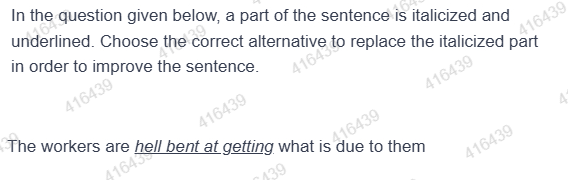
In the question given below, a part of the sentence is italicized and underlined. Choose the correct alternative to replace the italicized part in order to improve the sentence. The workers are hell bent at getting what is due to them
Figure for MBA CET 2025 Slot 4 question 185
  1. Option A
  2. Option B
  3. Option C
  4. Option D
  5. Option E
Show answerHide answer

Answer: C

Approach: Preposition with "hell-bent".

Solution: "Hell-bent" (determined at any cost) takes "on/upon" + -ing: "hell-bent upon getting". "At" is wrong. "Upon" is the formal form of "on", so option C "hell bent upon getting" corrects the sentence.

Why the other options are wrong:
A hell bent on getting: also an acceptable form; the key takes the formal "upon".
B for / D in: wrong prepositions with "bent".
E No improvement: "bent at" is incorrect.

Cetking shortcut: "Bent on/upon" = determined — never "bent at" or "bent for".

Answer: C

Q186MediumCET 2025 · Slot 4 · Q186
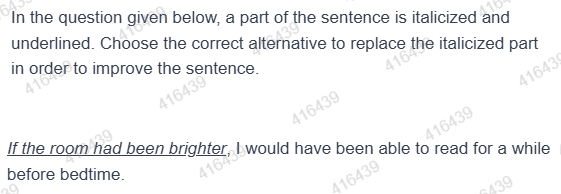
In the question given below, a part of the sentence is italicized and underlined. Choose the correct alternative to replace the italicized part in order to improve the sentence. If the room had been brighter, I would have been able to read for a while before bedtime.
Figure for MBA CET 2025 Slot 4 question 186
  1. Option A
  2. Option B
  3. Option C
  4. Option D
  5. Option E
Show answerHide answer

Answer: C

Approach: Third conditional — inverted form.

Solution: The result "I would have been able to read" is a past unreal result, so the condition is past perfect. "Had the room been brighter" is the inverted (if-less) third conditional and is the improvement the question expects; note that option D repeats the original text, so the setter treats C as the preferred form.

Why the other options are wrong:
A If the room was brighter: simple past — second conditional, wrong with "would have been".
B If the room are brighter: subject-verb error.
D If the room had been brighter: identical to the given part, so it is not a replacement.
E No improvement: rejected because D already reproduces the original.

Cetking shortcut: Third conditional: "If + had + V3" = "Had + subject + V3".

Answer: C

Q181EasyCET 2025 · Slot 3 · Q181
Sitting in the garden, the moon was seen shining in the sky by us.
  1. The moon was seen by us in the sky
  2. We saw the moon shining in the sky
  3. The moon was seen shinning by us in the sky
  4. The moon was seen shinning in the sky by
  5. No improvement
Show answerHide answer

Answer: B

Approach: Dangling modifier — the doer of 'sitting' must come right after the comma.

Solution: As written, the sentence implies the moon was sitting in the garden. The people sitting were 'we', so 'we' must be the subject, in active voice.
Correct: 'Sitting in the garden, we saw the moon shining in the sky.'

Why the other options are wrong:
A. Keeps 'the moon' as subject — still dangling; also drops 'shining'.
C. Misspells 'shining' and keeps the dangling subject.
D. Misspelt, incomplete ('by …') and still dangling.
E. No improvement — the original is a dangling modifier.

Cetking shortcut: With an opening '-ing' phrase, the answer almost always starts with the human doer (we/he/she).

Answer: B

Q182EasyCET 2025 · Slot 3 · Q182
The contractor did not keep his promise that the work will be finished before the end of the week
  1. could
  2. shall
  3. Would
  4. was
  5. No improvement
Show answerHide answer

Answer: C

Approach: Sequence of tenses — past main verb → past form in the subordinate clause.

Solution: Main clause: 'The contractor did not keep his promise' (past). The promise clause must shift back: 'will' → would.
Correct: '… his promise that the work would be finished before the end of the week.'

Why the other options are wrong:
A. could — changes the meaning to ability, not a promise.
B. shall — present/future form; breaks sequence of tenses.
D. was — 'was be finished' is ungrammatical.
E. No improvement — 'will' is wrong after a past main verb.

Answer: C

Q183EasyCET 2025 · Slot 3 · Q183
The principal was angry on seeing a wooden broken chair lying in the corridor
  1. Broken wooden chair
  2. Wooden and broken chair
  3. Broken and wooden chair
  4. Broken chair wooden
  5. No improvement
Show answerHide answer

Answer: A

Approach: Order of adjectives — opinion/condition → size → age → shape → colour → origin → material → purpose → noun.

Solution: 'Broken' describes condition (quality); 'wooden' is material. Material sits closest to the noun.
Correct: 'The principal was angry on seeing a broken wooden chair lying in the corridor.'

Why the other options are wrong:
B. 'Wooden and broken chair' — wrong order and an unnecessary 'and'.
C. 'Broken and wooden chair' — 'and' is not used between adjectives of different categories.
D. 'Broken chair wooden' — adjective after the noun; wrong.
E. No improvement — 'wooden broken' is the wrong order.

Cetking shortcut: Material adjective (wooden, golden, silk) always sits right next to the noun.

Answer: A

Q184MediumCET 2025 · Slot 3 · Q184
Anyone interested in the use of computers can learn much if you have access to a personal computer.
  1. one of them have access
  2. they have access
  3. access can be available
  4. he or she has access
  5. No improvement
Show answerHide answer

Answer: D

Approach: Pronoun–antecedent agreement and consistency of person.

Solution: The antecedent is Anyone — third person, singular. 'You' (second person) is wrong, and the verb must be singular.
Correct: 'Anyone interested in the use of computers can learn much if he or she has access to a personal computer.'

Why the other options are wrong:
A. 'one of them have access' — 'one … have' is wrong agreement; 'them' has no antecedent.
B. 'they have access' — plural; formal grammar keeps 'anyone' singular.
C. 'access can be available' — awkward passive; loses the person.
E. No improvement — 'you' does not match 'anyone'.

Answer: D

Q185MediumCET 2025 · Slot 3 · Q185
Despite his old age, his movements were as spirited as a young man.
  1. a young man’s
  2. if a young man
  3. of a young man
  4. those of a young man
  5. No improvement
Show answerHide answer

Answer: D

Approach: Faulty comparison — compare the same kind of things.

Solution: 'His movements' (plural thing) are being compared with 'a young man' (person) — illogical.
Use the plural pronoun those to stand for 'movements': '… as spirited as those of a young man.'

Why the other options are wrong:
A. 'a young man's' — elliptical and singular in form; 'those of' is the exact, plural match for 'movements'.
B. 'if a young man' — meaningless here.
C. 'of a young man' — still lacks the noun being compared.
E. No improvement — compares movements with a man.

Cetking shortcut: Plural noun compared → 'those of'; singular → 'that of'.

Answer: D

Practise these in the Arena

Take timed tests built around MBA CET topics and see where you stand.

Open the Arena