CAT Arrangements questions (2018–2025) — actual DILR sets with solutions
252 real CAT Arrangements questions from CAT 2018 to CAT 2025, each with options, the verified answer and a step-by-step solution. Practice one topic at a time,
252 real CAT questions · CAT 2018–2025 · 16 Medium · 21 Hard
Game Passing the buck | DILR CAT 2025 Slot 3 | Wide Wordy | Hard
Seven children, Aarav, Bina, Chirag, Diya, Eshan, Farhan, and Gaurav, are sitting in a circle facing inside (not necessarily in the same order) and playing a game of ‘Passing the Buck’. The game is played over 10 rounds. In each round, the child holding the Buck must pass it directly to a child sitting in one of the following positions: • Immediately to the left; • Immediate to the right; • Second to the left; or • Second to the right. The game starts with Bina passing the Buck and ends with Chirag receiving the Buck. The table below provides some information about the pass types and the child receiving the Buck. Some information is missing and labelled as ‘?’. Round Pass Type Received by 1 Immediately to the left Aarav 2 Second to the right ? 3 Immediately to the right Diya 4 ? ? 5 ? Aarav 6 Second to the left ? 7 Immediately to the left Gaurav 8 Immediately to the left ? 9 ? Farhan 10 ? Chirag
Game Passing the buck | DILR CAT 2025 Slot 3 | Wide Wordy | Hard
Seven children, Aarav, Bina, Chirag, Diya, Eshan, Farhan, and Gaurav, are sitting in a circle facing inside (not necessarily in the same order) and playing a game of ‘Passing the Buck’. The game is played over 10 rounds. In each round, the child holding the Buck must pass it directly to a child sitting in one of the following positions: • Immediately to the left; • Immediate to the right; • Second to the left; or • Second to the right. The game starts with Bina passing the Buck and ends with Chirag receiving the Buck. The table below provides some information about the pass types and the child receiving the Buck. Some information is missing and labelled as ‘?’. Round Pass Type Received by 1 Immediately to the left Aarav 2 Second to the right ? 3 Immediately to the right Diya 4 ? ? 5 ? Aarav 6 Second to the left ? 7 Immediately to the left Gaurav 8 Immediately to the left ? 9 ? Farhan 10 ? Chirag
Who is sitting third to the left of Eshan?
Q3CAT 2025 · Slot 3 · CAT Hard✓ Answer verified
Game Passing the buck | DILR CAT 2025 Slot 3 | Wide Wordy | Hard
Seven children, Aarav, Bina, Chirag, Diya, Eshan, Farhan, and Gaurav, are sitting in a circle facing inside (not necessarily in the same order) and playing a game of ‘Passing the Buck’. The game is played over 10 rounds. In each round, the child holding the Buck must pass it directly to a child sitting in one of the following positions: • Immediately to the left; • Immediate to the right; • Second to the left; or • Second to the right. The game starts with Bina passing the Buck and ends with Chirag receiving the Buck. The table below provides some information about the pass types and the child receiving the Buck. Some information is missing and labelled as ‘?’. Round Pass Type Received by 1 Immediately to the left Aarav 2 Second to the right ? 3 Immediately to the right Diya 4 ? ? 5 ? Aarav 6 Second to the left ? 7 Immediately to the left Gaurav 8 Immediately to the left ? 9 ? Farhan 10 ? Chirag
For which of the following pass types can the total number of occurrences be uniquely determined?
Q4CAT 2025 · Slot 3 · CAT Hard✓ Answer verified
Game Passing the buck | DILR CAT 2025 Slot 3 | Wide Wordy | Hard
Seven children, Aarav, Bina, Chirag, Diya, Eshan, Farhan, and Gaurav, are sitting in a circle facing inside (not necessarily in the same order) and playing a game of ‘Passing the Buck’. The game is played over 10 rounds. In each round, the child holding the Buck must pass it directly to a child sitting in one of the following positions: • Immediately to the left; • Immediate to the right; • Second to the left; or • Second to the right. The game starts with Bina passing the Buck and ends with Chirag receiving the Buck. The table below provides some information about the pass types and the child receiving the Buck. Some information is missing and labelled as ‘?’. Round Pass Type Received by 1 Immediately to the left Aarav 2 Second to the right ? 3 Immediately to the right Diya 4 ? ? 5 ? Aarav 6 Second to the left ? 7 Immediately to the left Gaurav 8 Immediately to the left ? 9 ? Farhan 10 ? Chirag
For which of the following children is it possible to determine how many times they received the Buck?
There are six spherical balls, B1, B2, B3, B4, B5, and B6, and four circular hoops H1, H2, H3, and H4. Each ball was tested on each hoop once, by attempting to pass the ball through the hoop. If the diameter of a ball is not larger than the diameter of the hoop, the ball passes through the hoop and makes a “ping”. Any ball having a diameter larger than that of the hoop gets stuck on that hoop and does not make a ping. The following additional information is known: 1. B1 and B6 each made a ping on H4, but B5 did not. 2. B4 made a ping on H3, but B1 did not. 3. All balls, except B3, made pings on H1. 4. None of the balls, except B2, made a ping on H2.
What was the total number of pings made by B1, B2, and B3?
Q6CAT 2025 · Slot 2 · CAT Medium✓ Answer verified
Balls and Hoops
There are six spherical balls, B1, B2, B3, B4, B5, and B6, and four circular hoops H1, H2, H3, and H4. Each ball was tested on each hoop once, by attempting to pass the ball through the hoop. If the diameter of a ball is not larger than the diameter of the hoop, the ball passes through the hoop and makes a “ping”. Any ball having a diameter larger than that of the hoop gets stuck on that hoop and does not make a ping. The following additional information is known: 1. B1 and B6 each made a ping on H4, but B5 did not. 2. B4 made a ping on H3, but B1 did not. 3. All balls, except B3, made pings on H1. 4. None of the balls, except B2, made a ping on H2.
Which of the following statements about the relative sizes of the balls is NOT NECESSARILY true?
Q7CAT 2025 · Slot 2 · CAT Medium✓ Answer verified
Balls and Hoops
There are six spherical balls, B1, B2, B3, B4, B5, and B6, and four circular hoops H1, H2, H3, and H4. Each ball was tested on each hoop once, by attempting to pass the ball through the hoop. If the diameter of a ball is not larger than the diameter of the hoop, the ball passes through the hoop and makes a “ping”. Any ball having a diameter larger than that of the hoop gets stuck on that hoop and does not make a ping. The following additional information is known: 1. B1 and B6 each made a ping on H4, but B5 did not. 2. B4 made a ping on H3, but B1 did not. 3. All balls, except B3, made pings on H1. 4. None of the balls, except B2, made a ping on H2.
Which of the following statements about the relative sizes of the hoops is true?
Q8CAT 2025 · Slot 2 · CAT Medium✓ Answer verified
Balls and Hoops
There are six spherical balls, B1, B2, B3, B4, B5, and B6, and four circular hoops H1, H2, H3, and H4. Each ball was tested on each hoop once, by attempting to pass the ball through the hoop. If the diameter of a ball is not larger than the diameter of the hoop, the ball passes through the hoop and makes a “ping”. Any ball having a diameter larger than that of the hoop gets stuck on that hoop and does not make a ping. The following additional information is known: 1. B1 and B6 each made a ping on H4, but B5 did not. 2. B4 made a ping on H3, but B1 did not. 3. All balls, except B3, made pings on H1. 4. None of the balls, except B2, made a ping on H2.
What BEST can be said about the total number of pings from all the tests undertaken?
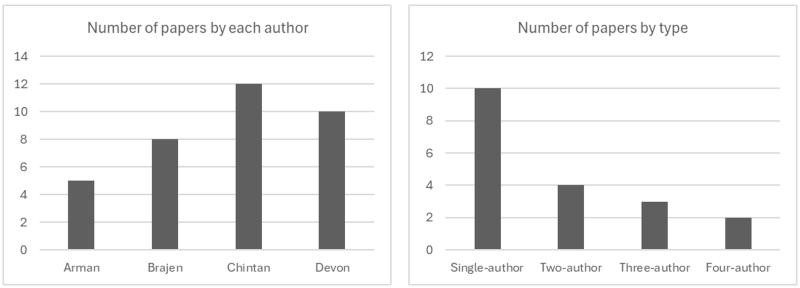
The following charts depict details of research papers written by four authors, Arman, Brajen, Chintan, and Devon. The papers were of four types, single-author, two-author, three-author, and four-author, that is, written by one, two, three, or all four of these authors, respectively. No other authors were involved in writing these papers. The following additional facts are known. 1. Each of the authors wrote at least one of each of the four types of papers. 2. The four authors wrote different numbers of single-author papers. 3. Both Chintan and Devon wrote more three-author papers than Brajen. 4. The number of single-author and two-author papers written by Brajen were the same.
What was the total number of two-author and three-author papers written by Brajen?
Q10CAT 2025 · Slot 2 · CAT Hard✓ Answer verified
Research Papers
The following charts depict details of research papers written by four authors, Arman, Brajen, Chintan, and Devon. The papers were of four types, single-author, two-author, three-author, and four-author, that is, written by one, two, three, or all four of these authors, respectively. No other authors were involved in writing these papers. The following additional facts are known. 1. Each of the authors wrote at least one of each of the four types of papers. 2. The four authors wrote different numbers of single-author papers. 3. Both Chintan and Devon wrote more three-author papers than Brajen. 4. The number of single-author and two-author papers written by Brajen were the same.
Which of the following statements is/are NECESSARILY true? i. Chintan wrote exactly three two-author papers. ii. Chintan wrote more single-author papers than Devon.
Q11CAT 2025 · Slot 2 · CAT Hard✓ Answer verified
Research Papers
The following charts depict details of research papers written by four authors, Arman, Brajen, Chintan, and Devon. The papers were of four types, single-author, two-author, three-author, and four-author, that is, written by one, two, three, or all four of these authors, respectively. No other authors were involved in writing these papers. The following additional facts are known. 1. Each of the authors wrote at least one of each of the four types of papers. 2. The four authors wrote different numbers of single-author papers. 3. Both Chintan and Devon wrote more three-author papers than Brajen. 4. The number of single-author and two-author papers written by Brajen were the same.
Which of the following statements is/are NECESSARILY true? i. Arman wrote three-author papers only with Chintan and Devon. ii. Brajen wrote three-author papers only with Chintan and Devon.
The following charts depict details of research papers written by four authors, Arman, Brajen, Chintan, and Devon. The papers were of four types, single-author, two-author, three-author, and four-author, that is, written by one, two, three, or all four of these authors, respectively. No other authors were involved in writing these papers. The following additional facts are known. 1. Each of the authors wrote at least one of each of the four types of papers. 2. The four authors wrote different numbers of single-author papers. 3. Both Chintan and Devon wrote more three-author papers than Brajen. 4. The number of single-author and two-author papers written by Brajen were the same.
If Devon wrote more than one two-author papers, then how many two-author papers did Chintan write?
The two most populous cities and the non-urban region (NUR) of each of three states, Whimshire, Fogglia, and Humbleset, are assigned Pollution Measures (PMs). These nine PMs are all distinct multiples of 10, ranging from 10 to 90. The six cities in increasing order of their PMs are: Blusterburg, Noodleton, Splutterville, Quackford, Mumpypore, Zingaloo. The Pollution Index (PI) of a state is a weighted average of the PMs of its NUR and cities, with a weight of 50% for the NUR, and 25% each for its two cities. There is only one pair of an NUR and a city (considering all cities and all NURs) where the PM of the NUR is greater than that of the city. That NUR and the city both belong to Humbleset. The PIs of all three states are distinct integers, with Humbleset and Fogglia having the highest and the lowest PI respectively.
The two most populous cities and the non-urban region (NUR) of each of three states, Whimshire, Fogglia, and Humbleset, are assigned Pollution Measures (PMs). These nine PMs are all distinct multiples of 10, ranging from 10 to 90. The six cities in increasing order of their PMs are: Blusterburg, Noodleton, Splutterville, Quackford, Mumpypore, Zingaloo. The Pollution Index (PI) of a state is a weighted average of the PMs of its NUR and cities, with a weight of 50% for the NUR, and 25% each for its two cities. There is only one pair of an NUR and a city (considering all cities and all NURs) where the PM of the NUR is greater than that of the city. That NUR and the city both belong to Humbleset. The PIs of all three states are distinct integers, with Humbleset and Fogglia having the highest and the lowest PI respectively.
The two most populous cities and the non-urban region (NUR) of each of three states, Whimshire, Fogglia, and Humbleset, are assigned Pollution Measures (PMs). These nine PMs are all distinct multiples of 10, ranging from 10 to 90. The six cities in increasing order of their PMs are: Blusterburg, Noodleton, Splutterville, Quackford, Mumpypore, Zingaloo. The Pollution Index (PI) of a state is a weighted average of the PMs of its NUR and cities, with a weight of 50% for the NUR, and 25% each for its two cities. There is only one pair of an NUR and a city (considering all cities and all NURs) where the PM of the NUR is greater than that of the city. That NUR and the city both belong to Humbleset. The PIs of all three states are distinct integers, with Humbleset and Fogglia having the highest and the lowest PI respectively.
What is the PI of Humbleset?
Q16CAT 2025 · Slot 2 · CAT Hard✓ Answer verified
Pollution 2 Cities
The two most populous cities and the non-urban region (NUR) of each of three states, Whimshire, Fogglia, and Humbleset, are assigned Pollution Measures (PMs). These nine PMs are all distinct multiples of 10, ranging from 10 to 90. The six cities in increasing order of their PMs are: Blusterburg, Noodleton, Splutterville, Quackford, Mumpypore, Zingaloo. The Pollution Index (PI) of a state is a weighted average of the PMs of its NUR and cities, with a weight of 50% for the NUR, and 25% each for its two cities. There is only one pair of an NUR and a city (considering all cities and all NURs) where the PM of the NUR is greater than that of the city. That NUR and the city both belong to Humbleset. The PIs of all three states are distinct integers, with Humbleset and Fogglia having the highest and the lowest PI respectively.
Which pair of cities definitely belong to the same state?
The two most populous cities and the non-urban region (NUR) of each of three states, Whimshire, Fogglia, and Humbleset, are assigned Pollution Measures (PMs). These nine PMs are all distinct multiples of 10, ranging from 10 to 90. The six cities in increasing order of their PMs are: Blusterburg, Noodleton, Splutterville, Quackford, Mumpypore, Zingaloo. The Pollution Index (PI) of a state is a weighted average of the PMs of its NUR and cities, with a weight of 50% for the NUR, and 25% each for its two cities. There is only one pair of an NUR and a city (considering all cities and all NURs) where the PM of the NUR is greater than that of the city. That NUR and the city both belong to Humbleset. The PIs of all three states are distinct integers, with Humbleset and Fogglia having the highest and the lowest PI respectively.
For how many of the cities and NURs is it possible to identify their PM and the state they belong to?
Ananya Raga, Bhaskar Tala, Charu Veena, and Devendra Sur are four musicians. Each of them started and completed their training as students under each of three Gurus — Pandit Meghnath, Ustad Samiran, and Acharya Raghunath between 2013 and 2024, including both the years. Each Guru trains any student for consecutive years only, for a span of 2, 3, or 4 years, with each Guru having a different span. During some of these years, a student may not have trained under these Gurus; however, they never trained under multiple Gurus in the same year. In none of these years, any of these Gurus trained more than two of these students at the same time. When two students train under the same Guru at the same time, they are referred to as Gurubhai, irrespective of their gender. The following additional facts are known. 1. Ustad Samiran never trained more than one of these students in the same year. 2. Acharya Raghunath did not train any of these students during 2015-2018, as well as during 2021-24. 3. Ananya and Devendra were never Gurubhai; neither were Bhaskar and Charu. All other pairs of musicians were Gurubhai for exactly 2 years. 4. In 2013, Ananya and Bhaskar started their trainings under Pandit Meghnath and under Ustad Samiran, respectively.
In which of the following years were Ananya and Bhaskar Gurubhai?
Q19CAT 2025 · Slot 2 · CAT Hard✓ Answer verified
Musicians
Ananya Raga, Bhaskar Tala, Charu Veena, and Devendra Sur are four musicians. Each of them started and completed their training as students under each of three Gurus — Pandit Meghnath, Ustad Samiran, and Acharya Raghunath between 2013 and 2024, including both the years. Each Guru trains any student for consecutive years only, for a span of 2, 3, or 4 years, with each Guru having a different span. During some of these years, a student may not have trained under these Gurus; however, they never trained under multiple Gurus in the same year. In none of these years, any of these Gurus trained more than two of these students at the same time. When two students train under the same Guru at the same time, they are referred to as Gurubhai, irrespective of their gender. The following additional facts are known. 1. Ustad Samiran never trained more than one of these students in the same year. 2. Acharya Raghunath did not train any of these students during 2015-2018, as well as during 2021-24. 3. Ananya and Devendra were never Gurubhai; neither were Bhaskar and Charu. All other pairs of musicians were Gurubhai for exactly 2 years. 4. In 2013, Ananya and Bhaskar started their trainings under Pandit Meghnath and under Ustad Samiran, respectively.
In which year did Charu begin her training under Pandit Meghnath?
Ananya Raga, Bhaskar Tala, Charu Veena, and Devendra Sur are four musicians. Each of them started and completed their training as students under each of three Gurus — Pandit Meghnath, Ustad Samiran, and Acharya Raghunath between 2013 and 2024, including both the years. Each Guru trains any student for consecutive years only, for a span of 2, 3, or 4 years, with each Guru having a different span. During some of these years, a student may not have trained under these Gurus; however, they never trained under multiple Gurus in the same year. In none of these years, any of these Gurus trained more than two of these students at the same time. When two students train under the same Guru at the same time, they are referred to as Gurubhai, irrespective of their gender. The following additional facts are known. 1. Ustad Samiran never trained more than one of these students in the same year. 2. Acharya Raghunath did not train any of these students during 2015-2018, as well as during 2021-24. 3. Ananya and Devendra were never Gurubhai; neither were Bhaskar and Charu. All other pairs of musicians were Gurubhai for exactly 2 years. 4. In 2013, Ananya and Bhaskar started their trainings under Pandit Meghnath and under Ustad Samiran, respectively.
In which of the following years were Bhaskar and Devendra Gurubhai?
Ananya Raga, Bhaskar Tala, Charu Veena, and Devendra Sur are four musicians. Each of them started and completed their training as students under each of three Gurus — Pandit Meghnath, Ustad Samiran, and Acharya Raghunath between 2013 and 2024, including both the years. Each Guru trains any student for consecutive years only, for a span of 2, 3, or 4 years, with each Guru having a different span. During some of these years, a student may not have trained under these Gurus; however, they never trained under multiple Gurus in the same year. In none of these years, any of these Gurus trained more than two of these students at the same time. When two students train under the same Guru at the same time, they are referred to as Gurubhai, irrespective of their gender. The following additional facts are known. 1. Ustad Samiran never trained more than one of these students in the same year. 2. Acharya Raghunath did not train any of these students during 2015-2018, as well as during 2021-24. 3. Ananya and Devendra were never Gurubhai; neither were Bhaskar and Charu. All other pairs of musicians were Gurubhai for exactly 2 years. 4. In 2013, Ananya and Bhaskar started their trainings under Pandit Meghnath and under Ustad Samiran, respectively.
Ananya Raga, Bhaskar Tala, Charu Veena, and Devendra Sur are four musicians. Each of them started and completed their training as students under each of three Gurus — Pandit Meghnath, Ustad Samiran, and Acharya Raghunath between 2013 and 2024, including both the years. Each Guru trains any student for consecutive years only, for a span of 2, 3, or 4 years, with each Guru having a different span. During some of these years, a student may not have trained under these Gurus; however, they never trained under multiple Gurus in the same year. In none of these years, any of these Gurus trained more than two of these students at the same time. When two students train under the same Guru at the same time, they are referred to as Gurubhai, irrespective of their gender. The following additional facts are known. 1. Ustad Samiran never trained more than one of these students in the same year. 2. Acharya Raghunath did not train any of these students during 2015-2018, as well as during 2021-24. 3. Ananya and Devendra were never Gurubhai; neither were Bhaskar and Charu. All other pairs of musicians were Gurubhai for exactly 2 years. 4. In 2013, Ananya and Bhaskar started their trainings under Pandit Meghnath and under Ustad Samiran, respectively.
In how many of the years between 2013-24, were only two of these four musicians training under these three Gurus?
DILR Set 1: Tapping Game 5 People | Teeny Numbers Arrangement | CAT 2025 Slot 1 | Moderate
Alia, Badal, Clive, Dilshan, and Ehsaan played a game in which each asks a unique question to all the others and they respond by tapping their feet, either once or twice or thrice. One tap means “Yes”, two taps mean “No”, and three taps mean “Maybe”. A total of 40 taps were heard across the five questions. Each question received at least one “Yes”, one “No”, and one “Maybe.” The following information is known. 1. Alia tapped a total of 6 times and received 9 taps to her question. She responded “Yes” to the questions asked by both Clive and Dilshan. 2. Dilshan and Ehsaan tapped a total of 11 and 9 times respectively. Dilshan responded “No” to Badal. 3. Badal, Dilshan, and Ehsaan received equal number of taps to their respective questions. 4. No one responded “Yes” more than twice. 5. No one’s answer to Alia’s question matched the answer that Alia gave to that person’s question. This was also true for Ehsaan. 6. Clive tapped more times in total than Badal.
How many taps did Clive receive for his question? ____
DILR Set 1: Tapping Game 5 People | Teeny Numbers Arrangement | CAT 2025 Slot 1 | Moderate
Alia, Badal, Clive, Dilshan, and Ehsaan played a game in which each asks a unique question to all the others and they respond by tapping their feet, either once or twice or thrice. One tap means “Yes”, two taps mean “No”, and three taps mean “Maybe”. A total of 40 taps were heard across the five questions. Each question received at least one “Yes”, one “No”, and one “Maybe.” The following information is known. 1. Alia tapped a total of 6 times and received 9 taps to her question. She responded “Yes” to the questions asked by both Clive and Dilshan. 2. Dilshan and Ehsaan tapped a total of 11 and 9 times respectively. Dilshan responded “No” to Badal. 3. Badal, Dilshan, and Ehsaan received equal number of taps to their respective questions. 4. No one responded “Yes” more than twice. 5. No one’s answer to Alia’s question matched the answer that Alia gave to that person’s question. This was also true for Ehsaan. 6. Clive tapped more times in total than Badal.
Which two people tapped an equal number of times in total?
DILR Set 1: Tapping Game 5 People | Teeny Numbers Arrangement | CAT 2025 Slot 1 | Moderate
Alia, Badal, Clive, Dilshan, and Ehsaan played a game in which each asks a unique question to all the others and they respond by tapping their feet, either once or twice or thrice. One tap means “Yes”, two taps mean “No”, and three taps mean “Maybe”. A total of 40 taps were heard across the five questions. Each question received at least one “Yes”, one “No”, and one “Maybe.” The following information is known. 1. Alia tapped a total of 6 times and received 9 taps to her question. She responded “Yes” to the questions asked by both Clive and Dilshan. 2. Dilshan and Ehsaan tapped a total of 11 and 9 times respectively. Dilshan responded “No” to Badal. 3. Badal, Dilshan, and Ehsaan received equal number of taps to their respective questions. 4. No one responded “Yes” more than twice. 5. No one’s answer to Alia’s question matched the answer that Alia gave to that person’s question. This was also true for Ehsaan. 6. Clive tapped more times in total than Badal.
DILR Set 1: Tapping Game 5 People | Teeny Numbers Arrangement | CAT 2025 Slot 1 | Moderate
Alia, Badal, Clive, Dilshan, and Ehsaan played a game in which each asks a unique question to all the others and they respond by tapping their feet, either once or twice or thrice. One tap means “Yes”, two taps mean “No”, and three taps mean “Maybe”. A total of 40 taps were heard across the five questions. Each question received at least one “Yes”, one “No”, and one “Maybe.” The following information is known. 1. Alia tapped a total of 6 times and received 9 taps to her question. She responded “Yes” to the questions asked by both Clive and Dilshan. 2. Dilshan and Ehsaan tapped a total of 11 and 9 times respectively. Dilshan responded “No” to Badal. 3. Badal, Dilshan, and Ehsaan received equal number of taps to their respective questions. 4. No one responded “Yes” more than twice. 5. No one’s answer to Alia’s question matched the answer that Alia gave to that person’s question. This was also true for Ehsaan. 6. Clive tapped more times in total than Badal.
How many “Yes” responses were received across all the questions? ____
At InnovateX, six employees, Asha, Bunty, Chintu, Dolly, Eklavya, and Falguni, were split into two groups of three each: Elite led by Manager Kuku, and Novice led by Manager Lalu. At the end of each quarter, Kuku and Lalu handed out ratings to all members in their respective groups. In each group, each employee received a distinct integer rating from 1 to 3. The score for an employee at the end of a quarter is defined as their cumulative rating from the beginning of the year. At the end of each quarter the employee in Novice with the highest score was promoted to Elite, and the employee in Elite with the minimum score was demoted to Novice. If there was a tie in scores, the employee with a higher rating in the latest quarter was ranked higher. 1. Asha, Bunty, and Chintu were in Elite at the beginning of Quarter 1. All of them were in Novice at the beginning of Quarter 4. 2. Dolly and Falguni were the only employees who got the same rating across all the quarters. 3. The following is known about ratings given by Lalu: • Bunty received a rating of 1 in Quarter 2. • Asha and Dolly received ratings of 1 and 2, respectively, in Quarter 3.
What was Eklavya’s score at the end of Quarter 2? ______
At InnovateX, six employees, Asha, Bunty, Chintu, Dolly, Eklavya, and Falguni, were split into two groups of three each: Elite led by Manager Kuku, and Novice led by Manager Lalu. At the end of each quarter, Kuku and Lalu handed out ratings to all members in their respective groups. In each group, each employee received a distinct integer rating from 1 to 3. The score for an employee at the end of a quarter is defined as their cumulative rating from the beginning of the year. At the end of each quarter the employee in Novice with the highest score was promoted to Elite, and the employee in Elite with the minimum score was demoted to Novice. If there was a tie in scores, the employee with a higher rating in the latest quarter was ranked higher. 1. Asha, Bunty, and Chintu were in Elite at the beginning of Quarter 1. All of them were in Novice at the beginning of Quarter 4. 2. Dolly and Falguni were the only employees who got the same rating across all the quarters. 3. The following is known about ratings given by Lalu: • Bunty received a rating of 1 in Quarter 2. • Asha and Dolly received ratings of 1 and 2, respectively, in Quarter 3.
How many employees changed groups more than once up to the beginning of Quarter 4? _____
At InnovateX, six employees, Asha, Bunty, Chintu, Dolly, Eklavya, and Falguni, were split into two groups of three each: Elite led by Manager Kuku, and Novice led by Manager Lalu. At the end of each quarter, Kuku and Lalu handed out ratings to all members in their respective groups. In each group, each employee received a distinct integer rating from 1 to 3. The score for an employee at the end of a quarter is defined as their cumulative rating from the beginning of the year. At the end of each quarter the employee in Novice with the highest score was promoted to Elite, and the employee in Elite with the minimum score was demoted to Novice. If there was a tie in scores, the employee with a higher rating in the latest quarter was ranked higher. 1. Asha, Bunty, and Chintu were in Elite at the beginning of Quarter 1. All of them were in Novice at the beginning of Quarter 4. 2. Dolly and Falguni were the only employees who got the same rating across all the quarters. 3. The following is known about ratings given by Lalu: • Bunty received a rating of 1 in Quarter 2. • Asha and Dolly received ratings of 1 and 2, respectively, in Quarter 3.
What was Bunty’s score at the end of Quarter 3? ______
At InnovateX, six employees, Asha, Bunty, Chintu, Dolly, Eklavya, and Falguni, were split into two groups of three each: Elite led by Manager Kuku, and Novice led by Manager Lalu. At the end of each quarter, Kuku and Lalu handed out ratings to all members in their respective groups. In each group, each employee received a distinct integer rating from 1 to 3. The score for an employee at the end of a quarter is defined as their cumulative rating from the beginning of the year. At the end of each quarter the employee in Novice with the highest score was promoted to Elite, and the employee in Elite with the minimum score was demoted to Novice. If there was a tie in scores, the employee with a higher rating in the latest quarter was ranked higher. 1. Asha, Bunty, and Chintu were in Elite at the beginning of Quarter 1. All of them were in Novice at the beginning of Quarter 4. 2. Dolly and Falguni were the only employees who got the same rating across all the quarters. 3. The following is known about ratings given by Lalu: • Bunty received a rating of 1 in Quarter 2. • Asha and Dolly received ratings of 1 and 2, respectively, in Quarter 3.
For how many employees can the scores at the end of Quarter 3 be determined with certainty? ____
At InnovateX, six employees, Asha, Bunty, Chintu, Dolly, Eklavya, and Falguni, were split into two groups of three each: Elite led by Manager Kuku, and Novice led by Manager Lalu. At the end of each quarter, Kuku and Lalu handed out ratings to all members in their respective groups. In each group, each employee received a distinct integer rating from 1 to 3. The score for an employee at the end of a quarter is defined as their cumulative rating from the beginning of the year. At the end of each quarter the employee in Novice with the highest score was promoted to Elite, and the employee in Elite with the minimum score was demoted to Novice. If there was a tie in scores, the employee with a higher rating in the latest quarter was ranked higher. 1. Asha, Bunty, and Chintu were in Elite at the beginning of Quarter 1. All of them were in Novice at the beginning of Quarter 4. 2. Dolly and Falguni were the only employees who got the same rating across all the quarters. 3. The following is known about ratings given by Lalu: • Bunty received a rating of 1 in Quarter 2. • Asha and Dolly received ratings of 1 and 2, respectively, in Quarter 3.
Which of the following statements is/are NECESSARILY true? I. Asha received a rating of 2 in Quarter 1. II. Asha received a rating of 1 in Quarter 2.
A round table has seven chairs around it. The chairs are numbered 1 through 7 in a clockwise direction. Four friends, Aslam, Bashir, Chhavi, and Davies, sit on four of the chairs. In the starting position, Aslam and Chhavi are sitting next to each other, while for Bashir as well as Davies, there are empty chairs on either side of the chairs that are sitting on. The friends take turns moving either clockwise or counterclockwise from their chair. The friend who has to move in a turn occupies the first empty chair in whichever direction (s)he chooses to move. Aslam moves first (Turn 1), followed by Bashir, Chhavi, and Davies (Turns 2, 3, and 4, respectively). Then Aslam moves again followed by Bashir, and Chhavi (Turns 5, 6, and 7, respectively). The following information is known. 1. The four friends occupy adjacent chairs only at the end of Turn 2 and Turn 6. 2. Davies occupies Chair 2 after Turn 1 and Chair 4 after Turn 5, and Chhavi occupies Chair 7 after Turn 2.
What is the number of the chair initially occupied by Bashir? ______
A round table has seven chairs around it. The chairs are numbered 1 through 7 in a clockwise direction. Four friends, Aslam, Bashir, Chhavi, and Davies, sit on four of the chairs. In the starting position, Aslam and Chhavi are sitting next to each other, while for Bashir as well as Davies, there are empty chairs on either side of the chairs that are sitting on. The friends take turns moving either clockwise or counterclockwise from their chair. The friend who has to move in a turn occupies the first empty chair in whichever direction (s)he chooses to move. Aslam moves first (Turn 1), followed by Bashir, Chhavi, and Davies (Turns 2, 3, and 4, respectively). Then Aslam moves again followed by Bashir, and Chhavi (Turns 5, 6, and 7, respectively). The following information is known. 1. The four friends occupy adjacent chairs only at the end of Turn 2 and Turn 6. 2. Davies occupies Chair 2 after Turn 1 and Chair 4 after Turn 5, and Chhavi occupies Chair 7 after Turn 2.
Who sits on the chair numbered 4 at the end of Turn 3? Options:
A round table has seven chairs around it. The chairs are numbered 1 through 7 in a clockwise direction. Four friends, Aslam, Bashir, Chhavi, and Davies, sit on four of the chairs. In the starting position, Aslam and Chhavi are sitting next to each other, while for Bashir as well as Davies, there are empty chairs on either side of the chairs that are sitting on. The friends take turns moving either clockwise or counterclockwise from their chair. The friend who has to move in a turn occupies the first empty chair in whichever direction (s)he chooses to move. Aslam moves first (Turn 1), followed by Bashir, Chhavi, and Davies (Turns 2, 3, and 4, respectively). Then Aslam moves again followed by Bashir, and Chhavi (Turns 5, 6, and 7, respectively). The following information is known. 1. The four friends occupy adjacent chairs only at the end of Turn 2 and Turn 6. 2. Davies occupies Chair 2 after Turn 1 and Chair 4 after Turn 5, and Chhavi occupies Chair 7 after Turn 2.
Which of the chairs are occupied at the end of Turn 6? Options:
A round table has seven chairs around it. The chairs are numbered 1 through 7 in a clockwise direction. Four friends, Aslam, Bashir, Chhavi, and Davies, sit on four of the chairs. In the starting position, Aslam and Chhavi are sitting next to each other, while for Bashir as well as Davies, there are empty chairs on either side of the chairs that are sitting on. The friends take turns moving either clockwise or counterclockwise from their chair. The friend who has to move in a turn occupies the first empty chair in whichever direction (s)he chooses to move. Aslam moves first (Turn 1), followed by Bashir, Chhavi, and Davies (Turns 2, 3, and 4, respectively). Then Aslam moves again followed by Bashir, and Chhavi (Turns 5, 6, and 7, respectively). The following information is known. 1. The four friends occupy adjacent chairs only at the end of Turn 2 and Turn 6. 2. Davies occupies Chair 2 after Turn 1 and Chair 4 after Turn 5, and Chhavi occupies Chair 7 after Turn 2.
Which of the following BEST describes the friends sitting on chairs adjacent to the one occupied by Bashir at the end of Turn 7? Options:
Q36CAT 2025 · Slot 1 · CAT Hard✓ Answer verified
Round Table Arrangement
A round table has seven chairs around it. The chairs are numbered 1 through 7 in a clockwise direction. Four friends, Aslam, Bashir, Chhavi, and Davies, sit on four of the chairs. In the starting position, Aslam and Chhavi are sitting next to each other, while for Bashir as well as Davies, there are empty chairs on either side of the chairs that are sitting on. The friends take turns moving either clockwise or counterclockwise from their chair. The friend who has to move in a turn occupies the first empty chair in whichever direction (s)he chooses to move. Aslam moves first (Turn 1), followed by Bashir, Chhavi, and Davies (Turns 2, 3, and 4, respectively). Then Aslam moves again followed by Bashir, and Chhavi (Turns 5, 6, and 7, respectively). The following information is known. 1. The four friends occupy adjacent chairs only at the end of Turn 2 and Turn 6. 2. Davies occupies Chair 2 after Turn 1 and Chair 4 after Turn 5, and Chhavi occupies Chair 7 after Turn 2.
Who sits on the chair numbered 4 at the end of Turn 3?
Q37CAT 2025 · Slot 1 · CAT Hard✓ Answer verified
Round Table Arrangement
A round table has seven chairs around it. The chairs are numbered 1 through 7 in a clockwise direction. Four friends, Aslam, Bashir, Chhavi, and Davies, sit on four of the chairs. In the starting position, Aslam and Chhavi are sitting next to each other, while for Bashir as well as Davies, there are empty chairs on either side of the chairs that are sitting on. The friends take turns moving either clockwise or counterclockwise from their chair. The friend who has to move in a turn occupies the first empty chair in whichever direction (s)he chooses to move. Aslam moves first (Turn 1), followed by Bashir, Chhavi, and Davies (Turns 2, 3, and 4, respectively). Then Aslam moves again followed by Bashir, and Chhavi (Turns 5, 6, and 7, respectively). The following information is known. 1. The four friends occupy adjacent chairs only at the end of Turn 2 and Turn 6. 2. Davies occupies Chair 2 after Turn 1 and Chair 4 after Turn 5, and Chhavi occupies Chair 7 after Turn 2.
Which of the chairs are occupied at the end of Turn 6?
Q38CAT 2024 · TITA✓ Answer verified
Bloggers
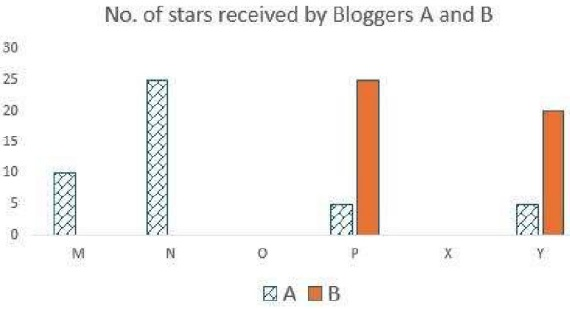
The following additional facts are known regarding the number of stars received by the bloggers from the surfers. The numbers of stars received by the bloggers from the surfers were all multiples of 5 (including 0). The total numbers of stars received by the bloggers were the same. Each blogger received a different number of stars from M. Two surfers gave all their stars to a single blogger. D received more stars than C from Y.
What was the total number of stars received by D?
Q39CAT 2024
Bloggers
The following additional facts are known regarding the number of stars received by the bloggers from the surfers. The numbers of stars received by the bloggers from the surfers were all multiples of 5 (including 0). The total numbers of stars received by the bloggers were the same. Each blogger received a different number of stars from M. Two surfers gave all their stars to a single blogger. D received more stars than C from Y.
What was the number of stars received by D from Y?
Q40CAT 2024 · TITA
Bloggers
The following additional facts are known regarding the number of stars received by the bloggers from the surfers. The numbers of stars received by the bloggers from the surfers were all multiples of 5 (including 0). The total numbers of stars received by the bloggers were the same. Each blogger received a different number of stars from M. Two surfers gave all their stars to a single blogger. D received more stars than C from Y.
How many surfers distributed their stars among exactly 2 bloggers?
Q41CAT 2024
Bloggers
The following additional facts are known regarding the number of stars received by the bloggers from the surfers. The numbers of stars received by the bloggers from the surfers were all multiples of 5 (including 0). The total numbers of stars received by the bloggers were the same. Each blogger received a different number of stars from M. Two surfers gave all their stars to a single blogger. D received more stars than C from Y.
Which of the following can be determined with certainty? I. The numbers of stars received by C from M II. The number of stars received by D from O
Q42CAT 2024 · TITA✓ Answer verified
QUIET Tournament
The game of QUIET is played between two teams. Six teams, numbered 1, 2, 3, 4, 5, and 6, play in a QUIET tournament. These teams are divided equally into two groups. In the tournament, each team plays every other team in the same group only once, and each team in the other group exactly twice. The tournament has several rounds, each of which consists of a few games. Every team plays exactly one game in each round. The following additional facts are known about the schedule of games in the tournament. Each team played against a team from the other group in Round 8. In Round 4 and Round 7, the match-ups, that is the pair of teams playing against each other, were identical. In Round 5 and Round 8, the match-ups were identical. Team 4 played Team 6 in both Round 1 and Round 2. Team 1 played Team 5 ONLY once and that was in Round 2. Team 3 played Team 4 in Round 3. Team 1 played Team 6 in Round 6. In Round 8, Team 3 played Team 6, while Team 2 played Team 5.
How many rounds were there in the tournament?
Q43CAT 2024 · TITA✓ Answer verified
QUIET Tournament
The game of QUIET is played between two teams. Six teams, numbered 1, 2, 3, 4, 5, and 6, play in a QUIET tournament. These teams are divided equally into two groups. In the tournament, each team plays every other team in the same group only once, and each team in the other group exactly twice. The tournament has several rounds, each of which consists of a few games. Every team plays exactly one game in each round. The following additional facts are known about the schedule of games in the tournament. Each team played against a team from the other group in Round 8. In Round 4 and Round 7, the match-ups, that is the pair of teams playing against each other, were identical. In Round 5 and Round 8, the match-ups were identical. Team 4 played Team 6 in both Round 1 and Round 2. Team 1 played Team 5 ONLY once and that was in Round 2. Team 3 played Team 4 in Round 3. Team 1 played Team 6 in Round 6. In Round 8, Team 3 played Team 6, while Team 2 played Team 5.
What is the number of the team that played Team 1 in Round 5?
Q44CAT 2024✓ Answer verified
QUIET Tournament
The game of QUIET is played between two teams. Six teams, numbered 1, 2, 3, 4, 5, and 6, play in a QUIET tournament. These teams are divided equally into two groups. In the tournament, each team plays every other team in the same group only once, and each team in the other group exactly twice. The tournament has several rounds, each of which consists of a few games. Every team plays exactly one game in each round. The following additional facts are known about the schedule of games in the tournament. Each team played against a team from the other group in Round 8. In Round 4 and Round 7, the match-ups, that is the pair of teams playing against each other, were identical. In Round 5 and Round 8, the match-ups were identical. Team 4 played Team 6 in both Round 1 and Round 2. Team 1 played Team 5 ONLY once and that was in Round 2. Team 3 played Team 4 in Round 3. Team 1 played Team 6 in Round 6. In Round 8, Team 3 played Team 6, while Team 2 played Team 5.
Which team among the teams numbered 2, 3, 4, and 5 was not part of the same group?
Q45CAT 2024 · TITA✓ Answer verified
QUIET Tournament
The game of QUIET is played between two teams. Six teams, numbered 1, 2, 3, 4, 5, and 6, play in a QUIET tournament. These teams are divided equally into two groups. In the tournament, each team plays every other team in the same group only once, and each team in the other group exactly twice. The tournament has several rounds, each of which consists of a few games. Every team plays exactly one game in each round. The following additional facts are known about the schedule of games in the tournament. Each team played against a team from the other group in Round 8. In Round 4 and Round 7, the match-ups, that is the pair of teams playing against each other, were identical. In Round 5 and Round 8, the match-ups were identical. Team 4 played Team 6 in both Round 1 and Round 2. Team 1 played Team 5 ONLY once and that was in Round 2. Team 3 played Team 4 in Round 3. Team 1 played Team 6 in Round 6. In Round 8, Team 3 played Team 6, while Team 2 played Team 5.
What is the number of the team that played Team 1 in Round 7?
Q46CAT 2024 · TITA
QUIET Tournament
The game of QUIET is played between two teams. Six teams, numbered 1, 2, 3, 4, 5, and 6, play in a QUIET tournament. These teams are divided equally into two groups. In the tournament, each team plays every other team in the same group only once, and each team in the other group exactly twice. The tournament has several rounds, each of which consists of a few games. Every team plays exactly one game in each round. The following additional facts are known about the schedule of games in the tournament. Each team played against a team from the other group in Round 8. In Round 4 and Round 7, the match-ups, that is the pair of teams playing against each other, were identical. In Round 5 and Round 8, the match-ups were identical. Team 4 played Team 6 in both Round 1 and Round 2. Team 1 played Team 5 ONLY once and that was in Round 2. Team 3 played Team 4 in Round 3. Team 1 played Team 6 in Round 6. In Round 8, Team 3 played Team 6, while Team 2 played Team 5.
What is the number of the team that played Team 6 in Round 3?
Q47CAT 2024 · TITA✓ Answer verified
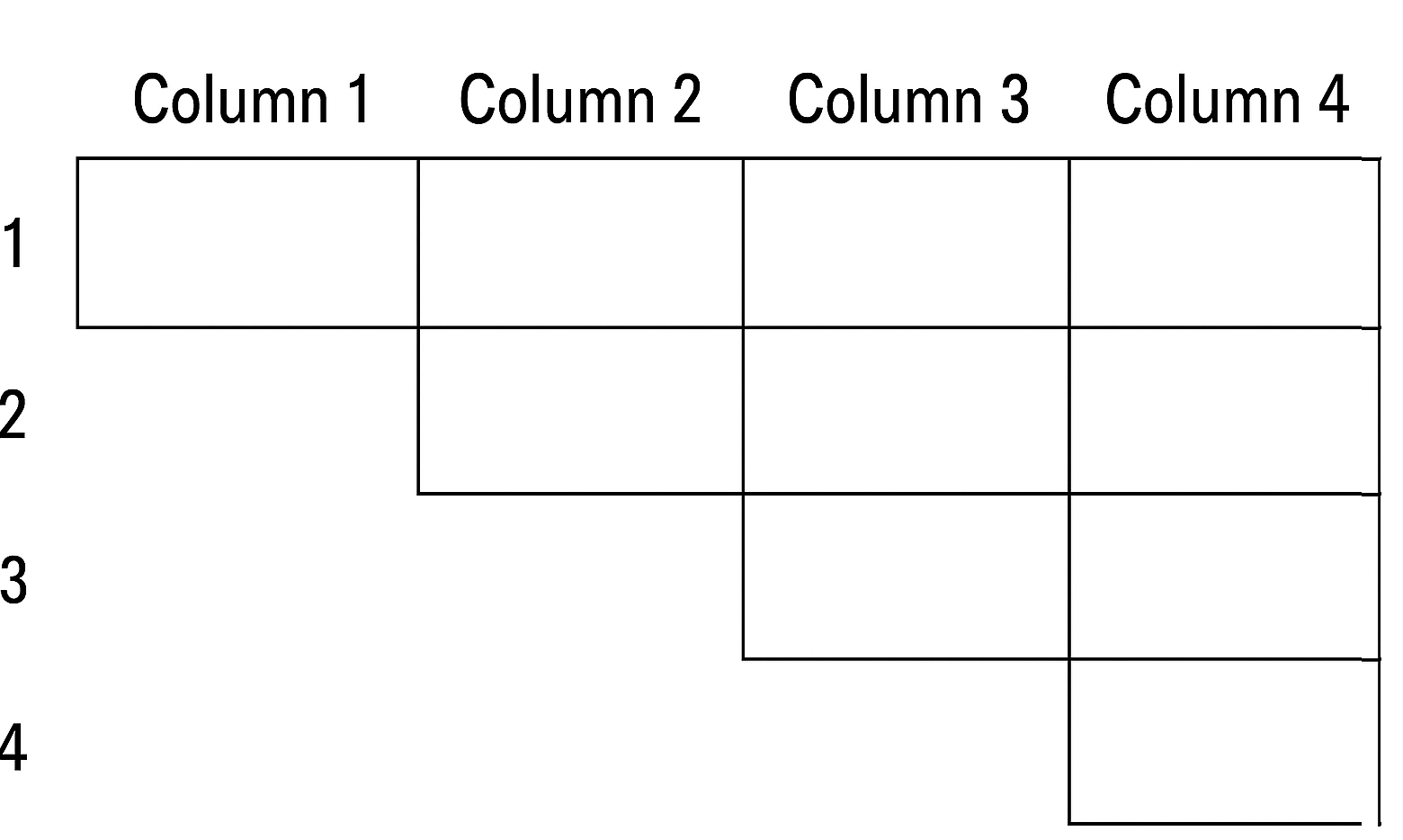
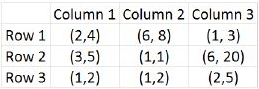
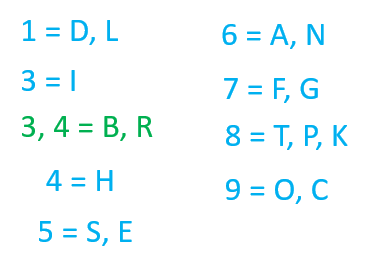
The numbers 1, 2, 3, 4, 5, 6, 7, 8, 9, and 10 are placed in ten slots of the following grid based on the conditions below. Numbers in any row appear in an increasing order from left to right. Numbers in any column appear in a decreasing order from top to bottom. 1 is placed either in the same row or in the same column as 10. Neither 2 nor 3 is placed in the same row or in the same column as 10. Neither 7 nor 8 is placed in the same row or in the same column as 9. 4 and 6 are placed in the same row.
Q. 1 What is the row number which has the least sum of numbers placed in that row?
Q48CAT 2024✓ Answer verified
The numbers 1, 2, 3, 4, 5, 6, 7, 8, 9, and 10 are placed in ten slots of the following grid based on the conditions below. Numbers in any row appear in an increasing order from left to right. Numbers in any column appear in a decreasing order from top to bottom. 1 is placed either in the same row or in the same column as 10. Neither 2 nor 3 is placed in the same row or in the same column as 10. Neither 7 nor 8 is placed in the same row or in the same column as 9. 4 and 6 are placed in the same row.
Q. 2 Which of the following statements MUST be true? I. 10 is placed in a slot in Row 1. II. 1 is placed in a slot in Row 4.
Q49CAT 2024✓ Answer verified
The numbers 1, 2, 3, 4, 5, 6, 7, 8, 9, and 10 are placed in ten slots of the following grid based on the conditions below. Numbers in any row appear in an increasing order from left to right. Numbers in any column appear in a decreasing order from top to bottom. 1 is placed either in the same row or in the same column as 10. Neither 2 nor 3 is placed in the same row or in the same column as 10. Neither 7 nor 8 is placed in the same row or in the same column as 9. 4 and 6 are placed in the same row.
Q. 3 Which of the following statements MUST be true? I. 2 is placed in a slot in Column 2. II. 3 is placed in a slot in Column 3.
Q50CAT 2024 · TITA✓ Answer verified
The numbers 1, 2, 3, 4, 5, 6, 7, 8, 9, and 10 are placed in ten slots of the following grid based on the conditions below. Numbers in any row appear in an increasing order from left to right. Numbers in any column appear in a decreasing order from top to bottom. 1 is placed either in the same row or in the same column as 10. Neither 2 nor 3 is placed in the same row or in the same column as 10. Neither 7 nor 8 is placed in the same row or in the same column as 9. 4 and 6 are placed in the same row.
Q. 4 For how many slots in the grid, placement of numbers CANNOT be determined with certainty?
Q51CAT 2024 · TITA✓ Answer verified
The numbers 1, 2, 3, 4, 5, 6, 7, 8, 9, and 10 are placed in ten slots of the following grid based on the conditions below. Numbers in any row appear in an increasing order from left to right. Numbers in any column appear in a decreasing order from top to bottom. 1 is placed either in the same row or in the same column as 10. Neither 2 nor 3 is placed in the same row or in the same column as 10. Neither 7 nor 8 is placed in the same row or in the same column as 9. 4 and 6 are placed in the same row.
Q. 5 What is the sum of the numbers placed in Column 4?
Q52CAT 2023 · Slot 3 · TITA✓ Answer verified
Wide Arrangement DILR Cat 2023 Slot 3
There are only three female students – Amala, Koli and Rini – and only three male students – Biman, Mathew and Shyamal – in a course. The course has two evaluation components, a project and a test. The aggregate score in the course is a weighted average of the two components, with the weights being positive and adding to 1. The projects are done in groups of two, with each group consisting of a female and a male student. Both the group members obtain the same score in the project. The following additional facts are known about the scores in the project and the test. The minimum, maximum and the average of both project and test scores were identical – 40, 80 and 60, respectively. The test scores of the students were all multiples of 10; four of them were distinct and the remaining two were equal to the average test scores. Amala’s score in the project was double that of Koli in the same, but Koli scored 20 more than Amala in the test. Yet Amala had the highest aggregate score. Shyamal scored the second highest in the test. He scored two more than Koli, but two less than Amala in the aggregate. Biman scored the second lowest in the test and the lowest in the aggregate. Mathew scored more than Rini in the project, but less than her in the test.
Q.1 What was Rini’s score in the project?
Q53CAT 2023 · Slot 3✓ Answer verified
Wide Arrangement DILR Cat 2023 Slot 3
There are only three female students – Amala, Koli and Rini – and only three male students – Biman, Mathew and Shyamal – in a course. The course has two evaluation components, a project and a test. The aggregate score in the course is a weighted average of the two components, with the weights being positive and adding to 1. The projects are done in groups of two, with each group consisting of a female and a male student. Both the group members obtain the same score in the project. The following additional facts are known about the scores in the project and the test. The minimum, maximum and the average of both project and test scores were identical – 40, 80 and 60, respectively. The test scores of the students were all multiples of 10; four of them were distinct and the remaining two were equal to the average test scores. Amala’s score in the project was double that of Koli in the same, but Koli scored 20 more than Amala in the test. Yet Amala had the highest aggregate score. Shyamal scored the second highest in the test. He scored two more than Koli, but two less than Amala in the aggregate. Biman scored the second lowest in the test and the lowest in the aggregate. Mathew scored more than Rini in the project, but less than her in the test.
Q.2 What was the weight of the test component?
Q54CAT 2023 · Slot 3 · TITA✓ Answer verified
Wide Arrangement DILR Cat 2023 Slot 3
There are only three female students – Amala, Koli and Rini – and only three male students – Biman, Mathew and Shyamal – in a course. The course has two evaluation components, a project and a test. The aggregate score in the course is a weighted average of the two components, with the weights being positive and adding to 1. The projects are done in groups of two, with each group consisting of a female and a male student. Both the group members obtain the same score in the project. The following additional facts are known about the scores in the project and the test. The minimum, maximum and the average of both project and test scores were identical – 40, 80 and 60, respectively. The test scores of the students were all multiples of 10; four of them were distinct and the remaining two were equal to the average test scores. Amala’s score in the project was double that of Koli in the same, but Koli scored 20 more than Amala in the test. Yet Amala had the highest aggregate score. Shyamal scored the second highest in the test. He scored two more than Koli, but two less than Amala in the aggregate. Biman scored the second lowest in the test and the lowest in the aggregate. Mathew scored more than Rini in the project, but less than her in the test.
Q.4 What was Mathew’s score in the test
Q55CAT 2023 · Slot 3✓ Answer verified
Wide Arrangement DILR Cat 2023 Slot 3
There are only three female students – Amala, Koli and Rini – and only three male students – Biman, Mathew and Shyamal – in a course. The course has two evaluation components, a project and a test. The aggregate score in the course is a weighted average of the two components, with the weights being positive and adding to 1. The projects are done in groups of two, with each group consisting of a female and a male student. Both the group members obtain the same score in the project. The following additional facts are known about the scores in the project and the test. The minimum, maximum and the average of both project and test scores were identical – 40, 80 and 60, respectively. The test scores of the students were all multiples of 10; four of them were distinct and the remaining two were equal to the average test scores. Amala’s score in the project was double that of Koli in the same, but Koli scored 20 more than Amala in the test. Yet Amala had the highest aggregate score. Shyamal scored the second highest in the test. He scored two more than Koli, but two less than Amala in the aggregate. Biman scored the second lowest in the test and the lowest in the aggregate. Mathew scored more than Rini in the project, but less than her in the test.
Q.5 Which of the following pairs of students were part of the same project team? i) Amala and Biman ii) Koli and Mathew
Q56CAT 2023 · Slot 2✓ Answer verified
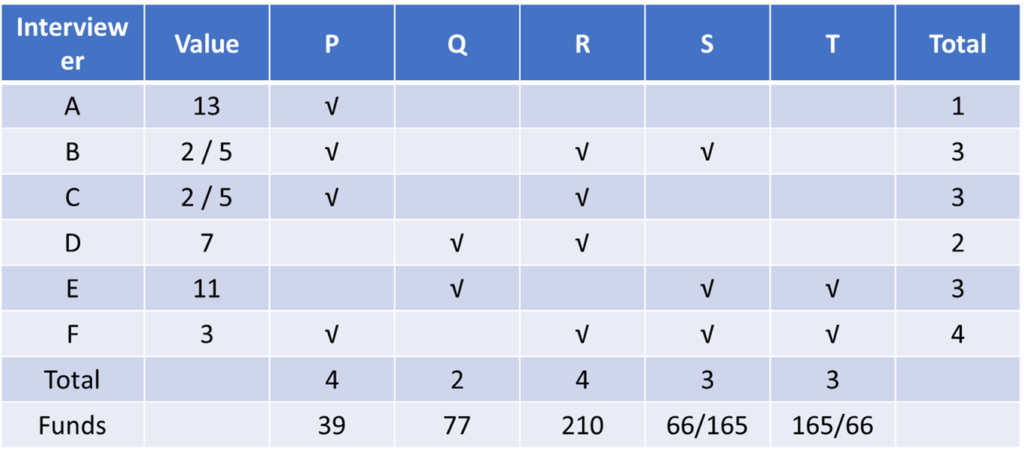
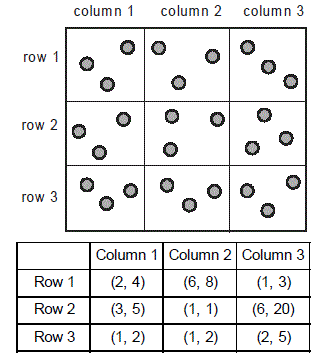
Q1-5. There are nine boxes arranged in a 3×3 array as shown in Tables 1 and 2. Each box contains three sacks. Each sack has a certain number of coins, between 1 and 9, both inclusive. The average number of coins per sack in the boxes are all distinct integers. The total number of coins in each row is the same. The total number of coins in each column is also the same. Table 1 gives information regarding the median of the numbers of coins in the three sacks in a box for some of the boxes. In Table 2 each box has a number which represents the number of sacks in that box having more than 5 coins. That number is followed by a × if the sacks in that box satisfy exactly one among the following three conditions, and it is followed by ×× if two or more of these conditions are satisfied. i) The minimum among the numbers of coins in the three sacks in the box is 1. ii) The median of the numbers of coins in the three sacks is 1. iii) The maximum among the numbers of coins in the three sacks in the box is 9
Q1. What is the total number of coins in all the boxes in the 3rd row?
Q57CAT 2023 · Slot 2✓ Answer verified
Q1-5. There are nine boxes arranged in a 3×3 array as shown in Tables 1 and 2. Each box contains three sacks. Each sack has a certain number of coins, between 1 and 9, both inclusive. The average number of coins per sack in the boxes are all distinct integers. The total number of coins in each row is the same. The total number of coins in each column is also the same. Table 1 gives information regarding the median of the numbers of coins in the three sacks in a box for some of the boxes. In Table 2 each box has a number which represents the number of sacks in that box having more than 5 coins. That number is followed by a × if the sacks in that box satisfy exactly one among the following three conditions, and it is followed by ×× if two or more of these conditions are satisfied. i) The minimum among the numbers of coins in the three sacks in the box is 1. ii) The median of the numbers of coins in the three sacks is 1. iii) The maximum among the numbers of coins in the three sacks in the box is 9
Q2. How many boxes have at least one sack containing 9 coins?
Q58CAT 2023 · Slot 2 · TITA✓ Answer verified
Q1-5. There are nine boxes arranged in a 3×3 array as shown in Tables 1 and 2. Each box contains three sacks. Each sack has a certain number of coins, between 1 and 9, both inclusive. The average number of coins per sack in the boxes are all distinct integers. The total number of coins in each row is the same. The total number of coins in each column is also the same. Table 1 gives information regarding the median of the numbers of coins in the three sacks in a box for some of the boxes. In Table 2 each box has a number which represents the number of sacks in that box having more than 5 coins. That number is followed by a × if the sacks in that box satisfy exactly one among the following three conditions, and it is followed by ×× if two or more of these conditions are satisfied. i) The minimum among the numbers of coins in the three sacks in the box is 1. ii) The median of the numbers of coins in the three sacks is 1. iii) The maximum among the numbers of coins in the three sacks in the box is 9
Q3. For how many boxes are the average and median of the numbers of coins contained in the three sacks in that box the same?
Q59CAT 2023 · Slot 2 · TITA✓ Answer verified
Q1-5. There are nine boxes arranged in a 3×3 array as shown in Tables 1 and 2. Each box contains three sacks. Each sack has a certain number of coins, between 1 and 9, both inclusive. The average number of coins per sack in the boxes are all distinct integers. The total number of coins in each row is the same. The total number of coins in each column is also the same. Table 1 gives information regarding the median of the numbers of coins in the three sacks in a box for some of the boxes. In Table 2 each box has a number which represents the number of sacks in that box having more than 5 coins. That number is followed by a × if the sacks in that box satisfy exactly one among the following three conditions, and it is followed by ×× if two or more of these conditions are satisfied. i) The minimum among the numbers of coins in the three sacks in the box is 1. ii) The median of the numbers of coins in the three sacks is 1. iii) The maximum among the numbers of coins in the three sacks in the box is 9
Q4. How many sacks have exactly one coin?
Q60CAT 2023 · Slot 2 · TITA✓ Answer verified
Q1-5. There are nine boxes arranged in a 3×3 array as shown in Tables 1 and 2. Each box contains three sacks. Each sack has a certain number of coins, between 1 and 9, both inclusive. The average number of coins per sack in the boxes are all distinct integers. The total number of coins in each row is the same. The total number of coins in each column is also the same. Table 1 gives information regarding the median of the numbers of coins in the three sacks in a box for some of the boxes. In Table 2 each box has a number which represents the number of sacks in that box having more than 5 coins. That number is followed by a × if the sacks in that box satisfy exactly one among the following three conditions, and it is followed by ×× if two or more of these conditions are satisfied. i) The minimum among the numbers of coins in the three sacks in the box is 1. ii) The median of the numbers of coins in the three sacks is 1. iii) The maximum among the numbers of coins in the three sacks in the box is 9
Q5. In how many boxes do all three sacks contain different numbers of coins?
Q61CAT 2023 · Slot 2✓ Answer verified
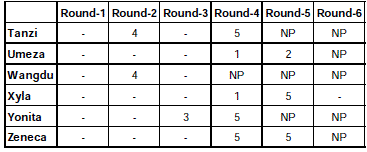
Q1-5. Three participants – Akhil, Bimal and Chatur participate in a random draw competition for five days. Every day, each participant randomly picks up a ball numbered between 1 and 9. The number on the ball determines his score on that day. The total score of a participant is the sum of his scores attained in the five days. The total score of a day is the sum of participants’ scores on that day. The 2-day average on a day, except on Day 1, is the average of the total scores of that day and of the previous day. For example, if the total scores of Day 1 and Day 2 are 25 and 20, then the 2-day average on Day 2 is calculated as 22.5. Table 1 gives the 2-day averages for Days 2 through 5. Participants are ranked each day, with the person having the maximum score being awarded the minimum rank (1) on that day. If there is a tie, all participants with the tied score are awarded the best available rank. For example, if on a day Akhil, Bimal, and Chatur score 8, 7 and 7 respectively, then their ranks will be 1, 2 and 2 respectively on that day. These ranks are given in Table 2. The following information is also known. 1. Chatur always scores in multiples of 3. His score on Day 2 is the unique highest score in the competition. His minimum score is observed only on Day 1, and it matches Akhil’s score on Day 4. 2. The total score on Day 3 is the same as the total score on Day 4. 3. Bimal’s scores are the same on Day 1 and Day 3.
Q1. What is Akhil's score on Day 1?
Q62CAT 2023 · Slot 2✓ Answer verified
Q1-5. Three participants – Akhil, Bimal and Chatur participate in a random draw competition for five days. Every day, each participant randomly picks up a ball numbered between 1 and 9. The number on the ball determines his score on that day. The total score of a participant is the sum of his scores attained in the five days. The total score of a day is the sum of participants’ scores on that day. The 2-day average on a day, except on Day 1, is the average of the total scores of that day and of the previous day. For example, if the total scores of Day 1 and Day 2 are 25 and 20, then the 2-day average on Day 2 is calculated as 22.5. Table 1 gives the 2-day averages for Days 2 through 5. Participants are ranked each day, with the person having the maximum score being awarded the minimum rank (1) on that day. If there is a tie, all participants with the tied score are awarded the best available rank. For example, if on a day Akhil, Bimal, and Chatur score 8, 7 and 7 respectively, then their ranks will be 1, 2 and 2 respectively on that day. These ranks are given in Table 2. The following information is also known. 1. Chatur always scores in multiples of 3. His score on Day 2 is the unique highest score in the competition. His minimum score is observed only on Day 1, and it matches Akhil’s score on Day 4. 2. The total score on Day 3 is the same as the total score on Day 4. 3. Bimal’s scores are the same on Day 1 and Day 3.
Q2. Who attains the maximum total score?
Q63CAT 2023 · Slot 2 · TITA✓ Answer verified
Q1-5. Three participants – Akhil, Bimal and Chatur participate in a random draw competition for five days. Every day, each participant randomly picks up a ball numbered between 1 and 9. The number on the ball determines his score on that day. The total score of a participant is the sum of his scores attained in the five days. The total score of a day is the sum of participants’ scores on that day. The 2-day average on a day, except on Day 1, is the average of the total scores of that day and of the previous day. For example, if the total scores of Day 1 and Day 2 are 25 and 20, then the 2-day average on Day 2 is calculated as 22.5. Table 1 gives the 2-day averages for Days 2 through 5. Participants are ranked each day, with the person having the maximum score being awarded the minimum rank (1) on that day. If there is a tie, all participants with the tied score are awarded the best available rank. For example, if on a day Akhil, Bimal, and Chatur score 8, 7 and 7 respectively, then their ranks will be 1, 2 and 2 respectively on that day. These ranks are given in Table 2. The following information is also known. 1. Chatur always scores in multiples of 3. His score on Day 2 is the unique highest score in the competition. His minimum score is observed only on Day 1, and it matches Akhil’s score on Day 4. 2. The total score on Day 3 is the same as the total score on Day 4. 3. Bimal’s scores are the same on Day 1 and Day 3.
Q3. What is the minimum possible total score of Bimal?
Q64CAT 2023 · Slot 2✓ Answer verified
Q1-5. Three participants – Akhil, Bimal and Chatur participate in a random draw competition for five days. Every day, each participant randomly picks up a ball numbered between 1 and 9. The number on the ball determines his score on that day. The total score of a participant is the sum of his scores attained in the five days. The total score of a day is the sum of participants’ scores on that day. The 2-day average on a day, except on Day 1, is the average of the total scores of that day and of the previous day. For example, if the total scores of Day 1 and Day 2 are 25 and 20, then the 2-day average on Day 2 is calculated as 22.5. Table 1 gives the 2-day averages for Days 2 through 5. Participants are ranked each day, with the person having the maximum score being awarded the minimum rank (1) on that day. If there is a tie, all participants with the tied score are awarded the best available rank. For example, if on a day Akhil, Bimal, and Chatur score 8, 7 and 7 respectively, then their ranks will be 1, 2 and 2 respectively on that day. These ranks are given in Table 2. The following information is also known. 1. Chatur always scores in multiples of 3. His score on Day 2 is the unique highest score in the competition. His minimum score is observed only on Day 1, and it matches Akhil’s score on Day 4. 2. The total score on Day 3 is the same as the total score on Day 4. 3. Bimal’s scores are the same on Day 1 and Day 3.
Q4. If the total score of Bimal is a multiple of 3, what is the score of Akhil on Day 2?
Q65CAT 2023 · Slot 2 · TITA
Q1-5. Three participants – Akhil, Bimal and Chatur participate in a random draw competition for five days. Every day, each participant randomly picks up a ball numbered between 1 and 9. The number on the ball determines his score on that day. The total score of a participant is the sum of his scores attained in the five days. The total score of a day is the sum of participants’ scores on that day. The 2-day average on a day, except on Day 1, is the average of the total scores of that day and of the previous day. For example, if the total scores of Day 1 and Day 2 are 25 and 20, then the 2-day average on Day 2 is calculated as 22.5. Table 1 gives the 2-day averages for Days 2 through 5. Participants are ranked each day, with the person having the maximum score being awarded the minimum rank (1) on that day. If there is a tie, all participants with the tied score are awarded the best available rank. For example, if on a day Akhil, Bimal, and Chatur score 8, 7 and 7 respectively, then their ranks will be 1, 2 and 2 respectively on that day. These ranks are given in Table 2. The following information is also known. 1. Chatur always scores in multiples of 3. His score on Day 2 is the unique highest score in the competition. His minimum score is observed only on Day 1, and it matches Akhil’s score on Day 4. 2. The total score on Day 3 is the same as the total score on Day 4. 3. Bimal’s scores are the same on Day 1 and Day 3.
Q5. If Akhil attains a total score of 24, then what is the total score of Bimal?
Q66CAT 2023 · Slot 1✓ Answer verified
Faculty members
Faculty members in a management school can belong to one of four departments – Finance and Accounting (F&A), Marketing and Strategy (M&S), Operations and Quants (O&Q) and Behaviour and Human Resources (B&H). The numbers of faculty members in F&A, M&S, O&Q and B&H departments are 9, 7, 5 and 3 respectively. Prof. Pakrasi, Prof. Qureshi, Prof. Ramaswamy and Prof. Samuel are four members of the school's faculty who were candidates for the post of the Dean of the school. Only one of the candidates was from O&Q. Every faculty member, including the four candidates, voted for the post. In each department, all the faculty members who were not candidates voted for the same candidate. The rules for the election are listed below. 1. There cannot be more than two candidates from a single department. 2. A candidate cannot vote for himself/herself. 3. Faculty members cannot vote for a candidate from their own department. After the election, it was observed that Prof. Pakrasi received 3 votes, Prof. Qureshi received 14 votes, Prof. Ramaswamy received 6 votes and Prof. Samuel received 1 vote. Prof. Pakrasi voted for Prof. Ramaswamy, Prof. Qureshi for Prof. Samuel, Prof. Ramaswamy for Prof. Qureshi and Prof. Samuel for Prof. Pakrasi.
Which two candidates can belong to the same department?
Q67CAT 2023 · Slot 1✓ Answer verified
Faculty members
Faculty members in a management school can belong to one of four departments – Finance and Accounting (F&A), Marketing and Strategy (M&S), Operations and Quants (O&Q) and Behaviour and Human Resources (B&H). The numbers of faculty members in F&A, M&S, O&Q and B&H departments are 9, 7, 5 and 3 respectively. Prof. Pakrasi, Prof. Qureshi, Prof. Ramaswamy and Prof. Samuel are four members of the school's faculty who were candidates for the post of the Dean of the school. Only one of the candidates was from O&Q. Every faculty member, including the four candidates, voted for the post. In each department, all the faculty members who were not candidates voted for the same candidate. The rules for the election are listed below. 1. There cannot be more than two candidates from a single department. 2. A candidate cannot vote for himself/herself. 3. Faculty members cannot vote for a candidate from their own department. After the election, it was observed that Prof. Pakrasi received 3 votes, Prof. Qureshi received 14 votes, Prof. Ramaswamy received 6 votes and Prof. Samuel received 1 vote. Prof. Pakrasi voted for Prof. Ramaswamy, Prof. Qureshi for Prof. Samuel, Prof. Ramaswamy for Prof. Qureshi and Prof. Samuel for Prof. Pakrasi.
Which of the following can be the number of votes that Prof. Qureshi received from a single department?
Q68CAT 2023 · Slot 1✓ Answer verified
Faculty members
Faculty members in a management school can belong to one of four departments – Finance and Accounting (F&A), Marketing and Strategy (M&S), Operations and Quants (O&Q) and Behaviour and Human Resources (B&H). The numbers of faculty members in F&A, M&S, O&Q and B&H departments are 9, 7, 5 and 3 respectively. Prof. Pakrasi, Prof. Qureshi, Prof. Ramaswamy and Prof. Samuel are four members of the school's faculty who were candidates for the post of the Dean of the school. Only one of the candidates was from O&Q. Every faculty member, including the four candidates, voted for the post. In each department, all the faculty members who were not candidates voted for the same candidate. The rules for the election are listed below. 1. There cannot be more than two candidates from a single department. 2. A candidate cannot vote for himself/herself. 3. Faculty members cannot vote for a candidate from their own department. After the election, it was observed that Prof. Pakrasi received 3 votes, Prof. Qureshi received 14 votes, Prof. Ramaswamy received 6 votes and Prof. Samuel received 1 vote. Prof. Pakrasi voted for Prof. Ramaswamy, Prof. Qureshi for Prof. Samuel, Prof. Ramaswamy for Prof. Qureshi and Prof. Samuel for Prof. Pakrasi.
If Prof. Samuel belongs to B&H, which of the following statements is/are true? Statement A: Prof. Pakrasi belongs to M&S. Statement B: Prof. Ramaswamy belongs to O&Q.
Q69CAT 2023 · Slot 1✓ Answer verified
Faculty members
Faculty members in a management school can belong to one of four departments – Finance and Accounting (F&A), Marketing and Strategy (M&S), Operations and Quants (O&Q) and Behaviour and Human Resources (B&H). The numbers of faculty members in F&A, M&S, O&Q and B&H departments are 9, 7, 5 and 3 respectively. Prof. Pakrasi, Prof. Qureshi, Prof. Ramaswamy and Prof. Samuel are four members of the school's faculty who were candidates for the post of the Dean of the school. Only one of the candidates was from O&Q. Every faculty member, including the four candidates, voted for the post. In each department, all the faculty members who were not candidates voted for the same candidate. The rules for the election are listed below. 1. There cannot be more than two candidates from a single department. 2. A candidate cannot vote for himself/herself. 3. Faculty members cannot vote for a candidate from their own department. After the election, it was observed that Prof. Pakrasi received 3 votes, Prof. Qureshi received 14 votes, Prof. Ramaswamy received 6 votes and Prof. Samuel received 1 vote. Prof. Pakrasi voted for Prof. Ramaswamy, Prof. Qureshi for Prof. Samuel, Prof. Ramaswamy for Prof. Qureshi and Prof. Samuel for Prof. Pakrasi.
What best can be concluded about the candidate from O&Q?
Q70CAT 2023 · Slot 1✓ Answer verified
Faculty members
Faculty members in a management school can belong to one of four departments – Finance and Accounting (F&A), Marketing and Strategy (M&S), Operations and Quants (O&Q) and Behaviour and Human Resources (B&H). The numbers of faculty members in F&A, M&S, O&Q and B&H departments are 9, 7, 5 and 3 respectively. Prof. Pakrasi, Prof. Qureshi, Prof. Ramaswamy and Prof. Samuel are four members of the school's faculty who were candidates for the post of the Dean of the school. Only one of the candidates was from O&Q. Every faculty member, including the four candidates, voted for the post. In each department, all the faculty members who were not candidates voted for the same candidate. The rules for the election are listed below. 1. There cannot be more than two candidates from a single department. 2. A candidate cannot vote for himself/herself. 3. Faculty members cannot vote for a candidate from their own department. After the election, it was observed that Prof. Pakrasi received 3 votes, Prof. Qureshi received 14 votes, Prof. Ramaswamy received 6 votes and Prof. Samuel received 1 vote. Prof. Pakrasi voted for Prof. Ramaswamy, Prof. Qureshi for Prof. Samuel, Prof. Ramaswamy for Prof. Qureshi and Prof. Samuel for Prof. Pakrasi.
Which of the following statements is/are true? Statement A: Non-candidates from M&S voted for Prof. Qureshi.
Q71CAT 2022✓ Answer verified
Hockey Goals CAT 2022 DILR Wide Set
Question (1 to 5) : The management of a university hockey team was evaluating performance of four women players − Amla, Bimla, Harita and Sarita for their possible selection in the university team for next year. For this purpose, the management was looking at the number of goals scored by them in the past 8 matches, numbered 1 through 8. The four players together had scored a total of 12 goals in these matches. In the 8 matches, each of them had scored at least one goal. No two players had scored the same total number of goals. The following facts are known about the goals scored by these four players only. All the questions refer only to the goals scored by these four players. 1. Only one goal was scored in every even numbered match. 2. Harita scored more goals than Bimla. 3. The highest goal scorer scored goals in exactly 3 matches including Match 4 and Match 8. 4. Bimla scored a goal in Match 1 and one each in three other consecutive matches. 5. An equal number of goals were scored in Match 3 and Match 7, which was different from the number of goals scored in either Match 1 or Match 5. 6. The match in which the highest number of goals was scored was unique and it was not Match 5.
How many goals were scored in Match 7?
Q72CAT 2022✓ Answer verified
Hockey Goals CAT 2022 DILR Wide Set
Question (1 to 5) : The management of a university hockey team was evaluating performance of four women players − Amla, Bimla, Harita and Sarita for their possible selection in the university team for next year. For this purpose, the management was looking at the number of goals scored by them in the past 8 matches, numbered 1 through 8. The four players together had scored a total of 12 goals in these matches. In the 8 matches, each of them had scored at least one goal. No two players had scored the same total number of goals. The following facts are known about the goals scored by these four players only. All the questions refer only to the goals scored by these four players. 1. Only one goal was scored in every even numbered match. 2. Harita scored more goals than Bimla. 3. The highest goal scorer scored goals in exactly 3 matches including Match 4 and Match 8. 4. Bimla scored a goal in Match 1 and one each in three other consecutive matches. 5. An equal number of goals were scored in Match 3 and Match 7, which was different from the number of goals scored in either Match 1 or Match 5. 6. The match in which the highest number of goals was scored was unique and it was not Match 5.
Which of the following is the correct sequence of goals scored in matches 1, 3, 5 and 7?
Q73CAT 2022✓ Answer verified
Hockey Goals CAT 2022 DILR Wide Set
Question (1 to 5) : The management of a university hockey team was evaluating performance of four women players − Amla, Bimla, Harita and Sarita for their possible selection in the university team for next year. For this purpose, the management was looking at the number of goals scored by them in the past 8 matches, numbered 1 through 8. The four players together had scored a total of 12 goals in these matches. In the 8 matches, each of them had scored at least one goal. No two players had scored the same total number of goals. The following facts are known about the goals scored by these four players only. All the questions refer only to the goals scored by these four players. 1. Only one goal was scored in every even numbered match. 2. Harita scored more goals than Bimla. 3. The highest goal scorer scored goals in exactly 3 matches including Match 4 and Match 8. 4. Bimla scored a goal in Match 1 and one each in three other consecutive matches. 5. An equal number of goals were scored in Match 3 and Match 7, which was different from the number of goals scored in either Match 1 or Match 5. 6. The match in which the highest number of goals was scored was unique and it was not Match 5.
Which of the following statement(s) is/are true? Statement-1: Amla and Sarita never scored goals in the same match. Statement-2: Harita and Sarita never scored goals in the same match.
Q74CAT 2022✓ Answer verified
Hockey Goals CAT 2022 DILR Wide Set
Question (1 to 5) : The management of a university hockey team was evaluating performance of four women players − Amla, Bimla, Harita and Sarita for their possible selection in the university team for next year. For this purpose, the management was looking at the number of goals scored by them in the past 8 matches, numbered 1 through 8. The four players together had scored a total of 12 goals in these matches. In the 8 matches, each of them had scored at least one goal. No two players had scored the same total number of goals. The following facts are known about the goals scored by these four players only. All the questions refer only to the goals scored by these four players. 1. Only one goal was scored in every even numbered match. 2. Harita scored more goals than Bimla. 3. The highest goal scorer scored goals in exactly 3 matches including Match 4 and Match 8. 4. Bimla scored a goal in Match 1 and one each in three other consecutive matches. 5. An equal number of goals were scored in Match 3 and Match 7, which was different from the number of goals scored in either Match 1 or Match 5. 6. The match in which the highest number of goals was scored was unique and it was not Match 5.
Which of the following statement(s) is/are false? Statement-1: In every match at least one player scored a goal. Statement-2: No two players scored goals in the same number of matches.
Q75CAT 2022✓ Answer verified
Hockey Goals CAT 2022 DILR Wide Set
Question (1 to 5) : The management of a university hockey team was evaluating performance of four women players − Amla, Bimla, Harita and Sarita for their possible selection in the university team for next year. For this purpose, the management was looking at the number of goals scored by them in the past 8 matches, numbered 1 through 8. The four players together had scored a total of 12 goals in these matches. In the 8 matches, each of them had scored at least one goal. No two players had scored the same total number of goals. The following facts are known about the goals scored by these four players only. All the questions refer only to the goals scored by these four players. 1. Only one goal was scored in every even numbered match. 2. Harita scored more goals than Bimla. 3. The highest goal scorer scored goals in exactly 3 matches including Match 4 and Match 8. 4. Bimla scored a goal in Match 1 and one each in three other consecutive matches. 5. An equal number of goals were scored in Match 3 and Match 7, which was different from the number of goals scored in either Match 1 or Match 5. 6. The match in which the highest number of goals was scored was unique and it was not Match 5.
If Harita scored goals in one more match as compared to Sarita, which of the following statement(s) is/are necessarily true? Statement-1: Amla scored goals in consecutive matches. Statement-2: Sarita scored goals in consecutive matches.
Q76CAT 2022✓ Answer verified
There are only four neighbourhoods in a city – Levmisto, Tyhrmisto, Pesmisto and Kitmisto. During the onset of a pandemic, the number of new cases of a disease in each of these neighbourhoods was recorded over a period of five days. On each day, the number of new cases recorded in any of the neighbourhoods was either 0, 1, 2 or 3. The following facts are also known: 1. There was at least one new case in every neighbourhood on Day 1. 2. On each of the five days, there were more new cases in Kitmisto than in Pesmisto. 3. The number of new cases in the city in a day kept increasing during the five-day period. The number of new cases on Day 3 was exactly one more than that on Day 2. 4. The maximum number of new cases in a day in Pesmisto was 2, and this happened only once during the five-day period. 5. Kitmisto is the only place to have 3 new cases on Day 2. 6. The total numbers of new cases in Levmisto, Tyhrmisto, Pesmisto and Kitmisto over the five-day period were 12, 12, 5 and 14 respectively..
Q. 1 What BEST can be concluded about the total number of new cases in the city on Day 2?
Q77CAT 2022✓ Answer verified
There are only four neighbourhoods in a city – Levmisto, Tyhrmisto, Pesmisto and Kitmisto. During the onset of a pandemic, the number of new cases of a disease in each of these neighbourhoods was recorded over a period of five days. On each day, the number of new cases recorded in any of the neighbourhoods was either 0, 1, 2 or 3. The following facts are also known: 1. There was at least one new case in every neighbourhood on Day 1. 2. On each of the five days, there were more new cases in Kitmisto than in Pesmisto. 3. The number of new cases in the city in a day kept increasing during the five-day period. The number of new cases on Day 3 was exactly one more than that on Day 2. 4. The maximum number of new cases in a day in Pesmisto was 2, and this happened only once during the five-day period. 5. Kitmisto is the only place to have 3 new cases on Day 2. 6. The total numbers of new cases in Levmisto, Tyhrmisto, Pesmisto and Kitmisto over the five-day period were 12, 12, 5 and 14 respectively..
Q. 2 What BEST can be concluded about the number of new cases in Levmisto on Day 3?
Q78CAT 2022✓ Answer verified
There are only four neighbourhoods in a city – Levmisto, Tyhrmisto, Pesmisto and Kitmisto. During the onset of a pandemic, the number of new cases of a disease in each of these neighbourhoods was recorded over a period of five days. On each day, the number of new cases recorded in any of the neighbourhoods was either 0, 1, 2 or 3. The following facts are also known: 1. There was at least one new case in every neighbourhood on Day 1. 2. On each of the five days, there were more new cases in Kitmisto than in Pesmisto. 3. The number of new cases in the city in a day kept increasing during the five-day period. The number of new cases on Day 3 was exactly one more than that on Day 2. 4. The maximum number of new cases in a day in Pesmisto was 2, and this happened only once during the five-day period. 5. Kitmisto is the only place to have 3 new cases on Day 2. 6. The total numbers of new cases in Levmisto, Tyhrmisto, Pesmisto and Kitmisto over the five-day period were 12, 12, 5 and 14 respectively..
Q. 3 On which day(s) did Pesmisto not have any new case?
Q79CAT 2022✓ Answer verified
There are only four neighbourhoods in a city – Levmisto, Tyhrmisto, Pesmisto and Kitmisto. During the onset of a pandemic, the number of new cases of a disease in each of these neighbourhoods was recorded over a period of five days. On each day, the number of new cases recorded in any of the neighbourhoods was either 0, 1, 2 or 3. The following facts are also known: 1. There was at least one new case in every neighbourhood on Day 1. 2. On each of the five days, there were more new cases in Kitmisto than in Pesmisto. 3. The number of new cases in the city in a day kept increasing during the five-day period. The number of new cases on Day 3 was exactly one more than that on Day 2. 4. The maximum number of new cases in a day in Pesmisto was 2, and this happened only once during the five-day period. 5. Kitmisto is the only place to have 3 new cases on Day 2. 6. The total numbers of new cases in Levmisto, Tyhrmisto, Pesmisto and Kitmisto over the five-day period were 12, 12, 5 and 14 respectively..
Q. 4 Which of the two statements below is/are necessarily false? Statement A: There were 2 new cases in Tyhrmisto on Day 3. Statement B: There were no new cases in Pesmisto on Day 2
Q80CAT 2022✓ Answer verified
There are only four neighbourhoods in a city – Levmisto, Tyhrmisto, Pesmisto and Kitmisto. During the onset of a pandemic, the number of new cases of a disease in each of these neighbourhoods was recorded over a period of five days. On each day, the number of new cases recorded in any of the neighbourhoods was either 0, 1, 2 or 3. The following facts are also known: 1. There was at least one new case in every neighbourhood on Day 1. 2. On each of the five days, there were more new cases in Kitmisto than in Pesmisto. 3. The number of new cases in the city in a day kept increasing during the five-day period. The number of new cases on Day 3 was exactly one more than that on Day 2. 4. The maximum number of new cases in a day in Pesmisto was 2, and this happened only once during the five-day period. 5. Kitmisto is the only place to have 3 new cases on Day 2. 6. The total numbers of new cases in Levmisto, Tyhrmisto, Pesmisto and Kitmisto over the five-day period were 12, 12, 5 and 14 respectively..
Q. 5 On how many days did Levmisto and Tyhrmisto have the same number of new cases?
Q81CAT 2022 · TITA✓ Answer verified
Adhara, Bithi, Chhaya, Dhanavi, Esther, and Fathima are the interviewers in a process that awards funding for new initiatives. Every interviewer individually interviews each of the candidates individually and awards a token only if she recommends funding. A token has a face value of 2, 3, 5, 7, 11, or 13. Each interviewer awards tokens of a single face value only. Once all six interviews are over for a candidate, the candidate receives a funding that is Rs.1000 times the product of the face values of all the tokens. For example, if a candidate has tokens with face values 2, 5, and 7, then they get a funding of Rs.1000 × (2 × 5 × 7) = Rs.70,000. Pragnyaa, Qahira, Rasheeda, Smera, and Tantra were five candidates who received funding. The funds they received, in descending order, were Rs.390,000, Rs.210,000, Rs.165,000, Rs.77,000, and Rs.66,000. The following additional facts are known: 1. Fathima awarded tokens to everyone except Qahira, while Adhara awarded tokens to no one except Pragnyaa. 2. Rashida received the highest number of tokens that anyone received, but she did not receive one from Esther. 3. Bithi awarded a token to Smera but not to Qahira, while Dhanavi awarded a token to Qahira but not to Smera
Q. 1 How many tokens did Qahira receive? _____ TITA
Q82CAT 2022✓ Answer verified
Adhara, Bithi, Chhaya, Dhanavi, Esther, and Fathima are the interviewers in a process that awards funding for new initiatives. Every interviewer individually interviews each of the candidates individually and awards a token only if she recommends funding. A token has a face value of 2, 3, 5, 7, 11, or 13. Each interviewer awards tokens of a single face value only. Once all six interviews are over for a candidate, the candidate receives a funding that is Rs.1000 times the product of the face values of all the tokens. For example, if a candidate has tokens with face values 2, 5, and 7, then they get a funding of Rs.1000 × (2 × 5 × 7) = Rs.70,000. Pragnyaa, Qahira, Rasheeda, Smera, and Tantra were five candidates who received funding. The funds they received, in descending order, were Rs.390,000, Rs.210,000, Rs.165,000, Rs.77,000, and Rs.66,000. The following additional facts are known: 1. Fathima awarded tokens to everyone except Qahira, while Adhara awarded tokens to no one except Pragnyaa. 2. Rashida received the highest number of tokens that anyone received, but she did not receive one from Esther. 3. Bithi awarded a token to Smera but not to Qahira, while Dhanavi awarded a token to Qahira but not to Smera
Q. 2 Who among the following definitely received a token from Bithi but not from Dhanavi?
Q83CAT 2022 · TITA✓ Answer verified
Adhara, Bithi, Chhaya, Dhanavi, Esther, and Fathima are the interviewers in a process that awards funding for new initiatives. Every interviewer individually interviews each of the candidates individually and awards a token only if she recommends funding. A token has a face value of 2, 3, 5, 7, 11, or 13. Each interviewer awards tokens of a single face value only. Once all six interviews are over for a candidate, the candidate receives a funding that is Rs.1000 times the product of the face values of all the tokens. For example, if a candidate has tokens with face values 2, 5, and 7, then they get a funding of Rs.1000 × (2 × 5 × 7) = Rs.70,000. Pragnyaa, Qahira, Rasheeda, Smera, and Tantra were five candidates who received funding. The funds they received, in descending order, were Rs.390,000, Rs.210,000, Rs.165,000, Rs.77,000, and Rs.66,000. The following additional facts are known: 1. Fathima awarded tokens to everyone except Qahira, while Adhara awarded tokens to no one except Pragnyaa. 2. Rashida received the highest number of tokens that anyone received, but she did not receive one from Esther. 3. Bithi awarded a token to Smera but not to Qahira, while Dhanavi awarded a token to Qahira but not to Smera
Q. 3 How many tokens did Chhaya award? _____ TITA
Q84CAT 2022 · TITA✓ Answer verified
Adhara, Bithi, Chhaya, Dhanavi, Esther, and Fathima are the interviewers in a process that awards funding for new initiatives. Every interviewer individually interviews each of the candidates individually and awards a token only if she recommends funding. A token has a face value of 2, 3, 5, 7, 11, or 13. Each interviewer awards tokens of a single face value only. Once all six interviews are over for a candidate, the candidate receives a funding that is Rs.1000 times the product of the face values of all the tokens. For example, if a candidate has tokens with face values 2, 5, and 7, then they get a funding of Rs.1000 × (2 × 5 × 7) = Rs.70,000. Pragnyaa, Qahira, Rasheeda, Smera, and Tantra were five candidates who received funding. The funds they received, in descending order, were Rs.390,000, Rs.210,000, Rs.165,000, Rs.77,000, and Rs.66,000. The following additional facts are known: 1. Fathima awarded tokens to everyone except Qahira, while Adhara awarded tokens to no one except Pragnyaa. 2. Rashida received the highest number of tokens that anyone received, but she did not receive one from Esther. 3. Bithi awarded a token to Smera but not to Qahira, while Dhanavi awarded a token to Qahira but not to Smera
Q. 4 How many tokens did Smera receive? _____ TITA
Q85CAT 2022✓ Answer verified
Adhara, Bithi, Chhaya, Dhanavi, Esther, and Fathima are the interviewers in a process that awards funding for new initiatives. Every interviewer individually interviews each of the candidates individually and awards a token only if she recommends funding. A token has a face value of 2, 3, 5, 7, 11, or 13. Each interviewer awards tokens of a single face value only. Once all six interviews are over for a candidate, the candidate receives a funding that is Rs.1000 times the product of the face values of all the tokens. For example, if a candidate has tokens with face values 2, 5, and 7, then they get a funding of Rs.1000 × (2 × 5 × 7) = Rs.70,000. Pragnyaa, Qahira, Rasheeda, Smera, and Tantra were five candidates who received funding. The funds they received, in descending order, were Rs.390,000, Rs.210,000, Rs.165,000, Rs.77,000, and Rs.66,000. The following additional facts are known: 1. Fathima awarded tokens to everyone except Qahira, while Adhara awarded tokens to no one except Pragnyaa. 2. Rashida received the highest number of tokens that anyone received, but she did not receive one from Esther. 3. Bithi awarded a token to Smera but not to Qahira, while Dhanavi awarded a token to Qahira but not to Smera
Q. 5 Which of the following could be the amount of funding that Tantra received? (a) Rs. 66,000 (b) Rs. 165,000
Q86CAT 2022✓ Answer verified
Directions for questions (6 to 10): Pulak, Qasim, Ritesh, and Suresh participated in a tournament comprising of eight rounds. In each round, they formed two pairs, with each of them being in exactly one pair. The only restriction in the pairing was that the pairs would change in successive rounds. For example, if Pulak formed a pair with Qasim in the first round, then he would have to form a pair with Ritesh or Suresh in the second round. He would be free to pair with Qasim again in the third round. In each round, each pair decided whether to play the game in that round or not. If they decided not to play, then no money was exchanged between them. If they decided to play, they had to bet either Rs. 1 or Rs. 2 in that round. For example, if they chose to bet Rs. 2, then the player winning the game got Rs. 2 from the one losing the game. At the beginning of the tournament, the players had Rs. 10 each. The following table shows partial information about the amounts that the players had at the end of each of the eight rounds. It shows every time a player had Rs. 10 at the end of a round, as well as every time, at the end of a round, a player had either the minimum or the maximum amount that he would have had across the eight rounds. For example, Suresh had Rs.10 at the end of Rounds 1, 3, and 8 and not after any of the other rounds. The maximum amount that he had at the end of any round was Rs. 13 (at the end of Round 5), and the minimum amount he had at the end of any round was Rs. 8 (at the end of Round 2). At the end of all other rounds, he must have had either Rs. 9, Rs. 11, or Rs. 12. It was also known that Pulak and Qasim had the same amount of money with them at the end of Round 4.
Q. 6 What BEST can be said about the amount of money that Ritesh had with him at the end of Round 8?
Q87CAT 2022✓ Answer verified
Directions for questions (6 to 10): Pulak, Qasim, Ritesh, and Suresh participated in a tournament comprising of eight rounds. In each round, they formed two pairs, with each of them being in exactly one pair. The only restriction in the pairing was that the pairs would change in successive rounds. For example, if Pulak formed a pair with Qasim in the first round, then he would have to form a pair with Ritesh or Suresh in the second round. He would be free to pair with Qasim again in the third round. In each round, each pair decided whether to play the game in that round or not. If they decided not to play, then no money was exchanged between them. If they decided to play, they had to bet either Rs. 1 or Rs. 2 in that round. For example, if they chose to bet Rs. 2, then the player winning the game got Rs. 2 from the one losing the game. At the beginning of the tournament, the players had Rs. 10 each. The following table shows partial information about the amounts that the players had at the end of each of the eight rounds. It shows every time a player had Rs. 10 at the end of a round, as well as every time, at the end of a round, a player had either the minimum or the maximum amount that he would have had across the eight rounds. For example, Suresh had Rs.10 at the end of Rounds 1, 3, and 8 and not after any of the other rounds. The maximum amount that he had at the end of any round was Rs. 13 (at the end of Round 5), and the minimum amount he had at the end of any round was Rs. 8 (at the end of Round 2). At the end of all other rounds, he must have had either Rs. 9, Rs. 11, or Rs. 12. It was also known that Pulak and Qasim had the same amount of money with them at the end of Round 4.
Q. 7 What BEST can be said about the amount of money that Pulak had with him at the end of Round 6?
Q88CAT 2022 · TITA✓ Answer verified
Directions for questions (6 to 10): Pulak, Qasim, Ritesh, and Suresh participated in a tournament comprising of eight rounds. In each round, they formed two pairs, with each of them being in exactly one pair. The only restriction in the pairing was that the pairs would change in successive rounds. For example, if Pulak formed a pair with Qasim in the first round, then he would have to form a pair with Ritesh or Suresh in the second round. He would be free to pair with Qasim again in the third round. In each round, each pair decided whether to play the game in that round or not. If they decided not to play, then no money was exchanged between them. If they decided to play, they had to bet either Rs. 1 or Rs. 2 in that round. For example, if they chose to bet Rs. 2, then the player winning the game got Rs. 2 from the one losing the game. At the beginning of the tournament, the players had Rs. 10 each. The following table shows partial information about the amounts that the players had at the end of each of the eight rounds. It shows every time a player had Rs. 10 at the end of a round, as well as every time, at the end of a round, a player had either the minimum or the maximum amount that he would have had across the eight rounds. For example, Suresh had Rs.10 at the end of Rounds 1, 3, and 8 and not after any of the other rounds. The maximum amount that he had at the end of any round was Rs. 13 (at the end of Round 5), and the minimum amount he had at the end of any round was Rs. 8 (at the end of Round 2). At the end of all other rounds, he must have had either Rs. 9, Rs. 11, or Rs. 12. It was also known that Pulak and Qasim had the same amount of money with them at the end of Round 4.
Q. 8 How much money (in Rs.) did Ritesh have at the end of Round 4?
Q89CAT 2022 · TITA✓ Answer verified
Directions for questions (6 to 10): Pulak, Qasim, Ritesh, and Suresh participated in a tournament comprising of eight rounds. In each round, they formed two pairs, with each of them being in exactly one pair. The only restriction in the pairing was that the pairs would change in successive rounds. For example, if Pulak formed a pair with Qasim in the first round, then he would have to form a pair with Ritesh or Suresh in the second round. He would be free to pair with Qasim again in the third round. In each round, each pair decided whether to play the game in that round or not. If they decided not to play, then no money was exchanged between them. If they decided to play, they had to bet either Rs. 1 or Rs. 2 in that round. For example, if they chose to bet Rs. 2, then the player winning the game got Rs. 2 from the one losing the game. At the beginning of the tournament, the players had Rs. 10 each. The following table shows partial information about the amounts that the players had at the end of each of the eight rounds. It shows every time a player had Rs. 10 at the end of a round, as well as every time, at the end of a round, a player had either the minimum or the maximum amount that he would have had across the eight rounds. For example, Suresh had Rs.10 at the end of Rounds 1, 3, and 8 and not after any of the other rounds. The maximum amount that he had at the end of any round was Rs. 13 (at the end of Round 5), and the minimum amount he had at the end of any round was Rs. 8 (at the end of Round 2). At the end of all other rounds, he must have had either Rs. 9, Rs. 11, or Rs. 12. It was also known that Pulak and Qasim had the same amount of money with them at the end of Round 4.
Q. 9 How many games were played with a bet of Rs. 2?
Q90CAT 2022✓ Answer verified
Directions for questions (6 to 10): Pulak, Qasim, Ritesh, and Suresh participated in a tournament comprising of eight rounds. In each round, they formed two pairs, with each of them being in exactly one pair. The only restriction in the pairing was that the pairs would change in successive rounds. For example, if Pulak formed a pair with Qasim in the first round, then he would have to form a pair with Ritesh or Suresh in the second round. He would be free to pair with Qasim again in the third round. In each round, each pair decided whether to play the game in that round or not. If they decided not to play, then no money was exchanged between them. If they decided to play, they had to bet either Rs. 1 or Rs. 2 in that round. For example, if they chose to bet Rs. 2, then the player winning the game got Rs. 2 from the one losing the game. At the beginning of the tournament, the players had Rs. 10 each. The following table shows partial information about the amounts that the players had at the end of each of the eight rounds. It shows every time a player had Rs. 10 at the end of a round, as well as every time, at the end of a round, a player had either the minimum or the maximum amount that he would have had across the eight rounds. For example, Suresh had Rs.10 at the end of Rounds 1, 3, and 8 and not after any of the other rounds. The maximum amount that he had at the end of any round was Rs. 13 (at the end of Round 5), and the minimum amount he had at the end of any round was Rs. 8 (at the end of Round 2). At the end of all other rounds, he must have had either Rs. 9, Rs. 11, or Rs. 12. It was also known that Pulak and Qasim had the same amount of money with them at the end of Round 4.
Q. 10 Which of the following pairings was made in Round 5?
Q91CAT 2021 · Slot 1✓ Answer verified
Amudha, Bharatan, Chandran, Dhinesh, Ezhil, Fani and Gowtham are seven people in a town. Any pair of them could either be strangers, acquaintances, or friends. All relationships are mutual. For example, if Amudha is a friend of Bharatan, then Bharatan is also a friend of Amudha. Similarly, if Amudha is a stranger to Bharatan, then Bharatan is also a stranger to Amudha. CAT 2021 Slot 1 Partial information about the number of friends, acquaintances, and strangers of each of these people among them is given in the table below. The following additional facts are also known. 1. Amudha, Bharatan, and Chandran are mutual strangers. 2. Amudha, Dhinesh, and Fani are Ezil's friends. 3. Chandran and Gowtham are friends. 4. Every friend of Amudha is an acquaintance of Bharatan, and every acquaintance of Bharatan is a friend of Amudha. 5. Every friend of Bharatan is an acquaintance of Amudha, and every acquaintance of Amudha is a friend of Bharatan.
Who are Gowtham’s acquaintances?
Q92CAT 2021 · Slot 1✓ Answer verified
Amudha, Bharatan, Chandran, Dhinesh, Ezhil, Fani and Gowtham are seven people in a town. Any pair of them could either be strangers, acquaintances, or friends. All relationships are mutual. For example, if Amudha is a friend of Bharatan, then Bharatan is also a friend of Amudha. Similarly, if Amudha is a stranger to Bharatan, then Bharatan is also a stranger to Amudha. CAT 2021 Slot 1 Partial information about the number of friends, acquaintances, and strangers of each of these people among them is given in the table below. The following additional facts are also known. 1. Amudha, Bharatan, and Chandran are mutual strangers. 2. Amudha, Dhinesh, and Fani are Ezil's friends. 3. Chandran and Gowtham are friends. 4. Every friend of Amudha is an acquaintance of Bharatan, and every acquaintance of Bharatan is a friend of Amudha. 5. Every friend of Bharatan is an acquaintance of Amudha, and every acquaintance of Amudha is a friend of Bharatan.
Which of these pairs share the same type of relationship?
Q93CAT 2021 · Slot 1✓ Answer verified
Amudha, Bharatan, Chandran, Dhinesh, Ezhil, Fani and Gowtham are seven people in a town. Any pair of them could either be strangers, acquaintances, or friends. All relationships are mutual. For example, if Amudha is a friend of Bharatan, then Bharatan is also a friend of Amudha. Similarly, if Amudha is a stranger to Bharatan, then Bharatan is also a stranger to Amudha. CAT 2021 Slot 1 Partial information about the number of friends, acquaintances, and strangers of each of these people among them is given in the table below. The following additional facts are also known. 1. Amudha, Bharatan, and Chandran are mutual strangers. 2. Amudha, Dhinesh, and Fani are Ezil's friends. 3. Chandran and Gowtham are friends. 4. Every friend of Amudha is an acquaintance of Bharatan, and every acquaintance of Bharatan is a friend of Amudha. 5. Every friend of Bharatan is an acquaintance of Amudha, and every acquaintance of Amudha is a friend of Bharatan.
Who is an acquaintance of Amudha?
Q94CAT 2021 · Slot 1✓ Answer verified
Amudha, Bharatan, Chandran, Dhinesh, Ezhil, Fani and Gowtham are seven people in a town. Any pair of them could either be strangers, acquaintances, or friends. All relationships are mutual. For example, if Amudha is a friend of Bharatan, then Bharatan is also a friend of Amudha. Similarly, if Amudha is a stranger to Bharatan, then Bharatan is also a stranger to Amudha. CAT 2021 Slot 1 Partial information about the number of friends, acquaintances, and strangers of each of these people among them is given in the table below. The following additional facts are also known. 1. Amudha, Bharatan, and Chandran are mutual strangers. 2. Amudha, Dhinesh, and Fani are Ezil's friends. 3. Chandran and Gowtham are friends. 4. Every friend of Amudha is an acquaintance of Bharatan, and every acquaintance of Bharatan is a friend of Amudha. 5. Every friend of Bharatan is an acquaintance of Amudha, and every acquaintance of Amudha is a friend of Bharatan.
Who is an acquaintance of Chandran?
Q95CAT 2021 · Slot 1 · TITA✓ Answer verified
Amudha, Bharatan, Chandran, Dhinesh, Ezhil, Fani and Gowtham are seven people in a town. Any pair of them could either be strangers, acquaintances, or friends. All relationships are mutual. For example, if Amudha is a friend of Bharatan, then Bharatan is also a friend of Amudha. Similarly, if Amudha is a stranger to Bharatan, then Bharatan is also a stranger to Amudha. CAT 2021 Slot 1 Partial information about the number of friends, acquaintances, and strangers of each of these people among them is given in the table below. The following additional facts are also known. 1. Amudha, Bharatan, and Chandran are mutual strangers. 2. Amudha, Dhinesh, and Fani are Ezil's friends. 3. Chandran and Gowtham are friends. 4. Every friend of Amudha is an acquaintance of Bharatan, and every acquaintance of Bharatan is a friend of Amudha. 5. Every friend of Bharatan is an acquaintance of Amudha, and every acquaintance of Amudha is a friend of Bharatan.
How many friends does Ezhil have? ______ TITA
Q96CAT 2021 · Slot 1 · TITA✓ Answer verified
Amudha, Bharatan, Chandran, Dhinesh, Ezhil, Fani and Gowtham are seven people in a town. Any pair of them could either be strangers, acquaintances, or friends. All relationships are mutual. For example, if Amudha is a friend of Bharatan, then Bharatan is also a friend of Amudha. Similarly, if Amudha is a stranger to Bharatan, then Bharatan is also a stranger to Amudha. CAT 2021 Slot 1 Partial information about the number of friends, acquaintances, and strangers of each of these people among them is given in the table below. The following additional facts are also known. 1. Amudha, Bharatan, and Chandran are mutual strangers. 2. Amudha, Dhinesh, and Fani are Ezil's friends. 3. Chandran and Gowtham are friends. 4. Every friend of Amudha is an acquaintance of Bharatan, and every acquaintance of Bharatan is a friend of Amudha. 5. Every friend of Bharatan is an acquaintance of Amudha, and every acquaintance of Amudha is a friend of Bharatan.
How many people are either a friend or a friend-of-a- friend of Ezhil? ______ TITA
Q97CAT 2021
Solve the questions based on this data. Ten objects o1, o2, …, o10 were distributed among Amar, Barat, Charles, Disha, and Elise. Each item went to exactly one person. Each person got exactly two of the items, and this pair of objects is called her/his bundle. The following table shows how each person values each object. The value of any bundle by a person is the sum of that person’s values of the objects in thatbundle. A person X envies another person Y if X values Y’s bundle more than X’s ownbundle. For example, hypothetically suppose Amar’s bundle consists of o1 and o2, and Barat’s bundleconsists of o3 and o4. Then Amar values his own bundle at 4 + 9 = 13 and Barat’s bundle at 9+ 3 = 12. Hence Amar does not envy Barat. On the other hand, Barat values his own bundleat 7 + 5 = 12 and Amar’s bundle at 5 + 9 = 14. Hence Barat envies Amar. The following facts are known about the actual distribution of the objects among the five people. 1. If someone’s value for an object is 10, then she/he received that object. 2. Objects o1, o2, and o3 were given to three different people. 3. Objects o1 and o8 were given to different people. 4. Three people value their own bundles at 16. No one values her/his own bundle at a number higher than 16. 5. Disha values her own bundle at an odd number. All others value their own bundles at an even number. 6. Some people who value their own bundles less than 16 envy some other people who value their own bundle at 16. No one else envies others.
Q. 1 What BEST can be said about object o8?
Q98CAT 2021✓ Answer verified
Solve the questions based on this data. Ten objects o1, o2, …, o10 were distributed among Amar, Barat, Charles, Disha, and Elise. Each item went to exactly one person. Each person got exactly two of the items, and this pair of objects is called her/his bundle. The following table shows how each person values each object. The value of any bundle by a person is the sum of that person’s values of the objects in thatbundle. A person X envies another person Y if X values Y’s bundle more than X’s ownbundle. For example, hypothetically suppose Amar’s bundle consists of o1 and o2, and Barat’s bundleconsists of o3 and o4. Then Amar values his own bundle at 4 + 9 = 13 and Barat’s bundle at 9+ 3 = 12. Hence Amar does not envy Barat. On the other hand, Barat values his own bundleat 7 + 5 = 12 and Amar’s bundle at 5 + 9 = 14. Hence Barat envies Amar. The following facts are known about the actual distribution of the objects among the five people. 1. If someone’s value for an object is 10, then she/he received that object. 2. Objects o1, o2, and o3 were given to three different people. 3. Objects o1 and o8 were given to different people. 4. Three people value their own bundles at 16. No one values her/his own bundle at a number higher than 16. 5. Disha values her own bundle at an odd number. All others value their own bundles at an even number. 6. Some people who value their own bundles less than 16 envy some other people who value their own bundle at 16. No one else envies others.
Q. 2 Who among the following envies someone else?
Q99CAT 2021 · TITA✓ Answer verified
Solve the questions based on this data. Ten objects o1, o2, …, o10 were distributed among Amar, Barat, Charles, Disha, and Elise. Each item went to exactly one person. Each person got exactly two of the items, and this pair of objects is called her/his bundle. The following table shows how each person values each object. The value of any bundle by a person is the sum of that person’s values of the objects in thatbundle. A person X envies another person Y if X values Y’s bundle more than X’s ownbundle. For example, hypothetically suppose Amar’s bundle consists of o1 and o2, and Barat’s bundleconsists of o3 and o4. Then Amar values his own bundle at 4 + 9 = 13 and Barat’s bundle at 9+ 3 = 12. Hence Amar does not envy Barat. On the other hand, Barat values his own bundleat 7 + 5 = 12 and Amar’s bundle at 5 + 9 = 14. Hence Barat envies Amar. The following facts are known about the actual distribution of the objects among the five people. 1. If someone’s value for an object is 10, then she/he received that object. 2. Objects o1, o2, and o3 were given to three different people. 3. Objects o1 and o8 were given to different people. 4. Three people value their own bundles at 16. No one values her/his own bundle at a number higher than 16. 5. Disha values her own bundle at an odd number. All others value their own bundles at an even number. 6. Some people who value their own bundles less than 16 envy some other people who value their own bundle at 16. No one else envies others.
Q. 3 What is Amar’s value for his own bundle? TITA
Q100CAT 2021✓ Answer verified
Solve the questions based on this data. Ten objects o1, o2, …, o10 were distributed among Amar, Barat, Charles, Disha, and Elise. Each item went to exactly one person. Each person got exactly two of the items, and this pair of objects is called her/his bundle. The following table shows how each person values each object. The value of any bundle by a person is the sum of that person’s values of the objects in thatbundle. A person X envies another person Y if X values Y’s bundle more than X’s ownbundle. For example, hypothetically suppose Amar’s bundle consists of o1 and o2, and Barat’s bundleconsists of o3 and o4. Then Amar values his own bundle at 4 + 9 = 13 and Barat’s bundle at 9+ 3 = 12. Hence Amar does not envy Barat. On the other hand, Barat values his own bundleat 7 + 5 = 12 and Amar’s bundle at 5 + 9 = 14. Hence Barat envies Amar. The following facts are known about the actual distribution of the objects among the five people. 1. If someone’s value for an object is 10, then she/he received that object. 2. Objects o1, o2, and o3 were given to three different people. 3. Objects o1 and o8 were given to different people. 4. Three people value their own bundles at 16. No one values her/his own bundle at a number higher than 16. 5. Disha values her own bundle at an odd number. All others value their own bundles at an even number. 6. Some people who value their own bundles less than 16 envy some other people who value their own bundle at 16. No one else envies others.
Q. 4 Object o4 was given to
Q101CAT 2021✓ Answer verified
Solve the questions based on this data. Ten objects o1, o2, …, o10 were distributed among Amar, Barat, Charles, Disha, and Elise. Each item went to exactly one person. Each person got exactly two of the items, and this pair of objects is called her/his bundle. The following table shows how each person values each object. The value of any bundle by a person is the sum of that person’s values of the objects in thatbundle. A person X envies another person Y if X values Y’s bundle more than X’s ownbundle. For example, hypothetically suppose Amar’s bundle consists of o1 and o2, and Barat’s bundleconsists of o3 and o4. Then Amar values his own bundle at 4 + 9 = 13 and Barat’s bundle at 9+ 3 = 12. Hence Amar does not envy Barat. On the other hand, Barat values his own bundleat 7 + 5 = 12 and Amar’s bundle at 5 + 9 = 14. Hence Barat envies Amar. The following facts are known about the actual distribution of the objects among the five people. 1. If someone’s value for an object is 10, then she/he received that object. 2. Objects o1, o2, and o3 were given to three different people. 3. Objects o1 and o8 were given to different people. 4. Three people value their own bundles at 16. No one values her/his own bundle at a number higher than 16. 5. Disha values her own bundle at an odd number. All others value their own bundles at an even number. 6. Some people who value their own bundles less than 16 envy some other people who value their own bundle at 16. No one else envies others.
Q. 5 Object o5 was given to
Q102CAT 2021✓ Answer verified
Solve the questions based on this data. Ten objects o1, o2, …, o10 were distributed among Amar, Barat, Charles, Disha, and Elise. Each item went to exactly one person. Each person got exactly two of the items, and this pair of objects is called her/his bundle. The following table shows how each person values each object. The value of any bundle by a person is the sum of that person’s values of the objects in thatbundle. A person X envies another person Y if X values Y’s bundle more than X’s ownbundle. For example, hypothetically suppose Amar’s bundle consists of o1 and o2, and Barat’s bundleconsists of o3 and o4. Then Amar values his own bundle at 4 + 9 = 13 and Barat’s bundle at 9+ 3 = 12. Hence Amar does not envy Barat. On the other hand, Barat values his own bundleat 7 + 5 = 12 and Amar’s bundle at 5 + 9 = 14. Hence Barat envies Amar. The following facts are known about the actual distribution of the objects among the five people. 1. If someone’s value for an object is 10, then she/he received that object. 2. Objects o1, o2, and o3 were given to three different people. 3. Objects o1 and o8 were given to different people. 4. Three people value their own bundles at 16. No one values her/his own bundle at a number higher than 16. 5. Disha values her own bundle at an odd number. All others value their own bundles at an even number. 6. Some people who value their own bundles less than 16 envy some other people who value their own bundle at 16. No one else envies others.
Q. 6 What BEST can be said about the distribution of object o1?
Q103CAT 2021✓ Answer verified
Chango Game
The game of Chango is a game where two people play against each other; one of them wins and the other loses, i.e., there are no drawn Chango games. 12 players participated in a Chango championship. They were divided into four groups: Group A consisted of Aruna, Azul, and Arif; Group B consisted of Brinda, Brij, and Biju; Group C consisted of Chitra, Chetan, and Chhavi; and Group D consisted of Dipen, Donna, and Deb. CAT 2021 Players within each group had a distinct rank going into the championship. The players have NOT been listed necessarily according to their ranks. In the group stage of the game, the second and third ranked players play against each other, and the winner of that game plays against the first ranked player of the group. The winner of this second game is considered as the winner of the group and enters a semi-final. The winners from Groups A and B play against each other in one semi-final, while the winners from Groups C and D play against each other in the other semi-final. The winners of the two semi-finals play against each other in the final to decide the winner of the championship. It is known that: 1. Chitra did not win the championship. 2. Aruna did not play against Arif. Brij did not play against Brinda. 3. Aruna, Biju, Chitra, and Dipen played three games each, Azul and Chetan played two games each, and the remaining players played one game each.
Who among the following was DEFINITELY NOT ranked first in his/her group?
Q104CAT 2021✓ Answer verified
Chango Game
The game of Chango is a game where two people play against each other; one of them wins and the other loses, i.e., there are no drawn Chango games. 12 players participated in a Chango championship. They were divided into four groups: Group A consisted of Aruna, Azul, and Arif; Group B consisted of Brinda, Brij, and Biju; Group C consisted of Chitra, Chetan, and Chhavi; and Group D consisted of Dipen, Donna, and Deb. CAT 2021 Players within each group had a distinct rank going into the championship. The players have NOT been listed necessarily according to their ranks. In the group stage of the game, the second and third ranked players play against each other, and the winner of that game plays against the first ranked player of the group. The winner of this second game is considered as the winner of the group and enters a semi-final. The winners from Groups A and B play against each other in one semi-final, while the winners from Groups C and D play against each other in the other semi-final. The winners of the two semi-finals play against each other in the final to decide the winner of the championship. It is known that: 1. Chitra did not win the championship. 2. Aruna did not play against Arif. Brij did not play against Brinda. 3. Aruna, Biju, Chitra, and Dipen played three games each, Azul and Chetan played two games each, and the remaining players played one game each.
Which of the following pairs must have played against each other in the championship?
Q105CAT 2021✓ Answer verified
Chango Game
The game of Chango is a game where two people play against each other; one of them wins and the other loses, i.e., there are no drawn Chango games. 12 players participated in a Chango championship. They were divided into four groups: Group A consisted of Aruna, Azul, and Arif; Group B consisted of Brinda, Brij, and Biju; Group C consisted of Chitra, Chetan, and Chhavi; and Group D consisted of Dipen, Donna, and Deb. CAT 2021 Players within each group had a distinct rank going into the championship. The players have NOT been listed necessarily according to their ranks. In the group stage of the game, the second and third ranked players play against each other, and the winner of that game plays against the first ranked player of the group. The winner of this second game is considered as the winner of the group and enters a semi-final. The winners from Groups A and B play against each other in one semi-final, while the winners from Groups C and D play against each other in the other semi-final. The winners of the two semi-finals play against each other in the final to decide the winner of the championship. It is known that: 1. Chitra did not win the championship. 2. Aruna did not play against Arif. Brij did not play against Brinda. 3. Aruna, Biju, Chitra, and Dipen played three games each, Azul and Chetan played two games each, and the remaining players played one game each.
Who won the championship?
Q106CAT 2021✓ Answer verified
Chango Game
The game of Chango is a game where two people play against each other; one of them wins and the other loses, i.e., there are no drawn Chango games. 12 players participated in a Chango championship. They were divided into four groups: Group A consisted of Aruna, Azul, and Arif; Group B consisted of Brinda, Brij, and Biju; Group C consisted of Chitra, Chetan, and Chhavi; and Group D consisted of Dipen, Donna, and Deb. CAT 2021 Players within each group had a distinct rank going into the championship. The players have NOT been listed necessarily according to their ranks. In the group stage of the game, the second and third ranked players play against each other, and the winner of that game plays against the first ranked player of the group. The winner of this second game is considered as the winner of the group and enters a semi-final. The winners from Groups A and B play against each other in one semi-final, while the winners from Groups C and D play against each other in the other semi-final. The winners of the two semi-finals play against each other in the final to decide the winner of the championship. It is known that: 1. Chitra did not win the championship. 2. Aruna did not play against Arif. Brij did not play against Brinda. 3. Aruna, Biju, Chitra, and Dipen played three games each, Azul and Chetan played two games each, and the remaining players played one game each.
Who among the following did NOT play against Chitra in the championship?
Q107CAT 2021✓ Answer verified
10 players – P1, P2, … , P10 − competed in an international javelin throw event. The number (after P) of a player reflects his rank at the beginning of the event, with rank 1 going to the topmost player. There were two phases in the event with the first phase consisting of rounds 1, 2, and 3, and the second phase consisting of rounds 4, 5, and 6. A throw is measured in terms of the distance it covers (in meters, up to one decimal point accuracy), only if the throw is a ‘valid’ one. For an invalid throw, the distance is taken as zero. A player’s score at the end of a round is the maximum distance of all his throws up to that round. Players are re-ranked after every round based on their current scores. In case of a tie in scores, the player with a prevailing higher rank retains the higher rank. This ranking determines the order in which the players go for their throws in the next round. In each of the rounds in the first phase, the players throw in increasing order of their latest rank, i.e. the player ranked 1 at that point throws first, followed by the player ranked 2 at that point and so on. The top six players at the end of the first phase qualify for the second phase. In each of the rounds in the second phase, the players throw in decreasing order of their latest rank i.e. the player ranked 6 at that point throws first, followed by the player ranked 5 at that point and so on. The players ranked 1, 2, and 3 at the end of the sixth round receive gold, silver, and bronze medals respectively. All the valid throws of the event were of distinct distances (as per stated measurement accuracy). The tables below show distances (in meters) covered by all valid throws in the first and the third round in the event. The following facts are also known. i. Among the throws in the second round, only the last two were valid. Both the throws enabled these players to qualify for the second phase, with one of them qualifying with the least score. None of these players won any medal. ii. If a player throws first in a round AND he was also the last (among the players in the current round) to throw in the previous round, then the player is said to get a double. Two players got a double. iii. In each round of the second phase, exactly one player improved his score. Each of these improvements was by the same amount. iv. The gold and bronze medalists improved their scores in the fifth and the sixth rounds respectively. One medal winner improved his score in the fourth round. v. The difference between the final scores of the gold medalist and the silver medalist, as well as the difference between the final scores of the silver medalist and the bronze medalist was 1.0 m.
Which two players got the double?
Q108CAT 2021✓ Answer verified
10 players – P1, P2, … , P10 − competed in an international javelin throw event. The number (after P) of a player reflects his rank at the beginning of the event, with rank 1 going to the topmost player. There were two phases in the event with the first phase consisting of rounds 1, 2, and 3, and the second phase consisting of rounds 4, 5, and 6. A throw is measured in terms of the distance it covers (in meters, up to one decimal point accuracy), only if the throw is a ‘valid’ one. For an invalid throw, the distance is taken as zero. A player’s score at the end of a round is the maximum distance of all his throws up to that round. Players are re-ranked after every round based on their current scores. In case of a tie in scores, the player with a prevailing higher rank retains the higher rank. This ranking determines the order in which the players go for their throws in the next round. In each of the rounds in the first phase, the players throw in increasing order of their latest rank, i.e. the player ranked 1 at that point throws first, followed by the player ranked 2 at that point and so on. The top six players at the end of the first phase qualify for the second phase. In each of the rounds in the second phase, the players throw in decreasing order of their latest rank i.e. the player ranked 6 at that point throws first, followed by the player ranked 5 at that point and so on. The players ranked 1, 2, and 3 at the end of the sixth round receive gold, silver, and bronze medals respectively. All the valid throws of the event were of distinct distances (as per stated measurement accuracy). The tables below show distances (in meters) covered by all valid throws in the first and the third round in the event. The following facts are also known. i. Among the throws in the second round, only the last two were valid. Both the throws enabled these players to qualify for the second phase, with one of them qualifying with the least score. None of these players won any medal. ii. If a player throws first in a round AND he was also the last (among the players in the current round) to throw in the previous round, then the player is said to get a double. Two players got a double. iii. In each round of the second phase, exactly one player improved his score. Each of these improvements was by the same amount. iv. The gold and bronze medalists improved their scores in the fifth and the sixth rounds respectively. One medal winner improved his score in the fourth round. v. The difference between the final scores of the gold medalist and the silver medalist, as well as the difference between the final scores of the silver medalist and the bronze medalist was 1.0 m.
Who won the silver medal?
Q109CAT 2021✓ Answer verified
10 players – P1, P2, … , P10 − competed in an international javelin throw event. The number (after P) of a player reflects his rank at the beginning of the event, with rank 1 going to the topmost player. There were two phases in the event with the first phase consisting of rounds 1, 2, and 3, and the second phase consisting of rounds 4, 5, and 6. A throw is measured in terms of the distance it covers (in meters, up to one decimal point accuracy), only if the throw is a ‘valid’ one. For an invalid throw, the distance is taken as zero. A player’s score at the end of a round is the maximum distance of all his throws up to that round. Players are re-ranked after every round based on their current scores. In case of a tie in scores, the player with a prevailing higher rank retains the higher rank. This ranking determines the order in which the players go for their throws in the next round. In each of the rounds in the first phase, the players throw in increasing order of their latest rank, i.e. the player ranked 1 at that point throws first, followed by the player ranked 2 at that point and so on. The top six players at the end of the first phase qualify for the second phase. In each of the rounds in the second phase, the players throw in decreasing order of their latest rank i.e. the player ranked 6 at that point throws first, followed by the player ranked 5 at that point and so on. The players ranked 1, 2, and 3 at the end of the sixth round receive gold, silver, and bronze medals respectively. All the valid throws of the event were of distinct distances (as per stated measurement accuracy). The tables below show distances (in meters) covered by all valid throws in the first and the third round in the event. The following facts are also known. i. Among the throws in the second round, only the last two were valid. Both the throws enabled these players to qualify for the second phase, with one of them qualifying with the least score. None of these players won any medal. ii. If a player throws first in a round AND he was also the last (among the players in the current round) to throw in the previous round, then the player is said to get a double. Two players got a double. iii. In each round of the second phase, exactly one player improved his score. Each of these improvements was by the same amount. iv. The gold and bronze medalists improved their scores in the fifth and the sixth rounds respectively. One medal winner improved his score in the fourth round. v. The difference between the final scores of the gold medalist and the silver medalist, as well as the difference between the final scores of the silver medalist and the bronze medalist was 1.0 m.
Who threw the last javelin in the event?
Q110CAT 2021✓ Answer verified
10 players – P1, P2, … , P10 − competed in an international javelin throw event. The number (after P) of a player reflects his rank at the beginning of the event, with rank 1 going to the topmost player. There were two phases in the event with the first phase consisting of rounds 1, 2, and 3, and the second phase consisting of rounds 4, 5, and 6. A throw is measured in terms of the distance it covers (in meters, up to one decimal point accuracy), only if the throw is a ‘valid’ one. For an invalid throw, the distance is taken as zero. A player’s score at the end of a round is the maximum distance of all his throws up to that round. Players are re-ranked after every round based on their current scores. In case of a tie in scores, the player with a prevailing higher rank retains the higher rank. This ranking determines the order in which the players go for their throws in the next round. In each of the rounds in the first phase, the players throw in increasing order of their latest rank, i.e. the player ranked 1 at that point throws first, followed by the player ranked 2 at that point and so on. The top six players at the end of the first phase qualify for the second phase. In each of the rounds in the second phase, the players throw in decreasing order of their latest rank i.e. the player ranked 6 at that point throws first, followed by the player ranked 5 at that point and so on. The players ranked 1, 2, and 3 at the end of the sixth round receive gold, silver, and bronze medals respectively. All the valid throws of the event were of distinct distances (as per stated measurement accuracy). The tables below show distances (in meters) covered by all valid throws in the first and the third round in the event. The following facts are also known. i. Among the throws in the second round, only the last two were valid. Both the throws enabled these players to qualify for the second phase, with one of them qualifying with the least score. None of these players won any medal. ii. If a player throws first in a round AND he was also the last (among the players in the current round) to throw in the previous round, then the player is said to get a double. Two players got a double. iii. In each round of the second phase, exactly one player improved his score. Each of these improvements was by the same amount. iv. The gold and bronze medalists improved their scores in the fifth and the sixth rounds respectively. One medal winner improved his score in the fourth round. v. The difference between the final scores of the gold medalist and the silver medalist, as well as the difference between the final scores of the silver medalist and the bronze medalist was 1.0 m.
What was the final score (in m) of the silver-medalist?
Q111CAT 2021✓ Answer verified
Journals CAT 2021 DILR Wide Set
Directions for the questions 1 to 5: A journal plans to publish 18 research papers, written by eight authors (A, B, C, D, E, F, G, and H) in four issues of the journal scheduled in January, April, July and October. Each of the research papers was written by exactly one of the eight authors. Five papers were scheduled in each of the first two issues, while four were scheduled in each of the last two issues. Every author wrote at least one paper and at most three papers. The total number of papers written by A, D, G and H was double the total number of papers written by the other four authors. Four of the authors were from India and two each were from Japan and China. Each author belonged to exactly one of the three areas — Manufacturing, Automation and Logistics. Four of the authors were from the Logistics area and two were from the Automation area. As per the journal policy, none of the authors could have more than one paper in any issue of the journal. The following facts are also known. 1. F, an Indian author from the Logistics area, wrote only one paper. It was scheduled in the October issue. 2. A was from the Automation area and did not have a paper scheduled in the October issue. 3. None of the Indian authors were from the Manufacturing area and none of the Japanese or Chinese authors were from the Automation area. 4. A and H were from different countries, but had their papers scheduled in exactly the same issues. 5. C and E, both Chinese authors from different areas, had the same number of papers scheduled. Further, E had papers scheduled in consecutive issues of the journal but C did not. 6. B, from the Logistics area, had a paper scheduled in the April issue of the journal. 7. B and G belonged to the same country. None of their papers were scheduled in the same issue of the journal. 8. D, a Japanese author from the Manufacturing area, did not have a paper scheduled in the July issue. 9. C and H belonged to different areas.
What is the correct sequence of number of papers written by B, C, E and G, respectively?
Q112CAT 2021 · TITA✓ Answer verified
Journals CAT 2021 DILR Wide Set
Directions for the questions 1 to 5: A journal plans to publish 18 research papers, written by eight authors (A, B, C, D, E, F, G, and H) in four issues of the journal scheduled in January, April, July and October. Each of the research papers was written by exactly one of the eight authors. Five papers were scheduled in each of the first two issues, while four were scheduled in each of the last two issues. Every author wrote at least one paper and at most three papers. The total number of papers written by A, D, G and H was double the total number of papers written by the other four authors. Four of the authors were from India and two each were from Japan and China. Each author belonged to exactly one of the three areas — Manufacturing, Automation and Logistics. Four of the authors were from the Logistics area and two were from the Automation area. As per the journal policy, none of the authors could have more than one paper in any issue of the journal. The following facts are also known. 1. F, an Indian author from the Logistics area, wrote only one paper. It was scheduled in the October issue. 2. A was from the Automation area and did not have a paper scheduled in the October issue. 3. None of the Indian authors were from the Manufacturing area and none of the Japanese or Chinese authors were from the Automation area. 4. A and H were from different countries, but had their papers scheduled in exactly the same issues. 5. C and E, both Chinese authors from different areas, had the same number of papers scheduled. Further, E had papers scheduled in consecutive issues of the journal but C did not. 6. B, from the Logistics area, had a paper scheduled in the April issue of the journal. 7. B and G belonged to the same country. None of their papers were scheduled in the same issue of the journal. 8. D, a Japanese author from the Manufacturing area, did not have a paper scheduled in the July issue. 9. C and H belonged to different areas.
How many papers were written by Indian authors?
Q113CAT 2021
Journals CAT 2021 DILR Wide Set
Directions for the questions 1 to 5: A journal plans to publish 18 research papers, written by eight authors (A, B, C, D, E, F, G, and H) in four issues of the journal scheduled in January, April, July and October. Each of the research papers was written by exactly one of the eight authors. Five papers were scheduled in each of the first two issues, while four were scheduled in each of the last two issues. Every author wrote at least one paper and at most three papers. The total number of papers written by A, D, G and H was double the total number of papers written by the other four authors. Four of the authors were from India and two each were from Japan and China. Each author belonged to exactly one of the three areas — Manufacturing, Automation and Logistics. Four of the authors were from the Logistics area and two were from the Automation area. As per the journal policy, none of the authors could have more than one paper in any issue of the journal. The following facts are also known. 1. F, an Indian author from the Logistics area, wrote only one paper. It was scheduled in the October issue. 2. A was from the Automation area and did not have a paper scheduled in the October issue. 3. None of the Indian authors were from the Manufacturing area and none of the Japanese or Chinese authors were from the Automation area. 4. A and H were from different countries, but had their papers scheduled in exactly the same issues. 5. C and E, both Chinese authors from different areas, had the same number of papers scheduled. Further, E had papers scheduled in consecutive issues of the journal but C did not. 6. B, from the Logistics area, had a paper scheduled in the April issue of the journal. 7. B and G belonged to the same country. None of their papers were scheduled in the same issue of the journal. 8. D, a Japanese author from the Manufacturing area, did not have a paper scheduled in the July issue. 9. C and H belonged to different areas.
Which of the following statement(s) MUST be true? Statement A: Every issue had at least one paper by author(s) from each country. Statement B: Every issue had at most two papers by author(s) from each area.
Q114CAT 2021✓ Answer verified
Journals CAT 2021 DILR Wide Set
Directions for the questions 1 to 5: A journal plans to publish 18 research papers, written by eight authors (A, B, C, D, E, F, G, and H) in four issues of the journal scheduled in January, April, July and October. Each of the research papers was written by exactly one of the eight authors. Five papers were scheduled in each of the first two issues, while four were scheduled in each of the last two issues. Every author wrote at least one paper and at most three papers. The total number of papers written by A, D, G and H was double the total number of papers written by the other four authors. Four of the authors were from India and two each were from Japan and China. Each author belonged to exactly one of the three areas — Manufacturing, Automation and Logistics. Four of the authors were from the Logistics area and two were from the Automation area. As per the journal policy, none of the authors could have more than one paper in any issue of the journal. The following facts are also known. 1. F, an Indian author from the Logistics area, wrote only one paper. It was scheduled in the October issue. 2. A was from the Automation area and did not have a paper scheduled in the October issue. 3. None of the Indian authors were from the Manufacturing area and none of the Japanese or Chinese authors were from the Automation area. 4. A and H were from different countries, but had their papers scheduled in exactly the same issues. 5. C and E, both Chinese authors from different areas, had the same number of papers scheduled. Further, E had papers scheduled in consecutive issues of the journal but C did not. 6. B, from the Logistics area, had a paper scheduled in the April issue of the journal. 7. B and G belonged to the same country. None of their papers were scheduled in the same issue of the journal. 8. D, a Japanese author from the Manufacturing area, did not have a paper scheduled in the July issue. 9. C and H belonged to different areas.
Which of the following statements is FALSE?
Q115CAT 2021 · TITA✓ Answer verified
Three reviewers Amal, Bimal, and Komal are tasked with selecting questions from a pool of 13 questions (Q01 to Q13). Questions can be created by external “subject matter experts” (SMEs) or by one of the three reviewers. Each of the reviewers either approves or disapproves a question that is shown to them. Their decisions lead to eventual acceptance or rejection of the question in the manner described below. If a question is created by an SME, it is reviewed first by Amal, and then by Bimal. If both of them approve the question, then the question is accepted and is not reviewed by Komal. If both disapprove the question, it is rejected and is not reviewed by Komal. If one of them approves the question and the other disapproves it, then the question is reviewed by Komal. Then the question is accepted only if she approves it. A question created by one of the reviewers is decided upon by the other two. If a question is created by Amal, then it is first reviewed by Bimal. If Bimal approves the question, then it is accepted. Otherwise, it is reviewed by Komal. The question is then accepted only if Komal approves it. A similar process is followed for questions created by Bimal, whose questions are first reviewed by Komal, and then by Amal only if Komal disapproves it. Questions created by Komal are first reviewed by Amal, and then, if required, by Bimal. The following facts are known about the review process after its completion. 1. Q02, Q06, Q09, Q11, and Q12 were rejected and the other questions were accepted. 2. Amal reviewed only Q02, Q03, Q04, Q06, Q08, Q10, Q11, and Q13. 3. Bimal reviewed only Q02, Q04, Q06 through Q09, Q12, and Q13. 4. Komal reviewed only Q01 through Q05, Q07, Q08, Q09, Q11, and Q12.
Q. 1 How many questions were DEFINITELY created by Amal? TITA
Q116CAT 2021 · TITA✓ Answer verified
Three reviewers Amal, Bimal, and Komal are tasked with selecting questions from a pool of 13 questions (Q01 to Q13). Questions can be created by external “subject matter experts” (SMEs) or by one of the three reviewers. Each of the reviewers either approves or disapproves a question that is shown to them. Their decisions lead to eventual acceptance or rejection of the question in the manner described below. If a question is created by an SME, it is reviewed first by Amal, and then by Bimal. If both of them approve the question, then the question is accepted and is not reviewed by Komal. If both disapprove the question, it is rejected and is not reviewed by Komal. If one of them approves the question and the other disapproves it, then the question is reviewed by Komal. Then the question is accepted only if she approves it. A question created by one of the reviewers is decided upon by the other two. If a question is created by Amal, then it is first reviewed by Bimal. If Bimal approves the question, then it is accepted. Otherwise, it is reviewed by Komal. The question is then accepted only if Komal approves it. A similar process is followed for questions created by Bimal, whose questions are first reviewed by Komal, and then by Amal only if Komal disapproves it. Questions created by Komal are first reviewed by Amal, and then, if required, by Bimal. The following facts are known about the review process after its completion. 1. Q02, Q06, Q09, Q11, and Q12 were rejected and the other questions were accepted. 2. Amal reviewed only Q02, Q03, Q04, Q06, Q08, Q10, Q11, and Q13. 3. Bimal reviewed only Q02, Q04, Q06 through Q09, Q12, and Q13. 4. Komal reviewed only Q01 through Q05, Q07, Q08, Q09, Q11, and Q12.
Q. 2 How many questions were DEFINITELY created by Komal? TITA
Q117CAT 2021 · TITA✓ Answer verified
Three reviewers Amal, Bimal, and Komal are tasked with selecting questions from a pool of 13 questions (Q01 to Q13). Questions can be created by external “subject matter experts” (SMEs) or by one of the three reviewers. Each of the reviewers either approves or disapproves a question that is shown to them. Their decisions lead to eventual acceptance or rejection of the question in the manner described below. If a question is created by an SME, it is reviewed first by Amal, and then by Bimal. If both of them approve the question, then the question is accepted and is not reviewed by Komal. If both disapprove the question, it is rejected and is not reviewed by Komal. If one of them approves the question and the other disapproves it, then the question is reviewed by Komal. Then the question is accepted only if she approves it. A question created by one of the reviewers is decided upon by the other two. If a question is created by Amal, then it is first reviewed by Bimal. If Bimal approves the question, then it is accepted. Otherwise, it is reviewed by Komal. The question is then accepted only if Komal approves it. A similar process is followed for questions created by Bimal, whose questions are first reviewed by Komal, and then by Amal only if Komal disapproves it. Questions created by Komal are first reviewed by Amal, and then, if required, by Bimal. The following facts are known about the review process after its completion. 1. Q02, Q06, Q09, Q11, and Q12 were rejected and the other questions were accepted. 2. Amal reviewed only Q02, Q03, Q04, Q06, Q08, Q10, Q11, and Q13. 3. Bimal reviewed only Q02, Q04, Q06 through Q09, Q12, and Q13. 4. Komal reviewed only Q01 through Q05, Q07, Q08, Q09, Q11, and Q12.
Q. 3 How many questions were DEFINITELY created by the SMEs?TITA
Q118CAT 2021✓ Answer verified
Three reviewers Amal, Bimal, and Komal are tasked with selecting questions from a pool of 13 questions (Q01 to Q13). Questions can be created by external “subject matter experts” (SMEs) or by one of the three reviewers. Each of the reviewers either approves or disapproves a question that is shown to them. Their decisions lead to eventual acceptance or rejection of the question in the manner described below. If a question is created by an SME, it is reviewed first by Amal, and then by Bimal. If both of them approve the question, then the question is accepted and is not reviewed by Komal. If both disapprove the question, it is rejected and is not reviewed by Komal. If one of them approves the question and the other disapproves it, then the question is reviewed by Komal. Then the question is accepted only if she approves it. A question created by one of the reviewers is decided upon by the other two. If a question is created by Amal, then it is first reviewed by Bimal. If Bimal approves the question, then it is accepted. Otherwise, it is reviewed by Komal. The question is then accepted only if Komal approves it. A similar process is followed for questions created by Bimal, whose questions are first reviewed by Komal, and then by Amal only if Komal disapproves it. Questions created by Komal are first reviewed by Amal, and then, if required, by Bimal. The following facts are known about the review process after its completion. 1. Q02, Q06, Q09, Q11, and Q12 were rejected and the other questions were accepted. 2. Amal reviewed only Q02, Q03, Q04, Q06, Q08, Q10, Q11, and Q13. 3. Bimal reviewed only Q02, Q04, Q06 through Q09, Q12, and Q13. 4. Komal reviewed only Q01 through Q05, Q07, Q08, Q09, Q11, and Q12.
Q. 4 How many questions were DEFINITELY disapproved by Bimal?
Q119CAT 2021✓ Answer verified
Three reviewers Amal, Bimal, and Komal are tasked with selecting questions from a pool of 13 questions (Q01 to Q13). Questions can be created by external “subject matter experts” (SMEs) or by one of the three reviewers. Each of the reviewers either approves or disapproves a question that is shown to them. Their decisions lead to eventual acceptance or rejection of the question in the manner described below. If a question is created by an SME, it is reviewed first by Amal, and then by Bimal. If both of them approve the question, then the question is accepted and is not reviewed by Komal. If both disapprove the question, it is rejected and is not reviewed by Komal. If one of them approves the question and the other disapproves it, then the question is reviewed by Komal. Then the question is accepted only if she approves it. A question created by one of the reviewers is decided upon by the other two. If a question is created by Amal, then it is first reviewed by Bimal. If Bimal approves the question, then it is accepted. Otherwise, it is reviewed by Komal. The question is then accepted only if Komal approves it. A similar process is followed for questions created by Bimal, whose questions are first reviewed by Komal, and then by Amal only if Komal disapproves it. Questions created by Komal are first reviewed by Amal, and then, if required, by Bimal. The following facts are known about the review process after its completion. 1. Q02, Q06, Q09, Q11, and Q12 were rejected and the other questions were accepted. 2. Amal reviewed only Q02, Q03, Q04, Q06, Q08, Q10, Q11, and Q13. 3. Bimal reviewed only Q02, Q04, Q06 through Q09, Q12, and Q13. 4. Komal reviewed only Q01 through Q05, Q07, Q08, Q09, Q11, and Q12.
Q. 5 The approval ratio of a reviewer is the ratio of the number of questions (s)he approved to the number of questions (s)he reviewed. Which option best describes Amal’s approval ratio?
Q120CAT 2021✓ Answer verified
Three reviewers Amal, Bimal, and Komal are tasked with selecting questions from a pool of 13 questions (Q01 to Q13). Questions can be created by external “subject matter experts” (SMEs) or by one of the three reviewers. Each of the reviewers either approves or disapproves a question that is shown to them. Their decisions lead to eventual acceptance or rejection of the question in the manner described below. If a question is created by an SME, it is reviewed first by Amal, and then by Bimal. If both of them approve the question, then the question is accepted and is not reviewed by Komal. If both disapprove the question, it is rejected and is not reviewed by Komal. If one of them approves the question and the other disapproves it, then the question is reviewed by Komal. Then the question is accepted only if she approves it. A question created by one of the reviewers is decided upon by the other two. If a question is created by Amal, then it is first reviewed by Bimal. If Bimal approves the question, then it is accepted. Otherwise, it is reviewed by Komal. The question is then accepted only if Komal approves it. A similar process is followed for questions created by Bimal, whose questions are first reviewed by Komal, and then by Amal only if Komal disapproves it. Questions created by Komal are first reviewed by Amal, and then, if required, by Bimal. The following facts are known about the review process after its completion. 1. Q02, Q06, Q09, Q11, and Q12 were rejected and the other questions were accepted. 2. Amal reviewed only Q02, Q03, Q04, Q06, Q08, Q10, Q11, and Q13. 3. Bimal reviewed only Q02, Q04, Q06 through Q09, Q12, and Q13. 4. Komal reviewed only Q01 through Q05, Q07, Q08, Q09, Q11, and Q12.
Q. 6 How many questions created by Amal or Bimal were disapproved by at least one of the other reviewers?
Q121CAT 2020 · Slot 3✓ Answer verified
A farmer had a rectangular land containing 205 trees. He distributed that land among his four daughters – Abha, Bina, Chitra and Dipti by dividing the land into twelve plots along three rows (X,Y,Z) and four Columns (1,2,3,4) as shown in the figure below: The plots in rows X, Y, Z contained mango, teak and pine trees respectively. Each plot had trees in non-zero multiples of 3 or 4 and none of the plots had the same number of trees. Each daughter got an even number of plots. In the figure, the number mentioned in top left corner of a plot is the number of trees in that plot, while the letter in the bottom right corner is the first letter of the name of the daughter who got that plot (For example, Abha got the plot in row Y and column 1 containing 21 trees). Some information in the figure got erased, but the following is known: 1. Abha got 20 trees more than Chitra but 6 trees less than Dipti. 2. The largest number of trees in a plot was 32, but it was not with Abha. 3. The number of teak trees in Column 3 was double of that in Column 2 but was half of that in Column 4. 4. Both Abha and Bina got a higher number of plots than Dipti. 5. Only Bina, Chitra and Dipti got corner plots. 6. Dipti got two adjoining plots in the same row. 7. Bina was the only one who got a plot in each row and each column. 8. Chitra and Dipti did not get plots which were adjacent to each other (either in row / column / diagonal). 9. The number of mango trees was double the number of teak trees.
How many mango trees were there in total?
Q122CAT 2020 · Slot 3✓ Answer verified
A farmer had a rectangular land containing 205 trees. He distributed that land among his four daughters – Abha, Bina, Chitra and Dipti by dividing the land into twelve plots along three rows (X,Y,Z) and four Columns (1,2,3,4) as shown in the figure below: The plots in rows X, Y, Z contained mango, teak and pine trees respectively. Each plot had trees in non-zero multiples of 3 or 4 and none of the plots had the same number of trees. Each daughter got an even number of plots. In the figure, the number mentioned in top left corner of a plot is the number of trees in that plot, while the letter in the bottom right corner is the first letter of the name of the daughter who got that plot (For example, Abha got the plot in row Y and column 1 containing 21 trees). Some information in the figure got erased, but the following is known: 1. Abha got 20 trees more than Chitra but 6 trees less than Dipti. 2. The largest number of trees in a plot was 32, but it was not with Abha. 3. The number of teak trees in Column 3 was double of that in Column 2 but was half of that in Column 4. 4. Both Abha and Bina got a higher number of plots than Dipti. 5. Only Bina, Chitra and Dipti got corner plots. 6. Dipti got two adjoining plots in the same row. 7. Bina was the only one who got a plot in each row and each column. 8. Chitra and Dipti did not get plots which were adjacent to each other (either in row / column / diagonal). 9. The number of mango trees was double the number of teak trees.
Which of the following is the correct sequence of trees received by Abha, Bina, Chitra and Dipti in that order?
Q123CAT 2020 · Slot 3✓ Answer verified
A farmer had a rectangular land containing 205 trees. He distributed that land among his four daughters – Abha, Bina, Chitra and Dipti by dividing the land into twelve plots along three rows (X,Y,Z) and four Columns (1,2,3,4) as shown in the figure below: The plots in rows X, Y, Z contained mango, teak and pine trees respectively. Each plot had trees in non-zero multiples of 3 or 4 and none of the plots had the same number of trees. Each daughter got an even number of plots. In the figure, the number mentioned in top left corner of a plot is the number of trees in that plot, while the letter in the bottom right corner is the first letter of the name of the daughter who got that plot (For example, Abha got the plot in row Y and column 1 containing 21 trees). Some information in the figure got erased, but the following is known: 1. Abha got 20 trees more than Chitra but 6 trees less than Dipti. 2. The largest number of trees in a plot was 32, but it was not with Abha. 3. The number of teak trees in Column 3 was double of that in Column 2 but was half of that in Column 4. 4. Both Abha and Bina got a higher number of plots than Dipti. 5. Only Bina, Chitra and Dipti got corner plots. 6. Dipti got two adjoining plots in the same row. 7. Bina was the only one who got a plot in each row and each column. 8. Chitra and Dipti did not get plots which were adjacent to each other (either in row / column / diagonal). 9. The number of mango trees was double the number of teak trees.
How many pine trees did Chitra receive?
Q124CAT 2020 · Slot 3✓ Answer verified
A farmer had a rectangular land containing 205 trees. He distributed that land among his four daughters – Abha, Bina, Chitra and Dipti by dividing the land into twelve plots along three rows (X,Y,Z) and four Columns (1,2,3,4) as shown in the figure below: The plots in rows X, Y, Z contained mango, teak and pine trees respectively. Each plot had trees in non-zero multiples of 3 or 4 and none of the plots had the same number of trees. Each daughter got an even number of plots. In the figure, the number mentioned in top left corner of a plot is the number of trees in that plot, while the letter in the bottom right corner is the first letter of the name of the daughter who got that plot (For example, Abha got the plot in row Y and column 1 containing 21 trees). Some information in the figure got erased, but the following is known: 1. Abha got 20 trees more than Chitra but 6 trees less than Dipti. 2. The largest number of trees in a plot was 32, but it was not with Abha. 3. The number of teak trees in Column 3 was double of that in Column 2 but was half of that in Column 4. 4. Both Abha and Bina got a higher number of plots than Dipti. 5. Only Bina, Chitra and Dipti got corner plots. 6. Dipti got two adjoining plots in the same row. 7. Bina was the only one who got a plot in each row and each column. 8. Chitra and Dipti did not get plots which were adjacent to each other (either in row / column / diagonal). 9. The number of mango trees was double the number of teak trees.
Who got the plot with the smallest number of trees and how many trees did that plot have?
Q125CAT 2020 · Slot 3✓ Answer verified
A farmer had a rectangular land containing 205 trees. He distributed that land among his four daughters – Abha, Bina, Chitra and Dipti by dividing the land into twelve plots along three rows (X,Y,Z) and four Columns (1,2,3,4) as shown in the figure below: The plots in rows X, Y, Z contained mango, teak and pine trees respectively. Each plot had trees in non-zero multiples of 3 or 4 and none of the plots had the same number of trees. Each daughter got an even number of plots. In the figure, the number mentioned in top left corner of a plot is the number of trees in that plot, while the letter in the bottom right corner is the first letter of the name of the daughter who got that plot (For example, Abha got the plot in row Y and column 1 containing 21 trees). Some information in the figure got erased, but the following is known: 1. Abha got 20 trees more than Chitra but 6 trees less than Dipti. 2. The largest number of trees in a plot was 32, but it was not with Abha. 3. The number of teak trees in Column 3 was double of that in Column 2 but was half of that in Column 4. 4. Both Abha and Bina got a higher number of plots than Dipti. 5. Only Bina, Chitra and Dipti got corner plots. 6. Dipti got two adjoining plots in the same row. 7. Bina was the only one who got a plot in each row and each column. 8. Chitra and Dipti did not get plots which were adjacent to each other (either in row / column / diagonal). 9. The number of mango trees was double the number of teak trees.
Which of the following statements is NOT true?
Q126CAT 2020 · Slot 3✓ Answer verified
A farmer had a rectangular land containing 205 trees. He distributed that land among his four daughters – Abha, Bina, Chitra and Dipti by dividing the land into twelve plots along three rows (X,Y,Z) and four Columns (1,2,3,4) as shown in the figure below: The plots in rows X, Y, Z contained mango, teak and pine trees respectively. Each plot had trees in non-zero multiples of 3 or 4 and none of the plots had the same number of trees. Each daughter got an even number of plots. In the figure, the number mentioned in top left corner of a plot is the number of trees in that plot, while the letter in the bottom right corner is the first letter of the name of the daughter who got that plot (For example, Abha got the plot in row Y and column 1 containing 21 trees). Some information in the figure got erased, but the following is known: 1. Abha got 20 trees more than Chitra but 6 trees less than Dipti. 2. The largest number of trees in a plot was 32, but it was not with Abha. 3. The number of teak trees in Column 3 was double of that in Column 2 but was half of that in Column 4. 4. Both Abha and Bina got a higher number of plots than Dipti. 5. Only Bina, Chitra and Dipti got corner plots. 6. Dipti got two adjoining plots in the same row. 7. Bina was the only one who got a plot in each row and each column. 8. Chitra and Dipti did not get plots which were adjacent to each other (either in row / column / diagonal). 9. The number of mango trees was double the number of teak trees.
Which column had the highest number of trees?
Q127CAT 2020 · Slot 3✓ Answer verified
The Hi-Lo game is a four-player game played in six rounds. In every round, each player chooses to bid Hi or Lo. The bids are made simultaneously. If all four bid Hi, then all four lose 1 point each. If three players bid Hi and one bids Lo, then the players bidding Hi gain 1 point each and the player bidding Lo loses 3 points. If two players bid Hi and two bid Lo, then the players bidding Hi gain 2 points each and the players bidding Lo lose 2 points each. If one player bids Hi and three bid Lo, then the player bidding Hi gains 3 points and the players bidding Lo lose 1 point each. If all four bid Lo, then all four gain 1 point each. Four players Arun, Bankim, Charu, and Dipak played the Hi-Lo game. The following facts are known about their game: 1. At the end of three rounds, Arun had scored 6 points, Dipak had scored 2 points, Bankim and Charu had scored −2 points each. 2. At the end of six rounds, Arun had scored 7 points, Bankim and Dipak had scored −1 point each, and Charu had scored −5 points. 3. Dipak’s score in the third round was less than his score in the first round but was more than his score in the second round. 4. In exactly two out of the six rounds, Arun was the only player who bid Hi.
What were the bids by Arun, Bankim, Charu and Dipak, respectively in the first round?
Q128CAT 2020 · Slot 3 · TITA
The Hi-Lo game is a four-player game played in six rounds. In every round, each player chooses to bid Hi or Lo. The bids are made simultaneously. If all four bid Hi, then all four lose 1 point each. If three players bid Hi and one bids Lo, then the players bidding Hi gain 1 point each and the player bidding Lo loses 3 points. If two players bid Hi and two bid Lo, then the players bidding Hi gain 2 points each and the players bidding Lo lose 2 points each. If one player bids Hi and three bid Lo, then the player bidding Hi gains 3 points and the players bidding Lo lose 1 point each. If all four bid Lo, then all four gain 1 point each. Four players Arun, Bankim, Charu, and Dipak played the Hi-Lo game. The following facts are known about their game: 1. At the end of three rounds, Arun had scored 6 points, Dipak had scored 2 points, Bankim and Charu had scored −2 points each. 2. At the end of six rounds, Arun had scored 7 points, Bankim and Dipak had scored −1 point each, and Charu had scored −5 points. 3. Dipak’s score in the third round was less than his score in the first round but was more than his score in the second round. 4. In exactly two out of the six rounds, Arun was the only player who bid Hi.
In how many rounds did Arun bid Hi?
Q129CAT 2020 · Slot 3 · TITA
The Hi-Lo game is a four-player game played in six rounds. In every round, each player chooses to bid Hi or Lo. The bids are made simultaneously. If all four bid Hi, then all four lose 1 point each. If three players bid Hi and one bids Lo, then the players bidding Hi gain 1 point each and the player bidding Lo loses 3 points. If two players bid Hi and two bid Lo, then the players bidding Hi gain 2 points each and the players bidding Lo lose 2 points each. If one player bids Hi and three bid Lo, then the player bidding Hi gains 3 points and the players bidding Lo lose 1 point each. If all four bid Lo, then all four gain 1 point each. Four players Arun, Bankim, Charu, and Dipak played the Hi-Lo game. The following facts are known about their game: 1. At the end of three rounds, Arun had scored 6 points, Dipak had scored 2 points, Bankim and Charu had scored −2 points each. 2. At the end of six rounds, Arun had scored 7 points, Bankim and Dipak had scored −1 point each, and Charu had scored −5 points. 3. Dipak’s score in the third round was less than his score in the first round but was more than his score in the second round. 4. In exactly two out of the six rounds, Arun was the only player who bid Hi.
In how many rounds did Bankim bid Lo?
Q130CAT 2020 · Slot 3 · TITA✓ Answer verified
The Hi-Lo game is a four-player game played in six rounds. In every round, each player chooses to bid Hi or Lo. The bids are made simultaneously. If all four bid Hi, then all four lose 1 point each. If three players bid Hi and one bids Lo, then the players bidding Hi gain 1 point each and the player bidding Lo loses 3 points. If two players bid Hi and two bid Lo, then the players bidding Hi gain 2 points each and the players bidding Lo lose 2 points each. If one player bids Hi and three bid Lo, then the player bidding Hi gains 3 points and the players bidding Lo lose 1 point each. If all four bid Lo, then all four gain 1 point each. Four players Arun, Bankim, Charu, and Dipak played the Hi-Lo game. The following facts are known about their game: 1. At the end of three rounds, Arun had scored 6 points, Dipak had scored 2 points, Bankim and Charu had scored −2 points each. 2. At the end of six rounds, Arun had scored 7 points, Bankim and Dipak had scored −1 point each, and Charu had scored −5 points. 3. Dipak’s score in the third round was less than his score in the first round but was more than his score in the second round. 4. In exactly two out of the six rounds, Arun was the only player who bid Hi.
In how many rounds did all four players make identical bids?
Q131CAT 2020 · Slot 3 · TITA✓ Answer verified
The Hi-Lo game is a four-player game played in six rounds. In every round, each player chooses to bid Hi or Lo. The bids are made simultaneously. If all four bid Hi, then all four lose 1 point each. If three players bid Hi and one bids Lo, then the players bidding Hi gain 1 point each and the player bidding Lo loses 3 points. If two players bid Hi and two bid Lo, then the players bidding Hi gain 2 points each and the players bidding Lo lose 2 points each. If one player bids Hi and three bid Lo, then the player bidding Hi gains 3 points and the players bidding Lo lose 1 point each. If all four bid Lo, then all four gain 1 point each. Four players Arun, Bankim, Charu, and Dipak played the Hi-Lo game. The following facts are known about their game: 1. At the end of three rounds, Arun had scored 6 points, Dipak had scored 2 points, Bankim and Charu had scored −2 points each. 2. At the end of six rounds, Arun had scored 7 points, Bankim and Dipak had scored −1 point each, and Charu had scored −5 points. 3. Dipak’s score in the third round was less than his score in the first round but was more than his score in the second round. 4. In exactly two out of the six rounds, Arun was the only player who bid Hi.
In how many rounds did Dipak gain exactly 1 point?
Q132CAT 2020 · Slot 3✓ Answer verified
The Hi-Lo game is a four-player game played in six rounds. In every round, each player chooses to bid Hi or Lo. The bids are made simultaneously. If all four bid Hi, then all four lose 1 point each. If three players bid Hi and one bids Lo, then the players bidding Hi gain 1 point each and the player bidding Lo loses 3 points. If two players bid Hi and two bid Lo, then the players bidding Hi gain 2 points each and the players bidding Lo lose 2 points each. If one player bids Hi and three bid Lo, then the player bidding Hi gains 3 points and the players bidding Lo lose 1 point each. If all four bid Lo, then all four gain 1 point each. Four players Arun, Bankim, Charu, and Dipak played the Hi-Lo game. The following facts are known about their game: 1. At the end of three rounds, Arun had scored 6 points, Dipak had scored 2 points, Bankim and Charu had scored −2 points each. 2. At the end of six rounds, Arun had scored 7 points, Bankim and Dipak had scored −1 point each, and Charu had scored −5 points. 3. Dipak’s score in the third round was less than his score in the first round but was more than his score in the second round. 4. In exactly two out of the six rounds, Arun was the only player who bid Hi.
In which of the following rounds, was Arun DEFINITELY the only player to bid Hi?
Q133CAT 2020 · Slot 3✓ Answer verified
XYZ organization got into the business of delivering groceries to home at the beginning of the last month. They have a two-day delivery promise. However, their deliveries are unreliable. An order booked on a particular day may be delivered the next day or the day after. If the order is not delivered at the end of two days, then the order is declared as lost at the end of the second day. XYZ then does not deliver the order, but informs the customer, marks the order as lost, returns the payment and pays a penalty for non-delivery. The following table provides details about the operations of XYZ for a week of the last month. The first column gives the date, the second gives the cumulative number of orders that were booked up to and including that day. The third column represents the number of orders delivered on that day. The last column gives the cumulative number of orders that were lost up to and including that day. It is known that the numbers of orders that were booked on the 11th, 12th, and 13th of the last month that took two days to deliver were 4, 6, and 8 respectively.
Among the following days, the largest fraction of orders booked on which day was lost?
Q134CAT 2020 · Slot 3✓ Answer verified
XYZ organization got into the business of delivering groceries to home at the beginning of the last month. They have a two-day delivery promise. However, their deliveries are unreliable. An order booked on a particular day may be delivered the next day or the day after. If the order is not delivered at the end of two days, then the order is declared as lost at the end of the second day. XYZ then does not deliver the order, but informs the customer, marks the order as lost, returns the payment and pays a penalty for non-delivery. The following table provides details about the operations of XYZ for a week of the last month. The first column gives the date, the second gives the cumulative number of orders that were booked up to and including that day. The third column represents the number of orders delivered on that day. The last column gives the cumulative number of orders that were lost up to and including that day. It is known that the numbers of orders that were booked on the 11th, 12th, and 13th of the last month that took two days to deliver were 4, 6, and 8 respectively.
On which of the following days was the number of orders booked the highest?
Q135CAT 2020 · Slot 3✓ Answer verified
XYZ organization got into the business of delivering groceries to home at the beginning of the last month. They have a two-day delivery promise. However, their deliveries are unreliable. An order booked on a particular day may be delivered the next day or the day after. If the order is not delivered at the end of two days, then the order is declared as lost at the end of the second day. XYZ then does not deliver the order, but informs the customer, marks the order as lost, returns the payment and pays a penalty for non-delivery. The following table provides details about the operations of XYZ for a week of the last month. The first column gives the date, the second gives the cumulative number of orders that were booked up to and including that day. The third column represents the number of orders delivered on that day. The last column gives the cumulative number of orders that were lost up to and including that day. It is known that the numbers of orders that were booked on the 11th, 12th, and 13th of the last month that took two days to deliver were 4, 6, and 8 respectively.
The delivery ratio for a given day is defined as the ratio of the number of orders booked on that day which are delivered on the next day to the number of orders booked on that day which are delivered on the second day after booking. On which of the following days, was the delivery ratio the highest?
Q136CAT 2020 · Slot 3✓ Answer verified
XYZ organization got into the business of delivering groceries to home at the beginning of the last month. They have a two-day delivery promise. However, their deliveries are unreliable. An order booked on a particular day may be delivered the next day or the day after. If the order is not delivered at the end of two days, then the order is declared as lost at the end of the second day. XYZ then does not deliver the order, but informs the customer, marks the order as lost, returns the payment and pays a penalty for non-delivery. The following table provides details about the operations of XYZ for a week of the last month. The first column gives the date, the second gives the cumulative number of orders that were booked up to and including that day. The third column represents the number of orders delivered on that day. The last column gives the cumulative number of orders that were lost up to and including that day. It is known that the numbers of orders that were booked on the 11th, 12th, and 13th of the last month that took two days to deliver were 4, 6, and 8 respectively.
The average time taken to deliver orders booked on a particular day is computed as follows. Let the number of orders delivered the next day be x and the number of orders delivered the day after be y. Then the average time to deliver order is (x+2y)/(x+y). On which of the following days was the average time taken to deliver orders booked the least?
Q137CAT 2020 · Slot 3✓ Answer verified
A survey of 600 schools in India was conducted to gather information about their online teaching learning processes (OTLP). The following four facilities were studied. F1: Own software for OTLP F2: Trained teachers for OTLP F3: Training materials for OTLP F4: All students having Laptops The following observations were summarized from the survey. 1. 80 schools did not have any of the four facilities – F1, F2, F3, F4. 2. 40 schools had all four facilities. 3. The number of schools with only F1, only F2, only F3, and only F4 was 25, 30, 26 and 20 respectively. 4. The number of schools with exactly three of the facilities was the same irrespective of which three were considered. 5. 313 schools had F2. 6. 26 schools had only F2 and F3 (but neither F1 nor F4). 7. Among the schools having F4, 24 had only F3, and 45 had only F2. 8. 162 schools had both F1 and F2. 9. The number of schools having F1 was the same as the number of schools having F4.
What was the total number of schools having exactly three of the four facilities?
Q138CAT 2020 · Slot 3✓ Answer verified
A survey of 600 schools in India was conducted to gather information about their online teaching learning processes (OTLP). The following four facilities were studied. F1: Own software for OTLP F2: Trained teachers for OTLP F3: Training materials for OTLP F4: All students having Laptops The following observations were summarized from the survey. 1. 80 schools did not have any of the four facilities – F1, F2, F3, F4. 2. 40 schools had all four facilities. 3. The number of schools with only F1, only F2, only F3, and only F4 was 25, 30, 26 and 20 respectively. 4. The number of schools with exactly three of the facilities was the same irrespective of which three were considered. 5. 313 schools had F2. 6. 26 schools had only F2 and F3 (but neither F1 nor F4). 7. Among the schools having F4, 24 had only F3, and 45 had only F2. 8. 162 schools had both F1 and F2. 9. The number of schools having F1 was the same as the number of schools having F4.
What was the number of schools having facilities F2 and F4?
Q139CAT 2020 · Slot 3 · TITA✓ Answer verified
A survey of 600 schools in India was conducted to gather information about their online teaching learning processes (OTLP). The following four facilities were studied. F1: Own software for OTLP F2: Trained teachers for OTLP F3: Training materials for OTLP F4: All students having Laptops The following observations were summarized from the survey. 1. 80 schools did not have any of the four facilities – F1, F2, F3, F4. 2. 40 schools had all four facilities. 3. The number of schools with only F1, only F2, only F3, and only F4 was 25, 30, 26 and 20 respectively. 4. The number of schools with exactly three of the facilities was the same irrespective of which three were considered. 5. 313 schools had F2. 6. 26 schools had only F2 and F3 (but neither F1 nor F4). 7. Among the schools having F4, 24 had only F3, and 45 had only F2. 8. 162 schools had both F1 and F2. 9. The number of schools having F1 was the same as the number of schools having F4.
What was the number of schools having only facilities F1 and F3?
Q140CAT 2020 · Slot 3 · TITA✓ Answer verified
A survey of 600 schools in India was conducted to gather information about their online teaching learning processes (OTLP). The following four facilities were studied. F1: Own software for OTLP F2: Trained teachers for OTLP F3: Training materials for OTLP F4: All students having Laptops The following observations were summarized from the survey. 1. 80 schools did not have any of the four facilities – F1, F2, F3, F4. 2. 40 schools had all four facilities. 3. The number of schools with only F1, only F2, only F3, and only F4 was 25, 30, 26 and 20 respectively. 4. The number of schools with exactly three of the facilities was the same irrespective of which three were considered. 5. 313 schools had F2. 6. 26 schools had only F2 and F3 (but neither F1 nor F4). 7. Among the schools having F4, 24 had only F3, and 45 had only F2. 8. 162 schools had both F1 and F2. 9. The number of schools having F1 was the same as the number of schools having F4.
What was the number of schools having only facilities F1 and F4?
Q141CAT 2020 · Slot 3✓ Answer verified
Sixteen patients in a hospital must undergo a blood test for a disease. It is known that exactly one of them has the disease. The hospital has only eight testing kits and has decided to pool blood samples of patients into eight vials for the tests. The patients are numbered 1 through 16, and the vials are labelled A, B, C, D, E, F, G, and H. The following table shows the vials into which each patient’s blood sample is distributed. If a patient has the disease, then each vial containing his/her blood sample will test positive. If a vial tests positive, one of the patients whose blood samples were mixed in the vial has the disease. If a vial tests negative, then none of the patients whose blood samples were mixed in the vial has the disease.
Suppose vial C tests positive and vials A, E and H test negative. Which patient has the disease?
Q142CAT 2020 · Slot 3✓ Answer verified
Sixteen patients in a hospital must undergo a blood test for a disease. It is known that exactly one of them has the disease. The hospital has only eight testing kits and has decided to pool blood samples of patients into eight vials for the tests. The patients are numbered 1 through 16, and the vials are labelled A, B, C, D, E, F, G, and H. The following table shows the vials into which each patient’s blood sample is distributed. If a patient has the disease, then each vial containing his/her blood sample will test positive. If a vial tests positive, one of the patients whose blood samples were mixed in the vial has the disease. If a vial tests negative, then none of the patients whose blood samples were mixed in the vial has the disease.
Suppose vial A tests positive and vials D and G test negative. Which of the following vials should we test next to identify the patient with the disease?
Q143CAT 2020 · Slot 3✓ Answer verified
Sixteen patients in a hospital must undergo a blood test for a disease. It is known that exactly one of them has the disease. The hospital has only eight testing kits and has decided to pool blood samples of patients into eight vials for the tests. The patients are numbered 1 through 16, and the vials are labelled A, B, C, D, E, F, G, and H. The following table shows the vials into which each patient’s blood sample is distributed. If a patient has the disease, then each vial containing his/her blood sample will test positive. If a vial tests positive, one of the patients whose blood samples were mixed in the vial has the disease. If a vial tests negative, then none of the patients whose blood samples were mixed in the vial has the disease.
Which of the following combinations of test results is NOT possible?
Q144CAT 2020 · Slot 3✓ Answer verified
Sixteen patients in a hospital must undergo a blood test for a disease. It is known that exactly one of them has the disease. The hospital has only eight testing kits and has decided to pool blood samples of patients into eight vials for the tests. The patients are numbered 1 through 16, and the vials are labelled A, B, C, D, E, F, G, and H. The following table shows the vials into which each patient’s blood sample is distributed. If a patient has the disease, then each vial containing his/her blood sample will test positive. If a vial tests positive, one of the patients whose blood samples were mixed in the vial has the disease. If a vial tests negative, then none of the patients whose blood samples were mixed in the vial has the disease.
Suppose one of the lab assistants accidentally mixed two patients' blood samples before they were distributed to the vials. Which of the following correctly represents the set of all possible numbers of positive test results out of the eight vials?
Q145CAT 2020 · Slot 1✓ Answer verified
Ten musicians (A, B, C, D, E, F, G, H, I and J) are experts in at least one of the following three percussion instruments: tabla, mridangam, and ghatam. Among them, three are experts in tabla but not in mridangam or ghatam, another three are experts in mridangam but not in tabla or ghatam, and one is an expert in ghatam but not in tabla or mridangam. Further, two are experts in tabla and mridangam but not in ghatam, and one is an expert in tabla and ghatam but not in mridangam. CAT 2020 Slot 1 The following facts are known about these ten musicians. 1. Both A and B are experts in mridangam, but only one of them is also an expert in tabla. 2. D is an expert in both tabla and ghatam. 3. Both F and G are experts in tabla, but only one of them is also an expert in mridangam. 4. Neither I nor J is an expert in tabla. 5. Neither H nor I is an expert in mridangam, but only one of them is an expert in ghatam.
Q. 1 Who among the following is DEFINITELY an expert in tabla but not in either mridangam or ghatam?
Q146CAT 2020 · Slot 1✓ Answer verified
Ten musicians (A, B, C, D, E, F, G, H, I and J) are experts in at least one of the following three percussion instruments: tabla, mridangam, and ghatam. Among them, three are experts in tabla but not in mridangam or ghatam, another three are experts in mridangam but not in tabla or ghatam, and one is an expert in ghatam but not in tabla or mridangam. Further, two are experts in tabla and mridangam but not in ghatam, and one is an expert in tabla and ghatam but not in mridangam. CAT 2020 Slot 1 The following facts are known about these ten musicians. 1. Both A and B are experts in mridangam, but only one of them is also an expert in tabla. 2. D is an expert in both tabla and ghatam. 3. Both F and G are experts in tabla, but only one of them is also an expert in mridangam. 4. Neither I nor J is an expert in tabla. 5. Neither H nor I is an expert in mridangam, but only one of them is an expert in ghatam.
Q. 2 Who among the following is DEFINITELY an expert in mridangam but not in either tabla or ghatam?
Q147CAT 2020 · Slot 1✓ Answer verified
Ten musicians (A, B, C, D, E, F, G, H, I and J) are experts in at least one of the following three percussion instruments: tabla, mridangam, and ghatam. Among them, three are experts in tabla but not in mridangam or ghatam, another three are experts in mridangam but not in tabla or ghatam, and one is an expert in ghatam but not in tabla or mridangam. Further, two are experts in tabla and mridangam but not in ghatam, and one is an expert in tabla and ghatam but not in mridangam. CAT 2020 Slot 1 The following facts are known about these ten musicians. 1. Both A and B are experts in mridangam, but only one of them is also an expert in tabla. 2. D is an expert in both tabla and ghatam. 3. Both F and G are experts in tabla, but only one of them is also an expert in mridangam. 4. Neither I nor J is an expert in tabla. 5. Neither H nor I is an expert in mridangam, but only one of them is an expert in ghatam.
Q. 3 Which of the following pairs CANNOT have any musician who is an expert in both tabla and mridangam but not in ghatam?
Q148CAT 2020 · Slot 1✓ Answer verified
Ten musicians (A, B, C, D, E, F, G, H, I and J) are experts in at least one of the following three percussion instruments: tabla, mridangam, and ghatam. Among them, three are experts in tabla but not in mridangam or ghatam, another three are experts in mridangam but not in tabla or ghatam, and one is an expert in ghatam but not in tabla or mridangam. Further, two are experts in tabla and mridangam but not in ghatam, and one is an expert in tabla and ghatam but not in mridangam. CAT 2020 Slot 1 The following facts are known about these ten musicians. 1. Both A and B are experts in mridangam, but only one of them is also an expert in tabla. 2. D is an expert in both tabla and ghatam. 3. Both F and G are experts in tabla, but only one of them is also an expert in mridangam. 4. Neither I nor J is an expert in tabla. 5. Neither H nor I is an expert in mridangam, but only one of them is an expert in ghatam.
Q. 4 If C is an expert in mridangam and F is not, then which are the three musicians who are experts in tabla but not in either mridangam or ghatam?
Q149CAT 2020✓ Answer verified
16 Patients
Sixteen patients in a hospital must undergo a blood test for a disease. It is known that exactly one of them has the disease. The hospital has only eight testing kits and has decided to pool blood samples of patients into eight vials for the tests. The patients are numbered 1 through 16, and the vials are labelled A, B, C, D, E, F, G, and H. The following table shows the vials into which each patient’s blood sample is distributed If a patient has the disease, then each vial containing his/her blood sample will test positive. If a vial tests positive, one of the patients whose blood samples were mixed in the vial has the disease. If a vial tests negative, then none of the patients whose blood samples were mixed in the vial has the disease.
Suppose vial C tests positive and vials A, E and H test negative. Which patient has the disease?
Q150CAT 2020✓ Answer verified
16 Patients
Sixteen patients in a hospital must undergo a blood test for a disease. It is known that exactly one of them has the disease. The hospital has only eight testing kits and has decided to pool blood samples of patients into eight vials for the tests. The patients are numbered 1 through 16, and the vials are labelled A, B, C, D, E, F, G, and H. The following table shows the vials into which each patient’s blood sample is distributed If a patient has the disease, then each vial containing his/her blood sample will test positive. If a vial tests positive, one of the patients whose blood samples were mixed in the vial has the disease. If a vial tests negative, then none of the patients whose blood samples were mixed in the vial has the disease.
Suppose vial A tests positive and vials D and G test negative. Which of the following vials should we test next to identify the patient with the disease?
Q151CAT 2020✓ Answer verified
16 Patients
Sixteen patients in a hospital must undergo a blood test for a disease. It is known that exactly one of them has the disease. The hospital has only eight testing kits and has decided to pool blood samples of patients into eight vials for the tests. The patients are numbered 1 through 16, and the vials are labelled A, B, C, D, E, F, G, and H. The following table shows the vials into which each patient’s blood sample is distributed If a patient has the disease, then each vial containing his/her blood sample will test positive. If a vial tests positive, one of the patients whose blood samples were mixed in the vial has the disease. If a vial tests negative, then none of the patients whose blood samples were mixed in the vial has the disease.
Which of the following combinations of test results is NOT possible?
Q152CAT 2020✓ Answer verified
16 Patients
Sixteen patients in a hospital must undergo a blood test for a disease. It is known that exactly one of them has the disease. The hospital has only eight testing kits and has decided to pool blood samples of patients into eight vials for the tests. The patients are numbered 1 through 16, and the vials are labelled A, B, C, D, E, F, G, and H. The following table shows the vials into which each patient’s blood sample is distributed If a patient has the disease, then each vial containing his/her blood sample will test positive. If a vial tests positive, one of the patients whose blood samples were mixed in the vial has the disease. If a vial tests negative, then none of the patients whose blood samples were mixed in the vial has the disease.
Suppose one of the lab assistants accidentally mixed two patients' blood samples before they were distributed to the vials. Which of the following correctly represents the set of all possible numbers of positive test results out of the eight vials?
Q153CAT 2020✓ Answer verified
Institute Contracts CAT 2020 DILR set
Four institutes, A, B, C, and D, had contracts with four vendors W, X, Y, and Z during the ten calendar years from 2010 to 2019. The contracts were either multi-year contracts running for several consecutive years or single-year contracts. No institute had more than one contract with the same vendor. However, in a calendar year, an institute may have had contracts with multiple vendors, and a vendor may have had contracts with multiple institutes. It is known that over the decade, the institutes each got into two contracts with two of these vendors, and each vendor got into two contracts with two of these institutes. The following facts are also known about these contracts. I. Vendor Z had at least one contract in every year. II. Vendor X had one or more contracts in every year up to 2015, but no contract in any year after that. III. Vendor Y had contracts in 2010 and 2019. Vendor W had contracts only in 2012. IV. There were five contracts in 2012. V. There were exactly four multi-year contracts. Institute B had a 7-year contract, D had a 4- year contract, and A and C had one 3-year contract each. The other four contracts were single-year contracts. VI. Institute C had one or more contracts in 2012 but did not have any contract in 2011. VII. Institutes B and D each had exactly one contract in 2012. Institute D did not have any contract in 2010.
In which of the following years were there two or more contracts?
Q154CAT 2020✓ Answer verified
Institute Contracts CAT 2020 DILR set
Four institutes, A, B, C, and D, had contracts with four vendors W, X, Y, and Z during the ten calendar years from 2010 to 2019. The contracts were either multi-year contracts running for several consecutive years or single-year contracts. No institute had more than one contract with the same vendor. However, in a calendar year, an institute may have had contracts with multiple vendors, and a vendor may have had contracts with multiple institutes. It is known that over the decade, the institutes each got into two contracts with two of these vendors, and each vendor got into two contracts with two of these institutes. The following facts are also known about these contracts. I. Vendor Z had at least one contract in every year. II. Vendor X had one or more contracts in every year up to 2015, but no contract in any year after that. III. Vendor Y had contracts in 2010 and 2019. Vendor W had contracts only in 2012. IV. There were five contracts in 2012. V. There were exactly four multi-year contracts. Institute B had a 7-year contract, D had a 4- year contract, and A and C had one 3-year contract each. The other four contracts were single-year contracts. VI. Institute C had one or more contracts in 2012 but did not have any contract in 2011. VII. Institutes B and D each had exactly one contract in 2012. Institute D did not have any contract in 2010.
Which of the following is true?
Q155CAT 2020✓ Answer verified
Institute Contracts CAT 2020 DILR set
Four institutes, A, B, C, and D, had contracts with four vendors W, X, Y, and Z during the ten calendar years from 2010 to 2019. The contracts were either multi-year contracts running for several consecutive years or single-year contracts. No institute had more than one contract with the same vendor. However, in a calendar year, an institute may have had contracts with multiple vendors, and a vendor may have had contracts with multiple institutes. It is known that over the decade, the institutes each got into two contracts with two of these vendors, and each vendor got into two contracts with two of these institutes. The following facts are also known about these contracts. I. Vendor Z had at least one contract in every year. II. Vendor X had one or more contracts in every year up to 2015, but no contract in any year after that. III. Vendor Y had contracts in 2010 and 2019. Vendor W had contracts only in 2012. IV. There were five contracts in 2012. V. There were exactly four multi-year contracts. Institute B had a 7-year contract, D had a 4- year contract, and A and C had one 3-year contract each. The other four contracts were single-year contracts. VI. Institute C had one or more contracts in 2012 but did not have any contract in 2011. VII. Institutes B and D each had exactly one contract in 2012. Institute D did not have any contract in 2010.
In how many years during this period was there only one contract?
Q156CAT 2020✓ Answer verified
Institute Contracts CAT 2020 DILR set
Four institutes, A, B, C, and D, had contracts with four vendors W, X, Y, and Z during the ten calendar years from 2010 to 2019. The contracts were either multi-year contracts running for several consecutive years or single-year contracts. No institute had more than one contract with the same vendor. However, in a calendar year, an institute may have had contracts with multiple vendors, and a vendor may have had contracts with multiple institutes. It is known that over the decade, the institutes each got into two contracts with two of these vendors, and each vendor got into two contracts with two of these institutes. The following facts are also known about these contracts. I. Vendor Z had at least one contract in every year. II. Vendor X had one or more contracts in every year up to 2015, but no contract in any year after that. III. Vendor Y had contracts in 2010 and 2019. Vendor W had contracts only in 2012. IV. There were five contracts in 2012. V. There were exactly four multi-year contracts. Institute B had a 7-year contract, D had a 4- year contract, and A and C had one 3-year contract each. The other four contracts were single-year contracts. VI. Institute C had one or more contracts in 2012 but did not have any contract in 2011. VII. Institutes B and D each had exactly one contract in 2012. Institute D did not have any contract in 2010.
What BEST can be concluded about the number of contracts in 2010?
Q157CAT 2020✓ Answer verified
The Hi-Lo game is a four-player game played in six rounds. In every round, each player chooses to bid Hi or Lo. The bids are made simultaneously. If all four bid Hi, then all four lose 1 point each. If three players bid Hi and one bids Lo, then the players bidding Hi gain 1 point each and the player bidding Lo loses 3 points. If two players bid Hi and two bid Lo, then the players bidding Hi gain 2 points each and the players bidding Lo lose 2 points each. If one player bids Hi and three bid Lo, then the player bidding Hi gains 3 points and the players bidding Lo lose 1 point each. If all four bid Lo, then all four gain 1 point each. Four players Arun, Bankim, Charu, and Dipak played the Hi-Lo game. The following facts are known about their game: 1. At the end of three rounds, Arun had scored 6 points, Dipak had scored 2 points, Bankim and Charu had scored −2 points each. 2. At the end of six rounds, Arun had scored 7 points, Bankim and Dipak had scored −1 point each, and Charu had scored −5 points. 3. Dipak’s score in the third round was less than his score in the first round but was more than his score in the second round. 4. In exactly two out of the six rounds, Arun was the only player who bid Hi.
Q. 1 What were the bids by Arun, Bankim, Charu and Dipak, respectively in the first round?
Q158CAT 2020 · TITA✓ Answer verified
The Hi-Lo game is a four-player game played in six rounds. In every round, each player chooses to bid Hi or Lo. The bids are made simultaneously. If all four bid Hi, then all four lose 1 point each. If three players bid Hi and one bids Lo, then the players bidding Hi gain 1 point each and the player bidding Lo loses 3 points. If two players bid Hi and two bid Lo, then the players bidding Hi gain 2 points each and the players bidding Lo lose 2 points each. If one player bids Hi and three bid Lo, then the player bidding Hi gains 3 points and the players bidding Lo lose 1 point each. If all four bid Lo, then all four gain 1 point each. Four players Arun, Bankim, Charu, and Dipak played the Hi-Lo game. The following facts are known about their game: 1. At the end of three rounds, Arun had scored 6 points, Dipak had scored 2 points, Bankim and Charu had scored −2 points each. 2. At the end of six rounds, Arun had scored 7 points, Bankim and Dipak had scored −1 point each, and Charu had scored −5 points. 3. Dipak’s score in the third round was less than his score in the first round but was more than his score in the second round. 4. In exactly two out of the six rounds, Arun was the only player who bid Hi.
Q. 2 In how many rounds did Arun bid Hi?
Q159CAT 2020 · TITA✓ Answer verified
The Hi-Lo game is a four-player game played in six rounds. In every round, each player chooses to bid Hi or Lo. The bids are made simultaneously. If all four bid Hi, then all four lose 1 point each. If three players bid Hi and one bids Lo, then the players bidding Hi gain 1 point each and the player bidding Lo loses 3 points. If two players bid Hi and two bid Lo, then the players bidding Hi gain 2 points each and the players bidding Lo lose 2 points each. If one player bids Hi and three bid Lo, then the player bidding Hi gains 3 points and the players bidding Lo lose 1 point each. If all four bid Lo, then all four gain 1 point each. Four players Arun, Bankim, Charu, and Dipak played the Hi-Lo game. The following facts are known about their game: 1. At the end of three rounds, Arun had scored 6 points, Dipak had scored 2 points, Bankim and Charu had scored −2 points each. 2. At the end of six rounds, Arun had scored 7 points, Bankim and Dipak had scored −1 point each, and Charu had scored −5 points. 3. Dipak’s score in the third round was less than his score in the first round but was more than his score in the second round. 4. In exactly two out of the six rounds, Arun was the only player who bid Hi.
Q. 3 In how many rounds did Bankim bid Lo?
Q160CAT 2020 · TITA✓ Answer verified
The Hi-Lo game is a four-player game played in six rounds. In every round, each player chooses to bid Hi or Lo. The bids are made simultaneously. If all four bid Hi, then all four lose 1 point each. If three players bid Hi and one bids Lo, then the players bidding Hi gain 1 point each and the player bidding Lo loses 3 points. If two players bid Hi and two bid Lo, then the players bidding Hi gain 2 points each and the players bidding Lo lose 2 points each. If one player bids Hi and three bid Lo, then the player bidding Hi gains 3 points and the players bidding Lo lose 1 point each. If all four bid Lo, then all four gain 1 point each. Four players Arun, Bankim, Charu, and Dipak played the Hi-Lo game. The following facts are known about their game: 1. At the end of three rounds, Arun had scored 6 points, Dipak had scored 2 points, Bankim and Charu had scored −2 points each. 2. At the end of six rounds, Arun had scored 7 points, Bankim and Dipak had scored −1 point each, and Charu had scored −5 points. 3. Dipak’s score in the third round was less than his score in the first round but was more than his score in the second round. 4. In exactly two out of the six rounds, Arun was the only player who bid Hi.
Q. 4 In how many rounds did all four players make identical bids?
Q161CAT 2020 · TITA✓ Answer verified
The Hi-Lo game is a four-player game played in six rounds. In every round, each player chooses to bid Hi or Lo. The bids are made simultaneously. If all four bid Hi, then all four lose 1 point each. If three players bid Hi and one bids Lo, then the players bidding Hi gain 1 point each and the player bidding Lo loses 3 points. If two players bid Hi and two bid Lo, then the players bidding Hi gain 2 points each and the players bidding Lo lose 2 points each. If one player bids Hi and three bid Lo, then the player bidding Hi gains 3 points and the players bidding Lo lose 1 point each. If all four bid Lo, then all four gain 1 point each. Four players Arun, Bankim, Charu, and Dipak played the Hi-Lo game. The following facts are known about their game: 1. At the end of three rounds, Arun had scored 6 points, Dipak had scored 2 points, Bankim and Charu had scored −2 points each. 2. At the end of six rounds, Arun had scored 7 points, Bankim and Dipak had scored −1 point each, and Charu had scored −5 points. 3. Dipak’s score in the third round was less than his score in the first round but was more than his score in the second round. 4. In exactly two out of the six rounds, Arun was the only player who bid Hi.
Q. 5 In how many rounds did Dipak gain exactly 1 point?
Q162CAT 2020✓ Answer verified
The Hi-Lo game is a four-player game played in six rounds. In every round, each player chooses to bid Hi or Lo. The bids are made simultaneously. If all four bid Hi, then all four lose 1 point each. If three players bid Hi and one bids Lo, then the players bidding Hi gain 1 point each and the player bidding Lo loses 3 points. If two players bid Hi and two bid Lo, then the players bidding Hi gain 2 points each and the players bidding Lo lose 2 points each. If one player bids Hi and three bid Lo, then the player bidding Hi gains 3 points and the players bidding Lo lose 1 point each. If all four bid Lo, then all four gain 1 point each. Four players Arun, Bankim, Charu, and Dipak played the Hi-Lo game. The following facts are known about their game: 1. At the end of three rounds, Arun had scored 6 points, Dipak had scored 2 points, Bankim and Charu had scored −2 points each. 2. At the end of six rounds, Arun had scored 7 points, Bankim and Dipak had scored −1 point each, and Charu had scored −5 points. 3. Dipak’s score in the third round was less than his score in the first round but was more than his score in the second round. 4. In exactly two out of the six rounds, Arun was the only player who bid Hi.
Q. 6 In which of the following rounds, was Arun DEFINITELY the only player to bid Hi?
Q163CAT 2020✓ Answer verified
Rating Set
The local office of the APP-CAB company evaluates the performance of five cab drivers, Arun, Barun, Chandan, Damodaran, and Eman for their monthly payment based on ratings in five different parameters (P1 to P5) as given below: P1: timely arrival P2: behaviour P3: comfortable ride P4: driver’s familiarity with the route P5: value for money Based on feedback from the customers, the office assigns a rating from 1 to 5 in each of these parameters. Each rating is an integer from a low value of 1 to a high value of 5. The final rating of a driver is the average of his ratings in these five parameters. The monthly payment of the drivers has two parts – a fixed payment and final rating-based bonus. If a driver gets a rating of 1 in any of the parameters, he is not eligible to get bonus. To be eligible for bonus a driver also needs to get a rating of five in at least one of the parameters. The partial information related to the ratings of the drivers in different parameters and the monthly payment structure (in rupees) is given in the table below: The following additional facts are known. Arun and Barun have got a rating of 5 in exactly one of the parameters. Chandan has got a rating of 5 in exactly two parameters. None of drivers has got the same rating in three parameters.
If Damodaran does not get a bonus, what is the maximum possible value of his final rating?
Q164CAT 2020✓ Answer verified
Rating Set
The local office of the APP-CAB company evaluates the performance of five cab drivers, Arun, Barun, Chandan, Damodaran, and Eman for their monthly payment based on ratings in five different parameters (P1 to P5) as given below: P1: timely arrival P2: behaviour P3: comfortable ride P4: driver’s familiarity with the route P5: value for money Based on feedback from the customers, the office assigns a rating from 1 to 5 in each of these parameters. Each rating is an integer from a low value of 1 to a high value of 5. The final rating of a driver is the average of his ratings in these five parameters. The monthly payment of the drivers has two parts – a fixed payment and final rating-based bonus. If a driver gets a rating of 1 in any of the parameters, he is not eligible to get bonus. To be eligible for bonus a driver also needs to get a rating of five in at least one of the parameters. The partial information related to the ratings of the drivers in different parameters and the monthly payment structure (in rupees) is given in the table below: The following additional facts are known. Arun and Barun have got a rating of 5 in exactly one of the parameters. Chandan has got a rating of 5 in exactly two parameters. None of drivers has got the same rating in three parameters.
If Eman gets a bonus, what is the minimum possible value of his final rating?
Q165CAT 2020✓ Answer verified
Rating Set
The local office of the APP-CAB company evaluates the performance of five cab drivers, Arun, Barun, Chandan, Damodaran, and Eman for their monthly payment based on ratings in five different parameters (P1 to P5) as given below: P1: timely arrival P2: behaviour P3: comfortable ride P4: driver’s familiarity with the route P5: value for money Based on feedback from the customers, the office assigns a rating from 1 to 5 in each of these parameters. Each rating is an integer from a low value of 1 to a high value of 5. The final rating of a driver is the average of his ratings in these five parameters. The monthly payment of the drivers has two parts – a fixed payment and final rating-based bonus. If a driver gets a rating of 1 in any of the parameters, he is not eligible to get bonus. To be eligible for bonus a driver also needs to get a rating of five in at least one of the parameters. The partial information related to the ratings of the drivers in different parameters and the monthly payment structure (in rupees) is given in the table below: The following additional facts are known. Arun and Barun have got a rating of 5 in exactly one of the parameters. Chandan has got a rating of 5 in exactly two parameters. None of drivers has got the same rating in three parameters.
If all five drivers get bonus, what is the minimum possible value of the monthly payment (in rupees) that a driver gets?
Q166CAT 2020✓ Answer verified
Rating Set
The local office of the APP-CAB company evaluates the performance of five cab drivers, Arun, Barun, Chandan, Damodaran, and Eman for their monthly payment based on ratings in five different parameters (P1 to P5) as given below: P1: timely arrival P2: behaviour P3: comfortable ride P4: driver’s familiarity with the route P5: value for money Based on feedback from the customers, the office assigns a rating from 1 to 5 in each of these parameters. Each rating is an integer from a low value of 1 to a high value of 5. The final rating of a driver is the average of his ratings in these five parameters. The monthly payment of the drivers has two parts – a fixed payment and final rating-based bonus. If a driver gets a rating of 1 in any of the parameters, he is not eligible to get bonus. To be eligible for bonus a driver also needs to get a rating of five in at least one of the parameters. The partial information related to the ratings of the drivers in different parameters and the monthly payment structure (in rupees) is given in the table below: The following additional facts are known. Arun and Barun have got a rating of 5 in exactly one of the parameters. Chandan has got a rating of 5 in exactly two parameters. None of drivers has got the same rating in three parameters.
If all five drivers get bonus, what is the maximum possible value of the monthly payment (in rupees) that a driver gets?
Q167CAT 2020 · TITA✓ Answer verified
Beads Arrangement CAT 2020 DILR Set
Twenty five coloured beads are to be arranged in a grid comprising of five rows and five columns. Each cell in the grid must contain exactly one bead. Each bead is coloured either Red, Blue or Green. While arranging the beads along any of the five rows or along any of the five columns, the rules given below are to be followed: 1. Two adjacent beads along the same row or column are always of different colours. 2. There is at least one Green bead between any two Blue beads along the same row or column. 3. There is at least one Blue and at least one Green bead between any two Red beads along the same row or column. Every unique, complete arrangement of twenty five beads is called a configuration.
The total number of possible configurations using beads of only two colours is:
Q168CAT 2020 · TITA✓ Answer verified
Beads Arrangement CAT 2020 DILR Set
Twenty five coloured beads are to be arranged in a grid comprising of five rows and five columns. Each cell in the grid must contain exactly one bead. Each bead is coloured either Red, Blue or Green. While arranging the beads along any of the five rows or along any of the five columns, the rules given below are to be followed: 1. Two adjacent beads along the same row or column are always of different colours. 2. There is at least one Green bead between any two Blue beads along the same row or column. 3. There is at least one Blue and at least one Green bead between any two Red beads along the same row or column. Every unique, complete arrangement of twenty five beads is called a configuration.
What is the maximum possible number of Red beads that can appear in any configuration?
Q169CAT 2020 · TITA✓ Answer verified
Beads Arrangement CAT 2020 DILR Set
Twenty five coloured beads are to be arranged in a grid comprising of five rows and five columns. Each cell in the grid must contain exactly one bead. Each bead is coloured either Red, Blue or Green. While arranging the beads along any of the five rows or along any of the five columns, the rules given below are to be followed: 1. Two adjacent beads along the same row or column are always of different colours. 2. There is at least one Green bead between any two Blue beads along the same row or column. 3. There is at least one Blue and at least one Green bead between any two Red beads along the same row or column. Every unique, complete arrangement of twenty five beads is called a configuration.
What is the minimum number of Blue beads in any configuration?
Q170CAT 2020 · TITA✓ Answer verified
Beads Arrangement CAT 2020 DILR Set
Twenty five coloured beads are to be arranged in a grid comprising of five rows and five columns. Each cell in the grid must contain exactly one bead. Each bead is coloured either Red, Blue or Green. While arranging the beads along any of the five rows or along any of the five columns, the rules given below are to be followed: 1. Two adjacent beads along the same row or column are always of different colours. 2. There is at least one Green bead between any two Blue beads along the same row or column. 3. There is at least one Blue and at least one Green bead between any two Red beads along the same row or column. Every unique, complete arrangement of twenty five beads is called a configuration.
Two Red beads have been placed in ‘second row, third column’ and ‘third row, second column’. How many more Red beads can be placed so as to maximise the number of Red beads used in the configuration?
Q171CAT 2019 · Slot 2✓ Answer verified
Set 1: Languages spoken
In the table below the check marks indicate all languages spoken by five people: Paula, Quentin, Robert, Sally and Terence. For example, Paula speaks only Chinese and English. These five people form three teams, Team 1, Team 2 and Team 3. Each team has either 2 or 3 members. A team is said to speak a particular language if at least one of its members speak that language. The following facts are known. (1) Each team speaks exactly four languages and has the same number of members. (2) English and Chinese are spoken by all three teams, Basque and French by exactly two teams and the other languages by exactly one team. (3) None of the teams include both Quentin and Robert. (4) Paula and Sally are together in exactly two teams. (5) Robert is in Team 1 and Quentin is in Team 3.
Who among the following four is not a member of Team 2?
Q172CAT 2019 · Slot 2✓ Answer verified
Set 1: Languages spoken
In the table below the check marks indicate all languages spoken by five people: Paula, Quentin, Robert, Sally and Terence. For example, Paula speaks only Chinese and English. These five people form three teams, Team 1, Team 2 and Team 3. Each team has either 2 or 3 members. A team is said to speak a particular language if at least one of its members speak that language. The following facts are known. (1) Each team speaks exactly four languages and has the same number of members. (2) English and Chinese are spoken by all three teams, Basque and French by exactly two teams and the other languages by exactly one team. (3) None of the teams include both Quentin and Robert. (4) Paula and Sally are together in exactly two teams. (5) Robert is in Team 1 and Quentin is in Team 3.
Who among the following four people is a part of exactly two teams?
Q173CAT 2019 · Slot 2✓ Answer verified
Set 1: Languages spoken
In the table below the check marks indicate all languages spoken by five people: Paula, Quentin, Robert, Sally and Terence. For example, Paula speaks only Chinese and English. These five people form three teams, Team 1, Team 2 and Team 3. Each team has either 2 or 3 members. A team is said to speak a particular language if at least one of its members speak that language. The following facts are known. (1) Each team speaks exactly four languages and has the same number of members. (2) English and Chinese are spoken by all three teams, Basque and French by exactly two teams and the other languages by exactly one team. (3) None of the teams include both Quentin and Robert. (4) Paula and Sally are together in exactly two teams. (5) Robert is in Team 1 and Quentin is in Team 3.
Who among the five people is a member of all teams?
Q174CAT 2019 · Slot 2✓ Answer verified
Set 1: Languages spoken
In the table below the check marks indicate all languages spoken by five people: Paula, Quentin, Robert, Sally and Terence. For example, Paula speaks only Chinese and English. These five people form three teams, Team 1, Team 2 and Team 3. Each team has either 2 or 3 members. A team is said to speak a particular language if at least one of its members speak that language. The following facts are known. (1) Each team speaks exactly four languages and has the same number of members. (2) English and Chinese are spoken by all three teams, Basque and French by exactly two teams and the other languages by exactly one team. (3) None of the teams include both Quentin and Robert. (4) Paula and Sally are together in exactly two teams. (5) Robert is in Team 1 and Quentin is in Team 3.
Apart from Chinese and English, which languages are spoken by Team 1?
Q175CAT 2019 · Slot 2 · TITA✓ Answer verified
Set 5 : Three pouches
Three pouches (each represented by a filled circle) are kept in each of the nine slots in a 3 × 3 grid, as shown in the figure. Every pouch has a certain number of one-rupee coins. The minimum and maximum amounts of money (in rupees) among the three pouches in each of the nine slots are given in the table. For example, we know that among the three pouches kept in the second column of the first row, the minimum amount in a pouch is Rs. 6 and the maximum amount is Rs. 8. There are nine pouches in any of the three columns, as well as in any of the three rows. It is known that the average amount of money (in rupees) kept in the nine pouches in any column or in any row is an integer. It is also known that the total amount of money kept in the three pouches in the first column of the third row is Rs. 4.
What is the total amount of money (in rupees) in the three pouches kept in the first column of the second row? [TITA]
Q176CAT 2019 · Slot 2 · TITA✓ Answer verified
Set 5 : Three pouches
Three pouches (each represented by a filled circle) are kept in each of the nine slots in a 3 × 3 grid, as shown in the figure. Every pouch has a certain number of one-rupee coins. The minimum and maximum amounts of money (in rupees) among the three pouches in each of the nine slots are given in the table. For example, we know that among the three pouches kept in the second column of the first row, the minimum amount in a pouch is Rs. 6 and the maximum amount is Rs. 8. There are nine pouches in any of the three columns, as well as in any of the three rows. It is known that the average amount of money (in rupees) kept in the nine pouches in any column or in any row is an integer. It is also known that the total amount of money kept in the three pouches in the first column of the third row is Rs. 4.
How many pouches contain exactly one coin? [TITA]
Q177CAT 2019 · Slot 2 · TITA✓ Answer verified
Set 5 : Three pouches
Three pouches (each represented by a filled circle) are kept in each of the nine slots in a 3 × 3 grid, as shown in the figure. Every pouch has a certain number of one-rupee coins. The minimum and maximum amounts of money (in rupees) among the three pouches in each of the nine slots are given in the table. For example, we know that among the three pouches kept in the second column of the first row, the minimum amount in a pouch is Rs. 6 and the maximum amount is Rs. 8. There are nine pouches in any of the three columns, as well as in any of the three rows. It is known that the average amount of money (in rupees) kept in the nine pouches in any column or in any row is an integer. It is also known that the total amount of money kept in the three pouches in the first column of the third row is Rs. 4.
What is the number of slots for which the average amount (in rupees) of its three pouches is an integer? [TITA]
Q178CAT 2019 · Slot 2 · TITA✓ Answer verified
Set 5 : Three pouches
Three pouches (each represented by a filled circle) are kept in each of the nine slots in a 3 × 3 grid, as shown in the figure. Every pouch has a certain number of one-rupee coins. The minimum and maximum amounts of money (in rupees) among the three pouches in each of the nine slots are given in the table. For example, we know that among the three pouches kept in the second column of the first row, the minimum amount in a pouch is Rs. 6 and the maximum amount is Rs. 8. There are nine pouches in any of the three columns, as well as in any of the three rows. It is known that the average amount of money (in rupees) kept in the nine pouches in any column or in any row is an integer. It is also known that the total amount of money kept in the three pouches in the first column of the third row is Rs. 4.
The number of slots for which the total amount in its three pouches strictly exceeds Rs. 10 is [TITA]
Q179CAT 2019 · Slot 1 · TITA✓ Answer verified
6digits
The following table represents addition of two six-digit numbers given in the first and the second rows, while the sum is given in the third row. In the representation, each of the digits 0, 1, 2, 3, 4, 5, 6, 7, 8, 9 has been coded with one letter among A, B, C, D, E, F, G, H, J, K, with distinct letters representing distinct digits.
Which digit does the letter A represent?
Q180CAT 2019 · Slot 1 · TITA✓ Answer verified
6digits
The following table represents addition of two six-digit numbers given in the first and the second rows, while the sum is given in the third row. In the representation, each of the digits 0, 1, 2, 3, 4, 5, 6, 7, 8, 9 has been coded with one letter among A, B, C, D, E, F, G, H, J, K, with distinct letters representing distinct digits.
Which digit does the letter B represent?
Q181CAT 2019 · Slot 1
6digits
The following table represents addition of two six-digit numbers given in the first and the second rows, while the sum is given in the third row. In the representation, each of the digits 0, 1, 2, 3, 4, 5, 6, 7, 8, 9 has been coded with one letter among A, B, C, D, E, F, G, H, J, K, with distinct letters representing distinct digits.
Which among the digits 3, 4, 6, and 7 cannot be represented by the letter D?
Q182CAT 2019 · Slot 1
6digits
The following table represents addition of two six-digit numbers given in the first and the second rows, while the sum is given in the third row. In the representation, each of the digits 0, 1, 2, 3, 4, 5, 6, 7, 8, 9 has been coded with one letter among A, B, C, D, E, F, G, H, J, K, with distinct letters representing distinct digits.
Which among the digits 4, 6, 7 and 8 cannot be represented by the letter G?
Q183CAT 2019 · Slot 1✓ Answer verified
Archery
Six players – Tanzi, Umeza, Wangdu, Xyla, Yonita and Zeneca competed in an archery tournament. The tournament had three compulsory rounds, Rounds 1 to 3. In each round every player shot an arrow at a target. Hitting the centre of the target (called bull’s eye) fetched the highest score of 5. The only other possible scores that a player could achieve were 4, 3, 2 and 1. Every bull’s eye score in the first three rounds gave a player one additional chance to shoot in the bonus rounds, Rounds 4 to 6. The possible scores in Rounds 4 to 6 were identical to the first three. A player’s total score in the tournament was the sum of his/her scores in all rounds played by him/her. The table below presents partial information on points scored by the players after completion of the tournament. In the table, NP means that the player did not participate in that round, while a hyphen means that the player participated in that round and the score information is missing. The following facts are also known. 1. Tanzi, Umeza and Yonita had the same total score. 2. Total scores for all players, except one, were in multiples of three. 3. The highest total score was one more than double of the lowest total score. 4. The number of players hitting bull’s eye in Round 2 was double of that in Round 3. 5. Tanzi and Zeneca had the same score in Round 1 but different scores in Round 3.
What was the highest total score?
Q184CAT 2019 · Slot 1✓ Answer verified
Archery
Six players – Tanzi, Umeza, Wangdu, Xyla, Yonita and Zeneca competed in an archery tournament. The tournament had three compulsory rounds, Rounds 1 to 3. In each round every player shot an arrow at a target. Hitting the centre of the target (called bull’s eye) fetched the highest score of 5. The only other possible scores that a player could achieve were 4, 3, 2 and 1. Every bull’s eye score in the first three rounds gave a player one additional chance to shoot in the bonus rounds, Rounds 4 to 6. The possible scores in Rounds 4 to 6 were identical to the first three. A player’s total score in the tournament was the sum of his/her scores in all rounds played by him/her. The table below presents partial information on points scored by the players after completion of the tournament. In the table, NP means that the player did not participate in that round, while a hyphen means that the player participated in that round and the score information is missing. The following facts are also known. 1. Tanzi, Umeza and Yonita had the same total score. 2. Total scores for all players, except one, were in multiples of three. 3. The highest total score was one more than double of the lowest total score. 4. The number of players hitting bull’s eye in Round 2 was double of that in Round 3. 5. Tanzi and Zeneca had the same score in Round 1 but different scores in Round 3.
What was Zeneca's total score?
Q185CAT 2019 · Slot 1✓ Answer verified
Archery
Six players – Tanzi, Umeza, Wangdu, Xyla, Yonita and Zeneca competed in an archery tournament. The tournament had three compulsory rounds, Rounds 1 to 3. In each round every player shot an arrow at a target. Hitting the centre of the target (called bull’s eye) fetched the highest score of 5. The only other possible scores that a player could achieve were 4, 3, 2 and 1. Every bull’s eye score in the first three rounds gave a player one additional chance to shoot in the bonus rounds, Rounds 4 to 6. The possible scores in Rounds 4 to 6 were identical to the first three. A player’s total score in the tournament was the sum of his/her scores in all rounds played by him/her. The table below presents partial information on points scored by the players after completion of the tournament. In the table, NP means that the player did not participate in that round, while a hyphen means that the player participated in that round and the score information is missing. The following facts are also known. 1. Tanzi, Umeza and Yonita had the same total score. 2. Total scores for all players, except one, were in multiples of three. 3. The highest total score was one more than double of the lowest total score. 4. The number of players hitting bull’s eye in Round 2 was double of that in Round 3. 5. Tanzi and Zeneca had the same score in Round 1 but different scores in Round 3.
Which of the following statements is true?
Q186CAT 2019 · Slot 1✓ Answer verified
Archery
Six players – Tanzi, Umeza, Wangdu, Xyla, Yonita and Zeneca competed in an archery tournament. The tournament had three compulsory rounds, Rounds 1 to 3. In each round every player shot an arrow at a target. Hitting the centre of the target (called bull’s eye) fetched the highest score of 5. The only other possible scores that a player could achieve were 4, 3, 2 and 1. Every bull’s eye score in the first three rounds gave a player one additional chance to shoot in the bonus rounds, Rounds 4 to 6. The possible scores in Rounds 4 to 6 were identical to the first three. A player’s total score in the tournament was the sum of his/her scores in all rounds played by him/her. The table below presents partial information on points scored by the players after completion of the tournament. In the table, NP means that the player did not participate in that round, while a hyphen means that the player participated in that round and the score information is missing. The following facts are also known. 1. Tanzi, Umeza and Yonita had the same total score. 2. Total scores for all players, except one, were in multiples of three. 3. The highest total score was one more than double of the lowest total score. 4. The number of players hitting bull’s eye in Round 2 was double of that in Round 3. 5. Tanzi and Zeneca had the same score in Round 1 but different scores in Round 3.
What was Tanzi's score in Round 3?
Q187CAT 2019 · Slot 1 · TITA✓ Answer verified
Set 1: Game Show
A new game show on TV has 100 boxes numbered 1, 2, ....., 100 in a row, each containing a mystery prize. The prizes are items of different types, a, b, c, ....., in decreasing order of value. The most expensive item is of type a, a diamond ring, and there is exactly one of these. You are told that the number of items at least doubles as you move to the next type. For example, there would be at least twice as many items of type b as of type a, at least twice as many items of type c as of type b and so on. There is no particular order in which the prizes are placed in the boxes
What is the minimum possible number of different types of prizes? ? (TITA)
Q188CAT 2019 · Slot 1 · TITA✓ Answer verified
Set 1: Game Show
A new game show on TV has 100 boxes numbered 1, 2, ....., 100 in a row, each containing a mystery prize. The prizes are items of different types, a, b, c, ....., in decreasing order of value. The most expensive item is of type a, a diamond ring, and there is exactly one of these. You are told that the number of items at least doubles as you move to the next type. For example, there would be at least twice as many items of type b as of type a, at least twice as many items of type c as of type b and so on. There is no particular order in which the prizes are placed in the boxes
What is the maximum possible number of different types of prizes? ? (TITA)
Q189CAT 2019 · Slot 1✓ Answer verified
Set 1: Game Show
A new game show on TV has 100 boxes numbered 1, 2, ....., 100 in a row, each containing a mystery prize. The prizes are items of different types, a, b, c, ....., in decreasing order of value. The most expensive item is of type a, a diamond ring, and there is exactly one of these. You are told that the number of items at least doubles as you move to the next type. For example, there would be at least twice as many items of type b as of type a, at least twice as many items of type c as of type b and so on. There is no particular order in which the prizes are placed in the boxes
Which of the following is not possible?
Q190CAT 2019 · Slot 1✓ Answer verified
Set 1: Game Show
A new game show on TV has 100 boxes numbered 1, 2, ....., 100 in a row, each containing a mystery prize. The prizes are items of different types, a, b, c, ....., in decreasing order of value. The most expensive item is of type a, a diamond ring, and there is exactly one of these. You are told that the number of items at least doubles as you move to the next type. For example, there would be at least twice as many items of type b as of type a, at least twice as many items of type c as of type b and so on. There is no particular order in which the prizes are placed in the boxes
You ask for the type of item in box 45. Instead of being given a direct answer, you are told that there are 31 items of the same type as box 45 in boxes 1 to 44 and 43 items of the same type as box 45 in boxes 46 to 100. What is the maximum possible number of different types of items?
Q191CAT 2019 · Slot 1✓ Answer verified
Set 5 : Supermarket
A supermarket has to place 12 items (coded A to L) in shelves numbered 1 to 16. Five of these items are types of biscuits, three are types of candies and the rest are types of savouries. Only one item can be kept in a shelf. Items are to be placed such that all items of same type are clustered together with no empty shelf between items of the same type and at least one empty shelf between two different types of items. At most two empty shelves can have consecutive numbers. The following additional facts are known. 1. A and B are to be placed in consecutively numbered shelves in increasing order. 2. I and J are to be placed in consecutively numbered shelves both higher numbered than the shelves in which A and B are kept. 3. D, E and F are savouries and are to be placed in consecutively numbered shelves in increasing order after all the biscuits and candies. 4. K is to be placed in shelf number 16. 5. L and J are items of the same type, while H is an item of a different type. 6. C is a candy and is to be placed in a shelf preceded by two empty shelves. 7. L is to be placed in a shelf preceded by exactly one empty shelf.
In how many different ways can the items be arranged on the shelves?
Q192CAT 2019 · Slot 1✓ Answer verified
Set 5 : Supermarket
A supermarket has to place 12 items (coded A to L) in shelves numbered 1 to 16. Five of these items are types of biscuits, three are types of candies and the rest are types of savouries. Only one item can be kept in a shelf. Items are to be placed such that all items of same type are clustered together with no empty shelf between items of the same type and at least one empty shelf between two different types of items. At most two empty shelves can have consecutive numbers. The following additional facts are known. 1. A and B are to be placed in consecutively numbered shelves in increasing order. 2. I and J are to be placed in consecutively numbered shelves both higher numbered than the shelves in which A and B are kept. 3. D, E and F are savouries and are to be placed in consecutively numbered shelves in increasing order after all the biscuits and candies. 4. K is to be placed in shelf number 16. 5. L and J are items of the same type, while H is an item of a different type. 6. C is a candy and is to be placed in a shelf preceded by two empty shelves. 7. L is to be placed in a shelf preceded by exactly one empty shelf.
Which of the following items is not a type of biscuit?
Q193CAT 2019 · Slot 1✓ Answer verified
Set 5 : Supermarket
A supermarket has to place 12 items (coded A to L) in shelves numbered 1 to 16. Five of these items are types of biscuits, three are types of candies and the rest are types of savouries. Only one item can be kept in a shelf. Items are to be placed such that all items of same type are clustered together with no empty shelf between items of the same type and at least one empty shelf between two different types of items. At most two empty shelves can have consecutive numbers. The following additional facts are known. 1. A and B are to be placed in consecutively numbered shelves in increasing order. 2. I and J are to be placed in consecutively numbered shelves both higher numbered than the shelves in which A and B are kept. 3. D, E and F are savouries and are to be placed in consecutively numbered shelves in increasing order after all the biscuits and candies. 4. K is to be placed in shelf number 16. 5. L and J are items of the same type, while H is an item of a different type. 6. C is a candy and is to be placed in a shelf preceded by two empty shelves. 7. L is to be placed in a shelf preceded by exactly one empty shelf.
Which of the following can represent the numbers of the empty shelves in a possible arrangement?
Q194CAT 2019 · Slot 1✓ Answer verified
Set 5 : Supermarket
A supermarket has to place 12 items (coded A to L) in shelves numbered 1 to 16. Five of these items are types of biscuits, three are types of candies and the rest are types of savouries. Only one item can be kept in a shelf. Items are to be placed such that all items of same type are clustered together with no empty shelf between items of the same type and at least one empty shelf between two different types of items. At most two empty shelves can have consecutive numbers. The following additional facts are known. 1. A and B are to be placed in consecutively numbered shelves in increasing order. 2. I and J are to be placed in consecutively numbered shelves both higher numbered than the shelves in which A and B are kept. 3. D, E and F are savouries and are to be placed in consecutively numbered shelves in increasing order after all the biscuits and candies. 4. K is to be placed in shelf number 16. 5. L and J are items of the same type, while H is an item of a different type. 6. C is a candy and is to be placed in a shelf preceded by two empty shelves. 7. L is to be placed in a shelf preceded by exactly one empty shelf.
Which of the following statements is necessarily true?
Q195CAT 2019 · Slot 1 · TITA
Set 7 : Letter coding
The following table represents addition of two six-digit numbers given in the first and the second rows, while the sum is given in the third row. In the representation, each of the digits 0, 1, 2, 3, 4, 5, 6, 7, 8, 9 has been coded with one letter among A, B, C, D, E, F, G, H, J, K, with distinct letters representing distinct digits.
Which digit does the letter A represent?(TITA)
Q196CAT 2019 · Slot 1 · TITA
Set 7 : Letter coding
The following table represents addition of two six-digit numbers given in the first and the second rows, while the sum is given in the third row. In the representation, each of the digits 0, 1, 2, 3, 4, 5, 6, 7, 8, 9 has been coded with one letter among A, B, C, D, E, F, G, H, J, K, with distinct letters representing distinct digits.
Which digit does the letter B represent? (TITA)
Q197CAT 2019 · Slot 1 · TITA
Set 7 : Letter coding
The following table represents addition of two six-digit numbers given in the first and the second rows, while the sum is given in the third row. In the representation, each of the digits 0, 1, 2, 3, 4, 5, 6, 7, 8, 9 has been coded with one letter among A, B, C, D, E, F, G, H, J, K, with distinct letters representing distinct digits.
Which among the digits 3, 4, 6 and 7 cannot be represented by the letter D? (TITA)
Q198CAT 2019 · Slot 1 · TITA
Set 7 : Letter coding
The following table represents addition of two six-digit numbers given in the first and the second rows, while the sum is given in the third row. In the representation, each of the digits 0, 1, 2, 3, 4, 5, 6, 7, 8, 9 has been coded with one letter among A, B, C, D, E, F, G, H, J, K, with distinct letters representing distinct digits.
Which among the digits 4, 6, 7 and 8 cannot be represented by the letter G? (TITA)
Q199CAT 2019 · Slot 1✓ Answer verified
Set 8 : Dance competition
Princess, Queen, Rani and Samragni were the four finalists in a dance competition. Ashman, Badal, Gagan and Dyu were the four music composers who individually assigned items to the dancers. Each dancer had to individually perform in two dance items assigned by the different composers. The first items performed by the four dancers were all assigned by different music composers. No dancer performed her second item before the performance of the first item by any other dancers. The dancers performed their second items in the same sequence of their performance of their first items. The following additional facts are known. i) No composer who assigned item to Princess, assigned any item to Queen. ii) No composer who assigned item to Rani, assigned any item to Samragni. iii) The first performance was by Princess; this item was assigned by Badal. iv) The last performance was by Rani; this item was assigned by Gagan. v) The items assigned by Ashman were performed consecutively. The number of performances between items assigned by each of the remaining composers was the same.
Which of the following is true?
Q200CAT 2019 · Slot 1✓ Answer verified
Set 8 : Dance competition
Princess, Queen, Rani and Samragni were the four finalists in a dance competition. Ashman, Badal, Gagan and Dyu were the four music composers who individually assigned items to the dancers. Each dancer had to individually perform in two dance items assigned by the different composers. The first items performed by the four dancers were all assigned by different music composers. No dancer performed her second item before the performance of the first item by any other dancers. The dancers performed their second items in the same sequence of their performance of their first items. The following additional facts are known. i) No composer who assigned item to Princess, assigned any item to Queen. ii) No composer who assigned item to Rani, assigned any item to Samragni. iii) The first performance was by Princess; this item was assigned by Badal. iv) The last performance was by Rani; this item was assigned by Gagan. v) The items assigned by Ashman were performed consecutively. The number of performances between items assigned by each of the remaining composers was the same.
Which of the following is FALSE?
Q201CAT 2019 · Slot 1✓ Answer verified
Set 8 : Dance competition
Princess, Queen, Rani and Samragni were the four finalists in a dance competition. Ashman, Badal, Gagan and Dyu were the four music composers who individually assigned items to the dancers. Each dancer had to individually perform in two dance items assigned by the different composers. The first items performed by the four dancers were all assigned by different music composers. No dancer performed her second item before the performance of the first item by any other dancers. The dancers performed their second items in the same sequence of their performance of their first items. The following additional facts are known. i) No composer who assigned item to Princess, assigned any item to Queen. ii) No composer who assigned item to Rani, assigned any item to Samragni. iii) The first performance was by Princess; this item was assigned by Badal. iv) The last performance was by Rani; this item was assigned by Gagan. v) The items assigned by Ashman were performed consecutively. The number of performances between items assigned by each of the remaining composers was the same.
The sixth performance was composed by:
Q202CAT 2019 · Slot 1✓ Answer verified
Set 8 : Dance competition
Princess, Queen, Rani and Samragni were the four finalists in a dance competition. Ashman, Badal, Gagan and Dyu were the four music composers who individually assigned items to the dancers. Each dancer had to individually perform in two dance items assigned by the different composers. The first items performed by the four dancers were all assigned by different music composers. No dancer performed her second item before the performance of the first item by any other dancers. The dancers performed their second items in the same sequence of their performance of their first items. The following additional facts are known. i) No composer who assigned item to Princess, assigned any item to Queen. ii) No composer who assigned item to Rani, assigned any item to Samragni. iii) The first performance was by Princess; this item was assigned by Badal. iv) The last performance was by Rani; this item was assigned by Gagan. v) The items assigned by Ashman were performed consecutively. The number of performances between items assigned by each of the remaining composers was the same.
Which pair of performances were composed by the same composer?
Q203CAT 2019✓ Answer verified
BSchool
The first year students in a business school are split into six sections. In 2019 the Business Statistics course was taught in these six sections by Annie, Beti, Chetan, Dave, Esha, and Fakir. All six sections had a common midterm (MT) and a common endterm (ET) worth 100 marks each. ET contained more questions than MT. Questions for MT and ET were prepared collectively by the six faculty members. Considering MT and ET together, each faculty member prepared the same number of questions. Each of MT and ET had at least four questions that were worth 5 marks, at least three questions that were worth 10 marks, and at least two questions that were worth 15 marks. In both MT and ET, all the 5-mark questions preceded the 10-mark questions, and all the 15-mark questions followed the 10-mark questions. The following additional facts are known. i. Annie prepared the fifth question for both MT and ET. For MT, this question carried 5 marks. ii. Annie prepared one question for MT. Every other faculty member prepared more than one questions for MT. iii. All questions prepared by a faculty member appeared consecutively in MT as well as ET. iv. Chetan prepared the third question in both MT and ET; and Esha prepared the eighth question in both. v. Fakir prepared the first question of MT and the last one in ET. Dave prepared the last question of MT and the first one in ET.
The second question in ET was prepared by:
Q204CAT 2019
BSchool
The first year students in a business school are split into six sections. In 2019 the Business Statistics course was taught in these six sections by Annie, Beti, Chetan, Dave, Esha, and Fakir. All six sections had a common midterm (MT) and a common endterm (ET) worth 100 marks each. ET contained more questions than MT. Questions for MT and ET were prepared collectively by the six faculty members. Considering MT and ET together, each faculty member prepared the same number of questions. Each of MT and ET had at least four questions that were worth 5 marks, at least three questions that were worth 10 marks, and at least two questions that were worth 15 marks. In both MT and ET, all the 5-mark questions preceded the 10-mark questions, and all the 15-mark questions followed the 10-mark questions. The following additional facts are known. i. Annie prepared the fifth question for both MT and ET. For MT, this question carried 5 marks. ii. Annie prepared one question for MT. Every other faculty member prepared more than one questions for MT. iii. All questions prepared by a faculty member appeared consecutively in MT as well as ET. iv. Chetan prepared the third question in both MT and ET; and Esha prepared the eighth question in both. v. Fakir prepared the first question of MT and the last one in ET. Dave prepared the last question of MT and the first one in ET.
How many 5-mark questions were there in MT and ET combined?
Q205CAT 2019✓ Answer verified
BSchool
The first year students in a business school are split into six sections. In 2019 the Business Statistics course was taught in these six sections by Annie, Beti, Chetan, Dave, Esha, and Fakir. All six sections had a common midterm (MT) and a common endterm (ET) worth 100 marks each. ET contained more questions than MT. Questions for MT and ET were prepared collectively by the six faculty members. Considering MT and ET together, each faculty member prepared the same number of questions. Each of MT and ET had at least four questions that were worth 5 marks, at least three questions that were worth 10 marks, and at least two questions that were worth 15 marks. In both MT and ET, all the 5-mark questions preceded the 10-mark questions, and all the 15-mark questions followed the 10-mark questions. The following additional facts are known. i. Annie prepared the fifth question for both MT and ET. For MT, this question carried 5 marks. ii. Annie prepared one question for MT. Every other faculty member prepared more than one questions for MT. iii. All questions prepared by a faculty member appeared consecutively in MT as well as ET. iv. Chetan prepared the third question in both MT and ET; and Esha prepared the eighth question in both. v. Fakir prepared the first question of MT and the last one in ET. Dave prepared the last question of MT and the first one in ET.
Who prepared 15-mark questions for MT and ET?
Q206CAT 2019✓ Answer verified
BSchool
The first year students in a business school are split into six sections. In 2019 the Business Statistics course was taught in these six sections by Annie, Beti, Chetan, Dave, Esha, and Fakir. All six sections had a common midterm (MT) and a common endterm (ET) worth 100 marks each. ET contained more questions than MT. Questions for MT and ET were prepared collectively by the six faculty members. Considering MT and ET together, each faculty member prepared the same number of questions. Each of MT and ET had at least four questions that were worth 5 marks, at least three questions that were worth 10 marks, and at least two questions that were worth 15 marks. In both MT and ET, all the 5-mark questions preceded the 10-mark questions, and all the 15-mark questions followed the 10-mark questions. The following additional facts are known. i. Annie prepared the fifth question for both MT and ET. For MT, this question carried 5 marks. ii. Annie prepared one question for MT. Every other faculty member prepared more than one questions for MT. iii. All questions prepared by a faculty member appeared consecutively in MT as well as ET. iv. Chetan prepared the third question in both MT and ET; and Esha prepared the eighth question in both. v. Fakir prepared the first question of MT and the last one in ET. Dave prepared the last question of MT and the first one in ET.
Which of the following questions did Beti prepare in ET?
Q207CAT 2019✓ Answer verified
Languages
In the table below the check marks indicate all languages spoken by five people: Paula, Quentin, Robert, Sally and Terence. For example, Paula speaks only Chinese and English. These five people form three teams, Team 1, Team 2 and Team 3. Each team has either 2 or 3 members. A team is said to speak a particular language if at least one of its members speak that language. The following facts are known. Each team speaks exactly four languages and has the same number of members.
English and Chinese are spoken by all three teams, Basque and French by exactly two teams and the other languages by exactly one team.
None of the teams include both Quentin and Robert.
Paula and Sally are together in exactly two teams.
Robert is in Team 1 and Quentin is in Team 3.
Who among the following four is not a member of Team 2?
Q208CAT 2019
Languages
In the table below the check marks indicate all languages spoken by five people: Paula, Quentin, Robert, Sally and Terence. For example, Paula speaks only Chinese and English. These five people form three teams, Team 1, Team 2 and Team 3. Each team has either 2 or 3 members. A team is said to speak a particular language if at least one of its members speak that language. The following facts are known. Each team speaks exactly four languages and has the same number of members.
English and Chinese are spoken by all three teams, Basque and French by exactly two teams and the other languages by exactly one team.
None of the teams include both Quentin and Robert.
Paula and Sally are together in exactly two teams.
Robert is in Team 1 and Quentin is in Team 3.
Who among the following four people is a part of exactly two teams?
Q209CAT 2019✓ Answer verified
Languages
In the table below the check marks indicate all languages spoken by five people: Paula, Quentin, Robert, Sally and Terence. For example, Paula speaks only Chinese and English. These five people form three teams, Team 1, Team 2 and Team 3. Each team has either 2 or 3 members. A team is said to speak a particular language if at least one of its members speak that language. The following facts are known. Each team speaks exactly four languages and has the same number of members.
English and Chinese are spoken by all three teams, Basque and French by exactly two teams and the other languages by exactly one team.
None of the teams include both Quentin and Robert.
Paula and Sally are together in exactly two teams.
Robert is in Team 1 and Quentin is in Team 3.
Who among the five people is a member of all teams?
Q210CAT 2019✓ Answer verified
Languages
In the table below the check marks indicate all languages spoken by five people: Paula, Quentin, Robert, Sally and Terence. For example, Paula speaks only Chinese and English. These five people form three teams, Team 1, Team 2 and Team 3. Each team has either 2 or 3 members. A team is said to speak a particular language if at least one of its members speak that language. The following facts are known. Each team speaks exactly four languages and has the same number of members.
English and Chinese are spoken by all three teams, Basque and French by exactly two teams and the other languages by exactly one team.
None of the teams include both Quentin and Robert.
Paula and Sally are together in exactly two teams.
Robert is in Team 1 and Quentin is in Team 3.
Apart from Chinese and English, which languages are spoken by Team 1?
Q211CAT 2019 · TITA✓ Answer verified
Crime based DILR
Which digit does the letter A represent?
Q212CAT 2019 · TITA✓ Answer verified
Crime based DILR
Which digit does the letter B represent?
Q213CAT 2019✓ Answer verified
Crime based DILR
Which among the digits 3, 4, 6 and 7 cannot be represented by the letter D?
Q214CAT 2019✓ Answer verified
Crime based DILR
Which among the digits 4, 6, 7 and 8 cannot be represented by the letter G?
Q215CAT 2019✓ Answer verified
Dance DILR CAT 2019 Set
Princess, Queen, Rani and Samragni were the four finalists in a dance competition. Ashman, Badal, Gagan and Dyu were the four music composers who individually assigned items to the dancers. Each dancer had to individually perform in two dance items assigned by the different composers. The first items performed by the four dancers were all assigned by different music composers. No dancer performed her second item before the performance of the first item by any other dancers. The dancers performed their second items in the same sequence of their performance of their first items. The following additional facts are known. No composer who assigned item to Princess, assigned any item to Queen. No composer who assigned item to Rani, assigned any item to Samragni. The first performance was by Princess; this item was assigned by Badal. The last performance was by Rani; this item was assigned by Gagan. The items assigned by Ashman were performed consecutively. The number of performances between items assigned by each of the remaining composers was the same.
Which of the following is true?
Q216CAT 2019
Dance DILR CAT 2019 Set
Princess, Queen, Rani and Samragni were the four finalists in a dance competition. Ashman, Badal, Gagan and Dyu were the four music composers who individually assigned items to the dancers. Each dancer had to individually perform in two dance items assigned by the different composers. The first items performed by the four dancers were all assigned by different music composers. No dancer performed her second item before the performance of the first item by any other dancers. The dancers performed their second items in the same sequence of their performance of their first items. The following additional facts are known. No composer who assigned item to Princess, assigned any item to Queen. No composer who assigned item to Rani, assigned any item to Samragni. The first performance was by Princess; this item was assigned by Badal. The last performance was by Rani; this item was assigned by Gagan. The items assigned by Ashman were performed consecutively. The number of performances between items assigned by each of the remaining composers was the same.
Which of the following is FALSE?
Q217CAT 2019✓ Answer verified
Dance DILR CAT 2019 Set
Princess, Queen, Rani and Samragni were the four finalists in a dance competition. Ashman, Badal, Gagan and Dyu were the four music composers who individually assigned items to the dancers. Each dancer had to individually perform in two dance items assigned by the different composers. The first items performed by the four dancers were all assigned by different music composers. No dancer performed her second item before the performance of the first item by any other dancers. The dancers performed their second items in the same sequence of their performance of their first items. The following additional facts are known. No composer who assigned item to Princess, assigned any item to Queen. No composer who assigned item to Rani, assigned any item to Samragni. The first performance was by Princess; this item was assigned by Badal. The last performance was by Rani; this item was assigned by Gagan. The items assigned by Ashman were performed consecutively. The number of performances between items assigned by each of the remaining composers was the same.
The sixth performance was composed by:
Q218CAT 2019✓ Answer verified
Dance DILR CAT 2019 Set
Princess, Queen, Rani and Samragni were the four finalists in a dance competition. Ashman, Badal, Gagan and Dyu were the four music composers who individually assigned items to the dancers. Each dancer had to individually perform in two dance items assigned by the different composers. The first items performed by the four dancers were all assigned by different music composers. No dancer performed her second item before the performance of the first item by any other dancers. The dancers performed their second items in the same sequence of their performance of their first items. The following additional facts are known. No composer who assigned item to Princess, assigned any item to Queen. No composer who assigned item to Rani, assigned any item to Samragni. The first performance was by Princess; this item was assigned by Badal. The last performance was by Rani; this item was assigned by Gagan. The items assigned by Ashman were performed consecutively. The number of performances between items assigned by each of the remaining composers was the same.
Which pair of performances were composed by the same composer?
Q219CAT 2019
Rifle
Ten players, as listed in the table below, participated in a rifle shooting competition comprising of 10 rounds. Each round had 6 participants. Players numbered 1 through 6 participated in Round 1, players 2 through 7 in Round 2,..., players 5 through 10 in Round 5, players 6 through 10 and 1 in Round 6, players 7 through 10, 1 and 2 in Round 7 and so on. The top three performances in each round were awarded 7, 3 and 1 points respectively. There were no ties in any of the 10 rounds. The table below gives the total number of points obtained by the 10 players after Round 6 and Round 10. The following information is known about Rounds 1 through 6: 1. Gordon did not score consecutively in any two rounds. 2. Eric and Fatima both scored in a round. The following information is known about Rounds 7 through 10: 1. Only two players scored in three consecutive rounds. One of them was Chen. No other player scored in any two consecutive rounds. 2. Joshin scored in Round 7, while Amita scored in Round 10. 3. No player scored in all the four rounds. Player No. | Player Name | Points after Round 6 | Points after Round 10 1 | Amita | 8 | 18 2 | Bala | 2 | 5 3 | Chen | 3 | 6 4 | David | 6 | 6 5 | Eric | 3 | 10 6 | Fatima | 10 | 10 7 | Gordon | 17 | 17 8 | Hansa | 1 | 4 9 | Ikea | 2 | 17 10 | Joshin | 14 | 17
What were the scores of Chen, David, and Eric respectively after Round 3?
Q220CAT 2019✓ Answer verified
Rifle
Ten players, as listed in the table below, participated in a rifle shooting competition comprising of 10 rounds. Each round had 6 participants. Players numbered 1 through 6 participated in Round 1, players 2 through 7 in Round 2,..., players 5 through 10 in Round 5, players 6 through 10 and 1 in Round 6, players 7 through 10, 1 and 2 in Round 7 and so on. The top three performances in each round were awarded 7, 3 and 1 points respectively. There were no ties in any of the 10 rounds. The table below gives the total number of points obtained by the 10 players after Round 6 and Round 10. The following information is known about Rounds 1 through 6: 1. Gordon did not score consecutively in any two rounds. 2. Eric and Fatima both scored in a round. The following information is known about Rounds 7 through 10: 1. Only two players scored in three consecutive rounds. One of them was Chen. No other player scored in any two consecutive rounds. 2. Joshin scored in Round 7, while Amita scored in Round 10. 3. No player scored in all the four rounds. Player No. | Player Name | Points after Round 6 | Points after Round 10 1 | Amita | 8 | 18 2 | Bala | 2 | 5 3 | Chen | 3 | 6 4 | David | 6 | 6 5 | Eric | 3 | 10 6 | Fatima | 10 | 10 7 | Gordon | 17 | 17 8 | Hansa | 1 | 4 9 | Ikea | 2 | 17 10 | Joshin | 14 | 17
Which three players were in the last three positions after Round 4?
Q221CAT 2019
Rifle
Ten players, as listed in the table below, participated in a rifle shooting competition comprising of 10 rounds. Each round had 6 participants. Players numbered 1 through 6 participated in Round 1, players 2 through 7 in Round 2,..., players 5 through 10 in Round 5, players 6 through 10 and 1 in Round 6, players 7 through 10, 1 and 2 in Round 7 and so on. The top three performances in each round were awarded 7, 3 and 1 points respectively. There were no ties in any of the 10 rounds. The table below gives the total number of points obtained by the 10 players after Round 6 and Round 10. The following information is known about Rounds 1 through 6: 1. Gordon did not score consecutively in any two rounds. 2. Eric and Fatima both scored in a round. The following information is known about Rounds 7 through 10: 1. Only two players scored in three consecutive rounds. One of them was Chen. No other player scored in any two consecutive rounds. 2. Joshin scored in Round 7, while Amita scored in Round 10. 3. No player scored in all the four rounds. Player No. | Player Name | Points after Round 6 | Points after Round 10 1 | Amita | 8 | 18 2 | Bala | 2 | 5 3 | Chen | 3 | 6 4 | David | 6 | 6 5 | Eric | 3 | 10 6 | Fatima | 10 | 10 7 | Gordon | 17 | 17 8 | Hansa | 1 | 4 9 | Ikea | 2 | 17 10 | Joshin | 14 | 17
Which player scored points in maximum number of rounds?
Q222CAT 2019✓ Answer verified
Rifle
Ten players, as listed in the table below, participated in a rifle shooting competition comprising of 10 rounds. Each round had 6 participants. Players numbered 1 through 6 participated in Round 1, players 2 through 7 in Round 2,..., players 5 through 10 in Round 5, players 6 through 10 and 1 in Round 6, players 7 through 10, 1 and 2 in Round 7 and so on. The top three performances in each round were awarded 7, 3 and 1 points respectively. There were no ties in any of the 10 rounds. The table below gives the total number of points obtained by the 10 players after Round 6 and Round 10. The following information is known about Rounds 1 through 6: 1. Gordon did not score consecutively in any two rounds. 2. Eric and Fatima both scored in a round. The following information is known about Rounds 7 through 10: 1. Only two players scored in three consecutive rounds. One of them was Chen. No other player scored in any two consecutive rounds. 2. Joshin scored in Round 7, while Amita scored in Round 10. 3. No player scored in all the four rounds. Player No. | Player Name | Points after Round 6 | Points after Round 10 1 | Amita | 8 | 18 2 | Bala | 2 | 5 3 | Chen | 3 | 6 4 | David | 6 | 6 5 | Eric | 3 | 10 6 | Fatima | 10 | 10 7 | Gordon | 17 | 17 8 | Hansa | 1 | 4 9 | Ikea | 2 | 17 10 | Joshin | 14 | 17
Which players scored points in the last round?
Q223CAT 2019 · TITA✓ Answer verified
Slots Game
Three pouches (each represented by a filled circle) are kept in each of the nine slots in a 3 × 3 grid, as shown in the figure. Every pouch has a certain number of onerupee coins. The minimum and maximum amounts of money (in rupees) among the three pouches in each of the nine slots are given in the table. For example, we know that among the three pouches kept in the second column of the first row, the minimum amount in a pouch is Rs. 6 and the maximum amount is Rs. 8. There are nine pouches in any of the three columns, as well as in any of the three rows. It is known that the average amount of money (in rupees) kept in the nine pouches in any column or in any row is an integer. It is also known that the total amount of money kept in the three pouches in the first column of the third row is Rs. 4.
What is the total amount of money (in rupees) in the three pouches kept in the first column of the second row?
Q224CAT 2019 · TITA
Slots Game
Three pouches (each represented by a filled circle) are kept in each of the nine slots in a 3 × 3 grid, as shown in the figure. Every pouch has a certain number of onerupee coins. The minimum and maximum amounts of money (in rupees) among the three pouches in each of the nine slots are given in the table. For example, we know that among the three pouches kept in the second column of the first row, the minimum amount in a pouch is Rs. 6 and the maximum amount is Rs. 8. There are nine pouches in any of the three columns, as well as in any of the three rows. It is known that the average amount of money (in rupees) kept in the nine pouches in any column or in any row is an integer. It is also known that the total amount of money kept in the three pouches in the first column of the third row is Rs. 4.
How many pouches contain exactly one coin?
Q225CAT 2019 · TITA✓ Answer verified
Slots Game
Three pouches (each represented by a filled circle) are kept in each of the nine slots in a 3 × 3 grid, as shown in the figure. Every pouch has a certain number of onerupee coins. The minimum and maximum amounts of money (in rupees) among the three pouches in each of the nine slots are given in the table. For example, we know that among the three pouches kept in the second column of the first row, the minimum amount in a pouch is Rs. 6 and the maximum amount is Rs. 8. There are nine pouches in any of the three columns, as well as in any of the three rows. It is known that the average amount of money (in rupees) kept in the nine pouches in any column or in any row is an integer. It is also known that the total amount of money kept in the three pouches in the first column of the third row is Rs. 4.
What is the number of slots for which the average amount (in rupees) of its three pouches is an integer?
Q226CAT 2019 · TITA✓ Answer verified
Slots Game
Three pouches (each represented by a filled circle) are kept in each of the nine slots in a 3 × 3 grid, as shown in the figure. Every pouch has a certain number of onerupee coins. The minimum and maximum amounts of money (in rupees) among the three pouches in each of the nine slots are given in the table. For example, we know that among the three pouches kept in the second column of the first row, the minimum amount in a pouch is Rs. 6 and the maximum amount is Rs. 8. There are nine pouches in any of the three columns, as well as in any of the three rows. It is known that the average amount of money (in rupees) kept in the nine pouches in any column or in any row is an integer. It is also known that the total amount of money kept in the three pouches in the first column of the third row is Rs. 4.
The number of slots for which the total amount in its three pouches strictly exceeds Rs. 10 is
Q227CAT 2019✓ Answer verified
Supermarket
A supermarket has to place 12 items (coded A to L) in shelves numbered 1 to 16. Five of these items are types of biscuits, three are types of candies and the rest are types of savouries. Only one item can be kept in a shelf. Items are to be placed such that all items of same type are clustered together with no empty shelf between items of the same type and at least one empty shelf between two different types of items. At most two empty shelves can have consecutive numbers. The following additional facts are known. A and B are to be placed in consecutively numbered shelves in increasing order I and J are to be placed in consecutively numbered shelves both higher numbered than the shelves in which A and B are kept D, E and F are savouries and are to be placed in consecutively numbered shelves in increasing order after all the biscuits and candies. K is to be placed in shelf number 16. L and J are items of the same type, while H is an item of a different type C is a candy and is to be placed in a shelf preceded by two empty shelves. L is to be placed in a shelf preceded by exactly one empty shelf.
In how many different ways can the items be arranged on the shelves?
Q228CAT 2019 · TITA
Supermarket
A supermarket has to place 12 items (coded A to L) in shelves numbered 1 to 16. Five of these items are types of biscuits, three are types of candies and the rest are types of savouries. Only one item can be kept in a shelf. Items are to be placed such that all items of same type are clustered together with no empty shelf between items of the same type and at least one empty shelf between two different types of items. At most two empty shelves can have consecutive numbers. The following additional facts are known. A and B are to be placed in consecutively numbered shelves in increasing order I and J are to be placed in consecutively numbered shelves both higher numbered than the shelves in which A and B are kept D, E and F are savouries and are to be placed in consecutively numbered shelves in increasing order after all the biscuits and candies. K is to be placed in shelf number 16. L and J are items of the same type, while H is an item of a different type C is a candy and is to be placed in a shelf preceded by two empty shelves. L is to be placed in a shelf preceded by exactly one empty shelf.
Which of the following items is not a type of biscuit?
Q229CAT 2019✓ Answer verified
Supermarket
A supermarket has to place 12 items (coded A to L) in shelves numbered 1 to 16. Five of these items are types of biscuits, three are types of candies and the rest are types of savouries. Only one item can be kept in a shelf. Items are to be placed such that all items of same type are clustered together with no empty shelf between items of the same type and at least one empty shelf between two different types of items. At most two empty shelves can have consecutive numbers. The following additional facts are known. A and B are to be placed in consecutively numbered shelves in increasing order I and J are to be placed in consecutively numbered shelves both higher numbered than the shelves in which A and B are kept D, E and F are savouries and are to be placed in consecutively numbered shelves in increasing order after all the biscuits and candies. K is to be placed in shelf number 16. L and J are items of the same type, while H is an item of a different type C is a candy and is to be placed in a shelf preceded by two empty shelves. L is to be placed in a shelf preceded by exactly one empty shelf.
Which of the following can represent the numbers of the empty shelves in a possible arrangement?
Q230CAT 2019✓ Answer verified
Supermarket
A supermarket has to place 12 items (coded A to L) in shelves numbered 1 to 16. Five of these items are types of biscuits, three are types of candies and the rest are types of savouries. Only one item can be kept in a shelf. Items are to be placed such that all items of same type are clustered together with no empty shelf between items of the same type and at least one empty shelf between two different types of items. At most two empty shelves can have consecutive numbers. The following additional facts are known. A and B are to be placed in consecutively numbered shelves in increasing order I and J are to be placed in consecutively numbered shelves both higher numbered than the shelves in which A and B are kept D, E and F are savouries and are to be placed in consecutively numbered shelves in increasing order after all the biscuits and candies. K is to be placed in shelf number 16. L and J are items of the same type, while H is an item of a different type C is a candy and is to be placed in a shelf preceded by two empty shelves. L is to be placed in a shelf preceded by exactly one empty shelf.
Which of the following statements is necessarily true?
Q231CAT 2018 · Slot 2✓ Answer verified
Set 7 : Letter Codes
According to a coding scheme the sentence, Peacock is designated as the national bird of India is coded as 5688999 35 1135556678 56 458 13666689 1334 79 13366 This coding scheme has the following rules: 1. The scheme is case-insensitive (does not distinguish between upper case and lower case letters). 2. Each letter has a unique code which is a single digit from among 1,2,3,......,9. 3. The digit 9 codes two letters, and every other digit codes three letters. 4. The code for a word is constructed by arranging the digits corresponding to its letters in a non-decreasing sequence. Answer these questions on the basis of this information
What best can be concluded about the code for the letter L?
Q232CAT 2018 · Slot 2✓ Answer verified
Set 7 : Letter Codes
According to a coding scheme the sentence, Peacock is designated as the national bird of India is coded as 5688999 35 1135556678 56 458 13666689 1334 79 13366 This coding scheme has the following rules: 1. The scheme is case-insensitive (does not distinguish between upper case and lower case letters). 2. Each letter has a unique code which is a single digit from among 1,2,3,......,9. 3. The digit 9 codes two letters, and every other digit codes three letters. 4. The code for a word is constructed by arranging the digits corresponding to its letters in a non-decreasing sequence. Answer these questions on the basis of this information
What best can be concluded about the code for the letter B?
Q233CAT 2018 · Slot 2✓ Answer verified
Set 7 : Letter Codes
According to a coding scheme the sentence, Peacock is designated as the national bird of India is coded as 5688999 35 1135556678 56 458 13666689 1334 79 13366 This coding scheme has the following rules: 1. The scheme is case-insensitive (does not distinguish between upper case and lower case letters). 2. Each letter has a unique code which is a single digit from among 1,2,3,......,9. 3. The digit 9 codes two letters, and every other digit codes three letters. 4. The code for a word is constructed by arranging the digits corresponding to its letters in a non-decreasing sequence. Answer these questions on the basis of this information
For how many digits can the complete list of letters associated with that digit be identified?
Q234CAT 2018 · Slot 2✓ Answer verified
Set 7 : Letter Codes
According to a coding scheme the sentence, Peacock is designated as the national bird of India is coded as 5688999 35 1135556678 56 458 13666689 1334 79 13366 This coding scheme has the following rules: 1. The scheme is case-insensitive (does not distinguish between upper case and lower case letters). 2. Each letter has a unique code which is a single digit from among 1,2,3,......,9. 3. The digit 9 codes two letters, and every other digit codes three letters. 4. The code for a word is constructed by arranging the digits corresponding to its letters in a non-decreasing sequence. Answer these questions on the basis of this information
Which set of letters CANNOT be coded with the same digit?
Q235CAT 2018 · Slot 1 · TITA✓ Answer verified
Set 3 : N x N Square Matrix
You are given an n×n square matrix to be filled with numerals so that no two adjacent cells have the same numeral. Two cells are called adjacent if they touch each other horizontally, vertically or diagonally. So a cell in one of the four corners has three cells adjacent to it, and a cell in the first or last row or column which is not in the corner has five cells adjacent to it. Any other cell has eight cells adjacent to it.
What is the minimum number of different numerals needed to fill a 3×3 square matrix? (TITA)
Q236CAT 2018 · Slot 1 · TITA✓ Answer verified
Set 3 : N x N Square Matrix
You are given an n×n square matrix to be filled with numerals so that no two adjacent cells have the same numeral. Two cells are called adjacent if they touch each other horizontally, vertically or diagonally. So a cell in one of the four corners has three cells adjacent to it, and a cell in the first or last row or column which is not in the corner has five cells adjacent to it. Any other cell has eight cells adjacent to it.
What is the minimum number of different numerals needed to fill a 5×5 square matrix? (TITA)
Q237CAT 2018 · Slot 1✓ Answer verified
Set 3 : N x N Square Matrix
You are given an n×n square matrix to be filled with numerals so that no two adjacent cells have the same numeral. Two cells are called adjacent if they touch each other horizontally, vertically or diagonally. So a cell in one of the four corners has three cells adjacent to it, and a cell in the first or last row or column which is not in the corner has five cells adjacent to it. Any other cell has eight cells adjacent to it.
Suppose you are allowed to make one mistake, that is, one pair of adjacent cells can have the same numeral. What is the minimum number of different numerals required to fill a 5×5 matrix?
Q238CAT 2018 · Slot 1✓ Answer verified
Set 3 : N x N Square Matrix
You are given an n×n square matrix to be filled with numerals so that no two adjacent cells have the same numeral. Two cells are called adjacent if they touch each other horizontally, vertically or diagonally. So a cell in one of the four corners has three cells adjacent to it, and a cell in the first or last row or column which is not in the corner has five cells adjacent to it. Any other cell has eight cells adjacent to it.
Suppose that all the cells adjacent to any particular cell must have different numerals. What is the minimum number of different numerals needed to fill a 5×5 square matrix?
Q239CAT 2018 · Slot 1✓ Answer verified
Set 7 : Management Electives
Adriana, Bandita, Chitra, and Daisy are four female students, and Amit, Barun, Chetan, and Deb are four male students. Each of them studies in one of three institutes − X, Y, and Z. Each student majors in one subject among Marketing, Operations, and Finance, and minors in a different one among these three subjects. The following facts are known about the eight students: 1. Three students are from X, three are from Y, and the remaining two students, both female, are from Z. 2. Both the male students from Y minor in Finance, while the female student from Y majors in Operations. 3. Only one male student majors in Operations, while three female students minor in Marketing. 4. One female and two male students major in Finance. 5. Adriana and Deb are from the same institute. Daisy and Amit are from the same institute. 6. Barun is from Y and majors in Operations. Chetan is from X and majors in Finance. 7. Daisy minors in Operations.
Who are the students from the institute Z?
Q240CAT 2018 · Slot 1✓ Answer verified
Set 7 : Management Electives
Adriana, Bandita, Chitra, and Daisy are four female students, and Amit, Barun, Chetan, and Deb are four male students. Each of them studies in one of three institutes − X, Y, and Z. Each student majors in one subject among Marketing, Operations, and Finance, and minors in a different one among these three subjects. The following facts are known about the eight students: 1. Three students are from X, three are from Y, and the remaining two students, both female, are from Z. 2. Both the male students from Y minor in Finance, while the female student from Y majors in Operations. 3. Only one male student majors in Operations, while three female students minor in Marketing. 4. One female and two male students major in Finance. 5. Adriana and Deb are from the same institute. Daisy and Amit are from the same institute. 6. Barun is from Y and majors in Operations. Chetan is from X and majors in Finance. 7. Daisy minors in Operations.
Which subject does Deb minor in?
Q241CAT 2018 · Slot 1✓ Answer verified
Set 7 : Management Electives
Adriana, Bandita, Chitra, and Daisy are four female students, and Amit, Barun, Chetan, and Deb are four male students. Each of them studies in one of three institutes − X, Y, and Z. Each student majors in one subject among Marketing, Operations, and Finance, and minors in a different one among these three subjects. The following facts are known about the eight students: 1. Three students are from X, three are from Y, and the remaining two students, both female, are from Z. 2. Both the male students from Y minor in Finance, while the female student from Y majors in Operations. 3. Only one male student majors in Operations, while three female students minor in Marketing. 4. One female and two male students major in Finance. 5. Adriana and Deb are from the same institute. Daisy and Amit are from the same institute. 6. Barun is from Y and majors in Operations. Chetan is from X and majors in Finance. 7. Daisy minors in Operations.
Which subject does Amit major in?
Q242CAT 2018 · Slot 1✓ Answer verified
Set 7 : Management Electives
Adriana, Bandita, Chitra, and Daisy are four female students, and Amit, Barun, Chetan, and Deb are four male students. Each of them studies in one of three institutes − X, Y, and Z. Each student majors in one subject among Marketing, Operations, and Finance, and minors in a different one among these three subjects. The following facts are known about the eight students: 1. Three students are from X, three are from Y, and the remaining two students, both female, are from Z. 2. Both the male students from Y minor in Finance, while the female student from Y majors in Operations. 3. Only one male student majors in Operations, while three female students minor in Marketing. 4. One female and two male students major in Finance. 5. Adriana and Deb are from the same institute. Daisy and Amit are from the same institute. 6. Barun is from Y and majors in Operations. Chetan is from X and majors in Finance. 7. Daisy minors in Operations.
If Chitra majors in Finance, which subject does Bandita major in?
Q243CAT 2018✓ Answer verified
Adriana, Bandita, Chitra, and Daisy are four female students, and Amit, Barun, Chetan, and Deb are four male students. Each of them studies in one of three institutes − X, Y, and Z. Each student majors in one subject among Marketing, Operations, and Finance, and minors in a different one among these three subjects. The following facts are known about the eight students: 1. Three students are from X, three are from Y, and the remaining two students, both female, are from Z. 2. Both the male students from Y minor in Finance, while the female student from Y majors in Operations. 3. Only one male student majors in Operations, while three female students minor in Marketing. 4. One female and two male students major in Finance. 5. Adriana and Deb are from the same institute. Daisy and Amit are from the same institute. 6. Barun is from Y and majors in Operations. Chetan is from X and majors in Finance. 7. Daisy minors in Operations.
Who are the students from the institute Z?
Q244CAT 2018✓ Answer verified
Adriana, Bandita, Chitra, and Daisy are four female students, and Amit, Barun, Chetan, and Deb are four male students. Each of them studies in one of three institutes − X, Y, and Z. Each student majors in one subject among Marketing, Operations, and Finance, and minors in a different one among these three subjects. The following facts are known about the eight students: 1. Three students are from X, three are from Y, and the remaining two students, both female, are from Z. 2. Both the male students from Y minor in Finance, while the female student from Y majors in Operations. 3. Only one male student majors in Operations, while three female students minor in Marketing. 4. One female and two male students major in Finance. 5. Adriana and Deb are from the same institute. Daisy and Amit are from the same institute. 6. Barun is from Y and majors in Operations. Chetan is from X and majors in Finance. 7. Daisy minors in Operations.
Which subject does Deb minor in?
Q245CAT 2018✓ Answer verified
Adriana, Bandita, Chitra, and Daisy are four female students, and Amit, Barun, Chetan, and Deb are four male students. Each of them studies in one of three institutes − X, Y, and Z. Each student majors in one subject among Marketing, Operations, and Finance, and minors in a different one among these three subjects. The following facts are known about the eight students: 1. Three students are from X, three are from Y, and the remaining two students, both female, are from Z. 2. Both the male students from Y minor in Finance, while the female student from Y majors in Operations. 3. Only one male student majors in Operations, while three female students minor in Marketing. 4. One female and two male students major in Finance. 5. Adriana and Deb are from the same institute. Daisy and Amit are from the same institute. 6. Barun is from Y and majors in Operations. Chetan is from X and majors in Finance. 7. Daisy minors in Operations.
Which subject does Amit major in?
Q246CAT 2018✓ Answer verified
Adriana, Bandita, Chitra, and Daisy are four female students, and Amit, Barun, Chetan, and Deb are four male students. Each of them studies in one of three institutes − X, Y, and Z. Each student majors in one subject among Marketing, Operations, and Finance, and minors in a different one among these three subjects. The following facts are known about the eight students: 1. Three students are from X, three are from Y, and the remaining two students, both female, are from Z. 2. Both the male students from Y minor in Finance, while the female student from Y majors in Operations. 3. Only one male student majors in Operations, while three female students minor in Marketing. 4. One female and two male students major in Finance. 5. Adriana and Deb are from the same institute. Daisy and Amit are from the same institute. 6. Barun is from Y and majors in Operations. Chetan is from X and majors in Finance. 7. Daisy minors in Operations.
If Chitra majors in Finance, which subject does Bandita major in?
Q247
In a certain board examination, students were to appear for examination in five subjects: English, Hindi, Mathematics, Science and Social Science. Due to a certain emergency situation, a few of the examinations could not be conducted for some students. Hence, some students missed one examination and some others missed two examinations. Nobody missed more than two examinations. The board adopted the following policy for awarding marks to students. If a student appeared in all five examinations, then the marks awarded in each of the examinations were on the basis of the scores obtained by them in those examinations. If a student missed only one examination, then the marks awarded in that examination was the average of the best three among the four scores in the examinations they appeared for. If a student missed two examinations, then the marks awarded in each of these examinations was the average of the best two among the three scores in the examinations they appeared for. The marks obtained by six students in the examination are given in the table below. Each of them missed either one or two examinations. The following facts are also known. I. Four of these students appeared in each of the English, Hindi, Science, and Social Science examinations. II. The student who missed the Mathematics examination did not miss any other examination. Ill. One of the students who missed the Hindi examination did not miss any other examination. The other student who missed the Hindi examination also missed the Science examination.
Q. 5 Who among the following did not appear for the Mathematics examination?
Q248
In a certain board examination, students were to appear for examination in five subjects: English, Hindi, Mathematics, Science and Social Science. Due to a certain emergency situation, a few of the examinations could not be conducted for some students. Hence, some students missed one examination and some others missed two examinations. Nobody missed more than two examinations. The board adopted the following policy for awarding marks to students. If a student appeared in all five examinations, then the marks awarded in each of the examinations were on the basis of the scores obtained by them in those examinations. If a student missed only one examination, then the marks awarded in that examination was the average of the best three among the four scores in the examinations they appeared for. If a student missed two examinations, then the marks awarded in each of these examinations was the average of the best two among the three scores in the examinations they appeared for. The marks obtained by six students in the examination are given in the table below. Each of them missed either one or two examinations. The following facts are also known. I. Four of these students appeared in each of the English, Hindi, Science, and Social Science examinations. II. The student who missed the Mathematics examination did not miss any other examination. Ill. One of the students who missed the Hindi examination did not miss any other examination. The other student who missed the Hindi examination also missed the Science examination.
Q. 6 Which students did not appear for the English examination?
Q249
In a certain board examination, students were to appear for examination in five subjects: English, Hindi, Mathematics, Science and Social Science. Due to a certain emergency situation, a few of the examinations could not be conducted for some students. Hence, some students missed one examination and some others missed two examinations. Nobody missed more than two examinations. The board adopted the following policy for awarding marks to students. If a student appeared in all five examinations, then the marks awarded in each of the examinations were on the basis of the scores obtained by them in those examinations. If a student missed only one examination, then the marks awarded in that examination was the average of the best three among the four scores in the examinations they appeared for. If a student missed two examinations, then the marks awarded in each of these examinations was the average of the best two among the three scores in the examinations they appeared for. The marks obtained by six students in the examination are given in the table below. Each of them missed either one or two examinations. The following facts are also known. I. Four of these students appeared in each of the English, Hindi, Science, and Social Science examinations. II. The student who missed the Mathematics examination did not miss any other examination. Ill. One of the students who missed the Hindi examination did not miss any other examination. The other student who missed the Hindi examination also missed the Science examination.
Q. 7 What BEST can be concluded about the students who did not appear for the Hindi examination?
Q250
In a certain board examination, students were to appear for examination in five subjects: English, Hindi, Mathematics, Science and Social Science. Due to a certain emergency situation, a few of the examinations could not be conducted for some students. Hence, some students missed one examination and some others missed two examinations. Nobody missed more than two examinations. The board adopted the following policy for awarding marks to students. If a student appeared in all five examinations, then the marks awarded in each of the examinations were on the basis of the scores obtained by them in those examinations. If a student missed only one examination, then the marks awarded in that examination was the average of the best three among the four scores in the examinations they appeared for. If a student missed two examinations, then the marks awarded in each of these examinations was the average of the best two among the three scores in the examinations they appeared for. The marks obtained by six students in the examination are given in the table below. Each of them missed either one or two examinations. The following facts are also known. I. Four of these students appeared in each of the English, Hindi, Science, and Social Science examinations. II. The student who missed the Mathematics examination did not miss any other examination. Ill. One of the students who missed the Hindi examination did not miss any other examination. The other student who missed the Hindi examination also missed the Science examination.
Q. 8 What BEST can be concluded about the students who missed the Science examination?
Q251TITA
In a certain board examination, students were to appear for examination in five subjects: English, Hindi, Mathematics, Science and Social Science. Due to a certain emergency situation, a few of the examinations could not be conducted for some students. Hence, some students missed one examination and some others missed two examinations. Nobody missed more than two examinations. The board adopted the following policy for awarding marks to students. If a student appeared in all five examinations, then the marks awarded in each of the examinations were on the basis of the scores obtained by them in those examinations. If a student missed only one examination, then the marks awarded in that examination was the average of the best three among the four scores in the examinations they appeared for. If a student missed two examinations, then the marks awarded in each of these examinations was the average of the best two among the three scores in the examinations they appeared for. The marks obtained by six students in the examination are given in the table below. Each of them missed either one or two examinations. The following facts are also known. I. Four of these students appeared in each of the English, Hindi, Science, and Social Science examinations. II. The student who missed the Mathematics examination did not miss any other examination. Ill. One of the students who missed the Hindi examination did not miss any other examination. The other student who missed the Hindi examination also missed the Science examination.
Q. 9 How many out of these six students missed exactly one examination? _______ TITA
Q252TITA
In a certain board examination, students were to appear for examination in five subjects: English, Hindi, Mathematics, Science and Social Science. Due to a certain emergency situation, a few of the examinations could not be conducted for some students. Hence, some students missed one examination and some others missed two examinations. Nobody missed more than two examinations. The board adopted the following policy for awarding marks to students. If a student appeared in all five examinations, then the marks awarded in each of the examinations were on the basis of the scores obtained by them in those examinations. If a student missed only one examination, then the marks awarded in that examination was the average of the best three among the four scores in the examinations they appeared for. If a student missed two examinations, then the marks awarded in each of these examinations was the average of the best two among the three scores in the examinations they appeared for. The marks obtained by six students in the examination are given in the table below. Each of them missed either one or two examinations. The following facts are also known. I. Four of these students appeared in each of the English, Hindi, Science, and Social Science examinations. II. The student who missed the Mathematics examination did not miss any other examination. Ill. One of the students who missed the Hindi examination did not miss any other examination. The other student who missed the Hindi examination also missed the Science examination.
Q. 10 For how many students can we be definite about which examinations they missed? _______ TITA
Every question here appeared in an actual CAT paper. For the full paper, open its page from the question's year and slot, or browse another topic from the list. Also on IIMking.com.