In a class of 150 students, 75 students chose physics, 111 students chose mathematics and 40 students chose chemistry. All students chose at least one of the three subjects and at least one student chose all three subjects. The number of students who chose both physics and chemistry is equal to the number of students who chose both chemistry and mathematics, and this is equal to half the number of students who chose both mathematics and physics. What is the maximum possible number of students who chose physics but not mathematics?
CAT 2026Papers & G StrategySet Theory
CAT Set Theory questions (2000–2025) — actual Quant questions with solutions
10 real CAT Set Theory questions from CAT 2000 to CAT 2025, each with options, the verified answer and a step-by-step solution. Practice one topic at a time, th
10 real CAT questions · CAT 2000–2025 · 1 Medium
In a group of 250 students (44% to 60% girls), 50% boys and 80% girls swim; 70% boys and 60% girls run. Find minimum and maximum number of students who do both.
If A = {62n − 35n − 1: n = 1, 2, 3, …} and B = {35(n − 1) : n = 1,2,3,…} then which of the following is true?
For two sets A and B, let AΔB denote the set of elements which belong to A or B but not both. If P = {1,2,3,4}, Q = {2,3,5,6,}, R = {1,3,7,8,9}, S {2,4,9,10}, then the number of elements in (PΔQ)Δ(RΔS) is
Consider the set S = {2, 3, 4, …, 2n + 1}, where n is a positive integer larger than 2007. Define X as the average of the odd integers in S and Y as th average of the even integers in S. What is the value of X – Y?
Consider the set S = {1, 2, 3, …, 1000}. How many arithmetic progressions can be formed from the elements of S that start with 1 and end with 1000 and have at least 3 elements?
Let S be a set of positive integers such that every element n of S satisfies the conditions a. 1000 ≤ n ≤ 1200 b. every digit in n is odd Then how many elements of S are divisible by 3?
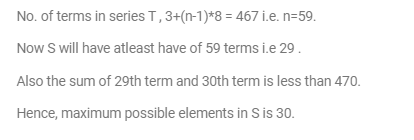
Let T be the set of integers {3, 11, 19, 27, …, 451, 459, 467} and S be a subset of T such that the sum of no two elements of S is 470. The maximu possible number of elements in S is
Consider the sets Tn = {n, n + 1, n + 2, n + 3, n + 4}, where n = 1, 2, 3, … , 96. How many of these sets contain 6 or any integral multiple thereof (i.e., any one of the numbers 6, 12, 18, …)?
The set of all positive integers is the union of two disjoint subsets {f(1), f(2) ….f(n),……} and {g(1), g(2),……,g(n),. }, where f (1) < f(2) <…< f(n) ….., and g(1) < g(2) <…< g(n) , and g(n) = f(f(n)) + 1 for all n ≥ 1. What is the value of g(1)?
Every question here appeared in an actual CAT paper. For the full paper, open its page from the question's year and slot, or browse another topic from the list. Also on IIMking.com.