Breakup G Strategy | AP , GP + Equation | Moderate
In an arithmetic progression, if the sum of fourth, seventh and tenth term is 99, and the sum of the first fourteen terms is 497, then the sum of first five terms is : [TITA]
CAT 2026Papers & G StrategyProgressions
27 real CAT Progressions questions from CAT 2018 to CAT 2025, each with options, the verified answer and a step-by-step solution. Practice one topic at a time,
27 real CAT questions · CAT 2018–2025 · 2 Medium
Breakup G Strategy | AP , GP + Equation | Moderate
In an arithmetic progression, if the sum of fourth, seventh and tenth term is 99, and the sum of the first fourteen terms is 497, then the sum of first five terms is : [TITA]
Shruti travels a distance of 224 km in four parts for a total travel time of 3 hours. Her speeds in these four parts follow an arithmetic progression, and the corresponding time taken to cover these four parts follow another arithmetic progression. If she travels at a speed of 960 meters per minute for 30 minutes to cover the first part, then the distance, in meters, she travels in the fourth part is
Consider the sequence: \[ t_1 = 1, \quad t_2 = -1, \quad t_n = \left( \frac{n - 3}{n - 1} \right)t_{n - 2} \quad \text{for } n \geq 3. \] Find the value of the sum: \[ \frac{1}{t_2} + \frac{1}{t_4} + \frac{1}{t_6} + \cdots + \frac{1}{t_{2022}} + \frac{1}{t_{2024}}. \]
Algebra + APGP + Fractions
Infinite Series Solution Find the sum of the series \[ \frac{1}{5} \left( \frac{1}{5} - \frac{1}{7} \right) + \left( \frac{1}{5} \right)^2 \left( \left( \frac{1}{5} \right)^2 - \left( \frac{1}{7} \right)^2 \right) + \left( \frac{1}{5} \right)^3 \left( \left( \frac{1}{5} \right)^3 - \left( \frac{1}{7} \right)^3 \right) + \cdots \]
Find the sum of the series \[ \frac{1}{5} \left( \frac{1}{5} - \frac{1}{7} \right) + \left( \frac{1}{5} \right)^2 \left( \left( \frac{1}{5} \right)^2 - \left( \frac{1}{7} \right)^2 \right) + \left( \frac{1}{5} \right)^3 \left( \left( \frac{1}{5} \right)^3 - \left( \frac{1}{7} \right)^3 \right) + \cdots \]
Suppose \( x_1, x_2, x_3, \ldots, x_{100} \) are in an arithmetic progression such that \( x_5 = -4 \) and \( 2x_6 + 2x_9 = x_{11} + x_{13} \). Then, \( x_{100} \) equals
Find the sum of the infinite series: (1/5)(1/5 − 1/7) + (1/5)²((1/5)² − (1/7)²) + …
Given a sequence defined as t1 = 1, t2 = −1, and tn = (n−3)/(n−1) × tn−2 for n ≥ 3. Find the value of 1/t2 + 1/t4 + 1/t6 + … + 1/t2024.
Suppose X1, X2, X3, . . . , X100 are in arithmetic progression such that X5 = −4 and 2X6 + 2X9 = X11 + X13. Then, X100 equals
Let \( a_n = 46 + 8n \) and \( b_n = 98 + 4n \) be two sequences. Find the sum of all terms common to both sequences.
Amal, Sunil, and Kamal can individually complete a job in a certain number of days, forming a harmonic progression. Kamal takes twice as much time as Amal to do the same amount of work. If Amal and Sunil work for 4 and 9 days respectively, and Kamal needs to work for 16 days to finish the remaining job, then the number of days Sunil will take to finish the job working alone is:
On day one, there are 100 particles in a laboratory experiment. On day n, where n≥2, one out of every n particles produces another particle. If the total number of particles in the laboratory experiment increases to 1000 on day m, then m equals
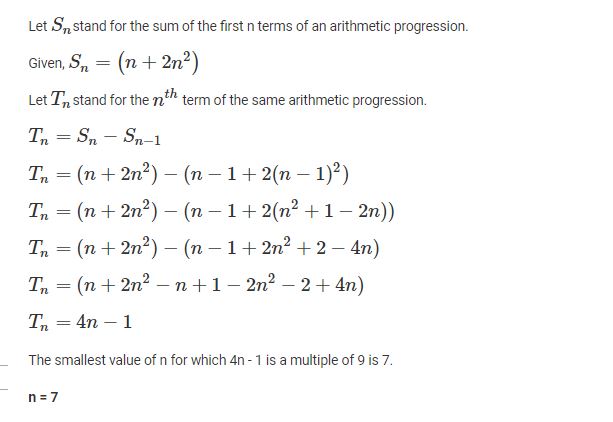
For any natural number n, suppose the sum of the first n terms of an arithmetic progression is (n+2n2). If the nth term of the progression is divisible by 9 , then the smallest possible value of n is
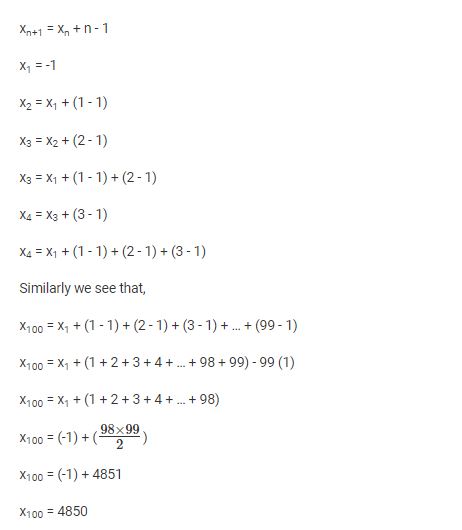
Consider a sequence of real numbers x1,x2,x3,… such that xn+1=xn+n−1 for all n≥1. Ifx1=−1 then x100 is equal to
Three positive integers x, y and z are in arithmetic progression. If y − x > 2 and xyz = 5(x + y + z), then z − x equals
For a sequence of real numbers x1, x2, ..., xn, if x1 − x2 + x3 − ... + (−1)n + 1xn = n2 + 2n for all natural numbers n, then the sum x49 + x50 equals
If x₀ = 1, x₁ = 2, and xₙ₊₂ = (1 + xₙ₊₁) / xₙ for n = 0, 1, 2, …, then what is the value of x₂₀₂₁?

Let teh m-th and n-thterms of a Geometric progression be 3/4 and 12, respectively, when m < n. If the common ratio of the progression is an integer r, then the smallest possible value of r + n − m is
A gentleman decided to treat a few children in the following manner. He gives half of his total stock of toffees and one extra to the first child, and then the half of the remaining stock along with one extra to the second and continues giving away in this fashion. His total stock exhausts after he takes care of 5 children. How many toffees were there in his stock initially?
Let a1 , a2 be integers such that a1 – a2 + a3 – a4 + ........ +(−1)n-1 an = n , for n ≥ 1. Then a51 + a52 + ........ + a1023 equals
The number of common terms in the two sequences: 15, 19, 23, 27, ...... , 415 and 14, 19, 24, 29, ...... , 464 is


If (2n+1) + (2n+3) + (2n+5) + ... + (2n+47) = 5280 , then what is the value of 1+2+3+ ... +n ?
If a1 + a2 + a3 + ... + an = 3(2n+1 − 2), then a11 equals
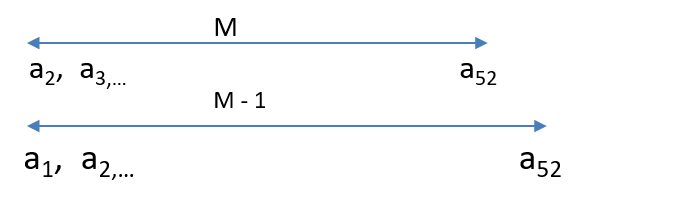
Let a1, a2, ... , a52 be positive integers such that a1 < a2 < ... < a52. Suppose, their arithmetic mean is one less than the arithmetic mean of a2, a3, ..., a52. If a52 = 100, then the largest possible value of a1 is
Let t1, t2,… be real numbers such that t1+ t2 +... + tn = 2n2 + 9n + 13, for every positive integer n ≥ 2. If tk=103, then k equals
The value of the sum 7 x 11 + 11 x 15 + 15 x 19 + ..... + 95 x 99 is
Let x, y, z be three positive real numbers in a geometric progression such that x < y < z. If 5x, 16y, and 12z are in an arithmetic progression then the common ratio of the geometric progression is A.1/6 B.3/6 C.3/2 D.5/2 Ex
Every question here appeared in an actual CAT paper. For the full paper, open its page from the question's year and slot, or browse another topic from the list. Also on IIMking.com.