Let’s Crack CET 2027

Your CET check-up · tap a ring to see yours

Alphanumeric Series – MBA CET questions with solutions

30 questions · CET 2025–2026 · Easy 25 · Medium 5 · Hard 0. Newest paper first. Full papers

Q10EasyCET 2026 · Attempt 2 Slot 2 · Q10
Complete the given series.
D-4, F-6, H-8, J-10, ?, ?.
  1. K-12, M-13
  2. L-12, M-14
  3. L-12, N-14
  4. K-12, M-14
  5. B-12, M-14
Show answerHide answer

Answer: C official key

Approach: Alphanumeric series — letter jumps +2 and the number is the letter's alphabet position.

Solution:
Letters: D, F, H, J → +2 each → L, N.
Numbers: 4, 6, 8, 10 = positions of D, F, H, J.
L = 12, N = 14.
Next two terms: L-12, N-14.

Why the other options are wrong:
A, D: K is +1 from J, not +2; also M-13 breaks the position rule.
B: M is only +1 from L.
E: B-12 — B is not the 12th letter.

Cetking shortcut: The number always equals the letter's rank — only C keeps both letters and numbers consistent.

Answer: C
Q34EasyCET 2026 · Attempt 2 Slot 2 · Q34

Complete the given series.

Z10, Y20, X30, W40, ?

  1. U50
  2. V60
  3. V50
  4. U60
  5. T50
Show answerHide answer

Answer: C official key

Approach: Alphanumeric series — letters step back by 1, numbers rise by 10.

Solution:
Letters: Z, Y, X, W → −1 each → V.
Numbers: 10, 20, 30, 40 → +10 → 50.
Next term: V50.

Why the other options are wrong:
A, D, E: U and T skip letters.
B: 60 skips a step of 10.

Answer: C

Q54EasyCET 2026 · Attempt 2 Slot 2 · Q54

Find the next term in series :

2A11, 4D13, 12G17, ?

  1. 36I19
  2. 36J21
  3. 48J21
  4. 48J23
  5. 46K23
Show answerHide answer

Answer: D official key

Approach: Alphanumeric series: track each part of the term separately.

Solution:
First number: 2 ×2 = 4, 4 ×3 = 12, 12 ×4 = 48.
Letter: A (+3) D (+3) G (+3) J.
Last number: 11 (+2) 13 (+4) 17 (+6) 23.
Next term: 48J23.

Why the other options are wrong:
A (36I19): wrong multiplier, letter and last number.
B (36J21): first number ×3 instead of ×4, last +4 instead of +6.
C (48J21): last number +4 instead of +6.
E (46K23): first number and letter wrong.

Cetking shortcut: Fix the easiest part first: the letter must be J (kills A, E), then the last number must be 23 (only D).

Answer: D

Q55EasyCET 2026 · Attempt 2 Slot 2 · Q55

Complete the given series by filling in the blank place with the correct option.

P5QR, P4QS, P3QT, _____, P1QV.

  1. PQW
  2. P2QU
  3. P2UQ
  4. PQ3U
  5. PQV2
Show answerHide answer

Answer: B official key

Approach: Alphanumeric series: constant letters, a falling number and a rising last letter.

Solution:
P and Q stay fixed in positions 1 and 3 (P _ Q _).
Number: 5, 4, 3, 2, 1.
Last letter: R, S, T, U, V.
Missing term: P2QU.

Why the other options are wrong:
A (PQW): number missing, wrong letter.
C (P2UQ): U and Q swapped.
D (PQ3U): wrong number and position.
E (PQV2): wrong letter and position.

Cetking shortcut: Keep the format P·number·Q·letter; only B keeps it.

Answer: B

Q57EasyCET 2026 · Attempt 2 Slot 2 · Q57

Complete the series by adding the current input in the given blank space :.

B2CD, _____, BCD4, B5CD, BC6D.

  1. B 2 C 2 D
  2. BC 3 D
  3. B 2 C 3 D
  4. BCD 7
  5. B3DC
Show answerHide answer

Answer: B official key

Approach: Alphanumeric series: the subscript number rises by 1 and moves one letter to the right each time (cyclically).

Solution:
Term 1: B2CD → number 2 on B.
Term 2: number 3 on C → BC3D.
Term 3: BCD4 → number 4 on D.
Term 4: B5CD → back to B (cycle). Term 5: BC6D.
Missing term: BC3D.

Why the other options are wrong:
A, C: carry two subscripts; each term has only one.
D: number 7 is far ahead and on the wrong letter.
E: letters out of order and number on the wrong letter.

Cetking shortcut: Read the positions of the numbers B, ?, D, B, C → the cycle B, C, D gives C with number 3.

Answer: B

Q4MediumCET 2026 · Attempt 2 Slot 1 · Q4

DIRECTIONS for the question: In the following question, a letter-number series is given, with one or more terms missing as shown by (?). Choose the missing term out of the given alternatives.

J2Z, K4X, I7V, ?, H16R, M22P

  1. I11T
  2. L11S
  3. L12T
  4. L11T
  5. L12S
Show answerHide answer

Answer: D official key

Approach: Split the term into first letter, number and last letter.

Solution:
Numbers: 2, 4, 7, ?, 16, 22 → differences +2, +3, +4, +5, +6 → missing = 7 + 4 = 11.
Last letters: Z, X, V, ?, R, P → each −2 → missing = T.
First letters alternate: odd terms J, I, H (−1); even terms K, ?, M (+1) → missing = L.
Missing term = L11T

Why the other options are wrong:
A I11T: first letter should be L (even-position sub-series).
B L11S, E L12S: last letter must be T.
C L12T: number must be 11, not 12.

Cetking shortcut: The number 11 and the letter T alone leave only A and D; the even-position letter K→?→M gives L.

Answer: D

Q41EasyCET 2026 · Slot 4 · Q41
Passage / data for this question

The question is based on the following alphabet and digit series.

D 5 P K U 8 Z M C I 6 O Q U E 1 T N R 4 G B A 9 F S O 2 H J V 7 Y X 3

How many vowels are there in the above arrangement which is immediately followed by a digit?

  1. 2
  2. 3
  3. 1
  4. 4
  5. 5
Show answerHide answer

Official CET key: E · Cetking's answer: D — see why below

Approach: Element-by-element scan of the series.

Solution:
Vowels in order: U(5), I(10), O(12), U(14), E(15), A(23), O(27).
Followed by a digit: U 8, I 6, E 1, A 9, O 2.
O(12) → Q and U(14) → E do not count.
Total = 5.

Cetking shortcut: Scan the digits instead: look at the element just before each digit — 5, 8, 6, 1, 4, 9, 2, 7, 3 → vowels before 8, 6, 1, 9, 2.

Answer: E

Q42EasyCET 2026 · Slot 4 · Q42
Passage / data for this question

The question is based on the following alphabet and digit series.

D 5 P K U 8 Z M C I 6 O Q U E 1 T N R 4 G B A 9 F S O 2 H J V 7 Y X 3

If all the vowels are deleted from the above arrangement, then which of the following letters/digits is 10th to from left?

  1. 9
  2. R
  3. G
  4. Q
  5. 4
Show answerHide answer

Answer: D official key

Approach: Delete, then count.

Solution:
Vowels up to Q: U(5), I(10), O(12) are removed.
New series from left: D 5 P K 8 Z M C 6 Q …
10th from left = Q.

Cetking shortcut: Original position 13 (Q) minus 3 vowels before it = 10.

Answer: D

Q43EasyCET 2026 · Slot 4 · Q43
Passage / data for this question

The question is based on the following alphabet and digit series.

D 5 P K U 8 Z M C I 6 O Q U E 1 T N R 4 G B A 9 F S O 2 H J V 7 Y X 3

Which of the following letters/digits is 7th to the right of 13th from the right end?

  1. J
  2. Q
  3. 6
  4. E
  5. 2
Show answerHide answer

Official CET key: A · Cetking's answer: E — see why below

Approach: Position arithmetic.

Solution:
Positions: 1 D, 2 5, 3 P, 4 K, 5 U, 6 8, 7 Z, 8 M, 9 C, 10 I, 11 6, 12 O, 13 Q, 14 U, 15 E, 16 1, 17 T, 18 N, 19 R, 20 4, 21 G, 22 B, 23 A, 24 9, 25 F, 26 S, 27 O, 28 2, 29 H, 30 J, 31 V, 32 7, 33 Y, 34 X, 35 3 (35 elements).
13th from right = 35 − 13 + 1 = 23rd from left = A.
7th to the right of it = 23 + 7 = 30th from left = J.

Why the other options are wrong:
E 2 – result of starting at G (21st) by miscounting from the right.
B Q, C 6, D E – lie to the left, not the right.

Cetking shortcut: 7th to the right of 13th from right = (13 − 7) = 6th from right = J.

Answer: A

Q44MediumCET 2026 · Slot 4 · Q44
Passage / data for this question

The question is based on the following alphabet and digit series.

D 5 P K U 8 Z M C I 6 O Q U E 1 T N R 4 G B A 9 F S O 2 H J V 7 Y X 3

How many consonants are there in the above arrangement which is immediately preceded by a consonant and immediately followed by a vowel?

  1. 3
  2. 2
  3. 4
  4. 5
  5. 1
Show answerHide answer

Official CET key: C · Cetking's answer: B — see why below

Approach: Scan for the pattern consonant–CONSONANT–vowel.

Solution:
P K U → K ✓
M C I → C ✓
G B A → B ✓
F S O → S ✓
No other consonant is followed by a vowel with a consonant before it (Q in O Q U has a vowel before it).
Total = 4.

Cetking shortcut: Start from each vowel and look at the two elements to its left — both must be consonants: U(5), I(10), A(23), O(27) qualify.

Answer: C

Q45EasyCET 2026 · Slot 4 · Q45
Passage / data for this question

The question is based on the following alphabet and digit series.

D 5 P K U 8 Z M C I 6 O Q U E 1 T N R 4 G B A 9 F S O 2 H J V 7 Y X 3

What will be the sum of all even numbers in the given arrangement?

  1. 12
  2. 14
  3. 16
  4. 18
  5. 20
Show answerHide answer

Answer: E official key

Approach: Filter and add.

Solution:
Digits: 5, 8, 6, 1, 4, 9, 2, 7, 3.
Even digits: 8, 6, 4, 2.
Sum = 8 + 6 + 4 + 2 = 20.

Answer: E

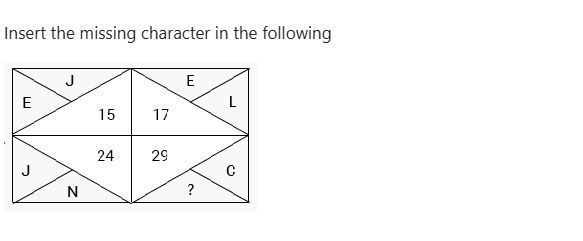
Q23EasyCET 2026 · Slot 3 · Q23

Insert the missing character in the following

Figure: a rectangle divided by its diagonals and a horizontal midline into triangular regions. Top row left to right: E, J, 15, 17, E, L. Bottom row: J, N, 24, 29, ?, C. (Letters sit in the outer triangles, numbers in the inner regions.)

Figure for MBA CET 2026 Slot 3 question 23
  1. M
  2. L
  3. Z
  4. R
  5. Q
Show answerHide answer

Answer: C official key

Approach: Letter positions in the outer triangles add up to the number in the adjoining inner region.

Solution:
Top-left: E(5) + J(10) = 15 ✓
Bottom-left: J(10) + N(14) = 24 ✓
Top-right: E(5) + L(12) = 17 ✓
Bottom-right: ? + C(3) = 29 → ? = 26 = Z.

Why the other options are wrong: M(13), L(12), R(18), Q(17) do not make the total 29.

Cetking shortcut: Number next to two letters in a figure → try the sum of their alphabet positions first.

Answer: C

Q41MediumCET 2026 · Slot 3 · Q41

Study the given series carefully and answer the question based on it.

H 8 & 5 T O 9 # V 6 P $ 7 W F * 1 N L 4 ? 3 / C Q U ! A 2 > J

Question : If all the even numbers are skipped from the series then find the product of the numbers that come between second vowel from right end and $?

  1. 22
  2. 24
  3. 21
  4. 40
  5. 32
Show answerHide answer

Answer: C official key

Approach: Rewrite the series without even numbers, then locate the two markers.

Solution:
Remove 8, 6, 4, 2:
H & 5 T O 9 # V P $ 7 W F * 1 N L ? 3 / C Q U ! A > J
Vowels from the right: A (1st), U (2nd).
Between $ and U: 7 W F * 1 N L ? 3 / C Q → numbers 7, 1, 3.
Product = 7 × 1 × 3 = 21.

Why the other options are wrong: 24/40/32 keep even numbers or use the wrong vowel; 22 is an arithmetic slip.

Answer: C

Q44MediumCET 2026 · Slot 3 · Q44

T % U 4 ) 6 & K Y ^ A 2 $ 8 L G | 3 M @ F P 7 ! C ~ H 9 Q : E 1 B 5

Based on the series give above four of the following five options are alike in a certain way and thus form a group. Which of the following does not belong to the group ?
A. 4&U
B. 6Y)
C. 7~P
D. 9EH
E. 15E
  1. 4&U
  2. 6Y)
  3. 7~P
  4. 9EH
  5. 15E
Show answerHide answer

Answer: E official key

Approach: Map each option to its positions in the series (X, X+3, X–1).

Solution:
Positions: U=3, 4=4, )=5, 6=6, &=7, Y=9, P=22, 7=23, ~=26, H=27, 9=28, E=31, 1=32, 5=34.
A: 4(4), &(7), U(3) → X, X+3, X–1 ✓
B: 6(6), Y(9), )(5) ✓
C: 7(23), ~(26), P(22) ✓
D: 9(28), E(31), H(27) ✓
E: 1(32), 5(34), E(31) → 2nd element is X+2, not X+3 ✗

Answer: E

Q14EasyCET 2026 · Slot 2 · Q14

Complete the series

2 Z 5, 7 Y 7, 14 X 9, 23 W 11, 34 V 13, ?

  1. 37 Y 16
  2. 47 U 15
  3. 40 H 12
  4. 45 U 17
  5. 43 X 14
Show answerHide answer

Answer: B official key

Approach: Alphanumeric series with three independent parts.

Solution:
First number: 2, 7, 14, 23, 34 → differences +5, +7, +9, +11 → next +13 = 47.
Letter: Z, Y, X, W, V → next U.
Last number: 5, 7, 9, 11, 13 → next 15.
Next term = 47 U 15.

Why the other options are wrong:

  • A 37 Y 16, C 40 H 12, E 43 X 14 – wrong letter.
  • D 45 U 17 – letter fits but 45 and 17 do not.

Cetking shortcut: The letter alone (U) leaves only B and D; the last number 15 then picks B.

Answer: B

Q15MediumCET 2026 · Slot 2 · Q15

What comes next in the series:

50, B, 210, F, 380, J, 460, .., ...?

  1. H, 510
  2. Q, 500
  3. V, 480
  4. N, 550
  5. U, 525
Show answerHide answer

Answer: D official key

Approach: Two interleaved series – letters and numbers.

Solution:
Letters: B(2), F(6), J(10) → +4 each → next N(14).
Numbers: 50, 210, 380, 460 → differences 160, 170 | 80, 90 – in each pair the second gap is 10 more than the first.
So the series continues N, then 460 + 90 = 550.
Next pair: N, 550.

Why the other options are wrong:

  • A H, 510 / B Q, 500 / C V, 480 / E U, 525 – none has the letter N (+4 from J).

Cetking shortcut: Only one option contains N – the letter series alone settles it.

Answer: D

Q28EasyCET 2026 · Slot 2 · Q28
The digits of the number 694128573 are rearranged in ascending order within the number.
How many digits will remain in their original positions after the rearrangement?
  1. 0
  2. 3
  3. 1
  4. 4
  5. 5
Show answerHide answer

Official CET key: A · Cetking's answer: C — see why below

Approach: Digit rearrangement: compare each position before and after sorting.

Solution:
Original: 6 9 4 1 2 8 5 7 3
Ascending: 1 2 3 4 5 6 7 8 9
Position-wise: 6/1, 9/2, 4/3, 1/4, 2/5, 8/6, 5/7, 7/8, 3/9 – no position matches.
Digits unchanged in position = 0.

Cetking shortcut: Since the digits are exactly 1–9, the sorted number is 123456789 – digit d stays only if it already sits at position d; none does.

Answer: A

Q56EasyCET 2026 · Slot 2 · Q56

Study the following arrangement carefully and answer the question given below

6 R 0 T 4 A 8 % B F 1 E # W @ 9 H I $ M N * 3 2 V $ 5 G P 7 Q

If all the symbols are eliminated from the above arrangement, then which of the following will be the 5th to the right of 10th element from the right end?
  1. 5
  2. V
  3. 4
  4. A
  5. G
Show answerHide answer

Answer: A official key

Approach: Alphanumeric series: delete the stated elements, renumber, then use position arithmetic.

Solution:
After removing symbols (%, #, @, $, *, $): 6 R 0 T 4 A 8 B F 1 E W 9 H I M N 3 2 V 5 G P 7 Q → 25 elements.
10th from right = 25 − 10 + 1 = 16th from left = M.
5th to the right of M = 16 + 5 = 21st from left = 5.

Why the other options are wrong:
B (V) is 20th, C (4) 5th, D (A) 6th, E (G) 22nd from left — none is the 21st.

Cetking shortcut: Convert everything to "position from left": 10th from right → (n − 10 + 1); moving right adds.

Answer: A

Q57EasyCET 2026 · Slot 2 · Q57

Study the following sequence carefully. Perform the swap as described below and answer the question.

Sequence:
P 3 Q % R 5 S $ T 7 U & V 9 W # X 2 Y @ Z

Instruction:

All symbols immediately followed by consonants interchange positions with that consonant.

Which element is 6th from the left after performing the swaps?
  1. S
  2. $
  3. U
  4. 5
  5. @
Show answerHide answer

Answer: D official key

Approach: Apply the swap rule pair by pair, then count from the left.

Solution:
Symbols immediately followed by a consonant: % R, $ T, & V, # X, @ Z → each pair swaps.
New series: P 3 Q R % 5 S T $ 7 U V & 9 W X # 2 Y Z @
Count from left: P(1) 3(2) Q(3) R(4) %(5) 5(6).
6th from left = 5.

Why the other options are wrong:
A (S) is 7th, B ($) 9th, C (U) 11th, E (@) 21st.

Cetking shortcut: Only the first six positions matter: swaps after position 6 cannot affect the answer — just fix % R.

Answer: D

Q58EasyCET 2026 · Slot 2 · Q58

In the given sequence, certain pairs of elements are interchanged as shown. After performing all interchanges, find the required element.

Sequence:
A 7 B % C 3 D & E 9 F $ G 2 H #

Swaps:
A ↔ 7, B ↔ %, C ↔ 3, D ↔ &, E ↔ 9, F ↔ $, G ↔ 2, H ↔ #

Which element will be 12th from the left after all interchanges?
  1. E
  2. D
  3. $
  4. F
  5. C
Show answerHide answer

Answer: D official key

Approach: Each adjacent pair is interchanged; rewrite and count.

Solution:
Original: A 7 B % C 3 D & E 9 F $ G 2 H #
After all swaps: 7 A % B 3 C & D 9 E $ F 2 G # H
Count: 7(1) A(2) %(3) B(4) 3(5) C(6) &(7) D(8) 9(9) E(10) $(11) F(12).
12th from left = F.

Why the other options are wrong:
A (E) is 10th, B (D) 8th, C ($) 11th, E (C) 6th.

Cetking shortcut: When every pair (1,2), (3,4)… swaps, an even position 2k takes the element originally at 2k − 1: 12th ← original 11th = F.

Answer: D

Q59EasyCET 2026 · Slot 2 · Q59

Study the following arrangement carefully and answer the question given below:

W 1 R % 4 J E # 7 M 2 I 9 B H 3 A $ 9 F Q 5 G 6 U S P

Which of the following is the eighth to the right of the eighteenth from the right end?
  1. A
  2. E
  3. $
  4. #
  5. U
Show answerHide answer

Answer: C official key

Approach: Position arithmetic in a series of n elements.

Solution:
Series has 27 elements: W 1 R % 4 J E # 7 M 2 I 9 B H 3 A $ 9 F Q 5 G 6 U S P.
18th from right = 27 − 18 + 1 = 10th from left = M.
8th to the right of it = 10 + 8 = 18th from left = $.

Why the other options are wrong:
A (A) is 17th, B (E) 7th, D (#) 8th, E (U) 25th from left.

Cetking shortcut: 8th to the right of 18th from right = (18 − 8) = 10th from right = 27 − 10 + 1 = 18th from left.

Answer: C

Q60EasyCET 2026 · Slot 2 · Q60

Study the following arrangement carefully and answer the question that follows.

7 A M 4 E 9 U B 6 T A 3 C E 8 M U 5 B A 2 E T 9 C M U

If all the vowels and even numbers are dropped from the above arrangement, which of the following will be the 10th from the left end of the remaining arrangement?
  1. B
  2. C
  3. M
  4. T
  5. 5
Show answerHide answer

Official CET key: A · Cetking's answer: C — see why below

Approach: Delete the stated elements, then count from the left.

Solution:
Original: 7 A M 4 E 9 U B 6 T A 3 C E 8 M U 5 B A 2 E T 9 C M U
Drop vowels (A, E, U) and even numbers (4, 6, 8, 2).
Remaining: 7 M 9 B T 3 C M 5 B T 9 C M
Count: 7(1) M(2) 9(3) B(4) T(5) 3(6) C(7) M(8) 5(9) B(10).
10th from left = B.

Why the other options are wrong:
B (C) is 7th/13th, C (M) 8th, D (T) 11th, E (5) 9th.

Cetking shortcut: Only scan until you have 10 survivors — no need to clean the full series.

Answer: A

Q24EasyCET 2026 · Slot 1 · Q24
Find the missing term :
3X, 7V, 13T, 21R, ?
  1. 31P
  2. 27N
  3. 31Q
  4. 29P
  5. 37P
Show answerHide answer

Answer: A official key

Approach: Track the number part and the letter part separately.

Solution:
Numbers: 3, 7, 13, 21 → differences +4, +6, +8 → next +10 → 31.
Letters: X(24), V(22), T(20), R(18) → −2 each → P(16).
Next term = 31P.

Why the other options are wrong: 31Q – letter step broken; 27N, 29P, 37P – number differences do not continue +10.

Answer: A

Q25EasyCET 2026 · Slot 1 · Q25
Study the given series properly and answer the question that follows :
B @ C 7 N R % 5 $ G 6 K M & 4 S # P U 5
Question : How many alphabets of Eglish laguage are present in the series which are preceded by a symbol and followed by a number in the given arrangement?
  1. One
  2. Three
  3. Four
  4. Zero
  5. Two
Show answerHide answer

Answer: E official key

Approach: Check every letter for the pattern Symbol – Letter – Number.

Solution:
Series: B @ C 7 N R % 5 $ G 6 K M & 4 S # P U 5
@ C 7 → symbol, letter, number ✓
$ G 6 → symbol, letter, number ✓
# P U → P is followed by a letter ✗
Other letters (B, N, R, K, M, S, U) are not preceded by a symbol.
Count = 2.

Cetking shortcut: Start from each symbol and look only at the next two items — there are just 5 symbols to check.

Answer: E

Q72EasyCET 2026 · Slot 1 · Q72
The position of how many digits in the number 351462987 will remain unchanged after the digits are rearranged in ascending order of the number ?
  1. One
  2. Four
  3. Zero
  4. Three
  5. Two
Show answerHide answer

Answer: E official key

Approach: Digit rearrangement — compare each position before and after sorting.

Solution:
Original: 3 5 1 4 6 2 9 8 7.
Ascending: 1 2 3 4 5 6 7 8 9.
Position 4: 4 → 4 (same). Position 8: 8 → 8 (same).
All other positions change. Unchanged digits = 2 (4 and 8).

Why the other options are wrong:
A One: misses one of the two matches.
B Four, D Three: count digits that only moved slightly.
C Zero: overlooks 4 and 8.

Cetking shortcut: With digits 1–9 sorted, a digit stays only if digit = its position number: check 'is the 4th digit 4?' etc.

Answer: E

Q37EasyCET 2025 · Slot 6 · Q37

How many odd digits are there in the following series of digits, each of which is immediately preceded by an even digit, but not immediately followed by an odd digit?

728913457589691824926

  1. 1
  2. 2
  3. 4
  4. 3
  5. 5
Show answerHide answer

Answer: B

Approach: Scan each odd digit and test both neighbours.

Solution:
7 2 8 9 1 3 4 5 7 5 8 9 6 9 1 8 2 4 9 2 6
Odd digits preceded by an even digit: 9 (after 8), 5 (after 4), 9 (after 8), 9 (after 6), 9 (after 4).
Now 'not followed by odd': 8-9-1 ✗, 4-5-7 ✗, 8-9-6 ✓, 6-9-1 ✗, 4-9-2 ✓.
Count = 2.

Cetking shortcut: Look only for the pattern even–odd–even.

Answer: B

Q48EasyCET 2025 · Slot 6 · Q48

If in the number 546839271, 1 is added to 1st 3rd 5th 7th and 9th digit and 1 is subtracted from the 2nd 4th 6th and 8th digits then all digits are arranged in descending order from left to right which of the following digit is 4th from the right end?

  1. 7
  2. 6
  3. 3
  4. 4
  5. 5
Show answerHide answer

Answer: D

Approach: Apply the odd/even-position changes, sort, then count from the right.

Solution:
546839271 → odd positions +1: 5→6, 6→7, 3→4, 2→3, 1→2; even positions −1: 4→3, 8→7, 9→8, 7→6.
New digits: 6 3 7 7 4 8 3 6 2.
Descending: 8 7 7 6 6 4 3 3 2.
4th from right: 2, 3, 3, 4 → 4.

Answer: D

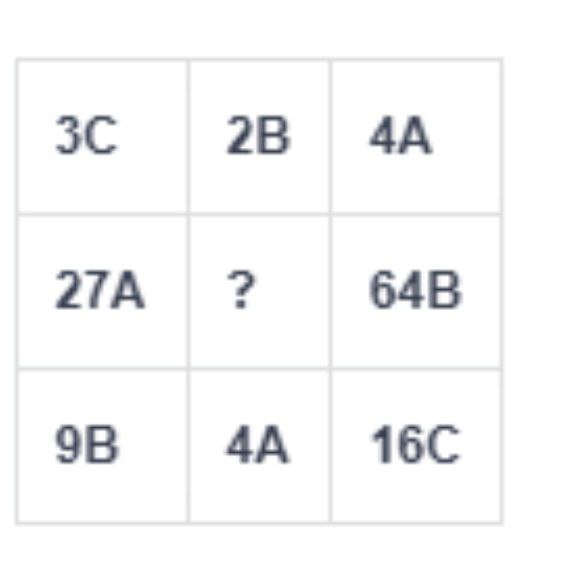
Q70EasyCET 2025 · Slot 5 · Q70

Find the missing character from among the given alternatives.

Figure for MBA CET 2025 Slot 5 question 70
  1. 12B
  2. 8C
  3. 18C
  4. 16C
  5. 16B
Show answerHide answer

Answer: B

Approach: Alphanumeric matrix: read columns – numbers follow power rules, letters A, B, C appear once per column.

Solution: Column 1: 3, 27, 9 → 3, 3³, 3². Column 3: 4, 64, 16 → 4, 4³, 4².
So column 2: 2, ?, 4 → middle = 2³ = 8.
Letters: each column has A, B and C once. Column 2 has B and A → missing letter C.
Missing term = 8C.

Why the other options are wrong:
A 12B, E 16B – number is not a power of 2 in the right order and B repeats.
C 18C – 18 is not 2³.
D 16C – 16 = 2⁴, not 2³.

Cetking shortcut: Spot the 27 and 64 – cubes – then the middle row is the cube row.

Answer: B

Q4EasyCET 2025 · Slot 3 · Q4
DIRECTIONS for the question: In the following question, a letter number series with one or more term/s missing as shown by ?. Choose the correct alternative to replace the question mark in the given series.
2Z5, 7Y7, 14X9, 23W11, 34V13, ?
  1. 27U24
  2. 45U15
  3. 47U15
  4. 47V14
  5. 23X7
Show answerHide answer

Answer: C

Approach: Three independent series inside each term: first number, letter, last number.

Solution:
First numbers: 2, 7, 14, 23, 34 → differences 5, 7, 9, 11 → next +13 = 47.
Letters: Z, Y, X, W, V → next U.
Last numbers: 5, 7, 9, 11, 13 → next 15.
Missing term = 47U15.

Why the other options are wrong:
A 27U24 and B 45U15: wrong first number.
D 47V14: letter should move to U and last number to 15.
E 23X7: repeats earlier parts.

Cetking shortcut: Check the easiest part first: the letter must be U and the last number 15 — only B and C survive; then 34 + 13 = 47 picks C.

Answer: C

Q16EasyCET 2025 · Slot 2 · Q16

Find the correct option at the place of the question mark:

Q1F, S2E, U6D, W21C, ?

  1. Z88B
  2. Y88B
  3. Y66B
  4. Z44A
  5. Y44B
Show answerHide answer

Answer: B

Approach: Treat the three parts (first letter, number, last letter) as separate series.

Solution:
First letters: Q, S, U, W (+2) → Y.
Numbers: 1 × 1 + 1 = 2, 2 × 2 + 2 = 6, 6 × 3 + 3 = 21, 21 × 4 + 4 = 88.
Last letters: F, E, D, C (−1) → B.
Next term = Y88B.

Why the other options are wrong: Z88B / Z44A get the first letter wrong (W + 2 = Y); Y66B and Y44B get the number wrong; Z44A also gets the last letter wrong.

Cetking shortcut: Letters alone leave Y66B, Y88B, Y44B; the number rule (×n + n) settles 88.

Answer: B

Practise these in the Arena

Take timed tests built around MBA CET topics and see where you stand.

Open the Arena