Let’s Crack CET 2027

Your CET check-up · tap a ring to see yours

Clocks & Calendars – MBA CET questions with solutions

36 questions · CET 2025–2026 · Easy 21 · Medium 15 · Hard 0. Newest paper first. Full papers

Q35EasyCET 2026 · Attempt 2 Slot 2 · Q35

Shekhar's birthday falls on 20th of May and Rohit's birthday falls on 1st of the same month. If Rohit's birthday falls on Sunday, then on which day is Shekhar's birthday?

  1. Monday
  2. Tuesday
  3. Wednesday
  4. Thursday
  5. Friday
Show answerHide answer

Official CET key: E · Cetking's answer: B — see why below

Approach: Calendar — count odd days between two dates of the same month.

Solution:
Rohit's birthday: 1 May = Sunday.
Shekhar's birthday: 20 May → 20 − 1 = 19 days later.
19 ÷ 7 = 2 weeks + 5 odd days.
Sunday + 5 days = Friday (Mon 1, Tue 2, Wed 3, Thu 4, Fri 5).

Why the other options are wrong:
B: Tuesday is Sunday + 2 — a counting slip.
A, C, D: Sunday + 1, 3 or 4.

Cetking shortcut: Same weekday repeats every 7 days: 1, 8, 15 May are Sundays → 15 + 5 = 20 is Friday.

Answer: E
Q37EasyCET 2026 · Attempt 2 Slot 2 · Q37

Charu correctly remembers that her father's birthday is after 24 but before 29 of May. Her sister remembers that their father's birthday is after 27 but before 31 May and her brother remembers that the birthday is on an even date. On which date in May is definitely their father's birthday?

  1. 30
  2. 28
  3. 26
  4. 29
  5. 24
Show answerHide answer

Answer: B official key

Approach: Date range intersection.

Solution:
Charu: after 24, before 29 → 25, 26, 27, 28.
Sister: after 27, before 31 → 28, 29, 30.
Common dates: 28 only.
Brother: even date — 28 is even ✓.
Birthday = 28 May.

Why the other options are wrong:
A: 30 is outside Charu's range.
C, E: 26 and 24 are outside the sister's range (24 is outside Charu's too).
D: 29 is excluded by Charu and is odd.

Cetking shortcut: 'After 24' and 'before 29' are exclusive limits — list only the dates strictly between.

Answer: B

Q137MediumCET 2026 · Attempt 2 Slot 2 · Q137
A clock is correctly set at 5:00 a.m. but loses 16 minutes every 24 hours. If the clock shows 10:00 p.m. on the fourth day, what is the actual time at that moment ?
  1. 1.00 p.m.
  2. 11.00 p.m.
  3. 12 p.m.
  4. 12 a.m.
  5. 11.30 a.m.
Show answerHide answer

Answer: B official key

Approach: Faulty clock: real time / clock time = 24 h / (24 h − loss).

Solution:
Clock loses 16 min per 24 h → in 24 real hours it shows 23 h 44 min = 1424 min.
From 5:00 a.m. (day 1) to 10:00 p.m. (day 4) on the clock = 3 days + 17 h = 89 h.
Real time elapsed = 89 × 1440/1424 = 89 × 90/89 = 90 h.
5:00 a.m. + 90 h = 5:00 a.m. + 3 days 18 h = 11:00 p.m. on day 4.

Cetking shortcut: 1424/1440 = 89/90 — so 89 clock-hours = 90 real hours; the clock is exactly 1 hour slow.

Answer: B

Q138EasyCET 2026 · Attempt 2 Slot 2 · Q138
What will be the measure of angle in degrees between the two hands of an ordinary clock at 2:30 PM ?
  1. 105°
  2. 120°
  3. 115°
  4. 125°
  5. 110°
Show answerHide answer

Answer: A official key

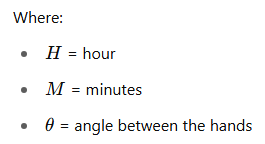
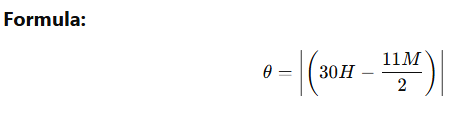
Approach: Angle = |30H − 5.5M|.

Solution:
H = 2, M = 30.
Angle = |30 × 2 − 5.5 × 30| = |60 − 165| = 105°.

Cetking shortcut: At 2:30 the minute hand is at 180°, hour hand at 60° + 15° = 75° → 105°.

Answer: A

Q139EasyCET 2026 · Attempt 2 Slot 2 · Q139
January 12, 1980, was Saturday. The day of the week on January 12, 1979 would have been :
  1. Friday
  2. Saturday
  3. Sunday
  4. Monday
  5. Tuesday
Show answerHide answer

Answer: A official key

Approach: Odd days: an ordinary year shifts the weekday by 1.

Solution:
Jan 12, 1979 to Jan 12, 1980 contains no 29 February (1979 is not a leap year; 29 Feb 1980 comes after 12 Jan) → 365 days = 1 odd day.
Going back one year: Saturday − 1 = Friday.

Cetking shortcut: Check for Feb 29 inside the span — none here, so shift by 1.

Answer: A

Q52EasyCET 2026 · Attempt 2 Slot 1 · Q52

DIRECTION for the questions: Solve the following question and mark the best possible option.

Ajay left home for the bus stop 15 minutes earlier than usual. It takes 10 minutes to reach the stop. He reached the stop at 8.40 am. What time does he usually leave the home for the bus stop?

  1. 8.30 am
  2. 8.45 am
  3. 8.55 am
  4. 8.15 am
  5. 8.50 am
Show answerHide answer

Answer: B official key

Approach: Actual departure = arrival − travel time; usual departure = actual departure + 15 min.

Solution:
Reached the stop at 8.40 am; travel takes 10 min → left home today at 8.30 am.
Today he left 15 min earlier than usual → usual departure = 8.30 + 0.15 = 8.45 am.

Why the other options are wrong:
A 8.30: that is today's departure, not the usual one.
C 8.55: adds 15 min to the arrival time.
D 8.15: subtracts 15 min instead of adding.
E 8.50: adds only 10 min to the arrival.

Answer: B

Q122EasyCET 2026 · Attempt 2 Slot 1 · Q122

January 1, 2010 was a Friday.
What was the day of the week on January 1, 2017?

  1. Monday
  2. Tuesday
  3. Saturday
  4. Sunday
  5. Friday
Show answerHide answer

Answer: D official key

Approach: Odd days: each ordinary year adds 1 day, each leap year 2.

Solution:
From 1 Jan 2010 to 1 Jan 2017 = years 2010–2016 = 7 years.
Leap years in between: 2012 and 2016 → 2 leap years, 5 ordinary.
Odd days = 5 × 1 + 2 × 2 = 9 → 9 mod 7 = 2.
Friday + 2 = Sunday.

Cetking shortcut: Odd days = number of years + number of leap years = 7 + 2 = 9 → 2.

Answer: D

Q74MediumCET 2026 · Slot 5 · Q74

If January 26th 1950 was a Thursday, what day was it on 15th August, 1947 ?

  1. Thursday
  2. Friday
  3. Tuesday
  4. Wedesday
  5. Sunday
Show answerHide answer

Answer: B official key

Approach: Count days between the dates and use odd days.

Solution:
15 Aug 1947 → 15 Aug 1948 = 366 days (includes 29 Feb 1948).
15 Aug 1948 → 15 Aug 1949 = 365 days.
15 Aug 1949 → 26 Jan 1950 = 16 (Aug) + 30 + 31 + 30 + 31 + 26 = 164 days.
Total = 366 + 365 + 164 = 895 days.
895 = 7 × 127 + 6 → 6 odd days.
26 Jan 1950 is Thursday, so 15 Aug 1947 is 6 days earlier: Thursday − 6 = Friday.

Cetking shortcut: Going back 6 days = going forward 1 day: Thursday + 1 = Friday.

Answer: B

Q123MediumCET 2026 · Slot 5 · Q123

Between 1 hour and 12 hours, how many times will the hour hand and minute hand be together (coincide)?

  1. 9 times
  2. 11 times
  3. 13 times
  4. 10 times
  5. 14 times
Show answerHide answer

Answer: B official key

Approach: The hands coincide 11 times in every 12 hours, once every 65 5/11 min.

Solution:
From 1 o'clock up to 12 o'clock the hands coincide at about 1:05, 2:11, 3:16, 4:22, 5:27, 6:33, 7:38, 8:44, 9:49, 10:54 — that is 10 times — and again at 12:00.
Total = 10 + 1 = 11 times.

Why the other options are wrong:

  • A (9), C (13), E (14): not consistent with one coincidence every 65 5/11 min.
  • D (10): leaves out the 12:00 coincidence.
  • 12 would assume one coincidence per hour, which is wrong because the hands do not meet between 11 and 1 o'clock except at 12.

Cetking shortcut: In 12 hours → 11 times; in 24 hours → 22 times. Between 11 and 1 o'clock the hands meet only once (at 12).

Answer: B

Q124EasyCET 2026 · Slot 5 · Q124

The calendar of the year 2010 will be the same as the calendar of which of the following year?

  1. 2012
  2. 2014
  3. 2021
  4. 2017
  5. 2020
Show answerHide answer

Answer: C official key

Approach: Calendars repeat when total odd days ≡ 0 (mod 7) and leap-year status matches.

Solution:
2010 is an ordinary year (1 odd day).
Odd days from 2010 to 2020: 11 years with 3 leap years (2012, 2016, 2020) → 11 + 3 = 14 ≡ 0 (mod 7).
So 1 Jan 2021 is the same weekday as 1 Jan 2010, and 2021 is also an ordinary year → same calendar.

Why the other options are wrong:

  • A (2012), E (2020): leap years — cannot match an ordinary year's calendar.
  • B (2014): 2010–2013 give 1 + 1 + 2 + 1 = 5 odd days.
  • D (2017): 2010–2016 give 9 ≡ 2 odd days.

Cetking shortcut: Ordinary years: the 1st year after a leap year repeats after 6 years; the 2nd and 3rd years after a leap year repeat after 11 years. 2010 is the 2nd year after 2008 → 2010 + 11 = 2021.

Answer: C

Q47MediumCET 2026 · Slot 3 · Q47

In a coded language P, Q, R, $, #, & are represented by 5, 8, 12, 10, 3 and 7 respectively.
When any two symbols are used together then one of them represents hour hand and another represents minute hand in a clock.

For e.g.

P& represents 5: 35 AM in clock.
#R represents 4: 00 AM in clock.

Priya sets her alarm at P# so that she gets ready and catches train at Q$. How much time she thinks she requires?

Note – Consider all time as AM

  1. 3 hr 45 min
  2. 3 hr 15 min
  3. 3 hr 50 min
  4. 3 hr 20 min
  5. 3 hr 35 min
Show answerHide answer

Answer: E official key

Approach: First symbol = hour hand position, second symbol = minute hand position (number × 5 minutes).

Solution:
Codes: P=5, Q=8, R=12, $=10, #=3, &=7.
Check: P& → hour 5, minute hand at 7 → 35 min → 5:35 ✓
Alarm P# → hour 5, minute hand at 3 → 15 min → 5:15 AM.
Train Q$ → hour 8, minute hand at 10 → 50 min → 8:50 AM.
Time needed = 8:50 – 5:15 = 3 hr 35 min.
(The printed example '#R = 4:00' should read 3:00 by the same rule; it does not affect the answer.)

Answer: E

Q130MediumCET 2026 · Slot 3 · Q130
In a 24-hour period, the hour and minute hands of a clock are at right angles to each other excluding all positions where the hands overlap or are directly opposite. How many such right-angle positions occur?
  1. 40
  2. 42
  3. 44
  4. 46
  5. 48
Show answerHide answer

Answer: C official key

Approach: In 12 hours the hands are at right angles 22 times (not 24); double it for a day.

Solution:
In 12 hours the minute hand gains 11 full rounds on the hour hand.
Each round produces 2 right angles → 22 right angles in 12 hours.
In 24 hours: 22 × 2 = 44.
Overlaps and straight-line positions are separate events and are not counted anyway.

Why the other options are wrong:

  • E (48): assumes 2 per hour × 24 — ignores that the hands gain only 22 rounds in a day.
  • A, B, D: miscounts.

Cetking shortcut: Right angles = 44, straight (opposite) = 22, coincide = 22 in a day — memorise this triplet.

Answer: C

Q131EasyCET 2026 · Slot 3 · Q131
In the year 2026, Republic Day of India falls on a Monday. On which day of the week will Children’s Day in India fall in the same year?
  1. Thursday
  2. Friday
  3. Saturday
  4. Sunday
  5. Monday
Show answerHide answer

Answer: C official key

Approach: Count odd days from 26 January to 14 November (2026 is not a leap year).

Solution:
Odd days after 26 Jan: Jan 5, Feb 0, Mar 3, Apr 2, May 3, Jun 2, Jul 3, Aug 3, Sep 2, Oct 3, Nov 14 → 0.
Total = 5 + 0 + 3 + 2 + 3 + 2 + 3 + 3 + 2 + 3 + 0 = 26 → 26 mod 7 = 5.
(Check: 292 days = 41 weeks + 5 days.)
Monday + 5 = Saturday.

Cetking shortcut: Month codes: 26 Jan Monday → 14 Nov is 292 days later; 292 = 287 + 5 → Monday + 5 = Saturday.

Answer: C

Q75EasyCET 2026 · Slot 1 · Q75
Prashant leaves his house at 20 minutes to Seven in the morning and reaches Hemant's house in 25 minutes where they eat a light breakfast and after 15 minutes, they leave for their office, which takes them another 35 minutes. At what time do they leave Hemant's house to go to the office ?
  1. 8:05 AM
  2. 7:55 AM
  3. 7:50 AM
  4. 7:20 AM
  5. 7:45 AM
Show answerHide answer

Answer: D official key

Approach: Time calculation — add the durations in order; stop at the asked event.

Solution:
20 minutes to seven = 6:40 AM.
Travel 25 min → reaches Hemant's house at 7:05 AM.
Breakfast 15 min → they leave Hemant's house at 7:20 AM.
(The 35-minute office trip is after the asked event — not needed.)

Why the other options are wrong:
B 7:55: adds the 35-minute office journey to 7:20 (that is the arrival at office, not the departure).
A 8:05: an arithmetic slip.
C 7:50, E 7:45: misread '20 minutes to seven' or the durations.

Cetking shortcut: Read exactly which moment is asked — departure from Hemant's, not arrival at office.

Answer: D

Q125EasyCET 2026 · Slot 1 · Q125

A clock shows 7 O'clock in the morning. By how much angle will the hours hand rotate when the clock shows 11:30 O'clock in the morning?

  1. 40°
  2. 125°
  3. 135°
  4. 150°
  5. 90°
Show answerHide answer

Answer: C official key

Approach: The hour hand moves 30° per hour (0.5° per minute).

Solution:
From 7:00 to 11:30 = 4.5 hours
Rotation = 4.5 × 30° = 135°

Cetking shortcut: Hour hand: 0.5° per minute → 270 min × 0.5 = 135°.

Answer: C

Q136MediumCET 2026 · Slot 1 · Q136
What day of the week was 15th August, 2010?
  1. Sunday
  2. Monday
  3. Tuesday
  4. Thursday
  5. Saturday
Show answerHide answer

Answer: A official key

Approach: Odd-days method: count odd days from a known reference (multiple of 400 years = 0 odd days).

Solution:
Years 1–2000 complete → 0 odd days (2000 is a multiple of 400)
2001–2009: 9 years incl. 2 leap years (2004, 2008) → 9 + 2 = 11 → 4 odd days
2010 up to 15 Aug: Jan 3, Feb 0, Mar 3, Apr 2, May 3, Jun 2, Jul 3, Aug (15) 1 → 17 → 3 odd days
Total = 0 + 4 + 3 = 7 → 0 odd days → Sunday

Cetking shortcut: Anchor on Independence Day: 15 Aug 1947 was a Friday; 63 years later with 16 leap days (1948–2008) → 79 → 2 odd days → Friday + 2 = Sunday.

Answer: A

Q137MediumCET 2026 · Slot 1 · Q137
If 15th August 2012 was a Wednesday, then what day of the week was 26th January 1998?
  1. Saturday
  2. Monday
  3. Tuesday
  4. Wednesday
  5. Friday
Show answerHide answer

Answer: B official key

Approach: Count odd days between the two dates and move backward from the known day.

Solution:
26 Jan 1998 → 26 Jan 2012 = 14 years with 3 leap days (Feb 2000, 2004, 2008) → 14 + 3 = 17 → 3 odd days
26 Jan 2012 → 15 Aug 2012: Jan 5, Feb 29 (leap) 1, Mar 3, Apr 2, May 3, Jun 2, Jul 3, Aug 15 → 1 → total 20 → 6 odd days
Total = 3 + 6 = 9 → 2 odd days
15 Aug 2012 is 2 days ahead of 26 Jan 1998 → Wednesday − 2 = Monday

Cetking shortcut: Move back 2 weekdays from Wednesday → Monday.

Answer: B

Q138EasyCET 2026 · Slot 1 · Q138
An accurate clock shows 3 o'clock in the afternoon. Through how many degrees will the hour hand rotate when the clock shows 9 o'clock of the same evening?
  1. 140°
  2. 170°
  3. 180°
  4. 110°
  5. 100°
Show answerHide answer

Answer: C official key

Approach: Hour hand moves 30° per hour.

Solution:
3 pm to 9 pm = 6 hours
Rotation = 6 × 30° = 180°

Answer: C

Q139EasyCET 2026 · Slot 1 · Q139
What is the angle between the hour and minute hands of a clock at 8:00?
  1. 110°
  2. 150°
  3. 180°
  4. 190°
  5. 120°
Show answerHide answer

Answer: E official key

Approach: Angle = |30H − 5.5M|.

Solution:
At 8:00: H = 8, M = 0 → 30 × 8 = 240°
Smaller angle = 360° − 240° = 120°

Cetking shortcut: Minute hand at 12, hour hand at 8 → 4 hour-gaps × 30° = 120°.

Answer: E

Q143MediumCET 2025 · Slot 5 · Q143

Find the day of the week on 26 January 1950

  1. Monday
  2. Tuesday
  3. Wednesday
  4. Thursday
  5. Friday
Show answerHide answer

Answer: D

Approach: Odd-days method: count odd days up to the date, then map 0 = Sunday, 1 = Monday, …

Solution:
26 Jan 1950 = 1949 complete years + 26 days
1600 years → 0 odd days; 300 years → 1 odd day
49 years = 12 leap + 37 ordinary → 12 × 2 + 37 × 1 = 61 → 61 mod 7 = 5
26 days of January → 26 mod 7 = 5
Total = 0 + 1 + 5 + 5 = 11 → 11 mod 7 = 4 → Thursday

Cetking shortcut: Known anchor: India's first Republic Day (26 Jan 1950) was a Thursday.

Answer: D

Q144EasyCET 2025 · Slot 5 · Q144

An accurate clock shows 8 o'clock in the morning. Through how may degrees will the hour hand rotate when the clock shows 2 o'clock in the afternoon?

  1. 144 degrees
  2. 160 degrees
  3. 180 degrees
  4. 90 degrees
  5. 125 degrees
Show answerHide answer

Answer: C

Approach: The hour hand moves 30° per hour.

Solution:
8 a.m. to 2 p.m. = 6 hours
Rotation = 6 × 30° = 180°

Why the other options are wrong:
A/B/D/E: not multiples of 30° for whole hours (except D = 3 hours).

Answer: C

Q145EasyCET 2025 · Slot 5 · Q145

On January 12, 1980, it was a Saturday. The day of the week on January 12, 1979 was

  1. Monday
  2. Tuesday
  3. Wednesday
  4. Thursday
  5. Friday
Show answerHide answer

Answer: E

Approach: Going back one year shifts the day back by the number of odd days in between.

Solution:
Jan 12, 1979 → Jan 12, 1980 contains Feb 1979 only (Feb 29, 1980 comes after Jan 12)
365 days = 52 weeks + 1 odd day
So Jan 12, 1979 = Saturday − 1 = Friday

Why the other options are wrong:
D (Thursday): wrongly counts 1980 as leap for this interval (2 odd days).

Answer: E

Q149EasyCET 2025 · Slot 4 · Q149

The angle between the minute hand and the hour hand of a clock when the time is 4.20, is

  1. 3 degree
  2. 5 degree
  3. 8 degree
  4. 10 degree
  5. 12 degree
Show answerHide answer

Answer: D

Approach: Clock angle formula.

Solution:
At 4:20, H = 4, M = 20.
Angle = |30 × 4 − 5.5 × 20| = |120 − 110| = 10°.

Why the other options are wrong:
A, B, C, E: not |120 − 110|.

Cetking shortcut: Minute hand at 4 exactly (120°); hour hand has moved 20 × 0.5 = 10° past 4 ⇒ 10°.

Answer: D

Solution figure for question 149Solution figure for question 149Solution figure for question 149
Q58EasyCET 2025 · Slot 3 · Q58
The train for Lucknow leaves every two and a half hours from New Delhi Railway Station. An announcement was made at the station that the train for Lucknow had left 40 minutes ago and the next train will leave at 18:00 hrs. At what time was the announcement made?
  1. 15:30 hrs
  2. 17:10 hrs
  3. 16:00 hrs
  4. 15:50 hrs
  5. 16:10 hrs
Show answerHide answer

Answer: E

Approach: Work backwards from the next departure using the fixed train interval.

Solution:
Trains leave every 2 h 30 min. The next train is at 18:00.
So the previous train left at 18:00 − 2:30 = 15:30.
The announcement was made 40 min after that: 15:30 + 0:40 = 16:10.

Why the other options are wrong:
A (15:30): this is when the previous train left, not when the announcement was made.
B (17:10): adds 40 min to the wrong reference time.
C (16:00), D (15:50): wrong offsets from 15:30.

Cetking shortcut: Announcement time = next departure − interval + time since the last departure = 18:00 − 2:30 + 0:40 = 16:10.

Answer: E

Q59EasyCET 2025 · Slot 3 · Q59
If the day before yesterday was Saturday, what day will fall on the day after tomorrow?
  1. Friday
  2. Thursday
  3. Wednesday
  4. Tuesday
  5. Sunday
Show answerHide answer

Answer: C

Approach: Calendar shift: move day by day from the reference day.

Solution:
Day before yesterday = Saturday, so yesterday = Sunday and today = Monday.
Tomorrow = Tuesday, so the day after tomorrow = Wednesday.

Why the other options are wrong:
D (Tuesday): this is tomorrow.
E (Sunday): this is yesterday.
A (Friday), B (Thursday): these count backwards.

Cetking shortcut: The day before yesterday is −2 and the day after tomorrow is +2, so the gap is 4 days: Saturday + 4 = Wednesday.

Answer: C

Q60EasyCET 2025 · Slot 3 · Q60
Mohini went to the movies 9 days ago. She goes to the movies only on Thursday. What day of the week is today?
  1. Thursday
  2. Saturday
  3. Sunday
  4. Tuesday
  5. Wednesday
Show answerHide answer

Answer: B

Approach: Day counting with remainder mod 7.

Solution:
She went 9 days ago, on a Thursday.
9 = 7 + 2. After 7 days it is Thursday again, and 2 more days gives Saturday.

Why the other options are wrong:
A (Thursday): this is the day 7 days later, not 9.
C (Sunday): this is 3 days after Thursday.
D (Tuesday): this counts back 2 days instead of forward.
E (Wednesday): this is Thursday − 1.

Cetking shortcut: Today = Thursday + (9 mod 7) = Thursday + 2 = Saturday.

Answer: B

Q75MediumCET 2025 · Slot 3 · Q75
If it was Saturday on 17th December, 2002 what was the day on 22nd December, 2004?
  1. Monday
  2. Tuesday
  3. Wednesday
  4. Sunday
  5. Friday
Show answerHide answer

Answer: D

Approach: Odd-days method: count the extra days beyond full weeks.

Solution:
17 Dec 2002 → 17 Dec 2003: 365 days = 1 odd day.
17 Dec 2003 → 17 Dec 2004: 366 days (29 Feb 2004 falls inside) = 2 odd days.
17 Dec 2004 → 22 Dec 2004: 5 days.
Total = 1 + 2 + 5 = 8, and 8 mod 7 = 1 odd day.
Saturday + 1 = Sunday.

Why the other options are wrong:
A (Monday): needs 2 odd days in total; treating 2004 as an ordinary year gives 1 + 1 + 5 = 7, which is Saturday (not offered), so this is a slip in the odd-day count.
C (Wednesday), B (Tuesday), E (Friday): wrong odd-day totals.

Cetking shortcut: Each ordinary year moves the day by 1 and each leap year by 2. Here 1 + 2 + 5 = 8 ≡ 1, so the answer is Sunday.

Answer: D

Q134MediumCET 2025 · Slot 3 · Q134
A watch which gains uniformly is 2 min low at noon on Monday and is 4 min. 48sec fast at 2pm on the following Monday. When was it correct?
  1. 2pm on Tuesday
  2. 2pm on Wednesday
  3. 2pm on Thursday
  4. 1pm on Friday
  5. 2pm on Monday
Show answerHide answer

Answer: B

Approach: Error changes from −2 min to +4 min 48 s uniformly.

Solution: Time elapsed: Monday 12 noon → next Monday 2 pm = 7 days 2 h = 170 h.
Total gain = 2 min + 4 min 48 s = 6 min 48 s = 6.8 min.
To be correct it must gain 2 min → time needed = 170 × 2/6.8 = 50 h.
Monday 12 noon + 50 h = Wednesday 2 pm.

Answer: B

Q2MediumCET 2025 · Slot 2 · Q2

Anora sees the time on her perfectly working ordinary wrist watch at 10:20 AM on 8th of March, 2025 and the next occasion when she sees the time on her same watch is at 11:15 AM on 11th of March, 2025. Determine the number of times, the hour and minute hand of her watch would have been exactly over one another between the two times that Anora saw the time on her watch ?

  1. 89
  2. 45
  3. 50
  4. 66
  5. 25
Show answerHide answer

Answer: D

Approach: The hands coincide 11 times in every 12 hours (once every 12/11 h = 65 5/11 min).

Solution:
10:20 AM, 8 Mar → 10:20 AM, 11 Mar = 3 days = 72 hours = 6 blocks of 12 hours.
Coincidences = 6 × 11 = 66.
Counting full 12-hour blocks gives the intended answer, 66 (the last 55 minutes add one more overlap at about 10:54 AM on 11 March, but 67 is not among the options).

Why the other options are wrong: 45 and 50 undercount; 89 counts more than 11 per 12 hours; 25 is roughly one day's count.

Cetking shortcut: 22 coincidences per day × 3 days = 66.

Answer: D

Q23EasyCET 2025 · Slot 2 · Q23

Abhini went to the movies nine days ago. She only goes to the movies on Thursday.

What day is it today?

  1. Wednesday
  2. Tuesday
  3. Saturday
  4. Sunday
  5. Thursday
Show answerHide answer

Answer: C

Approach: Day after n days = start day + (n mod 7).

Solution:
She went on a Thursday, 9 days ago.
9 = 7 + 2 → today is 2 days after Thursday = Saturday.

Why the other options are wrong: Tuesday/Wednesday count backwards; Thursday would need a multiple of 7 days; Sunday is 10 days.

Answer: C

Q41MediumCET 2025 · Slot 2 · Q41

At what time between 9 and 10 o'clock are the hands of a clock 23-minute spaces apart?

  1. 9:28
  2. 9:26
  3. 9:23
  4. 9:37
  5. 9:24
Show answerHide answer

Answer: E

Approach: Minute hand gains 55 minute-spaces on the hour hand every 60 minutes.

Solution:
At 9:00 the minute hand (at 12) is 45 spaces behind the hour hand (at 9).
To be 23 spaces apart with the minute hand still behind, it must gain 45 − 23 = 22 spaces.
Time = 22 × 60/55 = 24 minutes → 9:24.
(Minute hand 23 spaces ahead would need a gain of 68 spaces = 74 2/11 min, beyond 10 o'clock.)
Check: at 9:24 the hour hand is at 47 spaces, minute hand at 24 → 23 apart ✓.

Answer: E

Q70MediumCET 2025 · Slot 2 · Q70
Twenty-sixth of January, 1950 was a Thursday.
Determine the day of the week on the Fifteenth of August, 1980.
  1. Thursday
  2. Friday
  3. Tuesday
  4. Sunday
  5. Wednesday
Show answerHide answer

Answer: B

Approach: Count odd days from the known date.

Solution:
26 Jan 1950 → 26 Jan 1980 = 30 years, crossing 29 Feb of 1952, 56, 60, 64, 68, 72, 76 = 7 leap days.
Odd days for 30 years = 30 + 7 = 37 → 37 mod 7 = 2.
26 Jan 1980 → 15 Aug 1980: Jan 5 + Feb 29 + Mar 31 + Apr 30 + May 31 + Jun 30 + Jul 31 + Aug 15 = 202 days → 202 mod 7 = 6.
Total odd days = 2 + 6 = 8 → 1. Thursday + 1 = Friday.

Cetking shortcut: Each year shifts the weekday by 1 (2 if a 29 Feb is crossed); add the month days separately.

Answer: B

Q30MediumCET 2025 · Slot 1 · Q30

A clock is set right at 8 AM. This clock gains 10 minutes in 24 hours. What is the true time when the clock indicates 11 AM ?

  1. 11:59:35
  2. 10:50:45
  3. 11:58:45
  4. 10:58:45
  5. 10:58:40
Show answerHide answer

Answer: D

Approach: Faulty clock: the clock runs 24 h 10 min while true time runs 24 h.

Solution:
Clock time passed from 8:00 to 11:00 = 3 h = 180 min.
True time = 180 × 1440 ÷ 1450 ≈ 178.76 min = 2 h 58 min 45 s.
True time = 8:00 + 2:58:45 = 10:58:45 AM.

Why the other options are wrong:
A 11:59:35, C 11:58:45 — after 11:00; a fast clock is ahead, so true time is earlier.
B 10:50:45 — far too large a correction.
E 10:58:40 — wrong seconds.

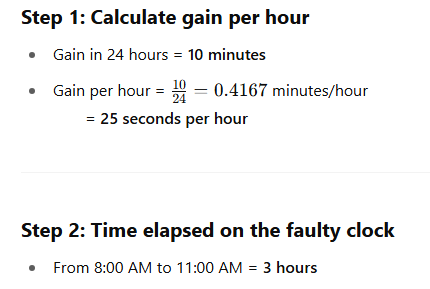
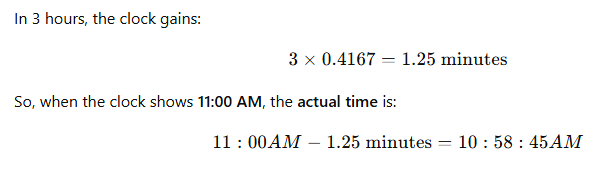
Cetking shortcut: Gain ≈ 10 min/24 h ≈ 25 s per hour → 3 h ≈ 75 s = 1 min 15 s → 11:00 − 1:15 = 10:58:45.

Answer: D

Solution figure for question 30Solution figure for question 30
Q44EasyCET 2025 · Slot 1 · Q44

Day 1 : Correctly throughout the whole day
Day 2 : Skips One Second during the whole day
Day 3 : Skips Three Seconds during the whole day
Day 4 : Skips Four Seconds during the whole day
Day 5 : Skips Seven Seconds during the whole day
Day 6 : Skips Thirteen Seconds during the whole day
Day 7 : Skips Seven Seconds during the whole day

How many Seconds did Ambatta's watch work during the given duration as per the information provided ?

  1. 604769 seconds
  2. 604768 seconds
  3. 604765 seconds
  4. 604764 seconds
  5. 604761 seconds
Show answerHide answer

Answer: C

Approach: Total minus skips.

Solution:
One day = 24 × 3600 = 86,400 s; 7 days = 604,800 s.
Skipped = 0 + 1 + 3 + 4 + 7 + 13 + 7 = 35 s.
Worked = 604,800 − 35 = 604,765 s.

Why the other options are wrong:
A 604769, B 604768, D 604764, E 604761 — skip totals of 31, 32, 36, 39 (miscounted).

Cetking shortcut: All options start 6047…; only the skip total (35) matters → last two digits 65.

Answer: C

Q45MediumCET 2025 · Slot 1 · Q45

Fifteenth August, 1947 was a Friday. Determine the day of the week on the Twenty-Sixth of January, 1957 ?

  1. Saturday
  2. Friday
  3. Sunday
  4. Thursday
  5. Tuesday
Show answerHide answer

Answer: A

Approach: Odd days method.

Solution:
15 Aug 1947 → 15 Aug 1956: 9 years with 29 Feb 1948, 1952, 1956 inside → odd days = 9 + 3 = 12 → 5.
15 Aug 1956 → 26 Jan 1957: Aug 16 + Sep 30 + Oct 31 + Nov 30 + Dec 31 + Jan 26 = 164 days → 164 mod 7 = 3.
Total odd days = 5 + 3 = 8 → 1.
Friday + 1 = Saturday.

Why the other options are wrong:
B Friday — 0 odd days.
C Sunday — 2 odd days (one extra leap day counted).
D Thursday, E Tuesday — counted backwards / wrong totals.

Cetking shortcut: Total days 3452 = 7 × 493 + 1 → one day ahead.

Answer: A

Q51EasyCET 2025 · Slot 1 · Q51

Two hands of an ordinary clock lie exactly over one another how many times in a continuous period of 72 hours ?

Figure for MBA CET 2025 Slot 1 question 51
  1. 24
  2. 72
  3. 76
  4. 66
  5. 56
Show answerHide answer

Answer: D

Approach: Hands coincide 11 times in 12 hours, i.e. 22 times in 24 hours.

Solution:
Hands overlap once every 12/11 hours, so in 12 hours they overlap 11 times (the 12th overlap falls exactly at the 12 o'clock that starts the next cycle).
In 24 hours: 2 × 11 = 22 times.
72 hours = 3 days → 3 × 22 = 66 times.

Why the other options are wrong:
24 / 72: assumes one overlap per hour.
76 / 56: no valid count gives these.

Cetking shortcut: Coincide 22/day, opposite 22/day, right angle 44/day. Multiply by days.

Answer: D

Practise these in the Arena

Take timed tests built around MBA CET topics and see where you stand.

Open the Arena