Let’s Crack CET 2027

Your CET check-up · tap a ring to see yours

Counting Figures – MBA CET questions with solutions

46 questions · CET 2025–2026 · Easy 11 · Medium 25 · Hard 10. Newest paper first. Full papers

Q77MediumCET 2026 · Attempt 2 Slot 1 · Q77
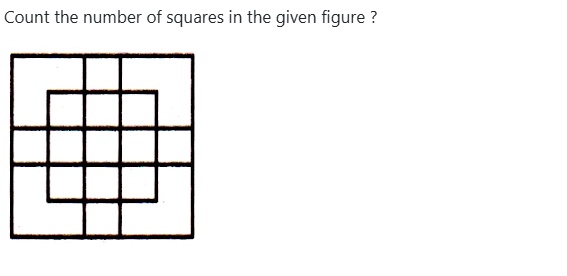
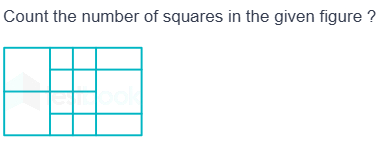
Count the number of squares in the given figure :
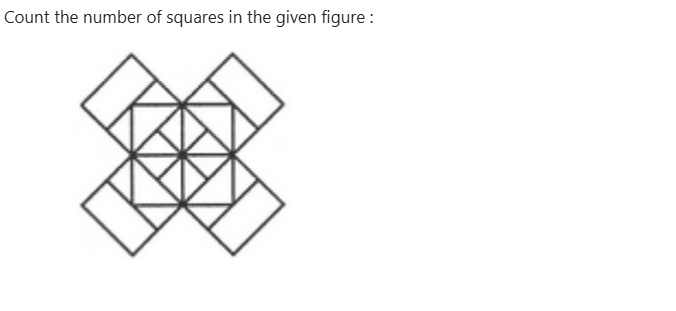
Figure for MBA CET 2026 Attempt 2 Slot 1 question 77
  1. 24
  2. 20
  3. 16
  4. 21
  5. 18
Show answerHide answer

Answer: E official key

Approach: Split the figure into the central upright square, the tilted diamond inside it, and the four tilted arms.

Solution:
Central upright square: 1 large + 4 quarter squares (cut by the middle cross) = 5.
Tilted diamond joining the midpoints: 1 + 4 small tilted squares (cut by the diagonals) = 5.
Four arm squares, one at each corner = 4.
Four small tilted squares between each arm and the diamond (formed by the arm's dividing line and the diagonal) = 4.
Total = 5 + 5 + 4 + 4 = 18.

Cetking shortcut: Use symmetry: count one quarter of the figure carefully, multiply by 4, then add the whole-figure squares (central square, diamond).

Answer: E
Q80EasyCET 2026 · Attempt 2 Slot 1 · Q80
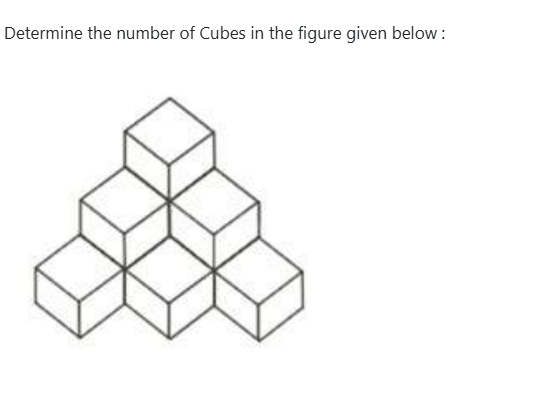
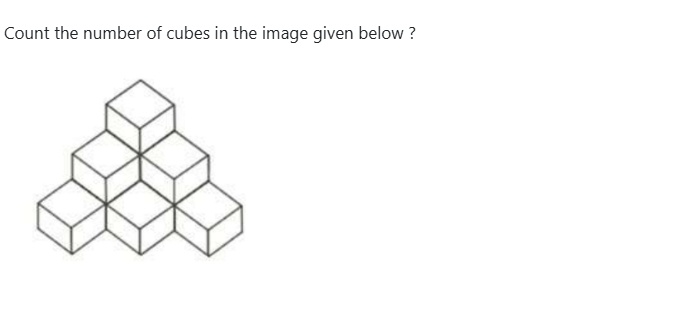
Count the number of cubes in the image given below ?
Figure for MBA CET 2026 Attempt 2 Slot 1 question 80
  1. 10
  2. 9
  3. 11
  4. 12
  5. 13
Show answerHide answer

Answer: A official key

Approach: Count layer by layer: the stack is a triangular pyramid.

Solution:
Top layer: 1 cube.
Middle layer: 3 cubes (2 visible + 1 hidden behind).
Bottom layer: 6 cubes (3 visible + 3 hidden).
Total = 1 + 3 + 6 = 10.

Why the other options are wrong:
B 9 / C 11 / D 12 / E 13: miscount the hidden cubes in the lower layers.

Cetking shortcut: A triangular (tetrahedral) stack with n layers has 1 + 3 + 6 + … cubes; for 3 layers that is 10.

Answer: A

Q84MediumCET 2026 · Attempt 2 Slot 1 · Q84
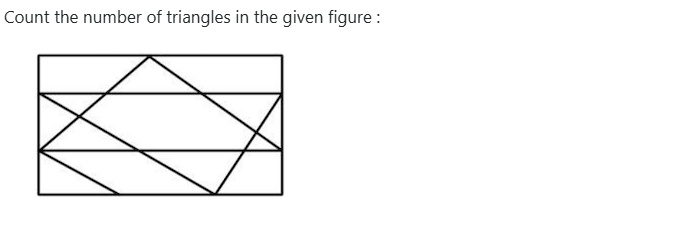
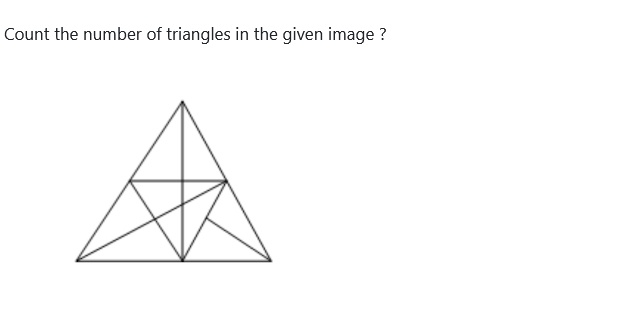
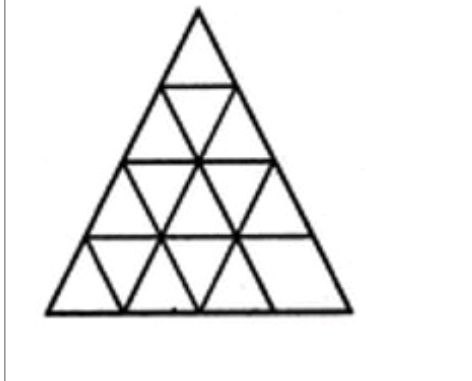
Count the number of triangles in the given figure :
Figure for MBA CET 2026 Attempt 2 Slot 1 question 84
  1. 20
  2. 17
  3. 19
  4. 21
  5. 22
Show answerHide answer

Answer: C official key

Approach: Group the triangles by where they sit: top region, left crossing, right crossing, large spanning triangles, bottom.

Solution:
Top region (lines from the top apex): the big apex triangle on the lower line, the two top-corner triangles, and the small apex triangle above the upper line = 4.
Left crossing (upper line, lower line, left edge, the two slanted lines meeting there): 5.
Right crossing (upper line, lower line, right edge, the two slanted lines meeting there): 5.
Large spanning triangles: upper line + the two lines meeting at the bottom; the big lower-left triangle; the bottom-right triangle = 3.
Bottom: the small bottom-left corner triangle and the triangle under the lower line between the two slanted lines = 2.
Total = 4 + 5 + 5 + 3 + 2 = 19.

Cetking shortcut: For each crossing point, pair up the lines through it with a third line that cuts both. Doing this point by point avoids counting the same triangle twice.

Answer: C

Q86MediumCET 2026 · Attempt 2 Slot 1 · Q86
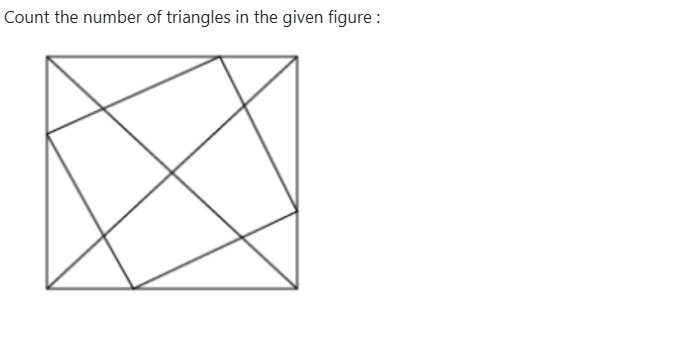
Count the number of triangles in the given figure :
Figure for MBA CET 2026 Attempt 2 Slot 1 question 86
  1. 17
  2. 23
  3. 13
  4. 18
  5. 20
Show answerHide answer

Answer: E official key

Approach: Count the triangles made by the outer square and its diagonals, then the ones made by the inscribed tilted square.

Solution:
Outer square with two diagonals: 4 quarter triangles (meeting at the centre) + 4 half-square triangles = 8.
Inscribed tilted square cuts off 4 corner triangles = 4.
A diagonal passes through each corner triangle and splits it into 2 smaller triangles: 4 × 2 = 8.
Total = 8 + 4 + 8 = 20.

Cetking shortcut: Count one corner (1 corner triangle + 2 pieces = 3), multiply by 4 (12), then add the 8 from the diagonals.

Answer: E
Q89EasyCET 2026 · Slot 4 · Q89
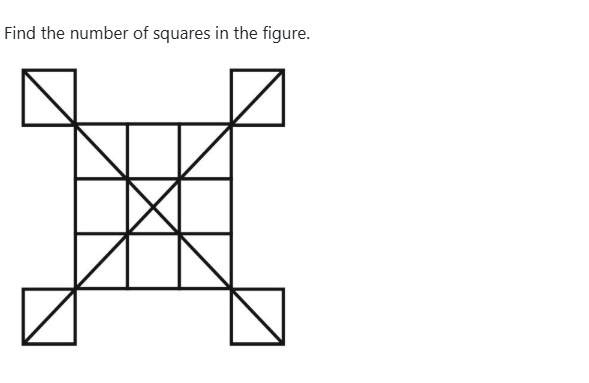
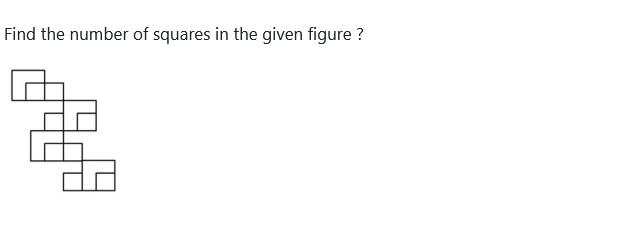
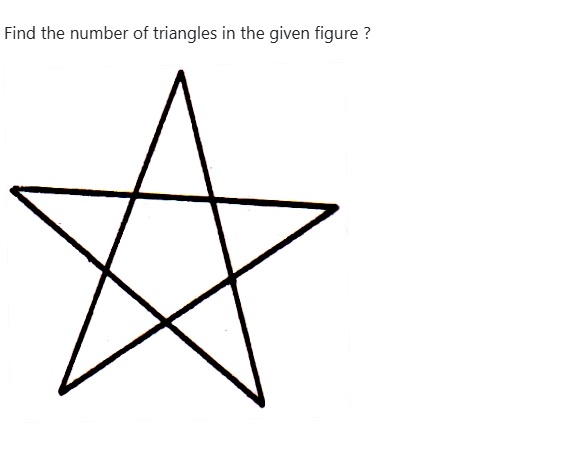
Find the number of squares in the figure.
Figure for MBA CET 2026 Slot 4 question 89
  1. 20
  2. 21
  3. 18
  4. 26
  5. 15
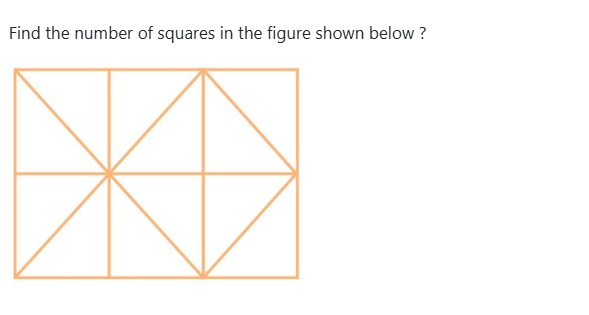
Show answerHide answer

Official CET key: C · Cetking's answer: B — see why below

Approach: Count squares size by size, then add the separate corner squares.

Solution: Central 3 × 3 grid: 1 × 1 squares = 9, 2 × 2 squares = 4, 3 × 3 square = 1 → 14.
Corner squares: 4 (the diagonals inside them do not create new squares).
The two diagonals cross only once, so no tilted squares are formed.
Total = 14 + 4 = 18.

Cetking shortcut: For an n × n grid: 1² + 2² + … + n² (for 3 × 3: 14). Then add separate pieces.

Answer: C

Q91EasyCET 2026 · Slot 4 · Q91
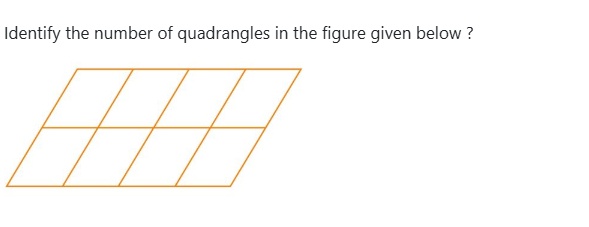
Identify the number of quadrangles in the figure given below ?
Figure for MBA CET 2026 Slot 4 question 91
  1. 30
  2. 25
  3. 28
  4. 32
  5. 35
Show answerHide answer

Official CET key: A · Cetking's answer: C — see why below

Approach: Grid of parallelograms: choose 2 slanted lines and 2 horizontal lines.

Solution: Slanted lines: 5; horizontal lines: 3.
Quadrilaterals = ⁵C₂ × ³C₂ = 10 × 3 = 30.

Cetking shortcut: For any m × n grid of parallel lines: C(m+1, 2) × C(n+1, 2).

Answer: A

Q94MediumCET 2026 · Slot 4 · Q94
Find the number of squares in the figure shown below ?
Figure for MBA CET 2026 Slot 4 question 94
  1. 6
  2. 9
  3. 7
  4. 10
  5. 12
Show answerHide answer

Answer: B official key

Approach: Count the grid squares, then the tilted square formed by the diagonals.

Solution: Rectangle = 3 × 2 grid of unit squares.
1 × 1 squares: 6. 2 × 2 squares: 2 → 8.
Diagonals: the four diagonal lines joining the centre-left node, the top node, the right-middle node and the bottom node form one tilted square → 1.
Total = 8 + 1 = 9.

Cetking shortcut: In an m × n grid, 1 × 1 squares = mn, 2 × 2 squares = (m−1)(n−1); then look for a diamond formed by the diagonals.

Answer: B

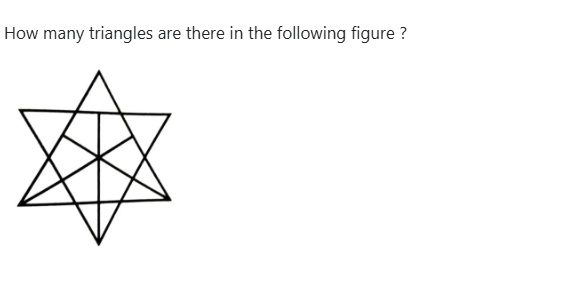
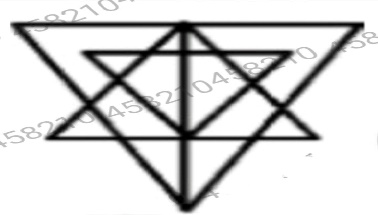
Q86HardCET 2026 · Slot 3 · Q86
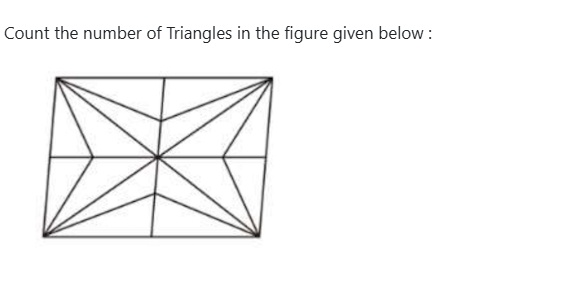
How many triangles are there in the following figure ?
Figure for MBA CET 2026 Slot 3 question 86
  1. 21
  2. 23
  3. 25
  4. 27
  5. 45
Show answerHide answer

Answer: D official key

Approach: Counting triangles — group by type (tips, halves, centre-based, big).

Solution:
The star is two big triangles; three lines run from three star points through the centre, cutting three of the six tips in half.
Small half-tips: 3 tips × 2 = 6
Whole tips (all 6 star points): 6
Triangles with one vertex at the centre and one at a lower star point (a cut tip + adjoining piece): 6
Triangle on the bottom side of the upright big triangle with its apex at the centre: 1
Halves of big triangles cut by the lines (upright triangle cut by 2 lines = 4 halves, inverted cut by 1 line = 2 halves): 6
Big triangles: 2
Total = 6 + 6 + 6 + 1 + 6 + 2 = 27.

Cetking shortcut: Count systematically by size; the 6 'half big triangles' are the ones most often missed.

Answer: D

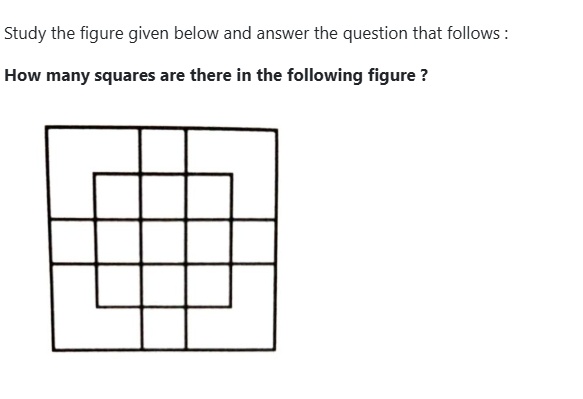
Q87MediumCET 2026 · Slot 3 · Q87
Study the figure given below and answer the question that follows :
How many squares are there in the following figure ?
Figure for MBA CET 2026 Slot 3 question 87
  1. 18
  2. 19
  3. 25
  4. 27
  5. 33
Show answerHide answer

Answer: D official key

Approach: Counting squares on a 5×5 unit layout — count by side length.

Solution:
Treat the outer square as 5 × 5 units; two full vertical and two full horizontal lines plus an inner 3 × 3 square.
Side 1: 9 cells of the inner 3 × 3 grid + 4 small squares in the middle of each outer side = 13
Side 2: 4 inside the inner square (2 × 2 blocks) + 4 corner squares of the outer frame = 8
Side 3: the inner square + 4 squares of side 3 anchored at each outer corner = 5
Side 5: the outer square = 1
Total = 13 + 8 + 5 + 1 = 27.

Cetking shortcut: Count by size (1, 2, 3, …) — never by 'pieces', which double-counts.

Answer: D

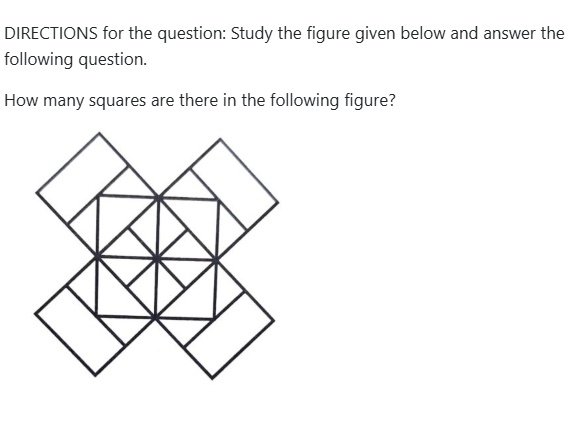
Q98HardCET 2026 · Slot 3 · Q98
DIRECTIONS for the question: Study the figure given below and answer the following question.
How many squares are there in the following figure?
Figure for MBA CET 2026 Slot 3 question 98
  1. 20
  2. 33
  3. 18
  4. 14
  5. 45
Show answerHide answer

Answer: C official key

Approach: Counting squares — straight and tilted, by size.

Solution:
Central square (ABCD) is cut by a vertical and a horizontal midline, by a tilted square (diamond) joining the side midpoints, and by short diagonals inside the diamond. Four tilted rectangles/squares stick out at the corners, each split lengthwise in half.
Small tilted squares inside the diamond (around the centre): 4
Quarter squares of the central square: 4
Tilted corner squares (the four arms): 4
Larger tilted squares made of an arm's inner half + the adjoining part of the diamond: 4
The diamond (square on the side midpoints): 1
Central square ABCD: 1
Total = 4 + 4 + 4 + 4 + 1 + 1 = 18.

Cetking shortcut: Tilted squares are easy to miss — count straight ones first, then tilted ones by size.

Answer: C

Q99MediumCET 2026 · Slot 3 · Q99
DIRECTIONS for the question: Study the figure given below and answer the question that follows :
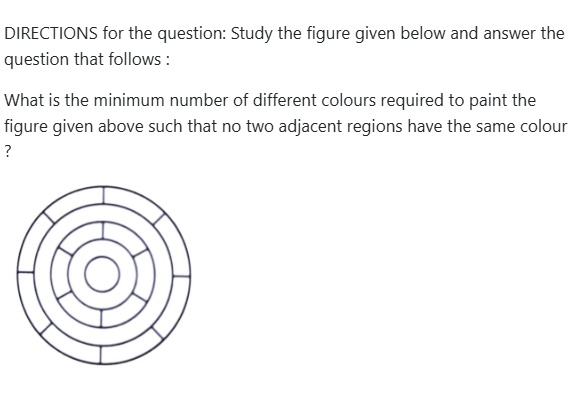
What is the minimum number of different colours required to paint the figure given above such that no two adjacent regions have the same colour ?
Figure for MBA CET 2026 Slot 3 question 99
  1. 3
  2. 4
  3. 5
  4. 6
  5. 7
Show answerHide answer

Answer: A official key

Approach: Minimum colours — map colouring of concentric rings.

Solution:
Outer ring: 8 segments in a cycle — an even cycle needs only 2 colours, alternating (1, 2, 1, 2 …).
Next ring (undivided): touches every outer segment ⇒ colour 3.
Next ring: 6 segments (even cycle) touching ring 3 ⇒ alternate colours 1 and 2.
Next ring (undivided): touches all 6 segments ⇒ colour 3.
Centre circle: touches only colour 3 ⇒ colour 1.
Minimum = 3 (two alternating colours for the segments + one for the solid rings).

Why the other options are wrong:
4, 5, 6, 7: more than needed — an even number of segments in each ring lets two colours alternate.

Cetking shortcut: A ring with an EVEN number of segments needs 2 colours; an ODD number would need 3. Solid rings in between take one extra colour.

Answer: A

Q100MediumCET 2026 · Slot 3 · Q100
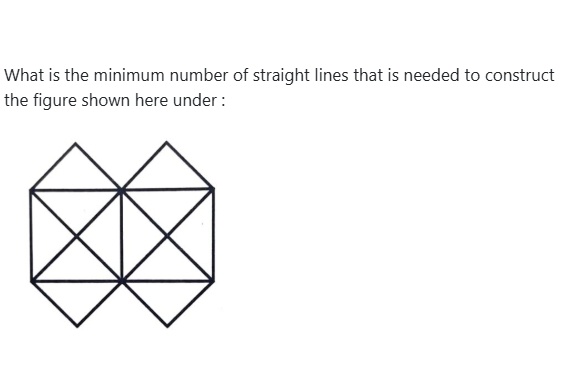
What is the minimum number of straight lines that is needed to construct the figure shown here under :
Figure for MBA CET 2026 Slot 3 question 100
  1. 11
  2. 13
  3. 15
  4. 21
  5. 50
Show answerHide answer

Answer: B official key

Approach: Minimum straight lines — extend every collinear piece into one line.

Solution:
Treat the two squares as 2 × 1 units, with roofs on top and V-shapes below.
Horizontal lines: top edge, bottom edge = 2.
Vertical lines: left, middle, right = 3.
Slanting '/' lines: left-square diagonal continuing into the right roof; right-square diagonal continuing down into the left V; left roof's left edge; right V's right edge = 4.
Slanting '\' lines: left-square diagonal continuing down into the right V; right-square diagonal continuing up into the left roof; right roof's right edge; left V's left edge = 4.
Total = 2 + 3 + 4 + 4 = 13.

Why the other options are wrong:
11: undercounts — the outer roof and V edges are separate lines. 15, 21, 50: count one straight line in several pieces.

Cetking shortcut: Before counting, extend each diagonal — here every square diagonal continues into a roof or V edge.

Answer: B

Q83HardCET 2026 · Slot 2 · Q83
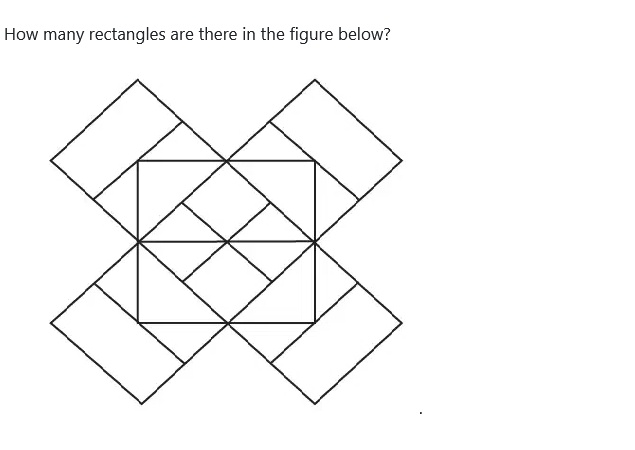
How many rectangles are there in the figure below?
Figure for MBA CET 2026 Slot 2 question 83
  1. 37
  2. 44
  3. 48
  4. 41
  5. 34
Show answerHide answer

Answer: E official key
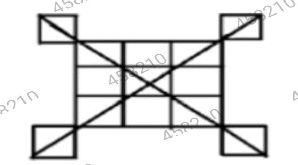
Approach: Count every tilted rectangle by choosing two down-right lines and two up-right lines whose four sides are fully drawn, add the upright ones, then remove the squares (the key counts only non-square rectangles).

Solution:
There are 7 down-right lines and 7 up-right lines. Two long lines of each slant cross to form the large central tilted square; the other lines are the flap edges and one short line of each slant through the centre.
Tilted rectangles:
- both long down-right lines with any 2 of the 7 up-right lines: C(7,2) = 21
- both long up-right lines with any 2 of the 7 down-right lines, excluding the pair already counted: 21 − 1 = 20
- short centre line of each slant with one long line of each slant: 2 × 2 = 4
Tilted total = 45.
Upright rectangles: the upright square has 3 horizontal lines and 2 vertical lines, so C(3,2) × 1 = 3.
All rectangles = 45 + 3 = 48.
Squares among them: 13 tilted + 1 (the whole upright square) = 14.
Rectangles other than squares = 48 − 14 = 34.

Why the other options are wrong:
C (48) includes the squares; the key counts only non-square rectangles.
A (37), B (44), D (41): partial counts that miss or double-count some tilted rectangles.

Cetking shortcut: Treat each slant as a set of parallel lines: any two lines of one slant with any two of the other slant make a rectangle if all four sides are drawn.

Answer: E
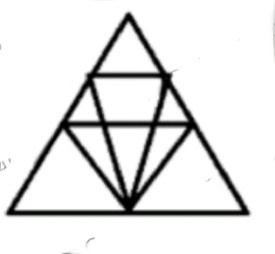
Q84MediumCET 2026 · Slot 2 · Q84
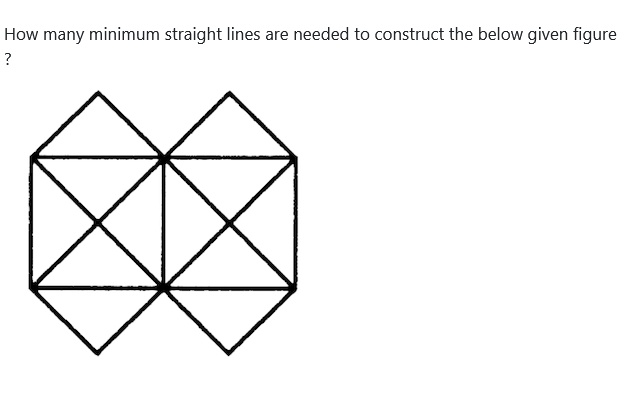
How many minimum straight lines are needed to construct the below given figure ?
Figure for MBA CET 2026 Slot 2 question 84
  1. 17
  2. 13
  3. 11
  4. 15
  5. 10
Show answerHide answer

Answer: B official key

Approach: Minimum lines = number of maximal straight lines, joining collinear pieces into one.

Solution:
Horizontal: the top line and the bottom line each run across the whole figure → 2.
Vertical: left side, middle line, right side → 3.
Down-right slant: (i) from the top-left peak down through the centre of the right square to the bottom-right corner; (ii) from the left shoulder down through the centre of the left square and on to the bottom-right peak; (iii) the right side of the top-right peak; (iv) the left side of the bottom-left peak → 4.
Up-right slant: by the mirror symmetry of the figure, another 4.
Total = 2 + 3 + 4 + 4 = 13.

Why the other options are wrong:
A (17), D (15): count collinear pieces as separate lines.
C (11), E (10): miss the short outer sides of the four peaks.

Cetking shortcut: Look for slanting lines that pass straight through a vertex into the next part of the figure; each such pair is one line.

Answer: B

Q85EasyCET 2026 · Slot 2 · Q85
Find the number of squares in the given figure ?
Figure for MBA CET 2026 Slot 2 question 85
  1. 12
  2. 13
  3. 14
  4. 18
  5. 10
Show answerHide answer

Answer: A official key

Approach: Count squares unit by unit; the figure is four identical units.

Solution:
Each unit = 1 big square + 2 small squares attached along its lower edge.
Unit 1 (top): 3 squares; Unit 2: 3; Unit 3: 3; Unit 4 (bottom): 3.
No new square is formed where units touch (the joins make L-shapes, not squares).
Total = 4 × 3 = 12.

Why the other options are wrong:
B (13), C (14): count a corner join as an extra square.
D (18): counts small rectangles as squares.
E (10): misses small squares partly inside big ones.

Cetking shortcut: Spot the repeating unit, count it once, multiply.

Answer: A

Q86EasyCET 2026 · Slot 2 · Q86
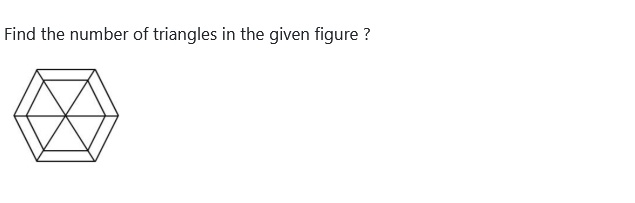
Find the number of triangles in the given figure ?
Figure for MBA CET 2026 Slot 2 question 86
  1. 11
  2. 12
  3. 10
  4. 9
  5. 13
Show answerHide answer

Answer: B official key

Approach: Two concentric hexagons with three long diagonals through the centre: triangles exist only with the centre as apex.

Solution:
The 3 diagonals cut the inner hexagon into 6 small triangles (centre + one inner edge) → 6.
They also form 6 larger triangles with the outer hexagon (centre + one outer edge) → 6.
The ring pieces are trapezoids; joining two adjacent triangles gives a rhombus, not a triangle.
Total = 6 + 6 = 12.

Why the other options are wrong:
A (11), C (10), D (9): miss some outer triangles.
E (13): counts the hexagon or a rhombus as a triangle.

Cetking shortcut: Every triangle here has its apex at the centre: 6 directions × 2 bases (inner, outer edge) = 12.

Answer: B

Q87MediumCET 2026 · Slot 2 · Q87
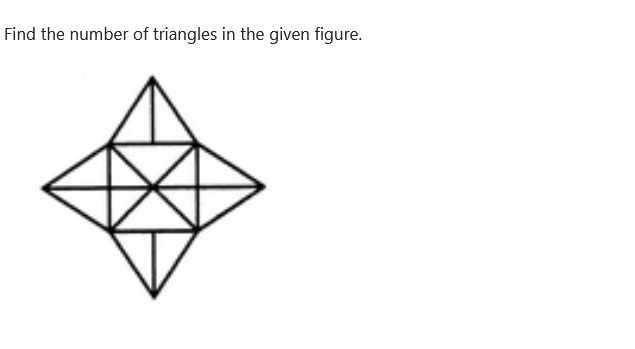
Find the number of triangles in the given figure.
Figure for MBA CET 2026 Slot 2 question 87
  1. 19
  2. 25
  3. 32
  4. 28
  5. 35
Show answerHide answer

Answer: D official key

Approach: Count by region: the 4 outer triangles, the central square, and triangles crossing from the side points into the square.

Solution:
Top triangle split by a vertical line: 2 small + 1 whole = 3. Same for bottom, left and right → 4 × 3 = 12.
Central square (2 diagonals + horizontal mid-line): 6 smallest triangles, 2 side triangles (left/right halves of the X), 4 half-square triangles → 12.
Crossing triangles: left point with top-left corner and centre, left point with bottom-left corner and centre, and the same two on the right → 4.
Total = 12 + 12 + 4 = 28.

Why the other options are wrong:
A (19), B (25): miss the crossing or half-square triangles.
C (32), E (35): count quadrilaterals or non-existent lines.

Cetking shortcut: The horizontal line runs tip to tip, so each side tip forms triangles with the square centre — easy to miss.

Answer: D

Q88EasyCET 2026 · Slot 2 · Q88
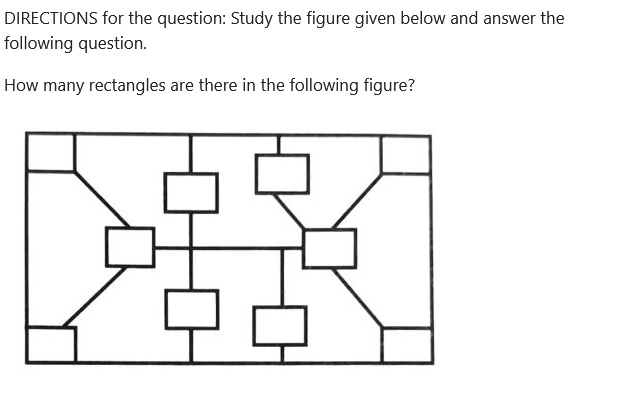
DIRECTIONS for the question: Study the figure given below and answer the following question.
How many rectangles are there in the following figure?
Figure for MBA CET 2026 Slot 2 question 88
  1. 9
  2. 11
  3. 10
  4. 12
  5. 13
Show answerHide answer

Answer: B official key

Approach: Count closed rectangles; lines broken by a box do not make full rectangles.

Solution:
Corner boxes: 4.
Inner boxes along the two vertical lines: 4; boxes on the horizontal connector: 2 → 6.
Outer border: 1.
Could the vertical lines split the outer rectangle? No — each is interrupted by boxes, so no larger rectangle is closed.
Total = 4 + 6 + 1 = 11.

Why the other options are wrong:
A (9), C (10): miss the outer border or a box.
D (12), E (13): treat interrupted lines as full dividers.

Answer: B

Q99HardCET 2026 · Slot 2 · Q99
Count the number of triangles in the given image ?
Figure for MBA CET 2026 Slot 2 question 99
  1. 29
  2. 31
  3. 28
  4. 30
  5. 26
Show answerHide answer

Answer: A official key

Approach: Label every point and list triangles vertex by vertex so none is repeated.

Solution:
Points: apex A; base B (left), M (middle), C (right); D on AB and E on AC (ends of the horizontal line); R = DE ∩ AM; P = BE ∩ AM; X = BE ∩ DM; F = end of the short line from C on EM.
Lines drawn: AB, AC, BC, AM, DE, DM, EM, BE, CF.
Triangles using A (11): ABC, ABM, ACM, ABE, ABP, ADE, ADR, ARE, APE, ADM, AEM.
Using B but not A (7): BCE, BDE, BDM, BDX, BEM, BXM, BPM.
Using C but not A/B (3): CEF, CEM, CFM.
Remaining (8): DEM, DEX, DRM, EXM, EPM, ERM, EPR, MXP.
Total = 11 + 7 + 3 + 8 = 29.

Why the other options are wrong:
B (31), D (30): include "triangles" that need an undrawn side (e.g. F joined to B or D).
C (28), E (26): miss triangles formed by the slanting line BE (such as ABP, BPM, EPR).

Cetking shortcut: Go vertex by vertex in alphabetical order and never revisit an earlier vertex — the cleanest way to avoid double counting.

Answer: A

Q7MediumCET 2026 · Slot 1 · Q7
Determine the number of Cubes in the figure given below :
Figure for MBA CET 2026 Slot 1 question 7
  1. 15
  2. 11
  3. 10
  4. 13
  5. 9
Show answerHide answer

Answer: C official key

Approach: Count each visible top face as a column and add the hidden cubes supporting it.

Solution:
The figure is a stepped pyramid seen from a corner, with three levels of top faces.
Top level: 1 column, 3 cubes high → 3 cubes.
Middle level: 2 columns, 2 cubes high → 4 cubes.
Front level: 3 columns, 1 cube high → 3 cubes.
Total = 3 + 4 + 3 = 10.
(Layer-wise: 1 on top + 3 in the middle layer + 6 in the bottom layer = 10.)

Why the other options are wrong: 9 or fewer misses hidden support cubes; 11, 13, 15 count cubes that the stepped shape does not need.

Cetking shortcut: A corner-stack pyramid with 1-2-3 visible tops is the triangular-number stack 1 + 3 + 6 = 10.

Answer: C

Q41HardCET 2026 · Slot 1 · Q41
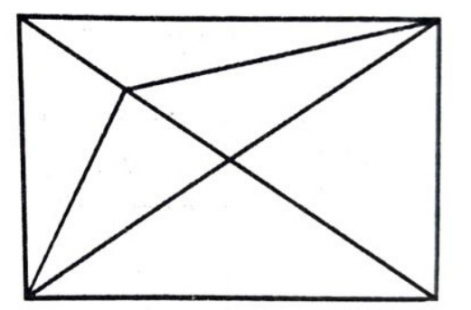
Count the number of Triangles in the figure given below :
Figure for MBA CET 2026 Slot 1 question 41
  1. 36
  2. 29
  3. 32
  4. 17
  5. 38
Show answerHide answer

Official CET key: A · Cetking's answer: C — see why below

Approach: Label the points and count triangles region by region (each quarter of the figure is identical).

Solution:
Lines: the 4 sides, both diagonals through centre O, the full horizontal and vertical lines through O, and 8 star lines (each corner joins the two inner star points next to it).
Triangles using only the corner points and O: 4 halves cut by each diagonal (e.g. TL-BL-BR) = 4, plus the 4 central triangles (TL-O-TR etc.) = 4 → 8.
Each of the 4 sides of the figure has: 2 triangles on the side through its midpoint and O (e.g. TL-Mt-O, TR-Mt-O), 2 thin triangles through the star point and the midpoint (TL-Mt-Pt, TR-Mt-Pt), 2 through the star point and O (TL-Pt-O, TR-Pt-O) and 1 star tip (TL-Pt-TR) → 7 per side × 4 = 28.
Total = 8 + 28 = 36.

Cetking shortcut: The figure has 4-fold symmetry — count the triangles touching one side (7) and multiply by 4, then add the 8 triangles made by the diagonals and sides alone.

Answer: A

Q83MediumCET 2026 · Slot 1 · Q83
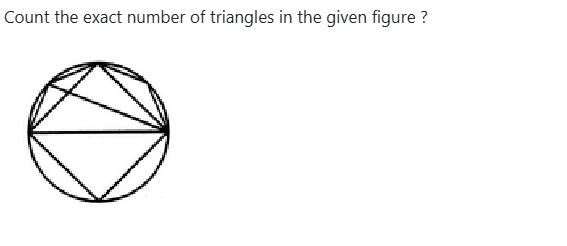
Count the exact number of triangles in the given figure ?
Figure for MBA CET 2026 Slot 1 question 83
  1. 8
  2. 10
  3. 13
  4. 11
  5. 9
Show answerHide answer

Answer: B official key

Approach: Counting triangles — label the points and count systematically.

Solution:
Label T (top), L (left), R (right), B (bottom) of the inscribed rhombus; P and Q are the extra points on the circle (upper-left and upper-right); X is where chord PR cuts TL.
Lower half: LRB → 1.
Upper half without PR: TLR, TPL, TQR → 3.
Triangles using chord PR: PTX, PXL, PRL, PRT, XRL, XTR → 6.
Total = 1 + 3 + 6 = 10.

Why the other options are wrong:
A 8, E 9: miss some of the triangles cut by chord PR.
C 13, D 11: count curved regions between chords and the circle, which are not triangles.

Cetking shortcut: Count triangles line by line: first those without the extra chord, then those that use it.

Answer: B

Q84EasyCET 2026 · Slot 1 · Q84
Find the number of triangles in the given figure ?
Figure for MBA CET 2026 Slot 1 question 84
  1. 8
  2. 11
  3. 9
  4. 10
  5. 12
Show answerHide answer

Official CET key: D · Cetking's answer: C — see why below

Approach: Counting triangles in a pentagram (five-pointed star).

Solution:
The star has 5 points (tip triangles) → 5 small triangles.
Each tip plus the two adjoining pieces forms a large triangle using one full side of the star; the five lines form 5 such big triangles (each line with the two lines that cross it at the far end).
The central pentagon is not a triangle.
Total = 5 + 5 = 10.

Why the other options are wrong:
C 9: misses one large triangle.
A 8, B 11, E 12: do not match the 5 + 5 structure.

Cetking shortcut: Pentagram = 10 triangles (5 tips + 5 large) — a standard result to remember.

Answer: D

Q85MediumCET 2026 · Slot 1 · Q85
Count the number of squares in the given figure ?
Figure for MBA CET 2026 Slot 1 question 85
  1. 26
  2. 31
  3. 19
  4. 28
  5. 27
Show answerHide answer

Answer: E official key
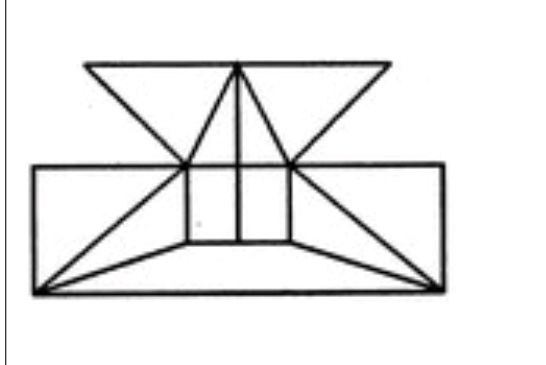
Approach: Counting squares on a partial 5 × 5 grid.

Solution:
Draw the grid with 6 lines each way (0–5). Lines 0, 2, 3, 5 run across the whole figure; lines 1 and 4 exist only on the inner square (from 1 to 4).
1 × 1 squares: 13.
2 × 2 squares: 8.
3 × 3 squares: 5 (the inner square and 4 others).
4 × 4 squares: 0 (no complete border).
5 × 5 square: 1 (outer boundary).
Total = 13 + 8 + 5 + 0 + 1 = 27.

Why the other options are wrong:
A 26: misses the outer square.
B 31, D 28: count rectangles or incomplete squares.
C 19: counts only the small and the obvious large squares.

Cetking shortcut: Count size by size (1×1, 2×2, …) and check all four sides of each candidate exist.

Answer: E
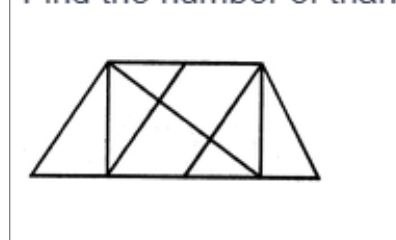
Q90MediumCET 2026 · Slot 1 · Q90
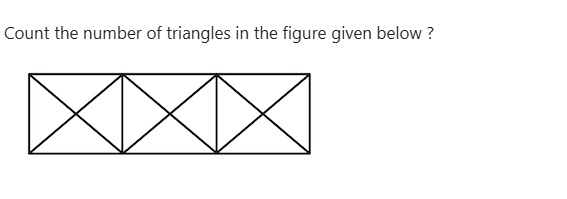
Count the number of triangles in the figure given below ?
Figure for MBA CET 2026 Slot 1 question 90
  1. 26
  2. 27
  3. 33
  4. 17
  5. 28
Show answerHide answer

Answer: E official key
Approach: Counting triangles — three squares in a row, each with both diagonals.

Solution:
In one square with both diagonals: 4 small triangles + 4 half-square triangles = 8.
Three squares → 3 × 8 = 24.
Across two adjacent squares: the diagonals of the two squares meet at their shared corner and form a triangle on the top edge and one on the bottom edge → 2 per adjacent pair.
Two adjacent pairs → 4.
Total = 24 + 4 = 28.

Why the other options are wrong:
A 26, B 27: miss some two-square triangles.
C 33: double-counts.
D 17: counts only small triangles and a few half-squares.

Cetking shortcut: Use the per-square value 8, then add the triangles that span two squares.

Answer: E
Q91MediumCET 2026 · Slot 1 · Q91
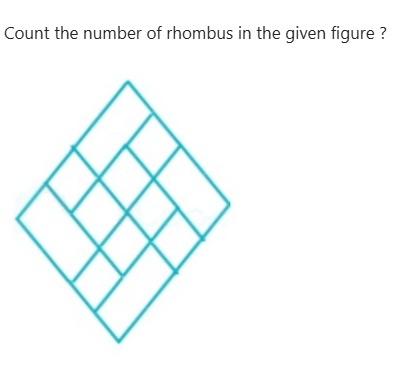
Count the number of rhombus in the given figure ?
Figure for MBA CET 2026 Slot 1 question 91
  1. 13
  2. 17
  3. 14
  4. 12
  5. 15
Show answerHide answer

Answer: C official key

Approach: Counting rhombuses — treat the figure as a tilted 4 × 4 grid with some lines missing.

Solution:
Turn the figure 45° so it becomes a square grid with lines 0–4 each way.
Full lines: the borders and the middle line in each direction; the other inner lines are drawn only part-way.
1 × 1 rhombuses: 8.
2 × 2 rhombuses: 5.
3 × 3: none have all four sides drawn → 0.
4 × 4: the whole figure → 1.
Total = 8 + 5 + 0 + 1 = 14.

Why the other options are wrong:
D 12, A 13: miss some 2 × 2 rhombuses or the outer one.
E 15, B 17: count shapes with a missing side.

Cetking shortcut: Rotate the figure mentally into a square grid; then it is a 'count the squares' question.

Answer: C

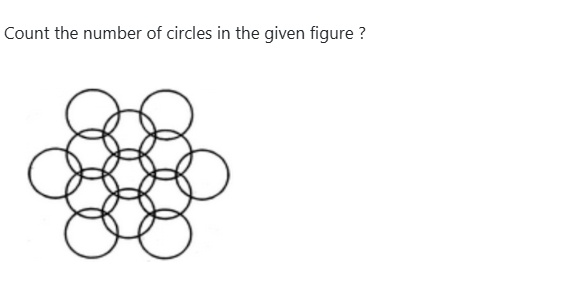
Q92EasyCET 2026 · Slot 1 · Q92
Count the number of circles in the given figure ?
Figure for MBA CET 2026 Slot 1 question 92
  1. 11
  2. 13
  3. 14
  4. 17
  5. 12
Show answerHide answer

Answer: B official key

Approach: Counting circles — outer ring and inner cluster separately.

Solution:
Outer circles: 2 at the top, 1 at the left, 1 at the right, 2 at the bottom → 6.
Inner cluster: centre-top 1, upper-left and upper-right 2, centre 1, lower-left and lower-right 2, centre-bottom 1 → 7.
Total = 6 + 7 = 13.

Why the other options are wrong:
A 11, E 12: miss inner overlapping circles.
C 14, D 17: count lens-shaped overlaps as extra circles.

Cetking shortcut: Count by rows from top to bottom and tick each full circle once.

Answer: B

Q96MediumCET 2026 · Slot 1 · Q96
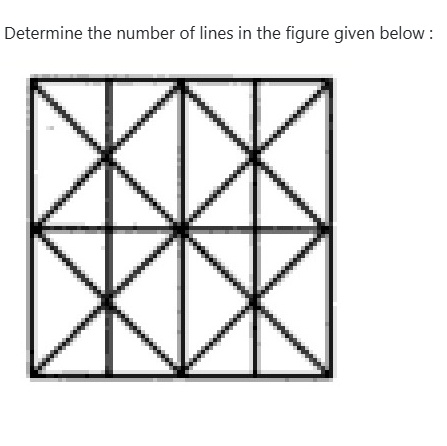
Determine the number of lines in the figure given below :
Figure for MBA CET 2026 Slot 1 question 96
  1. 13
  2. 14
  3. 12
  4. 17
  5. 10
Show answerHide answer

Answer: B official key

Approach: Counting straight lines — count each full straight line once, even if it passes through several cells.

Solution:
Vertical lines: 5.
Horizontal lines: 3 (top, middle, bottom).
Diagonals: the two corner-to-corner diagonals of the whole figure are single straight lines (each passes through two cells) → 2.
Other diagonals inside the four cells → 4.
Total = 5 + 3 + 2 + 4 = 14.

Why the other options are wrong:
D 17: counts segments instead of full straight lines.
A 13, C 12, E 10: miss vertical or diagonal lines.

Cetking shortcut: Check which cell diagonals line up into one long straight line before counting.

Answer: B

Q97HardCET 2026 · Slot 1 · Q97
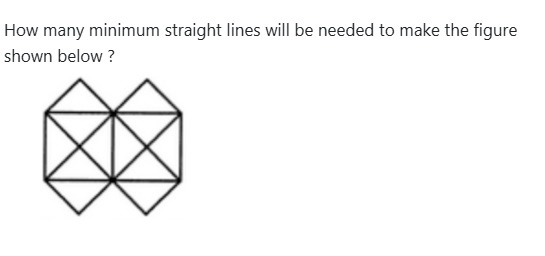
How many minimum straight lines will be needed to make the figure shown below ?
Figure for MBA CET 2026 Slot 1 question 97
  1. 17
  2. 19
  3. 13
  4. 10
  5. 15
Show answerHide answer

Answer: C official key

Approach: Minimum straight lines — merge every set of collinear segments.

Solution:
Horizontal: top edge and bottom edge of the two squares → 2.
Vertical: left, middle and right sides → 3.
Lines sloping up (/): the diagonal of the left square continues into the left side of the right roof → 1; the right edge of the left lower triangle continues into the right square's diagonal → 1; plus the left side of the left roof and the right edge of the right lower triangle → 2. Total 4.
Lines sloping down (\): by symmetry → 4.
Total = 2 + 3 + 4 + 4 = 13.

Why the other options are wrong:
A 17, B 19: count segments rather than full lines.
D 10: merges segments that are not collinear.
E 15: misses that the diagonals continue into the triangle sides.

Cetking shortcut: Extend each diagonal with a ruler-eye: it runs straight into the next triangle's edge.

Answer: C

Q78MediumCET 2025 · Slot 6 · Q78
Find the number of triangles in the following figure
Figure for MBA CET 2025 Slot 6 question 78
  1. 27
  2. 25
  3. 23
  4. 21
  5. 29
Show answerHide answer

Answer: A

Approach: Triangle counting — use the symmetry about the vertical line.

Solution: The figure is symmetric about the vertical line. Count by type:
• Triangles that have the vertical line as one side: 7 on the left and 7 on the right = 14.
• Triangles symmetric about the vertical line: the big inverted triangle, the tip below the upright triangle's base, the upright triangle, its top piece above the small inverted triangle's top edge, and the small inverted triangle = 5.
• Remaining slanted triangles formed where the sides of the big inverted triangle, the upright triangle and the small inverted triangle cross: 4 on the left and 4 on the right = 8.
Total = 14 + 5 + 8 = 27.

Cetking shortcut: In a figure symmetric about a line, count one side, double it, and add the triangles that straddle the line.

Answer: A

Q79HardCET 2025 · Slot 6 · Q79
Find the number of triangles in the following figure
Figure for MBA CET 2025 Slot 6 question 79
  1. 20
  2. 24
  3. 28
  4. 29
  5. 32
Show answerHide answer

Answer: C

Approach: Triangle counting in a 3×3 grid crossed by two long diagonals, with a small square at each end of the diagonals.

Solution: Corner squares: each is cut by one diagonal into 2 triangles → 4 × 2 = 8.
The 3×3 grid with both diagonals passing through its vertices: counting every set of three lines that bound a triangle gives 32.
Total on the figure as drawn = 32 + 8 = 40. This total does not appear among the options; the recorded key is C (28) and the figure needs faculty review.

Answer: C

Q81MediumCET 2025 · Slot 6 · Q81
Find the number of triangles in the given figure
Figure for MBA CET 2025 Slot 6 question 81
  1. 12
  2. 18
  3. 22
  4. 26
  5. 28
Show answerHide answer

Answer: B

Approach: Triangle counting — count triangles at the common bottom vertex, then the rest.

Solution: Label the base midpoint M. Four lines rise from M to the ends of the two horizontal lines.
Apex M, base on the lower horizontal line: 4 rays cut it in 4 points → C(4,2) = 6.
Apex M, base on the upper horizontal line: only the 2 longer rays reach it → 1.
Apex M, third side on the left side of the big triangle: base, lower ray, upper ray → C(3,2) = 3; right side also 3.
Triangles at the top vertex: with the upper line, the lower line and the base → 3.
Two small triangles between the two horizontal lines at the left and right edges → 2.
Total = 6 + 1 + 3 + 3 + 3 + 2 = 18.

Cetking shortcut: For lines fanning out from one point, triangles with that apex = C(number of rays cut, 2) for each crossing line.

Answer: B

Q83MediumCET 2025 · Slot 5 · Q83

Find the minimum number of straight lines required to make the given figure.

Figure for MBA CET 2025 Slot 5 question 83
  1. 16
  2. 17
  3. 18
  4. 19
  5. 20
Show answerHide answer

Answer: B

Approach: Minimum straight lines: count each straight segment that cannot be extended into another.

Solution: Top bar = 1
Two slants from the ends of the top bar down to the inner box top corners = 2
Two lines from the top-middle point to the inner box corners = 2
Central vertical from the top-middle point to the inner bottom = 1
Outer rectangle = 4
Two lines from the bottom corners to the inner box top corners = 2
Two inner box verticals = 2
Inner box bottom = 1
Two lines from the bottom corners to the inner box bottom corners = 2
Total = 1 + 2 + 2 + 1 + 4 + 2 + 2 + 1 + 2 = 17.

Cetking shortcut: Count by direction groups (horizontals, verticals, slants left, slants right) and check that no two segments are collinear.

Answer: B

Q93MediumCET 2025 · Slot 5 · Q93

Find the number of triangles in the given figure.

Figure for MBA CET 2025 Slot 5 question 93
  1. 10
  2. 12
  3. 14
  4. 16
  5. 18
Show answerHide answer

Answer: C

Approach: Counting triangles: label all points and count by groups.

Solution: Label: top-left T, top-middle M, top-right R; bottom points (left to right) P1, P2, P3, P4, P5 (P2 below T, P4 below R); X = crossing of T–P4 and M–P2; Y = crossing of T–P4 and R–P3.
Left end: TP1P2 = 1
With base on P2–P4 and apex T: TP2P4, TP2X, TMX, TMP2 = 4
Triangles using P2: XP2P4 = 1
Big: TP1P4 = 1
Right side: RP4P5, RP3P4, RP3P5, RYP4, YP3P4 = 5
Top: TRY, TRP4 = 2
Total = 1 + 4 + 1 + 1 + 5 + 2 = 14.

Cetking shortcut: Count triangles containing each slanted line once, then the 'compound' ones – do not count by eye.

Answer: C

Q94MediumCET 2025 · Slot 5 · Q94

Find the minimum number of straight lines required to make the given figure.

Figure for MBA CET 2025 Slot 5 question 94
  1. 9
  2. 11
  3. 14
  4. 12
  5. 8
Show answerHide answer

Answer: B

Approach: Minimum straight lines: count lines in each of the three directions of the triangular grid.

Solution: Horizontal lines: 3 inside + base = 4.
Lines parallel to the right side: right side + 3 inside lines = 4.
Lines parallel to the left side: left side + 2 inside lines = 3 (the bottom-right small cell has no '/' line, so the third inner line is absent).
Total = 4 + 4 + 3 = 11.

Cetking shortcut: A full grid of n rows needs 3n lines (12 for 4 rows); subtract any line that is missing – here one, so 11.

Answer: B

Q95MediumCET 2025 · Slot 5 · Q95

Find the number of triangles in the given figure

Figure for MBA CET 2025 Slot 5 question 95
  1. 10
  2. 11
  3. 12
  4. 14
  5. 16
Show answerHide answer

Answer: D

Approach: Counting triangles: split the figure into the fan on the left, the box with its crossing lines, and the two outer triangles.

Solution: Label: L = left vertex; A, B, C = top, middle, bottom of the left vertical; D, E, F = top, middle, bottom of the central vertical; G, H = top and bottom right corners; T, U = top and bottom apexes.
Fan from L: LAB, LBC, LAC = 3
Left box with crossing lines: ABD, BCF, BDE, BEF, BDF = 5
Top: ADT, DGT, AGT = 3
Bottom: CFU, FHU, CHU = 3
Total = 3 + 5 + 3 + 3 = 14.

Cetking shortcut: Count the top and bottom 'roof' triangles as a pair (3 + 3) – they are mirror images.

Answer: D

Q98MediumCET 2025 · Slot 3 · Q98
In the following question, find the number of triangles
Figure for MBA CET 2025 Slot 3 question 98
  1. 11
  2. 13
  3. 15
  4. 17
  5. 19
Show answerHide answer

Answer: C

Approach: Counting triangles: name every point and list triangles systematically.

Solution:
Name the corners A (top-left), B (top-right), C (bottom-right), D (bottom-left), the centre O, and P, the point on AO joined to B and D.
Triangles on the sides of the rectangle: ABC, ABD, ACD, BCD (4).
Triangles with O: ABO, BCO, CDO, ADO (4).
Triangles with P: ABP, ADP, BCP, CDP, BDP, BOP, DOP (7).
Total = 4 + 4 + 7 = 15.

Why the other options are wrong:
A (11), B (13): these miss the large triangles through P (BCP, CDP) or the big half-triangles.
D (17), E (19): these count four-sided shapes or overlaps more than once.

Cetking shortcut: Fix one vertex at a time (all triangles using P, then O, then corners only). This avoids double counting.

Answer: C

Q99EasyCET 2025 · Slot 3 · Q99
In the following question, find the number of squares in the given figure.
Figure for MBA CET 2025 Slot 3 question 99
  1. 32
  2. 30
  3. 29
  4. 28
  5. 42
Show answerHide answer

Answer: B

Approach: Squares in an n × n grid = 1² + 2² + ... + n².

Solution:
The figure is a 4 × 4 grid.
1 × 1 squares: 16. 2 × 2 squares: 9. 3 × 3 squares: 4. 4 × 4 squares: 1.
Total = 16 + 9 + 4 + 1 = 30.

Why the other options are wrong:
A (32), C (29), D (28): miscounts of one of the sizes.
E (42): adds rectangles, which are not squares.

Cetking shortcut: For an n × n grid, the total number of squares = n(n + 1)(2n + 1)/6 = 4 × 5 × 9/6 = 30.

Answer: B

Q91MediumCET 2025 · Slot 2 · Q91
Identify the number of rhombuses in the figure given below:
Figure for MBA CET 2025 Slot 2 question 91
  1. 13
  2. 14
  3. 15
  4. 16
  5. 17
Show answerHide answer

Answer: B

Approach: Treat the figure as a 4 × 4 lattice of small rhombuses with some inner lines missing; count k × k rhombuses size by size.

Solution:
The outer rhombus is cut by three inner lines in each direction, but two inner lines in each direction stop short (one corner strip in each direction is not divided).
1 × 1 rhombuses (complete small cells): 8.
2 × 2 rhombuses (all four sides present): 5.
3 × 3 rhombuses: 0 (each would need a missing line segment).
4 × 4 (the whole figure): 1.
Total = 8 + 5 + 0 + 1 = 14.

Cetking shortcut: Only equal-sided blocks (1 × 1, 2 × 2, …) are rhombuses; 1 × 2 or 2 × 3 blocks are parallelograms — do not count them.

Answer: B

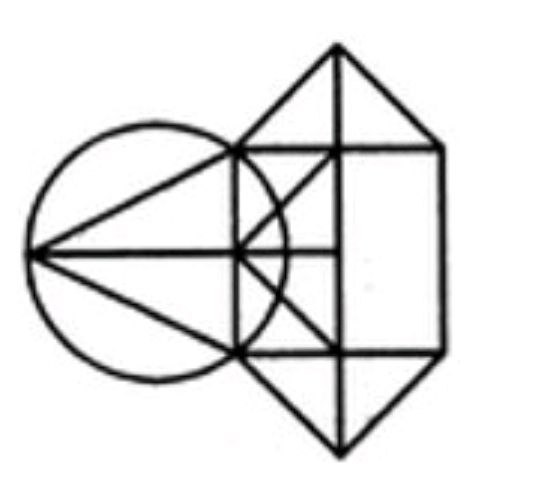
Q97MediumCET 2025 · Slot 2 · Q97
Find the number of triangles in the given figure:
Figure for MBA CET 2025 Slot 2 question 97
  1. 16
  2. 13
  3. 12
  4. 15
  5. 14
Show answerHide answer

Answer: E
Approach: Label the straight-line points and count triangles region by region (the circle's arcs form no triangles).

Solution:
Left (inside the circle, apex at the circle's left point P, rectangle's left side QMS): PQM, PMS, PQS = 3.
Top cap (apex T over the rectangle's top QUV): TQU, TUV, TQV = 3.
Bottom cap (apex B under the rectangle's bottom SDW): BSD, BDW, BSW = 3.
Inside the rectangle (lines from M to U and to D, middle line MN): MQU, MUN, MND, MDS, MUD = 5.
Total = 3 + 3 + 3 + 5 = 14.

Cetking shortcut: A triangle split by one line from its apex gives 3 triangles — use this for each cap.

Answer: E
Q82HardCET 2025 · Slot 1 · Q82

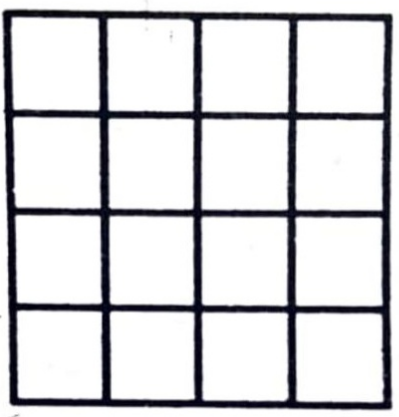
Count the number of squares in the given figure ?

Figure for MBA CET 2025 Slot 1 question 82
  1. 16
  2. 18
  3. 13
  4. 20
  5. 12
Show answerHide answer

Answer: B

Approach: Map the grid lines and count squares size by size, checking every side exists.

Solution:
Take the small cell as 1 unit. Width = 6 units (columns: 2 | 1 | 1 | 2), height = 4 units.
Left block (2 × 4): only a mid-line → 2 squares of 2 × 2.
Middle strip (2 × 4): full 1-unit grid → 8 squares of 1 × 1 and 3 squares of 2 × 2.
Right block (2 × 4): lines at 1 and 3 units → 1 square of 2 × 2 in the middle.
Larger squares: 3 × 3 squares span columns 3–6, rows 1–3 and rows 2–4 = 2; 4 × 4 squares span columns 1–4 and columns 3–6 = 2.
Total = 8 + (2 + 3 + 1) + 2 + 2 = 18.

Cetking shortcut: Count 1 × 1, then 2 × 2, then larger sizes separately, and for big squares check that all four edges are drawn.

Answer: B

Q83HardCET 2025 · Slot 1 · Q83

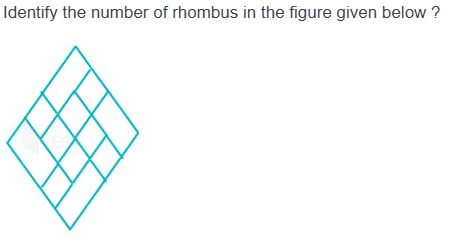
Identify the number of rhombus in the figure given below ?

Figure for MBA CET 2025 Slot 1 question 83
  1. 13
  2. 14
  3. 15
  4. 16
  5. 17
Show answerHide answer

Answer: B

Approach: Treat the figure as a 4 × 4 slanted grid with a few missing segments; count rhombuses of side 1, 2, 3, 4.

Solution:
The big rhombus has 3 interior lines in each direction; the 2nd line in each direction is complete, but the 1st and 3rd stop one unit short of the border (four short segments missing).
Side 1 (small rhombuses fully enclosed): 8.
Side 2 (2 × 2 blocks with all four edges drawn): 5.
Side 3: none – each of the 4 possible 3 × 3 blocks has a missing edge segment.
Side 4: the whole figure = 1.
Total = 8 + 5 + 0 + 1 = 14.

Cetking shortcut: Rectangular (1 × 2) blocks are parallelograms, not rhombuses – count only equal-sided blocks.

Answer: B

Q87MediumCET 2025 · Slot 1 · Q87

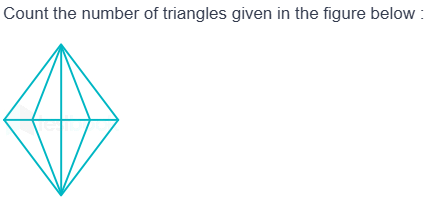
Count the number of triangles given in the figure below :

Figure for MBA CET 2025 Slot 1 question 87
  1. 32
  2. 16
  3. 22
  4. 24
  5. 13
Show answerHide answer

Answer: D

Approach: Count triangles above the horizontal line, below it, and those spanning both halves.

Solution:
The horizontal line has 5 points; the top vertex is joined to all 5 and the bottom vertex is joined to all 5.
Top half: any 2 of the 5 points with the top vertex → C(5, 2) = 10.
Bottom half: likewise 10.
The vertical line joins top and bottom vertices through the middle point → top vertex, bottom vertex and any of the other 4 points form a triangle → 4.
Total = 10 + 10 + 4 = 24.

Cetking shortcut: Fan of lines from one vertex to n points on a line gives C(n, 2) triangles.

Answer: D

Q96HardCET 2025 · Slot 1 · Q96

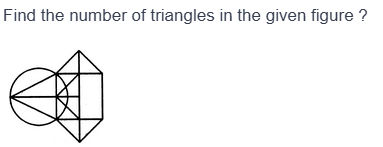
Find the number of triangles in the given figure ?

Figure for MBA CET 2025 Slot 1 question 96
  1. 12
  2. 13
  3. 15
  4. 14
  5. 11
Show answerHide answer

Answer: D

Approach: Label the points and count triangles region by region (arcs are not sides).

Solution:
Let O = leftmost point of circle, A/D = top-left/bottom-left of square, M = midpoint of AD, T/U = top/bottom apex, P/Q/R = points on the central vertical line (top side, middle, bottom side).
Left fan: OAM, OMD, OAD = 3.
Top roof: TAP, TPB, TAB = 3; bottom roof: UDR, URC, UDC = 3.
Inside the square, using diagonals MP and MR: AMP, DMR, MPQ, MQR, MPR = 5.
Total = 3 + 3 + 3 + 5 = 14.

Cetking shortcut: Label every intersection first; then list triangles by a fixed vertex (O, T, U, M) so none repeat.

Answer: D

Q97EasyCET 2025 · Slot 1 · Q97

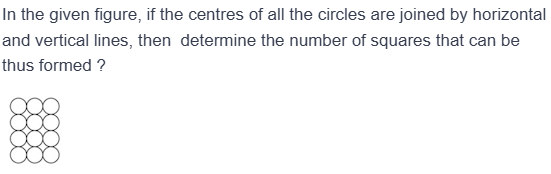
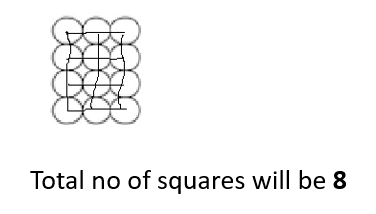
In the given figure, if the centres of all the circles are joined by horizontal and vertical lines, then determine the number of squares that can be thus formed ?

Figure for MBA CET 2025 Slot 1 question 97
  1. 1
  2. 5
  3. 7
  4. 8
  5. 6
Show answerHide answer

Answer: D

Approach: The circle centres form a lattice of points; count squares in that lattice.

Solution:
Circles are in 4 rows × 3 columns → centres form a 4 × 3 grid of points = 3 × 2 unit squares.
1 × 1 squares: 3 × 2 = 6.
2 × 2 squares: 2 × 1 = 2.
Total = 8.

Why the other options are wrong:
6: misses the two 2 × 2 squares.
5 / 7: miscounts the grid.
1: only the largest square.

Cetking shortcut: For an m × n grid of unit squares, total squares = Σ (m − k + 1)(n − k + 1).

Answer: D

Solution figure for question 97
Q99EasyCET 2025 · Slot 1 · Q99

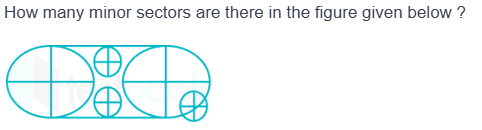
How many minor sectors are there in the figure given below ?

Figure for MBA CET 2025 Slot 1 question 99
  1. 32
  2. 22
  3. 24
  4. 16
  5. 20
Show answerHide answer

Answer: E

Approach: A minor sector here is one quarter of a circle cut by two perpendicular diameters.

Solution:
Circles divided by two diameters: big left circle, big right circle, two small middle circles, small bottom-right circle = 5.
Each contributes 4 quarter sectors.
Total = 5 × 4 = 20.

Why the other options are wrong:
16: misses one circle.
22 / 24 / 32: count non-sector regions or the outer outline.

Cetking shortcut: Count circles with a '+' inside, multiply by 4.

Answer: E
Practise these in the Arena

Take timed tests built around MBA CET topics and see where you stand.

Open the Arena