Let’s Crack CET 2027

Log in to track · your CET progress

Equations – MBA CET questions with solutions

26 questions · CET 2025–2026 · Easy 19 · Medium 7 · Hard 0. Newest paper first. Full papers

Q102EasyCET 2026 · Attempt 2 Slot 2 · Q102
The difference between a two-digit number and the number obtained by interchanging the positions of its digits is 36. What is the difference between the two digits of that number?
  1. 3
  2. 4
  3. 5
  4. 6
  5. 8
Show answerHide answer

Answer: B official key

Approach: Two-digit number 10a + b; reversing gives 10b + a; difference = 9(a − b).

Solution:
(10a + b) − (10b + a) = 9(a − b) = 36.
a − b = 36 ÷ 9 = 4.

Cetking shortcut: Difference of a number and its reverse ÷ 9 = difference of digits → 36/9 = 4.

Answer: B
Q103EasyCET 2026 · Attempt 2 Slot 2 · Q103
From the given numbers, find a positive number which, when increased by 17, is equal to 60 times the reciprocal of the number.
  1. 20
  2. 6
  3. 4
  4. 3
  5. 9
Show answerHide answer

Answer: D official key

Approach: Form the equation x + 17 = 60/x and solve the quadratic.

Solution:
x + 17 = 60/x → x² + 17x − 60 = 0.
(x + 20)(x − 3) = 0 → x = 3 or x = −20.
Positive number = 3.
Check: 3 + 17 = 20 = 60/3. ✔

Cetking shortcut: Plug options: only 3 gives 20 on both sides (20 → 37 vs 3; 6 → 23 vs 10; 4 → 21 vs 15).

Answer: D

Q132EasyCET 2026 · Attempt 2 Slot 1 · Q132

Lata has the same number of sisters as brothers.
Her brother Shyam has twice as many sisters as brothers.

How many children are there in the family?

  1. 3
  2. 5
  3. 6
  4. 7
  5. 8
Show answerHide answer

Answer: D official key

Approach: Count siblings excluding the person themselves.

Solution:
Let g girls and b boys.
Lata (a girl): sisters = g − 1, brothers = b → g − 1 = b.
Shyam (a boy): sisters = g, brothers = b − 1 → g = 2(b − 1).
g = 2(g − 2) → g = 4, b = 3 → total = 7.

Cetking shortcut: Option check: 4 girls + 3 boys — Lata sees 3 sisters, 3 brothers; Shyam sees 4 sisters, 2 brothers ✓.

Answer: D

Q145EasyCET 2026 · Attempt 2 Slot 1 · Q145

When a certain amount is distributed equally among 14 girls, each girl receives ₹160 more than what she would receive if the same amount were distributed equally among 18 girls.
If ₹1,120 is kept aside before distribution and the remaining amount is then distributed among 14 girls, each girl now receives ₹80 less than before.
Find the original total amount.

  1. ₹8,640
  2. ₹9,600
  3. ₹10,080
  4. ₹11,520
  5. ₹12,520
Show answerHide answer

Answer: C official key

Approach: Equal distribution: difference in shares gives the total.

Solution:
T/14 − T/18 = 160 → T(18 − 14)/252 = 160 → T = 160 × 63 = 10,080.
Check: 10,080/14 = 720; (10,080 − 1,120)/14 = 8,960/14 = 640 = 720 − 80 ✓.

Cetking shortcut: 1,120/14 = 80 — the second statement is automatically true; use only the first. Also total must be divisible by 14 and 18 (LCM 126): 10,080 = 126 × 80.

Answer: C

Q109EasyCET 2026 · Slot 5 · Q109

The sum of two integers, when multiplied with each of the numbers separately, gives 4332 and 8664, respectively. Find the difference between the two numbers.

  1. 19
  2. 28
  3. 38
  4. 48
  5. 76
Show answerHide answer

Answer: C official key

Approach: Add the two equations to get (sum)².

Solution:
Let the integers be a, b: (a + b)·a = 4332, (a + b)·b = 8664.
Adding: (a + b)² = 12996 → a + b = 114.
a = 4332/114 = 38, b = 8664/114 = 76.
Difference = 76 − 38 = 38.

Why the other options are wrong:

  • A (19), B (28), D (48): do not come from a + b = 114.
  • E (76): that is the larger number, not the difference.

Cetking shortcut: Ratio of products = a : b = 4332 : 8664 = 1 : 2 → b = 2a, (3a)·a = 4332 → a² = 1444 → a = 38; difference = a = 38.

Answer: C

Q140MediumCET 2026 · Slot 5 · Q140

In a city, domestic electricity charges are as follows:

₹4.20 per unit for the first 100 units,

₹5.80 per unit for consumption above 100 units

A fixed meter charge of ₹120 per month is applicable.
Electricity duty at 10% is charged only on energy charges, not on the fixed charge.

If a household consumed 168 units of electricity for one month, what will be the total electricity bill?

  1. ₹1016
  2. ₹1136
  3. ₹1192
  4. ₹1312
  5. ₹1368
Show answerHide answer

Answer: A official key

Approach: Slab billing; duty only on energy charges.

Solution:
First 100 units: 100 × 4.20 = ₹420.
Next 68 units: 68 × 5.80 = ₹394.40.
Energy charges = ₹814.40.
Duty 10% of 814.40 = ₹81.44.
Fixed meter charge = ₹120 (no duty).
Total = 814.40 + 81.44 + 120 = ₹1015.84 → ₹1016 (bill rounded to the nearest rupee).

Why the other options are wrong:

  • B (₹1136): adds the ₹120 fixed charge twice.
  • C (₹1192): charges all 168 units at ₹5.80.
  • D, E: overcharge / duty on wrong base.

Cetking shortcut: Energy × 1.1 + 120: 814.4 × 1.1 = 895.84 → + 120 = 1015.84.

Answer: A

Q104EasyCET 2026 · Slot 3 · Q104
In a sanctuary, there are horses and ostriches. Each animal has one head. The total number of heads is 86 and the total number of legs is 250. How many ostriches are there?
  1. 45
  2. 46
  3. 47
  4. 48
  5. 49
Show answerHide answer

Answer: C official key

Approach: Heads–legs problem: two linear equations in two unknowns.

Solution:
Let horses = h, ostriches = o.
Heads: h + o = 86. Legs: 4h + 2o = 250.
Halve legs: 2h + o = 125 → subtract heads equation: h = 39.
o = 86 − 39 = 47.

Cetking shortcut: If all 86 were ostriches → 172 legs; extra 250 − 172 = 78 legs ÷ 2 per horse = 39 horses → ostriches = 47.

Answer: C

Q105EasyCET 2026 · Slot 3 · Q105

There are two examination halls, X and Y.

Statement I:
If 15 students are shifted from hall X to hall Y, then the number of students in both halls, becomes equal.

Statement II:
If 25 students are shifted from hall Y to hall X, then the number of students in hall X becomes twice the number of students in hall Y.

Based on the above statements, answer the following question:

The number of students in halls, X and Y, respectively, is:

  1. 90, 60
  2. 105, 75
  3. 120, 90
  4. 135, 105
  5. 140, 60
Show answerHide answer

Answer: D official key

Approach: Translate each transfer statement into a linear equation and solve.

Solution:
Let hall X = x, hall Y = y.
I: x − 15 = y + 15 → x − y = 30.
II: x + 25 = 2(y − 25) → x = 2y − 75.
Substitute: 2y − 75 − y = 30 → y = 105, x = 135.
Check: 135+25 = 160 = 2 × 80 = 2 × (105−25). ✓

Cetking shortcut: Only options with x − y = 30 survive (A, B, C, D); test II on them — only 135, 105 gives 160 = 2 × 80.

Answer: D

Q106EasyCET 2026 · Slot 2 · Q106

DIRECTION for the question: Solve the following question and mark the best possible option.

When a sum of money was distributed to 12 persons instead of 16 persons, each person got Rs. 400 more. What was the sum?
  1. Rs. 14400
  2. Rs. 16000
  3. Rs. 19200
  4. Rs. 14151
  5. Rs. 16987
Show answerHide answer

Answer: C official key

Approach: Equate the difference in per-head shares.

Solution: Let the sum be S. S/12 − S/16 = 400.
LCM 48: (4S − 3S)/48 = 400 ⇒ S/48 = 400.
S = 19200.

Cetking shortcut: The 4 removed people's money (4 × S/16) is now shared as 400 each by 12 people = 4800 ⇒ S/16 = 1200 ⇒ S = 19200.

Answer: C

Q107EasyCET 2026 · Slot 2 · Q107

DIRECTION for the question: Solve the following question and mark the best possible option.

On a 26 question test, five points were deducted for each wrong answer and eight points were credited for each correct answer. If all the questions were answered, how many were correct if the score was zero?
  1. 6
  2. 9
  3. 10
  4. 13
  5. 17
Show answerHide answer

Answer: C official key

Approach: Linear equation in number of correct answers.

Solution: Let correct = x, wrong = 26 − x.
8x − 5(26 − x) = 0 ⇒ 13x = 130 ⇒ x = 10.
Check: 10 × 8 = 80 and 16 × 5 = 80 → score 0.

Cetking shortcut: For zero score, correct : wrong = 5 : 8 ⇒ correct = 5/13 × 26 = 10.

Answer: C

Q125EasyCET 2025 · Slot 6 · Q125
Village P has a population of 78000 which is decreasing at the rate 1800 per year. Village Q has a population of 54000, which is increasing at the rate of 600 per year. in how many years will the population of the two villages be equal?
  1. 14
  2. 15
  3. 10
  4. 12
  5. 13
Show answerHide answer

Answer: C

Approach: Equate the two linear population expressions.

Solution:
P after x years = 78000 − 1800x.
Q after x years = 54000 + 600x.
78000 − 1800x = 54000 + 600x ⇒ 24000 = 2400x ⇒ x = 10 years.

Cetking shortcut: Gap 24000 closes at 1800 + 600 = 2400 per year ⇒ 10 years.

Answer: C

Q128EasyCET 2025 · Slot 6 · Q128
A drum of kerosene is ¾ full. When 50 liters of kerosene is drawn from it, it remains 11/16 full, What is the capacity of the drum?
  1. 900
  2. 750
  3. 800
  4. 850
  5. 875
Show answerHide answer

Answer: C

Approach: Fraction removed × capacity = quantity drawn.

Solution:
3/4 − 11/16 = 12/16 − 11/16 = 1/16 of the drum.
1/16 × capacity = 50 L ⇒ capacity = 800 L.

Cetking shortcut: Drop in fraction = 1/16 ⇒ 16 × 50 = 800.

Answer: C

Q129MediumCET 2025 · Slot 6 · Q129
Sujit and Suraj each have some money. If Sujit gives Rs. 10 to Suraj, then Suraj will have twice the money left with Sujit. But, if Suraj gives Rs. 10 to Sujit, then they both have an equal amount of money. How much money does Sujit have?
  1. Rs 70
  2. Rs 80
  3. Rs 60
  4. Rs 50
  5. Rs 40
Show answerHide answer

Answer: D

Approach: Form two linear equations from the two exchanges.

Solution:
Let Sujit = S, Suraj = R.
Suraj gives ₹10 ⇒ equal: S + 10 = R − 10 ⇒ R = S + 20.
Sujit gives ₹10 ⇒ R + 10 = 2(S − 10) ⇒ S + 30 = 2S − 20 ⇒ S = 50.
Check: R = 70; 70 + 10 = 80 = 2 × 40 ✓.

Why the other options are wrong:
A ₹70: that is Suraj's money.
B, C, E: fail the checks.

Cetking shortcut: Test options: S = 50 ⇒ R = 70 ⇒ 80 vs 40 ✓ twice.

Answer: D

Q131EasyCET 2025 · Slot 6 · Q131
A sum of Rs 8.75 is made up of 105 coins, which are of either 10 paise or 5 paise. How many 5 paise coins are there?
  1. 40
  2. 38
  3. 37
  4. 39
  5. 35
Show answerHide answer

Answer: E

Approach: Two-variable coin equation (or alligation on coin values).

Solution:
₹8.75 = 875 paise. Let 10-paise coins = x ⇒ 5-paise coins = 105 − x.
10x + 5(105 − x) = 875 ⇒ 5x + 525 = 875 ⇒ x = 70.
5-paise coins = 105 − 70 = 35.

Cetking shortcut: If all 105 were 5-paise: 525 p; extra 350 p comes from 10-paise coins at 5 p each ⇒ 70 of them ⇒ 35 five-paise coins.

Answer: E

Q107EasyCET 2025 · Slot 5 · Q107

An employer engaged a servant with free boarding and lodging for one year with the condition that the servant will be given Rs.15000 and a cycle at the end of the year. The servant agreed but served the employer only for 9 months and thus received Rs. 11000 and a cycle. The price of the cycle is:

  1. Rs.1100
  2. Rs.1000
  3. Rs.1200
  4. Rs.1500
  5. Rs.1300
Show answerHide answer

Answer: B

Approach: Total yearly pay = cash + cycle; pay for 9 months = 3/4 of it.

Solution:
Let cycle = ₹x. Full-year pay = 15000 + x
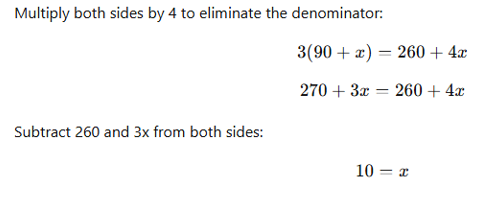
9 months = 3/4 year → (3/4)(15000 + x) = 11000 + x
45000 + 3x = 44000 + 4x
x = ₹1000

Cetking shortcut: Missing 3 months cost him 15000 − 11000 = 4000 cash, which is 1/4 of the yearly pay → yearly pay = 16000 → cycle = 16000 − 15000 = ₹1000.

Answer: B

Q109MediumCET 2025 · Slot 4 · Q109

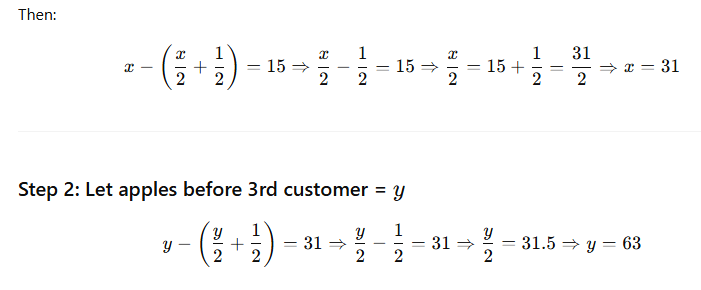
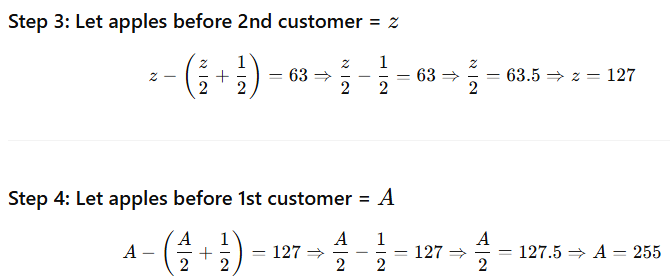
A woman sells to the first customer half of her stock of apples and half an apple, to the second customer she sells half her remaining stock and half an apple, and so on to the third and to the fourth customer. She finds that she now has 15 apples left. How many apples did she have before she started selling them?

  1. 250
  2. 255
  3. 254
  4. 270
  5. 350
Show answerHide answer

Answer: B

Approach: Reverse the operations from the end.

Solution:
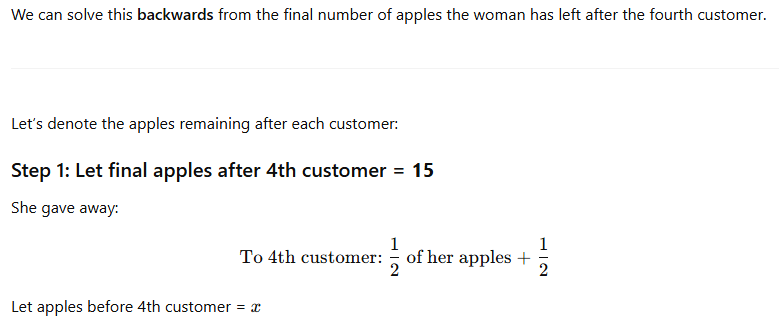
After a sale: left = x/2 − ½ ⇒ before the sale x = 2(left + ½) = 2 × left + 1.
After 4th customer: 15 ⇒ before 4th = 31.
Before 3rd = 2 × 31 + 1 = 63.
Before 2nd = 2 × 63 + 1 = 127.
Before 1st = 2 × 127 + 1 = 255.

Cetking shortcut: Each step maps L → 2L + 1, i.e. (L + 1) doubles: 16 × 2⁴ = 256 ⇒ start = 255.

Answer: B

Solution figure for question 109Solution figure for question 109Solution figure for question 109
Q110MediumCET 2025 · Slot 4 · Q110

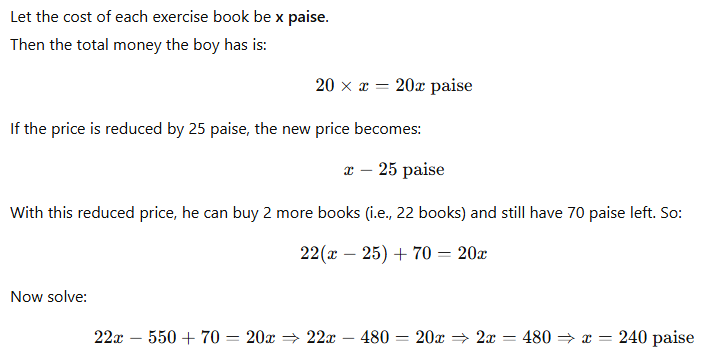
A boy has enough money to buy 20 exercise books. If each book cost 25 paise less, he could buy two more books and still have 70 paise left. How much money did he have originally?

  1. 35
  2. 42
  3. 48
  4. 52
  5. 50
Show answerHide answer

Answer: C

Approach: Form one linear equation in the price.

Solution:
Let price per book = p paise ⇒ money = 20p paise.
New price = (p − 25) paise; 22 books + 70 paise left: 22(p − 25) + 70 = 20p.
22p − 550 + 70 = 20p ⇒ 2p = 480 ⇒ p = 240 paise.
Money = 20 × 240 = 4800 paise = Rs. 48.
Check: 22 × 215 = 4730; 4800 − 4730 = 70 paise. ✓

Cetking shortcut: Options ÷ 20 give the price; only Rs. 48 → Rs. 2.40 per book works: Rs. 2.15 × 22 = 47.30, leaving 70 paise.

Answer: C

Solution figure for question 110Solution figure for question 110
Q111MediumCET 2025 · Slot 4 · Q111

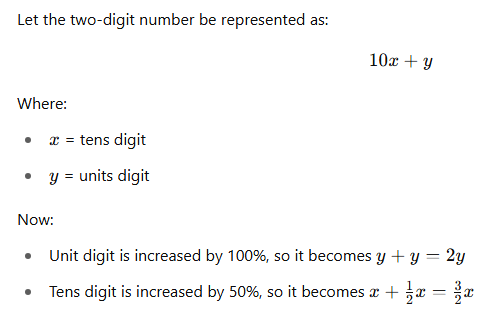
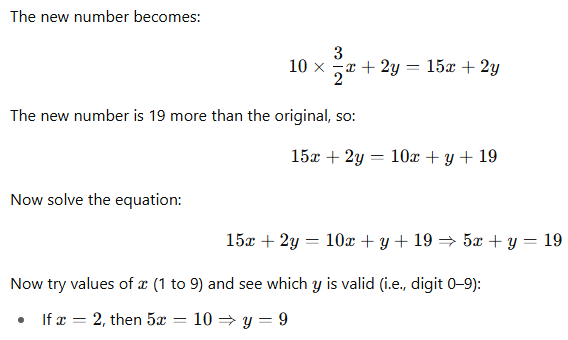
The digit at unit place of a two-digit number is increased by 100% and the digit at ten places of the same number is increased by 50%. The new number thus formed is 19 more than the original number. What is the original number?

  1. 22
  2. 25
  3. 27
  4. 29
  5. 21
Show answerHide answer

Answer: D

Approach: Place-value algebra.

Solution:
Original number = 10a + b.
Units digit +100% → 2b; tens digit +50% → 1.5a. New number = 10(1.5a) + 2b = 15a + 2b.
15a + 2b = 10a + b + 19 ⇒ 5a + b = 19.
a = 2 ⇒ b = 9 → 29; a = 3 ⇒ b = 4 → 34 (not an option).
Check 29: tens 2 → 3, units 9 → 18 ⇒ new value 30 + 18 = 48 = 29 + 19. ✓

Why the other options are wrong:
A (22): 5×2 + 2 = 12 ≠ 19.
B (25): 15 ≠ 19.
C (27): 17 ≠ 19.
E (21): 11 ≠ 19.

Cetking shortcut: Just test 5 × (tens) + (units) = 19 on the options — only 29 gives 10 + 9 = 19.

Answer: D

Solution figure for question 111Solution figure for question 111Solution figure for question 111
Q109EasyCET 2025 · Slot 3 · Q109
In a group of buffaloes and ducks, the number of legs is 24 more than twice the number of heads. What is the number of buffalo in a group?
  1. 6
  2. 8
  3. 10
  4. 12
  5. 4
Show answerHide answer

Answer: D

Approach: Heads–legs equation.

Solution: Let buffaloes = B, ducks = D.
Heads = B + D; legs = 4B + 2D.
4B + 2D = 2(B + D) + 24 → 4B + 2D = 2B + 2D + 24 → 2B = 24 → B = 12.

Cetking shortcut: Each buffalo has 2 'extra' legs over 2-per-head; 24 extra legs ÷ 2 = 12 buffaloes.

Answer: D

Q123EasyCET 2025 · Slot 3 · Q123
The price of the item X rises by Rs 40 per year and that of item Y by Rs 15 per year. If the price of item X and Y in the year 2002 was Rs 420 and Rs 630 respectively, in which year the price of item X will be Rs 40 more than the price of item Y?
  1. 2010
  2. 2011
  3. 2012
  4. 2013
  5. 2014
Show answerHide answer

Answer: C

Approach: Track the gap Y − X year by year.

Solution: In 2002, Y − X = 630 − 420 = 210 (Y higher).
Each year X gains 40 − 15 = 25 on Y.
Required: X − Y = +40 → total change needed = 210 + 40 = 250.
Years = 250 ÷ 25 = 10 → 2002 + 10 = 2012.

Answer: C

Q124EasyCET 2025 · Slot 3 · Q124
A class starts at 10 am and lasts till 1.27 pm. Four periods are held during this interval. After every period, 5 minutes are given free to the students. What is the exact duration of each period?
  1. 42min
  2. 48min
  3. 51min
  4. 53min
  5. 60min
Show answerHide answer

Answer: B

Approach: Total time = 4 periods + 3 breaks (no break after the last period).

Solution: 10:00 am to 1:27 pm = 3 h 27 min = 207 min.
Breaks = 3 × 5 = 15 min.
Period time = 207 − 15 = 192 min → each period = 192 ÷ 4 = 48 min.

Answer: B

Q130EasyCET 2025 · Slot 2 · Q130
Amreeshdar calculated 7/18 instead of 7/8 of a number. His answer was 770 less than the correct one. What was the number?
  1. 1520
  2. 1584
  3. 1556
  4. 1656
  5. 1728
Show answerHide answer

Answer: B

Approach: Difference of the two fractions × number = 770.

Solution:
7/8 − 7/18 = 7(18 − 8)/144 = 70/144 = 35/72.
(35/72)x = 770 → x = 770 × 72/35 = 22 × 72 = 1584.

Cetking shortcut: 770/35 = 22 → x = 22 × 72.

Answer: B

Q140MediumCET 2025 · Slot 2 · Q140
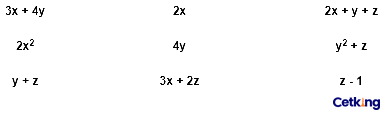
In a 3×3 magic square, the sum of entries in any row, column, or diagonal is the same number N. The cells are expressed in variables x, y, and z. Find the value of N.
Figure for MBA CET 2025 Slot 2 question 140
  1. 12
  2. 36
  3. 21
  4. 48
  5. 24
Show answerHide answer

Answer: B

Approach: Equate pairs of line sums to get linear relations among x, y, z.

Solution:
Grid: [3x+4y, 2x, 2x+y+z] / [2x², 4y, y²+z] / [y+z, 3x+2z, z−1].
Row 1 = 7x + 5y + z; Column 2 = 5x + 4y + 2z → z = 2x + y.
Row 3 = 3x + y + 4z − 1; equate with Row 1 → 4x + 4y − 3z + 1 = 0 → with z = 2x + y: y = 2x − 1, z = 4x − 1.
Anti-diagonal = 2x + 6y + 2z; equate with Row 1 → 5x = y + z = 6x − 2 → x = 2, y = 3, z = 7.
N = 7(2) + 5(3) + 7 = 36. Check Row 2: 8 + 12 + 16 = 36 ✓; Column 1: 18 + 8 + 10 = 36 ✓; Main diagonal: 18 + 12 + 6 = 36 ✓

Cetking shortcut: Use only linear lines (Row 1, Column 2, Row 3, anti-diagonal) — avoid the x² and y² cells until the check.

Answer: B

Q145EasyCET 2025 · Slot 2 · Q145
Datta purchased two oranges, three bananas and four apples for Rs. 15. Had he instead bought 3 oranges, 2 bananas, and 1 apple, it would have cost Rs. 10. If Datta bought 3 oranges, 3 bananas and 3 apples, how much did he pay?
  1. Rs. 7.50
  2. Rs. 12
  3. Rs. 12.50
  4. Rs. 15
  5. Rs. 10
Show answerHide answer

Answer: D

Approach: Add the two equations — the coefficients become equal.

Solution:
2o + 3b + 4a = 15 and 3o + 2b + a = 10.
Add: 5o + 5b + 5a = 25 → o + b + a = 5.
3 oranges + 3 bananas + 3 apples = 3 × 5 = Rs 15.

Cetking shortcut: When individual prices can't be found, look for a combination of the equations that matches the target.

Answer: D

Q125EasyCET 2025 · Slot 1 · Q125
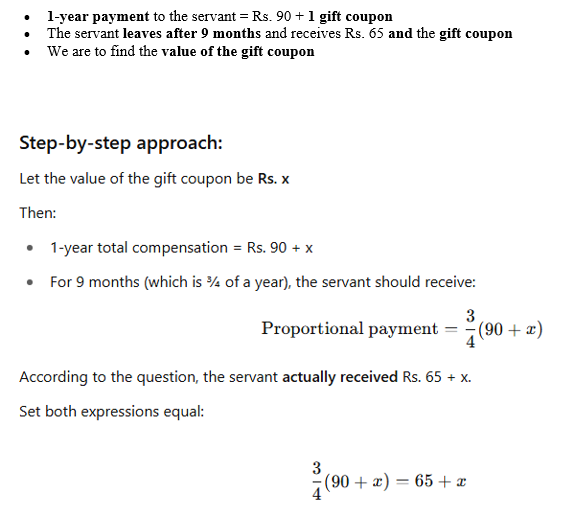
One year payment to the servant is Rs. 90 plus one gift coupon. The servant leaves after 9 months and receives Rs. 65 and a gift coupon. Determine the value of the gift coupon ?
Figure for MBA CET 2025 Slot 1 question 125
  1. 7.5
  2. 15
  3. 10
  4. 12
  5. 18
Show answerHide answer

Answer: C

Approach: Prorate the whole annual package.

Solution:
Let gift = G. Annual pay = 90 + G
9 months' pay = (3/4)(90 + G)
(3/4)(90 + G) = 65 + G
67.5 + 0.75G = 65 + G → 0.25G = 2.5 → G = ₹10

Cetking shortcut: 3 months' pay = (90 + G) − (65 + G) = 25 → annual = 100 → G = 100 − 90 = 10.

Answer: C

Solution figure for question 125Solution figure for question 125
Q126MediumCET 2025 · Slot 1 · Q126
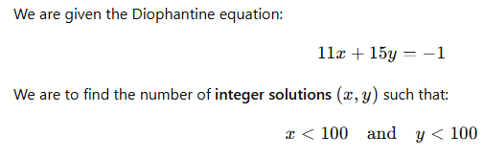
How many integer solutions exists for the equation 11x + 15y = -1 such that both x and y are less than 100
Figure for MBA CET 2025 Slot 1 question 126
  1. 1
  2. 15
  3. 17
  4. 16
  5. 20
Show answerHide answer

Answer: D

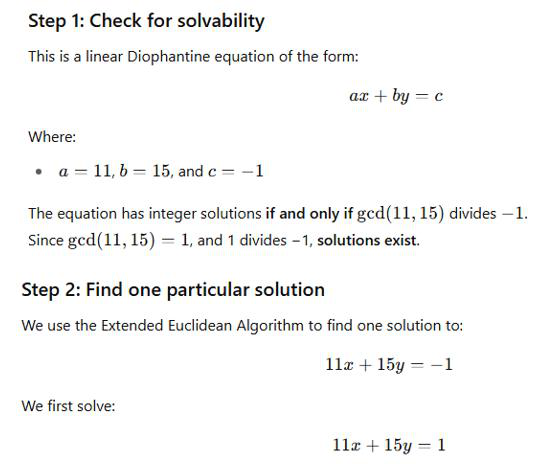
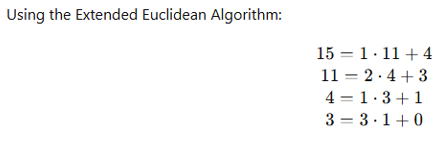
Approach: Find one solution, write the general form, count valid t.

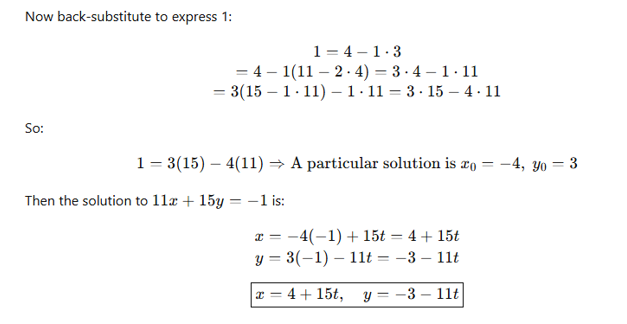
Solution:
Particular solution: x = 4, y = −3 (44 − 45 = −1)
General: x = 4 + 15t, y = −3 − 11t
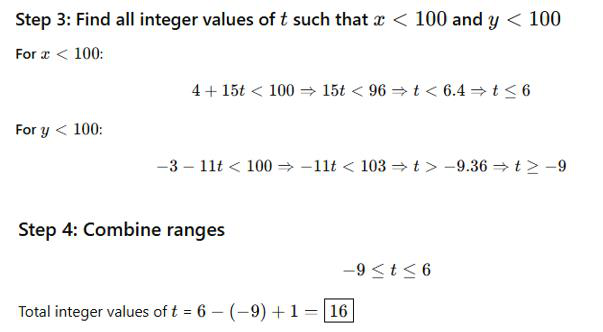
x < 100 → 15t < 96 → t ≤ 6
y < 100 → −11t < 103 → t ≥ −9
t = −9, −8, …, 6 → 16 values

Cetking shortcut: Count t-values as 6 − (−9) + 1 = 16; watch the off-by-one traps (15 and 17).

Answer: D

Solution figure for question 126Solution figure for question 126Solution figure for question 126Solution figure for question 126Solution figure for question 126

Practise these in the Arena

Take timed tests built around MBA CET topics and see where you stand.

Open the Arena
Compare CET 2027 programmes
BooksProMocksProShortcutsProBest valueCompletePro
Priceincl. GST₹1,999Inclusive of GST₹2,799₹2,999Inclusive of GST₹10,000₹14,999Inclusive of GST₹18,000₹19,999Inclusive of GST
Planning — Syllabus, Plans, Cutoffs, Strategies
Weekly Plans✓✓✓✓
Pro Calculators✓✓✓✓
MockNiti✓✓—✓
CET Study — Improvement
Purple Books✓——✓
100 G Strategy Shortcuts¹——✓✓
10 Sacred Art of Tukka²——✓✓
Cetking Bibles✓✓✓✓
Practice — From Zero to Expert with timer
40 Mocks—✓—✓
10 PYQs—✓—✓
30 Sectionals✓✓—✓
Arena Pro✓✓✓✓
GDPI — Interview Ready
GDPI Prep———✓
CMAT 2027 Program for +⁠₹100—

Not ready yet? Try our FREE Pack — 1 Full Length Mock, 5 PYQs, Calculators, Arena Access, Weekly Plan

Try for Free
  • ¹ 100 Sacred Art of Shortcuts workshops (Recorded + Live)
  • ² 10 Sacred Art of Tukka workshops (Recorded + Live)

What next

Admit cards · CAT admit card · © Cetking Universe · Terms & Privacy · By using this site, you agree to Cetking's Terms.