Let’s Crack CET 2027

Your CET check-up · tap a ring to see yours

Interest – MBA CET questions with solutions

21 questions · CET 2025–2026 · Easy 16 · Medium 5 · Hard 0. Newest paper first. Full papers

Q128MediumCET 2026 · Attempt 2 Slot 2 · Q128
A person lent out a certain sum on simple interest and the same sum on compound interest at a certain rate of interest per annum. He noticed that the ratio between the difference of compound interest and simple interest of 3 years and that of 2 years is 25:8. Determine the rate of interest per annum :
  1. 10.5%
  2. 11.5%
  3. 12.5%
  4. 8%
  5. 10.95%
Show answerHide answer

Answer: C official key

Approach: CI − SI formulas: 2 years = P(r)², 3 years = P(r)²(3 + r), r as a fraction.

Solution:
Let r = rate as a fraction.
CI − SI (2 yrs) = P r².
CI − SI (3 yrs) = P r²(3 + r).
Ratio = (3 + r) : 1 = 25 : 8 → 3 + r = 25/8 → r = 1/8.
Rate = 12.5% p.a.

Cetking shortcut: Ratio of 3-yr to 2-yr difference = 3 + r → 25/8 − 3 = 1/8 = 12.5%.

Answer: C
Q129MediumCET 2026 · Attempt 2 Slot 2 · Q129
What annual payment will discharge a debt of ₹50,440 due in 3 years, at the rate of 5% per annum when compounded annually ?
  1. Rs. 16522
  2. Rs. 15800
  3. Rs. 17754
  4. Rs. 18522
  5. Rs. 13598
Show answerHide answer

Answer: D official key

Approach: Equal annual instalments: present value of all instalments = debt (compound interest).

Solution:
Read the debt of ₹50,440 as the amount owed today, to be repaid in 3 equal annual instalments x at 5% CI.
x/1.05 + x/1.05² + x/1.05³ = 50,440.
Multiply by 1.05³ = 1.157625: x(1.1025 + 1.05 + 1) = 50,440 × 1.157625.
x × 3.1525 = 58,390.6 → x = 18,522.
Check: 18,522 = 16,000 × 1.05³, and 16,000 × 3.1525 = 50,440 exactly.

Why the other options are wrong:
If ₹50,440 were the amount due at the END of 3 years, the instalment would be 50,440/3.1525 = ₹16,000 — not among the options; A, B, C and E match neither reading.

Cetking shortcut: Instalment = 50,440 × 1.05³ / 3.1525 = 16,000 × 1.157625 = 18,522.

Answer: D

Q130MediumCET 2026 · Attempt 2 Slot 2 · Q130
Ms. Kavita invested money in two schemes, A and B, offering compound interest @ 8 p.c.p.a. and 12 p.c.p.a. respectively. If the total amount of interest accrued through two schemes together in two years was Rs 4538 and the total amount invested was Rs 20,000, what was the amount invested in Scheme A by Kavita ?
  1. Rs. 6250
  2. Rs. 8500
  3. Rs. 7240
  4. Rs. 5000
  5. Rs. 5850
Show answerHide answer

Official CET key: A · Cetking's answer: C — see why below

Approach: Two-year CI factor: 8% → 16.64%, 12% → 25.44%.

Solution:
Let Scheme A = x, Scheme B = 20,000 − x.
CI on A in 2 yrs = 0.1664x; on B = 0.2544(20,000 − x).
0.1664x + 5088 − 0.2544x = 4538
0.088x = 550 → x = Rs. 6,250.

Why the other options are wrong:
B, C, D, E: plug in — e.g. D (5000): 832 + 3816 = 4648 ≠ 4538.

Cetking shortcut: If all 20,000 were at 12%, interest = 5088; actual is 550 less; each rupee moved to 8% loses 0.088 → 550/0.088 = 6250.

Answer: A

Q111EasyCET 2026 · Attempt 2 Slot 1 · Q111

At what annual interest rate, compounded yearly, will $80,000 amount to $88,200 in 2 years?

  1. 4%
  2. 4.5%
  3. 5%
  4. 5.5%
  5. 6 %
Show answerHide answer

Answer: C official key

Approach: Compound interest: A = P(1 + r)ⁿ.

Solution:
88,200 / 80,000 = 1.1025.
(1 + r)² = 1.1025 → 1 + r = 1.05.
r = 5%.

Cetking shortcut: Know squares: 1.05² = 1.1025, 1.04² = 1.0816, 1.06² = 1.1236.

Answer: C

Q136EasyCET 2026 · Attempt 2 Slot 1 · Q136

A man invested ₹18,000 in ₹50 shares of a company at a 20% premium. If the company declares a 12% dividend at the end of the year, how much dividend will he receive?

  1. ₹1,440
  2. ₹1,500
  3. ₹1,600
  4. ₹1,800
  5. ₹2,160
Show answerHide answer

Answer: D official key

Approach: Shares: buy at market value, dividend on face value.

Solution:
Market price = 50 × 1.20 = Rs 60.
Number of shares = 18,000 / 60 = 300.
Dividend per share = 12% of 50 = Rs 6.
Total dividend = 300 × 6 = Rs 1,800.

Why the other options are wrong:
E (2,160) applies 12% to the amount invested; A, B, C come from wrong share counts or prices.

Cetking shortcut: Dividend yield on investment = 12% × 50/60 = 10% → 10% of 18,000 = 1,800.

Answer: D

Q113EasyCET 2026 · Slot 5 · Q113

Ritika borrowed some money at the rate of 6% per annum for the first 3 years, 9% per annum for the next 5 years, and 13% per annum for the remaining period.
If she paid a total simple interest of ₹8,160 at the end of 11 years, how much money did she borrow?

  1. ₹8,000
  2. ₹9,000
  3. ₹10,000
  4. ₹12,000
  5. ₹15,000
Show answerHide answer

Answer: A official key

Approach: Simple interest with changing rates — add the rate × time products.

Solution:
Periods: 3 years at 6%, 5 years at 9%, remaining 11 − 8 = 3 years at 13%.
Total SI% = 6 × 3 + 9 × 5 + 13 × 3 = 18 + 45 + 39 = 102%.
102% of P = 8160 → P = 8160 × 100/102 = ₹8,000.

Why the other options are wrong:

  • B, C, D, E: give total interest of ₹9,180, ₹10,200, ₹12,240 and ₹15,300 respectively.

Cetking shortcut: Total SI% = Σ(rate × years); principal = SI × 100/(total %).

Answer: A

Q114EasyCET 2026 · Slot 5 · Q114

The population of a town increases at a rate of 12% per annum.
If a population of a town was 7,500 at the end of 2018, what will be its population at the end of 2021?

  1. 10,368
  2. 10,537
  3. 10,684
  4. 10,752
  5. 10,920
Show answerHide answer

Official CET key: B · Cetking's answer: A — see why below

Approach: Population growth works like compound interest: P(1 + r/100)ⁿ.

Solution:
End 2018 → end 2021 = 3 years.
Population = 7500 × (1.12)³.
1.12² = 1.2544; 1.2544 × 1.12 = 1.404928.
7500 × 1.404928 = 10,536.96 ≈ 10,537.

Why the other options are wrong:

  • A (10,368): = 7500 × 1.3824 — 1.12³ is 1.4049, not 1.3824.
  • C, D, E: over-estimates — exceed 7500 × 1.405.

Cetking shortcut: Successive 12%: 7500 → 8400 → 9408 → 9408 + 1128.96 = 10,536.96.

Answer: B

Q136EasyCET 2026 · Slot 5 · Q136

Find the compound interest on ₹1250 for 1½ years at 5% per annum, if interest is payable semi-annually.

  1. ₹96.11
  2. ₹91.24
  3. ₹95.31
  4. ₹100.01
  5. ₹120.22
Show answerHide answer

Official CET key: A · Cetking's answer: C — see why below

Approach: Half-yearly compounding: half the rate, double the periods.

Solution:
Rate per half-year = 5/2 = 2.5%; periods = 1½ × 2 = 3.
Amount = 1250 × (1.025)³.
1.025² = 1.050625; × 1.025 = 1.076890625.
Amount = 1250 × 1.076890625 = 1346.11.
CI = 1346.11 − 1250 = ₹96.11.

Why the other options are wrong:

  • C (₹95.31): arithmetic slip in 1.025³ (gives amount 1345.31).
  • B (₹91.24), D (₹100.01), E (₹120.22): do not equal 1250 × 1.025³ − 1250.

Cetking shortcut: Successive 2.5%: 1250 → 1281.25 → 1313.28 → 1346.11 → CI = 96.11.

Answer: A

Q133EasyCET 2026 · Slot 4 · Q133
A sum of money at simple interest doubles itself in 8 years. What is the rate of interest per annum?
  1. 10.50%
  2. 12%
  3. 12.50%
  4. 15%
  5. 20%
Show answerHide answer

Answer: C official key

Approach: Simple interest: I = PRT/100.

Solution:
Doubles ⇒ interest = principal ⇒ I = P.
P = P × R × 8/100 ⇒ R = 100/8 = 12.5%.

Why the other options are wrong:
A, B, D, E – give interest ≠ P in 8 years (e.g. 12% → 96%).

Cetking shortcut: SI doubling: R × T = 100 ⇒ R = 100/8.

Answer: C

Q134EasyCET 2026 · Slot 4 · Q134
What will be the compound interest on Rs. 1000 at 10% per annum for 1 year, when the interest is compounded half-yearly?
  1. Rs. 100
  2. Rs. 110
  3. Rs. 105
  4. Rs. 102.50
  5. Rs. 112.50
Show answerHide answer

Answer: D official key

Approach: Half-yearly compounding: halve the rate, double the periods.

Solution:
Rate per half-year = 5%; periods = 2.
Amount = 1000 × 1.05² = 1000 × 1.1025 = 1102.50.
CI = 1102.50 − 1000 = Rs. 102.50.

Why the other options are wrong:
A (100) – simple interest / annual compounding.
B, C, E – arithmetic slips.

Cetking shortcut: CI for 2 periods at r% = 2r + r²/100 = 10 + 0.25 = 10.25% of 1000.

Answer: D

Q123EasyCET 2026 · Slot 3 · Q123
A certain sum amounts to ₹575 at 5% simple interest in the same time in which ₹750 amounts to ₹840 at 4% simple interest. What is the original sum?
  1. ₹480
  2. ₹500
  3. ₹520
  4. ₹540
  5. ₹560
Show answerHide answer

Answer: B official key

Approach: Use the second loan to find time, then reverse simple interest for the first.

Solution:
Second case: SI = 840 − 750 = 90 = 750 × 4 × t/100 → t = 3 years.
First case: Amount = P(1 + 5 × 3/100) = 1.15P = 575.
P = 575 / 1.15 = ₹500.

Cetking shortcut: Test options: 500 × 1.15 = 575 ✓ directly.

Answer: B

Q129EasyCET 2026 · Slot 2 · Q129

DIRECTION for the question: Solve the following question and mark the best possible option.

The interest on a certain deposit at 4.5% p.a. is Rs. 202.50 in one year. How much will the additional interest in one year be on the same deposit, at 5% p.a.?

  1. Rs. 20.25
  2. Rs. 22.50
  3. Rs. 25
  4. Rs. 42.75
  5. Rs. 42.25
Show answerHide answer

Answer: B official key

Approach: Find principal, then apply the 0.5% extra rate.

Solution: P = 202.50 ÷ 0.045 = Rs. 4500.
Interest at 5% = 4500 × 0.05 = Rs. 225.
Additional interest = 225 − 202.50 = Rs. 22.50.

Why the other options are wrong:
A (20.25): 10% of 202.50.
D, E: wrongly add values.
C (25): 0.5% of 5000.

Cetking shortcut: Extra = 202.50 × 0.5/4.5 = 202.50/9 = 22.50.

Answer: B

Q130EasyCET 2026 · Slot 2 · Q130

DIRECTION for the question: Solve the following question and mark the best possible option.

A sum of money at simple interest amounts to Rs. 815 in 3 years and Rs. 854 in 4 years. The sum is?

  1. Rs. 650
  2. Rs. 690
  3. Rs. 698
  4. Rs. 700
  5. Rs. 750
Show answerHide answer

Answer: C official key

Approach: SI per year from the difference of amounts.

Solution: SI for 1 year = 854 − 815 = Rs. 39.
SI for 3 years = 3 × 39 = Rs. 117.
Principal = 815 − 117 = Rs. 698.

Why the other options are wrong:
B (690), D (700): close-number traps.
A, E: wrong interest count.

Answer: C

Q131EasyCET 2026 · Slot 2 · Q131

DIRECTION for the question: Solve the following question and mark the best possible option.

There is a 60% increase in the amount in 6 years at simple interest. What will be the compound interest of Rs. 12000 after 3 years at the same rate?

  1. Rs. 2160
  2. Rs. 3120
  3. Rs. 3972
  4. Rs. 6240
  5. Rs. 1200
Show answerHide answer

Answer: C official key

Approach: SI gives the rate; apply CI for 3 years.

Solution: 60% in 6 years at SI ⇒ rate = 10% p.a.
CI = 12000 × (1.1³ − 1) = 12000 × 0.331 = Rs. 3972.

Why the other options are wrong:
E (1200): just one year's interest.
A, B, D: wrong rate or wrong number of years; SI for 3 years would be 3600, and CI must be a bit more.

Cetking shortcut: CI for 3 years at 10% = 33.1% of P → 0.331 × 12000 = 3972.

Answer: C

Q111EasyCET 2025 · Slot 6 · Q111
A man invested X rupees for Y years at a rate of 3.25% per annum simple interest. if he received 3.25 X after Y years find the value of Y?
  1. 68.22
  2. 67.32
  3. 65.33
  4. 69.23
  5. 71.32
Show answerHide answer

Answer: D

Approach: Simple interest: SI = P × R × T / 100, with SI = Amount − Principal.

Solution:
Amount = 3.25X ⇒ SI = 3.25X − X = 2.25X.
2.25X = X × 3.25 × Y / 100 ⇒ 225 = 3.25Y.
Y = 225 / 3.25 = 69.23 years.

Why the other options are wrong:
Using SI = 3.25X (forgetting to subtract principal) gives 100 — not an option; A, B, C, E are calculation slips.

Cetking shortcut: Y = (Amount/P − 1) × 100 / R = 2.25 × 100 / 3.25 = 900/13 ≈ 69.23.

Answer: D

Q125EasyCET 2025 · Slot 5 · Q125

Aman pays 40 times the annual rent to purchase a building. The rate % per annum he derives from his investment is

  1. 25%
  2. 2.5%
  3. 50%
  4. 5%
  5. 7.5%
Show answerHide answer

Answer: B

Approach: Rate of return = annual income ÷ investment × 100.

Solution:
Annual rent = R → price = 40R
Return = R/40R × 100 = 2.5%

Why the other options are wrong:
D (5%) would need 20 years' rent; A (25%) misplaces the decimal.

Cetking shortcut: Rate = 100/40 = 2.5%.

Answer: B

Q126MediumCET 2025 · Slot 5 · Q126

Mr. Dua invested money in two schemes, A and B offering compound interest @ 8 p.c.p.a. and 12 p.c.p.a. respectively. If the total amount of interest accrued through two schemes together in two years was Rs 4538.00 and the total amount invested was Rs 20,000, what was the amount invested in Scheme A?

  1. Rs 6000
  2. Rs. 6250
  3. Rs. 6500
  4. Rs. 16000
  5. Rs. 16500
Show answerHide answer

Answer: B

Approach: CI for 2 years at r% = P[(1 + r/100)² − 1]; split the principal as x and 20000 − x.

Solution:
8% for 2 years → 16.64% of x
12% for 2 years → 25.44% of (20000 − x)
0.1664x + 0.2544(20000 − x) = 4538
5088 − 0.088x = 4538 → 0.088x = 550 → x = 6250
Check: 1040 + 0.2544 × 13750 = 1040 + 3498 = 4538 ✓

Cetking shortcut: If all ₹20,000 were at 12%, interest = 5088. Each rupee moved to 8% loses 0.088. Loss = 550 → 550/0.088 = 6250 (alligation on effective 2-year rates).

Answer: B

Q127EasyCET 2025 · Slot 5 · Q127

A sum of money is borrowed and paid back in two annual installments of Rs 882 each, allowing 5% compound interest. The sum borrowed was

  1. Rs. 1600
  2. Rs. 1620
  3. Rs. 1640
  4. Rs. 1680
  5. Rs. 1650
Show answerHide answer

Answer: C

Approach: Sum borrowed = present value of the instalments at 5% CI.

Solution:
PV of 1st instalment = 882/1.05 = 840
PV of 2nd instalment = 882/1.05² = 882/1.1025 = 800
Sum = 840 + 800 = ₹1640

Cetking shortcut: 882 = 2 × 441 = 2 × 21²; with 1.05 = 21/20, PVs are 882 × 20/21 = 840 and 840 × 20/21 = 800.

Answer: C

Q114EasyCET 2025 · Slot 2 · Q114
Rashesh pays 1/6 via UPI, 1/3 via cash, and balance next year with 10% interest. Interest = ₹6000. What was the original price?
  1. ₹110000
  2. ₹120000
  3. ₹90000
  4. ₹100000
  5. ₹150000
Show answerHide answer

Answer: B

Approach: Find the balance fraction; interest is on the balance only.

Solution:
Paid now = 1/6 + 1/3 = 1/2 of price x → balance = x/2.
Interest = 10% of x/2 = 0.05x = 6000 → x = ₹1,20,000.

Answer: B

Q133MediumCET 2025 · Slot 2 · Q133
Qoban splits money in 1:2 ratio. Smaller part gets 10% interest, larger part gets 5%. Total interest after 2 years = ₹830. Initial deposit in each scheme > ₹1000. Find total money M?
  1. 12000
  2. 8000
  3. 6000
  4. 9000
  5. 5700
Show answerHide answer

Answer: C

Approach: Compound interest for 2 years on each part; solve for M.

Solution:
Parts: M/3 at 10%, 2M/3 at 5% (CI, 2 years).
CI factors: 10% → 1.21 − 1 = 0.21; 5% → 1.1025 − 1 = 0.1025.
Interest = 0.21(M/3) + 0.1025(2M/3) = 0.07M + 0.06833M = 0.138333M = 830 → M = 6000.
Check: 2000 → 420, 4000 → 410, total 830 ✓ (both parts > ₹1000).

Cetking shortcut: 2-year CI % = 2r + r²/100: 21% and 10.25%; test options quickly.

Answer: C

Q140EasyCET 2025 · Slot 1 · Q140
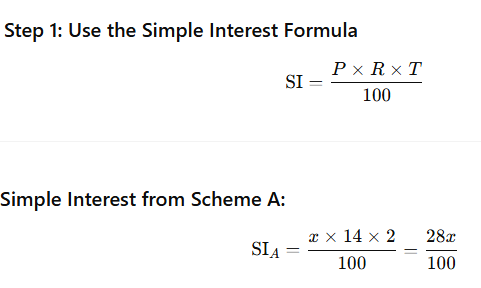
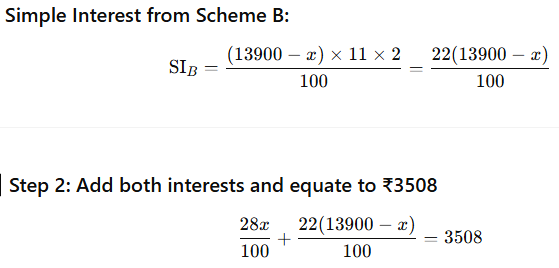
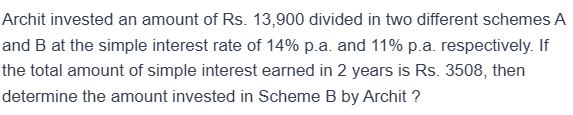
Archit invested an amount of Rs. 13,900 divided in two different schemes A and B at the simple interest rate of 14% p.a. and 11% p.a. respectively. If the total amount of simple interest earned in 2 years is Rs. 3508, then determine the amount invested in Scheme B by Archit ?
Figure for MBA CET 2025 Slot 1 question 140
  1. 6400
  2. 6500
  3. 7200
  4. 7500
  5. 6800
Show answerHide answer

Answer: A

Approach: Simple interest equation for 2 years.

Solution:
Let A = x, B = 13900 − x
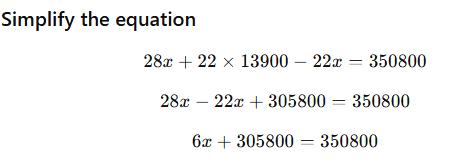
2 × [0.14x + 0.11(13900 − x)] = 3508
0.14x + 0.11(13900 − x) = 1754
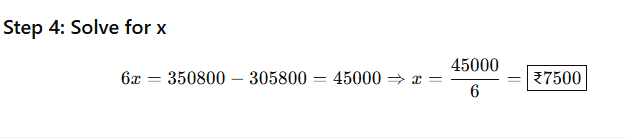
0.03x + 1529 = 1754 → x = 7500
Scheme B = 13900 − 7500 = ₹6400

Why the other options are wrong:
D (7500): that is the Scheme A amount.

Cetking shortcut: If all ₹13,900 earned 14%, yearly SI = ₹1946; actual = ₹1754; shortfall 192 = 3% of B → B = 192/0.03 = ₹6400.

Answer: A

Solution figure for question 140Solution figure for question 140Solution figure for question 140Solution figure for question 140

Practise these in the Arena

Take timed tests built around MBA CET topics and see where you stand.

Open the Arena