Let’s Crack CET 2027

Log in to track · your CET progress

Progressions – AP/GP – MBA CET questions with solutions

23 questions · CET 2025–2026 · Easy 18 · Medium 4 · Hard 1. Newest paper first. Full papers

Q150MediumCET 2026 · Attempt 2 Slot 2 · Q150
Given below is the sequence of series. Analyse the pattern of the series and find the missing next term in the series:
5, 11, 17, 23, 31, ....
  1. 37
  2. 39
  3. 41
  4. 43
  5. 47
Show answerHide answer

Answer: C official key

Approach: Prime-number series: every alternate prime.

Solution:
Primes: 2, 3, 5, 7, 11, 13, 17, 19, 23, 29, 31, 37, 41, 43 …
The series takes the 3rd, 5th, 7th, 9th, 11th primes → next is the 13th prime = 41.
(Equivalently: each term skips exactly one prime — after 31 skip 37 → 41.)

Why the other options are wrong:
A (37): the prime right after 31 — but the series always skips one prime.
B (39): not prime (3 × 13).
D (43): skips two primes.
E (47): skips three primes.

Cetking shortcut: When the gap breaks from a steady +6 (23 → 31), test the prime list.

Answer: C
Q109EasyCET 2026 · Attempt 2 Slot 1 · Q109

Find the missing number in the series:

7, 22, 24, 73, 75, ?

  1. 150
  2. 226
  3. 225
  4. 95
  5. 81
Show answerHide answer

Answer: B official key

Approach: Alternating operations series: ×3 + 1, then +2.

Solution:
7 × 3 + 1 = 22
22 + 2 = 24
24 × 3 + 1 = 73
73 + 2 = 75
75 × 3 + 1 = 226

Why the other options are wrong:
C (225) is ×3 without +1; A (150) is ×2; D, E break the pattern.

Cetking shortcut: Jumps of +2 every alternate term signal a two-operation cycle; the other step is ×3 + 1.

Answer: B

Q110EasyCET 2026 · Attempt 2 Slot 1 · Q110

Find the missing number in the following series:

16, 40, 140, 630, ?, 22522.5

  1. 3485
  2. 3380
  3. 3930
  4. 3465
  5. 3845
Show answerHide answer

Answer: D official key

Approach: Multiplier series with the multiplier rising by 1.

Solution:
16 × 2.5 = 40
40 × 3.5 = 140
140 × 4.5 = 630
630 × 5.5 = 3465
Check: 3465 × 6.5 = 22,522.5 ✓

Cetking shortcut: A fractional last term (22522.5) hints at ×(n.5) multipliers; verify with the last term.

Answer: D

Q125EasyCET 2026 · Attempt 2 Slot 1 · Q125

Find the odd number in the following series:

216, 214, 211, 206, 200, 188

  1. 206
  2. 188
  3. 211
  4. 200
  5. 214
Show answerHide answer

Answer: D official key

Approach: Differences follow consecutive primes.

Solution:
Differences should be −2, −3, −5, −7, −11.
216 − 2 = 214, 214 − 3 = 211, 211 − 5 = 206, 206 − 7 = 199, 199 − 11 = 188.
The series shows 200 instead of 199, so 200 is the odd one.

Why the other options are wrong:
A, B, C, E all fit the prime-difference pattern.

Cetking shortcut: 188 fits only from 199 (199 − 11), which confirms 200 is wrong.

Answer: D

Q126EasyCET 2026 · Attempt 2 Slot 1 · Q126

Find the odd one out from the following numbers:

510, 254, 126, 64, 30, 14, 6

  1. 254
  2. 126
  3. 64
  4. 30
  5. 6
Show answerHide answer

Answer: C official key

Approach: Each term = (previous − 2) ÷ 2, i.e. terms are 2ⁿ − 2.

Solution:
510 = 2⁹ − 2, 254 = 2⁸ − 2, 126 = 2⁷ − 2, next should be 2⁶ − 2 = 62.
Then 30 = 2⁵ − 2, 14 = 2⁴ − 2, 6 = 2³ − 2.
64 breaks the pattern (should be 62).

Cetking shortcut: All numbers except 64 are 2 less than a power of 2.

Answer: C

Q129EasyCET 2026 · Attempt 2 Slot 1 · Q129

Find the sum of all numbers divisible by 6 between 100 and 400.

  1. 11,850
  2. 12,300
  3. 12,450
  4. 12,600
  5. 12,900
Show answerHide answer

Answer: C official key

Approach: AP sum of multiples in a range.

Solution:
First multiple of 6 above 100 = 102; last below 400 = 396.
Number of terms = (396 − 102)/6 + 1 = 50.
Sum = 50/2 × (102 + 396) = 25 × 498 = 12,450.

Cetking shortcut: Sum = 6 × (17 + 18 + … + 66) = 6 × 50 × 83/2 = 12,450.

Answer: C

Q103EasyCET 2026 · Slot 5 · Q103

Find the missing term in the following series.

6, ? , 21 ,33, 48

  1. 10
  2. 14
  3. 12
  4. 18
  5. 20
Show answerHide answer

Answer: C official key

Approach: Difference series — differences grow by 3.

Solution:
Known gaps: 33 − 21 = 12, 48 − 33 = 15 → differences rise by 3.
So the earlier gaps are 6 and 9: 6 + 6 = 12, 12 + 9 = 21 ✓.
Missing term = 12.

Why the other options are wrong:

  • A (10), B (14), D (18), E (20): break the +6, +9, +12, +15 pattern (e.g. 14 → gaps 8, 7).

Cetking shortcut: Work backwards from the known end: 21 − 9 = 12.

Answer: C

Q104EasyCET 2026 · Slot 5 · Q104

In the following question, a number series is given with one term missing.
Find the missing term from the given alternatives.

456.5, 407, 368.5, 341, 324.5, ?

  1. 309
  2. 319
  3. 317
  4. 323
  5. 321
Show answerHide answer

Answer: B official key

Approach: Second-difference series — the gaps fall by a constant 11.

Solution:
Differences: 456.5 − 407 = 49.5; 407 − 368.5 = 38.5; 368.5 − 341 = 27.5; 341 − 324.5 = 16.5.
Gaps fall by 11 each time: 49.5, 38.5, 27.5, 16.5 → next gap = 5.5.
Next term = 324.5 − 5.5 = 319.

Why the other options are wrong:

  • A (309), C (317), D (323), E (321): imply gaps 15.5, 7.5, 1.5, 3.5 — none continues the −11 pattern.

Cetking shortcut: Once the first two gaps (49.5, 38.5) show a drop of 11, keep dropping the gap by 11: 16.5 → 5.5, so 324.5 − 5.5 = 319.

Answer: B

Q128EasyCET 2026 · Slot 5 · Q128

Identify the Odd One Out :

7, 12, 19, 26, 39, 52

  1. 19
  2. 26
  3. 39
  4. 12
  5. 52
Show answerHide answer

Answer: B official key

Approach: Difference series with consecutive odd differences.

Solution:
Expected differences: +5, +7, +9, +11, +13.
7 + 5 = 12 ✓, 12 + 7 = 19 ✓, 19 + 9 = 28 (given 26 ✗), 28 + 11 = 39 ✓, 39 + 13 = 52 ✓.
26 is the odd one out (should be 28).

Why the other options are wrong:

  • A (19), C (39), D (12), E (52): all fit the +5, +7, +9, +11, +13 pattern.

Cetking shortcut: Check the term from both sides: 39 − 11 = 28 confirms the correct value, so 26 is wrong.

Answer: B

Q106EasyCET 2026 · Slot 3 · Q106
The sum of three numbers in a GP is 26 and their product is 216. What are the three numbers?
  1. 16, 6, 4
  2. 4, 6, 16
  3. 9, 6, 11
  4. 2, 6, 18
  5. 5, 7, 14
Show answerHide answer

Answer: D official key

Approach: Three numbers in GP: take them as a/r, a, ar so the product is a³.

Solution:
Product a³ = 216 → a = 6.
Sum: 6/r + 6 + 6r = 26 → 6/r + 6r = 20 → 3r² − 10r + 3 = 0.
r = 3 or 1/3 → numbers 2, 6, 18.
Check: 2 + 6 + 18 = 26, 2 × 6 × 18 = 216. ✓

Why the other options are wrong:

  • A, B: 4, 6, 16 sums to 26 but 6/4 ≠ 16/6 (not a GP); product 384.
  • C: 9, 6, 11 is not a GP; product 594.
  • E: 5, 7, 14 is not a GP; product 490.

Cetking shortcut: Middle term of a 3-term GP = cube root of the product = 6; then check which option has 6² = first × third (2 × 18 = 36).

Answer: D

Q107EasyCET 2026 · Slot 3 · Q107

Find the next number in the given series:

650, 601, 565, 540, 524, ?

  1. 520
  2. 518
  3. 515
  4. 514
  5. 512
Show answerHide answer

Answer: C official key

Approach: Difference series — differences are consecutive perfect squares.

Solution:
Differences: 650→601 = −49, 601→565 = −36, 565→540 = −25, 540→524 = −16.
These are −7², −6², −5², −4² → next is −3² = −9.
524 − 9 = 515.

Cetking shortcut: Whenever differences are 49, 36, 25… think squares immediately.

Answer: C

Q108EasyCET 2026 · Slot 3 · Q108

Find the missing number in the following series:

94, 118, 158, ?, 286, 374

  1. 198
  2. 206
  3. 214
  4. 226
  5. 232
Show answerHide answer

Answer: C official key

Approach: Second-difference series — the differences grow by a constant 16.

Solution:
Known differences: 118 − 94 = 24, 158 − 118 = 40 (+16).
Next differences: 56, 72, 88.
Missing term = 158 + 56 = 214.
Check: 214 + 72 = 286, 286 + 88 = 374. ✓

Cetking shortcut: Use the end: 374 − 286 = 88, so the difference before is 72 → 286 − 72 = 214.

Answer: C

Q140EasyCET 2026 · Slot 2 · Q140

DIRECTION for the question: Find the next number in the sequence

7, 26, 63, 124, 215, 342, (---)

  1. 481
  2. 400
  3. 511
  4. 391
  5. 421
Show answerHide answer

Answer: C official key

Approach: Compare each term with a perfect cube.

Solution: 7 = 2³ − 1, 26 = 3³ − 1, 63 = 4³ − 1, 124 = 5³ − 1, 215 = 6³ − 1, 342 = 7³ − 1.
Next = 8³ − 1 = 512 − 1 = 511.

Why the other options are wrong:
A (481), E (421), D (391), B (400): none is 8³ − 1.

Cetking shortcut: Differences 19, 37, 61, 91, 127 rise by 18, 24, 30, 36 → next difference 169 → 342 + 169 = 511.

Answer: C

Q103EasyCET 2026 · Slot 1 · Q103

What is the sum of the first 60 natural numbers?

  1. 1850
  2. 1890
  3. 1780
  4. 1875
  5. 1830
Show answerHide answer

Answer: E official key

  1. Sum of first n naturals = n(n+1)/2.
  2. n = 60: 60 × 61 / 2 = 30 × 61 = 1830.

Why not the others:

  • (A) 1850: not equal to 1830.
  • (B) 1890: that is 60×63/2.
  • (C) 1780: not equal.
  • (D) 1875: not equal.

Quick check: Pairing 1+60 = 61, 30 pairs: 1830.

Answer: (E)

Q138EasyCET 2025 · Slot 6 · Q138
Find the sum of first 100 even natural numbers
  1. 10100
  2. 11020
  3. 10080
  4. 10050
  5. 10070
Show answerHide answer

Answer: A

Approach: Sum of first n even natural numbers = n(n + 1).

Solution:
2 + 4 + … + 200 = 2(1 + 2 + … + 100) = 2 × 100 × 101/2 = 100 × 101 = 10100.

Why the other options are wrong:
D 10050: uses n(n+1)/2 × 2 wrongly or 100 × 100.5.
B, C, E: arithmetic slips.

Cetking shortcut: n(n + 1) = 100 × 101 = 10100.

Answer: A

Q144EasyCET 2025 · Slot 6 · Q144
The sum of three numbers in AP is 48. The sum of their squares is 800. Find the smallest number among following.
  1. 10
  2. 12
  3. 11
  4. 9
  5. 13
Show answerHide answer

Answer: B

Approach: Three numbers in AP: take them as a − d, a, a + d.

Solution:
Sum = 3a = 48 ⇒ a = 16.
Sum of squares = 3a² + 2d² = 800 ⇒ 768 + 2d² = 800 ⇒ d² = 16 ⇒ d = 4.
Numbers: 12, 16, 20 ⇒ smallest = 12.

Why the other options are wrong:
A 10 ⇒ 10, 16, 22: squares sum 840.
C 11, D 9, E 13: squares sum 818, 866, 786 — not 800.

Cetking shortcut: Middle term = 48/3 = 16; test options: 12, 16, 20 ⇒ 144 + 256 + 400 = 800 ✓.

Answer: B

Q102EasyCET 2025 · Slot 5 · Q102

Find the sum of first 90 even natural numbers.

  1. 8180
  2. 8190
  3. 9180
  4. 8100
  5. 8150
Show answerHide answer

Answer: B

Approach: Sum of first n even natural numbers = n(n + 1).

Solution:
Even numbers: 2 + 4 + … + 180 = 2(1 + 2 + … + 90)
= 2 × 90 × 91/2 = 90 × 91
= 8190

Cetking shortcut: n(n+1) directly: 90 × 91 = 8190. Option D (8100 = 90²) is the sum of the first 90 odd numbers — a trap.

Answer: B

Q139EasyCET 2025 · Slot 3 · Q139
Find the wrong number in the series
789, 645, 545, 481, 440, 429, 425
  1. 645
  2. 545
  3. 481
  4. 440
  5. 429
Show answerHide answer

Answer: D

Approach: Successive differences.

Solution: 789 − 144 (12²) = 645
645 − 100 (10²) = 545
545 − 64 (8²) = 481
481 − 36 (6²) = 445 (given 440 ✘)
445 − 16 (4²) = 429 ✔
429 − 4 (2²) = 425 ✔
The wrong term is 440; it should be 445.

Answer: D

Q124MediumCET 2025 · Slot 2 · Q124
T = {3,11,19,...,467}, an AP with d = 8. Max subset S such that no two elements of S add up to 470?
  1. 32
  2. 34
  3. 29
  4. 28
  5. 30
Show answerHide answer

Answer: E

Approach: Pair up terms that add to 470; take at most one from each pair.

Solution:
Number of terms = (467 − 3)/8 + 1 = 59.
Pairs adding to 470: (3, 467), (11, 459), … — the middle term is 235 (3 + 8 × 29), and 235 + 235 = 470 needs two equal elements, so 235 has no partner.
Pairs = (59 − 1)/2 = 29. Take one from each pair + 235 → 29 + 1 = 30.

Cetking shortcut: Odd number of terms symmetric about 235: max = (n + 1)/2 = 30.

Answer: E

Q125MediumCET 2025 · Slot 2 · Q125
8436 steel balls stacked in layers: 1, 3, 6, 10,... (triangular numbers). How many layers?
  1. 32
  2. 34
  3. 36
  4. 38
  5. 24
Show answerHide answer

Answer: C

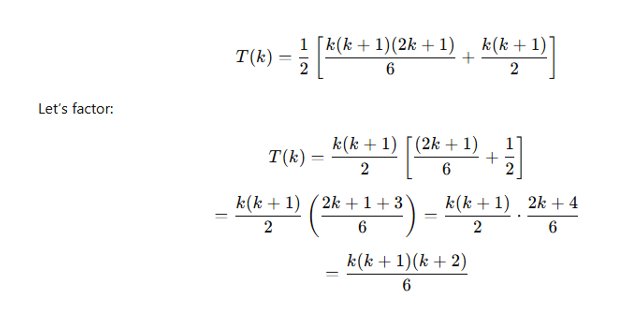
Approach: Total balls in n triangular layers = tetrahedral number n(n + 1)(n + 2)/6.

Solution:
n(n + 1)(n + 2)/6 = 8436 → n(n + 1)(n + 2) = 50616.
∛50616 ≈ 37 → try 36 × 37 × 38 = 50616 ✓
So n = 36 layers. (Check n = 38: 38 × 39 × 40/6 = 9880 ≠ 8436.)

Cetking shortcut: 8436 × 6 = 50616 ends in 6; 36 × 37 × 38 ends in 6 (6 × 7 × 8 = 336), 38 × 39 × 40 ends in 0 — so 36.

Answer: C

Q135HardCET 2025 · Slot 1 · Q135
a, b, c, d and e are 5 distinct numbers that from an arithmetic progression. They are not necessarily consecutive terms but form the first 5 terms of the AP. It is known that c is the arithmetic mean of a and b, and d is the arithmetic mean of b anc c.
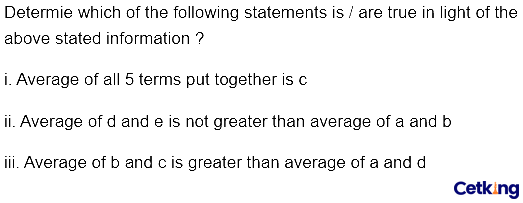
Determie which of the following statements is / are true in light of the above stated information ?
i. Average of all 5 terms put together is c
ii. Average of d and e is not greater than average of a and b
iii. Average of b and c is greater than average of a and d
Figure for MBA CET 2025 Slot 1 question 135
  1. i and ii only
  2. i and iii only
  3. ii and iii only
  4. ii only
  5. i ,ii and iii
Show answerHide answer

Answer: A

Approach: Place a, b, c, d on a number line, then fit e.

Solution:
Take a = 0, b = 4k (k ≠ 0). c = mean of a, b = 2k; d = mean of b, c = 3k
0, 2k, 3k, 4k plus e must be 5 equally spaced values → e = k (common gap k)
So a = 0, e = k, c = 2k, d = 3k, b = 4k
i. Average = (0 + k + 2k + 3k + 4k)/5 = 2k = c → true
ii. Avg(d, e) = 2k, Avg(a, b) = 2k → 'not greater' → true
iii. Avg(b, c) = 3k vs Avg(a, d) = 1.5k → greater only if k > 0; for a decreasing AP (k < 0) it fails → not necessarily true

Why the other options are wrong:
B, C, E: treat iii as always true, but it reverses for a decreasing AP.
D: misses statement i, which holds for every k.

Cetking shortcut: Equalities and 'not greater' (here an equality) survive a sign flip of k; a strict 'greater' comparison does not.

Answer: A

Q141EasyCET 2025 · Slot 1 · Q141
Choose the correct option that should come next in the series given below :
2, 1, (1/2), (1/4), ...
Figure for MBA CET 2025 Slot 1 question 141
  1. 1/16
  2. 2/8
  3. 1/3
  4. 1/32
  5. 1/8
Show answerHide answer

Answer: E

Approach: Identify the common ratio.

Solution:
2 → 1 → ½ → ¼: each term is half the previous one
Next term = ¼ × ½ = 1/8

Why the other options are wrong:
A (1/16), D (1/32): skip one or two terms.
B (2/8): equals 1/4, the current term.
C (1/3): breaks the halving pattern.

Answer: E

Q150MediumCET 2025 · Slot 1 · Q150
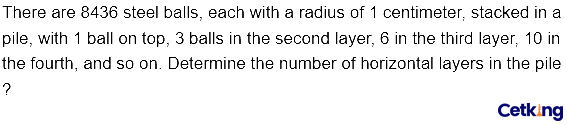
There are 8436 steel balls, each with a radius of 1 centimeter, stacked in a pile, with 1 ball on top, 3 balls in the second layer, 6 in the third layer, 10 in the fourth, and so on. Determine the number of horizontal layers in the pile ?
Figure for MBA CET 2025 Slot 1 question 150
  1. 32
  2. 36
  3. 96
  4. 34
  5. 24
Show answerHide answer

Answer: B

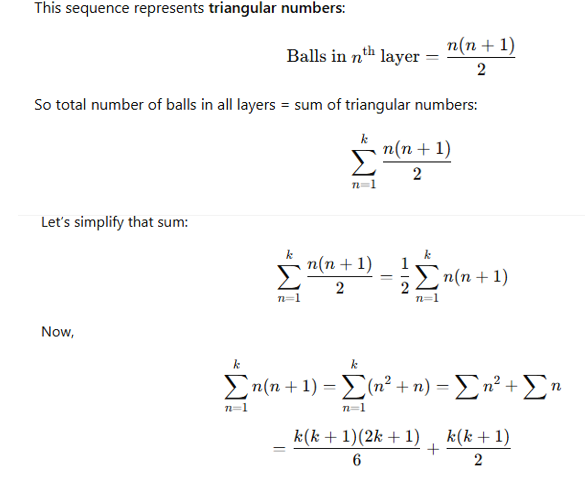
Approach: Sum of triangular numbers = n(n+1)(n+2)/6.

Solution:
Layers: 1, 3, 6, 10, … = n(n+1)/2
Total = n(n+1)(n+2)/6 = 8436
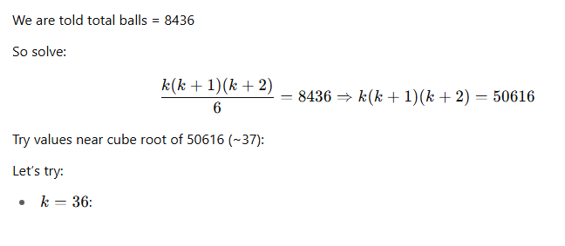
n(n+1)(n+2) = 50616
Cube root of 50616 ≈ 37 → try 36 × 37 × 38 = 50616 ✓
n = 36 layers

Why the other options are wrong:
A (32), D (34): give 5984 and 7140 balls.
E (24): 2600 balls.
C (96): far too many.

Cetking shortcut: n³/6 ≈ 8436 → n³ ≈ 50600 → n ≈ 37 → the middle of three consecutive numbers is 37, so n = 36.

Answer: B

Solution figure for question 150Solution figure for question 150Solution figure for question 150

Practise these in the Arena

Take timed tests built around MBA CET topics and see where you stand.

Open the Arena
Compare CET 2027 programmes
BooksProMocksProShortcutsProBest valueCompletePro
Priceincl. GST₹1,999Inclusive of GST₹2,799₹2,999Inclusive of GST₹10,000₹14,999Inclusive of GST₹18,000₹19,999Inclusive of GST
Planning — Syllabus, Plans, Cutoffs, Strategies
Weekly Plans✓✓✓✓
Pro Calculators✓✓✓✓
MockNiti✓✓—✓
CET Study — Improvement
Purple Books✓——✓
100 G Strategy Shortcuts¹——✓✓
10 Sacred Art of Tukka²——✓✓
Cetking Bibles✓✓✓✓
Practice — From Zero to Expert with timer
40 Mocks—✓—✓
10 PYQs—✓—✓
30 Sectionals✓✓—✓
Arena Pro✓✓✓✓
GDPI — Interview Ready
GDPI Prep———✓
CMAT 2027 Program for +⁠₹100—

Not ready yet? Try our FREE Pack — 1 Full Length Mock, 5 PYQs, Calculators, Arena Access, Weekly Plan

Try for Free
  • ¹ 100 Sacred Art of Shortcuts workshops (Recorded + Live)
  • ² 10 Sacred Art of Tukka workshops (Recorded + Live)

What next

Admit cards · CAT admit card · © Cetking Universe · Terms & Privacy · By using this site, you agree to Cetking's Terms.