Let’s Crack CET 2027

Your CET check-up · tap a ring to see yours

Remainders – MBA CET questions with solutions

14 questions · CET 2025–2026 · Easy 9 · Medium 5 · Hard 0. Newest paper first. Full papers

Q101EasyCET 2026 · Attempt 2 Slot 2 · Q101
What least number must be added to 1056, so that the sum is completely divisible by 23 ?
  1. 2
  2. 4
  3. 3
  4. 5
  5. 1
Show answerHide answer

Answer: A official key

Approach: Remainder method: add (divisor − remainder).

Solution:
1056 ÷ 23: 23 × 45 = 1035, remainder = 1056 − 1035 = 21.
Least number to add = 23 − 21 = 2.
Check: 1058 = 23 × 46.

Cetking shortcut: Nearest multiple above: 23 × 46 = 1058 → 1058 − 1056 = 2.

Answer: A
Q103EasyCET 2026 · Attempt 2 Slot 1 · Q103

A number when divided by 256 gives a remainder 73.
When the same number is divided by 16, what will be the remainder?

  1. 1
  2. 7
  3. 9
  4. 11
  5. 13
Show answerHide answer

Answer: C official key

Approach: Remainder with a divisor that divides the original divisor.

Solution:
N = 256k + 73.
256 = 16 × 16, so 256k leaves remainder 0 when divided by 16.
So remainder = 73 mod 16; 73 = 16 × 4 + 9 → remainder 9.

Cetking shortcut: If the new divisor is a factor of the old one, just divide the old remainder by the new divisor.

Answer: C

Q104EasyCET 2026 · Slot 4 · Q104
What is the units digit of the product 15 * 22 * 37 * 44?
  1. 2
  2. 5
  3. 0
  4. 4
  5. 8
Show answerHide answer

Answer: C official key

Approach: Units digit of a product depends only on the units digits of the factors.

Solution:
Units digits: 5, 2, 7, 4.
5 × 2 = 10 → units digit 0.
Anything × (number ending in 0) ends in 0.
Units digit of 15 × 22 × 37 × 44 = 0.

Why the other options are wrong:
A, D, E (2, 4, 8) – come from ignoring the 5 × 2 pair.
B (5) – 5 × odd ends in 5, but here 5 meets an even number.

Cetking shortcut: A factor ending in 5 together with any even factor always gives units digit 0.

Answer: C

Q113EasyCET 2026 · Slot 4 · Q113
A number when divided by 5 leaves a remainder of 3. What is the remainder when the square of that number is divided by 5?
  1. 1
  2. 2
  3. 3
  4. 4
  5. 0
Show answerHide answer

Answer: D official key

Approach: Remainders multiply: rem(N²) = rem(r²).

Solution:
N = 5k + 3, so N leaves remainder 3.
N² leaves the same remainder as 3² = 9 when divided by 5.
9 = 5 × 1 + 4 ⇒ remainder 4.
Check: N = 8, N² = 64 = 5 × 12 + 4 ✓.

Why the other options are wrong:
C (3) – assumes the remainder stays the same.
A, B, E – arithmetic slips.

Cetking shortcut: Pick the smallest such number (3): 3² = 9 → remainder 4.

Answer: D

Q103EasyCET 2026 · Slot 3 · Q103
Find the remainder when 73 + 75 + 78 + 57 + 197 is divided by 34.
  1. 2
  2. 4
  3. 5
  4. 7
  5. 9
Show answerHide answer

Answer: B official key

Approach: Remainder of a sum = remainder of the sum of individual remainders.

Solution:
Sum = 73 + 75 + 78 + 57 + 197 = 480.
34 × 14 = 476.
480 − 476 = 4.

Cetking shortcut: Remainders by 34: 5 + 7 + 10 + 23 + 27 = 72 → 72 − 68 = 4.

Answer: B

Q46EasyCET 2026 · Slot 1 · Q46
Find the smallest number which leaves a remainder of 3 when divided by 5, 6, 7 and 8 but leaves no remainder when divided by 9 ?
  1. 1683
  2. 1598
  3. 1458
  4. 1692
  5. 1703
Show answerHide answer

Answer: A official key

Approach: Number = LCM(5, 6, 7, 8) × k + 3, then force divisibility by 9.

Solution:
LCM(5, 6, 7, 8) = 840 → N = 840k + 3.
840 = 9 × 93 + 3, so N ≡ 3k + 3 (mod 9).
Need 3k + 3 divisible by 9 → k + 1 divisible by 3 → smallest k = 2.
N = 1680 + 3 = 1683 (digit sum 18 ✓ divisible by 9).

Cetking shortcut: Options must be (multiple of 840) + 3 and have digit sum divisible by 9 — only 1683 (1680 + 3, digit sum 18).

Answer: A

Q146EasyCET 2025 · Slot 6 · Q146
on dividing 30879 by a certain number the question is 67 and the remainder is 327. find the divisor
  1. 476
  2. 456
  3. 466
  4. 444
  5. 457
Show answerHide answer

Answer: B

Approach: Dividend = Divisor × Quotient + Remainder.

Solution:
30879 = 67 × d + 327.
67d = 30879 − 327 = 30552.
d = 30552/67 = 456 (remainder 327 < 456 ✓).

Why the other options are wrong:
A 476, C 466, D 444, E 457: 67 × each + 327 ≠ 30879 (e.g. 67 × 457 + 327 = 30946).

Cetking shortcut: Units digit: 67 × d must end in 2 (…879 − …327) ⇒ 7 × d ends in 2 ⇒ d ends in 6: options 476, 456, 466 — then 30552/67 = 456.

Answer: B

Q147MediumCET 2025 · Slot 6 · Q147
Find remainder when 354¹⁷⁶- 346¹⁷⁶ is divided by 700.
  1. 5
  2. 0
  3. 2
  4. 4
  5. 3
Show answerHide answer

Answer: B

Approach: aⁿ − bⁿ is divisible by (a + b) when n is even.

Solution:
n = 176 is even ⇒ 354¹⁷⁶ − 346¹⁷⁶ is divisible by 354 + 346 = 700.
Remainder = 0.

Why the other options are wrong:
A, C, D, E: non-zero remainders are impossible since 700 divides the expression exactly.

Cetking shortcut: Spot 354 + 346 = 700 and the even power ⇒ remainder 0 instantly.

Answer: B

Q101MediumCET 2025 · Slot 4 · Q101

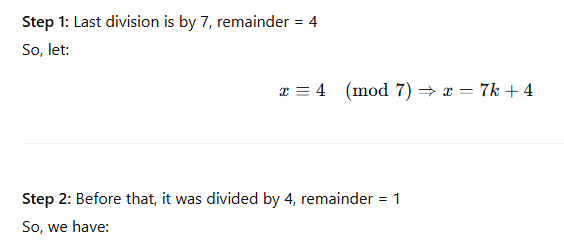
After the division of a number successively by 3, 4 and 7, the remainders obtained are 2,1 and 4 respectively. What will be the remainder if 84 divides the same number?

  1. 50
  2. 48
  3. 53
  4. 80
  5. 72
Show answerHide answer

Answer: C

Approach: Successive division — reconstruct the number from the last quotient.

Solution:
Let the last quotient be k. Work from the innermost division outwards.
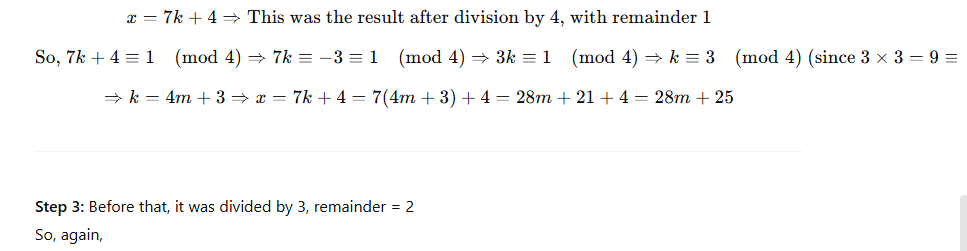
Third division (by 7) leaves 4: the quotient before it = 7k + 4.
Second division (by 4) leaves 1: the quotient before it = 4(7k + 4) + 1 = 28k + 17.
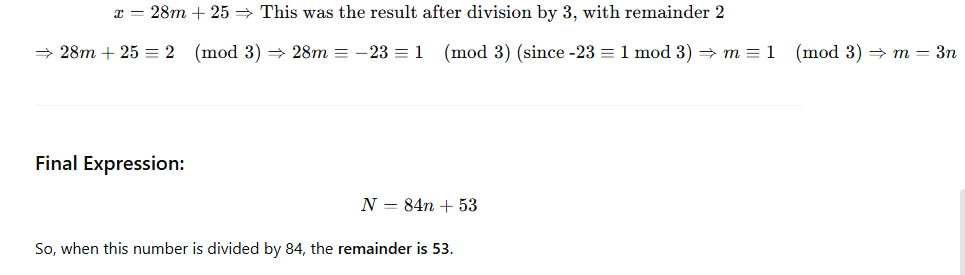
First division (by 3) leaves 2: N = 3(28k + 17) + 2 = 84k + 53.
Note 3 × 4 × 7 = 84, so N = 84k + 53 ⇒ remainder on dividing by 84 = 53.
Check with k = 0: N = 53 → 53 ÷ 3 = 17 r 2; 17 ÷ 4 = 4 r 1; 4 ÷ 7 = 0 r 4. ✓

Cetking shortcut: Remainder by the product of divisors = r1 + d1·r2 + d1·d2·r3 = 2 + 3×1 + 12×4 = 53.

Answer: C

Solution figure for question 101Solution figure for question 101Solution figure for question 101
Q107MediumCET 2025 · Slot 3 · Q107
Find the least number which can be divided by 16, 18, 20 and 25 leaves 4 as a remainder in each case, but when divided by 7 leaves no remainder.
  1. 17004
  2. 18000
  3. 18002
  4. 18004
  5. 19000
Show answerHide answer

Answer: D

Approach: N = LCM(16, 18, 20, 25)·k + 4, then make N divisible by 7.

Solution: 16 = 2⁴, 18 = 2·3², 20 = 2²·5, 25 = 5² → LCM = 2⁴·3²·5² = 3600.
N = 3600k + 4. 3600 ÷ 7 leaves remainder 2, 4 ÷ 7 leaves 4 → N ≡ 2k + 4 (mod 7).
2k + 4 ≡ 0 (mod 7) → 2k ≡ 3 → k = 5 (2·5 + 4 = 14 ✔).
N = 3600 × 5 + 4 = 18,004.

Cetking shortcut: Every option must be 4 more than a multiple of 3600 → only 18004 fits (18000 + 4); check 18004 ÷ 7 = 2572 ✔.

Answer: D

Q99EasyCET 2025 · Slot 2 · Q99
When 3³³³ is divided by 11, the remainder is …?
  1. 1
  2. 10
  3. 3
  4. 11
  5. 5
Show answerHide answer

Answer: E

Approach: Find a small power of 3 that leaves remainder 1 when divided by 11.

Solution:
3⁵ = 243 = 11 × 22 + 1 → 3⁵ ≡ 1 (mod 11).
333 = 5 × 66 + 3 → 3³³³ = (3⁵)⁶⁶ × 3³ ≡ 1 × 27 (mod 11).
27 = 2 × 11 + 5 → remainder 5.

Cetking shortcut: Fermat: 3¹⁰ ≡ 1 (mod 11), but spotting 3⁵ = 243 ≡ 1 is quicker; then only 333 mod 5 = 3 matters.

Answer: E

Q107MediumCET 2025 · Slot 2 · Q107
Find smallest number which leaves remainder 4 when divided by 16, 18, 20, 25, but divisible by 7:
  1. 19000
  2. 18004
  3. 17004
  4. 18000
  5. 18002
Show answerHide answer

Answer: B

Approach: Number = LCM × k + remainder; then apply the divisibility-by-7 condition.

Solution:
16 = 2⁴, 18 = 2 × 3², 20 = 2² × 5, 25 = 5² → LCM = 2⁴ × 3² × 5² = 3600.
Number = 3600k + 4.
3600 = 7 × 514 + 2 → 3600k + 4 ≡ 2k + 4 (mod 7). Need 2k + 4 ≡ 0 → 2k ≡ 3 → k ≡ 5 (mod 7).
Smallest k = 5 → 18000 + 4 = 18004 = 7 × 2572 ✓

Cetking shortcut: Only options ending in 4 qualify (18004, 17004); 17004 − 4 = 17000 is not a multiple of 3600, so 18004.

Answer: B

Q148MediumCET 2025 · Slot 2 · Q148
A University has less than 5000 students. If students are divided equally into teams of either 9, 10, 12, or 25 each, exactly 4 students are always left out. However, dividing them into teams of 11 leaves no student out. Determine the maximum number of teams of 12 students that can be formed.
  1. 150
  2. 250
  3. 100
  4. 10
  5. 75
Show answerHide answer

Answer: A

Approach: Same remainder 4 → number = LCM × k + 4; then impose divisibility by 11.

Solution:
LCM(9, 10, 12, 25) = 2² × 3² × 5² = 900 → x = 900k + 4 < 5000 → k = 0 to 5.
900 ≡ 9 (mod 11) → 9k + 4 ≡ 0 (mod 11) → 9k ≡ 7 → k ≡ 2 (mod 11).
Only k = 2 → x = 1804 (= 11 × 164 ✓).
Teams of 12: 1804 ÷ 12 = 150 remainder 4 → maximum 150 teams.

Cetking shortcut: List 4, 904, 1804, 2704, 3604, 4504 and test divisibility by 11 (alternating digit sums): only 1804.

Answer: A

Q104EasyCET 2025 · Slot 1 · Q104
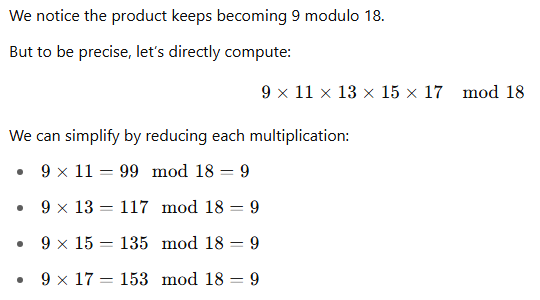
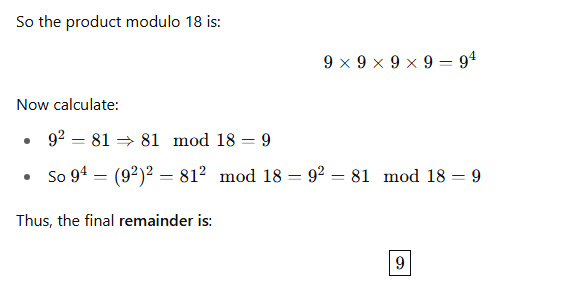
Find the remainder when : (1719 X 1721 X 1723 X 1725 X 1727) is divided by 18 ?
Figure for MBA CET 2025 Slot 1 question 104
  1. 9
  2. 1
  3. 19
  4. 31
  5. 7
Show answerHide answer

Answer: A

Approach: Replace each factor by its remainder mod 18.

Solution:
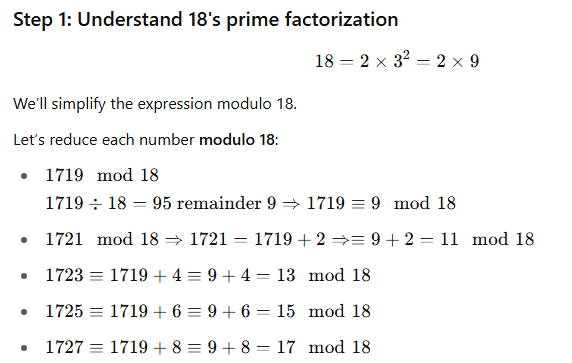
1719 = 18 × 95 + 9 → 9
1721 → 11, 1723 → 13, 1725 → 15, 1727 → 17
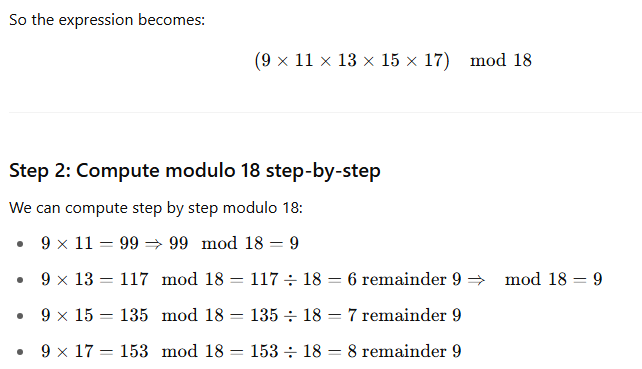
Product ≡ 9 × (11 × 13 × 15 × 17) (mod 18)
11 × 13 × 15 × 17 is odd, and 9 × odd ≡ 9 (mod 18)
Remainder = 9

Cetking shortcut: One factor leaves 9 and all others are odd: 9 × odd always leaves 9 on division by 18.

Answer: A

Solution figure for question 104Solution figure for question 104Solution figure for question 104Solution figure for question 104

Practise these in the Arena

Take timed tests built around MBA CET topics and see where you stand.

Open the Arena