Let’s Crack CET 2027

Your CET check-up · tap a ring to see yours

Syllogism – MBA CET questions with solutions

26 questions · CET 2025–2026 · Easy 23 · Medium 3 · Hard 0. Newest paper first. Full papers

Q18EasyCET 2026 · Attempt 2 Slot 2 · Q18
Statements: No women teacher can play. Some women teachers are athletes.

Conclusions:
1. Male athletes can play.
2. Some athletes can play.
  1. Only conclusion I follows
  2. Only conclusion II follows
  3. Either I or II follows
  4. Neither I nor II follows
  5. Both I and II follow
Show answerHide answer

Answer: D official key

Approach: Syllogism — 'No' + 'Some' statements; check only definite conclusions.

Solution:
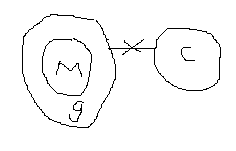
No women teacher can play: the women-teacher circle is separate from 'players'.
Some women teachers are athletes: athlete circle overlaps women teachers.
Those athletes who are women teachers cannot play; about other athletes nothing is known.
I. 'Male athletes can play' — males are never mentioned → does not follow.
II. 'Some athletes can play' — only a possibility, not certain → does not follow.

Why the other options are wrong:
A, E: I introduces a new term (male athletes).
B, E: II is possible but not definite.
C: I and II are not a complementary pair, so 'either-or' cannot apply.

Cetking shortcut: From 'Some A are B' + 'No A is C' the valid conclusion is 'Some B are not C' — here 'Some athletes cannot play', which is neither option.

Answer: D
Q19EasyCET 2026 · Attempt 2 Slot 2 · Q19
Statement: All mangoes are golden in colour. No golden colored things are cheap.

Conclusions:
I. All mangoes are cheap.
II. Golden colored mangoes are not cheap.
  1. Only conclusion I follows
  2. Only conclusion II follows
  3. Either I or II follows
  4. Neither I nor II follows
  5. Both I and II follow
Show answerHide answer

Answer: B official key

Approach: Syllogism — 'All' + 'No' gives a definite 'No'.

Solution:
All mangoes are golden; no golden thing is cheap.
Mangoes sit fully inside 'golden', which has no overlap with 'cheap' → no mango is cheap.
I. All mangoes are cheap — contradicts the result → does not follow.
II. Golden-coloured mangoes are not cheap — every mango is golden and not cheap → follows.

Why the other options are wrong:
A, E: I is directly contradicted.
C: 'either-or' needs one of the two always true while neither is certain; here II is certain.
D: II does follow.

Cetking shortcut: All A are B + No B is C ⇒ No A is C — a standard valid form.

Answer: B

Q25MediumCET 2026 · Attempt 2 Slot 2 · Q25
Statements : All cups are glasses. Some glasses are bowls. No bowl is a plate.

Conclusions :
I. No cup is a plate.
II. No glass is a plate.
III. Some plates are bowls.
IV. Some cups are not glasses.
  1. Only either I or III follows
  2. Only II and III follow
  3. Only III and IV follow
  4. Only I follows
  5. None follows
Show answerHide answer

Answer: E official key

Approach: Syllogism with four conclusions — accept only definite ones.

Solution:
Cups ⊂ Glasses; Glasses overlap Bowls; Bowls and Plates are disjoint.
I. No cup is a plate — cups and plates are never linked; a cup may or may not be a plate → does not follow.
II. No glass is a plate — glasses that are not bowls may be plates → does not follow.
III. Some plates are bowls — contradicts 'No bowl is a plate' → false.
IV. Some cups are not glasses — contradicts 'All cups are glasses' → false.
None of the conclusions follows.

Why the other options are wrong:
A: I and III are not complementary (III is outright false), so 'either-or' fails.
B, C, D: each includes a conclusion that is only possible or plainly false.

Cetking shortcut: 'No' links only the two terms named; it cannot be extended through a 'Some' link to cups or glasses.

Answer: E

Q71EasyCET 2026 · Attempt 2 Slot 1 · Q71

DIRECTIONS for the question: In the following question two statements are given followed by two conclusions numbered I and II. You have to take the given statements to be true even if they seem to be at variance with commonly known facts. Read the conclusions and then decide which of the given conclusion/s logically follows from the two given statements, disregarding commonly known facts.

Give Answer

a] if only conclusion I follows;

b] if only conclusion II follows;

c] if either conclusion I or II follows;

d] if neither conclusion I or II follows;

e] if both conclusion I and II follows;

Statements:

No win is a loss.

All losses are victories.

Conclusions:

I. No victory is a win

II. Some victories are wins

  1. if only conclusion I follows;
  2. if only conclusion II follows;
  3. if either conclusion I or II follows;
  4. if neither conclusion I or II follows;
  5. if both conclusion I and II follows;
Show answerHide answer

Answer: C official key

Approach: Draw the minimum Venn, test each conclusion, then check for a complementary pair.

Solution:
No win is a loss; all losses are victories.
Wins sit outside Loss, but may or may not overlap Victory (outside the Loss part).
I (No victory is a win): not certain.
II (Some victories are wins): not certain.
Same subject and predicate, one 'No', one 'Some' → exactly one must be true → either I or II.

Why the other options are wrong:
A / B / E: neither conclusion is definite on its own.
D: ignores the complementary pair.

Cetking shortcut: Neither definite + same two terms + 'No' vs 'Some' → straight to 'either'.

Answer: C

Q72EasyCET 2026 · Attempt 2 Slot 1 · Q72

DIRECTIONS for the question: In the following question two statements are given followed by two conclusions numbered I and II. You have to take the given statements to be true even if they seem to be at variance with commonly known facts. Read the conclusions and then decide which of the given conclusion/s logically follows from the two given statements, disregarding commonly known facts.

Give Answer

a] if only conclusion I follows;

b] if only conclusion II follows;

c] if either conclusion I or II follows;

d] if neither conclusion I or II follows;

e] if both conclusion I and II follows;

Statements:

Some pens are erasers.

All sharpeners are pens.

Conclusions:

I. All sharpeners being erasers is a possibility.

II. All erasers are pen.

  1. if only conclusion I follows;
  2. if only conclusion II follows;
  3. if either conclusion I or II follows;
  4. if neither conclusion I or II follows;
  5. if both conclusion I and II follows;
Show answerHide answer

Answer: A official key

Approach: Test the possibility case and the definite case separately.

Solution:
Some pens are erasers; all sharpeners are pens.
I: Sharpeners lie inside Pens; nothing stops all of them from also being inside Erasers → possible → follows.
II: Only 'some pens are erasers' is given; erasers can lie partly outside Pens → does not follow.

Why the other options are wrong:
B / E: II is not certain.
C: I already follows definitely.
D: I follows.

Answer: A

Q73EasyCET 2026 · Attempt 2 Slot 1 · Q73

DIRECTIONS for the question: In the following question two statements are given followed by two conclusions numbered I and II. You have to take the given statements to be true even if they seem to be at variance with commonly known facts. Read the conclusions and then decide which of the given conclusion/s logically follows from the two given statements, disregarding commonly known facts.

Give Answer

a] if only conclusion I follows;

b] if only conclusion II follows;

c] if either conclusion I or II follows;

d] if neither conclusion I or II follows;

e] if both conclusion I and II follows;

Statements:

All squares are circles.

No circle is a triangle.

Conclusions:

I. No square is a triangle.

II. All circle are squares.

  1. if only conclusion I follows;
  2. if only conclusion II follows;
  3. if either conclusion I or II follows;
  4. if neither conclusion I or II follows;
  5. if both conclusion I and II follows;
Show answerHide answer

Answer: A official key

Approach: Use the All + No rule.

Solution:
All squares are circles; no circle is a triangle.
Squares lie inside Circles, which are fully apart from Triangles → no square is a triangle → I follows.
II reverses an 'All' statement → does not follow.

Why the other options are wrong:
B / E: II is invalid.
C: I follows definitely.
D: I follows.

Answer: A

Q74EasyCET 2026 · Attempt 2 Slot 1 · Q74

DIRECTIONS for the question: In the following question two statements are given followed by two conclusions numbered I and II. You have to take the given statements to be true even if they seem to be at variance with commonly known facts. Read the conclusions and then decide which of the given conclusion/s logically follows from the two given statements, disregarding commonly known facts.

Give Answer

a] if only conclusion I follows;

b] if only conclusion II follows;

c] if either conclusion I or II follows;

d] if neither conclusion I or II follows;

e] if both conclusion I and II follows;

Statements:

No place is a tank.

Some places are venues.

Conclusions:

I. Some places are tanks.

II. All places are venues.

  1. if only conclusion I follows;
  2. if only conclusion II follows;
  3. if either conclusion I or II follows;
  4. if neither conclusion I or II follows;
  5. if both conclusion I and II follows;
Show answerHide answer

Answer: D official key

Approach: Check each conclusion directly against the statements.

Solution:
No place is a tank; some places are venues.
I (Some places are tanks): contradicts 'No place is a tank' → does not follow.
II (All places are venues): only 'some' is given → does not follow.
I and II use different terms, so no either-or → neither follows.

Why the other options are wrong:
A / B / E: neither conclusion is valid.
C: either-or needs a pair on the same two terms.

Answer: D

Q75EasyCET 2026 · Attempt 2 Slot 1 · Q75

DIRECTIONS for the question: In the following question two statements are given followed by two conclusions numbered I and II. You have to take the given statements to be true even if they seem to be at variance with commonly known facts. Read the conclusions and then decide which of the given conclusion/s logically follows from the two given statements, disregarding commonly known facts.

Give Answer

a] if only conclusion I follows;

b] if only conclusion II follows;

c] if either conclusion I or II follows;

d] if neither conclusion I or II follows;

e] if both conclusion I and II follows;

Statements:

All dancers are artists.

No artist is a racer.

Conclusions:

I No dancer is a racer.

II. At least some dancers are racers.

  1. if only conclusion I follows;
  2. if only conclusion II follows;
  3. if either conclusion I or II follows;
  4. if neither conclusion I or II follows;
  5. if both conclusion I and II follows;
Show answerHide answer

Answer: A official key

Approach: Use the All + No rule.

Solution:
All dancers are artists; no artist is a racer.
Dancers lie inside Artists, which are fully apart from Racers → no dancer is a racer → I follows.
II contradicts I → does not follow.

Why the other options are wrong:
B / E: II is false.
C: 'Either' is used only when neither is definite.
D: I follows.

Answer: A

Q72EasyCET 2026 · Slot 4 · Q72

Below are two statements, followed by two conclusions. Assume both statements are true, even if they contradict common knowledge. Read the conclusions and choose which one logically follows from the two statements.

Statements:
1. All pens are pencils.
2. Some pens are erasers.

Conclusions:
I. Some pencils are erasers.
II. Some erasers are pencils.

  1. Only conclusion I follows
  2. Only conclusion II follows
  3. Either I or II follows
  4. Neither I nor II follows
  5. Both I and II follow
Show answerHide answer

Answer: E official key

Approach: Syllogism: All A are B + Some A are C → Some B are C (and its converse).

Solution: 'All pens are pencils' and 'Some pens are erasers' → the pens that are erasers are also pencils → Some pencils are erasers (I follows).
'Some' statements convert: Some erasers are pencils (II follows).

Why the other options are wrong: A and B miss that I and II are conversions of each other; C applies only to complementary pairs; D ignores the definite overlap.

Cetking shortcut: If I follows, its direct conversion II also follows – mark both.

Answer: E

Q73EasyCET 2026 · Slot 4 · Q73

Below are two statements, followed by two conclusions. Assume both statements are true, even if they contradict common knowledge. Read the conclusions and choose which one logically follows from the two statements.

Statements:
1. Some books are pens.
2. Some pens are erasers.

Conclusions:
I. All books are erasers.
II. Some erasers are books.

  1. Only conclusion I follows
  2. Only conclusion II follows
  3. Either I or II follows
  4. Neither I nor II follows
  5. Both I and II follow
Show answerHide answer

Answer: D official key

Approach: Syllogism: Some + Some gives no definite conclusion.

Solution: 'Some books are pens' and 'Some pens are erasers' – the pens that are books and the pens that are erasers need not overlap.
I: 'All books are erasers' – not definite. II: 'Some erasers are books' – not definite.
Neither follows, and they do not form a complementary pair, so 'either' is ruled out.

Why the other options are wrong: A, B, E claim a definite link that does not exist; C needs a complementary pair (Some/No on the same terms), which is not the case here.

Cetking shortcut: Some + Some = no conclusion – decide in five seconds.

Answer: D

Q71EasyCET 2026 · Slot 2 · Q71

In question below are given two statements followed by two conclusions numbered I and II. You have to take the given two statements to be true even if they seem to be at variance from commonly known facts. Read the conclusion and then decide which of the given conclusions logically follows from the two given statements, disregarding commonly known facts.

Give answer:
(A) If only conclusion I follows
(B) If only conclusion II follows
(C) If either I or II follows
(D) If neither I nor II follows and
(E) If both I and II follow.

Statements: All young scientists are open-minded.
No open-minded men are superstitious.

Conclusions:
1. No scientist is superstitious.
2. No young people are superstitious.

  1. A
  2. B
  3. C
  4. D
  5. E
Show answerHide answer

Answer: D official key

Approach: Syllogism: All A are B + No B is C ⇒ No A is C (only for A).

Solution:
All young scientists are open-minded; no open-minded man is superstitious.
Valid inference: No young scientist is superstitious.
Conclusion I talks of all scientists — older scientists are not covered by the statements → does not follow.
Conclusion II talks of all young people — young non-scientists are not covered → does not follow.
Neither follows.

Why the other options are wrong:
A, E: Conclusion I generalises "young scientists" to all scientists.
B, E: Conclusion II generalises to all young people.
C: I and II are not a complementary pair, so "either-or" does not apply.

Cetking shortcut: The derived conclusion must keep the exact subject term ("young scientists"); any wider subject fails.

Answer: D

Q72EasyCET 2026 · Slot 2 · Q72

In question below two statements are given followed by two conclusions numbered I and II. You have to take the given two statements to be true even if they seem to be at variance from commonly known facts. Read the conclusion and then decide which of the given conclusions logically follows from the two given statements, disregarding commonly known facts.

Give answer:
(A) If only conclusion I follows
(B) If only conclusion II follows
(C) If either I or II follows
(D) If neither I nor II follows and
(E) If both I and II follow.

Statements: Raman is always successful.
No fool is always successful.

Conclusions:
1. Raman is a fool.
2. Raman is not a fool.

  1. A
  2. B
  3. C
  4. D
  5. E
Show answerHide answer

Answer: B official key

Approach: If a member belongs to a class, and no fool belongs to that class, the member is not a fool.

Solution:
Raman ∈ {always successful}.
No fool ∈ {always successful}.
So Raman ∉ {fools} → Conclusion II follows, Conclusion I is contradicted.

Why the other options are wrong:
A: Conclusion I contradicts the statements.
C: "either" needs both to be possible; I is impossible.
D: II follows definitely.
E: I does not follow.

Answer: B

Q27MediumCET 2026 · Slot 1 · Q27

Given below are Two Statements, followed by Two Conclusions, A and B. Assume both Statements are true [even if they contradict common knowledge].

Then based on the Statements, choose the Conclusion(s) which logically follow(s) from the Two Statements.

Statement I : All students who study regularly pass exams.

Statement II : John studies regularly.

Conclusion :

A : John is a student.

B : John will pass the exams.

  1. Only Conclusion A follows
  2. Only Conclusion B follows
  3. Either Conclusion A or Conclusion B follows
  4. Neither Conclusion A nor Conclusion B follows
  5. Both Conclusion A and Conclusion B follow
Show answerHide answer

Official CET key: E · Cetking's answer: B — see why below

Approach: Apply 'All who do X do Y' to the person who does X — the examiner reads Statement II in the context of Statement I (John as one of the students).

Solution:
Statement I talks about students who study regularly; Statement II places John in that group by saying he studies regularly.
Read this way, John is one of the students → Conclusion A follows.
Students who study regularly all pass → John will pass → Conclusion B follows.
Hence both conclusions follow (as per the official key).

Note: In strict syllogism logic, Statement II never says John is a student, so A cannot be derived and B depends on A — a strict reading would give 'Neither'. The official key treats John as a student in context.

Why the other options are wrong (official reading):
A / B – each alone ignores that the context makes both true.
C – 'Either' is only for complementary pairs, which these are not.
D – rejects the contextual reading the key uses.

Answer: E

Q28EasyCET 2026 · Slot 1 · Q28

Given below are Two Statements, followed by Two Conclusions, A and B. Assume both Statements are true [even if they contradict common knowledge].

Then based on the Statements, choose the Conclusion(s) which logically follow(s) from the Two Statements.

Statements : All dogs are mammals.

Some mammals are cats.

Conclusion :

A : All dogs are cats.

B : Some cats are dogs.

  1. Only Conclusion A follows
  2. Only Conclusion B follows
  3. Either Conclusion A or Conclusion B follows
  4. Neither Conclusion A nor Conclusion B follows
  5. Both Conclusion A and Conclusion B follow
Show answerHide answer

Answer: D official key

Approach: Venn method — draw the least-overlap case.

Solution:
Dogs lie fully inside Mammals. Cats overlap Mammals partly.
Draw Cats overlapping Mammals in a region outside Dogs — both statements stay true and Dogs and Cats never meet.
A: All dogs are cats ✗ (not even some are certain).
B: Some cats are dogs ✗ (no overlap is forced).
Neither follows.

Why the other options are wrong: A, B, E need a definite dog–cat overlap; C (either) needs a complementary pair — A and B are not complementary.

Cetking shortcut: 'All + Some' with the common term (mammals) not distributed in both gives no definite conclusion.

Answer: D

Q29EasyCET 2026 · Slot 1 · Q29

Given below are Two Statements, followed by Two Conclusions, A and B. Assume both Statements are true [even if they contradict common knowledge].

Then based on the Statements, choose the Conclusion(s) which logically follow(s) from the Two Statements.

Statement : All bags are cakes.

All lamps are cakes.

Conclusion :

A : Some lamps are bags.

B : No lamp is a bag.

  1. Only Conclusion A follows
  2. Only Conclusion B follows
  3. Either Conclusion A or Conclusion B follows
  4. Neither Conclusion A nor Conclusion B follows
  5. Both Conclusion A and Conclusion B follow
Show answerHide answer

Answer: C official key

Approach: Check for a complementary (either–or) pair when no definite conclusion exists.

Solution:
Bags and Lamps are both inside Cakes, with no stated relation between them.
So 'Some lamps are bags' is not certain and 'No lamp is a bag' is not certain individually.
But the two are complementary: either some lamps are bags or none are — one must be true.
Hence Either A or B follows.

Why the other options are wrong: A only / B only – neither is definite; Neither – ignores the complementary pair; Both – they contradict each other.

Cetking shortcut: Same subject–predicate pair, one 'Some' and one 'No', neither definite → Either–or.

Answer: C

Q30EasyCET 2026 · Slot 1 · Q30

Given below are Two Statements, followed by Two Conclusions, A and B. Assume both Statements are true [even if they contradict common knowledge].

Then based on the Statements, choose the Conclusion(s) which logically follow(s) from the Two Statements.

Statements : All roads are poles.

No pole is a house.

Conclusion :

A : Some roads are houses.

B : Some houses are poles.

  1. Only Conclusion A follows
  2. Only Conclusion B follows
  3. Either Conclusion A or Conclusion B follows
  4. Neither Conclusion A nor Conclusion B follows
  5. Both Conclusion A and Conclusion B follow
Show answerHide answer

Answer: D official key

Approach: Combine 'All' with 'No' through the middle term.

Solution:
All roads are poles, and no pole is a house → no road is a house (definite).
A: Some roads are houses — contradicts the definite 'No road is a house' ✗.
B: Some houses are poles — contradicts 'No pole is a house' ✗.
Neither follows.

Why the other options are wrong: A, B, E need conclusions that directly contradict the statements; C needs a complementary pair, which is absent.

Answer: D

Q31EasyCET 2026 · Slot 1 · Q31

Given below are Two Statements, followed by Two Conclusions, A and B. Assume both Statements are true [even if they contradict common knowledge].

Then based on the Statements, choose the Conclusion(s) which logically follow(s) from the Two Statements.

Statements : All pens are chalk.

All chairs are chalk.

Conclusion :

A : Some pens are chairs.

B : Some chalks are pens.

  1. Only Conclusion A follows
  2. Only Conclusion B follows
  3. Either Conclusion A or Conclusion B follows
  4. Neither Conclusion A nor Conclusion B follows
  5. Both Conclusion A and Conclusion B follow
Show answerHide answer

Answer: B official key

Approach: Two 'All' statements into the same set give no link between the subsets, but each 'All' can be converted to 'Some'.

Solution:
Pens and Chairs both lie inside Chalk; they may or may not overlap.
A: Some pens are chairs — not certain ✗.
B: All pens are chalk → some chalks are pens (conversion of 'All') ✓.
Only B follows.

Why the other options are wrong: A only / Both – pen–chair overlap is not forced; Either – A and B are not complementary; Neither – misses the valid conversion in B.

Cetking shortcut: 'All X are Y' always gives 'Some Y are X' — check for this conversion first.

Answer: B

Q25EasyCET 2025 · Slot 5 · Q25

In the question below, two statements are given, followed by two conclusions numbered I and II. You have to take the given two statements to be true even if they seem to be at variance from commonly known facts. Read the conclusion and then decide which of the given conclusions logically follows from the two given statements, disregarding commonly known facts.

Statements: No women teacher can play. Some women teachers are athletes.

Conclusions:

I. Male athletes can play

II. Some athletes can play

  1. Only conclusion I follows
  2. Only conclusion II follows
  3. Either I or II follows
  4. Neither I nor II follows
  5. Both I and II follow
Show answerHide answer

Answer: D

Approach: Syllogism — Venn diagram, test each conclusion for certainty.

Solution: No women teacher can play → the set "women teachers" lies fully outside "can play".
Some women teachers are athletes → those athletes cannot play.
I: Male athletes are never mentioned → cannot be concluded.
II: The only athletes we know about are ones who cannot play; other athletes may or may not play → "Some athletes can play" is only a possibility, not certain.
Neither follows.

Why the other options are wrong:
A, B, E — each claims a conclusion that is only possible.
C Either–or — needs a complementary pair; I and II are not complementary.

Cetking shortcut: Valid from "No A is B" + "Some A is C" is only "Some C are not B" — here "Some athletes cannot play". Anything positive about athletes playing is a trap.

Answer: D

Q6EasyCET 2025 · Slot 4 · Q6

In the question given below, two statements are given, followed by two conclusions numbered I and II. You have to take the given two statements to be true even if they seem to be at variance from commonly known facts. Read the conclusion and then decide which of the given conclusions logically follows from the two given statements, disregarding commonly known facts.

Statements: No women teacher can play. Some women teachers are athletes.

Conclusions:
1. Male athletes can play.
2. Some athletes can play.

  1. Only 1 follows
  2. Only 2 follows
  3. Either 1 or 2 follows
  4. Neither 1 nor 2 follows
  5. Both 1 and 2 follow
Show answerHide answer

Answer: D

Approach: Syllogism — draw Venn diagrams; a conclusion follows only if it is true in every possible diagram.

Solution:
No women teacher (W) can play (P) → W and P are separate circles.
Some W are athletes (A) → A overlaps W.
Conclusion 1 — 'Male athletes can play': the statements say nothing about males → does not follow.
Conclusion 2 — 'Some athletes can play': A and P may or may not overlap (a case with no overlap is possible) → does not follow.
What does follow is 'Some athletes cannot play' — not given here.

Why the other options are wrong:
A, E: Conclusion 1 brings in 'males', an outside term.
B: A–P overlap is only a possibility.
C: the two conclusions are not a complementary pair, so 'either-or' does not apply.

Cetking shortcut: Some + No → 'Some ... not' conclusion only. Any positive 'some' between the outer terms fails.

Answer: D

Solution figure for question 6
Q7EasyCET 2025 · Slot 4 · Q7

In the question given below, two statements are given, followed by two conclusions numbered I and II. You have to take the given two statements to be true even if they seem to be at variance from commonly known facts. Read the conclusion and then decide which of the given conclusions logically follows from the two given statements, disregarding commonly known facts.

Statements: All mangoes are golden in colour. No golden-coloured things are cheap.

Conclusions:
1. All mangoes are cheap.
2. Golden-coloured mangoes are not cheap.

  1. Only 1 follows
  2. Only 2 follows
  3. Either 1 or 2 follows
  4. Neither 1 nor 2 follows
  5. Both 1 and 2 follow
Show answerHide answer

Answer: B

Approach: Syllogism — draw Venn diagrams; a conclusion follows only if it is true in every possible diagram.

Solution:
All mangoes (M) are golden (G) → M inside G.
No golden thing is cheap (C) → G and C separate, so M and C are separate too.
Conclusion 1 — 'All mangoes are cheap': opposite of the definite 'No mango is cheap' → false.
Conclusion 2 — 'Golden-coloured mangoes are not cheap': all mangoes are golden and nothing golden is cheap → follows.

Why the other options are wrong:
A, E: Conclusion 1 contradicts the statements.
C: either-or needs a complementary pair where neither is definite; here 2 is definite.
D: Conclusion 2 does follow.

Cetking shortcut: All + No → No (All A are B, No B is C ⇒ No A is C).

Answer: B

Solution figure for question 7
Q8EasyCET 2025 · Slot 4 · Q8

In the question given below, two statements are given, followed by two conclusions numbered I and II. You have to take the given two statements to be true even if they seem to be at variance from commonly known facts. Read the conclusion and then decide which of the given conclusions logically follows from the two given statements, disregarding commonly known facts.

Statements: All flowers are trees. No fruit is tree.

Conclusions:
1. No fruit is flower.
2. Some trees are flowers.

  1. Only 1 follows
  2. Only 2 follows
  3. Either 1 or 2 follows
  4. Neither 1 nor 2 follows
  5. Both 1 and 2 follow
Show answerHide answer

Answer: E

Approach: Syllogism — draw Venn diagrams; a conclusion follows only if it is true in every possible diagram.

Solution:
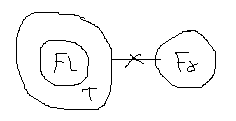
All flowers (Fl) are trees (T) → Fl inside T.
No fruit (Fr) is a tree → Fr outside T, so Fr is outside Fl as well.
Conclusion 1 — 'No fruit is flower': follows (Fr is completely outside T, which contains Fl).
Conclusion 2 — 'Some trees are flowers': conversion of 'All flowers are trees' → follows.

Why the other options are wrong:
A, B: each leaves out a conclusion that does follow.
C: either-or is only for a complementary pair where neither follows definitely.
D: both follow.

Cetking shortcut: 'All A are B' always converts to 'Some B are A'; No + All (reversed) → No.

Answer: E

Solution figure for question 8
Q9EasyCET 2025 · Slot 4 · Q9

In the question given below, two statements are given, followed by two conclusions numbered I and II. You have to take the given two statements to be true even if they seem to be at variance from commonly known facts. Read the conclusion and then decide which of the given conclusions logically follows from the two given statements, disregarding commonly known facts.

Statements: Some swords are sharp. All swords are rusty.

Conclusions:
1. Some rusty things are sharp.
2. Some rusty things are not sharp.

  1. Only 1 follows
  2. Only 2 follows
  3. Either 1 or 2 follows
  4. Neither 1 nor 2 follows
  5. Both 1 and 2 follow
Show answerHide answer

Answer: A

Approach: Syllogism — draw Venn diagrams; a conclusion follows only if it is true in every possible diagram.

Solution:
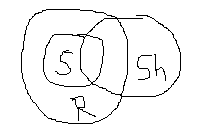
All swords (S) are rusty (R) → S inside R.
Some swords are sharp (Sh) → Sh overlaps S, hence overlaps R.
Conclusion 1 — 'Some rusty things are sharp': the sharp swords are rusty → follows.
Conclusion 2 — 'Some rusty things are not sharp': all rusty things could be sharp (R inside Sh is possible) → does not follow.

Why the other options are wrong:
B, E: Conclusion 2 is only a possibility.
C: Conclusion 1 is definite, so 'either-or' does not apply.
D: Conclusion 1 does follow.

Cetking shortcut: With only positive statements, a negative conclusion can never be definite.

Answer: A

Solution figure for question 9
Q74EasyCET 2025 · Slot 3 · Q74
In the following question, three statements are given, followed by three conclusions numbered I, II, III. You have to take the given statements to be true even if they seem to be at variance with commonly known facts. Read all the conclusions and then decide which of the given conclusion/s logically follows from the given statements, disregarding commonly known facts.
Statements: Some hills are rivers. Some rivers are deserts. All deserts are roads.
Conclusions: I. Some roads are tigers. II. Some roads are hills. III. Some deserts are hills.
  1. None follows
  2. Only one follows
  3. Only I and II follow
  4. Only II and III follow
  5. All follow
Show answerHide answer

Answer: A

Approach: Syllogism: draw the possible Venn diagram and test each conclusion.

Solution:
Hills–Rivers: some (partial overlap). Rivers–Deserts: some. Deserts ⊂ Roads.
I. Some roads are tigers: tigers are not mentioned at all, so ✗.
II. Some roads are hills: hills meet rivers, but that part may lie outside deserts and roads. Not certain, so ✗.
III. Some deserts are hills: deserts meet rivers in a different part from hills. Not certain, so ✗.
No conclusion must be true, so None follows.

Why the other options are wrong:
B, C, D, E: each needs at least one of I, II, III to follow, and none does.

Cetking shortcut: Two 'some' statements in a chain (some + some) never give a definite conclusion. Here hills reach roads only through two 'some' links, so nothing follows.

Answer: A

Q25EasyCET 2025 · Slot 2 · Q25

Statements: Some hills are rivers. Some rivers are deserts. All deserts are roads.

Conclusions:
I. Some roads are rivers.
II. Some roads are hills.
III. Some deserts are hills.

  1. None follows
  2. Only I follows
  3. Only I and II follow
  4. Only II and III follow
  5. All follow
Show answerHide answer

Answer: B

Approach: Venn diagram / syllogism rules: 'Some + All' gives 'Some'; 'Some + Some' gives nothing.

Solution:
Some rivers are deserts + All deserts are roads → Some rivers are roads → Some roads are rivers. I follows.
Hills connect to rivers only through 'some' – no definite link to roads or deserts. II and III do not follow.

Why the other options are wrong: II (roads–hills) and III (deserts–hills) are possible but not certain, so any option including them is wrong; 'None' ignores I.

Cetking shortcut: Two 'Some' statements in a chain never give a definite conclusion – so II and III are out immediately.

Answer: B

Q26MediumCET 2025 · Slot 2 · Q26

Statements: All tigers are jungles. No jungle is bird. Some birds are rains.

Conclusions:
I. No rain is jungle.
II. Some rains are jungles.
III. No bird is tiger.

  1. Only I and II follow
  2. Only III follows
  3. Only either I or II follows, and III follows
  4. All follow
  5. None follows
Show answerHide answer

Answer: C

Approach: Syllogism rules plus the complementary-pair (either–or) check.

Solution:
All tigers are jungles + No jungle is bird → No tiger is bird → III follows.
Rains link to jungles only through birds ('some birds are rains', 'no jungle is bird') – no definite relation.
I 'No rain is jungle' and II 'Some rains are jungles' have the same subject and predicate and together cover all cases, so either I or II follows.

Why the other options are wrong: I and II can never both be true; 'Only III' ignores the either–or pair; 'All' and 'None' are wrong.

Cetking shortcut: 'Some X are Y' and 'No X is Y' with no definite link = classic either–or pair.

Answer: C

Q39EasyCET 2025 · Slot 1 · Q39

The Six statements below that are labelled as A, B, C, D, E and F are then followed by four combinations of three statements.

Choose the set in which the statements are logically related i.e the third statement can be deduced from the first two statements together. Read the information carefully and answer the question.

A. All honest persons are good natured.
B. Some good natured persons are not honest.
C. Some honest persons are good natured.
D. All honest person are obese.
E. All obese person are good natured.
F. Some good natured person are honest.

  1. BEA
  2. ECF
  3. CEA
  4. FBD
  5. DEA
Show answerHide answer

Answer: E

Approach: Syllogism chain: All–All gives All.

Solution:
D: All honest persons are obese.
E: All obese persons are good natured.
D + E → All honest persons are good natured = statement A.
So DEA is the valid set.

Why the other options are wrong:
A BEA — 'Some good natured are not honest' + E cannot give 'All honest are good natured'.
B ECF — F follows from C alone (conversion), not from E and C together.
C CEA — 'some' + 'all' cannot give an 'all' conclusion.
D FBD — two 'some' statements give no conclusion.

Cetking shortcut: Look for two 'All' statements with a shared middle term (obese) — DEA.

Answer: E

Practise these in the Arena

Take timed tests built around MBA CET topics and see where you stand.

Open the Arena