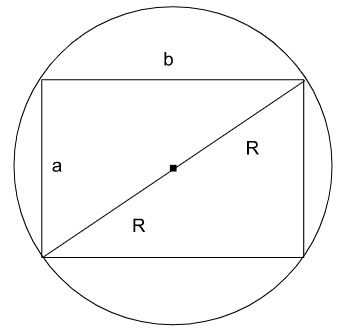
All the vertices of a rectangle lie on a circle of radius R. If the perimeter of the rectangle is P, then the area of the rectangle is:
CAT 2026Papers & G StrategyQuantTopic-wise past questions
From IIMking.com · part of Cetking Universe
CAT Questions on Geometry - Circles
1. CAT 2022 QA Slot 1 | Geometry - Circles CAT Question
Question 1 of 47
All the vertices of a rectangle lie on a circle of radius R. If the perimeter of the rectangle is P, then the area of the rectangle is:
In a triangle ABC, AB = AC = 8 cm. A circle drawn with BC as diameter passes through A. Another circle drawn with the center at A passes through B and C. Then, the area of the overlapping region between the two circles is:

A circle of diameter 8 inches is inscribed in a triangle ABC where ∠ABC = 90°. If BC = 10 inches, then the area of the triangle in square inches is.

Let C1 and C2 be concentric circles such that the diameter of C1 is 2 cm longer than that of C2. If a chord of C1 has length 6 cm and is a tangent to C2, then the diameter, in cm, of C1 is:
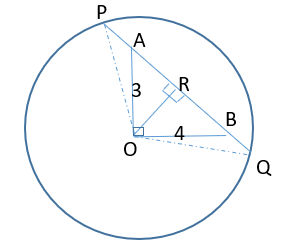
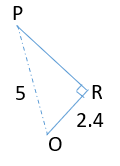
Let C be a circle of radius 5 meters having center at O. Let PQ be a chord of C that passes through points A and B where A is located 4 meters north of O and B is located 3 meters east of O. Then, the length of PQ, in meters, is nearest to:
The vertices of a triangle are (0, 0), (4, 0), and (3, 9). The area of the circle passing through these three points is:
In a circle of radius 11 cm, CD is a diameter and AB is a chord of length 20.5 cm. If AB and CD intersect at a point E inside the circle and CE has a length of cm, then the difference of the lengths of BE and AE, in cm, is:
AB is a diameter of a circle of radius 5 cm. Let P and Q be two points on the circle so that the length of PB is 6 cm, and the length of AP is twice that of AQ. Then the length, in cm, of QB is nearest to:
Two circles, each of radius 4 cm, touch externally. Each of these two circles is touched externally by a third circle. If these three circles have a common tangent, then the radius of the third circle, in cm, is:
In a circle, two parallel chords on the same side of a diameter have lengths 4 cm and 6 cm. If the distance between these chords is 1 cm, then the radius of the circle, in cm, is:
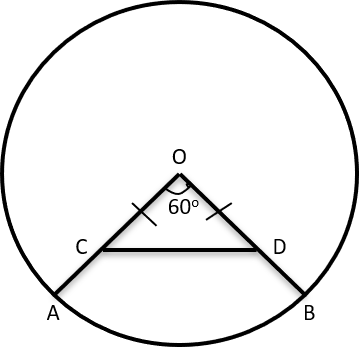
In a circle with center O and radius 1 cm, an arc AB makes an angle 60 degrees at O. Let R be the region bounded by the radii OA, OB, and the arc AB. C and D are two points on OA and OB, respectively, such that OC = OD and the area of triangle OCD is half that of R. Then the length of OC, in cm, is:
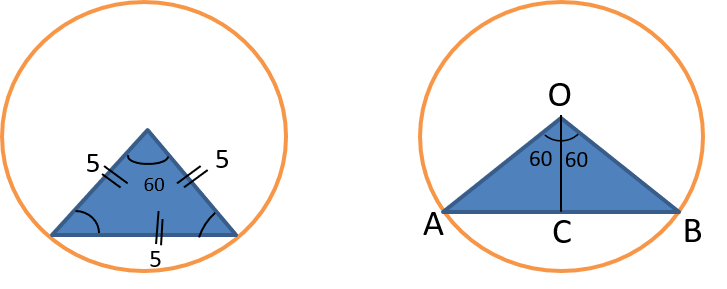
A chord of length 5 cm subtends an angle of 60° at the center of a circle. The length, in cm, of a chord that subtends an angle of 120° at the center of the same circle is:

In a triangle ABC, a circle with diameter BC is drawn, intersecting AB and AC at points P and Q, respectively. If the lengths of AB, AC, and CP are 30 cm, 25 cm, and 20 cm respectively, then the length of BQ, in cm, is:
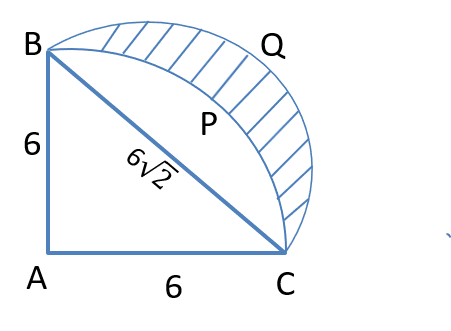
Let ABC be a right-angled isosceles triangle with hypotenuse BC. Let BQC be a semicircle, away from A, with diameter BC. Let BPC be an arc of a circle centered at A and lying between BC and BQC. If AB has a length of 6 cm, then the area, in sq. cm, of the region enclosed by BPC and BQC is:
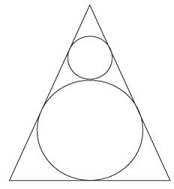
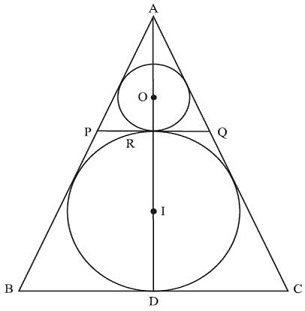
Two circles, both of radii 1 cm, intersect such that the circumference of each one passes through the center of the circle of the other. What is the area (in sq cm) of the intersecting region?
Two circles with centers P and Q cut each other at two distinct points A and B. The circles have the same radii and neither P nor Q falls within the intersection of the circles. What is the smallest range that includes all possible values of the angle AQP in degrees?

A semicircle is drawn with AB as its diameter. From C, a point on AB, a line perpendicular to AB is drawn meeting the circumference of the semicircle at D. Given that AC = 2 cm and CD = 6 cm, the area of the semicircle (in sq. cm.) will be:
Two identical circles intersect such that their centers, and the points at which they intersect, form a square of side 1 cm. The area in sq. cm of the portion that is common to the two circles is:
What is the distance in cm between two parallel chords of lengths 32 cm and 24 cm in a circle of radius 20 cm?
Four points A, B, C, and D lie on a straight line in the X-Y plane, such that AB = BC = CD, and the length of AB is 1 meter. An ant at A wants to reach a sugar particle at D. But there are insect repellents kept at points B and C. The ant would not go within one meter of any insect repellent. The minimum distance in meters the ant must traverse to reach the sugar particle is:

In the following figure, the diameter of the circle is 3 cm. AB and MN are two diameters such that MN is perpendicular to AB. In addition, CG is perpendicular to AB such that AE:EB = 1:2, and DF is perpendicular to MN such that NL:LM = 1:2. The length of DH in cm is:
P, Q, S, and R are points on the circumference of a circle of radius r, such that PQR is an equilateral triangle and PS is a diameter of the circle. What is the perimeter of the quadrilateral PQSR?

In the adjoining figure, I and II are circles with centers P and Q respectively. The two circles touch each other and have a common tangent that touches them at points R and S respectively. This common tangent meets the line joining P and Q at O. The diameters of I and II are in the ratio 4 : 3. It is also known that the length of PO is 28 cm. What is the ratio of the length of PQ to that of QO?
In the adjoining figure, I and II are circles with centers P and Q respectively. The two circles touch each other and have a common tangent that touches them at points R and S respectively. This common tangent meets the line joining P and Q at O. The diameters of I and II are in the ratio 4 : 3. It is also known that the length of PO is 28 cm. What is the radius of the circle II?
In the adjoining figure, I and II are circles with centers P and Q respectively. The two circles touch each other and have a common tangent that touches them at points R and S respectively. This common tangent meets the line joining P and Q at O. The diameters of I and II are in the ratio 4 : 3. It is also known that the length of PO is 28 cm. The length of SO is .

In the adjoining figure, chord ED is parallel to the diameter AC of the circle. If ∠CBE = 65°, then what is the value of ∠DEC?

On a semicircle with diameter AD, chord BC is parallel to the diameter. Further, each of the chords AB and CD has length 2, while AD has length 8. What is the length of BC?
Let C be a circle with centre P0 and AB be a diameter of C. Suppose P1 is the mid-point of the line segment P0B, P2 is the mid-point of the line segment P1B and so on. Let C1, C2, C3, … be circles with diameters P0P1, P1P2, P2P3 … respectively. Suppose the circles C1, C2, C3, … are all shaded. The ratio of the area of the unshaded portion of C to that of the original circle C is:

A circle with radius 2 is placed against a right angle. Another smaller circle is also placed as shown in the adjoining figure. What is the radius of the smaller circle?
The ratio of the sum of the lengths of all chord roads to the length of the outer ring road is
Amit wants to reach N2 from S1. It would take him 90 minutes if he goes on the minor arc S1 − E1 on OR, and then on the chord road E1 − N2. What is the radius of the outer ring road in km?
Amit wants to reach E2 from N1 using first the chord N1 – W2 and then the inner ring road. What will be his travel time in minutes on the basis of information given in the above question?

AB is a chord of a circle. AB = 5 cm. A tangent parallel to AB touches the minor arc AB at E. What is the radius of the circle? Statements: A. AB is not a diameter of the circle B. The distance between AB and the tangent at E is 5 cm

There are two concentric circles such that the area of the outer circle is four times the area of the inner circle. Let A, B, and C be three distinct points on the perimeter of the outer circle such that AB and AC are tangents to the inner circle. If the area of the outer circle is 12 square centimeters, then the area (in square centimeters) of the triangle ABC would be:


Three horses are grazing within a semi-circular field. In the diagram given below, AB is the diameter of the semi-circular field with the center at O. Horses are tied up at P, R, and S such that PO and RO are the radii of semi-circles with centers at P and R, respectively, and S is the center of the circle touching the two semi-circles with diameters AO and BO. The horses tied at P and R can graze within the respective semi-circles, and the horse tied at S can graze within the circle centered at S. The percentage of the area of the semi-circle with diameter AB that cannot be grazed by the horses is nearest to:


In the figure given below, AB is the chord of a circle with center O. AB is extended to C such that BC = OB. The straight line CO is produced to meet the circle at D. If ∠ACD = y° and ∠AOD = x° such that x = ky, then the value of k is:

In the figure below, the rectangle at the corner measures 10 cm × 20 cm. The corner A of the rectangle is also a point on the circumference of the circle. What is the radius of the circle in cm?

Let the radius of each circular park be r, and the distances to be traversed by the sprinters A, B, and C be a, b, and c, respectively. Which of the following is true?
Sprinter A traverses distances A1A2, A2A3, and A3A1 at average speeds of 20, 30, and 15, respectively. B traverses her entire path at a uniform speed of (10√3 + 20). C traverses distances C1C2, C2C3, and C3C1 at average speeds of 40(√3 + 1), 40(√3 + 1), and 120, respectively. Where would B and C be respectively when A finishes her sprint?

Sprinters A, B, and C traverse their respective paths at uniform speeds u, v, and w, respectively. It is known that u2 : v2 : w2 is equal to Area A : Area B : Area C, where Area A, Area B, and Area C are the areas of triangles A1A2A3, B1B2B3, and C1C2C3, respectively. Where would A and C be when B reaches point B3?
In the figure below (not drawn to scale), rectangle ABCD is inscribed in the circle with the center at O. The length of side AB is greater than that of side BC. The ratio of the area of the circle to the area of the rectangle ABCD is π : √3. The line segment DE intersects AB at E such that ∠ODC = ∠ADE. What is the ratio AE : AD?
In the figure given below (not drawn to scale), A, B, and C are three points on a circle with center O. The chord BA is extended to a point T such that C becomes a tangent to the circle at point C. If ∠ATC = 30° and ∠ACT = 50°, then the angle ∠BOA is:

In the figure given below, find the distance PQ.

There is a common chord of 2 circles with radius 15 and 20. The distance between the two centers is 25. The length of the chord is:

A certain city has a circular wall around it, and this wall has four gates pointing north, south, east, and west. A house stands outside the city, three km north of the north gate, and it can just be seen from a point nine km east of the south gate. What is the diameter of the wall that surrounds the city?

A square is inscribed in a circle. What is the difference between the area of the circle and that of the square? Statements: A. The diameter of the circle is 25 cm. B. The side of the square is 25 cm.

There is a circle with center C at the origin and radius r cm. Two tangents are drawn from an external point D at a distance d cm from the center. What are the angles between each tangent and the X-axis. Statements: I. The coordinates of D are given. II. The X-axis bisects one of the tangents.