If A = {62n − 35n − 1: n = 1, 2, 3, …} and B = {35(n − 1) : n = 1,2,3,…} then which of the following is true?
CAT 2026Papers & G StrategyQuantTopic-wise past questions
CAT Previous Year Questions| Sets
From IIMking.com · part of Cetking Universe
Question 1 of 8
For two sets A and B, let AΔB denote the set of elements which belong to A or B but not both. If P = {1,2,3,4}, Q = {2,3,5,6,}, R = {1,3,7,8,9}, S {2,4,9,10}, then the number of elements in (PΔQ)Δ(RΔS) is
Consider the set S = {2, 3, 4, …, 2n + 1}, where n is a positive integer larger than 2007. Define X as the average of the odd integers in S and Y as th average of the even integers in S. What is the value of X – Y?
Consider the set S = {1, 2, 3, …, 1000}. How many arithmetic progressions can be formed from the elements of S that start with 1 and end with 1000 and have at least 3 elements?
Let S be a set of positive integers such that every element n of S satisfies the conditions a. 1000 ≤ n ≤ 1200 b. every digit in n is odd Then how many elements of S are divisible by 3?
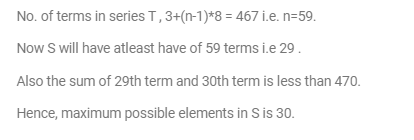
Let T be the set of integers {3, 11, 19, 27, …, 451, 459, 467} and S be a subset of T such that the sum of no two elements of S is 470. The maximu possible number of elements in S is
Consider the sets Tn = {n, n + 1, n + 2, n + 3, n + 4}, where n = 1, 2, 3, … , 96. How many of these sets contain 6 or any integral multiple thereof (i.e., any one of the numbers 6, 12, 18, …)?
The set of all positive integers is the union of two disjoint subsets {f(1), f(2) ….f(n),……} and {g(1), g(2),……,g(n),. }, where f (1) < f(2) <…< f(n) ….., and g(1) < g(2) <…< g(n) , and g(n) = f(f(n)) + 1 for all n ≥ 1. What is the value of g(1)?